
15 KPIs Every UAE CFO Must Track in 2026 (Free Zone & Mainland)

A CFO in the UAE can no longer afford a dashboard that only explains what happened last quarter. In 2026, KPI discipline sits much closer to tax, audit, and funding risk. Corporate Tax is fully live. The filing cycle is real. Cabinet Decision No. 129 of 2025 took effect on 14 April 2026 and reinforced the wider compliance environment.
The UAE’s e-invoicing pilot starts on 1 July 2026, with phased mandatory implementation beginning from 1 January 2027 for larger businesses. Large multinational groups also now need to watch the UAE’s Domestic Minimum Top-up Tax regime. That changes the role of management reporting. These KPIs are no longer just internal performance measures.
They now help support Corporate Tax calculations, explain VAT positions, defend financing decisions, prepare for audit, and answer harder board questions. For Qualifying Free Zone Persons, the pressure is even sharper because audited financial statements are required regardless of whether revenue is below AED 50 million. So what exactly should your dashboard look like?
Why KPIs Are No Longer Optional for UAE CFOs in 2026
The UAE has moved from a low-tax planning environment to a rules-driven reporting environment. Federal Decree-Law No. 47 of 2022 made Corporate Tax a permanent part of the finance function, and the FTA continues to stress that returns must be filed and tax paid within nine months from the end of the tax period. That means delayed visibility is now a real cost, not a harmless reporting habit.
The same point applies outside Corporate Tax. The Ministry of Finance’s electronic invoicing framework is now on a live timetable. The pilot starts on 1 July 2026. Businesses with annual revenue of at least AED 50 million must appoint an ASP by 30th October 2026 and implement the system by 1 January 2027.
Government entities follow later, and smaller businesses move in phases after that. A dashboard that does not track cash, receivables, tax exposure, and reporting accuracy will age badly. Fast.
How to Use This List - Free Zone vs. Mainland
Not every KPI carries the same weight for every UAE entity. Some matter equally to all businesses. Others become critical only when the tax profile changes.
A mainland company will usually focus harder on taxable profit, interest deductibility, and monthly tax cash provisioning.
A QFZP needs sharper visibility over qualifying versus non-qualifying income, transfer pricing discipline, and de minimis exposure.
To make this practical, each KPI below is tagged one of three ways: All Entities, Free Zone Priority, or Mainland Priority. One more note: businesses with revenue of AED 3 million or less may still elect Small Business Relief for tax periods ending on or before 31 December 2026, but that does not remove the need for KPI tracking. It simply changes the consequences of what the numbers are telling you.
Category A - Profitability KPIs

Profitability KPIs show whether the business is creating real value from its operations, not just generating revenue. In 2026, UAE CFOs need this category to assess margin strength, tax impact, and whether profit performance can actually support growth, funding, and compliance.
1) EBITDA Margin - All Entities
Formula: EBITDA ÷ Revenue × 100
This measures core operating profitability before financing, tax, and non-cash accounting charges.
In 2026, EBITDA is not just a boardroom number. Under the UAE Corporate Tax framework, the general interest deduction limitation rule allows net interest expenditure only up to 30% of EBITDA, subject to the relevant threshold and exclusions.
That gives EBITDA legal weight in addition to management value. A leveraged business can look fine operationally and still lose deductions if EBITDA compresses.
For practical benchmarking, many UAE finance teams use broad operating ranges as a starting point only: services 15-25%, retail 5-10%, manufacturing 10-20%. These are not statutory targets. They are early-warning guideposts. If your EBITDA margin falls while revenue is flat, the question is simple: is the business getting weaker, or is cost classification getting messy?
Free Zone vs. Mainland Note
For QFZPs, EBITDA helps test whether qualifying activity economics are holding up or whether related-party allocations are quietly eating margin. For mainland companies, EBITDA directly affects interest deductibility, so monthly tracking is far more useful than year-end regret. Audited financial statements also make this KPI part of audit readiness, not just profitability reporting.
2) Net Profit Margin - All Entities
Formula: Net Profit ÷ Revenue × 100
This is the bottom-line margin after operating costs, finance costs, and tax effects.
Net profit margin now has a direct tax consequence for mainland businesses because the UAE levies a 9% Corporate Tax rate, with a 0% rate on taxable profits up to AED 375,000. If net margin slips and the finance team notices too late, the tax estimate, dividend planning, and covenant conversations all get uglier at once.
Take a simple example. A mainland trading company with AED 5 million in revenue and a 12% net profit margin generates AED 600,000 profit. At 9% on taxable profit above AED 375,000, the Corporate Tax exposure on the excess is AED 20,250. That is not a year-end clean-up item. That is a monthly planning item.
Free Zone vs. Mainland Note
For QFZPs, net margin helps distinguish whether qualifying income is genuinely profitable or being diluted by non-qualifying activity and cross-charged costs. For mainland businesses, this KPI links directly to current tax and tax provisioning. Either way, unexplained swings deserve attention before the return is filed.
3) Gross Profit Margin - All Entities
Formula: (Revenue − Cost of Goods Sold) ÷ Revenue × 100
This is often the first KPI to flash red before net margin starts looking weak.
Gross margin matters because transfer pricing rules apply to transactions with Related Parties and Connected Persons whether they sit in the mainland, a Free Zone, or outside the UAE. If related-party procurement, management charges, or resale pricing are distorting COGS, gross margin usually shows it before the tax file does.
A consistent decline in gross margin does not prove a transfer pricing issue. But it does tell the CFO where to look first: intercompany pricing, cost allocations, supplier mix, and inventory write-downs. In 2026, a lazy “we’ll review that at year-end” approach is an invitation to work weekends.
Free Zone vs. Mainland Note
For Free Zone entities, gross margin is especially useful where qualifying income could be eroded by inflated related-party costs. If qualifying activity is real, the economics should usually look real as well.
Category B — Cash Flow & Liquidity KPIs
Cash flow KPIs reveal whether the business can convert reported performance into usable cash. For UAE businesses facing VAT cycles, Corporate Tax deadlines, and tighter reporting discipline, liquidity is no longer a back-office concern. It is a financial control issue.
4) Operating Cash Flow (OCF) - All Entities
Formula: Net Profit + Depreciation & Amortisation ± Change in Working Capital
This shows the cash the business is generating from operations, not just the profit it is booking on paper.
Corporate Tax has to be paid within nine months from the end of the tax period. VAT returns and VAT payments are due within 28 days from the end of the VAT tax period. That means a business can be profitable on paper and still struggle if operating cash flow is weak. OCF tells the CFO whether the company can actually fund tax, payroll, suppliers, and debt service without begging working capital for mercy.
Negative OCF for two or three consecutive months deserves escalation. Not because the sky has fallen, but because tax deadlines do not care about your optimistic sales forecast.
CFO Action Point
Track OCF weekly where margins are thin, collections are volatile, or inventory cycles are long. Monthly review is fine only when liquidity is genuinely stable.
5) Cash Conversion Cycle (CCC) - All Entities
Formula: Days Inventory Outstanding + Days Sales Outstanding − Days Payable Outstanding
This shows how long cash stays trapped in the operating cycle before it comes back.
The e-invoicing framework gives businesses a more structured and digital invoice environment from 2026 onward. That will not automatically improve collections, but it will make weak receivable discipline harder to excuse. A high CCC means cash is stuck in stock or receivables while VAT, payroll, and tax deadlines keep moving normally.
For many trading businesses in the UAE, a CCC below 45 days is a healthy working benchmark. Above that, the CFO should test whether the problem sits in stock aging, customer credit control, or supplier timing. Usually, one of them is the villain. Sometimes all three show up together.
Free Zone vs. Mainland Note
Free Zone exporters often face longer settlement cycles because international buyers, shipping lead times, and customs-related documentation slow the cash loop. That does not make a high CCC harmless. It just makes it easier to ignore until it hurts.
6) Cash Runway - Mainland Priority / Startups
Formula: Current Cash Balance ÷ Monthly Net Burn Rate
This shows how many months the business can continue operating at the current burn rate.
Small Business Relief can reduce Corporate Tax burden for eligible businesses, but it does not remove operating obligations. Salaries, rent, loan instalments, VAT, and supplier payments still need cash. The relief threshold of AED 3 million remains available only through tax periods ending on or before 31 December 2026, so runway analysis still matters even for smaller entities.
For UAE SMEs and funded startups, a six-month runway is often a sensible minimum discipline point. Below that, the CFO needs an active plan, not a positive mindset.
Category C - Tax Compliance KPIs - UAE-Specific
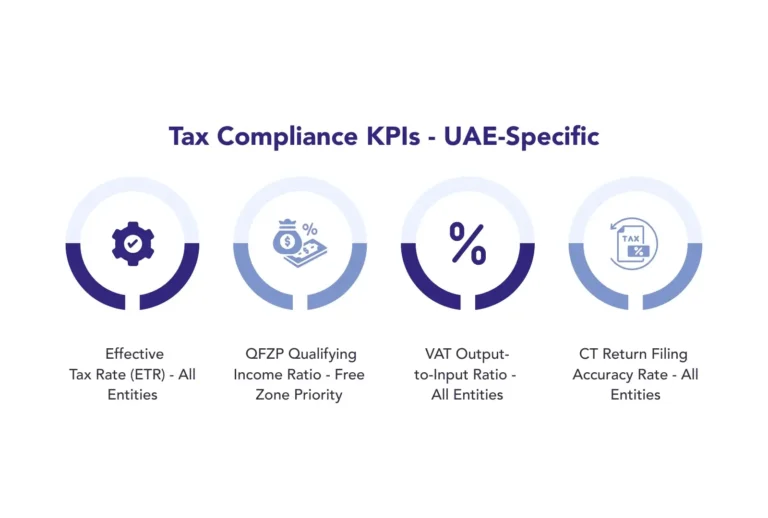
This category turns tax from a year-end filing task into a live management issue. These KPIs help CFOs monitor whether the business is staying aligned with UAE Corporate Tax, VAT, QFZP rules, and the wider compliance direction now shaping finance decisions in 2026.
7) Effective Tax Rate (ETR) - All Entities
Formula: Total Tax Expense ÷ Pre-Tax Profit × 100
This shows how the entity’s real tax charge compares with accounting profit.
In a standard mainland case, the ETR should usually reconcile back toward the UAE’s 9% Corporate Tax rate, taking account of the 0% band up to AED 375,000 and any permanent or temporary differences. If the ETR is well below 9%, the file should explain why. If it is materially above 9%, the CFO should check for disallowed expenses, missed deductions, poor structuring, or deferred tax effects.
ETR is also one of the cleanest ways to explain the tax story to boards, lenders, and investors. It turns tax from a compliance footnote into a management number.
Free Zone vs. Mainland Note
For a QFZP, ETR may reflect a blend of 0% on qualifying income and 9% on non-qualifying income. For mainland entities, it should normally reconcile more directly to the statutory rate structure. Either way, unexplained ETR swings are never charming.
8) QFZP Qualifying Income Ratio - Free Zone Priority
Formula: Qualifying Income ÷ Total Income × 100
This tracks how much of total income remains inside the 0% QFZP zone.
This is the survival KPI for many Free Zone structures. A QFZP must keep non-qualifying revenue within the de minimis threshold: the lower of AED 5 million or 5% of total revenue. If that threshold is breached, the entity ceases to be a QFZP from the beginning of that tax period, and the consequence continues for that period plus the next four tax periods. That is not a rounding error. That is a strategy problem.
CFO Action Point
Set the internal alert well before the legal limit. A 3% warning threshold for non-qualifying income gives management time to correct contracts, invoicing flows, and activity classification before the business falls off the ledge.
9) VAT Output-to-Input Ratio - All Entities
This internal ratio compares VAT collected on sales with VAT paid on purchases in each VAT period. It highlights unusual refund positions, sudden liability spikes, or mismatched transaction patterns.
The FTA’s compliance activity is not theoretical. It reported 85,500 field visits in the first half of 2025 alone across UAE markets. That statistic is not a VAT-ratio formula, but it does underline the point: unusual tax behaviour is worth spotting before the Authority does. Meanwhile, VAT returns remain due within 28 days of the end of the tax period, so unexplained swings in input or output VAT can become cash and compliance problems quickly.
The e-invoicing framework also increases the importance of consistent invoice data, even if implementation is phased. Once invoice generation, reporting, and exchange become more structured, weak VAT pattern analysis becomes harder to hide behind spreadsheets and hope.
Free Zone vs. Mainland Note
Designated Zone businesses may show legitimate volatility because VAT treatment can differ by transaction flow. That is fine. Unexplained volatility is not.
10) CT Return Filing Accuracy Rate - All Entities
This is an internal control KPI: the percentage of Corporate Tax return line items that reconcile to audited financial statements and supporting schedules without manual correction.
The April 2026 penalty reforms were aimed at Tax Procedures, VAT, and Excise Tax, not a wholesale rewrite of Corporate Tax penalties. CFOs should keep that distinction clear. But the wider message is still obvious: the UAE is rewarding cleaner compliance and faster corrections, while pushing businesses toward more disciplined tax records. In that environment, a poor CT reconciliation process is asking for trouble.
CFO Action Point
Target 100%. Build a three-way reconciliation before filing: management accounts to VAT returns, VAT returns to turnover schedules, and turnover schedules to the CT return. The FTA continues to remind taxpayers that Corporate Tax returns and liabilities must be completed within the legal deadline. Good reconciliation is not paranoia. It is cheaper than fixing errors later.
Category D - Operational Efficiency KPIs
Operational efficiency KPIs measure how well the business converts activity into results without unnecessary leakage in cost, time, or working capital. In the UAE, these numbers matter because weak process discipline now affects not just profitability, but also tax accuracy, audit readiness, and cash stability.
11) Days Sales Outstanding (DSO) - All Entities
Formula: (Accounts Receivable ÷ Revenue) × Number of Days
This shows the average number of days it takes to collect from customers.
VAT does not wait for your customer to finally answer the phone. A business can owe output VAT long before the cash arrives. That makes DSO one of the most practical early-warning KPIs on a UAE dashboard.
As electronic invoicing rolls out, invoice dates, exchange timing, and data consistency become more structured. That does not mean the FTA will judge businesses on DSO itself. It does mean finance teams will have far less excuse for poor receivables visibility. Under 30 days is excellent for many businesses. Above 75 days is a control problem until proven otherwise.
12) Operating Expense Ratio (OER) - All Entities
Formula: Operating Expenses ÷ Net Revenue × 100
This shows how much revenue is being consumed by operating cost before finance and tax.
OER is where cost discipline becomes visible. If revenue is flat but OER keeps rising, the business is moving toward a profitability squeeze whether management admits it yet or not. In the UAE Corporate Tax context, the problem is sharper because not every expense is equally deductible. Entertainment expenditure, for example, is only partly deductible under the tax framework. That means the CFO should track tax-sensitive cost categories separately rather than burying them in one operating expense bucket.
A good OER review also separates structural cost growth from sloppy cost allocation. They look similar in bad reports. They are not the same problem.
13) Deferred Tax Asset / Liability Balance - All Entities
This KPI tracks temporary differences between accounting carrying amounts and tax bases, and the related deferred tax asset or liability position.
Many UAE businesses first felt the real impact of IAS 12 only after Corporate Tax became live. IAS 12 requires recognition of deferred tax liabilities, or in some cases deferred tax assets, for temporary differences subject to the standard’s rules and exceptions. In plain English: accounting profit and taxable income are now talking to each other more often, and sometimes not very politely.
For QFZPs, deferred tax can become more nuanced because future recovery or settlement may sit partly within a 0% and partly within a 9% environment. For investors, lenders, and transaction buyers, an unexplained deferred tax balance is a red flag because it suggests the tax story in the financial statements is incomplete.
Category E - Growth & Strategic KPIs
Growth KPIs help CFOs judge whether expansion is sustainable, fundable, and properly aligned with the company’s wider financial position. In 2026, strategy cannot sit separately from compliance, tax exposure, and reporting expectations. It has to move with them.
14) Revenue Growth Rate vs. Budget Variance - All Entities
Formula 1: (Current Revenue − Prior Period Revenue) ÷ Prior Period Revenue × 100
Formula 2: (Actual Revenue − Budgeted Revenue) ÷ Budgeted Revenue × 100
These two measures should be read together, not separately.
Growth without budget discipline is how CFOs get surprised by tax, working capital, and staffing pressure. If actual revenue materially exceeds budget, the business may also be walking into a higher tax payment profile, faster stock build, and higher collections risk. If revenue underperforms budget, the problem flips: cost base, runway, and financing assumptions may all need to change.
On the macro side, forecasts for UAE growth in 2026 vary depending on the source. The IMF’s country page shows 2026 projected real GDP growth of 3.1%, while WAM reported a World Bank projection of 5% for 2026. That range is a useful reminder: CFO budgets should be realistic, sector-specific, and regularly re-tested rather than copied from optimistic board slides.
15) DMTT / Pillar Two Exposure Indicator - Applicable to Large Groups
This KPI tracks whether the group’s effective tax position could trigger the UAE’s Domestic Minimum Top-up Tax.
The UAE DMTT applies to constituent entities of multinational groups with annual global revenue of at least EUR 750 million in the consolidated financial statements of the ultimate parent entity in at least two of the four preceding financial years. The regime is effective for financial years starting on or after 1 January 2025. That means UAE holding companies, regional headquarters, and local finance teams within large groups should already be monitoring Pillar Two exposure.
CFO Action Point
Build a Pillar Two safe-harbour check into quarterly board reporting. Even where the group is currently below the threshold, strong growth or consolidation changes can push it into scope faster than expected.
Quick Comparison Table - Free Zone vs. Mainland KPI Priorities
| KPI | Free Zone (QFZP) | Mainland | Priority Level |
| EBITDA Margin | Monitor for margin erosion and qualifying activity economics | Monitor for interest cap impact | Both — Critical |
| Net Profit Margin | Track qualifying vs. non-qualifying income effect | Track CT liability and tax provisioning | Both — Critical |
| Qualifying Income Ratio | Core QFZP survival metric | Not applicable | Free Zone — Critical |
| Effective Tax Rate | 0% / 9% blended profile | 9% structure with 0% band up to AED 375,000 | Both — Critical |
| VAT Output-to-Input Ratio | Watch Designated Zone complexity and unusual refund patterns | Standard VAT monitoring | Both — High |
| CT Return Accuracy Rate | Critical because QFZP status and audited reporting need clean support | Critical for filing, provisioning, and audit defence | Both — Critical |
| DMTT Indicator | Relevant for large multinational groups | Relevant for large multinational groups | Large entities only |
How ADEPTS Can Help
Tracking 15 KPIs is not difficult. Most businesses can feel confident about it. BUt, tracking them consistently, linking them to UAE tax risk, and turning them into management action is the hard part.
That is where ADEPTS comes in.
ADEPTS supports businesses through:
CFO Services in UAE
In practice, that means helping finance teams build dashboards that do more than decorate monthly packs. They explain performance. They connect the numbers to filing risk. And they prepare management for audits, financing, and board scrutiny.
Disclaimer: KPI benchmarks vary by sector, business model, and stage of growth. These metrics should guide management judgment, not replace professional advice.
Conclusion
The UAE CFO dashboard in 2026 needs to do three jobs at once. It must help management run the business. It must support tax and compliance accuracy. And it must stand up to audit, lender, and investor scrutiny.
That is why these 15 KPIs matter. They cover profitability, cash flow, tax compliance, operational efficiency, and growth. More importantly, they turn finance from backward-looking reporting into forward-looking control. In 2026, a KPI is not just a management tool. It is evidence.
Your 2026 financial dashboard is not just a dashboard. It is your defence against an FTA problem before it becomes an FTA file.
FAQs:
There is no single winner, but for most mainland companies the short list is Net Profit Margin, Operating Cash Flow, and CT Return Filing Accuracy Rate. For QFZPs, the Qualifying Income Ratio is often the most sensitive KPI.
Yes. Many core KPIs are shared, but Free Zone entities need extra focus on qualifying income, de minimis exposure, and audited financial statement support. Mainland businesses usually put more weight on tax provisioning and interest deductibility.
It measures the proportion of total income that qualifies for the 0% QFZP regime. It matters because non-qualifying revenue must stay within the lower of AED 5 million or 5% of total revenue.
It means financing decisions can directly limit deductible interest. A business with weak EBITDA may lose tax deductions even if the debt is commercially normal.
The entity ceases to be a QFZP from the beginning of that tax period, and the consequence continues for that period and the following four tax periods.
It is better described as a strong internal risk signal, not an official published audit formula. But unusual VAT patterns absolutely deserve CFO attention in a high-compliance environment.
For many mainland entities, ETR should broadly reconcile toward the 9% UAE Corporate Tax structure, allowing for the 0% band up to AED 375,000 and any tax adjustments. QFZPs may show a blended rate.
Yes. Small Business Relief can reduce Corporate Tax impact for eligible periods through 31 December 2026, but it does not remove the need for cash, margin, and compliance control.
It is the UAE’s Domestic Minimum Top-up Tax for in-scope multinational groups. It applies where the revenue threshold and group conditions are met under the UAE DMTT framework.
It makes invoice generation, exchange, and reporting more structured. That increases the importance of receivables discipline, VAT consistency, and data accuracy.
There is no universal answer, but many finance teams view under 30 days as strong and above 75 days as critical. The correct benchmark still depends on sector and customer profile.
Deferred tax arises from temporary differences between accounting carrying amounts and tax bases. IAS 12 governs recognition, subject to its conditions and exceptions.
CCC shows how long cash is tied up in inventory and receivables before returning to the business. For SMEs, it is often the difference between smooth operations and constant cash pressure.
Start with reconciliation. Tie management accounts to VAT returns, tax schedules, and filed Corporate Tax positions. Then document unusual movements in margin, tax ratios, and cash flow before they need explaining externally.
Yes, provided the reporting structure is disciplined, the accounting data is timely, and tax and finance are being reviewed together rather than in separate silos.
References
- Federal Tax Authority. “Federal Decree-Law No. 47 of 2022 on Taxation of Corporations and Businesses.” Accessed May 10, 2026. https://tax.gov.ae/en/content/federal.decreelaw.no.47.of.2022.on.taxation.of.corporations.and.businesses.home.new.aspx
- Federal Tax Authority. “Small Business Relief.” Accessed May 10, 2026.
https://tax.gov.ae/en/taxes/corporate.tax/corporate.tax.topics/small.business.relief.23.aspx - Federal Tax Authority. “Qualifying Free Zone Person.” Accessed May 10, 2026.
https://tax.gov.ae/Datafolder/Files/Pdf/2024/CT%20Bulletin/Basic%20Tax%20Information%20bulletin-%20Free%20Zone%20Person-English.pdf - Federal Tax Authority. “Will My Interest Expenditure Be Fully Deductible?” Accessed May 10, 2026.
https://tax.gov.ae/en/faq.aspx?keyword=Will+my+interest+expenditure+be+fully+deductible%3F+ - Federal Tax Authority. “Federal Tax Authority Urges Submission of Corporate Tax Returns and Settlement of Corporate Tax Liabilities Within Nine Months From the End of The Tax Period.” September 24, 2025.
https://tax.gov.ae/en/media.centre/news/federal.tax.authority.urges.submission.of.corporate.tax.returns.and.settlement.of.corporate.tax.liabilities.within.nine.months.from.the.end.of.the.tax.period.aspx - United Arab Emirates Ministry of Finance. “Ministerial Decision No. 84 of 2025 on Audited Financial Statements for the Purposes of Federal Decree-Law No. 47 of 2022 on the Taxation of Corporations and Businesses.” Accessed May 10, 2026. https://mof.gov.ae/wp-content/uploads/2025/04/Ministerial-Decision-No.-84-of-2025-on-Audited-Financial-Statements.pdf
- United Arab Emirates Ministry of Finance. “Domestic Minimum Top-Up Tax (DMTT).” Accessed May 10, 2026. https://mof.gov.ae/uae-domestic-minimum-top-up-tax/
- Federal Tax Authority. “Federal Tax Authority Announces Entry into Force of the Decision Amending Administrative Penalties Imposed for Violations of Tax Legislation and Calls on Registrants to Benefit from the Advantages of the New Decision.” April 15, 2026.
https://tax.gov.ae/en/media.centre/news/federal.tax.authority.announces.entry.into.force.of.the.decision.amending.administrative.penalties.imposed.for.violations.of.tax.legislation.and.calls.on.registrants.to.benefit.from.the.advantages.of.the.new.decision.aspx - Federal Tax Authority. “Filing VAT Returns And Making Payments.” Accessed May 10, 2026.
https://tax.gov.ae/en/taxes/Vat/vat.topics/filing.vat.returns.and.making.payments.aspx - Federal Tax Authority. “17.6 Million Packs of Tobacco and Taxable Beverage Containers Found Without Paid Excise Tax in 6 Months.” Accessed May 10, 2026.
https://tax.gov.ae/en/media.centre/News/17.6.million.packs.of.tobacco.and.taxable.beverage.containers.found.without.paid.excise.tax.in.6.months.aspx - IFRS Foundation. “IAS 12 Income Taxes.” Accessed May 10, 2026.
https://www.ifrs.org/issued-standards/list-of-standards/ias-12-income-taxes/ - International Monetary Fund. “United Arab Emirates and the IMF.” Accessed May 10, 2026.
https://www.imf.org/en/countries/are - Emirates News Agency (WAM). “World Bank: UAE Economy to Grow 5% in 2026; 5.1% in 2027.” January 13, 2026. https://www.wam.ae/en/article/by7hcd7-world-bank-uae-economy-grow-2026-51-2027
Related Articles