
Value Surge vs. Volume Contraction in GCC Markets
Q3 2025 was a quarter that made global dealmakers look twice.
Deal value climbed, yet deal volume slipped.
This contrast turned Global M&A Q3 2025 into one of the most closely watched periods of the year.
A handful of major transactions shaped the numbers.
The market leaned toward selectivity, strategy, and scale was driven by a clear Megadeal Surge and a faster wave of AI-Driven M&A. These moves set the tone for what deal making now looks like: fewer files on the table, but far bigger bets.
At the same time, the GCC carved out its own story.
While many markets slowed, the region kept its pace. The GCC IPO Pipeline stayed active. Cross-border interest held steady. And UAE M&A Growth continued to build confidence across sectors.
This momentum is shaping the GCC M&A Outlook 2025, supported by a sharper regional appetite for scale and a more deliberate cross-border deal strategy.
In a year defined by contrasts, the Gulf is proving that steady conviction can stand out even when global activity becomes uneven.
Global Value Surge vs. Volume Collapse
Q3 2025 was a quarter of contrasts. Deal values soared, but the number of transactions dropped. This is the reality of Global M&A Q3 2025 – a market where a few big moves can define the quarter while smaller deals pause.
Record Value, Depressed Volumes
Global M&A reached approximately US$1.26 trillion in Q3 2025, up about 40% from the previous year, making it one of the most valuable third quarters on record.
Yet the deal count told a contrasting story. With roughly 8,912 transactions, Q3 saw its lowest volume in twenty years. There were fewer deals overall, but the ones that closed carried far higher stakes.
In this environment, regional players moved fast. Companies turned to M&A advisory in the UAE, to navigate increasingly complex transactions. Expertise in cross-border deals became essential, and strategic guidance was in high demand.
Average Deal Size Jumps
With fewer deals but much larger totals, the average deal size climbed to roughly US$141.4 million, from US$85.5 million last year. The market is clearly rewarding scale and strategy. Every move counted. Every transaction had to justify itself.
This set the stage for careful planning and strategic timing. Companies leaned on the cross-border deal strategy to make each deal work. Size alone was not enough; execution was critical.
Macro Headwinds and Tariff Uncertainty
Early in the quarter, U.S. tariff announcements and antitrust reviews froze several pipelines. By the end of the quarter, cautious optimism returned. Pent-up demand and easing fears pushed investors into large strategic deals and selective IPOs.
Naveen Nataraj of Evercore said, “As the year has progressed, there’s growing comfort that the tariff landscape is going to land in a place that people are able to navigate.”
That sentiment fueled confidence in the GCC M&A Outlook 2025 and kept the GCC IPO Pipeline active. Meanwhile, UAE M&A growth continued steadily, proving the Gulf remains a hotspot for bold, strategic investments.
Middle East Resilience and Divergence
The global market slowed, but the Middle East didn’t wait.
Global M&A Q3 2025 had soaring deal values but falling volumes. The Gulf took a different path.
In H1 2025, regional M&A volumes grew about 19%, with roughly 271 deals announced. While global boardrooms hesitated, investors in the Gulf acted decisively.
GCC Concentration
Most deals came from the UAE, Saudi Arabia, and Egypt. Together, they made up nearly 90% of the region’s deal value.
Strong UAE M&A Growth and a busy GCC IPO Pipeline show the Gulf is more than a participant — it’s a driver. Companies increasingly relied on M&A transaction support. Expertise in cross-border transactions became essential.
Key Structural Drivers
Sovereign wealth funds continue to push big deals. National diversification agendas, like Vision 2030, guide investments in tech, infrastructure, and industrial assets.
The rise of AI-Driven M&A is fueling high-value strategic moves. Smart players use a deliberate cross-border deal strategy to capture the best opportunities.
All of this strengthens the GCC M&A Outlook 2025. Even as global markets pause, the Gulf is moving with confidence, liquidity, and strategy.
Strategic Imperatives Driving M&A Scale

The global M&A landscape is increasingly defined by size and strategic intent.
Large-scale deals are no longer outliers. They set the tone for the quarter, influence market confidence, and shape the GCC M&A Outlook 2025. The next section explores how the Megadeal Surge has redefined dealmaking and why scale has become a central strategic focus.
The Megadeal Ecosystem and Focus on Scale
The first nine months of 2025 set a new benchmark for high-value deals. Global M&A Q3 2025 saw Megadeals Above US$10bn reach a multi-year high. From January to September, the number of megadeals jumped from 28 to around 50 compared to the same period in 2024 (Dealogic, MUFG).
This is more than a numbers story.
It reflects a market that rewards scale, strategy, and impact. Corporations and sponsors are targeting transactions that reshape industries. At the same time, the rise of AI-Driven M&A is creating opportunities in tech, data, and IP-heavy sectors, where innovation drives value.
Flagship Industrial & Consumer Transactions
Some transactions defined the quarter:
- Union Pacific – Norfolk Southern: This rail consolidation, valued at roughly US$85bn, highlights the ongoing appetite for network-scale industrial deals.
- Electronic Arts LBO: A US$55bn leveraged buyout by a consortium including Saudi Arabia’s PIF demonstrates the willingness of global sponsors to pursue scale in gaming and IP-rich assets. This deal also underscores the importance of cross-border deal strategy in complex, high-value transactions.
Regional players and advisory firms were crucial in making these deals happen. Companies relied on M&A advisory in the UAE to structure, navigate, and execute cross-border, continental transactions.
These megadeals didn’t just make headlines — they set the stage for future transactions, influencing both the GCC IPO Pipeline and continued UAE M&A Growth.
Sovereign Capital and National Vision Alignment
Sovereign wealth funds are no longer just investors.
In the Gulf, they act as systemic M&A actors, shaping markets and setting strategic direction. Funds like PIF, Mubadala, ADQ, and QIA are deploying capital into domestic champions while supporting outbound diversification in energy transition, logistics, technology, and healthcare.
This is a key driver of the Megadeal Surge in the region.
Vision-Linked Portfolio Construction
Deals are increasingly structured to align with national priorities.
Localization initiatives, digital sovereignty programs, AI-Driven M&A, data center build-outs, manufacturing projects, and green infrastructure investments are shaping transactions.
PwC’s regional analysis shows mid-market, high-impact deals are often designed with national vision alignment in mind.
This approach reinforces UAE M&A Growth while boosting the GCC M&A Outlook 2025. Sovereign-backed strategy ensures that deals aren’t just financial-they serve a long-term, structural purpose.
GCC Technology & Infrastructure Deals
The region’s biggest moves in 2024–2025 show how capital is shifting toward scale, petrochemicals, and AI-ready digital infrastructure. Two deals stand out because they capture where the GCC is heading.
Borouge – Borealis – NOVA combination
ADNOC and OMV agreed to bring Borouge and Borealis under one umbrella and acquire NOVA Chemicals. The combined business, Borouge Group International, is positioned as a US$60+ billion global polyolefins champion, one of the largest in the world. This deal strengthens Abu Dhabi’s role as a petrochemicals hub and shows how sovereign capital is driving consolidation at the top end of the industry.
G42 – Khazna Data Centers
In another major move, e& sold its 40 percent stake in Khazna Data Centers to G42 for US$2.2 billion. The transaction marks a deliberate shift toward AI-ready digital infrastructure, with G42 expanding its footprint across hyperscale and cloud-driven assets. It also highlights how sovereign-linked groups in the UAE are reshaping the data-centre landscape to support the next wave of AI and cloud growth.
These two deals illustrate a broader pattern.
Large-scale combinations are building national champions in core industries, while data-infrastructure investors are pushing hard into AI-focused assets. Advisory firms providing M&A advisory in the UAE are playing a central role in structuring these complex transactions and navigating cross-border considerations.
Artificial Intelligence (AI) as the Core Value Driver
AI is no longer a niche topic. It drives strategy, valuations, and integration decisions in almost every sector. For dealmakers, understanding AI is now as crucial as understanding finance.
Security & Infrastructure Consolidation
In 2025, Palo Alto Networks agreed to acquire CyberArk in a US$25 billion cash-and-stock deal, merging network, cloud and identity security under one roof. This integration aims to deliver a comprehensive security platform ready for AI-era risks — from human users to machine and AI-agent identities.
AI Infrastructure Super-Deals
Meanwhile, NVIDIA’s partnership with OpenAI, backed by a commitment of up to US$100 billion for AI infrastructure and data-centre scale-up, highlights how strategic value today is not just in software or tech services — but in the physical infrastructure powering large-scale AI operations worldwide.
Implications for the Gulf
AI is also reshaping deals in the GCC.
Sovereign funds, private equity sponsors, and corporates are positioning to capture AI-related value. Firms offering M&A transaction support are crucial partners for navigating these complex transactions.
These trends are feeding into UAE M&A Growth and keeping the GCC IPO Pipeline active. Companies are no longer just investing in assets; they’re investing in future-proof capabilities. Cross-border deal strategy has never been more important as investors align AI, scale, and long-term strategic goals.
Global & MENA IPO Market Assessment: Quality Over Volume
Even with global uncertainty, the MENA region is holding its ground. Investors are looking for quality over quantity, and that’s reshaping the market. The GCC IPO Pipeline is growing, while UAE M&A Growth continues steadily, showing that Gulf markets are maturing without chasing volume.
MENA Market Maturity and Listings Surge
According to EY’s MENA IPO Eye, the region recorded 11 IPOs in Q3 2025, raising roughly US$0.7bn. While total proceeds were slightly lower year-on-year, the number of listings increased, mainly driven by mid-market activity in Saudi Arabia and the UAE.
This shows continued investor appetite for well-structured, fundamentals-focused companies.
Market performance also reinforces this confidence. Dubai’s DFM General Index is up around 18% year-to-date, while Abu Dhabi’s ADX General Index has gained about 9%. The momentum reflects strong demand for high-quality GCC names and newly listed infrastructure, financial, and industrial assets.
Looking forward, approximately 19 companies and funds are preparing to launch IPOs in Q4 2025 and into 2026, signalling increasing depth in the GCC listings pipeline.
In this environment, robust advisory support, including M&A advisory in the UAE, and cross-border transaction support, remains essential for issuers navigating valuation, structuring, and regulatory requirements.
Americas & Europe: High-Quality Revivals
While MENA markets continue to focus on selective mid-market listings, the U.S. and Europe are experiencing a resurgence of high-quality, large-cap IPOs.
According to Martin Thorneycroft of Morgan Stanley, this latest wave is being led by more stable, well-established companies, in contrast to the speculative growth names that characterized the previous cycle.
- Klarna (Fintech) raised US$1.37bn in its blockbuster New York IPO. Shares jumped ~30% on debut, pushing the company’s market capitalization near US$20bn and validating renewed investor appetite for sustainable fintech models.
- StubHub (Ticketing Platform) raised US$800m in a listing with a market valuation of approximately US$8.6bn. While slightly below initial targets, the listing marked a critical reopening of the consumer-internet IPO window.
These marquee transactions highlight a robust recovery rather than a slowdown.
Contrary to fears of stagnation, global IPO volumes in Q3 2025 rose roughly 19% year-over-year, with proceeds surging nearly 89%. The market has moved beyond “measured” caution into a period of accelerating momentum, driven by high-quality issuers with disciplined pricing and clear paths to profitability.
Implications for the Gulf
This selective revival in the Americas and Europe reinforces the importance of strategic positioning in the GCC IPO Pipeline. Gulf investors and sponsors are watching closely, using lessons from global listings to shape UAE M&A Growth and plan cross-border deals.
Asia-Pacific: Strategic Capital Shift
Asia-Pacific is showing a clear shift in capital allocation. Investors are weighing risk, opportunity, and market structure, creating a strategic revival in the region’s IPO activity.
Hong Kong Listing Revival
In late September 2025, Zijin Gold International raised about US$3.2 billion in an IPO on HKEX — one of the largest public offerings in Hong Kong this year.
The strong demand, oversubscription, and post‑listing surge suggest renewed investor confidence in select high‑value deals. While overall capital markets data for 2025 remains incomplete, marquee listings such as this point to a tentative recovery in Hong Kong’s equity capital markets.
Drivers: China Risk Re-Pricing & Delisting Threats
Investor sentiment is being shaped by risk and regulatory considerations. U.S. delisting threats for Chinese companies, coupled with easing domestic tech scrutiny and attractive valuations, are prompting global funds to rebalance toward Hong Kong.
James Wang from Goldman Sachs highlights how these dynamics are creating strategic entry points for long-only investors.
This regional shift also has implications for the Gulf. Lessons from Hong Kong’s market, combined with selective, high-quality IPOs, reinforce the importance of cross-border deal strategy and careful advisory support from M&A advisory in the UAE. Gulf sponsors can leverage these insights to position companies for both regional and global listings, strengthening the GCC IPO Pipeline.
Investor and Analyst Commentary
The M&A and IPO landscape is being shaped as much by market dynamics as by expert insight. Leading investors and analysts provide context that helps explain recent trends and what comes next.
Tariff Landscape & Deal Confidence – Naveen Nataraj, Evercore
“As the year has progressed, there’s growing comfort that the tariff landscape is going to land in a place that people can navigate,” says Nataraj. This confidence underpinned the late-Q3 surge in megadeals and IPOs, reinforcing the momentum seen in Global M&A Q3 2025 and the Megadeal Surge across major markets.
Return of High-Quality, Large-Cap IPOs – Martin Thorneycroft, Morgan Stanley
Thorneycroft notes that subdued IPO issuance over the past year was largely due to a lack of strong, large-cap companies. Q3 2025 marked a turning point as these high-quality names returned, supporting both GCC IPO Pipeline activity and investor appetite in the UAE M&A Growth market.
https://www.morganstanley.com/insights/articles/ipo-outlook-2025
Capital Rebalancing Toward Hong Kong
Global capital is gradually shifting toward select emerging markets, including Hong Kong, as investors respond to attractive valuations, cleaner regulatory environments, and geopolitical developments. This trend highlights the growing importance of a robust Cross-Border Deal Strategy for regional investors and sponsors.
Mid-Market, High-Impact Deals in the Middle East
Mid-market transactions in the Middle East that align with national priorities—such as localization, economic diversification, and digital or green infrastructure—continue to attract attention. Even as global deal volumes fluctuate, these deals illustrate why M&A transaction support remains essential for structuring and executing complex cross-border transactions.
MENA IPO Depth and Regulatory Strength – Brad Watson, EY-Parthenon MENA
Watson emphasizes that MENA capital markets are growing in depth and maturity. Strong regulatory frameworks and a healthy pipeline heading into Q4 2025 position the region for sustainable long-term growth, supporting both the GCC IPO Pipeline and continued UAE M&A Growth.
Key Transaction Cases: Global and Regional
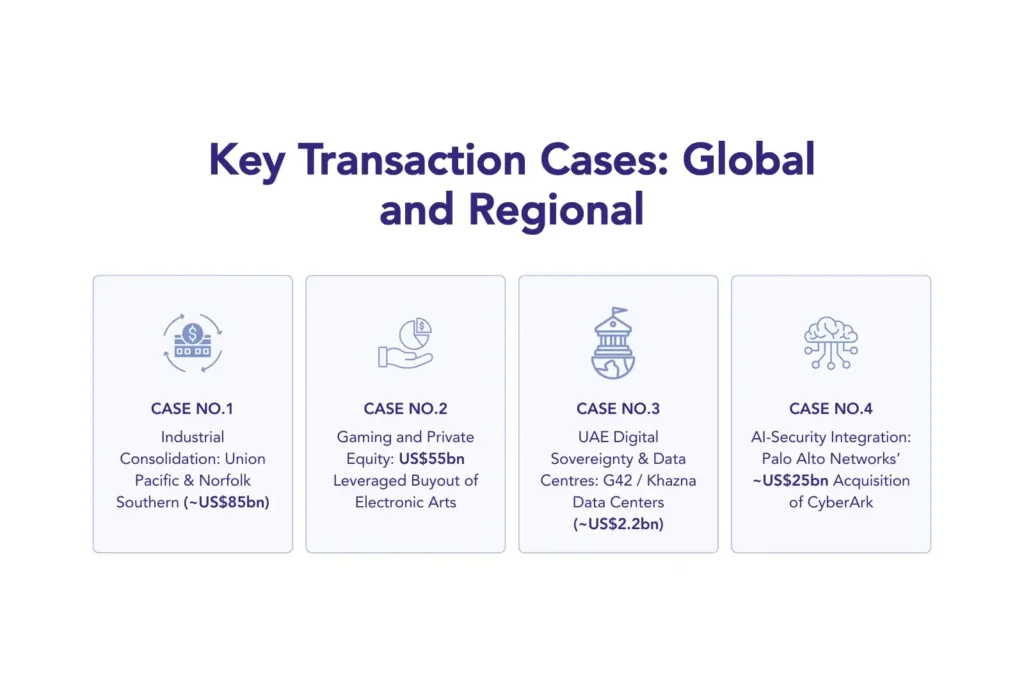
The past nine months have produced deals that define both scale and strategy. From U.S. industrial giants to Gulf tech infrastructure, these transactions illustrate where capital, expertise, and foresight are coming together.
Case 1 – Industrial Consolidation: Union Pacific & Norfolk Southern (~US$85bn)
This proposed rail merger demonstrates the strategic pursuit of network scale, operational efficiency, and pricing power in core U.S. infrastructure. The deal underscores how cross-border deal strategy and careful advisory can unlock value in complex, high-capital transactions.
Case 2 – Gaming and Private Equity: US$55bn Leveraged Buyout of Electronic Arts
One of the largest sponsor-led take-privates ever, this buyout highlights private equity’s willingness to invest in IP-rich, cash-generative gaming assets with strong recurring revenue. It exemplifies the Megadeal Surge in high-value, strategically focused transactions, a trend mirrored in Gulf markets via UAE M&A Growth.
Case 3 – UAE Digital Sovereignty & Data Centres: G42 / Khazna Data Centers (~US$2.2bn)
E &’s sale of its wholesale data-center operations to G42, alongside Silver Lake and MGX, signals Abu Dhabi’s push into AI-ready digital infrastructure and regional cloud capacity. Deals like this show how Dubai M&A is critical to executing sovereign-backed, high-impact deals.
Case 4 – AI-Security Integration: Palo Alto Networks’ ~US$25bn Acquisition of CyberArk
This transaction reflects the convergence of network, cloud, and identity security in an AI-driven M&A environment. Companies are increasingly paying premiums for platforms that manage privileged access, underscoring how technology is a core driver of Global M&A value creation in Q3 2025.
Strategic Takeaways for Q4 2025
As Q4 2025 unfolds, a few clear themes are emerging for M&A and IPO activity. Scale, strategy, and quality are dominating investor decisions.
M&A Focus
Global deal-making continues to favor high-value transactions. According to GlobalData, global M&A deal value surged 36% in Q3 2025, highlighting that companies and sponsors are prioritizing transactions above US$500 million. Many of these deals focus on AI capabilities, data, or infrastructure, reflecting strategic ambitions that go beyond mere expansion.
Regional Strategy (GCC)
The GCC is demonstrating resilience through mid-market deals (US$50–500 million), which move quickly, face clearer regulatory pathways, and often align with national priorities like digital transformation, energy transition, and economic diversification.
PwC Middle East reports that regional M&A volumes grew ~19% in H1 2025, while EY notes that MENA completed 649 deals worth roughly US$69.1 billion in the first nine months of 2025.
Capital Markets Advisory
Equity capital markets continue to reward high-quality, profitable issuers. Clear governance, ESG commitments, and a compelling strategic narrative help companies secure premium pricing. Lower-quality names, meanwhile, face ongoing pricing pressure, reinforcing the need for careful preparation before listing.
Inbound Opportunity into GCC
Investor-friendly frameworks—especially in free zones like ADGM and DIFC—combined with robust sovereign-backed pipelines and strong index performance, are attracting sustained foreign direct investment. This is creating fertile ground for UAE M&A Growth, the GCC IPO Pipeline, and cross-border transactions guided by a sophisticated cross-border deal strategy.
Outlook and Forecasted Trends (Q4 2025 / 2026)
Q4 2025 and 2026 are all about value over volume. Investors are picky. They want deals that matter. That’s why average deal sizes remain high, even if total volumes stay below 2021 peaks.
Sustained High Average Deal Size
Megadeals and upper-mid-market transactions dominate. Fewer deals, but bigger impact. Global M&A Q3 2025 shows scale still drives attention. Assets in tech, infrastructure, and industrial sectors are especially sought after.
Continued Momentum in MENA IPOs
MENA IPOs are holding strong. State-linked listings and healthy local liquidity keep the GCC IPO Pipeline active. Investors are favoring quality, well-run companies over speculative names.
AI Infrastructure & Data Centre M&A
Deals in AI infrastructure, data centres, and semiconductor-adjacent assets are heating up. AI-Driven M&A is shaping valuations and strategy. Middle East AI campus projects and NVIDIA–OpenAI-style investments show where long-term value is heading.
Privatisation & Asset Recycling in GCC
Sovereign privatisations and stake sales remain active. Moves like ADNOC portfolio shifts and Saudi privatisation programs support UAE M&A Growth and cross-border deal strategy. Clearer regulations and alignment with national priorities make these deals attractive.
Navigating the New M&A / IPO Landscape (Expert Guidance Themes)
The market is selective. Deals that work now need focus, planning, and clear priorities.
Strategic Due Diligence for Scale Deals
Big transactions demand more than a basic review. Experts check synergies, tech and AI integration, antitrust exposure, and regulatory or tariff risks. For UAE M&A Growth and cross-border deals, spotting issues early speeds up the process and reduces surprises.
Capital Markets Advisory for High-Quality IPOs
Investors care about quality. Firms with solid governance, clear sector focus, and good timing attract attention. Strong advisory helps companies hit the right windows, supporting the GCC IPO Pipeline.
GCC Sector Deep Dives
Some sectors are hotter than others. Digital transformation, fintech, logistics, and healthcare get the most investment interest. Knowing regulations and growth trends is critical to closing deals successfully.
Fintech & Open-Banking Trends
Targets must be ready for open banking, cloud systems, and Islamic fintech setups. Proper preparation boosts investor confidence. Here, M&A advisory in the UAE and Dubai M&A support are key to navigating local rules.
Geopolitical Risk Assessment
Global risks matter. Tariffs, sanctions, and delisting threats—especially across the U.S., China, and GCC—can derail deals. A clear cross-border deal strategy keeps deals moving and protects value.
Conclusion
The dealmaking environment is shifting fast, and the Gulf sits at the centre of that momentum. Companies that prepare early, understand sector dynamics, and stay alert to regulatory and geopolitical risks tend to move with more confidence—and capture more value. Whether it’s an IPO, a large acquisition, or a cross-border partnership, the decisions made now shape growth for years to come. With clearer governance, stronger technology foundations, and a more global investor base, the GCC market is entering a phase where well-planned strategies genuinely stand out.
FAQs:
Companies face tricky tax and cross-border issues. Double taxation is still a concern, and different jurisdictions often have conflicting rules. Working with M&A advisory in the UAE and leveraging a cross-border deal strategy helps identify pitfalls early and structure deals efficiently, reducing surprises at closing.
Currency swings, especially USD versus emerging market currencies, are affecting deal pricing and returns. Buyers often adjust valuations, include hedging clauses, or renegotiate terms to protect margins. This volatility adds complexity to cross-border transactions and requires active treasury management.
Earn-outs and conditional payments protect buyers and reward sellers if the target performs as expected. They are increasingly used in tech, AI, and infrastructure deals where future revenue or milestones are uncertain. This approach aligns incentives and mitigates risks when valuations are high or markets volatile.
Family-owned businesses in the GCC are selling partial stakes or restructuring before IPOs to bring in strategic partners and professional management. This spreads ownership, improves governance, and smooths the listing process. It also feeds the GCC IPO Pipeline by creating investable, transparent entities attractive to institutional investors.
Cybersecurity is now a top focus for buyers and investors. IT systems, cloud infrastructure, and AI platforms are scrutinized, as breaches can affect valuation and post-deal integration. Companies engaging in AI-Driven M&A need robust controls and documented mitigation strategies to maintain investor confidence.
Regulators now require detailed disclosures on AI systems, data handling, and privacy protocols. Companies must show compliance, storage procedures, and ethical use of data. This transparency ensures investors understand potential operational or reputational risks before listing.
Green-energy and ESG certifications are increasingly important. Investors want proof that infrastructure projects meet sustainability standards, are energy-efficient, and comply with regulations. This affects financing costs, deal attractiveness, and long-term asset valuation.
AI-focused acquisitions can be tricky to integrate with older IT systems. Data migration, workflow alignment, and cybersecurity must be carefully managed. Poor integration can slow ROI, reduce operational efficiency, and even trigger compliance issues, making planning and governance critical.
ESG compliance is a major factor for institutional investors. Companies with strong governance, transparent reporting, and credible social/environmental policies are more likely to secure premium pricing. This trend reinforces the importance of aligning strategy with market expectations.
In uncertain markets, investors favor defensive sectors like healthcare, utilities, and infrastructure. These sectors offer stability and predictable cash flows. This behavior shapes where IPO and M&A activity is concentrated during periods of market stress.
Private credit funds are filling the gap left by more cautious banks. They provide flexible financing for mid-market and cross-border transactions, often at faster turnaround times. This supports UAE M&A Growth by enabling deals that might otherwise stall.
Lower tech valuations are drawing strategic buyers back to the market. Companies with strong IP, AI capabilities, or digital infrastructure are seen as long-term winners. Deals now focus on acquiring high-potential targets at better pricing, creating opportunities for both regional and global investors.
Geopolitical tensions add complexity to approvals. Tariffs, sanctions, and national security reviews can slow or block deals. Careful planning using a cross-border deal strategy is essential to ensure deals proceed without delays while protecting value.
Dual listings allow companies to access multiple capital pools and reduce regional or currency risks. Listing in the GCC, Hong Kong, and US also boosts visibility, liquidity, and investor confidence. This strategy can be particularly effective for tech, fintech, and energy companies.
Investors expect strong boards, transparent operations, and clear ESG policies. Meeting these standards increases credibility and attractiveness for institutional capital. Aligning with these requirements supports the GCC IPO Pipeline and encourages long-term investor engagement.
References
- ‘A Comeback for IPOs’. Morgan Stanley,
https://www.morganstanley.com/insights/articles/ipo-outlook-2025. - ‘A Comeback for IPOs’. Morgan Stanley,
https://www.morganstanley.com/insights/articles/ipo-outlook-2025. - ADNOC and OMV to Merge Petrochemical Firms to Create $60 Billion Giant.
https://www.investing.com/news/stock-market-news/adnoc-and-omv-to-merge-petrochemical-firms-to-create-60-billion-giant-3906948. - ADX | Abu Dhabi Securities Exchange. https://www.adx.ae/.
- Agencies, News. ‘Union Pacific to Buy Norfolk Southern for $85bn’. Al Jazeera,
https://www.aljazeera.com/economy/2025/7/29/union-pacific-to-buy-norfolk-southern-for-85bn. - Briefing, Middle East. ‘Middle East M&A Activity Grows in H1 2025’. Middle East Briefing, 8 Sept. 2025, https://www.middleeastbriefing.com/news/middle-east-ma-activity-grows-in-h1-2025/.
- COO|authorurl:https://www.ey.com/en_gl/people/george-chan, authorsalutation:|authorfirstname:George|authorlastname:Chan|authorjobtitle:EY Global IPO Leader; EY Greater China Assurance. How Can You Navigate Your IPO Planning with Confidence? https://www.ey.com/en_gl/insights/ipo/trends.
- Dawn , Kopecki, et al. For Global M&A, Third Quarter Was One of the Best – and Worst – in Recent History.
https://www.reuters.com/world/asia-pacific/global-ma-third-quarter-was-one-best-worst-recent-history-2025-09-30/. - Dubai, TenTwenty | Webdesign, Webshops & E.-marketing |. ‘Invent a Better Everyday | Abu Dhabi, UAE | G42 | G42, Etisalat to Establish UAE’s Largest Data Center Provider’. Invent a Better Everyday | Abu Dhabi, UAE | G42,
https://www.g42.ai/resources/news/g42-etisalat-to-establish-uaes-largest-data-center-provider. - E& Signed Binding Agreement to Sell Its 40% Stake in Khazna for $2.2 Billion.
https://www.eand.com/content/dam/eand/assets/docs/latest-announcements/2025/eand-adx-announcement-khazna-en-25-02-25.pdf. - EA Announces Agreement to Be Acquired by PIF, Silver Lake, and Affinity Partners for $55 Billion.
https://investors.ea.com/press-releases/press-release-details/2025/EA-Announces-Agreement-to-be-Acquired-by-PIF-Silver-Lake-and-Affinity-Partners-for-55-Billion/default.aspx. - GCC. https://www.gcc-sg.org/en/Pages/default.aspx.
- ‘Good Growth in GCC IPO Market in 2025 so Far despite Volatility Due to Tariffs Row’. Khaleej Times, https://www.khaleejtimes.com/business/markets/gcc-ipo-market-2025-good-growth.
- Jul 30 and 2025. ‘Palo Alto Networks Announces Agreement to Acquire CyberArk, the Identity Security Leader’. Palo Alto Networks,
https://www.paloaltonetworks.com/company/press/2025/palo-alto-networks-announces-agreement-to-acquire-cyberark–the-identity-security-leader. - ‘Klarna Shares Rise 15% in Their First Day of Trading on Wall Street’. Euronews, 11 Sept. 2025,
http://www.euronews.com/business/2025/09/11/klarna-shares-rise-15-in-their-first-day-of-trading-on-wall-street. - Leader|authorurl:https://www.ey.com/en_sa/people/greg-hughes, authorsalutation:|authorfirstname:Greg |authorlastname:Hughes|authorjobtitle:EY-Parthenon MENA IPO and Transactions Diligence. MENA IPO EYE Q3 2025.
https://www.ey.com/en_sa/technical/ipo/mena-ipo-eye-resources/mena-ipo-eye-q3-2025. - Leader|authorurl:https://www.ey.com/en_sy/people/lamice-murshid, authorsalutation:|authorfirstname:Lamice|authorlastname:Murshid|authorjobtitle:EY MENA Brand, Marketing and Communications. MENA Region Witnesses Increased M&A Activity in the First 9 Months of 2025 with 649 Deals Totaling US$69.1b.
https://www.ey.com/en_sy/newsroom/2025/11/mena-region-witnesses-increased-m-a-activity-in-the-first-9-months-of-2025-with-649-deals-totaling-us-69-1b. - Market, Dubai Financial. Dubai Financial Market. https://www.dfm.ae/.
- Nvidia to Invest up to $100 Billion in OpenAI, Linking Two Artificial Intelligence Titans.
https://www.reuters.com/business/nvidia-invest-100-billion-openai-2025-09-22/. - Perumal, Santhosh V. ‘Mena IPO Pipeline Remains “Strong”: EY’. Gulf Times, 29 Oct. 2025,
https://www.gulf-times.com/article/713891/business/mena-ipo-pipeline-remains-strong-ey. - PIF’s US$55 Billion Bet on Electronic Arts: Gaming, Power, and Politics (GlobalSWF).
https://globalswf.com/news/pif-s-us-55-billion-bet-on-electronic-arts-gaming-power-and-politics. - PricewaterhouseCoopers. ‘2025 TransAct Middle East Mid-Year Update’. PwC,
https://www.pwc.com/m1/en/publications/2025-transact-middle-east-mid-year-update.html. - ———. ‘Middle East M&A Defies Global Slowdown with Double-Digit Growth’. PwC,
https://www.pwc.com/m1/en/media-centre/2025/middle-east-mergers-acquisitions-defies-global-slowdown.html. - Private Equity.
https://impact.economist.com/projects/real-world-strategy/private-equity/professionalperspectives/ - Subin, Samantha. ‘Palo Alto Networks Stock Falls after Announcing $25 Billion CyberArk Deal’. CNBC, 30 July 2025, https://www.cnbc.com/2025/07/30/palo-alto-networks-cyberark-deal.html.
- Ticketing Platform StubHub Erases Gains to Close below Issue Price in Choppy NYSE Debut.
https://www.reuters.com/business/finance/ticketing-platform-stubhub-erases-gains-close-below-issue-price-choppy-nyse-2025-09-17/. - ‘Union Pacific and Norfolk Southern to Create America’s First Transcontinental Railroad’. Union Pacific, https://www.up.com/press-releases/growth/norfolk-southern-transcontinental-nr-250729.
- ‘We the UAE 2031’ Vision.
https://u.ae/en/about-the-uae/strategies-initiatives-and-awards/strategies-plans-and-visions/innovation-and-future-shaping/we-the-uae-2031-vision. - Zijin Gold International Debuts on Hong Kong Stock Exchange in World’s Largest Gold Mining IPO-News-Zijin Mining Group Co., Ltd.
https://www.zijinmining.com/news/news-detail-122323.htm.