
Advanced Regulatory Resilience: 5 Emerging Risks in UAE Due Diligence for 2026
Due diligence in the UAE is no longer about ticking boxes. In 2026, regulators, banks, and institutional customers do not ask whether a company was compliant. They ask whether the business can withstand regulatory scrutiny after ownership changes. This is the shift from compliance snapshots to regulatory resilience.
Liabilities today surface faster. Not through paper files. Through systems, transaction data, and digital audit trails. Global alignment is accelerating this pressure.
OECD Pillar Two reshapes group tax exposure. FATF enforcement raises the bar on AML accountability. Climate laws convert ESG claims into legal obligations. The investor reality in 2026 is blunt. If risk exists, it will be discovered. If controls are weak, the buyer will inherit the cost.
This is why modern legal due diligence UAE work now extends beyond traditional silos.
AML. Tax. ESG. Data. Governance. Systems. This article focuses on emerging risks that sit outside standard due diligence checklists. Risks that surface after closing. Risks that destroy value quietly.
Use this guide as a framework: Risk → Evidence → Deal protection → Post-close control. This is smart due diligence UAE AI auditing in practice.
Risk 1: AML Objective Liability + Proliferation Financing Exposure

The UAE’s AML framework has moved decisively toward objective liability. The test is no longer what a company knew. It is what it ought to have known. This matters deeply for due diligence for business acquisition.
Proliferation Financing (PF) is now explicitly in scope. Not theoretical. Not limited to banks. Trade. Logistics. Manufacturing. Any business touching goods, components, or cross-border distribution is exposed.
Strategic Impact Activities face heightened scrutiny. Licensing sensitivity has increased. So has enforcement confidence. This is the rise of the AML objective liability test UAE.
Where deals get hit (the market gap)
Most target companies look clean on paper. Customer onboarding checks exist. Sanctions screening is “performed.” Policies are up to date. The failure happens later.
Red flags were detected – but not escalated. Transactions were questioned – but allowed.
Distributors were trusted – but never examined. Indirect exposure is the most common trigger. Sanctioned end-users hiding behind distributors. Dual-use goods routed through benign corridors. Freight forwarders acting as blind spots. Another recurring issue is misclassification.
Businesses conducting regulated or DNFBP-adjacent activity without recognizing it. This creates silent supervisory breach risk. These gaps rarely appear in traditional due diligence checklist UAE 2026 templates.
Evidence pack that actually matters
Policy documents are not evidence.
Regulators look for behavior.
Key materials include:
- Decision trails showing who approved high-risk customers and why
- Proliferation screening logic focused on end-use and end-user, not just names
- Records of attempted transactions, not only completed ones
- Third-party chain diligence covering agents, brokers, freight partners, and introducers
This is where proliferation financing risk assessment UAE becomes real.
Deal protection moves
Advanced buyers no longer rely on generic AML reps.
They use structure.
- AML and PF remediation as a condition precedent
- Specific indemnities for sanctions or PF breaches
- Walk-away triggers tied to regulatory findings
Post-close, the focus is speed. A 90-day controls uplift. Clear metrics. Independent testing. This is no longer optional for due diligence services UAE providers operating at the top tier.
Risk 2: Climate MRV Deadline + Carbon-Driven Valuation and Financing Risk
The UAE Climate Change Law has moved ESG from narrative to obligation. Measurement. Reporting. Verification. MRV is now mandatory. The mandatory ESG reporting UAE 2026 regime includes a clear reporting deadline. 30 May 2026 has been widely flagged by Big-4 and regulators. This ends the era of voluntary disclosure.
Carbon data is now treated like financial data. Incomplete data creates risk. Inaccurate data creates liability.
Where deals get hit (the market gap)
Most sellers still present ESG through marketing decks. Sustainability claims. Net-zero ambitions. Supplier codes. What they lack is auditable MRV. This creates immediate greenwashing exposure. Banks hesitate. Insurers price uncertainty aggressively.
The second impact is supply-chain contagion.
Large customers now demand emissions data. Suppliers without it lose eligibility. Revenue risk follows. High-carbon assets face valuation compression. Debt pricing worsens. Climate-risk integration by UAE banks is accelerating. This affects far more than heavy industry.
Even service businesses feel it through tenders, insurance, and financing terms.
Evidence pack investors now expect
Credible buyers ask practical questions:
- What measurement methodology is used?
- Is data traceable to source systems?
- Is there a clear verification pathway?
They also map contracts.
Which customers require carbon disclosure? Which tenders depend on it? Physical climate risk is reviewed with equal seriousness. Heat stress. Water scarcity. Operational CAPEX exposure. This connects directly to risk factors UAE investment 2026 assessments.
Deal protection moves
Generic ESG warranties no longer work.
Advanced transactions include:
- Carbon and ESG warranties tied to measurable evidence
- Earnout protection linked to tender and contract eligibility
- Post-close MRV build sprints with named ownership
This is how climate compliance becomes value protection, not cost.
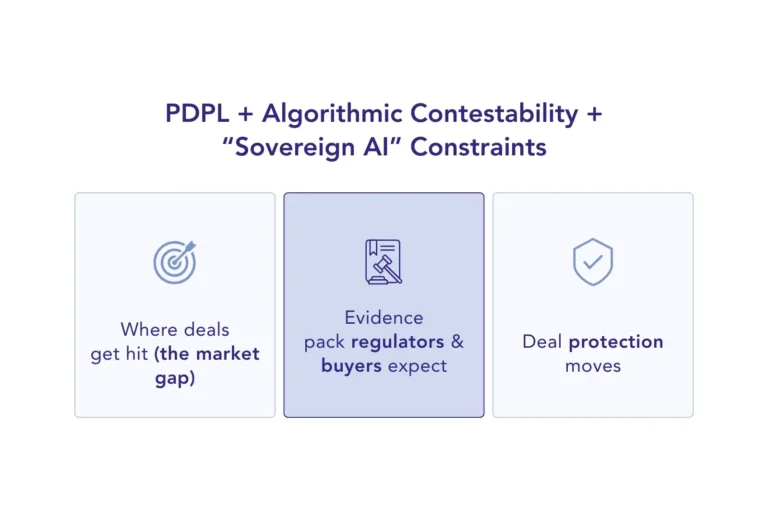
Risk 3: PDPL + Algorithmic Contestability + “Sovereign AI” Constraints
PDPL enforcement in the UAE has matured. This is no longer a future risk. Penalties are real.
Enforcement confidence has increased. Historic neglect now carries forward into acquisitions.
The second shift is more subtle but more disruptive. Automated decision-making is now contestable. Individuals can demand human review.
This directly affects:
- Credit scoring
- Pricing engines
- Hiring platforms
- Underwriting systems
If a decision cannot be explained, it cannot be defended.
The third pressure point is strategic. “Sovereign AI” direction and sector standards are shaping data localization UAE PDPL expectations. In sensitive industries, data and model residency is becoming a condition of legal operability.
Where deals get hit (the market gap)
Most targets pass surface-level PDPL compliance UAE data protection checks.
Privacy notices exist. Consent language is present. Integration is where deals fail. Data cannot be moved across borders. Models cannot be re-hosted. Vendor contracts restrict portability.
AI systems create another blind spot.
Decisions are automated – but not auditable. Explainability is absent. Error propagation spreads across workflows. When complaints arise, regulators focus on systems. Not intentions. This is the new reality of smart due diligence UAE AI auditing.
Evidence pack regulators and buyers expect
Advanced diligence focuses on operability, not theory.
Key evidence includes:
- Explainability logs for automated decisions
- Audit trails showing how outputs were generated
- DPIAs for high-risk processing activities
- Bias and failure-mode testing results
Buyers also require a clear map. Where data sits. Where models run. Which vendors control what. This is essential for due diligence framework Dubai transactions involving AI or data-driven services.
Deal protection moves
Sophisticated deals now include guardrails.
- Integration carve-outs until AI and data governance is proven
- AI governance covenants covering model changes and retraining
- Incident response drills for data and algorithmic failures
Post-close, the focus is architectural. Privacy-by-design. Secure-by-design. Documented accountability. Without this, growth becomes legally constrained.
Risk 4: Director, Shadow Director, and Bankruptcy Lookback Liability
Director liability in the UAE has sharpened. Formal titles matter less than actual influence. Shadow directors. De facto decision-makers. Advisers exercising control. All now face scrutiny.
Bankruptcy reforms have strengthened lookback exposure. Mismanagement risk exists even before insolvency. Not just after. Public Joint Stock Company (PrJSC) governance expectations have also tightened. Committee structures. Independence. Challenge culture.
This elevates personal director liability UAE law from a theoretical concern to a pricing factor.
Where deals get hit (the market gap)
Family-controlled businesses are the most exposed. Control is exercised off-paper. Decisions are informal. Authority is assumed, not documented. Board minutes tell another story. Attendance is recorded. But challenge is absent. Dissent is invisible.
Committees exist, but only in name. Mandates are vague. Oversight is decorative. When distress emerges, regulators reconstruct behavior. Two years back. Sometimes more.
This is where risk factors UAE investment 2026 surface unexpectedly.
Evidence pack that reveals real exposure
Advanced buyers test governance behavior, not structure.
They examine:
- Board attendance and challenge records
- Evidence of dissent and escalation
- Related-party approvals and conflict handling
- Independent review of key decisions
They also apply a financial distress lens. Payments. Asset sales. Preferential treatment. The goal is simple. Can directors prove they acted responsibly?
Deal protection moves
Governance is now a transaction deliverable.
Common protections include:
- Governance remediation between signing and close
- Pricing adjustments for uncovered director risk
- Enhanced D&O insurance analysis
Post-close, buyers move fast. Committee resets. Charter updates. Clear reporting cadence. This is no longer governance hygiene. It is liability containment.
Risk 5: Free Zone “Status Cliff” + DMTT Group Liability + Real-Time Digital Audit
Tax risk in the UAE has become structural. The Qualifying Free Zone Person (QFZP) tax 2026 regime introduced a hard edge. The de minimis test is no longer forgiving. Cross the threshold – AED 5 million or 5% non-qualifying revenue – and the status collapses.
Not gradually. Immediately.
This is the de minimis threshold UAE tax cliff. At the same time, Pillar Two has arrived in substance. The Domestic Minimum Top-Up Tax (DMTT) introduces joint and several liability across UAE constituent entities. A small acquisition can now pull an investor into unexpected group-level exposure.
Overlay this with digital enforcement. E-invoicing architecture under Peppol and DCTCE creates continuous data visibility. UDARS signals a broader shift toward machine-readable audit oversight. This is UAE corporate tax compliance 2026 in real time.
Where deals get hit (the market gap)
Most diligence still treats tax as historical. Returns are reviewed. Positions are summarized. Comfort is assumed. This approach fails in 2026. One revenue-mix error can flip the tax outcome for years. Free Zone benefits disappear retroactively.
Acquirers are also surprised by scope.
A modest UAE entity becomes part of a larger Pillar Two perimeter. Top-up tax exposure emerges at group level. Allocation was never discussed. Systems then amplify the risk.
ERP setups cannot produce structured invoice outputs. E-invoicing onboarding is incomplete. Audit trails are fragmented. Digital audits do not wait for explanations. They flag anomalies first. This is why e-invoicing UAE Peppol mandate 2026 readiness now belongs in core diligence.
Evidence pack that withstands digital scrutiny
Advanced buyers demand precision.
They test:
- Revenue segmentation logic for qualifying vs non-qualifying income
- Contract-level classification, not summaries
- Group mapping for DMTT exposure and liability allocation
Systems readiness matters just as much.
- ERP capability to generate structured e-invoices
- ASP onboarding plans and timelines
- Data retention and retrieval testing
This aligns directly with UDARS digital auditing system UAE expectations.
Deal protection moves
Modern tax protection is forward-looking.
Effective mechanisms include:
- Status-cliff warranties tied to monitored revenue mix
- DMTT indemnities with clear allocation mechanics
- Digital compliance readiness as a condition precedent
Post-close, the focus is operational discipline. Continuous monitoring. Automated thresholds. Clear accountability. Tax resilience is no longer advisory. It is engineered.
Conclusion
In 2026, the most important diligence question has changed. It is no longer:
“Are they compliant?” It is: “Will regulators, banks, customers, and platforms accept this business after we buy it?”
This is the heart of due diligence services UAE in the current cycle. Regulatory risk now emerges through systems. Through data. Through behavior over time. Smart diligence delivers three outcomes. First, evidence-based risk scoring. Not opinions. Proof. Second, deal-terms translation. Pricing. Indemnities. Conditions precedent. Covenants. Third, a 90–180 day stabilization roadmap. Controls. Data. Governance. Reporting.
This is the new standard for due diligence framework Dubai transactions. Resilience is not defensive. It is strategic.
FAQs:
Because patterns reveal intent, control quality, and governance maturity. Single breaches can be fixed. Repeated behaviors indicate systemic weakness.
Because compliance at one point in time does not prove that controls work under stress, scale, or ownership change.
Trade, logistics, manufacturing, and distribution models with indirect end-users and cross-border supply chains.
Because customers, lenders, and insurers now demand carbon data across the value chain, not just at the asset level.
Higher uncertainty leads to pricing penalties, exclusions, or outright refusal where MRV is weak.
Regulatory challenge, customer disputes, and forced suspension of automated processes.
Yes. Data residency, vendor restrictions, and sovereign AI expectations can make integration legally impossible.
Because responsibility is contextual. What is reasonable depends on role, influence, and knowledge.
When decisions are made off-paper, accountability cannot be demonstrated during regulatory review.
The hard de minimis cliff and real-time data visibility remove tolerance for revenue-mix errors.
Because DMTT applies joint and several liability across in-scope constituent entities.
Anomalies are detected immediately, often before management is aware of them.
AML escalation failures, unverifiable ESG data, and non-compliant data handling.
Because risk crystallizes after closing, not before.
By stress-testing systems, data flows, governance behavior, and enforcement response capability – not just documents.
References
- PwC. “UAE Climate Change Law: Mandatory Emissions Reporting Obligations.” Middle East Tax News Alerts, 2025.
https://www.pwc.com/m1/en/services/tax/middle-east-tax-news-alerts/2025/uae-climate-change-law-mandatory-emissions-reporting-obligations.html - GCC BDI. “Shifting Burdens and Accountability: The New UAE AML Law.” Legal Updates, 2024.
https://gccbdi.org/legal-updates/shifting-burdens-and-accountability-new-uae-aml-law-united-arab-emirates - Focal. “Customer Due Diligence in the UAE: What Has Changed and Why It Matters.” Focal AI Blog, 2024.
https://www.getfocal.ai/blog/customer-due-diligence-in-the-uae - AML UAE. “A Complete Guide to Effective Customer Due Diligence in the UAE.” 2024.
https://amluae.com/a-complete-guide-to-effective-customer-due-diligence/ - Central Bank of the UAE. “Anti-Money Laundering and Combating the Financing of Terrorism.” Official Guidance Portal.
https://www.centralbank.ae/en/our-operations/anti-money-laundering-aml/ - BSA Ahmad Bin Hezeem & Associates LLP. “UAE Bankruptcy Law Amendments: Directors’ and Managers’ Personal Liability.” Insights, 2024.
https://www.bsalaw.com/insight/uae-bankruptcy-law-amendments-directors-and-managers-personal-liability/ - Alvarez & Marsal. “From Operations to Assets: Quantifying the ROI of AI in Financial Due Diligence.” Thought Leadership, 2024.
https://www.alvarezandmarsal.com/thought-leadership/from-operations-to-assets-quantifying-the-roi-of-ai-in-financial-due-diligence - UAE Ministry of Justice. Federal Decree-Law No. 11 of 2024 on Climate Change. Official Legislation Text.
https://uaelegislation.gov.ae/en/legislations/3314/download - Charles Russell Speechlys. “Recent Developments in Directors’ Liability in the UAE and England & Wales.” Expert Insights, 2024.
https://www.charlesrussellspeechlys.com/en/insights/expert-insights/dispute-resolution/2024/recent-developments-in-directors-liability-in-the-uae-and-england–wales/ - Ministry of Economy, UAE. Ministerial Decision No. 137 of 2024.
https://www.moet.gov.ae/documents/20121/0/MD%2BNo%2B1372024.pdf/545bb4be-cd84-f3ea-a6e9-68742c443b69 - Khaleej Times. “UAE Sets the Stage for Fully Digital Accounting and Audit Regime.” Khaleej Times, 2024.
https://www.khaleejtimes.com/business/uae-sets-stage-for-fully-digital-accounting-audit-regime - Organisation for Economic Co-operation and Development (OECD). Global Anti-Base Erosion (GloBE) Model Rules (Pillar Two).
https://www.oecd.org/tax/beps/global-anti-base-erosion-model-rules-pillar-two.htm - Financial Action Task Force (FATF). Guidance on Proliferation Financing Risk Assessment and Mitigation.
https://www.fatf-gafi.org/en/publications/Fatfrecommendations/Guidance-proliferation-financing-risk-assessment-mitigation.html