
How to Register for UAE E-Invoicing July 2026 Pilot: Step-by-Step for Large Taxpayers
The UAE’s e-invoicing pilot is almost here. And for large taxpayers, this is the point where things stop being theory and start becoming real.
From 1 July 2026, selected businesses can begin onboarding into the pilot, while voluntary early adopters can also step in and start testing the system before the first mandatory phase lands.
For businesses above the AED 50 million e-invoicing threshold UAE, the full rollout starts on 1 January 2027.
So yes, this is the right time to get your head around how to register for UAE e-invoicing and what the process entails.
If you want to understand the basics of UAE e-invoicing, the system model, and why it matters, you can read up here.
What Is the UAE E-Invoicing July 2026 Pilot?
The UAE e-invoicing July 2026 pilot registration phase is the live onboarding window before mandatory implementation begins for the first group of businesses. It starts on 1 July 2026.
Businesses selected for the Taxpayer Working Group (TWG) will be contacted directly by the Ministry of Finance and included only after they agree in writing. Other businesses can still choose voluntary early adoption from the same date.
Why the Pilot Is Your Best Window
For businesses considering e-invoicing voluntary registration UAE 2026, this pilot window gives something valuable: time.
The UAE’s penalty decision does not apply to businesses using e-invoicing voluntarily before they become mandatorily in scope. Penalties start only from the relevant mandatory date.
That gives businesses time to fix ERP mapping issues, clean up invoice data, test the flow, and train teams before the rules begin to bite. It also helps catch problems early, reduce manual errors, and build a cleaner process before January 2027.
Who Qualifies as a “Large Taxpayer” for the Pilot?
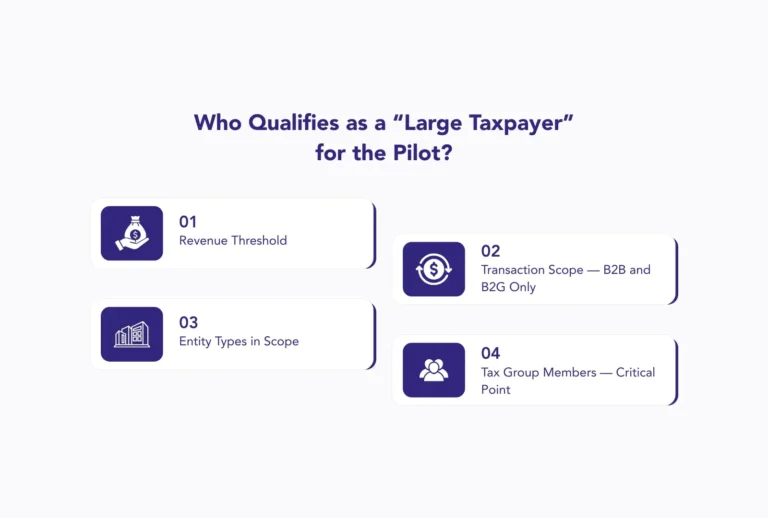
Not every business moves at the same time. So first, let’s see who the UAE treats as a large taxpayer for this rollout.
1. Revenue Threshold
Start with the number that matters most. If your business has annual revenue of AED 50,000,000 or more, you fall into Phase 1 of the large taxpayer e-invoicing pilot UAE rollout.
That means your ASP must be appointed by 30 October 2026, and your mandatory go-live date is 1 January 2027. This is the core AED 50 million e-invoicing threshold UAE businesses need to watch.
2. Transaction Scope — B2B and B2G Only
The current scope covers business-to-business and business-to-government transactions. So, if your business issues invoices to other businesses or government entities, those transactions sit inside the e-invoicing net unless a specific exclusion applies.
B2C sales are not included in the current rollout. But if your business also issues B2B or B2G invoices, that part of your invoicing must still move into the new system on time.
3. Entity Types in Scope
This is wider than many businesses expect. It is not just mainland companies. The system applies to persons conducting business in the UAE for in-scope transactions, which is why mainland LLCs and many free zone companies can fall in scope too.
In practice, recent UAE guidance commonly points to free zone businesses such as DMCC, JAFZA, IFZA, RAKEZ, ADGM, and DIFC as examples. It can also reach non-resident persons who must issue UAE tax invoices. And yes, a business can still be in scope even if it is not VAT-registered.
In that case, it would still need a TIN through the FTA system.
4. Tax Group Members — Critical Point
This is where many groups trip. Each Tax Group member does not ride on the representative member’s number for e-invoicing. Each entity must use its own TIN, and for businesses already registered with the FTA, that TIN is the first 10 digits of its own TRN. Not the group representative’s TRN.
Also, the guidance is built around onboarding at the person level, which is why group members onboard separately. Market guidance following the MoF rules also notes that members may choose different ASPs.
Here is the timeline in one quick view:
| Entity Type | ASP Appointment Deadline | Mandatory Go-Live |
| Revenue ≥ AED 50M | 30 October 2026 | 1 January 2027 |
| Revenue < AED 50M | 31 March 2027 | 1 July 2027 |
| Government entities | 31 March 2027 | 1 October 2027 |
These dates come straight from the UAE rollout plan under the Ministry of Finance guidance.
If you sit above the AED 50 million e-invoicing threshold UAE, the answer is simple: you are in the first mandatory wave, and the clock is already louder than it looks
TWG Pilot vs Voluntary Registration — What Is the Difference?
There are two ways into the July 2026 pilot phase. One starts when the Ministry contacts you. The other starts when you decide not to wait. The end goal is the same, but the way in is different.
Option A — Taxpayer Working Group (TWG) — MoF-Selected
This route is not open for application. The Ministry contacts selected businesses directly and tells them they are being considered for the pilot. But that does not make them part of it straight away. A business joins the TWG only after it agrees in writing. Once it does, the business must meet all technical requirements set by the Ministry and the FTA from day one.
The TWG is the supervised route. It is built for live testing, implementation, and feedback under Ministry and FTA oversight. So if your business is contacted, think of it as an early seat at the table, but with real obligations attached.
This is not a “maybe later” invitation. It is more like the regulator knocking and saying, “You’re up.”
Option B — Voluntary Registration — Open to All
This route is wider.
From 1 July 2026, all Persons, regardless of revenue, can choose to implement e-invoicing voluntarily. So this is bigger than just VAT-registered businesses. If a business is not already registered with the FTA, it will still need to obtain a TIN through EmaraTax before onboarding.
But voluntary does not mean casual. A business that joins early must still follow the full technical setup. That means PINT AE XML format, onboarding with an Accredited Service Provider UAE, and starting the onboarding process through the EmaraTax portal. The MoF guidance is clear that the onboarding process is initiated by the business through EmaraTax, not by the ASP.
This option is usually the smarter one for businesses that want to test their ERP, train finance teams, and avoid the January 2027 scramble. The official guidance also makes one point very clear: administrative penalties apply only from the date a person is required to implement e-invoicing on a mandatory basis. So the voluntary phase gives businesses room to test the system before enforcement catches up.
TWG = Ministry invites → you agree in writing → supervised pilot begins.
Voluntary = you choose to join → start onboarding through EmaraTax → comply with the full technical rules.
Both = real-world testing before your mandatory phase, but the MoF’s express penalty-relief wording is tied to voluntary implementation.
Step-by-Step: How to Register for the UAE E-Invoicing Pilot
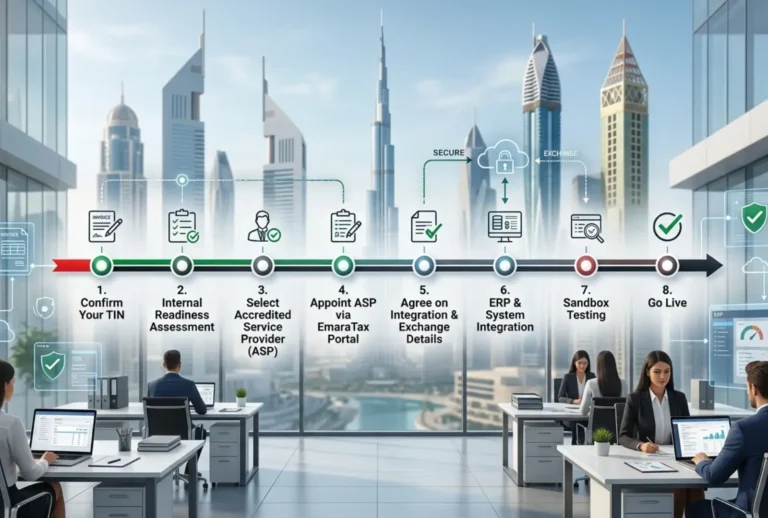
Let’s start with the first thing that can quietly mess up the whole process: the identifier. Before systems, before testing, before ASP onboarding, confirm your TIN.
Step 1 — Confirm Your TIN
If you want to know how to register for UAE e-invoicing right, start here. For businesses already registered with the FTA, the TIN is the first 10 digits of the TRN. If the business is in scope but not registered with the FTA, it needs to use the EmaraTax portal to generate a TIN first.
No TIN, no clean start.
Tax Groups need extra care. Each member must use its own TIN only. Not the representative member’s TRN. That means each entity should check its own number before moving into the pilot.
Recent implementation guidance also notes that Tax Group members onboard individually for e-invoicing, which is exactly where many groups get tripped up.
So this step looks small, but it is not. Get the identifier wrong here, and the rest of the setup starts wobbling before it even begins.
Step 2 — Conduct Internal Readiness Assessment
Before moving into UAE e-invoicing ASP appointment EmaraTax, make sure your systems are actually ready. Check whether your ERP or accounting system can generate the required invoice data, connect with the ASP, and support testing before you go-live.
Start with the basics. Can your system generate invoices in PINT AE XML format? Are the key fields in place, such as invoice date, line items, VAT amounts, and buyer and supplier details?
Then check what needs to change. Some businesses may need ERP upgrades, connectors, or extra mapping work. It is also important to estimate your B2B and B2G invoice volumes properly, because that will affect your integration scope and ASP setup.
Step 3 — Shortlist and Select an Accredited Service Provider (ASP)
Once your readiness check is done, the next step is to choose an ASP from the official list. The MoF publishes the UAE’s pre-approved providers, and businesses can begin the onboarding journey through the EmaraTax portal.
Be careful with vendor claims. “Peppol-compatible” does not mean approved. Your provider must be a valid Accredited Service Provider UAE under the MoF framework.
When comparing providers, focus on the practical points: ERP compatibility, implementation experience, data security, and support during onboarding and testing. Pricing will vary by business size, invoice volume, and system complexity.
Step 4 — Formally Appoint Your ASP via EmaraTax portal
This is the formal step.
Log in to EmaraTax portal through the FTA e-services platform. The FTA says EmaraTax supports sign-in through UAE PASS, and the MoF guidance says the onboarding process must be started there by the taxpayer’s account admin.
Inside EmaraTax, go to the E-INVOICING section, review the official list of pre-approved providers, choose your ASP, and click “Proceed to ASP.”
From there, you are redirected to the provider’s portal to continue onboarding. The MoF also makes one rule very clear: each person or government entity can onboard with only one ASP for all e-invoicing requirements.
If you fall under the AED 50 million e-invoicing threshold UAE, this step cannot drift. Your ASP appointment deadline is 30 October 2026. Miss that, and the calendar stops being friendly.
Step 5 — Agree on Integration and Exchange Details with Your ASP
Once the ASP is appointed, do not jump straight to go-live.
First, you need to agree with the working model. The MoF says you and your ASP need to decide how invoice data will be shared, how you will receive success or failure confirmations, and how supplier invoices sent to you will arrive through the ASP.
This is also where the process gets practical. Map the full route, not just the happy path. How does data leave your ERP? Who sees failed messages first? What happens when an invoice is rejected? Who fixes it, and how fast? The official readiness checklist also tells businesses to establish a governance model with the ASP on how errors will be resolved before go-live.
Step 6 — System Integration and ERP Configuration
This is the stage where your system needs to work in practice, not just on paper. Your ERP or invoicing system must be able to generate compliant invoice data in PINT AE XML format and connect properly with your ASP.
Once onboarding is complete, your ASP will assign your Peppol Participant Identifier. After that, your team can begin end-to-end testing of invoice exchange, confirmations, and reporting flows.
The exact timeline will depend on your system setup. For customized environments, integration and mapping may take several weeks.
Step 7 — Test the System in the Sandbox Environment
Before going live, test the full process in the sandbox environment. Make sure invoice data can move from your ERP to the ASP, reach the buyer side correctly, and return the required confirmations.
Do not test invoices only. Test credit notes, rejected files, failed transmissions, and other error cases as well. All issues should be documented and resolved before live rollout.
Step 8 — Go Live
Once testing is complete, move into live rollout. A phased approach is usually more practical: start with internal testing, then a small customer group, then expand gradually to full volume.
It is also important to inform key B2B customers and suppliers before you go-live so they are ready for the new exchange process.
If a system failure happens after launch, the issuer and the recipient must notify the Authority within 2 business days from the date of the failure.
How to Appoint an ASP via EmaraTax
The formal appointment happens through EmaraTax. Keep the process simple and direct:
- Log in via UAE PASS and access the EmaraTax portal from your taxpayer account.
- Open the E-INVOICING section to view the official ASP list.
- Choose your ASP from the registry and make sure it is approved under the UAE MoF framework.
- Use only one ASP per entity. Each business entity can onboard with only one provider.
- Tax Group members choose separately. Each member uses its own TIN and can appoint its own ASP.
- Click “Proceed to ASP.” EmaraTax will redirect you to the provider’s portal to continue onboarding.
- Receive your Participant Identifier from the ASP after onboarding is completed. This becomes your network ID for exchange.
What Happens After Registration — The Full Implementation Timeline
Once registration is done, the focus shifts from onboarding to execution. Here is the timeline in one view.
| Date | Milestone |
| January 2026 | Early readiness activity picked up, including ASP accreditation consultation and MoF e-invoicing awareness sessions |
| 23 February 2026 | MoF published the official UAE Electronic Invoicing Guidelines V1.0 |
| 21 April 2026 | The 4-corner exchange model went live, and ASP selection through EmaraTax opened |
| 1 July 2026 | Pilot phase begins and voluntary adoption opens |
| 30 October 2026 | Large taxpayers must appoint an ASP |
| 31 December 2026 | Pilot phase ends |
| 1 January 2027 | Mandatory go-live for businesses with revenue of AED 50 million or more |
| 31 March 2027 | Businesses below AED 50 million must appoint an ASP |
| 1 July 2027 | Mandatory go-live for businesses below AED 50 million |
| 1 October 2027 | Mandatory go-live for in-scope government entities |
The core rollout dates above are confirmed in the MoF’s official guidelines and implementation announcement. One small accuracy note: the January 2026 row is safer when framed as an early readiness milestone, because the official pages clearly show January consultation and awareness activity, but not one single MoF page I checked that pins the full PINT AE release to one exact January date.
Post-registration obligations to keep in mind
- Invoices still need to move on time. Current UAE e-invoicing guidance says issuers must issue and transmit e-invoices and e-credit notes within 14 days of the date of the business transaction, where applicable.
- Retention still matters. E-invoices generally need to be archived and retained for at least 5 years, and longer retention periods can apply under VAT law in specific cases, including real estate-related records.
- Do not treat paper files as the answer. The MoF’s legal updates make clear that businesses in scope must archive electronic invoice data to meet record-keeping standards, so paper-only archiving is not enough for this system.
- Check data hosting early. The official readiness checklist tells businesses to agree data hosting and data security requirements with their ASP, and current implementation guidance also flags UAE data residency requirements for invoice data. That is one of those things that seems boring until it becomes expensive.
- Keep watching MoF and FTA updates. The official guidance expressly notes that more exclusions or refinements can be added by future Ministerial Decisions, so this is not the kind of project you set up once and then forget in a drawer.
Penalties If You Miss the July 31, 2026 Deadline
For large taxpayers, the real penalty risk starts from the mandatory go-live date, not during the voluntary pilot period. The official penalty decision does not apply to businesses using e-invoicing voluntarily before they become mandatorily in scope.
- Failure to appoint an ASP on time: AED 5,000 for each month of delay, or part of a month.
- Late e-invoice issuance or transmission: AED 100 per invoice, capped at AED 5,000 per calendar month.
- Late e-credit note issuance or transmission: AED 100 per credit note, capped at AED 5,000 per calendar month.
- System failure not reported to the FTA: AED 1,000 per day of delay, or part of a day. The notification deadline is within 2 business days from the failure date.
- Storage failure: invoice data must be stored within the UAE, but the penalty decision does not set a separate fixed fine for this item. It is better framed as a compliance and audit risk.
The 14-day rule also matters. Where the VAT-law timing rule does not override it, the electronic invoice or credit note must be issued and transmitted within 14 days from the Date of Business Transaction.
Quick penalty table
| Violation | Penalty |
| Failure to appoint ASP | AED 5,000 per month of delay |
| Late e-invoice issuance/transmission | AED 100 per invoice, capped at AED 5,000 per month |
| Late e-credit note issuance/transmission | AED 100 per credit note, capped at AED 5,000 per month |
| Failure to report system failure | AED 1,000 per day of delay |
| Failure to store data in the UAE | Compliance and audit risk |
| Invoice issued outside 14-day window | Non-compliance risk |
Common Mistakes Large Taxpayers Are Making Right Now
This is where good plans usually go sideways.
- Mistake 1 — Treating 31 July as the start date. It is not. It is the ASP appointment deadline for businesses with revenue of AED 50 million or more. The official rollout then makes 1 January 2027 the mandatory go-live date, and current implementation roadmaps treat assessment, selection, testing, and rollout as a multi-week exercise, not a last-minute sprint.
- Mistake 2 — Signing with an unaccredited vendor. “Peppol-compatible” is not the same thing as UAE-approved. The Ministry publishes the pre-approved ASP list and says it is updated periodically, so the safest move is to verify the provider on the official registry before you sign anything.
- Mistake 3 — Assuming one Tax Group TRN covers everyone. It does not. The MoF guidance is clear: each Tax Group member has its own TIN, each member must be onboarded for e-invoicing, and group members may even choose different ASPs.
- Mistake 4 — Underestimating ERP mapping work. This is rarely a quick settings change. The official guidance says businesses need to align their ERP or accounting system with the ASP and complete testing before go-live, while current implementation roadmaps treat data mapping, validation, and testing as one of the longest parts of the project.
- Mistake 5 — Waiting for a government notification. That message is only for businesses selected into the pilot. The same MoF guidance also says all Persons, regardless of revenue, can implement e-invoicing voluntarily from 1 July 2026. So if you are not in the TWG, waiting for an invitation is mostly just waiting. Large taxpayers now have an extended window to appoint their ASP until 30 October 2026. So if you are not in the TWG, waiting for an invitation is mostly just waiting.
- Mistake 6 — Ignoring free zone entities. Many free zone businesses still assume this sits outside their world. That is risky. The MoF framework applies on a broad basis to persons carrying on business in the UAE unless specifically excluded, and recent UAE implementation guidance says this includes many free zone businesses doing B2B or B2G transactions, including names such as DMCC, IFZA, JAFZA, RAKEZ, ADGM, and DIFC.
The biggest mistake is thinking there is still plenty of time. In e-invoicing projects, that thought usually shows up right before the panic does.
How ADEPTS Can Help
ADEPTS helps businesses move from planning to action. The team reviews your current ERP, invoice flow, and VAT position to identify readiness gaps before the pilot or mandatory phase begins.
ADEPTS also supports ASP selection and EmaraTax onboarding, helping you choose the right accredited provider and complete the formal appointment process properly. This reduces delays and avoids mistakes at the setup stage.
On the technical side, ADEPTS can assess whether your invoice data is ready for PINT AE XML format, coordinate ERP mapping and testing with your tech team, and help build practical workflows for issuing, receiving, validating, and archiving e-invoices.
After go-live, ADEPTS continues to support compliance monitoring, exception handling, and audit readiness. When 30 October 2026 arrives, your business should already be connected, tested, and running, not scrambling. That is exactly where ADEPTS adds value.
Conclusion
The UAE’s e-invoicing rollout has now moved into the action stage. For large taxpayers, 30 October 2026 is the key deadline to appoint an ASP and get ready for mandatory implementation from 1 January 2027.
That makes UAE e-invoicing July 2026 pilot registration one of the most important compliance steps to complete before Q3 ends. The pilot gives businesses time to fix system gaps, test workflows, and prepare properly before enforcement begins.
If your business wants to move forward with clarity, ADEPTS can help with readiness assessment, ASP onboarding, system coordination, and go-live support.
If you want, I can now do one final full-flow cleanup of the whole article so the tone, length, and transitions all feel consistent.
FAQs:
Not yet. As of 8 May 2026, the pilot itself has not started. The live 4-corner exchange model launched on 21 April 2026, but the official Pilot Programme starts on 1 July 2026.
You will not need to guess. The Ministry of Finance contacts selected businesses directly, and a business joins the pilot only if it agrees in writing. If you are selected and accept, the full technical requirements apply from that point.
Yes. From 1 July 2026, all persons, regardless of revenue, can choose to implement e-invoicing voluntarily. But voluntary does not mean light-touch. You still need to meet the full technical requirements, and the e-invoicing administrative penalties apply only from your mandatory implementation date, not during the voluntary phase.
Your TIN is your e-invoicing identifier. If you are already registered with the FTA, it is the first 10 digits of your TRN. If you are in scope but not registered with the FTA, you need to register and generate a TIN through EmaraTax.
Use the official MoF pre-approved eInvoicing Service Providers page and the EmaraTax e-invoicing section. The Ministry says the provider list is updated periodically, and businesses can select their ASP through EmaraTax.
Each Tax Group member uses its own TIN, not the representative member’s TRN, and each person must appoint only one ASP for itself. Read together, that means group members onboard separately. Recent implementation guidance also states that Tax Group members can choose different ASPs.
Monitor the official list and be ready to move if your provider drops off it or if the MoF/FTA directs a change.
Free zone companies are not automatically exempt. The UAE framework applies broadly to persons conducting business in the UAE for in-scope transactions unless specifically excluded. So a free zone company can be part of the July 2026 phase if it is selected for the pilot or if it joins voluntarily, and later mandatory dates depend on revenue and transaction scope.
No, not under the current rollout. The current framework is aimed at B2B and B2G transactions. B2C is not part of the current phases unless a future decision expands the scope.
The 4-corner model is the live exchange setup launched on 21 April 2026. It lets businesses exchange invoices through accredited ASP channels. The 5-corner model is the wider UAE design shown by the MoF, where Corner 5 is the FTA reporting layer for tax data and status messages. In other words, 4-corner is the live exchange stage; 5-corner is the full reporting architecture.
There is no fixed legal timeline in the official rules. The MoF guidance only says businesses must complete the required ERP changes, integrations, and testing before go-live. In practice, this is a multi-week project, especially for large or customized ERP environments, so it is safer to plan early rather than treat it like a quick settings update.
For Phase 1 businesses, the real penalty exposure starts from the mandatory compliance date, not during the voluntary pilot. Once penalties apply, failing to implement e-invoicing or appoint an accredited provider triggers AED 5,000 for each month or part of a month of delay. Late issuance or transmission of an e-invoice triggers AED 100 per invoice, capped at AED 5,000 per calendar month.
Yes, in some cases, but only with an important distinction. The legally compliant e-invoice is the structured XML invoice sent through the e-invoicing system. PDFs alone are not e-invoices. That said, the official Guidelines also say that where the buyer has not yet implemented e-invoicing, a regular Tax Invoice, such as a PDF, may still be required in addition to the electronic Tax Invoice.
The e-invoicing decision says e-invoices, e-credit notes, and associated data must be stored within the UAE in line with the Tax Procedures Law timeline. In practical VAT terms, businesses generally keep records for at least 5 years, while real-estate-related records are kept for 15 years.
Not forever. The better way to say it is this: during the voluntary phase, the e-invoicing administrative penalties do not apply before your mandatory go-live date. But once your mandatory date arrives, the normal penalty rules apply. Also, even in the voluntary phase, you still have to meet the full technical requirements if you choose to join.
References
- Emara Tax. https://u.ae/en/information-and-services/finance-and-investment/taxation/emaratax.
- ‘Peppol Directory’. OpenPeppol, https://peppol.org/tools-support/peppol-directory/
- ‘Pre-Approved eInvoicing Service Providers’. Ministry of Finance – United Arab Emirates,
https://mof.gov.ae/en/about-us/initiatives/einvoicing/pre-approved-einvoicing-service-providers/ - UAE Electronic Invoicing Guidelines Version V 1.0 Date: 23 February 2026.
https://mof.gov.ae/wp-content/uploads/2026/02/UAE-Electronic-Invoicing-Guidelines_V-1.0-23Feb2026.pdf