
B2C E-Invoicing in UAE: What Retailers Should Expect and Do Now
Retailers have one question on their mind.
Will every receipt, restaurant bill, pharmacy invoice, and online order confirmation soon become part of the UAE’s digital tax system?
Not yet.
But that does not mean retailers can ignore it.
B2C e-invoicing UAE is not mandatory today. The current rollout is focused on B2B and B2G transactions. For now, normal consumer sales are outside the mandatory system.
Still, the law does not close the door on B2C.
That is the part retailers should watch closely.
Supermarkets, restaurants, pharmacies, boutiques, e-commerce stores, salons, and other consumer-facing businesses do not need to panic. But they do need to understand what has already changed, what has not changed, and what may come next.
This article starts with the most important point: where e-invoicing in UAE stands today for B2C businesses.
Where Does B2C Stand in the UAE E-Invoicing Framework Today?
What the Law Says
The UAE has already built the legal base for electronic invoicing.
Federal Decree-Law No. 16 of 2024 amended the UAE VAT Law. It expanded the concept of tax invoices and tax credit notes to include electronic invoices. This is the legal foundation for UAE VAT e-invoicing.
Ministerial Decision No. 243 of 2025 then set out the wider scope of the Electronic Invoicing System. It explains how electronic invoices and electronic credit notes will be issued, exchanged, reported, and stored.
But for retailers, the main point comes from Ministerial Decision No. 244 of 2025.
This decision deals with mandatory implementation. It also states that Business-to-Consumer transactions are not subject to the Electronic Invoicing System for now.
That sounds simple. But the wording matters.
B2C is not permanently excluded. It is excluded until a future decision is issued by the Minister.
So there is no confirmed B2C deadline today. There is also no permanent exemption.
Moreover, the 24-month transitional provision in Ministerial Decision No. 243 of 2025 does not create a B2C transition period. It applies to specific excluded transactions, such as certain airline-related international goods transportation.
In short, the current UAE e-invoicing mandate applies to B2B and B2G transactions. B2C transactions are outside the mandatory phase for now, but they may be brought in later.
What This Means Practically for Retailers Right Now
If your business sells only to final consumers, you are not in scope for mandatory FTA e-invoicing at this stage.
This covers many restaurants, supermarkets, boutiques, pharmacies, salons, small retail shops, and similar B2C businesses.
Your current receipts can still be used.
Thermal print receipts are still valid. So are paper invoices, PDF receipts, and email confirmations for consumer sales.
You also do not need to appoint an Accredited Service Provider only because you sell to consumers.
But there is one catch.
Some retailers are not purely B2C. They may look like consumer businesses, but part of their revenue may come from business customers.
For example, a restaurant may provide corporate catering. A pharmacy may supply a clinic. A retailer may sell goods to another company. A hotel may issue invoices to corporate clients.
Those are not normal consumer transactions.
They may fall under the current UAE e-invoicing requirements.
This is where classification becomes important. A business should not assume it is fully outside the system just because most of its customers are individuals.
The current UAE e-invoicing timeline can be understood as follows:
| Transaction Type | Currently in Scope? | Deadline, if in Scope |
| B2B, Business to Business | Yes | January 1, 2027 for businesses with revenue of AED 50 million or more; July 1, 2027 for others |
| B2G, Business to Government | Yes | January 1, 2027 for businesses with revenue of AED 50 million or more; October 1, 2027 for government entities |
| B2C, Business to Consumer | No, excluded until a future decision is issued | Not yet announced |
For retailers, the message is clear.
B2C receipts are not mandatory e-invoices today.
But mixed businesses should be careful. Consumer sales and business sales need to be separated. That is the first step.
Once that is done, retailers can see what applies now and what may need preparation later.
Why B2C Was Excluded — And Why That Will Change
B2C was not excluded because it is unimportant.
It was excluded because retail is a different system.
Think about a supermarket on a weekend. Thousands of bills. Small values. Fast checkouts. Refunds. Loyalty points. Card payments. Cash payments. Delivery app orders. Maybe even self-checkout counters.
Now add restaurants, pharmacies, salons, boutiques, online stores, hotels, and service counters.
That is not a small invoice flow. That is a flood.
So the UAE has started with the part of the system that is easier to control first. B2B and B2G transactions. These usually have buyer details, tax registration numbers, purchase records, and proper accounting trails.
B2C does not always work like that.
A customer walks in, pays, gets a receipt, and leaves.
That simple retail moment becomes much more complex when it has to move through a digital tax reporting system.
Why B2C Was Excluded Now
The first issue is volume.
B2C businesses issue far more receipts than normal B2B businesses issue invoices. A café may issue more receipts in one day than a consulting firm issues invoices in a month.
That matters.
Every receipt would need to be created, stored, and possibly reported in a structured format. Not as a plain PDF. Not as a picture. Not as a printed slip only.
The second issue is technology.
The current UAE e-invoicing model depends on structured invoice data, system connectivity, and Accredited Service Providers. That is manageable for many companies using ERP or accounting software.
Retailers are different.
Many still depend on POS systems that are built mainly to print receipts, send email confirmations, manage discounts, and close daily sales. These systems are not always ready for FTA e-invoicing or Peppol-based data exchange.
And then there are payment apps, food delivery platforms, e-commerce carts, booking systems, and loyalty tools.
All of them may touch the invoice journey.
So this cannot be treated as a simple software update.
There is also the customer side.
Consumers may need to get used to QR code receipts, verified digital invoices, digital refund trails, and tax-linked transaction records. Some will understand it quickly. Some will not care. Some will ask questions at the counter.
Retail staff will need to answer those questions.
That is why a phased approach makes sense. First, build the system. Then test it. Then roll it out across B2B and B2G. After that, the government can decide how and when B2C should be added.
This is also how many other countries moved.
Saudi Arabia, India, Italy, and France did not treat all transactions in the same way from the very first day. They used phases, thresholds, simplified invoices, QR codes, or reporting models to bring different transaction types into the system over time.
So B2C is not outside because it is irrelevant.
It is outside because the UAE is giving the market time to get ready.
Why Retailers Should Expect It to Change
The Ministry of Finance has presented e-invoicing in UAE as part of a wider digital tax transformation. This is not only about changing invoice formats. It is about cleaner tax data, faster reporting, fewer gaps, and better visibility over transactions.
A system like that is unlikely to stop at B2B forever.
PwC Middle East has also indicated that the Ministry may expand the framework to include B2C transactions at a later stage.
Oman is another useful signal.
Its Fawtara programme is also based on the Peppol framework, but Oman has included B2B, B2G, and B2C from the start. Its large taxpayer pilot is expected to begin in August 2026.
That does not mean the UAE will copy Oman exactly.
But it does show where the GCC conversation is moving.
The wider global direction is also clear. Tax authorities want better VAT data. They want less manual reporting. They want fewer blind spots between sales, receipts, VAT returns, and accounting records.
Retail is too big to stay outside that picture forever.
So the practical message for UAE retailers is simple.
Use this time.
Check your POS system. Review how receipts are issued. Separate B2C and B2B sales. Ask your software provider about future UAE e-invoicing requirements. And do not wait until a formal B2C date appears on the UAE e-invoicing timeline.
By then, system changes may already be urgent.
What B2C E-Invoicing Could Look Like: Global Precedents
The UAE has not announced how B2C will work yet.
So we should not guess too much.
But retailers do not need to start from zero. Other countries have already moved through this stage. Some went fast, some used thresholds, some created lighter rules for consumer invoices.
The pattern is useful.
B2C usually does not follow the exact same model as B2B. It is often simpler. Faster. More receipt-based. But still digital.
That is the part UAE retailers should study now.
Saudi Arabia — The Closest Regional Playbook
Saudi Arabia is the closest regional example for UAE retailers.
ZATCA introduced e-invoicing across all VAT invoices, including simplified tax invoices used for B2C transactions. Phase 1 started in December 2021. Phase 2, the integration phase, started in January 2023.
The B2C model is not the same as the B2B model.
For B2B tax invoices, the invoice generally moves through clearance before it reaches the buyer. For B2C simplified invoices, the process is lighter. The seller issues the simplified invoice to the customer, usually with a QR code. The system then reports the data to ZATCA within the required timeline.
That small difference matters.
A B2C customer does not want to wait at the counter while an invoice is cleared. The sale has to move quickly. Scan. Pay. Receipt. Done.
But behind that simple moment, the system still needs to work.
The invoice needs the right structure. The QR code must be generated. The data must be secure. The POS or billing system must be able to report it.
And the scale is massive. Saudi Arabia processed more than 8.2 billion e-invoices through the Fatoorah platform in 2025, a 64% increase from the previous year.
That is the real lesson. B2C e-invoicing can work at scale. But only when systems are ready.
What this means for UAE retailers: a future B2C model under UAE e-invoicing may be lighter than B2B clearance, but it will still require POS, billing, and reporting integration. A printed receipt alone will not be enough once B2C is brought into the system.
Oman — The GCC Neighbour That Included B2C From Day One
Oman is another signal UAE retailers should not ignore.
Its Fawtara e-invoicing programme is based on a Peppol-style model. Unlike the UAE’s current approach, Oman has planned its system to cover B2B, B2G, and B2C transactions.
The first phase is expected to begin with around 100 large VAT-registered companies in August 2026. Later phases will extend to large VAT-registered companies, remaining VAT taxpayers, and government entities.
This does not mean the UAE will copy Oman.
The UAE has made a different choice for now. B2C is outside the current mandatory phase. That position is clear.
But Oman shows something important. The GCC is not treating consumer invoicing as a side issue. It is already part of the regional conversation.
Retailers operating in more than one GCC market should be especially careful. A system built only for today’s UAE rules may not be enough for tomorrow’s regional compliance needs.
What this means for UAE retailers: B2C may not be on the current UAE e-invoicing timeline, but regional movement is already happening. Retailers should avoid POS and billing systems that cannot support future B2C digital invoicing or Peppol-style connectivity.
India — What Large-Scale B2C E-Invoicing Looks Like in Practice
India shows what happens when e-invoicing is rolled out through thresholds.
GST e-invoicing started with larger businesses in 2020. Over time, the threshold was reduced, and more taxpayers were brought into the system.
B2C was handled differently.
India did not treat every small consumer invoice the same way as a B2B invoice. Instead, large businesses above the prescribed turnover threshold had to add a dynamic QR code to B2C invoices. This helped customers verify payment and invoice details without making every consumer invoice follow the full B2B e-invoicing route.
That is a practical model.
It recognises the difference between a business invoice and a consumer receipt. A business buyer may need tax registration details, input tax credit support, and accounting records. A consumer usually needs proof of payment, return support, warranty support, or a tax-compliant receipt.
Different use. Different design.
For the UAE, this is an important example. If B2C is introduced later, it may not apply to everyone at once. Large retailers may come first. High-volume chains may come before small shops. E-commerce platforms may face earlier requirements than low-volume service providers.
That would be much easier to manage than switching the entire retail market overnight.
What this means for UAE retailers: a threshold-based approach is one of the most realistic options for future FTA e-invoicing expansion into B2C. Large retailers, e-commerce platforms, supermarkets, pharmacies, restaurants, and high-volume chains should prepare earlier than small low-volume businesses.
What B2C E-Invoicing Will Likely Mean for UAE Retailers
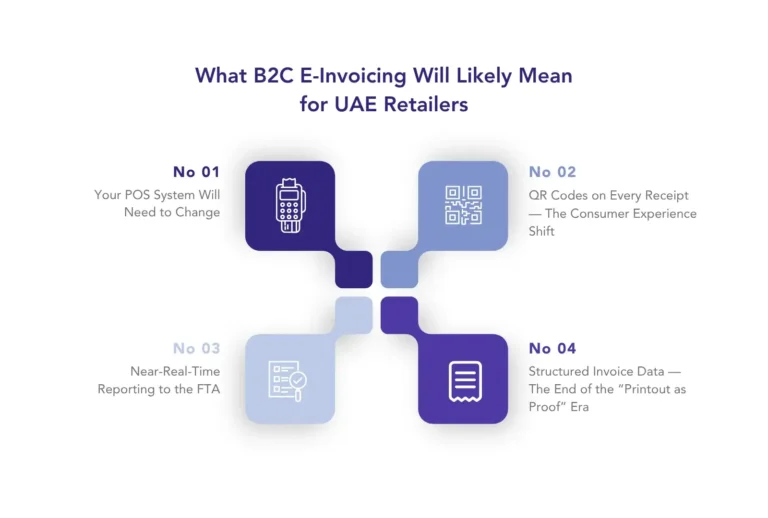
For customers, the change may look small.
They pay. They get a receipt. Maybe there is a QR code on it.
For the retailer, the change is much bigger.
The real work will happen inside the POS system, the billing software, the VAT records, and the reporting process. A future B2C model will not only ask retailers to print a better receipt. It will ask them to create proper digital invoice data at the time of sale.
That is where many businesses may struggle.
A receipt printer can print anything. A compliant system cannot.
1. Your POS System Will Need to Change
Most UAE retailers still use POS systems that are built around receipts.
They print thermal slips. They send PDF receipts. They email order confirmations. Some connect to accounting software at the end of the day. Others only push summary sales data.
That may be fine for current B2C rules.
But it may not be enough when future UAE e-invoicing requirements are extended to consumer transactions.
A future model will likely need the POS system to create structured invoice data. The system will need to capture the correct invoice fields, VAT details, transaction time, branch details, refund data, and possibly customer-facing verification details.
This is very different from printing words on paper.
Retailers may also need to connect their POS or billing system with an Accredited Service Provider, or with another reporting channel created for B2C. The UAE has not confirmed the B2C model yet, so this is not a current obligation. But it is a serious planning point.
The practical advice is simple.
Do not buy or renew a POS system only because it is cheap or easy to use.
Ask the vendor about UAE e-invoicing readiness. Ask whether the system can create structured invoice data. Ask whether it supports API connectivity. Ask whether they are following the Ministry of Finance and FTA developments.
And ask it now, not after a B2C decision is issued.
A poor POS decision today can become an expensive compliance problem later.
2. QR Codes on Every Receipt — The Consumer Experience Shift
The most visible change may be the QR code.
Saudi Arabia already uses QR codes on simplified invoices for consumer transactions. The customer receives the invoice and can scan the code to check key details.
The UAE has not confirmed the same approach for B2C. Still, it is one of the more likely models because it works well in retail.
It is quick. It is simple for the customer. It does not stop the checkout line.
But for the business, it is not just a small square printed on the receipt.
The QR code has to come from the system. It has to match the invoice. It has to reflect the correct VAT data. It also has to work when there are discounts, refunds, cancelled orders, split payments, loyalty points, delivery fees, or branch-level sales.
That is where manual processes fail.
A supermarket cannot manually create QR codes for thousands of receipts. A restaurant cannot ask staff to adjust invoice data during the dinner rush. A pharmacy chain cannot afford mismatched receipt data across branches.
So the QR code issue is really a system issue.
If B2C is added later, retailers will need automated QR generation from the POS, billing software, or e-commerce platform. The customer may only see the code. The FTA will care about the data behind it.
3. Near-Real-Time Reporting to the FTA
Many retailers think the receipt is the main issue.
It is not.
Reporting may become a bigger issue.
In Saudi Arabia, simplified B2C invoice data is reported to ZATCA within the required timeline. The UAE may adopt a similar approach, or it may choose a different reporting window. There is no confirmed B2C rule yet.
But retailers should expect one thing.
If B2C becomes part of FTA e-invoicing, the system will likely require automatic reporting in some form. It may not be full pre-clearance like B2B. It may be lighter. It may allow batch reporting. It may use a short reporting window.
Still, the data will have to move.
That means the billing system must know more than the sale amount.
It must know what was sold, how VAT was applied, which branch made the sale, whether the invoice was cancelled, whether a refund was issued, and whether the data was successfully reported.
This changes the role of retail systems.
The checkout counter becomes part of the tax reporting process.
That may sound dramatic, but it is already the direction of digital tax systems globally. The gap between daily sales and VAT reporting is getting smaller.
Retailers should prepare for that now.
4. Structured Invoice Data — The End of the “Printout as Proof” Era
For years, retailers have treated the receipt as proof.
A till slip. A PDF. A screenshot. An email confirmation.
That habit will not fit neatly into a structured e-invoicing system.
The Ministry of Finance has already clarified that an eInvoice is structured invoice data issued, exchanged, and reported electronically. A PDF, Word file, image, scanned copy, or email is not an eInvoice.
That point matters.
In a future B2C model, the legal and tax record may sit behind the receipt. The paper or PDF may only be the customer-facing version.
Retailers will also need proper digital archiving.
Not a messy folder of PDF receipts.
Not only daily sales summaries.
Not exported Excel files that finance teams later struggle to match with VAT returns.
For businesses already preparing for B2B UAE VAT e-invoicing, this is especially important. B2C should not be built as a separate, disconnected process. A retailer with business customers, corporate accounts, and walk-in consumers needs one clear invoice trail.
The cleaner the system is now, the easier the future shift will be.
Which Sectors Should Pay Closest Attention?
Some retailers can afford to watch and wait.
Others should start preparing earlier.
The difference is not only size. It is volume, system complexity, VAT sensitivity, refund activity, and whether the business also deals with corporate customers.
A small business with one counter may have limited exposure for now. A mid-sized restaurant group with corporate catering, delivery apps, branch-level POS data, refunds, and monthly VAT reporting has a very different risk profile.
The sectors below should pay closer attention.
| Sector | Why B2C E-Invoicing Matters More Here | Risk Level |
| Retail and Supermarkets | High daily transaction volume. POS upgrades take time, and any future change will affect every checkout counter. | High |
| Restaurants and F&B | Many restaurants have both consumer sales and B2B sales, such as corporate catering, events, and office meal contracts. This creates a dual-invoicing environment. | High |
| Pharmacies and Healthcare | VAT treatment can be sensitive. Consumer invoices may also support insurance claims, medical records, or reimbursement documents. | High |
| E-Commerce | Many platforms already operate digitally, but some still issue PDF confirmations rather than structured invoice data. Payment gateways, returns, wallets, and delivery charges add more complexity. | Medium-High |
| Hospitality and Hotels | Hotels deal with high-value consumer bills, corporate bookings, tourism fees, deposits, refunds, and folio billing. These systems will need structured output if B2C rules expand. | Medium-High |
| Professional Services to Consumers | Legal, beauty, wellness, training, and similar services may become relevant if future rules use revenue thresholds or sector-based rollout. | Medium |
The highest-risk business is not always the biggest one.
A restaurant chain may have more invoicing complexity than a larger B2C-only retailer. An online store with multiple payment gateways may face more issues than a physical shop with one POS system.
So retailers should not ask only one question: “Are we in scope today?”
They should ask a better one.
How many systems touch our customer receipt before it becomes part of our VAT records?
That answer will show how ready the business really is.
What Smart Retailers Are Doing Right Now
The current B2C exclusion gives retailers time.
Not a reason to sleep on it.
For a small shop, waiting may not create much trouble today. But for a supermarket, restaurant chain, pharmacy group, e-commerce seller, or hotel, the story is different. These businesses have several systems creating receipts, invoices, refunds, reports, and VAT records every day.
And most of those systems were not built with FTA e-invoicing in mind.
So the better approach is not to rush into software. It is to understand the current setup first.
Where are invoices created? Where do receipts go? Who checks VAT? Which system handles refunds? And how much of the business is actually B2C?
That is where smart retailers are starting.
Step 1 — Conduct a Digital Invoicing Audit
Start with the basics.
How does your business issue receipts and invoices today?
For many retailers, the answer is not as simple as it sounds. A counter sale may create a thermal receipt. An online sale may create an email confirmation. A delivery order may sit inside a platform. A refund may be handled by the branch team. A corporate invoice may come from accounting software.
All of this needs to be mapped.
Paper receipts. PDF emails. In-app receipts. WhatsApp confirmations. ERP invoices. POS slips. Manual invoices. Daily sales summaries.
Put them all on the table.
Then check which system creates each document. Is it the POS? The billing software? The e-commerce platform? The ERP? The accounting team?
This exercise usually exposes weak points.
Manual invoice numbers. Excel adjustments. Refunds posted late. VAT corrections done outside the system. Branches using different receipt formats. Sales summaries that do not match accounting records.
These issues may look manageable today. Under structured e-invoicing in the UAE, they can become real compliance problems.
Step 2 — Classify Your Transactions
Retailers should not only ask, “Are we a B2C business?”
That question is too broad.
The better question is, “What types of transactions do we actually have?”
A restaurant may sell meals to walk-in customers, but also invoice a company for staff catering. A pharmacy may sell medicines to individuals, but also supply a clinic. A boutique may sell to shoppers and also provide uniforms to a corporate client.
Same business. Different transaction types.
This matters because B2C transactions are outside the current mandatory phase. But B2B and B2G transactions are already part of the current UAE e-invoicing mandate, subject to the relevant rollout dates.
So retailers need a clean split.
B2C sales on one side. B2B sales on another. B2G, if any, separately.
Once that split is clear, the business can see what applies now and what is only a future risk.
This step is especially important for mixed businesses. They may think they are safe because most customers are individuals. But even a small corporate sales stream can bring part of the business into scope.
Step 3 — Talk to Your POS or Billing System Vendor
Do this before your next system renewal.
Not after.
Ask your POS or billing vendor clear questions. Can the system generate structured invoice data? Does it support XML output? Can it connect through APIs? Has the vendor reviewed UAE Ministry of Finance requirements? Are they preparing for possible B2C rules?
Then listen carefully.
A vague “yes, we support e-invoicing” is not enough.
Many vendors use the term loosely. Some mean PDF invoices. Some mean invoice automation. Some mean Saudi e-invoicing. Some mean a basic tax invoice template. That does not automatically mean readiness for UAE e-invoicing.
Ask specifically about UAE requirements.
Ask about Accredited Service Provider connectivity. Ask whether their system can handle QR codes, refunds, branch-level invoicing, VAT fields, and future reporting needs.
If the vendor cannot explain the roadmap, that is a warning sign.
A cheap POS system can become very expensive when compliance rules change.
Step 4 — Follow the Official Channels
There will be a lot of noise around B2C e-invoicing.
Some software providers will market early. Some articles will guess dates. Some businesses will hear from a friend that B2C is already mandatory. Others will wait because “it does not apply to us.”
Both reactions can be risky.
Retailers should follow official updates first.
The UAE Ministry of Finance eInvoicing page should be treated as the main source for programme updates. The Federal Tax Authority website should also be followed for tax announcements and future compliance steps. EmaraTax is relevant because it is already being used in the current eInvoicing journey for Accredited Service Provider selection.
Your tax agent should also monitor updates for you.
That does not mean every retailer needs to take action today. It means future decisions should not come as a surprise.
In UAE e-invoicing, one phrase can change the position quickly. A threshold. A sector. A date. A pilot category. A new decision by the Minister.
Retailers should not depend on market rumours for that.
Step 5 — Prepare Your Finance Team
E-invoicing is not only an IT project.
It may start with software, but it lands in finance.
The finance team will need to understand the full invoice journey. When is the invoice issued? What data is captured? How is it transmitted? Where is it stored? How are refunds handled? How are credit notes matched? How does everything connect to the VAT return?
These are not technical questions only.
They affect daily finance work.
Before any major system change, retailers should train their finance team on UAE VAT e-invoicing basics. The team should understand tax invoice rules, simplified invoice concepts, VAT fields, refund treatment, archiving, and reconciliation.
This is where many businesses go wrong.
They connect the system first and fix the process later.
That usually creates more work.
A better approach is to make sure finance understands the process before the software is changed. Otherwise, the business may end up with a connected system and messy records.
That is not readiness.
Step 6 — Consider a VAT Health Check
Before B2C is added to the system, VAT records should be cleaned up.
This is not the exciting part. But it is the part that prevents problems later.
Retailers should review how VAT is applied on sales, discounts, returns, loyalty points, delivery charges, service charges, mixed supplies, exempt items, and zero-rated items. They should also check whether POS reports match VAT returns and accounting records.
Small errors can hide for a long time in retail.
A wrong tax code. A missing credit note. A manual refund. A duplicated invoice. A branch-level adjustment that finance only sees at month-end.
Under a more digital reporting model, these gaps become easier to spot.
That is why a VAT health check should happen before B2C appears on the official UAE e-invoicing timeline. Once the rules are announced, the business may be too busy fixing systems to clean old data properly.
The goal is simple.
Make today’s VAT records clean enough to survive tomorrow’s digital reporting.
How ADEPTS Can Help
Retailers do not need a dramatic transformation plan today.
Most of them need something simpler.
They need to know what kind of transactions they actually have, where the invoice data is coming from, and whether their current systems can cope when the rules move further.
That is where ADEPTS can support.
A good starting point is transaction classification. Many retailers describe themselves as B2C businesses because most customers walk in, pay, and leave. But that is not always the full picture.
A restaurant may also bill companies for staff meals. A supermarket may have bulk corporate customers. A hotel may issue invoices to both tourists and business clients.
Those sales should not all be treated in the same way.
ADEPTS can review your sales flow and identify what is B2C, what is B2B, and what is B2G. This matters because some transactions may already fall under FTA e-invoicing, even if your business is mostly consumer-facing.
VAT is the next area to clean up.
Retail VAT records often look fine at a high level. The problems usually sit underneath. Refunds. Discounts. Loyalty points. Delivery charges. Cancelled bills. Split payments. Service charges. Wrong tax codes. Manual corrections at branch level.
These are small issues until the tax authority has faster access to transaction data.
A VAT health check helps identify those gaps before they become harder to fix.
ADEPTS can also review your POS, ERP, billing, and accounting systems. The purpose is not to push a software change before it is needed. The purpose is to see whether your current setup can support structured invoice data, proper VAT fields, digital archiving, QR code readiness, and possible ASP connectivity in the future.
This is especially important before renewing or replacing a POS system.
A system that works today may still be a poor choice for tomorrow’s UAE e-invoicing environment.
ADEPTS also tracks Ministry of Finance and FTA updates, so retailers do not have to rely on market rumours or vendor claims. B2C rules may come through a separate decision, a phased rollout, a revenue threshold, or sector-based requirements. The wording will matter.
Finance team training is part of the same picture.
E-invoicing is not only for IT teams. Finance teams will need to understand invoice issuance, transmission, archiving, reconciliation, credit notes, refunds, and VAT return matching. If the finance process is weak, even a good system will not fix everything.
B2C e-invoicing in the UAE is not a question of if. It is a question of when. The businesses that prepare quietly now will be the ones that comply confidently later.
Conclusion
B2C e-invoicing is not mandatory in the UAE today.
That point should be clear.
If you run a restaurant, supermarket, pharmacy, boutique, salon, online store, or similar consumer-facing business, your normal B2C receipts are not part of the current mandatory rollout..
But this should not be read as a permanent exemption.
The current rules keep B2C transactions outside the system until a future decision is issued. That wording gives retailers time. It does not give them a reason to ignore the subject completely.
Other markets show the likely direction. Saudi Arabia brought consumer invoices into its e-invoicing model. Oman has included B2C from the start. India used thresholds and QR codes for large businesses.
The UAE has not announced its B2C model yet.
So no retailer should treat 2027 as a confirmed B2C deadline. That would be wrong.
Still, the future of e-invoicing in UAE is clearly moving towards cleaner data, faster reporting, and more connected tax records. B2C is a natural part of that journey, even if it is not in the first mandatory phase.
For retailers, the real decision is not whether to panic.
They should not.
The real decision is whether to keep buying systems that only print receipts, only send PDFs, and only push sales data to finance at the end of the day.
That is where future problems may start.
A retailer that understands its transaction mix, checks its VAT records, questions its POS vendor, and trains its finance team will be in a stronger position when B2C rules arrive.
That is the practical message of B2C e-invoicing UAE.
Not mandatory yet.
Not something to ignore either.
Retailers that want to assess their position early can speak to ADEPTS for a B2C readiness consultation and clear next steps.
FAQs:
There is no confirmed date yet. But B2C is excluded for now, not permanently.
No mandatory action is required today. Still, review your POS, receipts, refunds, and VAT records.
B2B is between businesses and needs buyer tax details. B2C is for final consumers and will likely use a simpler receipt-based model.
No, not for purely B2C sales today. This may change if B2C is included in a future phase.
It is a lighter invoice usually used for consumer sales. The UAE has not confirmed this model for B2C yet.
Saudi Arabia uses simplified invoices with QR codes for B2C sales. The UAE may adopt a similar model, but nothing is confirmed yet.
Not under the current rules. If B2C is introduced later, small businesses may be phased in by size, sector, or revenue.
Check whether your website, payment gateway, and accounting system can produce structured invoice data. PDF confirmations may not be enough later.
Separate B2B, B2G, and B2C sales. Your consumer receipts may be out of scope, but business invoices may already be covered.
No B2C-specific penalties apply today. Once mandatory, fines may apply for non-compliance with future e-invoicing rules.
References
- ‘eInvoicing’. Ministry of Finance – United Arab Emirates, https://mof.gov.ae/en/about-us/initiatives/einvoicing/
- Ministerial Decision No. 243 of 2025 on the Electronic Invoicing System . https://mof.gov.ae/wp-content/uploads/2025/09/Ministerial-Decision-no.-243-of-2025-on-the-Electronic-Invoicing-System.pdf.
- Ministerial Decision No. 244 of 2025 on the Implementation of the Electronic Invoicing System.
https://mof.gov.ae/wp-content/uploads/2025/09/Ministerial-Decision-No.-244-of-2025-on-the-Implementation-of-the-Electronic-Invoicing-System.pdf. - ‘Pre-Approved eInvoicing Service Providers’. Ministry of Finance – United Arab Emirates,
https://mof.gov.ae/en/about-us/initiatives/einvoicing/pre-approved-einvoicing-service-providers/. - ‘Saudi Arabia’s e-Invoices Soar to 8.2bn in 2025, Marking 64% Surge’. Arab News, 7 Jan. 2026,
https://arab.news/2we6c . - ‘The Future Is Open’. OpenPeppol, https://peppol.org/ .
- Varghese, Justin. ‘UAE E-Invoicing Countdown Begins: New Deadlines, Rules and Risks Explained’. Gulf News: Latest UAE News, Dubai News, Business, Travel News, Dubai Gold Rate, Prayer Time, Cinema, 23 June 2026, https://gulfnews.com/business/tax-news/uae-e-invoicing-countdown-begins-new-deadlines-rules-and-risks-explained-1.500583910.