
Management Accounts vs. Statutory Accounts in UAE: What Every Business Owner Must Understand for Corporate Tax
Most UAE business owners have seen both terms. Many use them interchangeably. Some genuinely believe their monthly management pack – the one their bookkeeper sends every quarter – is enough to file a Corporate Tax return.
It is not.
The difference between management accounts vs statutory accounts in UAE is not a technicality. Under Federal Decree-Law No. 47 of 2022, taxable income must be derived from IFRS-compliant financial statements. Not from your management pack. Not from your Xero dashboard. Not from the Excel sheet your finance team updates monthly.
If your CT return is built on the wrong foundation, the numbers are wrong. And the FTA will find out. This guide explains what each type of account is, what the law actually requires, and, critically, what happens when businesses get this wrong.
What Are Management Accounts? Running the Business, Not Reporting to Regulators
Management accounts are internal financial reports. They are prepared for you – the business owner, the directors, the management team – not for any external authority.
There is no law that tells you what to put in them. No accounting standard governs their format. Your bookkeeper or in-house finance team prepares them. An auditor does not sign them. The FTA never asks to see them.
What they typically include:
- Profit and Loss (P&L) – period performance vs prior period or budget
- Cash flow statement – where money is coming in and going out
- Balance sheet snapshot – assets, liabilities, equity at a point in time
- KPIs and dashboards – debtor days, gross margin, cost per department
- Budget vs actuals – are you on track or off?
- Departmental or project breakdown – performance by business unit
Their purpose is decision-making. You use them to price contracts, plan headcount, manage cash, talk to your bank, or figure out whether a branch is performing.
Legal status in UAE: Not required by law. Not submitted to the FTA. Not an accepted basis for a Corporate Tax return. Useful but not legally sufficient for compliance.
What Are Statutory Accounts? The Accounts the Law Actually Requires
Statutory accounts are a different animal entirely.
These are formal financial statements prepared in accordance with legally mandated accounting standards. In the UAE, that means IFRS (International Financial Reporting Standards) or IFRS for SMEs, as specified under Ministerial Decision No. 114 of 2023.
They are not flexible. They are not customised for what you want to see. They follow a prescribed structure:
- Statement of Comprehensive Income (your P&L under IFRS)
- Statement of Financial Position (your Balance Sheet)
- Statement of Changes in Equity
- Cash Flow Statement
- Notes to the Financial Statements
All five are required. One missing component means your financial statements are incomplete – and your CT return is built on an incomplete foundation.
Legal status in UAE: Mandatory under the UAE Corporate Tax Law. Taxable income is derived from these statements under Article 20 of Federal Decree-Law No. 47 of 2022. They form the starting point for your CT return. Subject to FTA review and audit.
Under Ministerial Decision No. 84 of 2025, certain entities must also have these statements externally audited more on that below.
Side-by-Side: What Actually Differs Between the Two
| Dimension | Management Accounts | Statutory Accounts (UAE CT) |
| Purpose | Internal decision-making | FTA compliance + CT return basis |
| Legal requirement | Not required by law | Mandatory under CT Law (Article 20) |
| Accounting standard | No fixed standard | IFRS or IFRS for SMEs (MD 114 of 2023) |
| Frequency | Monthly or quarterly | Annual (per financial year) |
| Audit required? | No | Yes – if revenue > AED 50M or QFZP |
| Who uses them? | Business owners, management | FTA, banks, investors, auditors, free zones |
| Format | Flexible, customised | Strict IFRS – 5 required statements |
| Accepted for CT return? | No | Yes |
| Prepared by | In-house team or bookkeeper | Qualified accountant / auditor |
| Publicly available? | No – internal only | Available to FTA on request or audit |
The table above is clean. But the implications are not. If you have been treating your management accounts as your statutory accounts, your CT filings may be based on figures that were never prepared to the standard the FTA requires.
Why This Distinction Matters More in the UAE Than Anywhere Else
Before June 2023, this distinction barely mattered for most UAE SMEs. No federal income tax meant no FTA scrutiny of financial statements. Your management accounts were sufficient for almost everything – bank meetings, internal reporting, free zone renewals.
That era is over.
Every UAE Corporate Tax return now connects directly back to statutory financial statements. The FTA derives its assessment from IFRS-compliant accounts. The moment you file a CT return, you are implicitly declaring that your taxable income is based on financial statements prepared to the required standard.
Here is where many first-time CT filers go wrong:
The misconception: UAE businesses that historically prepared only management accounts now believe those are sufficient for CT. They are not. The law is unambiguous on this point.
The risk: A CT return filed from management accounts – not IFRS-compliant statutory statements — produces an incorrect taxable income figure. That is a potential under-declaration. The FTA can raise an assessment, impose penalties, and flag the business for closer scrutiny.
The free zone risk: Qualifying Free Zone Persons (QFZPs) depend on clean, audited IFRS financials to maintain their 0% tax status. If the accounting does not meet the required standard, QFZP status is at risk. And if QFZP status is lost, 9% applies – retroactively on the tax period in question.
This is not a technicality you can resolve at year-end. It requires the right foundation from day one.
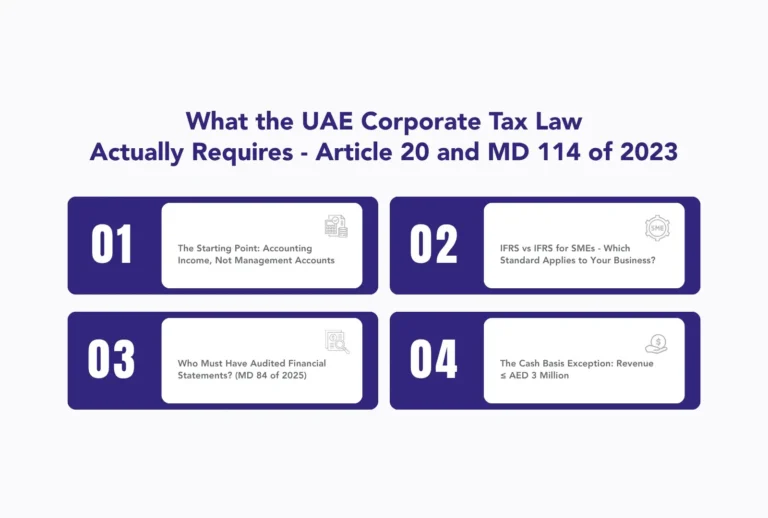
What the UAE Corporate Tax Law Actually Requires - Article 20 and MD 114 of 2023
The Starting Point: Accounting Income, Not Management Accounts
Article 20(1) of Federal Decree-Law No. 47 of 2022 is the anchor provision:
Taxable income is the net profit or loss as per “adequate, standalone financial statements prepared for financial reporting purposes in accordance with accounting standards accepted in the UAE.”
Translation for business owners: Your CT return starts with your IFRS P&L. Not your management pack. Not your bank statement. Not the numbers your bookkeeper sends you on the 15th of every month.
Parker Russell UAE summarises this precisely: taxable persons must independently determine their taxable income using duly prepared, individual (unconsolidated) financial statements that adhere to the applicable accounting standard.
IFRS vs IFRS for SMEs - Which Standard Applies to Your Business?
| Revenue in Tax Period | Accounting Standard | Audit Required? | Notes |
| ≤ AED 3 million | Cash basis (optional) | No | SBR eligibility may also apply |
| > AED 3M and ≤ AED 50M | IFRS for SMEs | No (unless QFZP) | Simplified, less costly than full IFRS |
| > AED 50 million | Full IFRS | Yes – mandatory | Ministerial Decision No. 84 of 2025 |
| Qualifying Free Zone Person | Full IFRS | Yes – mandatory | Regardless of revenue level |
| Tax Group member | IFRS (standalone) | SPFS required | Aggregated SPFS per MD 84 of 2025 |
One important note: IFRS for SMEs is not available to QFZPs, regardless of their revenue size. Free zone businesses claiming the 0% rate must use full IFRS.
Who Must Have Audited Financial Statements? (MD 84 of 2025)
Ministerial Decision No. 84 of 2025, effective for tax periods starting on or after 1 January 2025, defines three mandatory audit categories:
Category 1: Standalone entities with revenue exceeding AED 50 million in the tax period.
Category 2: Qualifying Free Zone Persons – mandatory audit regardless of revenue level.
Category 3: Tax Groups – must prepare audited Special Purpose Financial Statements (SPFS) for each tax period.
For non-residents, only UAE-derived revenue, through a permanent establishment or UAE nexus, counts toward the AED 50M threshold. Global revenue does not trigger the audit requirement.
For most businesses between AED 3M and AED 50M, an external audit is not mandatory for CT purposes. But IFRS-compliant statutory accounts remain non-negotiable as the basis for the return.
The Cash Basis Exception: Revenue ≤ AED 3 Million
Businesses with revenue at or below AED 3 million in the tax period may prepare financial statements on the cash basis of accounting rather than full accrual IFRS. This is an optional concession, not a default.
The cash basis threshold aligns with the Small Business Relief (SBR) revenue ceiling, under which a business can elect to treat its taxable income as zero and pay 0% CT regardless of profit. This is worth checking if you are close to the threshold.
A critical point: cash basis does not mean no records. The FTA still requires full financial records to be maintained for seven years. “Cash basis” refers to the accounting method, not to a documentation exemption.
Accounting Income vs Taxable Income - The Bridge Most Businesses Miss
The Formula (Article 20 CT Law)
Here is the formula that drives every UAE CT return:
Taxable Income = Accounting Income (Net Profit per IFRS Financial Statements) ± Adjustments required under CT Law
Your IFRS P&L is the starting point. But accounting income is not the same as taxable income. The two are connected, but they are not equal. Adjustments must be applied before CT is calculated.
This is the step that confuses most first-time CT filers. They take their net profit figure from their financial statements and apply 9% directly. That is incorrect. The Article 20 adjustments come first.
Common Adjustments: What Gets Added Back or Excluded
| Adjustment Type | Direction | Example | Legal Basis |
| Unrealised gains/losses | Exclude (by election) | Mark-to-market IFRS gains not yet realised in cash | Article 20(2) + election |
| Non-deductible expenses | Add back | Fines, penalties, personal expenses run through the business | CT Law deduction rules |
| Exempt income | Exclude | Participation exemption dividends, qualifying FZ income | Exemption provisions |
| Provisions (excess) | Add back | General bad debt provision not meeting FTA-specific criteria | Deduction rules |
| Related-party transactions | Adjust | Transactions not at arm’s length – must reflect TP pricing | Transfer Pricing rules |
| Depreciation differences | Adjust | IFRS useful life estimate vs FTA-approved method | CT Law amortisation |
| Interest expense (excess) | Add back | Thin capitalisation – interest > 30% of adjusted EBITDA | General Interest Deduction Limit |
| Donations (unapproved) | Add back | Donations to organisations not on FTA-approved list | CT deduction provisions |
A note on unrealised gains: the FTA’s Determination of Taxable Income Guide (CTGDTI1, July 2024) states that if a business does not make the election to exclude unrealised gains in its first tax year, that is treated as an irrevocable decision. Missing this election in year one is a permanent mistake. It cannot be reversed later.
The 5 Most Common Mistakes UAE Businesses Make with Their Accounts

These are not theoretical errors. These are the mistakes ADEPTS sees regularly in first-year CT filings.
Mistake 1: Filing the CT return from management accounts instead of IFRS-compliant financial statements. The most common error, and the most dangerous. Management accounts are not prepared to IFRS. They are not adequate standalone financial statements. A CT return built on them is built on sand.
Mistake 2: Using IFRS for SMEs when revenue exceeds AED 50 million. IFRS for SMEs is only available for businesses below the AED 50M threshold. Above it, full IFRS is required and an external audit is mandatory. Businesses that crossed the threshold in their first CT year and continued on IFRS for SMEs are non-compliant.
Mistake 3: Not applying Article 20 adjustments. Submitting accounting income directly as taxable income, without add-backs, elections, or exclusions, is a filing error. Taxable income and accounting income are not interchangeable. They never are.
Mistake 4: Not maintaining audited financials when required – particularly for QFZPs. Free zone businesses frequently assume their free zone registration exempts them from audit requirements. It does not. Under MD 84 of 2025, QFZPs must have audited accounts regardless of revenue. Failure to maintain these puts 0% status at risk.
Mistake 5: Management accounts and statutory accounts showing materially different numbers with no reconciliation. When the FTA cross-references figures and finds a gap between the two with no explanation, that gap becomes a risk signal. FTA audits are risk-scored. Unexplained mismatches are a red flag.
Free Zone Businesses: You Have More Obligations, Not Fewer
The 0% rate available to Qualifying Free Zone Persons is one of the most attractive features of the UAE CT regime. It is also one of the most condition-heavy.
QFZP status is not automatic. It must be maintained through ongoing compliance – and financial reporting sits at the centre of that compliance.
Audit: QFZPs must maintain audited financial statements under MD 84 of 2025. This is mandatory regardless of revenue. A free zone business with AED 5 million in revenue still requires an external audit if it is claiming QFZP status.
Standard required: Full IFRS. Not IFRS for SMEs. QFZPs cannot use the simplified standard regardless of their size.
Qualifying vs non-qualifying income: If a QFZP has income from activities that do not meet the qualifying income criteria, that income is taxed at 9%. The accounting must separately identify and segregate qualifying income from non-qualifying income. Management accounts typically do not do this. Statutory accounts, properly prepared, must.
Free zone annual submissions: Many free zones require audited accounts annually as a condition of licence renewal – separate from the FTA requirement. These may have different deadlines. A QFZP may face two audit obligations with different timelines. Plan for both.
QFZP status can be lost if financial statements are not audited, not prepared to IFRS, or if the de minimis conditions that at least 95% of revenue is qualifying income are not met. Once lost, it is not automatically recoverable for the period in question.
Tax Groups: The SPFS Requirement Most Groups Have Missed
A Tax Group is a parent company and its subsidiaries that elect to file a single consolidated CT return as one taxable person.
Tax Groups have their own financial reporting obligations under MD 84 of 2025 and many groups are not yet aware of them.
Individual member audit rule: Individual Tax Group members are not required to maintain audited standalone financial statements solely for CT purposes, even if a single member’s standalone revenue exceeds AED 50M.
But here is what IS required: Every Tax Group must prepare and maintain audited Special Purpose Financial Statements (SPFS) for each tax period starting on or after 1 January 2025.
What SPFS means in practice:
- Line-by-line aggregation of standalone IFRS financial statements from all group members
- Intra-group transactions must be eliminated
- No IFRS 3 (business combinations) or IFRS 10 (consolidation) adjustments
- Each subsidiary still needs its own IFRS-compliant standalone statements before the SPFS can be prepared
This is a critical point. A Tax Group cannot simply submit one consolidated IFRS 10 set of accounts for CT purposes. The SPFS is a specific document different from a standard group consolidation. If your group has not yet arranged for SPFS preparation for the 2025 tax year, you are behind.
What Management Accounts Are Actually Useful For in UAE
This guide is not dismissing management accounts. They serve a real purpose just not the one many businesses try to use them for.
Mid-year CT planning: Management accounts help you estimate tax liability throughout the year before statutory accounts are finalised. Useful for provisioning, cash planning, and avoiding a surprise CT bill.
Cash flow management: Monthly management accounts are the primary tool for monitoring cash position, debtor days, payables, and working capital. Statutory accounts arrive months after year-end. For operational decisions, management accounts are essential.
Bank financing: Lenders routinely request management accounts alongside statutory accounts. The statutory accounts show year-end position. The management accounts show recent trading particularly relevant if you are seeking finance mid-year.
Performance monitoring: Departmental P&L, project margin, sales by product line, headcount cost per revenue unit – these granular breakdowns are typically not in statutory accounts. Management accounts carry the operational narrative.
VAT return preparation: A business with monthly management accounts reconciled to its accounting system prepares VAT returns faster and with fewer errors. The management accounts provide the reconciliation trail.
FTA audit support: During an FTA review, management accounts help explain movements in the statutory accounts. They provide the operational story behind the numbers. The FTA does not accept them as a basis for CT but they are valuable as supporting documentation.
The right approach: run both. Use management accounts to run the business. Use statutory accounts to report to the FTA.
How ADEPTS Prepares Your Accounts - Both Kinds
Running a UAE business now means managing two reporting tracks. Most businesses struggle with one. Running both to the right standard, on time requires a team that understands both.
Here is how ADEPTS helps:
IFRS-compliant statutory accounts: We prepare financial statements to the standard required by the CT Law whether full IFRS (for businesses above AED 50M or QFZPs) or IFRS for SMEs (for businesses between AED 3M and AED 50M). These form a clean, defensible starting point for your CT return.
CT return preparation: We apply all Article 20 adjustments add-backs, elections, exclusions, TP adjustments to convert accounting income to the correct taxable income figure. We do not apply 9% to your net profit and call it done.
Management accounts: We set up monthly management account reporting tailored to how your business operates department breakdown, project margins, cash forecasting, budget vs actuals. You see your business clearly throughout the year, not just at year-end.
Audit coordination: For businesses requiring external audit revenue above AED 50M, QFZPs, or Tax Group SPFS we coordinate with statutory auditors to ensure accounts meet both IFRS and FTA requirements. No last-minute surprises at audit time.
Tax Group SPFS: For groups of companies, we prepare the aggregated Special Purpose Financial Statements required under MD 84 of 2025 including the line-by-line aggregation and intra-group elimination.
Backlog accounting cleanup: If your accounts are behind, not IFRS-compliant, or have been prepared to an inconsistent standard, we reconstruct them to the required level before your CT filing.
See our UAE backlog accounting cleanup service
Conclusion
Management accounts run the business. Statutory accounts report to the FTA.
That is the distinction. It is not complicated but the consequences of ignoring it under UAE Corporate Tax are real and documented.
Under UAE CT, taxable income must start from IFRS-compliant statutory financial statements. The audit requirement depends on revenue (above AED 50M), free zone status (QFZP), or Tax Group membership not on business type or personal preference. And the Article 20 adjustments are the mandatory bridge between what your accounts show and what you owe in tax.
If your first CT return was filed from management accounts, or from accounts that were not prepared to IFRS, that is a problem worth addressing now not at the next FTA audit.
ADEPTS prepares both types of accounts. We connect them to a clean, correctly adjusted CT return with the legal citations to back every figure.
FAQs:
No. QuickBooks and Xero outputs are accounting records, not IFRS-compliant financial statements. They can be the source data used to prepare statutory accounts, but the reports themselves do not constitute adequate financial statements under MD 114 of 2023. Your accountant or tax agent must prepare a formal set of IFRS or IFRS for SMEs statements from your accounting system data before filing your CT return.
Corporate Tax returns must be filed within nine months of the end of the relevant tax period. For businesses on a calendar year (January to December), this means the CT return for the year ending 31 December 2024 is due by 30 September 2025. Check your specific tax period if you use a non-calendar financial year.
You are non-compliant with Ministerial Decision No. 84 of 2025. The FTA can reject your return, raise an assessment, and impose penalties. Beyond the immediate filing risk, unaudited accounts where audit is mandatory is a serious compliance failure that increases FTA risk-scoring on your account. Get the audit done before filing — or before your next filing if the return has already been submitted.
Yes. A loss-making business still has a CT obligation — specifically, the obligation to correctly determine taxable income (which may be a loss available to carry forward). IFRS-compliant statements are required regardless of whether the business is in profit or loss. Loss carry-forward can only be claimed if it is supported by properly prepared financial statements.
There is no standalone penalty for the accounting standard itself, the penalty mechanism is triggered when an incorrect or inadequate CT return is filed, or when the FTA conducts an audit and finds the financial statements insufficient. This can result in administrative penalties under the Tax Procedures Law, potential under-declaration assessments, and late payment surcharges. Working with an FTA-approved tax agent reduces exposure.
No. Article 20 of the CT Law requires taxable income to be determined from individual, standalone financial statements, not from a parent’s consolidated group accounts. A UAE branch or subsidiary must prepare its own standalone IFRS-compliant statements, even if the parent group prepares consolidated IFRS 10 accounts. The consolidated accounts are not the legal basis for a UAE CT return.
Full IFRS is the comprehensive set of accounting standards used by large and listed companies globally. IFRS for SMEs is a simplified version – it removes some complex measurement requirements (such as certain fair value accounting rules) and reduces disclosure obligations. In UAE CT terms, both are accepted standards – the choice depends on revenue. Below AED 50M, IFRS for SMEs is available and considerably less resource-intensive. Above AED 50M, full IFRS is mandatory.
For CT compliance, you need statutory accounts. Management accounts are not a legal requirement but are highly recommended for running the business effectively. In practice, businesses that maintain good monthly management accounts find it significantly easier and less costly to prepare year-end statutory accounts because the underlying data is already clean, reconciled, and current.
The statutory accounts figure – AED 380,000 – is the starting point for your CT calculation. But even that is accounting income, not taxable income. Article 20 adjustments must still be applied. The gap between your management accounts and statutory accounts is normal (different timing, different treatment of provisions and accruals) but must be reconcilable. If the FTA asks why the two figures differ, you need a clear explanation.
The FTA requires businesses to maintain financial records and supporting documents for seven years from the end of the relevant tax period. This includes the financial statements themselves, source documents (invoices, contracts, bank statements), accounting records, and any documents supporting the adjustments made in the CT return. Even cash basis filers and Small Business Relief claimants must comply with the record-keeping requirement.
Yes, if they are registered as a taxable person for CT. Natural persons conducting business activities in the UAE with revenue exceeding AED 1 million in a calendar year are within the scope of UAE Corporate Tax. They must prepare financial statements in accordance with the applicable accounting standard and maintain records for seven years. Sole traders on cash basis (revenue ≤ AED 3M) have a simplified option, but records are still mandatory.
Under IFRS (IAS 12), the introduction of UAE Corporate Tax creates deferred tax assets and liabilities in IFRS financial statements where there are temporary differences between the carrying value of assets/liabilities in the accounts and their tax base. For most SMEs on IFRS for SMEs, the deferred tax treatment is simplified. For full IFRS preparers – particularly those with significant fixed assets, long-term provisions, or financial instruments – the deferred tax calculation requires specialist input. This is a new requirement that many UAE businesses are encountering for the first time.
Changes to accounting method or financial year for CT purposes are possible but require FTA approval. Switching accounting standards (for example, from IFRS for SMEs to full IFRS) or changing the financial year end must be notified and in some cases approved through EmaraTax. Switching without proper notification creates a compliance risk. Seek guidance before making any change.
The General Interest Deduction Limitation (GIDL) under the CT Law restricts the deductibility of net interest expense to 30% of adjusted EBITDA (earnings before interest, tax, depreciation, and amortisation as calculated under the CT Law). Any interest expense exceeding that limit must be added back to taxable income. This is one of the key Article 20 adjustments — and it requires your IFRS P&L to show interest expenses and EBITDA components with sufficient granularity. If your business is significantly debt-funded, the thin capitalisation calculation should be run before finalising the CT return.
Yes. Exempt persons including qualifying government entities, qualifying public benefit entities, and certain investment funds are still required to maintain financial records and prepare financial statements in accordance with IFRS or IFRS for SMEs under the CT Law. Exemption from paying CT is not an exemption from financial reporting obligations. Certain exempt entities also have registration and notification obligations with the FTA, which require supporting financial documentation.
References
- Federal Decree-Law No. 47 of 2022 on the Taxation of Corporations and Businesses (UAE Corporate Tax Law). uaelegislation.gov.ae
- Ministerial Decision No. 114 of 2023 — Applicable Accounting Standards. mof.gov.ae
- Ministerial Decision No. 84 of 2025 — Audited Financial Statements Requirement. mof.gov.ae
- FTA – Accounting Standards and Interaction with Corporate Tax Guide (November 2023). tax.gov.ae
- FTA – Corporate Tax Guide: Determination of Taxable Income, CTGDTI1 (July 2024). tax.gov.ae
- Parker Russell UAE – UAE Corporate Tax: IFRS and Accounting Compliance. parkerrusselluae.com
- Abbas Accounting – Accounts and Financial Statements in UAE Corporate Tax Regime (April 2026).
abbasaccounting.com - Kreston Menon – UAE Corporate Tax: Accounting Profits and Taxable Income. krestonmenon.com
- IFRSLAB – UAE Corporate Tax 2025: Complete Filing Guide (November 2025). ifrslab.ae
- Profitz Advisory – UAE Audit Mandate 2026: SME Relief vs AED 50M Rule (October 2025).
profitzadvisory.com