
IFRS Explained: How Global Accounting Standards Impact Your Audit & Financial Success

In the UAE, businesses must adhere to strict international standards for financial reporting. These standards, known as the International Financial Reporting Standards (IFRS), are based on globally accepted accounting principles.
IFRS is a mandatory prerequisite for legal standing and tax compliance in the UAE’s mature 2026 regulatory environment. The 2026 deadlines are approaching. Are you ready for them?
IFRS ensures financial reports are clear, consistent, and comparable worldwide. This builds trust with investors and regulators. By complying with IFRS, companies align themselves with international best practices
In this post, we’ll break down how IFRS impacts audits and financial success—so you avoid the severe administrative and criminal penalties associated with the Capital Market Authority (CMA) and Federal Tax Authority (FTA) enforcement cycles. As of 2026, IFRS is no longer a choice for growth; it is the baseline for the UAE Corporate Tax regime and mandatory ESG disclosures under Federal Decree-Law No. 11 of 2024.
The 2026 Compliance Mandate: Why IFRS is Non-Negotiable
With the first full-cycle compliance year under the new UAE Corporate Tax system, the landscape has shifted significantly. IFRs was once voluntary but now it is an absolute compulsion. Initial registration grace periods, regulators are no longer offering leniency.
The Corporate Monitoring Authority (CMA) has brought with it severe consequences for non-compliance. Fines of up to AED 200 million for reporting misconduct are a massive increase as well as a source of tension for businesses.
If businesses ignore IFRS now, it can be devastating.
What is IFRS and Why Does it Matter in the UAE?
What is IFRS?
International Financial Reporting Standards (IFRS) are global rules for financial reporting. These rules are there to give a level of uniformity to the financial language of businesses. This is very important for businesses to achieve international level. IFRS now includes the International Sustainability Standards Board (ISSB) frameworks (IFRS S1 and S2), which are mandatory for large emitters and listed firms as of May 30, 2026.
Why Does IFRS Exist?
For enforceable transparency and tax-base protection. When financial reports follow the same rules, investors and regulators can trust what they see. It makes comparing companies easier and builds confidence in the market.
When Did the UAE Adopt IFRS?
The UAE adopted IFRS in 1999 for listed companies and financial institutions. Over the years, more businesses started following it, especially those looking to attract global investors or expand internationally. While the UAE adopted IFRS in 1999, the 2026 era marks the total subrogation of the SCA by the Capital Market Authority (CMA), broadening the scope of IFRS enforcement to all financial activities including virtual assets.
Pre and Post 2026 Comparison
| Feature | Pre-2026 (Implementation) | 2026 (Enforcement) |
| Primary Regulator | SCA | CMA (with broader executive powers) |
| Sustainability | Voluntary CSR | Mandatory GHG reporting (Scope 1 & 2) |
| Corporate Tax | Registration/Grace Periods | Mature Audits & Risk-based monitoring |
| Financial Statements | IAS 1 Structure | IFRS 18 Categories (Operating, Investing, Financing) |
How IFRS Helps UAE Businesses
- Brings in More Investors – Foreign investors trust clear, standardized reports. IFRS makes UAE businesses more appealing.
- Boosts Business Credibility – Transparent reporting builds trust with banks, partners, and customers.
- Opens Global Opportunities – Many international lenders and partners prefer working with IFRS-compliant businesses.
- Improves Decision-Making – Clear financial data helps companies make smarter moves.
- Global Acknowledgement: The UAE is a major business hub with global investors. IFRS ensures financial reports meet international standards. This builds trust with investors and regulators.
What Happens if You Don’t Follow IFRS?
Since following IFRS compliance UAE is a must, you will have to face some serious issues with the authorities when you don’t. IFRS isn’t optional anymore. It’s required mandatory for all the listed companies, banks, and others under SCA (Securities and Commodities Authority) and the Central Bank of the UAE.
If businesses do not follow these standards, these things can happen:
- Administrative fines up to AED 200 million or ten times the illicit profit achieved
- Statutory Liability for Directors and Executives – Under Article 29 of the Capital Market Law, board members face personal liability for misleading IFRS disclosures in prospectuses
- AED 10,000 Administrative Penalty for failure to register for Corporate Tax, which requires IFRS-compliant financial statements for submission
- Suspension of Licenses and M&A Freezes – The Central Bank and CMA now block dividend distributions and acquisitions for entities with unresolved reporting gaps
IFRS compliance gives lots of credibility to your business. This means easy investment procurement for your business. This is especially true if you would like foreign investors to jump in. They will see crystal clear reporting and won’t have a reason to hesitate. In case you don’t comply, your reports will be ambiguous, and your chances of getting investments will be very thin too.
The High Cost of Non-Compliance: 2026 Enforcement Case Studies
In 2024 and 2025, several insurers were downgraded or barred from launching new products due to deficiencies in IFRS 17 implementation. These issues caused significant financial setbacks and reputational damage, highlighting the direct consequences of non-compliance.
A major link between IFRS and Corporate Tax has emerged. The FTA can now reject a tax return if the underlying IFRS audit is missing, leading to late filing interest of 14% annually. This is a critical development for businesses to understand—failure to comply with IFRS directly impacts tax filings, further amplifying the financial penalties involved.
Key Differences Between IFRS and Previous UAE Accounting Standards

IFRS came around in 1999. Before IFRS, businesses in the UAE used different accounting methods. Some businesses followed local rules, while others used industry-specific practices. The financial reports were inconsistent and that was a huge concern for investors. They couldn’t understand or trust.
When the UAE adopted IFRS, everything changed. Reports became structured and standardized. Businesses had to follow clear international rules. This made financial statements more transparent and easier to compare.
Let’s look at one major difference.
Revenue Recognition: Integration of Mandatory E-Invoicing (July 2026)
Before IFRS, companies in the UAE had different ways of recognizing revenue. Some recorded sales as soon as they sent an invoice. Others followed flexible industry practices. There were no strict guidelines.
With IFRS, revenue recognition became structured and consistent. The IFRS 15 standard introduced five simple steps:
- Identify the contract with the customer.
- List the goods or services the company will provide.
- Set the total price for the contract.
- Decide how to divide the price across the goods/services.
- Recognize revenue only when the company delivers the goods/services.
This means companies can’t record revenue too early. They must prove they delivered value before booking sales. This prevents inflated earnings and makes financial reports more trustworthy.
IFRS 15 compliance is now verified through the FTA’s real-time Peppol network, integrating Mandatory E-Invoicing by July 2026.
Asset Valuation: Fair Value vs. Historical Cost
In the past, many UAE businesses used historical cost for asset valuation. If a company bought a building 20 years ago, it stayed on the books at its original price, even if its market value had tripled.
IFRS takes a different approach. It promotes fair value accounting, meaning assets are valued based on their current market price. For example:
- Real estate is revalued regularly.
- Financial instruments reflect actual market conditions.
- Impairments (like a drop in asset value) must be recognized immediately.
As of 2026, asset valuation must reflect climate-related risks and fair value adjustments for ESG-linked financial instruments under IFRS 9 amendments.
This gives a more accurate picture of a company’s financial health. Investors and stakeholders get real-time insights rather than outdated numbers.
New IFRS 18 Income Statement Categories
| IFRS 18 Category | Description of Included Items | Impact on 2026 Reporting |
| Operating | Residual category for main business activities. | Standardized subtotal for “Operating Profit” is now mandatory. |
| Investing | Returns from assets not used for main operations. | Clearer distinction from operational gains. |
| Financing | Expenses from raising capital and lease interest. | Tightened classification for interest/dividends. |
| Income Taxes | All tax-related income and expenses. | Direct reconciliation with Corporate Tax filings. |
| Discontinued Ops | Results from discontinued business units. | Consistent with IFRS 5 requirements. |
The Impact of IFRS Adoption
A change is a change even if it is for the better. Same happened with IFRS. When it became mandatory, the signals were mixed. Business struggled and some even had to make difficult adjustments. Some were lucky to see the benefits right away.
2026 data confirms that 98% of listed firms have now transitioned to the standardized IFRS 18 income statement structure to facilitate cross-border comparability.
- Foreign investment increased, as investors trusted IFRS-compliant reports more.
- Audits became smoother, with clearer rules on revenue and asset valuation.
IFRS’s Impact on Audits in the UAE
IFRS has really changed the world of financial auditing in the UAE. Financial reports are now very detailed. Auditors dig deeper, put more thought and more research in the process. There’s less room for guesswork or outdated methods.
Before IFRS, audits were simpler. Businesses had more flexibility in reporting. Now, auditors follow stricter rules. They check valuations, impairments, and disclosures carefully. This makes financial statements more transparent—but also more complex.
Let’s look at two key areas where IFRS has made a big impact.
Inventory Valuation Auditing: More Precision, Less Flexibility
In the past, UAE businesses had different ways to value inventory. Some used outdated costs. Others applied broad estimates.
Under IFRS (IAS 2 – Inventories), inventory must be valued at the lower of cost or net realizable value (NRV). This means:
- If the market price drops, businesses must adjust inventory values.
- Auditors must verify cost calculations and market price assumptions.
- Companies can no longer overstate inventory to improve financial results.
For auditors, this means a closer review of cost methods, supplier contracts, and market trends. They ensure businesses aren’t inflating their assets.
As of 2026, auditors must also verify GHG (Greenhouse Gas) emissions data independently, adding a new layer of complexity to the process.
Impairment of Assets Auditing: A Closer Look at Value Drops
Under older standards, many companies didn’t regularly check for asset impairment. A building, machine, or investment could sit on the books at full value—even if its real worth had dropped.
IFRS (IAS 36 – Impairment of Assets) changed that. Now, businesses must:
- Test for impairment regularly.
- Use market data and forecasts to check asset value.
- Recognize losses immediately, instead of delaying them.
For auditors, this means more work. They must review impairment indicators, like declining sales or industry downturns. They also check how businesses calculate asset values. This has made audits more technical and data-driven.
Like inventory valuation, the 2026 standards also require independent verification of GHG emissions data when calculating impairment losses.
Audited Special Purpose Financial Statements (SPFS) for Tax Groups
Starting in 2026, all Tax Groups must now prepare audited Special Purpose Financial Statements (SPFS), regardless of their revenue. This includes ensuring that intra-group transactions are fully eliminated, which is critical for accurate corporate tax filings.
This change, driven by Ministerial Decision No. 84 of 2025, is mandatory for entities with revenue exceeding AED 50 million and for all Qualifying Free Zone Persons (QFZPs). Failure to provide these audited statements may result in the FTA rejecting tax relief claims or, for QFZPs, revoking the 0% tax status.
Case Study: An Audit Firm’s Experience with IFRS
- Spend more time on asset valuations and impairments.
- Train staff on new IFRS rules.
- Use advanced tools to verify fair values and financial assumptions.
Actionable Tip: Get IFRS-Trained Auditors Early
IFRS audits aren’t just routine checks anymore. They require expertise. Businesses should engage FTA-approved tax agents who are also IFRS-certified early—not just at year-end. This helps:
- Spot compliance issues before they become a problem.
- Avoid last-minute adjustments that delay reports.
- Ensure smoother, stress-free audits.
Achieving Financial Success Through IFRS Compliance
Better Access to International Capital Markets
Want funding from global investors? They need numbers they can trust. IFRS makes financial reports clear and consistent. That’s exactly what international lenders and investors look for.
The 2026 National Investment Strategy sets a clear goal: attract $65.3 billion in Foreign Direct Investment (FDI) by 2031. IFRS is the bridge to this ambition, providing the transparency and reliability that international investors demand.
Take this example: A UAE-based manufacturing company wanted a loan from a European bank. The bank asked for financial statements. Since the company followed IFRS, the reports were transparent, detailed, and internationally recognized. The bank also required verified ESG scores alongside the IFRS financial statements. The bank approved the loan. Expansion plans moved forward.
Without IFRS standards, things might have been different. Some banks reject funding if reports don’t meet global standards. Others ask for extra documentation, delaying deals. IFRS helps businesses avoid these roadblocks.
Enhanced Strategic Decision-Making
Good decisions start with accurate numbers. IFRS helps businesses see the real picture. No hidden losses. No overvalued assets. Just clear financial health insights.
Imagine a retail company in Dubai. Sales are strong, but profits seem lower than expected. Thanks to IFRS reporting, the finance team spots the issue: high inventory costs and slow-moving stock. They adjust pricing, cut waste, and boost cash flow. Problem solved—before it became a crisis.
With reliable data, business leaders can:
- Identify risks early.
- Plan growth strategies with confidence.
- Avoid financial surprises.
Using Management-Defined Performance Measures (MPMs) under IFRS 18 helps provide audited, transparent non-GAAP metrics to investors, offering deeper insights into financial health.
Actionable Tip: Train Your Finance Team in IFRS
IFRS is detailed. Mistakes can lead to compliance issues. That’s why companies investing in training IFRS-ready ERP systems see smoother audits and stronger financial management.
Invest in IFRS-ready ERP systems that automate 2026 sustainability reporting and e-invoicing workflows to ensure your business stays ahead of compliance requirements.
Common IFRS Challenges and How to Overcome Them in the UAE
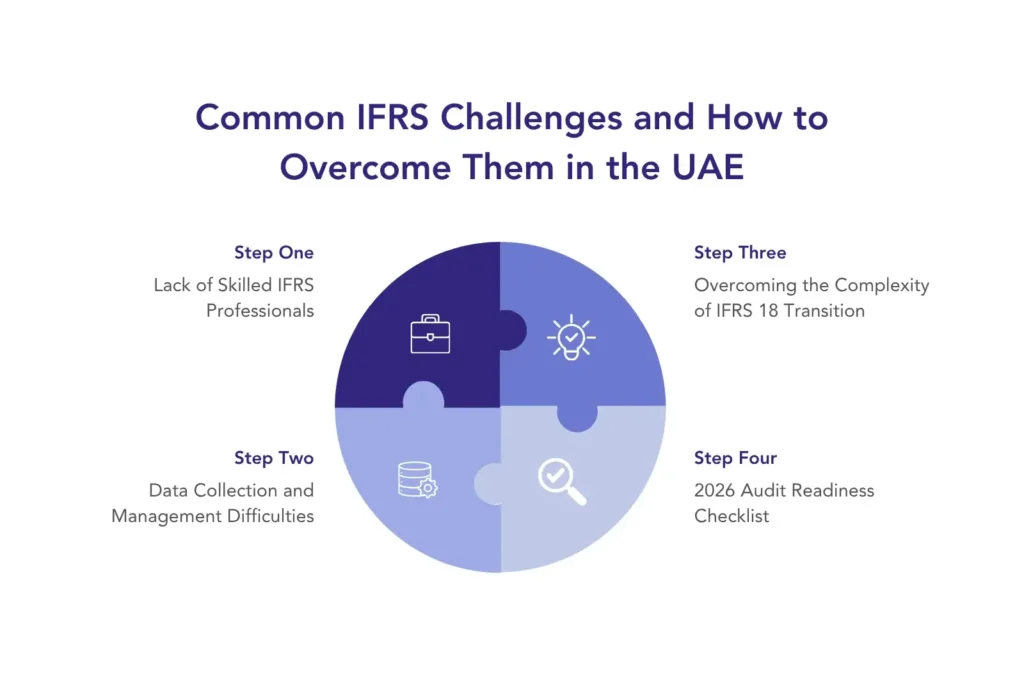
Lack of Skilled IFRS Professionals
IFRS is detailed. It requires expertise. But many businesses in the UAE lack trained accountants who fully understand the standards. This leads to errors, IFRS compliance UAE risks, and delayed reporting.
The demand for actuarial and sustainability accountants has increased by 43% since 2020, reflecting the growing need for professionals with expertise in both IFRS and sustainability reporting.
How to Fix It:
- Invest in ongoing IFRS training – IFRS changes over time. Regular training keeps your finance team updated.
- Hire IFRS specialists – If your team isn’t fully equipped, bring in experts to guide the process.
- Use external consultants – Auditors and advisory firms can help ensure compliance while your staff is in the process of IFRS learning.
Real Example: A UAE-based logistics company struggled with IFRS lease accounting (IFRS 16). After training their finance team, they reduced reporting errors by 40% and streamlined audits.
Data Collection and Management Difficulties
IFRS relies on accurate, well-organized financial data. But many businesses still use outdated systems or struggle with the challenge of integrating financial data with the National Measurement, Reporting, and Verification (MRV) platform for climate reporting, leading to errors and missing information.
How to Fix It:
- Implement strong accounting software – Automated tools help track financial data with precision.
- Integrate systems – Link accounting, sales, and inventory platforms for smoother data flow.
- Set up clear processes – Define who collects, verifies, and reports financial data to avoid last-minute errors.
Example: A retail company in Dubai faced data mismatches when preparing IFRS-compliant financials. After upgrading to a cloud-based accounting system, they reduced reporting time by 50% and improved accuracy.
Overcoming the Complexity of IFRS 18 Transition
The transition to IFRS 18 brings additional challenges, particularly around the reclassification of the Chart of Accounts into five new IFRS categories. Businesses can streamline this process by using AI-powered mapping tools to handle the complexities of categorizing financial data and ensuring compliance with the new standards.
Expert Quote: “The complexity of IFRS 18 transition can be significantly reduced by leveraging AI-driven solutions for mapping and data classification,” says a 2026 Technology Provider specializing in Digital MRV and IFRS-ready cloud solutions.
2026 Audit Readiness Checklist
To ensure your business is fully prepared for the 2026 IFRS audit requirements, follow this checklist:
- Verification of Ministerial Decision 84 eligibility: Confirm whether your business qualifies for mandatory audited financial statements (entities with revenue above AED 50 million, QFZPs).
- Preparation of IFRS 18 comparative data for 2026: Gather the necessary data for accurate comparisons.
- Reconciliation of VAT-CT revenue mismatches: Ensure all VAT and Corporate Tax revenues align correctly.
- Documentation of Transfer Pricing (TP) for related-party transactions above AED 500,000: Make sure all TP documentation is up-to-date and available for review.
The 2026 CMA Framework: A New Era for UAE Securities
On January 1, 2026, the Capital Market Authority (CMA) replaced the Securities and Commodities Authority (SCA) under Federal Decree-Laws No. 32 and 33 of 2025. This shift marks the UAE’s commitment to aligning with international “mature market” standards, much like those in the UK and Singapore, to protect the surge of over 6,700 millionaires who entered the market between 2024 and 2025.
The Statutory Prospectus Liability Framework now holds issuers, boards, and advisers explicitly liable for any missing or misleading information. Additionally, the CMA has Early Intervention Powers (Article 54) to order mergers or remove management if a firm is likely to breach liquidity requirements.
The Whistle-Blower Protections (Article 60) immunize reporters from criminal or civil liability, promoting transparency in the UAE’s evolving financial ecosystem. Firms have a one-year transition period, which ends on January 1, 2027, to regularize their status under the new framework.
CMA 2026 Criminal and Administrative Sanctions
| Offence Category | 2026 Sanction (Criminal) | 2026 Sanction (Administrative) |
| Insider Trading | Min. 1 year prison + AED 1M-250M fine | Fine up to AED 200M or 10x profit |
| Financial Activities w/o License | Min. 1 year prison + AED 1M-250M fine | License revocation / Employment ban |
| False Prospectus Info | Min. 1 year prison + AED 1M-250M fine | Trading suspension up to 3 years |
Mandatory Climate Disclosures: IFRS S1, S2, and UAE Climate Law
Federal Decree-Law No. 11 of 2024 has transformed climate action from voluntary to legally binding. All UAE entities (mainland and free zone) must measure and report Scope 1 and 2 emissions by May 30, 2026. This requirement aligns with IFRS S1 (General Sustainability) and IFRS S2 (Climate-related Disclosures), which have now been integrated into UAE financial reporting practices.
Non-compliance with these requirements can result in fines ranging from AED 50,000 to AED 2 million, doubling for repeat violations. Additionally, Huge Carbon Emission Entities (those emitting more than 0.5 MtCO2e) must be registered by June 28, 2025. For smaller businesses, 2026 is the year they must have their digital MRV (Measurement, Reporting, and Verification) systems operational.
The May 30, 2026 Deadline: Universal Compliance Checklist
- All businesses must align with GHG reporting (Scope 1 & 2).
- Register with the National Carbon Credit Registry (NRCC) if applicable.
- Ensure MRV systems are operational for emissions verification.
Conclusion
2026 marks the end of “learning” and the start of “proof.”
Embrace IFRS as the core of your 2026 risk management and tax optimization strategy. The integration of CMA oversight, Corporate Tax audits, and Mandatory ESG reporting means that financial reporting is now the single most important control point for UAE business survival.
Success in 2026 belongs to the businesses that move beyond compliance to leverage audited transparency as a competitive advantage in the global market. This approach not only ensures regulatory compliance but also positions businesses to access better credit ratings, lower their cost of capital, and gain faster regulatory approvals.
References
- International Accounting Standards Board. International Financial Reporting Standards (IFRS).
https://www.ifrs.org/issued-standards/ - IFRS Foundation. IFRS S1 and IFRS S2 Sustainability Disclosure Standards.
https://www.ifrs.org/issued-standards/ifrs-sustainability-standards-navigator/ - International Sustainability Standards Board. General Sustainability-Related Disclosures (IFRS S1).
https://www.ifrs.org/projects/work-plan/general-sustainability-related-disclosures/ - International Sustainability Standards Board. Climate-Related Disclosures (IFRS S2).
https://www.ifrs.org/projects/work-plan/climate-related-disclosures/ - UAE Ministry of Finance. UAE Corporate Tax Law (Federal Decree-Law No. 47 of 2022).
https://mof.gov.ae/corporate-tax/ - Federal Tax Authority. Corporate Tax Guide and Compliance Requirements.
https://tax.gov.ae/en/corporate.tax.aspx - UAE Government Portal. Climate Change Laws and Environmental Regulations.
https://u.ae/en/information-and-services/environment-and-energy/climate-change - Securities and Commodities Authority. Regulatory Framework for Listed Companies and IFRS Compliance.
https://www.sca.gov.ae/en/services/regulations.aspx - World Bank. The Role of IFRS in Enhancing Financial Transparency.
https://www.worldbank.org/en/topic/financialsector - PwC. IFRS 18 Presentation and Disclosure in Financial Statements.
https://www.pwc.com/gx/en/services/audit-assurance/ifrs-reporting.html - Deloitte. IFRS in the Middle East: Implementation and Challenges.
https://www2.deloitte.com/middleeast/en/pages/audit/topics/ifrs.html - KPMG. UAE Corporate Tax and IFRS Alignment Insights.
https://home.kpmg/ae/en/home/insights.html
Related Articles