
VAT Grouping UAE 2026: FTA's New Scrutiny Rules and What They Mean for Your Group Structure

Your VAT group was set up years ago. Returns are filed. One TRN. Everything looks clean. That used to be enough. It isn’t anymore.
In 2026, the Federal Tax Authority is looking at how your business actually operates and not just the filings. They want to see who controls what. How money moves. Whether your entities function like one business or just appear to.
This means VAT grouping in the UAE has shifted. What was once an administrative setup is now a tax position that must be justified. The law has not changed in a dramatic way on paper. But enforcement is a lot more detailed now.
Now, if your group fails the integration test, the impact is not limited to future filings. The FTA can now opt to reassess your past VAT positions. Deny input tax. Shift liabilities. For holding structures, family groups, multi-entity retail chains, and shared-service models, this is one of the most important VAT risks in 2026.
We have created this guide that breaks down what the FTA is actually checking, where the risks sit, and what you need to do now. If you have a business, this is a must read for you.
What Is VAT Grouping in the UAE?
VAT grouping in the UAE is governed by Article 4 of the VAT Law. It allows two or more legal entities established in the UAE, under common control, to register as a single taxable person. Instead of each entity filing separately, the group operates under one Tax Registration Number. One consolidated VAT return is filed through EmaraTax in a group.
At a basic level, nothing changes about the tax rate. The standard 5% VAT still applies. What changes is how transactions are treated within the group. Intra-group supplies are ignored for VAT purposes. No VAT is charged between members. No output tax. No input recovery. These transactions simply fall outside the scope.
The benefit of grouping together comes from these things. It simply means less administrative work. Smoother cash flow. Fewer internal tax charges.
The FTA typically processes VAT group applications within 20 working days. Once approved, the group is treated as one entity for VAT purposes. Set up the group once. File together. Move on. This was the standard practice before these latest rules regarding VAT groups in the UAE.
That assumption no longer holds, though. Deep and detailed changes are now in place and they affect more and more groups now.
How VAT Grouping Works - The Basics

Before we dig into the details of the new rules, let’s run through the basics first.
Eligibility Requirements
Not every set of companies can form a VAT group. The rules are specific on which companies can actually form a group. Each member must be a legal person with a fixed establishment in the UAE. This is non-negotiable.
The entities must also be related. That usually means one entity controls the others, or there is common ownership across the group.
There is also a financial threshold. The combined taxable supplies of the group must meet the mandatory registration threshold of AED 375,000.
One important restriction. A company cannot be part of more than one VAT group at the same time.
There is also a newer development many businesses overlook. Under Cabinet Decision No. 100 of 2024, if a member stops making taxable supplies, it must be removed from the group. This is not optional. Leaving it unchanged creates exposure.
The Representative Member
Every VAT group has a Representative Member. This is the entity that deals with the FTA on behalf of the entire group. It files the consolidated VAT return. It holds the TRN. It submits applications and amendments through EmaraTax.
But the key point is liability. The Representative Member is responsible for the VAT obligations of the entire group. Not just its own transactions. Everything. If something goes wrong at group level, the FTA will not chase each entity separately. It will deal with the Representative Member first.
That is a structural risk many groups underestimate.
The Core Advantage: Intra-Group Transactions
The biggest benefit of VAT grouping is how internal transactions are treated.
Take a simple example.
Company A provides management services to Company B. If they are separate VAT registrants, Company A must charge 5% VAT. Company B then recovers it, subject to conditions. If they are a VAT group, that step disappears. No VAT will be charged and no recovery either.
This reduces cash flow friction. It also reduces compliance work. But this advantage is exactly why the FTA is now paying closer attention. Because when grouping is used without real integration, it starts to distort the tax outcome.
What Has Changed in 2026? FTA's New Scrutiny Framework
This is where the shift happens.
Two legal updates sit in the background:
- Federal Decree-Law No. 16 of 2025
- Federal Decree-Law No. 17 of 2025
Both came into effect on 1 January 2026.
On paper, they refine the VAT Law and the Tax Procedures Law. In practice, they expand how the FTA enforces compliance.
VAT Grouping Is Now a Tax Position
Earlier, VAT grouping felt like an election. You met the criteria. You applied. You moved on. That mindset is outdated. In 2026, VAT grouping is treated as a position that must be continuously supported.
The question is no longer about the ownership criteria? Under the new laws, the real question is if the companies actually operate as one integrated business?
If the answer is no, the group is exposed. Even if it was valid when first formed.
Risk-Based Audits Are Now Targeting VAT Groups
The FTA is no longer auditing randomly. Its 2023–2026 strategy is built on risk profiling. Data is the driver.
VAT returns are now cross-checked against:
- Corporate Tax filings
- Customs data
- Financial disclosures
If your VAT group files a consolidated return, but individual entities report very different numbers for Corporate Tax, that mismatch stands out immediately.
That is a trigger. Another pressure point is VAT credits. Input VAT is now subject to a five-year limitation window. Credits sitting from earlier years are being reviewed more aggressively. Groups carrying large balances from prior periods are on the radar.
The Shift: Paper Links Are Not Enough
This is the most important change to understand. Sharing a TRN does not prove integration. Having common ownership does not prove integration either. Even having intercompany transactions does not prove integration.
The FTA is looking at substance.
If your entities:
- operate independently
- have separate management
- run different businesses with no real connection
then grouping starts to look artificial. And the law gives the FTA power to act.
It can force de-grouping if:
- the conditions are no longer met
- there is no real economic, financial, or organizational link
- or there is a reasonable basis to believe the structure reduces tax improperly
This is not theoretical. It is already happening in audits.
Why Older VAT Groups Are at Highest Risk
Groups formed years ago share a common pattern.They were created for efficiency. Not for integration. Over time, businesses change. Activities shift. New entities are added. Others stop trading. But the VAT group stays the same.
No review. No restructuring. No documentation update. That gap is exactly what the FTA is now testing. If your group has not been reviewed in the last two to three years, it is not a neutral position anymore. It is a risk position.
The 3-Part Integration Test the FTA Now Applies
Most businesses are still guessing what the FTA checks.
It is not a mystery. The framework is already in the law. Article 4 and the Executive Regulations use three clear lenses: financial, economic, and organizational integration. If your group cannot hold up across all three, it is exposed.
Let’s break this down properly
Test 1: Financial Integration
This is the first filter. And often the easiest place to fail. The FTA wants to see whether the group behaves like a single financial system. Not separate wallets under one name.
What they expect to see:
- Centralized treasury or cash pooling
- Consolidated financial reporting
- Shared banking relationships or coordinated funding
- Intercompany loans that are properly documented and structured
- A clear flow of funds across entities, not isolated balances
What raises concern:
- Each entity has completely separate bank accounts with no linkage
- Independent accounting systems with no consolidation
- No visibility of group-level financial control
- Intercompany balances that exist on paper but are not managed properly
This is where many groups get caught. They assume common ownership is enough. It is not. If money does not move like a group, the structure does not look like a group.
Test 2: Economic Integration
Now the FTA steps back and asks a bigger question. Why do these entities exist together? Is there a shared business purpose? Or are they simply parked under one structure?
What the FTA looks for:
- A common commercial objective across entities
- Activities that support or depend on each other
- A value chain that connects the businesses
- Intra-group transactions that reflect real commercial substance
What raises concern:
- Entities operating in completely unrelated industries
- No dependency between entities
- No clear business logic behind grouping
- Transactions that exist only to justify grouping
For example, a trading company, a cafeteria, and a real estate holding entity grouped together with no operational overlap will struggle here.
The FTA is not asking whether they are owned by the same person. It is asking whether they function as one business. That is a very different test.
Test 3: Organizational Integration
This is where structure meets reality. The FTA looks at how the group is actually run. Who makes decisions. How operations are managed.
What they expect to see:
- Shared directors or key decision-makers
- Centralized management functions
- Common employees or shared HR structures
- Shared premises, systems, or infrastructure
- Coordinated operational control
What raises concern:
- Completely separate management teams
- Different offices with no interaction
- No shared systems or processes
- Independent decision-making across entities
This test often exposes groups that look connected on paper but operate in silos. If leadership, staff, and systems are not connected, the group starts to break apart under scrutiny.
How the FTA Looks at It - In One View
| Integration Area | What the FTA Looks For | Red Flag |
| Financial | Centralized treasury, shared banking, consolidated accounts | Fully separate finances, no oversight |
| Economic | Shared purpose, linked activities, real commercial flow | Unrelated businesses grouped together |
| Organizational | Shared management, staff, systems, infrastructure | Separate teams, locations, and control |
The Key Insight Most Businesses Miss
These tests are not applied in isolation. You do not pass because you are strong in one area. You need consistency across all three.
A group with shared ownership but no operational overlap fails.
A group with shared management but no financial integration fails.
The FTA is forming a view. And once that view is negative, everything built on top of the group becomes questionable.
Who Is Most at Risk? High-Exposure Group Structures
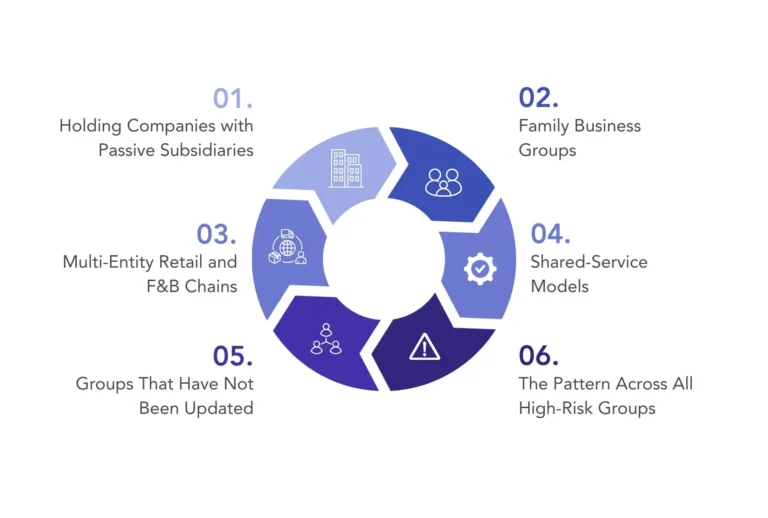
Not all VAT groups carry the same risk. Some structures are now sitting directly in the FTA’s line of sight. If you fall into one of these categories, you should assume scrutiny is coming.
Holding Companies with Passive Subsidiaries
This is one of the most common setups. A holding company sits on top. Subsidiaries operate below. Different sectors. Different activities.
The problem? The holding entity often does not make taxable supplies. It exists for ownership, not operations. That weakens both economic and financial integration. If the subsidiaries also operate independently, the group starts to look like a collection of separate businesses rather than a single unit.
This is exactly the kind of structure the FTA is now questioning.
Family Business Groups
Family groups often grow organically. One entity becomes three. Then five. Then ten. Retail, real estate, trading, hospitality. All under the same umbrella. At some point, they are grouped for VAT. But here is the issue.
These entities rarely evolve in a coordinated way. Each business develops its own operations, management, and financial structure. Over time, the original integration fades. What remains is a VAT group that no longer reflects reality. That gap is now a risk under new rules and regulations.
Multi-Entity Retail and F&B Chains
This structure is very common. Each outlet is a separate LLC. All are grouped under one TRN. It works well from a compliance perspective. But the FTA is now asking a sharper question.
Does each outlet operate independently? If each location has its own management, staff, and financial control, the argument for grouping becomes weak. The structure may look unified. The operations may not be. That distinction matters now.
Shared-Service Models
In these setups, one entity provides services like HR, IT, or finance to the rest of the group. This can support integration. But only if it is real and properly structured.
Where it becomes risky:
- Services are loosely defined or undocumented
- Pricing lacks justification
- The service entity operates differently from the rest of the group
- Cross-border elements are involved
In 2026, this model sits at the intersection of VAT and transfer pricing.
That means more scrutiny. Not less.
Groups That Have Not Been Updated
This is the silent risk category. And one of the biggest.
Groups that:
- added new entities but did not notify the FTA
- kept entities that stopped making taxable supplies
- changed business activities without revisiting the structure
Under current rules, these are not minor issues. They create ongoing exposure. And importantly, the liability sits with the Representative Member.
The Pattern Across All High-Risk Groups
The common thread is simple.
The structure stayed the same. The business did not. That disconnect is what the FTA is now testing. And once it is visible, the next step is not a warning. It is action.
Real-World Scenario: When a VAT Group Gets Challenged
Take a typical UAE structure.
Three entities under one VAT group:
- A real estate holding company
- A general trading LLC
- A cafeteria business
They were grouped five years ago. Same ownership. One TRN. Returns filed on time. No issues. Then an audit starts. Not because of VAT alone. Because of a mismatch. The consolidated VAT return shows one picture. The Corporate Tax filings show another.
That is enough to trigger a deeper review. The FTA applies the three-part test.
Financial Integration:
Each entity runs its own bank account. No central treasury. No consolidated reporting. Intercompany balances exist but are not actively managed.
Economic Integration:
The businesses do not depend on each other. Real estate, trading, and food service operate separately. No shared value chain.
Organizational Integration:
Different managers. Different staff. Different locations. No shared systems.
At this point, the conclusion becomes straightforward. This is not one business. It is three separate businesses grouped together. Now the consequences start.
The FTA challenges the VAT group. It moves to de-group the entities. But it does not stop there.
It looks back. All intra-group transactions that were ignored for VAT purposes are now reviewed. Management fees. Cost allocations. Internal supplies. Those transactions should have been taxed at 5%. So the FTA recalculates the position. Output VAT becomes payable. Input VAT recovery is restricted.
And the liability? It sits with the Representative Member. What started as a routine audit turns into a multi-year tax exposure.
What De-Grouping Actually Means for Your Business
De-grouping is not just an administrative change. It is a structural reset. And it comes with immediate consequences.
When Can the FTA Force De-Grouping?
The FTA has clear authority to cancel a VAT group.
This happens when:
- The legal conditions are no longer met
- The entities are not financially, economically, or organizationally integrated
- There is a reasonable basis to believe the structure reduces tax improperly
This decision does not require agreement from the business.
If the FTA forms that view, it acts.
Voluntary De-Grouping
You can act before the FTA does. The Representative Member can apply for de-grouping through EmaraTax. The process is usually handled within 20 working days. The effective date is typically the start of the next tax period, unless the FTA determines otherwise.
This matters. Because timing affects how much exposure you carry into the future.
Financial Consequences
This is where the impact becomes real.
Once de-grouped:
- All transactions between entities become taxable at 5%
- VAT must be charged, reported, and paid on intra-group supplies
- Cash flow pressure increases immediately
But the bigger issue is retrospective exposure.
If the FTA determines the group was not valid, it can reassess past periods.
That means:
- Output VAT on historical intra-group transactions
- Possible denial of input VAT
- Adjustments that affect multiple years
This is not a small correction. It can reshape your tax position entirely.
Transfer Pricing Now Becomes Critical
Inside a VAT group, pricing between entities often receives less attention.
After de-grouping, that changes overnight.
Every intercompany transaction must now:
- Have proper documentation
- Reflect arm’s length pricing
- Align with Corporate Tax requirements
VAT and transfer pricing are now linked.
If one fails, the other is affected.
The 2026 Penalty Reality
The penalty framework is now simpler. But stricter in effect.
Key points:
- Late VAT filing: AED 1,000 for the first instance, AED 2,000 for repeat cases
- Late registration: AED 20,000
- Input VAT denial is permanent. It is not just a penalty. It is a loss
There is one important lever. Voluntary disclosure before an audit reduces the damage significantly. After the FTA steps in, your options narrow. Penalties are significant enough for businesses to be vigilant.
Step-by-Step: How to Review and Protect Your VAT Group Structure
This is the part that matters most. If you are responsible for a VAT group, this is your checklist.
Step 1: Map Your Group Clearly
List every entity in the VAT group.
Include:
- Legal name
- Business activity
- Ownership structure
- TRN linkage
If you cannot map the group cleanly, that is your first issue.
Step 2: Test Integration Properly
Do not assume integration. Prove it.
For each entity, document:
- Financial links
- Economic purpose
- Organizational structure
You are not preparing for internal review. You are preparing for an FTA audit.
Step 3: Review Intra-Group Transactions
Look back at least three years.
Check:
- Are transactions documented?
- Is pricing justified?
- Does the activity reflect real business substance?
If the answer is unclear, fix it now. Not later.
Step 4: Align VAT and Corporate Tax Positions
This is where many groups fail.
Your consolidated VAT return must make sense when compared to each entity’s Corporate Tax filing.
If the numbers tell different stories, the FTA will notice.
Step 5: Check Group Composition
Have any entities:
- Stopped making taxable supplies?
- Changed activities?
- Been added or removed informally?
If yes, update your VAT group through EmaraTax.
Ignoring this is not neutral. It creates liability.
Step 6: Review VAT Credit Balances
Credits from earlier years are not indefinite.
The five-year limitation window applies.
Amounts sitting from older periods must be reviewed and, where possible, claimed before expiry deadlines.
Unclaimed credits do not carry forward forever. They disappear.
Step 7: Consider Voluntary De-Grouping
Not every structure should remain grouped. If your group does not hold up under the integration test, consider restructuring before the FTA forces it.
Controlled change is always better than enforced change.
Step 8: Get an Independent Review
Internal teams often miss structural issues.
A proper VAT group review should:
- Test all three integration areas
- Identify audit triggers
- Provide a clear risk position
This is not routine compliance. It is risk management.
How ADEPTS Can Help
This is where technical support matters.
ADEPTS focuses on VAT group structures at a detailed level. Not just filings.
Key areas of support:
- Full VAT Group Health Checks across financial, economic, and organizational integration
- Identification of audit risks based on current FTA scrutiny patterns
- Preparation and submission of VAT group amendments and de-grouping applications
- Alignment of VAT positions with Corporate Tax reporting
- Voluntary disclosure support before FTA audit intervention
Our VAT consultant services make sure your VAT group stands up under scrutiny before the FTA tests it.
Conclusion
VAT grouping in the UAE in 2026 is not a set-and-forget arrangement. The rules did not suddenly change. The enforcement did. The FTA now looks beyond structure. It looks at substance. If your group does not operate as one integrated business across financial, economic, and organizational levels, it is exposed.
The highest risk sits with:
- holding structures
- family groups
- shared-service models
- groups that have not been reviewed in years
The shift is clear. VAT grouping is no longer about convenience. It is about justification. If that justification is weak, the consequences follow.
FAQs:
Yes. VAT grouping does not change Corporate Tax filing requirements. Each entity still files separately for Corporate Tax.
There is no fixed percentage stated in simple terms, but control must exist. This usually means majority ownership or the ability to direct decisions.
Yes, if it meets the conditions and has a fixed establishment in the UAE.
No. Only UAE-established legal persons with a fixed establishment can be included.
No. Audits are risk-based. They are triggered by data mismatches, unusual patterns, or structural concerns.
Contracts remain valid, but VAT treatment changes. Supplies between entities become taxable going forward.
It is not mandatory in a strict sense, but having clear documentation strengthens your position during audits.
Generally within the statutory limitation period, but risk increases where issues are identified.
Board structures, shared management roles, HR policies, system access, and operational workflows all help.
Yes. The VAT group is treated as one taxable person. An issue in one part can affect the entire group.
Yes, but this requires approval and formal amendment through the FTA system.
Credits must be claimed within the allowed period. Older balances may expire if not used in time.
Typically, changes take effect from the next tax period unless otherwise approved by the FTA.
After de-grouping, all intercompany transactions must meet transfer pricing rules. Documentation becomes essential.
VAT grouping treats entities as one taxable person for VAT. Corporate Tax grouping has separate rules and does not merge entities into a single taxpayer in the same way.
References
- VAT Law (Federal Decree-Law No. 8 of 2017) — Tax Group Article Topic: Article 4 — Tax Group eligibility, FTA powers to force/cancel grouping https://uaelegislation.gov.ae/en/legislations/1227
- VAT Executive Regulations (Cabinet Decision No. 52 of 2017) — Tax Group Rules Topic: 3-part integration test exact wording (economic, financial, organizational), cancellation grounds
https://uaelegislation.gov.ae/en/legislations/1226 - FTA Official: Tax Group Registration Service Page Topic: Eligibility, AED 375,000 threshold, Representative Member, 20 working days processing, EmaraTax process
https://tax.gov.ae/en/services/vat.group.registration.aspx - FTA Official: Tax Groups VAT Guide (PDF) Topic: Complete group registration mechanics, eligibility criteria, anti-avoidance rules, forced grouping
https://tax.gov.ae/Datafolder/Files/Pdf/Tax-Groups-Guide.pdf - De-Registration of Tax Groups Service Page Topic: Voluntary de-grouping process via EmaraTax, required documents, grounds for cancellation
https://tax.gov.ae/en/services/deregistration.of.tax.groups.aspx - Ministry of Finance Official Announcement — Federal Decree-Law No. 16 of 2025 Topic: Official MoF announcement of VAT amendments effective 1 January 2026
https://mof.gov.ae/en/news/ministry-of-finance-to-implement-vat-law-amendments-starting-january-2026/ - Federal Decree-Law No. 17 of 2025 (Tax Procedures Law) — Full Text Topic: New 5-year limitation rule, expanded FTA audit powers, cross-tax framework https://uaelegislation.gov.ae/en/legislations/1625
- KPMG UAE — Federal Decree-Law No. 16 & 17 of 2025 Analysis Topic: Detailed breakdown of both laws, VAT + Tax Procedures changes, compliance impact
https://kpmg.com/ae/en/insights/tax-insights/federal-decree-law-no-16-and-17-of-2025.html - UAE VAT Law Amendments Effective 1 January 2026 Topic: Input VAT denial rules, “knew or should have known” standard, 5-year credit expiry
https://www.dlapiper.com/en/insights/publications/gulf-tax-insights/2025/gulf-tax-insights-december-2025/uae-announces-amendments-to-vat-law-effective-1-january-2026 - Alvarez & Marsal — Significant Amendments to UAE VAT Law & Tax Procedures Law Topic: VAT group scrutiny context, FTA risk-based audit strategy 2023–2026, transitional 2018–2020 credit deadline
https://www.alvarezandmarsal.com/thought-leadership/middle-east-tax-alert-uae-significant-amendments-to-uae-vat-law-and-tax-procedures-law - Alvarez & Marsal — FTA Risk-Based Audits 2026 Topic: 93,000 inspection visits 2024 (135% increase), data analytics audit selection, VAT vs CT mismatch triggers
https://www.alvarezandmarsal.com/thought-leadership/middle-east-tax-alert-uae-from-vat-to-corporate-tax-how-fta-s-risk-based-audits-will-shape-compliance-in-2026 - PwC UAE — Legislative Updates VAT & Tax Procedures 2026 Topic: Both Decree-Laws summary, compliance impact on businesses, official law links
https://www.pwc.com/m1/en/services/tax/middle-east-tax-news-alerts/2025/uae-significant-legislative-updates-tax-procedures-vat-excise-tax-laws.html - BDO UAE — Cabinet Decision No. 129 of 2025 (New Penalty Regime) Topic: New penalties effective 14 April 2026, VAT late filing fines, voluntary disclosure benefits
https://www.bdo.ae/en-gb/news/news/revision-in-administrative-penalties-for-violation-of-tax-laws-in-the-uae
Related Articles