
How to Set Up a Company in Dubai Free Zone

Did you know that the Dubai Free Zone has become a mature, highly regulated financial ecosystem, driving growth in 2026?
Dubai Free Zone is one of the most attractive places for entrepreneurs globally. It offers streamlined processes, tax advantages, full foreign ownership, and tremendous opportunities for new businesses.
Here is the more significant news: According to the Dubai Economic Agenda D33, Dubai has successfully reached the 7th position in the Global Financial Centres Index (GFCI) as of March 2026, positioning it alongside London and New York. This is a major milestone, highlighting Dubai’s global financial prowess.
The Free Zone now stands as the engine of a AED 937 billion GDP economy.
If reading this has triggered your business mind crunching figures and wondering how to set up a company in Dubai free zone, no need to worry; this guide will answer all your queries on how to open a company in dubai free zone.
What is a Dubai Free Zone?
Dubai Free Zone is a designated economic area developed to attract international businesses and investors. To promote investment, support business growth, and make the Dubai Free Zone one of the biggest business hubs, the UAE government helps international companies set up quickly without needing a local partner and offers 100% foreign ownership, a streamlined regulatory framework, and conditional tax benefits under the Qualifying Free Zone Person (QFZP) regime.
There are several Free Zones in the UAE, each catering to specific industries. Some of the most well-known zones are:
- DIFC Freezone (Dubai International Financial Centre) is a designated financial hub for banking, fintech, and professional services.
- DMCC Freezone (Dubai Multi Commodities Centre) caters to businesses involved in trade and commodities, supporting gold, diamonds, tea, and other goods.
- ADGM Freezone (Abu Dhabi Global Market) is a financial center with an independent legal framework based on English common law.
2026 Industry Focus Comparison
| Free Zone | Industry Focus |
| DIFC | Fintech/Wealth |
| DMCC | Commodities/AI |
| DAFZA | Logistics/Trade |
The Hybrid Shift: Operating Onshore via Free Zone Permits
In 2026, entities with a DUL (Dubai Unified License) can access the Mainland for a fixed six-month fee. This hybrid structure, facilitated by the new Free Zone Mainland Operating Permit, provides businesses with greater flexibility in operating on both the Free Zone and Mainland.
Key Objectives of Dubai Free Zones
Here are a few reasons why the Dubai Free Zone has been set:
1. Promoting Foreign Direct Investment
Dubai free zones attract foreign direct investments. They offer incentives to foreign businesses, such as reducing taxes, not limiting the movement of capital between home country and the Dubai free zone, and allowing relatively free movement of labour, making it financially beneficial for the companies to invest.
2. Economic Diversification
The establishment of the Dubai free zone has allowed the country’s economy to diversify and become less reliant on oil revenues. With growth in sectors like commodities trading, technology, and logistics, the country is diversifying exponentially.
3. Ease of Doing Business
The government has made setting up a company in Dubai free zone very simple. They expedite the business setup process and efficient growth by reducing paperwork and legal irregularities, allowing companies to follow basic rules, and, above all, allowing companies to choose their license according to their specific industry needs.
Business structures in Dubai Free Zone
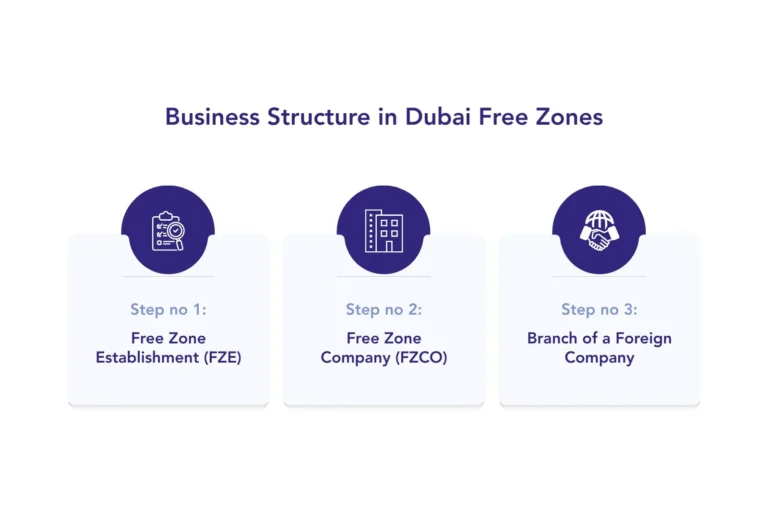
Depending on the size and ownership of the business, the Dubai Free Zone commonly have the following business structures:
- A Free Zone Establishment (FZE) is a business entity with a single owner: either an individual who solely owns and operates the business or a corporate entity that registers a new business under its name.
- Free Zone Company (FZCO): A multi-shareholder company (between 2 and 50 shareholders) which can have individuals, corporate entities, or a combination of both.
- Branch of a Foreign Company—A branch of a business registered outside of the UAE may initiate a business in the Dubai free zone. This branch will then operate under the same name and conduct the same business activities as the parent company.
Advantages of Setting Up in a Dubai Free Zone

When you open a company in the Dubai free zone, these are the following advantages that you can enjoy:
1. Sector-Specific Ecosystems and Infrastructure
The most significant advantage of opening a company in the Dubai free zone is that it provides access to sector-specific ecosystems and state-of-the-art infrastructure. While 100% foreign ownership is now common on the Mainland, the Free Zones offer specialized resources tailored to industries such as fintech, commodities, and logistics. This makes the Free Zone a highly advantageous environment for businesses in niche sectors.
2. Strategic Tax Efficiency
Dubai free zone offers businesses the advantage of strategic tax efficiency, with 0% corporate tax on qualifying income.
0% Corporate Tax is now contingent upon meeting QFZP criteria, including mandatory annual audits, making compliance essential for maintaining this tax benefit. Companies can significantly reduce their operational costs and reinvest in their business.
3. Transferring of Profits and Capital
When you set up a company in Dubai free zone, businesses can transfer all of their profits and capital to their home country without any restrictions. Unlike some jurisdictions where governments limit fund transfers.
4. No Import or Export Duties
The government has built free zone to help businesses operate efficiently. If you set up a company in the Dubai free zone and your business is related to commodity trading, the government allows the import and export of goods without any customs duties. The streamlined processes and reduced business costs make the Dubai-free zones highly attractive for businesses.
5. Simplified Business Setup
Another advantage that attracts foreign businesses towards the Dubai-free zones is that the processes have been streamlined, allowing them to start their business within a few days. There is a fast and efficient business registration process with minimal bureaucracy, straightforward licensing procedures, and compliance requirements, allowing entrepreneurs to enter the market quickly without administrative delays.
6. Modern Infrastructure and Strategic Location
Dubai Free Zones offers businesses attractive office spaces, warehouses, logistics facilities, and business parks equipped with the latest technology. Their strategic location between Europe, Asia, and Africa makes them an ideal global trade and investment hub.
Steps to Set Up a Company in a Dubai Free Zone
But you don’t have to worry, as we’ll guide you exactly on how to set up a company in the Dubai free zone.
Choose the Right Free Zone
After you have decided to enter the free zone, the first thing you need to do is to choose your zone. Dubai’s free zone has dedicated zones for different kinds of businesses, such as trading, financing, media, or technology.
Select Business Activity and Legal Structure
Next, you will select and decide upon the business activity and its legal structure. You need to determine if you’ll be working in a Free Zone Establishment, where there is a single owner, or in a Free Zone Company, where you will have multiple shareholders. Just make sure that your selected free zone allows your intended business activities.
Reserve Company Name and Submit Initial Application
Once you have decided on your free zone and are set on the business structure and activity according to your zone, you need to decide upon your company’s name. All you have to do is submit your application to the relevant zone authority and ensure that your business name complies with UAE regulations. You will also obtain your Dubai Unified Licence (DUL) QR Identity as part of this step, which integrates your business into the digital ecosystem.
Prepare Required Documentation
Apply for a Business License
Next, you have to apply for a business license depending on your business activity, such as trading, service, or industrial licenses. The Dubai free zone has an efficient and streamlined process, and all you have to do is submit your documents to the Free Zone authority and get your license.
Lease Office Space
Fast-Track Banking Onboarding (5-Day Turnaround via DUL Integration)
Since you’ll need a place to manage your funds and may need to transfer money back and forth to your home country, it’s important to take advantage of the Fast-Track Banking Onboarding. With DUL integration, banks like Emirates NBD and Mashreq can now process account openings in just 5 days, down from the previous 65-day timeframe. This is part of the Service Providers Project initiated by the DET, which accelerates the setup process with a digital-first approach.
Apply for Residency Visas
Corporate Tax Registration and E-Invoicing Alignment
Once your company is up and running, you must register for corporate tax within 3 months of license issuance. As part of this process, you’ll need to ensure alignment with the e-invoicing system, which is being rolled out in phases in 2026.
Required Documents for Company Formation
Passport Copies of Shareholders and Directors
Proof of Address
Business Plan (Mandatory for All QFZP Entities to Justify Qualifying Income Activities)
It is now mandatory for all QFZP entities to submit a business plan to justify their qualifying income activities. This will include company objectives, financial projections, and operational strategies.
Memorandum and Articles of Association
Initial Approval Certificate
Ultimate Beneficial Owner (UBO) Declaration
As of 2026, the UBO Declaration is a mandatory document for all companies operating in Dubai Free Zones to ensure compliance with transparency regulations.
AML/CFT Risk Assessment Profile
In accordance with 2026 Anti-Money Laundering (AML) rules, businesses in high-risk sectors must provide an AML/CFT Risk Assessment Profile as part of their documentation. This helps regulators verify that companies comply with the necessary legal requirements.
2026 Document Requirements Table
| Category | Documents |
| Identity | Passport copies of shareholders and directors |
| Corporate/Structural | Memorandum and Articles of Association, Initial Approval Certificate |
| Compliance/Tax | Business Plan (mandatory for all QFZP entities), UBO Declaration, AML/CFT Risk Assessment Profile |
Licensing Options in Dubai Free Zones
Commercial License
Service License
Industrial License
E-commerce License
The 2026 UAE Media Council Advertiser Permit
As of February 1, 2026, all businesses involved in e-commerce and influencer-related activities must obtain an additional UAE Media Council Advertiser Permit. This is a mandatory requirement for publishing sponsored content, and failure to comply can result in fines of up to AED 10,000.
Regulated vs. Non-Regulated Licenses: Quick Overview
In 2026, businesses in Dubai Free Zones must differentiate between regulated and non-regulated licenses under the Dubai Economic Tourism (DET) Framework. The key difference lies in the level of government oversight and compliance requirements. Understanding this distinction is crucial for selecting the right license for your business and ensuring compliance with industry-specific regulations.
- Regulated Licenses are for businesses in sectors that face higher government oversight, such as finance, healthcare, and media. These industries require more stringent compliance with local regulations, audits, and often additional permits.
- Non-Regulated Licenses, on the other hand, are for businesses that operate in sectors with minimal regulatory restrictions. These businesses generally face fewer compliance obligations, making them easier and quicker to set up.
Quick Comparison: Regulated vs. Non-Regulated Licenses
| Criteria | Regulated Licenses | Non-Regulated Licenses |
| Examples of Sectors | Finance, Healthcare, Media, Legal Services | Consulting, Trading, IT, Services |
| Compliance Requirements | Higher regulatory scrutiny, mandatory audits, additional permits | Basic compliance with UAE business laws |
| Key Permits/Approvals | May require additional permits like the UAE Media Council Advertiser Permit for media businesses | Generally no additional permits required |
| License Process | More complex, involves higher fees and longer setup times | Simpler and faster setup with fewer regulatory hurdles |
| Ongoing Obligations | Annual reports, audits, strict industry oversight | Fewer ongoing obligations, but basic legal compliance required |
| Examples of Businesses | Banks, Hospitals, Media Agencies | Consulting Firms, E-commerce, Import/Export Businesses |
Visa and Immigration Process
Eligibility for Investor and Employee Visas
Steps to Obtain Residency Visas
Medical Tests and Emirates ID Application
2026 Golden and Green Visa Updates: Self-Sponsorship and Stability
- Golden Visa Requirements: As of February 2026, there is no minimum down payment required for the property-based Golden Visa. Instead, the sole criterion for eligibility is a DLD (Dubai Land Department) valuation of AED 2 million for the property.
- Salama AI-powered Digital Platform: For 2026 visa renewals, the Salama AI-powered digital platform will be used for faster processing and management of renewals. This system is designed to simplify and speed up the visa renewal process for residents.
- Visa for Life Promotions: Some Free Zones, such as IFZA and SPC, are offering Visa for Life promotions, covering basic renewal fees for the duration of the business license. This makes it easier for businesses to manage their long-term visa needs without worrying about additional costs.
Post-Setup Compliance Requirements
Annual License Renewal
Submission of Audited Financial Statements
While this was previously not a compulsion in all the free zones, it is now a universal audit requirement for all QFZPs. Some Dubai free zones require you to submit audited financial statements of your business. To avoid any unnecessary trouble, you should engage an audit firm to ensure compliance with local regulations.
Compliance with UAE Laws and Free Zone Regulations
Mandatory Electronic Invoicing (E-Invoicing) 2026
Starting from July 2026, all B2B and B2G transactions must use structured XML formats for invoicing, in compliance with the UAE’s e-invoicing system. This is part of the broader move towards digitization in the UAE’s regulatory framework.
Failing to comply with this requirement could result in penalties, and businesses must ensure that they are ready to meet these digital requirements.
The Salama AI-powered platform will be integrated for seamless invoicing and compliance checks, which will be mandatory for businesses operating in Free Zones.
The 5-Year Lockout Rule: The Cost of Non-Compliance
Under the 2026 QFZP regulations, failing to meet the QFZP conditions, such as failing the qualifying income or documentation criteria, will result in a 5-year disqualification from 0% tax benefits.
Once disqualified, businesses will be required to pay standard corporate taxes, which may severely impact their financial planning. This regulation emphasizes the importance of maintaining strict compliance with the Free Zone’s standards and tax benefits.
2026 Compliance Calendar
| Deadline | Compliance Requirement | Frequency |
| Jan 31, 2026 | Annual license renewal | Annual |
| Mar 31, 2026 | VAT filing and payment | Quarterly |
| April 14, 2026 | Corporate Tax Payment (new 14% p.a. penalty for late payments) | Annual |
| June 30, 2026 | QFZP status review and filing for businesses qualifying for 0% tax | Annual |
| July 1, 2026 | Phase 1 e-invoicing for large businesses (B2B/B2G XML format) | Annual | Sept 30, 2026 | AML and KYC filings with local authorities | Annual |
| December 31, 2026 | Small Business Relief (SBR) eligibility review | Annual |
Common Challenges and Solutions
Navigating regulatory requirements
When it comes down to navigating regulatory requirements in a foreign land, no matter how straightforward the system seems, there is always a risk involved. In 2026, this risk is driven more by data reconciliation across regulators (FTA, Ministry of Economy, and Central Bank) rather than procedural complexity.
Therefore, you must take the assistance of free zone specialists to reduce that risk. ADEPTS UAE assists companies and organizations in setting up their businesses in Free Zones.
ADEPTS offers dedicated professionals who guide you through each step, helping you choose the correct free zone for your business and ensuring you stay compliant with the regulatory requirements.
Fast-Track Banking Onboarding (Optimized Onboarding Step)
Opening a corporate bank account is no longer a major challenge due to DUL integration. It is now an optimized onboarding step with significantly reduced timelines. When you open a corporate bank account, there are multiple documents that the banks require, and sorting and filing them can be a hassle, considering that you are working in a foreign land. Managing visa quotas and employment regulations
ADEPTS offers dedicated professionals who guide you through each step, helping you choose the correct free zone for your business and ensuring you stay compliant with the regulatory requirements.
Managing visa quotas and employment regulations
Navigating Domestic Transfer Pricing Audits
With 2026 enforcement, businesses now face increased scrutiny on domestic transfer pricing and related party transactions. Regulators are using integrated digital systems to identify inconsistencies between financial statements, tax filings, and UBO disclosures.
Engaging UAE-accredited tax agents helps ensure proper documentation, benchmarking, and creation of digital audit trails aligned with FTA requirements.
Mitigating Audit Risks: The Role of Accredited Service Providers (ASP)
In 2026, compliance is no longer manual—it is digital-first.
Accredited Service Providers (ASP) play a critical role in ensuring real-time compliance through structured reporting, e-invoicing alignment, and audit-ready documentation. Engaging ASPs helps businesses proactively manage regulatory risks and maintain consistency across all government platforms.
Conclusion
When setting up a business in a Dubai Free Zone, a highly stable and globally credible business platform is offered, from tax advantages and full foreign ownership, to a high-tech yet efficient business environment. Dubai remains the #1 destination for founders in 2026, offering one of the most efficient tax environments available today.
While the systems have been streamlined to ensure a smooth process, you must follow the set guidelines and abide by the rules of your zone authority. Scaling your business in a regulated hub requires proactive, audit-ready governance. Noncompliance with the laws can not only end up in the business facing penalties, but can also result in your license’s suspension.
Hiring specialists like ADEPTS can help ensure that you fulfill all the set criteria, choose the correct free zone for your business, and stay compliant with the Free Zone and UAE laws. If you are planning to setup business in the Dubai free zone, now is the time to conduct a 2026 Compliance Health Check and ensure your structure is fully aligned with regulatory expectations.
FAQs
No, most Free Zones allow remote registration. However, a visit to Dubai may be required for specific processes like opening a corporate bank account or obtaining residency visas.
No, Free Zone businesses cannot trade directly in the UAE mainland. They must work with a local distributor or establish a mainland branch to do so.
Setting up a business in the Free zone depends on a lot of factors, such as business activity and office space. Typical expenses include:
- Business license and registration fees
- Office lease (flexi-desk, shared, or physical)
- Visa and immigration costs
- Corporate bank account setup fees
Businesses must meet banking requirements, including:
- Choosing a bank based on business needs
- Submitting required documents (trade license, passports, proof of business)
- Attending a bank meeting (some require physical presence)
- Awaiting approval, which can take a few days to a week
Yes. The DUL is a mandatory digital identification system for all businesses in Dubai (Mainland and Free Zone) under Law No. 6 of 2023. It provides a QR code that stores all your licensing and ownership data. You will need it to open bank accounts, connect DEWA utilities, and apply for government permits.
Yes, under the new Dubai Executive Council Resolution No. 11 of 2025, Free Zone companies can now apply for a “Mainland Operating Permit”. For a fee of approximately AED 5,000 for six months, you can access the local market without opening a separate onshore branch, provided you maintain separate financial records for tax purposes.
If you want to maintain Qualifying Free Zone Person (QFZP) status and benefit from 0% corporate tax, then yes, an annual audit is mandatory regardless of revenue. If you choose not to be audited, your company will default to the standard 9% corporate tax regime (unless you qualify for Small Business Relief, which ends in December 2026).
As of February 1, 2026, anyone in the UAE publishing sponsored or promotional content (paid or unpaid) on social media must hold a valid Advertiser Permit from the UAE Media Council. This requires you to already hold a valid trade or freelance license.
Yes. As of February 2, 2026, the 50% down payment requirement for property investors has been removed. Now, you only need to provide a Dubai Land Department (DLD) certified valuation showing a property value of at least AED 2 million to be eligible for a 10-year residency visa.
References
- Amir, Nivetha Dayanand, Khitam Al. ‘Dubai Moves up in Global Financial Rankings’. Gulf News: Latest UAE News, Dubai News, Business, Travel News, Dubai Gold Rate, Prayer Time, Cinema, 26 Mar. 2026,
https://gulfnews.com/business/dubai-climbs-to-7th-globally-strengthening-its-financial-hub-status-1.500486982. - DET Collaborates with Service Providers to Streamline Bank Account Opening and Financial Services through DUL.
https://www.dubaidet.gov.ae/en/newsroom/press-releases/det-collaborates-with-banking-service-providers. - Dubai DET. https://www.dubaidet.gov.ae/en/.
- Dubai Launches Free Zone Mainland Operating Permit to Unlock New Growth for Investors.
https://www.dubaidet.gov.ae/en/newsroom/press-releases/new-growth-for-investors. - Dubai Unified Licence.
https://www.investindubai.gov.ae/en/business-setup/company-set-up-options-in-dubai/dubai-unified-licence-guide. - Golden Visa.
https://u.ae/en/information-and-services/visa-and-emirates-id/residence-visas/golden-visa.
Related Articles