
Small Business Relief or QFZP? The Free Zone Election That Costs the Most Money

A Free Zone company with revenue below AED 3 million faces an unusual Corporate Tax choice.
Small Business Relief can reduce its Taxable Income to nil, while the QFZP regime applies a 0% rate to Qualifying Income.
At first glance, the comparison looks simple: if both routes can produce little or no UAE Corporate Tax, just pick whichever carries the lighter compliance burden.
That is not the right comparison.
Small Business Relief and the Qualifying Free Zone Person regime operate under different rules, and a company cannot move between them without considering what the election actually changes.
The first question is whether a Free Zone company can claim SBR at all. From there, the more important ones follow:
- what happens when a company elects out of QFZP treatment,
- how long that decision binds it,
- and whether the short-term simplicity of SBR is worth giving up a potentially valuable Free Zone tax position.
That is where the real cost of the decision begins.
Can a Free Zone Company Claim Small Business Relief?
The short answer: yes, potentially — but not while the company is treated as a Qualifying Free Zone Person.
Article 21 of the UAE Corporate Tax Law allows an eligible Resident Person to elect for Small Business Relief.
To qualify:
- Revenue must not exceed AED 3 million in the relevant Tax Period or in any previous Tax Period,
- and the election is made separately for each eligible period rather than once and for all.
The restriction for Free Zone businesses is more specific: a QFZP is expressly excluded from SBR. But incorporation in a Free Zone doesn’t lock a company into QFZP treatment by default.
The FTA’s Free Zone Persons Guide confirms that a Free Zone Person may elect not to be treated as a QFZP and instead fall under the standard Corporate Tax regime — and if it then meets the SBR conditions, Small Business Relief becomes available.
| Position | SBR available? | Relevant tax treatment |
| QFZP | No | 0% on Qualifying Income; 9% on non-Qualifying Taxable Income |
| Free Zone Person electing out of QFZP | Potentially | Standard Corporate Tax rules; SBR may apply if eligible |
| Free Zone Person not meeting SBR conditions | No | Standard Corporate Tax rules |
In other words, the Free Zone licence itself gives a company neither SBR nor the QFZP 0% rate automatically. Eligibility depends entirely on which regime applies and whether its conditions are met.
And SBR doesn’t take a company out of the Corporate Tax system altogether. The FTA confirmed in August 2026 that SBR beneficiaries must still register, keep the required records, and file a simplified Corporate Tax return — the Corporate Tax Registration UAE guide covers that process in more detail.
Which brings us to the more consequential part of the choice: what actually happens once a Free Zone company elects out of QFZP treatment?
Small Business Relief Did Not Expire in 2026 — It Now Runs to 2029
Before looking at what a Free Zone company gives up by leaving QFZP treatment, one timing point needs to be cleared up: Small Business Relief did not expire in 2026.
Under the original Ministerial Decision No. 73 of 2023, the AED 3 million threshold applied only to Tax Periods ending on or before 31 December 2026.
That position changed in 2026. Ministerial Decision No. 131 of 2026 amended the earlier decision and extended UAE Small Business Relief to eligible Tax Periods ending on or before 31 December 2029.
The extension changed the deadline, not the core eligibility rules. The UAE Corporate Tax Small Business Relief threshold remains AED 3 million, the Revenue test still considers the current and previous Tax Periods, and the relief must still be elected for each eligible period. QFZPs also remain excluded. Importantly, once Revenue exceeds AED 3 million in a relevant Tax Period, SBR cannot simply become available again when Revenue later falls below the threshold.
So UAE Small Business Relief in 2027, 2028 and 2029 is now relevant to the election decision.
The Real Cost: SBR Is an Annual Election, but Leaving QFZP Can Affect Five Tax Periods
This is where the two options stop being comparable.
Small Business Relief is elected separately for each eligible Tax Period. A company may claim it through its Corporate Tax Return for one period and reconsider the position for the next, provided it continues to meet the eligibility conditions.
Leaving QFZP treatment works very differently.
Under Article 19 of the Corporate Tax Law, a Qualifying Free Zone Person may elect to become subject to the standard Corporate Tax rates. The FTA Free Zone Persons Guide explains the consequence clearly: the election applies from the Tax Period in which it becomes effective and continues for the following four Tax Periods. The current Ministerial Decision No. 229 of 2025 maintains this five-period consequence under the QFZP conditions.
So one year of SBR can carry a much longer opportunity cost.
If the election takes effect from FY2026:
| Tax Period | Potential position after leaving QFZP |
| 2026 | Standard regime; SBR may be available |
| 2027 | QFZP treatment cannot simply be restored because it is now more attractive |
| 2028 | Standard regime continues |
| 2029 | Standard regime continues |
| 2030 | Standard regime continues |
| 2031 | QFZP eligibility can be reassessed, subject to the applicable conditions |
The decision should therefore never be based only on the Corporate Tax payable for 2026. The proper comparison is the value of SBR today against the QFZP position that may be unavailable for five Tax Periods.
That comparison needs numbers, not assumptions.
What Should Actually Be Included in an SBR vs QFZP Cost Model?
Because leaving QFZP treatment can affect five Tax Periods, the comparison should not stop at the tax payable this year. A practical SBR vs QFZP cost model should consider the following:
- Current-year tax position: Calculate Taxable Income, Qualifying Income and non-Qualifying Taxable Income separately, then compare the tax payable under QFZP, the standard Corporate Tax regime and Small Business Relief. One important point is that a QFZP does not benefit from the ordinary 0% rate on the first AED 375,000 of non-Qualifying Taxable Income; that income is subject to 9%.
- Expected Revenue growth: Forecast whether Revenue is likely to remain within the AED 3 million SBR threshold. If the business is already close to the limit, SBR may provide only a short-term benefit before the company becomes ineligible.
- Future value of QFZP status: Estimate how much income could potentially qualify for the 0% QFZP rate over the same five-period window. This should be assessed under Cabinet Decision No. 100 of 2023 and the current Ministerial Decision No. 229 of 2025, rather than assuming that all Free Zone income qualifies automatically.
- Compliance cost: Include the actual cost of maintaining QFZP status, such as audited financial statements where required, adequate substance, Qualifying Income analysis, de minimis testing, Transfer Pricing compliance and supporting tax documentation. There is no meaningful standard AED amount; the figure should reflect the company’s own circumstances.
- Tax attributes: Consider the effect on Tax Losses and Net Interest Expenditure. SBR periods do not operate like ordinary taxable periods for creating, using or transferring these amounts, so existing and future tax attributes should also form part of the comparison.
The result is not really a “0% versus 0%” decision.
It is a comparison between the immediate benefit of SBR and the tax value, flexibility and compliance cost of retaining QFZP status over the full five-period horizon.
That framework is what makes the next step, testing the decision through actual scenarios, meaningful.
Three Free Zone Scenarios: When the Cheapest Election Changes
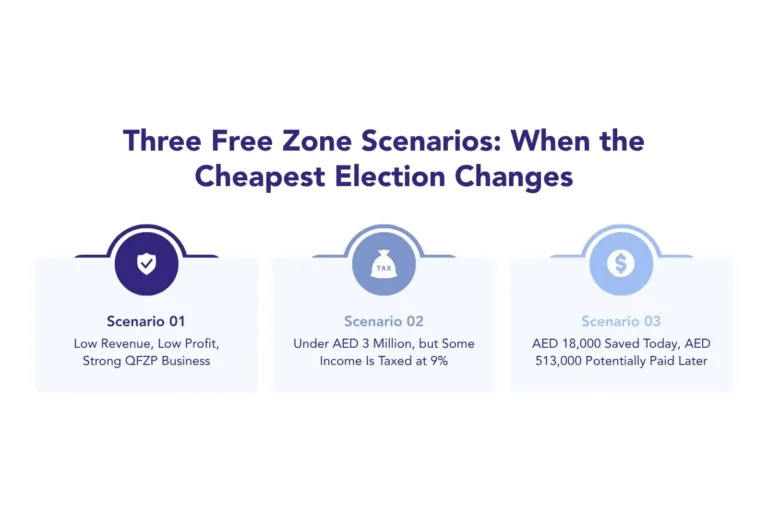
The cost model becomes clearer when the same rules are applied to numbers. The following examples are illustrative only; the actual result will depend on the company’s income profile, QFZP eligibility and expected growth.
Scenario 1 — Low Revenue, Low Profit, Strong QFZP Business
Assume a Free Zone company has:
| Item | Illustrative amount |
| Revenue | AED 1.5 million |
| Taxable profit | AED 300,000 |
| Qualifying Income | 100% |
| Expected Revenue growth | Low |
If the company remains a QFZP, its Qualifying Income could potentially benefit from the 0% rate. If it instead enters the standard Corporate Tax regime without SBR, its AED 300,000 Taxable Income remains below the ordinary AED 375,000 0% threshold. If eligible SBR is elected, it is treated as having no Taxable Income.
In other words, all three routes could produce AED 0 Corporate Tax for the year.
The lesson is important: electing out of QFZP solely to obtain SBR may produce no additional current-year tax saving, while affecting the company’s QFZP position for five Tax Periods.
That does not mean QFZP must always be retained. If the commercial value of the regime is limited and maintaining its compliance requirements is disproportionately costly, the wider economics may still support leaving it.
Scenario 2 — Under AED 3 Million, but Some Income Is Taxed at 9%
Now assume:
| Item | Illustrative amount |
| Revenue | AED 2.8 million |
| Taxable profit | AED 1 million |
| Qualifying component | AED 800,000 |
| Non-Qualifying Taxable Income | AED 200,000 |
For this illustration, assume the AED 200,000 is subject to 9% while the company otherwise continues to satisfy all QFZP conditions, including the applicable de minimis requirements.
Under QFZP treatment:
- AED 800,000 Qualifying Income → potentially 0%
- AED 200,000 non-Qualifying Taxable Income → 9%
- Illustrative Corporate Tax: AED 18,000
The FTA Free Zone Persons Guide confirms that a QFZP does not receive the ordinary 0% band on the first AED 375,000 of Taxable Income that is not Qualifying Income.
If the company elects out of QFZP and qualifies for Small Business Relief, it would be treated as having no Taxable Income for that Tax Period.
Illustrative Corporate Tax: AED 0
The apparent saving is therefore AED 18,000.
But that is only the first line of the calculation.
Is AED 18,000 saved today worth giving up potential QFZP treatment for the remaining four affected Tax Periods?
Scenario 3 — AED 18,000 Saved Today, AED 513,000 Potentially Paid Later
Now change one assumption: Revenue is expected to exceed AED 3 million from the following Tax Period.
Assume future Taxable Income is AED 1.8 million per year, and that this income would otherwise have qualified for the 0% QFZP rate if QFZP status had been retained and all conditions continued to be satisfied.
Once SBR is no longer available, the ordinary Corporate Tax calculation becomes:
AED 1,800,000 − AED 375,000 = AED 1,425,000
AED 1,425,000 × 9% = AED 128,250 per year
If the FY2026 election keeps the company outside QFZP treatment through FY2030, four subsequent Tax Periods could therefore produce:
AED 128,250 × 4 = AED 513,000
That compares with an illustrative AED 18,000 saving in FY2026.
The example does not mean that electing for SBR will always cost AED 513,000. It shows why a one-year comparison can give the wrong answer entirely. The FTA confirms that an election out of QFZP applies to the election Tax Period and the following four Tax Periods.
For businesses assessing whether their future income can continue to qualify for the Free Zone 0% rate, our UAE Free Zone Corporate Tax rules guide explains the current QFZP framework in more detail.
Never compare SBR against QFZP for one year only. Model the full five-Tax-Period effect of the election.
And once that five-period cost is visible, the next question becomes much easier: where is the break-even point?
When Does Small Business Relief Usually Win — and When Should QFZP Be Protected?
The scenarios show why there is no default winner. The better route depends on where the business is today and, more importantly, where it is likely to be during the five Tax Periods affected by the decision.
| Business profile | Direction to investigate |
| Revenue comfortably below AED 3 million for the foreseeable future | SBR becomes more attractive |
| Low profit and little current Corporate Tax exposure | Do not leave QFZP merely for a nominal SBR benefit |
| High QFZP compliance cost but little expected Qualifying Income | SBR may be commercially preferable |
| Revenue likely to exceed AED 3 million soon | Model the future QFZP opportunity cost carefully |
| High-margin Qualifying Activities | Protecting QFZP status may be substantially more valuable |
| Material income currently exposed to 9% under QFZP | SBR may create an immediate saving, but compare it with the full five-period cost |
| Significant brought-forward Tax Losses or Net Interest Expenditure | Include the timing and utilisation consequences |
| Business close to the QFZP de minimis limit | Run sensitivity analysis rather than assuming the 0% position will continue |
For this assessment, current activities should be tested against Ministerial Decision No. 229 of 2025, which now governs Qualifying Activities, Excluded Activities and the de minimis requirements. Free Zone status alone is not enough to preserve the 0% outcome.
The Free Zones vs Mainland Corporate Tax Return Requirements guide explains the broader difference between ordinary Free Zone Corporate Tax treatment and the QFZP regime.
Once the preferred route is clear, the remaining issue is procedural: how is the election actually made, and what does the company still have to file?
How to Make the Election and What Still Has to Be Filed
Choosing Small Business Relief does not remove the company from the Corporate Tax system.
A company must still be registered for Corporate Tax. If eligible, SBR is elected through the Corporate Tax Return for the relevant Tax Period, and the FTA requires an SBR beneficiary to submit a simplified Corporate Tax Return. Records supporting Revenue and the company’s eligibility must also be retained.
For example, the FTA has confirmed that a company with a financial year ending on 31 December 2025 must file its Corporate Tax Return by 30 September 2026, reflecting the normal nine-month filing period. Our Corporate Tax Registration UAE guide covers the registration process separately.
The Article 19 election not to be treated as a QFZP has its own timing rules. Under the FTA Free Zone Persons Guide, the election can take effect from:
- the beginning of the Tax Period in which the election is made; or
- the beginning of the following Tax Period.
It may be made during the relevant Tax Period or through the related Tax Return, but not after the filing deadline for that return has passed.
That timing matters. Once effective, the decision is no longer simply a filing choice for that year—it starts the five-Tax-Period consequence discussed above.
How ADEPTS Models This Decision
By this stage, the issue is no longer whether SBR or QFZP looks cheaper on the current return. The decision needs to be tested against the company’s actual numbers and expected direction.
At ADEPTS, we would model the election across five connected layers:
- Eligibility: current and previous-period Revenue, Resident Person status, QFZP conditions, applicable MNE exclusions and continued SBR eligibility.
- Current-year tax: QFZP liability, standard Corporate Tax, the SBR result and any income exposed to 9%.
- Five-period forecast: expected Revenue, Taxable Income, Qualifying Income, non-Qualifying Income, de minimis exposure and the likelihood that QFZP conditions will continue to be met.
- Tax attributes and compliance: Tax Losses, Net Interest Expenditure, audit costs, Transfer Pricing, substance requirements and supporting documentation.
- Break-even point: how much must SBR save today before giving up the potential future value of QFZP status becomes economically rational?
The purpose is not simply to find the lowest tax number. It is to identify when that lower number stops being the better decision.
Before the Corporate Tax Return is filed, the election should therefore be documented with both its legal basis and its expected financial outcome. Where a business requires representation or support with that assessment, ADEPTS provides FTA-approved Tax Agency Services.
Conclusion
SBR and QFZP should never be compared on year-one Corporate Tax alone.
SBR depends on the AED 3 million Revenue test and the applicable eligibility conditions, while leaving QFZP treatment can affect five Tax Periods.
For a Free Zone company, that means modelling current tax, Revenue growth, future Qualifying Income, compliance costs and the value of retaining QFZP status before making the election.
The better election is not necessarily the one that produces the lowest tax today. It is the one that produces the stronger overall tax position across the relevant periods.
FAQs:
Not if SBR required you to elect out of QFZP. That Article 19 election can affect five Tax Periods, so QFZP status cannot simply be restored the following year.
No. The AED 3 million Revenue test considers the current and previous Tax Periods. A past breach can therefore prevent later SBR eligibility even if Revenue falls again.
No. SBR does not remove Corporate Tax registration or filing obligations. Eligible businesses still file a simplified Corporate Tax Return and retain supporting records.
It does not renew automatically. SBR must be elected for each eligible Tax Period. If you file the return without making the election, you generally cannot add it later for that period.
Not because of SBR alone. However, audited financial statements may still be required under Free Zone rules, company law, financing arrangements, shareholder requirements or another applicable obligation.
Existing Tax Losses are generally preserved. During SBR periods, they cannot be used in the normal way and new losses are not generated; they may become available again once SBR ends, subject to the rules.
It is based on the Taxable Person’s Revenue as a whole, not only Free Zone or Qualifying Income. The AED 3 million SBR threshold must therefore be tested at the relevant Taxable Person level.
Not independently. A UAE branch is generally part of the same juridical person as its head office, so SBR eligibility is assessed for the Taxable Person as a whole.
Yes. A Tax Group is treated as one Taxable Person, so SBR eligibility is tested using the group’s consolidated Revenue. A QFZP also cannot remain a QFZP while part of a Tax Group.
No. The extension to 2029 does not remove the need to plan for QFZP compliance. If Revenue later exceeds AED 3 million, SBR may disappear while the earlier Article 19 election can still remain effective.
References
- aasaid@mof.gov.ae. “Ministry of Finance Issues Decision on Small Business Relief for Corporate Tax Purposes.” Ministry of Finance – United Arab Emirates, 6 Apr. 2023,
https://mof.gov.ae/en/news/ministry-of-finance-issues-decision-on-small-business-relief-for-corporate-tax-purposes/. - Abdou, Mahmoud. “Ministry of Finance Announces Extension of Small Business Relief for Corporate Tax Purposes until 31 December 2029.” Ministry of Finance – United Arab Emirates, 7 Aug. 2026,
https://mof.gov.ae/en/news/ministry-of-finance-announces-extension-of-small-business-relief-for-corporate-tax-purposes-until-31-december-2029/. - Cabinet Resolution Identifying the Qualified Income for the Qualifying Free Zone for the Purpose of Federal Decree-Law Concerning the Corporate Tax. https://uaelegislation.gov.ae/en/legislations/2175.
- Federal Decree-Law No. (47) of 2022 On Corporate and Business Tax.
https://uaelegislation.gov.ae/en/legislations/1582/download. - Federal Tax Authority – Corporate Tax Topics.
https://tax.gov.ae/en/taxes/corporate.tax/corporate.tax.topics/small.business.relief.23.aspx - Free Zone Persons Corporate Tax Guide | CTGFZP1.
https://tax.gov.ae//Datafolder/Files/Guides/CT/Free%20Zone%20Persons%20-%2020%2005%202024%20final%20for%20GCD.pdf. - FTA Clarifies Small Business Relief Rules Ahead of Tax Return Deadline in UAE.
https://gulfbusiness.com/en/2026/uae/fta-clarifies-small-business-relief-rules-ahead-of-tax-return-deadline-in-uae/. - Ministerial Decision No. 229 of 2025. https://tax.gov.ae//Datafolder/Files/Pdf/2025/MD-No-229.pdf.
Related Articles