Dubai’s Race to Retain Financial Supremacy in the Middle East

Dubai is not just a city. It is a story of ambition, risk and timing. This desert hub has turned into a magnet for global money. The DIFC is at the heart of it all, hosting banks, funds and startups. Let us delve into how Middle East finance found a beating pulse in this city.


The growth did not happen by accident. Skyscrapers, policies and incentives all seem planned to secure Dubai financial supremacy. But the clock is ticking. Abu Dhabi is growing, Riyadh is racing. The regional competition is real, fierce and post-pandemic recovery is only step one of a longer game for dominance.


This article will explore Dubai’s achievements and challenges. From DIFC’s impact to FinTech innovation, Dubai juggles infrastructure challenges and a complex regulatory environment as it races to be a business hub amidst regional rivals. To know the reason of investors faith in Dubai, one has to dig deep and identify what keeps this financial hub alive, why money keeps flowing in and how it continues shining in Middle East finance, even as rivals try to bite into its lead.

Dubai's Financial Hub Achievements and Strengths

Dubai has been quietly building something huge. This city has transformed into a global financial hub in less than two decades. The DIFC, established in 2004, is central to this rise. With legal and regulatory autonomy under the UAE federal framework, it attracts banks, insurers and startups alike. It is very much clear that Dubai financial supremacy is no accident.

Overview of DIFC

The DIFC is home to over 2,700 registered companies, ranging from local firms to global giants. Ranked top in MENA and among top 15 worldwide in the Global Financial Centres Index, it punches far above its weight. Its autonomy, governance and investor-friendly regulations make it a magnet. Dubai is not just hosting finance, it is shaping it.

Financial Sector Contribution

Finance and insurance account for 14.7 percent of Dubai’s GDP and the growth is robust. Asset management, family offices, Islamic finance and insurance are booming. It will be interesting to explore these sectors and how they complement each other. The diversity in Dubai’s financial services ensures stability and global credibility. Investors see it as a city that balances tradition with innovation.

Foreign Investor Participation

Dubai is a magnet for foreign money. With 85 percent foreign ownership in the Dubai Financial Market as of 2024, trust and openness are clear. It is not just local capital at work; Dubai acts as a gateway for flows between East, West and Africa. When compared to Riyadh or Abu Dhabi, Dubai’s blend of accessibility, regulation and growth keeps it ahead.

Expansion and Strengthening of Dubai’s Capital Markets

Dubai’s capital markets have grown faster than many expected. How is that small desert city attracting global issuers? The DFM and Nasdaq Dubai are buzzing with activity. Equity listings are climbing and debt instruments, including Sukuk and green bonds, are seeing record traction. This growth underlines Dubai financial supremacy in Middle East finance.

Growth Trajectory of DFM and Nasdaq Dubai

The DFM has increased listings while Nasdaq Dubai attracts international debt issuers. Sukuk and green bonds are catching on fast, giving investors not just profits but also ethical choices. Dubai’s markets stand strong. Its mix of FinTech innovation, transparency and easy access makes it a financial hub that few in the region can match.

Dubai’s Role in Islamic Finance

Dubai handles a big slice of global Islamic finance, especially sukuk issuances. The city has managed to stay so innovative. Strong regulatory environment updates let new market ideas flourish and give investors real confidence. The city’s mix of rules and creativity makes it a financial hub that keeps drawing attention worldwide. These measures make Dubai not just a regional player but a global contender. Even if other Middle Eastern centers try to catch up, Dubai has already built a formidable edge in trust and credibility.

FinTech and Innovation Leadership

Dubai’s Race to Retain Financial Supremacy in the Middle East

Dubai is not just chasing money, it is chasing innovation. It is now a hotspot for FinTech innovation globally. Blockchain experiments, AI applications and digital assets are popping up everywhere. The city is more than a traditional financial hub. Investors see opportunities and trust the ecosystem. Dubai is moving fast, breaking old molds and inherently a traditional financial hub.

Dubai as a Top Global FinTech Hub

Dubai ranks among top five global FinTech centers and trust me, it is not by luck. Startups, banks and investors are trying out all sorts of AI and blockchain ideas. FinTech innovation is everywhere. Digital assets, robo-advisors and new payment systems are taking off fast. These technologies keep the financial hub buzzing while strengthening  Dubai’s financial supremacy through a mix of tech with traditional finance. Traditional banks cannot resist this change as the city’s energy and openness make it clear: Dubai is serious about Dubai financial supremacy and tech-led growth.

DIFC Innovation Hub and Government Initiatives

The DIFC Innovation Hub provides sandboxes, support and mentorship to startups and established firms alike. Government programs push fintech initiatives, making it easier to test ideas without huge risks. In Dubai, AI is integrated in banking and wealth management. Dubai blends rules with creativity, proving that FinTech innovation is not just a buzzword but real work happening on the ground. This balance makes the city a dynamic financial hub and reinforces Dubai financial supremacy in ways that investors can actually see and trust.

Balancing Innovation and Risk

Innovation is exciting but risky. Regulatory frameworks are evolving, balancing investor confidence and new tech adoption. If a project fails, Dubai handles it with flexibility, learning fast and improving rules. The city wants to lead in Middle East finance while keeping global standards intact. It is a financial hub that embraces change but never compromises trust or stability.

Regional Competition and Market Dynamics

Dubai has long been the star in Middle East finance, but the story is changing. Abu Dhabi is growing fast, backed by big sovereign funds like ADIA and Mubadala. It is important to understand that Abu Dhabi’s competition matters as Dubai’s crown is not guaranteed. Thus, investors are noticing the shifts.

Abu Dhabi’s Growing Financial Sector

Abu Dhabi is clever about attracting money. Lighter taxes in some sectors and strong government backing make it appealing. If Dubai does not respond quickly, in that case, Dubai financial supremacy could feel pressure. Offices, talent and investment are slowly spreading. It is worthwhile to notice that Abu Dhabi is quietly challenging Dubai’s lead while maintaining a calm, stable growth pace.

Riyadh’s Vision 2030 Driven Financial Expansion

Riyadh is moving fast under Vision 2030. Reforms, big infrastructure projects and talent incentives are drawing regional headquarters. Investors are taking notice. If Riyadh keeps its pace, it will soon be a major rival in the region. The Riyadh rivalry is real. Dubai’s financial hub status is strong but not unassailable. Competition is heating up and the Middle East is suddenly full of options for capital and talent.

Comparative Analysis and Future Scenarios

Cost of living, taxes, infrastructure and lifestyle differ across these cities. Dubai still wins in connectivity and amenities, but rivals are improving fast. There can be scenarios where Dubai financial supremacy could slip if innovation slows or regulations lag. The regional competition is intense, unpredictable and reshaping the future of Middle East finance in ways everyone must watch closely.

Regulatory Environment and Risk Management

Dubai’s financial growth comes with responsibilities. After the 2022 FATF grey-listing, the UAE had to tighten regulatory environment rules around AML and CFT. These updates keep the financial hub compliant and trustworthy. Stronger rules, better oversight and clear guidance give investors confidence and help maintain Dubai financial supremacy in the region. Investors are watching closely and Dubai financial supremacy relies heavily on these careful measures.

UAE’s Post-2022 FATF Compliance

The UAE acted fast after FATF recommendations. New policies, stricter monitoring and reporting standards were introduced. Mistakes do happen but the system adapts and learns. This is not just bureaucracy; it protects Middle East finance integrity. Dubai shows that rules and innovation can coexist. Regulatory environment improvements build investor trust and position Dubai as a resilient financial hub.

Lessons from Financial Scandals

Past scandals like Abraaj Group taught tough lessons. Transparency, accountability and oversight are no longer optional. Dubai now emphasizes checks and balances. The city risks reputation and Dubai financial supremacy could falter. Learning from mistakes makes the regulatory environment stronger, while maintaining flexibility for investors and innovators.

Maintaining Global Trust vs Competitiveness

Balancing trust and speed is tricky. Too strict and innovation slows; too loose and confidence drops. Dubai is experimenting, adjusting rules and watching global trends. This delicate act preserves Middle East finance credibility while keeping the financial hub attractive. Investors feel secure and Dubai positions itself as both bold and trustworthy.

Economic Diversification and Foreign Investment

Dubai is not just about oil anymore. This desert city now manages to pull in money from tourism, logistics, real estate and finance. This is why economic diversification is crucial. Foreign investment keeps flowing in and the city cleverly balances multiple sectors. This approach secures its financial hub role and maintains Dubai financial supremacy.

Growth Beyond Hydrocarbons

Tourism, logistics, real estate and finance grow side by side. If one sector faces a slowdown, others pick up the slack. This mix makes the economy resilient. Dubai does not rely on oil alone. Economic diversification strengthens stability. Investors notice the adaptability and the city continues to lead in Middle East finance naturally.

Venture Capital and Startup Ecosystem

Venture capital is flowing and startups are popping up everywhere. FinTech, green tech and new services are thriving. Investors now feel confident placing money here. Foreign investment fuels innovation. The financial hub thrives as ideas meet capital. Dubai financial supremacy grows as regulation supports smart risks and creativity without stifling innovation.

Family Offices, Wealth Management and ESG

Family offices and wealth management firms are expanding quickly. Green finance and ESG initiatives are becoming standard practice. Dubai is ready even if global investors demand sustainable options. Sustainable finance integrates with Foreign investment and growth. The financial hub stays competitive while Dubai financial supremacy strengthens across sectors with a future-focused approach.

Strategic Outlook and Future Growth

Dubai has done a lot, but the race is never over. How is that it keeps pulling in talent and investors while others catch up? Dubai financial supremacy relies on constant adaptation, smart planning and the city’s knack for attracting global money.

Opportunities from Emerging Markets and GCC

Wealth in the GCC and emerging markets is growing fast. Investors see potential everywhere. Foreign investment keeps rising, making Dubai not just a regional player but a global connector. Growth is happening step by step, carefully and strategically.

Risks and Uncertainties

Global tensions and economic swings are real threats. Dubai has to stay flexible in sudden market shifts. Rules, talent policies and innovation must adjust quickly. A strong regulatory environment helps. Maintaining trust while staying competitive is a balancing act. Dubai financial supremacy depends on navigating risks wisely without slowing down progress.

Sustainable Finance and Digital Economy

Sustainability and digital innovation are more than trends. Dubai is pushing for green finance, AI and blockchain integration. Sustainable finance and tech keep the financial hub future-ready. Dubai financial supremacy is not just about numbers now but about leading responsibly and staying ahead in Middle East finance for decades to come.

Conclusion

Dubai has built an impressive financial hub that blends innovation, regulation and global connectivity. It stays ahead amongst rivals like Abu Dhabi and Riyadh. Dubai’s financial supremacy is not accidental. Strong infrastructure, diverse sectors, investor confidence and tech adoption keep the city at the forefront of Middle East finance now as well as for the future.


The city’s strengths are clear: the DIFC, strong regulatory environment, thriving FinTech sector and economic diversification. It is needless to say that Dubai must keep innovating.  amid intensifying efforts of regional competitors. Investors, wherever they go, notice the blend of lifestyle, infrastructure and smart governance. Dubai excels in all. Sustainable finance and Foreign investment will continue to fuel growth while maintaining Dubai’s status as a premier financial hub.

FAQs:

Dubai has a mix that is hard to beat. Strong regulatory environment, the DIFC, multiple sectors and active FinTech innovation all pull global investors. The city offers stability and opportunity in ways few other financial hubs in the Middle East finance landscape can match.

The DIFC gives legal autonomy and clear governance, plus sandboxes for new ideas. Policies are investor-friendly. Startups and established firms feel supported. Innovation thrives, risks are manageable, and the city stays competitive in a fast-moving regional market.

Abu Dhabi and Riyadh are not standing still. Incentives, reforms and growing infrastructure create serious Regional competition. Investors have options. Dubai’s challenge is to keep innovating while rivals steadily improve their own financial hubs.

Dubai stays strict yet flexible. Compliance is strong but innovation is allowed. Post-FATF upgrades strengthened the regulatory environment. Trust builds slowly but pays off, and Dubai maintains its position as a credible financial hub in the Middle East finance space.

FinTech innovation drives digital banking, blockchain adoption, and AI integration. Investors notice. This keeps the financial hub modern and competitive. Dubai’s tech focus ensures global relevance and makes Dubai financial supremacy more than just numbers on a report.

Open policies, investor-friendly rules, and strong positioning in Middle East finance make Dubai appealing. Foreign investment keeps flowing. The global institutions see Dubai as safe, lucrative, and a hub where business runs smoothly.

Pressure comes from all sides. Regional competition, infrastructure challenges, and geopolitical uncertainty mean Dubai cannot slow down. Innovation must continue. Only smart planning, flexible regulatory environment and strong investor confidence protect Dubai financial supremacy.

Good transport, housing, connectivity and lifestyle attract skilled professionals. Talent retention and inflow support businesses, innovation and growth. Dubai financial supremacy depends as much on people as policies or markets.

Regulations are favorable, access to investors is strong, economic diversification is real, and Sustainable finance initiatives are expanding. Abu Dhabi or Riyadh cannot match the full package. Dubai’s mix keeps it ahead as a financial hub, ready for global business.

Recovery is strong. Market confidence is back, listings are up, FinTech innovation continues, and regulatory environment adjustments keep investors happy. Post-pandemic recovery shows Dubai’s resilience and ability to maintain Dubai financial supremacy even after global shocks.

Wealth growth, tech-driven finance, digital economy expansion, and Sustainable finance adoption are shaping the future. These trends ensure Dubai financial supremacy stays strong. The city is positioning itself to lead, adapt, and remain the top financial hub in Middle East finance for decades to come.

Related Articles​​

How ETIP is Driving the UAE's Net Zero by 2050 Ambitions

What does a nation built on oil take to chase Net Zero?


The UAE has an answer: ambition backed by action


By 2050, the country plans to cut its emissions to zero while still growing its economy.


One of the most innovative tools driving this shift is ETIP. 


Known as the Electricity Tariff Incentive Programme, it rewards industries for saving energy. 


Use power wisely, pay less. 


Go further, and you can secure the ETIP Abu Dhabi certification, proof that efficiency is more than a promise. With ETIP certification, businesses are showing they can compete and stay green simultaneously.


This is why ETIP matters. 


It links climate goals to the bottom line. It helps companies cut waste, boost credibility, and move the UAE closer to its Net Zero 2050 vision.

Understanding the UAE’s Net Zero by 2050 Ambitions

The UAE has made a big call: reach Net Zero by 2050. 


It was the first in the region to sign up under the Paris Agreement. That means cutting carbon without cutting growth.


The plan touches every corner of life. Power needs to be clean. Industries must save more and waste less. Cars, buses, and planes have to run on cleaner fuel. Buildings should use less energy. 


Even farms and waste sites are part of the shift.


This isn’t just about the environment; it’s also about the economy. Cleaner industries can create new jobs and open doors for exports. Programs like Energy Saving Solutions in Abu Dhabi show how change on the ground supports the bigger picture.


The government knows it takes more than technology. That’s why there’s climate finance to fund projects, research to test new ideas, and training to prepare workers. From skills like Energy Auditor Certification Dubai to R&D labs, the UAE is setting up people and businesses to thrive in a low-carbon world.

What is ETIP and How It Works?

So, what is ETIP? It stands for the Electricity Tariff Incentive Programme. 


The idea is simple: reward companies that use energy wisely. 


If a factory invests in efficiency, it will receive lower electricity and gas tariffs, which will result in less waste, less cost, and less carbon.


ETIP started as a pilot in Abu Dhabi. The first version, often called ETIP 1.0, set the basics: encourage industries to save power through better equipment and more innovative processes. 


ETIP 2.0 built on that. It expanded the programme and clarified the rules so that more companies could join.


ETIP Abu Dhabi targets the heavy industries that consume the most energy today. Offering discounted tariffs turns efficiency into a competitive edge. Companies save money, while the nation steadily steps toward Net Zero 2050.


Firms need to qualify through the ETIP Abu Dhabi certification process, which checks whether they meet the standards for energy performance. Once approved, they can secure full ETIP certification. For many industrial players, the certification is more than paperwork. It proves they are serious about efficiency, climate goals, and long-term competitiveness.

ETIP’s Impact on the UAE’s Industrial Sector and Net Zero Goals

ETIP cuts costs. 


That’s the first thing industries notice. Cheaper power bills free up money that can go back into the business. At the same time, the programme pushes factories to use better machines and more intelligent systems. Save energy, save money.


The numbers are solid. Productivity in some plants has gone up by 14%. Investments in efficiency are paying back with a 25% return. So far, industries have received around AED 610 million in benefits. That’s proof the system works.


For Abu Dhabi, this matters a lot. 


Heavy industries run on vast amounts of energy. With the ETIP Abu Dhabi certification, companies show they are serious about saving. Getting full ETIP certification isn’t just a stamp. It tells buyers and partners that these factories are ready for the Net Zero future.


There’s a bigger picture, too. 


ETIP makes industries more challenging and competitive. It also links well with the UAE’s plans for a smart and circular economy — one in which waste is cut, resources last longer, and growth doesn’t come at the planet’s cost.

Integration of ETIP with Broader Sustainability and Climate Change Plans in the UAE

How ETIP is Driving the UAE's Net Zero by 2050 Ambitions

ETIP does not stand alone. It fits into the country’s bigger climate picture. The National Climate Change Plan of the UAE 2017–2050 outlines how the government will cut emissions, adapt to risks, and grow the economy. ETIP is one of the tools that makes this plan work on the ground.


ADDED, the Abu Dhabi Department of Economic Development powers the programme. But it is not just one office running the show. Other players are involved, too. Energy bodies, regulators, and industry leaders all have a role. Together, they keep the system fair and effective.


There is also close work with EWEC and others on clean energy certificates. These certificates give proof that electricity comes from renewable sources. They encourage factories and companies to choose cleaner power and follow better sustainability practices.


So ETIP is not just about cheaper tariffs. It is part of a whole ecosystem — climate, economic, and industry policies moving in the same direction.

Role of Innovative Technologies and R&D in ETIP’s Success

What is ETIP really about? At its core, it’s a program that drives industries to modernize. Old machines waste energy, while more intelligent systems, renewable power, and digital controls deliver real savings. 


That’s where ETIP Abu Dhabi shows its strength.


Factories applying for ETIP certification or even the more advanced ETIP Abu Dhabi certification often invest in innovation. Solar panels, efficient motors, and digital meters are becoming common. Some companies also trial carbon capture or nature-based solutions, while others look for tailored Energy Saving Solutions in Abu Dhabi to fit their operations.


Research and development keep this momentum alive. You can’t reach Net Zero 2050 with yesterday’s tools, so new studies and pilot projects guide industries toward better results. 


Programs like Energy Auditor Certification Dubai also help build a skilled workforce to run and improve these systems.


In the end, ETIP ties innovation to action. Linking tariff incentives to efficiency motivates companies to try new ideas, adopt proven technologies, and scale them up. This steady mix of R&D, innovation, and ETIP compliance will help the UAE stay on track for its climate goals.

Practical Steps for UAE Industrial Companies to Benefit from ETIP and Support Net Zero Goals

How ETIP is Driving the UAE's Net Zero by 2050 Ambitions

Getting into ETIP Abu Dhabi is not complicated. Companies apply through the Abu Dhabi Department of Economic Development. To qualify, they need to show proof of energy efficiency, such as audits, performance reports, or certifications that track energy use. Once approved, they receive discounted tariffs and can move toward full ETIP certification.


The smart move is to start with the basics: Carry out an energy audit, replace outdated machines, and install monitoring systems to catch waste early. Even small upgrades can make a big difference. In Abu Dhabi, many firms are already turning to Energy Saving Solutions to cut costs and meet the standards for ETIP Abu Dhabi certification.


Support is also available. Organizations like ADEPTS help companies handle compliance, track savings, and make sure they don’t miss out on incentives. They also guide firms on things like Energy Auditor Certification Dubai, which helps build in-house expertise and strengthens long-term efficiency.


The last step is strategy. 


ETIP isn’t just about cheaper bills today. It’s about aligning with the UAE’s Net Zero vision. Companies that plan now — invest in clean energy, test new technologies, and upskill their teams — will be more competitive locally and globally tomorrow.

ADEPTS’ Contribution to the UAE’s Net Zero Vision

Hitting Net Zero takes more than technology. It also needs strong compliance and financial discipline. This is where ADEPTS play a role. They work with UAE companies to stay on top of regulatory filings, tax returns, and sustainability reporting.


For firms moving toward greener practices, ADEPTS makes the process smoother. They help with zero return tax filings, so businesses, even if not profitable, stay compliant and avoid penalties. This is critical for startups and SMEs investing in clean technologies, and they can’t afford distractions from paperwork.


ADEPTS also connects companies to government systems like EmaraTax. This integration saves time, reduces errors, and ensures filings are aligned with official requirements.


The value goes beyond tax. 


ADEPTS helps businesses understand and access financial incentives linked to climate action. By guiding companies on compliance and reporting, it ensures that incentives are not missed and risks are managed. 


In short, ADEPTS gives industrial players the financial backbone to focus on energy efficiency and the bigger Net Zero goals.

Conclusion

The ETIP is more than just a cost-saving program. It is helping industries in Abu Dhabi and across the UAE take real, practical steps toward a low-carbon future. Encouraging companies to cut energy waste and adopt cleaner technologies brings the Net Zero 2050 target within reach.


For businesses, the next step is simple: take advantage of ETIP, prioritize efficiency, and work with partners like ADEPTS, which can guide you through compliance and unlock the benefits that come with it.


If industries and service providers keep moving in this direction, ETIP will not only strengthen the UAE’s journey to Net Zero but also set an example for other countries seeking workable solutions to climate challenges.

FAQs:

Most programs give advice or push awareness campaigns, but ETIP is different. It connects savings directly to electricity tariffs. If a factory meets the set targets, the monthly bill goes down. That’s real motivation.

Industries need to prove actual improvements in energy use. Auditors check machines, systems, and numbers against fixed benchmarks. If the results match the expectations, the plant qualifies for ETIP certification and will receive cheaper electricity and gas tariffs.

Yes, ETIP is not just for huge industrial plants. SMEs can also qualify if they meet efficiency goals. The savings may look smaller, but reduced energy bills can mean stability and growth for smaller firms.

Lower energy bills reduce production costs straight away. That makes products more affordable without cutting profit margins. At the same time, companies gain a reputation for being green, which helps them sell abroad where sustainability matters.

The UAE government, through ADDED, keeps ETIP tied to broader climate goals. Policies provide backing, structure, and funding. Without that support, industries might not prioritize energy efficiency or stay committed long term.

ETIP pushes industries to upgrade equipment and cut wasted energy. Using less electricity means fewer emissions from power plants. So every factory that improves efficiency lowers its carbon footprint and supports national Net Zero goals.

There aren’t direct fines, but facilities lose tariff discounts if they fail audits. Paying higher bills is a penalty in itself. It forces companies to improve systems and try again in the next cycle.

By making industries more efficient, ETIP reduces operating costs and frees up capital for expansion. This helps Abu Dhabi push beyond oil and build a stronger, greener, and more diverse economy for the future.

Certified firms usually install smart meters, replace old equipment with energy-efficient machines, and improve cooling systems. Many also adopt renewable energy solutions. These upgrades cut waste, lower costs, and align with ETIP rules.

Firms can work with partners like ADEPTS Chartered Accountants. They help align ETIP savings with tax reporting, manage zero-return filings, and ensure companies don’t miss out on incentives while staying fully compliant.

References

Related Articles​​

Why Project Assurance Is the Secret Weapon for Mega UAE Infrastructure Projects

UAE is changing its skyline fast. Look at Expo 2020. Look at Dubai Creek Tower. There are smart city projects too. How is that even possible? Let us see. Teams, they are building big and thinking ahead. It is exciting. You know, the nation is reaching new heights. Let us delve into the careful planning and oversight that turns multi-billion projects into reality.


Managing such complex and massive undertakings is not easy. Projects face enormous pressure from timelines, budgets, and diverse stakeholders. This is where project assurance solutions step in. They provide independent checks, guide decisions, and help teams stay on track while reducing risks. Without them, chaos could quietly creep in.


ADEPTS is at the forefront of this transformation. Based in the UAE, they specialize in ensuring projects are on course from start to finish. If you want to understand more about their approach, explore their Project Assurance Services. Their expertise ensures that mega projects deliver real value while keeping complexity manageable.

The Scale and Complexity of Mega Infrastructure Projects in the UAE

UAE’s mega infrastructure projects are, you know, just mind-blowing. Multi-billion-dollar budgets, so many stakeholders, and the latest tech make each project a huge puzzle. How is that even pulled off? Let us think about it for a second. These projects are reshaping cities. They are really pushing construction and urban development in ways most people cannot imagine, seriously.

Massive Scale and Cutting-Edge Technologies

These projects deal with enormous budgets and all the latest engineering tricks. Skyscrapers, smart city grids, futuristic transport – they need nonstop coordination. Teams collaborate constantly, sometimes around the clock. Imagine advanced digital tools paired with sustainable materials. This is where long term project assurance really helps. It keeps things on track and makes sure nothing, absolutely nothing, slips through the cracks.

Challenges in Managing Mega Projects

Regulations, multiple contractors, tight timelines, and sustainability targets create a tricky mix. What if one contractor misses a deadline? That can throw everything off. UAE projects need more than management alone. They need risk assurance in UAE to guide teams, catch issues early, and really make sure everyone is on the same page, you know what I mean? It is tricky but manageable.

The Critical Role of Early Risk Mitigation

Finding risks early saves money and headaches, really. From supply delays to tech glitches, mega projects, they face countless surprises. Let us delve into how using project assurance solutions can keep budgets and timelines in check. Proactive steps make sure these high-stakes projects deliver what governments, investors, and communities truly expect. And yes, it works every time if done right.

What Is Project Assurance and Why It Matters

Project assurance is like a safety net for big projects. It gives independent expert oversight. It also provides real-time health checks across the project lifecycle. How is that helpful? It lets teams spot problems early. It keeps everyone on track. Let us delve into why project assurance is critical for high-value projects and complex environments.

Independent Oversight and Real-Time Health Checks

Experts who are not part of the delivery team monitor every phase. They identify issues and give advice that can be acted on immediately. Think of it as a second pair of eyes that never blinks. Using project assurance solutions ensures nothing is missed. Projects stay aligned and risks are minimized.

Beyond Project Management: Risk and Governance Focus

Project assurance is different from regular project management. It focuses on risk, governance, and outcomes. What if a key risk is ignored? It could cause delays and extra costs. Risk assurance solutions make sure that all risks are spotted early. Teams gain confidence that objectives and governance standards are met.

Boosting Transparency and Accountability

Transparency and accountability are essential for complex projects. Independent oversight gives all stakeholders the same clear view. Miscommunication is reduced. Let us delve into how project assurance builds confidence in decision-making. It ensures compliance and keeps teams focused. It is like a compass guiding projects in the right direction.

Project Assurance as a Risk Management Tool in UAE Mega Projects

Why Project Assurance Is the Secret Weapon for Mega UAE Infrastructure Projects

Project assurance is like a safety net for projects. It helps spot risks before they become disasters. Cost overruns, delays, compliance issues, supplier problems, and scope creep are all caught early. How is that possible? Let us see. By having independent oversight teams, problems are noticed immediately. It saves time and money. You know, it really makes a difference.

Identifying Key Risks in Mega Projects

Every big project has risks. In UAE, it is even more complex. Projects are massive and involve many parties. Project assurance identifies risks in cost, schedule, and quality. It also checks supplier performance and ensures no scope creep occurs. Using risk assurance solutions makes sure nothing is missed. It is proactive. Teams can act fast.

Examples from UAE Infrastructure Priorities

Think about green projects and smart city initiatives. They are ambitious and technically advanced. Project assurance monitors every step. Digital transformation projects also benefit. Risks are identified and managed in time. Project assurance solutions are critical here. Without them, delays and extra costs could spiral. It is like having a safety net under every high-wire project.

Early Detection and Proactive Intervention

Spotting issues early is key. It prevents costly disruptions. What if a delay occurs in a multi-billion-dollar project? The impact is huge. Let us delve into how project assurance stops small issues from becoming major problems. It gives teams confidence. They know that actions can be taken immediately. Proactive intervention is the secret to project success.

Aligning Projects with UAE’s Strategic Priorities Through Assurance

Project assurance is really important for UAE projects. It keeps things on track with Vision 2031. Sustainable development, technology adoption, and regulatory compliance are all covered. How is that possible? Let us see. Independent experts check every step. Teams, they know what is expected. It is like a guide. It makes projects safer and more reliable.

Aligning with Vision 2031 Goals

Projects must follow sustainability, technology, and regulation. Project assurance checks each phase. It is like a compass. Teams, they adjust quickly if needed. Using project assurance solutions makes sure goals are met. Let us see how this stops mistakes early. It saves time. It prevents wasted effort. It really makes a difference.

Embedding UAE-Specific Standards and Compliance

UAE has unique standards and laws. Project assurance makes sure these are followed. Teams, they understand exactly what to do. It is not just ticking boxes. Risk assurance in UAE identifies gaps early. Let us see. This prevents delays. It avoids legal problems. It gives confidence to everyone involved. You know it works.

Supporting UAE’s Global Reputation

The UAE wants to be known for innovative infrastructure. Project assurance helps with that. It shows quality and transparency. Teams, they feel confident delivering results. Let us delve into how oversight ensures success. It is like giving each project a badge of trust. Investors, governments, and communities see the effort. It is really impressive.

The Benefits of Project Assurance for Key UAE Stakeholders

Why Project Assurance Is the Secret Weapon for Mega UAE Infrastructure Projects

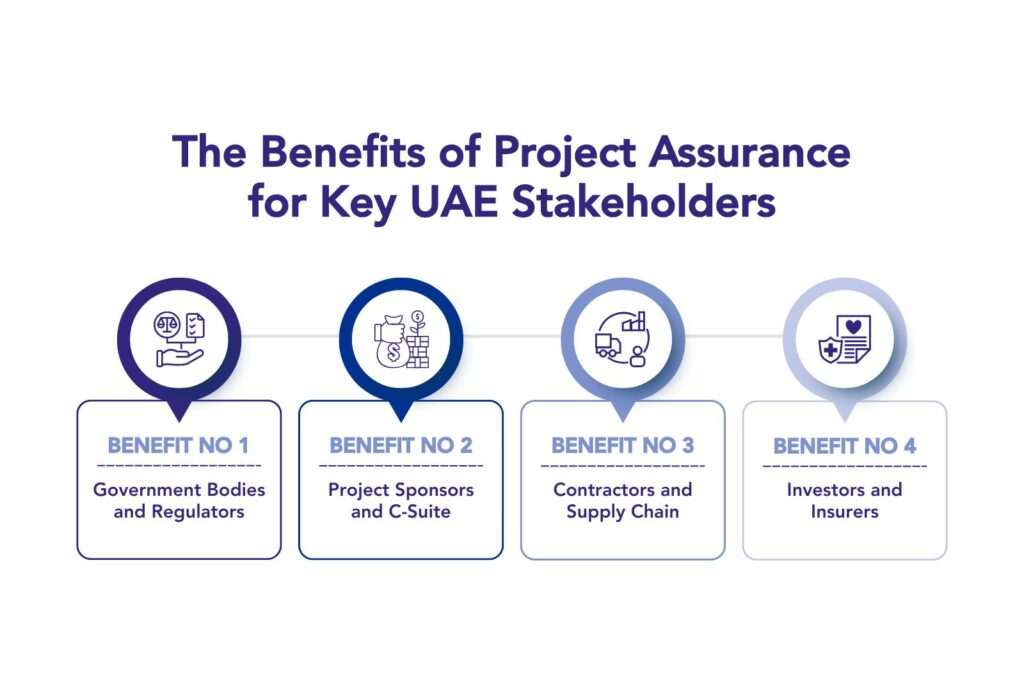
Project assurance is really valuable for everyone involved. It gives clarity and confidence. How is that possible? Let us see. Governments, investors, sponsors, and contractors all benefit. It ensures compliance, quality, and smooth delivery. Teams, they know what is expected. Projects stay on track. Risks are reduced. Everyone feels confident. You know it makes a difference.

Government Bodies and Regulators

For regulators and government bodies, project assurance ensures compliance and quality. It is not just checking boxes. Independent oversight verifies that rules and standards are met. Project assurance solutions provide assurance that each project aligns with regulations. Let us see. This builds trust. It reduces errors. It gives confidence to authorities that projects meet expectations every step of the way.

Project Sponsors and C-Suite

Project sponsors and the C-suite gain confidence in ROI and strategic alignment. They know the project is on track. Decisions are informed. Risks are spotted early. Risk assurance solutions give visibility into progress and outcomes. Let us see. This reduces surprises. It ensures the project delivers value. Teams, they can focus on execution. It makes leadership feel secure about investments.

Contractors and Supply Chain

Contractors and supply chain teams benefit too. They gain clarity on deliverables and timelines. Everyone understands what is required. It is easier to coordinate. Dependencies are managed. Let us see how project assurance ensures expectations are clear. It prevents misunderstandings. It keeps the project moving smoothly. Teams, they feel confident about what comes next.

Investors and Insurers

Investors and insurers face less uncertainty. Risks are identified early. Decisions are more informed. Projects are less likely to overrun costs or timelines. Let us see. Independent oversight gives assurance that investments are safer. It reduces surprises. It builds trust in the project. Everyone feels more secure. You know, it really works for high-stakes UAE projects.

How Project Assurance Enhances Collaboration and Communication in Complex Projects

Project assurance really helps teams work together. It brings clarity and trust. How is that done? Let us see. Independent experts check everything. Teams, they know what is happening at every stage. Communication improves naturally. Conflicts are spotted early. Decisions are coordinated. It is like giving everyone the same map. You know, it really keeps projects on track.

Fostering Transparency Through Independent Assurance

Independent third-party oversight builds transparency. Everyone sees the same progress and risks. Teams trust the data. Stakeholders are confident in what is reported. Using project assurance solutions makes sure nothing is hidden. Let us see. This reduces misunderstandings. It improves collaboration. For projects in the UAE, it enhances business resilience advisory in UAE. Teams feel aligned and informed. Businesses grow confidently. 

Enabling Timely Conflict Resolution

Project assurance catches conflicts early. Delays and confusion are avoided. Teams figure out the issues before they reach problematic levels. It is easier to resolve disagreements. Let us see how this works in practice. Independent monitoring guides decisions. Communication is smooth. Problems are fixed quickly. Everyone can focus on delivery. It really keeps projects moving without chaos.

Integrating Multi-Disciplinary Teams

Complex projects have many stakeholders and specialists. Project assurance helps integrate all these groups. It ensures coordination and clarity. Using risk assurance in UAE, teams understand responsibilities and priorities. Let us see. Deliverables are clear. Misalignment is prevented. Everyone works together efficiently. It is like connecting puzzle pieces perfectly. Projects finish on time and meet expectations.

Future Trends in UAE Mega Projects and Project Assurance

The future of UAE mega projects is exciting. Technology is changing how projects are delivered. Digital tools and embedded assurance models are becoming standard. How is that helpful? Let us see. Teams, they can monitor progress in real-time. Risks are spotted early. Projects stay aligned with strategic goals. ADEPTS is ready to support this evolution. You know, it really changes the game.

Digital Transformation and Embedded Assurance

Digital transformation is reshaping project assurance. Real-time monitoring tools track every stage. Teams can act immediately. Embedded assurance models are integrated into project workflows. Using long term project assurance, projects maintain alignment with goals. Let us see. Communication improves. Decisions are faster. Mistakes are prevented. Projects move smoothly. You know, technology makes everything more visible and manageable.

AI, Analytics, and Predictive Risk Management

Artificial intelligence and data analytics help predict issues before they occur. Risk patterns are identified. Decisions are informed. Using risk assurance solutions, teams can prevent cost overruns and delays. Let us see. It is like having foresight. Problems are fixed before they grow. Project outcomes are more reliable. You know, predictive insights really change how mega projects succeed in the UAE.

Evolving Regulations and ADEPTS’ Vision

Regulations and standards in the UAE are constantly changing. Project assurance must adapt. ADEPTS focuses on future-ready services. Let us see. They provide guidance and independent checks. Teams can align with global best practices. Strategic oversight ensures compliance. Using strategic post-audit action plans, project leaders plan for long-term success. It is like having a roadmap. You know, projects are safer and smarter.

ADEPTS’ Unique Approach to Project Assurance in the UAE

ADEPTS has a unique way of handling project assurance. It is structured, thorough, and proactive. Let us see. Their approach follows ISO 21502 standards and covers each phase independently. Teams, they get real-time guidance. Risks are spotted early. Decisions are informed. It is like having a trusted partner at every step. You know, it really keeps projects on track.

ISO 21502 Aligned, Phase-by-Phase Reviews

Every phase of a project is reviewed carefully. ADEPTS uses ISO 21502 as a guide. Independent checks ensure alignment with objectives. Teams, they know exactly what is expected. Using project assurance solutions, each stage is verified. Let us see. This prevents surprises. Communication improves. Projects run smoother. You know, step-by-step assurance really reduces mistakes.

Risk-Driven Focus and Governance

ADEPTS focuses on critical risks, compliance, and resource allocation. Teams understand priorities. Decisions are based on real-time insights. Using long term project assurance, risks are managed proactively. Let us see. This builds confidence. Governance is clear. Everyone knows their role. Projects deliver value efficiently. You know, a risk-driven approach makes projects safer and smarter in the UAE.

Real-Time Reporting and Benefits Realization

Executives get actionable reports at every stage. ADEPTS ensures post-project benefits are realized. Teams, they can adjust quickly. Using corporate governance for SMEs in UAE, leadership stays informed. Let us see. Decisions are faster. Projects deliver expected outcomes. Confidence is high. It is like having a dashboard guiding every step. You know, results are predictable and reliable.

Conclusion

Project assurance is really the secret weapon for UAE mega projects. It keeps everything on track despite complexity. ADEPTS provides independent oversight, risk management, and guidance. Teams, they work confidently. Projects deliver value efficiently. Stakeholders, they gain clarity and trust. Let us see. With project assurance, risks are managed early. Outcomes are predictable. You know, UAE ambitions become achievable with this approach.

FAQs:

Project assurance is independent oversight. It checks progress, risks, and alignment. Project management runs the project. You know, assurance adds a safety net and confidence.

Construction, infrastructure, technology, and energy sectors gain most. Projects with high complexity or multiple stakeholders benefit heavily. Let us see.

It ensures projects align with sustainability goals. Risks are spotted early. Resources are used efficiently. You know, it supports UAE Vision 2031.

Yes. Independent checks verify adherence to local standards. Teams, they act before issues arise. Compliance is easier to manage.

Cost overruns, delays, compliance gaps, supplier performance, and scope creep are common. Project assurance identifies these early. Let us see.

ADEPTS operates independently. It provides unbiased reports and guidance. Teams, they receive recommendations without influence. You know, it ensures trust and transparency.

All phases benefit. Early-stage reviews prevent design issues. Mid-stage reviews spot execution problems. Late-stage reviews ensure smooth go-live and benefits realization.

AI, data analytics, and real-time monitoring enhance visibility. Risks are predicted before they happen. Teams, they act faster. Let us see.

Related Articles​​

Ultimate 2026 Guide To VAT Refunds In The UAE: How Tourists, Businesses, And Special Entities Can Claim Their Refunds

VAT has been part of the UAE economy since 2018 with a standard rate of five percent. At first, it felt like a disruption. Yet now it is a backbone of the country’s revenue. How is that? Because VAT fuels development while keeping businesses accountable. Tourists, companies and even residents encounter VAT daily and refunds matter a lot.


Refunds are not just technical paperwork. They have a direct impact on tourism, trade and even small daily transactions. For tourists, VAT refunds make shopping more attractive. For businesses, it ensures efficiency and better cash flow. For special entities, it safeguards unique privileges. What if you could recover more simply? That is exactly why this 2026 guide is here.


This guide is crafted for clarity. Whether you are a traveler planning shopping or a company managing compliance, you will find simple paths to claim refunds. For UAE readers, it also means acting within stricter refund timelines and preparing for new enforcement updates in 2026. ADEPTS, a trusted VAT consultant, helps with smooth filing and reclaiming. Their expertise in VAT registration in UAE proves why compliance can be painless.


From 1 January 2026, the era of open-ended VAT credit accumulation is over; refunds and excess input tax are now governed by a defined 5-year statute of limitations, making VAT recovery a time-sensitive decision rather than an open option.

Understanding VAT and VAT Refunds in the UAE

VAT in the UAE is more than a tax. It is a system shaping trade, tourism and compliance. Since 2018, people have learned how VAT works and why refunds matter. Curious how it all connects? This section breaks down the basics of VAT, its structure and why refunds are vital for both businesses and travelers, from 2026 onwards, within clearly defined statutory time limits.

What Is VAT and How Does It Work?

VAT is a consumption tax applied on goods and services. Businesses collect VAT from customers. This is then paid to the government. Input VAT is when companies pay on purchases. Output VAT is when they collect amount on sales. The Federal Tax Authority oversees VAT compliance and refunds. Many firms depend on VAT registration services in Dubai to stay compliant and to ensure excess input VAT is monitored before statutory expiry deadlines introduced from 2026.

VAT Refunds: Concept and Importance

Refunds happen when input VAT exceeds output VAT. The extra amount is claimed back from the authority. Why does this matter? For companies, it frees up cash flow. For tourists, it makes shopping affordable. Even UAE nationals and global organizations benefit from refunds. From 1 January 2026, however, VAT refunds are no longer indefinite and must be claimed within a defined 5-year period from the relevant tax period. With proper VAT registration UAE processes, supported by VAT registration services UAE Dubai, refunds become faster and more reliable when claims are made within the permitted statutory window.

VAT Refunds for Tourists in the UAE

Ultimate 2025 Guide to VAT Refunds in the UAE: How Tourists, Businesses, and Special Entities Can Claim Their Refunds

Shopping in the UAE is a thrill. Fancy malls, luxury brands and endless souvenirs. But did you know tourists can get their VAT back? That means real savings. The refund scheme is simple yet many travelers still miss out. In this part, we break down eligibility, step by step process and clever tips for smooth refunds under the fully digital, paperless system applied in 2026.

Eligibility Criteria for Tourists

Not every traveler can claim a refund. You must be a non-resident and at least eighteen. Each invoice should be worth at least AED 250 and purchases must come from FTA-registered shops. Goods must leave the country with you. Many tourists even check Online VAT registration UAE status to confirm if a store is approved before shopping.

Step-by-Step VAT Refund Process for Tourists

The VAT refund process for tourists begins when you shop at stores that display tax-free signs. You ask for a digital tag linked to your receipt. At departure points like airports, land borders or seaports, you scan your details. Passport, invoices and card are shown. Refunds arrive as cash up to AED 10,000 or are sent to your bank card quickly through the paperless tourist VAT refund system, which in 2026 operates across thousands of participating stores and self-service kiosks using risk-based verification to reduce manual inspections.


In fact, under Article 46(4) of the Tax Procedures Law, submitting a VAT refund claim can extend the audit period for that specific claim by up to two additional years from the date of submission.

Key Points & Tips for Tourists

The easiest trick is to keep receipts in one folder so validation is faster. Try to combine small purchases into bigger ones above the AED 250 threshold. Always validate digitally before leaving or you will lose the claim. Some travelers even track their refund status online for peace of mind. That way, no money slips away unnoticed.


Tourists should also note the difference between validation and collection timelines: goods must be validated at the airport kiosk within 90 days from the purchase date, while the actual refund amount can be collected (cash or card) within one year after successful validation.

VAT Refunds for Businesses in the UAE

Running a business in the UAE comes with opportunities but also with compliance needs. VAT is a big part of this story. Did you know companies can claim back excess input VAT? It sounds simple but it requires attention to detail — and, from 2026 onwards, timely action. This section explains eligibility, the refund process, free zone rules and ADEPTS support.

Eligibility for Businesses

Not every company can claim a refund. To qualify, you need a valid TRN and be VAT-registered. When input VAT on expenses exceeds output VAT collected on sales, refunds get due. However, businesses have to keep proper invoices, receipts and contracts to claim refund. If a firm is not sure about compliance, in that case a VAT consultant becomes handy in guiding them towards managing records while avoiding mistakes. 


From 1 January 2026, businesses must also observe a strict 5-year statute of limitations on VAT refunds, meaning excess input tax credits expire five years from the end of the tax period in which they arose.


As a transitional measure, VAT credits originating from 2018, 2019, 2020, and 2021 must be claimed no later than 31 December 2026; any unclaimed amounts after this date are legally forfeited.

Step-by-Step Process for Business VAT Refunds

To claim a refund, first filing regular VAT returns via the FTA portal is a must. For refund, you submit an application Form VAT311. Do attach supporting invoices and documents. Once submitted, the FTA reviews, verifies details and approves the application. Afterwards, payment is issued directly to your bank account. Refundable expenses include office rent, imports, utilities and professional services. Proper filing speeds up approval process and reduces errors.


From 2026 onwards, businesses should note that self-invoicing for Reverse Charge Mechanism (RCM) purposes has been abolished, and refund claims must instead be supported by valid commercial supplier invoices and import documentation.


Businesses should also be aware of supply-chain due diligence requirements, as the Federal Tax Authority may deny a refund if the claimant “should have known” that a supplier was involved in VAT non-compliance; verifying supplier TRNs on the FTA portal before booking input VAT is strongly advised.


Filing large refund claims close to the end of the five-year limitation period can increase audit exposure, as submitting a refund application may extend the audit window for that claim by up to two additional years.

VAT Refunds for Businesses in Dubai Free Zones

Free Zones offer special benefits. However VAT rules still apply. Companies in Free Zones can use the reverse charge mechanism for imports. But compliance and managing cash flow is important. Refunds are processed through the EmaraTax platform. It is designed to simplify claims. It is important to follow Free Zone regulations especially for businesses which trade across mainland and Free Zone borders.


From 1 January 2026, while the reverse charge mechanism continues to apply, businesses are no longer required to issue self-invoices for RCM purposes; instead, Free Zone entities must retain commercial supplier invoices, import documentation, and EmaraTax records as primary support for VAT refund claims.

Role of ADEPTS in Business VAT Refunds

VAT refund claims can be tricky, and even small mistakes cause delays. ADEPTS supports businesses by reviewing records, checking compliance, and handling submissions. Their tailored services are particularly useful for Free Zone firms. By offering audit assistance and guidance, ADEPTS helps companies get refunds faster and avoid penalties while staying aligned with FTA regulations.


ADEPTS also assists businesses in reviewing historic VAT ledgers to identify excess input tax credits approaching statutory expiry and supports corrective filings, including refund-related voluntary disclosures, under the revised and more proportionate penalty framework effective from April 2026.

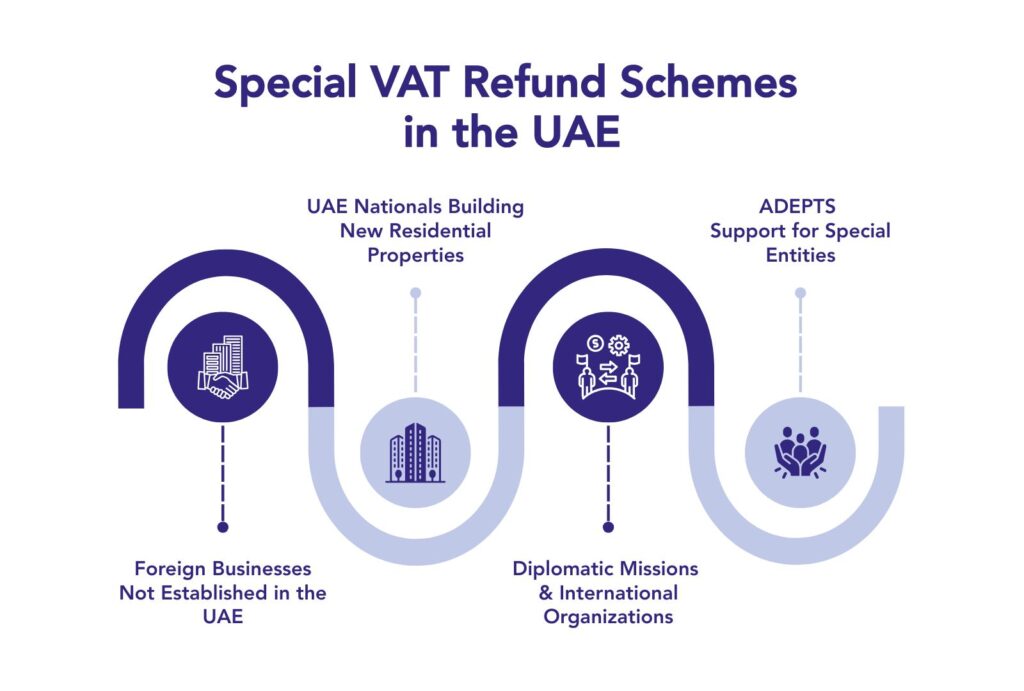
Special VAT Refund Schemes in the UAE

Ultimate 2025 Guide to VAT Refunds in the UAE: How Tourists, Businesses, and Special Entities Can Claim Their Refunds

VAT refunds in the UAE are not a one size fits all matter. Apart from tourists and registered companies there are certain situations where refunds apply. These schemes aim to keep things fair and to support groups that are not meant to bear VAT cost. Curious how it works. Let us explore these special VAT refund schemes in simple terms.

Foreign Businesses Not Established in the UAE

Ever wondered what happens when a company abroad pays VAT in the UAE. The Federal Tax Authority (FTA) makes room for this. If a business is outside the Emirates but pays VAT here, it can apply once every year. The refund is possible if the foreign country gives the same to UAE entities. Documents like contracts and invoices are required.


For 2026, the reciprocity list has been expanded to include Switzerland, allowing eligible Swiss businesses to claim VAT refunds in the UAE. Claims must be submitted by 31 August of the year following the year in which the VAT was incurred. 


In addition, foreign business refund claims must relate to a minimum VAT amount of AED 2,000; claims below this threshold are rejected.

UAE Nationals Building New Residential Properties

For UAE citizens who build their own house, the New Residence Construction Scheme feels like a big relief. Some building materials and contractor services can qualify for refunds. The idea is that VAT should not be an extra burden on Emiratis creating a private home. The claim requires invoices and needs to be made within a specific timeline after completion.


From 2026 onwards, refund applications under this scheme are submitted through the “Maskan” Smart App, which integrates with UAE Pass and municipal data as part of the zero-bureaucracy initiative to streamline processing. 


While the claim process is simpler, citizens should note that if the property is sold or used for commercial purposes shortly after completion, the Federal Tax Authority retains the right to claw back the refunded VAT.

Diplomatic Missions and International Organizations

Diplomatic offices often follow a different path. Embassies, consulates and recognized international bodies may get back VAT on expenses. The process is not quick since it usually needs cooperation between the FTA and the Ministry of Foreign Affairs. Supporting files matter most. Without proof that the mission or organization is eligible, the refund claim may not move forward.

ADEPTS Support for Special Entities

Every scheme has paperwork plus deadlines and even a small mistake causes delay. This is where a VAT consultant plays a helpful role. ADEPTS provides personal guidance by preparing applications and checking documents carefully. Entities in UAE free zones also get advice shaped around the latest free zone VAT rules. That way compliance stays strong and refund applications go through with less stress.


ADEPTS also supports special entities in reviewing eligibility conditions, submission timelines, and post-refund compliance requirements, helping reduce the risk of rejection or clawback under the updated refund framework.

Common Challenges and Best Practices

Claiming VAT refunds is not always straightforward. Businesses often struggle with delayed filings or missing paperwork and these errors can lead to significant setbacks. Even a small mismatch in invoices against Federal Tax Authority records can block claims. Companies also risk penalties when they miss deadlines for submission. Late payments are now subject to a 14% annual penalty, charged monthly, making timely submission even more critical. This is why strong systems and expert guidance are crucial.

Typical Issues in VAT Refund Claims

The most common issues include late submission of claims and incomplete documentation. Errors in tax invoices or data mismatches with FTA records create further hurdles. Missing or mismatched invoices can block claims and lead to penalties, including fines for failure to maintain proper records. The updated penalty structure for record-keeping now starts at AED 10,000 for the first violation, with up to AED 20,000 for repeat violations within 24 months. Many businesses also fail to follow proper validation steps or overlook deadlines. These mistakes are avoidable but they can cause delays in processing and may even affect future applications for refunds.


In 2026, businesses also face increased risk where historic VAT credits remain unreviewed, as excess input tax is now subject to a five-year expiry and unclaimed balances may lapse permanently. Filing large refund claims close to the expiry deadline can further increase audit scrutiny.

Best Practices to Ensure Successful Refunds

Keeping organized records is essential and digitizing invoices reduces the risk of human error. Regular reconciliation with the FTA portal helps identify issues before they become serious. Filing Voluntary Disclosures (VD) for any discrepancies early can help avoid penalties. Filing VD promptly can significantly reduce penalties since the penalty is now 1% per month of the tax difference, calculated from the original due date until VD submission.


Working with a trusted VAT consultant like ADEPTS ensures applications are accurate and timely. For businesses that are expanding operations, using VAT registration services in UAE and Dubai provides both compliance and long-term strategic support.


As a best practice in 2026, businesses should periodically review VAT ledgers to identify credits approaching the 5-year limit, verify suppliers’ TRNs before booking input VAT, and avoid delaying refund applications until the final months of eligibility.

Future Outlook and Regulatory Updates for 2026

The launch of the EmaraTax platform has transformed how businesses manage online VAT registration UAE and other filings. Decision No. 8 of 2024 clarified error correction rules making compliance easier for taxpayers. The simplified export verification process for VAT refunds is another step by the FTA to enhance efficiency and transparency for both local and international entities.


From 2026 onwards, VAT refunds and excess input tax credits are governed by a strict 5-year statute of limitations, replacing the previous open-ended approach and making timely reconciliation and recovery essential.


Furthermore, 2026 onwards, fees for issuing Tax Registration Certificates and Warehouse Keeper Certificates have been cancelled, and these documents are now available as free digital downloads.


From April 2026, voluntary disclosures of refund errors generally attract a compensatory penalty of 1% per month, replacing the earlier fixed, punitive penalty structure.

Emerging Trends in VAT Refunds

Digitalization and automation are rapidly changing VAT compliance practices. Experts expect possible expansion of refund schemes in the near future. With increasing reliance on data analytics and AI monitoring the focus will be on stricter VAT compliance in Dubai and other Emirates. Companies registering for the first time including those seeking Abu Dhabi VAT registration will also need to adapt to these evolving requirements.


In 2026, risk-based audits and data-driven cross-checks are expected to intensify, particularly regarding historic VAT credit balances, refund timing, and consistency between VAT returns and refund applications.

How ADEPTS Prepares Clients for Future Changes

ADEPTS supports clients with proactive communication and specialized training to stay updated on VAT changes. Tech-enabled solutions make compliance more efficient and reduce risks of errors. For companies operating in free zones ADEPTS provides additional guidance through VAT health check services so that every entity stays compliant and confident about future refund opportunities.


As part of 2026 readiness, ADEPTS also assists clients in reviewing expiring VAT credits, assessing refund eligibility under the new limitation rules, and navigating voluntary disclosures under the revised and more proportionate penalty framework effective from April 2026.

Conclusion

VAT refunds may sound boring but in reality they can save you quite a bit. Imagine this, you are a business owner, a tourist, or part of a special entity—every eligible claim counts. Keeping proper invoices and meeting deadlines is not just a rule, it is your ticket to smoother cash flow. Failure to meet deadlines or provide accurate invoices could result in significant penalties, including a 14% annual penalty for late payments and fines for incomplete documentation. Working with a VAT consultant like ADEPTS makes life easier and less stressful — especially as VAT refunds have become strictly time-sensitive since 2026.


The rules differ depending on who you are. Tourists need to be non-residents. Businesses must have proper registration and invoices. Special entities like free zone companies or diplomatic offices have their own steps. Miss one tiny thing and your claim might get stuck. That is why expert guidance and organized records make the whole process simpler and help ensure VAT credits are recovered before statutory expiry deadlines apply.


So, if you happen to be in the UAE and are thinking about claiming your refunds, why wait until the last minute? Businesses holding VAT credits from 2018 to 2021 should act before 31 December 2026 to avoid permanent loss of those amounts. ADEPTS has got your back. They handle everything from online VAT registration UAE to VAT compliance in Dubai and even Abu Dhabi VAT registration. Step by step, they make sure nothing slips through, and your refunds reach you without any hassle.

FAQs:

Well, not really. VAT refunds mostly apply to goods you buy and take out of the UAE. Hotel stays and other services usually do not qualify. But the system makes sense if you plan your purchases from registered retailers and carry them out with proper invoices.

Here is the catch. Online orders delivered locally are generally not refundable. Only physical goods you take with you when leaving the country count. Make sure invoices and customs validation are done correctly. Validation must be completed within 90 days of purchase under the paperless tourist refund system.

No, residents cannot claim tourist VAT refunds. The system is meant for foreign visitors and special entities only. So if you are a resident, you will not get refunds for goods purchased locally.


Mistakes can really cost you. If you submit incorrect or incomplete information, you might face fines starting from AED 10,000 for incorrect records and up to AED 20,000 for repeat violations. Additionally, late payments or errors could lead to a 14% annual penalty charged monthly. The FTA could even investigate your case further. Just double-checking your documents or getting help from a VAT consultant can save you plenty of headaches and keep the whole process much smoother.


From April 2026, voluntary disclosures related to refund errors generally attract a percentage-based monthly penalty rather than heavy fixed fines.

If you overstay, your claim may not be accepted because refunds depend on valid departure records. Without proper customs verification, the system won’t validate your purchase. Overstaying could also lead to penalties under the new system, where the FTA can apply fines for incorrect documentation and possibly block any future claims.

Yes, but only if the items are sealed and approved for export by customs. If you eat or open them locally, no refund. Always check participating retailers before buying.

Generally, employees cannot claim VAT directly. Companies may reclaim eligible expenses if rules are followed and documentation is in order.

Customs declarations are essential. They confirm your goods are leaving the UAE, which is required to validate refunds. Missing or wrong declarations can block your claim entirely. In 2026, customs data is increasingly used for automated cross-checks during refund reviews.

Yes, businesses can carry forward unused VAT credits or request a refund depending on their filing status. Proper submission via the FTA portal is key. From 1 January 2026, unused VAT credits are subject to a five-year limitation period, after which they expire if not claimed.

If a claim is rejected, you can file a reconsideration request with the FTA within the allowed period. Having proper documentation helps. Working with a VAT consultant like ADEPTS increases your chances of success. Where the FTA has not issued a final decision, refund-related voluntary disclosures may still be submitted within two years of the refund application date.

References

Related Articles​​

The CBUAE's Anti-Fraud Framework: A Step-by-Step Implementation Guide Beyond Due Diligence

The Central Bank of the UAE has a huge role in keeping finance stable. It regulates banks, insurers, and fintechs. The CBUAE Anti-Fraud Framework is at its core. This is more than rules. It builds trust and order. That is why Central Bank UAE fraud prevention matters in a digital economy.


Why do anti-fraud frameworks matter in UAE. The market is global, diverse, and very fast. New fraud schemes appear almost daily. That is where UAE Anti-Fraud Regulations take the lead. They keep institutions alert. Without them, financial crime prevention UAE would collapse, leaving companies exposed to manipulation, laundering, and deceptive activity.


This article goes further than due diligence. It looks at how the CBUAE Anti-Fraud Framework links with UAE AML/CFT regulations to create a clear step-by-step model. We cover prevention, detection, and response. What if firms miss key steps. Let us delve into this together and uncover how fraud can be stopped smartly.

Understanding the CBUAE’s Anti-Fraud Framework

The CBUAE Anti-Fraud Framework is designed to strengthen integrity across financial institutions. It does not stop at surface checks. It guides firms to prevent and respond effectively. By linking to UAE Anti-Fraud Regulations, the framework creates trust. To truly understand how it works, you need to see its objectives, legal alignment, and core documents.

Objectives: Prevent, Detect, Respond

The foundation of this framework lies in three goals. Institutions must prevent fraud before it starts. They should detect suspicious activity quickly, guided by CBUAE fraud detection guidelines. Finally, firms respond through clear escalation channels. This cycle ensures resilience. For deeper insights, visit our page on Fraud Risk Management.

Alignment with AML/CFT and Global Standards

The framework does not work on its own. It is tied closely to UAE AML/CFT regulations and even follows the FATF rules from around the world. Everything links together so nothing gets missed. How cool is that?


This makes it vital for financial crime prevention UAE. Compliance ensures institutions are credible across borders. You can also explore AML & Compliance Services to understand how regulatory alignment strengthens operations.

Key Regulatory Documents and Guidelines

Guidance comes directly from the Central Bank. These include official circulars, control standards, and compliance manuals. They support Central Bank UAE fraud prevention efforts and outline responsibilities for financial firms. Many parts connect back to UAE Anti-Fraud Regulations. Institutions can study the AML/CFT Guidelines to stay updated with evolving requirements.

Governance and Organizational Structure

The CBUAE's Anti-Fraud Framework: A Step-by-Step Implementation Guide Beyond Due Diligence

Fraud prevention is never random. It starts with a solid governance model that defines roles and accountability. Within the CBUAE Anti-Fraud Framework, governance ensures leadership drives oversight and compliance. Institutions that embed strong controls create transparency and trust. In fact, effective Anti-fraud compliance UAE depends on governance more than any other pillar of protection.

Governance Role in Fraud Control

Strong governance is the backbone of Central Bank UAE fraud prevention. Leaders set the tone for zero tolerance against fraud. They establish committees, monitor fraud risks, and track reporting channels. This is not just theory, it is practice. For deeper insight on governance structures, explore Enterprise Risk Advisory UAE.

Compliance Officers’ Appointment and Duties

Every institution must designate compliance officers to ensure adherence with UAE Anti-Fraud Regulations. Their job is monitoring suspicious activities, guiding internal teams, and reporting breaches to regulators. They are the first line of defense for the CBUAE Anti-Fraud Framework. To learn more about officer responsibilities, check AML & Compliance Services.

ADEPTS’ Governance Support

At ADEPTS, we do more than consult. We help institutions design governance models that match Fraud risk assessment UAE requirements. Our approach ensures boards, officers, and committees work together for effective Anti-fraud compliance UAE. To see how our support aligns with regulatory needs, visit Fraud Risk Management.

Risk Assessment and Identification of Fraud Threats

Understanding fraud risks is more than ticking boxes. The CBUAE Anti-Fraud Framework emphasizes proactive evaluation. Institutions must spot threats before they escalate. By conducting thorough Fraud risk assessment UAE, firms can protect themselves and clients. What if a vulnerability is missed? Early detection reduces exposure and supports Financial crime prevention UAE.

Conducting Comprehensive Fraud Risk Assessments

Firms must evaluate fraud risks systematically, examining processes, transactions, and historical trends. This is not a one-time task but a continuous exercise. Institutions following CBUAE Anti-Fraud Framework principles strengthen operations. For detailed strategies, explore Fraud Risk Management.

Integration of Risk-Based Approach (RBA)

A risk-based approach (RBA) allows resources to focus on high-risk areas. It improves efficiency and aligns with Anti-fraud compliance UAE standards. How is that different from routine checks? RBA adjusts continuously as threats evolve. For expert guidance, check Enterprise Risk Advisory UAE.

Tools and Methodologies for Identifying Vulnerabilities

These days, catching fraud is more than just doing the usual checks. Using tools like data analytics, watching trends, and spotting weird patterns can reveal hidden risks. Following UAE Anti-Fraud Regulations keeps you on the right side of the rules and makes your detection way more accurate. Learn more about practical tools at Detecting Errors and Frauds in Auditing.

Developing and Implementing Fraud Prevention Controls

Fraud prevention requires more than rules. Under the CBUAE Anti-Fraud Framework, firms must build proactive controls tailored to UAE operations. These controls not only detect irregularities but prevent them. Leveraging Fraud prevention technology UAE helps institutions stay ahead. What if a gap is missed? Strong preventive measures reduce risk exposure significantly.

Designing Control Measures Specific to UAE Financial Context

Control measures must reflect UAE regulatory requirements and market practices. This includes process checkpoints, transaction monitoring, and employee oversight. Effective measures enhance Financial crime prevention UAE and build trust with stakeholders. To explore strategic control design, refer to Fraud Risk Management.

Embedding Internal Policies, Standards, and Procedures

Embedding clear policies ensures day-to-day operations align with Anti-fraud compliance UAE. Standards and procedures guide staff, set expectations, and maintain regulatory alignment. This reduces human error and operational loopholes. For details on institutional policies and compliance workflows, check AML & Compliance Services.

ADEPTS Solutions for Fraud Prevention Technology and Process Optimization

ADEPTS provides tools and solutions to optimize fraud controls. From analytics to automated alerts, technology strengthens detection while streamlining processes. These solutions support Fraud prevention technology UAE and integrate with existing systems. Learn how ADEPTS enhances organizational efficiency at Enterprise Risk Advisory UAE.

Detection Mechanisms: Beyond Customer Due Diligence (CDD)

The CBUAE's Anti-Fraud Framework: A Step-by-Step Implementation Guide Beyond Due Diligence

Fraud detection is more than basic checks. The CBUAE Anti-Fraud Framework encourages real-time monitoring and analytics to spot suspicious activity instantly. What if traditional due diligence is not enough? Using Fraud prevention technology UAE helps institutions uncover hidden risks and strengthens Financial crime prevention UAE, keeping operations safe and compliant.

Advanced Fraud Detection Techniques

Modern techniques include AI, pattern recognition, and analytics that flag anomalies quickly. Institutions relying on these strategies enhance Financial crime prevention UAE and stay ahead of fraud trends. For deeper strategies, visit Fraud Risk Management.

Role of Suspicious Transaction Reporting (STR) and FIU

STRs are critical under CBUAE suspicious transaction reporting (STR) and UAE AML/CFT regulations. Financial institutions must report unusual activities promptly to FIU. This ensures accountability and regulatory compliance. For guidance on reporting frameworks, check AML & Compliance Services.

Examples of Fraud Typologies in UAE

UAE financial institutions face multiple fraud types, from identity theft to transaction manipulation. Understanding these typologies under CBUAE Anti-Fraud Framework and UAE Anti-Fraud Regulations is key. Practical examples enhance staff awareness and compliance. Learn more at Detecting Errors and Frauds in Auditing.

Response and Investigation Protocols

A strong response protocol is essential under CBUAE Anti-Fraud Framework. Immediate action upon fraud detection prevents escalation. Institutions must have clear procedures that align with Anti-fraud compliance UAE standards. What if multiple departments are involved? Coordinated responses ensure effective mitigation and preserve reputation.

Structured Response Actions

Upon detecting fraud, organizations follow predefined steps to investigate, contain, and report. These procedures enhance CBUAE Anti-Fraud Framework adherence and prevent financial losses. For structured implementation guidance, refer to Fraud Risk Management.

Coordination with CBUAE and Law Enforcement

Coordination with Central Bank UAE fraud prevention teams, law enforcement, and other regulators is critical. Effective collaboration strengthens investigation outcomes and compliance. To understand practical coordination methods, explore Enterprise Risk Advisory UAE.

Documentation and Evidence Management

Accurate documentation supports legal proceedings and internal investigations. Adhering to Financial crime prevention UAE standards ensures evidence is organized and traceable. Learn best practices at AML & Compliance Services.

Training, Awareness, and Continuous Improvement

Staff awareness is the first line of defense. Training programs under Anti-fraud compliance UAE improve detection and response. What if employees are unaware of risks? A culture of vigilance enhances Financial crime prevention UAE. Continuous improvement ensures controls remain relevant and effective in the evolving UAE financial landscape.

Staff Training Programs on Fraud Detection

Training equips employees to spot anomalies and follow protocols. Regular sessions enhance Anti-fraud compliance UAE and reduce human error. For practical training solutions, visit AML & Compliance Services.

Creating a Culture of Fraud Awareness

Building awareness across all levels encourages vigilance. Staff participation reinforces Financial crime prevention UAE. Real examples and interactive sessions make learning engaging. For insights on fostering awareness, check Fraud Risk Management.

ADEPTS Training Modules and Continuous Monitoring

ADEPTS offers specialized modules and ongoing compliance monitoring. Using Fraud prevention technology UAE, firms can track improvements and gaps. This strengthens detection and response capabilities. Explore solutions at Enterprise Risk Advisory UAE.

Leveraging Technology in the CBUAE Anti-Fraud Framework

Technology transforms fraud prevention. Using AI, machine learning, and big data under CBUAE Anti-Fraud Framework improves accuracy. What if human monitoring fails? Digital tools provide real-time alerts and insights. Integration with Fraud prevention technology UAE ensures that institutions stay compliant and efficient in their operations.

AI, Machine Learning, and Big Data

AI and analytics detect anomalies and patterns faster than manual review. They enhance Fraud prevention technology UAE and compliance. For tech deployment strategies, see Fraud Risk Management.

Integration of Fintech and Cybersecurity Strategies

Combining fintech solutions with robust cybersecurity ensures UAE Anti-Fraud Regulations compliance. Institutions minimize exposure while maximizing efficiency. Learn integration best practices at AML & Compliance Services.

ADEPTS Expertise in Technology Deployment

ADEPTS helps deploy cutting-edge systems for detection, monitoring, and reporting. Leveraging Anti-fraud compliance UAE, institutions improve resilience against fraud. Explore solutions at Enterprise Risk Advisory UAE.

Monitoring, Reporting, and Audit

Watching things closely and reporting problems is really what keeps fraud in check under the CBUAE Anti-Fraud Framework. Acting quickly can stop losses before they pile up. Doing audits and self-checks shows what works and what does not. But hey, what if someone just ignores the gaps? Trouble comes fast. Continuous improvement is critical to Anti-fraud compliance UAE and regulatory alignment.

Continuous Monitoring Mechanisms

Real-time dashboards and alerts track anomalies. Continuous monitoring ensures CBUAE Anti-Fraud Framework adherence. For tools and methodologies, see Fraud Risk Management.

Reporting Obligations and Timelines

Regulations require prompt reporting to FIU and regulators, following CBUAE suspicious transaction reporting (STR) and UAE AML/CFT regulations. For guidance, check AML & Compliance Services.

Audits and Self-Assessments

Regular audits benchmark effectiveness and improve Anti-fraud compliance UAE. Institutions can identify gaps and refine processes. Explore audit frameworks at Enterprise Risk Advisory UAE.

Challenges and Future Trends in UAE Anti-Fraud Measures

Fraud risks evolve with digital transformation. Regulatory updates also reshape the UAE Anti-Fraud Regulations landscape. ADEPTS helps institutions adapt and remain compliant. How will future trends impact operations? Being proactive in Financial crime prevention UAE ensures resilience and keeps institutions ahead of fraud threats.

Emerging Fraud Risks from Digital Transformation

Digitalization introduces new fraud schemes. Institutions must innovate to maintain Financial crime prevention UAE. Proactive monitoring and adaptive strategies are essential. For guidance, check Fraud Risk Management.

Regulatory Updates and Enhancements

UAE regulators continuously update rules. Institutions must align with UAE Anti-Fraud Regulations to remain compliant. For regulatory guidance, refer to AML & Compliance Services.

ADEPTS’ Role in Adapting to Evolving Risks

ADEPTS supports firms with advanced tools and consultancy to enhance Anti-fraud compliance UAE. Continuous updates, monitoring, and training ensure readiness against emerging threats. Explore solutions at Enterprise Risk Advisory UAE.

FAQs:

The CBUAE Anti-Fraud Framework is different. It is not just about rules. It mixes prevention, detection, and response in one. It also follows UAE AML/CFT regulations closely. Using Fraud prevention technology UAE makes it smarter than many others. Curious how it works in practice? Check Fraud Risk Management.

Small banks or fintechs can start simple. Focus on high-risk areas first. Put Anti-fraud compliance UAE rules in place. Train staff and use some affordable tech tools. Keep monitoring light but steady. Need examples? Visit AML & Compliance Services.

Ignoring rules can cost a lot. Fines, bad publicity, maybe license issues. If you skip reporting under CBUAE suspicious transaction reporting (STR), regulators notice. Following UAE Anti-Fraud Regulations keeps trouble away. Want a guide? See Enterprise Risk Advisory UAE.

CDD is basic checks. EDD is for high-risk clients. More digging, more monitoring. Both follow UAE AML/CFT regulations. CBUAE Anti-Fraud Framework makes sure you know who is on the other side. Curious about risk-based monitoring? Check Fraud Risk Management.

Tech spots what humans miss. AI, analytics, and Fraud prevention technology UAE tools detect patterns and weird activities. This helps with Financial crime prevention UAE. Makes life easier and faster. Need ideas on using tech? See Enterprise Risk Advisory UAE.

At least once a year. Or sooner if rules change. Helps with Anti-fraud compliance UAE. Keeps you aligned with CBUAE Anti-Fraud Framework. Better safe than sorry. For tips on monitoring and audits, see AML & Compliance Services.

Yes, they can. ADEPTS automates CBUAE suspicious transaction reporting (STR). Reports go faster, errors drop. Works with UAE AML/CFT regulations. Saves time and headaches. For more on automation, visit Enterprise Risk Advisory UAE.

Watch for strange transactions, weird patterns, and unusual client behavior. Keep Fraud risk assessment UAE updated. Helps with Financial crime prevention UAE. Stay alert, review often. For details on spotting fraud signs, see Fraud Risk Management.

Related Articles​​

DMCC vs. Other Free Zones: Which is Best for Your Business in 2026?

The UAE isn’t just open for business. It’s like a special haven built for it. Consider the fact that in 2026, more than 40 free zones across the country are competing for new businesses, new opportunities of investment. The government has introduced several business friendly policies to support investment growth.


Each Free Zone is  promising something different: location, cost, speed, industry focus. Some are quiet industrial hubs. Others are sleek towers packed with global giants. But one name always stands out: DMCC. Is it really the best? Or just the loudest? 


If you’re looking to start, grow, or move your business in the UAE, choosing the right free zone is not a small decision. It affects your cost, your flexibility, your licenses, even how global banks and partners treat you.


This guide breaks it all down. We’ll compare DMCC with the other major free zones in the UAE like IFZA, RAKEZ, ADGM, DIFC, Dubai South, Sharjah Media City, and more.
Not in theory. In practice.


Let’s get to the point. No fluff. No hype. Just what you need to know to make the smart call.

What Are Free Zones in the UAE?

Free zones are special areas where businesses get major tax perks to set up a company, a business. The idea is to attract foreign investors. The purpose is to fuel trade in the UAE. The main objective is to build global industries from the ground up.


Here’s what you get when you choose a free zone:

  • 100% foreign ownership. No local sponsor needed.

  • Under UAE Corporate Tax Law (Federal Decree-Law No. 47 of 2022), a 9% corporate tax applies unless the business earns “Qualifying Income.”

  • To qualify for the 0% rate, companies must demonstrate Adequate Economic Substance, including physical presence, employees, and operational activity inside the free zone.

  • Free zones that promote “virtual” or desk-only setups now expose businesses to automatic 9% tax risk.

  • No personal income tax.

  • No customs duties on imports and re-exports within the free zone.


Some free zones are general-purpose. Others are laser-focused on industries like:

  • Commodities (DMCC, Dubai Gold & Diamond Park)

  • Technology (Dubai Internet City, Dubai Silicon Oasis)

  • Media and creatives (Dubai Media City, Twofour54)

  • Finance (DIFC in Dubai, ADGM in Abu Dhabi)

  • Logistics and trade (JAFZA, Dubai South, KIZAD)

Each free zone has its own rules, costs, and reputation. Some are great for startups. Others cater to multinationals. Picking the right one depends on what your business actually needs.

Why DMCC Is Frequently Touted as the UAE's Premier Free Zone in 2026

Why DMCC Is Frequently Touted as the UAE's Premier Free Zone in 2026

There are over 40 free zones in the UAE. So why does DMCC keep coming out on top? It’s the consistency. DMCC, located in Jumeirah Lakes Towers (JLT), has been named the World’s No.1 Free Zone for eight years straight by the Financial Times’ fDi Rankings. This can’t be a fluke. It is a message to serious entrepreneurs, traders, and global businesses: this is where business gets done.


More than 24,000 (around 25,000) companies already call DMCC home. And they’re not just local shops. We’re talking global names in commodities trading, fintech, crypto, blockchain, legal, professional services, and general trade.

1. Built for Global Trade

DMCC directly runs commodities exchanges. Think about big things like gold, diamonds, tea, coffee, it’s all traded here tax-free, thanks to DMCC’s direct integration with the Dubai Gold & Commodities Exchange (DGCX) and Dubai Diamond Exchange.


For rough diamonds and regulated gold trading, DMCC is effectively mandatory due to Kimberley Process compliance and vault-to-exchange integration. Other free zones cannot replicate this ecosystem.

2. A Trusted Name in Finance and Crypto

With a strong, clear regulatory framework, DMCC supports crypto companies, fintech startups, and financial consultancies.


DMCC is suitable for proprietary crypto trading, blockchain development, NFT platforms, and treasury operations. Regulated activities such as running an exchange, custody, or brokerage fall under VARA (Dubai) or ADGM (Abu Dhabi), not DMCC.

3. Grade-A Infrastructure

Think sleek office towers, stunning lake views, cafes, gyms, luxury apartments, and metro access—all in one spot.


DMCC’s mandatory physical office requirement now acts as a compliance advantage, helping companies defend the 0% Qualifying Income position under corporate tax rules.

4. Flexible Licensing That Grows With You

Want to run multiple activities under one license? Need an SPV or a holding company? DMCC makes it easy.


DMCC offers a DMCC + DED dual license, allowing companies to operate on the mainland without a local sponsor.  Most budget free zones (Shams, Meydan) do not offer seamless onshore access.

5. Logistics Without the Headache

DMCC has partnerships with JAFZA and DAFZA, giving your company access to Dubai’s biggest logistics zones without leaving your DMCC registration behind.


DMCC (JLT) is a non-bonded zone. Moving goods into JLT usually triggers 5% customs duty unless routed through a bonded warehouse. JAFZA is a fully bonded zone, allowing goods to remain duty-free until released into the UAE market.

6. Built-In Business Community

Networking is a major feature of DMCC. Whether you’re connecting with global traders or crypto founders, DMCC creates an environment built for scale.


And yes, DMCC company formation cost is higher than some smaller zones. But you’re paying for quality, compliance protection, and bankability.

DMCC vs Other Free Zones — 2026 Total Cost Reality

UAE banks now “tier” free zones for risk assessment.
  • Tier 1 (DMCC, DIFC, JAFZA): High bank acceptance, standard due diligence
  • Tier 2/3 (Budget Zones): High rejection rates, 3–6 month delays, minimum balances often AED 200,000+
Free ZoneBanking Tier (2026)Corporate Tax OutcomePhysical Substance Requirement3-Year Total Cost RealityBest Use Case (2026 Reality)
DMCCTier 1(High acceptance)0% possible (Qualifying Income protected)Mandatory physical officeHigher upfront cost, lower long-term tax & banking riskActive trading, commodities, crypto proprietary trading, fintech SMEs, holding/SPVs
DIFCTier 10% possible (strict substance & compliance)Mandatory office + high governanceVery high cost, low regulatory riskFunds, financial institutions, VC-backed structures
JAFZATier 10% possible (substance-driven)Warehouses / industrial substanceHigh capex, strong trade efficiencyLarge-scale logistics, manufacturing, bonded trading
ADGMTier 10% possible (regulated entities)Strong substance & complianceHigh cost, high complianceInstitutional finance, legal, regulated fintech
DSOTier 20% only if substance provenOffice or lab space requiredMedium cost, moderate banking riskTech startups with real operations
RAKEZTier 2 / 3Often defaults to 9% for tradingRequired but loosely enforcedLow setup cost, high restructuring riskManufacturing with physical operations
ShamsTier 3High probability of 9% taxMinimal / virtualCheap license, high banking failure costFreelancers, media creators (non-trading)
MeydanTier 3Very high 9% tax exposureVirtual setups commonLowest license cost, highest banking riskSolo consultants with non-revenue-heavy models

Saving AED 10,000 on a license often results in failed bank account openings and expensive compliance consultants later.

3-Year Total Cost of Ownership (TCO) – 2026 View

  • DMCC: Higher upfront cost, lower tax exposure, smoother banking

  • Budget Zones: Low setup cost, but higher risk of 9% tax, banking failures, and restructuring

For active trading companies, DMCC is often cheaper over a 3-year horizon.

Critical Factors to Consider When Choosing Between DMCC and Other Free Zones in 2026

Not all free zones are built the same. And not all are built for you. Before you jump into DMCC company formation or set up in another free zone, ask one thing:  What does your business actually need? Here’s how to break it down:

Your Business Activity

Different free zones specialize in different things. If you’re in commodities, crypto, or fintech, DMCC is your playground. Tech startup? Look at Dubai Silicon Oasis. Shipping and exports? JAFZA makes more sense. Choose a zone that gets your industry. It makes everything smoother, from licensing to support.

The Real Cost

Don’t just look at the headline fee.The real cost is always way higher than what it shows on the paper. Factor in setup charges, annual renewals, visa costs, and office rent. DMCC company formation cost starts higher than others. But you get what you pay for: infrastructure, reputation, and real credibility.


Lower license fees in budget zones often come with higher long-term costs due to corporate tax exposure, banking delays, and restructuring expenses. The cheapest setup is rarely the most viable one in 2026.

Location

Where are your clients? Your team? Your suppliers? Company formation in DMCC Dubai puts you in the heart of the city. You’re close to metro lines, airports, ports, and talent pools. But if port access is everything to you, JAFZA wins. You can cut the logistics cost several times with a JAFZA company.  If you’re building hardware and need space, RAKEZ and DSO are better.

Office Flexibility

Some zones force you to rent a full office, even if you’re a one-person team. Others offer flexi-desks, hot desks, or full towers. If you don’t need a big place and the freezone asks you to maintain one, your overhead cost can totally ruin the profit balance. The good thing about DMCC is that you can find something suitable in all situations here.


DMCC free zone company setup gives you options. From smart desks to sky-high towers.
If you want a fully remote setup?


Purely remote or virtual office setups now increase exposure to 9% corporate tax and banking rejection. Physical office presence is no longer optional for active businesses.

Rules That Work for You

If you are a business owner or you want to start one, your number 1 concern will be rules and regulations. They can either support a business or break its back and cut its wings. So choose your free zone that supports the particular type of business that you are trying to run. DMCC offers multi-activity licenses, SPVs, and even holding company options under one roof. That’s rare. And powerful.


Smaller zones may limit how many activities you can do under one license. Watch for that.

Visa Support

Businesses often need to offer immigration visas for foreign workers. If your business will need a large team, go for a zone with broad visa quotas. DMCC company setup supports generous visa limits, even for smaller offices.


In 2026 DMCC enforces a strict ratio of 1 visa per 9 square meters of office space. Growing teams must scale office size to unlock additional visas.


If you are a freelancer and your workforce won’t need to come over to the UAE, then DMCC is not much of an opportunity for you. Try Shams or Meydan for cheaper visa bundles.

Support That Actually Helps

Business setups need lots of support. Especially in the initial phase. Some free zones give you a desk and disappear. You are on your own after that. That can be a lot of hassle. Some freezones can create communities for support and assistance. DMCC business setup comes with serious networking, events, trade links, investor intros, mentorship. That kind of support pays off fast, especially if you’re new in town.

Speed and Digital Process

Need to go live in a few days? Meydan and IFZA are super fast and fully online. DMCC is fast, but not instant. You’re trading speed for structure and long-term value. Know your timeline. Choose accordingly.

Reputation

This one’s big. DMCC is known worldwide. Banks trust it. Investors respect it. Clients recognize it. A DMCC free zone business setup can instantly boost your credibility. Other zones may not have that same weight, especially outside the UAE.

Real Estate Ownership

DMCC (JLT) allows freehold ownership of office units, offering long-term asset value and stability. JAFZA is primarily leasehold-only, suitable for operational scale but not ownership-driven strategies.

WPS Enforcement

DMCC strictly enforces the Wage Protection System (WPS) through its portal. This adds administrative layers but protects companies from labor disputes and compliance penalties compared to looser zones.

Emerging Trends and Regulatory Updates in 2026 Impacting Free Zones

Emerging Trends and Regulatory Updates in 2026 Impacting Free Zones

Things are shifting fast in the UAE’s business world. Here’s what’s changing and how DMCC is staying ahead:

  • Crypto is getting real. DMCC offers multiple crypto license options and keeps evolving with global compliance trends.

  • Green, tech, and media are rising. Zones like DSO, Shams, and IFZA are moving fast to serve these growing sectors.

  • SME support is expanding. Subsidies, mentorships, and startup incentives are popping up, especially in zones focused on innovation.

  • VAT compliance is now a must. DMCC is one of the few zones giving companies clear VAT guidance and training.

  • Digital setup is speeding up. More zones now offer full online registration and visa processes. Meydan leads the pack here.

  • Multi-activity licensing is on the rise. DMCC is still the best at this, letting one company handle multiple lines of business legally and cleanly.

In short: the rules are shifting. DMCC is adapting. And many other zones are playing catch-up.

Legal Framework: Why It Matters

  • DMCC operates under UAE Civil Law and Federal Courts.

  • DIFC and ADGM operate under English Common Law, preferred by institutional investors and VCs for shareholder protections.

Authority & Regulatory Basis (2026)

  • UAE Corporate Tax: Federal Decree-Law No. 47 of 2022

  • Qualifying Income Rules: Cabinet Decision No. 55 of 2023

  • AML & Banking Risk: FATF Outcomes – February 2024

  • DMCC Framework: DMCC Company Regulations 2020

How ADEPTS Adds Value in Navigating Free Zone Selection & Setup in UAE

Choosing a free zone is not just a paperwork task. It’s a strategic move. That’s where ADEPTS comes in. We specialize in DMCC company formation and work with multiple top-tier UAE free zones. We don’t just check boxes, we help you choose the right setup for your business model, growth plans, and budget.


Here’s what you get with ADEPTS:

  • Clear advice on which free zone matches your activity and industry.

  • Help comparing DMCC free zone company setup with others based on real licensing cost, location pros, and visa support.

  • Expertise in multi-license setups, SPVs, and crypto registration—especially in zones like DMCC that support complex structures.

  • Full support from start to finish: licenses, visas, office leasing, and banking coordination.

  • Whether you’re a startup or multinational, we tailor every step to fit your scale, timeline, and goals.

The result? A faster, smoother, and more commercially smart entry into the UAE market. No guesswork. No wasted money.

Conclusion

DMCC continues to be a top choice for 2026—and now for even stronger reasons. In a world of tighter tax rules, stricter banking, and global compliance pressure, DMCC’s structure has become a protection mechanism, not a cost.


Every free zone has strengths. But in 2026, the smartest decision isn’t the cheapest license. It’s the setup that survives tax audits, banking reviews, and global scrutiny.

FAQs:

DMCC is perfect for commodities trading, fintech, crypto, blockchain, professional services, and general trading. It’s also a strong fit for holding companies and businesses that need multi-activity flexibility. If you’re building a global business, DMCC free zone company formation gives you serious leverage.

DMCC company formation cost starts higher than zones like Shams or Meydan. Expect around AED 30,000-35,000 depending on your license and office type. But you’re paying for premium infrastructure, reputation, and business credibility. For serious entrepreneurs, it’s often

Yes. DMCC now offers expanded crypto licenses, multi-activity setups, and structures for SPVs and holding companies. These updates give founders more freedom to operate under one umbrella without registering multiple entities.

Absolutely. DMCC company formation allows 100% foreign ownership, with no need for a local partner or sponsor—just like other top-tier UAE free zones.

You’ll find everything from flexi-desks and co-working setups to premium office towers overlooking JLT. DMCC company setup also includes access to virtual offices and scalable options for growing teams.

DMCC continues to offer broad visa quotas, even for smaller office sizes. In 2025, digital visa processing is faster, and zones like DMCC are working closely with immigration authorities to support smoother onboarding of talent, especially for tech and finance sectors.

References

Related Articles​​

Impact of UAE’s 64% Surge in Trademark Registrations: What Businesses Should Know

Guess what UAE has just recorded a huge jump in trademark registrations. A 64% rise in Q1 2024 compared to Q1 2023. That is 4,610 up from 2,813. How is that even possible? Lets delve into why businesses are suddenly waking up to the need for a registered trademark to protect their brands in this fast-moving market.

The 64% Surge in Numbers

Numbers do not lie. From 2,813 to 4,610 registrations shows many companies now understand the real value of intellectual property. What if your brand is left unprotected while others get ahead? Many are now trying out tools like free trademark search in UAE to make sure their assets stay safe and strong in a competitive landscape.

Why it Matters for Businesses

This is not just numbers. It shows growing trust in UAE’s business world and investors feeling confident. How is that your company can use this trend? Getting a registered trademark early can really boost credibility, set your brand apart, and give you a solid footing in an innovation-driven market.

UAE as Global Business Hub

UAE has become a real hotspot for trade, innovation, and investment. With digitized processes and solid legal protection, companies feel safer to expand. What if your business misses this wave? Lets delve into how UAE’s smart IP frameworks and forward-thinking rules help startups, SMEs, and investors protect their brands efficiently.

Understanding Trademark Registration in the UAE

Ever wondered why a registered trademark matters so much for businesses in UAE? Well, imagine building a brand and someone else using your name or logo. That can be a nightmare. Lets delve into how trademarks protect your identity, give you legal rights, and ensure your business stands out in a market as competitive as Dubai and Abu Dhabi.

What is a Trademark

A trademark is basically your business signature. It could be a name, logo, slogan, or even a symbol. How is that important? It sets you apart and stops others from copying your identity. Every smart business in UAE knows securing a registered trademark is more than paperwork. It is a shield that keeps your brand safe.

UAE Trademark Registration Process

Getting a trademark in UAE is easier now with digitized services. First, you search your mark using free trademark search in UAE tools. Then submit applications online, pay fees, and wait for approval. Lets delve into why many prefer trademark registration agents in Dubai to avoid mistakes and speed up the process. It saves time and reduces rejection risks. Learn more about our Trademark Registration Service for step-by-step guidance.

Legal Frameworks Supporting Trademarks

UAE follows global standards like the Paris Convention and TRIPS Agreement. This ensures your trademark is recognized internationally. What if you are a foreign investor? Knowing these frameworks gives confidence that your IP rights are enforceable. Businesses also leverage legal due diligence consultancy to make sure registration is rock solid and legally bulletproof. Check our Legal Due Diligence Consultancy for guidance.

Role of UAE Ministry of Economy

The Ministry of Economy is key to registration and protection. Digitized systems speed up approval. Civil and criminal enforcement gives businesses confidence. How is that your company can feel secure while others rush to register? Lets delve into how these protections make UAE a safe and attractive place for startups, SMEs, and big investors alike.

Analysis of the 64% Surge: What Drove the Increase?

Guess what UAE saw a 64% rise in trademark registrations in Q1 2024. That is huge. How is that happening so fast? Lets delve into the sectors driving this surge. From smart technology to transportation, F&B, pharmaceuticals, medical devices, finance, and real estate, businesses now realize the value of a registered trademark in Dubai and Abu Dhabi.

Sector-wise Surge

Smart technology and transportation lead the way, closely followed by F&B, pharma, medical devices, finance, and real estate. What if your business is in one of these sectors? Lots of businesses now try trademark registration offer services to lock in their IP fast. A registered trademark gives them real protection in a competitive market.

Investor Confidence and IP Awareness

The spike shows growing trust in UAE’s IP laws. Businesses realize protecting brands is essential. How is that investors feel safe while startups expand? Lets delve into why awareness of intellectual property rights is spreading fast. Companies now see IP as a real business asset worth investing in and safeguarding properly.

Digitized Registration Services

The Ministry of Economy made registration simple. Online applications, faster approvals, and digitized systems help companies act quickly. Some even use free trademark search in UAE to avoid conflicts. Check out our Trademark Registration Service to see how tech speeds up approvals and protects brands across UAE, including Dubai and Abu Dhabi.

Economic and Business Implications of the Surge

Guess what? UAE’s trademark jump is more than numbers. Believe it or not, it shows real economic vitality. Companies in Dubai and Abu Dhabi see IP as asset. How do you protect ideas while staying ahead? Well, a registered trademark gives that edge, sparks creativity, and helps businesses grow in fast-moving markets.

Economic Vitality and Innovation

Trademark growth signals lively economy. Companies invest in new products knowing IP is safe. What if your business waits? Early action with a trademark registration offer can change everything. Innovation plus protection equals long-term growth and stronger positioning. Some businesses even feel more confident launching ideas across Dubai and Abu Dhabi now.

UAE as a Business Destination

UAE is drawing global firms like never before. Investors trust legal protections and easy systems. Just imagine your brand thriving here. Think about it: a registered trademark makes UAE a safe choice for expansion and cross-border partnerships. Companies now see IP protection as a serious part of business planning.

Competition and Brand Differentiation

A registered trademark builds identity and loyalty. How do you stand out in crowded markets? Many now see trademarks as strategic tools. They help win customers, protect reputation, and command respect. In Dubai or Abu Dhabi, having your brand legally secured gives real credibility beyond just marketing or social campaigns.

Startups and SMEs Benefits

Startups and SMEs benefit big. Trademarks safeguard unique ideas and brand stories. What if competitor copies concept? Many now leverage trademark registration agents in Dubai to secure IP efficiently. Early registration gives peace of mind. Lets face it, protecting brand lets small businesses focus on growth, innovation, and making their mark in UAE.

Foreign Investment and Expansion

Foreign investors love UAE’s IP-friendly market. Safe trademarks encourage cross-border business and partnerships. How do you attract international collaborators? Well, protecting a registered trademark makes expansion easier and investment safer. Companies see value beyond borders, in Dubai, Abu Dhabi, and other emirates. IP is now part of serious growth strategy.

Legal Protections and Enforcement of Trademarks in UAE

You might ask, how secure are brands here. Guess what, the system is stricter than many think. Civil and criminal tools are available. Businesses often worry what if copies hit shelves. In this part, you will see why enforcement in the UAE is both feared and respected.

Civil Remedies and Market Protection

Owners can turn to civil remedies once their trademark is copied. Courts may grant damages or order injunctions. In some cases counterfeit goods are seized right away. How is that for quick response. The law works like shield. Sometimes it feels like sword too, giving genuine businesses clear upper hand.

Criminal Penalties and Counterfeit Control

In the UAE, counterfeiting is more than a business risk. It is crime. Offenders can face fines or even prison. Fake goods are destroyed to warn others. Some people ask, is this too harsh. But the truth is, such action keeps the market clean and helps honest players grow stronger.

Building Confidence for Businesses

Awareness of these protections changes how businesses operate. They know investment in brand identity is safe. Customers get more trust in what they buy. Without such law, fake goods would take over. But here, competition stays fair. Loyalty is built on real products, not on clever copies flooding the market.

Steps Businesses Should Take in Light of the Surge

So what should companies do now that trademarks in the UAE are surging. Some rush late, others get copied fast. Better approach is simple. Start early. Treat brand protection as foundation, not afterthought. In this part, you will see why early registering trademarks is a must and how experts help.

Register Early and Cover Completely

Smart firms move quick. They secure registering trademarks before the idea spreads. Scope matters too. Cover logos, names, slogans together. That way loopholes are avoided. Many ask, what if I expand later. Well, without wide cover, space for growth shrinks. Early steps may feel costly but save far more later.

Keep Watch and Defend the Mark

Getting a certificate is one thing. Monitoring and protecting trademarks is another. Brands should track misuse online, in shops, even in ads. Some fakes slip in quietly. Guess what, once ignored they multiply. Quick response stops bigger loss. Law in the UAE is strict, but owners must stay alert too.

Trademarks as Growth Drivers

Some think a mark is just legal formality. Not true. A registered mark is a business asset. It builds loyalty, attracts partners, and helps in funding. Imagine two startups. One with a strong brand. Another with none. Investors trust the first. Why. Because protection signals stability, and stability fuels growth.

Get the Right Guidance

The process can feel tricky. Here trademark attorneys and trademark consultants make it smoother. They know classes, documents, appeals. Their role saves time and costly errors. For official steps, businesses can check the UAE Ministry of Economy trademark guide. With experts and the right info, the path becomes far less complex.

Challenges and Considerations Amid Increased Registrations

Now comes the flip side. With the rise in filings, not all paths are smooth. Some sectors feel crowded. Others deal with copycats. This part explores issues like mark similarity, enforcement complexities, and why trademark searches with proper due diligence save trouble. Let us see where risks hide and how to handle them.

Crowding and Similar Marks

Popular industries attract most applications. That leads to mark similarity headaches. Two logos may look alike, or names may sound close. When that happens, disputes rise. The law helps, but the process drags. Careful planning and unique branding save time. Simple rule, stand out early, and competitors cannot trap you later.

Value of Careful Checks

Many rush in without checks. But skipping trademark searches and ignoring due diligence is risky. Imagine months of work only to face rejection. That burns money and energy. A smart business first investigates what exists. They make sure the ground is clear. It feels slow at first, yet prevents bigger setbacks later.

Speed Versus Accuracy

Everyone wants quick filings. The speed of registration does matter. However, racing too fast may create errors. Wrong classes or vague coverage mean weak protection. On the other side, endless delays invite imitators. The trick is balance. File fast, but check twice. Accuracy makes the mark solid, and speed keeps rivals away.

When Rules Get Complex

Even after success, enforcement complexities can show up. A company may win registration but struggle to stop infringers. Why. Because cross-border cases, online sales, and fake goods complicate matters. The solution lies in vigilance and legal support. Rights are powerful, but only if owners are active in guarding them every day.

Future Outlook: What to Expect for UAE Businesses

So what lies ahead. UAE businesses must gear up for bigger changes. More IP registrations, stronger legal reforms, and smart technological upgrades are shaping the market. Add to that an expanding role in global IP frameworks. The stage is set. The question is. How can firms stay sharp in this fast game.

Rising Curve Ahead

The numbers are not slowing. In fact, IP registrations keep climbing. Just in nine months, growth hit thirty nine percent. That signals trust and ambition. What if this continues. Companies will face even tighter competition. Staying ahead will need not just ideas but also smart protection strategies that secure brands early and well.

Shifts in Law

The government is pushing legal reforms to keep pace with innovation. Rules are getting clearer, penalties are stricter, and processes are smoother. That builds confidence for investors. It also warns infringers that the risk is high. For firms, the smart move is to study changes closely and use them as shields for growth.

Tech Driven Systems

Technological upgrades are turning IP services faster and more user friendly. Online filing, AI powered checks, and digital monitoring make protection easier. This saves both time and cost. Businesses can file, track, and defend marks from anywhere. If you want to explore current tools, visit the UAE Ministry of Economy’s portal.

Global Ties

The UAE is not working alone. Through global IP frameworks, its role is expanding. That means local marks gain wider reach abroad. It also helps foreign firms trust the UAE as a safe market. For local entrepreneurs, this is a doorway. Protecting a mark here may soon open smoother entry into global ventures.

How ADEPTS Supports Businesses in Navigating Trademark Registration

So, how do UAE businesses actually turn laws into gains. That is where ADEPTS steps in. With proven IP strategy and sharp trademark registration skills, the firm makes complex rules look simple. The goal is clear. Build confidence. Guard ideas. And set brands on a track that makes growth secure and lasting.

Expert Edge

ADEPTS brings expertise that covers all aspects of IP strategy. From market scans to filing advice, the firm helps cut risks and boost returns. Their approach is not one-size-fits-all. Each client gets guidance shaped around sector needs. What does that mean. It means fewer mistakes, faster moves, and more control over brand future.

Tailored for UAE

Every market has its own rules. ADEPTS understands UAE businesses better. Services are tailored to match local laws while keeping global reach in mind. That balance matters. Protecting a brand in Dubai or Abu Dhabi is one thing. Making sure it is respected abroad is another. ADEPTS helps strike both with ease.

Best Practices in Play

Strong intellectual property management is not just about filing papers. It is about running systems that keep marks safe long term. ADEPTS trains teams, sets checks, and uses tools to monitor risks. This keeps firms ready against threats. Want to see how their services unfold. Visit ADEPTS Trademark Consultancy to learn more.

Partnership Advantage

In the end, support is about trust. ADEPTS partners with firms not just as consultants but as long-term guides. The focus is on securing brand strength and building a durable edge in crowded markets. With expert trademark registration and strategy, businesses get a shield and a sword. That is a deal worth taking.

FAQs:

Usually, UAE trademark registration takes four to six months. Sounds fast, right? But delays pop up if papers are missing or if someone objects. Still, compared to other countries, the UAE moves quick. Best trick is filing early. That way UAE businesses stay ahead and do not risk someone else jumping first.

They can, but not directly on their own. Foreign firms need a local agent or consultant to file. The law makes it that way to keep things smooth. Many overseas companies see trademark registration in the UAE as their first serious step into Gulf markets. It is like buying a ticket to entry. Look for Jafza Free Zone here.

Costs include official fees, lawyer charges, and sometimes translations. At first, it feels pricey, but the protection lasts years. Think of it as insurance. Skipping it can be way more expensive later. For a breakdown, check this UAE Trademark Registration Cost Resource. Many UAE businesses use it before planning budgets.

A trademark registration here lasts ten years. After that, it needs renewal. Miss the deadline and rights can slip away fast. On top of that, brands must keep an eye out for trademark infringement. Many UAE businesses hire consultants just to monitor the market. Better to pay a little now than fight later.

Simple truth. No trademark registration, no strong protection. Anyone can copy your brand, and fighting back is messy. Courts rely on registered marks, not just use. That means higher costs, loss of customers, even damage to reputation. For UAE businesses, skipping it is like leaving your shop door open all night.

Good news. One UAE trademark covers all seven emirates. No need to file separately for Dubai, Abu Dhabi, or the rest. Saves money and time. But remember, if you want global reach, you must file abroad or use treaties. Local protection is just the first solid step toward bigger markets.

Not really. A UAE trademark only protects inside the country. To go global, companies use the Madrid Protocol or file in each country. Still, a UAE filing shows you mean business. Many UAE businesses first secure home ground. Then they use it as leverage when stepping onto the world stage.

Disputes go through courts or official channels. Judges can block sales, award damages, or even order fake goods seized. In tough cases, criminal penalties apply. The system is strict, and trademark infringement does not get ignored. UAE businesses who act fast usually save money and brand trust. Waiting too long often hurts.

Related Articles​​

Abu Dhabi Chamber Reports 17% Rise in German Business Membership as UAE-Germany Trade Tops $13.8 Billion

Abu Dhabi is fast becoming a preferred destination for German businesses, with the Chamber reporting a 17 percent increase in German memberships by August 2025


The sharp rise reflects more than just growing numbers; it demonstrates investors’ confidence and trust in Abu Dhabi’s pro-business policies and welcoming market environment. German companies see the city not simply as an entry point into the region, but as a long-term partner for growth and innovation.


Trade figures further underscore this momentum. 


In 2024, non-oil trade between the UAE and Germany exceeded AED 50 billion ($13.8 billion), highlighting the strength and resilience of bilateral economic ties. Behind these numbers lies a growing conviction that Abu Dhabi is positioning itself as a serious global competitor, offering stability and opportunity to international investors.

Trade and Economic Cooperation Growth

The membership spike is only part of the story. 


At the core of this momentum is a consistent increase in UAE–Germany trade, which expanded by 5.4 percent in 2024, led primarily by growth in engineering, aviation, logistics, finance, and energy. 


While the headline numbers are impressive in themselves, it is the accelerating pace of this expansion that is drawing the most attention from industry watchers and policymakers alike.


The signs are clear when you walk through Jebel Ali port or Abu Dhabi’s industrial zones. German vehicles, medical technology, turbines, industrial machinery, and electric cars dominate the import flow. Each shipment doesn’t just add to the balance sheet; it deepens the UAE’s reliance on German precision industries.


Exports are moving the other way, too. The UAE’s electrical equipment, heavy machinery, aircraft, and even precious metals are carving out space in German markets. That’s not a minor shift—it’s Abu Dhabi positioning itself inside Europe’s industrial supply chain.


Observers say the real accelerant is strategic partnerships and joint ventures. Some are public, others quieter, tucked inside advisory firms and investment agreements. 


Together, they’re pushing capital and technology in both directions. It feels less like cautious trade and more like a race to build footholds before the next big wave of competition arrives.

Sovereign Wealth and Investment Dynamics

The financial trail unfolding between Abu Dhabi and Berlin is beginning to speak louder than any press release. Sovereign giants such as Mubadala, ADIA, and DP World are not content with watching the German market from afar; they are actively buying into it. 


Their investments span port management, aircraft maintenance, clean energy, and finance, each carefully calculated to anchor Emirati influence in Europe’s largest economy.


For Abu Dhabi, this is not opportunism but strategy. 


Diversification has long been a slogan in post-oil rhetoric, yet in reality, it has become the very architecture of survival. Germany’s industrial backbone and robust financial systems provide the scale and predictability that sovereign wealth funds require when mapping out decades-long horizons.


The attraction, however, is not one-sided. German companies, often searching for reliable capital to fuel expansion, are increasingly willing to welcome Emirati partners. 


What is emerging is not a series of isolated transactions but a steady and deliberate flow of co-investments designed to spark innovation, consolidate influence, and cement lasting bilateral ties.


Still, this story carries an undertone of rivalry. 


Other global powers are circling Germany with similar ambitions, eager to secure their footholds. The question lingers on whether Abu Dhabi can deepen its economic imprint quickly enough to stay ahead or whether the window of opportunity will narrow as competitors close in.

Millionaire Migration and Investor Appeal

It’s not just trade figures making noise. 


People with serious money are on the move. More German and European millionaires are choosing Abu Dhabi, and the pace is faster than most expected.


The reasons aren’t complicated. Taxes are lighter. Rules are clearer. The city is built to impress, with roads, airports, and digital systems that actually work. Add luxury housing, private healthcare, and schools parents trust, and the decision starts to look obvious.


Officials have helped smooth the path. Residency programs are easier to access, regulations are less murky, and investors know what they’re signing up for. In Germany and elsewhere, that level of certainty is slipping.


The shift is still building, but it raises a blunt question: if this flow continues, will Abu Dhabi become Europe’s new safe deposit box for wealth?

Abu Dhabi Chamber’s Role and Strategic Vision

The Chamber is playing an active hand. It isn’t just counting members; it’s acting as a meeting point. Businesses can use it for digital services, day-to-day facilitation, and direct talks with the government. Family firms and small entrepreneurs often say access matters more than big promises.


The Chamber’s 2025–2028 roadmap is blunt about its aims: push innovation, widen diversification, and keep the private sector sharp. None of this is theory. Some steps are already showing up in programs that cut red tape and push firms to scale.


One move stands out on the horizon: a UAE delegation is set to visit Germany. It’s more than symbolic. Deals will be discussed, and industries on both sides—aviation, energy, logistics—are watching closely.


The message from Abu Dhabi is consistent, almost repetitive by design: come, invest, and don’t just pass through. Stay.

ADEPTS’ Role in Supporting German and International Businesses

ADEPTS has carved out a niche in helping foreign firms land in Abu Dhabi. The firm handles the unglamorous but critical work—tax, accounting, and advisory services—that companies need when they enter a new market.


For German and EU businesses, that support often starts with company formation, regulatory compliance, and corporate tax planning. Transfer pricing and local market entry advice are also part of the package. Without those, expansion tends to stall.


The firm also works with clients on residency and investment frameworks, including wealth management setups and holding company structures. Those details distinguish between committing capital and holding back for high-net-worth families or corporates testing the Gulf.


Cross-border deals are another area where ADEPTS steps in. Guidance on transactions, VAT, audit requirements, and financial reporting is designed to keep firms moving without tripping over local rules.


For Abu Dhabi, the pitch is straightforward: a partner like ADEPTS lowers the friction. It makes the city more attractive by showing foreign investors they won’t have to fight the system alone.

Future Outlook and Opportunities

What comes next is where the story sharpens. 


German–UAE ties are expected to deepen into manufacturing, advanced technology, renewable energy, and logistics. Both sides see these sectors as future-proof and are willing to invest in them.


Trade and investment flows are unlikely to slow. If anything, they are projected to rise, along with business memberships at the Chamber. For investors, that means the market is not just open but expanding.


The long-term impact is harder to miss. Abu Dhabi is edging closer to its aim of being more than a regional hub. The city is staking its claim as a global center for trade, capital, and innovation—where European expertise and Gulf ambition meet.


The trajectory looks set. 


The question is how fast it unfolds, and which players move early enough to catch the next wave.

References

Related Articles​​

The Human vs. AI Challenge: Why You Need Both to Fight Modern Fraud in the UAE

A single missed red flag can cost a UAE business millions. 


One fake invoice, one hacked account, one employee mistake, and the damage spreads fast. 


Fraud today isn’t simple theft. It hides in digital payments, cross-border transfers, and complex supply chains. These are the modern fraud challenges UAE companies face daily.


AI looks like the answer. AI fraud detection UAE tools scan thousands of data points in seconds, flagging patterns no human could catch in time. They’re fast, tireless, and precise.


But AI doesn’t understand intent. It can’t read the subtle signals of human behavior, culture, or pressure. That’s where people make the difference. The most vigorous defense is not man or machine alone. 


It’s both, working together. 


This is the real heart of the human vs AI in fraud detection debate.


The UAE knows this. Its regulators and businesses are pushing for stronger fraud risk management UAE frameworks that combine smart tech with expert oversight. And leaders like ADEPTS are showing how to make that balance real with tools and human insight working side by side.

The Fraud Landscape in the UAE: Current Trends and Challenges

The Human vs. AI Challenge: Why You Need Both to Fight Modern Fraud in the UAE

Fraudsters know where the money flows, and the UAE is a prime target. As a global hub for trade, finance, and technology, the country attracts not just investment but also highly organized crime. Criminal networks see opportunity in every digital transaction and every cross-border deal. That’s why the modern fraud challenges the UAE faces are unlike those in most markets.


The threats take many shapes, like, phishing emails that trick staff into sharing credentials, business email compromise (BEC) schemes where fake executives demand urgent wire transfers, synthetic identity theft, where stolen data is stitched together to open new accounts, and even toll fraud, exploiting telecom systems for illegal gains. 


Add to this the growing wave of cross-border financial scams, and you have a constantly shifting battlefield.


The price tag is heavy. Studies estimate losses reaching AED 1.2 billion annually. That’s money drained from businesses, government budgets, and consumer trust. It also creates reputational risks, where one high-profile case can shake confidence in an entire sector.


To fight back, the UAE has built one of the most active regulatory environments in the region. The Ministry of Interior deploys AI-driven monitoring systems to catch anomalies. The UAE Accountability Authority enforces strict controls and reporting standards. Together, they push companies toward stronger fraud risk management UAE frameworks that leave fewer blind spots for criminals to exploit.

AI-Powered Fraud Detection: Capabilities and Advantages

With fraud attempts multiplying, regulators and businesses are leaning hard on technology to stay ahead. That’s where AI fraud detection in the UAE comes into play. Unlike manual reviews or after-the-fact audits, AI doesn’t blink. It analyzes millions of transactions in real time, flagging anomalies before they escalate into losses.


The strength of AI lies in speed and scale. Algorithms scan data across banking, telecom, and government systems without fatigue. Machine learning models recognize patterns humans would never notice, such as the odd timing of a transfer, an unusual login location, or a sudden spike in micro-payments. 


These aren’t random guesses. They’re predictive insights built from years of fraud data. That’s the power of fraud detection technology that the UAE has invested in.


The applications are already visible. Major banks like Emirates NBD and ADCB use intelligent surveillance systems, multi-factor authentication, and algorithmic lending checks to reduce fraud exposure. 


Every suspicious login attempt or flagged transaction is assessed in seconds, not hours. In telecom, fraud hunters are targeting toll fraud and SIM swap scams. The Telecommunications and Digital Government Regulatory Authority (TDRA) even launched an AI-powered digital fraud hunter to spot scams across online platforms, a clear signal of where the fight is heading.


AI gives the UAE a defensive edge. But while machines see patterns, they don’t understand intent. Human expertise still matters for that, and the next section explores the balance.

The Critical Role of Human Expertise in Fraud Prevention

AI is powerful, but it isn’t perfect. Some fraud schemes in the UAE don’t show up as neat patterns in data. Think of a fake CEO voice on a phone call, a deepfake video, or an urgent email that plays on fear. That’s social engineering, and machines often miss it.


This is where people matter. Human analysts bring context and common sense. They can connect dots across behavior, motive, and local market knowledge. They notice when something “feels off,” even if the numbers look fine. That intuition is what tips the scale in favor of catching complex fraud.


Humans also clean up AI’s mistakes. An algorithm might block a valid transfer or flag a loyal customer as suspicious. A trained investigator can step in, review the case, and clear it without disrupting business. That balance keeps companies safe without frustrating clients.


And let’s not forget regulation. Fraud prevention in the UAE runs under strict laws. Machines can follow rules, but only people can interpret them with legal and ethical judgment. Oversight ensures fraud detection doesn’t cross boundaries while still protecting institutions.


On their own, machines or humans will always have gaps. Together, they close them. That’s the real foundation of combating fraud in the UAE.

Why a Hybrid Approach is Essential: Combining Human and AI Strengths

AI doesn’t catch everything. Some fraud in the UAE is built on manipulation, not math. A fake voice on the phone. A deepfake video. An urgent email designed to scare staff into clicking. These tricks target people, not systems, which is why AI fraud detection in the UAE alone often misses them.


This is where the balance of human vs AI in fraud detection matters. Humans see what algorithms can’t. Analysts bring judgment, context, and experience. They understand pressure tactics, cultural cues, and the way criminals hide behind half-truths. Sometimes it’s just a gut feeling that something isn’t right — and that instinct saves money.


Strong fraud risk management in the UAE means combining people with fraud detection technology. Machines scan fast, but humans correct, guide, and prevent costly mistakes. An AI might freeze a clean transaction or mislabel a trusted client. 


A human can review the case, fix the error, and keep business moving. That mix truly strengthens UAE fraud prevention and helps combat fraud while addressing modern fraud challenges in the UAE.


Regulation makes their role even more important. Fraud prevention in the UAE has strict legal boundaries. Technology follows rules, but people apply them with judgment. That ensures fraud control is both effective and compliant.


Machines give speed and scale. People give insight and balance. Put them together, and you have a real defense. That’s how AI fraud detection in the UAE becomes more than a slogan, it becomes a system that works.

Practical Tips for UAE Businesses to Strengthen Fraud Defenses

The Human vs. AI Challenge: Why You Need Both to Fight Modern Fraud in the UAE

Before diving into advanced tools, companies should remember that fraud defense is not just about technology but also people, culture, and everyday practices.

Use AI Tools, But Keep Humans in the Loop

AI can flag suspicious vendor payments or unusual expense claims, but it’s human judgment that confirms if it’s really fraud or just an error. A blended approach avoids false alarms.

Train Staff to Spot Red Flags

Fraud often starts with small tricks like fake emails or unusual requests. Simple training sessions on spotting scams can prevent bigger losses later.

Bring in Forensic Experts When Needed

Routine audits may miss hidden patterns. Independent forensic reviews, like those from ADEPTS, can uncover risks buried deep in financial records or vendor chains.

Strengthen Login Security

Adding multi-factor authentication and monitoring unusual login behavior makes it harder for attackers to sneak into company systems.

Keep Monitoring, Don’t Relax

Fraud tactics change quickly in the UAE market. Continuous monitoring and a clear response plan make sure threats are caught early before they snowball.

ADEPTS’ Role in Enhancing Fraud Risk Management in the UAE

Fraud is no longer limited to forged documents or suspicious invoices. Scams in today’s financial landscape are powered by speed, technology, and deception. For businesses in the region, fraud risk management in the UAE has become less about reacting after the fact and more about building proactive shields. This is where ADEPTS offers specialized expertise that combines technology and human insight to protect organizations.


What makes ADEPTS stand out is the balance it strikes in the ongoing human vs AI in fraud detection debate. While artificial intelligence tools can process vast volumes of data to flag anomalies, human auditors bring the contextual judgment and regulatory knowledge that machines alone can’t provide. 


ADEPTS integrates both, layering AI fraud detection in the UAE with forensic auditing and expert-led reviews to create a stronger and more reliable defense system.


This approach is not theory; it is practice. ADEPTS has worked with companies across the UAE that were dealing with very different fraud risks, sometimes it was vendor manipulation, other times internal collusion, and in recent years, digital payment fraud. In one real case, automated analytics spotted unusual payment patterns that would have slipped through routine checks. 


Once flagged, ADEPTS’ forensic experts dug deeper and traced the issue back to hidden vendor relationships. That investigation ended up saving the client millions and it proved something important. The debate isn’t about choosing between human expertise or AI. The real strength comes when the two work together.


This is the philosophy ADEPTS applies every day. Fraud tactics in the UAE evolve quickly, from online scams to insider abuse. 


To keep pace, ADEPTS constantly updates its algorithms, invests in team training, and aligns its methods with the latest UAE regulations. That way, clients aren’t scrambling to react after damage is done; they’re already a step ahead.


The lesson is clear: fraud detection tools deliver speed and scale, but human insight provides the judgment and context. ADEPTS’ blended model gives businesses in the UAE the confidence to manage fraud risks today and prepare for whatever comes next.

Conclusion

The fight against financial fraud can’t rely on one approach alone. AI brings speed and reach, while human expertise ensures accuracy and fairness in every decision.


The UAE has shown real leadership here, pairing regulation with rapid adoption of advanced technology to build a fraud management framework that few regions can match.


For businesses, the message is simple: don’t wait for fraud to hit. Partnering with trusted providers like ADEPTS offers detection and long-term resilience through forensic auditing, regulatory alignment, and tailored risk management solutions.

FAQs:

UAE businesses face phishing, fake invoices, crypto scams, insider fraud, and identity theft, all rising with digital transformation.

AI rapidly scans massive data, detecting unusual activity patterns faster than humans, minimizing false positives and strengthening fraud prevention systems.

AI enhances detection but cannot replace human judgment, experience, and intuition. People remain vital for decisions, evidence analysis, and investigations.

Fraud prevention in the UAE follows Penal Code, AML laws, Central Bank compliance, and regulator directives ensuring accountability.

Fraudsters use fake emails, calls, or texts, exploiting trust to extract passwords, information, or trick victims into unauthorized transfers.

Forensic auditing investigates financial records, exposes hidden transactions, tracks irregularities, and provides credible evidence for court and regulatory investigations.

AI empowers SMEs by automating fraud monitoring, detecting suspicious transactions, protecting resources, lowering risks, and ensuring compliance cost-effectively.

Secure accounts, preserve evidence, report internally, inform regulators, notify stakeholders, launch a forensic investigation, and strengthen controls immediately.

References

Related Articles​​

Red Flags of Financial Fraud for UAE Business Owners to Watch Out For

Fraud doesn’t knock before it enters. It slips in quietly, costs you big, and can strike any UAE business without warning. In a fast-growing economy, every opportunity attracts not just investors, but also fraudsters who are sharper, faster, and harder to spot.


The only way to stay ahead is through relentless vigilance and powerful fraud and risk management. That’s where ADEPTS steps in, turning awareness into action and threats into missed chances for criminals.

Understanding Financial Fraud in the UAE Business Context

Financial fraud is when money or assets are stolen using deception. It can come from inside the company or from outside attackers.


UAE businesses face unique challenges. The economy is growing fast, industries are diverse, and digital technology is everywhere. These factors provide opportunities for fraudsters, making the need for tax fraud prevention and fraud and risk management extremely critical.


Fraud comes in many forms. Internal fraud involves employees or insiders, and external fraud comes from outside the business. Both can cause severe damage, which is why risk fraud management strategies are essential for long-term business protection.


Specific sectors in the UAE attract fraud more than others. The most significant fraud risks lie in real estate, banking, and digital assets. 


Being aware puts you in control.

Common Types of Financial Fraud Affecting UAE Business Owners

Internal Fraud comes from inside the company, often by trusted employees. It can quietly drain your business if you’re not careful. Key types include:


  • Asset Misappropriation: This is stealing company assets like cash or inventory. Examples are skimming money before it’s recorded or stealing stock directly. It’s the most common fraud type and can go unnoticed for a long time.

  • Payroll Fraud: Fraudsters create fake employees, called ghost employees, or exaggerate hours worked to get paid more than they deserve. It’s a sneaky way to bleed payroll funds.

  • Procurement Fraud: Employees involved in purchasing may take kickbacks from suppliers or approve inflated invoices. This kind of fraud raises costs and cheats the company out of money.

  • Expense Reimbursement Fraud: This happens when employees claim expenses that aren’t real or show increased amounts to get extra cash. Sometimes they even charge personal costs to the business.

  • Financial Statement Manipulation: This is when the numbers on reports are twisted to cover up losses or make the company look healthier than it really is. It can fool investors and cause serious damage down the line.


External Fraud hits from outside your business, using tricks or tech to steal money or data. Watch out for these common types:


  • Business Email Compromise (BEC) and Cybercrime: Hackers fake emails or take control of inboxes to fool staff into sending money or giving away secrets. These scams move fast and catch many off guard.

  • Investment Scams and Ponzi Schemes: This kind of fraud involves someone offering a “too good to be true” investment. You hand over cash by trusting the person, but the promised returns never come. It’s all a setup to steal your money.

  • Identity Theft and Fake Financing: Criminals steal business information or fake documents to get loans or credit under your company’s name. This can damage your credit and trust.

  • Phishing and Social Engineering: Scammers trick your people with emails or calls, convincing them to hand over passwords or confidential information. Once inside, fraudsters have a free pass to everything in the accounts.

Critical Red Flags of Financial Fraud for UAE Business Owners to Monitor

Fraudsters don’t always hide their tracks well. They slip up. If you’re aware of what to look for, you can catch them early before things worsen. Here are some red flags that should put you on alert:

Behavioral Red Flags

  • Lifestyle changes that don’t match income: If someone’s spending or lifestyle suddenly becomes much more expensive than before, it could be worth investigating. Sometimes, big changes happen for good reasons, but in some cases, they may point to money being handled in the wrong way.

  • Won’t delegate or take time off: If a person clings to control and never hands off work or takes a break, it could be because they’re hiding something. Taking time off means risking getting caught.

  • Strange vendor or client ties: If someone pushes deals through with vendors or clients without following standard procedures. This could point to fake invoices or dishonest tactics to take company funds.

  • Personal money problems or gambling: Employees who are dealing with debt or gambling might try to steal from the company to fix their problems. Watch for signs of stress or risky habits.

Financial and Systemic Red Flags

Fraud usually leaves clues in your numbers and systems. If things don’t line up, don’t just brush it off. Watch for these signs:


  • Missing money or stock: If cash or inventory doesn’t match the records, it’s a major red flag. This could mean theft or an attempt to cover up costly mistakes.

  • Unexplained repeat transactions: When the same payments or transfers keep showing up without an apparent reason, it might be an effort to disguise suspicious activity.

  • Tampered or missing documents: If key records disappear or are altered without explanation, someone may be trying to hide evidence.

  • Wild budget swings: Sudden, unexplained jumps in expenses or profits should trigger a closer look, whether it’s poor management or deliberate fraud.

  • Lack of oversight: When no one reviews work or shares responsibilities, misconduct can go unnoticed.

Operational Red Flags

Fraud can also show up in how your business runs day to day. Keep an eye out for the following warning signs:


  • Fighting audits or inspections: If someone fights hard against reviews or tries to delay audits and inspections, chances are they have something to hide. Fraudsters hate being watched.

  • Changing accounting rules too often: When accounting methods or numbers keep shifting for no apparent reason, it could be a way to hide suspicious activities or mistakes.

The Role of Forensic Accounting and Fraud Detection Audits in the UAE

Forensic accounting involves digging deep into financial records to uncover hidden fraud. It’s more than just checking numbers — it means investigating suspicious activity using data, analysis, and expert insight.


While regular audits focus on verifying accuracy, forensic audits go a few steps further. They actively look for evidence of wrongdoing, making them a key part of fraud and risk management strategies.


Catching fraud early saves money and protects reputations, which is why risk fraud management and specialized fraud detection audits are vital for UAE businesses. These processes don’t wait for problems to surface; they proactively search for warning signs.


Moreover, technology now plays a critical role in this work. AI, data analytics, and fraud detection software can identify patterns and anomalies that humans might miss. Combined with skilled investigation, they form a strong defense against financial crime.


Ultimately, tax fraud prevention depends on early detection through forensic accounting and targeted audit procedures, ensuring issues are resolved before they cause severe damage.

Legal and Regulatory Landscape Surrounding Financial Fraud in the UAE

The UAE takes fraud seriously and has strict laws and rules to prevent it. Anti-money laundering, or AML, is one big part of this. Businesses must follow these rules closely.


If you get caught committing fraud, the penalties are tough. Fines, business limits, even jail time. It’s not something to mess with.


Regulators and financial intelligence units monitor the situation, track suspicious moves, and help enforce the law. For UAE businesses, working with these bodies is key to good fraud and risk management. It also helps with tax fraud prevention and overall risk fraud management.

How UAE Business Owners Can Protect Their Companies from Financial Fraud

First off, set up controls that actually work. Don’t let one person run the show. Spread the responsibilities so no one has too much power.


Make sure your team knows what fraud looks like. Train them well. If they spot suspicious or concerning activities early, it can save you big problems later.


Don’t just wait for audits, conduct them regularly and include them in surprise checks. Catch problems before they spiral out of control.


Keep an eye on money and daily operations. Look out for anything that feels off.


Don’t face it alone. Partner with specialists like ADEPTS, who understand the unique fraud landscape in the UAE. They offer end-to-end support in fraud and risk management, tax fraud prevention, and risk fraud management, helping safeguard your business before problems escalate.


Having pros on your side makes all the difference.

ADEPTS’ Expertise in Fraud Risk Management for UAE Businesses

ADEPTS knows fraud isn’t simple. They dive deep with forensic accounting to find what’s hidden and keep businesses safe. They don’t just hand out generic solutions. Every company is different, and so are the solutions.


They’ve worked with all kinds of businesses across the UAE and know the rules inside out. That means they don’t just help you follow the law; they help you avoid costly mistakes through tax fraud prevention strategies that align with your operations.


Lots of companies trust ADEPTS to protect what matters. They help stop fraud before it turns into a massive problem through effective fraud and risk management practices. And they keep your business in good standing with clients and regulators.


When ADEPTS is on your side, you’re not just reacting to fraud but staying ahead with proactive risk fraud management solutions tailored to your industry.

Conclusion

Catching fraud early means spotting red flags before they become disasters. Staying alert isn’t a one-time thing; it’s a constant effort.


No business can do it alone. You need sharp eyes and the right help to keep fraud at bay.


Partner with ADEPTS. Their expert team knows how to protect your business and manage fraud risks from every angle. Don’t wait for fraud to hit—get ahead of it now.

FAQs:

Fraud in UAE is getting trickier. Hackers are using smarter scams, fake investments, and messing with digital money more than before. Businesses need to stay sharp.

Business Email Compromise happens when scammers fake emails or break in, then fool workers into sending money or info. It’s mostly about tricking people.

If you think fraud is happening, don’t wait. Lock things down, tell the right people, and call in fraud pros to check it out quickly.

Small businesses can afford forensic help. Lots of firms offer services that fit smaller budgets, so you don’t have to skip them.

Do fraud checks at least once a year. If you’re in a risky field, do it more often so you catch problems early.

Technology like AI and special software can spot weird money moves quickly. Many UAE companies use these tools now.

Fake investments usually promise big money fast. If the offer sounds too good or the company pushes you to act quickly, be careful and check everything twice.

Fraud is particularly prevalent in real estate, banks, digital assets, and construction sites, where cash flows are high and rules can be tricky.

Businesses fail because they have weak controls, do not train staff, mix up duties, and ignore warning signs. That’s when fraud sneaks in.

Follow AML rules strictly, train your people, watch your transactions, report sketchy stuff fast, and get advice from compliance experts to stay clean.

Related Articles​​

Adepts View Stats