A Business Guide to Foreign Tax Credit (FTC) in the UAE: Avoiding Double Taxation Under Corporate Tax Regulations

Paying tax once is expected. Paying it twice on the same income?


That’s a problem no business can afford.


Yet that’s exactly what happens when UAE companies earn abroad without a plan for relief.


Since June 2023, corporate tax has become part of the UAE’s landscape. Getting UAE corporate tax registration done is step one, but it doesn’t solve the bigger issue: avoiding double taxation.


Here’s the thing: A business might pay withholding tax in one country and then face corporate tax again in the UAE. Margins shrink, cash flow suffers, and competitiveness suffers.


That’s where the Foreign Tax Credit (FTC) comes in. When used correctly, it lets companies offset overseas tax paid against their UAE liability. Used carelessly, it leaves money on the table.


What this really means is that businesses need more than just corporate tax registration in Dubai or hiring corporate tax registration services. They need a clear playbook to claim FTC efficiently and protect their global income.


This guide provides that playbook for you; it’s practical, sharp, and focused on helping UAE businesses keep their profits where they belong.

Understanding Foreign Tax Credit (FTC) in the UAE

Imagine this. You run a UAE business, earn income overseas, and pay tax in that country. Then, when filing your UAE return, the same income gets taxed again. That’s where the Foreign Tax Credit (FTC) steps in.


At its core, FTC is simple. It’s a credit that allows businesses to offset tax already paid abroad against the UAE corporate tax registration liability on that same income. Instead of losing money to double taxation, you reduce your UAE bill by the amount you’ve already paid overseas.


Here’s why it matters. 


Without the FTC, global businesses would constantly bleed profits. Cross-border expansion would feel like a penalty, not a growth strategy. By applying the FTC, the UAE ensures companies can operate internationally without being unfairly taxed twice.


Federal Decree-Law No. 47 of 2022 provides the legal foundation for the UAE Corporate Tax Law. It is the backbone of the FTC and a formal relief mechanism for taxpayers.


But there’s a catch. 


The credit is capped. This means that you can only claim FTC up to the amount of UAE corporate tax payable on that same income. If the foreign tax you paid is higher, you don’t get a refund or carryover. 


The extra amount paid is simply lost.


So yes, corporate tax registration services in Dubai will get you through compliance, but understanding Foreign tax credit is what protects your global earnings.

How Double Taxation Happens for UAE Businesses

A Business Guide to Foreign Tax Credit (FTC) in the UAE: Avoiding Double Taxation Under Corporate Tax Regulations

Double taxation sounds technical, but its impact is painfully real. It’s when the same income is taxed twice: first abroad, then again in the UAE. For businesses that trade, invest, or expand across borders, that’s a direct hit to their profits.


Here’s the thing. 


Many UAE companies pay withholding tax when money flows out of a foreign country. Dividends, royalties, or service fees are often sliced at source. Once that same income is reported in the UAE, it falls under the corporate tax net again.


Here are a few common scenarios:


  • A UAE consultancy billing clients in Europe has a percentage withheld before payment lands.
  • A trading company pays duties abroad, then faces tax again once profits are booked locally.
  • A holding company receiving dividends from overseas subsidiaries is taxed once in the host country and then again under UAE corporate tax.


This means that foreign tax laws and UAE rules don’t always align. 


Each jurisdiction claims the right to tax income related to it. Foreign governments see the source of income, while the UAE sees residency and global earnings. Without relief, businesses are squeezed from both ends.


This tug of war is exactly why the Foreign tax credit exists. It balances the two systems so companies don’t bleed cash in the cracks between jurisdictions.

Eligibility Criteria for Claiming FTC in the UAE

Not every business can use the Foreign Tax Credit. Here’s what counts:


Who can claim FTC


  • UAE tax resident companies (juridical persons)
  • Permanent establishments of foreign businesses in the UAE


What taxes qualify


  • Must be imposed by a recognized foreign government
  • Must be compulsory, not optional or voluntary
  • Must be based on net income or profits
  • Withholding taxes on dividends, royalties, or interest usually qualify.
  • Local fees or levies that don’t resemble corporate tax do not qualif.y


What proof is required


  • Official evidence of tax paid abroad
  • Type of income the tax applies to
  • Date and amount of payment
  • Exchange rate used when converting to dirhams


This means that ticking the box for corporate tax registration in Dubai or completing tax registration in the UAE is only the start. Your records need to be airtight if you want FTC relief.

Calculating and Applying the Foreign Tax Credit

Knowing FTC exists is one thing, but actually being able to calculate it is where businesses trip up. Let’s break it down.


Step-by-step process


  1. Work out your taxable income in the UAE, including foreign-sourced income.
  2. Identify the foreign tax actually paid on that income.
  3. Check if that tax qualifies under the FTC rules (government-imposed, compulsory, profit-based).
  4. Compare the foreign tax paid with the UAE corporate tax due on the same income.
  5. Claim the lower of the two as your FTC.


Interaction with taxable income


Foreign income doesn’t sit in a silo. It gets added to your UAE taxable base. Foreign losses, on the other hand, reduce your UAE taxable income just like local ones. That means you calculate FTC after aggregating all income and losses.


Example


Example 1:


Imagine a UAE company earns AED 1,000,000 from a project in Europe. The company pays AED 120,000 in foreign tax there. Now, when reporting the same income in the UAE, the corporate tax due is AED 90,000.


  • Foreign tax paid: AED 120,000
  • UAE tax liability: AED 90,000
  • FTC allowed: AED 90,000 (the lower of the two)


Here, the UAE company can only use AED 90,000 as credit. The extra AED 30,000 foreign tax paid is lost; there is no carryover and no refund.


Example 2:


Now imagine the same company earns income where the UAE tax due is higher than the foreign tax. For instance:


  • UAE tax liability: AED 100,000
  • Foreign tax paid: AED 70,000


In this case, the company gets a credit of AED 70,000 (since that’s the lower amount). But the business still owes the remaining AED 30,000 to the UAE tax authorities.


Result


The credit can never exceed what you owe in the UAE. Any extra foreign tax paid is gone for good. That’s why careful calculation and proper documentation are key; without proof, you can’t claim the credit.


Limits and excess tax


  • The FTC cannot exceed the UAE corporate tax payable on that income.
  • Any foreign tax above that limit is gone. It cannot be carried forward or transferred.
  • Proper documentation is non-negotiable. Without proof, the credit won’t stick.


What this really means is that while UAE corporate tax registration or hiring corporate tax registration services in Dubai can make you compliant, smart FTC calculation can save your business real money.

Double Taxation Avoidance Agreements & Their Role in FTC

The UAE has signed over a hundred double taxation treaties, which are crucial when claiming foreign tax credits. These agreements prevent companies from paying tax twice on the same income.


Here’s what you need to know:


  • Credit vs exemption: DTAs usually give relief in one of two ways. Either they allow you to claim a tax credit for already-paid foreign taxes or exempt that income from UAE tax altogether. Which method applies depends on the treaty.
  • Withholding taxes: Many treaties set caps on how much tax another country can deduct at source from dividends, interest, or royalties. For example, a treaty might cut dividend withholding from 15% to 5%. That lower rate directly reduces the foreign tax you must credit against your UAE liability.
  • Maximizing FTC claims: If you don’t use the treaty, you may end up paying higher withholding taxes abroad that aren’t fully creditable in the UAE. Using the treaty correctly means less tax leakage and a smoother FTC claim.
  • Practical impact: Treaties don’t eliminate the need to calculate your FTC, but they do shape the numbers. Especially the foreign tax paid and the limit you can credit against UAE tax.


In short, DTAs aren’t just fine print. They’re the difference between paying more tax than needed and keeping things efficient.

Common Challenges and Compliance Obligations

A Business Guide to Foreign Tax Credit (FTC) in the UAE: Avoiding Double Taxation Under Corporate Tax Regulations

Claiming foreign tax credits isn’t just about adding up numbers. You need to prove every figure is real. That means keeping tax receipts, payment confirmations, and official filings from the foreign country. Miss one document, and the credit could be denied—even if the tax was paid in full. For businesses handling UAE corporate tax registration, staying organized and keeping detailed records is key to avoiding problems with the FTA.

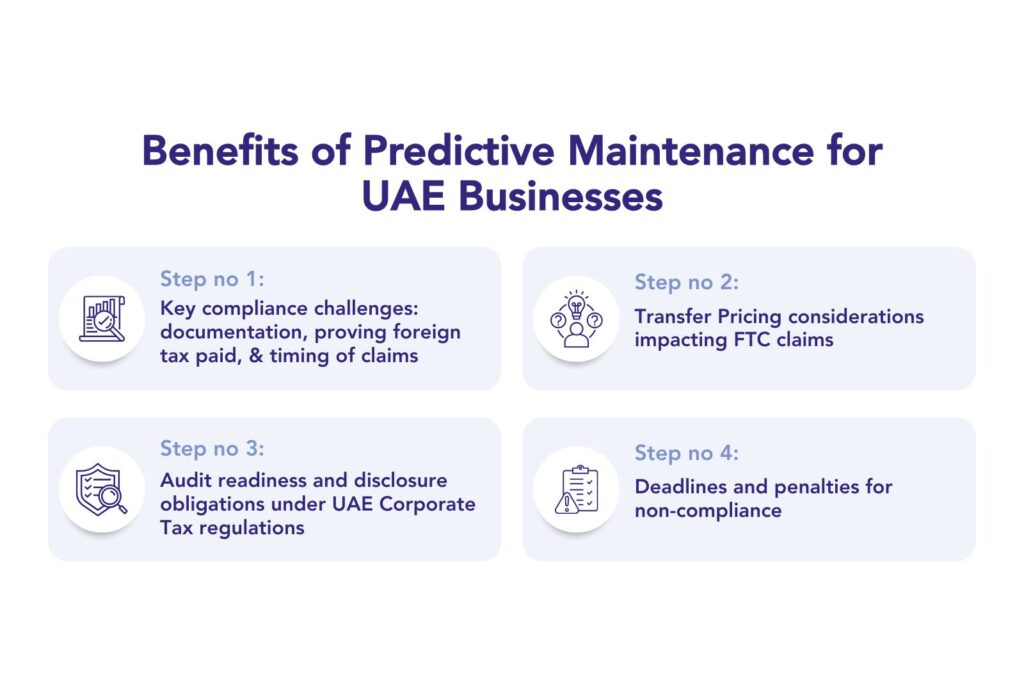
Key compliance challenges: documentation, proving foreign tax paid, & timing of claims

One of the biggest hurdles is documentation. Authorities in the UAE will expect you to show proof that the foreign tax was actually paid, not just withheld on paper. Timing also matters. If you miss the window for making a claim, the opportunity to offset your UAE tax liability may be lost.

Transfer Pricing considerations impacting FTC claims

Transfer pricing is another layer to think about. If your related-party transactions aren’t priced correctly, it could affect how much foreign tax is considered valid for credit. Getting this wrong risks a transfer pricing adjustment and a rejected FTC claim.

Audit readiness and disclosure obligations under UAE Corporate Tax regulations

Being audit-ready means more than just having a file of receipts. The UAE Corporate Tax rules require disclosures that tie your foreign tax payments to actual taxable income. If the numbers don’t line up, auditors will notice. Staying ready for questions now prevents headaches later.

Deadlines and penalties for non-compliance

Deadlines aren’t flexible. Late claims or incomplete filings can lead to penalties, such as a 14% annual penalty for late payments and fines for incomplete records. In some cases, businesses could face the permanent loss of credit, making it crucial to stay on top of deadlines. Businesses need to build FTC tracking into their tax calendars, not treat it as an afterthought, to ensure timely filing and avoid these penalties.

Planning and Strategies to Optimize FTC Benefits

Every multinational business wants to avoid paying tax twice on the same income. That’s where planning around foreign tax credits (FTCs) becomes essential.

Structuring International Operations to Reduce Double Taxation

How a business is set up in different countries can affect the amount of tax it pays. If it isn’t planned carefully, the same income might get taxed twice. This is a real issue for companies moving into the UAE. 


Look closely at where profits are recorded and how money moves between your offices or subsidiaries. Ensure your structure fits the rules for corporate tax registration in Dubai and other countries where you operate. Even minor adjustments can save much in taxes and keep everything above board.

Using Free Zone Incentives Alongside FTC Claims

UAE Free Zones remain attractive for companies seeking tax advantages. Pairing these incentives with FTC claims can significantly lower the overall tax bill. Many businesses already rely on corporate tax registration services in the UAE to ensure their Free Zone benefits are not wasted due to poor compliance. When managed properly, Free Zone relief and FTC credits complement each other rather than overlap.

Applying Tax Treaties Carefully

Tax treaties exist to stop businesses from being taxed twice on the same income. But each treaty is different. They have their own rules, limits, and ways they work. If your company does mandatory corporate tax registration in the UAE, knowing how a treaty fits into your tax registration in the UAE overall tax picture can make a big difference. 


Using a treaty correctly can boost your foreign tax credit (FTC) claims and ensure that your business complies with UAE rules and the tax laws of other countries.

Why Professional Advice Matters

Foreign tax credits can get messy fast. One small mistake and you could pay twice or miss out on relief. That’s why having someone who really knows the rules helps. People who handle corporate tax registration services in Dubai can walk you through how UAE corporate tax works alongside taxes in other countries. With that guidance, you make more intelligent choices, keep more profits, and stay ready for any rule changes.

Recent Updates and Legislative Changes Impacting FTC in the UAE (2024–2025)

The UAE has made some changes to how foreign tax credits (FTC) work. If your business earns income abroad, these updates matter. They affect how much tax you pay here and what you can claim back. 


Getting it wrong can cost you money.

Cabinet Decisions and FTA Rulings Relevant to FTC Claims and Corporate Tax

The government has issued rules that tell companies exactly how to claim FTC. You need to know these rules if you are doing corporate tax registration in Dubai. They explain which foreign taxes qualify, what documents you need, and how to report them. Following them keeps you out of trouble with the FTA.

Key Provisions from Cabinet Decision No. 55, No. 63, and FTA Decision No. 5

Cabinet Decision No. 55 limits the amount of credit you can claim against your UAE tax. Cabinet Decision No. 63 says how to report income from other countries. FTA Decision No. 5 gives instructions on proof and calculation. Knowing these rules helps you make the most of your FTC when you do mandatory corporate tax registration in the UAE.

How These Changes Affect Foreign Investors and UAE Resident Companies

These rules make it safer for investors from abroad to plan business in the UAE. For UAE companies with international operations, mistakes can mean losing FTC credits and potentially incurring penalties for non-compliance. Using corporate tax registration services in Dubai helps ensure that claims are correct and nothing is missed.

Impact of the UAE’s Continuous Development in Tax Policy on FTC and Corporate Taxes

The UAE keeps updating its tax rules, which is good news if you stay informed. Tax registration in the UAE now requires more attention to detail, but it also gives companies a chance to claim what they are owed. Planning ahead and using expert advice keeps you on top of changes and helps you avoid penalties for misreporting, and protects your profits from tax-related errors.

How ADEPTS Can Help Your Business with UAE FTC and Corporate Tax Compliance

Running a business in the UAE and dealing with foreign tax credits can be tricky. ADEPTS helps make it simple. They know UAE corporate tax registration inside out and can guide you through international tax rules.


They support companies with FTC planning, tax registration in the UAE, and corporate tax compliance. They also advise on transfer pricing, audits, and double taxation agreements.


Every business is different, so ADEPTS creates solutions that fit your needs. Whether expanding abroad or managing multiple locations, they ensure your FTC claims are accurate and your UAE corporate tax obligations are met.


If you want to handle FTC and corporate tax registration in Dubai without mistakes, ADEPTS can help. The proper guidance today keeps your business safe and your taxes under control.

Conclusion

Paying tax twice is a headache no business wants. Using foreign tax credits the right way can stop that from happening. Keep your records straight, understand how treaties work, and follow the rules. If you do, you can stay compliant and save money. UAE companies that plan ahead and get the right help will avoid surprises and make the most of their corporate tax registration in Dubai and UAE corporate tax obligations.

FAQs:

Yes. If a company doesn’t use all of its foreign tax credits in a given year, the remaining credits can often be carried forward to offset future UAE corporate tax liabilities. Planning ahead helps you make the most of this benefit.

FTC applies only to corporate taxes, not VAT or other indirect taxes. Keep in mind that tax registration in UAE for VAT is separate, and credits for VAT don’t affect FTC claims.

Submitting inaccurate claims can lead to fines for incorrect claims, rejected credits, or even additional taxes. Penalties for late submissions could include a 14% annual penalty on overdue amounts, while incorrect documentation may incur fines up to AED 20,000 for repeat violations.

No. FTC in the UAE applies to tax resident companies and permanent establishments, not individuals.

Foreign tax amounts must be converted to AED at the official exchange rate when claiming FTC. Fluctuations can affect your claim, so careful record-keeping is important.

You need proof of tax paid abroad, such as tax receipts, payment confirmations, and official filings. Proper documentation ensures your mandatory corporate tax registration in the UAE remains compliant.

UAE’s FTC rules are among the clearest in the GCC. They provide structured limits and detailed guidance, which helps businesses claim credits more predictably compared to some neighboring countries.

Yes. While both can claim FTC, entities in free zones may have additional incentives or restrictions depending on the zone. Understanding these differences is key for companies completing corporate tax registration in Dubai or elsewhere in the UAE.

References

Related Articles​​

The Role of Transfer Pricing in Managing Foreign Tax Credits and Exemptions

Taxes don’t stop at borders. 


Multinational businesses in the UAE face a maze of rules when profits flow across countries. 


That’s where transfer pricing comes in. It sets the price for transactions between related entities, making sure tax authorities see the numbers as fair and transparent.


Globally, transfer pricing has become one of the most closely watched areas of tax law. In the UAE, the spotlight is even brighter after the new corporate tax framework. Companies now need to align with UAE transfer pricing rules, backed by detailed documentation and compliance checks.


Foreign tax credits and exemptions are meant to stop companies from paying tax twice on the same income. They can ease the burden, but only if the underlying pricing between related entities is set up correctly.


This is where the link matters: effective transfer pricing in the UAE can decide whether a company maximizes its foreign tax credits or leaves money on the table. 


This article explains how transfer pricing services in the UAE play a critical role in optimizing outcomes, giving businesses a smarter way to handle foreign tax credits and exemptions.

Why Foreign Tax Credits and Exemptions Matter

The Role of Transfer Pricing in Managing Foreign Tax Credits and Exemptions

Foreign tax credits are a simple idea with a big impact. When a multinational enterprise pays tax abroad, the home country often allows a credit for those taxes. This prevents the same income from being taxed twice. Without it, cross-border trade would be far more expensive.


Exemptions work differently but with the same goal: avoiding double taxation. In the UAE, Free Zone incentives add another layer. These exemptions can reduce or even remove tax liability. But to benefit, companies must show that their intercompany transactions follow the UAE transfer pricing rules.


The link is clear for businesses using transfer pricing services in Dubai. Credits and exemptions only work if the transfer prices are defensible. If tax authorities see mismatched pricing, they can deny credits or claw back exemptions.


That’s why understanding common credit mechanisms is key. Most credits are capped at the amount of domestic tax due, meaning they can’t always fully wipe out foreign tax. UAE entities engaged in cross-border trade need to plan carefully, balancing credits, exemptions, and transfer pricing regulations in the United Arab Emirates to get the best result.

How Transfer Pricing Shapes Foreign Tax Credits

Transfer pricing adjustments don’t just change numbers on paper. They shift taxable profits between countries. And that shift decides how much foreign tax credit a business can actually use. Get the pricing wrong, and the credits shrink. Get it right, and companies protect themselves against double taxation.


The arm’s length principle is the guardrail here. When transactions between related parties are priced as if they were between independents, tax authorities are less likely to challenge them. For UAE companies, following the arm’s length standard under the transfer pricing UAE rules is the clearest way to keep credits intact and maximize relief.


Audits make this real. A tax authority might adjust intercompany prices, which changes taxable income in both jurisdictions. That means the original foreign tax credit calculation no longer holds. Suddenly, a business that thought it had avoided double tax is back at risk. Cases like this show why transfer pricing services in the UAE and strong documentation matter.


For UAE businesses, the stakes are high. Free Zone companies relying on exemptions still need to prove their pricing meets compliance. Mainland corporations handling trade with multiple jurisdictions need defensible numbers to protect their credits. Whether it’s transfer pricing in Dubai or across other Emirates, the principle is the same: sound pricing decisions drive tax efficiency.

Managing Exemptions with Transfer Pricing Compliance

Free Zone incentives are a powerful draw for multinationals in the UAE, but they don’t come free. To keep exemptions, companies must show that their intercompany pricing is aligned with UAE transfer pricing regulations and backed by proper records. Strong transfer pricing documentation in Dubai is often the difference between keeping and losing those benefits.


Non-compliance comes at a cost. Authorities can adjust taxable income, deny exemptions, and impose penalties, such as fines for incorrect documentation, rejection of claims, or 14% annual penalties for late filings. Sometimes, a business may lose Free Zone status altogether if pricing doesn’t reflect real economic activity, which could also trigger additional tax recalculations or compliance penalties.


That’s why transfer pricing is more than a technical exercise. It demonstrates substance. It proves that Free Zone entities are not just shells but carry out genuine business. The arm’s length principle supports that reality, making the exemptions defensible.


Best practice means aligning transfer pricing policies with exemption rules from the start. For companies using transfer pricing services in Dubai or working with advisors, this includes regular reviews, benchmarking, and consistent reporting across group entities. Done right, compliance doesn’t just avoid penalties, it secures the long-term value of Free Zone incentives.

UAE Transfer Pricing Updates for 2025

The Ministry of Finance has tightened the rules for tax groups this year. The January 2025 guidance set clear expectations on how the UAE transfer pricing rules apply when companies file as a group.


One major update covers tax losses. Groups can now offset losses within the unit, but only if intercompany pricing meets the arm’s length standard. Interest expenditure and corporate tax incentives are also under closer review. The message is simple: pricing structures must reflect real business, not just paper adjustments.


These changes directly affect foreign tax credits and exemptions. If group profits shift because of a transfer pricing adjustment, the ability to claim credits abroad may shrink. Free Zone benefits also risk being reduced if pricing fails to align with transfer pricing regulations in the United Arab Emirates.


Deadlines are also sharper. 2025 filings require complete documentation and disclosure forms. Miss the timelines, and penalties apply, including the 14% annual penalty for late submissions and fines for incomplete or incorrect filings under UAE corporate tax compliance rules. For many businesses, working with transfer pricing services in the UAE is no longer optional; it’s the safest way to keep compliance tight and tax outcomes optimized.

Transfer Pricing Methods in the UAE

The Role of Transfer Pricing in Managing Foreign Tax Credits and Exemptions

The UAE applies the OECD’s five approved methods, all recognized by the Federal Tax Authority. These approaches help prove that related-party transactions follow the arm’s length principle and hold up under scrutiny.


Comparable Uncontrolled Price (CUP): Considered the most reliable when good data exists. CUP compares prices charged in related-party transactions with those in independent, uncontrolled deals. It’s widely used in sectors like commodities, finance, and licensing.


Resale Price Method: Ideal for distributors. It starts from the resale price to third parties and subtracts an appropriate gross margin. This method works best when the reseller doesn’t add much extra value beyond distribution.


Cost-Plus Method: This method is common in manufacturing or service arrangements. It adds a fair markup to costs, showing that routine functions are priced reasonably. This is especially useful for UAE entities offering back-office support or routine production.


Transactional Net Margin Method (TNMM): The most practical tool in many UAE cases. It compares the net margin earned in a controlled transaction against margins from independent businesses. TNMM is flexible and often applied when gross margin data is hard to find.


Profit Split Method: Suitable for highly integrated operations where both entities contribute unique value. It divides combined profits based on each party’s role. This often applies in complex supply chains, R&D-heavy industries, or when valuable intangibles are involved.


For UAE businesses, the choice of method is more than a compliance tick-box. The right approach can protect Free Zone exemptions, secure foreign tax credits, and reduce audit risk. 


Strong benchmarking and transfer pricing documentation in Dubai are essential no matter which method is used. That’s why many companies turn to transfer pricing services in UAE to ensure their chosen method is defensible and aligned with transfer pricing regulations in the United Arab Emirates.

The Strategic Role of Transfer Pricing Advisory: How ADEPTS Supports UAE Businesses

Compliance with UAE transfer pricing regulations isn’t just about ticking boxes. It’s about protecting profits, credits, and exemptions. That’s where ADEPTS steps in. As one of the leading advisory firms in the UAE, ADEPTS specializes in transfer pricing compliance and risk management for businesses of all sizes.


ADEPTS offers a full suite of support:

  • Preparing and maintaining transfer pricing documentation in Dubai that meets FTA standards


  • Benchmarking intercompany transactions to align with the arm’s length principle


  • Optimizing the use of foreign tax credits and exemptions in cross-border structures


  • Helping Free Zone entities maintain eligibility for tax incentives through strong compliance frameworks.


The value goes beyond paperwork. ADEPTS helps businesses avoid penalties, prevent disputes, and preserve incentives by proactively addressing transfer pricing risks. Their team ensures that whether a company is based in Dubai, Abu Dhabi, or another Emirate, it has defensible transfer pricing in UAE policies.


ADEPTS provides more than compliance for companies navigating the evolving landscape of transfer pricing services in the UAE. It provides confidence.

Conclusion

Transfer pricing has become central to tax planning in the UAE. It decides whether foreign tax credits actually work and whether exemptions, like Free Zone benefits, stay secure. Get it right and businesses save money. Get it wrong and they face penalties or lose incentives.


There’s no magic trick, just discipline. Keep records in order. Price transactions fairly. Stay updated on the rules. That’s the foundation.


For many companies, working with advisors like ADEPTS simplifies the process. They help turn transfer pricing in the UAE from a compliance headache into a clear plan that protects outcomes.


The message is clear: don’t treat transfer pricing as background noise. It’s now one of the most important tools for managing taxes in the UAE.

FAQ's

Late or missing transfer pricing documentation may trigger penalties, such as 14% annual penalties for late submissions, fines for incomplete or incorrect filings, audits, adjustments, and possible loss of tax incentives, increasing compliance and financial risks significantly.

The arm’s length principle ensures transactions reflect market-based pricing, preventing companies from shifting profits artificially and safeguarding tax bases against aggressive tax avoidance practices.

Yes, foreign tax credits in the UAE can often be carried forward, subject to conditions, allowing businesses to offset future tax liabilities effectively.

Free Zone companies must maintain substance, meet regulatory conditions, and follow arm’s length transfer pricing practices to preserve 0% corporate tax benefits successfully.

Yes, intercompany loans generally require transfer pricing analysis, ensuring interest rates and terms reflect arm’s length standards, avoiding tax adjustments or regulatory scrutiny.

For service transactions, the Cost-Plus Method and Transactional Net Margin Method are typically applied, ensuring fair margins and compliance with transfer pricing regulations.

Businesses should update transfer pricing documentation annually, or whenever major changes occur, to reflect current market conditions and satisfy Federal Tax Authority requirements.

  • Failure to submit TP documentation: AED 50,000 to AED 200,000
  • Failure to maintain TP documentation: AED 50,000 to AED 100,000
  • Failure to submit Masterfile/Local File: AED 50,000 to AED 100,000
  • Failure to provide requested information: AED 10,000 to AED 50,000
  • Incorrect or incomplete documentation: AED 10,000 to AED 50,000

References

Related Articles​​

UAE’s ADGM Becomes MENA’s Largest Financial Hub: 11,000+ Licenses Issued by Mid-2025

Abu Dhabi Global Market (ADGM) just hit a landmark. By the end of June 2025, it had more than 11,000 active licences, making it the largest international financial centre in the Middle East and North Africa (MENA).


What’s behind the jump? This registration surge reflects serious momentum. ADGM’s ecosystem now spans 308 financial firms and 2,664 non-financial firms, and it’s drawing global powerhouses through its English common law framework and investor-friendly setup. Assets under management (AUM) climbed 42% year-on-year, while market capitalization of its listed entities surpassed AED 500 billion, underscoring the centre’s role in accelerating Abu Dhabi’s non-oil growth.

ADGM’s Growth Highlights in H1 2025

The numbers speak for themselves. ADGM closed the first half of 2025 with 2,972 licensed firms on its books. it’s the ecosystem that powers Abu Dhabi’s financial rise.


Of these, 308 were financial firms, from banks to asset managers, while 2,664 were non-financial businesses that support the wider economy. It shows ADGM isn’t a niche hub. It’s a marketplace where financial giants and service firms grow side by side.


The licensing pipeline tells an even sharper story. 1,869 new licences were issued in just six months, up 47% year-on-year. Behind every licence is an adgm company formation aspiration, a business betting on Abu Dhabi as its base for the Middle East, Africa, and South Asia.


The regulator, the Financial Services Regulatory Authority, wasn’t idle either. It granted more In-Principle Approvals (IPAs) and Financial Services Permissions (FSPs), signalling that global banks, funds, and fintech players are clearing the gateway into ADGM.


And this isn’t just paper shuffling. More and more professionals now work across Al Maryah and Al Reem Islands. That’s a full city of talent like lawyers, bankers, fund managers, fintech developers-fueling deal-making and financial innovation.


In short, ADGM is not just growing. It’s accelerating, and the numbers are the proof.

Asset Management Sector Performance

The asset management industry is thriving under ADGM’s watch. Assets under management surged 42% year-on-year, showing investors’ confidence in Abu Dhabi’s financial framework.


The number of licensed players grew too. 154 fund and asset managers are now on the books, with 209 funds registered under ADGM’s jurisdiction.


Big names are betting on the hub. Firms like Nuveen, Kimmeridge, Fortress, and BlackRock have planted their flag, often working in tandem with Mubadala and other local giants. That mix of global capital and regional muscle is reshaping ADGM into a serious asset management powerhouse.

Strategic Partnerships and Investments

Partnerships and investments have been crucial in fuelling the magnanimous growth. Fortress and Mubadala teamed up on credit and real estate plays. Kimmeridge and Mubadala Energy are pushing forward on energy ventures. 


Mubadala and Alpha Dhabi are doubling down on private credit, while an AI-native reinsurance platform backed by IHC, BlackRock, and ADGM firms is taking shape. Each move strengthens Abu Dhabi’s grip on global capital flows.


But the innovation story may be even bigger. ADGM signed an MoU with Chainlink in March, tying the IFC to the global standard for onchain finance. The goal: build tokenisation frameworks that are both compliant and scalable. 


In Q1 2025, Stacks Asia and Bitgrit also joined the ecosystem, leveraging ADGM’s Distributed Ledger Technology (DLT) Foundations framework. Together, these developments are cementing Abu Dhabi’s rise as the region’s blockchain hub with global credibility.


This isn’t scattered progress. It’s a coordinated playbook that blends finance, energy, AI, and blockchain into one growth engine.

ADGM’s Position as Market Capitalisation Leader

ADGM isn’t just the largest by licences. It now leads the MENA region by market capitalisation of listed entities, with over AED 500 billion on ADX. That firepower feeds Abu Dhabi’s non-oil economy and strengthens its role in capital formation across the region.

Regulatory and Infrastructure Enhancements

Rules are evolving with the market. ADGM rolled out progressive frameworks aligned with global standards, covering everything from Basel Core Principles to cyber risk management.


On the ground, it launched digital platforms like AccessRP, aimed at streamlining the real estate ecosystem. Costs were tackled too, with reduced commercial permit fees and new regulations designed to give firms more operational flexibility.


Beyond Abu Dhabi, ADGM signed MoUs with Azerbaijan, Bhutan, Hong Kong, Sweden, and Astana, extending its influence into new markets.

ADGM Courts and Dispute Resolution

ADGM is also building trust in the legal space. It launched a Pro Bono Mediators Panel to widen access to justice. And it secured a global spotlight, with Abu Dhabi set to host the International Bar Association’s Arbitration Day in January 2026.

Talent Development and ADGM Academy Initiatives

The focus isn’t just on firms. It’s on people. ADGM Academy ran targeted training sessions and industry-specific events. Emiratis are gaining ground through job placements and tailored upskilling programs.


Knowledge-building is part of the push too, with research papers on AI, cybersecurity, and financial crime prevention shaping the next wave of expertise from Abu Dhabi.

Abu Dhabi’s Strategic Advantages for Financial Hub Growth

Why Abu Dhabi? Because the city has built the full package. Infrastructure, law, talent, and global reach all stack in its favour.


Start with infrastructure. Al Maryah and Al Reem Islands are more than shiny real estate. They’re purpose-built districts wired with advanced digital systems, transport links, and Grade A office space. That creates a physical backbone that rivals any global hub from London to Singapore.


Then there’s connectivity. Abu Dhabi sits at the crossroads of East and West. Direct flights link the capital to over 120 cities worldwide, making it as easy for a fund manager in New York or a family office in Mumbai to plug into ADGM as it is for a local investor.


The legal framework is another advantage. ADGM operates under English Common Law, one of the most trusted systems in international finance. That gives global firms clarity and comfort when structuring deals, raising capital, or resolving disputes. It’s a sharp contrast to many regional centres where rules can be opaque.


On the people side, the demographics are on Abu Dhabi’s side. The UAE’s population is growing, with a workforce that is young, multilingual, and increasingly specialised in finance, tech, and law. Emiratisation programmes and ADGM Academy are also building homegrown talent pipelines to support the sector long-term.


Finally, the policy environment matters. The UAE government has kept rules transparent and business-friendly. Licensing is faster. Fees are competitive. And reforms like corporate tax clarity, digital platforms such as AccessRP, and reduced operating costs make scaling here simpler than in rival markets.


Put it together, and you see why global players aren’t just setting up outposts. They’re making Abu Dhabi a base of operations in MENA – and increasingly, a launchpad into wider emerging markets.

ADEPTS’ Role in Accelerating UAE’s Financial Rise

Growth in Abu Dhabi and the wider UAE doesn’t happen by accident. Ambitious businesses still need to navigate licenses, regulators, and tax rules before they can tap into the opportunities. That’s where ADEPTS comes in.


We help with company formation in adgm – from fintech startups to global banks – set up and expand in ADGM and across the UAE’s Free Zones. Our job is to simplify the maze: structuring businesses, securing licenses, meeting compliance deadlines, and making sure every box regulators care about is ticked.


But we don’t stop at compliance. ADEPTS works with founders, CFOs, and investors to shape strategies that match the UAE’s fast-moving financial landscape. Whether it’s tax planning, cross-border structuring, or operational guidance, we help clients stay ahead of the curve.


The impact is bigger than individual clients. By lowering entry barriers and building confidence in the system, ADEPTS strengthens ADGM’s position as a trusted gateway for foreign investors and a launchpad for local partnerships.


For businesses that want to scale quickly and sustainably in the UAE, ADEPTS is the partner that makes the rules clear and the path forward visible.

Future Outlook and 10th Anniversary Highlights

ADGM is about to hit a milestone: ten years of operation. But the real story is ahead. The growth pipeline for 2025 and beyond is strong. New firms are coming in. Global partnerships are expanding. Regulations are evolving to stay ahead.


The ambition is bold: to make Abu Dhabi the Capital of Capital. With momentum building, that vision looks closer than ever.

References

  • https://www.mediaoffice.abudhabi/en/economy/adgm-largest-international-financial-centre-in-mena-with-11000-plus-active-licences-at-end-of-h1-2025/
  • https://www.prnewswire.com/in/news-releases/adgm-is-the-mena-regions-largest-ifc-with-11-128-active-licences-at-the-end-of-h1-2025–302549083.html
  • https://www.financemagnates.com/cryptocurrency/chainlink-joins-adgm-on-blockchain-and-ai-after-ripple-collaboration/
  • https://www.adgm.com/media/announcements/stacks-asia-dlt-foundation-joins-adgm
  • https://finance.yahoo.com/news/adgm-mena-regions-largest-ifc-125100053.html?guccounter=1&guce_referrer=aHR0cHM6Ly93d3cuZ29vZ2xlLmNvbS8&guce_referrer_sig=AQAAAF-0cSVMljskDARgqNaaH41OGm7OR4QMDVN61KDvNYz6R6lm3DN3Fq9C5Kd_BbKY8ayxixyP3ZHUqbVABou2Sa5OUXV1WiSOW4p-ErsVPv3LbTLUXtr9jrdK81ved3eQD68TvYfJVt5-J4NhqBkL7-sL8HnA5YozBsnJUg7yfHIw

Related Articles​​

UAE Unveils Updated Corporate Tax Rules for Free Zones in 2026

The UAE has never shied away from rewriting the rules to stay ahead. Now, it’s doing it again. In a surprise move, the Ministry of Finance issued Ministerial Decisions No. 229 and 230 of 2025, introducing new tax rules that could redefine Free Zone businesses’ operations. As of 2026, these decisions have moved from policy announcement to active enforcement.


The changes are not just technical updates. 

They mark a turning point in the understanding of corporate tax treatment, bringing clarity on qualifying activities while simultaneously increasing compliance obligations for Free Zone businesses seeking to retain preferential tax treatment, quietly expanding both opportunity and exposure under the regime.


This isn’t just another policy update for a nation where Free Zones are more than just business hubs. They fuel diversification, attract foreign capital, and secure the UAE’s role as a global player.


What was positioned as reform in 2025 now functions as an enforcement framework in 2026, reinforcing the country’s long-term economic strategy rather than signalling a temporary adjustment.

Key Changes in Qualifying Activities and Tax Scope

The 2025 update isn’t just a tweak—it’s a clean slate. 


Ministerial Decision No. 265 of 2023 is out. In its place comes Decision No. 229 of 2025, which rewrites the definition of qualifying activities inside the Free Zones and remains fully operative in 2026.


The shift is bold. 


Qualifying Commodity Trading has been expanded far beyond its earlier limits. 


Businesses dealing in industrial chemicals, environmental commodities such as carbon credits, and associated by-products now fall within scope.


Perhaps the most striking move is removing the “raw form” restriction. No longer confined to unprocessed commodities, the new rules open the door to metals, minerals, energy products, agricultural goods, and their by-products.


This change materially expands eligibility for downstream and processed commodities, including petrochemicals, refined oil products, steel alloys, and industrial outputs, bringing manufacturing and industrial trading hubs such as JAFZA and Hamriyah firmly within scope, rather than limiting the regime to raw commodity traders.


But there’s a catch. 


To qualify, transactions must carry the weight of transparency, backed by a Quoted Price from a recognised commodity exchange or Price Reporting Agency. Without that seal of credibility, the tax benefit won’t apply, and the income risks reclassification at the standard 9% corporate tax rate.

Treasury and Financing Services Clarification

If commodities were the headline change, treasury and financing services are the quiet power play. 


The Ministry has now spelled out what counts as qualifying treasury activities, ending months of speculation among multinationals and holding companies.


The clarification goes deeper than expected. Self-investment and intra-group financing for related parties are now officially recognised as qualifying activities. This single move positions Free Zones as trading hubs and financial nerve centres for global businesses.


In 2026, however, these activities are subject to heightened audit and transfer pricing scrutiny, particularly where financing flows involve Mainland related parties or cross-border group entities.

Recognised Price Reporting Agencies

The update goes beyond who trades and into how those trades are valued.


Ministerial Decision No. 230 of 2025 sets out, for the first time, a list of recognised Price Reporting Agencies and exchanges that Free Zone firms must use.


On the surface, it’s a technical detail. In practice, it’s a guardrail. The Ministry is closing the door on inflated numbers or vague valuations by linking transactions to prices from trusted global benchmarks.


For businesses, the message is clear: play by international pricing rules or risk losing the tax break. In 2026, pricing validation is one of the first areas tested during Free Zone tax audits.

High Sea Sales and Merchanting: A Quiet Clarification

One area that confused traders throughout 2025 was the treatment of goods that never enter the UAE.


In 2026, clarity has emerged: High Sea Sales (merchanting transactions) can qualify as “Distribution from a Designated Zone” provided the Commercially Important Group Activities (CIGA)—pricing, contracting, risk management—are genuinely performed within the Free Zone.


The goods do not need to touch UAE soil. The decisions do.
Where management and control sit outside the Free Zone, the income does too.

Impact on Free Zone Business Environment

On paper, the update looks like another technical tweak. 


In reality, it’s a reminder of why Free Zones matter to the UAE’s economy in the first place. They aren’t just business parks but magnets for investment, job creation, and new industries. The latest rules give that role a firmer footing.


By syncing with international tax practices, the UAE is trying to walk a fine line: keep its corporate tax regime competitive while ensuring global investors see it as credible. In 2026, that credibility is enforced through mandatory audits and documentary substantiation rather than policy intent alone.


One detail stands out. 


The decision to include environmental commodities, such as carbon credits, ties Free Zone incentives to the UAE’s green agenda. Growth and sustainability used to be separate debates. Now, at least in policy terms, they’re colliding.

Practical Implications for Businesses

For Free Zone companies, the changes bring both relief and a warning. Relief is because the fog around tax planning is finally lifting. Knowing the activity is no longer sufficient. In 2026, qualifying status must be demonstrated annually through audited financial statements, pricing support, and verifiable compliance documentation.


But the warning is just as sharp. The zero percent corporate tax rate is not merely earned; it must be audited. Self-assessment alone is no longer sufficient under the Free Zone Corporate Tax regime.


There’s an opportunity too. The broader scope of commodity trading and clarified  treasury rules give multinationals more room to structure operations—but only where compliance is embedded into day-to-day decision-making.

UAE’s Strategic Vision and Economic Diversification

Free Zones have always been central to the UAE’s push to look beyond oil. They attract capital, talent, and industries that might otherwise bypass the region. The new tax updates don’t change that role; they double down on it.


Officials are making the case that the country can be competitive and credible. Low rates on one hand, alignment with global standards on the other. It’s a tricky balance, but the UAE thinks it can pull it off.


In 2026, that balance is being tested through enforcement rather than incentives alone.


Investors will hear more than numbers in this announcement. The inclusion of green commodities and the tighter pricing rules are signals. The government is betting that businesses will see the UAE not just as a tax-friendly hub but as a place to grow under a framework the rest of the world trusts. Whether that bet pays off is now up to the market.

The Compliance Cost: Mandatory Audits for All

This is the single most significant operational change affecting Free Zone businesses in 2026.


Ministerial Decision No. 84 of 2025 introduced a Universal Audit Requirement for all Qualifying Free Zone Persons (QFZPs).


Unlike Mainland entities, where audits are generally required only once revenue exceeds AED 50 million, every QFZP must now prepare Audited Financial Statements, regardless of revenue level, even if turnover is AED 1.


For startups and small Free Zone entities, this translates into annual compliance costs typically ranging from AED 15,000 to AED 20,000. Failure to comply results in immediate loss of the 0% corporate tax rate.

The Compliance Reality of Free Zone Taxation in 2026

As the Free Zone Corporate Tax regime moves fully into its enforcement phase in 2026, the focus has shifted decisively from eligibility to consequence.


What initially appeared as expanded opportunities under the updated rules now operate alongside strict conditions, long-term penalties, and binding elections that can shape a business’s tax position for years.


The following considerations do not represent optional planning points. They form the risk framework that determines whether a Free Zone entity can retain the 0% corporate tax rate, or lose it for up to half a decade.

The Five-Year Lockout Rule: One Strike Policy

The consequences of non-compliance extend far beyond a single tax year.


If a Qualifying Free Zone Person fails to meet any condition, such as breaching the de minimis test, missing an audit, or failing substance requirements, the entity is disqualified for the current tax year and the following four tax years.


A single compliance failure in 2026 removes access to the 0% corporate tax rate until 2031.

Small Business Relief: The Double-Dip Trap

Free Zone entities cannot simultaneously claim Small Business Relief (SBR) and retain Qualifying Free Zone Person status.


Businesses must choose:

  • Option A: QFZP – 0% tax, mandatory audit, full compliance
  • Option B: SBR – 0% tax, no audit, binding election for five years

Choosing incorrectly in 2026 locks the tax position until 2031.

Transfer Pricing: The Domestic Risk

In 2026, audit focus has shifted sharply toward domestic transfer pricing.


Transactions between Free Zone entities and Mainland related parties are now a primary audit trigger, particularly where service fees, management charges, or treasury arrangements appear to shift profits into the Free Zone.

Pillar Two: The Global Minimum Tax Reality

For multinational groups with consolidated global revenue exceeding EUR 750 million, the Free Zone tax benefit may be neutralised.


Even where a Free Zone entity qualifies for a 0% UAE Corporate Tax rate, the Domestic Minimum Top-Up Tax (DMTT) may apply to ensure a 15% effective tax rate under the OECD Pillar Two framework.

Strategic Certainty Through Advance Pricing Agreements

Following the release of the UAE’s APA guidance in December 2025, Free Zone entities may now pursue unilateral Advance Pricing Agreements to lock in transfer pricing methodologies for up to five years.


For large domestic transactions, APAs are increasingly used as a risk-mitigation tool rather than a defensive measure.

Voluntary Election: When Paying Tax Makes Sense

In certain scenarios, electing out of QFZP status may be commercially advantageous.


Loss-making Free Zone startups may benefit from becoming standard taxpayers, allowing tax losses to be carried forward and offset against future profits—an option generally unavailable under the QFZP regime.


Such elections are binding for five years and must be carefully evaluated.

Intellectual Property Strategy and the Nexus Requirement

Only income derived from Qualifying Intellectual Property backed by UAE-based R&D expenditure may benefit from the 0% rate.


Patents and copyrighted software may qualify. Marketing IP, including trademarks, brands, and goodwill, is not taxed at 9%.

Headquarters Services and Substance Redefined

Headquarters activities require genuine senior management decision-making and operating expenditure within the UAE.


A nominal or “mailbox” headquarters structure fails substance tests and risks full taxation at 9%.

VAT vs Corporate Tax: Clearing the Free Zone Confusion

A Free Zone for corporate tax purposes is not automatically a Designated Zone for VAT purposes.


While QFZP status can apply across Free Zones, 0% treatment for goods distribution generally requires operations within a Designated Zone such as JAFZA.

Loss Relief Restrictions

Tax losses incurred during a 0% QFZP period are ring-fenced.


If the entity later becomes taxable, those losses cannot be used to offset future taxable income, reinforcing the importance of early strategic elections.

ADEPTS’ Role in the Shift

For companies in the Free Zones, the new tax rules are not just another memo; they’re a puzzle that needs decoding fast. That’s where ADEPTS has been stepping in.


The firm has built a reputation for guiding startups, SMEs, and multinationals through corporate tax registration, VAT health checks, and compliance filings. However, recent ministerial decisions have expanded its role. 


Clients are now leaning on ADEPTS not only for paperwork but also for strategy: how to structure cross-border operations, manage treasury functions, and ensure that a zero percent rate actually sticks.


From advising on recognised pricing to keeping businesses aligned with qualifying activity rules, ADEPTS is positioning itself less like a consultant and more like a partner; one that helps firms stay compliant without losing sight of growth.


In 2026, clients are increasingly relying on ADEPTS for strategic decision-making—evaluating QFZP viability, audit readiness, transfer pricing alignment, and long-term tax positioning—rather than compliance in isolation.

Conclusion

Free Zones have always been the UAE’s calling card, and these new tax rules raise the stakes again. Instead of vague guidelines, businesses now face sharper compliance thresholds—and sharper consequences for missteps.


The early movers will lock in the advantages, while the slow ones may end up tangled in compliance costs. This is not just about tax breaks anymore; it’s about trust, transparency, and proving the UAE can run with the toughest global standards without losing its edge.


2025 introduced the framework.


2026 is the enforcement year.

References

Related Articles​​

VAT Penalty Traps in Free Zones: Audit-Proofing Your Books for 2026

UAE Freezones are business havens. Less legal complications, less investment worries, and just a lot of ease. But VAT in UAE free zones isn’t very simple. One wrong invoice, one missed return, and you could be looking at a penalty bigger than the tax itself.


By early 2026, the FTA has moved to a risk-based, automated enforcement model. They are making sure no one escapes VAT, if it applies. With over 93,000 inspection visits conducted in 2024 and Federal Decree-Laws No. 16 and 17 of 2025 now fully in effect, audits are high-volume, data-driven, and digitally triggered. Updated rules mean more scrutiny. More targeted audits. Less room for mistakes. If you’re running a free zone company, you can’t afford to treat VAT like an afterthought. You need your accounting and bookkeeping services in uae airtight. Every figure backed by proof. Every return filed without errors.


That’s the goal of this article. We’ll walk you through the VAT rules that matter, the traps that cost businesses money, and how to keep your books audit-ready. And if you’d rather not lose sleep over compliance? ADEPTS can help. Our accounting and bookkeeping services in UAE keep free zone businesses penalty-free and ready for any FTA check.

Understanding VAT in UAE Free Zones: Key Concepts

UAE free zones are special economic areas where businesses enjoy tax benefits and trade advantages. But for VAT, not all free zones are treated the same.

Two types matter most:

  • Designated Free Zones

    treated like outside the UAE for certain VAT purposes. Goods moved between them can be zero-rated if the rules are met. As of 2026, B2B transactions within Designated Zones are subject to real-time traceability under the National Electronic Invoicing System (EIS), requiring structured XML/JSON reporting aligned with PINT AE standards.

  • Non-Designated Free Zones – treated the same as the mainland when it comes to VAT.


The VAT rate framework is straightforward on paper:

  • 5% standard rate applies to most supplies.

  • Zero-rated supplies, like certain exports, apply if you meet strict conditions.

  • Exempt supplies, such as some financial services, are outside VAT’s scope.


The trick? Applying these correctly in your books. A sale you thought was zero-rated could turn into a 5% VAT liability if your paperwork doesn’t match digital XML/JSON standards required by the FTA under the UAE e-invoicing framework. That’s why bookkeeping UAE businesses can trust is not just a nice-to-have – it’s survival.

The Role of Accredited Service Providers (ASPs) in Free Zones

Under the July 2026 EIS pilot, large taxpayers must connect to the FTA system through Accredited Service Providers (ASPs). These providers validate, transmit, and store structured e-invoices under the DCTCE (5-Corner) model, ensuring compliance before invoices reach customers.

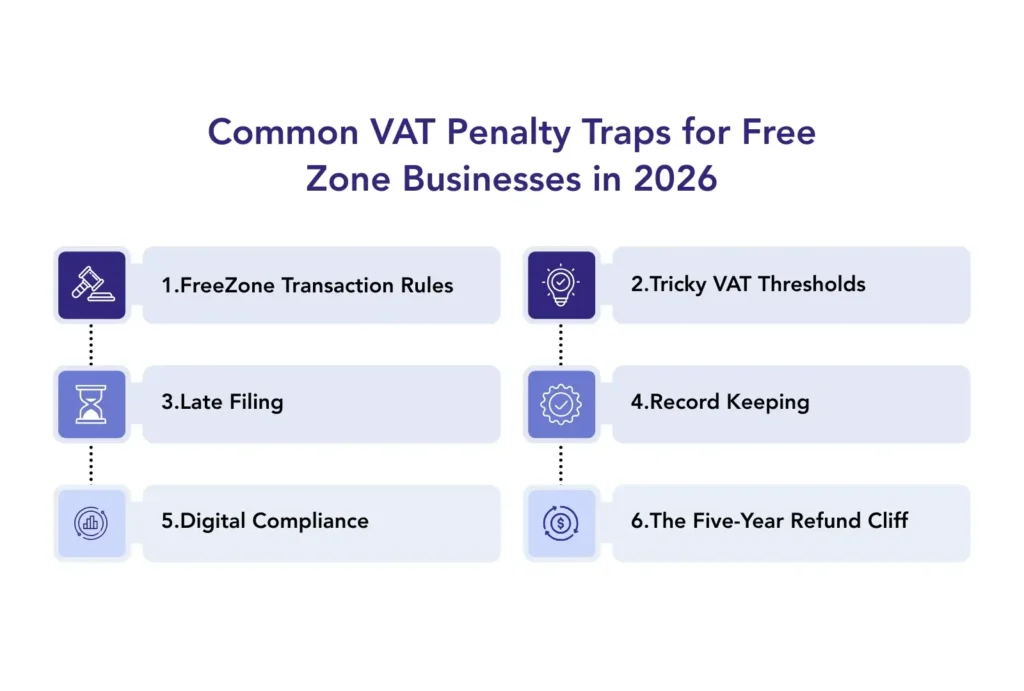
Common VAT Penalty Traps for Free Zone Businesses in 2026

Common VAT Penalty Traps for Free Zone Businesses in 2026

Want to avoid a difficult situation? Know the VAT traps. Here are some common ones:

FreeZone Transaction Rules

A lot of free zone owners think every transaction between free zones is zero-rated. That’s a myth. The truth? It’s only zero-rated if you meet strict FTA conditions. Miss one condition and you owe 5% VAT plus penalties.

Tricky VAT Thresholds

Another costly mistake is ignoring the VAT registration thresholds. If your taxable turnover crosses AED 375,000, registration is mandatory. Even at AED 187,500, voluntary registration can save you from losing input VAT claims. Many businesses only realise they’ve crossed the limit after the FTA sends a notice.

Late Filing

Then there’s late filing.


From April 14, 2026, late payment penalties are calculated at a 14% annualized flat rate under Cabinet Decision No. 129 of 2025, replacing the previous compounding structure.

Record Keeping

Record-keeping is another trap. The law says you must keep invoices and VAT-related documents for five years. That means every tax invoice, every supporting document, every adjustment note. Without them, you have no defence in an audit.


Confusion over supplies between mainland and free zones also causes trouble.


Under Article 48.1 and updated supplier due diligence requirements, the trap is now missing supplier documentation. Failure to obtain proper VAT-compliant documentation can lead to input tax denial under Article 54 UAE VAT input tax denial rules.

Digital Compliance

And in 2026, digital compliance matters more than ever. The July 1, 2026 EIS Pilot Mandate introduces structured e-invoicing requirements for selected taxpayers. If your system can’t issue compliant invoices or store them in the right format, you’re already exposed.

The Five-Year Refund Cliff

One of the biggest VAT penalties in UAE free zones 2026 is silent. Excess VAT credits older than five years will be permanently forfeited after December 31, 2026 under the VAT refund statute of limitations UAE rules. This VAT legacy credit recovery deadline 2026 is non-extendable. If you don’t claim or adjust before the cut-off, the credit disappears.

How to Audit-Proof Your Books in Free Zones for 2026

How to Audit-Proof Your Books in Free Zones for 2026

The FTA isn’t just checking VAT returns anymore. They’re checking the story behind the numbers. That’s why accounting and bookkeeping must now be system-integrated, XML-ready bookkeeping. 


Every sale, every purchase, every bank movement should be recorded accurately. That means Structured XML/JSON E-Invoices, purchase receipts, bank statements, contracts, VAT returns, fixed asset registers, reconciliations, and digital backups.


Your documents must tell the same story your VAT return tells. If your bank statements don’t match your declared transactions, it’s a red flag.


This is because The UAE now operates under the DCTCE (5-Corner) EIS model where invoice data flows through certified channels before reaching the FTA. Evasions are not tolerated at all. The systems are stringent. The controls are stronger. New regulations are digging deeper than the mere surface of business transactions. For example:

The Anti-Evasion Standard: “Knew or Should Have Known”

Under the unified administrative penalty framework, businesses can be penalized if they “knew or should have known” that a transaction involved VAT evasion. Supplier due diligence is now part of FTA audit preparation for free zone businesses.


Strong accounting and bookkeeping in UAE free zones isn’t about paperwork for the sake of it. It’s about proving, beyond doubt, that every VAT figure you submit is correct. Do that, and even a surprise audit won’t rattle you.

Practical Steps to Avoid VAT Penalties in Free Zones

VAT compliance in a free zone starts with one simple habit: watch your numbers.

Track the Deadlines

Deadlines are just as critical. VAT returns are due by the 28th of the month following your tax period, whether you file quarterly or monthly. One late return can trigger penalties and mark you as a compliance risk. Large taxpayers with revenue ≥ AED 50 million must appoint an Accredited Service Provider (ASP) by July 31, 2026.

Run Internal VAT Health Checks

Don’t wait for the FTA to tell you something’s wrong. Run regular internal VAT health checks. Review your invoices, reconcile them with bank records, and make sure your designated and non-designated free zone transactions are clearly separated. Mixing them up is one of the fastest ways to get VAT treatment wrong.


Shift from basic VAT reviews to Integrated VAT-Corporate Tax Reconciliations, especially if you are claiming 0% Corporate Tax as a Qualifying Free Zone Person (QFZP).

Bring in Technology

Technology can be your safety net. PINT-compliant EIS integrated software centralises your VAT data and ensures compliance.


That’s where ADEPTS comes in. We handle VAT health checks, compliance reviews, full bookkeeping services in UAE businesses trust, and audit support designed for free zones.

Impact of New 2026 Regulations on Free Zone VAT Compliance

2026 marks the full implementation of the UAE VAT unified administrative penalty framework. VAT records are now used to verify Substance for 0% Corporate Tax eligibility under the Qualifying Free Zone Person (QFZP) regime.

Old Penalty System New 2026 Framework
Compounding late payment penalties 14% annualized flat rate (effective April 14, 2026)
Manual audit triggers Risk-based automated enforcement
Paper/PDF invoices Structured XML/JSON EIS reporting

VAT compliance is no longer isolated. It now directly impacts Corporate Tax eligibility, financial statement audits, and economic substance verification.


In short, 2026 marks the end of reactive compliance.

How ADEPTS Supports Your Business in Navigating VAT Complexities in Free Zones

ADEPTS help businesses thrive without worrying about compliance issues. Here are the details you need to know:

Customized VAT Compliance Consultation and Health Checks

Every free zone business has a different VAT profile. ADEPTS starts by looking at your numbers, your operations, and your transactions. Then we run a health check to spot risks before the FTA does.  We run Integrated VAT/CT Health Checks aligned with QFZP requirements. You walk away knowing exactly where you stand and what needs fixing.

Reliable VAT Registration and Filing Management Services

We handle the paperwork, the deadlines, and the submissions. From getting your VAT registration approved to filing accurate returns on time, we make sure you never miss a step or a date.

Expert Bookkeeping Support to Keep Your Records Audit-Proof

Good bookkeeping is more than entering figures. It’s about creating a clear trail that an auditor can follow without raising questions. Our bookkeeping UAE services ensure your invoices, receipts, bank statements, and VAT returns line up perfectly.

EIS Migration Advisory

We help businesses transition to structured invoicing under the July 2026 pilot.

Transitional Refund Management (Dec 2026 Deadline)

Secure your VAT legacy credit recovery deadline 2026 before December 31, 2026.

Training and Advisory on the Latest VAT Laws and FTA Audit Expectations

VAT rules in free zones change, sometimes quietly. We train your team on the latest requirements and prepare you for how the FTA actually runs audits. That way, no inspection catches you off guard.

End-to-End Support During FTA VAT Audits

 An audit can feel like a storm. We stand with you from the first notice to the final clearance, handling the communication, gathering documents, and answering questions. The goal is to protect you and keep business disruption to a minimum.

Dedicated Client Portal for Document Management and Compliance Tracking

All your compliance documents in one secure place. Easy to upload, easy to retrieve, and always ready when the FTA asks. You can track your compliance status in real time without chasing files or emails. With ADEPTS, it’s all easy breezy.

Conclusion

VAT in UAE free zones isn’t something you can “set and forget.”  The 2026 rules make that impossible. Audit-proof bookkeeping and accurate VAT compliance are not optional anymore. They’re the difference between running your business in peace and losing weeks of work to an investigation. 


If you don’t understand the UAE VAT 2026 compliance updates, you risk penalties, backdated tax, and losing refunds permanently.  Secure your legacy refunds before the December 31, 2026 expiry. Partnering with ADEPTS means you don’t have to fight that battle alone.

fAQ's

If your taxable turnover hits AED 375,000 in the last 12 months, registration is mandatory. At AED 187,500, you can register voluntarily, which can help you recover input VAT. This applies to free zone companies just like mainland businesses, unless your activities are fully outside the scope of VAT.

The Cabinet decides which free zones are “Designated.” These zones are treated as outside the UAE for certain VAT purposes, especially goods movement. Non-designated free zones follow the same VAT rules as the mainland. The official FTA list is your reference point.

Late filings, underpayment of VAT, incorrect zero-rating, missing invoices, poor record-keeping, and failure to register on time. Many penalties come from small errors in classification or missing supporting documents.

Yes. E-invoicing is mandatory starting with the July 2026 pilot. Structured XML/JSON invoices must comply with PINT AE standards.

At least five years. This includes tax invoices, credit notes, contracts, bank statements, VAT returns, and any supporting paperwork. In some cases, such as real estate transactions, the retention period can be longer. Digital data residency within the UAE is now mandatory under 2026 compliance rules.

Yes, if the expenses are related to taxable business activities and you meet the input VAT recovery rules. You’ll need proper tax invoices and proof that the expense is directly tied to your taxable supplies.

Inconsistent filings, mismatches between returns and bank records, unusually high refund claims, repeated late submissions, or transactions that don’t align with your business profile. Random checks also happen.

 If you supply digital services to UAE customers, VAT can apply even if you’re in a free zone. The place of supply rules decide if VAT is due, and these rules were updated in 2025 to cover more digital transactions.

Late payment penalties apply at 14% per annum under Cabinet Decision No. 129 of 2025. Corrected returns may attract an AED 500 fixed penalty, with waivers available for certain voluntary disclosures that do not change the tax due.

Cloud-based accounting software that supports UAE VAT rules, generates compliant e-invoices, and stores digital records securely. Integrations with bank feeds and ERP systems can make reconciliations faster and more accurate.

References

  • Federal Tax Authority (FTA). E-Invoicing System (EIS) Public Consultation and Implementation Updates. Abu Dhabi: FTA, 2024–2026.
    https://tax.gov.ae/en/einvoicing
  • Ministry of Finance, United Arab Emirates. Electronic Invoicing (E-Invoicing) Framework and PINT AE Standards Documentation.
    https://mof.gov.ae/einvoicing
  • United Arab Emirates. Federal Decree-Law No. 47 of 2022 on the Taxation of Corporations and Businesses (Corporate Tax Law). Abu Dhabi: UAE Government.
    https://mof.gov.ae/corporate-tax

Related Articles​​

Human vs. AI Bookkeeping: Comparative Error Rates in 2025’s Leading UAE Accounting Firms

Bookkeeping in the UAE is not what it used to be. The year is 2025, and firms now handle numbers in ways our past selves could never imagine. Businesses search for accounting and bookkeeping that meets speed, accuracy, and compliance. Firms offering Accounting & Bookkeeping Services in UAE are redefining their role in the economy.

With VAT, Corporate Tax, and ESR rules becoming stricter, accuracy is no longer optional—it is survival. Even small mistakes can mean heavy fines or damaged trust. That is why accounting and bookkeeping services in UAE focus on precision. What if the tools you use could guarantee better compliance without extra stress?

The debate is clear: traditional human bookkeeping or AI-powered systems. Which produces fewer errors? Which works best for UAE businesses in 2025? This is where ADEPTS comes in. Known for blending human skills with technology, they bring accounting and bookkeeping Dubai into a new era. Let us explore this unique approach.

Overview of Bookkeeping in UAE Accounting Firms in 2025

Human vs. AI Bookkeeping: Comparative Error Rates in 2025’s Leading UAE Accounting Firms

Bookkeeping in the UAE is evolving fast in 2025. Firms juggle tradition and tech as expectations rise for speed, accuracy, and compliance. Accounting and bookkeeping services in UAE and accounting and bookkeeping UAE are shifting to meet these new demands. This overview sets the scene for what matters now and what is fading out.

Traditional Bookkeeping in UAE

Traditional bookkeeping relies heavily on manual data entry. Spreadsheet reconciliations. Delayed reporting. This creates fatigue and mistakes occur. Reviews pile up. Decisions lag. Many accounting and bookkeeping companies in UAE still use these flows due to perceived costs, but pressure rises as volumes increase and audits tighten. Old methods cannot keep pace with modern demands.

AI-Powered Bookkeeping Transformation

AI bookkeeping automates data capture, flags anomalies, and reconciles accounts in real time. Pattern recognition trims repetitive work and boosts accuracy. For accounting and bookkeeping services in UAE, this means cleaner ledgers and faster close. When bookkeeping accounting and tax services run through smart systems, compliance checks become routine. Humans focus on judgment and special cases.

Rising AI Adoption in the UAE

Adoption in the UAE is accelerating. Firms start with pilots and scale fast after seeing error reductions and faster closes. Vendors integrate with banks and tax portals, easing onboarding. Leaders in accounting and bookkeeping UAE pair automation with review steps, satisfying regulators and clients while freeing teams for analysis.

Common Errors in Bookkeeping

Errors still appear. Data entry slips, misclassifications, and missed rule updates do not vanish overnight. AI struggles with messy inputs; humans struggle with fatigue. In bookkeeping UAE, layered review and an internal audit process catch anomalies early. This transforms near misses into learning and keeps fines away.

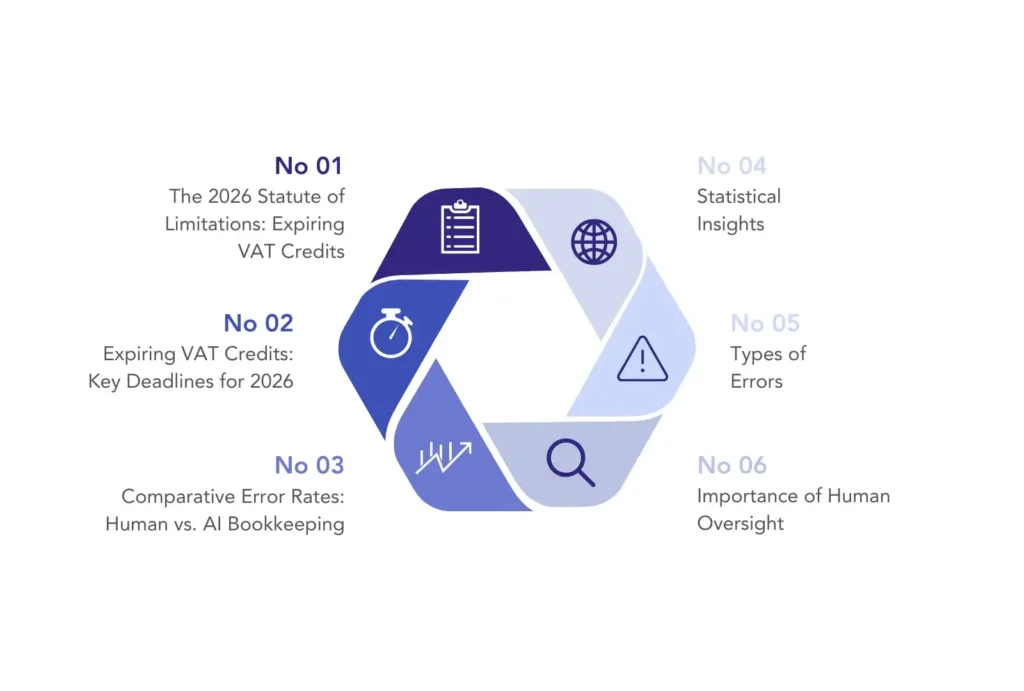
Comparative Error Rates: Human vs. AI Bookkeeping

In 2025, UAE accounting and bookkeeping accuracy matters more than ever. Manual processes face limits under strict tax rules and complex transactions. Meanwhile, AI bookkeeping offers measurable performance boosts. Here, we compare error patterns in both approaches using UAE-specific statistics.

Statistical Insights

Recent studies show AI bookkeeping reduces invoice-related errors by nearly 85% and improves operational efficiency by 50%. Manual methods in accounting and bookkeeping services in UAE still face high error rates with complex datasets. These gaps underline why hybrid setups are increasingly preferred. Learn more about our accounting and bookkeeping solutions.

Types of Errors

Human bookkeeping errors in UAE arise from fatigue, distraction, and misinterpreting VAT or corporate tax rules. Inaccurate input data and/ or outdated algorithms result in  AI errors. However, AI issues tend to be less frequent and easier to trace compared to widespread manual errors.

Importance of Human Oversight

AI bookkeeping in UAE reduces common mistakes but is not flawless. Human review ensures special-case handling and regulatory alignment. Accounting and bookkeeping companies in UAE achieve the highest accuracy when human insight complements AI tools.

Leading UAE Accounting Firms Embracing AI

Across the UAE, firms are blending technology with expertise. Top players use AI as extra eyes—spotting errors, meeting VAT and corporate tax rules, and maintaining client trust.

Adoption by Top Firms

Well-known accounting and bookkeeping companies in UAE are shifting from slow manual logs to smarter, AI-driven tools. The change reduces costly mistakes in large transaction batches. By letting software handle repetitive checks, accountants focus on high-value tasks.

Role of AI-Enabled Platforms

Modern platforms like QuickBooks AI, Xero, and Zoho Books are now fixtures in accounting and bookkeeping services in UAE. They flag odd entries instantly, match payments automatically, and deliver summaries quickly.

ADEPTS Case Example

At ADEPTS, AI handles sorting, cross-checking, and compliance, while seasoned accountants review exceptions. VAT and corporate tax filings leave no room for guesswork, and records stay precise without losing personal attention.

Complementing Human Expertise

Even with AI speed, trained professionals are essential. Human oversight at ADEPTS ensures unusual transactions and special cases get the care they deserve—turning technology into a trusted assistant.

Regulatory and Compliance Impact on Bookkeeping Error Rates

Human vs. AI Bookkeeping: Comparative Error Rates in 2025’s Leading UAE Accounting Firms

UAE rules change frequently. VAT, Corporate Tax, and ESR can shift quickly, causing headaches for businesses handling accounting and bookkeeping in UAE. One misplaced entry could mean fines or delays.

AI for Real-Time Compliance

AI keeps accounting and bookkeeping services in UAE aligned with rules, updating tax codes instantly, catching odd transactions, and preparing reports before deadlines.

Human Challenges and AI’s Role

Even sharp bookkeepers cannot always track every rule change. AI doesn’t tire or forget. It flags exceptions, allowing humans to focus on decisions that matter.

Benefits of Combining Human Expertise with AI in Bookkeeping

AI bookkeeping in the UAE is powerful, but humans add context and judgment. Picture an unusual supplier payment flagged at 3 a.m.; a bookkeeper reviews it in the morning. Speed from machines, sense from humans—this is the magic.

Improved Accuracy and Reduced Errors

AI spots red flags quickly, but human review ensures entries align with UAE tax rules. This hybrid approach dramatically lowers mistakes, making audits simpler.

Enhanced Efficiency and Time Savings

Tasks that took full workdays now finish faster. AI handles repetitive work while humans focus on judgment calls, freeing accountants to strategize. Explore further on our blog.

Data-Driven Insights for Strategic Growth

AI transforms raw numbers into charts, alerts, and forecasts in minutes. Accountants add context and spot growth opportunities. Together, they create a financial playbook accurate, timely, and locally relevant.

Future Outlook: The Role of AI and Humans in UAE Bookkeeping Beyond 2025

Bookkeeping in UAE is heading for a tech-powered future. AI will continue reducing errors, but humans remain vital for judgment and strategy. Accounting and bookkeeping services in UAE will blend tech speed with human intuition.

Anticipated Advances in AI Technology and Further Reduction in Errors

AI will predict errors before they happen. In bookkeeping UAE, this ensures smoother audits. Humans still handle tricky rules, providing context machines cannot.

Shifting Role of Accountants to Strategic Advisors and AI Supervisors

Accountants guide decisions, supervise AI, and interpret insights. In accounting and bookkeeping Dubai, experts focus on strategy while AI manages repetitive tasks.

Importance of Continuous Human Oversight Due to Market Complexities

Even with smarter AI, mistakes occur. Tax rules and policy changes require human eyes. Continuous oversight ensures compliance and protects businesses.

How ADEPTS Takes Hybrid Bookkeeping from Concept to Practice

ADEPTS offers services that take the whole lot off your shoulders. As a business owner you can spend the precious free time and energy for progress and growth:

ADEPTS structured Bookkeeping Services

Their tiered monthly packages—starting with Essential for lean operations, scaling up through Growth, Advanced, and Premium bundle bookkeeping, VAT/compliance filing, and increasingly sophisticated reporting and oversight. It’s subscription bookkeeping: predictable, rapid, and always audit-ready.

Accuracy without Bureaucracy

With IFRS-aligned financial reporting and regular quarterly reviews, ADEPTS turns lagging processes into proactive intelligence, errors get flagged early, corrections happen fast, and compliance becomes baked in.

Humans Interpret, AI Delivers

Their management reporting transforms raw data into actionable insights—KPIs, trend analysis, risk forecasts—so accountants focus on strategy, not grunt work.

Audit Stress Neutralized

ADEPTS’ audit-readiness service prepares documentation, trains staff, and simulates audits, slashing surprises and reinforcing regulatory trust.

Empowerment Not Dependence

Through practical IFRS training, ADEPTS equips client teams to understand, question, and refine AI outputs—keeping human judgment firmly in the loop.

Fixing Asset Missteps

Their fixed-asset management, the tagging, depreciation, auditing, and policy drafting, seals another leak where manual bookkeeping often cracks.

Beyond the Books

With services spanning from CFO/ERP implementation to tax, risk consulting, and business support, ADEPTS integrates technology with expertise—transforming bookkeeping into strategic advantage.

fAQ's

AI cuts invoice mistakes by 85%! Humans still make slips when tired. Combined with expert review, accounting and bookkeeping UAE stays accurate.

Mostly yes. AI applies VAT and corporate tax rules, but humans handle tricky cases. Accounting and bookkeeping services in UAE work best as a hybrid system.

No. AI lacks context and judgment. Accounting and bookkeeping companies in UAE achieve accuracy when humans supervise AI.

Fatigue, distraction, misclassifications, and outdated tax rules. High-volume tasks worsen mistakes. AI helps, but human review is key in accounting and bookkeeping services in UAE.

AI handles reconciliation and anomaly checks. Humans review exceptions. Accounting and bookkeeping Dubai stays accurate, compliant, and smart.

Yes. AI needs correct input and updated rules. Without humans, compliance and nuanced decisions may fail. Hybrid systems work best.

AI applies rules consistently and flags issues instantly. Humans check exceptions. Accounting and bookkeeping services in UAE stay audit-ready.

Setup costs exist, but savings come fast—fewer errors and faster closes. Accounting and bookkeeping Dubai becomes efficient.

VAT, Corporate Tax, and ESR rules push firms to adapt. AI tracks updates in real-time. Humans ensure correct interpretation. Accounting and bookkeeping UAE stays compliant.

Related Articles​​

New UBO Rules & Forensic Auditing: Ensuring Compliance and Uncovering Concealed Ownership

Who really owns your company? If the authorities came knocking tomorrow, could you prove it without hesitation?


In the UAE, these aren’t casual questions. They’re compliance flashpoints that can decide whether your business thrives or collapses. The new Ultimate Beneficial Owner rules make one thing clear: you must know exactly who really runs your company. 


No guesswork. No grey areas.


Forensic audit Dubai experts work like detectives. They trace money flows, dig through records, and expose hidden ownership layers most people don’t even see.


In the UAE, following UBO requirements and working with reliable forensic auditors is no longer just “a good move” anymore.


It’s what keeps your business safe. Do it right, and you stay clean, compliant, and confident.


Mess it up, and you could face heavy fines, including AED 10,000 for non-compliance with UBO rules, significant penalties for transfer pricing violations (ranging from AED 50,000 to AED 200,000), long legal trouble, and reputational damage that’s hard to fix.


With the 2025 UBO update already in effect, there’s no time to relax. Things have shifted, and it’s going to affect how many companies operate.

Understanding New UBO Rules in the UAE (2025 Update)

From August 28, 2025, new rules under Cabinet Resolution No. 58 will affect how companies in the UAE report their Ultimate Beneficial Owners. The purpose is straightforward – to clear ownership, stop financial fraud, and boost confidence in business nationwide.


These rules apply to every company registered in the UAE, whether on the mainland, in free zones, or offshore. No one is outside the compliance net, except for certain financial free zones like DIFC and ADGM, which follow their own frameworks.


Under the resolution, companies must keep accurate and updated registers for their UBOs, nominee directors, and shareholders. Updates are not optional. If a change happens, it must be reported within the timelines set by the Ministry of Economy.


Ignoring the rules is expensive. Under Cabinet Resolution No. 132 of 2023, penalties can reach AED 100,000, with the risk of further sanctions, including 14% annual penalties for late submissions, fines for misreporting, or additional penalties for missing reports or inaccurate ownership details.” 


This is where forensic audit Dubai expertise becomes valuable. By pairing UBO compliance with forensic audit services, businesses can verify the accuracy of ownership records and spot irregularities early. Engaging forensic auditing professionals also ensures the company’s registers match reality, reducing the risk of hidden ownership or fraudulent declarations. For complex cases, linking this process with tax investigation & dispute services in the UAE adds another layer of protection.

Key Definitions and Concepts Related to UBO

In the UAE, “beneficial ownership” means the natural person who ultimately owns or controls a company, even if that control isn’t obvious on paper. It’s about who truly benefits from the business’s profits or decisions.


There’s a difference between direct ownership, where someone holds shares in their name, and indirect ownership, where control passes through layers of companies or trusts. Both count when figuring out who the real owners are.


Nominee shareholders are people or entities listed as owners who hold shares on behalf of the actual beneficial owners. Finding who the nominee shareholders really represent is important to figure out who ultimately controls the company.


UBO reporting comes into play when a person owns or controls at least 25 percent of a company’s shares or voting power, or holds significant influence over its operations.


Knowing these rules and working with forensic audit Dubai experts helps businesses keep their ownership details straight and follow UAE regulations properly.

The Role of Forensic Auditing in Ensuring Compliance

Forensic auditing is not your typical financial review. In the UAE, it means getting into the details and looking for fraud, hidden owners, or strange money movements that don’t add up.


Regular audits just focus on the numbers on paper. Forensic audits look beyond that. They dig into what’s really happening and follow the trail wherever it leads.


This kind of work reveals complicated ownership setups meant to avoid UBO rules. It also finds problems like money laundering or false reports before they become bigger issues.


Auditors here use fraud investigations, background checks, watch for suspicious activity, and study financial records closely. They try to spot what others might miss.


For any business, forensic auditing matters a lot. It makes governance stronger, keeps companies following the rules, and protects them from fines or damage to their name.


Working with trusted forensic audit services helps companies spot risks early and stay on the right side of the law.

Impact of Non-Compliance with UBO Rules

Not following UBO rules can land a company in big trouble. Fines are steep, with penalties up to AED 100,000 for non-compliance and the people in charge could face legal action. Sometimes, companies even get restrictions placed on their business.


But it’s not just money. When word gets out that a company isn’t playing by the rules, its reputation takes a hit. Partners and investors may start to pull away. Trust, once lost, is tough to get back.


Authorities in the UAE have started cracking down more. Companies that don’t update their UBO info or delay reporting can expect penalties of up to AED 100,000 for non-compliance, including the loss of exemptions and fines for late filings. These actions show that no one gets a free pass.


If a company discovers it’s not compliant, it must act quickly. Usually, that means bringing in forensic audit experts to investigate the issues and fix the records.


After that, updating all registers and reporting to the authorities on time are important. Companies should also examine their compliance processes to avoid the same mistakes.


Teaming up with solid forensic audit services providers can make this easier. If things get tricky, tax investigation & dispute services in the UAE can help handle any enforcement problems.

Compliance Challenges and Solutions for UAE Businesses

Following the new UBO rules isn’t always as easy as it sounds. On paper, it’s straightforward. In real life, it’s messy. Some companies have ownership structures that are too complex. Others keep records that are months, sometimes years, out of date. And a lot of businesses simply don’t have the systems in place to keep up.


You slip up once, and the consequences hit hard. Big fines. Legal trouble. A reputation that can take years to rebuild.


So how do you stay out of trouble?

  • Fix your internal controls. Keep ownership information updated. Double-check it often. Don’t let deadlines slide.
  • Get outside eyes on your books. Regular forensic audit services can spot mistakes or shady activity before anyone else.
  • Teach your team. Managers and staff need to know the UBO rules and how to spot fraud early.
  • Use tech where it makes sense. Good data tools can flag odd transactions, track changes, and make reporting a lot less painful.

Strong systems help. However, regular reviews from a trusted forensic audit service can be the difference between finding a problem in time and finding it in a penalty notice.

The Role of Technology in Forensic Auditing and UBO Compliance

New UBO Rules & Forensic Auditing: Ensuring Compliance and Uncovering Concealed Ownership

Technology has changed how compliance is done. It’s faster, smarter, and a lot harder for shady ownership structures to slip through.


AI and data analytics are leading the way. They dig through huge amounts of information in seconds. Spot patterns people might miss. Flag transactions that don’t make sense. For forensic audit services, problems get caught early, sometimes before they even turn into a case.


Then there’s blockchain. Think of it as a digital ledger no one can quietly edit. Storing UBO registers here means ownership records stay tamper-proof and easy to verify.


Automated reporting tools also make life easier. They remind you when updates are due, pull the right data, and send it where it needs to go. No last-minute panic.


And none of this works without strong cybersecurity. Sensitive ownership information needs protection—firewalls, encryption, access controls. A leak here doesn’t just hurt your reputation. It can open the door to fraud.


Combining these tools with regular forensic audit services turns compliance from a headache into a habit for many businesses.

Sector-Specific Considerations for UBO Compliance in the UAE

UBO compliance doesn’t look the same for everyone. Different sectors face different risks and different rules.


Financial institutions sit at the top of the list. They already deal with strict regulations, but UBO rules push them further. Enhanced due diligence is standard here. Every ownership detail is checked, verified, and re-verified. Any gaps can trigger audits or even investigations.


The real estate sector is another high-risk area. Property can hide dirty money. That’s why ownership checks are tighter. Developers, brokers, and agents need solid processes to confirm who’s really behind a purchase or company.


Free zone companies have their own twists. Most follow federal UBO laws, but some free zones layer on extra requirements. Mainland companies deal directly with the Ministry of Economy, so their reporting process may look a bit different.


Offshore entities add another layer of complexity. Many are tied to international compliance rules. That means keeping track of UAE regulations and other jurisdictions’ laws. Missing one can cause problems in both places.


For all these sectors, regular checks often with the help of forensic audit service providers, make staying compliant a lot less risky.

ADEPTS: Your Partner for UBO Compliance and Forensic Auditing

Some firms give you reports. ADEPTS gives you answers and a plan to fix the problems they find.


After spending years working in forensic auditing in Dubai and helping companies stay on the right side of the rules, ADEPTS’ experts know how regulators think. They know the local market. And they know how to spot trouble before it becomes a crisis.


Here’s what they do for UAE businesses:

  • Forensic audit services that dig into the numbers, follow the money, and flag anything suspicious.
  • UBO register setup and maintenance so your ownership records are clean, accurate, and ready if anyone asks.
  • Risk checks and fraud prevention plans are built for your exact business and are not copied from a template.

Clients like working with ADEPTS because they keep it simple. There is no jargon, no endless delays, just clear advice, practical steps, and a team that actually follows through.


If you want a partner who understands both compliance and the reality of running a business in the UAE, ADEPTS is worth a call.

Conclusion

The new UBO rules aren’t just another set of forms to fill. They’re a clear signal that the UAE wants full transparency on who really owns and controls businesses. Ignore them, and the penalties can be brutal.


Pairing strong compliance with regular forensic auditing services gives you more than peace of mind. It keeps your records clean, spots fraud early, and shows regulators you’re serious about doing things right.


The smart move? Don’t wait for an inspection or a problem to push you into action. Tighten your processes now, get your UBO register in shape, and bring in experts who know how to spot risks before they blow up.


ADEPTS can help you do exactly that. If you want clear answers, solid compliance, and less stress over audits, it’s time to talk to them.

FAQ's

All UAE companies, including those in free zones (except DIFC and ADGM), must maintain a UBO register to disclose actual ownership information to authorities.

Companies must update their UBO register promptly whenever ownership changes occur, and submit accurate information to authorities within the specified regulatory deadlines.

Non-compliance with UBO regulations can result in hefty fines (up to AED 100,000), business restrictions, reputational damage, and even suspension of trade licenses in severe cases. These penalties are aligned with the latest regulations, which also include 14% annual penalties for late filings or non-compliance.

Forensic auditing examines financial records, transactions, and ownership structures to uncover suspicious patterns, hidden beneficiaries, and potential money laundering activities.

Yes. When conducted by qualified professionals, forensic audit findings are admissible in UAE courts and can significantly strengthen legal cases against fraudulent activities.

Yes, most free zone companies must follow the same UBO rules as mainland firms, except entities in financial free zones like DIFC and ADGM.

Indicators include unexplained financial discrepancies, irregular transactions, missing documentation, sudden profit drops, or suspicious ownership changes that may suggest fraud or misconduct.

Nominee shareholders can obscure the identity of true owners, requiring deeper investigation to trace actual control and comply with UBO reporting requirements.

Technology enables advanced data analysis, AI-driven fraud detection, and secure evidence collection, making forensic audits faster, more accurate, and fully compliant with UAE laws.

ADEPTS continuously monitors legal updates, trains its auditors, and applies advanced tools to ensure all forensic audits meet the latest UAE compliance standards.

References

Related Articles​​

Business Setup in Sharjah Mainland: Opportunities and Compliance

Tired of sky-high setup costs and limited trade options?


You’re not alone. Plenty of founders hit a wall when they try to launch in the UAE. Free zones can be restrictive. Dubai is expensive. And navigating red tape without local insight? That slows everything down.


That’s why company formation in Sharjah is gaining ground. The city offers location, flexibility, and a lower cost of doing business, that to without cutting you off from the rest of the UAE. A Sharjah mainland company setup lets you trade freely, work with government clients, and expand on your own terms.


But to do it right, you need more than just a license. 


You need to stay compliant, avoid delays, and make smart moves from the start. That’s where ADEPTS comes in. They handle the hard parts, so you don’t have to.

Why Choose Sharjah Mainland for Business Setup?

Sharjah offers a clear advantage for businesses that want to operate across the UAE without burning through their budget. A Sharjah mainland company setup gives you more freedom, more reach, and fewer limitations compared to many free zones or high-cost emirates.


Here’s why it works:


Wider access


With a company formation in Sharjah mainland, you can trade anywhere in the UAE. You’re not restricted to a zone or region. This matters if your clients, suppliers, or plans involve multiple emirates.


Full ownership


Since 2021, many business activities allow 100% foreign ownership even in the mainland. You don’t need a local partner or sponsor for most setups. That means more control and simpler decision-making.


Lower costs


Setting up in Sharjah generally costs less than Dubai or Abu Dhabi. Office rent, license fees, and daily operations are more affordable. For startups or SMEs, this difference can be significant.


Smart location


Sharjah sits between Dubai and the Northern Emirates. It has a major airport, access to key ports, and strong links by road. It’s a good base for logistics, services, and industries that rely on fast movement.


Supportive infrastructure


Beyond just location, the city is built for business. There are industrial zones, commercial spaces, and support services designed to help you get started and grow.


When you look at flexibility, ownership, and cost together, business formation in Sharjah makes a lot of sense for companies that want a long-term base in the UAE.

Types of Business Activities and Licenses in Sharjah Mainland

Here’s the deal: your business license isn’t just red tape, in fact it defines your path. Pick the wrong one, and you’re looking at delays, do-overs, and possibly higher costs down the line.


In Sharjah mainland, there are three main types:

  • Commercial – If you’re selling products, trading, or importing goods, this is your lane.

  • Professional – For service-based work like consultancy, design, IT, and legal services.

  • Industrial – If your work involves manufacturing, assembling, or packaging—this is the right fit.

Even if you already have a clear idea of what your business will do, don’t rush this step. The wrong category can hold up approvals or even derail your setup halfway through.


The good thing is, the system is flexible. You’ll find support for all kinds of industries, such as retail, IT, logistics, food services, even niche consultancies. That’s one reason business formation in Sharjah works well for both small startups and larger operations.


And if you’re leaning towards a Sharjah mainland company setup, you’re not locked into a zone or a single location. Setting up a company in Sharjah mainland offers freedom which helps you out if and when you plan to grow or work with clients across the UAE.


The key is to match your business activity with your actual operations. A clean setup now means fewer problems later. This is especially true in mainland company formation in Sharjah, where compliance is tied closely to how accurate your license is.


Working with someone who knows the system, someone who’s handled Sharjah mainland company set up processes before, it can make this step a lot easier. It saves time and avoids guesswork.


Whether you’re offering services or selling products, Sharjah company formation gives you enough options to build exactly what you need. And if you’re unsure about anything, there are professionals who deal with company formation in Sharjah mainland every day. Getting guidance early can keep things moving.

Legal Structures for Sharjah Mainland Companies

Choosing the right legal structure is just as important as picking the right license. It affects how much control you have, how you pay taxes, and even how many visas you can issue.


In Sharjah mainland company setup, these are the most common structures:


Limited Liability Company (LLC)


Having a limited liability company is the most popular setup for people going through company formation in Sharjah. It allows for multiple shareholders, offers liability protection, and now, thanks to recent changes you can own 100% of the company for many types of activities. No local partner required, unless you’re in a restricted sector.


Sole Proprietorship


A sole proprietorship is a simple setup for individuals offering professional services. It’s just you, no partners, no board. You keep full control, but you also take full liability. Not ideal for high-risk businesses, but it works well for consultants or freelancers going through company formation in Sharjah mainland.


Branch Office


Got a business running in the UAE or abroad? 


You can set up a branch office in Sharjah mainland. It won’t be a separate company, it stays connected to the original one, using the same name and legal identity. This works well for companies that want to enter the UAE market without starting from scratch.


Another route is a partnership. This is where two or more individuals team up to register a company and share the responsibilities. It’s relatively easy to get started, but there’s a catch:joint liability


While it still suits some setups, many entrepreneurs now lean toward models that offer more independence, especially with the option for 100% foreign ownership now on the table.


The legal structure you choose isn’t just a formality. It affects how much of the company you actually own, how exposed you are legally, and even how many employee visas you can get. In short: it shapes your business experience from day one.


Thanks to reforms introduced in 2021, full foreign ownership is now possible for a wide range of business activities in Sharjah mainland. You don’t need a local sponsor, nominee, or complicated workaround. It’s a simpler, cleaner path to operating your own company.


No matter if you are starting alone or going all in with your trusted team members, you must take the time to understand the setup options. Making the right call early can reduce the risks of getting into any uncalled for troubles. 


Yes, it’s possible to switch, but it usually means dealing with paperwork and delays all of which can break down your momentum.

Step-by-Step Process for Setting Up a Business in Sharjah Mainland

If you’re looking at company formation in Sharjah, this is your guide:

Reserve Your Trade Name

Pick a name that fits your business and meets UAE naming rules. Then reserve it with the Sharjah Department of Economic Development (DED). This step matters more than you think and the name issues are a common reason for delays in Sharjah mainland company setup.

Apply for Initial Approval

This is your green light from the government to move forward. It confirms there’s no objection to your business type or activity. Without this, you can’t proceed with company formation in Sharjah mainland.

Prepare the Legal Documents

Here’s where things get real. You’ll need to draft and notarize your Memorandum of Association (MoA) and, if required, a Shareholders Agreement. These define how your business will be structured and who controls what.

Secure an Office Space

Physical office space is mandatory. Virtual offices or PO boxes won’t pass in a Sharjah mainland company set up. You need a registered tenancy contract, verified through the right municipal channels. This is a box you must tick for your business license to move forward.

Submit Final Documents and Get Your License

Once everything’s in order, submit your full set of documents to the DED. Assuming no red flags, this is where your Sharjah company formation becomes official. You’ll receive your trade license here.

Apply for Establishment Card and Visas

With your license in hand, apply for your establishment card from MOHRE. That opens the door to visa applications for you and any of your employees. The type of license and structure you choose will impact how many visas you’re eligible for.

Open a Corporate Bank Account

Last step is to set up your business bank account. Each bank in the UAE has its own requirements, so expect a bit of back-and-forth. Having your documents in order makes this quicker.

Timeline & Common Challenges

Setting up a mainland company in Sharjah usually takes between 2 to 6 weeks. Some people manage it faster, others get stuck for months. The difference usually comes down to how prepared you are; documents, approvals, and getting the right office space sorted.


Challenges:


Here are a few challenges that you may face:

  • Trade name rejections. If the name doesn’t meet DED rules, it gets rejected straight away. This happens more than you’d think. Always check it properly first.

  • Paperwork issues. One wrong ID copy or a missing signature can stop everything.

  • Problems with the office lease. Your tenancy has to be in the right location and officially registered. If not, the setup won’t move forward.

How to avoid the mess:


In order to avoid the mess and avoid these challenges, you must: 

  • Plan properly. 
  • Get your documents in order. 
  • Don’t pick an office at the last minute. 
  • Double-check the name before applying. 
  • Try and get to work with someone local who knows the system inside out, so you can save weeks of frustration.

Opportunities for Investors and Entrepreneurs in Sharjah Mainland

  • Sector growth is real. Manufacturing, logistics, retail, tourism, and tech are all expanding fast. If your business fits in one of these, you’re in the right place.
  • Industrial zones are busy. Manufacturing is rising, with strong logistics backed by Sharjah’s ports. Retail and tourism are back on track. Tech is booming with young founders jumping in.
  • The government’s making it easier. From cheaper land to quicker licensing, Sharjah is actively supporting new businesses. Grants and SME programs show up often—great for first-timers.
  • Location gives you leverage. Sharjah’s central spot connects you to the rest of the UAE and the wider GCC. If you plan to scale, this is a good place to start.
  • Startups thrive here. You’ll find co-working spaces, meetups, and real community. It’s not just about setup, it’s about growth and collaboration.

Role of Business Setup Consultants like ADEPTS in Sharjah Mainland

Starting a business anywhere comes with hurdles, and company formation in Sharjah mainland is no exception. From trade license rules to legal paperwork, things can get overwhelming fast, especially for entrepreneurs unfamiliar with the UAE’s business landscape.


That’s where firms like ADEPTS come in. Rather than guessing your way through the process, you get clear guidance. 


ADEPTS has a solid grasp on the local procedures, helping you navigate everything from choosing the right activity code to submitting paperwork to the right authority, no wild goose chases.


They handle the essentials:

  • Drafting and submitting legal documentation


  • Helping secure your trade license


  • Assisting with office leasing that fits mainland regulations


  • Ensuring compliance management is in place from day one


Having that kind of support doesn’t just save time, in fact it also lowers the risk of mistakes that could delay your launch or trigger fines later.


What sets ADEPTS apart is how they customize the setup. Every business has different needs. Whether you’re a solo consultant or launching a logistics firm, they tailor the Sharjah mainland company setup process to suit your size, sector, and goals.


If you’re serious about business formation in Sharjah, trying to DIY everything may slow you down. Having an experienced consultant means fewer roadblocks and more focus on actually building your business.

Key Considerations Before Setting Up Business in Sharjah Mainland

Business Setup in Sharjah Mainland: Opportunities and Compliance

Starting a business is never just about paperwork. And when it comes to company formation in Sharjah, it goes beyond getting a trade license. From legal rules to finding the right office, there’s more going on under the surface, especially if you’re setting up in the mainland.


Whether you’re starting from scratch or expanding an existing setup, here are a few points to keep in mind for a smoother Sharjah mainland company setup.

1. Licensing Limits: Know What’s Allowed

Not all business activities fall under standard approvals. If you’re opening something like a clinic, school, or legal advisory firm, you’ll likely need extra clearances from relevant authorities.


Skipping this step can cause delays or force you to change your setup mid-process. Before diving into your mainland company formation in Sharjah, check your activity type against the SEDD list. It’s a quick task, but it can save you weeks later.

2. Budgeting Beyond Just Registration

Yes, Sharjah company formation is often cost-effective, but the license fee is just one part.


You’ll also need to factor in things like rent, staff visas, health insurance, and Emirates ID costs. Even small stuff like signage adds up. If you want your business formation in Sharjah to run smoothly, build a complete budget that includes all of your early setup and operational expenses.

3. Location Isn’t Just About Rent

You’ll need a physical office to move forward with Sharjah mainland company set up, but the location isn’t just a formality.


Some areas are better for foot traffic, others for lower costs. The type and size of your space also influence how many visas you can apply for. Choosing the right spot from the start makes things easier in the long run, for hiring, customers, and compliance.

4. Think Ahead: Visas, Growth & Flexibility

Many new businesses focus on getting started. But it helps to think about what comes next. Can your current office space and trade license support five employees next year? What about ten?


The good news is, company formation in Sharjah mainland gives you room to grow. Just make sure your setup leaves space for that growth, changing later can be a hassle.

5. Stay Updated on UAE Business Laws

The UAE’s policies evolve fast. Whether it’s visa reforms, tax laws, or Emiratization rules, staying in the loop matters.


Any of these can impact how you go about your Sharjah mainland company formation. If you’re unsure, it’s worth getting expert help. A good consultant will walk you through what’s changed and how it affects your setup.

Conclusion

There’s a reason so many entrepreneurs choose company formation in Sharjah. It’s cost-effective, straightforward, and well-positioned for growth. But success also depends on how well you prepare, legally, financially, and strategically.


That’s why teams like ADEPTS exist. Their support can help simplify your Sharjah mainland company setup, giving you space to focus on what matters most: building something that lasts.


If you’re thinking seriously about Sharjah company formation, don’t do it solo. The right guidance can save you time and stress, and help you launch smarter from day one.

FAQs:

There’s no fixed capital requirement across the board, it all depends on the activity and the legal structure you choose. Some businesses can start with a small declared capital, while others might need more. You don’t always need to deposit the amount, but it should reflect something realistic for your business type.

Yes, it’s possible, but it’s not just a simple switch. You would need to close your free zone license and register a new one under Sharjah Mainland. That includes different documentation, approvals, and potentially shifting your office location. Many businesses do it when they outgrow the limits of a free zone.

If all your documents are ready and there are no special approvals needed, it can take around 5 to 7 working days. But in some cases, especially for certain industries, it might take longer. Each case is different. The key is to stay on top of the paperwork and respond quickly when extra info is requested.

Sharjah Mainland usually requires a physical office for licensing. A proper address is needed during registration. Virtual offices or flexi desks aren’t commonly accepted like in some free zones. That said, some shared office spaces might qualify if they meet government criteria. It’s always good to check before you commit to a space.

Visa quotas aren’t the same for everyone. They’re linked to your office space usually, you get one visa per 8–10 square meters. Bigger offices mean more employee visas. Some activities also have different rules. If you’re planning to grow your team, choose a space that supports that plan from day one.

In many business activities, foreign investors can now fully own their Sharjah Mainland company. No local sponsor is needed in these cases. But not all activities are covered yet. Some still require an Emirati partner. It’s best to check the approved list before registering your business to avoid surprises later.

Every Sharjah Mainland company needs a physical office space to get licensed. The size depends on the activity and how many visas you want. You’ll need a valid lease registered with the municipality. It doesn’t have to be huge, but it must meet the minimum square meter requirement based on your needs.

These days, you might not need a local sponsor at all. The rules changed recently, and now full foreign ownership is allowed for many types of businesses. But not all. Some activities still require a local partner. It’s best to confirm this before you begin, so you don’t hit a roadblock later.

If your license expires, or your office setup doesn’t meet the rules, you could face fines or worse, have your license suspended. Spot checks do happen. It’s better to stay ahead of renewals and keep your documents up to date than to deal with the mess later.

ADEPTS doesn’t disappear after setup. They help keep your company in good standing by managing renewals, tracking deadlines, updating licenses, and making sure your business stays compliant with local laws. They’re on top of the rules, so you don’t have to chase every small change yourself.

References

Related Articles​​

Arbitration vs. Court Litigation in UAE: Choosing the Right Path for Disputes

Business in the UAE is growing fast. That also means more room for things to go wrong.


A supplier misses deadlines. A partner pulls out. A contract goes sideways. Someone has to show up to clean up the mess.


You’ve got options, but they’re not all created equal.


Arbitration? Court litigation? These are the two main routes to dispute resolution services in the UAE. People use both terms interchangeably.


And here’s why that matters: your choice affects everything, be it cost, time, privacy, or control. It’s not just about the law. It’s about protecting your business.


This isn’t a legal dictionary. It’s a guide to help you figure out what fits and doesn’t.


Let’s break it down.

Understanding Court Litigation in the UAE

Court litigation in the UAE is formal, structured, and layered. If you choose this path, here’s what you’re walking into.

The Court Structure

There are three main levels:

  • Court of First Instance: Where the dispute starts.

  • Court of Appeal: If one party isn’t happy with the outcome.

  • Court of Cassation: The final word — but only on legal grounds, not facts.

Each emirate has its own court system, but the structure remains more or less the same.

How the Process Works

It starts with filing a claim, which is usually through the online portal. From there:

  1. The defendant gets notified.

  2. Both sides submit written arguments.

  3. Hearings take place (often short and procedural).

  4. A judgment is issued.

  5. If needed, it goes to appeal.

It’s not a fast process. Depending on the case, it can take months and sometimes years.

Language and Procedure Matter

This part confuses many people: court proceedings in the UAE are always in Arabic. That includes all filings, arguments, and court documents. If your contract or evidence is in English, it must be translated.


The system is formal, so if you miss a deadline or file the wrong paperwork, your case can be delayed or even dismissed. Therefore, having legal counsel who knows the litigation and dispute resolution landscape in the UAE isn’t optional. It’s essential.

Costs, Time, and Exposure

Court fees in the UAE are tied to the value of the claim. On top of that, you’ll pay for lawyers and translations, which can quickly push costs higher.


Time is another factor. Court cases rarely move fast. Filings, responses, expert reports, and appeals can stretch the process over months and sometimes years.


And then there’s exposure. Court hearings are public. Judgments are published. For companies protecting sensitive information, that alone can be a dealbreaker.


If you’re looking at litigation dispute resolution, the courts give you a clear, enforceable path. But you’ll trade speed and privacy for structure and authority.

Arbitration in the UAE: An Overview

Arbitration has gained serious ground in the UAE over the past few years. Businesses like it for one simple reason: it puts them in control.

What Is Arbitration?

Arbitration is a private way to settle disputes. No courtrooms. No public hearings. The parties pick a neutral arbitrator who listens, decides, and issues a binding ruling. 


It’s faster. Quieter. More flexible.


Although this is definitely not a shortcut, it’s another route, and in the UAE, businesses often prefer this route.

The Legal Framework

The backbone is Federal Law No. 6 of 2018, which brought UAE arbitration law in line with international standards. It gave structure, clarity, and legal weight to arbitration agreements and awards.


And now there’s arbitrateAD, launched in 2024 to replace the old ADCCAC. It’s a sign that the UAE isn’t just keeping up, it’s actively improving its arbitration game.

Where It Happens

You’ve got options. The Dubai International Arbitration Centre (DIAC) is the heavyweight in Dubai. arbitrateAD is the go-to in Abu Dhabi. Others like DIFC-LCIA (now part of DIAC) and ICC UAE also handle international and local cases.


These centers don’t just host the process but they also bring rules, structure, and professional arbitrators to the table.

How It Works

It starts with an agreement, which is often stated right into the contract. If a dispute pops up, both parties pick their arbitrators (usually one each, with a third neutral one if needed). Hearings follow, but they’re far less formal than court sessions. 


Then comes the award — binding and final.


This process sets arbitration apart in litigation and dispute resolution: it’s direct, private, and usually faster.

Privacy and Flexibility

Unlike a court, arbitration is confidential. No public records. No media. That matters if you’re handling sensitive contracts or protecting a reputation.


There’s also flexibility. Parties can choose where the arbitration happens, what language is used, and even which laws apply. 

It’s tailor-made legal dispute resolution.

Enforceability

Thanks to the New York Convention, UAE arbitration awards can be enforced in over 160 countries, making it a huge plus for cross-border disputes. That’s why arbitration is a go-to in tax dispute resolution and complex commercial cases.

The Big Picture

The UAE isn’t just promoting arbitration; in fact, it’s investing in it. New rules, modern centers, better procedures. The trend is clear: more businesses are choosing arbitration over court.

And when used right, it’s a powerful tool for dispute resolution, legal advice, and strategic decision-making.

Arbitration vs. Court Litigation: Detailed Comparison

Arbitration vs. Court Litigation in UAE: Choosing the Right Path for Disputes

So how do these two really stack up? Let’s break it down, not with theory, but with what actually matters when you’re facing a dispute.

Speed: Arbitration's Time Advantage

Arbitration usually resolves disputes faster due to streamlined procedures and avoidance of court backlog.


Court litigation often experiences delays from busy court calendars and procedural formalities.

Cost: Comparing Financial Implications

Money matters — especially when a dispute drags on. So let’s look at what each path might actually cost you.


Arbitration costs include arbitrators’ fees and legal representation, but can be lower for complex disputes due to time savings.


Court litigation involves court fees, translation costs, and potentially higher attorney fees due to longer process lengths. 


Hence, the longer the case runs, the more cost builds up,  especially in the UAE’s formal litigation and dispute resolution system.

Confidentiality: Protecting Sensitive Information

Some disputes have more on the line than just money. Maybe it’s your reputation. Maybe it’s sensitive business data you can’t afford to leak. In those situations, keeping things private can matter more than the outcome itself.


Arbitration gives you that cover. The hearings aren’t open to the public, and the decision stays off the record. It’s a quieter way to handle a fight, especially when you’d rather competitors or the media not dig around.


The court works the opposite way. Hearings are public. Judgments end up in official records for anyone to see. If you take that route, you have to accept that parts of your dispute could end up in the open.

Control Over Process and Decision-Maker Selection

One big reason businesses lean toward arbitration? Control.


Parties in arbitration can choose expert arbitrators and tailor procedures, including timing and location. This flexible setup is mainly useful when a case requires technical knowledge or a faster pace.


Litigation assigns judges randomly; strict procedural rules govern hearings and evidence. There’s little room to shape the process. You get what the system gives you.

Appeal Rights and Finality of Decisions

Want to wrap things up and move on? Arbitration keeps it tight.


Arbitration awards are typically final with very limited grounds for challenge. That’s good for closure, but less so if you think the decision missed the mark.


Court litigation allows appeals through several levels, offering extended opportunities to contest decisions. That means more chances to fight your corner, but also more time, more money, and no guaranteed outcome. It’s a double-edged sword in the world of litigation and dispute resolution.

Enforceability, Especially Internationally

If your dispute crosses borders, this can be the dealbreaker.


Arbitration awards travel well. Thanks to agreements like the New York Convention, they can be enforced in over 160 countries. That’s why big commercial and tax dispute resolution cases often lean this way.


Court judgments? Strong inside the UAE, but once you step outside, it gets complicated. Enforcing them abroad usually means jumping through extra legal hoops, and sometimes, it’s not even possible.

Industry Preferences in the UAE

Different industries have their go-to method.


Construction, real estate, and finance often pick arbitration. They like the technical expertise, privacy, and control over the process.


Local disputes — specifically the ones where public accountability matters a lot tend to stick with the court. In these cases, litigation and dispute resolution offer the structure and transparency businesses want when the issue needs to be seen and settled in the open.

Choosing Between Arbitration and Litigation

Factor Arbitration Court Litigation
Nature of the dispute
Works well for technical or industry-specific issues; parties can appoint experts as arbitrators.
Suitable for general disputes; judges are assigned randomly and may not have sector-specific expertise.
Confidentiality
Private process; hearings and awards are not public.
Public process; hearings and judgments are on record.
Budget
Can be cost-effective for complex disputes due to time savings.
May be cheaper for straightforward cases.
Speed
Typically faster with fewer procedural delays.
Often slower due to busy court schedules and formalities.
Enforceability
Widely recognized internationally under the New York Convention.
Mostly enforceable within the UAE; limited recognition abroad.
Appeal rights
Decisions are final with very limited grounds for challenge.
Multiple appeal levels available.
Other options
Mediation or hybrid dispute resolution services can be integrated before or alongside arbitration.
Mediation can be attempted before trial but is less common.

Latest UAE Legal Developments and Trends (2024–2025)

Arbitration in the UAE is moving fast. New rules and court rulings are reshaping the process. For those in litigation and dispute resolution, it could mean a quick win or a long wait.

arbitrateAD Rules — fresh and functional

February 2024 saw the launch of the arbitrateAD rules, giving the Abu Dhabi Global Market (ADGM) default status as the seat of arbitration unless both parties agree otherwise. They introduced the option of appointing an emergency arbitrator before the main tribunal is formed, making urgent relief possible without delay. 


The rules also allow the consolidation of related disputes and the addition of extra parties when it’s practical. For smaller disputes under AED 9 million, there’s now a fast-track procedure aiming to deliver an award in just four months.

Court of Cassation rulings making arbitration clearer

The UAE’s highest court has also been busy refining the rules of the game. It confirmed that not paying arbitration costs doesn’t invalidate the clause itself. It shut down the use of one-sided clauses that give one party the choice of arbitration while forcing the other into court. 


Judges are taking a more pragmatic view of mistranslations, focusing on the parties’ real intentions when an arbitration clause is misrendered. But they’re strict about formalities — an unsigned annex containing an arbitration clause won’t be enforced, no matter how many stamps it carries.

What does all this mean for businesses

The takeaway is simple: arbitration is becoming the preferred route for high-value and cross-border disputes in the UAE. But it’s also clear that the margin for drafting errors is shrinking. A clause that’s unclear, mistranslated, or left without a signature can sink your dispute plan before it ever gets going. That’s why smart businesses treat contract drafting like a first line of defence — it’s how you lock in your rights and make sure any decision can be enforced later.

The Role of ADEPTS in UAE Dispute Resolution

ADEPTS works with companies facing disputes of all shapes and sizes, whether the matter ends up in arbitration or in court. They bring in more than just legal knowledge. ADEPT’s team covers forensic accounting, financial analysis, and practical advice that helps clients see the bigger picture.


The work often starts well before anyone files a claim. ADEPTS looks at the facts, the risks, and the possible routes to settlement. Sometimes that means private arbitration. Other times, it means litigation and dispute resolution through the courts. Either way, the aim is to keep things moving and avoid unnecessary costs.


Their edge comes from mixing skills. Legal experts, accountants, and industry specialists all weigh in on the same case. That mix gives clients stronger strategies and a better shot at getting the result they want.

Conclusion: Making the Informed Choice

In the UAE, there’s no universal rule for how to handle a dispute. Arbitration is often quicker and keeps matters private. Court litigation can take longer but offers more chances to appeal and can be better suited to cases that need to be heard in public. The choice comes down to your priorities, the complexity of the case, and how you want it resolved.


The truth is, the groundwork starts before any conflict. A well-written dispute resolution clause in your contracts can save you a lot of time, stress, and money. A vague or poorly drafted one can do the opposite.


That’s why it pays to bring in experienced advisors early. ADEPTS works with businesses to set the right approach from day one, so when problems do arise, you’re ready to act.

FAQs:

It’s not enough to simply write “arbitration” in the contract. The clause has to be clear, in writing, and signed. If the wording is vague or the translation is sloppy, you might lose the right to arbitrate before you even start.

It can be done, but only if both sides agree and the court approves. Once the litigation process starts, it’s like a moving train — not easy to change tracks.

Some disputes wrap up in months. Others take a year or more, especially if they involve multiple parties or complex technical matters. Still, it’s usually quicker than waiting for a court date.

In most cases, yes. Courts will only interfere if there’s a serious procedural flaw, the arbitrator exceeded their powers, or other legal defects. Disliking the decision isn’t enough to reopen the case.

They’re there for urgent situations — where waiting for a regular tribunal could cause serious damage. Think disappearing assets, time-sensitive shipments, or contracts about to be breached in ways that can’t be fixed later.

Not in the way you’d appeal a court judgment. The court won’t rehear the facts. They only check for specific legal problems that could invalidate the award.

The case moves forward anyway. The tribunal will hear the present party’s evidence and issue an award. That award can still be enforced against the party who didn’t show up.

It depends on the arbitration rules and the agreement between the parties. There are arbitrator fees, administrative costs, and legal fees. Sometimes the loser pays most of it, other times it’s split.

Yes, as long as it’s clearly agreed in the contract. Just make sure the award will be enforceable in the UAE — the New York Convention usually takes care of that.

They don’t just give legal advice. They help shape the strategy, handle the financial side, and keep the whole process on track, from early planning to final enforcement.

References

Related Articles​​

UAE's Stringent AML Enforcement: Analyzing Over 380+ AED Million ($104M) Fines in Early 2025

The world today sees financial systems getting complex, and money laundering becoming a bigger risk than ever. Governments everywhere are tightening the net. That is where anti money laundering and compliance comes in. It is not just about rules. It is about protecting economies, stopping crime, and keeping businesses safe. How is that not important for everyone?


The story becomes even more interesting when we talk about the UAE. In early 2025, regulators stepped up like never before. Authorities raised the bar on AML in UAE, making businesses rethink their strategies. With UAE AML reforms pushing harder, companies are learning that compliance is not optional anymore. What if ignoring it costs them their license or reputation?


Numbers often speak louder than words. Media reports including Gulf News, Khaleej Times, WAM, Arabian Business, and JobXDubai confirm fines of over AED 370 million. Some tallies suggest the total actually crossed AED 380 million in just eight months. That makes us ask, what is anti money laundering compliance, and why has it become so costly to ignore in the UAE?

Overview of UAE AML Regulatory Landscape

The regulatory space in the UAE has become a hot topic. With UAE AML laws getting sharper, businesses are under the microscope. Regulators now demand stricter controls and zero tolerance for gaps. For companies, AML compliance UAE is no longer a box-ticking exercise. It has become a survival requirement. Without it, the risks of penalties or shutdowns are too real.

Key Regulators Driving Compliance

The Central Bank, Ministry of Economy, and Securities and Commodities Authority are the pillars of oversight. Each plays a unique role in supervision and penalties. Their efforts build a shield of compliance and anti money laundering practices across industries. The idea is simple. Keep the UAE’s financial system clean. Protect investors. And show the world that accountability runs deep.

National AML Strategy 2024–2027

The government launched its National AML Strategy for 2024 to 2027. It is all about strict inspections, more fines, and continuous monitoring. Companies are now turning to AML solutions in UAE to stay ahead. The reforms also tie into global benchmarks, ensuring no loopholes remain. One might ask, how is that not proof of a serious intent to fight financial crime?

Enforcement Scope in Early 2025

Numbers back up the bold stance. In just months, regulators fined 31 institutions, including 13 exchange houses, 10 banks, seven insurers, and one finance company. For firms, this shows how AML compliance service is not a choice but a need. With enforcement this wide, everyone is accountable. Missing compliance now comes with a price tag that few can afford.

Breakdown of AML Fines by Industry in Early 2025

The scale of penalties in 2025 shows no sector was spared. From banking halls to property brokers, fines stacked up quickly. Regulators imposed over AED 380 million in just eight months. This was not small change. It was a message that AML Dubai oversight will touch every corner of the financial and non-financial world. Nobody is immune anymore.

Exchange Houses and Money Services

Exchange houses were the hardest hit. A staggering AED 200 million fine on a single firm set the tone. Add smaller cases, and totals crossed AED 205 million. Weak internal checks and suspicious transfers were common. Firms now turn to AML compliance services to survive. Because in a cash-heavy business, regulators expect every transaction to be monitored with precision.

Real Estate, Metals and DNFBPs

Real estate firms, gemstone traders, and DNFBPs faced their own share of pain. Over AED 20 million in metals and gemstones, AED 18.5 million in property, and AED 22.6 million for DNFBPs. Together these reveal sector-specific gaps. Many lacked proper screening. Without anti money laundering compliance services, lapses multiplied. It makes you wonder, why risk such heavy losses by cutting corners?

Banks, Insurers, and Securities

The financial core was not safe either. Two foreign banks paid AED 18.1 million. Seven insurers and securities players added another AED 1.15 million in fines. Weak risk systems and failure to flag unusual activities were common triggers. Businesses now explore AML compliance services Dubai or even a simple AML service to strengthen checks. Otherwise, small mistakes can cost millions overnight.

Major Case Studies with Real Examples

Nothing brings the picture alive better than real-world cases. In 2025, several fines made headlines, each showing how costly weak compliance can be. Some firms turned to AML consulting firms in UAE only after getting punished. By then it was too late. Let us delve into four examples that reveal the true face of strict enforcement across industries.

Record Fine on an Exchange House

The biggest jolt came in May 2025 when an exchange house was fined AED 200 million. On top of that, a branch manager was fined AED 500,000 and banned from financial roles. This case shows how regulators are cracking down on poor systems. Many firms now look for AML compliance consultants UAE to avoid repeating such costly mistakes.

Foreign Bank Branches Under Fire

Foreign players were not exempt. Two international bank branches were fined AED 18.1 million for breaching AML standards. It highlighted that even global institutions must respect local rules. Regulators demanded accountability at every level. This proved why partnering with a reliable AML compliance company matters. What if ignoring local compliance wipes out years of reputation in one stroke?

Ministry of Economy’s Sector-Wide Penalties

The Ministry of Economy widened its scope, imposing over AED 42 million in fines on real estate, corporate service providers, metals, and gemstones. A notable part was AED 2.25 million levied on three firms in gold and property. Without a strong anti money laundering compliance company, sector players got exposed. It was a reminder that even smaller entities cannot hide from scrutiny.

SCA Steps In to Safeguard Markets

The Securities and Commodities Authority also flexed its muscles. In 2025, it imposed AED 1.15 million in fines on firms violating market-related AML laws. This was less about the size and more about protecting integrity. Businesses realized that having anti money laundering consultants in Dubai onboard could prevent embarrassing lapses. It is a wake-up call across the trading community.

Factors Driving the Severity of Fines

Not every company gets the same penalty. Some face small fines, while others get hit with huge numbers. What drives this difference? Often it comes down to intent, effort, and industry risks. Regulators in the UAE have made it clear that weak efforts will not be tolerated. Many firms now seek AML compliance services UAE to reduce such exposure.

Willful or Repeated Breaches

When violations happen again and again, regulators lose patience. Repetition shows negligence or even intent. For example, firms that skip AML CDD checks invite fines of up to AED 100,000 for non-compliance, and repeat violations may lead to fines doubling or tripling. Repeated lapses make authorities act harder, and sometimes penalties can double or triple, in line with Cabinet Decision No. 132 of 2023 and 14% annual penalties for late filings. How is that not a direct sign? Playing careless with controls is like walking into a storm without an umbrella. 

Weak Controls and Risk Management

Many fines in 2025 came from poorly designed systems. No monitoring, no proper checks, no leadership accountability. Without expert help, businesses failed to meet standards. That is where anti money laundering consulting services could have made a difference. Weak controls are like open gates, letting illicit transactions flow in. Regulators see it, and they punish accordingly. If millions move without checks, fines can rise steeply, with penalties reaching up to AED 100,000 and additional fines for serious violations

Volume and Cooperation Gaps

The scale of suspicious transactions also matters. If millions move without checks, fines rise steeply, with penalties reaching up to AED 100,000 for non-compliance. Another trigger is attitude. Companies that do not cooperate with regulators during investigations often face harsher action. This is where AML advisory services can help. Guidance during probes can soften the blow. Ignoring regulators, on the other hand, is like lighting a match in a dry forest.

Sector Vulnerabilities

Not all sectors are equal. Exchange houses, real estate, and gems are cash-heavy and naturally attract more scrutiny. Authorities expect them to have airtight controls. Failure here results in sharper penalties, including fines up to AED 100,000 and potential suspension of business licenses. That is why many high-risk firms now rely on AML compliance consultants UAE. Because in vulnerable industries, even one mistake can bring down million-dirham penalties overnight.

Impact of These Enforcement Actions

The ripple effect of UAE regulators’ tough stance is being felt across industries. Firms now see fines not as distant threats but as real dangers. Many are rushing to adopt stronger frameworks and even hire outside experts. Demand for AML compliance services has grown as businesses realize the cost of ignoring rules is far greater than the investment in compliance.

Regulatory Stance and Market Message

The penalties send a bold message. Authorities are not interested in excuses anymore. They want results. Companies failing to meet obligations are hit hard, with fines up to AED 100,000, suspension of licenses, and possible 14% annual penalties for repeated violations, no matter the size or sector. It shows the seriousness of enforcement. Many organizations now invest in a structured AML compliance service, knowing it is cheaper than paying million-dirham penalties, which can reach AED 100,000 for non-compliance or 14% annual penalties for repeated lapses. 

International Standards and FATF Alignment

The UAE’s removal from the FATF grey list gave regulators fresh momentum. They want to prove the country matches or even exceeds international benchmarks. Firms must adapt quickly, embracing AML solutions in UAE that match global requirements. This step reassures global partners and investors. It also makes clear that the country is determined to keep its financial system beyond reproach.

Investor and Public Confidence

A clean financial system breeds trust. By showing zero tolerance, regulators boost investor confidence in the UAE market. Ordinary citizens also feel reassured when they see dirty money blocked. Many companies now look for the best AML compliance companies in Dubai to safeguard their reputation. It is not just about avoiding penalties. It is about building a future based on credibility.

Non-Monetary Sanctions

Money is not the only punishment. Several firms have faced suspensions, license withdrawals, and even operational bans. These non-monetary actions hit harder than fines, as they disrupt day-to-day survival. It proves compliance is not optional. Businesses realize the importance of aligning with a trusted AML compliance company before it is too late. Because once closed, reopening is rarely easy.

Historical Context: AML Enforcement in UAE Pre-2025

To understand today’s strict environment, we need to look back. So, what is AML in UAE before the massive fines of 2025? For years, regulators were building their frameworks step by step. The journey shows a gradual tightening of the rules. Each milestone prepared the ground for the sharp crackdowns we are now witnessing across industries.

Early Enforcement Trends

In the early years, AML enforcement was lighter. Regulators focused mainly on record-keeping and basic reporting. Penalties were smaller and often treated as reminders, but now, non-compliance can lead to fines up to AED 100,000 and possible license cancellations. Some firms treated compliance almost like a side note. At times, weak reporting even linked to AML tax gaps. It showed a lack of maturity in systems that later became the backbone of strict oversight.

Growing Strictness in the 2010s and 2020s

By the mid-2010s, the pace began to change. More industries faced closer checks. The 2020s accelerated this trend with heavier penalties and wider investigations. Businesses turned to AML compliance services Dubai as the demand for structured support grew. It was a sign that leniency was fading fast. What if ignoring compliance now meant a sudden license cancellation?

Milestones Leading to 2025 Crackdown

Several turning points shaped the current landscape. FATF reviews pushed the UAE to tighten measures. The country’s brief placement on the grey list was a wake-up call. As a result, regulators doubled their effort, introducing reforms that forced firms to adapt. Many companies began working with an AML compliance company or seeking AML advisory services just to keep pace.

Regulatory Bodies Roles and Coordination

No single regulator can fight financial crime alone. That is why the UAE built a network of institutions to monitor compliance. Their combined work ensures anti money laundering and compliance obligations are not ignored. Each agency has its own turf but they often collaborate. Together, they create a stronger wall against illicit money entering or moving through the system.

Central Bank of UAE’s Oversight

The Central Bank is the core financial watchdog. It oversees banks and exchange houses, making sure systems can detect suspicious flows. When controls fail, fines are swift. Many firms enhance monitoring with an AML service to meet Central Bank demands. Without strong checks in place, even a single flagged transfer can trigger investigations and potential multi-million-dirham penalties.

Ministry of Economy’s Enforcement Reach

The Ministry of Economy casts a wide net across DNFBPs, real estate, and corporate service providers. It conducts inspections, issues fines, and suspends licenses. Many companies now turn to AML compliance consultants UAE to align with ministry rules. The penalties in 2025 proved that no business is too small or niche to avoid enforcement. Everyone is under its radar.

Securities and Commodities Authority (SCA)

The SCA plays a vital role in market integrity. It monitors brokers and listed firms, making sure trading channels stay clean. Breaches in reporting or monitoring attract fines. Companies often rely on an AML compliance company for guidance. After all, a small slip in securities can spark chain reactions. The SCA’s vigilance reassures investors that fairness is safeguarded.

Coordinated Investigations

Collaboration is where the system shines. Regulators share data, run joint probes, and act on suspicious transaction reports. Together, they strengthen detection and enforcement. Having an anti money laundering service provider becomes critical here, as firms must satisfy multiple agencies at once. This coordination shows how UAE regulators want a united front, leaving no room for gaps in compliance.

Common AML Violations Across Industries

UAE's Stringent AML Enforcement: Analyzing Over 380+ AED Million ($104M) Fines in Early 2025

Despite repeated reminders, many firms keep making the same mistakes. Regulators consistently find gaps in compliance and anti money laundering processes. From banks to brokers, errors appear in customer checks, monitoring, or reporting. These flaws allow risks to slip through undetected. The irony is that most violations are preventable. Businesses just fail to set proper systems or invest in structured compliance.

Weak KYC and Due Diligence

One of the most common failures is poor client verification. Firms skip detailed background checks or rely on outdated documents. Such lapses create huge risks of money laundering. Stronger anti money laundering compliance services could prevent these pitfalls. After all, if you do not know your customer, how can you spot unusual activity? KYC is the first barrier that must never break.

Suspicious Transaction Reporting Gaps

Regulators also penalize companies for failing to file Suspicious Transaction Reports on time. Sometimes reports are incomplete. Other times they are ignored completely. This undermines the system. To plug this gap, many firms now depend on AML/CFT compliance services Dubai. Structured reporting ensures red flags are raised quickly. Without timely alerts, regulators treat the oversight as a serious violation.

Monitoring and Record-Keeping Failures

Another frequent weakness is poor monitoring of daily transactions. Businesses also forget to maintain proper records for the mandated years. When inspectors arrive, files are missing or incomplete. That is when firms realize how critical an AML compliance service can be. Proper monitoring systems help catch unusual flows before they become bigger risks. Weak records almost always result in regulatory penalties.

Sector-Specific Challenges

Some industries naturally face higher risks. Real estate brokers, exchange houses, and gemstone traders are especially vulnerable due to large cash flows. Regulators expect extra vigilance here. Companies often explore AML Dubai frameworks tailored to these needs. Guidance like the Anti Money Laundering and CFT Guidelines for Financial Institutions helps firms strengthen defences. Ignoring these sector-focused requirements has led to some of the heaviest fines in 2025.

Legal and Financial Consequences of Non-Compliance

Fines are often seen as the big punishment, but they are only the beginning. The real damage unfolds later, often in unexpected ways. Companies that ignore compliance risk losing their future. That is why working with a trusted AML compliance company is more than protection. It is about survival in a regulatory environment that is tougher than ever before.

License Suspensions and Criminal Charges

Authorities do not stop at money. In severe cases, licenses are suspended or permanently revoked. Executives can even face personal fines and criminal proceedings. These outcomes cripple businesses completely. Firms that lacked an anti money laundering compliance company by their side learned this lesson too late. Once criminal action starts, fines up to AED 100,000 and rebuilding trust and operations becomes nearly impossible.

Reputation and Investor Trust

Beyond penalties, reputation damage is devastating. Investors walk away, and clients lose confidence. Sometimes the market sees a fined company as untrustworthy for years. This is where AML compliance consultants UAE make a difference, ensuring standards are upheld before scandals emerge. Protecting image is as important as protecting assets. After all, who wants to deal with a tainted brand?

Long-Term Business Impact

Operationally, non-compliance drains resources. Firms face audits, restrictions, and extra monitoring for years. It slows growth and increases costs. Some even struggle to access financing or partnerships. Many are now turning to structured AML service frameworks and advanced AML compliance services to recover. Compliance is not just about avoiding penalties anymore. It has become a core part of long-term sustainability.

How Companies Can Strengthen AML Compliance

The fines of 2025 made one point clear. Prevention is always cheaper than punishment. Businesses need to invest in structured frameworks before regulators come knocking. Strong AML compliance services offer the foundation. They guide companies through monitoring, reporting, and risk assessments. The choice is simple. Build defenses now or face penalties later. Which side would any business prefer?

Building Strong Programs and Monitoring Systems

The first step is a robust AML program. Companies must design risk-based systems, monitor daily transactions, and keep updated policies. Many turn to AML consulting firms in UAE for expertise in setting up tailored monitoring solutions. Without these structures, blind spots remain. Technology-driven programs also ensure red flags are caught faster, leaving less room for risky flows to slip unnoticed.

Training and Compliance Culture

Rules are useless without people who understand them. Staff need training to recognize risks, file reports, and follow procedures. Building a culture of vigilance pays off in the long run. Investing in anti money laundering services ensures employees are not just trained but motivated to stay alert. After all, one careless employee mistake can undo the strongest compliance system.

Leveraging Technology for Better Controls

Manual systems can no longer keep up with modern threats. Companies now deploy AI and data analytics to identify unusual activity at scale. Automation reduces errors and speeds up reporting. Many firms adopt AML compliance services Dubai for this tech advantage. The smarter the tools, the safer the business becomes. What if missing one alert leads to millions in fines?

Partnering with Expert Providers

Sometimes, in-house systems are not enough. That is why many organizations rely on an anti money laundering service provider. From audits to ongoing monitoring, external experts bring specialized knowledge. Businesses often explore Anti Money Laundering and Compliance Services for full-scale support. Partnering early saves time, protects reputation, and builds confidence that regulators will find compliance standards in place.

Future Outlook: AML Enforcement Trends in UAE

Looking ahead, one thing is certain. Regulations will only grow tougher. Businesses cannot expect any slowdown in inspections or penalties. Demand for strong AML solutions in UAE will rise as companies try to future-proof operations. The pace of change is quick, and firms that stay reactive will fall behind. The smart move is to plan ahead now.

Stricter Regulatory Developments Ahead

The rest of 2025 will likely bring tighter oversight. Surprise inspections, enhanced monitoring, and broader data-sharing are expected. Regulators want to ensure that no loophole remains. This is where AML advisory services become critical. Guidance from experts helps businesses adapt to the shifting environment. It is easier to comply proactively than scramble when regulators suddenly appear at the door.

Global Standards Shaping Local Rules

The UAE is deeply tied to global finance. As international AML rules evolve, local standards will mirror them. This alignment keeps the country competitive and credible. Companies that invest early in a reliable AML compliance service are better placed to handle sudden changes. Staying aligned with international benchmarks is not optional anymore. It is part of business survival and growth.

The Rise of Crypto and Digital Assets

Perhaps the biggest new frontier is digital finance. Cryptocurrencies and tokenized assets bring opportunities but also risks. Regulators in the UAE are already drafting stricter measures. Firms need anti money laundering consulting services to manage these challenges. Many in AML Dubai circles say crypto will define the next wave of compliance battles. The question is, are businesses ready for it?

ADEPTS Role

When regulations tighten, businesses search for reliable partners. That is where ADEPTS steps in. Known among the best AML compliance companies in Dubai, it provides more than basic guidance. The firm blends compliance with growth strategies. By offering holistic solutions, ADEPTS ensures companies not only avoid fines but also build stronger reputations. It is about safety, stability, and sustainable progress.

Full-Service Advisory Strength

ADEPTS covers a wide advisory spectrum, including taxation, audit, assurance, and business consulting. Yet its strength lies in AML advisory services. By integrating compliance into wider governance, it ensures businesses function without fear of sudden penalties. Clients benefit from a one-stop solution, reducing the need to juggle multiple providers. That efficiency creates confidence and helps companies plan with clarity.

Specialized AML and Risk Expertise

Beyond general services, ADEPTS focuses on areas where risks are highest. Its teams cover AML, ICOFR, cybersecurity, and resilience. This makes it an ideal AML compliance company for organizations exposed to regulatory scrutiny. The goal is simple. Close the gaps before regulators find them. Specialized expertise allows ADEPTS to deliver proactive defense, not just reactive fixes. That sets it apart.

Sector-Wide Support

Whether it is a financial institution, a DNFBP, a corporate group, or a property firm, ADEPTS brings tailored advice. Its consultants understand sector-specific risks and deliver focused solutions. That is why it stands out among AML consulting firms in UAE. Each industry has its own challenges, but ADEPTS adapts strategies to fit. This flexibility ensures compliance remains both practical and effective.

Value and Integrated Approach

What makes ADEPTS unique is its integrated style. From compliance audits to tech-driven monitoring systems, it blends expertise with innovation. Many firms now rely on anti money laundering consultants in Dubai for continuous support. ADEPTS also expands into areas like Fraud Risk Management, creating wider protection. The value lies not just in meeting regulations, but in building resilient growth for the long term.

Conclusion

The first months of 2025 were not business as usual. More than AED 380 million in fines rattled the market and changed the game. For anyone doubting the weight of AML compliance UAE, this was the proof. Regulators in AML Dubai made it loud. Do the work or face the cost. Simple, though not everyone listened.


Truth be told, the vigilance is not slowing down anytime soon. The UAE wants to be ahead of the curve, matching global rules while keeping its reputation spotless. That means anti money laundering and compliance will keep stretching wider. Some companies adapt quickly. Others wait until it is too late. And regulators, well, they are running out of patience.


So here is the call. Stop waiting. Structured AML compliance services or professional anti money laundering services are not luxuries anymore. They are survival tools. Think about it. Which is harder? Paying once for good systems or bleeding money, reputation, and time after fines? The smart companies know the answer. Compliance is not a burden, it is insurance.

FAQs:

The backbone is Federal Decree Law No. 20 of 2018. Then there are cabinet rules and sector circulars. Put simply, this is what is anti money laundering compliance in the UAE. Not the easiest book to read, but it sets the ground rules.

Three names pop up every time. The Central Bank, the Ministry of Economy, and the Securities and Commodities Authority. Each has its turf, but they overlap a lot too.

Yes, 100 percent. VASPs can’t hide under the “new tech” excuse. Regulators treat them as high-risk, so controls are even tighter. Some firms already seek AML service just to cope.

It’s usually the boring basics. Weak KYC, late suspicious reports, no proper files. Regulators hate sloppy systems. One bad audit can cost millions.

There isn’t a neat range. Some get a few hundred thousand. Others, like in 2025, paid hundreds of millions. It depends on scale, intent, and how badly controls collapsed.

Yes, and it shocks some. Managers have been fined, even banned. Staff negligence can end careers. It is not just companies that pay the price.

Skipping due diligence, poor monitoring, ignoring STRs. The list repeats. Many now lean on AML compliance services Dubai to plug these holes, but often only after a fine. Funny timing, right?

Five years is the rule. That means customer data, reports, transaction files. Miss that deadline, and inspectors won’t be kind.

Think of STRs as early warning sirens. They tell regulators when something looks fishy. If firms don’t file them, the silence itself is suspicious.

Yes, more than most. Big cash deals, offshore buyers, high values. All risky. Many property brokers now test AML solutions in UAE to avoid the spotlight.

Losing licenses, bans on operations, even personal charges. Reputations sink faster than balance sheets. A trusted AML compliance company keeps firms away from that cliff.

It gave regulators momentum. They want to prove standards stay high. More inspections, not less. Grey list exit wasn’t a break, it was a challenge to keep delivering.

Exchange houses drown in cash. Real estate deals are complex. Jewelers face smuggling risks. Each sector has a headache of its own. No one-size solution fits all.

They share data, run joint probes, and cross-check suspicious reports. It’s a web. One agency flags, the others dig. That teamwork makes penalties harder to escape.

Training staff, using smart tools, and bringing in outside experts. Many firms go to anti money laundering consultants in Dubai before regulators show up. Prevention is way cheaper than punishment.

Related Articles​​

Adepts View Stats