Repeat Lapses Cost Half Moon $37,500 As Adgm Cracks Down On Late Filings

The Abu Dhabi Global Market’s Registration Authority has fined Half Moon Investments Limited and its directors $37,500. The penalty follows repeated failures to submit company accounts within the required timeframe.


Regulators said the breaches were not one-off mistakes; in fact, they were ongoing. Each missed deadline undermines transparency, which is why ADGM has chosen to act firmly.

Details of Penalties

Half Moon Investments Limited was ordered to pay $7,500 for failing to submit its financial statements for the year ending December 31, 2023, within the required deadline. The penalty was imposed directly on the company after the accounts were delayed past the statutory timeframe.


The Registration Authority did not stop there. It also held the individuals in charge responsible. Directors Shaukat Murad, Zia Murad, and Manuel Mateos were each fined $10,000 for their role in the repeated failures. 


The regulator said directors must ensure that a company meets its reporting obligations and that this duty cannot be ignored.


This was not the company’s first lapse. It had already been warned, and previous penalties were on record. Despite that, the same mistakes happened again. Regulators stressed that repeated non-compliance leaves little room for flexibility. 


They said the fines reflect the missed deadlines and failure to take earlier warnings seriously.

Background Context

Half Moon has been on the regulator’s radar for some time. 


In March 2023, the company was fined for failing to file its accounts for the December 31, 2021, financial year. That penalty came with a warning that future delays would not be treated lightly. 


Even with that warning in place, the company slipped again.


For ADGM, timely reporting is not simply a matter of forms and dates. It is how the financial centre signals reliability to investors, businesses, and international partners. 


When a firm delays its accounts, it creates gaps in the information others rely on to make decisions, which undermines trust in the market.


The Registration Authority has clarified that this cycle of late filings will not be allowed to continue. Repeated breaches are treated more seriously than first-time mistakes, and the action against Half Moon shows how the regulator intends to handle such cases in the future.

ADGM’s Stance and Future Actions

The Registration Authority says its job is not only about filings inside Abu Dhabi but also about meeting global standards, including those set by the OECD Global Forum. That means every company registered in ADGM is expected to follow internationally recognized rules.


Corporate reports are at the centre of this. They show whether a business is sound or if hidden risks exist. When those reports arrive late, the market loses clarity. 


Once clarity is lost, trust is harder to rebuild.


ADGM has signalled it will keep a close watch. More penalties are possible. The regulator has been clear that firms that do not comply will be dealt with, and that the wider system depends on everyone playing by the same rules.

Conclusion

ADGM has made its position clear. Enforcement will continue, and penalties will follow where firms or directors fail.


For licensed entities, the message is simple: meet your filing deadlines


Directors’ responsibility is personal and corporate. Late accounts will not be brushed aside; repeated lapses now carry a clear cost.

References

Related Articles​​

Fujairah Free Zone vs. Sharjah Free Zone: A Business Comparison – The Complete Guide for 2026

The UAE didn’t become a global business hub by accident. Free zones played a big part. 


They’ve opened the door for foreign investors, made company setup easier, and turned the country into a magnet for international business.


If you’re setting up in the UAE, a free zone is probably already on your radar.


But here’s the real question: with dozens of options across the country, how do you choose the one that’s right for your business?


Choosing the right free zone affects more than just the cost of setting it up. It affects many parts of your business, like licenses, shipping, access to customers, taxes, and the profit you actually make in the end.


And in 2026, that choice carries more weight than before. It’s no longer just about location or license pricing — it’s about how your structure holds up under a fully enforced Corporate Tax and compliance environment.


In this guide, we compare two solid options: the Fujairah Free Zone (FFZ) and the Sharjah Free Zone (SFZ).

  • FFZ is known for its location near international shipping lanes and flexible licensing options.
  • SFZ stands out for its proximity to Dubai and support for creative, tech, and SME industries.

Whether you’re exploring Fujairah free zone business setup, planning company formation in Fujairah, or weighing Fujairah free zone trade license cost against Sharjah’s offerings, this guide will give you the facts.


We’ll break it all down: setup steps, costs, licenses, infrastructure, legal rules, and long-term benefits with today’s enforcement realities built in.


And if you need a hand? 


ADEPTS is in the thick of it, helping companies streamline Fujairah free zone company registration, decode license structures, and stay compliant from day one – especially now that documentation, audit readiness, and structured reporting are part of normal business operations.

What’s New in 2026

  • Corporate Tax is now a documentation and audit-driven environment for free zone businesses. The 0% rate depends on maintaining Qualifying Free Zone Person (QFZP) status and earning qualifying income.

  • The de-minimis test matters: non-qualifying income must remain within the lower of AED 5 million or 5% of total revenue to preserve QFZP status.

  • Audited financial statements are a core condition for QFZP under the Corporate Tax framework.

  • Small Business Relief only applies to tax periods ending on or before 31 December 2026, subject to eligibility.

  • ESR reporting has been cancelled for financial years ending after 31 December 2022 — but businesses must retain records for historic periods.

  • The UAE eInvoicing programme introduces structured eInvoices. PDFs, scans, and emailed invoices are not considered eInvoices under the upcoming system.

Quick Verdict (2026)

  • Fujairah Free Zone — best suited to port-adjacent logistics, storage-heavy operations, industrial activity, and export routing where east-coast access provides operational advantage.

  • Sharjah Free Zone ecosystem — best suited to UAE-wide distribution, SMEs, creative and tech businesses, publishing and e-commerce models, using different Sharjah zones for different licence and facility needs.

Strategic Locations and Infrastructure

Where your business is based shapes how fast it grows — and how far it reaches. In the UAE, location isn’t just about maps. It’s about ports, borders, air freight, and expansion possibilities.


So how do Fujairah Free Zone and Sharjah Free Zone stack up?

Sharjah Free Zones: Cluster Overview (2026)

It’s important to clarify something in 2026: Sharjah isn’t one single free zone — it’s an ecosystem of specialized zones, each built for different types of businesses.

Sharjah Zone Best for Typical facility focus Primary source to verify
SAIF Zone Logistics, trade, air-cargo adjacency Warehouses, trade units near airport SAIF business set-up page
Hamriyah Free Zone (HFZA) Industrial, heavy manufacturing, steel, oil & gas support Industrial plots, large warehouses HFZA official site
SHAMS Media, creative, influencers, digital services Flexi-desk, co-working, content studios SHAMS licensing page
SPC Free Zone Publishing, e-commerce, broad service activity mixes Fast licensing, packages, visa bundles SPC Free Zone official site

This distinction matters because when someone says “Sharjah Free Zone,” the real decision is which Sharjah zone fits your activity and facility needs.

Fujairah Free Zone: Built for Movement

Fujairah offers more than a spot on the coast; it opens straight onto the Indian Ocean, avoiding chokepoints like the Strait of Hormuz. That’s a big win for shipping, logistics, oil and gas, and heavy equipment companies.


If you’re looking at Fujairah free zone company setup, you’ll find yourself right next to Fujairah Port and Fujairah International Airport. That proximity translates into quicker shipments, lower costs, and smoother import/export processes.

Sharjah Free Zone: Central and Connected

Sharjah’s strength is access. It borders Dubai and Ajman, connects easily to the Northern Emirates, and gives you a wide reach without the price tag of its flashier neighbor.


It’s a smart pick for business setup in Fujairah Free Zone alternatives, especially if you want to tap into the UAE’s internal trade routes or serve customers across multiple cities. The Sharjah International Airport is efficient and growing fast.

Facilities That Fit Your Business

A good space makes all the difference, and both free zones understand that. However, the kinds of spaces they offer vary.


Fujairah clearly focuses on scale. Large warehouses, industrial land plots, and full-scale logistics units make it ideal for forming a company that involves machinery, bulk storage, or distribution.


Sharjah is smaller and sleeker. The zone is packed with offices, creative hubs, and SME-ready workspaces, which are perfect for media, IT, consulting, and product startups.


Both zones deliver on utilities and tech infrastructure. Sharjah has a slight edge on smart city elements. Fujairah wins on physical capacity and port-side warehousing.

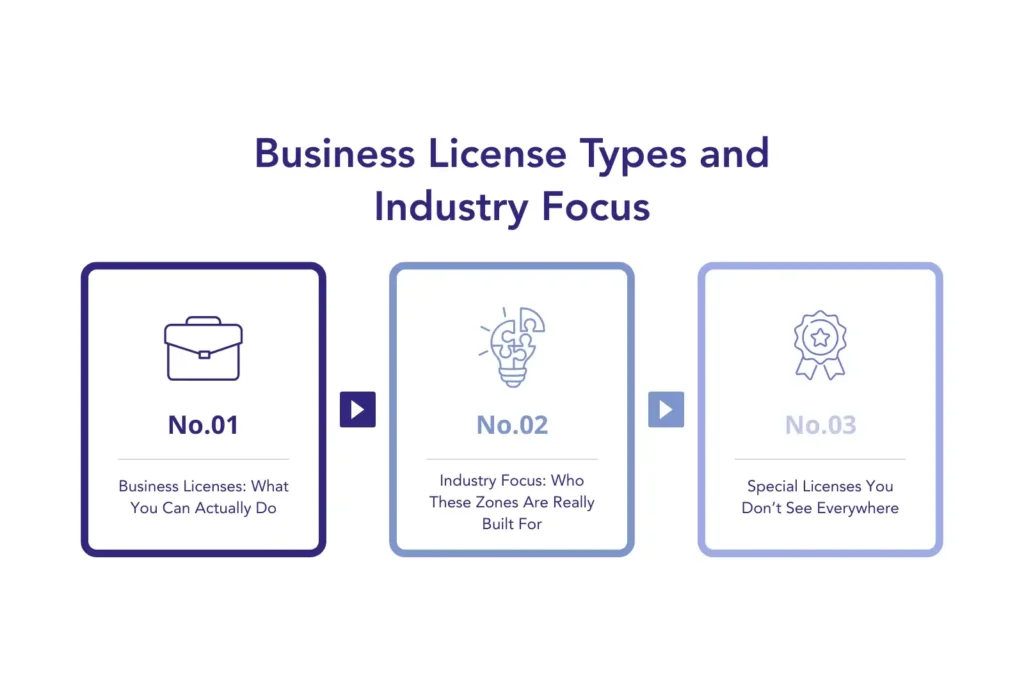
Business License Types and Industry Focus

Business License Types and Industry Focus

Choosing a free zone isn’t just about where your office goes. It’s about what you’re allowed to do once you get there. Every zone has its own set of licenses, industry focus, and hidden perks that can shape how your business operates.


Let’s look at what Fujairah and Sharjah bring to the table.

Business Licenses: What You Can Actually Do

Both free zones cover trading, industrial, and service licenses. You’ll be able to import, export, consult, manufacture, or offer services depending on your setup.


But here’s where the difference kicks in: the license structures.


Fujairah free zone company formation is particularly straightforward if you’re in logistics, marine services, or heavy equipment. You’ll find business categories tailored to those sectors, with options to add on warehousing or import/export functions right from the start.


In practice, Fujairah’s licence framework remains centred around commercial (trading), service, and industrial categories — particularly aligned with port-driven logistics, marine support, oil and gas services, and storage-heavy operations.


Sharjah takes a broader, more modern approach. It’s free zones, especially Sharjah Media City and SPC Free Zone, that cater to creative industries, tech startups, e-commerce businesses, and consultants. There’s more flexibility in mixing activities, like running a marketing agency that also sells digital products.

Industry Focus: Who These Zones Are Really Built For

Fujairah plays to its strengths. It’s made for businesses tied to the sea, energy, and large-scale operations. Think ship repair, oil and gas support, storage facilities, and re-export companies.


Sharjah shifts focus toward innovation, education, and entrepreneurship. You’ll find a strong presence of SMEs working in media, publishing, ICT, and online services. Light manufacturing also has a home here, thanks to zones like Sharjah Airport International Free Zone (SAIF Zone).


In 2026, the way your activity is licensed carries added weight. 


Your registered licence category can directly influence how your income is assessed under the UAE Corporate Tax framework — particularly when determining whether revenue may qualify under the Qualifying Free Zone Person (QFZP) rules.

Special Licenses You Don’t See Everywhere

Now here’s something that often gets missed.


Fujairah stands out for allowing alcohol and tobacco trading licenses, which many other zones avoid altogether. This makes it a go-to for specific types of import/export businesses — especially those with distribution across Africa or South Asia.


(As always, businesses should verify current activity approvals directly with Fujairah Free Zone Authority, as controlled goods licensing is subject to updated regulatory conditions.)


Sharjah doesn’t go that route. Instead, it shines in how it supports hybrid licenses, letting businesses combine service and commercial activities under one roof. If you’re launching something new or not quite conventional, that kind of flexibility can be gold.


Zones like SPC Free Zone and SHAMS are particularly known for structuring licences that allow multiple related activities under a single registration, which can be useful for digital-first, consulting, or mixed-revenue models.


In 2026, this licence structure will have another layer of importance. 


The specific activity listed on your licence, and what you actually do in practice can influence whether your income is treated as “qualifying” or “excluded” under Ministerial Decision 229 of 2025 on Qualifying and Excluded Activities. 


That distinction is central to maintaining 0% Corporate Tax under the Qualifying Free Zone Person (QFZP) rules.

Company Setup Process: Step-by-Step Comparison

Getting a business up and running in a UAE free zone isn’t tricky, but it’s not all identical paperwork. Both Fujairah and Sharjah offer relatively smooth setup paths. Still, the details can affect how quickly you start operating, how much you spend, and how many steps you need to get there.


Let’s compare the experience on the ground.

Registration and Paperwork: What You’ll Need

At a glance, the company formation process in both zones looks similar:


You fill out an application, submit your documents, and wait for approvals. But the behind-the-scenes flow differs.

Core Setup Steps (2026 Overview)

At a structural level, the core steps generally follow the UAE’s standard free zone framework:

  • Choose your legal form, define your business activity, and reserve a trade name.
  • Submit the initial application along with identity documents and any required approvals.
  • Decide on your facility type (flexi-desk, office, or warehouse) — this directly impacts visa eligibility and even how banks assess your KYC profile.
  • Pay the relevant fees and receive your licence, establishment card, and immigration file (where applicable).

Fujairah Free Zone: What to Expect

In Fujairah Free Zone, the steps are lean. Submit your business plan, passport copies, and initial application, and you can often receive pre-approval within days. The process is especially friendly for businesses setting up with warehouses or trading licenses.


Fujairah’s government portal formally lists the required documents, which typically include:

  • Application form
  • Business plan
  • Passport copies
  • Specimen signature
  • In some cases, a No Objection Certificate (NOC)

As documentation requirements can evolve, applicants should review the latest checklist directly through the Fujairah authority before submission.

Sharjah Free Zones: Zone-Dependent Flow

Sharjah’s free zones, depending on which one you choose, may ask for a few more specifics. Some require activity justifications or additional documents during early screening. 


However, the overall structure is still efficient and easy to follow.


The exact flow in Sharjah depends on the zone selected:

  • SAIF Zone: Choose between commercial, service, or industrial licences, then secure the appropriate facility.

  • SHAMS: Licensing is structured around activity categories such as media, services, or holding activities.

  • SPC Free Zone: Create an online profile, select a package (including “instant licence” or visa-inclusive bundles), and confirm permitted activities before issuance

How Fast Can You Start?

Speed matters, and this is where things get interesting.


Fujairah typically moves quickly for company registration, especially for single-owner setups or pre-defined business categories. Marketing materials often reference fast-track licensing within a few working days, but in practice, timelines depend on the nature of the activity, internal risk review, KYC checks, and how complete your documentation is at submission.


Sharjah’s pace can vary slightly depending on the zone. Some creative or hybrid activity licenses might take a few extra days due to internal review. Again, while promotional timelines may suggest quick issuance, the actual approval period depends on activity classification, compliance screening, and document readiness.


It’s also important to separate licence issuance from bank account opening. Banking timelines operate independently and are subject to UBO verification, AML due diligence, and institution-specific onboarding reviews — which can extend beyond the licence approval stage.

What It’s Going to Cost

Let’s talk numbers — not just headlines.


License fees in both zones start low, especially for solo entrepreneurs or small consultancies. However, the Fujairah Free Zone company setup cost tends to be more competitive when it comes to industrial or warehouse-based licenses.


That said, the total setup cost in 2026 depends on more than just the headline licence fee. Several variables influence the final figure, including:

  • Licence type (commercial, service, industrial, or specialised activity)
  • Facility size and type (flexi-desk, office, warehouse, land plot)
  • Visa quota linked to the chosen facility
  • Activity risk classification or additional regulatory approvals (where required)
  • Ongoing compliance costs such as audit requirements, Corporate Tax filings, VAT registration (if applicable), and bookkeeping support

Here’s what to factor in:

  • License issuance and registration charges
  • Service and admin fees (usually fixed annually)
  • Office rent or warehouse lease (varies by size and location)
  • Security deposits (often refundable, but sometimes locked for the first year)
  • Renewal costs, which are usually predictable — but important to budget in

Sharjah’s pricing is attractive for flexi-desk or shared office setups, especially if you’re testing the waters or running a lean startup.


Certain Sharjah zones publish “starting from” package references — for example, SHAMS promotes licence packages starting from AED 5,750 (subject to activity and package selection), and SPC Free Zone markets instant licence options generally in the AED 5,750–6,875 range depending on inclusions. Final pricing always depends on activity mix, visa allocation, and facility choice.


In Fujairah Free Zone, fee structures are typically confirmed by the authority at the time of application and approval. Published guidance indicates that costs vary based on activity, facility, and documentation requirements, and applicants should rely on the official authority quotation rather than fixed package assumptions.

Visas: How Many, How Fast?

Once your business is live, you’ll want to hire your team or at least secure your own residency.


Both zones offer visa quotas linked to the size of your leased space. Typically:

  • A flexi-desk gives you 1 to 2 visas
  • A full office or warehouse can qualify you for more.

Visa allocations are ultimately governed by immigration rules and the specific free zone authority’s internal policies, with office size, lease type, and activity category all influencing the approved quota.


In Fujairah, visa processing is handled directly through the free zone authority. It’s quick, streamlined, and investor visas are usually processed first. Expect timelines of 5 to 10 working days, assuming medical and Emirates ID steps go smoothly.


Sharjah follows a similar structure, though some zones offer bundled visa packages with license deals, which is helpful if you’re bringing in multiple team members immediately.


Looking ahead, visa renewals and quota approvals can also be influenced by the company’s broader compliance standing — including Corporate Tax registration status, VAT compliance (where applicable), and AML obligations. Maintaining clean regulatory records helps ensure smoother immigration interactions over time. 

Legal and Regulatory Environment

Legal and Regulatory Environment

Setting up is one thing. Running a business year after year is another. That’s where the legal and compliance side of free zones comes into play, and the differences between Fujairah and Sharjah start to matter more.

Rules, Renewals, and Reporting

Both free zones operate under the UAE’s commercial framework, but each one enforces its own rules regarding audits, renewals, and penalties.


In 2026, that framework sits alongside the UAE Corporate Tax regime, which applies to free zone companies as well. The 0% Corporate Tax rate is not automatic — it depends on maintaining Qualifying Free Zone Person (QFZP) status and earning qualifying income.


To retain QFZP status, businesses must meet specific conditions, including passing the de-minimis threshold test — meaning non-qualifying revenue must remain within the lower of AED 5 million or 5% of total revenue.


Audited financial statements are now a core requirement for QFZP compliance, and failure to meet these conditions can shift income into the standard Corporate Tax regime.


In Fujairah Free Zone, the process is refreshingly no-nonsense. Basic reporting is expected, and license renewals are usually handled quickly, especially if your paperwork is in order. Businesses that complete their Fujairah free zone company registration often find the compliance structure flexible enough to stay focused on growth, not red tape.


Sharjah’s zones vary. Some are more hands-on with audits, especially for businesses in finance, manufacturing, or publishing. If you prefer operating within a clearly defined compliance structure, this might actually be a plus.


For smaller businesses, Small Business Relief remains available only for tax periods ending on or before 31 December 2026, subject to eligibility conditions.


It’s also worth noting that Economic Substance Regulation (ESR) reporting requirements have been cancelled for financial years ending after 31 December 2022, although historic record-keeping obligations still apply.

Intellectual Property and Data

Sharjah tends to attract creatives, such as media producers, publishers, and tech founders, and this shows in how its zones handle intellectual property. Solid policy frameworks back your branding, content, and data.


That doesn’t mean Fujairah falls short. Suppose your company formation in Fujairah involves shipping, equipment, or storage. In that case, your focus is more likely on protecting logistics processes or brand identity covered under national IP laws.


Either way, your assets are protected. You just need to know where the zone’s focus lies.

Ownership, Profits, and Control

Both zones offer one of the UAE’s biggest advantages: full ownership. There is no need for a local partner; you own 100% of the business.


Whether you’re pursuing a Fujairah free zone company setup or choosing a Sharjah license, the rules on capital are clear. You can send profits home, reinvest them elsewhere, or move capital however you like, without restriction.


However, profit distribution now sits within the broader Corporate Tax framework. Profit distribution now operates within the broader Corporate Tax framework.


This is especially helpful for founders running lean or planning international expansion. For many, it’s a key reason they choose to go for a business setup in Fujairah Free Zone in the very first place.

2026 eInvoicing Readiness

The UAE’s eInvoicing programme introduces structured electronic invoicing requirements. PDFs, emailed invoices, or scanned documents will not qualify as compliant eInvoices under the new system.


The Ministry of Finance programme roadmap outlines phased rollout and pilot timing, meaning businesses operating in free zones should prepare systems early rather than treating eInvoicing as a distant requirement.

Master Comparison Table

Decision Factor Fujairah Free Zone (FFZ / FFZA) Sharjah Free Zone Ecosystem (SAIF / HFZA / SHAMS / SPC) Primary Reference Type
Primary Location Advantage Direct east-coast port access; Indian Ocean routing Proximity to Dubai & Northern Emirates; strong internal distribution reach Official zone portals
Typical Operating Model Port-driven logistics, storage-heavy, industrial and re-export models Cluster-based ecosystem: industrial, trade, media, publishing, e-commerce Zone authority sites
License Structure Commercial (trading), service, industrial categories Zone-specific: SAIF/HFZA (industrial/trade), SHAMS (media/creative), SPC (publishing/e-commerce/consulting) SAIF, SHAMS, SPC licensing pages
Setup Flow Lean approval flow; authority-led processing Zone-dependent process; online profile or assisted registration depending on authority u.ae + zone portals
Processing Timeline Marketing references fast issuance; actual timelines depend on activity risk & checks Some zones market “instant licensing”; actual approval depends on compliance screening Authority disclosures
Facility Options Warehouses, industrial plots, offices Flexi-desk, offices, warehouses (varies by zone) Zone facility listings
Visa Planning Visa quota linked to facility size and lease Visa packages and quotas vary by zone and facility SPC/SHAMS official info
Banking & KYC Reality Separate timeline; subject to UBO & AML review Same — bank onboarding independent of licence issuance Advisory reality
Corporate Tax (0% Eligibility) 0% subject to QFZP status and qualifying income Same — QFZP rules apply equally FTA Free Zone Persons Guide
De-minimis Threshold Non-qualifying income must remain within AED 5m or 5% of total revenue Same threshold applies FTA guidance
Audited Financial Statements Required for QFZP compliance Required for QFZP compliance FTA + MoF MD 84/2025
Small Business Relief (SBR) Available only for tax periods ending on/before 31 Dec 2026 (if eligible) Same SBR window MoF MD 73/2023
ESR Status (2026) ESR filings cancelled after FY ending 31 Dec 2022 (historic records retained) Same ESR status MoF ESR announcement
eInvoicing Readiness Structured eInvoices required; PDFs/scans not valid Same structured eInvoice requirement MoF eInvoicing programme
Mainland Access / Dual License Verify with authority; not universally promoted Certain zones (e.g., SPC) promote dual-license options SPC official info
Renewal & Compliance Discipline Renewal tied to documentation accuracy and regulatory standing Same; compliance status affects smooth renewals CT/VAT compliance framework
Cost Structure Transparency Fees confirmed at approval stage; variable by activity & facility Some zones publish “starting from” packages (subject to activity & inclusions) Zone pricing pages

Cost Analysis and Financial Incentives

Cost matters, not just on day one, but across the lifespan of your business. It’s one thing to get started cheap. It’s another to stay lean, efficient, and profitable over time.


So how do Fujairah Free Zone and Sharjah Free Zone compare when the numbers are on the table?

Setup vs. Long-Term Costs

Fujairah is often seen as the more budget-friendly option, especially for businesses that need space — warehouses, yards, or full industrial plots. The Fujairah free zone company setup cost tends to be lower than in more urbanized zones, and ongoing lease rates are competitive.


Office-based businesses also benefit. For example, a standard Fujairah free zone business setup package with a flexi-desk and license can run significantly cheaper than similar offerings in more high-profile zones.


Sharjah, on the other hand, has its strengths in modern workspaces, flexible packages for digital-first companies, and startup-oriented incentives. If you’re in e-commerce, consulting, or digital services, it’s worth comparing the licensing structures closely.


When factoring in Fujairah free zone company formation for logistics or industrial work, long-term operational savings often outweigh the initial costs, particularly for companies moving large volumes or dealing with storage-heavy operations.


In 2026, the total cost is influenced by more than just the licence and rent. Key drivers include: 

  • licence type (commercial, service, industrial, or specialised activity)
  • facility size and category
  • approved visa quota
  • activity risk profile and any required regulatory approvals
  • annual audit cost where audited financial statements are required
  • and ongoing Corporate Tax and VAT compliance costs, including bookkeeping and return filings.

Published Packages vs Variable Fees

Some Sharjah zones publicly advertise starting packages. For example, SHAMS promotes licence packages “starting from AED 5,750” through its official calculator (subject to activity and inclusions). 


SPC Free Zone markets instant licence options and bundled visa packages with “starting from” price points depending on activity mix and facility type. As always, final pricing depends on visa allocation, office requirements, and permitted activities.


In Fujairah Free Zone, fees are typically confirmed by the authority at the quotation or approval stage. Costs depend on licence type, facility, and documentation requirements. 


Businesses should treat third-party “from AED X” claims cautiously unless published directly by the authority or its officially recognised partners.

Taxes and Customs: What You Keep

Both zones offer the standard free zone perks:

  • 0% Corporate Tax applies only where the company qualifies as a Qualifying Free Zone Person (QFZP) and earns qualifying income under the UAE Corporate Tax framework.

  • Non-qualifying income is subject to the standard 9% Corporate Tax rate.

  • The de-minimis threshold (lower of AED 5 million or 5% of total revenue) determines whether QFZP status is preserved.


  • Full customs exemptions on imports into the zone


  • 100% profit repatriation

Fujairah’s position near the port gives it an edge for businesses that rely on international shipping. Import duties are avoided on goods brought into the free zone, and export logistics tend to be simpler.


Customs exemptions continue to apply to goods imported into and re-exported from the free zone in line with UAE customs regulations.


VAT still applies where relevant, but both zones provide solid support to help businesses register and remain compliant.


VAT continues to apply to taxable supplies, particularly where goods or services are supplied to mainland UAE customers or where standard VAT rules are triggered.


Bottom line? Whether you’re working through company formation in Fujairah or setting up in Sharjah, the tax structure is built to support growth, not chip away at your margins — provided compliance conditions are actively maintained.

Real-World ROI

So what’s the actual return?


For small businesses and startups, Sharjah’s quick license options and compact office solutions keep overhead low and scaling easy.


For industrial firms, trading companies, or logistics operations, Fujairah free zone company registration usually delivers higher ROI over time. The setup costs are lower, space is abundant, and shipping access cuts operational friction.


In both cases, the UAE’s wider free zone incentives, no currency restrictions, full ownership, and no exit barriers help businesses grow with minimal interference.

Market Access and Business Ecosystem

Licenses and paperwork are one thing. But once you’re up and running, you want to know: where does this zone actually take you?


Let’s look beyond setup and into the real-world ecosystem of Fujairah and Sharjah — the routes they open, the markets they touch, and the kind of business communities they offer.

Market Reach That Matches Your Business

If your operations rely on shipping, the Fujairah Free Zone is built for that. It’s the only emirate with direct access to the Indian Ocean — no detours through the Strait of Hormuz. That means fewer delays and more predictable routes, especially for companies in exports or logistics. It’s one of the reasons the Fujairah free zone business setup appeals to firms moving goods across borders.


Fujairah also connects well by road. Routes into Saudi Arabia, Oman, and other GCC countries are active and accessible, making regional trade straightforward.


In 2026, logistics planning isn’t just about geography. Businesses also need to consider Corporate Tax exposure on mainland transactions, customs treatment across borders, tariff structures, and structured eInvoicing requirements that may apply depending on supply chains and customer location.


Sharjah plays a different game. It’s landlocked, but its roads do the heavy lifting. Positioned near Dubai, with fast connections to Ajman and other northern emirates, it’s ideal for businesses that sell locally or rely on urban logistics. If you’re targeting consumers or running regional services, it gives you steady access to large markets without the complications of port-based operations.


It’s also worth remembering that Sharjah is not one single ecosystem. Use SAIF or Hamriyah Free Zone (HFZA) for industrial and trade-heavy models; SHAMS for media and creative activity; and SPC Free Zone for publishing, consultancy, and e-commerce structures — including mainland dual-licence options where offered.

What Kind of Community Are You Joining?

You’ll find companies in every zone, but the tone, pace, and collaboration will be different.


Sharjah’s free zones lean toward creative and tech-driven industries. Media, design, e-learning, app development — that’s the crowd. Many zones run events, mentorship sessions, or networking panels. If you’re a startup or growing team, there’s support beyond just a desk and license.


Fujairah plays a quieter game. It’s not built for networking mixers — it’s built for operations. If you’re dealing with freight, equipment, or large-scale storage, the Fujairah free zone company setup process gets you direct access to port services, customs, and warehousing partners. That kind of access matters more than a newsletter or meet-and-greet.

Real Support, Not Just Promises

Every free zone says it offers support. What that looks like is another story.


Sharjah’s zones are more hands-on. You’ll find incubation programs, legal advisors, and even branding help for new businesses. If your business model is still evolving, this extra guidance layer can make a real difference.


Fujairah’s approach is simpler. You deal with one office and one contact, and most of your setup happens without layers of bureaucracy. That’s why many businesses stick with Fujairah free zone company registration — it’s efficient, direct, and focused on getting you to market.

Best Fit Scenarios (2026)

Consultant / Solo Founder

  • Best zone fit: Sharjah ecosystem (SHAMS or SPC) for service-based, consultancy and digital-first models with lighter operational footprint.

  • Compliance note: 0% Corporate Tax applies only if QFZP conditions are met, including qualifying income, de-minimis threshold compliance (lower of AED 5m or 5%), and audited financial statements. Mainland service revenue must be reviewed carefully.

  • Facility note: Flexi-desk or shared office typically sufficient; visa quota usually limited to 1–2 unless upgraded to a physical office.

E-commerce / Import–Export Distributor

  • Best zone fit: SAIF or SPC for UAE-wide distribution and airport adjacency; Fujairah for port-driven trade or route-specific export models.

  • Compliance note: Revenue segregation is critical where mainland sales exist; non-qualifying income affects QFZP eligibility and VAT obligations. Audited financial statements required for 0% eligibility.

  • Facility note: Warehouse or trade unit generally required; visa quota linked to leased space and operational scale.

Industrial / Manufacturing Business

  • Best zone fit: Fujairah Free Zone or Hamriyah Free Zone (HFZA) for industrial plots, bulk storage and long-term production scale.

  • Compliance note: Industrial income may qualify under QFZP if qualifying activities and substance requirements are met; audited financial statements and proper documentation are mandatory.

  • Facility note: Industrial land plots or large warehouses standard; higher visa allocations typically linked to facility size.

Media / Creative Business

  • Best zone fit: SHAMS and other Sharjah media-focused zones for content, publishing, digital services and creative activities.

  • Compliance note: Media income must meet QFZP and substance requirements for 0% treatment; audited financial statements remain a core condition.

  • Facility note: Flexi-desk or small office commonly sufficient, but documentation and compliance systems must align with Corporate Tax expectations.

Quality of Life and Business Environment

Setting up a company is just one part of the equation. Living, hiring, and building a team you actually want to keep? That depends on the environment around you. Both Fujairah and Sharjah offer very different lifestyles, and each comes with its own kind of balance.

Daily Life Beyond the Business

Fujairah moves at a slower rhythm. It’s not a crowded place, and that’s part of what makes it livable. Rents are lower, roads stay clear, and you’re never far from the sea. If you’re setting up through Fujairah free zone company formation and plan to stay close, you’ll find the basics covered — schools, clinics, supermarkets — without a bigger city’s pressure or price tag.


Sharjah has a different kind of energy. It’s busier, more built-up, and closely tied to the urban life of Dubai. It has museums, universities, and events happening year-round. For business owners with families, it offers strong healthcare, decent schools, and lots of everyday comforts. If you want access to Dubai without paying to live there, Sharjah hits the balance.


If the founder plans to relocate personally, it’s important to understand that UAE tax residency is determined under Cabinet Decision No. 85 of 2022. Simply owning a free zone company does not automatically make the owner a UAE tax resident — days spent in the country and other personal and economic ties matter.

Safety, Rules, and the Business Climate

Both Emirates are safe, stable, and well-policed, which is one reason foreign investors feel confident about setting up shop here.


Sharjah tends to be more traditional — there are rules around public behavior, signage, and business hours. It’s a good fit if you prefer structure and clarity. Fujairah is more relaxed, especially in the port and industrial zones. That relaxed environment is part of what makes business setup in Fujairah Free Zone popular with foreign companies.


When it comes to regulations, both zones are transparent. Licensing authorities are clear about what’s allowed, what’s not, and how to stay compliant. No surprises.

Green Business, Smart Growth

Sustainability isn’t just a buzzword here. Both free zones have started taking measurable steps toward eco-friendly operations, whether through building codes, utility efficiency, or waste management policies.


Fujairah’s focus on land availability and energy-saving infrastructure is a bonus if you’re planning a long-term operation, especially in manufacturing or logistics. It helps keep overhead low while meeting environmental standards — a key point in many Fujairah free zone company setup strategies.


Sharjah leans more into innovation-led sustainability, such as smart offices, paperless licensing, and incentives for green startups. If your brand cares about its footprint, it’s worth factoring in.

Why Choose ADEPTS for Your Free Zone Business Setup

Choosing a free zone is one thing. Navigating the setup process, staying compliant, and avoiding unnecessary costs? That’s where most businesses get stuck.


ADEPTS steps in before that happens.


From day one, clients get clear guidance, not just a list of documents or a one-size-fits-all form. Whether you’re planning a Fujairah free zone business setup or evaluating Sharjah’s packages, we help you make the right call based on your needs, not someone else’s sales pitch.


We handle the paperwork, coordinate with authorities, and flag anything that might slow you down later. That includes checking your license scope, reviewing visa quotas, and calculating your total costs, including often-overlooked items like Fujairah free zone trade license cost or annual office lease terms.


If you’re looking at company formation in Fujairah for a trading or logistics business? We’ve done it before. Many times. 


Do you need help navigating Sharjah’s more layered regulatory structure? We know where the bottlenecks are and how to avoid them.


We don’t disappear once the license is issued. ADEPTS sticks around through renewals, expansions, or restructuring. You’ll have the same point of contact, consistency, and advice tailored to your business is direction, and not just where it starts.


Whether you’re going for Fujairah free zone company registration or setting up in a Sharjah creative zone, ADEPTS keeps things simple, legal, and cost-effective — so you can focus on running the business, not chasing paperwork.

Conclusion

Fujairah and Sharjah don’t compete; instead, they serve different kinds of businesses.


If you’re moving goods, storing equipment, or shipping regionally, Fujairah makes sense. You’ll get space, port access, and fewer moving parts. For port-driven, storage-heavy, or industrial models where logistics efficiency drives margins, that simplicity can translate into long-term operational advantage.


But if you’re building a team, running something creative or digital, or need to be close to Dubai without paying Dubai prices, Sharjah is worth considering. Its cluster-based ecosystem — from industrial trade zones to media and publishing hubs — allows you to align your licence, facility, and growth model more precisely.


Both zones are solid. It depends on what kind of work you do and what you want from the setup. In 2026, that decision also means understanding how your activity, income mix, and compliance structure interact with Corporate Tax rules, audit requirements, and reporting obligations.


If you’re not sure, that’s normal. ADEPTS helps with the thinking part and not just the forms. Free zone selection today is not just a registration decision — it’s a structural decision that affects tax positioning, banking timelines, visa planning, and long-term scalability. You bring the idea. They help you get it off the ground — properly.

FAQs:

Yes. You’ll need separate licenses from each free zone. For example, one branch can go through Fujairah free zone company registration, while the other sets up in Sharjah. Just keep compliance and renewals separate.

The laws are mostly the same, as they follow UAE labor law. But the process feels different. Business setup in Fujairah Free Zone is generally more flexible for blue-collar roles. Sharjah has tighter rules in service sectors.

No major difference. Both follow federal IP law. Sharjah offers more legal help in media or tech zones. In a Fujairah free zone business setup, you’ll likely need external legal support if IP is a priority.

You can sponsor your spouse and kids in both zones once your visa is active. Fujairah free zone company setup is typically faster with less back-and-forth. Sharjah works too — just more documentation.

Both use UAE civil courts. Fujairah is faster for trade-related disputes, especially if you’re set up with a Fujairah free zone company formation. Sharjah offers more structured arbitration support for service firms.

Fujairah free zone company setup is ideal if you need serious storage — cold units, port access, large warehouses. Sharjah has good options too, especially in Hamriyah Free Zone, but space is tighter.

Both help with license cancellations and visa shifts. Fujairah is more efficient for industrial firms. Sharjah’s support is better for service-based businesses or those relocating into tech/media hubs. Either way, company formation in Fujairah is a common next step for mainland logistics firms.

No cash grants. But Fujairah free zone trade license cost is often discounted for new businesses. Sharjah offers packages — reduced fees, flexible leases, sometimes free advisory. Depends on the free zone.

No. A free zone company only benefits from 0% Corporate Tax if it qualifies as a Qualifying Free Zone Person (QFZP) and earns “qualifying income” under the UAE Corporate Tax rules. Otherwise, non-qualifying income is taxed at 9%, like any other taxable business.

In practice, a QFZP must be established in a qualifying free zone, have adequate substance, earn qualifying income, meet the de-minimis test for non-qualifying income, maintain audited financial statements, and comply with Corporate Tax filing obligations. Failing these conditions can move the company into the 9% regime.

The de-minimis test checks how much non-qualifying revenue a free zone company earns. If that revenue stays within the lower of AED 5 million or 5% of total revenue, QFZP status can be preserved. If the threshold is exceeded, the company risks losing 0% treatment for that tax period.

Yes. For companies relying on QFZP status, audited financial statements are now a core condition. Without audited financials, the company is unlikely to meet the documentation and substance expectations linked to QFZP and may see its income pushed into the standard 9% Corporate Tax rate.

Yes, based on current rules, Small Business Relief is only available for tax periods ending on or before 31 December 2026, subject to eligibility conditions. Free zone startups relying on this relief should factor the cut-off date into medium-term tax planning and growth projections.

Selling to mainland customers can affect both VAT and Corporate Tax. VAT is generally due on taxable supplies to mainland UAE. For Corporate Tax, the way mainland income is structured and booked can affect whether it is treated as qualifying or non-qualifying income, and therefore whether 0% QFZP treatment can still apply.

Yes. The UAE eInvoicing framework is expected to apply to in-scope taxpayers regardless of whether they operate in the mainland or a free zone. Structured eInvoices, not PDFs or email attachments, will be required once the regime goes live. Free zone businesses should plan ERP and process upgrades in advance.

No. Corporate Tax, VAT, AML and UBO rules are federal and apply across all emirates. The choice between Fujairah and Sharjah affects location, cost structure, logistics and ecosystem, but not the underlying federal compliance obligations. The key differences lie in how each free zone is set up to support your business model.

References

Related Articles​​

Dubai’s Creators HQ: A Global Hub Attracting 2,415 Members and 78 International Firms in Just Six Months

Dubai has a way of turning bold ideas into reality very quickly. When Creators HQ launched in January 2025, it set out to be the region’s first real home for content creators. Just a few months in, it’s already become something much bigger.


In only six months, the hub has welcomed more than 2,400 members from 147 countries and 78 international companies representing 24 nations. The momentum has been nothing short of electric, cementing Dubai’s position as a rising force in the global content economy. 


From influencers and gamers to filmmakers and podcasters, creators of every kind are now looking to Dubai, not just as a destination, but as the place to build what comes next.

A Global Crowd Under One Roof

Six months in, the numbers speak for themselves. More than 2,400 active members have signed on, joined by 78 forward-looking companies that see Dubai as the place to be.

But it’s not just about size. It’s about scope. Members come from 147 countries, while companies represent 24 nations. A rare diversity gathered under one roof.


Certain countries stand out. 


The UK, Pakistan, the United States, India, France, and Germany have made their mark as the key contributors, offering creative talent and serious business muscle. Together, they’ve helped shape a network that’s far more than a directory of names. It’s a living, breathing map of the global creator economy: dynamic, deeply connected, and influencing what comes next.

Vision and Goals

Creators HQ is built on a bold ambition: 


to see the UAE recognized as the world’s capital of the content economy. 

It is not just a regional hub but also a place where creators, ideas, and opportunities converge globally.


Furthermore, the creators HQ’s next milestone is clear. We’re setting our sights on a thriving community of 10,000 creators, each adding their voice, craft, and stories to this growing ecosystem.


And the reach is already staggering. Collectively, creators in this network connect with more than 2.45 billion people worldwide. That isn’t just an audience, it’s a global stage waiting to be shaped.

Impact and Industry Scope

This isn’t one lane of creativity. 

  • It’s social media creators building their own brands, 
  • gamers streaming late into the night, 
  • podcasters recording in makeshift studios, 
  • digital artists posting work to stay seen, 
  • and people testing the edges of AI, VR, AR, and e-sports.

And the ripple effect goes wide. Sometimes it’s economic, new jobs, small businesses, new markets. Sometimes it’s cultural; shaping what people talk about, how they express themselves, even what feels “normal.” 


And at times it’s humanitarian, creators rallying support, raising money, or just giving a voice to something ignored. 


It doesn’t look neat on a chart, but the influence is everywhere.

Leadership Perspective

Mohammad Abdullah Al Gergawi, the UAE’s Minister of Cabinet Affairs, doesn’t talk in empty slogans, he speaks with intentional clarity. He sees Creators HQ not as a fancy project, but as a cornerstone of a broader strategy. “The content economy is one of the main drivers shaping the world’s future,” he says. And then, pointedly: the UAE wants to be among the first to create and lead that future.


Creators HQ is more than a building with perks. 


Al Gergawi sees it as a comprehensive, attractive ecosystem where creators, businesses, and ideas intersect to push positive, purposeful content that directly contributes to community development.


He goes on to say, “We believe creators and innovators are the ones who shape a better world for humanity.” 


That isn’t vague motivator-speak. To him, Creators HQ is a platform, a bridge bringing together diverse creative voices under one roof. 


Al Gergawi says they’ll reach new heights together and inspire more connected, hopeful conversations around the globe.

Background and Support

Creators HQ traces its roots back to the Content Creators Fund, introduced by Sheikh Mohammed bin Rashid Al Maktoum. 


The fund was set up with a clear purpose: to give digital talent in the UAE a real chance to grow and compete globally. 


It has become more than financial backing for many young creators. It’s a gateway to resources, mentorship, and industry connections. By investing in this space, the UAE is fueling sector growth and signaling to the world that Dubai is ready to be a serious hub for the creator economy.

Member Services and Infrastructure

Being part of this space isn’t just about grabbing a desk to sit at, it’s more like joining a place where things are always happening. There are workshops, little events, and chances to meet people and swap ideas. 


And it’s not only about networking either. Members can get real help from eachother, like sorting out Golden Visas, figuring out relocation, or even starting up a company in Dubai.


Basically, the tedious paperwork and stressful bits are taken care of, so people can just focus on what they came for, creating, building, and doing their work.

Future Outlook

The UAE wants to be known as the global hub for digital creativity, a place where people from everywhere come together with new ideas. 


Creators HQ wants to contribute to that by connecting people, mixing cultures, and helping fresh thinking come to life. 


It’s not only about the projects, but about building something bigger that lasts and motivates the next wave of creative people.

Role of ADEPTS in Supporting Digital Creators and Businesses

ADEPTS has become a key partner for creators and companies building their bases in the UAE. It acts as a trusted guide on financial, tax, and advisory matters, helping the creators focus less on paperwork and more on their work.


The ADEPTS team brings practical knowledge in corporate taxation, VAT, risk consulting, business setup, and services designed with content creators and digital enterprises in mind. ADEPTS also supports ICV certification, giving creators and firms an edge in the local market.


From company formation to financial compliance and long-term advisory, ADEPTS offers clear, workable solutions that keep businesses steady and sustainable. 


Ensuring the energy inside Creators HQ can become lasting growth, not just quick wins.

References

Related Articles​​

Top 10 Profitable Business Activities to Start in RAKEZ in 2026: The Ultimate UAE Guide

Tired of high business costs, slow approvals, and endless red tape? You’re not alone. 


Many entrepreneurs waste months chasing paperwork and paying fees before they even make their first sale.


That’s why more investors are turning to RAKEZ company formation. It’s fast, cost-effective, and built for growth. RAKEZ also remains one of the lowest-cost UAE free zones, known for quick setup, flexible facilities, and a wide range of permitted activities across industrial and service sectors.


RAKEZ business activities continue to attract entrepreneurs because the free zone supports both industrial and service-based businesses.


In 2026, success also depends on choosing the right activity and aligning with factors like corporate tax positioning, qualifying free zone income, digital compliance readiness, and operational substance. 


In this guide, we’ll walk you through the Top 10 Profitable Business Activities to Start in RAKEZ in 2026 and why this free zone is your shortcut to success.

What Changed for RAKEZ Businesses in 2026

RAKEZ remains one of the UAE’s most attractive free zones for entrepreneurs. However, the business environment in 2026 has evolved.


Setting up a company is still fast and cost-effective, but profitability now depends on choosing the right activity, understanding tax rules, and preparing for digital compliance.

Corporate Tax Enforcement

The UAE Corporate Tax system is now fully active. The 0% tax benefit for free zone companies is not automatic.


To benefit from the 0% rate, a business must qualify as a Qualifying Free Zone Person (QFZP) and meet conditions such as:

  • earning qualifying income
  • staying within the de-minimis threshold (5% of revenue or AED 5 million)
  • maintaining adequate economic substance
  • preparing audited financial statements

Businesses earning non-qualifying income may be taxed at the standard 9% corporate tax rate.


For entrepreneurs planning a RAKEZ business setup, choosing the right activity structure is now more important than ever.

e-Invoicing Is Approaching

The UAE is introducing a national e-Invoicing system, with a pilot rollout expected in July 2026.


This means companies planning a business setup in the RAKEZ free zone should select accounting or ERP systems that can support structured digital invoicing.


In the future, invoice data will be transmitted digitally instead of relying only on PDF invoices.

Ras Al Khaimah Growth Drivers

Ras Al Khaimah continues to see strong growth across several sectors:

  • tourism and hospitality development
  • logistics and regional trade
  • industrial manufacturing expansion

Large projects around Al Marjan Island are also increasing demand for services, distribution, and supply chain businesses.


These trends are creating new opportunities for entrepreneurs exploring RAKEZ business activities.

Why Choose RAKEZ in 2026?

RAKEZ isn’t just a free zone. It’s a complete launchpad for entrepreneurs, startups, and established businesses. Here’s why it’s one of the most in-demand choices for RAKEZ business setup and company formation in RAKEZ this year: 

100% foreign ownership

From day one of your RAKEZ company setup, the business is completely yours—no local partner or sponsor required. You hold full legal control over decisions, profits, and future sales. Whether you’re a solo entrepreneur or an overseas investor, you can register, operate, and even sell the company on your own terms.

0% corporate and personal income tax for up to 50 years

This isn’t a quick promotional offer—it’s a decades-long benefit. If your business qualifies as a Qualifying Free Zone Person (QFZP) under UAE rules, meets RAKEZ’s substance requirements, earns qualifying income, and keeps non-qualifying revenue below the legal threshold, it may benefit from a 0% corporate tax rate on qualifying income. 


Non-qualifying income may be subject to the standard 9% UAE corporate tax rate, allowing businesses to retain more profits for reinvestment and expansion.

Full repatriation of capital and profits

Made a profit? You can transfer it anywhere in the world without limits or restrictions. This makes RAKEZ especially attractive for international entrepreneurs who want easy access to their earnings when operating a business through a RAKEZ free zone company setup.

Low setup costs and transparent pricing

The Rakez company setup cost is one of the most competitive in the UAE. Packages are clear, with no surprise charges. You know exactly what you’ll pay from day one, making it easy to plan your budget when planning your RAKEZ company formation.

Access to global markets

RAKEZ sits in Ras Al Khaimah, a location that connects you to the Middle East, Europe, Africa, and Asia with efficient shipping and logistics networks. A smart base for import, export, and distribution businesses choosing a RAKEZ business setup.

Scalable facilities

From a RAKEZ free zone company setup in a shared workspace to a fully customised industrial unit, RAKEZ grows with you. Start small, upgrade later, and keep costs aligned with your business stage as your RAKEZ business activities expand.

Over 1,000 approved business activities

Whether you want to trade, manufacture, consult, or provide services, there’s likely a license that fits your plan. The RAKEZ activity list includes over 1,000 approved RAKEZ business activities, covering almost every sector from trading and manufacturing to consulting and specialised services.

Streamlined setup

Forget months of waiting. Most entrepreneurs get their RAKEZ trade license in a matter of days, meaning you can start operating and generating revenue almost immediately after completing your RAKEZ company setup.

Choosing the Right RAKEZ Business Activity in 2026

Selecting the right activity from the RAKEZ activity list is more important than ever in 2026.


Under UAE Corporate Tax rules, every company registered in a free zone is considered a Free Zone Person. However, only businesses that meet specific conditions can qualify as a Qualifying Free Zone Person (QFZP) and benefit from the 0% corporate tax rate on qualifying income.


This means the type of RAKEZ business activities you choose can influence how your income is taxed.


Some business models align more naturally with qualifying income than others.

Business Model Likely Tax Alignment
Manufacturing/processing Strong
Logistics and distribution Strong
Headquarter services to related parties Moderate
General consultancy to mainland clients Weaker

Entrepreneurs planning a RAKEZ business setup should evaluate their revenue sources carefully to ensure their activity structure supports long-term tax efficiency.

Top 10 Profitable Business Activities in RAKEZ for 2026

Top 10 Profitable Business Activities in RAKEZ for 2026

Setting up a business in the UAE is easier when you choose the right opportunity from the start. With RAKEZ company formation, you can access over 1,000 licensed activities, but some stand out for their profit potential in 2026. These sectors benefit from RAKEZ’s strategic location, low Rakez company setup cost, and fast licensing process. 


In 2026, the most successful RAKEZ business activities are those that combine strong market demand with the right operational structure, tax positioning, and compliance readiness under UAE Corporate Tax rules.


Whether you’re considering RAKEZ free zone company formation for trading, services, or manufacturing, the right choice can put you ahead of the competition. 


Here are the top business ideas worth your attention.

1. E-Commerce and Online Services

The UAE’s online market is growing fast, and RAKEZ business setup options make it easy to join in. Whether you want to run an e-commerce store, a marketplace platform, a drop-shipping business, or offer digital services like marketing and app development, RAKEZ has license packages designed for online entrepreneurs. With a RAKEZ free zone company setup, you can sell to customers across the Middle East and beyond, all while enjoying low costs and global market access.


In 2026, many businesses are moving beyond simple drop-shipping toward fulfillment services, niche product distribution, and cross-border e-commerce operations. Entrepreneurs applying for a RAKEZ e-commerce license can build scalable online businesses that serve customers across the GCC and international markets.

2. IT Services, Software & Cybersecurity

From app development to cloud solutions, demand for tech expertise is only growing. With RAKEZ free zone company setup, tech firms can serve both UAE-based clients and international markets. RAKEZ’s modern infrastructure, reliable connectivity, and flexible workspaces make it an ideal base for IT consulting, software development, and cybersecurity startups that want to scale fast.


New opportunities in 2026 include AI software development, SaaS platforms, cloud security services, and outsourced technology support for international companies.

3. Management, Tax, and Business Consultancy

UAE businesses are navigating new tax laws, corporate structuring rules, and compliance requirements, and need expert guidance. Starting a consultancy through company formation in RAKEZ puts you in a market that’s hungry for advisory, tax planning, and business strategy services. Firms like ADEPTS have already built a strong presence here, proving that RAKEZ is a prime hub for consultants who want credibility and clients from day one.


With the implementation of UAE Corporate Tax and new compliance frameworks, demand for advisory services such as corporate tax consulting, restructuring, and regulatory compliance support has increased significantly.

4. Creative Marketing & Digital Media Agencies

Brands in the UAE are competing hard for attention, and most would rather hire an agency than build a full in-house team. If you start your agency through RAKEZ business setup, you can offer services like social media management, content production, influencer campaigns, and digital advertising to a growing client base. The free zone’s cost-effective packages mean more of your budget can go toward talent and creative tools.


In 2026, many agencies are also expanding into video marketing, influencer management, AI-driven marketing automation, and performance-based digital advertising services.

5. Import/Export and Trading

Whether it’s electronics, building materials, auto parts, or consumer goods, trading remains one of the strongest opportunities for Rakez free zone company formation. Businesses benefit from direct access to UAE ports, efficient customs processes, and zero import/export duties within RAKEZ. It’s a setup that works equally well for startups testing a niche and established traders moving large volumes.


Specialised B2B trading businesses particularly in building materials, construction supplies, and industrial equipment continue to perform well due to strong regional demand and the UAE’s role as a global re-export hub.

6. Manufacturing & Light Industrial

RAKEZ isn’t just about offices and trade; it has dedicated industrial zones built for production. Through RAKEZ company formation, manufacturers can produce food items, cosmetics, textiles, electronics, and custom goods with room to expand as demand grows. The free zone also aligns with the UAE’s “Make it in the Emirates” push, giving industrial businesses a strategic advantage.


Light manufacturing activities such as packaging production, private-label FMCG processing, and customised product manufacturing are particularly attractive in RAKEZ’s industrial facilities.

7. Health, Wellness & Fitness Centers

From boutique gyms to rehabilitation clinics, the UAE’s health and wellness market is thriving. A RAKEZ company setup in this sector gives you access to modern facilities, clear licensing processes, and a large expat community that values quality care and fitness. Medical labs, wellness clinics, and training studios all find RAKEZ a practical, well-connected base.


Growing interest in preventive healthcare, fitness training, and specialised wellness services continues to support this sector in 2026.

8. Educational and Training Centers

Language schools, IT academies, early learning centers, and corporate training providers all have a strong market in the UAE. With company formation in RAKEZ, you can tap into a diverse community of students from young learners to professionals looking to upskill.


Professional training institutes focused on technology skills, business certifications, and corporate upskilling programs are particularly in demand in the UAE’s evolving workforce landscape.

9. Logistics & Warehousing

If your business depends on moving goods efficiently, RAKEZ free zone company setup is a smart choice. The free zone’s location near major UAE ports and highways makes it ideal for distribution hubs, last-mile delivery, and large-scale storage facilities. 


Many businesses now combine logistics services with e-commerce fulfilment operations to support the growing regional online retail market.

10. Renewable Energy & Sustainability Solutions

Clean energy is no longer a niche—it’s the future. 


Businesses in solar power consulting, energy-efficient products, waste-management technology, and eco-friendly construction materials are in high demand. A Rakez free zone company formation in this sector gives you access to industrial plots, modern utilities, and government-backed sustainability programs. 


With competitive RAKEZ company setup cost and incentives for green innovation, RAKEZ is positioning itself as a hub for companies that want to profit while supporting the UAE’s Net Zero 2050 goals.

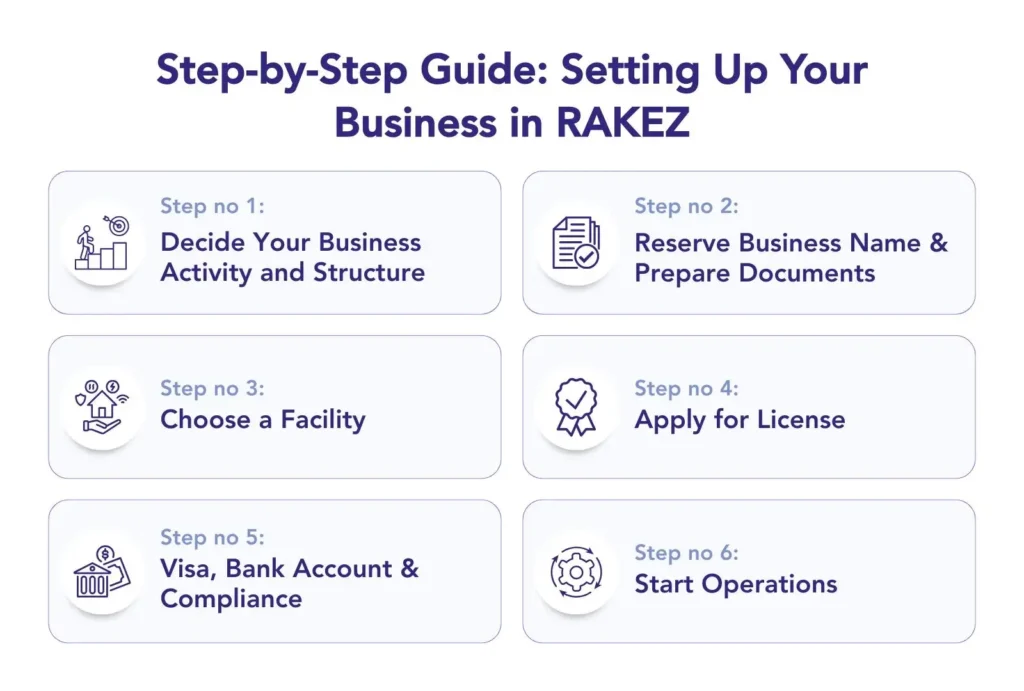
Step-by-Step Guide: Setting Up Your Business in RAKEZ

Step-by-Step Guide: Setting Up Your Business in RAKEZ

The process here isn’t complicated, but there are a few things you need to get right in the right order. Think of it as a checklist. You decide what you want to do, get the paperwork in shape, and then RAKEZ pretty much takes you the rest of the way. In 2026, the main difference is that you also want to think about tax positioning and digital compliance from day one, not after you’re already operating.

1. Decide Your Business Activity and Structure

First, figure out exactly what you want to do. RAKEZ has more than a thousand approved activities, so there’s plenty of choice. You can go for a Free Zone Establishment, a Free Zone Company, or even just open a branch. That decision will shape the rest of your RAKEZ company formation process.


If you want to protect a 0% corporate tax position, this is also the stage where you should check whether your planned income is likely to be qualifying or non-qualifying under UAE Corporate Tax rules.

2. Reserve Your Business Name & Prepare Documents

Once you know the activity, get a name locked in. After that, you’ll need to send in the basics, passport copies, proof of address, and sometimes a No Objection Certificate. It’s a simple part of company formation in RAKEZ, but you can’t skip it. If you’re setting up with partners or a group structure, it’s also smart to align shareholder details and governance documents early to avoid delays later.

3. Choose a Facility

This is where costs start to vary. RAKEZ offers everything from a small flexi-desk to a big industrial unit. What you choose will affect your Rakez company setup cost, so think about where you want to start and how quickly you plan to expand. In 2026, your facility choice can also impact “substance” expectations, especially if you plan to claim qualifying free zone status.

4. Apply for License

With the activity and space sorted, you can go for your license. Trade, service, or industrial—it’s your call. You can even have multiple activities under one, which makes Rakez a free zone company formation pretty flexible. Just make sure the activities you pick match how you’ll actually earn revenue — this matters more in 2026 than it used to.

5. Visa, Bank Account, and Compliance

Next, sort out residency visas, open a bank account, and make sure you’re good with tax and AML rules. This is where your RAKEZ company setup moves from paper to something you can actually operate.


 In 2026, add two more items to this step: Corporate Tax registration (where applicable) and setting up bookkeeping software that can support upcoming e-invoicing requirements.

6. Start Operations

Some packages, like RAKEZ’s Biz Starter, let you get going in just 24 hours. Once that’s done, you’re officially in business and can start connecting with clients across the UAE and beyond. That’s the real start of your RAKEZ business setup journey. From day one, keep your contracts, invoices, and records organised — it saves serious time later for tax filings, audits, and compliance reviews.

Benefits of Starting Your Business in RAKEZ

Benefit What It Means for You
Full foreign ownership You keep 100% control of your business—no local sponsor, no shared decision-making.
0% corporate tax on qualifying income Free zone companies can qualify for a 0% corporate tax rate on qualifying income, provided they meet Qualifying Free Zone Person (QFZP) conditions, including substance requirements and earning qualifying income. Non-qualifying income will be taxed at the standard 9% corporate tax rate.
Fast setup process Your license and visas can often be ready in 1 to 5 working days, so you can start trading quickly. However, you must ensure to register for Corporate Tax if applicable and set up digital compliance systems, such as e-invoicing, from day one.
Affordable, scalable packages From low-cost flexi-desks to full-scale industrial units, your RAKEZ company setup cost matches your budget and growth plans. Scalability includes the ability to scale operations and align with RAKEZ’s operational substance requirements for QFZP eligibility.
Customizable business activities Combine up to five activities under one license—ideal for diverse business models. Ensure your business activities are aligned with qualifying income rules to preserve tax benefits.
Networking and business support Attend events, join coworking communities, and access shared admin services to grow faster. RAKEZ also offers support for meeting e-invoicing and tax compliance requirements.
Strategic market access Reach the UAE, Gulf countries, Africa, Asia, and Europe from one central location. RAKEZ’s position offers access to growing markets and low-cost operations, plus compliance with evolving UAE Corporate Tax and regulatory standards.

2026 RAKEZ Compliance Checklist

As businesses in RAKEZ continue to grow, maintaining regulatory compliance becomes even more crucial in 2026. The UAE’s evolving corporate tax system and digital compliance mandates require companies to ensure they are fully aligned with both local and international standards.


Here’s a 2026 Compliance Checklist for RAKEZ companies to ensure smooth operations:

Key Compliance Areas for RAKEZ Companies:


Corporate Tax Registration:

  • All companies must register for Corporate Tax in 2026, even if they qualify for the 0% tax rate.

  • Ensure your business qualifies as a Qualifying Free Zone Person (QFZP).


Qualifying Income Monitoring:

  • Ensure at least 95% of your income is qualifying for the 0% tax benefit.

  • Non-qualifying income may be subject to the standard 9% tax.


Economic Substance Requirements:

  • Physical presence and actual operations in RAKEZ are necessary to qualify for the 0% tax rate.

  • Maintain substantial operations as per the Qualifying Free Zone Person (QFZP) guidelines.


Audited Financial Statements:

  • All RAKEZ companies claiming 0% tax benefits must have audited financial statements.

  • This includes proper records for all business transactions.


e-Invoicing Readiness:

  • Ensure your accounting or ERP systems are compatible with UAE’s e-invoicing system set to roll out in July 2026.

  • All invoices must be digitally transmitted to tax authorities.


Document Management:

  • Maintain organized records, including contracts, invoices, bank reconciliations, and payroll.

  • These records may be audited by the UAE tax authorities for compliance.

How ADEPTS Can Help You Succeed in RAKEZ

Opening a company in RAKEZ gives you access to one of the UAE’s most business-friendly hubs. But a license alone isn’t enough; you need the right setup, the right structure, and a plan that keeps you compliant while you grow. That’s where ADEPTS makes a real difference.


They’ve worked with entrepreneurs, startups, and established firms to handle RAKEZ business setup from start to finish. They deal with the details you might overlook, making sure your business doesn’t just start—it starts right.


Here’s how they can step in:

  • Business setup and licensing – Helping you pick the structure that fits your plans, sort your paperwork, and get your RAKEZ company formation done without delays. This includes ensuring your business meets the new qualifying free zone conditions for 0% corporate tax, where applicable.

  • Tax planning and corporate structuring – Setting you up in a way that protects your profits and ticks every box for free zone compliance. ADEPTS helps ensure your revenue model qualifies for the 0% corporate tax rate, while maintaining the necessary operational substance in RAKEZ.

  • Regulatory compliance and VAT advisory – Making sure you stay in line with UAE laws and avoid costly mistakes. They assist with corporate tax registration and ensure your systems are set up for mandatory e-invoicing in 2026.

  • Financial reporting, audits, and management advice – Turning numbers into insights you can actually use to make decisions. This includes preparing your business for the new audit requirements for businesses claiming the 0% tax rate and aligning with the 2026 corporate tax framework.

  • Digital transformation and ERP solutions – Bringing in tech that keeps your business organised and ready to scale. ADEPTS helps integrate e-invoicing solutions and ERP systems that comply with the UAE’s digital transformation efforts, making sure your business is ready for the future.

  • Accounting, payroll, and HR support – Managing the ongoing admin so you can focus on running the business. They handle the complexities of VAT, corporate tax filings, and help you stay compliant with the UAE’s evolving regulations.

ADEPTS doesn’t just process forms. They help you build a business that’s ready to last in the RAKEZ ecosystem while staying ahead of regulatory changes, particularly those in 2026.

FAQs:

RAKEZ offers multiple license types for both service-based and industrial activities.

  • Service licenses include consultancy, trading, and tech services.
  • Industrial licenses cover manufacturing, warehousing, and production services.
A physical office is required, depending on your license type and activity.
  • For service licenses, a flexi-desk or shared office may be enough.
  • For industrial licenses, you’ll need a dedicated space such as a warehouse or industrial unit.
Yes, businesses can transfer their operations from other free zones to RAKEZ.
  • You’ll need to de-register your business from the previous free zone.
  • RAKEZ will assist with the documentation and licensing process for the transfer.
Yes, RAKEZ companies need to register for Corporate Tax, even if they qualify for 0% tax.
  • Corporate Tax registration applies to all businesses, even those with qualifying income under the 0% rate.
  • RAKEZ companies must prove they meet the Qualifying Free Zone Person (QFZP) conditions.
The de-minimis threshold determines if a business qualifies for 0% tax on its income.
  • Businesses must earn at least 95% of their revenue from qualifying sources (or up to AED 5 million).
  • Exceeding the threshold triggers standard corporate tax rates on non-qualifying income.
To be e-invoicing ready, new RAKEZ companies must integrate compatible accounting systems.
  • Choose ERP or accounting software that supports UAE’s e-invoicing framework.
  • Ensure your invoice data can be digitally transmitted to tax authorities by July 2026.

References

  • ‘Make It in the Emirates 2026 | 4-7 May | Abu Dhabi UAE’. Make It in the Emirates, https://www.miite.ae/
  • RAKEZ | Setup Your Business in Ras Al Khaimah Free Zone | Best Economic Zone in UAE. https://rakez.com/en/

Related Articles​​

What's the Difference? Forensic Auditing vs. Traditional Auditing for UAE Businesses

Numbers tell stories. For UAE businesses in 2025, ignoring them is risky. How is that for a wake-up call? Auditing helps you spot gaps, secure investor trust, and follow the law. Some firms still treat audits like chores. But knowing what is really happening in your finances can save headaches. It is more than checking papers.


The rules are changing fast in the UAE. Federal Decree-Law No. 41/2023, Corporate Tax Law, and AML regulations are making compliance tougher. What if a tiny slip costs millions? Companies must adapt. Staying alert to every update is not optional. Strong audit practices now protect your business from mistakes, fines, and unexpected trouble before they snowball.


Understanding the gap between forensic auditing in Dubai and traditional auditing is vital. Let us delve into the different purposes each serves. Routine checks versus digging for hidden fraud makes a big difference. This article shows UAE decision-makers how to pick the right audit type. You will get insights, practical tips, and strategies to safeguard your business.

Understanding Traditional Auditing

Traditional auditing helps check if numbers actually make sense. For UAE businesses, it ensures everything is accurate and compliant. How is that for peace of mind? This process finds mistakes, verifies financial health, and builds trust with investors. Auditing is not just paperwork. It is a shield against costly errors and surprises. Companies ignoring it face serious risks.

Historical Development of Traditional Auditing in the UAE

In the UAE, traditional auditing started simple, focused on basic records and compliance. Over years, globalization and investor expectations demanded structured practices. What if businesses stayed outdated? Modern auditing ensures that UAE businesses meet legal and financial standards while promoting confidence. Historical development shaped practices that remain crucial today for transparency and accountability.

Scope and Regulatory Standards

Annual financial statements are typically covered in Traditional auditing. Reason is to check compliance with IFRS and GAAP and to verify accuracy. Auditors examine transactions and confirm alignment with UAE Ministry of Economy rules. Let us delve into why this matters. By performing proper audits, fines can be avoided. It maintains investor trust. Keep operations smooth. These standards are vital to remain credible and reliable for UAE businesses.

Frequency, Processes, Benefits, and Limitations

Audits happen routinely or when regulations demand. Auditors test samples, review internal controls, and inspect records. The benefits? Clearer transparency, stronger investor confidence, and regulatory compliance. But detecting hidden fraud or operational gaps is tricky. Knowing limits helps UAE businesses plan extra measures. Traditional auditing is essential, but it cannot reveal everything, especially subtle financial misconduct or errors.

Understanding Forensic Auditing

Forensic auditing in dubai is not your regular number check. It digs deep into finances to spot fraud and hidden risks. How is that for insight? Companies uncover irregularities and protect their reputation. Forensic audit services help UAE businesses see the unseen. It is about more than compliance. It is about survival and trust in tricky financial situations.

History and Evolution of Forensic Auditing in the UAE

Forensic auditing began when simple audits could not stop fraud. In the UAE, it evolved fast because businesses faced complex financial crimes. What if companies ignored subtle red flags? Now, forensic auditing in Dubai combines investigation with technology. UAE businesses rely on it to detect fraud, settle disputes, and meet growing regulatory demands without losing credibility or confidence.

Role in Fraud Detection and Dispute Resolution

Fraud, misconduct, and financial disputes are tricky. Forensic audits uncover these issues by tracing suspicious transactions, examining documents, and interviewing staff. Let us delve into why this matters. Forensic accounting services provide actionable insights. UAE businesses gain tools to stop losses, protect investors, and maintain trust. Traditional audits cannot always reveal hidden risks, but forensic audits can.

Legal Tool and When Forensic Audits Are Needed

Forensic audits create evidence courts accept. They are done when fraud is suspected, financial disputes arise, or regulators investigate. What if a problem goes unnoticed? Costs, fines, or lawsuits could explode. Forensic audit in Dubai helps UAE businesses act fast, provide credible reports, and stay legally compliant. Timing is critical because delayed audits can make issues worse.

Techniques, Technology, and Benefits for UAE Businesses

Investigators use data mining, background checks, interviews, electronic data review, and AI tools. Specialized software from a computer forensics company dubai or digital forensic service UAE makes investigations precise. Forensic audit services help UAE businesses comply with Corporate Tax Law, AML rules, and DFSA standards while improving controls and reducing risks. Companies become resilient and fraud-proof.

Key Differences Between Forensic and Traditional Auditing

Picking the right audit is not always easy for UAE businesses. Traditional audits check numbers and make sure rules are followed. Forensic audit services go deeper. They spot fraud and hidden issues. How is that for insight? Each type works differently. Knowing their differences helps companies stay safe, keep investors happy, and avoid trouble.

Aspect Traditional Auditing Forensic Auditing
Objective
Verify accuracy of financial statements
Detect and investigate fraud or financial misconduct
Trigger
Routine, compliance-based
Response to suspected fraud or legal disputes
Scope
Broad financial overview
Targeted, in-depth investigation of specific issues
Methodology
Sampling transactions, testing internal controls
Detailed evidence gathering, interviews, surveillance
Reporting
Auditor’s opinion on financial fairness
Detailed investigative report suitable for court use
Regulatory Compliance
IFRS, GAAP standards compliance
Adheres to investigative standards and legal protocols
Frequency
Periodic, usually annual
On-demand, as situations arise

Common Fraud Risks in UAE Businesses

Fraud is a growing worry for UAE businesses. Asset misappropriation, financial statement fraud, and corruption are common traps. How is that for a headache? These risks can silently drain profits and damage trust. Companies need to spot them early. Forensic audit services help detect irregularities that traditional audits might miss. Let us delve into the types of fraud threatening businesses in the UAE.

Sector-Specific Fraud Risks

Certain industries face higher fraud exposure. Real estate and construction often see asset misappropriation. Banks and retail sectors face financial statement fraud and corruption. What if businesses ignore these red flags? Losses mount quickly. Forensic auditing in Dubai equips companies with tools to trace fraud, safeguard assets, and maintain reputation across high-risk sectors efficiently.

How Audits Address These Risks

Traditional audits check accuracy and compliance but may miss subtle fraud. Forensic audits dig deep, using detailed evidence, interviews, and data analysis. Let us delve into why this matters. Forensic audit services dig out stuff that usually hides, while traditional audits keep your books clear and honest. When you use both, your UAE business gets a proper shield against sneaky fraud and unexpected money problems. It is like having eyes everywhere and a safety net under your finances—you sleep easier knowing nothing slips through.

Practical Implications of Each Audit Type for UAE Businesses

What's the Difference? Forensic Auditing vs. Traditional Auditing for UAE Businesses

Traditional audits keep numbers in check and show compliance. Investors feel safer when accounts are verified. How is that for trust? Routine audits support transparency, help plan budgets, and keep UAE businesses credible. But alone, they might miss tricky fraud. Auditing ensures confidence, yet hidden risks can still slip through unnoticed if deeper checks are ignored.

How Forensic Audits Uncover Hidden Risks

Forensic audits dig where traditional audits stop. They expose hidden fraud, misconduct, and sneaky financial errors. What if a company misses these? Forensic audit services ask questions, check data, and use tech to spot anything unusual. UAE businesses get a clearer picture, stop losses before they grow, and act quickly. It is all about noticing what others miss and staying one step ahead of trouble.

Impact on Reputation, Legal Standing, and Stakeholders

Audits affect more than numbers. Traditional audits build investor trust and show honesty. Forensic audits protect legal standing and reduce disputes. Well, how is that for reassurance? You know, companies get more trust, regulators feel happy, and stakeholders relax. Both audits? They help UAE businesses skip fines or legal messes. Reputation stays solid. Business keeps rolling. Nothing fancy, just safer and smoother all around.

Cost and Time Differences

Traditional audits are routine, cheaper, and predictable. Forensic audits are detailed, complex, and can take longer. What if companies ignore this? Planning is key. Forensic auditing in Dubai costs more upfront but prevents huge losses or penalties later. UAE businesses must balance efficiency and risk detection. Spending wisely today can save headaches and money tomorrow.

Integrating Both Audit Types for Comprehensive Oversight

Combining audits is smart. Routine checks maintain clarity while forensic audits catch hidden problems. How is that for full coverage? Forensic audit services complement traditional audits perfectly. UAE businesses get full oversight, reduce risk, protect stakeholders, and meet regulations. Together, they create strong governance and keep operations resilient in tricky financial environments.

Regulatory and Legal Landscape Impacting Auditing in the UAE

Auditing in UAE is serious business. Laws like Federal Decree-Law No. 41/2023 and Corporate Tax Law make sure companies play fair. AML rules add extra pressure. You cannot ignore them. Detecting Errors and Frauds in Auditing helps UAE businesses figure out what to report and when. Stay compliant and sleep easier at night.

Role of Government Bodies

The Ministry of Economy, DFSA, ADGM, and freezones are always watching. They want honesty and clear records. Miss a step and penalties hit fast. Forensic audit services help UAE businesses stay in line. Reports get done right, numbers are clean, and operations keep running smoothly. It is about avoiding trouble before it starts.

Legal Admissibility of Forensic Audit Evidence

Forensic audits create reports courts can accept. Imagine a dispute without proof. Traditional audits often fall short here. UAE businesses benefit by having evidence that holds up in court. It keeps regulators happy and investors confident. Using forensic audits adds a safety net. You know your documents can be trusted if things ever go sideways.

Audit Reporting and Disclosure Obligations

All audits need reporting that makes sense. You cannot hide mistakes. Investors and regulators expect clarity. Combine traditional and forensic audits and you are covered. UAE businesses can show accurate numbers, maintain trust, and avoid fines. Doing it right today keeps reputation intact. Mistakes left hidden cost far more later.

The Growing Need for Forensic Auditing in the UAE

Fraud is creeping into UAE businesses like you would not believe. Deals go wrong, money disappears, disputes pop up. Forensic audit services dig deep and catch what traditional audits miss. Companies must stick to Corporate Tax Law and AML rules. Investors sleep better knowing there is someone watching the books closely. Trust me, prevention beats cleaning up later.

Regulatory Reforms Increasing Audit Scrutiny

Laws like Federal Decree-Law No. 41/2023 are no joke. Penalties bite hard, and auditors now need proper licenses. Future of Auditing in AI Advancements shows how smart forensic audits help UAE businesses keep things legal without slowing down operations. It’s about staying compliant and avoiding surprises that could ruin your reputation.

Forensic Audits Supporting Governance and Investor Trust

Litigation is becoming everyday news. How do companies survive? Forensic auditing in dubai catches hidden risks, fixes control gaps, and keeps the board happy. Investors and regulators notice. Companies feel confident knowing there are no skeletons in the closet. Using forensic audits is like having an insurance policy for your reputation and money.

Technology and Innovation Driving Forensic Audits

AI, blockchain, big data – these are not buzzwords. They actually help spot fraud fast. UAE businesses can use predictive analytics and digital tools to see problems before they explode. Technology makes audits faster, smarter, and reliable. Staying ahead is not optional anymore. You cover your bases and sleep easier knowing you are prepared for anything.

Technology and Innovation in Auditing

What's the Difference? Forensic Auditing vs. Traditional Auditing for UAE Businesses

Technology is changing audits fast. AI scans mountains of numbers in minutes. Blockchain keeps records tamper-proof. Big data shows patterns humans might miss. UAE businesses cannot ignore this. Forensic audit services now blend tech and expertise to spot hidden fraud. It is like having X-ray vision for finances. Staying ahead is no longer luxury, it is necessity.

Leveraging Advanced Analytics and Predictive Modeling

Forensic auditors do not just crunch numbers. They use advanced analytics and predictive modeling to see trouble before it hits. Imagine predicting fraud like weather forecasting. UAE businesses can adjust strategies and plug gaps fast. Traditional audits cannot do this. Forensic audits with tech give companies serious foresight. Check more insights on Blogs.

Digital Transformation Impact on Audit Efficiency

Digital tools make audits faster and smarter. Manual checks are slow and risky. Let us delve into AI-driven dashboards, automated sampling, and electronic record verification. UAE businesses get efficiency and accuracy like never before. Both traditional and forensic audits benefit. It is about reducing time, errors, and stress while keeping regulators and stakeholders happy and confident.

ADEPTS: Your Trusted Partner for Auditing in the UAE

ADEPTS Chartered Accountants is the team you want by your side. They know the Middle East business scene like the back of their hand. ADEPTS offers auditing and forensic auditing in Dubai that fits your company like a glove. Investors sleep easier, bosses stress less, and companies stay on the right side of the law.

Comprehensive Auditing and Forensic Services

Whether it is routine audits or tricky investigations, ADEPTS has it handled. They check financial statements, compliance, and operational risks with eagle eyes. You might say they see what others miss. Audit Assurance helps spot fraud, tighten controls, and make reports crystal clear. Stakeholders feel confident because surprises are kept at bay.

Expertise in UAE Regulatory Landscape

Laws like Corporate Tax Law, AML rules, and DFSA standards are not simple. ADEPTS makes sense of them. Detecting Errors and Frauds in Auditing shows how they create reports ready for regulators and courts. UAE businesses get peace of mind, fewer fines, and a stronger reputation. It is like having a guide through a tricky maze.

Client-Centric Approach and Success Stories

ADEPTS sticks close with clients. Multidisciplinary teams deliver advice that is practical, not just theoretical. Real stories show companies saving millions and dodging compliance nightmares. Forensic Accounting Services dig out hidden risks before they explode. Investors trust the numbers. Companies sleep easier knowing someone smart is watching the books.

Contact and Call to Action

Need auditing help? ADEPTS is ready. Personalized solutions for all audits, from regular checks to forensic accounting services. Reach out today to strengthen processes, detect fraud early, and stay compliant. Learn how tech and strategy merge in Future of Auditing in AI Advancements. UAE businesses gain insights, clarity, and peace of mind.

Conclusion

Picking the right audit really matters in the UAE. Traditional auditing keeps numbers clean and clear but does not always catch sneaky fraud. Forensic audit services dig deeper, expose hidden issues, and protect your business from surprises. Both types shape reputation, legal safety, and investor trust. Knowing when to use which saves money, stress, and sleepless nights.


Mixing both audits gives full financial visibility. Routine checks cover compliance while forensic dives spot the hidden stuff. UAE businesses gain stronger controls, smarter decisions, and less risk. Think of it as having both a flashlight and a map on a dark, winding road. You see hazards early and avoid costly mistakes.


Working with pros like ADEPTS Chartered Accountants makes all the difference. They prevent fraud, correct errors, and keep you fully compliant with UAE laws. Your business stays resilient, trusted, and confident. For safety, growth, and peace of mind, having ADEPTS by your side is simply smart.

FAQs:

Traditional audits catch usual mistakes but clever fraud can hide. Forensic audit services dig deeper and reveal sneaky stuff that routine checks miss. UAE companies often combine both for safety. Think of it like visiting a general doctor then seeing a specialist for hidden issues. You sleep better knowing nothing is lurking behind the numbers.

It really depends on what your business is doing. Big deals, odd transactions, or disputes? That calls for forensic auditing in Dubai. Even steady companies benefit from occasional checks. Like looking under the hood before a long trip, it prevents major issues later. Smart folks do it early instead of waiting for trouble to hit.

Yes, if handled by a certified forensic auditor UAE the right way. Documentation and procedure matter a lot. Reports can be used in disputes, tax checks, or regulatory matters. It is like having a legal net under your finances. Accuracy matters. Without it, you are just guessing. Properly done audits give trust and safety.

You need someone trained in fraud, forensic techniques, and UAE laws. A forensic chartered accountant or certified auditor UAE is ideal. They must know Corporate Tax Law and AML rules. Experience with forensic accounting services in Dubai ensures courts and regulators accept the report. You want eyes that see everything, nothing hidden, nothing missed.

Federal Decree-Law No. 41/2023 makes things stricter. Traditional audits cover compliance. Forensic audit services uncover hidden problems. Businesses weigh cost, speed, and safety. Think smoke detector plus fire extinguisher. Together they protect your financial house. Alone, you might notice trouble too late. Both together give peace of mind and smarter decisions.

Absolutely. Digital forensic service UAE tracks unusual activity, flags breaches, and prevents bigger issues. It is proactive, not reactive. Companies gain security and calm. Prevention beats fixing disaster later. Imagine a guard watching your digital money. You sleep at night knowing someone is watching the shadows, stopping trouble before it happens.

High-risk sectors like real estate, banking, construction, and retail get the most value. Big cash flows hide fraud easily. Forensic auditing in Dubai uncovers risks, ensures compliance, and builds trust. Smaller firms with cross-border dealings also benefit. Think of it as extra eyes on your most valuable stuff, spotting danger before it becomes disaster.

They stay neutral, avoid bias, and stick to strict methods. Forensic audit firms document every step, interview impartially, and report honestly. Companies get real insights, not just guesses. Objectivity keeps management, regulators, and investors happy. Like a referee who never favors any team, auditors follow rules and provide facts without fear or favor.

Frequent disputes, unexplained losses, suspicious transactions, or fast growth without proper controls are red flags. Forensic auditors in Dubai catch problems early. Acting fast prevents money loss, legal troubles, and stress. Like noticing a warning light on your car, early attention stops bigger breakdowns. Timely action saves headaches and keeps business running smoothly.

Combining audit assurance with forensic audit services gives full financial clarity. ADEPTS spots errors, prevents fraud, strengthens controls, and ensures compliance. UAE companies gain transparency, trust, and confidence in decisions. Like using both a magnifying glass and shield together, it protects your finances completely. You see risks and block them before damage happens.

Related Articles​​

Mainland Company Setup in Abu Dhabi: Navigating Local Regulations

Abu Dhabi is the capital of the UAE but it’s also the engine room of serious business. Oil, finance, clean energy, logistics, defence, and a growing tech sector all have deep roots here. And the government? It’s pro-business and actively reshaping policies to bring in global entrepreneurs.


If you’re thinking of going big in the UAE, mainland company setup in Abu Dhabi is the move. It gives you direct access to the local market, fewer restrictions, and the ability to bid for government contracts. Unlike free zones, you’re not boxed in by geography or business scope.


And things are only getting better. As of 2024 and 2025, Abu Dhabi has made it easier than ever for foreigners to fully own their mainland companies. No local sponsor needed for most sectors. Less paperwork. Faster licensing. This shift has opened the floodgates, especially for startups, SMEs, and global players eyeing the Gulf.


Bottom line? If you want reach, credibility, and room to grow, Abu Dhabi mainland business setup is where you start.

Why Choose Mainland Company Setup in Abu Dhabi?

There are some very solid reasons for setting up a mainland company in Abu Dhabi. We are going to list them for you here:

Full Access to UAE and International Markets

With mainland company formation in Abu Dhabi, you’re not locked into one zone. You can operate freely across all emirates and even expand internationally. No geographic limits means more flexibility, more customers, and more partnerships. Whether it’s a warehouse in Dubai or a client in Europe, no worries for you because you’re good to go.

Eligibility for Government Contracts

Government projects in Abu Dhabi are massive. Think about  infrastructure, defence, healthcare, and smart city development. Only mainland companies can bid for these contracts. That’s a major reason businesses choose Abu Dhabi mainland business setup over free zone options. These deals aren’t just big, they’re stable, long-term opportunities.

Two-Year Trade License Validity

The Department of Economic Development (ADDED) now offers two-year trade licenses for most activities. That means fewer renewals, less admin work, and reduced costs. The process has also been digitized, making it much easier for companies to manage licensing without delays.

Strategic Fit for High-Growth Sectors

Abu Dhabi is actively supporting industries like oil and gas, advanced manufacturing, logistics, AI, fintech, biotech, tourism, and sustainability. If your business aligns with one of these, company setup Abu Dhabi gives you access to incentives, partnerships, and infrastructure tailored for growth.

Recent Changes in Mainland Regulations (2024–2025)

Abu Dhabi is making some serious moves to bring in global business. Rules are being rewritten. Barriers are coming down. And if you’re setting up now, you’re walking into a much easier system than just a few years ago.


Here’s what’s changed and why it matters.

100% Foreign Ownership

Most business activities in the mainland no longer need a UAE national as a shareholder. You can now fully own your mainland company setup in Abu Dhabi, no local partner, no split shares. This gives founders and investors full control, both legally and financially.

No More Sponsor Requirement for Many Sectors

In the past, having a local service agent was mandatory even if they held no shares. That’s been scrapped for many industries. If your business falls under professional or commercial activities, you can now register without involving a sponsor. It cuts costs and removes unnecessary friction.

Digital Registration and Licensing

Everything’s gone online. The Abu Dhabi Department of Economic Development (ADDED) now runs most company formation services digitally. Name reservations, license applications, payments – everything is streamlined. This makes mainland company register Abu Dhabi a faster, more transparent process.

Fee Reductions and Incentives for New Companies

ADDED has rolled out major fee cuts, especially for new entrepreneurs. There are reduced license fees, flexible payment options, and even exemptions for certain sectors. These cost breaks are designed to attract startups and SMEs looking for a lean entry into the UAE market.

Step-by-Step Guide to Mainland Company Setup in Abu Dhabi

Setting up a business isn’t rocket science. But it does need structure. The structure is being fully explained here: 

a. Choose Your Business Activity and Legal Structure

As a business, you need to choose your activity. There is a list that gives you info about allowed business activities. Start here. You’ll have to pick an activity like retail, consulting, trading, logistics, manufacturing, or any choice from the list. All the coming formalities depend on your choice of activity. So this is an important step. 


Now you will be asked to choose your business’ legal form. The most common structure is an LLC. But there are others: sole proprietorships, civil companies (for professionals), and branches of foreign companies. Your choice will determine liability, ownership, and sponsor requirements.

b. Trade Name Registration

Pick a name that reflects your business. It must be unique, respectful, and aligned with UAE naming rules. No offensive terms, no references to religion or politics, and no duplicating existing names.


You can reserve your trade name through ADDED’s online portal or at a customer happiness center. Once approved, the name is locked for your use while you complete the rest of the steps in your company formation in Abu Dhabi mainland.

c. Initial Approvals & Documentation

Before getting a full license, you need what’s called “initial approval.” This confirms the government has no objection to your business idea or activity.


At this stage, you’ll prepare documents like:

Depending on your legal form, document requirements may vary. So double-check the checklist on the ADDED portal.

d. Office Space Requirements

You must have a physical address to register your mainland company. That means a signed tenancy contract and an Ejari (tenancy registration certificate). Co-working spaces are allowed in some cases, but not for all activities.


There’s also a virtual license option, but it’s limited to select business types, mostly digital services and consultancies. Still, in most cases, if you’re doing business setup in Abu Dhabi mainland, you’ll need a proper office. It is absolutely non-negotiable.

e. Final Licenses & Additional Approvals

Once your documents are ready, submit everything through ADDED. Pay the fees. Wait for the business license.


But that’s not all. Some sectors need extra approvals. Clinics, schools, travel agencies, restaurants. These must go through other departments, Health, Education, or Culture and Tourism. Check your business activity list. If you fall under a regulated category, get those clearances before applying for the license.


Once approved, your mainland company register Abu Dhabi is done.

f. Post-License Steps

Now comes the setup behind the scenes. First, apply for visa quotas. Then sponsor your employees or family. Register for Emirates ID, labor cards, and health insurance.


Next, open a UAE bank account. You’ll need your license, tenancy contract, and shareholder details. Each bank has its own rules. Some stricter than others. Then come the registrations. VAT (if required). Customs (if you’re importing or exporting).


Chamber of Commerce (mandatory for all). Do it right, and you’re good to go. Operations start. Business begins. You’re officially in the market.

Key Local Regulatory Bodies

When you are setting up a mainland company setup in Abu Dhabi, there are some regulatory bodies you’ll have to face.  It is important that you know about them beforehand so you are ready to deal with what’s coming ahead:

Abu Dhabi Department of Economic Development (ADDED)

This is your main point of contact. ADDED issues trade licenses, approves business activities, and oversees all commercial compliance for mainland companies. Everything starts here.

Municipality, Customs, and Other Departments

Depending on your activity, you’ll also deal with:

  • The Abu Dhabi Municipality (for tenancy verification)

  • General Administration of Customs (for import/export businesses)

  • Sector-specific bodies like the Department of Health or Ministry of Education

Check the list before you apply. Missing a clearance can delay your license.

Stay Updated

Rules shift. Fast. Ownership laws, licensing processes, visa caps—they all evolve. Subscribe to ADDED updates or work with a registered consultant. Staying ahead keeps you compliant and out of trouble.

Legal Compliance and Document Checklist

Don’t wing it. These are the basic documents most businesses need for company formation in Abu Dhabi mainland:

  • Trade name certificate

  • Initial approval letter

  • Memorandum or Articles of Association (MoA/AoA)

  • Tenancy contract or Ejari

  • Passports and visas of all shareholders

  • NOC (if applicable)

  • Business plan (required for some activities)

  • Additional permits for regulated sectors

That’s just the setup. After that, you’ll need to stay compliant with health and safety rules, labor laws, and tax obligations like VAT registration (if applicable).

Costs and Fees for Mainland Setup (2024/2025 Snapshot)

Let’s talk money. Here’s where your main costs will go:

  • Trade name and initial approvals: AED 600–1,000

  • License issuance (first year): AED 7,000–15,000

  • Notarization and legal translation: AED 1,000–2,000

  • Office rent (varies by size and location): starts from AED 15,000/year

  • Visa fees (per employee): AED 6,000-8000

Good news? ADDED offers discounts and waivers for new companies, especially in priority sectors. There are also bundled startup packages that reduce upfront costs.


Abu dhabi company setup probably isn’t the cheapest in UAE but it really offers value for the money spent here. Businesses are all set to grow super fast and bring in precious profits in no time. 

Frequently Encountered Challenges and Solutions

Businesses come across some common challenges as they set up their companies. Here are some you can keep an eye out for:

Picking the Right Activity and Structure

Many businesses get this wrong. They choose the wrong activity or legal form and run into trouble later. The key? Match your setup to your actual operations and future goals. If you want to scale, your license should let you.

License Categories and NOC Confusion

Some activities fall under multiple categories. Some need extra NOCs. Knowing when you need external approvals, and when you don’t, can save weeks of back-and-forth. Read the fine print or ask someone who’s done it before.

Surprise Costs

It’s not just license and rent. Translation fees, security deposits, municipality clearances, it all adds up. Planning a mainland company setup in Abu Dhabi means budgeting for the full picture, not just the obvious stuff.

Why Consultants Help

A good consultant sees the roadblocks before you hit them. They’ll help you pick the right activity, avoid NOC delays, manage fees, and deal with ADDED the right way. If you’re new to the UAE system, get help. Get sound advice. It’s worth it.

Why Partner with ADEPTS for Your Abu Dhabi Mainland Setup

You don’t need to figure it all out alone. ADEPTS handles every step, from your business activity down to your final trade license. We help you choose the right legal form, register your trade name, prepare all the paperwork, and manage every government touchpoint.


Our team knows the system inside out. That means faster approvals, lower costs, and fewer mistakes.


But we don’t disappear once your company is up. ADEPTS offers full post-setup support, tax, accounting, compliance, and ongoing business advice tailored to UAE law. We don’t sell templates. We build smart, efficient, risk-free launch plans that fit your business.

FAQs:

Not directly. You’ll need to set up a new mainland entity. Then transfer assets, licenses, and possibly employees. Once that’s done, you can shut down or adjust your free zone license.

It depends on your office space and license type. Small offices usually get a limited quota. To increase it, apply through the Ministry of Human Resources and justify the business need.

Yes. If your salary and housing meet the minimum requirements, you can sponsor your spouse, kids, and in some cases, your parents.

Stick to UAE labor laws. That means written contracts, approved work visas, health insurance, and paying salaries through the Wages Protection System (WPS).

 Yes. If your annual profit crosses AED 375,000, you’ll pay 9% corporate tax. Registration with the FTA is mandatory. So are regular filings.

 If your documents are ready and approvals go smoothly, setup can be done in 5 to 10 working days. Delays usually come from missing paperwork or third-party approvals.

No restrictions. You can move profits out of the UAE anytime. No taxes on dividends. No limits on currency transfer.

Yes, if the activities are closely related or fall under the same license category. If not, you may need to apply for additional approvals.

Renew your license through ADDED. You’ll need a valid tenancy contract, updated documents, and clearance certificates. The process is mostly online.

We stay with you after the setup. ADEPTS handles your accounting, tax filings, payroll, and compliance checks. You focus on your business, we take care of the rest.

Related Articles​​

IPO vs. M&A: What’s Powering Exits for UAE Entrepreneurs in 2026?

Business in the UAE is shifting gears. Founders are scaling fast, raising big, and thinking beyond the build. As of 2025, a lot of businesses need a smart exit plan. It is almost a must in the present business scene of the UAE. 


When it comes to exit strategies, the two most powerful exit routes are IPOs and M&As. Go public or get acquired. Both can unlock capital, expand reach, and take your business global. But they move at different speeds and come with very different playbooks. 


Exits attract investors, boost confidence, and turn private wins into public growth. For the UAE, every successful exit builds a stronger, more competitive economy. For successful exits, experience counts. Timing. Structuring. Tax planning. Not every business can pull it on their own. 


Now let’s break down what’s really driving these exits in 2025. And which path might fit your next move.

UAE’s Exit Ecosystem in 2026: A Real Look at the Landscape

The UAE’s exit market isn’t slowing down. It’s heating up. Trends are changing


In Q1 2025 alone, the region saw over 60 M&A deals in the UAE, with a total value of more than $20 billion, according to EY. That’s a 45% jump from the same period last year. Tech, fintech, energy, and healthcare led the charge. M&A services and transaction support are no longer niche, they’re essential.


At the same time, IPOs are holding strong. $ 2.4 billion was raised across 14 IPOs in the MENA region in Q1, with the UAE playing a major role. ADX and DFM are drawing serious institutional attention. Regional players are listing locally with global ambitions.


So, what’s fueling this momentum?

Diversification

The UAE government is all-in on diversification. Oil is no longer the only story. The government is trying to get the economic load off oil trade alone. The economy is being pushed toward knowledge, tech, and clean energy. That shift brings funding, regulation, and exits. New businesses are opening. Big names are entering the market. The UAE is becoming a business hub with all these factors coming together.


The UAE’s push toward AI, green energy, and digital finance has further accelerated exit opportunities, with new regulations favoring innovative business models and cross-border investment flows.

Regulatory Reforms

The rules are getting sharper. Regulatory reforms like the new Companies Law, faster licensing in free zones, and FDI-friendly frameworks make setting up and scaling easier. For investors and founders, this reduces friction and speeds up deal timelines. The environment is being set for business scaling. Tight regulations and strict rules as well as their application by the government creating a supportive eco system for businesses to thrive and for foreign investment to flow in confidently.


Recent ministerial clarifications in early 2026 have further streamlined antitrust approvals and introduced clearer frameworks for cross-border M&A, improving deal speed and certainty.

Global Business Base

The UAE has become a magnet for headquarters. As more businesses shift eastward, the UAE stands out as a neutral, stable, and globally connected base. That matters in M&A. Buyers want assets in markets with legal clarity and global access. They want safety, stability, law and order. These factors give them confidence and the UAE is winning here.


Dubai and Abu Dhabi continue to rank high in global corporate rankings for stability, making the UAE a preferred exit hub for regional and international investors.

Sovereign Wealth Funds and Regional Private Equity

Mubadala, ADQ, ADIA, and others are no longer passive investors. They’re strategic players. Backing IPOs. Structuring M&A deals. Driving consolidation in tech and healthcare. Private equity firms, especially in Dubai and Abu Dhabi, are also increasingly active, shaping exits from behind the scenes.


The UAE’s exit ecosystem in 2025 is liquid, structured, and opportunity-rich. Whether you’re planning an IPO or preparing for acquisition, you’re not operating in a vacuum. You’re in one of the most dynamic markets for deal-making in the world.


Sovereign wealth funds are expanding into early-stage tech and green infrastructure, giving founders more options for both partial and full exits, while PE activity in mid-market healthcare, fintech, and logistics continues to grow sharply.

IPOs in the UAE: Capitalizing on Public Markets

IPOs in the UAE: Capitalizing on Public Markets

Going public isn’t just for billion-dirham giants anymore. In 2025, IPOs in the UAE are faster, more accessible, and firmly on the radar for mid-sized and scaling businesses.


Let’s start with the process.

Solid Criteria

To launch an IPO, companies must meet eligibility rules set by the Securities and Commodities Authority (SCA). These include financial history, corporate governance standards, and proper internal controls. For founders, it means having your house in order like clean books, clean structure, and a clear growth story.


SCA has introduced updated reporting standards and ESG disclosure expectations, making strong governance and sustainability metrics critical for IPO readiness.

Dual Licensing

The regulatory environment is also evolving. Dual licensing has made it easier for free zone companies to operate on the mainland, making more firms IPO-ready. New listing rules on ADX and DFM have lowered the entry bar while increasing transparency. Smaller floats. Faster timelines. Clearer requirements. That’s made IPOs a real option for a wider pool of businesses.


The dual licensing framework now allows smoother consolidation of free zone and mainland entities for IPO purposes, reducing restructuring delays.

Privatization Drive

What’s driving this momentum? UAE Vision 2071 is pushing the government to privatize key sectors and get more local champions onto the public market. Think utilities, transport, logistics, and finance. These aren’t just government exits, they’re signals to the market that IPOs are central to national strategy.


And it’s working. We’ve already seen big names like Parkin, Spinneys, and Moro Hub hit the market. More are coming. All eyes are on Tabby, Yango, and several fintech and health-tech players expected to IPO before the end of 2025. Some could be unicorns. All are set to shape the public investor landscape.


This momentum also benefits the m&a dubai ecosystem. Many firms preparing for IPOs are first turning to uae m&a transaction support to streamline their structure or clean up their cap table. The line between M&A and IPO is blurrier than ever.

Foreign Institutional Investment

Then there’s the capital itself. Foreign institutional investors are active. Very active. In Q1 2025, international inflows into UAE IPOs hit record highs, driven by strong dividend outlooks and liquidity on ADX. Public market sentiment is stable, valuations are realistic, and the appetite is there, especially in sectors like green energy, digital payments, and logistics.


That’s opened the door for m&a deal structuring experts to collaborate with founders choosing between acquisition offers and public listings. Advisory firms offering m&a tax & reorganisation services in uae are becoming part of the IPO prep conversation, especially for firms spinning off business units or consolidating before going public.


So what does all this mean for founders?


It means IPO isn’t a moonshot anymore. It’s a practical, achievable route if you’ve got the fundamentals right and if you’re getting smart guidance from firms offering m&a services and m&a transaction advisory services in dubai, even before you file your prospectus.


ADX and DFM have both introduced mid-cap IPO windows, specifically targeting growing tech, healthcare, and clean energy businesses, making public markets more accessible to founders beyond the traditional large-cap segment.

Key Takeaways for UAE IPOs in 2026

  • Strong governance and ESG reporting are now non-negotiable.

  • Dual licensing simplifies IPO eligibility for free zone firms.

  • Privatization programs continue to drive public market activity.

  • Foreign institutional investors are actively participating, boosting liquidity.

  • Advisory support in M&A and IPO structuring is essential for smooth execution.

Mergers & Acquisitions: Catalysts for Growth and Consolidation

Not every company wants to go public. And not every exit needs a stock exchange.


M&A in Dubai is alive and aggressive. Deals are getting smarter, bigger, and faster when done right. For many UAE entrepreneurs, acquisition is the faster, cleaner path to cash, scale, or strategic realignment.


Let’s look at what’s driving it in 2025.

A New Legal Landscape That Changes the Game

A major update landed this year: Ministerial Decree No. 3 (2025). It’s focused on economic concentration and antitrust controls. That means big deals are getting more scrutiny. Cross-sector consolidation? Now it needs clearer justification. And the way you structure your deal matters more than ever.


That’s where m&a transaction advisory services in dubai are playing a critical role. Founders can’t afford missteps. Neither can buyers. Legal clarity and tax strategy go hand in hand. Professional services make it all simple for businesses. They get things done.

Mid-Market is Booming. But So Are the Giants

2025 isn’t just about billion-dollar mergers. The mid-market is exploding too. Think $50M to $200M deals. Logistics firms acquiring tech startups. Industrial players absorbing niche suppliers. Family businesses exiting to regional giants. But the big fish are still swimming. 


The UAE saw megadeals in energy, fintech, and defense this year. These deals need experienced m&a deal structuring experts who can handle multi-jurisdiction, multi-entity operations.

Sovereign Wealth Funds Are Not Sitting Back

Mubadala, ADQ, and ADIA aren’t waiting for opportunities. They’re creating them with their own efforts. They’re leading deals, backing acquisitions, and reshaping sectors like clean energy, AI, defense, and digital health.


Sovereign funds are increasingly partnering with UAE-based family offices and PE firms to co-invest in mid-sized startups, creating dual-track exit pathways that combine IPO readiness with potential strategic buyouts.

Cross-Border Ambition Is Growing

The UAE isn’t just buying local. More deals are reaching into North America, Southeast Asia, and Europe. Tech companies, logistics players, and investment arms are actively pursuing assets abroad.


These cross-border deals require serious m&a tax & reorganisation services in uae to manage foreign compliance, repatriation strategies, and restructuring. It’s no longer just about getting the deal done, it’s about doing it smart.

Timelines Are Getting Longer. But That’s Not a Bad Thing

Regulatory reviews are adding more steps to the process. Deals that once took 3 months may now take 6 or more. But that’s not always a negative. It gives time for better due diligence, sharper negotiation, and tighter integration plans. Founders working with the right m&a advisory dubai teams know how to use this time wisely, refining structure, cleaning up liabilities, and preparing for clean exits.

M&A: The Fast Exit With More Moving Parts

An IPO puts your company in the spotlight. An M&A deal puts it in someone else’s hands. M&A services offer faster liquidity. Fewer disclosure headaches. But more behind-the-scenes complexity.You’re negotiating valuation, team retention, brand future, and control. 


Integration can be tricky. But with proper uae m&a transaction support, you’re not guessing. You’re negotiating from a position of strength. This is especially true for founders in tech and software. 


IN 2026, IT, fintech, and health-tech founders increasingly rely on M&A advisory for carve-outs, IP transfers, and licensing setups to avoid deal-killing legal or operational risks.

Deep Dive: IPO vs. M&A for UAE Entrepreneurs

There’s no universal “best” exit. It all depends on your business, your goals, and your timeline.
Here’s how IPOs and M&As stack up through the lens of what actually matters to UAE founders in 2025.

Capital Mobilization

An IPO can unlock huge public capital. You get access to equity markets, strong valuations, and a wave of new investors. Look at Parkin and Spinneys—both raised hundreds of millions and boosted their growth firepower overnight. But it’s not for everyone. M&A gives you faster liquidity. You sell all or part of your business, cash out quickly, and sometimes stay on to help it grow. For mid-size founders in m&a in dubai, this route is becoming the preferred play.

Market Visibility

IPOs put you in the spotlight. Everyone sees your numbers. Your story is out there. That kind of visibility can raise your brand and attract talent. But not all founders want the fame. M&A deals are quiet, controlled, and strategic. Many UAE deals in tech and healthcare this year were handled discreetly, with little public noise and a big private win.

Regulatory Burden

An IPO means full transparency. Continuous reporting. External audits. Public scrutiny.
It’s heavy, especially if you’re not ready for it. M&A? Still regulated. Especially post-Ministerial Decree No. 3 (2025). But once the deal is done, you’re out. No more public updates. That’s why founders using m&a transaction advisory services in dubai often prefer the M&A route when speed and privacy matter.

Valuation Approach

IPOs get their value from the market. If your story lands right, and timing is perfect, you might get a massive premium. But it’s risky. The market can turn fast. M&A valuations are negotiated. You talk terms. You build in protections. Clauses. Earn-outs. It’s more controlled. This is where m&a deal structuring experts in the UAE earn their keep, securing terms that protect founders and reward performance.

Execution Timeline

IPOs take time. 6 to 12 months of prep, paperwork, and roadshows. It’s a process.
M&A can move faster. If both sides are aligned, deals can close in a few months.
But with new antitrust rules, even M&A deals can drag. UAE founders now rely on uae m&a transaction support teams to navigate the growing review process and keep momentum.

Post-Exit Roles

IPOs often keep the founder on board, but with limitations. You answer to shareholders now.
M&A deals vary. Many include earn-outs, advisory roles, or even full exits. Some founders take their cash and walk. Others stay on as part of a bigger growth plan.


In sectors like IT, founders often work with m&a advisory for IT companies in uae to negotiate clear post-exit responsibilities and rewards.


IPOs offer scale, attention, and long-term play.
M&A offers speed, flexibility, and strategic alignment.


Both can work. But you need the right partner in your corner, someone who knows the landscape, speaks the language, and builds exits around your business, not the other way around.

Emerging Trends Shaping Exits in 2026 UAE

Exits aren’t just about money. They’re shaped by what’s happening around the deal. Here’s what UAE entrepreneurs are watching closely this year.

Sustainability Is Starting to Pay

ESG isn’t a checkbox anymore. Investors, especially those in IPOs and strategic acquisitions are rewarding businesses with sustainable models, clean operations, and low-risk environmental profiles.


If your business has clean supply chains, climate reporting, or strong employee practices, your exit valuation may be higher. IPO-ready firms with solid ESG disclosures are seeing more serious bids and smoother approvals.


In 2026, regulatory maturity is becoming a valuation multiplier. Governance quality and disclosure discipline are now directly impacting pricing. Companies with structured board oversight, clean audit trails, and transparent reporting frameworks are commanding stronger investor confidence and faster regulatory clearances.

Tech Is Still the Main Target

AI, cloud platforms, and fintech infrastructure are fueling M&A appetite. Big corporates are acquiring rather than building. That’s good news for UAE tech founders. And it’s why m&a advisory for it companies in uae is in such high demand deals in these sectors come with added complexity around IP, licenses, and data governance.


In 2026, tech acquisitions remain strong, especially in AI, fintech, and B2B SaaS. However, diligence has become deeper and more forensic. Buyers are stress-testing IP ownership, cybersecurity frameworks, recurring revenue durability, and regulatory exposure before signing term sheets. Premium valuations still exist, but only for businesses that can withstand this higher scrutiny.

Private Equity and Family Offices Are Getting Bolder

The mid-market M&A scene is being reshaped by new money. Local family offices and global PE funds are active, aggressive, and willing to pay a premium for founder-led businesses. This has created more options for UAE founders who want partial exits or strategic growth capital. The right m&a services firm can help shape these offers into long-term wins.


In 2026, more mid-market capital is competing directly with strategic buyers. Private equity and family offices are not just participating — they are driving valuation tension. Competitive bidding environments are becoming more common, giving founders stronger negotiation leverage and more structured deal options such as minority buy-ins and staged exits.

Dual Licensing is Changing the Game

The new dual licensing rules are helping free zone businesses access mainland opportunities and public markets without relocation. That flexibility makes more companies IPO-eligible or acquisition-ready, especially when paired with proper m&a tax & reorganisation services in uae to handle cross-zone compliance.


In 2026, dual-track exit strategies are gaining momentum. Founders are preparing for IPO readiness while simultaneously engaging strategic buyers. IPO preparation is increasingly used as leverage in M&A negotiations, strengthening valuation discussions and improving deal terms.

Diversity Is Getting Valued

Firms with female leaders, diverse boards, and independent governance are getting better market reception. It’s no coincidence that IPO prospectuses now highlight board composition. Founders preparing to list are actively improving their governance profiles and in M&A, this creates stronger buyer confidence.


Beyond optics, diversity and structured governance are now viewed as risk-mitigation tools. Buyers and public investors are correlating independent boards and diverse leadership with stronger long-term performance and lower regulatory exposure.

Step-by-Step Guide to Preparing for a Successful Exit in 2026

Step-by-Step Guide to Preparing for a Successful Exit in 2026

Here’s the checklist every UAE founder should have in hand. Whether you’re eyeing an IPO or thinking about selling.

1. Get Your Financials in Shape

This isn’t optional. Audited accounts, proper IFRS adoption, and clean forecasts build credibility. No investor or buyer wants surprises in due diligence.


In 2026, serious buyers expect 12–24 months of financial hygiene before a transaction. That includes audited financial statements, a normalized EBITDA bridge that clearly explains one-offs, and transparent revenue quality metrics such as contract tenure, churn rates, and customer cohorts. Working capital controls are also under deeper review, especially for mid-market deals.

2. Nail Regulatory Compliance

Make sure you meet Securities and Commodities Authority (SCA) requirements. If you’re in a regulated sector, align early with the Ministry of Economy (MOE). Delays here can kill deal momentum.

3. Build Strong Governance

Appoint independent board members. Clarify roles. Get serious about internal controls. Buyers and public investors want to see real oversight—not just names on paper.


In 2026, governance discipline is tied directly to valuation. Clean share registers, clear ESOP structures, properly documented IP assignment, and well-drafted key commercial contracts are now baseline expectations. Cap table confusion or undocumented equity promises can materially reduce deal value.

4. Prepare Your Story

For IPOs, that means a solid investor pitch and a strong roadshow plan. For M&A, it’s about building a sharp Confidential Information Memorandum (CIM) that makes your business irresistible.


Exit readiness now requires choosing the right preparation track. For M&A, founders are building structured data rooms early — a reusable “single source of truth” containing financials, contracts, compliance files, HR records, and IP documentation. For IPOs, disclosure readiness is equally critical, with prospectus-level documentation, risk factor clarity, and forward-looking statement discipline prepared well in advance.

5. Watch the Market

Timing matters. Your sector’s momentum, macro conditions, and competitor activity all affect valuation. Move when your window is open.

6. Engage the Right Advisors Early

Don’t wait until the term sheet lands. Start working with m&a advisory uae firms, lawyers, and tax consultants as early as possible. The team at ADEPTS helps UAE founders structure exits that maximize value and minimize post-deal regret.


In 2026, tax and structuring reviews are happening earlier in the lifecycle. Founders are conducting group structure sanity checks (free zone vs mainland alignment), modelling transaction tax outcomes (share sale vs asset sale), and assessing cross-border exposure before entering negotiations. Early modelling prevents last-minute restructuring that can delay or derail deals.

Case Studies and Practical Lessons from UAE Exits in 2025–2026

In 2024, Dubai-based Tabby became the UAE’s standout IPO. The fintech firm went public on the DFM with a valuation crossing AED 5 billion, driven by strong local investor appetite and a robust pre-IPO funding round. This listing proved how homegrown tech can command premium valuations when backed by solid fundamentals and governance.


On the M&A side, Careem’s partial acquisition by e& underscored a rising trend: strategic, local buyers stepping in with long-term visions. The deal reportedly valued the Careem Super App at over AED 1.1 billion, marking one of the region’s most strategic digital acquisitions.


But not every exit sailed smoothly. A planned IPO by a UAE logistics group stalled due to valuation disagreements between founders and underwriters. Lesson: market timing and alignment on value expectations are everything. Regulatory hurdles also delayed an Abu Dhabi health tech M&A transaction, where cross-border data compliance concerns pushed timelines by months.


Entrepreneurs are also learning how to balance post-exit roles. In several 2024 exits, founders stayed on in strategic advisory positions or transitioned into non-executive board roles — preserving continuity without operational entanglement.


Cross-border deals brought extra complexity. One Dubai e-commerce firm sold a minority stake to a UK buyer but had to restructure its legal entities across two free zones to meet repatriation and tax clarity needs. A clear reminder: exit planning in the UAE must account for legal infrastructure across jurisdictions.


Dual-track strategies are emerging. Companies prepare for IPO while entertaining strategic buyouts, leveraging advisory services to maintain flexibility and control.

Future Outlook - What’s Next for UAE Entrepreneurs Post-2025?

The line between IPO and M&A is blurring. Some firms are exploring dual-track strategies — preparing for an IPO while entertaining buyout offers. Regulatory innovation is catching up. The digitization of shareholder rights, new frameworks for dual-class shares, and sandboxed listing environments are all part of the game now. These moves will make IPOs more founder-friendly.


SPACs and direct listings could make a comeback. The ADX and DFM are actively exploring new products to attract mid-sized growth firms, including UAE family-owned businesses and tech startups looking to skip the traditional roadshow. The UAE’s positioning as a global business and tech hub is only deepening. With capital flowing in from sovereign funds, private equity, and Asia-based family offices, the exit landscape is maturing – fast.

ADEPTS’ Role in Supporting UAE Entrepreneurial Exits

ADEPTS works with founders long before the exit clock starts ticking. Our ICV certification support ensures businesses are well-positioned for high-value partnerships or IPO scrutiny.


For joint ventures, we design growth strategies that scale valuation – and we’ve helped multiple UAE-based JVs achieve 20–30% uplift in pre-deal valuation through smart tax structuring and IFRS compliance.


Exit readiness isn’t just financial. It’s regulatory, legal, and strategic. ADEPTS provides a full suite: capital structure reviews, tax impact assessments, and IPO/M&A documentation support. We help entrepreneurs position themselves to meet both MOE and SCA standards while aligning with future investors’ expectations.


In 2026, ADEPTS begins engagements with a structured exit readiness diagnostic. This includes auditability assessments, governance gap analysis, and detailed earnings quality reviews to identify weaknesses before buyers or regulators do.


We also provide valuation support and deal modelling to help founders understand pricing scenarios under IPO, full sale, JV, or partial exit structures — before entering negotiations.


Tax-optimized structuring remains central to our advisory approach. Whether it is a share sale, asset carve-out, joint venture, or staged exit, we model outcomes to preserve founder value and reduce transaction friction.


Documentation discipline is another 2026 priority. We ensure companies are prepared for regulator scrutiny, bank due diligence, buyer review processes, and — where relevant — public-market disclosure standards. Clean documentation directly impacts speed and valuation.


In 2024, ADEPTS advised a UAE med-tech startup that exited via a strategic acquisition. Our team optimized the holding structure, unlocked tax efficiencies through double tax treaties, and helped negotiate favorable earn-out terms, while keeping the founder in a board advisory role post-exit.


From navigating antitrust clearance to aligning with ESG mandates and ensuring shareholder clarity, ADEPTS remains the trusted advisor for founders building to sell or list.

Conclusion

Whether you’re aiming for an IPO or exploring a strategic M&A, the UAE offers a vibrant, fast-evolving exit landscape.


But one size never fits all. The right path depends on your sector, your growth story, and your personal ambitions.


With deep expertise and proven results, ADEPTS helps UAE entrepreneurs structure smarter exits, maximize value, and avoid last-minute surprises.


Plan early. Exit right. Build the legacy you want.


IPOs reward scale, governance strength, and market timing.


M&A rewards strategic fit, proof of value, and execution certainty.


In 2026 UAE, the real winner is the founder who builds an exit-ready business before choosing the route.

FAQs:

Directors now face stronger personal liability for misleading disclosures or material omissions. Active oversight of financials and risk factors is mandatory — passive approval is no longer defensible.

A filing is required when combined UAE turnover and market impact cross Ministry thresholds. If a deal materially affects market share or control, regulatory clearance should be assumed.

Most legacy VAT credits fall under a five-year limitation window. If not formally claimed or preserved, they may expire permanently.

It allows regulated institutions to stabilize share prices shortly after listing. This reduces early volatility and protects against sharp post-IPO swings.

Listed companies must disclose governance structure, board diversity, sustainability risks, and environmental impact indicators. ESG reporting is now a compliance expectation, not a branding tool.

AI companies linked to strategic infrastructure face deeper national security review. While valuations remain strong, regulatory scrutiny is significantly higher.

Reviews typically range from 30 to 90 days, depending on complexity. SPAs must factor this into long-stop dates and conditional closing clauses.

If they list on UAE onshore exchanges, federal capital market rules apply. Free zone incorporation does not exempt them from national securities regulation.

Penalties include administrative fines, transaction invalidation risks, and potential escalation for repeated non-compliance. Proper system alignment is essential before rollout.

Preparing for both IPO and M&A creates competitive tension. Buyers pay more when founders have credible public-market alternatives.

Regulators can step in earlier to protect investors. Weak capital structures or governance gaps may trigger supervision before a crisis unfolds.

Unreconciled VAT filings, transfer pricing gaps, undocumented related-party transactions, and weak working capital controls are major red flags.

ESOPs should be clearly documented, cap-table aligned, and structured for clean vesting acceleration. Ambiguity reduces deal certainty and valuation.

It compensates investors in cases of market misconduct. Strong regulatory backing improves overall investor confidence in listed issuers.

Higher rates compress valuations and reduce liquidity. Many PE-backed firms time IPOs around rate stabilization cycles.

Clean tax filings, regulatory compliance records, employment documentation, and clear indemnity clauses are critical to ring-fence historical exposure.

References

Related Articles​​

Free Zone LLC vs. Branch Office in RAKEZ
(2026 UAE Regulatory & Tax Guide)

RAKEZ is one of the most business-friendly setups in the UAE and it’s gaining traction fast. Based in Ras Al Khaimah, RAKEZ supports more than 50 industries. These industries range from trading and logistics to tech and consulting. The zone caters to both start-ups and global brands. What is so appealing, though? The flexibility, simplicity, and a solid reputation for getting things done.


The question is why Rakez? There are so many other free zones too. It’s simple. Setting up a business here doesn’t burn a hole in your pocket. RAKEZ company setup costs are lower than most other zones. Packages are flexible, and office options range from virtual desks to full warehouses.


You also get:

  • 100% foreign ownership
  • No currency restrictions
  • Full repatriation of profits
  • A strong legal framework

Add modern infrastructure, a strategic location, and access to both local and global markets and it’s clear why RAKEZ company formation is in demand. There’s another big win: RAKEZ corporate tax benefits. Free zone entities that qualify under the UAE’s new tax regime can still enjoy a 0% corporate tax rate on eligible income.


That’s huge. Especially in 2026, when tax planning matters more than ever.


However, in 2026, the structuring decision in RAKEZ is no longer just about cost and ownership. It is directly linked to full Corporate Tax enforcement, active monitoring of Qualifying Free Zone Person (QFZP) status, increased audit expectations, enhanced UBO transparency rules, stricter AML oversight, and tighter banking due diligence for new incorporations.


The 0% Corporate Tax rate is no longer assumed. It must be earned and maintained through ongoing compliance and substance requirements.


So if you’re looking to launch or expand in the UAE, RAKEZ deserves your attention. But The big question is “should you open a Free Zone LLC or register a Branch Office”?


Let’s break it down.

What Is a Free Zone LLC in RAKEZ?

A Free Zone Limited Liability Company (FZ-LLC) in RAKEZ is one of the most flexible business structures available in the UAE. It gives you full ownership, limited liability, and the freedom to operate in a booming economic zone without any local partner involved.


This isn’t a branch. It’s a fully independent legal entity. You can set it up with just one shareholder, or up to fifty. That makes it ideal for solo founders, family-owned firms, and investment-backed startups alike.


Once your RAKEZ company formation is complete, you’re treated as a standalone business under UAE commercial law. That’s important. It means your company takes on its own debts and liabilities your personal assets stay protected.


You also get access to a wide selection of license types:

  • Commercial (for trading and general business)
  • Service (for professionals and consultants)
  • Industrial (for manufacturing or assembly)
  • Educational (for training centers and institutions)
  • Media (for creatives and content firms)

And it’s not just about licenses. RAKEZ free zone company setup gives you options for real estate too. From flexi-desks to private offices, warehouses, and land for development, the options are many and the benefits are real.


Tax-wise, FZ-LLCs registered under RAKEZ corporate tax rules can still benefit from the 0% corporate tax rate. But this is true only if they meet qualifying criteria. That includes earning income strictly from within the free zone or from other free zone entities.


In 2026, to qualify as a Qualifying Free Zone Person (QFZP), an FZ-LLC must:

  • Earn qualifying income as defined under Corporate Tax regulations
  • Maintain adequate economic substance within RAKEZ
  • Comply with transfer pricing rules where applicable
  • Maintain proper books and records
  • Meet audit expectations where required
  • Failure to meet QFZP conditions may result in 9% Corporate Tax exposure on taxable income.

FZ-LLCs also allow:

  • Full profit repatriation
  • No restrictions on currency movement
  • Easy shareholder transfers
  • Access to UAE residency visas for owners and employees
  • Fast-track setup and digital services via RAKEZ’s portal

Who picks this structure?


Founders who want control. Businesses that plan to scale. Investors who want a clean cap table and a protective legal wrapper. And companies looking to take advantage of RAKEZ free zone company formation benefits without compromise.


It’s the go-to setup for those who want flexibility today and growth potential tomorrow.

Free Zone LLC vs. Branch Office in RAKEZ: What Really Sets Them Apart

You’ve seen the basics. Now let’s zoom in. Here’s how a Free Zone LLC stacks up against a Branch Office in RAKEZ, point by point. No fluff. Just what matters when you’re making a decision.

Legal Status

An FZ-LLC stands on its own. It’s a separate legal entity with its own identity. A Branch Office is just an extension. It operates under the name and structure of its parent company. No legal independence.

Shareholders

An FZ-LLC can have between 1 to 50 shareholders. Great for founders, investors, or group ownership. A Branch doesn’t have shareholders. It belongs entirely to the parent.

Ownership

Both structures allow 100% foreign ownership in RAKEZ. With an FZ-LLC, you own the company. With a Branch, the parent company owns it completely.

Liability

An FZ-LLC limits your risk. The company is liable, not you. A Branch Office pushes all liabilities up to the parent. Any legal or financial trouble? It lands on the main company’s books.

Business Activities

An FZ-LLC can choose from a wide range of licenses—commercial, service, industrial, media, and more. A Branch is restricted. It can only perform the exact same activities as its parent company.

Bank Account

An FZ-LLC opens its own corporate bank account in the UAE. A Branch usually operates under the parent’s financial structure. That means less flexibility in handling money locally.


In 2026, banking scrutiny has tightened significantly. Branch Offices often face enhanced KYC reviews, especially where the parent company is overseas. Banks review group ownership layers, source of funds at parent level, and cross-border tax exposure. This can extend onboarding timelines.


Standalone FZ-LLCs with clear shareholder structures, documented substance, and strong compliance frameworks are generally preferred by banks and experience smoother onboarding.

Tax Treatment

Both follow RAKEZ corporate tax rules. FZ-LLCs enjoy 0% on qualifying free zone income up to AED 375,000, and 9% on anything above. Branches pay tax based on where income comes from and whether it qualifies under the free zone regime.


In 2026, Corporate Tax enforcement is fully active. Tax treatment depends on income characterization and QFZP eligibility, not merely on the legal structure.

Repatriation of Profits

FZ-LLCs can freely repatriate profits and capital. No restrictions. Branches typically pass profits back to the parent, following its policies.

Setup Speed

Both are quick. You can usually complete a RAKEZ company setup in 5 to 10 working days, whether it’s an FZ-LLC or a Branch.

Minimum Capital Requirement

FZ-LLCs need to show AED 10,000 to 15,000 in minimum capital (depends on the activity). Branches don’t need any share capital. That’s one less thing to fund upfront.

Customization

FZ-LLCs offer flexibility. You can shape the structure, change shareholders, and tweak the setup as your business grows. Branches are rigid. You’re locked into the parent’s identity and structure.


The simple answer is if you want flexibility, growth potential, and legal protection, go FZ-LLC.
If you just need a local presence and want to keep things simple, go Branch.

Setup Process for Each Structure

Setup Process for Each Structure

Let’s get real about what it takes to set up business in RAKEZ. Whether you’re building from scratch with a Free Zone LLC, or opening a Branch Office of an existing business, the process is straightforward, but not identical.

Free Zone LLC Setup Steps

Starting fresh? Here’s what you’re in for:

  1. Choose your business activity and structure.
    This defines everything else—your license, your costs, and your compliance.


  2. Pick a trade name.
    RAKEZ has rules. No duplicates, no offensive language, no references to religion or government.


  3. Apply for initial approval.
    Submit your plan, ID documents, and request approval to proceed.


  4. Register legal documents.
    You’ll need a Memorandum of Association (MOA), Articles of Association (AOA), and passport copies.


  5. Pay fees and get your license.
    Once approved, you settle the government fees and collect your license.


  6. Open a UAE business bank account.
    Your company is now a separate legal entity, so it needs its own account.


  7. Start operations.
    You’re live. Time to rent an office, hire staff, and get moving.

In 2026, Corporate Tax registration and accounting framework implementation should be completed immediately after license issuance to ensure compliance from day one.


Timeline: If your documents are in order, expect 5 to 10 business days for full setup.

Branch Office Setup Steps

Already have a company? This path is shorter—but stricter.

  1. Get a board resolution from the parent company.
    This authorizes the opening of a branch in RAKEZ.


  2. Gather your legal documents.
    That includes the parent company’s certificate of incorporation, MOA, AOA, and a power of attorney.


  3. Submit your application to RAKEZ.
    Add the trade name, activity type, and supporting papers.


  4. Pay the fees and receive your business permit.
    Once approved, you’re good to go.


  5. No share capital required.
    That’s one less item on your checklist.

In 2026, branch setups must align Corporate Tax registration, VAT reporting (if applicable), and regulatory compliance with group-level governance from the outset. Enhanced KYC documentation may also be required for banking.


Timeline: Also around 5 to 10 business days, assuming no hiccups in documentation.

RAKEZ Free Zone LLC: Key Benefits & Drawbacks

Let’s say you’re leaning toward the Free Zone LLC. What’s the upside—and what should you watch for?

Major Benefits

  • Full control. You own it. You run it. No local partner required.

  • Wide choice of activities. From trading to tech to training—you’re covered.

  • Investor-friendly. Easy to add shareholders or bring in partners later.

  • Office flexibility. Rent a desk, a private suite, or a full warehouse. RAKEZ has options.

  • Visa packages are clean and fast. Staff, partners, even family—sorted.

  • Built for growth. Ideal for startups, SMEs, or foreign investors eyeing the UAE market.

Potential Drawbacks

  • More paperwork if you’re in a regulated sector. Finance, media, or healthcare may need extra approvals.


  • Tax compliance is on you. Yes, there are RAKEZ corporate tax benefits, but you still need to register, file, and stay compliant under UAE law.

In 2026, maintaining QFZP status requires ongoing monitoring, substance alignment, and proper documentation. Non-compliance may trigger 9% Corporate Tax exposure.

RAKEZ Branch Office: Key Benefits & Drawbacks

Choosing a Branch Office in RAKEZ isn’t just about skipping setup costs. It’s a deliberate move, best suited for companies that already have traction elsewhere and want a clean entry into the UAE.

Key Benefits

  • Quick expansion path. Already have a business? A branch lets you set up without reinventing the wheel.

  • No share capital needed. That’s money saved upfront.

  • Simplified compliance. Most regulatory work mirrors your parent company’s processes.

  • Brand consistency. You operate under the same name, same identity, same business model.

Perfect for businesses that want to grow into RAKEZ without creating a whole new legal structure.

Drawbacks

  • Zero legal independence. The branch can’t act on its own. The parent company is on the hook for everything—contracts, debts, liabilities.


  • Limited activities. You’re locked into whatever the parent company is licensed for. No pivoting.


  • No flexibility with ownership or structure. You can’t bring in partners or new investors. The branch remains 100% tied to the parent.

In 2026, enhanced banking scrutiny and group-level tax exposure analysis may create longer onboarding timelines for branches with overseas parents.


In short: if you want control and agility, this probably isn’t it.

Taxation, Banking, and Compliance in 2026

Taxation, Banking, and Compliance in 2026

Let’s get practical. RAKEZ offers strong tax advantages. This however needs clear understanding of the tax rules on your part: 

Corporate Tax

Both Free Zone LLCs and Branches fall under UAE’s federal tax law. Here’s how it works in 2026:

  • 0% tax on profits up to AED 375,000

  • 9% tax on anything above, unless you qualify as a free zone entity with eligible income

RAKEZ corporate tax incentives still apply but you have to meet the conditions. That means doing business primarily within the free zone or with other free zone entities.


In 2026, compliance is proactive, not reactive. Both structures must register for Corporate Tax, file annual returns, and maintain transfer pricing documentation where applicable.

Personal Income Tax

Still zero. That hasn’t changed. No tax on salaries or dividends at the personal level for either structure.

Banking Access

Both FZ-LLCs and Branches can open business accounts in UAE banks. But in practice, banks often prefer FZ-LLCs. Why? Because they’re standalone entities. Less risk. Clearer structure. Branches may face more paperwork, especially if the parent is overseas.


Documentation expectations in 2026 typically include:

  • Detailed business plan and projected revenue model
  • Office lease agreement and evidence of physical presence
  • Shareholder identification and UBO disclosures
  • Source of funds documentation
  • Corporate Tax registration details
  • VAT registration (if applicable)
  • Parent company financials (for branch offices)

Compliance Requirements

Doesn’t matter which structure you pick—you still have to stay on the right side of the law.


That means:

  • Economic Substance Regulations (ESR)

  • Ultimate Beneficial Ownership (UBO) filings

  • VAT registration and filings (if you cross the threshold)

  • Corporate tax registration and returns

  • Transfer Pricing documentation (if applicable)

  • Maintenance of proper accounting records

  • Increasing audit expectations depending on activity and tax positioning

No shortcuts here. Whether it’s a RAKEZ company formation or a branch setup, compliance isn’t optional.

Decision Factors: Which Is Best for Your Business?

Let’s make this simple. You’re not choosing between good and bad. You’re choosing what fits your goals. Both the options work but it only depends on what you are looking for.

Choose a Free Zone LLC if:

  • You want a stand-alone UAE entity with full independence
  • Flexibility and future growth are part of your plan
  • You aim to bring in investors, partners, or shareholders down the line
  • You want a clear legal separation between your personal and business liabilities
  • You prefer a structure banks like when opening an account

Choose a Branch Office if:

  • You already have an established business in the UAE or abroad
  • You want to test the UAE market with minimal structural changes
  • You need brand consistency with your main company
  • You want to keep control centralized at your head office
  • You’re not planning to raise capital or bring in partners locally

Still not sure? Then you’re not just choosing a structure, you’re shaping your expansion strategy. The wrong call creates friction later. The right one unlocks growth.

RAKEZ Setup Packages & Costs (2026)

Good news: RAKEZ company setup is still one of the most affordable in the UAE.

FZ-LLC Packages

Start from AED 5,750–6,000, depending on license type and visa needs. These starter packages typically include:

  • Trade license
  • Flexi-desk or shared workspace
  • 1 UAE residency visa
  • Company documents

Need more? RAKEZ has tailored packages for:

  • E-commerce businesses
  • Industrial operations
  • Media and education providers
  • Multi-visa packages with larger offices or warehouses

Branch Office Setup

Similar licensing and registration fees apply around the same ballpark. But here’s the kicker: no share capital required. That’s money saved.


However, in 2026, total cost evaluation must go beyond the license fee. Businesses must factor in:

  • Corporate Tax compliance and advisory
  • Accounting and bookkeeping
  • Audit (where applicable)
  • Transfer Pricing documentation (if required)
  • ESR reporting (if applicable)
  • Banking documentation support

Common Mistakes in 2026

  1. Choosing a Branch to Avoid Tax
    A branch structure does not eliminate Corporate Tax exposure. Tax treatment depends on income type and regulatory classification.

  2. Assuming Automatic 0% Corporate Tax
    Free Zone entities must meet and maintain QFZP conditions. The 0% rate applies only to qualifying income.

  3. Underestimating Compliance Costs
    Ignoring Corporate Tax filings, audit, transfer pricing, and ESR can lead to penalties or unexpected tax exposure.

How ADEPTS Can Help

Forming a company is easy. Forming it right  that’s where expertise comes in.


ADEPTS helps businesses navigate the RAKEZ setup process without headaches.


Here’s what we do:

  • Help you pick the right structure based on your business model, market plans, and long-term goals


  • Handle all documentation and filings, from name reservation to final license issuance


  • Assist with banking, including introductions to UAE banks and account setup


  • Ensure tax compliance, including RAKEZ corporate tax, ESR, UBO, and VAT


  • Support your growth with accounting, audit, and advisory services tailored for RAKEZ businesses


  • Provide QFZP eligibility assessment

  • Corporate Tax registration and filing

  • Transfer Pricing documentation (where required)

  • Accounting and audit readiness

  • Ongoing regulatory monitoring aligned with 2026 enforcement standards


Whether you’re launching an FZ-LLC or opening a branch, ADEPTS gives you clarity, speed, and peace of mind.

FAQs:

Not directly. A RAKEZ Free Zone LLC is meant to operate within the free zone or internationally. If you want to sell goods or services in the mainland UAE, you’ll need to work through a local distributor or agent who holds the necessary mainland license. That’s standard across all UAE free zones.

RAKEZ gives you options. You don’t need a full office to get started. A flexi-desk package is enough for many license types, especially for solo founders or service-based businesses. As your company grows or you hire more staff, you can easily upgrade to a physical office or warehouse.

Not at all. Renewals in RAKEZ are designed to be fast and straightforward. Most of it can be done online. Costs depend on your license type and visa count, but overall, RAKEZ is known for keeping renewal fees reasonable and transparent, especially compared to Dubai free zones.

It depends on your facility type. A flexi-desk usually gives you 1 to 2 visas. A physical office or warehouse means more space and more visas. RAKEZ ties visa eligibility to your leased workspace, but they’re flexible. You can increase your visa quota as your team grows.

There’s no switch button. You’d need to shut down the branch and go through a fresh RAKEZ company formation process for a Free Zone LLC. That means new documents, new registration, and a new license. It’s doable, but it’s not a direct conversion.

Some activities fall under regulated sectors, and they need outside approvals. Think financial services, healthcare, education, media, and legal consulting. In these cases, you’ll need clearance from UAE authorities like the Central Bank, KHDA, or Media Regulatory Office before RAKEZ can issue your license.

Both FZ-LLCs and Branch Offices must meet UAE compliance standards. That includes:

  • Corporate Tax registration and filing
  • Economic Substance Regulations (ESR), if applicable
  • Ultimate Beneficial Ownership (UBO) declarations
  • VAT registration and returns, if turnover exceeds the threshold

Some FZ-LLCs, especially in regulated sectors, may also need to submit audited financials annually. Branches may be able to rely on the parent company’s audit reports but it depends on the activity and structure.

ADEPTS doesn’t disappear after you get your license. We stay involved, helping you stay compliant, grow, and adapt. That includes:

  • Handling corporate tax, ESR, UBO, and VAT filings
  • Running internal audits to catch issues before they become problems
  • Supporting you with payroll, bookkeeping, and financial reporting

Offering advice whenever you need to make a change—whether it’s hiring, restructuring, or expanding to new markets

Only if QFZP criteria are met and maintained.

Often required depending on activity and tax positioning.

Depends on income nature and regulatory structure.

Generally, a properly structured FZ-LLC with clear substance profile.

Yes, but it involves fresh incorporation and regulatory approvals.

References

Related Articles​​

How Failure to Renew ICV Compliance Can Block Your UAE Government Contracts

Winning a UAE government contract isn’t just about offering the best price. It’s about proving you meet every requirement the regulators care about.


In the UAE, that means staying aligned with the In-Country Value program. Your ICV certificate UAE shows how much your business contributes to the local economy and it’s one of the first things decision-makers check before awarding a tender.


Let it expire, or fail to update it, and your chances of winning shrink fast. Government buyers move on to the next compliant bidder without hesitation. 


Therefore, keeping your ICV certification updated isn’t just some paperwork that you can keep avoiding, it’s your ticket to the deal table.

What is the ICV Program?

The In-Country Value Program started in 2018 as an Abu Dhabi National Oil Company (ADNOC) initiative. Its goal was simple: make sure more of the money spent on projects stayed inside the UAE.


It worked so well that the program expanded to the federal level. Now, all federal government entities and many local ones use it as a benchmark for awarding contracts.


Your ICV certificate in Dubai, ICV certificate in Abu Dhabi, or ICV certificate in the UAE measures how much your business adds to the national economy. 


The ICV certificate looks at specific factors:

  • How much do you spend on local suppliers
  • How many Emiratis do you employ
  • Your investments in UAE operations
  • Your use of local products and services

These numbers turn into a score. Higher scores mean stronger chances in competitive bidding.


The program isn’t limited to oil and gas anymore. Construction, healthcare, transportation, manufacturing, and other sectors all face the same expectation: prove your value to the UAE economy or risk losing the contract.

Why Does ICV Compliance Matter for Government Contracts?

An updated ICV certificate the UAE isn’t optional, it’s your entry pass to most public tenders.
Government agencies and large state-owned companies won’t even review your bid without it.


ICV scoring carries serious weight. In some federal tenders, it can account for 25% of your total evaluation. That means even if your price is sharp and your technical offer is solid, a weak ICV score can sink your chances.


Having a current ICV audit gives you more than just eligibility, it gives you an edge. Procurement teams see a high, up-to-date score proving that you support the local economy. That can tip the scales in your favor when bids are close.


Ignoring your ICV certification process, or let your certificate expire, and you’re out before the competition even starts. Outdated or missing compliance often leads to instant disqualification, even for past contract holders.


In government contracting here, staying compliant isn’t about avoiding trouble. It’s about staying in the game.

Latest Updates in ICV Compliance (2025)

The 2025 ICV certification process is tougher, sharper, and less forgiving.


Rules have been tightened, and evaluation criteria have more detail than ever.


Annual third-party audits are now the norm, especially for companies supplying ADNOC. You’ll need a valid ICV audit every year to qualify for tenders in certain sectors.


The UAE government has also digitized the ICV certification submission process. Tender documents, certificates, and updates all move through online platforms leaving no room for late or incomplete paperwork.


Sector-specific rules are another big change. Oil and gas, construction, healthcare, and manufacturing each have tailored requirements to push for more local value creation.


Small and medium enterprises get new incentives to participate. But even with these privileges, updated compliance is non-negotiable. An expired ICV certificate in the UAE still means a closed door in public procurement.

Risks and Consequences of Failure to Renew ICV Compliance

How Failure to Update ICV Compliance Can Block Your UAE Government Contracts

If you fail to keep your ICV certificate in the UAE updated, the consequences are immediate. Contracts can be blocked, tenders rejected, and ongoing projects cancelled.


Government buyers don’t take chances on non-compliant suppliers. An outdated ICV certificate in Dubai or an ICV certificate in Abu Dhabi can trigger increased scrutiny, delays in tender processing, or even financial penalties.


Another cost is reputation damage. Once a federal or emirate-level agency sees you as unreliable on compliance, winning back their trust is tough.


The loss goes beyond one contract. Non-compliance can shut you out of high-value sectors like oil and gas, where an updated ICV audit is mandatory. It can also limit your access to large-scale infrastructure and industrial projects.


Every expired certificate is a missed growth opportunity in the UAE and the broader GCC market. In competitive bidding, that’s a price most companies can’t afford to pay.

How to Ensure Timely and Correct ICV Compliance Updates

  1. Keep your financials audit-ready

    • Maintain accurate, up-to-date audited financial statements throughout the year to avoid delays in the ICV certification process.

  2. Work with authorized experts.

    • Partner with licensed ICV auditors in the UAE to ensure your evaluation is accurate and meets MoIAT standards.

  3. Track your ICV metrics regularly.

    • Monitor local spend, Emirati employment, and capital investments to stay aligned with program requirements.

  4. Go digital for submissions.

    • Use official ICV certification services portals to submit, update, and track your compliance status.

  5. Renew early

    • Schedule your next ICV audit well before your current certificate expires especially if you have ongoing or upcoming tenders.

  6. Document everything

    • Keep contracts, invoices, and employment records ready to support your claims during certification.

  7. Review changes in the 2025 rules.

Stay informed about sector-specific requirements so your ICV certificate in the UAE remains valid for all target tenders.

The Role of ADEPTS in Supporting Your ICV Compliance

ICV compliance isn’t always easy. The rules change, and every sector has its own twists. That’s where ADEPTS helps.


ADEPTS is a UAE-based team of experts who know the ins and outs of getting and keeping your ICV certificate in the UAE, ICV certificate in Dubai, or ICV certificate in Abu Dhabi up to date.


ADEPTS works with companies in oil and gas, construction, healthcare, and more. They help avoid mistakes that can cost you a shot at government contracts.


Value-added services include:

  • Audit preparation and accurate data compilation

  • Financial and operational data validation

  • Tender submission support to ensure smooth ICV audit reviews

  • Ongoing compliance monitoring so your ICV certificate remains valid year-round

With ADEPTS, ICV compliance stops being a last-minute headache and becomes a competitive advantage in winning UAE government projects.

Strategic Benefits Beyond Compliance

Keeping your ICV certificate in the UAE updated isn’t just a rule to follow. It’s a chance to position your business where the best contracts are.

  • You look dependable – An active ICV certificate in Dubai or ICV certificate in Abu Dhabi shows you’re serious about working with the UAE, not just winning a quick project.

  • You contribute to the bigger picture – Every local dirham spent, every Emirati hired, feeds into the country’s economic goals. That matters to decision-makers.

  • You get access others don’t – High scores can unlock sectors, initiatives, and partnerships that are closed to low scorers.

  • You build trust over time – Consistent compliance keeps you on preferred supplier lists, making it easier to win repeat work.

In short, ICV isn’t only about meeting a requirement. It’s about earning a stronger place in the market.

Conclusion

In the UAE, an updated ICV certificate isn’t a formality, it’s a pass to the most valuable contracts in the market. Let it expire, and doors close fast.


The rules aren’t softening. If anything, 2025 has made them stricter, with tighter audits and more sector-specific checks. That’s why regular updates aren’t optional. They’re survival.


Don’t treat ICV compliance like a yearly chore you rush through at the last minute. Build it into how you run the business.


If you’re not sure where to start, get someone who knows the system inside out. ADEPTS has been keeping companies’ paperwork and scores in shape long before tender season hits.


Stay updated, and you stay in the race. Let it slide, and someone else will take the contract you wanted.

FAQ's

For initial certification, you need full financials, contracts, and local spend records. For annual renewal, mostly updated financial statements and proof you kept up local spending and Emirati employment.

Yes, foreign-owned companies can get the certificate if they meet local value criteria—like hiring Emiratis and buying local goods. Ownership doesn’t block eligibility but meeting rules does.

Usually, it takes a few weeks. If all documents are ready and audits go smooth, you can expect certification within one to two months depending on workload and sector.

Yes, submitting wrong data can lead to penalties including fines, disqualification from tenders, or losing your current contracts. Always double-check before submission to avoid trouble

Each emirate might have sector-specific tweaks and extra rules. For example, Abu Dhabi has tighter ADNOC-linked rules, while Dubai and others may focus on different local value priorities.

ICV focuses on overall local economic value, spending, investment, and employment. Emiratization specifically targets hiring Emirati nationals to boost local workforce participation.

Yes, companies can request a review or appeal through their certifying body or relevant government department if they think their score was wrongly calculated.

SMEs with a good ICV score can access more government tenders, get special incentives, and build credibility as local partners trusted by public sector buyers.

Yes, the program already covers construction, healthcare, transport, and more. Expect more sectors to join as the government pushes for broader economic diversification.

Use official government portals for submission and tracking. Some private firms offer dashboards and alerts to help businesses monitor their ICV certification process and deadlines.

References

Related Articles​​

The Dilemma of Outsourcing vs. Local Investment: What Gives Better ICV Scores in 2025?

ICV scores aren’t just any numbers on a report. They are important numbers. In the UAE, they decide who wins the big contracts and who gets left behind. The government’s push for local value creation is changing how companies do business in 2025. 


And here’s where the real choice comes in: do you invest in local resources or outsource to keep costs low? One can lift your ICV score and open doors to high-value tenders. The other might save money now but cost you opportunities later. 


This is the tug-of-war every serious player in oil, gas, and other key sectors is facing.

Understanding ICV and Its Significance in 2025

ICV stands for In-Country Value. It’s a program designed to keep more of every dirham spent by businesses inside the UAE. Any money going out is basically a loss for the economy in the long run. The goal is simple: more Emiratis in jobs, a stronger non-oil economy, and less reliance on imports.


The rules are getting stricter in 2025. Companies won’t get high scores unless they spend more locally, hire more UAE nationals, and build real ties with UAE-based suppliers. It’s no longer about filling out paperwork. Auditors now want to see proof like how you hire, where you buy from, and how much you invest back into the country.


An ICV certificate is no longer optional if you want to win big contracts in oil, gas, or other key sectors. Your score tells government buyers and private clients if you’re serious about supporting the UAE’s economy. A high ICV score pushes you to the front of the line. A low one can lock you out, no matter how good your prices or services are.


In short, ICV isn’t just another compliance box to tick. It’s the ticket to competing and winning in 2025. In the competitive economy of the UAE, you need a higher score and before that you need your ICV certificate in UAE is a must. 

Key Components Affecting ICV Scores

The Dilemma of Outsourcing vs. Local Investment: What Gives Better ICV Scores in 2025?

ICV score is built on specific, measurable actions your business takes in the UAE. These are the factors that matter most:

Local Procurement

This is the biggest driver of your ICV score. The more you spend on UAE-based suppliers, the higher you climb. It’s not just about how much money goes out the door, it’s also about what percentage of your total purchases stay in the UAE. Whether it’s machinery, raw materials, or essential services, local sourcing shows commitment to the national economy and gives your score an immediate boost.

Investment in the UAE

The program rewards businesses that put real money back into the country. That could mean building new facilities, upgrading technology, opening R&D centers, or expanding infrastructure on UAE soil. Capital investment signals long-term intent, not quick wins. The more visible your footprint here, the stronger your ICV rating becomes.

Emiratization

Hiring UAE nationals isn’t optional anymore if you want to compete in 2025 tenders. But the score isn’t just about headcount. It looks at how you develop Emirati talent. Are you offering training, leadership pathways, and real career growth? Companies that do this well stand out and get rewarded with higher ICV scores.

Expat Talent Utilization

Expatriates still count toward your workforce contribution, but their weight is lower than Emiratis. A balanced team matters. If your company relies too heavily on foreign workers without integrating local hires, expect your score to dip.

Bonus Factors

If you are all into earning more than the basic score, there are certain things you can do. Actions like exporting UAE-made products, showing consistent investment growth, engaging in local community projects, or transferring technology to UAE partners all work in your favor. These steps prove you’re not just making profits here, you’re building value for the country’s future. It shows your business is actually building the economy and benefitting the country. ICV Score is all about that.

Outsourcing: Definition and Impact on ICV Scores

Outsourcing in the UAE is simple. You hand over part of your operations to external providers instead of building local capabilities. Sometimes that means overseas suppliers. Other times, it’s non-local vendors inside the region. Either way, the work and money leave the UAE’s immediate economy. It is the opposite of ICV.


Outsourcing has its perks. It can cut costs fast. It gives you flexibility, letting you scale up or down without heavy commitments. You can tap into specialized skills that might be scarce locally. For companies moving quickly, it often feels like the fastest way to get things done.


But there’s a trade-off when it comes to ICV scores. Money spent outside the UAE means less local procurement value. Your ICV certificate Dubai will be a bad story. Relying on expat-heavy teams reduces your Emiratization score. With no facilities, assets, or long-term local hires, you’re missing out on capital investment points too.


The result is lower ICV scores and not insignificant. You will have many losses with low ICV scores. That can hurt your standing in government tenders, especially in oil and gas where ICV compliance is closely checked. Companies that depend too much on outsourcing often find themselves priced out of big contracts, even when their services are strong.

Local Investment: Definition and Impact on ICV Scores

Local investment isn’t just a line in your annual report. It’s money, talent, and resources planted firmly in the UAE economy. It’s building factories and service facilities, hiring Emirati professionals, and running research and development with local suppliers. Unlike outsourcing, this leaves a visible, lasting footprint that the ICV program actively rewards.

How It Lifts Your ICV Score

Local investment pushes your ICV rating up fast. Every dirham spent on infrastructure or technology shows you’re committed to long-term growth. Local procurement keeps funds circulating inside the UAE, adding more points to your score. Add Emiratization, hiring and training nationals, and you’re no longer just eligible for big contracts. You’re one of the top contenders.

The Long-Term Advantage

This isn’t only about scoring high today. Companies that invest heavily in the UAE build trust with government entities. They earn preferential treatment in tenders and are seen as reliable partners aligned with the country’s long-term goals. That reputation creates a competitive edge no outsourcing-heavy business can easily match.

Real Results in Action

Look at oil and gas. Major players that built assembly lines, opened service centers, and hired Emirati engineers have climbed steadily in ICV rankings. They win more tenders and lock in long-term partnerships with national operators. The strategy works and it keeps paying off year after year.

Comparative Analysis: Outsourcing vs. Local Investment for ICV Scores in 2025

When it comes to ICV scores, outsourcing and local investment pull in opposite directions. Here’s how they stack up against each other on major scoring factors:

ICV Attribute Outsourcing Local Investment
Local Procurement
Low – spending goes to external suppliers outside UAE
High – majority of spend is within UAE supply chains
Capital Investment
Minimal – no facilities or infrastructure built locally
Significant – new plants, tech centers, and R&D hubs
Emiratization
Limited – workforce is mostly expat-heavy
High – hiring, training, and developing UAE nationals
Expat Talent Weighting
Weighted lower in score calculations
Balanced workforce mix gives higher score
Bonus Factors
Few opportunities for export growth or community impact
Greater scope for exports, tech transfer, and social contribution

Mainland Companies: Why Many Still Prefer This Route

In 2025, ICV scoring is weighted heavily toward local spending and Emirati hires. Over 65% of the score depends on these two factors. Companies that lean too much on outsourcing risk losing major points, no matter how much money they save in the short term.


The trade-off is obvious. Outsourcing trims costs today. Local investment wins you tenders tomorrow. Government projects and big private contracts favor companies with strong local roots.


The smart play? Outsource only what you can’t get locally, specialized tasks, niche skills, or temporary support. Everywhere else, spend in the UAE, hire locally, and build your presence on the ground. That’s how you keep costs in check without losing the ICV advantage that decides who lands the deal.

How Companies Can Optimize ICV Scores in 2025

You don’t need an all-or-nothing approach. Companies can combine outsourcing with strong local initiatives to maximize their ICV scores. Here’s how:

  • Maximize Local Procurement: Source materials, services, and suppliers from within the UAE wherever possible, even if part of the work is outsourced overseas.

  • Increase Emiratization: Create targeted hiring and training programs for UAE nationals to boost workforce score weighting.

  • Invest Strategically: Channel capital into local facilities, technology upgrades, and R&D centers to build a long-term presence.

  • Build Local Partnerships: Collaborate with UAE-based SMEs, join community development projects, and share technology and knowledge to gain bonus points.

  • Develop an ICV Improvement Plan: Show clients and auditors a clear roadmap for boosting local value year after year, proving long-term alignment with national goals.

Optimizing ICV isn’t just a compliance exercise, it’s a competitive strategy. In 2025, companies that weave local investment into their operating model will stay ahead in tenders and secure stronger government and private partnerships than those relying on outsourcing alone.

ADEPTS: Your Partner in ICV Score Improvement

ADEPTS is a leading name in ICV certification services across the UAE. With deep knowledge of the National In-Country Value (ICV) program, ADEPTS helps businesses turn ICV scoring from a challenge into a growth opportunity.


Their services cover the entire process: ICV auditing, strategy development, Emiratization solutions, local procurement guidance, and investment advisory. Whether you’re a multinational supplier or a growing SME, ADEPTS builds a custom plan to raise your ICV score and keep you competitive in government and private tenders.


What sets ADEPTS apart is its balanced approach. The team helps companies figure out where outsourcing makes sense, and where local investment delivers maximum ICV benefit. The goal is not just to meet compliance requirements but to unlock long-term advantages in the UAE market.


Several clients in oil and gas, manufacturing, and services have seen significant ICV score improvements after working with ADEPTS, leading to more tender wins and stronger partnerships with national entities.

Conclusion

In 2025, ICV will decide who wins and who watches from the sidelines. It’s no longer a box to tick. It’s a real advantage in a market where government tenders and big contracts are up for grabs.


Companies that spend and hire locally climb higher on the scorecard. They build stronger ties with decision-makers and get first pick on opportunities. Outsourcing can still help in some cases, but only if it’s done without draining value out of the UAE economy.


If your goal is to compete and win, you need more than good pricing or a big name. You need a clear ICV strategy. You need the right partner to help you plan, certify, and improve your score. ADEPTS does exactly that, giving you a smarter path to balance costs, meet requirements, and stay ahead in the UAE market.

FAQs:

 ICV certificates usually last 14 months. To renew, you’ll need fresh financial data and proof that you’re still meeting your commitments.

Yes. Small businesses can score high if they buy from local suppliers, hire Emiratis, and build smart partnerships in the UAE.

You’ll need audited financial statements, a clear record of spending and procurement sources, your workforce breakdown, and other supporting data.

The core rules stay the same: spend locally, invest locally, hire locally. The weighting may shift a bit depending on your sector, like construction, healthcare, or manufacturing.

Yes, positively. Revenue from exports adds bonus points, showing you’re helping strengthen the UAE’s global trade presence.

 Yes. Companies that misreport data or don’t deliver on promises can face reduced scores, tender disqualification, or other penalties.

The UAE has the most established program. Others in the GCC are catching up, but the UAE’s ICV is more mature and closely linked to government procurement.

There’s no strict minimum. But higher scores mean better chances of winning.

 Sharing technology and know-how with local partners adds bonus points to your score. It shows long-term commitment to UAE expertise.

Yes. CSR efforts like supporting education, training programs, or social projects can improve your bonus factors and boost your overall score.

Related Articles​​

Adepts View Stats