A Guide to VAT Deregistration in UAE (Updated 2026)

VAT deregistration is a high-stakes legal finality. If your business no longer meets the VAT requirements, you must cancel your VAT registration with the Federal Tax Authority (FTA). This is the final mandatory step in extinguishing your tax liabilities under Federal Decree-Law No. 16 of 2025.


Doing it on time is crucial. Delays can lead to penalties, fines, and unnecessary tax filings. Many business owners overlook this step, but failing to deregister can create problems later.


So, who needs to deregister? If your business has shut down, revenue has dropped below the threshold, or you no longer meet VAT requirements, you must take action. Deregistration is the final mandatory step in extinguishing tax liabilities under Federal Decree-Law No. 16 of 2025.


Deregistration is now a “trigger event” for a risk-based audit. The FTA’s Strategy 2023–2026 emphasizes digital traceability. Therefore, deregistration is not a paperwork exercise but the closure of a digital record that must be “clean” to avoid retrospective investigations.

Who Can Apply for VAT Deregistration?

Not every business can cancel VAT registration. You need to meet the FTA’s conditions. Here’s when you qualify:

Business Closed or No More Sales? Deregister Now!

If your business shuts down or you stop selling taxable goods/services, you must cancel your VAT registration. Keeping it active means extra paperwork and fines for no reason!

Revenue Below AED 375,000? Voluntary VAT Deregistration

If your annual taxable revenue drops under AED 375,000, you can deregister—but it’s not mandatory. Its voluntary VAT Deregistration. Some businesses stay registered when their revenue is below this threshold. Others may cancel their registration because VAT is an extra hassle and expense.

Revenue Below AED 187,500? Mandatory VAT Deregistration

If your taxable income in the last 12 months is below AED 187,500 FTA requires you to deregister. No choice here—it’s the rule!

Breaching the Voluntary Threshold Floor

Falling below AED 187,500 is now treated as breaching the minimum legal threshold for VAT registration, meaning continued registration may be considered non-compliant.

Mergers, Acquisitions & Ownership Changes

Merging with another company? Selling your business? Changing owners? You may need to deregister and reapply under a new name. Double-check with the FTA to avoid tax troubles later! For example, if Company A buys Company B, B might need to deregister while A takes over its VAT responsibilities.

Deregistration as a Compliance Milestone in 2026

In 2026, VAT deregistration is no longer just an administrative step—it is a formal compliance milestone that must align with broader tax obligations, including Corporate Tax. Closing your TRN does not complete your exit strategy. Businesses must ensure that VAT closure is synchronized with Corporate Tax filings, financial reporting, and digital audit trails to avoid post-deregistration scrutiny.

The Rolling 12-Month Threshold Test

In 2026, eligibility is assessed using a rolling 12-month historical test combined with a forward-looking 30-day anticipatory test. Businesses must continuously “look back” each month to evaluate taxable supplies and ensure they still meet registration thresholds. This applies across all taxable supplies, including virtual assets and certain real estate disposals, which are now included in threshold calculations.


Additionally, under Cabinet Decision No. 100 of 2024, the FTA may initiate involuntary deregistration if a business fails to meet requirements or compromises the integrity of the tax system—significantly increasing audit risk.

How to Deregister for VAT in the UAE

VAT deregistration is simple when you understand the core principles and the governmental criteria clearly. It should also be done step by step, in a systematic way. If you miss a step, you’ll face delays, fines, or even rejection.


Need help with the step-by-step procedure? Read below and make it all smooth and clear:

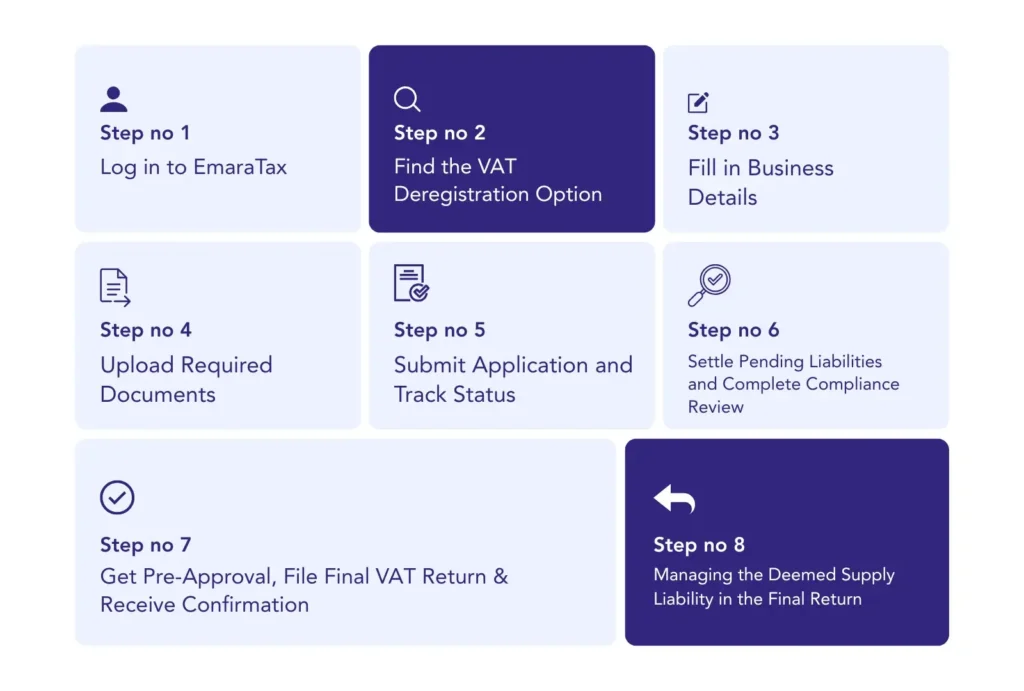
Step 1: Log in to EmaraTax

If you ever registered for VAT, you’ll have your EMARA tax credentials. The first thing to do is to go to the Federal Tax Authority (FTA) website and sign in to EmaraTax using your registered email and password.


Use UAE PASS as the primary login method to securely access your EmaraTax account.

Step 2: Find the VAT Deregistration Option

Once inside, head to the “VAT” tab and look for “Deregistration”. Click on it to start your application.


Don’t lurk around. Do what is necessary before wasting time. You know why? Because the system might log you out if you’re inactive for too long, so move quickly!

Step 3: Fill in Business Details

You’ll need to enter:

  • Trade License Number
  • VAT Registration Number (TRN)
  • Reason for Deregistration (Business closed? Revenue dropped? Ownership changed?)

Be honest and accurate at this step. This is the step where you have to be very careful and may even need expert advice like that of ADEPTS. This is because if your reason doesn’t match FTA rules, your application could get rejected. You may be just confused but the system will reject the application. A rejection can be extremely cumbersome and problematic. 


Special attention must be given to the ‘Effective Date’ of deregistration, which must be fully supported by your submitted documentation to avoid rejection or audit triggers.

Step 4: Upload Required Documents

The FTA needs proof from you. Proof comes in the form of documents. So gather your documents before you even apply for deregistration. Upload the right documents based on your reason for deregistration:


1- Business Closure? → License cancellation certificate
2Revenue Dropped? → Profit & loss statements, VAT returns
3Ownership Change? → Transfer agreements, updated trade license


Double-check the documents required and make sure everything is in place. In case there are missing documents, you’ll have to face unnecessary delays.

Step 5: Submit Application and Track Status

Once everything is in place, submit your deregistration request. You can track its progress in EmaraTax under the “Application Status” section. You’ll get regular updates but you can check the status on your own too.

Step 6: Settle Pending Liabilities and Complete Compliance Review

The FTA will review your application and check if you have:

  • Any outstanding VAT returns
  • Unpaid VAT liabilities, fines, or penalties

If anything is pending, you must settle it before getting approval. Failing to do so will result in delays and possible penalties. Make sure there are no outstanding liabilities at all. You can check the government website for complete and in-depth instructions about settling your liabilities. 


As part of the final compliance review, businesses must calculate and declare any ‘Deemed Supply’ liability in accordance with Article 28 of the VAT Executive Regulations. This means that any remaining stock, assets, or capital items on which input VAT was previously claimed are treated as supplied at market value, triggering a final 5% output VAT liability.

Step 7: Get Pre-Approval, File Final VAT Return & Receive Confirmation

Once you’re pre-approved, the FTA will ask for your final VAT return. Submit it, wait for their review.  Once it is approved, you’ll get your VAT deregistration confirmation without further delays. 


It is very important to know that you need to keep filing VAT returns to avoid fines Until you get official confirmation. Your instinct would be to stop filing VAT  returns once you have made clear your intentions in the application. This is not how it works, though. Wait for the confirmation before cessation of VAT returns from your side.

Step 8: Managing the Deemed Supply Liability in the Final Return

The deemed supply adjustment is one of the most critical compliance requirements in 2026. Failure to properly account for this can lead to audit flags, additional tax liabilities, and retrospective penalties. Businesses must ensure all inventory and capital assets are reviewed and valued accurately before final submission.

Documents You Need for VAT Deregistration

In 2026, the FTA operates a fully digital documentation system, and physical VAT certificates are no longer required as verification is conducted through electronic records and QR-based registration systems.

Valid Trade License

Your trade license must be active when applying. If your business is already closed, you may need a license cancellation certificate from the relevant authority.

Business Financial Records

The FTA may request profit & loss statements, balance sheets, and tax invoices to check your eligibility. Keep them accurate and up to date.

Financial Turnover Template

A mandatory structured Excel-based template showing taxable income and expenses from the date of VAT registration to the cessation date.

Declaration of Taxable Supplies & Expenses

You must provide a statement listing:

  • Your taxable sales and purchases from the date of VAT registration.
  • Any VAT-exempt or zero-rated supplies.
  • Other declaration letters, depending on your deregistration reason.

Pledge Letter (12-Month Declaration)

A formal declaration confirming that the business has not made any taxable supplies in the past 12 months.

Undertaking Letter (30-Day Forward Declaration)

A declaration confirming that the business will not make any taxable supplies in the next 30 days following the deregistration request.

VAT Returns Submission Proof

Before deregistering, you must have submitted all pending VAT returns. The FTA will check your compliance history, so make sure there are no missing filings.

Proof of Business Closure (If Applicable)

If you’re deregistering due to a business shutdown, you need to provide:

  •  Trade license cancellation certificate
  • Business closure confirmation from authorities

This proves that your business is no longer operational and does not need VAT registration.

No Pending Amendments Before Submission

If you have any changes or corrections to your VAT details (such as business address, name, or ownership structure), make sure they are updated in EmaraTax before submitting the deregistration request.

Bank Account Details (For VAT Refunds)

If you are eligible for a VAT refund, your bank details must be up to date. Ensure that:

  • Your bank account matches the registered business name.
  • The details are correct to avoid refund delays.

Documents for VAT Adjustments

If you’ve made any adjustments to VAT returns (like corrections in past filings), you may need to submit supporting documents. These include:

  • Adjustment records
  • Credit/debit notes
  • Explanations for changes made

Additional Documents Requested by FTA

The FTA officer reviewing your case may request extra documents based on your application. Always keep your financial records and compliance documents ready to speed up the process.

Document Requirements by Deregistration Basis (2026)

Deregistration Basis Mandatory Documents for 2026
Business Closure Cancelled Trade License, Board Resolution, Liquidation Report
Below Threshold Financial Turnover Template, P&L Statement, 12-Month Pledge Letter
Merger/Transfer Sale Agreement, Amended MOA, Updated License of Transferee
Natural Person Proof of Cessation of Business Activity, 30-Day Undertaking Letter

Processing Time & Approval

Processing Time & Approval

VAT deregistration is not instant. The Federal Tax Authority (FTA) follows a structured review process, and approval depends on how complete and accurate your application is. Let’s break it down.

Typical Processing Time

The FTA typically processes it within 20 business days. However, this is just an estimate. It can take a lot more than this. It could be just 20 days too. Here are the factors that make the difference: 

  • Accuracy of your application – You need to make sure all of your documents are hundred percent accurate. If there are mistakes or missing information. You should be ready for delays.

  • Pending VAT liabilities or fines – If you have outstanding dues, you must settle them first. FTA is not going to process your deregistration request until you have outstanding liabilities in the name of your business. Settle everything and then file for deregistration if you want a smooth process. 

  • Additional document requests – If the FTA requires more details, the process may take longer.

If your case is straightforward and all requirements are met, you should receive deregistration approval within the standard timeframe. However, you should expect delays if further review is needed in your case for any reasons we have given you above.

FTA Review Process & Follow-Ups

Once your application is submitted, the FTA will review your request based on the following:

  • Eligibility criteria – Does your business meet the deregistration requirements?
  • Pending VAT returns & dues – Have you filed all returns and paid all VAT liabilities?
  • Document verification – Are your financial records and other supporting documents valid?

If the FTA finds any issues, they may:

  • Request additional documents to clarify certain details.
  • Ask for amendments if your submitted details are incorrect or incomplete.
  • Reject the application if your business is still liable for VAT.

It’s important to regularly check your application status on EmaraTax. If the FTA requests more details, respond as soon as possible. This will help speed up the process.

Receiving Final VAT Deregistration Confirmation

Once the FTA completes its review and approves your application, you will receive:

  • A formal VAT deregistration confirmation from the FTA.
  • Final approval notice via email and EmaraTax.
  • Instructions on any remaining compliance steps (if applicable).

Once you receive the confirmation, your VAT obligations officially end. However, you should keep your VAT records for at least five years, as the FTA may request them for audits in the future.

What to Do If Your Application Is Rejected?

VAT deregistration applications can be rejected if they don’t meet the required conditions. Some common reasons for rejection include:

Dealing with VAT Deregistration Rejection? Here’s What to Do!

Don’t stress—getting denied isn’t the end. Just follow these steps to get back on track:

  1. Check the reason – Log in to EmaraTax and see why your application was rejected. Missing documents? Unpaid fines? You need to know what went wrong. The reason will be given quite clearly. Just make sure to get it out of the way.

  2. Fix the problem – Settle any outstanding fines, submit missing VAT returns, or correct errors in your application. The FTA won’t approve it until everything is in order. If you are thinking of bypassing FTA, give up the thought. 

  3. Reapply with the right info – Double-check every detail before submitting again. One small mistake can send you back to square one!

  4. Still confused? Contact the FTA – If you’re unsure what to fix, reach out to the FTA for clarification. It’s better to ask than to keep getting rejected.

Ignoring the rejection won’t make it disappear. You just need to follow the instructions of the governmental authorities. Resolve the issues that are stipulated by the authorities. If you don’t resolve the problem, you’ll still need to file VAT returns and could face penalties.

Why VAT Deregistration Compliance Matters

Are you wondering why worry about deregistering so much? There are some solid reasons here. If you don’t deregister properly, you’ll potentially face serious fines, legal trouble, and business disruptions. The authorities may keep adding your VAT to your payable account if your deregistration is not complete and confirmed. Here’s what you need to know:

1. Late Deregistration Penalty

Miss the deadline? The FTA slaps you with an AED 1,000 fine, increasing every month up to AED 10,000. You see, even delays are so expensive. If you don’t deregister properly, get ready for even worse. So, delays will cost you sp it is better to deregister on time!

2. Fines for Incorrect VAT Returns & Unpaid Dues

Messy VAT returns? Unpaid dues? The FTA doesn’t take these lightly. You could face steep fines for errors or missed payments. Accuracy is key.


From AED 500 for minor mistakes to AED 20,000 for repeated non-compliance, the penalties can add up quickly. And with the new 14% annual penalty rate on late payments, it’s more important than ever to stay on top of your VAT obligations. Avoid the hassle and the fines, make sure your records are accurate and up-to-date. 

3. How Non-Compliance Hurts Your Business

Don’t even think of non-compliance. Skipping VAT rules can cause:

  • Reputational Damage – A bad tax record can hurt business relationships.
  • Operational Disruptions – Fixing compliance issues takes time and money. It’s always better to have none.
  • More Scrutiny – The FTA watches businesses with compliance issues more closely. Breathe freely and that’s possible only if you are clear with FTA.</li

4. Legal Trouble is Real

VAT fraud isn’t just about fines. It can land you in serious legal trouble. Fake documents or tax evasion? That’s a criminal offense in the UAE. this won’t be taken lightly in the UAE. Don’t try to be oversmart here. If you are caught, convicted, you’ll be in deep trouble. Convictions can mean huge fines and even jail time.

5. Real Cases That Show the UAE Means Business

  • May 2021: The UAE Supreme Court fined a taxpayer AED 4.2 million for VAT fraud—five times the evaded tax.

  • December 2024: A tax gang of 15 individuals & 12 companies got caught in a AED 107 million fraud case. Charges? Forgery, money laundering, and tax evasion.

6. Stricter VAT Rules – The FTA is Watching

In November 2024, the UAE toughened VAT laws under Cabinet Decision No. 100. Now, the FTA can forcibly deregister businesses that violate tax rules. If you’re not compliant, they can shut you down.


In the end, businesses should know that ignoring VAT rules isn’t worth the risk. Stay compliant and avoid fines, legal trouble, and business headaches.

  1. Outstanding VAT payments or penalties – Ensure all dues are settled before applying.

  2. Pending VAT returns – Submit all VAT filings before requesting deregistration.

  3. Incorrect or missing information – Double-check all business details before submission.

  4. Not meeting the eligibility criteria – If your business still meets the VAT registration threshold, deregistration will not be allowed.

Businesses must monitor the Final Return Submission Window—once pre-approved, you have 28 days to submit your final VAT return.


It is critical to Check Status Regularly on EmaraTax, as the FTA may issue clarifications or audit notices that pause the standard processing timeline.

Why Your Application Might Be Delayed: The Audit Trigger

Applications may be delayed due to cross-tax reconciliation checks between VAT and Corporate Tax filings. Any mismatch in cessation dates, financial reporting, or liquidation timelines can trigger an audit. High-risk sectors such as gold, scrap metal, and electronics face increased scrutiny.

Penalties for Non-Compliance

Updated 2026 Penalty Framework

Type of ViolationPenalty Framework (Post-April 14, 2026)Logic/Incentive
Late DeregistrationAED 1,000/monthFixed administrative fine
Unpaid Final Tax14% per annum (applied monthly)Interest-based system
Incorrect Final ReturnAED 500 (1st instance)Lower penalty for errors
Audit Non-CooperationAED 20,000Applies to taxable person/agent

The previous compounding fine model has been replaced with a 14% annual interest system under Cabinet Decision No. 129 of 2025.


Additionally, under the “Should Have Known” standard, input VAT claimed from non-compliant suppliers may be denied during final review, with interest applied—introducing a strict buyer accountability rule.

The 5-Year Statute of Limitations and Refund Expiry

Under Federal Decree-Law No. 17 of 2025, VAT credits are now subject to a strict 5-year limitation period.


Any recoverable VAT from 2018–2020 must be claimed before December 31, 2026, or it will expire permanently.


Businesses must Conduct a Historical Credit Audit before deregistration to ensure no refundable amounts are lost.

Synchronization with Corporate Tax (CT) Deregistration

VAT deregistration must now be aligned with Corporate Tax deregistration obligations.

  • VAT deadline: 20 business days
  • Corporate Tax deadline: 3 months

Failure to align both can trigger penalties and audit flags under cross-tax data analytics systems.


VAT cessation triggers CT filing obligations for the final tax period.

Expert Assistance & Conclusion

VAT deregistration may seem simple, but in 2026 it is a high-risk compliance event tied to digital audit systems.

How ADEPTS Can Help Businesses with VAT Deregistration

At ADEPTS, we specialize in helping businesses navigate the complexities of VAT compliance, including:

  • Assessing your eligibility for VAT deregistration based on UAE regulations
  • Preparing and submitting your application with complete and accurate information
  • Ensuring all VAT returns are filed and outstanding liabilities are cleared
  • Handling communication with the FTA and responding to follow-up queries
  • Guiding businesses on tax record retention to ensure future compliance

ADEPTS operates under strict Tax Agent Accountability, ensuring full compliance during audits and regulatory reviews.

With our expert team, you can avoid delays, errors, and unexpected penalties.

Ensuring Compliance and Avoiding Unnecessary Penalties

Many businesses unknowingly make mistakes when deregistering for VAT. Here’s how ADEPTS ensures your business remains compliant:

  • Timely Application Submission – Avoiding the AED 1,000 late deregistration penalty (which can rise to AED 10,000).
  • Accurate Documentation – Preventing rejections due to missing or incorrect details.
  • Final VAT Return Filing – Ensuring all VAT obligations are settled before deregistration.
  • Post-Deregistration Compliance – Helping businesses maintain tax records for audits and avoid future legal issues.

Final Checklist for Businesses Considering VAT Deregistration

Before applying, ensure you have:

    1. Met the eligibility criteria (business closure, turnover below threshold, etc.)
    2. Filed all VAT returns up to the final period
    3. Paid all outstanding VAT liabilities and penalties
    4. Updated bank details for any VAT refunds
    5. Prepared the required documents (trade license, financial records, etc.)
    6. Checked for any pending amendments in previous VAT returns
    7. Reconciled VAT against Corporate Tax revenue
    8. Verified no pending Electronic Invoicing mismatches

In 2026, VAT deregistration is a digital exit. ADEPTS ensures that your financial, legal, and electronic records align perfectly to protect you from future audits and penalties.

Need Help? Contact ADEPTS Today!

VAT deregistration is a critical step in ensuring your business remains compliant with UAE tax laws. Avoid costly mistakes—let the experts handle it for you!

FAQs:

The FTA usually takes 20 business days, but Tax Assessment reviews may extend this timeline significantly.

Yes! If your business revenue hits the mandatory (AED 375,000) or voluntary (AED 187,500) threshold again, you can apply for VAT re-registration through EmaraTax. Just like the first time, you’ll need to submit a fresh application.

Issuing electronic invoices after deregistration will result in an automatic system block through the FTA access point.

Yes! First, check why it was rejected on EmaraTax. If it’s a simple fix (like missing documents or unpaid dues), correct it and reapply. If you think the rejection is unfair, you can appeal to the FTA with supporting documents.

Common reasons include:

  • Unpaid VAT or pending fines
  • Missing VAT returns
  • Incorrect business details
  • Not meeting eligibility criteria

Yes! Before the FTA approves your request, you must file your last VAT return and pay any outstanding dues. They’ll review everything before giving you the green light.

Yes! If you’ve overpaid, the FTA will refund the amount—but only if your bank details are updated in EmaraTax. Double-check to avoid any delays!

Payments can now be made through GIBAN and UAE PASS-integrated systems.

Yes! If a branch stops taxable activities but the main business is still running, you can apply for partial deregistration. The FTA will assess your case before approving it.

Yes, but not immediately. You must keep VAT records for 5 years even after deregistering. The FTA can still audit past returns if needed. Keep your paperwork in order!

No! Even if your business closes, you still have to manually apply for VAT deregistration on EmaraTax. If you don’t, the FTA may continue charging fines for non-compliance.

Not directly. But if you’re deregistering due to business closure, your trade license may also be canceled, affecting visa renewals for employees. Plan ahead!

Oops! If you deregister by mistake, you must reapply if your revenue crosses the threshold. But during re-registration, you can’t charge VAT, so be careful with your timing!

Yes! If your income falls below AED 187,500, you can deregister. But if your income increases again, you’ll need to re-register.

Importers: You lose your TRN, so you can’t claim VAT refunds on imports.
Exporters: You can’t issue VAT invoices or claim refunds on export taxes.

Yes, under Cabinet Decision No. 105 of 2021, subject to valid justification.

Yes, B2B transactions must comply with structured XML/Peppol standards from July 2026.

5 years standard, 15 years for real estate transactions.
References

Related Articles​

Outsourced vs. In-House CFOs: Making the Right Choice for Your Business

A Chief Financial Officer is a senior-level position in any company’s leadership positions. CFOs handle cash flow and shape the company’s financial strategies.
The CFO is a business’s financial guidepost. They help navigate financial decisions, ensure financial plans align, and support the company’s goals.

From deciding where to spend and invest to managing risks and tracking profits, the CFO plays an integral part in keeping the company financially healthy. CFOs oversee budgets, ensure dues clearance, handle dividends, and ensure everything runs smoothly.

The chief financial officer is responsible for controllership, treasury, risk management, taxation, investor relations, and internal audit.

However, the question that usually arises is whether to hire an in-house CFO or outsource CFO services.

The answer is not as simple; you need to look at the pros and cons of both types of CFO hiring and then evaluate which best suits your company.

To help you make the decision easily, we will discuss the benefits and costs of In-house and Outsourced CFO services, along with a hybrid version of this job.
So, keep reading to make the right choice for your business.

What is an In-House CFO?

An in-house CFO service is when the company hires a person full-time to be its chief financial officer. This in-house CFO is deeply involved in all financial matters and business decisions.
The CFO oversees all financial planning for the year, provides cash flow budgeting, and helps in investment decisions. They manage risks and ensure that all financial records are in compliance with regulations.
In-house CFO provides strategic guidance to support business growth and stability. They keep accurate financial records and report key insights to all the stakeholders.

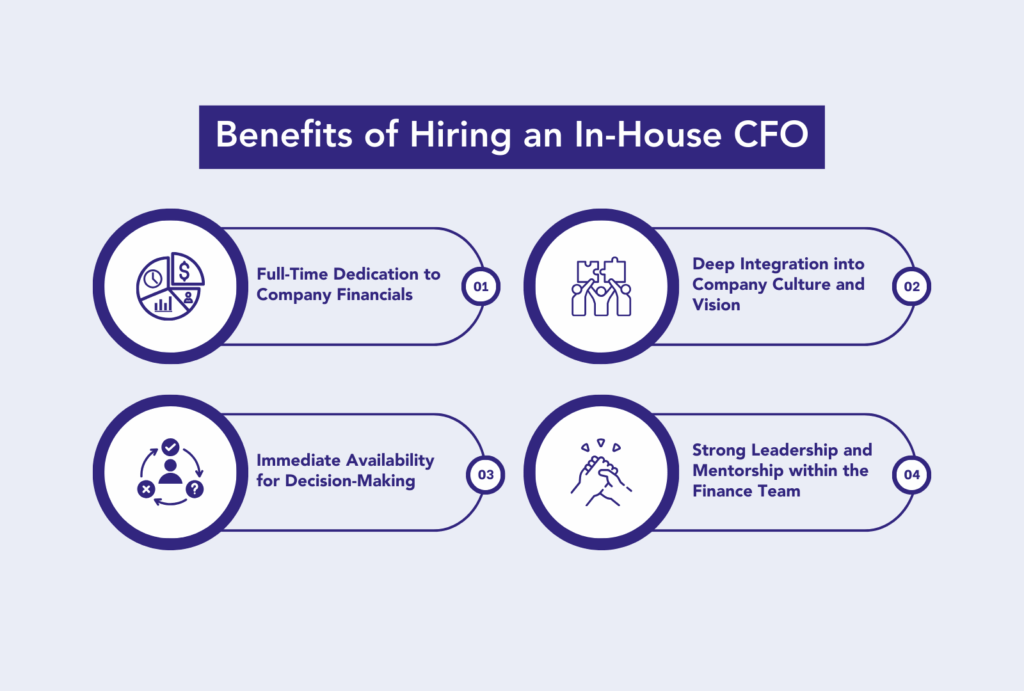
Benefits of Hiring an In-House CFO

Hiring an in-house CFO means you’ve got a person solely looking for your business’s well-being and growth. Therefore, the in-house CFO brings in the following advantages:

Full-Time Dedication to Company Financials

Having a dedicated and full-time committed financial manager is one of the biggest advantages of hiring an in-house CFO. They give all their time to the company and ensure its financial standing remains strong. Being a full-time employee allows the CFOs to closely monitor cash flow, budget effectively, and make informed financial decisions without distractions.

Deep Integration into Company Culture and Vision

Since the in-house CFO is a full-time company member, they can develop a sense of its mission, vision, and goals. This allows them to ensure a strong financial position of the company that is aligned with the company’s goals. Their direct involvement in everyday operations fosters a seamless connection between financial planning and business strategy,

Immediate Availability for Decision-Making

A business constantly makes big decisions, which requires on-the-spot financial insights. Having an in-house CFO service implies that top management will always have access to the company’s real-time financial situations, allowing them to make informed decisions.

Strong Leadership and Mentorship within the Finance Team

An in-house CFO leads and develops the company’s finance department. Their hands-on approach allows them to train the team members and improve their skills and work efficiency by creating a strong financial team; the CFO ensures accurate record-keeping, effective budgeting, and strategic financial planning, strengthening the business’s overall financial health.

Challenges of Hiring an In-House CFO

While an in-house CFO brings benefits to the company, their services come with a set of challenges as well:

High Salary, Benefits, and Overhead Costs

A CFO’s position is anything but easy. Like other top management positions, the CFOs have to deal with a lot of work pressure and too many figures, as every penny spent or earned can make or break a company.

This is why full-time CFOs are paid high salaries and fringe benefits. Therefore, in-house CFO services are expensive, and not every company can afford them.

Long-Term Commitment Required

While outsourced CFO services in UAE are hired on an hourly or project basis, hiring a full-time CFO means a long-term commitment that can result in more benefits than costs for the firm. This is why adjusting or reducing costs associated with this role may be challenging if the business faces financial difficulties or restructuring.

May Lack Exposure to External Industry-Wide Financial Trends

No matter what people say, a person who deals with multiple businesses has more knowledge about the industry’s current trends than someone who only works in an office setting. Yes, they bring their own experience, but information and new trends are better learned when exposed to a wide range of businesses.
Hiring an in-house CFO may limit the company’s ability to adapt to evolving financial strategies.

Recruitment and Retention Challenges

A professional candidate who is an expert in their field and able to work in such mentally intense positions is not easy to hire.Hiring requires a lot of research, interviews, and recruitment costs, and then retention can become a challenge.

Retention is a challenge not just because an in-house CFO has a high salary but also because they are in high demand. If they receive better offers and packages from competitors or if there are limited growth opportunities within the company, they may end up resigning.

What is an Outsourced CFO?

An outsourced CFO is a part-time professional hired externally to provide the company with financial guidance. Small or medium-sized businesses that cannot afford to hire a full-time CFO due to their high costs tend to get the CFO services externally for a few hours or for a certain project only.
Just like a full-time CFO, outsourced CFOs also help develop financial strategies for business growth; they ensure regulatory compliance in all financial records, analyze cash flows, help budget for forthcoming expenses, and provide valuable insights for risk management, future investment planning, and making informed decisions.
Companies employ Outsourced services of CFO based on:
  • Part-time – for ongoing financial management on a limited basis
  • Project-based – for specific financial initiatives like fundraising, mergers, or system upgrades
  • Interim – to fill temporary CFO vacancies during leadership transitions

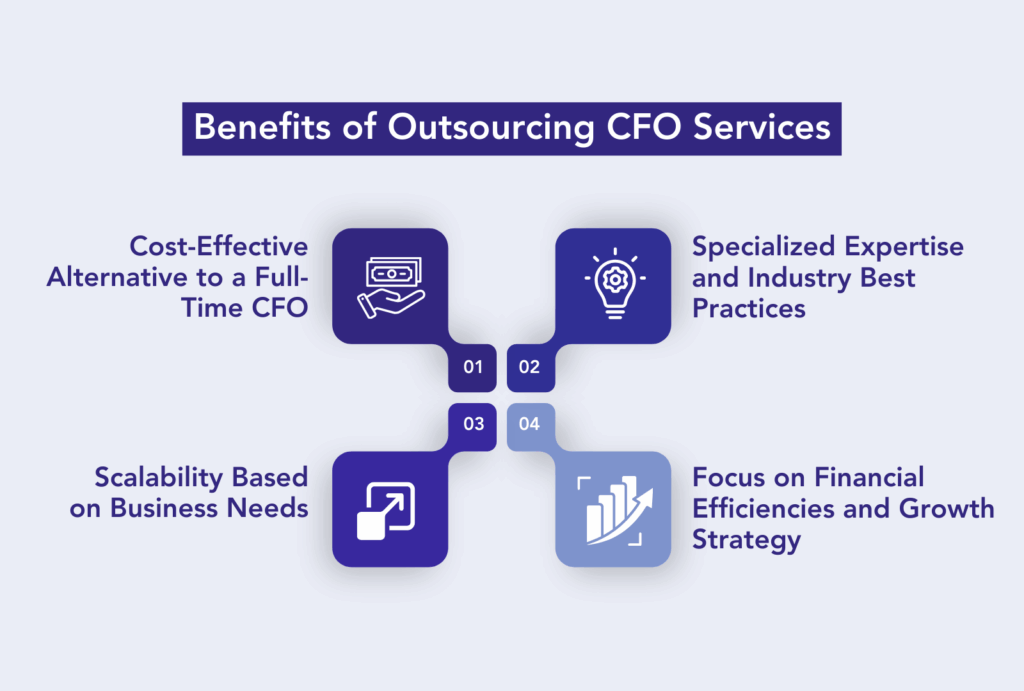
Benefits of Outsourcing CFO Services

Outsourcing CFO services in UAE can be a strategic decision for businesses looking to optimize their financial management without the commitment of a full-time hire.

Cost-Effective Alternative to a Full-Time CFO

Outsourced CFO services in Dubai are an amazing alternative and cost effective strategy when it comes to small and medium enterprises. Hiring a CFO on a temporary basis cuts down on the high salaries and packages of a full-time CFO and makes them more budget-friendly.

Specialized Expertise and Industry Best Practices

Outsourced CFOs work with many businesses, so they know a lot about different industries and stay updated on the latest financial trends. They use this knowledge to help companies make smart money decisions.

Scalability Based on Business Needs

Hiring a full-time CFO is expensive, especially for small businesses; therefore, small companies can adjust the level of CFO support based on their financial needs. Outsourced CFO services in Dubai allow small-scale businesses to enjoy flexibility without a long-term commitment.

Focus on Financial Efficiencies and Growth Strategy

Outsourced CFOs identify cost-saving opportunities, optimize cash flow, and develop growth strategies. Their expertise helps businesses streamline financial operations and make informed decisions that drive profitability.

Challenges of Outsourcing CFO Services

Just like an in-house CFO has its set of challenges, outsourced CFOs also come with their demurs.

Less Direct Control Over Financial Operations

Just as a team needs its leader to make important decisions, a company also requires real-time information about its financials when strategizing for the future. Outsourcing the CFO services in UAE does not give the company the benefit of having direct control or information about finances because the CFO is not always available.

Possible Communication Gaps Due to Remote Work

The most common and unavoidable problem with an outsourced CFO service is communication. Outsourced CFOs work remotely for you, which can result in delays or misunderstandings when discussing money plans due to poor internet connection or unavailability during decision-making. That’s why regular check-ins are super important!

Dependency on an External Service Provider

When you work with someone on a temporary basis, you have to rely on them for information, and relying on an external service for matters involving finances can be a very big challenge. If a company depends too much on an outsourced CFO and they leave, it can be hard to adjust and find a new one quickly.

Cost Comparison: In-House vs. Outsourced CFOs

Choosing between an in-house CFO and an outsourced CFO. Costs play a big role in this decision. Here’s what you should know.

Salary, Benefits, and Other Expenses

An in-house CFO isn’t cheap. On average, they make around $170 per hour, plus the company has to cover benefits, office space, and software costs. These extra expenses add up fast.
Meanwhile, outsourced CFO services range from $6 to $70 per hour, making them a more budget-friendly option. Since these CFOs work remotely, businesses don’t have to worry about buying extra tools or software.

Hidden Costs You Might Overlook

With both models, extra costs exist beyond just salaries or service fees.
Hiring an in-house CFO means recruitment costs, training, and onboarding. If they leave, you have to start the process all over again.
An outsourced CFO might seem cheaper, but communication gaps and dependency on an external provider are always risky. If they suddenly stop working with you, replacing them could take time.

Fixed vs. Flexible Costs

A full-time CFO gets a fixed monthly salary, no matter how busy or slow the company is. This can make financial planning difficult.
With an outsourced CFO, companies gain more control over spending. They can hire for specific projects or part-time work, and services can be scaled up or down as needed, which helps businesses stay flexible.

Industry-specific regulatory and compliance challenges in the UAE

Some key challenges companies face in different sectors are:

Real Estate Regulations

The real estate industry must comply with property ownership laws, rental regulations, and financial reporting standards. Developers and landlords must register transactions with the Real Estate Regulatory Authority (RERA) and follow anti-money laundering (AML) laws to prevent illegal property dealings.

Retail and VAT Compliance

Retail businesses in the UAE must charge Value Added Tax (VAT) on sales and submit regular VAT returns to the government. They also need to follow strict invoicing rules and maintain proper records of sales and expenses.

Healthcare Financial Compliance

Healthcare industry is also required to fulfill their sector specific laws like; insurance claim regulations, protection of patient data, etc. By following financial reporting standards and ensuring all transactions align with UAE’s healthcare policies, businesses can avoid penalties and fines.

Industry-Specific Applications of CFO Models

Hiring and retaining chief financial officers is an expensive task, and every business cannot afford CFO services in Dubai.Therefore, businesses opt for different CFO models for various tasks:
  • Retail businesses focus on keeping track of products, setting good prices, and planning for online sales.
  • Real estate companies need help managing money, planning investments, and following property rules.
  • Healthcare businesses deal with complicated billing, saving costs, and making sure they follow strict rules.
  • Construction companies must carefully handle big project budgets, contracts, and money flow.
There are very specific and clear laws on finances and companies must abide by them to avoid penalties or fines. The CFOs whether in-house or outsourced all must ensure that the company is maintaining clear, transparent financials and they are paying the right amount of taxes towards their government.

Construction Industry Challenges

Construction industry has contract regulations, payment timelines, and project cost reporting. Following labor laws and ensuring on time payments of workers, etc. can prevent unnecessary penalties.

Free Zone and Tax Compliance

Businesses in free zones receive tax benefits, but they are also strictly required to meet the conditions that are decided upon to maintain their exemptions. They must follow proper bookkeeping, financial reporting, and annual audit requirements to stay compliant with free zone authorities.
Each industry has unique compliance needs, and failing to meet these regulations can result in fines or legal issues. Many businesses rely on financial experts, such as CFOs, to manage these challenges effectively.

Hybrid CFO Model: The Best of Both Worlds

Did you know that your business can also opt for a hybrid CFO model? You can hire a CFO on a low package who can monitor your everyday finances and outsource professional services when you require strategic planning so you can make informed decisions before taking any risks.
A hybrid CFO model is beneficial for those who need to make big business altering decisions for example when growing the business, setting up a new store, going through mergers or acquisitions.
In these situations where there is a very high risk, companies can outsource the CFO services and get professional advice and risk management so they can make an informed decision.

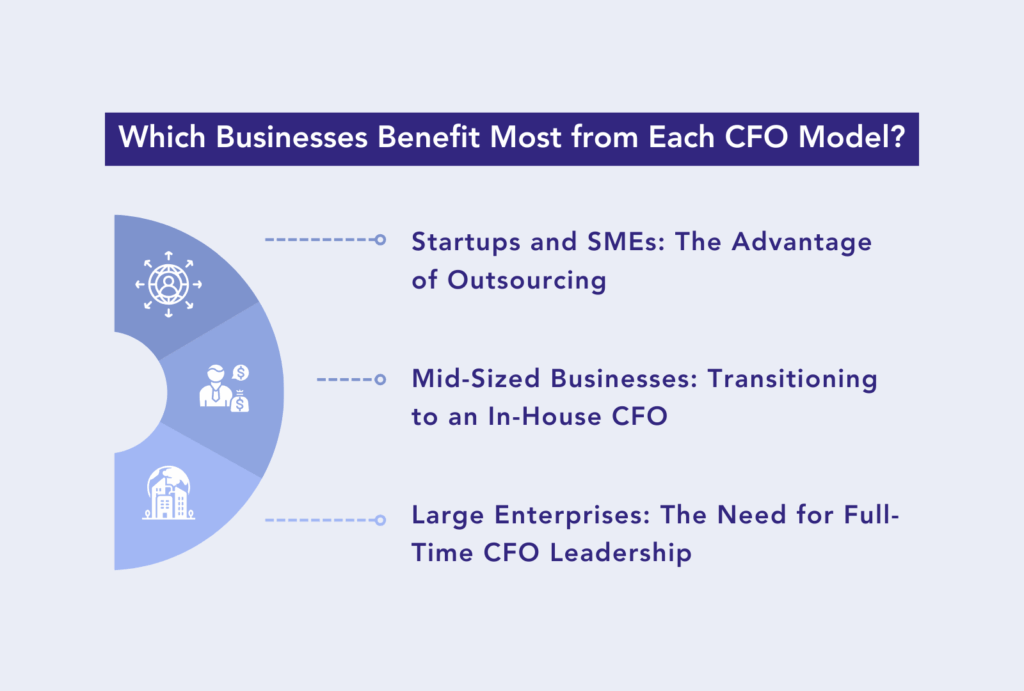
Which Businesses Benefit Most from Each CFO Model?

While we have discussed some basic benefits and challenges of hiring or outsourcing the CFO services in UAE, they may not be the same for every business. Therefore, every business must draw up their own pros and cons before deciding on the kind of CFO model to follow.
Here are some ideas for CFO models for various business types:

Startups and SMEs: The Advantage of Outsourcing

Startups and SMEs are small scale businesses with 50 or less employees that cannot afford the expenses of hiring a full time CFO. Their finances are also on a smaller scale compared to multinationals and large enterprises, and therefore their day to day expenses can be easily handled by an accountant. This is why the best strategy for them is to outsource their CFO services when they want to take high risk decisions.

Mid-Sized Businesses: Transitioning to an In-House CFO

Medium-sized businesses with 50 – 250 employees are the growing companies that are hiring more employees, taking on stakeholders, and opening up multiple branches; they are expected to have more complex financial structures, with extended daily expenses to record and higher taxes to pay.
All of this can be overwhelming and requires a lot of attention and careful monitoring to ensure that the financial records of the business are transparent and in accordance with the government regulations. This is why mid-sized businesses may benefit more if they start transitioning towards hiring a full time CFO to help ensure that financial strategies align closely with the company’s evolving needs.

Large Enterprises: The Need for Full-Time CFO Leadership

Large companies who have 250 – 500 employees, running multiple branches, have complex financial structures, multiple stakeholders, are attempting to grow their business internationally, need to have a full time CFO leadership.
This is majorly because the firm is taking major risks and investment decisions and having real time information about finances and strategic planning from a finance expert can prove to be very beneficial for the firm. While the expense of a CFO may seem to be higher at the moment, in the long run an in-house CFO can prove to be more beneficial.

Corporate Tax and VAT in the UAE

Corporate tax is a liability that companies operating in the UAE need to pay annually. On the other hand, VAT, or value-added tax, is the added charge on goods and services.

Companies must register for Corporate tax and VAT, keep track of their earnings, and file reports to avoid getting fined.

International Financial Reporting Standards

UAE has advised the companies to follow International Financial Reporting Standards (IFRS). These rules help businesses keep clear financial records, like how much money they make and spend. This makes it easier for others to understand and compare their financial reports.

How a CFO Helps with Compliance

A CFO (Chief Financial Officer) ensures that a company follows all financial rules. They handle taxes, VAT, and financial reports so that the company doesn’t face fines or legal problems. A CFO also organizes records and ensures reports are sent on time.

Having transparent and honest financial reports is essential for investors and the government. It helps businesses attract new investors and make strong business deals. Following UAE tax laws also helps companies keep their benefits, especially those in free zones with special tax rules.

When to Transition from Outsourced to In-House CFO

When the company is growing and dealing on a bigger scale, it needs to shift from an outsourced CFO to a full-time, in-house financial leader. This shift is essential because increasing financial complexity and higher revenue bring up the need for constant strategic oversight.
As companies grow, their financial operations tend to become more demanding, with a dire need for someone dedicated to long-term planning and day-to-day decision-making.
A well-structured transition ensures minimal disruptions, allowing businesses to maintain stability while adapting to their evolving financial needs.

Key Considerations for Choosing the Right CFO Model

You need to consider the following when choosing the right CFO model for your business.

Business Size, Industry, and Financial Complexity

The most important factor when choosing the CFO model is the size of your business, whether you are a small, medium, or large-scale business. Then comes the industry you are operating in and your financials’ complexity.
A small-scale business with budget restraints would work better if it outsourced its CFO services in Dubai because they have fairly simple financials, and its business size also does not allow it to spend too much on hiring a full-time CFO.
However, a large business with a complex financial structure because it has large scale operations and huge amounts of day to day expenditures needs an in-house CFO to handle the records and keep them according to the laws.

Growth and Expansion Needs

The growth of business and the need for an in-house CFO go hand in hand. As the business grows, so do its operations, financials, expenses, and need for real-time financial information. These are the few things that only an in-house CFO who is dedicated to working with the team and is clear on the company’s goals can provide.

Budget and Long-Term Goals

The third thing a business needs to identify when deciding on an in-house CFO service in UAE of an outsourced CFO services is their budget and their long-term goals. If a business is on a budget constraint and knows they only require a financial leader for a short time to guide them through an investment or high risk decision, outsourcing the CFO services is the best decision.
But if you need day-to-day guidance and your budget allows you to do so, then an in-house CFO is the best way to go so that you can stay updated with your financial standings and have a leader to guide you through your tough days.

Following Rules and Regulations

Lastly, the business needs to see how strict and how many rules and regulations they must abide by when conducting a business. Suppose your industry falls under multiple complex regulations. In that case, you need to find an in-house CFO who can keep your finance department in check with the regulations, ensure transparency and compliance to the laws, and keep you away from any penalties and fines.
However, for businesses with simple financial needs, an outsourced CFO can still provide the right level of support to stay compliant with the law.

Conclusion

Choosing the right CFO model depends on a business’s size, financial complexity, and growth plans. Startups and small businesses often benefit from outsourced CFOs for cost-effective financial guidance, while mid-sized and large companies may require a full-time CFO for ongoing leadership.
For businesses in transition, a hybrid model, combining an in-house and outsourced CFO can provide flexibility and expertise without the high costs of a full-time executive. Regardless of the model, strong financial leadership is key to maintaining compliance, improving profitability, and driving business success.

FAQs:

An outsourced CFO services works closely with the company’s finance team, offering guidance on budgeting, financial planning, and compliance. They typically communicate through virtual meetings, emails, and shared financial software, ensuring smooth collaboration without disrupting daily operations.

Yes, outsourced CFO services in Dubai help businesses prepare financial reports, pitch decks, and funding strategies to attract investors or secure loans. Their expertise in financial modeling and risk assessment makes them valuable partners in fundraising efforts.

An in-house CFO continuously analyzes financial data, monitors market trends, and develops strategies for future growth. They create long-term financial plans, set revenue targets, and ensure the company remains financially stable.

Time zone differences may cause delays in communication and decision-making. However, businesses can minimize this by setting clear working hours, using collaboration tools, and hiring outsourced CFOs who can adjust to their time zone needs.

Reputable outsourced CFO firms use secure cloud-based systems, encrypted communication channels, and strict access controls to protect financial data. They often sign confidentiality agreements to ensure data security and compliance with regulations.

A qualified outsourced CFO should have certifications like CPA (Certified Public Accountant), CMA (Certified Management Accountant), or ACCA (Association of Chartered Certified Accountants). Experience in financial management, strategic planning, and industry knowledge is also crucial.

While an outsourced CFO service can handle high-level financial strategy, they do not replace a full finance team. Businesses may still need accountants and financial analysts for daily bookkeeping, payroll, and tax filings.

Businesses can measure ROI by assessing improvements in financial efficiency, cost savings, profitability, and strategic decision-making. A CFO’s impact is often seen in better cash flow management, reduced financial risks, and successful growth strategies.

Signs that it’s time to switch include increased financial complexity, regulatory challenges, rapid business growth, or the need for more hands-on financial leadership. If an outsourced CFO service is no longer meeting the company’s needs, it might be time to hire a full-time CFO.

Related Articles

UAE’s Blue Visa vs. Other Residency Visas:
Which One is Right for You?

Thinking of moving to the UAE? Picking the right visa is a big deal. The wrong choice can mean lost time and money.
The UAE’s Blue Visa is the latest option. It’s built for sustainability professionals and green economy experts. But how does it stack up against the Golden Visa, Green Visa, and others?
This guide breaks it down. No fluff. No confusion. Just a clear comparison to help you decide fast. Whether you’re a business, an investor, or a professional, you’ll know exactly which visa fits your needs.
Let’s dive in.

Types of UAE Residency Visas

The UAE offers several residency visa options, each tailored to different professionals and business needs. Here’s how they compare:

Blue Visa – A Residency for the Future

When it comes to long-term residency options, the Blue Visa is the latest thing here. It has just made it to the scene and it is specifically for experts and researchers in sustainability, environmental sciences, and the green economy.

If you work in renewable energy, climate change research, environmental sciences or any field driving a sustainable future, this visa is for you. It is in line with the UAE sustainability initiative Net Zero 2050 vision and is definitely the right choice for professionals in the above-mentioned fields.

The UAE is investing heavily in clean energy, waste management, and eco-friendly tech. If you are working in a related field, you’ll be welcomed with open arms by the government. The application process is open 24/7 with an online application system. If you are interested and you are eligible, you should be applying right away.

Golden Visa – The Top Choice for Investors & Professionals

The Golden Visa is truly golden as it offers a 10-year residency permission for investors, entrepreneurs, and highly skilled professionals. If you love the UAE vibe, and you really want to be part of the country, this is a great option. Invest here and get a golden visa.
The distinctive factor is that you do not need a local sponsor for a golden visa. If you are investing here or perhaps have a much-needed skill, you’ll get it without a sponsor. This simply means ease and flexibility for new business founders, high-net-worth individuals, and even experts in medicine, science, and technology.
The next great thing about the golden visa is that you can call your family over. You don’t have to invest your money or skills to be alone here. Invest here and bring your family, too.

Green Visa – The Freelancer and Startup-Friendly Option

The Green Visa is the UAE freelancer Visa. It is a 5-year residency designed for freelancers, skilled employees, and small business owners. It removes the need for company sponsorship, making it ideal for independent professionals who want to work and live in the UAE without employer restrictions.

It’s perfect for tech, consulting, and creative services because it is a practical solution for those looking for mid-term residency.

Silver Visa – A Balanced Midterm Solution

The Silver Visa is probably the first step towards the Golden Visa as it gives 5-year residency for business owners and professionals who need a stable base in the UAE but don’t yet qualify for the Golden Visa. It’s a great option for those growing their business or career while keeping their long-term options open.

The requirements are more accessible, making it a preferred choice for mid-level investors and professionals who seek security without committing to a decade-long visa.

Freelancer Visa – Short-Term Flexibility for the Self-Employed

The Freelancer Visa is perfect for independent workers in media, technology, and consulting. It typically comes with a 1-3 year validity, depending on the emirate. It’s one of the easiest residency visas to obtain, with lower financial requirements compared to long-term visas. This option is best for digital nomads and self-employed professionals looking for a hassle-free way to live and work in the UAE without being tied to a single employer.

UAE Residency Visa Comparison

Choosing the right residency visa in the UAE depends on your profession, investment plans, and long-term goals. Here’s a UAE residency visa comparison for you:

Blue Visa – For Sustainability Leaders

The Blue Visa is for professionals in the fields of sustainability, environmental sciences, and the green economy. Typically, professionals in the fields of renewable energy, climate research, or eco-friendly innovation will get this visa.
  • Eligibility: Open to researchers, scientists, and professionals in the field of sustainability.
  • Key Benefits: This one comes with long-term residency of 10 years, business-friendly policies, easy application system, simplified eligibility criteria, and alignment with the UAE’s sustainability goals.
The UAE government is investing heavily in sustainable energy initiatives and blue visas are part of the government’s sustainability drive and this means substantial ease and support by the government for researchers and experts in the related fields.
  • Who Should Apply? Environmental scientists, researchers, and sustainability consultants, as well as green tech entrepreneurs.
  • Business & Investment Perks Stay Longer, Stress Less – The Blue Visa lets you live in the UAE for 10 years. No need to worry about renewals anytime soon. It opens doors to jobs in growing fields like sustainability and environmental work. You can sponsor your family, making it easier for them to live with you in the UAE.

Not just that, moving around the UAE and even other Gulf countries becomes simpler. Blue Visa gets full access to healthcare, education, and other important services. One great benefit is that this one lets you buy property in the UAE, adding security and investment opportunities.

Golden Visa – Best for Investors & High-Tier Professionals

The Golden Visa offers a 10-year residency and is designed for investors, entrepreneurs, top-tier professionals, and exceptional students. It provides maximum stability and business flexibility.
  • Eligibility: Business owners, investors, skilled professionals in medicine, engineering, IT, and science, and high-achieving students.
  • Key Benefits: No local sponsor required, ability to own 100% of a business, and family sponsorship.
  • Who Should Apply? Entrepreneurs, wealthy investors, and highly skilled professionals seeking long-term residency.
  • Business & Investment Perks: Full business ownership, priority government services, and access to exclusive real estate investments.

Green Visa – The Freelancer & Startup-Friendly Option

The Green Visa offers a 5-year residency with no employer sponsorship required. It’s a great option for self-employed professionals, freelancers, and startup founders.
  • Eligibility: Skilled workers, freelancers, and entrepreneurs in tech, consulting, and creative industries.
  • Key Benefits: Independence from company sponsorship, family sponsorship, and a renewable 5-year term.
  • Who Should Apply? Remote workers, freelancers, and business owners who need flexible residency.
  • Business & Investment Perks: Easier startup setup, access to UAE’s business hubs, and tax benefits.

Silver Visa – Mid-Tier Business Residency

The Silver Visa is a 5-year residency designed for business owners and professionals who don’t yet meet the Golden Visa criteria but still want long-term stability.

  • Eligibility: Mid-level investors, business owners, and professionals with stable income.
  • Key Benefits: Lower financial entry requirements than the Golden Visa and access to UAE’s business ecosystem.
  • Who Should Apply? Entrepreneurs and professionals are growing their businesses but are not yet eligible for long-term visas.
  • Business & Investment Perks: Stability for medium-scale businesses, access to UAE banking and financial services.

Freelancer Visa – Short-Term Residency for the Self-Employed

The Freelancer Visa is the most flexible option, offering 1-3 years of residency for independent professionals.

  • Eligibility: Self-employed individuals in media, IT, marketing, consulting, and creative industries.
  • Key Benefits: Low-cost residency, no corporate ties, and ability to work with multiple clients.
  • Who Should Apply? Digital nomads, consultants, and solo entrepreneurs.
  • Business & Investment Perks: Affordable entry into the UAE market and the ability to scale into a larger business.
Each visa serves a unique purpose. If you’re an investor or entrepreneur, the Golden Visa is the best choice. Freelancers and startup founders will benefit from the Green Visa or Freelancer Visa. Sustainability professionals have a clear path with the Blue Visa, while the Silver Visa provides a balanced option for mid-tier professionals.

Why the Blue Visa Stands Out

The Blue Visa stands out because it is actually a lot more than just a residency option. It is a specially created category for top tier talent in sustainability, environmental sciences, and clean energy.

A Key Player in the UAE’s Net Zero 2050 Strategy

The UAE is investing heavily in renewable energy, carbon reduction, and eco-friendly initiatives. The initiative through which this is happening is Net Zero 2050 Strategy.

The UAE Net Zero 2050 initiative is the country’s plan to cut carbon emissions to zero by 2050. This means reducing pollution as much as possible and balancing out any remaining emissions. It’s a big step, making the UAE the first country in the Middle East to take on this challenge. The plan also supports the Paris Agreement, which aims to slow down global warming.

To make this happen, the UAE is bringing together key industries like energy, transport, agriculture, and infrastructure. The Ministry of Climate Change and Environment is leading the effort, working with businesses and government bodies to update policies and introduce cleaner ways of working. The goal is to reduce emissions without slowing down economic growth.

A big focus is clean energy. The UAE started investing in renewables over 15 years ago and has already put more than $40 billion into solar and nuclear projects. By 2030, clean energy production is expected to reach 14 GW, a massive increase from just 100 MW in 2015. With this initiative, the UAE is securing a greener future while keeping its economy strong.

The Blue Visa is the key here because this visa brings in experts who will assist the government materialize its vision of a sustainable economy.

Exclusive Benefits for Sustainability Professionals

If you work in environmental science, sustainability consulting, or clean energy, this visa gives you long-term stability to grow your career. Unlike standard work visas, the Blue Visa offers:

  • Long-term residency, providing job and business security.
  • Freedom to work on multiple projects, not tied to a single employer.
  • Easier access to government-backed sustainability initiatives.
  • Easy family reunion regulations.
  • Access to exclusive employment opportunities.
  • Blue visa holders can even own property in the UAE.
It’s designed for people who want to innovate, research, and lead in green industries—not just work in them.

Eligibility Criteria

Both Emiratis and expats can apply for the Blue visa if they meet the right criteria.
You may qualify if you are:
  • A member of an environmental group, company, or NGO
  • A winner of a global award for environmental efforts
  • A well-known activist working for the planet
  • A researcher focused on sustainability or conservation

A Launchpad for Green Startups & Eco-Friendly Businesses

The UAE is investing billions into renewable energy, smart cities, and eco-conscious projects. For startups in clean tech, waste management, or carbon reduction, this visa provides a golden opportunity.

  • Easier business set up with support from sustainability-focused free zones.
  • Access to funding and grants for green initiatives.
  • Opportunities to collaborate with government projects in energy and environment.

Business & Investment Opportunities with UAE Visas

Getting a UAE residency visa isn’t just about living here—it’s about growing a business, making smart investments, and tapping into a booming economy. Whether you’re an entrepreneur, investor, or freelancer, the UAE gives you plenty of ways to succeed.

Starting a Business: Free Zone or Mainland?

Setting up a company in the UAE is quick and easy. The big question? Free Zone or Mainland?

  • Free Zones give you 100% ownership, tax breaks, and full profit control. Perfect for startups, tech firms, and international businesses.
  • Mainland companies let you operate anywhere in the UAE and work with government contracts. A better choice if you want a local market presence.
Each visa type—Golden, Green, Freelancer, or Blue Visa—offers different levels of business flexibility. It all depends on your goals.

Where’s the Smart Money Going?

The UAE is a goldmine for investors. Some of the hottest sectors right now include:
  • Real Estate – Luxury properties, rental investments, and off-plan developments.
  • Tech & Innovation – AI, blockchain, fintech, and cybersecurity are booming.
  • Healthcare & Biotech – The UAE is a hub for medical tourism and private healthcare.

The Golden Visa is a great fit if you’re investing big in these industries. It gives you stability and business freedom, plus access to exclusive deals.

Sustainability: The Next Big Thing

Green business is the future, and the UAE is all in. If you’re in clean energy, eco-tourism, or sustainability tech, this is your moment.
  • The Blue Visa is designed for professionals and entrepreneurs in green industries.
  • The UAE is investing heavily in solar power, waste management, and smart cities.
  • Government incentives make it easier to launch and scale eco-friendly businesses.
If you’re working on something that helps the planet, the UAE is ready to back you up.

Tax Perks That Make a Difference

Let’s talk numbers. The UAE is one of the most tax-friendly places to do business.
  • 0% corporate tax in Free Zones.
  • No personal income tax—you keep what you earn.
  • If you’re in the Mainland, taxes are still low compared to global standards.

That means more profit, less red tape, and a business-friendly environment that helps companies grow fast.

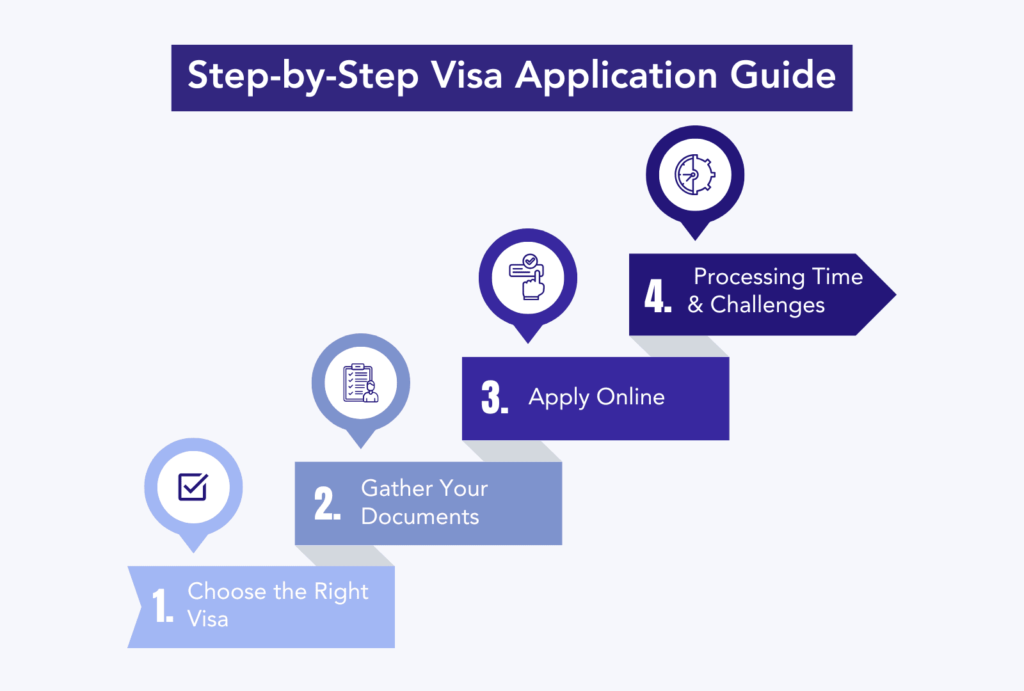
Step-by-Step Visa Application Guide

Let us walk through each step together:

1. Choose the Right Visa

Pick a visa that matches your career or business goals:
  • Blue Visa – For sustainability experts and green entrepreneurs.
  • Golden Visa – For investors, business owners, and top professionals.
  • Green Visa – For freelancers, skilled employees, and startups.
  • Silver Visa – For mid-tier business owners and professionals.
  • Freelancer Visa – This is for self-employed individuals in media, tech, and consulting.

2. Gather Your Documents

Most applications need:

Passport copy
Proof of income or investment
Educational qualifications (for professionals)
Business license (for entrepreneurs)
Medical fitness test & health insurance

3. Apply Online

Submit your application through:
  • ICP Smart Services (icp.gov.ae) – General applications.
  • GDRFA Dubai (gdrfad.gov.ae) – Dubai-based applications.
  • Free Zone Authorities – If setting up a business.

4. Processing Time & Challenges

  • Freelancer & Green Visa – 2 to 4 weeks.
  • Golden & Blue Visa – 1 to 3 months.
  • Possible delays – Document issues, medical test results, or nomination approvals.

How ADEPTS Can Help

Setting up a business or securing a UAE visa? ADEPTS makes the process seamless. Here’s how we help:

Business Setup Services

We handle Free Zone and Mainland company registration and we leave no stone unturned to ensure a smooth and hassle-free start for your UAE business setup.

Tax Compliance & Advisory

Tax compliance is very complicated and especially for newcomers. If you are starting a business for the first time, tax compliance can overwhelm you. This is where our experts guide you through UAE tax laws, VAT, and corporate tax planning. They’ll make it all easy and simple for you.

Audit & Financial Services

Need financial transparency for your visa or business? We provide audit services and financial reports that meet UAE regulations. You won’t have to worry about your audit at all.

Investment Consulting

Looking to invest but don’t know which way to go? Are you out there for investment opportunities in UAE? Money is precious and you don’t want to lose it in a scam. We help you identify high-return opportunities in real estate, tech, healthcare, and sustainability sectors.

Residency Visa Assistance

We simplify the entire process for individuals and businesses and we give you a stress-free experience, from visa selection to final application. Enjoy expert guidance, fast processing, and peace of mind.

Conclusion

The UAE is a great place to live, and it offers security and financial stability. The government seems interested in letting people in, too. There are, however, multiple types of visas that you’ll have to choose from according to your career, business, and investment goals. The visa type you choose impacts your chances of being accepted as well as your chances of success in the UAE. Learn all about blue, green, silver, or golden visas in the UAE, choose the one that suits you best, and start a new chapter of life in the UAE.

FAQs:

AED 2 million for real estate investors, with variations for other categories.

No, freelancers usually qualify for the Green Visa or Freelancer Visa instead.

Yes, if your business focuses on clean energy, green tech, or environmental solutions.

Yes, most visas allow you to sponsor spouses, children, and parents under specific conditions.

Zero personal income tax and corporate tax exemptions in Free Zone company setup.

The Golden Visa and Green Visa offer the best options for business owners.

Typically 1 to 3 months, depending on visa type and application completeness.

Yes, you can switch if you meet the eligibility criteria.

No, just like the Golden and Green Visas, it does not require a local sponsor.

It allows foreign entrepreneurs to start businesses in the Mainland or Free Zone With full ownership. Want to secure your UAE visa hassle-free? Contact Tax Adepts today!

Related Articles​​