Factors That Influence Real Estate Valuation in the UAE

Thinking about investing in property in the UAE? Before you make a move, it’s crucial to understand what drives real estate prices here. The UAE market moves fast—values rise and fall based on more than just location.

From infrastructure to investor demand, several key factors shape property valuation. A common person can easily fail to take these important factors into account, especially when they don’t even know about them.

In this guide, we break it all down. Simple. Clear. Straight to the point. So you can make smarter, more confident investment decisions

Location: The Prime Driver

If you remember one thing from this guide, let it be this—location drives everything in UAE real estate. It’s the single most important factor that shapes a property’s value. And in the UAE, where new developments pop up constantly, knowing where to invest is half the game. 

Proximity to Key Amenities

Want high returns? Focus on convenience. Properties near top schools, hospitals, shopping centers, and business districts almost always hold stronger value. Families want properties that promise easy connectivity with amenities.

A family-friendly villa in Arabian Ranches, for example, gains value simply because it’s close to schools and community facilities.

Same goes for apartments near metro stations. Commuters love the ease, and so do investors looking for high rental demand. Look for areas with planned infrastructure too. Future metro lines or new malls can boost value fast—even before they’re built.

Neighborhood Reputation and Prestige

In the UAE, perception is power. Some communities carry a name—and a price tag—that sets them apart.

Take Emirates Hills, for example. It’s known as the “Beverly Hills of Dubai.” Properties here don’t just offer space; they offer status. Prestige adds long-term stability and strong resale potential.

Views and Surroundings

It’s not just about where a property is—it’s also about what you see from it.
A studio with a marina view will outperform a larger unit with a parking lot view, in terms of both value and rental yield.

Waterfront, skyline, golf course, or park views all push prices up. Green spaces also add to the quality of life, especially for families. Buyers are willing to pay more for that lifestyle experience.

Example? A penthouse facing the Burj Khalifa commands significantly more than one in the same building facing away from it. It’s the same square footage—but a very different value.

Property Characteristics: Size, Age, and Condition

Factors That Influence Real Estate Valuation in the UAE

The location of your property is very important but that is not the only factor. After all, its
Size, layout, age, condition, and design have a place in the game. 

Size and Layout

Yes, bigger usually means more expensive. Also important is how a certain space is used. A well-designed 1,200 sq ft two-bedroom apartment can feel more spacious and functional than a poorly laid-out 1,500 sq ft unit.

Investors and families alike prefer open-plan layouts, good lighting, and smart use of space. Balconies, storage areas, and en-suite bathrooms increase appeal. For villas, a garden or private pool can bump up value significantly. Now these features usually come when a property is big in size but not always. Sometimes, small spaces are designed so well that they have all of these features despite their size.

Age and Condition of the Building

In general, newer buildings, whether you are buying business in Dubai or a residential place, fetch higher market prices. They offer modern finishes, updated tech, and better energy efficiency. Maintenance is usually lower, and amenities are often more advanced.

But older properties still hold value—if they’re well maintained. A 10-year-old apartment that’s been regularly upgraded can outperform a 5-year-old one with poor upkeep.

Renovations matter, too.

If you want to boost your property value, you might want to infuse it with certain features that people tend to like, for example modern flooring, updated kitchens, and smart lighting. These things mean small changes but they can really boost resale value and rental income.

Design and Architectural Style

UAE buyers are drawn to modern and distinctive design. Traditional style doesn’t work everywhere. The UAE is modernising and with this change are changing the choices of the residents. People now love the modern clean lines, large windows, and minimalist interiors. These things are in demand and people are loving them in Dubai and Abu Dhabi.

But just modern furnishings won’t make your property unique. If you add something unique like high ceilings, custom finishes, or statement staircases, they’ll add character and increase marketability.

Smart home technology can also boost the value of your property in modern times. Buyers will love properties with integrated systems for lighting, climate, and security. Especially younger buyers and tech-savvy tenants.

Market Dynamics: Supply, Demand, and Trends

Factors That Influence Real Estate Valuation in the UAE

Even the best property in the best location won’t grow in value if the market isn’t moving in the right direction. This is because your property, on its own, is just one of the picture. The other half is the Market. Real estate values are deeply tied to market forces.

Current Supply and Demand

When demand outpaces supply, prices go up. It’s simple economics—but in the UAE, it can shift quickly.

In 2023, Dubai saw a strong demand surge, especially in mid-to-high-end residential areas. According to recent market data, average property prices in Dubai rose by 15%, driven by increased investor interest, population growth, and favorable visa policies. On the flip side, oversupply can hold values back. This often happens in areas where too many units launch at once—especially in outer zones or lower-demand communities.

Example: Several apartment projects in Dubailand saw slower appreciation because new units kept hitting the market, giving buyers too many choices.

Investor Tip: Look for tight inventory in high-demand zones like Dubai Marina or Downtown—these areas often recover faster and appreciate steadily.

Emerging Trends to Watch

Market sentiment also plays a big role. Right now, there’s rising interest in eco-friendly buildings, short-term rental-friendly zones, and branded residences.

Branded developments like Armani Residences or The Ritz-Carlton Residences are attracting premium buyers. These often carry 20–30% higher price tags but maintain long-term value better.

Also, the shift toward flexible remote work has increased demand for larger living spaces. Villas and townhouses with home offices are seeing renewed interest.

Keep an eye on migration trends too. As more expats choose to live long-term in the UAE, especially under Golden Visa and Blue Visa schemes, demand for ownership is rising.

Always check quarterly market reports before buying. Even small shifts in supply or buyer interest can affect your property’s resale timeline and price.

Economic Conditions and Growth

Factors That Influence Real Estate Valuation in the UAE

Real estate doesn’t move in a vacuum. It follows the broader economy. When the UAE economy is growing, real estate values tend to follow.

Strong Economy = Strong Property Market

The UAE’s economy is one of the most diversified in the region.
When sectors like tourism, finance, and logistics grow, more jobs are created. More jobs mean more residents—and more demand for housing.

In recent years, Dubai and Abu Dhabi have both seen solid GDP growth, backed by government investments, trade expansion, and business-friendly reforms.

This economic strength directly boosts property demand—especially in freehold areas.

Watch for Recession Signals

Your property’s value is linked with the overall health of the economy. If you want to stay vigilant, you should keep an eye out for recessions. When the economy slows down overall, your real estate will start losing value too. This is because of the overall uncertainty that prevails in the economy at those times. 

The UAE economy is strong. It does go smoothly through economic recessions. However, you can’t say it takes no hit at all. You need to monitor both international and national economies for better forecasts. When the economy is slow, make decisions that align with the situation.

Emerging Market Trends

In property business or any business for that matter, you have to follow the trends. You need to move with the customer/buyer psychology. It is not about your own choice, smart business is about the choice of your buyer. Know the trends and bag big money:

Sustainable and Green Homes

Buyers are starting to care about energy efficiency, eco-friendly materials, and lower utility costs. Developers offering solar panels, water-saving systems, and LEED certifications are gaining traction. Green buildings often come with higher upfront prices—but lower long-term costs and better tenant appeal.

Mixed-Use Developments

Modern buyers want everything close—work, home, shopping, and leisure.
That’s why mixed-use communities like Dubai Hills Estate and Yas Island are in high demand.

These master-planned areas offer built-in convenience, strong community feel, and better infrastructure. And they tend to hold value better than isolated developments.

Stay Updated

The UAE real estate market moves fast. Government initiatives, visa changes, global events—all can shift trends overnight. Stay informed, read market reports, and work with advisors who understand local dynamics.

Government Policies and Infrastructure Development

In the UAE, government decisions directly influence real estate values. From visa reforms to mega infrastructure projects, the market often moves in response to policy shifts.

Government Regulations and Laws

Policies shape investor confidence—and buyer eligibility.

Take mortgage regulations, for example. If the required down payment increases, fewer buyers qualify. But when lending becomes easier, the market sees more transactions. Governmental policies have direct impact on how the property scene moves in a country.

Visa laws are another major driver

The UAE introduced the golden visa and some other long-term residency options. These options have attracted high-net-worth individuals and professionals from many different countries. These people are investing their money in property in the UAE. Since they are rich to start with, they go for their private properties instead of rental properties.

The 10-year Golden Visa linked to property investment has boosted sales in luxury communities like Palm Jumeirah and Downtown Dubai.

Infrastructure Projects

Infrastructure impacts big time. Places that have new highways, metro extensions, bridges, and community services attract people. Why? Because humans love luxury and ease. No one wants to put their money in a place that lacks necessities and luxuries. People want to move towards good things and an easy life. 

For example, properties near the Dubai Metro Green Line saw steady appreciation after the line’s expansion.

As an investor, you’d like to track announced projects, not just completed ones. You can find out about projects that will have the best of all things and if you catch them early, you can save a lot of money.

Investment Zones and Incentives

Free zones are great places to invest in. This is true when you are buying a business in Dubai and settling down there with your family. You’d be thinking, why? Well, foreigners come to do business in these areas and they’ll love their homes to be nearby, no? YES! This is why Free zones are great from a property point of view. Zones like Dubai International Financial Centre (DIFC) and Abu Dhabi Global Market (ADGM) come with unique ownership rights and tax benefits.

The UAE also regularly introduces incentives for property buyers—such as fee waivers or reduced registration costs—to encourage investment.


Interest Rates and Financing Options

Buying power is directly tied to financing—and interest rates are the lever that moves the needle.

Impact of Interest Rates

When interest rates are low, mortgages are cheaper. That increases affordability and boosts demand, especially in mid-market segments. More people can buy property when the interest rates are low. When they are high, many will just pull back because the costs soar.

Availability of Mortgages

The easier it is to borrow, the more active the market becomes. People want to invest but obviously, money is the issue. When policies allow Flexible lending, there are competitive bank offerings, and low down payments, more and more people will be encouraged to step in.

On the other hand, if banks tighten approval standards, especially for off-plan units, transactions may slow down.

Working with a mortgage broker can help investors access better rates and navigate the approval process more smoothly.

Payment Plans and Developer Incentives

Off-plan properties often come with buyer-friendly payment plans—a major draw for investors with medium-term horizons.

Some developers offer post-handover plans, 0% interest schemes, or extended payment terms over 3–5 years.

Conclusion

Buying or selling property is quite an art and there is a lot of science too. You need to understand the nitty gritty details of your property as well as that of the market if you want to make money out of it. If its just bling arrows in the dark, you can easily lose all of your investment in one lethal blow. So pay attention when you are buying or selling properties. You can even hire professionals for property valuation because this is obviously beyond a lay man’s abilities. Professional evaluation will give you a clear picture and it will save your investment from being ruined.

FAQs:

Rental yield reflects how much income a property can generate.
Higher yields often mean better cash flow and higher investment value, especially in sought-after areas. Investors track yield to assess ROI and compare properties.

Yes. Besides the property price, factor in:
– DLD registration fee (usually 4%)
– Agent commission (2%)
– Service charges (annual)
– Mortgage setup fees (if applicable)
Always get a full cost breakdown before signing.

Yes, in designated freehold areas, foreigners can buy, sell, and lease properties without a local partner.
Popular zones include Dubai Marina, Downtown, and Palm Jumeirah.

Check:
Title deed
Developer reputation
RERA approvals
Building condition
Service charge history
Outstanding payments or disputes
Due diligence protects you from legal or financial surprises.

High service charges can eat into rental yield and reduce profit.
Always ask for the service charge per square foot and compare it to similar buildings. Newer or luxury buildings tend to charge more.

Off-plan units can offer lower entry prices and flexible payment plans, but they carry risk (e.g., delays or market changes). Ready units generate rental income immediately but require more upfront cash. Choose based on your goals—short-term cash flow vs. long-term growth.

For developers:
– Check their history on the DLD or RERA website
– Visit past projects
– Review handover timelines and build quality

For sellers:
– Ensure the title deed is in their name
– Confirm no disputes or encumbrances
– Use a registered agent for the transaction

Related Articles​​

Due Diligence Checklist: What to Check Before Buying a Business in the UAE

Due Diligence Checklist: What to Check Before Buying a Business in the UAE

Due diligence is the process of checking everything before signing the deal. It helps you avoid hidden debts, legal troubles, and operational failures. Skipping this step can lead to serious financial losses or legal issues.

How to Choose the Right Property Valuation Firm in the UAE

How to Choose the Right Property Valuation Firm in the UAE

How to Choose the Right Property Valuation Firm in the UAE Imagine selling a property and finding out that you could have sold it for a greater price, and because of poor valuation, you’ve lost money. Or imagine you’re buying a property and paying way more than its value. Property valuation in the UAE is […]

Offshore Corporate Banking & Accounting Trends in Gulf Countries – 2026

Ever wondered why so many businesses and investors are institutionalizing their presence in the Gulf when it comes to international finance? It’s not just hype. The UAE is becoming a serious player in the world of offshore banking, with multiple offshore account setups being recorded every year, driven by 2026 projections and a forecasted 5.3% GDP expansion led largely by the non-hydrocarbon sector.


Offshore banking basically just means putting your money in a bank that’s not in your own country. People do it for all sorts of reasons, like spreading out their money across different currencies, maybe getting some tax benefits, or just making it easier to handle international stuff.


And no, it’s not about hiding money or anything. These days, it’s more about doing things the right way, staying legal, staying smart, and using the system to your advantage. That’s where opening an offshore bank account comes in.


And the Gulf? It’s becoming the new go-to spot. The combination of modern financial zones (like DIFC and ADGM), digital banking options, and stricter global reporting rules has pushed the region to the front. Businesses no longer chase secrecy, they want stability, transparency, and legal setups. What once looked like a trend is now becoming the global standard. That’s why UAE offshore bank accounts are getting so much attention, especially from people who previously looked at places like the Cayman Islands or BVI.


Whether you’re thinking about opening offshore bank account in Dubai or comparing options to find the best offshore bank accounts for your business, the Gulf now offers a powerful, practical alternative. In this article, we’ll break down the key trends shaping offshore banking in the region for 2026—and why more people are making the switch.

Shift from Traditional Offshore Hubs to Gulf-Based Alternatives

Not too long ago, places like the British Virgin Islands (BVI), Seychelles, and the Cayman Islands were the default when it came to setting up offshore bank accounts. But things are changing fast. More and more people are looking toward the Gulf, especially financial hubs like DIFC, ADGM, QFC, and Bahrain FinTech Bay, as smarter, more stable choices.


Why? These places are achieving adequacy-listed status. You still get a good level of confidentiality, but now it’s paired with strong legal systems, international compliance, and modern banking infrastructure. So you’re not just hiding your money, you’re actually building something legitimate and future-proof.


Plus, with new regional incentives and bilateral agreements in place, setting up a UAE offshore bank account or even an offshore Dubai bank account isn’t just easier, it’s becoming a strategic move. Following the Russian Ministry of Finance’s January 1, 2026 order removing the UAE from its offshore jurisdiction list, and with ADGM recording a 48% year-on-year growth in Assets Under Management (AUM) in late 2025, offshore accounts UAE are now seen as real alternatives to the old-school tax havens.

Digital-First Offshore Banking Experiences

Let’s face it, nobody wants to deal with piles of paperwork or wait in lines at a bank anymore. That’s why the Gulf’s digital push is a game-changer, especially when it comes to offshore banking. Neobanks like Wio and Liv. in the UAE, and STC Pay in Saudi Arabia, are making it very easy to get started with offshore bank account opening, by integrating agentic AI for automated compliance rather than simply using your phone.


It’s not just about convenience, either. These platforms offer real, business-friendly features like multi-currency wallets, compliance dashboards, and round-the-clock access. In 2026, many also include automated VAT reporting and integrated bookkeeping directly within the app, which is huge for anyone managing international operations.


On top of that, we’re seeing things like blockchain-based ID verification and even early experiments with DeFi-style banking. The January 2026 launch of the NEO PAY and Wio Bank PoS lending partnership has further strengthened SME access to working capital, making opening an offshore bank account smoother and more secure than ever before, especially if you’re thinking about offshore bank account in UAE or trying to open offshore bank accounts without jumping through endless hoops.

Tax Residency & Substance Rules Driving Account Structuring

Here’s something a lot of people don’t realize when they first look into offshore banking, the FTA has transitioned to a mature, risk-based audit model. Especially in places like the UAE and Bahrain, there are real rules now. The Economic Substance Regulations (ESR) mean that if you want that tax-friendly status, you actually need to be doing business. While ESR reporting is canceled for financial years ending after 2022, the Substance Test itself remains mandatory to qualify for 0% Corporate Tax, which means real offices, real staff, and real activity.


So when people talk about offshore bank account opening in places like ADGM or DIFC, it’s no longer about just getting a name on a license, it’s about proving you have substance. And without that, you’re risking audits or worse, getting your account frozen.


If you’re looking at offshore accounts UAE, the setup now revolves around proper trade licenses and structured activity. For 2026, this also ties directly into Qualifying Free Zone Person (QFZP) rules, including the requirement to maintain adequate expenditure within the UAE. The days of just setting up a shell company and disappearing are over. Now it’s all about staying compliant, building a legit presence, and using that as the base to open offshore bank accounts the right way.

GCC-Wide Alignment with Global Reporting Standards

Things are changing when it comes to offshore banking in the Gulf, especially with the push for global financial transparency. The UAE has shifted from early enforcement to enforcing the April 14, 2026, Tax Penalty Reform, replacing earlier disclosure fines with a standardized 14% per annum late payment penalty under Cabinet Decision No. 129 of 2025, all tied directly to CRS and FATCA. So, if you’ve been thinking about setting up an offshore bank account UAE or anywhere in the region, it’s important to know that compliance is a big deal now.


Other countries like Saudi Arabia and Bahrain are also on the same page. Saudi’s ZATCA and Bahrain’s MOF have partnered with international regulators to make sure everything’s above board, with near real-time financial reporting and automated cross-border data exchange becoming the norm.


So, if you’re opening an offshore bank account in UAE or even looking into offshore accounts UAE, you’ll need to keep everything tidy and ready for inspection. Under the new Understatement Penalty (UP) regime, undisclosed tax differences identified through Voluntary Disclosure now attract a 1% monthly charge, and if you’re not ready with the proper documentation, you could face fines or even have your account frozen.


Old vs. 2026 Penalty Framework (VAT & Corporate Tax)


Old Regime: Fixed penalties and discretionary fines
2026 Regime: 14% annual late payment penalty + 1% monthly Understatement Penalty

Strategic Use of Dual Jurisdictions for Asset Protection

A lot of businesses are leveraging mutual recognition with their setups these days. One trend that’s catching on is combining Gulf licenses, like those from DIFC or ADGM, with structures in places like Singapore, Mauritius, or Switzerland. It’s a smart way to take advantage of the Gulf’s tax benefits while spreading out the risk and regulatory exposure.


This hybrid approach is especially popular with real estate holding companies, tech firms protecting intellectual property, and cross-border family trusts. Following the January 13, 2026, formal recognition of data protection frameworks between QFC, DIFC, and ADGM, companies can now balance the benefits of Gulf-based offshore accounts uae with the stability and reputation of other international financial centers.


It’s a strategy that’s not just about saving money; it’s about securing assets and ensuring long-term protection across multiple borders, with the 2026 launch of the Bahraini International Commercial Court adding a new regional hub for dispute resolution.

Rise of Confidential Corporate Structuring Within DIFC/ADGM

There’s been a noticeable rise in businesses setting up offshore bank accounts Dubai with a focus on confidentiality and flexibility. In particular, more and more companies are using Special Purpose Vehicles (SPVs), Private Trusts, and Foundations, all operating under the 2026 VARA Stablecoin and Virtual Asset regime, backed by the robust legal frameworks of DIFC and ADGM.


These structures are becoming the go-to for managing everything from crypto assets to securing loans or planning family wealth, with DIFC Law No. 5 of 2020 maturing to address AI-driven and automated decision-making models.


What’s amazing is that these setups aren’t just for the big players anymore, they’re also attracting family offices, tech entrepreneurs, and businesses that need more specialized solutions. It’s all about protecting assets, managing risk, and getting the most out of the Gulf’s modern financial environment, including the growing use of SPVs for tokenized real estate structures, a major 2026 trend.

Growing Role of Offshore Accounts in Capital Raising

Capital raising in the Gulf is regularizing status under the New Capital Markets Law (CMA) of 2026, and offshore bank accounts are playing a big part in that. The repeal of Federal Law No. 4 of 2000 and the introduction of a new prospectus liability framework have made clean, well-structured offshore accounts essential for venture capital, private equity, and IPO preparation.


A lot of tech and eCommerce startups now lean on setups in Abu Dhabi Global Market (ADGM) or Qatar Financial Centre (QFC) because they make things simple when dealing with international investors, while aligning with the newly established CMA Investor Protection Fund introduced in 2026.


These structures are slowly becoming the norm for software-as-a-service (SaaS), financial technology (FinTech), and anyone raising serious capital, especially as criminal penalties now apply for misleading prospectus disclosures.


And post-IPO? Places like Saudi Arabia’s Tadawul Stock Exchange and NASDAQ Dubai are already linking up with offshore accounts UAE to help companies repatriate dividends in a clean, tax-efficient way. It’s not just smart, it’s becoming standard.

Regulatory Sandboxes Shaping Next-Gen Offshore Offerings

Graduating from sandboxes to the New Banking Law (Decree-Law No. 6 of 2025), the Gulf’s fintech ecosystem is entering a new phase. Places like the Dubai International Financial Centre (DIFC) Innovation Hub and Bahrain’s FinHub are no longer just test zones, they’re becoming full launchpads for regulated offshore banking solutions.


They’re helping fintech startups scale tools like AI-powered risk scoring, instant AML checks, and secure digital asset storage, while also complying with the Child Digital Safety Law effective January 1, 2026, which now impacts onboarding, data handling, and platform design.


Names like Tarabut Gateway and Hubpay have already taken advantage of these setups to launch services that are totally offshore banking-ready. It’s not just cool tech, it’s paving the way for easier, smarter offshore bank account opening in the region, under a regime where the Central Bank can impose fines of up to AED 1 billion for breaches of digital and open finance standards.


The best part? Gulf governments are backing these projects with real money and support. They’re not just playing around, they want to lead. That’s good news for anyone looking to open offshore bank accounts with modern tools and better user experience.

Cost Structures & Minimum Balance Requirements in Gulf Offshore Bank Accounts

Opening an offshore bank account is a smart move, but many people forget to consider the actual costs involved. From opening fees to monthly charges, there’s more to it than just signing a few forms.


Compared to big-name hubs like the United States (USA), United Kingdom (UK), and Singapore, Gulf regions such as the Dubai International Financial Centre (DIFC), Abu Dhabi Global Market (ADGM), Qatar Financial Centre (QFC), and Bahrain can actually be more cost-efficient.


You still get world-class infrastructure, strong legal frameworks, and a strategic location, but often at a lower price point. That’s what makes offshore bank accounts Dubai and offshore bank account in UAE such an attractive option.


Minimum balance requirements now reflect a clear 2026 market bifurcation. Digital-first banks like Wio typically require balances of around AED 3,000, while traditional institutions such as Emirates NBD may require AED 50,000 or more, depending on the account type and risk profile. Then there are ongoing costs to think about: monthly maintenance fees, fees for handling multiple currencies, and even costs for document attestation. In addition, the ADGM 2026 fee schedule introduces a mandatory USD 300 data protection fee payable at each annual renewal. Each center, whether it’s DIFC, ADGM, QFC, or Bahrain, has its own pricing model.


If you’re thinking about opening an offshore bank account or comparing options for a UAE offshore bank account, understanding these numbers upfront will help you budget properly and pick the right fit for your business, especially as the December 31, 2026 deadline marks the final window to benefit from Small Business Relief (SBR) and maintain 0% tax on revenue below AED 3 million.


2026 Offshore Banking Cost Comparison (Indicative)


BankApprox. Minimum Balance (2026)Best For
Wio BankZero (Starter/Creator)Startups & SMEs
Mashreq NeoBizZero (Lite) to AED 50,000 (Prime)Growth-stage businesses
RAKBANKZero (RAKstarter) to ~AED 25,000 (Current)Trading & mid-sized firms
Emirates NBDAED 50,000+ (Package dependent)Large corporates & holdings

Conclusion

Offshore banking in the Gulf isn’t about staying hidden anymore, it’s about doing things the smart and legit way.


The whole landscape has shifted. With top-tier financial hubs like Dubai International Financial Centre (DIFC) and Abu Dhabi Global Market (ADGM), plus tighter global rules, the Gulf is now firmly navigating the 2026 enforcement era, becoming a serious choice for people who want offshore setups that are actually compliant and reliable.


Looking ahead to 2026, it’s clear that more businesses will be choosing the Gulf to open offshore bank accounts, supported by expected regional growth of around 5% and the UAE’s rising status as the “Capital of Capital,” alongside S&P Global’s 2026 outlook pointing to stable bank credit quality despite global trade shifts.


ADEPTS is helping its clients figure things out, from offshore bank account opening to putting together the right structure, all while staying on the right side of the law, offering defensive future-proofing for businesses operating within offshore banking in the Gulf.

FAQs:

Right now, the UAE, especially through DIFC and ADGM, are leading in offshore banking. Oman has also entered the picture with its new Digital Banking Framework for 2026, while Bahrain and Qatar are continuing to mature. Still, most people find the UAE offshore bank account setups easier to manage and more advanced in terms of flexibility and process.

Yes, you don’t need to live in the UAE to set one up. A lot of people are opening offshore bank accounts remotely, but for 2026 setups, banks now require Advanced eKey verification along with proper documents and a legit business setup


UAE still offers 0% tax on many types of income, as long as your setup meets the new substance rules. However, for large multinational groups, the Domestic Minimum Top-up Tax (DMTT) applies from 2026. In Saudi Arabia (KSA), there’s a 20% corporate tax, but certain free zone setups and structures can reduce that. However, it’s best to get a tax advisor to go through your specific case.

ESR (Economic Substance Regulations) are stricter now. While ESR reporting is canceled for financial years ending after 2022, the Substance Test remains mandatory. You can’t just register a paper company and disappear. To stay compliant, you need real activity, like staff, office space, and actual business being done in the Gulf. Otherwise, you might get flagged.

It’s still evolving, but following the January 1, 2026 VARA stablecoin updates, some banks and licensed entities in DIFC and ADGM are starting to support crypto, especially for custody and investment holding. You’ll need to go through licensed providers though; it’s not like a regular bank account yet.

Yes, but only if your structure is set up under a licensed Digital Asset or FinTech framework. Under the VARA regime effective January 1, 2026, stablecoin and virtual asset activities are more clearly regulated, but you still can’t declare yourself a crypto company without approvals.

You’ll typically need a valid trade license, shareholder documents, passport copies, utility bills for proof of address, and sometimes a business plan or contracts to show real operations. Offshore bank account opening processes may require additional documentation depending on your activity.


It usually takes 1 to 3 days for digital-only neobanks, while institutional or traditional banks may take 2 to 8 weeks. However, it is highly dependent. If your documents are all good and the compliance team is happy, it can be faster. But sometimes it drags if there’s extra due diligence or delays from your side.

Not always. For some zones like ADGM or DIFC, you can get away with flexi-desks or virtual offices, especially if your activity doesn’t need a full setup. But if you’re claiming economic substance, then yes, you’ll need more than just a PO box.

Definitely. In fact, a lot of startups now prefer the UAE because of digital banks, easier onboarding, and access to VC funding. Keep in mind that December 31, 2026 is the final deadline to benefit from Small Business Relief (SBR) at 0% tax on revenue under AED 3 million. You don’t need to be a giant corporation to set things up anymore; just have a clean structure and a solid reason for opening an offshore bank account.


References

Related Articles​​

Unlocking Investor Confidence Through Structured Feasibility Reports

The UAE has matured into a global safe haven for institutional capital. From tech startups to luxury brands, investors are watching closely. Opportunities are abundant. But with opportunity comes risk. 


That’s why smart investors now demand more than just a great pitch. They want numbers. They want facts. They want proof. A blind shot can be a waste of investment even in a disciplined economic landscape defined by the ‘We the UAE 2031’ vision.


In this fast-moving market, one thing builds real trust—a solid, structured feasibility report. It gives measurable insight into the potential of a certain idea. It’s not just paperwork. It’s your roadmap. It’s how you show that your idea is worth the leap.


In 2026, failing to provide structured data isn’t just a planning oversight—it’s a fundamental risk to capital, especially in an era of automated audits.

The Role of Feasibility Reports in Investment Decisions

Humans need guarantees. When an investor is ready to put in a massive amount of investment in a project, he or she would really want to play safe. A feasibility report answers one key question: Can this business model withstand regulatory scrutiny and achieve ROI under the 2026 unified penalty framework?


It looks at the full picture. Market demand. Costs. Competitors. Risks. Legal rules. And profit potential. It’s not based on hopes. It’s based on data. Data makes it easy for investors to trust. They see something measurable, tangible in front of them.


This matters a lot in the early stages. When an idea is fresh, it’s easy to get excited. But excitement doesn’t pay bills. Investors need more.


They want proof that the project makes sense. That it’s been tested. That the numbers add up.


A good feasibility report does that. It shows you’ve thought things through. It shows what could go wrong—and how to fix it. It shows how much money is needed and when it might come back.


For investors, this is critical. They don’t invest on manual, legacy bookkeeping. They look for logic. Structure. And strategy.


That’s why a solid report can open doors. It builds trust. It reduces risk. And it turns a pitch into a plan. No serious investor moves forward without it.

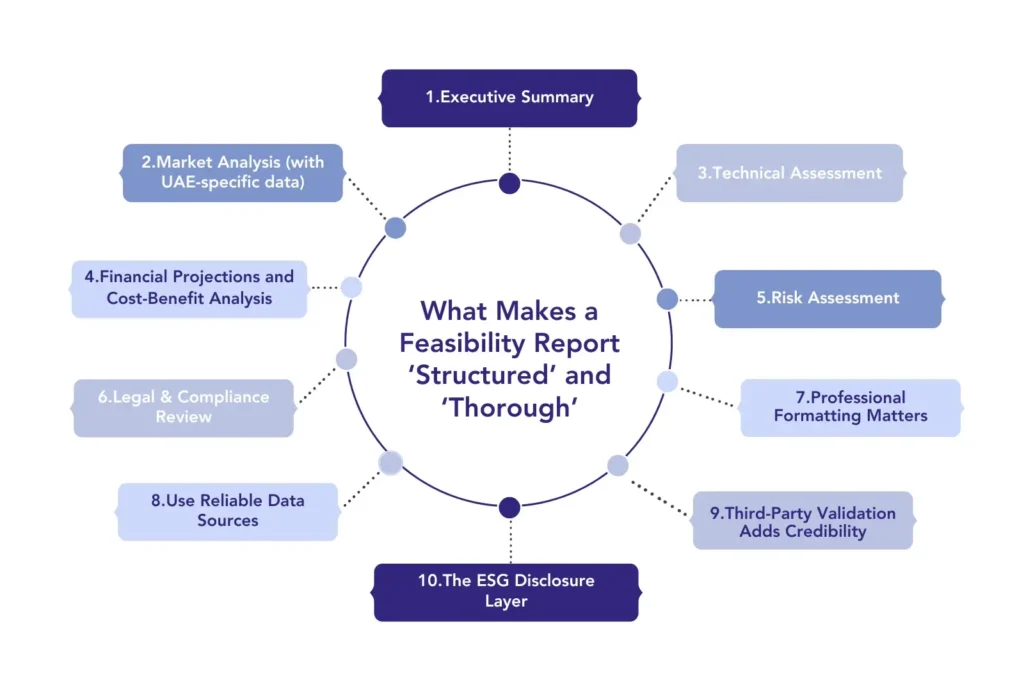
What Makes a Feasibility Report ‘Structured’ and ‘Thorough’

What Makes a Feasibility Report ‘Structured’ and ‘Thorough’

Not all reports are created equal. A real, structured feasibility report follows a clear format. It’s detailed. It’s professional. And it answers all the right questions.

Here’s what it should include:

Executive Summary

This is the first page. It gives a quick overview. What is the project? What’s the goal? Is it worth doing? Investors read this first, so it needs to be sharp.

Market Analysis (with UAE-specific data)

This is where you show demand. Who are your customers? How big is the market in the UAE? What are the trends? This section needs real stats, not guesses. Think government data, industry reports, and market surveys. Include hyper-local demographic data and 15-minute city accessibility metrics to highlight the evolving urban landscape and its influence on demand.

Technical Assessment

Here you explain how the business will actually run. Location. Equipment. Staffing. Tech needs. Supply chain. If it’s a product, how will it be made? If it’s a service, how will it be delivered? Also, add a requirement for digital infrastructure and e-invoicing readiness evaluation, as this is now a critical factor for businesses operating under the UAE’s evolving tax and compliance framework.

Financial Projections and Cost-Benefit Analysis

This is where numbers matter most. Expected income. Operating costs. Profit margins. Break-even points. ROI. Use clear charts and realistic assumptions. Investors will look closely here. Change “cost-benefit analysis” to “DMTT and Pillar Two impact modeling” for multinational entities to reflect the new corporate tax landscape that investors need to account for in 2026.

Risk Assessment

Every project has risks. This section shows you understand them. What could go wrong—and what’s the backup plan? Political risks, market shifts, cost overruns—list them all. Show that you’re prepared. Now, include “Physical and Transitional Climate Risks” as mandatory categories to align with the growing emphasis on environmental impact and regulatory compliance.

Legal & Compliance Review

Especially in the UAE, legal rules can vary by business type and location. This section covers licenses, permits, ownership rules, tax impact, and any regulatory hurdles. Update to mention Resolution No. 11 of 2025 regarding mainland-free zone hybrid operations, as this will affect many businesses moving forward.

Professional Formatting Matters

A good report isn’t just full of data—it looks clean and easy to read. Use clear headings. Good layout. Consistent fonts. Proper referencing. It shows attention to detail.

Use Reliable Data Sources

No made-up stats. Use official UAE reports, government databases, or trusted research firms. Every claim should be backed up.

Third-Party Validation Adds Credibility

A report carries more weight when a trusted expert prepares or reviews it. That’s why investors prefer reports made by professional advisory firms like ADEPTS. It shows your idea has been checked, tested, and validated by someone who knows the market.

The ESG Disclosure Layer

Modern feasibility reports must include Digital MRV (Measurement, Reporting, and Verification) systems to be credible to 2026 investors. ESG (Environmental, Social, and Governance) considerations are no longer optional but essential, and the report should demonstrate that the project complies with the upcoming GHG (Greenhouse Gas) reporting requirements under Federal Decree-Law No. 11 of 2024, with the May 30, 2026, deadline clearly reflected.

Addressing Investor Concerns Through Structured Reports

In 2026, investors have become more rigorous in their due diligence processes. Gone are the days of relying on gut feelings. They now demand comprehensive, actionable insights, and structured feasibility reports are their primary source of confidence.

Defensibility Against AI-Driven Disruption and Shifting Consumer Demographics

In a rapidly changing market, investors want to know how well a business can withstand AI-driven disruption and adapt to evolving consumer preferences. Market viability is no longer solely about demand but also about adaptability. Feasibility reports must include data showing the business’s resilience in the face of technological and demographic changes.

ROI Sensitivity to Corporate Tax and the 14% Annualized Late Payment Penalty Rate

In 2026, investors also require detailed projections of ROI sensitivity to Corporate Tax (9%) and the 14% annualized penalty for late payments. These are no longer abstract risks; they directly impact profitability, and feasibility reports must address them clearly.

Clean Compliance Reputation for Future Exit or IPO

A business’s governance and compliance record is now a critical factor for investors planning future exits or IPOs. A history of clean audits, regulatory adherence, and clear compliance procedures is an essential element in gaining investor trust.

Addressing Hidden Tax Liabilities and Shadow Director Risks

Investors are keenly focused on identifying hidden tax liabilities and shadow director risks. Feasibility reports must be comprehensive, addressing potential financial and governance risks and showing that the business is prepared to handle them.

Comparative Analysis: Investor Concern Evolution (2024 vs. 2026)

Traditional Concern 2026 Strategic Evolution Feasibility Report Solution
Market Saturation Algorithmic Dominance Technical audit of AI-driven pricing and customer acquisition logs.
Operational Costs Digital Compliance CAPEX Inclusion of E-Invoicing and automated reporting system costs.
Regulatory Shifts Enforcement Friction Detailed roadmap for meeting May 30, 2026, ESG deadlines.
Exit Strategy Due Diligence Resilience Maintenance of audit-ready data trails for 7 years as per UAE law.

Sensitivity Analysis for Tax Fluctuations

The introduction of the Domestic Minimum Top-up Tax (DMTT) and the Pillar Two guidelines means feasibility reports must now include sensitivity analysis on tax fluctuations. Investors need to understand how changes in tax policy could affect returns, and feasibility reports must offer projections based on various scenarios.

Case Examples from the UAE

Here are some examples right from the UAE that will give the reader real and deep insight into the efficacy of structured feasibility reports:

Renewable Energy – Masdar’s 1GW Solar Project

Masdar is building a huge solar power plant in Abu Dhabi. As of early 2026, their renewable energy portfolio has reached 65GW, and they are deploying $30–35 billion in equity toward a 100GW target. One standout project is the 5.2GW solar PV project with 19GWh battery storage—setting the new gold standard for dispatchable baseload power feasibility.  This didn’t happen overnight. Detailed feasibility studies helped secure both equity and debt funding. Investors had clear data, solid forecasts, and confidence in the plan. That’s what made it possible.

Real Estate – Off-Plan Projects in Dubai

Dubai’s off-plan market is booming. In 2025 alone, $78 billion in sales were recorded, and 110,500 residential units are forecast for delivery in 2026. The Dubai Metro Blue Line is now a key driver for location analysis, making it an essential factor for feasibility studies in the real estate sector. Developers use feasibility studies to show market demand, expected ROI, and cost breakdowns. With that info, investors can commit without guessing.

Tech/Startups – Fintech in ADGM and DIFC

ADGM and DIFC have solidified their positions as key fintech hubs in the UAE. The UAE fintech market is projected to hit $52.07 billion by 2026. These zones offer strong legal frameworks and investor-friendly regulations, making them attractive for fintech startups. Before pitching to global investors, many startups build trust through solid feasibility reports.  These reports prove the idea works, shows potential growth, and help meet regulatory checks. That’s how they raise real funding.

2026 Sector Snapshot

Sector 2026 Market Context Key Feasibility Metric
Renewable Energy 65GW operational/committed portfolio. Battery Storage capacity (GWh) for grid stability.
Real Estate 132,000 homes sold in 2025; price moderation expected. Proximity to “Blue Line” Metro and 15-minute city hubs.
Fintech $52.07 Billion Market Size. Compliance with CBUAE Fintech Strategy 2026.
Luxury Beachfront 140% surge in supply-shortage zones. Capital preservation vs. High-yield speculation.

Benefits of Structured Feasibility Reports for Investors and Project Owners

Owners and investors both have massive benefits to reap. We are going to talk about the benefits for both groups separately:

For Investors

Clarity on Risk vs. Reward

A good report lays out the risks, costs, and potential returns in plain numbers. This helps investors make smarter decisions—and avoid surprises. They know exactly what they’re getting into.

Higher Confidence in Project Leadership

A structured report proves the team knows what it’s doing. It shows planning, research, and real effort. This builds trust in your leadership and execution.

Greater Alignment with Return Expectations

Investors care about timelines and profit. A detailed financial projection aligns their expectations with your goals. It helps prevent future conflicts and builds long-term partnerships.

Golden Visa Eligibility Validation

For investors looking to secure long-term residency, a structured report for an AED 2 million investment has become the standard for Golden Visa eligibility. The report is an essential tool to demonstrate the investment’s potential and its alignment with government policies.

For Project Owners

Easier Capital Acquisition

Banks, angel investors, and VCs all want proof. A solid feasibility report is that proof. It shows you’ve done the research and built a plan around real numbers. That makes funding discussions smoother—and faster.

Better Strategic Clarity

Planning a business can feel overwhelming. A feasibility study forces you to slow down and think. You’ll spot challenges early, test your assumptions, and build a stronger foundation.

Stronger Positioning for Regulatory Support

In the UAE, many business benefits—like ICV certification, FDI licenses, or DED approvals—require structured planning and documentation. A feasibility study UAE helps you check those boxes, faster. It also shows regulators you’re ready to comply and contribute to the economy.

Optimizing the Effective Tax Rate

In 2026, the benefit of a feasibility study is not just about obtaining funds but about optimizing the effective tax rate. By including R&D Tax Credits (up to 50%) under Ministerial Decision No. 24 of 2026, feasibility reports help identify qualifying R&D spend that enhances ROI for project owners.

Unlocking the 2026 Strategic Advantage

A solid feasibility report can also unlock strategic advantages in 2026, especially in areas like the “Blue Visa for environmental leaders and the “Startup Visa” programs. These programs reward businesses that demonstrate alignment with the UAE’s strategic economic goals, and a well-prepared feasibility study is essential to securing these benefits.

Current Trends in Feasibility Reporting in the UAE

Feasibility reporting in UAE is evolving fast. Investors and regulators expect more. So do smart entrepreneurs.

Let’s look at what’s changing—and what still goes wrong.

ESG Factors Are Now a Priority

Environmental, Social, and Governance (ESG) elements are becoming part of the core analysis. As of May 30, 2026, non-compliance with ESG requirements will result in fines of up to AED 2,000,000. Investors want to know if your business is sustainable—not just profitable. Green practices, ethical sourcing, and social impact now influence funding decisions, especially in government-linked projects.

AI and Data Analytics for Market Predictions

Feasibility studies are no longer built on static reports alone. The shift is now towards AI-powered compliance dashboards and automated red-flag analytics used by the FTA. These predictive tools are helping founders model real-time market shifts, track customer behavior, simulate pricing strategies, and even forecast regional demand across the UAE.

Focus on ICV Impact in PPP Projects

In public-private partnerships, the UAE government is pushing hard for local value creation. Investors and government bodies now expect feasibility studies to include ICV (In-Country Value) impact analysis. It’s not just about the project—it’s about how it benefits the UAE economy.

Key Challenges in Feasibility Reporting in the UAE

Key Challenges in Feasibility Reporting in the UAE

Let’s take a look at the challenges that will be part of the process:

Over-Optimistic Financial Projections

Many feasibility study services still stretch the numbers. Unrealistic revenue goals or lowball costs can damage credibility fast. Investors can spot this—and walk away. In 2026, the biggest challenge is the “Digital Gap”, with businesses failing to integrate into the national e-invoicing framework. This failure can be a major red flag for investors.

Weak Market Validation

Assuming demand without proof is risky. A feasibility report needs strong evidence: real market data, surveys, competitor analysis, and buyer behavior in the UAE. Without it, the plan feels hollow.

Ignoring Local Costs and Culture

Cost structures in the UAE vary by emirate, business activity, and setup type. Rent, staffing, and licensing can change your margins quickly. Also, overlooking cultural norms—like negotiation styles, hiring practices, or customer preferences—can derail even the best ideas.

Engage UAE-Based Experts

A local advisory partner knows the laws, the market, and the red flags. They help you avoid blind spots and tailor your report to what actually works here. That’s why involving firms like ADEPTS adds real value—not just a signature on the last page.

2026 Compliance & Enforcement Trends

Area 2026 Focus Risk/Mitigation
Tax Filing First full cycle CT returns due Sept 2026. Late filing fees: AED 500-1,000/month.
VAT Credits 5-year hard deadline for legacy credit recovery. Forfeiture of credits if not claimed by Dec 31, 2026.
E-Invoicing Large taxpayer mandatory live-phase prep. System non-compliance fines: AED 5,000.
ESG / Climate Scope 1 & 2 baseline verification. License suspension for failure to register with NRCC.

Best Practices in Preparing Investor-Ready Feasibility Reports

A feasibility report is your chance to shine. It’s more than just a document—it’s your pitch. Investors need to see clear, reliable information. Here’s how to make sure your report hits all the right notes.

Engage Multidisciplinary Teams (Finance, Legal, Engineering)

Don’t try to handle everything on your own. A good feasibility report needs input from different experts. Sustainability Officers bring insights on environmental impact, AI Governance Experts ensure ethical use of technology, and finance teams bring the numbers. Legal teams ensure everything’s compliant. Engineers make sure the technical side is solid. When each expert adds their touch, the result is a complete, well-rounded report that shows you’ve covered every base.

Align Report Structure with Local Investor Expectations

Investors in the UAE have specific expectations. They want clear financial forecasts, realistic market analysis, and a plan that fits with local regulations. They also like to see a roadmap of how the project will contribute to the economy, especially if it creates local jobs or supports sustainability. Tailor your report to focus on these points. When you align with what they care about, you’ll capture their attention. Make sure your report also aligns with “feasibility study services in Dubai” to cater to the regional focus.

Include Visual Summaries, Charts, and Risk Flags

Nobody wants to wade through pages of numbers and text. Keep it simple. Use charts, graphs, and tables to break down complex data. Highlight key points and risks clearly. Investors want to get the big picture quickly, and visuals make that easier. By using clear, easy-to-understand visuals, you show professionalism and respect for the investor’s time.

Regularly Update Feasibility Assumptions in Dynamic Markets

Markets, especially in sectors like real estate and energy, change fast. What worked last year may not apply today. Keep your assumptions fresh by implementing Real-Time Monitoring. Integrate AI dashboards that track market shifts, allowing you to stay on top of the latest trends and conditions. Investors will appreciate that you’re staying on top of things. They want to know you’re prepared for changes and can adjust when necessary.

Conduct a Peer or Third-Party Audit Before Investor Presentation

A fresh set of eyes makes a huge difference. Before presenting your report to investors, have someone else—preferably an expert—review it. A Pre-Audit Health Check helps you catch mistakes or weaknesses you might have missed. It also shows you’re committed to making the report as solid as possible. After all, investors want to know they’re seeing the best, most accurate version of your plan.

The 2026 'Audit-Ready' Standard

In 2026, it’s not just about preparing a solid report—it’s about ensuring you’re ‘audit-ready’. This includes maintaining records in Arabic where required. Failure to do so can result in fines, although the penalty is now reduced to AED 5,000. It’s essential for large entities, especially multinational groups, to ensure their financial models are Pillar Two ready and comply with the OECD Global Minimum Tax rules.

Conclusion

A well-structured feasibility report does more than check a box. It builds trust. It shows investors that you’re serious, prepared, and thinking long term. In 2026, this is no longer a choice—it is a strategic necessity for capital preservation.


In the UAE’s fast-moving and competitive market, this kind of reporting isn’t just a nice-to-have. It’s a smart strategy. As the UAE moves toward its 2031 economic vision, the barrier to entry is no longer just capital—it’s governance excellence. It helps you stand out, win investor confidence, and move faster than the competition.


If you’re launching a project here, don’t skip this step. Invest in a strong, credible feasibility report. It’s the key to unlocking funding, securing partnerships, and building a business that lasts. With institutions like the DIFC Family Wealth Centre standardizing how long-term value is created and protected, structured reporting is now central to regulatory resilience and long-term economic stewardship. A strong feasibility study UAE is no longer optional—it’s expected.

FAQs:

It depends on the size and complexity of your project. High-value or technical projects may cost more, especially if they involve multiple sectors or locations. Different firms will have different rates. Multiple factors can impact the pricing. In 2026, costs now also include ESG verification and digital tax modeling, typically starting at AED 15,000 for SMEs and scaling to AED 75,000+ for complex energy or tech projects.

Not always. But for large-scale, high-risk, or investment-heavy projects, Free Zones often require one. Even if not mandatory, most Free Zone authorities recommend it—especially when applying for funding or special licenses. However, in 2026, they are mandatory for Mainland Expansion Permits under Resolution No. 11 of 2025 and for ESG compliance registration.

At least once a year—or whenever major market or financial changes occur. For fast-moving sectors like real estate, tech, or energy, more frequent updates are smart. In 2026, this has shifted to continuous monitoring with annual formal resets, aligned with the September 30 Corporate Tax filing cycle.

 A market study looks at demand, trends, and competition. A feasibility report includes that—but also dives into costs, risks, legal factors, and financial returns. It’s broader, deeper, and more decision-focused.

Yes—definitely. A clear, well-researched report shows professionalism and lowers investor risk. International investors often rely on it to understand local market potential and legal frameworks. In 2026, a feasibility study in UAE also helps investors assess Corporate Tax exposure, ESG compliance, and regulatory risks before committing capital.

Typically 2 to 6 weeks. It depends on the scope, the availability of data, and how quickly stakeholders respond. Bigger projects may take longer—especially if they involve site visits or technical assessments.

The government doesn’t “approve” reports. But certain departments—like the Department of Economic Development (DED) or Free Zone authorities—may review them during license applications, PPP proposals, or FDI programs. A strong report improves your chances of getting approvals and support.

It is the final date to regularize status for companies operating on the Mainland without a separate onshore entity. Failure to comply can expose businesses to regulatory penalties and licensing restrictions.

All UAE businesses must measure and report Scope 1 & 2 emissions under Federal Decree-Law No. 11 of 2024. Non-compliance can result in fines of up to AED 2,000,000.

The penalty can be waived if the first Corporate Tax return is filed within 7 months from the end of the first tax period. Early compliance and proper planning are critical to avoid unnecessary penalties.

References

Related Articles​​

40 Years of JAFZA: Lessons from Dubai’s Free Zone Powerhouse for Global Business Leaders

JAFZA Just Turned 40. And That’s a Big Deal. This isn’t just a birthday. It’s a game-changing milestone. Back in 1985, JAFZA was just an idea. If you look at it now,
It’s a global trade beast.

It helped turn Dubai into a business magnet. Investors. Exporters. Founders. Everyone showed up. It started small. Today, over 9,000 companies call it home. It broke barriers.
Opened doors. Made trade faster and smarter.

Sheikh Hamdan recently celebrated this journey. His words weren’t just for JAFZA. They were for the bold vision that built Dubai’s economy. For local business owners, this is more than a number. It’s a blueprint.

Take risks. Think big. Build smart. Stay ahead.

The Rise of JAFZA: From Modest Beginnings to Global Powerhouse

Back in 1985, JAFZA started with just 19 companies. No one imagined it would become one of the biggest free zones in the world. But it did and fast.

At the heart of this growth was bold leadership. Sultan Ahmed bin Sulayem had a clear vision: make Dubai a global trade hub. He didn’t wait. He built systems, cut red tape, and made it easy for businesses to grow.

The location helped too. JAFZA sits between Jebel Ali Port and Al Maktoum Airport. That means your goods can move by sea, air, and land — all in one spot. No delays. No complicated transfers. Just smooth logistics.

Today, over 9,500 companies call JAFZA home. From startups to global giants.

And it all started with 19 companies and one big idea.

JAFZA by the Numbers: Impact in 2025

JAFZA isn’t just big, it’s a giant in the region’s economy. The numbers speak for themselves.

A Global Business Magnet

In 2025, JAFZA is home to over 11,000 companies. They come from 157 countries. Every major industry is here, logistics, manufacturing, retail, energy, and tech.


Investment Powerhouse

Cumulative investments have crossed AED 110 billion. That’s money flowing into infrastructure, warehouses, factories, and people. It’s also a clear sign that global investors trust JAFZA.


Backbone of Dubai’s Non-Oil Economy

JAFZA plays a key role in shifting Dubai beyond oil. In 2024, it handled AED 713 billion in non-oil trade. That’s a 15% year-on-year growth, showing strong momentum despite global headwinds.

Source: DP World Annual Report 2024

Key Driver of GDP and FDI

  • JAFZA contributes 36% to Dubai’s GDP.
  • It also attracts 74% of Dubai’s foreign direct investment in high-impact sectors like advanced manufacturing, logistics, and green energy.

This zone isn’t just a place to do business. It’s a platform for growth, innovation, and global reach.

Key Success Factors

JAFZA didn’t grow by chance. It was built to win and here’s why it works so well.

Built Around Trade

JAFZA is fully integrated with DP World and Jebel Ali Port. That means faster shipping, easier customs, and no third-party delays. Everything flows through one powerful trade ecosystem.


One-Stop Setup

Business setup is simple. You get single-window clearance, clear rules, and minimal paperwork. No bouncing between government departments. No wasted time.

Ready-to-Use Infrastructure

Offices, warehouses, factories, all built and ready. Fiber optics, smart logistics, high-speed internet. Add to that digital portals and online approvals, and you can run your business from anywhere.

Tax and Ownership Perks

JAFZA offers 100% foreign ownership. No local sponsor needed. You also get zero corporate tax inside the free zone. These incentives make it one of the most cost-effective places to launch or expand.

A Global Blueprint

JAFZA’s model has been so successful, it’s now used in other DP World free zones around the world, from London Gateway to India’s smart logistics parks.

Everything is designed to help your business grow faster, smoother, and smarter.

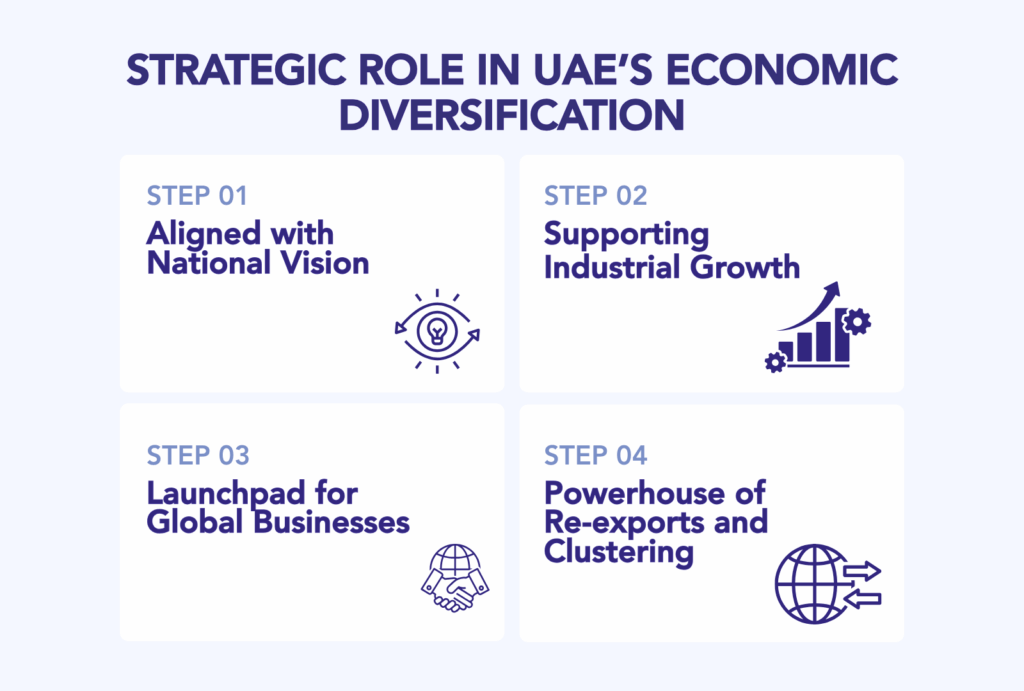
Strategic Role in UAE’s Economic Diversification

JAFZA isn’t just a free zone. It’s a core part of the UAE’s economic future.

Aligned with National Vision

JAFZA directly supports UAE Vision 2031 and the Dubai Economic Agenda D33. Both plans aim to double the economy, boost global trade, and lead in innovation. JAFZA provides the ground where these goals become real.


Supporting Industrial Growth

It plays a strong role in Operation 300bn and Make it in the Emirates, national programs designed to grow the UAE’s manufacturing sector. With its ready-made industrial zones and streamlined processes, JAFZA helps factories launch fast and scale big.

Launchpad for Global Businesses

JAFZA is the go-to entry point for companies wanting to enter the MENA region. From multinationals to fast-moving SMEs, thousands use JAFZA as their base to serve customers across the Middle East, Africa, and South Asia.

Powerhouse of Re-exports and Clustering

JAFZA drives a major share of the UAE’s re-export activity. Its location and logistics make it easy to ship goods across borders. At the same time, industrial clustering in areas like logistics, food processing, and tech brings major supply chain efficiencies.

JAFZA isn’t just building business. It’s shaping the new economy of the UAE.

What Businesses Can Learn from JAFZA’s Playbook

JAFZA didn’t just grow, it scaled with strategy. Here’s what other businesses can take from its success.

Think in Ecosystems

JAFZA doesn’t work alone. It’s connected to ports, airports, customs, and digital platforms. This ecosystem mindset creates speed, reduces friction, and unlocks scale. Businesses that build or plug into strong ecosystems move faster and win bigger.

Stay the Course

One thing that stands out is policy consistency. JAFZA’s leadership has stayed committed to business-friendly rules for decades. That long-term vision matters. Businesses should build with patience, clarity, and direction, not just quick wins.

Use Free Zones as Launchpads

JAFZA proves that free zones can be powerful growth engines. With the right structure, tax perks, and logistics, they remove barriers. Businesses should use zones like JAFZA to test markets, reduce costs, and scale regionally.

Build for Trade

Everything in JAFZA is built around trade, warehouses, roads, permits, and systems. It shows the value of trade-first thinking. Even digital businesses can benefit from thinking globally and aligning operations to cross-border efficiency.

The lesson? Growth isn’t luck. It’s structure, vision, and strategy done right over time.

How ADEPTS Supports Investors in Free Zones

Setting up in a free zone like JAFZA? ADEPTS makes it easier — and smarter.

Structuring That Works

Mainland or free zone? We help you choose what fits your business. Our experts explain the pros and cons, so you get it right from day one.

Smart Tax Planning

Free zones still need tax planning. We guide you through ICV compliance, corporate tax rules, and how to make the most of your setup.

VAT, ESR & Transfer Pricing

We help you stay compliant with VAT, Economic Substance Regulations, and transfer pricing — even if your business operates across borders.

Hassle-Free Setup

From license applications to regulatory filings, we handle the details. You focus on business. We handle the setup and day-to-day compliance.

Beyond the Basics

We also support sustainability reporting, financial transparency, and FTA compliance — all becoming more important in 2025 and beyond.

With ADEPTS, you don’t just register a business. You build it right.

Future Outlook: What’s Next for JAFZA and Global Trade

Big changes are coming — and JAFZA is ready.

Smarter, Greener Trade

Expect more focus on green logistics, AI-driven supply chains, and digital trade corridors. JAFZA is already testing smart systems to speed up operations and cut waste.

Leading the Green Shift

JAFZA is part of the UAE’s clean future. It’s working toward carbon neutrality by 2040 and net-zero emissions by 2050. That means more sustainable buildings, cleaner transport, and greener partners.

Tech-First Supply Chains

From real-time tracking to digital customs, JAFZA is evolving fast. The goal? A supply chain that’s faster, cleaner, and built for the future.

Conclusion

JAFZA’s journey shows what happens when vision, infrastructure, and smart policies come together.

It’s more than a free zone — it’s a blueprint. One that other businesses can learn from.

With long-term thinking and public-private teamwork, JAFZA didn’t just grow. It led.

Now it’s your move.

FAQs:

 It’s not just a free zone. It’s plugged straight into Jebel Ali Port and DP World’s global network. That means faster, smarter access by land, sea, and air — all from one place.

Yes, 100%. No local sponsor. No hidden strings. That’s why global investors love it.

 Yep. Zero corporate tax on qualifying income. No personal income tax. Full profit repatriation. You keep more of what you earn.

Totally. Quick customs. Bonded warehouses. Direct port access. Move goods fast, no drama.

 We set you up. We plan your taxes. We handle VAT, ESR, ICV, and offer ongoing advice. You grow. We handle the grind.

Both. JAFZA isn’t one-size-fits-all. Logistics, tech, manufacturing, services — they all thrive here.

 Big things. Smart logistics. AI-powered trade corridors. Real-time data to speed things up. The future’s already in motion.

Don’t be. JAFZA gives you the tools. ADEPTS backs you with strategy and reports. You’ll stay compliant and ahead.

 JAFZA’s going green for real. Carbon neutrality by 2040. Net-zero by 2050. Solar power, green buildings, clean transport — it’s all in the plan.

Big time. Over 135,000 jobs so far. It partners with national programs to train and hire UAE talent across industries.

Related Articles​​

ADGM vs. DIFC: Which is the Better Choice for a Holding Company?

When you think about starting a business, there is one very important decision apart from deciding what product or service to sell that you need to decide on and which can make or break your business – the location of your business.

Yes, your business’s location is very important for you as it impacts how you will be able to access the potential markets, the regulatory environment that you will deal with, the tax benefits you will get to enjoy, and even the kind of talent you can attract.

In fact, choosing the right location opens the doors to networking and growth opportunities. And when it comes to holding company setup in the UAE, there are two major zones in the UAE: Abu Dhabi Global Market or Dubai International Financial Centre.

If you are looking to find out, what is a UAE holding company, or which zone supports your goals, then you’re in the right place. 

With this article, we will help you decide which is the best zone for your business. Continue reading the article so you can make an informed decision.

Understanding Abu Dhabi Global Market (ADGM)

First things first, let’s talk about each location individually so you can identify the most suitable location, therefore let’s understand the Abu Dhabi Global Market.

What is ADGM? Overview, jurisdiction, and key benefits

The Abu Dhabi Global Market is a leading premier business hub in the world, located on Al Maryah Island in Abu Dhabi, UAE. It is a great place for businesses that are mainly focused on financial services, fintech (technology for finance), asset management, and international legal services. This makes it an ideal choice for a holding company Abu Dhabi Global Markets setup.

They follow the laws that are similar to those followed in the UK and are referred to as the English Common Law. Following these laws makes it easier for international investors and businesses to understand and comply with, making it an advantage for anyone considering an ADGM holding company set up.

Did you know that setting up a business in ADGM offers lowest corporate tax, full repatriation of profits, and benefits from the UAE’s wide network of tax treaties with other countries, making it a tax-efficient spot and an attraction for international investors, especially those planning a holding company ADGM registration.

Wondering what it will cost to set up a holding company in ADGM? Well, here is the good news, as per the recent news, setting up a company in ADGM in 2025 just got a lot more convenient for some and a little pricier for others.

If you are setting up a non-financial business, the registration fee has gone down by half from $10,000 to $5,000, and renewals are also down to $5,000. Retail businesses are even luckier, with getting registration for just $2,000 instead of the old $6,000.

If you’re launching a financial services business in ADGM, be aware that licensing fees have been revised upward starting in 2025. Tech startups continue to benefit from reduced rates compared to traditional firms.

In addition, all entities must pay a mandatory data protection fee. ADGM has also introduced updates to auditor registration, employment regulations, and compliance policies to align with international financial standards.

​ADGM's Regulatory Environment

Regulatory environment in other words is the businessmen’s playbook that they need to comply with when running in Abu Dhabi Global Market. This jurisdiction is an attraction for investors as it offers a robust and progressive regulatory environment.​ Let’s look into it in a little detail.

Since ADGM is an independent jurisdiction, therefore it has its own regulatory system called the Financial Services Regulatory Authority (FSRA). This regulatory body ensures a fair, efficient, and responsive financial marketplace.

Moreover, the said regulatory body is also responsible for monitoring all financial services within ADGM. FSRA sets and enforces regulations that align with international standards. The FSRA is known to operate with a risk-based and outcome-focused strategy, fostering innovation all the while maintaining market integrity.

Regulations for Holding Companies in ADGM

Abu Dhabi Global Market follows the English common law to make it easier for all the international investors to comply with. Additionally, following this comprehensive legal framework provides the investors with a familiar and transparent structure. In order to ensure compliance with and efficiency of a smooth operational system in the jurisdiction, FSRA has established specific obligations for financial service companies.

Ease of Doing Business in ADGM

ADGM is not only known for the subpar tax benefits that it offers but also for a business friendly environment, streamlined registrations and an efficient regulatory system. 

Furthermore, the FSRA also extends its assistance when it comes to facilitating the companies with government related services and providing licensing of legal entities.  These facilities make ADGM a highly appealing hub for the business fraternity and has resulted in 160 firms choosing to operate in it.

Current Regulatory Trends and Recent FSRA Developments

In order to stay aligned with the global standards and emerging market trends, the FSRA continually enhances its regulatory framework. Recent developments include:

  • Digital Assets Framework: In January 2025, the FSRA finalized enhancements to its regulatory framework so it can align with the Basel Committee on Banking Supervision (BCBS) principles. It implemented miscellaneous changes to support the evolving digital assets landscape. ​
  • Virtual Assets Regulation: The FSRA has published guiding principles on its approach to virtual asset regulation and supervision. It outlines expectations for virtual asset service providers and reinforces ADGM’s position as a leading hub for digital innovation. 
  • Client Classification and Conduct Requirements: In August 2023, FSRA brought in new rules about how clients are classified, how their assets are kept safe, and how firms should behave. The goal was to make things better and safer for all the investors and keep the market as fair and trustworthy as possible.

Understanding Dubai International Financial Centre (DIFC)

Understanding Dubai International Financial Centre (DIFC)

Let’s look into the Dubai International Financial Centre, also known as DIFC. This free zone is amongst the prime locations for doing business, especially when it comes to DIFC holding company setup.

What is DIFC? Overview, jurisdiction, and key benefits.

The Dubai International Finance Center is a famous jurisdiction in the UAE that was established in 2004. This free zone has gained popularity as the global financial hub over time and truly for the right reasons.

Being an independent zone, DIFC also has its own legal and regulatory framework to ensure things run smoothly. Its location allows it to connect the financial centers of Europe and Asia, covering a region from Central Asia and the Indian subcontinent to North and East Africa. This setup allows trade and investment to move across the Middle East, Africa, and South Asia (MEASA) region.

DIFC offers several tax benefits. Such as 0% corporate tax for 50 years, allowing your business to keep more profits. You can send money in and out of the country without any restrictions, while fully owning your business, even if you are a foreign investor. Moreover, DIFC is part of the UAE’s tax treaty network, which can help reduce taxes in other countries as well.

DIFC focuses on industries like banking, finance, insurance, and financial technology. Many big global companies are based here, so if you setup a holding company in DIFC, you’ll be part of a strong and growing business community with great connections.

Here’s what you need to know when you setup holding company in DIFC. The regular DIFC holding company cost to register a company is around $8,000, and the yearly license fee is about $12,000. If you’re starting a financial service business, the costs might be more because of extra rules. But if you’re setting up a tech startup or a non-financial business, cost to set up a holding company in DIFC can be much cheaper.

DIFC has a license called the Innovation License in which the yearly fee is $1,500. For a holding company using a structure like an SPV, there is a separate setup and annual fee, although the exact amounts may vary based on the structure. Additionally, there is a data protection fee applicable at the time of registration and a recurring annual renewal fee, depending on the entity type.

DIFC’s Regulatory Environment

The Dubai International Financial Centre (DIFC) is a great place for starting a business. It has clear rules and strong support, especially for foreign investors and holding companies.

The Dubai Financial Services Authority (DFSA) is the regulatory authority that makes sure all businesses follow the rules. It watches over both financial and non-financial companies. DFSA helps companies grow while keeping things safe and fair.

If you want to set up a holding company in DIFC, DFSA makes the process easy to understand. Their rules help you run your business smoothly and legally.

Regulations for Holding Companies in DIFC

Setting up a DIFC holding company is simple. Many people use a type of company called an Special Purpose Vehicle or SPV. These are used to own shares, real estate, or other assets.

DFSA has a clear list of what you need to do. They’ve also made it easier recently for startups, family offices, and big companies to follow the rules.

Ease of Doing Business

DIFC is known for being easy to do business in. The system uses English common law, and everything is online, from forms to approvals.

You also get help from top service providers around the world. If you’re thinking about a holding company setup in the UAE, DIFC can be a smart and simple choice.

Recent DFSA Updates and Regulatory Shifts

The DFSA has recently updated its rules to match new global finance standards. These updates include:

  • Faster license approvals for non-financial businesses.
  • Changes to follow the new UAE Corporate Tax law.
  • Better transparency to match standards set by the Organisation for Economic Co-operation and Development (OECD) and Base Erosion and Profit Shifting (BEPS) rules.

These changes help companies follow the rules more easily and make DIFC even stronger as a global financial center.

Quick Comparison Table: ADGM vs. DIFC at a Glance

Aspect ADGM DIFC

Legal system

English Common Law
English Common Law

Setup and Licensing Costs

Starts at $10,000 (non-financial), with renewals at $10,000
Starts at $8,000 for registration, $12,000 for renewal

Regulatory Body

Financial Services Regulatory Authority (FSRA)
Dubai Financial Services Authority (DFSA)

Core Focus Industries

Financial Services, FinTech, Asset Management, Legal Services
Financial Services, Real Estate, Tech, Insurance, Legal Services

Flexibility for Holding Companies

High – Flexible structures for holding companies
High – Common structures like SPVs for holding companies

Setup Timeline

Approximately 1-3 weeks
Approximately 2 – 4 weeks

Key Differences Between ADGM and DIFC

Let’s look at some key differences between both Jurisdictions

Legal and Regulatory Framework

The Dubai Financial Services Authority (DFSA) is the group that looks after how things run in DIFC. They make sure all companies, especially financial ones, follow the rules. Their job is to keep the system fair, safe, and working well for everyone.

If you want to setup holding company in DIFC, there are a few clear steps. Most people set it up as a Special Purpose Vehicle or SPV. That’s just a company made to hold shares in other businesses. You’ll need to tell DFSA what your company plans to do, who owns it, and then follow their process.

The cost to set up a holding company in DIFC usually starts at $8,000. Each year, you’ll also need to pay a renewal fee of about $12,000. But if you’re a tech startup or a non-financial company, you might get a cheaper option like the Innovation License. Just remember, if you’re thinking about Abu Dhabi (ADGM) instead of DIFC, the rules and costs may be different.

DIFC makes business setup pretty easy. They follow English common law like the UK, and you can also do most of the setup online, which saves time, especially if you’re from another country.

The DFSA also updates its rules often to keep up with the world. This includes changes for fintech, digital assets, and faster licenses for some businesses. So, DIFC stays modern, smooth, and safe for companies.

Cost Comparison: Setting Up and Maintaining a Holding Company in ADGM vs. DIFC

If you are setting up a holding company in the UAE, it is important to understand all the costs involved. Both Abu Dhabi Global Market and Dubai International Financial Centre offer attractive benefits. But the costs of registration, operational expenses, and office infrastructure can differ. Here’s a simple breakdown of the key costs in both jurisdictions:

1. Registration Fees: ADGM vs. DIFC

When you’re setting up a company, the first thing you’ll need to think about is the registration fee. In ADGM, non-financial businesses now pay $5,000, and tech startups get a sweet deal at $1,500. If you’re in financial services, the cost is higher, $16,700. There’s also a $300 data protection fee added to the bill.

At DIFC, most businesses face standard setup fees, but tech startups and non-financial companies can take advantage of the Innovation License, which has more affordable initial and annual fees. In addition to these, businesses must also consider a data protection fee that involves both an upfront payment and an annual renewal fee.

2. Ongoing Operational Costs

After the initial registration, businesses must also consider renewal fees each year. In ADGM, non-financial businesses pay a $5,000 renewal fee, while tech startups continue at $1,500 per year. Financial firms in ADGM should plan for $16,200 annually to maintain their license.

In DIFC, the standard renewal cost is around $12,000 for most companies. However, holding companies or special purpose vehicles (SPVs) pay much less, about $1,000 per year. Tech companies using the Innovation License also benefit from the lower $1,500 annual renewal.

3. Office Space and Infrastructure Costs

Office space is an important consideration when setting up a business. In ADGM, businesses are not required to have a dedicated office, although they may choose to rent one. The cost of office space can vary depending on the size and location.

Similarly, DIFC offers flexible workspace solutions, including serviced offices. The cost of office space in DIFC can also vary, with prices influenced by the features and size of the office chosen.

Industry Focus and Ecosystem

Industry Focus and Ecosystem

Selecting the right zone depends on your industry and the type of business community you wish to join. Understanding which sectors thrive in ADGM and DIFC is a key factor in making an informed decision.

Which sectors thrive in ADGM?

ADGM is a great choice for tech startups, fintech companies, family offices, and holding companies. It supports new and growing businesses with flexible rules and lower setup costs. Many digital and innovation-led companies are choosing ADGM for its modern approach and startup-friendly environment.

Which sectors thrive in DIFC?

DIFC is well known for financial services. This includes banking, insurance, investment firms, and legal services. It is home to many global financial companies. If you’re in traditional finance or need access to investors, DIFC offers a powerful network.

Networking and business opportunities

Both zones offer strong ecosystems, but in different ways. DIFC has a large and mature network of global businesses, legal firms, and banks. ADGM has a fast-growing tech scene with lots of support for innovation and digital business. Both offer chances to connect with key players in your industry.

Taxation and Financial Benefits

Let’s see the differences between Taxation and Financial Benefits that both the jurisdictions offer.

Corporate Tax Rates and Incentives

ADGM and DIFC both offer a 0% corporate tax on qualifying income. To get this, your business must meet the conditions of a Qualifying Free Zone Person (QFZP). But if your business fails to qualify, then you’ll pay 9% corporate tax on non-qualifying income.

Building on the taxation point, in ADGM there’s no personal income tax and you can send all profits abroad. However, in DIFC there are no taxes on capital gains, dividends, or interest for qualifying income.

The UAE has over 130 double tax treaties with other countries. These treaties help you avoid paying tax twice on the same income. This is great for international businesses, especially for holding companies and investors.

Repatriation of Profits and Capital

A significant advantage of setting up a company in ADGM or DIFC is the freedom to send back profits and capital to your home country without any restrictions.

In ADGM, businesses can send their earnings and capital back to their home country freely. There are no limits, and no taxes are applied when transferring funds abroad. This makes it a great choice for international investors and holding companies.


In DIFC, the same benefit applies. Companies are allowed full repatriation of profits, dividends, and capital with no currency controls. This helps businesses move money efficiently, especially those with global operations.

If your goal is to keep financial control and flexibility, both ADGM and DIFC offer a smooth and investor-friendly approach.

Financial Services and Banking Options

ADGM and DIFC are both good places if your business needs banks and financial systems. They’ve got lots of banks and finance companies, so it’s easy to send or receive payments.

In ADGM, you can find all kinds of finance services, like investment banks, companies that manage money for people, and new tech-based finance businesses. They also have their own regulatory body, FSRA, to ensure everything is safe and fair.

DIFC is even bigger. There are more than 600 financial companies there. Big banks, insurance companies, and people who invest money all work there. It’s a main spot for finance in the Middle East and Africa.

You can open a bank account in both places. But it takes some time. You have to give your documents and go through checks. Once your company is ready, keeping the account is simple.

Strategic Relevance for International Investors

If you’re planning to grow your business across the world, ADGM and DIFC are great places to start. The UAE has big future goals called Vision 2030, and both these places are a big part of that plan. The country wants more businesses, less oil dependence, and more jobs.

Both jurisdictions follow important global rules that make things fair and safe for international businesses. So, if you’re from another country, you’ll feel more secure doing business here. The rules are clear, and things work smoothly.

DIFC has been around longer and is more famous. It connects well with markets in the Middle East, Africa, and South Asia. It’s kind of like a busy international crossroads. ADGM is newer but growing super fast. It’s good for tech companies, finance, and investment businesses.

So if you want to set up a holding company setup in the UAE, or just need a place where your business can grow strong and steady, both are great picks. You get tax perks, strong laws, and easy links to the rest of the world.

Factors to Consider When Choosing

Factors to Consider When Choosing

Here is what you need to consider when choosing your jurisdiction.

Your Business Needs and Objectives

Before picking ADGM or DIFC, think about what your business really needs. Start by looking at your goals. Are you aiming for global expansion? Do you need access to investors, or want to hold shares in other companies?

Both zones are strong—but the best choice depends on where you see your company in the next 5 to 10 years. If you’re a tech startup, ADGM might suit you better. If you need access to a large financial network, DIFC could be the right fit.

Expert Insight:
“Your business structure should grow with your company. Pick a jurisdiction that doesn’t just work for today, but also supports your future plans.”

Target Market and Industry

Where you set up your business really depends on who you’re trying to reach.

If most of your clients or investors are in the Middle East, Africa, or South Asia, then DIFC might be the better fit. It’s been around longer, and it’s well-connected in the finance world.

But if you’re in tech or looking for a quicker setup, ADGM could be a smarter move. It’s newer but growing fast, and a lot of startups like it for the simpler rules and good support. Also think about your industry. Some businesses need specific approvals, and one zone might make that easier than the other.

At the end of the day, go where you’ll get the right backing for your kind of work and where your customers are.

Compliance Requirements and Reporting

Setting up your business is just the first step, staying compliant is what keeps it running.

Both ADGM and DIFC have rules you need to follow after you’re all set up. These include filing annual returns, keeping proper records, and submitting financial statements on time.

And now, with the new Corporate Tax rules in the UAE, things have shifted a bit. You’ll need to keep an even closer eye on your profits and how they’re reported. This applies even more if you’re not a Qualifying Free Zone Person (QFZP).

The good news? Both jurisdictions are pretty clear about what they expect. They also publish updates when laws change. Still, it helps to have a local advisor or tax consultant keeping tabs on things, especially with new tax laws rolling out.

Making Your Decision: ADGM or DIFC?

Choosing between ADGM and DIFC really comes down to what kind of business you have and where you see it heading. DIFC has been around longer. It’s busy, well-known, and packed with banks, law firms, and big finance names. If you’re working in traditional finance or want access to global investors, DIFC might feel like a better fit.

ADGM is newer but catching up fast. It’s especially good for tech startups, holding companies, and businesses that want a bit more flexibility in structure and pricing. It’s also known for being slightly easier to deal with when it comes to setup. When considering holding company setup in the UAE, both ADGM and DIFC offer strong advantages depending on your priorities. Before you decide, think about your goals; where your market is, what kind of license you’ll need, and how fast you want to scale.

Bottom line is that both jurisdictions are excellent options. You just need the one that fits your business best. But if you still think you need an opinion, then experts at ADEPTs can help you figure out what’s right for your next step.

FAQs:

Usually, it takes around 5 to 10 working days if your documents are complete and approved quickly. Sometimes it can be faster if everything is in place. Whether you’re working on a holding company setup in the UAE or specifically planning to setup a holding company in DIFC or ADGM, proper documentation speeds up the process.

Yes, both offer UAE residency visas once your company is set up. The number of visas depends on your office type and size.

No major restrictions. A holding company can own shares, real estate, intellectual property, or other assets, locally or globally, as long as it matches your license purpose. Whether it’s a difc holding company or a holding company in Abu Dhabi, flexibility in asset ownership is a shared advantage.

There’s no fixed minimum capital in ADGM for SPVs. DIFC also doesn’t require a large capital amount for SPVs. It’s more about maintaining a proper structure and meeting regulatory requirements, making the cost to set up a holding company in DIFC and ADGM relatively affordable for many business types.

Yes, both are often used to manage or hold shares in international companies. You can operate globally while being registered in the UAE. This is one of the key reasons businesses consider holding company setup in the UAE, especially through platforms like DIFC or ADGM.

The key challenge is staying up to date with ongoing reporting, new tax laws (like the UAE Corporate Tax), and regulatory filings. It’s important to stay organized or work with a trusted advisor to avoid penalties. For both ADGM and DIFC holding companies, compliance is crucial for long-term stability, especially considering changes in tax rules that may impact the difc holding company cost or filing requirements.

References

Related Articles​​

Franchise vs. Independent Business: Which is Better in Dubai?

Dream of owning a business in Dubai? Some tough decisions are in the way. You’ve got two main options. Buy a franchise or build your own independent business. You’ll have to choose.

A franchise means stepping into a proven brand. An independent business means starting from scratch—your name, your rules.

But here’s the real question: Which one works better in Dubai’s unique market?

In this article, we’ll break it down.
Startup costs.
Control and freedom.
Brand power.
Support systems.
And most importantly—what fits you best.

Let’s help you choose the right path.

Understanding the Franchise Model in Dubai

A franchise gives you a shortcut. With a franchise, you’re not building from zero.
You step into a system that’s already tested—and already earning.

Think about some big names—Subway, Tim Hortons, Fitness First. These are brands people already trust. That trust turns into foot traffic, sales, and faster growth.

In Dubai, brand matters a lot. Locals, expats, and tourists often prefer familiar names.
That’s a big advantage if you’re new to the market.

But here’s the catch—it’s not cheap. The initial investment can be high. You’ll likely pay a franchise fee, fit-out costs, and sometimes a percentage of your revenue. It’s a solid setup, but it comes at a price.

The good news? You get support.
Franchisors offer training, tools, and guidance.
It’s like having a roadmap—and someone to call when you hit traffic.

You also save time on marketing. The brand already has recognition and campaigns in place. That gives you a head start others don’t have. In short, franchising in Dubai offers structure, support, and speed. But it also means less freedom and higher upfront costs. You can figure out all the details with professional business evaluation services if some factors aren’t clear.

Let’s see how that compares to going independent.

Benefits of Franchising in Dubai

Franchise vs. Independent Business: Which is Better in Dubai?

Let’s take a good look at the benefits of buying a business in Dubai:

Instant Trust with an Established Brand

When you buy into a franchise, you’re buying more than a business—you’re buying a name people already know. That recognition builds instant trust. Customers are more likely to walk in, buy, and come back. In a competitive place like Dubai, that’s a huge advantage.

Support and Training from Day One

With a franchise, you get plenty of support. Franchisors usually provide full training. You’ll have step-by-step guides. They’ll help with marketing too. Basically, you are not on your own when you choose a franchise. It is a lot easier than setting up your own business from scratch.

Lower Risk, Proven Model

Franchises follow a tested formula. They’ve already worked out what sells, how to price, and how to scale. This means fewer surprises—and less trial and error.

Just look at McDonald’s. Its success around the world—including in the UAE—shows how powerful a proven model can be.

Challenges of Franchising in Dubai

Franchising is not all roses. There are challenges too. Let’s see what they are:

High Initial Investment

Getting started isn’t cheap. You’ll need to pay franchise fees, cover fit-out costs, and maybe even pay for equipment or branding materials. Some franchises in Dubai can cost hundreds of thousands of dirhams just to open. You’re buying into a system—but that system has a price.

Royalties and Ongoing Fees

Even after setup, the bills don’t stop. You will have to pay royalties regularly. This is a lot of money since it goes on forever. On top of that, you might have to pay marketing fees or monthly service fees.These costs mean a substantial part of your profits. This will seem massive in the first few months especially. Basically, you don’t get to keep everything with you.

Limited Freedom and Control

You own the business, but you don’t call all the shots. There are pre-set rules in almost everything related with the business. You may feel restricted when you have to follow the rules for branding and even pricing. You may even have guidelines in terms of store decor. This means you don’t get to do everything according to your own choice. 

Exploring the Independent Business Route in Dubai

Starting from scratch means full creative control. You choose the name, the style, the strategy—everything is yours. But it’s not easy. You’ll need to do your own market research, build a business plan, and figure out what works. No support system. No shortcuts.

The upside?

You keep 100% of the profits. No royalty fees. No brand restrictions. And if your idea clicks—you could build something big. It’s freedom with risk. But for many entrepreneurs in Dubai, it’s worth it.

Advantages of Independent Businesses in Dubai

Advantages of Independent Businesses in Dubai

While buying business in dubai is awesome because established businesses or franchises are already set and offer lots of support, there are massive benefits of starting an independent business too. Here they go:

Complete Control

You make all the decisions—branding, pricing, marketing, and growth.
No one tells you how to run your business.

Higher Potential Profits

No royalty fees or shared revenue.
Everything you earn stays with you.

Flexibility and Innovation

You can pivot fast, test new ideas, and respond to market trends quickly.
It’s your business—your way.

Disadvantages of Independent Businesses in Dubai

There definitely are some disadvantages:

Higher Risk

No proven system to follow.
Success depends fully on your planning and execution.

Brand Building Takes Time

You start with zero recognition.
It takes effort—and budget—to earn customer trust.

No Built-In Support

No franchisor to guide you.
You’ll need to figure out everything on your own.

Dubai’s Market: Key Considerations

Let’s see how Market works in Dubai:

Unique Business Environment

Dubai moves fast. It’s an economic hub now. Competition is high, but so are the opportunities. Success often depends on timing, location, and how well you understand the local demand. It is not like you enter to conquer. Like any other market in the world, you’ll have to put in your share of effort and research.

Cultural Awareness Matters

Dubai is diverse, but culture still plays a big role. Respect for local values and traditions can build trust—and loyalty. Small things, like how you communicate or market, can make a big difference.

Know the Legal Landscape

There are rules for everything—licenses (freezone company or mainland), visas, taxes, and more.
Whether you franchise or go independent, you need to stay compliant.
Working with a local consultant or PRO can save time and stress.

Demand and Market Trends in Dubai

Figuring our demand and hot trends is almost indispensable when you are starting a business of your own:

Hot Sectors

Some industries are booming.
Hospitality, retail, and technology lead the way.
Food chains, fashion brands, and tech startups see strong demand.

Growth Stats

Retail sales are growing steadily. The tech sector is expanding fast—especially fintech and smart services. Dubai’s tourism keeps fueling hospitality and F&B businesses.

Emerging Trends

New trends are taking over the market. Like Sustainability. It  is becoming a priority.
Green products and eco-conscious brands now get all the attention. E-commerce is on now. People love buying online now.

Legal and Regulatory Framework

Legal work is tough here. Businesses have to comply with strict laws, rules and regulations. Standards are high and they must be met too.

Company Registration

Buying a business in UAE or in his case, starting a business requires following clear procedures. You’ll need a trade license, a business plan, and relevant documents.
The process can differ based on whether you’re in a free zone or mainland.

Visa Regulations

Sponsorship is essential for hiring employees.
Labor laws are in place. Follow them for ease and smooth working of your business.  Visa regulations are strict. Businesses need to comply strictly.

Local Partnerships

Certain businesses require a local sponsor or partner.
This means a UAE national owns 51% of the business.
It’s important to understand the legal implications of these partnerships.

Tax & VAT Considerations

tax and vat

No need to forget about taxes. UAE is not the place to even think of tax evasions. So here are some important details for the businesses:

Franchise Businesses:

  • Benefit from Established VAT Systems
    Franchises often come with a pre-set VAT process that’s already aligned with regulations.
  • Possible Consolidated Tax Strategies
    Depending on the franchise structure, taxes may be handled within a larger corporate strategy, offering some efficiency.
  • VAT Registration Assistance
    Franchisors usually guide franchisees through the VAT registration process during onboarding.

Independent Businesses:

  • Independent VAT Management
    You’ll need to handle VAT registration, reporting, and compliance on your own.
    There’s no franchisor to guide you.
  • Full Control, Full Liability
    You control your tax strategy, but you also bear full responsibility for compliance and any issues.
  • Professional VAT Advisory
    It’s highly recommended to hire a VAT advisor or consultant to stay on top of the rules and avoid costly mistakes.

Financial Implications: Costs and Funding Options

Whether franchise or independent business, there are certain financial implications that come with business. Lets see which type brings what:

1. Comparing Startup Costs: Franchise vs. Independent

  • Franchise Costs: High initial fees, ongoing royalties, and marketing fees.
  • Independent Business Costs: Lower initial fees but more investment in branding, marketing, and setup from scratch.

2. Available Funding Options in Dubai

  • Bank Loans: Available for both franchise and independent businesses, though franchises may have an edge with their proven business model.
  • Venture Capital and Investors: Investors are often more inclined to fund franchises due to lower risk.
  • Government Grants: Some sectors may benefit from special funding or subsidies, especially those aligned with Dubai’s economic goals (e.g., tech, sustainability).

3. Analyzing Potential ROI

  • Franchise ROI: Steady returns due to an established brand, but ongoing fees reduce profit margins.
  • Independent Business ROI: Higher potential returns without shared profits, but it takes longer to establish the brand and customer base.

Startup Costs Comparison

Franchise:

  • Initial Fees: the initial fees are extremely high especially when it is a known international brand. The initial fees can be tens of thousands to millions of dirhams.
  • Equipment & Inventory: if you are choosing an international brand’s franchise, you’ll need to invest in branded equipment. You will also have to spend on the initial stock and both these things are very expensive. 
  • Example: Opening a McDonald’s franchise in Dubai could cost anywhere from AED 1 million to AED 3 million, including fees, fit-out, and equipment.

Independent Business:

  • Market Research: for franchise, you need loads of money. For your own business, you need to invest in market research and that is lots of stress. It is also very time consuming and involves daring decisions too.
  • Branding: You’ll be starting from scratch. You won’t get a brand built and running like in case of a franchise. You’ll find yourself working on marketing, advertising, creating brand identity from scratch, business logo and everything else. It’s a lot of work actually.
  • Operational Expenses: These include lease, permits, licenses, and employee salaries.
  • Example: Starting an independent coffee shop may cost AED 300,000 to AED 700,000, depending on location, interior design, and initial setup.

Funding Options in Dubai

Bank Loans

  • Requirements: Banks usually require a solid business plan, proof of income, and a good credit history.
  • Interest Rates: Interest rates for small business loans in Dubai range from 5% to 10%, depending on the bank and loan type.

Government Grants

  • Dubai offers support for SMEs, especially in sectors like technology, sustainability, and innovation.
  • Programs like the Dubai SME offer access to funding and resources to boost business growth.

Angel Investors

  • If you’re in the early stages, angel investors can be a good option.
  • These investors are willing to take on higher risk in exchange for equity or a return on investment.
  • To attract them, you’ll need a strong business idea and a clear growth plan.

Success Stories and Case Studies

Franchise Success Story 1:

  • Type: F&B (International Coffee Chain)
  • Key Factors: Global brand, streamlined operations, strong supply chain
  • Outcome: Launched 10 outlets in 2 years, achieved 30% YoY growth

Franchise Success Story 2:

  • Type: Fitness Franchise
  • Key Factors: Popular U.S. brand, Dubai health trend, location strategy
  • Outcome: Breakeven in 8 months, sold regional rights

Independent Success Story 1:

  • Type: Boutique Digital Marketing Agency
  • Key Factors: Niche focus on SMEs, tech-forward tools, Emirati founder credibility
  • Outcome: Acquired by a regional media group after 3 years

Independent Success Story 2:

  • Type: Local Fashion Brand
  • Key Factors: Cultural relevance, Instagram marketing, seasonal collections
  • Outcome: Featured at Dubai Design Week, expanded from pop-up to 3 locations

Conclusion

In summary, the choice between a franchise and an independent business depends on your goals.

Franchises offer brand recognition, support, and a proven model, but come with higher startup costs and ongoing fees.

Independent businesses give you complete control, higher profit potential, and flexibility, but require more effort in market research, branding, and compliance.

The key to success in either model is thorough market research and careful planning.
Understand the market trends, legal framework, and financial landscape before making your decision.

Ultimately, choose the model that aligns best with your vision and resources.
And don’t forget—professional advice from consultants or legal experts can help you navigate the process smoothly.

FAQs:

  • Franchising: Best suited for established sectors like F&B, retail, and fitness, where brand recognition drives success.

  • Independent Ventures: Works well in niches like tech, digital marketing, and local fashion, where innovation and flexibility are key.
  • Franchise: Typically takes 1-2 years to break even, thanks to an established brand and proven system.

  • Independent: May take 2-3 years as you build your brand and customer base from scratch.
  • Mainland: Expats need a local partner (UAE national) who holds 51% of the business.

  • Free Zones: Expats can fully own businesses in most free zones, with no need for a local partner.
  • Costs like licenses, visas, sponsorship fees, and employee benefits often get overlooked.

  • Additionally, costs related to marketing, real estate, and permits can add up.
  • Research the brand: Check the franchise’s track record, its success in other markets, and its financial health.

  • Evaluate support: Ensure that the franchisor offers strong operational support and training.

  • Visit current outlets: Speak with other franchisees to get a true picture.
  • Franchises: Typically easier to fund due to their proven business models and lower risk.

  • Independent Startups: Harder to secure funding but possible with a strong business plan and pitch.
  • Mainland: Provides access to the wider Dubai market but requires a local partner.

  • Free Zones: Offer 100% foreign ownership and tax benefits but limit market access to free zone areas.

Related Articles​​

Financial Management for Small Businesses in UAE: 2026 Strategies for Growth & Compliance

Small businesses mean small funds, but this definitely does not have to mean small growth. Running and growing a small business all comes down to meticulously managing money. In the UAE’s maturing regulatory environment, business owners now operate in a landscape where 2026 marks the conclusion of the first full corporate tax cycles and the shift toward active enforcement rather than education. 


With a fast-changing market and compliance-driven oversight, business owners need innovative financial strategies to keep things running smoothly. The UAE’s AED 92.4 billion Federal Budget for 2026 further reinforces government-led growth opportunities for compliant and well-structured small businesses. 


By incorporating simple steps in their business such as tracking down every expense, planning and budgeting, and paying off all debts timely can make a big difference. Utilizing the right tools efficiently and staying up to date with evolving regulatory requirements under the 2026 compliance framework can help businesses stay profitable.


In this article, we’ll break down easy and practical UAE small business financial management 2026 tips to help small businesses succeed, so keep reading to learn more!

Why Financial Management is Critical for UAE SMEs in 2026

A penny saved is a penny earned. Financial management is not just for the SMEs but also for big businesses. In 2026, financial management has shifted from preparing for tax compliance to surviving and operating confidently in the enforcement phase of UAE taxation. In order to grow your business, you need to budget and plan every penny that you spend, while ensuring your financial records, controls, and reporting can withstand regulatory scrutiny.


Taxation is one of the most critical yet often overlooked aspects of running a business. Paying more than necessary can significantly reduce your profit margins and limit opportunities for growth. 


On the other hand, underpaying—even unintentionally—can lead to audits, fines, and reputational damage.  In a more competitive 2026 market, strategic financial planning is now essential not only for compliance but also to build credibility with banks, lenders, and potential investors. Striking the right balance is essential to maintaining financial health, staying compliant, and positioning your business for long-term success in an economy projected to grow by 5.3% in 2026.


Therefore, understanding UAE Small Business Financial Management 2026 is very important for all businesses operating in the UAE’s high-growth environment, where SMEs with formal business plans are shown to outperform their peers by approximately 20%.

UAE’s 2026 Regulatory Landscape

The UAE government has set out a maturing and enforcement-driven regulatory framework effective from January 1, 2026, under Federal Decree-Laws No. 16 and 17 of 2025, that businesses must now operate within. 


These rules focus on taxes and financial reporting, so SMEs need to understand Corporate Tax compliance for UAE SMEs in a post-learning, enforcement-focused environment to avoid penalties and ensure smooth business operations. 


The updated laws significantly expand the Federal Tax Authority’s audit powers, including extended record-keeping expectations and audit look-back periods of up to 15 years in cases of tax evasion, along with stricter timelines for record updates and corrections.

Corporate Tax Expansion

The focus in 2026 has moved away from introductory tax rates toward mandatory registration and filing deadlines. While the 0% corporate tax rate continues to apply to taxable income of AED 375,000 or less, and a 9% corporate tax applies on income exceeding this threshold, the critical compliance risk now lies in meeting statutory filing timelines rather than understanding rates.


For Juridical Persons (companies), the first UAE Corporate Tax return must be filed by September 30, 2026, under the “9-month rule.” Missing this deadline triggers penalties and a 14% annual interest rate on unpaid corporate tax.


Natural Persons (including freelancers and sole proprietors) are also brought squarely into scope in 2026. If their 2025 business turnover exceeded AED 1 million, they must register for Corporate Tax by March 31, 2026.

Key 2026 Corporate Tax Deadlines

Taxpayer Type Key Requirement Deadline
Juridical Persons (Companies) Corporate Tax Return Filing September 30, 2026
Natural Persons (Freelancers / Individuals) Corporate Tax Registration (if 2025 turnover > AED 1 million) March 31, 2026

Additionally, free zone entities remain subject to economic substance and activity reporting, with greater scrutiny in 2026 to demonstrate real operational presence rather than form-only structures.

VAT and Excise Tax Updates

Value Added Tax (VAT) is a tax on goods and services that businesses collect from customers and pay to the government. It affects the product/service’s prices, the company’s profits, and production costs, so SMEs must manage it carefully,  particularly by using VAT automation tools Dubai to maintain accuracy and timely compliance. In the UAE, businesses must register for VAT if their taxable supplies and imports exceed AED 375,000 annually. Voluntary registration is allowed if the taxable turnover or expenses exceed AED 187,500. Staying informed about these thresholds helps ensure compliance and supports sound financial planning.


Additionally, the UAE government has introduced taxes on single-use plastics to encourage businesses to choose eco-friendly alternatives and help protect the environment.

The 5-Year Expiry Rule

As of 2026, VAT credits are no longer subject to indefinite carry-forward. Under Federal Decree-Law No. 16 of 2025, VAT credits originating from 2021 will begin expiring if they are not claimed within the prescribed five-year period. This makes periodic VAT reviews, reconciliations, and the use of VAT automation tools Dubai essential to avoid permanent loss of recoverable VAT.


Tiered Sugar Tax


Effective January 1, 2026, the UAE has replaced the previous 50% flat excise tax on sweetened drinks with a tiered excise tax model based on sugar content. Under this system, beverages with higher sugar levels attract higher excise rates, for example, approximately AED 1.09 per liter for high-sugar drinks. This change directly impacts pricing, margins, and excise compliance for affected SMEs.

Economic Challenges in 2026

Regardless of the relaxation provided by the UAE government, running a business is going to come with a lot of challenges.


In 2026, these challenges are less about global inflation, which is projected to remain low at approximately 1.8% and more about strategic agility, operational efficiency, and digital readiness. With the ongoing shift toward a cashless and digitally enabled economy, running a business is now harder for SMEs that fail to adapt their systems, payment methods, and internal controls to remain competitive.


Apart from this, while geopolitical issues in nearby regions continue to influence supply chains, the primary pressure for UAE businesses in 2026 comes from maintaining margins in a stable but highly competitive and mature market. Businesses are increasingly required to operate with higher efficiency, faster decision-making, and stronger financial discipline to remain profitable.

Core Financial Management Strategies for 2026

Budgeting is not a one-size-fits-all approach; it highly depends on the size of the business, its expenses, and financial goals.

Budgeting and Forecasting

Here are a few UAE small business financial management 2026 ways that can assist small businesses to budget intelligently. Regardless of the relaxation provided by the UAE government, running a business is going to come with a lot of challenges. In 2026, the focus of budgeting and forecasting has shifted toward automation, accuracy, and real-time decision-making rather than manual projections.

Zero-Based Budgeting for SMEs

Zero based budgeting is when the firm sets a new budget every year. Instead of adjusting and carrying forward last year’s costs and expenses, the management sits down together and evaluate every expense and cost that is predicted to be incurred that year. 


This helps the business justify every penny that is predicted to be spent and allows them to cut down on unnecessary expenses while utilizing the saved money for more important things, like marketing or customer service.


Did you know, a Dubai-based F&B startup used the zero-based budgeting technique in the year 2024 as part of its preparation for a stricter 2026 compliance and cost-efficiency environment.


The startup analyzed its expenses and eliminated unnecessary costs. They refined their supplier contracts and reallocated resources, which resulted in costs being reduced by 30% and it gave them sufficient funds to reinvest their savings into marketing and customer experience.

AI-Powered Forecasting Tools

Another method that has been proven successful when it comes to budgeting and forecasting is the use of appropriate AI powered forecasting tools. These tools provide accurate results to the businesses when it comes to making predictions about the cash flow. Apart from this, the tools also help in keeping a check on expenses, and planning for future growth by automatically generating forecasts and explaining variances rather than relying on manual inputs.


They analyze the trends and provide real-time insights that help the small businesses make informed decisions. In 2026, traditional tools are increasingly being replaced by agent-based FP&A platforms such as Prophix One, ChatFin AI, and Datarails FP&A Genius, which can automatically complete budgets, flag anomalies, and support faster decision-making, rather than earlier-generation tools like flocast.ae and Zoho Finance Suite that primarily focused on automation and tracking.

Managing Cash Flow in High-Cost Environments

Cash flow management means making sure a business has enough money coming in to cover its expenses. In a high-cost environment (where rent, salaries, and other expenses are high), businesses need to be extra careful about how they handle their cash.

Tactics to Improve Liquidity

Liquidity refers to the situation where the business has access to money in the form of cash. Businesses can sell their unpaid invoices to platforms like Beehive.ae to get instant cash instead of waiting for customers to pay. Another way to improve liquidity is by asking suppliers for longer payment terms can help businesses hold onto cash for a longer time, improving financial stability.

Avoiding Cash Flow Pitfalls

Apart from selling your invoices and asking suppliers for longer payment terms, one thing that small businesses must be doing is to avoid any cash pitfalls. A cashflow pitfall is referred to a situation where the businesses suffer lack of liquid cash flow. This can either be because a business relies too much on post dated checks or trusts its customers too much and they take too long to pay.


These situations are pitfalls as they lead the businesses to cash shortages and avoiding over reliance on post dated cheques and providing customers with long debts can ensure that a business does not suffer cash flow problems especially if they want to survive in a high cost environment.

Dubai’s Cashless Strategy 2026

As part of Dubai’s Cashless Strategy 2026, businesses are increasingly expected to move toward digital transactions by default. Shifting away from cash and post-dated cheques to digital payments improves real-time cash flow visibility, reduces reconciliation time, and minimizes manual errors. For SMEs, adopting digital payment systems supports faster collections, clearer audit trails, and more accurate cash flow monitoring, which is critical in a cost-sensitive operating environment.

Debt Management

The third strategy when it comes to managing finances in a small business is to manage your debt smartly. Yes, when running a small business there are a lot of challenges that a business may face and if the budgeting and financing is not done accurately, chances are that the business will fall in debt sooner or later.


To keep your business healthy and make smart decisions about borrowing money and repaying loans, you must know exactly when to get a loan and how you can leverage the UAE Central Bank’s 2026 loan.

When to get a loan?

Businesses should take loans when they need funds for growth, expansion, or managing short-term cash flow gaps, but only if they can afford to repay. In 2026, the UAE offers SME loan programs like the Emirates NBD Business Quick Loan, which provides faster access to funds for small businesses.

Refinancing High-Interest Debt

If a business has expensive loans with high interest rates, refinancing means replacing them with new loans at lower rates to reduce monthly payments. In 2026, the UAE Central Bank’s interest rate cuts will allow businesses to refinance and save money on repayments.

Navigating UAE Tax Compliance in 2026

Understanding taxes is tedious and can get nerve recking quickly, but staying compliant is important to avoid penalties. Here’s what small businesses in the UAE need to know for 2026, as compliance has moved firmly into the enforcement phase rather than education.

Corporate Tax Registration and Filing

The first and the most important thing for all businesses to do, no matter the size of the company, is to register for corporate tax and file their returns on time. In fact, the UAE government introduced EmaraTax Portal to make this process easier. In 2026, timely registration, accurate filing, and record updates are closely monitored by the Federal Tax Authority (FTA).

Step-by-Step Guide to EmaraTax Portal

  1. Log in to the EmaraTax Portal using your business credentials, or create an account if you’re a new user.

  2. Complete your Corporate Tax registration if it is still pending, to ensure you are eligible to file and pay taxes.

  3. Navigate to the relevant Corporate Tax section on the dashboard to begin the filing process.

  4. Complete your business profile by entering all required information and uploading the necessary documents.

  5. The system will assist in calculating your corporate tax liability based on the income you declare.

  6. Review all entered details carefully and submit your corporate tax return before the deadline.

  7. Pay the calculated tax amount using the available payment options within the portal.

  8. Once payment is made, you will receive an official confirmation from the Federal Tax Authority (FTA) acknowledging receipt.

  9. Businesses must also notify the FTA of any changes to their records—such as trade license details, ownership, or activities—within 20 business days to avoid administrative penalties.

Small Business Relief (SBR) 2026 Updates

Did you know that if your revenue is less than AED 3 million, you can apply for Small Business Relief (SBR) and get an exemption from corporate tax.? Small Business Relief (SBR) remains available only for tax periods ending on or before December 31, 2026, after which eligibility and relief conditions may change.


However, you must officially apply for it through the EmaraTax Portal so your business can stay on track and avoid any issues in the future.

VAT Best Practices

Staying on top of VAT is not easy, but with the right tools and a little smartness, it doesn’t have to be hard. Here are some simple ways to make VAT compliance easier in 2026, as procedural requirements continue to evolve.

Automating VAT Returns

If you’re manually filling your VAT returns, that is a risky business, and this can cause mistakes to creep in and cost you unnecessary fines. Using tools like TallyPrime UAE Edition and FTA’s VAT Compliance Dashboard, this software helps you generate VAT invoices and file returns without breaking a sweat while tracking your VAT obligations and ensuring you don’t miss deadlines.


From January 1, 2026, self-invoicing under the Reverse Charge Mechanism (RCM) is no longer required, reducing administrative effort but increasing the importance of maintaining proper standard documentation to support reverse charge transactions.

Common VAT Mistakes to Avoid

Many businesses tend to make mistakes when it comes to VAT. Here are some common mistakes that you need to be aware of:

  • Some things are VAT-exempted, this means you cannot claim back the tax and therefore you must double-check before filing to avoid any trouble.

  • Forgetting to pay VAT means penalties for late VAT filing in UAE 2026. Under the new penalty framework, late payments are now subject to a 14% annual interest rate, charged monthly, replacing the previous 2% immediate and 4% monthly penalty structure.

  • The FTA requires businesses to keep records for at least five years. If they ever ask for them and you don’t have them, you could face penalties of AED 10,000 per violation, which will apply for the first offense, with repeat violations incurring fines of AED 20,000 if committed within 24 months.

  • Under the updated tax procedures, failure to maintain or update records within prescribed timelines can result in stricter enforcement actions.

Leveraging Technology for Financial Efficiency

Living in the 21st century and not using technology means you are missing out on efficiency and convenience in your business.

Top 2026 Accounting Software for UAE SMEs

Here are the Best cloud accounting software for UAE startups:

Cloud-Based Solutions

Cloud-based solutions are amazing tools that allow you to store terabytes of data online. These tools allow you to manage your business finances without needing any physical paperwork or software installed on a computer.


Cloud-based tools like QuickBooks Online, Xero with FTA integration are amazing cloud-based tools that are conveniently available at economical prices and very easy to use, allowing you to manage finances efficiently and enabling you to access your accounts from anywhere and avoid the headache of paperwork piling up.

Blockchain for Transparency

The Dubai Blockchain Platform is amongst the Best cloud accounting software for UAE startups. It ensures financial records are super secure and can’t be changed or tampered with. This technology helps businesses keep their transactions transparent and trustworthy.


Blockchain-based tools like this are great for SMEs looking to build trust with investors, auditors, and even customers. They make accounting easier, reduce errors, and allow businesses to focus on growth without worrying about financial fraud or record manipulation.

AI-Driven Financial Advisors

Did you know that there are AI-driven tools that can actually give you some very valuable advice on managing your finances?


Smart tools like Wealthface and SIRON AML are amazing when it comes to AI-driven financial advisors. While Wealthface guides you on where you can invest your extra income by creating personalized investment plans based on your financial goals, the SIRON AML detects fraud and suspicious activities so you can stay away from unnecessary problems.


These advisory tools allow you to make informed decisions and stay on the right side of the law, without having to spend hours in your office.

Electronic Invoicing System (EIS) Roadmap

As part of the UAE’s transition toward a fully digital tax and compliance ecosystem, the Electronic Invoicing System (EIS) roadmap introduces machine-readable XML/JSON invoices that will gradually replace traditional PDF invoices.


A pilot phase is scheduled to commence on July 1, 2026, initially targeting larger businesses. Under this roadmap, large firms will be required to appoint an Accredited Service Provider (ASP) by July 31, 2026, to ensure system connectivity and compliance.


Although SMEs are not immediately mandated, 2026 is the recommended transition year for small businesses to begin aligning their accounting systems and Best cloud accounting software for UAE startups with EIS-ready capabilities, reducing future compliance risk and manual rework.

Funding and Grants for UAE SMEs in 2026

UAE government cares for it’s people especially those who are contributing to the economy positively, therefore, it has introduced funding programs for the startups that assists them when it comes to incorporating technology and promote eco-friendly practices, in 2026, the focus of government support has shifted from pure cash grants to market access, scalability, and integration into federal supply chains.

Government-Backed Programs

Here is what the government backed programs are that offer funding and grants to startups:

Khalifa Fund’s 2026 Expansion

The khalifa fund initiatives now include the “SME Champions” platform, which connects eligible SMEs directly with government and semi-government procurement opportunities valued at over AED 672 million, moving beyond one-time funding toward long-term revenue access. The program is offering up to AED 2 million just to make sure that the businesses do not face any financial stress and can grow with a stronger emphasis on readiness for government contracts rather than upfront financial aid.


If you are wondering how to apply through the Khalifa Fund SME Champions platform, just head to the Khalifa Fund portal, submit your business profile, and demonstrate operational capability, compliance readiness, and alignment with government procurement requirements.

Mohammed Bin Rashid Innovation Fund

This is also a funding program that has been started by the UAE government called Mohammed Bin Rashid Innovation Fund, under the MBRIF 11th Cohort (2026), the program continues to support innovation-led SMEs, with funding structures increasingly linked to commercialization, partnerships, and market deployment rather than standalone financing. This specific program provides small startups with access to guarantees and financing support, particularly for AI, advanced technology, and green energy projects, while facilitating connections to strategic partners and government-backed initiatives.

Alternative Financing

Not every small business owner is comfortable with the idea of taking loans as they fear losing control of the business. Here are two alternative financing methods that businesses can use to generate finance:

Crowdfunding

In the crowdfunding method, you do not go to the bank asking for loans; instead, you approach other people who want to invest in your company. There are further divisions in crowdfunding:

  • Eureeca
    Eureeca is an alternative financing method for equity funding. This is where people invest money in your business, and in return, they get a small share of your company.

  • Liwwa
    Liwwa connects businesses with individual lenders through peer-to-peer lending. Instead of going to a bank, you borrow money from regular people who want to invest. You pay them back with interest, just like a bank loan.

Venture Debt

Some businesses grow really fast and need money but don’t want to sell shares. Venture debt is a type of loan that helps these businesses get funding without giving up ownership. Companies like Shorooq Partners help businesses get these special loans so they can keep growing while still staying in control.

Avoiding Costly Financial Mistakes

Case Study: A Dubai SMEs Costly Penalty

A Dubai-based SME learned the lesson of avoiding costly financial mistakes the hard way when they mixed personal and business accounts. This oversight resulted in a hefty AED 50,000 Economic Substance Regulation (ESR) non-compliance fine , a costly lesson in financial management.

Top 5 Compliance Mistakes to Avoid

To protect your business from unnecessary penalties, be mindful of these common financial missteps under the 2026 penalty framework introduced through Cabinet Decision No. 129:

  • Missing Corporate Tax or VAT filing deadlines – While the 2026 penalty reform replaces daily compounding fines, late tax payments now attract a 14% annual interest rate, making delays expensive over time despite the simplified structure.
  • Submitting incorrect tax returns – First-time incorrect returns are now subject to a reduced fixed penalty of AED 500, but repeated errors or material misstatements can still trigger audits and stricter enforcement actions.
  • Underreporting income – Attempting to reduce corporate tax liability can lead to reassessments, penalties, and prolonged audits, with enforcement in 2026 focused heavily on accuracy of declared income.
  • Ignoring payroll and Emiratisation compliance – Failing to meet Emiratisation quotas or maintain proper payroll records can attract penalties and disrupt business operations, particularly as cross-agency data matching increases.

  • Poor record maintenance – Inadequate or outdated records can result in penalties and interest exposure, especially with stricter filing duties and extended audit review powers under the current enforcement regime.

Future-Proofing Your Finances: 2026 Trends

The financial landscape is evolving fast, and staying prepared is key! From sustainability-focused loans to digital payment innovations, here’s what SMEs need to watch out for as they prepare beyond 2026 and into 2027.

ESG-Linked Financing

Sustainability is no longer just an ethical choice, it’s a financial advantage. Banks like Mashreq are now offering lower interest rates for SMEs that adopt environmentally and socially responsible practices. This trend presents a unique opportunity for businesses to secure cost-effective financing while enhancing their ESG (Environmental, Social, and Governance) credentials.

Central Bank Digital Currency (CBDC)

The UAE’s Digital Dirham pilot program is set to revolutionize cross-border payments. As part of Digital Dirham Phase 2, the focus has expanded to wholesale and retail cross-border use cases, enabling businesses to benefit from faster settlements, lower transaction costs, and improved payment transparency, a game-changer for SMEs engaged in international trade.

FAQs:

In most cases, older errors are better disclosed earlier. Depending on timing, waiting until April 2026 may result in higher cumulative penalties compared to the current fixed penalty regime.

The repetition rule applies only if the same violation occurs within 24 months. After that period, the breach is generally treated as a first-time offence again.

No. While self-invoicing is removed, businesses must still retain the supplier invoice and proof of payment to support any VAT position taken.

A system failure refers to technical issues that prevent issuing or transmitting e-invoices in the required format, particularly prolonged ERP or ASP outages.

In most cases, natural persons are subject to the AED 1 million turnover rule rather than Free Zone qualifying income rules. If the AED 1 million threshold was exceeded during 2025, Corporate Tax registration must be completed by March 31, 2026.

The date of supply is generally determined by the digital wallet confirmation, which serves as the legally relevant transaction timestamp.

Refunds may be available for eligible overpayments, including certain administrative penalties, provided claims are submitted within the allowed timeframe.

Yes. Participation in digital payment platforms does not remove tax transparency or reporting obligations where they otherwise apply.

The threshold is generally calculated exclusive of VAT. Where the threshold was exceeded in 2025, registration is required by March 31, 2026.

The ASP must support multi-entity access, data segregation, and consolidated reporting under the group TRN.

The new interest-based model replaces the previous compounding penalty structure for post-April 2026 violations.

Yes. A registered Legal Representative remains mandatory, and failures to notify the FTA may attract penalties.

Accepting crypto as payment alone does not usually make an SME a VASP. Additional services such as custody or exchange would change this position.

Core funding and AI Mentor programs are generally reserved for Emirati entrepreneurs, though non-Emiratis may benefit indirectly through partnerships.

An administrative penalty of AED 500 per month applies, together with 14% annual interest on any unpaid tax.

References

Related Articles​​

IFRS Explained: How Global Accounting Standards Impact Your Audit & Financial Success

In the UAE, businesses must adhere to strict international standards for financial reporting. These standards, known as the International Financial Reporting Standards (IFRS), are based on globally accepted accounting principles. 


IFRS is a mandatory prerequisite for legal standing and tax compliance in the UAE’s mature 2026 regulatory environment. The 2026 deadlines are approaching. Are you ready for them?


IFRS ensures financial reports are clear, consistent, and comparable worldwide. This builds trust with investors and regulators. By complying with IFRS, companies align themselves with international best practices


In this post, we’ll break down how IFRS impacts audits and financial success—so you avoid the severe administrative and criminal penalties associated with the Capital Market Authority (CMA) and Federal Tax Authority (FTA) enforcement cycles. As of 2026, IFRS is no longer a choice for growth; it is the baseline for the UAE Corporate Tax regime and mandatory ESG disclosures under Federal Decree-Law No. 11 of 2024.

The 2026 Compliance Mandate: Why IFRS is Non-Negotiable

With the first full-cycle compliance year under the new UAE Corporate Tax system, the landscape has shifted significantly. IFRs was once voluntary but now it is an absolute compulsion. Initial registration grace periods, regulators are no longer offering leniency. 


The Corporate Monitoring Authority (CMA) has brought with it severe consequences for non-compliance. Fines of up to AED 200 million for reporting misconduct are a massive increase as well as a source of tension for businesses.


If businesses ignore IFRS now, it can be devastating.

What is IFRS and Why Does it Matter in the UAE?

Let’s simplify some important thing before we move onto explaining major and complicated aspects of financial reporting:

What is IFRS?

International Financial Reporting Standards (IFRS) are global rules for financial reporting. These rules are there to give a level of uniformity to the financial language of businesses. This is very important for businesses to achieve international level. IFRS now includes the International Sustainability Standards Board (ISSB) frameworks (IFRS S1 and S2), which are mandatory for large emitters and listed firms as of May 30, 2026.

Why Does IFRS Exist?

For enforceable transparency and tax-base protection. When financial reports follow the same rules, investors and regulators can trust what they see. It makes comparing companies easier and builds confidence in the market.

When Did the UAE Adopt IFRS?

The UAE adopted IFRS in 1999 for listed companies and financial institutions. Over the years, more businesses started following it, especially those looking to attract global investors or expand internationally. While the UAE adopted IFRS in 1999, the 2026 era marks the total subrogation of the SCA by the Capital Market Authority (CMA), broadening the scope of IFRS enforcement to all financial activities including virtual assets.

Pre and Post 2026 Comparison

Feature Pre-2026 (Implementation) 2026 (Enforcement)
Primary Regulator SCA CMA (with broader executive powers)
Sustainability Voluntary CSR Mandatory GHG reporting (Scope 1 & 2)
Corporate Tax Registration/Grace Periods Mature Audits & Risk-based monitoring
Financial Statements IAS 1 Structure IFRS 18 Categories (Operating, Investing, Financing)

How IFRS Helps UAE Businesses

  • Brings in More Investors – Foreign investors trust clear, standardized reports. IFRS makes UAE businesses more appealing.

  • Boosts Business Credibility – Transparent reporting builds trust with banks, partners, and customers.

  • Opens Global Opportunities – Many international lenders and partners prefer working with IFRS-compliant businesses.

  • Improves Decision-Making – Clear financial data helps companies make smarter moves.

  • Global Acknowledgement: The UAE is a major business hub with global investors. IFRS ensures financial reports meet international standards. This builds trust with investors and regulators.

What Happens if You Don’t Follow IFRS?

Since following IFRS compliance UAE is a must, you will have to face some serious issues with the authorities when you don’t. IFRS isn’t optional anymore. It’s required mandatory for all the listed companies, banks, and others under SCA (Securities and Commodities Authority) and the Central Bank of the UAE.


If businesses do not follow these standards, these things can happen:

  • Administrative fines up to AED 200 million or ten times the illicit profit achieved

  • Statutory Liability for Directors and Executives – Under Article 29 of the Capital Market Law, board members face personal liability for misleading IFRS disclosures in prospectuses

  • AED 10,000 Administrative Penalty for failure to register for Corporate Tax, which requires IFRS-compliant financial statements for submission

  • Suspension of Licenses and M&A Freezes – The Central Bank and CMA now block dividend distributions and acquisitions for entities with unresolved reporting gaps

IFRS compliance gives lots of credibility to your business. This means easy investment procurement for your business. This is especially true if you would like foreign investors to jump in. They will see crystal clear reporting and won’t have a reason to hesitate. In case you don’t comply, your reports will be ambiguous, and your chances of getting investments will be very thin too.

The High Cost of Non-Compliance: 2026 Enforcement Case Studies

In 2024 and 2025, several insurers were downgraded or barred from launching new products due to deficiencies in IFRS 17 implementation. These issues caused significant financial setbacks and reputational damage, highlighting the direct consequences of non-compliance.


A major link between IFRS and Corporate Tax has emerged. The FTA can now reject a tax return if the underlying IFRS audit is missing, leading to late filing interest of 14% annually. This is a critical development for businesses to understand—failure to comply with IFRS directly impacts tax filings, further amplifying the financial penalties involved.

Key Differences Between IFRS and Previous UAE Accounting Standards

Key Differences Between IFRS and Previous UAE Accounting Standards

IFRS came around in 1999. Before IFRS, businesses in the UAE used different accounting methods. Some businesses followed local rules, while others used industry-specific practices. The financial reports were inconsistent and that was a huge concern for investors. They couldn’t understand or trust.


When the UAE adopted IFRS, everything changed. Reports became structured and standardized. Businesses had to follow clear international rules. This made financial statements more transparent and easier to compare.


Let’s look at one major difference.

Revenue Recognition: Integration of Mandatory E-Invoicing (July 2026)

Before IFRS, companies in the UAE had different ways of recognizing revenue. Some recorded sales as soon as they sent an invoice. Others followed flexible industry practices. There were no strict guidelines.


With IFRS, revenue recognition became structured and consistent. The IFRS 15 standard introduced five simple steps:

  1. Identify the contract with the customer.
  2. List the goods or services the company will provide.
  3. Set the total price for the contract.
  4. Decide how to divide the price across the goods/services.
  5. Recognize revenue only when the company delivers the goods/services.

This means companies can’t record revenue too early. They must prove they delivered value before booking sales. This prevents inflated earnings and makes financial reports more trustworthy.


IFRS 15 compliance is now verified through the FTA’s real-time Peppol network, integrating Mandatory E-Invoicing by July 2026.

Asset Valuation: Fair Value vs. Historical Cost

In the past, many UAE businesses used historical cost for asset valuation. If a company bought a building 20 years ago, it stayed on the books at its original price, even if its market value had tripled.


IFRS takes a different approach. It promotes fair value accounting, meaning assets are valued based on their current market price. For example:

  • Real estate is revalued regularly.
  • Financial instruments reflect actual market conditions.
  • Impairments (like a drop in asset value) must be recognized immediately.

As of 2026, asset valuation must reflect climate-related risks and fair value adjustments for ESG-linked financial instruments under IFRS 9 amendments.


This gives a more accurate picture of a company’s financial health. Investors and stakeholders get real-time insights rather than outdated numbers.

New IFRS 18 Income Statement Categories

IFRS 18 Category Description of Included Items Impact on 2026 Reporting
Operating Residual category for main business activities. Standardized subtotal for “Operating Profit” is now mandatory.
Investing Returns from assets not used for main operations. Clearer distinction from operational gains.
Financing Expenses from raising capital and lease interest. Tightened classification for interest/dividends.
Income Taxes All tax-related income and expenses. Direct reconciliation with Corporate Tax filings.
Discontinued Ops Results from discontinued business units. Consistent with IFRS 5 requirements.

The Impact of IFRS Adoption

A change is a change even if it is for the better. Same happened with IFRS. When it became mandatory, the signals were mixed. Business struggled and some even had to make difficult adjustments. Some were lucky to see the benefits right away.


2026 data confirms that 98% of listed firms have now transitioned to the standardized IFRS 18 income statement structure to facilitate cross-border comparability.

  • Foreign investment increased, as investors trusted IFRS-compliant reports more.
  • Audits became smoother, with clearer rules on revenue and asset valuation.

IFRS’s Impact on Audits in the UAE

IFRS has really changed the world of financial auditing in the UAE. Financial reports are now very detailed. Auditors dig deeper, put more thought and more research in the process. There’s less room for guesswork or outdated methods.


Before IFRS, audits were simpler. Businesses had more flexibility in reporting. Now, auditors follow stricter rules. They check valuations, impairments, and disclosures carefully. This makes financial statements more transparent—but also more complex.


Let’s look at two key areas where IFRS has made a big impact.

Inventory Valuation Auditing: More Precision, Less Flexibility

In the past, UAE businesses had different ways to value inventory. Some used outdated costs. Others applied broad estimates.


Under IFRS (IAS 2 – Inventories), inventory must be valued at the lower of cost or net realizable value (NRV). This means:

  • If the market price drops, businesses must adjust inventory values.
  • Auditors must verify cost calculations and market price assumptions.
  • Companies can no longer overstate inventory to improve financial results.

For auditors, this means a closer review of cost methods, supplier contracts, and market trends. They ensure businesses aren’t inflating their assets.


As of 2026, auditors must also verify GHG (Greenhouse Gas) emissions data independently, adding a new layer of complexity to the process.

Impairment of Assets Auditing: A Closer Look at Value Drops

Under older standards, many companies didn’t regularly check for asset impairment. A building, machine, or investment could sit on the books at full value—even if its real worth had dropped.


IFRS (IAS 36 – Impairment of Assets) changed that. Now, businesses must:

  • Test for impairment regularly.
  • Use market data and forecasts to check asset value.
  • Recognize losses immediately, instead of delaying them.

For auditors, this means more work. They must review impairment indicators, like declining sales or industry downturns. They also check how businesses calculate asset values. This has made audits more technical and data-driven.


Like inventory valuation, the 2026 standards also require independent verification of GHG emissions data when calculating impairment losses.

Audited Special Purpose Financial Statements (SPFS) for Tax Groups

Starting in 2026, all Tax Groups must now prepare audited Special Purpose Financial Statements (SPFS), regardless of their revenue. This includes ensuring that intra-group transactions are fully eliminated, which is critical for accurate corporate tax filings.


This change, driven by Ministerial Decision No. 84 of 2025, is mandatory for entities with revenue exceeding AED 50 million and for all Qualifying Free Zone Persons (QFZPs). Failure to provide these audited statements may result in the FTA rejecting tax relief claims or, for QFZPs, revoking the 0% tax status.

Case Study: An Audit Firm’s Experience with IFRS

One UAE-based audit firm saw major changes after IFRS was introduced. Before, audits focused on basic checks—verifying revenue, expenses, and balances. After IFRS, the process became more detailed.
They had to:
  • Spend more time on asset valuations and impairments.
  • Train staff on new IFRS rules.
  • Use advanced tools to verify fair values and financial assumptions.
Their verdict? IFRS made audits longer and more complex—but also more reliable. Investors and regulators now trust financial reports more.

Actionable Tip: Get IFRS-Trained Auditors Early

IFRS audits aren’t just routine checks anymore. They require expertise. Businesses should engage FTA-approved tax agents who are also IFRS-certified early—not just at year-end. This helps:

  • Spot compliance issues before they become a problem.
  • Avoid last-minute adjustments that delay reports.
  • Ensure smoother, stress-free audits.

Achieving Financial Success Through IFRS Compliance

IFRS isn’t just a rulebook—it’s a game changer. It builds trust. Trust brings investors, lenders, and partners. With clear financial reports, businesses look strong and reliable. That’s how they grow.
IFRS standards also improve how companies track money. No more outdated reports or confusing numbers. Just accurate data that helps leaders make better decisions. Let’s see how this works in real life.

Better Access to International Capital Markets

Want funding from global investors? They need numbers they can trust. IFRS makes financial reports clear and consistent. That’s exactly what international lenders and investors look for.


The 2026 National Investment Strategy sets a clear goal: attract $65.3 billion in Foreign Direct Investment (FDI) by 2031. IFRS is the bridge to this ambition, providing the transparency and reliability that international investors demand.


Take this example: A UAE-based manufacturing company wanted a loan from a European bank. The bank asked for financial statements. Since the company followed IFRS, the reports were transparent, detailed, and internationally recognized. The bank also required verified ESG scores alongside the IFRS financial statements. The bank approved the loan. Expansion plans moved forward.

Without IFRS standards, things might have been different. Some banks reject funding if reports don’t meet global standards. Others ask for extra documentation, delaying deals. IFRS helps businesses avoid these roadblocks.

Enhanced Strategic Decision-Making

Good decisions start with accurate numbers. IFRS helps businesses see the real picture. No hidden losses. No overvalued assets. Just clear financial health insights.


Imagine a retail company in Dubai. Sales are strong, but profits seem lower than expected. Thanks to IFRS reporting, the finance team spots the issue: high inventory costs and slow-moving stock. They adjust pricing, cut waste, and boost cash flow. Problem solved—before it became a crisis.


With reliable data, business leaders can:

  • Identify risks early.
  • Plan growth strategies with confidence.
  • Avoid financial surprises.

Using Management-Defined Performance Measures (MPMs) under IFRS 18 helps provide audited, transparent non-GAAP metrics to investors, offering deeper insights into financial health.

Actionable Tip: Train Your Finance Team in IFRS

IFRS is detailed. Mistakes can lead to compliance issues. That’s why companies investing in training IFRS-ready ERP systems see smoother audits and stronger financial management.


Invest in IFRS-ready ERP systems that automate 2026 sustainability reporting and e-invoicing workflows to ensure your business stays ahead of compliance requirements.

Common IFRS Challenges and How to Overcome Them in the UAE

Like we explained before, switching to IFRS isn’t always smooth. Many UAE businesses struggle with complex rules, data management, and finding the right expertise. But, these problems aren’t impossible to be tackled. They just need the right approach. Here are a few things businesses can do to make it smoother:

Lack of Skilled IFRS Professionals

IFRS is detailed. It requires expertise. But many businesses in the UAE lack trained accountants who fully understand the standards. This leads to errors, IFRS compliance UAE risks, and delayed reporting.

The demand for actuarial and sustainability accountants has increased by 43% since 2020, reflecting the growing need for professionals with expertise in both IFRS and sustainability reporting.


How to Fix It:

  • Invest in ongoing IFRS training – IFRS changes over time. Regular training keeps your finance team updated.
  • Hire IFRS specialists – If your team isn’t fully equipped, bring in experts to guide the process.
  • Use external consultants – Auditors and advisory firms can help ensure compliance while your staff is in the process of IFRS learning.

Real Example: A UAE-based logistics company struggled with IFRS lease accounting (IFRS 16). After training their finance team, they reduced reporting errors by 40% and streamlined audits.

Data Collection and Management Difficulties

IFRS relies on accurate, well-organized financial data. But many businesses still use outdated systems or struggle with the challenge of integrating financial data with the National Measurement, Reporting, and Verification (MRV) platform for climate reporting, leading to errors and missing information.


How to Fix It:

  • Implement strong accounting software – Automated tools help track financial data with precision.
  • Integrate systems – Link accounting, sales, and inventory platforms for smoother data flow.
  • Set up clear processes – Define who collects, verifies, and reports financial data to avoid last-minute errors.

Example: A retail company in Dubai faced data mismatches when preparing IFRS-compliant financials. After upgrading to a cloud-based accounting system, they reduced reporting time by 50% and improved accuracy.

Overcoming the Complexity of IFRS 18 Transition

The transition to IFRS 18 brings additional challenges, particularly around the reclassification of the Chart of Accounts into five new IFRS categories. Businesses can streamline this process by using AI-powered mapping tools to handle the complexities of categorizing financial data and ensuring compliance with the new standards.


Expert Quote: “The complexity of IFRS 18 transition can be significantly reduced by leveraging AI-driven solutions for mapping and data classification,” says a 2026 Technology Provider specializing in Digital MRV and IFRS-ready cloud solutions.

2026 Audit Readiness Checklist

To ensure your business is fully prepared for the 2026 IFRS audit requirements, follow this checklist:

  • Verification of Ministerial Decision 84 eligibility: Confirm whether your business qualifies for mandatory audited financial statements (entities with revenue above AED 50 million, QFZPs).

  • Preparation of IFRS 18 comparative data for 2026: Gather the necessary data for accurate comparisons.

  • Reconciliation of VAT-CT revenue mismatches: Ensure all VAT and Corporate Tax revenues align correctly.
  • Documentation of Transfer Pricing (TP) for related-party transactions above AED 500,000: Make sure all TP documentation is up-to-date and available for review.

The 2026 CMA Framework: A New Era for UAE Securities

On January 1, 2026, the Capital Market Authority (CMA) replaced the Securities and Commodities Authority (SCA) under Federal Decree-Laws No. 32 and 33 of 2025. This shift marks the UAE’s commitment to aligning with international “mature market” standards, much like those in the UK and Singapore, to protect the surge of over 6,700 millionaires who entered the market between 2024 and 2025.


The Statutory Prospectus Liability Framework now holds issuers, boards, and advisers explicitly liable for any missing or misleading information. Additionally, the CMA has Early Intervention Powers (Article 54) to order mergers or remove management if a firm is likely to breach liquidity requirements.


The Whistle-Blower Protections (Article 60) immunize reporters from criminal or civil liability, promoting transparency in the UAE’s evolving financial ecosystem. Firms have a one-year transition period, which ends on January 1, 2027, to regularize their status under the new framework.

CMA 2026 Criminal and Administrative Sanctions

Offence Category 2026 Sanction (Criminal) 2026 Sanction (Administrative)
Insider Trading Min. 1 year prison + AED 1M-250M fine Fine up to AED 200M or 10x profit
Financial Activities w/o License Min. 1 year prison + AED 1M-250M fine License revocation / Employment ban
False Prospectus Info Min. 1 year prison + AED 1M-250M fine Trading suspension up to 3 years

Mandatory Climate Disclosures: IFRS S1, S2, and UAE Climate Law

Federal Decree-Law No. 11 of 2024 has transformed climate action from voluntary to legally binding. All UAE entities (mainland and free zone) must measure and report Scope 1 and 2 emissions by May 30, 2026. This requirement aligns with IFRS S1 (General Sustainability) and IFRS S2 (Climate-related Disclosures), which have now been integrated into UAE financial reporting practices.


Non-compliance with these requirements can result in fines ranging from AED 50,000 to AED 2 million, doubling for repeat violations. Additionally, Huge Carbon Emission Entities (those emitting more than 0.5 MtCO2e) must be registered by June 28, 2025. For smaller businesses, 2026 is the year they must have their digital MRV (Measurement, Reporting, and Verification) systems operational.

The May 30, 2026 Deadline: Universal Compliance Checklist

  • All businesses must align with GHG reporting (Scope 1 & 2).
  • Register with the National Carbon Credit Registry (NRCC) if applicable.
  • Ensure MRV systems are operational for emissions verification.

Conclusion

2026 marks the end of “learning” and the start of “proof.”


Embrace IFRS as the core of your 2026 risk management and tax optimization strategy. The integration of CMA oversight, Corporate Tax audits, and Mandatory ESG reporting means that financial reporting is now the single most important control point for UAE business survival.


Success in 2026 belongs to the businesses that move beyond compliance to leverage audited transparency as a competitive advantage in the global market. This approach not only ensures regulatory compliance but also positions businesses to access better credit ratings, lower their cost of capital, and gain faster regulatory approvals.

References

Related Articles​​

20 Key Benefits of Transfer Pricing Benchmarking for Multinational Businesses

Multinational companies often buy and sell things between their own branches in different countries. Transfer Pricing Benchmarking helps them set fair prices for these transactions. This makes sure they follow tax rules, avoid fines, and distribute profits properly.

In the UAE, businesses have to follow the Federal Tax Authority (FTA) rules for transfer pricing. Since the tax authorities are forever vigilant and quick to notice even the smallest of misdoings, a strong benchmarking strategy is what businesses must have. 

 We are going to look at the benefits of having a strong transfer pricing benchmark in detail:

Key Benefits of Transfer Pricing Benchmarking

Let’s take a look at all the benefits of transfer price benchmarking below:

Compliance with Tax Regulations

Compliance with tax regulations is probably the biggest advantage of transfer pricing benchmarking. It ensures that businesses follow the OECD guidelines and UAE’s FTA transfer pricing rules. Companies face the risk of penalties, audits, and legal actions without compliance. With proper benchmarking, companies maintain accurate records and can easily justify pricing decisions.

Avoiding Double Taxation

Cross-border transactions often create tax complications. If a company operates in multiple countries, it can end up paying taxes twice on the same income. Transfer pricing benchmarking ensures that intercompany pricing aligns with UAE’s Double Taxation Treaties (DTTs). This prevents unnecessary tax burdens and keeps financials efficient.

Strengthening Audit Defense

When you have a well-documented transfer pricing policy, you have a strong defence against tax audits. UAE businesses are required to be ready for FTA audits and proper benchmarking means the company already has strong documentation to justify intercompany transactions. This significantly reduces the chances of disputes with tax authorities.

Risk Mitigation

UAE is a land where business is thriving and this is why Tax regulations are constantly changing. This is because the government is constantly trying to accommodate foreign investment and create a safe environment for businesses. In this situation and as hard as it may be, companies have to be ahead of risks. With transfer pricing benchmarking, businesses can = identify potential tax risks and they can even take preventive measures to avoid unexpected penalties and financial losses.

Increased Transparency

If you want to build trust with tax authorities, start being transparent all year round. Benchmarking simply shows that a company’s transfer pricing policies are fair and that they follow UAE regulations. Transparency also reduces regulatory scrutiny from both local and international tax bodies.

Cost Efficiency

Tax efficiency is a priority for any business. Transfer pricing benchmarking optimizes intercompany pricing structures to ensure cost savings. It helps companies make tax-efficient decisions while complying with UAE’s transfer pricing disclosure requirements.

Improved Profit Allocation

A well-structured transfer pricing policy ensures that profits are distributed fairly across different jurisdictions. In the UAE, this helps avoid aggressive tax audits related to profit shifting. Proper benchmarking aligns profit allocation with regulatory expectations.

Supports Business Decision-Making

Accurate transfer pricing data helps businesses make informed financial decisions. In the UAE, companies rely on benchmarking reports to structure supply chains, set competitive pricing, and improve operational efficiency.

Reduces Transfer Pricing Adjustments

When regulatory bodies suspect cases of non-compliance, they will adjust transfer pricing. This type of transfer pricing can lead to extra tax liabilities and penalties. Benchmarking makes sure that pricing policies are in line with FTA and global tax regulations, and there is no need for adjustments.

Improving Global Tax Strategy

International businesses need to follow tax rules in every country they operate in. Transfer pricing benchmarking helps make sure your pricing matches UAE tax treaties and global rules like OECD’s BEPS guidelines. This helps you manage taxes better across all countries and avoid surprises.

Avoiding Legal Disputes

Fighting with tax authorities can cost a lot of money and time. Benchmarking gives you proof that your prices are fair, which reduces the risk of tax audits and legal trouble. It also helps you follow important UAE rules like the Economic Substance Regulations (ESR), so you stay on the safe side.

Following Industry Standards

Every industry has its own pricing standards. To stay competitive, your business needs to follow those benchmarks. Transfer pricing benchmarking helps you set prices that match what other companies in your industry — both in UAE free zones and mainland — are doing. This keeps you in line with market trends and avoids raising red flags.

Making Cross-Border Deals Easier

Doing business across borders can get messy with taxes. Benchmarking helps you set fair prices between your branches in different countries. It also helps you build a tax-friendly structure that follows UAE free zone rules and international tax treaties. This makes global deals smoother and less risky.

Following the Arm’s Length Principle

The Arm’s Length Principle means your prices between related companies must be the same as prices between two totally separate companies. Benchmarking helps you prove your prices are fair. This keeps you compliant with UAE tax rules and international standards, so you avoid audits and penalties.

Helping with Advance Pricing Agreements (APAs)

Some companies work with tax authorities to set clear pricing rules for the future — this is called an Advance Pricing Agreement (APA). Benchmarking provides the data needed to make these agreements. It helps you lock in tax certainty for years to come, so you can plan ahead without worrying about future tax problems.

Better Internal Controls

A clear transfer pricing policy helps businesses stay organized and follow the rules. In the UAE, companies have operations in both mainland and free zones. Benchmarking helps set fair prices between these branches. This way, your pricing stays the same across all locations, and you avoid internal mistakes or compliance issues.

Helps with Mergers & Acquisitions

Mergers and acquisitions often come with tricky tax questions. Benchmarking helps you show that your pricing is fair before signing any deals. This helps both sides understand the risks. It’s especially helpful for businesses planning to grow in the UAE, where tax rules can change based on location.

Avoids Profit Shifting Problems

Tax authorities always check if companies move profits to low-tax countries on purpose. Benchmarking gives you proof that your prices between related companies are fair. This protects you from getting accused of tax evasion and keeps you compliant with UAE rules.

Makes Supply Chains More Efficient

A smart supply chain doesn’t just focus on products — it also looks at taxes. Benchmarking helps you plan your supply chain in a way that saves tax and follows UAE incentives. This also makes it easier to manage cross-border transactions without facing tax surprises.

Builds Investor Trust

Investors care about clear and honest financial reporting. Benchmarking shows that your prices follow both UAE tax rules and global standards like the OECD guidelines. This helps investors feel confident that your business is being run properly and that you have nothing to hide.

Research & Case Studies

Lets see some real life examples here:

Case Studies

Apple Inc.

Apple used transfer pricing to move profits to countries with low taxes. It followed global tax rules, so everything stayed legal. This helped Apple save tax money and avoid paying tax twice on the same profits.

Starbucks

Starbucks used pricing studies to show its deals with related companies had fair prices. This way, tax authorities in different countries accepted the prices. It avoided double taxes and stayed away from tax fights.

Amazon

Amazon got checked by tax offices in many countries. But because it had strong documents showing how it set prices, it could explain everything. This saved Amazon from big fines and proved how important good records are.

Coca-Cola

Coca-Cola had a big tax case in the U.S. tax court. The company used pricing data to explain why it charged what it did. This helped Coca-Cola settle the case and avoid huge penalties.

Research

OECD Reports

OECD (a global tax group) studied how big companies use transfer pricing. Their reports explain how companies can set fair prices and follow tax rules in all countries where they work.

UAE FTA Guidelines

UAE’s FTA (tax authority) also made clear rules for transfer pricing. These guidelines help UAE companies know how to price deals with related companies and avoid tax problems.

FAQs:

It follows OECD rules. Companies must set fair prices for deals with related companies. They need to keep documents to prove it.
All companies must share transfer pricing details in tax returns. Big global groups also need to file Master File, Local File, and CbCR if they meet FTA limits.
Free zone companies must also follow fair pricing rules. They should keep records and show proof if FTA asks.
There can be fines, extra taxes, and deeper FTA checks. Missing documents can lead to big financial penalties.
Yes, if they deal with related companies or cross-border sales. They need documents to show prices are fair.
ESR asks companies to show real business activity in UAE. Transfer pricing records help prove this.
No official APA yet. But companies can ask FTA for advice on tricky cases.
Keep all agreements, price studies, and financial records ready. Be ready to explain prices to FTA.
Transfer pricing changes can affect VAT too. Clear records help avoid VAT issues.
Document all related party deals. Follow fair pricing rules. Check prices with market rates. Stay updated on FTA rules. Keep records safe for audits.

Related Articles​

Offshore vs. Onshore (Free Zone vs. Mainland) Bank Accounts: Choosing the Right Option for Your SME in the UAE

Offshore vs. Onshore (Free Zone vs. Mainland) Bank Accounts: Choosing the Right Option for Your SME in the UAE

Opening a business in the UAE? You’ll need a bank account. But not all accounts are the same. You have three main options: Mainland, Free Zone, and Offshore. Each comes with its own rules, benefits, and challenges.

Due Diligence Checklist: What to Check Before Buying a Business in the UAE

Due Diligence Checklist: What to Check Before Buying a Business in the UAE

Due diligence is the process of checking everything before signing the deal. It helps you avoid hidden debts, legal troubles, and operational failures. Skipping this step can lead to serious financial losses or legal issues.

The Ultimate Guide to Forming a Holding Company in ADGM (2026)

The Ultimate Guide to Forming a Holding Company in ADGM (2026)

The key benefits include 100% foreign ownership, no restrictions on moving money in and out of the UAE, and zero corporate tax on certain types of income, making ADGM an excellent choice for companies, family offices, and investors looking for a safe and tax-efficient place to manage their wealth.

Due Diligence Checklist: What to Check Before Buying a Business in the UAE

Buying a business in UAE sounds exciting. But without proper due diligence, it can turn into a costly mistake.


Due diligence is the process of checking everything before signing the deal. It helps you avoid hidden debts, legal troubles, and operational failures. Skipping this step can lead to serious financial losses or legal issues.


The UAE has a booming business scene. From free zones to mainland setups, opportunities are everywhere. But each comes with its own rules, risks, and regulations. A smart buyer knows what to look for.


In this guide, we’ll break down everything you need to check before buying a business in the UAE. Let’s dive in.

Legal Due Diligence

Legal issues can cause big problems in a business deal. Before buying a business in the UAE, you need to check its legal status carefully.

Business Ownership and Legal Structure

Find out who owns the business and how it is set up. In the UAE, businesses can be Mainland, Free Zone, or Offshore. Each type has different ownership rules, so make sure you understand them.

  • Mainland: Usually requires a UAE national as a local sponsor (unless 100% foreign ownership is allowed in that sector).

  • Free Zone: Offers full foreign ownership but comes with restrictions, like needing a free zone office and limited trading within the UAE.

  • Offshore: Ideal for international business, but you can’t operate in the UAE market.

Confirm the company’s legal structure to ensure it fits your business goals.

Trade License Verification

Every business in the UAE needs a valid trade license. Check:

  • Is the trade license active?
  • Does it cover the business activities you want to operate?
  • Is it issued by the correct authority (Mainland’s Department of Economic Development (DED) or a Free Zone authority)?

A suspended or restricted license can be a major red flag.

Compliance with UAE Laws and Regulations

The UAE has strict business rules. The company must follow them to avoid fines or even shutdown.

  • Employment Laws – Check if staff contracts, visas, and benefits follow UAE labor laws.

  • Taxes – Make sure the business is registered for VAT and has paid all required taxes.

  • Industry Rules – Some businesses, like healthcare or finance, need special approvals.

If the company doesn’t follow these laws, it could face serious penalties.

Existing Contracts, Agreements, and Leases

Carefully review all signed documents, including:

  • Customer and supplier agreements – Are they favorable? Any risks?
  • Lease agreements – Is the rent fair? Are there hidden penalties?
  • Loan or credit agreements – Any outstanding debts?

A bad contract can lock you into financial trouble for years.

Pending Litigation or Legal Disputes

Check if the company is involved in lawsuits. Ongoing disputes with employees, suppliers, or government authorities can drain resources and damage reputation. Request a legal clearance certificate and verify court records.

Intellectual Property Rights and Trademarks

Does the business own its brand name, logo, or unique products?

  • Check if trademarks are legally registered in the UAE.
  • Ensure no copyright or patent disputes exist.
  • Confirm ownership of web domains and social media accounts—they are key assets.

Without legal protection, someone else can claim the brand and put your business at risk.


Legal due diligence isn’t just paperwork. It protects you from future problems. Missing a single legal issue can cost you big. Take your time and get expert advice if needed.

Regulatory & License Risk in a Post-Leniency Era

The leniency period for regulatory alignment has ended. Legal due diligence must now focus on the enforceability of the business model itself.

  • License Activity vs. Operations Mismatch: Confirm that the trade license activities strictly match the actual revenue-generating operations. Deviations can lead to penalties or account freezing.

  • Legacy Shareholder Arrangements: Identify side agreements or nominee arrangements that may conflict with modern Economic Substance Regulations (ESR) or Ultimate Beneficial Owner (UBO) disclosure rules.

  • Change of Control Approvals: Verify specific approval requirements for Free Zones (including DMCC, JAFZA, and DIFC) or mainland regulators, which may trigger approval obligations on share transfers.

Financial Due Diligence

A business might look profitable on the surface, but without a deep dive into its finances, you could be walking into a financial trap. Understanding the numbers is crucial before making a deal.

Review Audited Financial Statements

Start by reviewing the company’s audited financial statements from the last few years. These reports give you a clear picture of its financial health. Look at the balance sheets to assess assets and liabilities. Check the profit and loss statements to see if the business is genuinely making money. The cash flow statement is equally important—it reveals whether the business has a steady inflow of cash or is struggling to pay its bills.


If financial statements are missing or unaudited, that’s a major red flag. A business with unreliable financial records could be hiding losses, unpaid debts, or even fraudulent activities.

Check Cash Flow and Revenue Consistency

Cash flow consistency is key. A business may show high revenue, but if cash is not coming in regularly, it could indicate serious financial issues. Look at revenue trends—are they stable, seasonal, or declining? If the business relies on just a few big clients, that’s a risk. Losing one could significantly impact earnings.


Cash flow problems often lead to delayed supplier payments, missed salary payments, and an inability to cover daily expenses. A company with irregular income might be struggling to survive.

Identify Outstanding Debts and Liabilities

Debts and liabilities must be carefully examined. Unpaid loans, overdue invoices, or pending employee dues can become your responsibility once you take over. Check if the company has:

  • Bank loans – Are there large amounts still unpaid? What are the repayment terms?
  • Supplier debts – Does the business owe significant amounts to vendors?
  • Employee obligations – Are there unpaid salaries, gratuities, or end-of-service benefits?
  • Legal fines or penalties – Any past violations that could come back to haunt you?

Hidden debts can quickly turn a seemingly good deal into a financial nightmare. You don’t want to buy a business only to find out later that it’s drowning in unpaid dues.

Ensure Tax Compliance

Tax laws in the UAE have changed in recent years. If a company has ignored them, you could inherit serious financial and legal trouble. Check for compliance with:

  • Corporate Tax – The UAE now applies a 9% corporate tax on businesses earning above AED 375,000.

  • VAT (Value-Added Tax) – If the company’s annual revenue exceeds AED 375,000, it must be VAT-registered. Are VAT filings accurate? Any unpaid amounts? Failure to do so could result in a penalty of AED 10,000 for late registration (effective from 14 April 2026). Ensure VAT filings are accurate and up-to-date, as missing deadlines could incur penalties of AED 10,000 for first-time late filings and AED 2,000 for repeat offenses within 24 months.

  • Excise Tax – If the business deals in tobacco, sugary drinks, or energy drinks, excise tax compliance is essential.

Tax evasion or unpaid dues can result in heavy penalties and legal action. Always verify tax filings and clearances before proceeding.

Review Accounts Payable and Receivable

A business with too many outstanding payments—either to suppliers or from customers—might have serious cash flow problems. Check:

  • Accounts Payable – How much does the business owe suppliers? Are payments overdue?
  • Accounts Receivable – How much do customers owe the business? Are invoices being collected on time?

If a company is struggling to collect payments from clients, you might end up chasing unpaid invoices instead of focusing on growth.

Evaluate Business Valuation and Pricing

Is the asking price fair? Many sellers overvalue their businesses, hoping for a high payout. Ensure the price is based on real data, not just a random figure. Business valuation methods include:

  • Asset-based valuation – Focuses on the value of tangible and intangible assets.
  • Earnings-based valuation – Calculates the future profit potential.
  • Market-based valuation – Compares the business to similar ones in the UAE.

If the price seems too high or too low, something might be off. Get an independent valuation to avoid overpaying.

2026 Enforcement-Focused Financial Red Flags

In the current regulatory climate, financial due diligence must go beyond standard EBITDA adjustments to account for the UAE’s shift from tax implementation to enforcement.

  • Impact of UAE Corporate Tax on EBITDA Normalisation: Review historical financials to identify artificial profit inflation during the 0% tax era. Adjust for sustainable margins post-tax implementation.

  • Deferred Tax Exposure (IAS 12): Assess temporary differences (such as depreciation methods) that are now crystallising into future tax liabilities or assets under IAS 12 Income Taxes.

  • Quality of Earnings Adjustments: Scrutinize one-off items that may actually represent recurring compliance costs such as transfer pricing documentation or substance maintenance.

  • Sustainability of Margins: Evaluate whether margins relied on tax arbitrage benefits that no longer exist due to Free Zone or tax holiday changes.

Operational Due Diligence

A business is only as strong as its daily operations. Even if the financials look good, weak operations can lead to long-term failure.

  • Business Model and Revenue Streams – How does the company make money? Is it dependent on a few big clients, or does it have a steady customer base? A business with diverse income sources is more stable.

  • Key Suppliers, Vendors, and Contracts – Does the business rely on a single supplier? Are contracts fair and long-term? If key vendors suddenly stop working with the company, can operations continue smoothly?

  • Employee Contracts, Benefits, and Labor Law Compliance – Are staff contracts, salaries, and benefits compliant with UAE labor laws? Any pending disputes? Losing experienced employees after takeover can disrupt operations.

  • Business Processes and Operational Efficiency – Are operations well-structured, or does everything rely on a few key people? A business that lacks clear processes can be difficult to scale.

  • Technology Infrastructure and IT Systems – Does the business use modern software and cybersecurity measures? Outdated systems can slow operations and pose security risks.

Business Model Resilience After Regulatory Tightening

Evaluate whether the target’s commercial viability survives the additional cost of full compliance.

  • Dependency on Tax-Driven Pricing: Identify pricing strategies previously supported by VAT non-collection or non-compliance.

  • Customer Concentration Risk: Assess whether key customers are sensitive to VAT or Corporate Tax pass-through costs.

  • Scalability Under Compliance Load: Confirm the operational model can support ESR, AML, and tax reporting obligations without margin erosion.

Market & Competitive Analysis

  • Industry Trends and Market Position – Is the industry growing or declining? Where does the business stand in the UAE market?

  • Competitor Analysis and Differentiation – Who are the main competitors? What makes this business different? Does it have a competitive edge?

  • Customer Satisfaction and Reviews – What do customers say? Are there consistent complaints? A bad reputation can be hard to fix.

  • Growth Potential and Expansion – Can the business scale? Are there opportunities to expand to new locations, markets, or products?

Tax & Compliance Due Diligence

  • VAT Registration and Compliance History – Is the business VAT-registered? Have filings been accurate and on time? Any unpaid VAT or penalties?

  • Corporate Tax Obligations and Exemptions – Does the business meet UAE’s 9% corporate tax requirement? Are there any exemptions or special tax benefits?

  • Excise Tax Implications (If Applicable) – If the business deals in tobacco, sugary drinks, or energy drinks, is excise tax properly filed and paid?

  • Economic Substance Regulations (ESR) Compliance – Does the company conduct real business activities in the UAE? Has it filed ESR reports as required?

  • Ultimate Beneficial Owner (UBO) Disclosures – Are ownership details properly reported? Any missing or unclear records can lead to legal trouble.

Post-2025 UAE Tax Enforcement & Legacy Exposure Review

With the Federal Tax Authority intensifying audits, buyers now inherit open years of tax risk.

  • Review of Open Audit Windows (2021–2025): Verify VAT positions for all open years. Earlier years may still be open for evasion.

  • Corporate Tax Readiness vs. Actual Compliance: Distinguish between filing and accurate reporting, including valid elections and grouping.

  • Free Zone Qualifying Income: Challenge assumptions around automatic 0% eligibility.

  • Transfer Pricing Documentation: Confirm Master File and Local File compliance for related-party transactions.

Real Estate & Asset Evaluation

Checking the business’s physical assets and property agreements is just as important as reviewing financials. A solid asset base adds value, while unclear ownership or outdated equipment can create problems.

  • Verification of Ownership or Lease Agreements – If the business owns property, confirm the title deeds are valid and clear of disputes. If it rents space, review lease agreements for renewal terms, hidden costs, and landlord obligations. Unexpected rent hikes or legal issues could impact profitability.

  • Physical Assets Valuation (Machinery, Vehicles, Equipment) – Check the condition and market value of machinery, company vehicles, and equipment. Are they in good working order, or will they need replacing soon? The cost of upgrades can significantly affect your budget.

  • Inventory Verification and Stock Valuation – If the business deals in physical products, ensure inventory records match actual stock levels. Are items moving at a steady rate, or is there unsold, outdated stock piling up? Poor inventory management can mean hidden losses.

  • Commercial Property Evaluation and Rental Agreements – Location matters. If the business relies on foot traffic, is it in a prime spot? For rented spaces, are the lease terms flexible, or could a sudden relocation disrupt operations? Always check zoning laws and property usage permissions.

Technology & Intellectual Property Due Diligence

Technology plays a big role in modern businesses. Weak IT systems or missing intellectual property rights can create serious risks.

  • Review of IT Systems, Software Licenses, and Cybersecurity Measures – Check if the business uses up-to-date software and legally obtained licenses. Outdated or unlicensed software can lead to security breaches or legal issues.

  • Data Privacy and Compliance with UAE Regulations – Does the business collect and store customer data? If so, is it following UAE data protection laws? Poor data management can lead to fines and loss of customer trust.

  • Intellectual Property Rights and Patents – If the business has trademarks, patents, or copyrights, ensure they are legally registered and protected. If these assets belong to someone else, the business may not have full control over its brand or products.

  • Cybersecurity Risk Assessment and IT Infrastructure Security – Are customer and financial data properly secured? Weak cybersecurity can lead to hacking, fraud, or data leaks, putting the business at risk.

Human Resources & Employee Considerations

  • Workforce Structure and Key Employee Retention – Identify essential employees. Losing key staff after takeover can disrupt operations.

  • End-of-Service Benefits (Gratuity) Liabilities – Check if the business has unpaid gratuity obligations. These could become your responsibility.

  • Employee Visa Status and Labor Law Compliance – Ensure all employees have valid visas and contracts that follow UAE labor laws. Any non-compliance can lead to fines.

  • Company Culture and Employee Satisfaction – A toxic work environment leads to high turnover. Review feedback and satisfaction levels to understand team morale.

Workforce Compliance & Hidden Employee Liabilities

The alignment between visa sponsorship, payroll, and economic employer is now a material tax issue.

  • Visa vs. Economic Employer Mismatches: Identify employees working for the target but sponsored by another entity.

  • Labour Law Changes: Verify compliance with Federal Decree-Law No. (33) of 2021, especially gratuity calculations.

  • Payroll VAT Recharges: Ensure inter-company staff costs are recharged with correct VAT treatment.

ESG (Environmental, Social, and Governance) Due Diligence

  • Environmental Compliance – Check if the business follows UAE environmental laws. Fines and legal issues can arise from violations.

  • Social Responsibility – Look at employee welfare, diversity, and fair treatment. A good workplace keeps staff happy and productive.

  • Corporate Governance – Strong leadership and ethical practices matter. Poor management can lead to risks and instability.

  • Past Issues – Check for past fines, complaints, or bad publicity. Ignoring them can cause trouble later.

Customer & Market Reputation Due Diligence

  • Online Reviews and Complaints – Check ratings and feedback on Google, social media, and industry sites. Too many complaints can be a red flag.

  • Business Reputation – See how the company is viewed in the market. A bad reputation can be hard to fix.

  • Customer Retention and Satisfaction – Are customers loyal, or do they leave after one purchase? A strong customer base means stable revenue.

  • Public Perception and PR Issues – Look for past controversies or negative press. A history of bad PR can affect future growth.

Supply Chain & Logistics Due Diligence

  • Key Supplier Contracts and Dependencies – Check if the business relies too much on a few suppliers. Losing one could cause major problems.

  • Logistics Network Efficiency and Costs – Review shipping, storage, and delivery processes. High costs or delays can hurt profits.

  • Alternative Supplier Plans – See if backup suppliers are in place. A flexible supply chain is more reliable.

  • Import/Export Regulation Risks – Make sure the business follows UAE trade laws. Customs issues or restrictions can disrupt operations.

Insurance & Risk Management Due Diligence

  • Business Insurance Policies – Check coverage for liability, property, and employee insurance. Gaps in coverage can be risky.

  • Claims History and Legal Risks – Look for past insurance claims or ongoing legal disputes. Unresolved issues could become your problem.

  • Business Interruption Coverage – See if the business is protected against unexpected disruptions like fires or supply chain failures.

  • Workplace Safety Compliance – Ensure the business follows UAE labor laws on employee safety. Violations can lead to fines or accidents.

Cultural & Brand Identity Due Diligence

  • Fit with UAE Culture and Laws – The business should respect local culture and follow UAE rules. Breaking them can cause problems.

  • Understanding Local Customers – See if the brand appeals to UAE customers. If people don’t connect with it, sales may suffer.

  • Risk of Changing the Brand – Changing the name or business style can confuse customers. Make sure it won’t hurt the business.

  • Comparison with Competitors – Check how the business stands against others. A strong brand should have a clear advantage.

Exit Strategy Due Diligence

  • Resale Value and Market Demand – Check if the business is easy to sell in the future. A business with high demand is a safer investment.

  • Exit Options – Look at ways to sell later. Can you sell to another buyer, merge with a company, or go public?

  • Shareholder Agreements – If there are partners, make sure the rules for selling shares are clear and fair.

  • Non-Compete Clauses – Some deals may stop you from starting a similar business after selling. Read the terms carefully.

Government Relations & Licensing Due Diligence

  • Permits and Approvals – Make sure all licenses and permits are valid. Expired or missing ones can shut the business down.

  • Compliance History – Check for past fines or legal issues. A bad record can cause future problems.

  • Government Incentives – See if the business gets tax breaks or other benefits. Losing them could affect profits.

  • Law Changes – Stay updated on UAE laws. New rules can impact how the business operates.

Risk Assessment & Contingency Planning

  • Potential Risks and Red Flags – Look for warning signs like legal issues, debts, or market decline. Ignoring them can be costly.

  • Backup Plans – Check if the business has plans for tough times. A good strategy helps it survive challenges.

  • Insurance and Claims History – Make sure the business has proper coverage. Past claims may show hidden risks.

Final Decision-Making & Negotiation

  • Summarizing Findings – Review everything you’ve checked. List the strengths, risks, and any deal-breakers.

  • Negotiating the Price – Use your research to get a fair deal. If there are risks, ask for a lower price.

  • Structuring the Agreement – Make sure the contract is clear on payments, ownership transfer, and responsibilities.

  • Smooth Handover – Plan how the business will transition. Ensure key staff stay and operations continue without issues.

How Due Diligence Findings Impact Deal Value in 2026

Due diligence findings should now directly affect valuation and deal structure.

  • Purchase Price Adjustments: Use quantified tax and compliance risks to renegotiate EBITDA multiples.

  • Escrow & Indemnities: Structure holdbacks to cover potential FTA reassessments for 2021–2025.

  • Post-Acquisition Cost of Remediation: Factor immediate costs such as ERP upgrades or hiring tax professionals into valuation.

Conclusion

Doing your homework before buying a business separates a smart investment from a costly mistake. Would you buy a car without checking the engine, the papers, or past accidents. You wouldn’t, right? It’s the same with a business. A deep dive into the company’s finances, legal standing, and daily operations helps you avoid nasty surprises.

It also puts you in a stronger position. If you spot issues, you can negotiate a better deal or walk away before it’s too late. Plus, knowing exactly what you’re getting into makes it easier to hit the ground running once the business is yours. You’ll already have a plan for what needs fixing and where the real opportunities are.

So take your time, ask the tough questions, and don’t rush. Start smart, grow big.

FAQs:

Signs include heavy debt, legal issues, declining sales, and bad customer reviews.

Check sales records, customer feedback, and retention rates. A loyal customer base is a good sign.

Yes. If you find debts, legal troubles, or outdated assets, you can ask for a lower price.

Request records from government authorities or ask the seller for official compliance documents.

A seller with a bad reputation may be hiding something. Research their past business dealings.

Discuss retention plans, offer incentives, and check employment contracts for stability.

Look for outdated technology, high overhead costs, or poor inventory management.

Check trademarks, patents, and copyrights. Confirm they are legally registered under the business name.

Ensure all contracts, liabilities, and pending lawsuits are properly disclosed and addressed in the agreement.

Look at industry trends, customer demand, and financial stability. A business should be growing, not struggling.

Yes, in many cases. When you buy a business, you may inherit its historical tax risks. If unpaid Corporate Tax or VAT relates to periods before the acquisition and is later identified by the FTA, the liability can still impact you. This is why buyers often use indemnities, escrow arrangements, or price adjustments to protect themselves.

A Tax Clearance Certificate confirms that the business has no outstanding tax liabilities at the time of transfer. While it is not mandatory in all transactions, it is strongly recommended. It helps reduce post-acquisition tax risk and provides comfort that VAT and Corporate Tax filings are up to date.

For VAT and Corporate Tax, the FTA generally has a 5-year audit window. However, in cases involving tax evasion, this can extend up to 15 years. Buyers should pay close attention to open audit years, especially from 2021 onwards, as these are actively reviewed under the enforcement regime.

Yes, once ownership transfers, ongoing Emiratisation obligations become your responsibility. If the business has missed targets or accumulated penalties, these issues can continue after acquisition. Emiratisation compliance should be reviewed carefully during due diligence to avoid unexpected fines or restrictions.

No. A Free Zone license alone does not guarantee 0% Corporate Tax. The business must meet strict conditions, including earning Qualifying Income, conducting approved activities, and maintaining proper economic substance. If these conditions are not met, the standard 9% Corporate Tax may apply.

References

Related Articles​​