The Impact of IFRS on UAE Real Estate Accounting Practices

UAE real estate is booming. Towers rise, deals close, and regulations grow. But behind the scenes, accounting is still playing catch-up.

Even with years of global standards in place, IFRS adoption across the sector is uneven. Some companies follow the rules. Others? Not so much.

And that gap matters. Especially if you’re a CFO, a compliance officer, or a serious investor looking at property in the UAE.

This article goes beyond the basics. We’re diving into the hidden challenges and real-world opportunities of aligning with IFRS. No fluff. No recycled advice. Just what you need to know to stay sharp—and stay ahead.

IFRS and the Hidden Risk in Valuation Gaps

The Impact of IFRS on UAE Real Estate Accounting Practices

In the UAE, many real estate companies still value their investment properties at historical cost. That means they ignore potential gains from rising property values—even though IFRS (specifically IAS 40) allows them to use fair value instead.

Why does this matter?

Because cost-based valuation paints an outdated picture. A building bought for AED 50 million might be worth AED 90 million today. But if it’s still sitting on the books at AED 50 million, the company is undervaluing its own assets.

This creates two big problems:

  • Weaker balance sheets: Equity appears lower than it actually is. That makes the business look riskier than it really is—on paper.

  • Tougher financing: Banks and investors rely on those numbers. If assets look small, lenders may offer smaller loans or demand higher interest. That hurts business growth.

Most articles stop there. But there’s a deeper issue.

When management undervalues property, it limits how the company can structure capital. Lower equity means less room to raise debt. This affects deal-making, expansion plans, and long-term strategy.

And here’s the kicker: this misalignment isn’t always intentional. Sometimes, it’s just habit—or a misunderstanding of what IFRS really allows.

For CFOs and strategic investors, this is a red flag. If you’re looking at a balance sheet and the property is recorded at cost, dig deeper. The real value might be hiding in plain sight.

IFRS 15 + VAT Nexus—What They Missed

You’ve probably seen this in competitor blogs: “Watch your milestone billing under IFRS 15!” Sure. That’s important. But they’re only scratching the surface.

The real problem? Misalignment between revenue recognition and VAT timelines.

Here’s how it plays out:

Under IFRS 15, revenue is recognized when performance obligations are satisfied—not necessarily when the invoice goes out. In real estate, that might mean recognizing revenue at project completion, handover stages, or other milestones tied to delivery.

But VAT in the UAE doesn’t follow the same logic. Under VAT law, tax is typically due at the earlier of invoice issuance or payment receipt.

So, if you’re recognizing revenue later under IFRS 15 but issuing invoices earlier, you’ve got a timing mismatch. And this mismatch triggers more than just confusion:

  • Overstated VAT liabilities in earlier periods

  • Understated accounting income in the same period

  • A trail of inconsistencies tax auditors love to dig into

This isn’t just a timing issue. It’s a deferred tax issue under IAS 12.

The IAS 12 Link: Deferred Tax Explained

IAS 12 – Income Taxes deals with exactly this kind of mismatch. When tax accounting and financial accounting treat income and expenses at different times, it creates temporary differences. These differences lead to deferred tax assets or liabilities, depending on whether the tax is paid earlier or later than the corresponding income is recognized.


In our scenario:

  • VAT is recognized early (on invoice),

  • Accounting revenue is recognized later (under IFRS 15),

  • The result? A temporary difference that falls squarely under IAS 12.

Properly accounting for this through deferred tax adjustments is critical to presenting a true and fair view of your financials—and ensuring compliance with both tax and financial reporting standards.

ADEPTS’ Dual-Framework Model

At ADEPTS, we don’t treat accounting and tax as separate worlds. We bridge them. Our dual-framework model aligns IFRS 15 and IAS 12 with UAE VAT law, so your revenue recognition and tax liabilities move in sync.


This isn’t just about ticking boxes. It’s about:

  • Protecting cash flow

  • Avoiding penalties and audit red flags

  • Enhancing audit readiness

  • And presenting a cleaner financial story to stakeholders

If you’re only watching your billing schedule, you’re missing the bigger picture. In today’s landscape, aligning accounting standards (IFRS 15, IAS 12) with tax frameworks (VAT, corporate tax) isn’t optional—it’s essential.

Lease Classification and its Impact on Profitability KPIs

With IFRS 16, leases aren’t just footnotes anymore. They sit right on the balance sheet—as liabilities and right-of-use assets.

That shift affects more than compliance. It reshapes profitability metrics that CFOs, lenders, and boards rely on every quarter.

Here’s how:

  • EBITDA goes up – Lease payments move below the EBITDA line, so your earnings look stronger—even though cash outflows haven’t changed.


  • Debt ratios spike – Leases now count as liabilities. That inflates your total debt and skews your debt-to-equity and debt-to-assets ratios.


  • ROA (Return on Assets) drops – The new right-of-use assets increase your asset base, so returns look weaker—even if your business hasn’t changed at all.

Sounds technical? Sure. But these numbers are what banks use for loan covenants. They’re also what investors use to measure operational efficiency.

And here’s the issue: most blogs stop at “leases go on the balance sheet.” They don’t explore how these reclassifications quietly change the optics of performance.

Imagine presenting strong EBITDA growth to stakeholders—but then getting questioned on higher leverage ratios. Or seeing your ROA slide just because an office lease got reclassified. The numbers might be correct, but the narrative gets confusing.

That’s why real estate CFOs need more than compliance checklists. They need KPI recalibration—to explain performance in a post-IFRS 16 world. Because the rules didn’t just change accounting standards UAE. They changed how success looks on paper.

Strategic Asset Reclassification under IAS 40

In the UAE, many real estate firms still treat their properties as inventory. That’s fine—if you’re holding them purely for sale in the normal course of business.

But what if a property is generating rental income? Or held long-term for capital appreciation?

Then you’re likely missing out. Because IFRS (specifically IAS 40) allows a reclassification to investment property. And that opens a door many don’t walk through.

Here’s the upside:

When you reclassify a qualifying asset under IAS 40, you can measure it at fair value—not just cost. That means:

  • You can recognize unrealized gains in financial statements

  • These gains are tax-neutral, as long as they remain unrealized before 2024 under UAE Corporate Tax Law

  • You get a stronger balance sheet and improved investor optics

Still, many firms don’t do this. Why? Either they’re unaware, or they’re avoiding the reclassification work.

But here’s what most blogs and advisors miss: this move isn’t just about accounting. It’s a strategic articulation play.

You’re showing investors a true, market-aligned view of your assets. You’re setting the stage for stronger valuation in M&A, better tax positioning, and clearer financial storytelling.

And when regulators or banks look at your numbers, there’s less ambiguity. You’re not just IFRS-compliant—you’re IFRS-savvy.

In a market as competitive and fast-moving as UAE real estate, that edge matters. It’s not just about ticking boxes. It’s about using the rules to unlock smarter reporting, better financing terms, and sharper investor confidence.

Case Studies – Missed by Most

Real impact doesn’t always show up in checklists. It shows up in decisions—how companies apply (or ignore) IFRS rules, and what that means for their bottom line. Here are five examples that reveal how smart alignment (or the lack of it) can shape real estate outcomes in the UAE:

Case 1: Inventory vs. Investment Property

A commercial tower, originally held as inventory, was reclassified under IAS 40. The shift unlocked significant fair value gains—without triggering taxes. This repositioning not only improved the company’s equity standing but also gave investors a clearer picture of true asset worth.

Case 2: Getting VAT Right with IFRS 15

A luxury residential developer had been recognizing revenue in a way that misaligned with VAT obligations. By correcting the timing through proper IFRS 15 interpretation, the firm avoided audit penalties and smoothed out future reporting cycles. The result? Better audit scores and fewer surprises.

Case 3: The EBITDA Illusion Post-IFRS 16

A lease-heavy real estate operator updated its lease accounting framework. The new IFRS 16 entries reshaped profitability metrics, pushing EBITDA higher—but also increasing liabilities. By proactively communicating the changes to lenders, they negotiated more favorable loan terms. Smart numbers, smart timing.

Case 4: Valuation That Speaks to Investors

Using Level 3 inputs under IFRS 13, a developer carried out a detailed fair value assessment of its holdings. The transparent and market-aligned valuations helped the firm stand out in investor meetings—and eventually led to a stronger acquisition offer.

Case 5: Tech Trouble in Compliance

A mid-sized firm learned the hard way that accounting isn’t just about people—it’s also about systems. Their ERP wasn’t aligned with IFRS tracking, which delayed the audit cycle and created last-minute compliance stress. A simple oversight with major operational consequences.

Each case is a reminder: IFRS isn’t just technical—it’s strategic. The difference between “compliant” and “competitive” often lies in how you apply the details.

Data Mapping & ERP Limitations—An Operational Blind Spot

When it comes to financial reporting implementation and accounting rule implementation, most people focus on accounting teams. But the real challenge often hides deeper—in the systems.

Many real estate firms in the UAE rely on ERPs that weren’t built for IFRS. That’s a problem. Because modern accounting under IFRS isn’t just about numbers—it’s about how those numbers are tracked, mapped, and reported.

Here’s where the cracks show:

  • Lease contracts aren’t broken down into right-of-use components (required under IFRS 16)

  • Revenue isn’t linked to specific performance obligations (IFRS 15 gap)

  • Asset registers don’t reflect classification differences between inventory and investment property (IAS 40)

  • Fair value adjustments under IFRS 13 aren’t tagged properly for reporting or audit

These aren’t just small gaps. They lead to reporting delays, audit issues, and compliance risk—even when your finance team knows the rules.

Most competitors skip this. They talk about policies and accounting standards in UAE but ignore the operational side.

That’s where ADEPTS steps in. We offer ERP reconfiguration services designed around IFRS logic. That means your systems track what auditors look for. Your reports line up with compliance. And your finance team spends less time fixing workarounds.

Because real compliance doesn’t just happen on paper. It starts with the data—and how your system handles it.

How ADEPTS Goes Beyond Generic Compliance Support

Most firms offer IFRS support. But here’s the truth: generic compliance doesn’t cut it in the UAE real estate sector. The landscape is complex, high-value, and constantly evolving.

At ADEPTS, we go deeper. We build solutions tailored for real estate professionals—CFOs, compliance officers, and strategic investors who need more than just checkboxes.

Here’s how we stand apart:

Custom Chart of Accounts

We design real estate-specific accounting structures that make IFRS mapping simple and clean. No guesswork. No rework. Just frameworks that speak your language and your numbers.

Audit-Preferred Templates

Our tools include documentation templates that auditors love. Clear, structured reporting for revenue recognition, lease classification, and fair value assessments. Less friction, faster audits.

Investor-Ready Insights

We advise on how IFRS changes affect valuation models, equity positions, and due diligence. Whether you’re raising capital or prepping for a transaction, our insights support a stronger story—one that resonates with serious investors.

We don’t just help you comply—we help you compete. IFRS, when done right, isn’t just a standard. It’s a strategic advantage.

Conclusion

If your IFRS compliance only checks regulatory boxes, you’re missing out.

You’re leaving behind valuation upside, audit efficiency, and investor trust—all of which matter more than ever in the UAE’s fast-moving real estate market.

At ADEPTS, we don’t treat IFRS as a burden. We treat it as a value accelerator. From smarter asset classification to system-level integration, we help real estate firms unlock the full potential of their numbers.

Book a diagnostic session with ADEPTS today—and discover the financial reporting implementation advantages your business hasn’t tapped yet.

FAQs:

Not usually. Under IFRS 15, revenue is only recognized when a performance obligation is satisfied. In long-term real estate contracts, that typically means revenue is recognized over time—not upfront—if the buyer controls the asset as it’s being built (e.g. in a tailored villa project). Otherwise, recognition happens at handover, not on day one.
Upfront recognition without meeting the right criteria is a red flag for auditors—and a risk for VAT mismatches.

IFRS 16 treats most long-term leases as finance leases—meaning both an asset and a liability hit the books.
In rent-to-own structures, if the buyer has a clear path to ownership or if the lease transfers control of the asset, it’s likely a finance lease. That means:

  • You recognize a right-of-use asset and a lease liability

  • It impacts EBITDA, debt ratios, and profitability metrics

  • And changes the tax and disclosure landscape

Treating it as an operating lease when it isn’t? That’s a compliance risk and a valuation distortion.

High. When you recognize revenue later under IFRS 15 but account for VAT earlier (due to invoicing or advance payments), you create a timing mismatch.

This mismatch can lead to:

  • Overpaid VAT in early periods

  • Delayed VAT recoveries

  • And worst of all—audit flags from the FTA, who may question why your tax filings don’t match your financials

But it goes deeper. Under IAS 12 – Deferred Tax, this kind of timing difference is considered a temporary difference, which should be reflected in your books as a deferred tax asset or liability.

If you’re not capturing that correctly, your financials could be misleading. Even if your VAT filings are technically accurate. That opens the door to audit issues, compliance risk, and potential penalties.

Bottom line: This is not a reporting gap. It’s a deferred tax issue. Proper alignment between IFRS 15, IAS 12, and UAE VAT law is essential for clean audit trails, risk-free compliance, and stronger financial reporting.

Supporting fair value in the UAE requires using Level 2 or Level 3 inputs under IFRS 13. Since direct comparable sales (Level 1) are often limited, most firms rely on:

  • Third-party valuation reports

  • Discounted cash flow models with market-based assumptions

  • Income capitalization approaches for rental assets

Auditors and investors want transparency, not just numbers. The stronger your documentation and rationale, the more credibility your fair value carries—especially in a market with fast-shifting dynamics.

Big ones. When leases move on balance sheet under IFRS 16, it inflates your liabilities—sometimes drastically. That can affect:

  • Debt-to-equity ratios

  • EBITDA-based interest coverage ratios

  • Loan covenant compliance

Suddenly, your metrics change—not because your operations did, but because the accounting did.
That’s why real estate CFOs need to renegotiate or clarify loan terms when applying IFRS 16. Lenders don’t like surprises—especially ones caused by reclassification.

Related Articles​​

Navigating Foreign Direct Investment (FDI) Rules in the UAE: A Practical Overview

The UAE stands tall as a hub for global business. It’s one of the top spots for foreign direct investment in the Middle East. From free zones to a fast-growing digital economy, the country offers real opportunities for investors.

But to make the most of it, you need to understand the rules. UAE foreign direct investment law here is clear—but not always simple. And if you get them wrong, it can cost you time, money, and market trust.

This article breaks it all down. No legal jargon. Just what you need to know to enter the UAE market with confidence.

What is Foreign Direct Investment (FDI)?

Navigating Foreign Direct Investment (FDI) Rules in the UAE: A Practical Overview

FDI or UAE foreign direct investment is when a business from one country invests directly in a business or asset in another country. This isn’t just buying stocks or shares. It means real control—like opening a branch, setting up a company, or buying into an existing business.

It’s different from portfolio investment. That’s when you invest in stocks or bonds but don’t control the business. FDI ir foreign direct investment in UAE is about ownership, influence, and long-term commitment.

In the UAE, FDI is a key driver of growth. And the government welcomes it—with the right rules in place.

Current FDI Regulations in the UAE (As of 2025)

The big news? In many sectors, you can now own 100% of your business. No local partner needed. This change made the UAE even more attractive for global investors.

It all started with updates to the UAE Commercial Companies Law. Now, if your sector is on the Positive List, you can go all in as a foreign investor.

But there’s also a Negative List. These are sectors where full foreign ownership is restricted—like oil exploration or defense-related industries.

Then there’s the matter of location. If you’re setting up on the Mainland, you’ll deal with local economic departments. In Free Zones, each zone has its own authority and set of rules.

Knowing where to invest and under what license can make or break your setup. So choose wisely.

Recent Changes in the FDI Framework

The UAE hasn’t been standing still. Since 2020, the FDI (foreign direct investment) landscape has seen serious upgrades. And between 2024 and 2025, things got even more investor-friendly.

The focus? Future industries. Think clean energy, smart tech, AI, biotech, and advanced logistics. The goal is clear: build a knowledge-based, innovation-driven economy. Plus  attract the right players to do it.

The Ministry of Economy (MoEI) and the Ministry of Industry and Advanced Technology (MoIAT) are leading the charge. Along with local economic departments, they’re setting new benchmarks, reviewing sector strategies, and giving fast-track support where it counts.

Bottom line: if you’re in tech, green energy, or digital services, the UAE wants you here. And they’ve cleared a path to make it easier.

Sectors Open to Full Foreign Ownership

More doors are open than ever before. Here are just a few sectors where 100% foreign ownership is allowed—and the opportunities are real:

  • Manufacturing – from food to electronics

  • Logistics & Supply Chain – especially last-mile and smart warehousing

  • Healthcare – hospitals, telemedicine, health tech

  • Information Technology – software, cloud, cybersecurity

  • Education – digital learning, training services

  • Hospitality & Tourism – luxury travel, eco-tourism ventures

  • Agritech & Green Energy – solar farms, vertical farming, recycling tech

Some sectors may have conditions—like minimum capital, Emirati employment quotas, or specific approvals. Always double-check the fine print.

Here’s a quick look:

Sector Ownership Limit Conditions
Manufacturing
Up to 100%
Depends on product type
Healthcare
Up to 100%
DHA/MOH approvals may apply
IT & AI
Up to 100%
Tech-based service required
Logistics
Up to 100%
Must support trade or transport
Education
Up to 100%
Subject to KHDA/education authority
Energy (Renewables)
Up to 100%
Environmental compliance needed
Oil & Gas
Restricted
Still on the Negative List

So yes—you’ve got space to grow. But each sector has its own rulebook. Don’t skip the homework.

Legal and Procedural Steps to Set Up FDI in the UAE

Setting up as a foreign investor? Here’s how it goes, step by step:

  1. Pick your business activity
    Start here. Your chosen activity decides where and how you can register—mainland, free zone, or offshore.

  2. Choose your legal structure
    LLC, branch, or sole establishment? Each comes with different rules. Get this right before moving forward. This simplifies the coming steps for you.

  3. Select your location
    Mainland gives you full UAE market access. Free zones offer tax perks and easier setup. Your sector often guides this choice. There is something in each choice. Make sure you choose the best for your business.

  4. Get initial approvals
    You’ll need a trade name approval and initial consent from the Department of Economic Development (DED) or relevant free zone.

  5. Submit documents
    Required documents usually include:

    • Passport copies of shareholders

    • Business plan (for some sectors)

    • Notarized board resolution (for corporate investors)

    • Memorandum of Association (MoA)

    • Lease agreement for your business address

  6. Sign with a notary
    Mainland setups may need notarized agreements. Free zones usually skip this.

  7. Apply for your license
    Submit everything to the DED or free zone authority. Pay the license fees.

  8. Register with relevant bodies
    Get your company registered with the Chamber of Commerce. Also register for:

    • VAT (if eligible)

    • Corporate tax (from 2024 onwards)

    • Import/export codes (if required)

  9. Open a corporate bank account
    This one can take time—so start early. Some banks ask for extra due diligence for foreign shareholders.

  10. Get immigration and labor approvals
    This lets you hire staff, apply for visas, and sponsor employees.

Do you need a local agent?
Only in limited cases. For example, if you’re opening a foreign branch on the mainland, a UAE national agent is still needed—but with no ownership rights. Do you need advice? Oh yes! Choose a business investment consultancy to navigate through the UAE foreign direct investment landscape smoothly. 

Common Challenges Faced by Foreign Investors

Even with reforms, some roadblocks still pop up. Here are the big ones:

  • Different rules in different emirates
    Dubai may allow something Sharjah doesn’t. Abu Dhabi might process faster than others. You’ll need to navigate local quirks carefully.

  • Sector-specific rules
    A healthcare setup isn’t the same as a logistics firm. Some sectors need extra approvals from regulators like DHA, KHDA, or MoIAT.

  • Opening a bank account
    This is often the slowest part. Expect compliance checks, KYC documents, and sometimes face-to-face interviews—especially if you’re not a UAE resident.

  • VAT registration
    VAT registration  is required if your revenue crosses the AED 375,000 mark. But it’s best to check early, as some sectors are zero-rated or exempt.

  • Corporate tax (as of 2024)
    Yes, it’s here. But only for businesses earning over AED 375,000 per year. Filing, accounting, and reporting must now follow stricter standards.

  • Compliance and renewals
    Licenses, immigration cards, labor files—they all expire. Missing a deadline can mean fines or a frozen license.

  • Language barriers
    Most legal documents are in Arabic. English translations are available—but not always accurate. A legal translator or bilingual consultant is worth it.

  • Cultural gaps
    Meetings, timelines, and negotiation styles vary. Things may take longer than expected. Building strong local relationships goes a long way.

Risk Factors and How to Mitigate Them

Every investment comes with risks. But in the UAE, most can be managed—if you plan smart.

Legal Risks

  • Licensing gaps: Misunderstand your business activity, and you might get the wrong license—or none at all.

  • Silent liabilities: In some older setups, local sponsors held more than just their name on paper. Watch out for legacy agreements with hidden clauses.

Mitigation tip: Hire a UAE-based legal advisor. Have them review every contract. Avoid “template” deals or off-the-shelf MoAs without customization.

Financial Risks

  • Delays cost money: A slow approval or bank account can stretch your runway.

  • Hidden fees: Setup charges, visa deposits, lease commitments—they add up quickly.

Mitigation tip: Ask for a full cost breakdown. Create a 6-month buffer budget. Always clarify payment terms and government fee schedules in writing.

Political/Economic Risks

  • Currency exposure: If your base currency shifts against the dirham, your profits can shrink.

  • Regional policy changes: Laws evolve fast. One year’s benefit may not last forever.

Mitigation tip: Use flexible contracts. Stay updated through your free zone or legal consultant. Consider hedging major currency transfers.

Cultural or Operational Mismatches

  • Business in the UAE can be fast and also formal. Rushing deals or ignoring hierarchy can hurt long-term partnerships.

Mitigation tip: Invest time in local relationships. Learn business etiquette. When in doubt, ask a local partner or PRO (Public Relations Officer).

Government Incentives and Support Mechanisms

The UAE doesn’t just welcome investors—it competes for them.

Free Zones vs. Mainland

  • Free Zones:

    • 100% foreign ownership

    • Corporate tax relief (up to 50 years in some zones)

    • Streamlined visa and office solutions

  • Mainland:

    • Full access to the UAE market

    • Wider scope of business activities

    • 100% ownership in approved sectors (no local sponsor needed)

International Protections

  • Investor Protection Treaties:
    UAE has dozens of bilateral investment treaties to protect investor rights and ensure fair treatment.

  • Double Taxation Agreements (DTA):
    Over 130 DTAs signed. This means less tax friction between the UAE and your home country.

Incentives for Top Investors

  • Golden Visa:
    10-year residency for investors, entrepreneurs, and key executives.

  • Green Visa:
    5-year residency for skilled workers and freelancers.

  • Fast-track licensing:
    Available in several emirates and sectors—often within 24-48 hours.

  • Innovation grants & sector-specific perks:
    Especially in AI, renewable energy, R&D, and advanced manufacturing.

Conclusion

The UAE is bold, fast-moving, and open for business.
With 100% foreign ownership, tax perks, and strategic location—it’s one of the top foreign direct investment destinations globally.

But success here isn’t just about money. It’s about knowing the rules, respecting the culture, and planning smart.

So take your time. Hire the right people. Read the fine print.
And when in doubt—ask. The UAE rewards those who come prepared.

FAQs:

Yes. The UAE allows full repatriation of capital and profits for foreign-owned businesses, especially in Free Zones and approved mainland sectors.

ADGM and DIFC follow English common law and focus on finance. Mainland offers broader activity scope. Choose based on your business model.

No cap, but you must follow UAE labor laws and get proper work permits. Emiratisation rules may apply in some mainland sectors.

FDI entities are subject to UAE corporate tax if they cross the revenue threshold, except in tax-exempt Free Zones (subject to qualifying rules).

Dubai, Abu Dhabi, and Sharjah lead—offering strong infrastructure, streamlined licensing, and sector-specific incentives like tech and green energy perks.

It can take 5 to 15 business days depending on the activity, location, and how complete your documents are. Free Zones are usually faster.

Yes. Investors can apply for Golden or Green Visas, depending on the capital amount, sector, and business type. No local sponsor needed.

Related Articles​​

Future of ICV in the UAE: AI, Automation, and Predictive Scoring

ICV isn’t just a policy anymore, it’s becoming a gateway to the UAE’s economic future.

What started as a way to grow the local economy has now become a powerful tool to reshape how businesses operate in the country. From hiring local talent to partnering with UAE-based suppliers, the In-Country Value program pushes companies to invest in the nation’s long-term growth, by keeping value where it belongs: right here in the UAE.

It’s one way the country is working towards its big goals for 2031. For many businesses, getting an ICV certificate in UAE, is now a key part of winning government contracts and showing commitment to national goals.

The ICV certification process really needs to change, especially with more companies reaching out to ICV certificate providers in UAE and looking into ICV certification services just to keep up with compliance.

That’s where AI, automation, and predictive tools come in. These can make the process faster, smarter, and fairer. This change is not far away, it’s already starting. And it could change everything for companies applying for an ICV certificate UAE-wide.

The Current ICV Framework: Manual Challenges

At the moment, getting an ICV score requires work. Companies must gather many documents, such as finance reports, HR records, and supplier lists, and submit them for certification. This manual process is important because it ensures all information is carefully reviewed by the ICV certifying bodies.

However, this thorough approach means the process can be slow, sometimes taking several weeks to receive a score. Since different certifying bodies are involved, there can be some differences in scoring, which may feel a bit unclear at times.

With many UAE businesses moving towards digital solutions, there’s a strong opportunity to modernize the ICV process. By making it faster and more consistent, companies will be better supported to stay competitive, reduce delays, and manage the cost of certification more effectively.

How AI and Predictive Scoring Will Transform ICV

AI is changing the way we look at the ICV certificate. Instead of waiting weeks for a score, companies will soon be able to know where they stand within minutes. That’s because AI can be trained on past ICV certifications and learn patterns from them. It can then use early financial numbers to guess what a company’s score might be.

Let’s say a business uploads its financials to a smart platform. The system checks its supplier list, Emirati staff, and local spending. Within seconds, it gives an estimated score. This helps the company plan better, fix gaps early, and save time.

Automation will also take over tasks like sorting suppliers, checking Emiratisation, and tracking spending. These steps are often done by hand today, which is slow and messy.

With these changes, the ICV certification process could become faster, cheaper, and more accurate. And that’s good news for everyone, from small businesses in Dubai to large suppliers in Abu Dhabi, all trying to improve their ICV score.

UAE’s Push Towards Smart ICV Systems: Initiatives and Indicators

The UAE is taking major strides to modernize its ICV certification framework by embedding smart technology into national initiatives. ADNOC’s “Make It with ADNOC” app is a prime example, offering a user-friendly platform that helps local and international suppliers connect, register, and manage procurement digitally. 

It simplifies how businesses interact with ADNOC’s supply chain, making participation in the ICV program more accessible. At the same time, the Ministry of Industry and Advanced Technology (MoIAT) is backing projects that use artificial intelligence in practical ways.

One of their programs is helping develop tools that can sort and understand large amounts of business data quickly, something that could help with checking ICV details more easily.

These kinds of efforts are slowly building the path toward a quicker and clearer ICV certification process, where businesses might spend less time waiting and more time planning ahead. Together, these efforts signal a clear shift toward smarter, faster, and more reliable certification practices, aligning with the broader vision for a tech-enabled UAE economy.

UAE’s Push Towards Smart ICV Systems: Initiatives and Indicators

With the shift toward data-driven compliance, companies in the UAE are rethinking how they manage their internal systems. Getting ready for smarter ICV certification means first putting your company in order, digitizing financial reports, procurement logs, and HR records. This step not only reduces manual work during an ICV audit but also improves the accuracy and speed of data submissions.

Real-time data capture is becoming essential. By automating daily operations and recording local spending, supplier engagement, and Emiratisation metrics, businesses can track their ICV certificate performance continuously rather than scrambling during certification season. 

Setting up internal dashboards to monitor these indicators helps management stay aligned with national goals and quickly address any shortfalls. Whether you’re aiming for an ICV certificate in Dubai, the approach remains the same: stay informed, stay ready.

Partnering with experienced ICV certificate providers in UAE can streamline the process further. These advisors understand the evolving ICV certification process and can guide companies on how to get ICV certificate in UAE without delays. 

As digitization increases, so does the need for clarity around ICV certificate meaning and planning for the ICV certificate cost as part of your annual strategy. Companies seeking a competitive edge in government procurement are investing in tech tools and training that help maintain strong scores across every new uae ICV certificate cycle.

Ultimately, a proactive roadmap, combining digitization, real-time data, smart advisory, and tech integration, is what will set businesses apart in the coming years. Those who adapt early will find that securing an ICV certificate UAE-wide, whether in Dubai, Abu Dhabi, or beyond, becomes not only simpler but more strategic.

Preparing for Predictive ICV: A Roadmap for Businesses

Future of ICV in the UAE: AI, Automation, and Predictive Scoring

Getting ready for the new predictive ICV system in the UAE?

It’s time to move beyond paperwork and start thinking digital. The UAE’s digital economy push is serious, and companies that don’t keep up might fall behind, especially when it comes to the ICV certificate.

Here’s a quick and practical way to prepare:

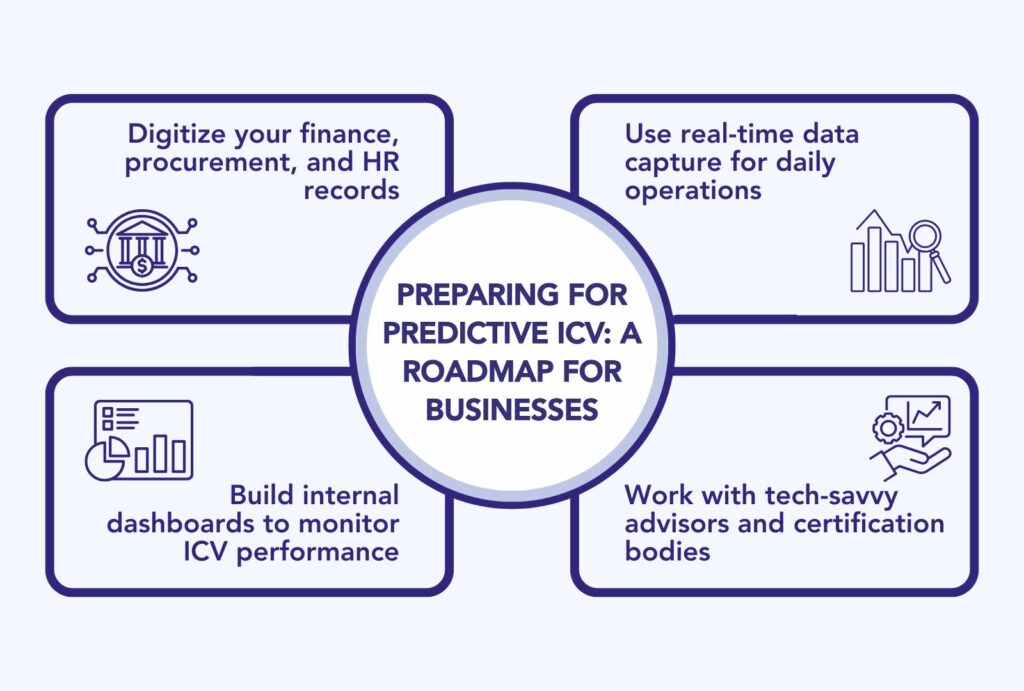
1. Digitize your finance, procurement, and HR records

If your documents are still sitting in drawers or Excel files, it’s time for a change. Predictive ICV certification needs digital data. So make sure everything, from invoices to payroll, is easy to access online. This is the first step if you’re asking how to get ICV certificate in UAE.

2. Use real-time data capture for daily operations

Manual entries just won’t cut it anymore. For the ICV certificate in UAE, businesses need to show updated figures, not last year’s reports. Whether it’s your supplier spending or Emirati hires, tracking it live makes a huge difference in your ICV audit.

3. Build internal dashboards to monitor ICV performance

Don’t wait for the end of the year to find out your score. Dashboards help you track your ICV numbers as you go. You can even predict your score before applying for ICV certification services from approved ICV certifying bodies.

4. Work with tech-savvy advisors and certification bodies

This isn’t something you should do alone. Look for experienced ICV certificate providers in UAE who understand the digital tools and the ICV certification process. They’ll guide you, tell you what to fix, and even help reduce your ICV certificate cost.

With the UAE Ministry of Industry and Advanced Technology pushing new digital use cases for ICV now is the right time to act. Whether you’re aiming for an ICV certificate in Dubai, Abu Dhabi, or anywhere else, the process is going to lean more and more on real-time, digital data.

So if you’ve been wondering about the ICV certificate meaning or who the best ICV certification bodies in UAE are, just know this: digital readiness is no longer optional, it’s a necessity.

Risks and Ethical Concerns in AI-Driven ICV

Now that AI is slowly getting into the ICV automation, it’s worth thinking about what that actually means. ICV automation is supposed to make things easier, quicker, and more accurate, but it’s not all as simple as it sounds.

There’s a flip side too. Things like privacy, data misuse, and how fair or unfair the scoring could be, these are things businesses need to think about before jumping into the Automated ICV certification.

1. Data security and confidentiality risks

One of the biggest concerns with AI-based ICV certification services is data privacy. Companies submit highly sensitive data, like financial reports, payrolls, and supplier contracts, to ICV certifying bodies in UAE. If this data is processed using AI tools, there’s a risk of breaches if security protocols aren’t up to the mark.

According to the OECD, AI systems handling business data must meet high standards of security and accountability. This is especially relevant when dealing with real-time ICV audits and cloud-based platforms.

2. Potential biases in AI scoring algorithms

AI systems learn from past data. If that data has biases, whether in how ICV certificate UAE scores were awarded in the past or how certain industries were evaluated, the algorithm might carry forward those same biases.

This could lead to unfair or uneven scoring across companies, even if their local value contributions are similar. As the World Economic Forum highlights, fairness and inclusiveness should be at the core of AI applications, particularly in governance-related areas like national compliance programs.

3. Need for transparency and auditability of predictive models

When AI is used to predict a company’s ICV score based on early financials or operational data, it’s essential that the process is transparent. Businesses should be able to understand how their score was generated and be given a chance to challenge or verify it.

This level of auditability is necessary to maintain trust in the ICV certification process in UAE. It also helps align AI tools with broader digital ethics principles, clarity, explainability, and fairness.

Recommendations for Businesses to Mitigate Risks

To move toward smart ICV certificate systems while keeping ethical standards intact, companies can take a few proactive steps:

  • Secure your data: Make sure that any digital tool or ICV certificate provider in UAE you work with uses strong encryption and follows data protection regulations.
  • Ask about AI fairness: If a provider offers AI-based predictive scoring, ask how their model is trained and whether they test for bias across sectors or business sizes.
  • Keep a manual backup: Even with automation, maintain a paper trail or digital log of your ICV audit data in case there’s a need for review or clarification.
  • Stay informed: Follow updates from MoIAT and trusted global sources like OECD and WEF to understand ethical trends and compliance expectations in AI.

Adopting AI in ICV certification UAE can bring major benefits, but only if it’s done responsibly. Balancing innovation with ethical practices is what will help businesses succeed in the long run.

The Competitive Advantage: First Movers in Predictive ICV Scoring

Future of ICV in the UAE: AI, Automation, and Predictive Scoring

In a landscape where speed and insight drive success, being early to adopt predictive ICV scoring can turn into a long-term strategic advantage.

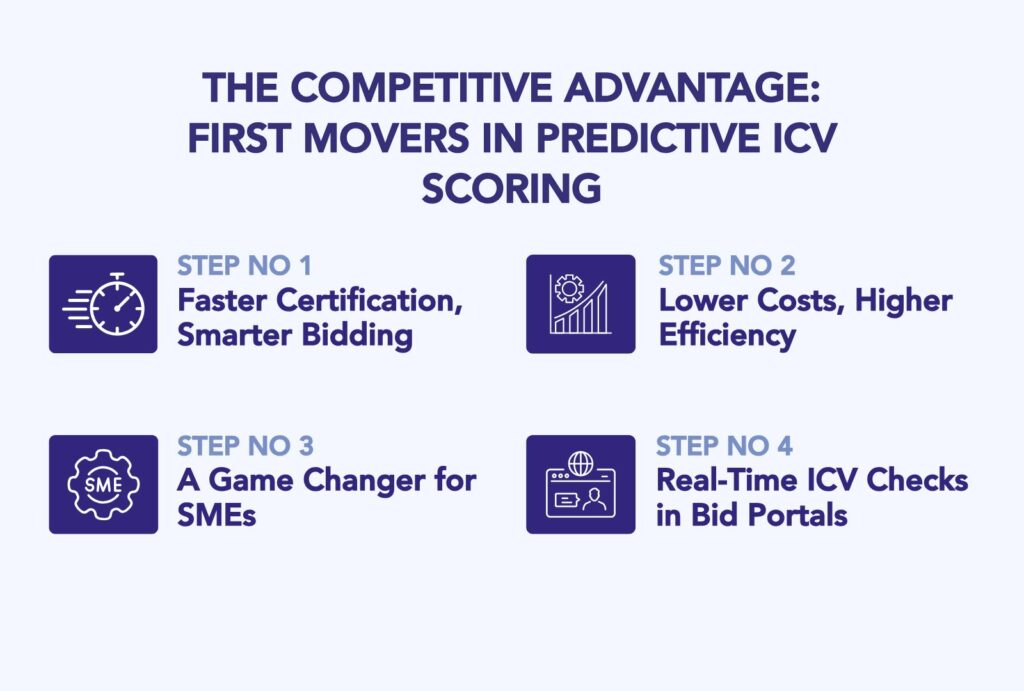
Faster Certification, Smarter Bidding

Getting ahead of the curve with predictive ICV scoring could give businesses in the UAE a serious edge, especially with how fast things are changing under the national ICV program. Companies that move early into this smarter approach won’t just get certified faster, they’ll likely cut down costs and get their bids in front of the right eyes quicker, too.

Lower Costs, Higher Efficiency

Early adoption means less time stuck gathering documents and more time focusing on strategy. And when ICV certification in UAE becomes part of real-time eligibility checks, those already plugged into predictive tools could automatically qualify for bids as soon as tenders go live.

A Game Changer for SMEs

For small and mid-sized businesses, this kind of head start is massive. Competing with larger companies is already tough, but shaving off delays and being ready to respond faster levels the playing field a bit. ADNOC’s focus on local supplier growth through its In-Country Value strategic goals shows there’s room for all.

Real-Time ICV Checks in Bid Portals

The shift toward automated ICV scoring could mean bid portals in the future will check your ICV score on the spot, no paperwork needed. And companies that got in early will already have systems in place, making the process smoother while everyone else scrambles to catch up.

ADEPTS; Your Trusted Partner in ICV Transformation

At ADEPTS we specialize in helping UAE businesses confidently navigate the ICV certification landscape. Whether you’re applying for your first ICV certificate in UAE or aiming to boost your existing score, our advisory and consulting services are designed to make the process more strategic and less stressful.

With expertise in ICV scoring, we don’t just focus on compliance, we focus on giving you a competitive edge. From optimizing your supply chain inputs to guiding your digital transformation, we prepare you for the future of predictive ICV. As the UAE moves toward data-driven industrial policies, we ensure you stay one step ahead, with both innovation and accountability.

Conclusion: Shaping the Future — ICV Beyond Compliance

As the ICV program in UAE evolves, the shift toward predictive and AI-enhanced scoring opens up a new world of opportunities, and challenges. It’s no longer just about meeting procurement requirements. For forward-thinking companies, In-Country Value is fast becoming a signal of operational resilience, digital maturity, and long-term competitiveness.

Embracing predictive ICV scoring isn’t just a smart move, it’s a strategic one. Businesses that adapt early can unlock faster certification cycles, higher bid win rates, and greater cost efficiencies.

The question now is simple: Is your business ready to move beyond compliance and lead in the next chapter of ICV?

FAQs:

AI will improve the accuracy of ICV certification by reducing human error and flagging inconsistencies early. Still, final approval depends on clean documentation and validation from recognized ICV certifying bodies and ICV certificate providers in UAE.

Predictive scoring will speed up parts of the ICV certification process, but it won’t replace full audits. ICV certificate decisions still require human oversight and documentation review by official ICV certification bodies in UAE.

Businesses should invest in smart ERPs, cloud-based accounting, and real-time tracking to strengthen their ICV certificate in UAE. Clean data and automation are key to streamlining the ICV certification process and improving scoring outcomes.

Not mandatory yet, but it may become standard. Real-time data helps ICV certificate providers in UAE assess a company’s performance more accurately, making it easier to meet evolving ICV certification UAE expectations in less time.

SMEs can use low-cost tools to automate cost tracking and HR reporting, helping them improve their ICV certificate UAE scores. Automation narrows the gap and helps them compete more confidently in the ICV certification process.

While there aren’t direct grants, digital transformation often lowers ICV certificate cost and shortens the audit time. Early adopters also gain a competitive edge when applying for ICV certification services or public contracts.

Without strong security, your ICV certificate in Dubai data could be exposed to breaches. Businesses must secure their digital systems before shifting to predictive tools for ICV certification or sharing sensitive records online.

A strong ITTI score could improve your ICV certificate Abu Dhabi standing. It reflects a company’s commitment to tech innovation, which will likely become a key part of how ICV certification UAE is evaluated in the future.

References

Related Articles​​

Transfer Pricing: A Comprehensive Guide

So, what is UAE transfer pricing? 


It’s basically the price that companies within the same group charge each other when they buy or sell things, like goods, services, or even the use of a brand name. The idea is to keep things fair and make sure those prices match what unrelated companies would charge in similar situations. 


The UAE tax landscape has undergone a seismic shift as the era of leniency has officially closed. Active enforcement and substantive audits are now the cornerstone of compliance.


Why does this matter? Well, following the UAE transfer pricing rules helps businesses avoid trouble, like audits or big fines. It also shows that you’re running things properly and staying transparent with your taxes.


As of February 2026, the FTA has moved from an educational phase to active enforcement, where businesses no longer face “warnings” but automated administrative penalties for non-compliance. 


Transfer pricing is now the primary tool used by the FTA to prevent profit shifting.


With the FTA’s Strategy 2023–2026, audits are no longer just about checking boxes—they’re now risk-driven and data-led. As part of this shift, the first wave of substantive audits is already underway, focusing on businesses within Dubai’s DIFC, Abu Dhabi’s ADGM, and mainland entities.


In this blog, we’ll walk you through what UAE transfer pricing is all about. We’ll also explain why things like benchmarking analysis, transfer pricing, and proper paperwork matter.

Understanding the Basics of UAE Transfer Pricing

What is Transfer Pricing?

Let’s look at the meaning of the term transfer pricing. Transfer pricing is when two companies that are part of the same group, like a parent company and its subsidiary, buy or sell things from each other. It could be products, services, or even using each other’s brand name.


Even though these companies are connected, the law says they have to deal with each other as if they’re not. This is called the arm’s length principle. It means the prices they use should match identical prices two independent parties would agree upon in the open market, substantiated by local or regional comparables. To make sure the prices are fair, the interquartile range (25th to 75th percentile) is often used to validate whether the prices are within an acceptable range.


For example, a company in the UAE makes mobile phone covers. It sells some of those covers to its parent company in another country. The UAE company has to charge a price that’s close to what it would charge a normal, unrelated customer—not too high or too low, but there’s a risk of automatic upward tax adjustments if the transaction falls outside the interquartile range. This way, both companies report fair profits and pay the right amount of tax in their countries.

Connected Persons vs. Related Parties

In 2026, transactions with “Connected Persons” (owners, directors, and their relatives) are a critical focus for the FTA, particularly for UAE Family Offices. It’s important to note that the burden of proof is on the taxpayer to demonstrate that legitimate commercial reasons fully explain any deviation from the arm’s length range.

Who needs to comply?

If your company does business with related parties—like group companies, subsidiaries, or sister companies—then UAE transfer pricing rules apply to you, no matter how big or small your business is.


But when it comes to keeping special documents (called a Master File and Local File), there are specific conditions:

  • You need to prepare a Local File if:
    • Your business has AED 200 million or more in annual revenue, OR
    • You’re part of a group that earns AED 3.15 billion or more globally (based on the group’s consolidated financial statements).
  • A Master File must be prepared by the group if it crosses the AED 3.15 billion global threshold.
  • In addition, businesses must also assess whether they meet the AED 40 million threshold for filing the mandatory Transfer Pricing Disclosure Form (TPDF).

These rules often affect:

  • Qualifying Free Zone Persons (QFZPs) seeking to maintain their 0% corporate tax rate, especially when trading with related parties inside or outside the UAE
  • Free zone companies that trade with related parties, inside or outside the UAE
  • Multinational groups with branches or companies in other countries
  • Family-owned groups where multiple businesses are under the same ownership

A key 2026 risk to be aware of: failure to maintain proper transfer pricing documentation can lead to the automatic loss of QFZP status, resulting in a 9% corporate tax being applied on the entire taxable income—even if qualifying activities are met.


So, if your company is part of a group and regularly does business with related companies, you must follow transfer pricing rules, and you may also need to keep the required documentation.

Summary of 2026 Compliance Thresholds

Requirement Trigger/Threshold 2026 Deadline/Standard
TP Disclosure Form Aggregate Related Party Transactions > AED 40M Within 9 months of the year-end
Connected Person Schedule Payments to a Connected Person > AED 500,000 Annually, with the Tax Return
Local File UAE Entity Revenue ≥ AED 200M Within 30 days of the request
Master File Group Global Revenue ≥ AED 3.15B Within 30 days of the request
CbC Reporting Group Global Revenue ≥ AED 3.15B Within 12 months of the fiscal year-end

Key Legislation and Guidelines

So, where do these rules come from?


Corporate Tax Law Federal Decree-Law No. 47 of 2022 explains the main law for UAE transfer pricing. It explains how related companies should set prices when doing business with each other. Federal Decree-Law No. 17 of 2025 (amending Tax Procedures) and Federal Decree-Law No. 16 of 2025 (amending VAT Law) have significantly modified the original 2022 framework. Cabinet Decision No. 44 of 2020 also talks about rules for Country-by-Country Reporting.


The UAE Ministry of Finance gives official guidance and updates to help businesses understand and follow the UAE transfer pricing rules. These updates are shared on their website.


The UAE also follows the OECD transfer pricing guidelines. This means companies need to use international best practices when setting prices between related parties.


Moreover, the Ministry of Finance also provides constant updates and guidance. The main aim is to assist the businesses and understand the UAE transfer pricing rules better, like;

  • when you need to have documentation, 
  • how to apply the arm’s length principle, 
  • and what kind of records to keep.

This is why the companies should stay updated on their announcements for any new clarifications.


Additionally, Ministerial Decision No. 97 of 2023 is the governing rule for documentation.


The 2025/2026 amendments introduced a “hard five-year deadline” for claiming tax credits and refunds, directly impacting how businesses manage transfer pricing adjustments and subsequent tax overpayments.

Apart from this, the UAE follows the OECD Transfer Pricing Guidelines, which are widely used around the world. These guidelines explain how to set fair prices between related companies and how to document everything properly. By aligning with the OECD rules, the UAE is showing that it’s serious about transparency and fair taxation—just like many other countries.

Unified Guidance Mechanisms

The FTA now issues official and binding directions to unify the interpretation of tax laws and reduce handling risk for multi-jurisdictional groups.

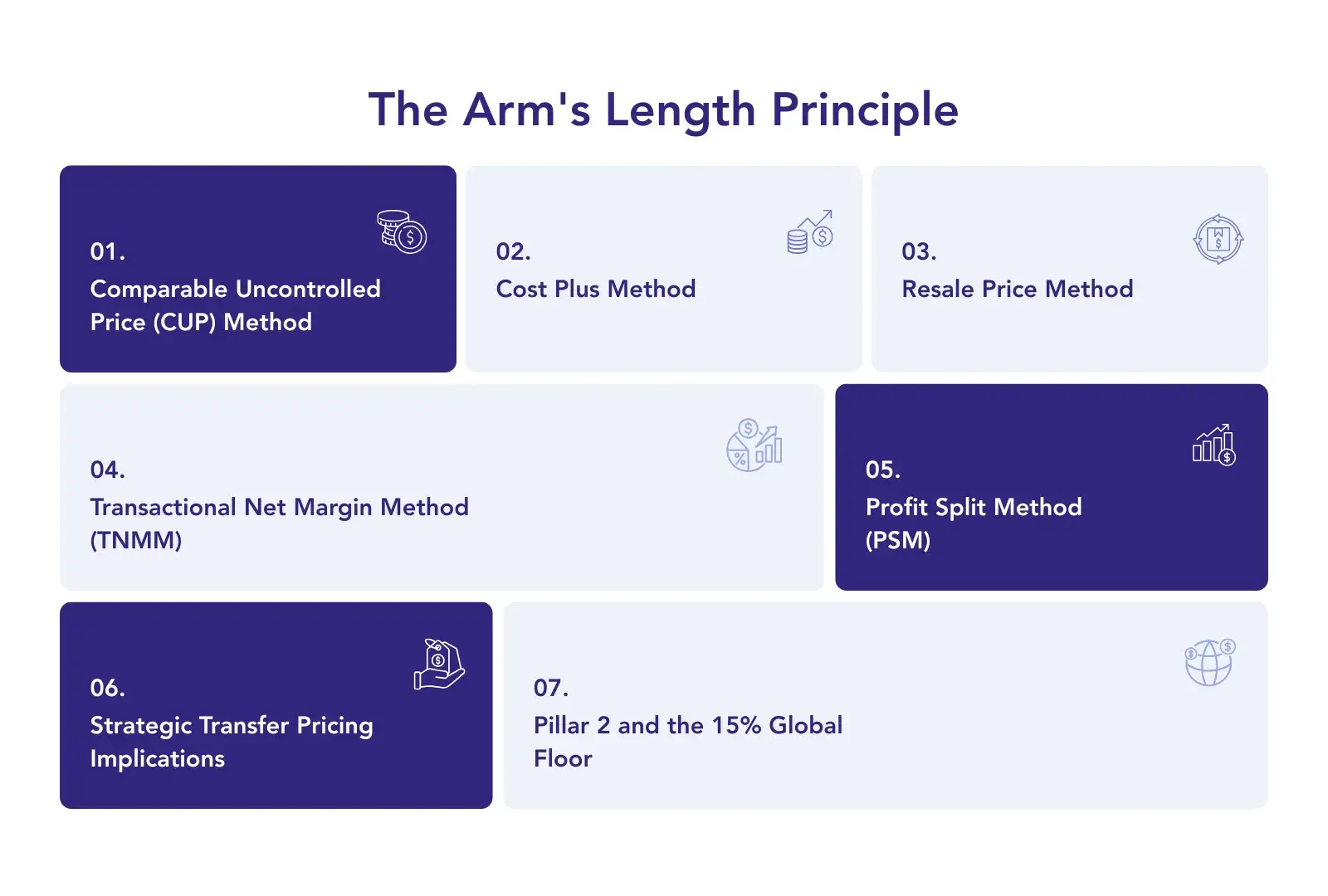
The Arm's Length Principle

Let’s understand the Arm’s Length Principle in a little detail. Here are the different methods to check if your transfer pricing is fair or not.

Comparable Uncontrolled Price (CUP) Method

Comparable Uncontrolled Price (CUP) is a way to check if your UAE transfer pricing is fair or not.


In this method, you compare the price charged in a deal between two related companies to the price charged in a similar deal between two companies that aren’t related. If the prices are more or less the same, you’re good. If they’re too high or too low, it might raise a red flag.


The FTA now utilizes real-time data from the e-invoicing system to cross-check transactional data, making the CUP method more enforceable than ever before. 


This means that the FTA can directly access transaction-level data, making comparisons more accurate.


While “hard to find matches” used to be a standard excuse, the 2026 digital infrastructure enables the FTA to see transactions in real-time, and internal comparables (deals with independent parties by the same company) are now the first point of audit scrutiny.


Strengths:

  • It is direct and easy to understand.
  • If you find a close match, it gives a strong case that your pricing is fair.

Weaknesses:

  • It may be hard to find an exact comparison as the product, terms or conditions may not be the same.
  • Even small differences of volume or location can make the comparison tricky.

For example, a UAE-based company sells mobile phones to its sister company in another country. The CUP method would mean comparing that price to what the same company charges independent customers in the UAE for the same phones. If the prices match, the charged prices are fair.

Cost Plus Method

The Cost Plus Method is another way to check if your transfer pricing is fair.


In this method, you start with the actual cost of making a product or providing a service. 


Then, you add a profit margin that is similar to what an independent company would charge in a similar situation. This gives you the final price you charge your related party.


It works best when:

  • You’re in manufacturing and selling goods to a related company, including contract manufacturing vs. toll manufacturing classifications, which determine different arm’s length profit margins.
  • You’re offering services, like IT, logistics, or admin support, to a group company.

For example,a UAE company is providing IT support to its parent company abroad.

  • The cost of the IT service is AED 100,000.
  • Common profit margin in the market is 10%.
  • Therefore, the final price would be AED 100,000 + 10% = AED 110,000.

That’s your benchmarking analysis transfer pricing—using the cost plus approach.


For 2026, the FTA expects a detailed breakdown of costs. “Clear cost records” are mandatory, and a failure to allocate overheads correctly can lead to a denial of deductions.

Resale Price Method

The Resale Price Method works a little differently. Instead of starting with the cost, you work backwards from the price at which a product is resold to an independent customer.


Here’s how it goes:

  • Start with the final selling price—what the product is sold for to an independent customer outside the group.
  • Then, subtract a gross profit margin that is similar to what an independent reseller would earn for doing their part (like storage, marketing, delivery, etc.).
  • What’s left is the arm’s length price that should have been paid to the related party who originally sold the product.

It’s important to note that the “gross profit margin” must reflect the local UAE market conditions. The FTA is skeptical of margins taken from European or US databases without specific “regional adjustments” for the Middle East market.


Let’s say a UAE-based distributor buys electronics from its parent company abroad and sells them locally.

  • The selling price to independent customers is AED 1,000 per unit.
  • Gross profit margin for distributors in this industry is generally 25%.
  • AED 1,000 – 25% = AED 750.

That AED 750 would be considered the arm’s length purchase price from the parent company, according to the resale price method.

Transactional Net Margin Method (TNMM)

The Transactional Net Margin Method, is about looking at net profit instead of gross profit.


Instead of focusing on the price of a single product or service, TNMM checks if your company’s overall profit margin is in line with what similar independent businesses are earning. It compares your net profit (after expenses) to something like sales, costs, or assets.


TNMM is the “most used method in 2026” due to its flexibility but requires a robust rejection analysis in benchmarking studies.


This method is really helpful when you don’t have detailed data about individual transactions or gross margins—especially for service providers or businesses with lots of operating costs.


Let’s say a UAE-based marketing company is providing services to a related party abroad.

  • You check the net profit margin of your business—maybe it’s 12%.
  • Then, you compare that to other independent marketing companies in the same region.
  • If they’re earning between 10% to 14%, you’re within range. That means your pricing is likely in line with the arm’s length principle

The FTA now checks the Net Profit Margin against industry peers. If a business reports consistent losses while peers are profitable, TNMM will likely trigger an audit.


That’s how a benchmarking study on transfer pricing works using TNMM—you’re checking if your profits are normal compared to others in the market.

Profit Split Method (PSM)

The Profit Split Method, or PSM, is used when two or more related companies are working closely together—like they’re part of the same team.


Instead of treating their work separately, PSM looks at the total combined profits from their joint activity and then splits those profits based on how much each one contributed.


This method is mandatory for highly integrated operations involving Qualifying Intellectual Property (IP).


This method is great when:

  • The companies are highly integrated,
  • Or they’re dealing with unique things like intellectual property or software,
  • And it’s hard to figure out who should charge what.

Let’s say a UAE tech company and its related company abroad are working together to develop a new app.

  • One team handles design, the other does the coding.
  • The app is launched and earns AED 1 million in profit.
  • They don’t invoice each other—they just split the profit based on their contributions.
  • Maybe the UAE team did 60% of the work, so they get 60% of the profits.

That’s how transfer pricing works under PSM—it’s all about dividing the profits fairly, based on what each company brings to the table.

Strategic Transfer Pricing Implications

UAE Transfer pricing isn’t just about staying compliant, it can also be a smart business tool if used right.

1. Impact on Supply Chains

UAE Transfer pricing decisions affect how goods and services move within your group. If you  set prices without thinking of the full picture, you might end up paying more tax in one country and less in another—causing issues down the road.


So, it’s important to plan your pricing to keep the supply chain efficient and tax-smart, especially in light of real-time digital reporting facilitated by e-invoicing, which allows the FTA to cross-check pricing data and ensures that pricing adjustments are consistent across jurisdictions.

2. Entity Structuring

How your group is set up—whether you’re working through a free zone entity, a mainland office, or several subsidiaries—can change how UAE transfer pricing rules apply to you. The way you structure your entities can open or close doors in terms of tax benefits, especially under the benchmarking analysis transfer pricing approach.


Additionally, consider the implications of the Domestic Minimum Top-Up Tax (DMTT), which ensures a 15% minimum tax for large groups. This new rule means that your transfer pricing strategy must align not only with UAE law but also with global tax positioning.

3. Value Chain Planning

By looking at your entire value chain, you can use benchmarking transfer pricing to make sure each entity in the group is earning a fair share based on what they actually do. This kind of planning helps prevent any part of the business from being over- or under-compensated.

4. Aligning with Global Tax Planning

Benchmark analysis transfer pricing isn’t just a local matter. If you’re part of a multinational group, you’ll want your UAE transfer pricing documentation to match your global tax strategy. That way, you’re covered in every country where your group operates.

5. Preventing Future Disputes

When your pricing is backed by a solid benchmarking study transfer pricing, you’re less likely to face questions or penalties from tax authorities. It’s a proactive step that keeps your business on the safe side of the law. You can also secure tax certainty for 3–5 years through a Unilateral Advance Pricing Agreement (UAPA), which ensures peace of mind and clarity on pricing strategies.

Pillar 2 and the 15% Global Floor

With the rollout of Pillar 2 and global minimum tax standards, the UAE transfer pricing framework now interacts with 15% minimum tax requirements for large multinational groups. This requires businesses to adapt their pricing strategies to ensure they meet these global tax standards.

Documentation Requirements: Transfer Pricing Report and Master File

Here are the documents required

Transfer Pricing Report

The Transfer Pricing Report is an important document that proves your business is following the UAE transfer pricing rules correctly. It shows the Federal Tax Authority (FTA) that you’ve charged fair prices in related-party transactions, chosen the right benchmarking analysis transfer pricing method, and stayed aligned with the arm’s length principle.

This report includes key details like:

  • Basic company information
  • A list of all related-party transactions
  • The UAE transfer pricing method used (such as CUP or TNMM)
  • A well-done benchmark study transfer pricing
  • Financial data explaining how the prices were set

Although you don’t need to submit this report when filing your tax return, it must be ready by the deadline in case the FTA asks for it.

Master File and Local File

Alongside the report, some businesses also need to prepare a Master File and a Local File.


The Master File gives a high-level overview of your entire multinational group. It covers global operations, business activities, and the group’s overall UAE transfer pricing policies.


The Local File focuses specifically on your UAE entity. It includes the details of your related-party transactions, the transfer pricing methods used, and the financial logic behind those prices.


The Local File must be provided to the FTA within 30 days of a request, and no extensions are generally granted in 2026.


You must prepare these files if your UAE business has revenue of AED 200 million or more in a financial year.

Country-by-Country (CbC) Reporting

CbC Reporting is for large multinational groups. It helps tax authorities around the world exchange key financial information to make sure taxes are being paid where the value is actually created.

If your group’s total revenue is more than AED 3.15 billion in a financial year, you’ll need to submit a CbC Report. This report includes:

  • Revenue earned
  • Profit before tax
  • Number of employees
  • Taxes paid in each country the group operates in

It gives tax authorities a clearer picture of how your business operates across borders.

Contemporaneous Records

In 2026, documentation must be prepared when the transaction occurs, not when an audit starts. This means that you must keep detailed records of related-party transactions at the time they happen, not just when the FTA initiates an audit.

2026 Documentation Checklist

For your convenience, here’s a quick checklist for 2026:

  • Master File
  • Local File
  • Transfer Pricing Disclosure Form (TPDF)
  • Intercompany Agreements
  • Benchmark Reports

Even if thresholds are not met, the taxpayer still carries the burden of proof to demonstrate the arm’s length nature of transactions. The “30-day rule” does not leave enough time to prepare files from scratch.

Technology and Automation in TP Compliance

Technology is making UAE transfer pricing compliance a lot easier and more accurate. Many companies are utilising multiple software tools to automate the generation of Transfer Pricing Reports and make benchmarking analysis transfer pricing with minimum manual work. These tools also work with ERP systems, which allows businesses to track related-party transactions and pricing in real time.


By automating the process, companies reduce human errors, save on time, and respond to compliance needs. Moreover, data analytics allows easy assessment of transfer pricing risks by scoring transactions based on how likely they are to draw attention from tax authorities. 


This makes it easier for businesses to spot and fix potential issues before they become a problem.

The E-Invoicing (PINT-AE) Mandate

As part of the UAE’s push towards digital tax compliance, the PINT-AE e-invoicing rollout is now mandatory. This initiative is designed to streamline VAT and Corporate Tax reporting, significantly reducing the risk of errors and fraud.


The 5-corner model involves the following stakeholders:

  1. Supplier
  2. Supplier’s Accredited Service Provider (ASP)
  3. Buyer’s ASP
  4. Buyer
  5. Federal Tax Authority (FTA)

Starting with the Pilot phase on July 1, 2026, the system will be implemented for businesses with AED 50M+ revenue in Phase 1, which begins on January 1, 2027.


It is critical to note that manual PDF or Excel invoices will not qualify for tax validation in 2026/2027, and businesses must adopt e-invoicing for compliance.

Selecting an Accredited Service Provider (ASP)

To ensure compliance with the e-invoicing mandate, businesses must appoint a government-certified ASP to route invoices directly to the FTA. The ASP will serve as the conduit for transmitting and validating e-invoices, ensuring that all transactions meet the regulatory standards set by the FTA.

Sector-Specific Transfer Pricing Considerations in the UAE

Different industries in the UAE face different transfer pricing challenges.

Logistics

In the logistics sector, UAE transfer pricing often involves freight mark-ups and warehousing services provided between related companies. These prices need to be fair—just like if the businesses weren’t connected.


For businesses in Designated Zones, it’s important to focus on the logistics and distribution of goods in/from a Designated Zone to maintain QFZP status. Ensuring proper pricing between related parties can help preserve the 0% corporate tax rate.

Tech and IP

In the tech and intellectual property (IP) space, transfer pricing usually covers royalties, licensing fees, and platform or software sharing. The charges should match what unrelated companies would typically agree on.


When it comes to Qualifying Intellectual Property (IP), companies must meet functionality tests for patents/copyrighted software. The FTA has heightened scrutiny on these areas in 2026 to ensure that IP valuations align with industry standards and that profits are fairly allocated based on the economic contribution of the IP.

Professional Services

For professional service firms, cross-border project staffing is common. If one company sends employees to help another within the group, cost-sharing must be handled correctly to reflect real market value.


In 2026, “substance over form” has become a key focus. The FTA requires that cross-border employee transfers reflect the market value of the expertise being shared, not just the nominal cost of sending the employees.

Manufacturing

In manufacturing, knowing the difference between contract manufacturing and toll manufacturing is important. Both involve producing goods for a related party, and UAE transfer pricing rules help decide how profits should be shared based on who does what.


The FTA will now look closely at the resulting profit margins in these arrangements, ensuring that toll manufacturing profit margins are reflective of the risk and value added by each party, as compared to contract manufacturing.

Internal Controls and Risk Management

Risk management must now be presented as a “Governance Operating System”. Proactive governance is essential because, from 2026, the cost of self-correction (1% per month) is significantly lower than the cost of an error detected during an audit (15% fixed + 1% per month).

Embedding TP into the Group Operating System

Having a strong systematic internal control ensures that transfer pricing practices are being followed. It is important to embed TP into your company’s Group Operating System and integrate TP checks into your overall governance processes and internal audits to catch potential issues early. This ensures that your transfer pricing is aligned with broader corporate risk management strategies.

Training Finance Teams

Training the finance teams helps identify and minimize any transfer pricing risks. With the right knowledge, they can spot issues before they become significant problems, ensuring the company stays on track.

Developing a TP Risk Scoring Matrix

A TP risk scoring matrix helps prioritize and address risks based on their severity. This tool helps companies identify which issues need immediate attention and where resources should be focused.

Audit Defense and Compliance

Audited Special Purpose Financial Statements are now required for Tax Groups that exceed consolidated income thresholds. These statements are essential for demonstrating compliance and addressing any discrepancies proactively.

Anti-Evasion System Implementation

The “knew or should have known” standard for tax evasion now applies to input tax recovery, requiring businesses to implement comprehensive systems to detect and prevent tax evasion. This adds another layer of compliance for businesses to ensure their operations are transparent and within legal bounds.

2026 Audit Defense Checklist

To stay ahead of audits, businesses should adopt the following best practices:

  • Segregation of duties
  • Approval workflows
  • Audit logs

By embedding these practices into your governance framework, you ensure that your transfer pricing and tax management systems are robust and compliant with the latest requirements.

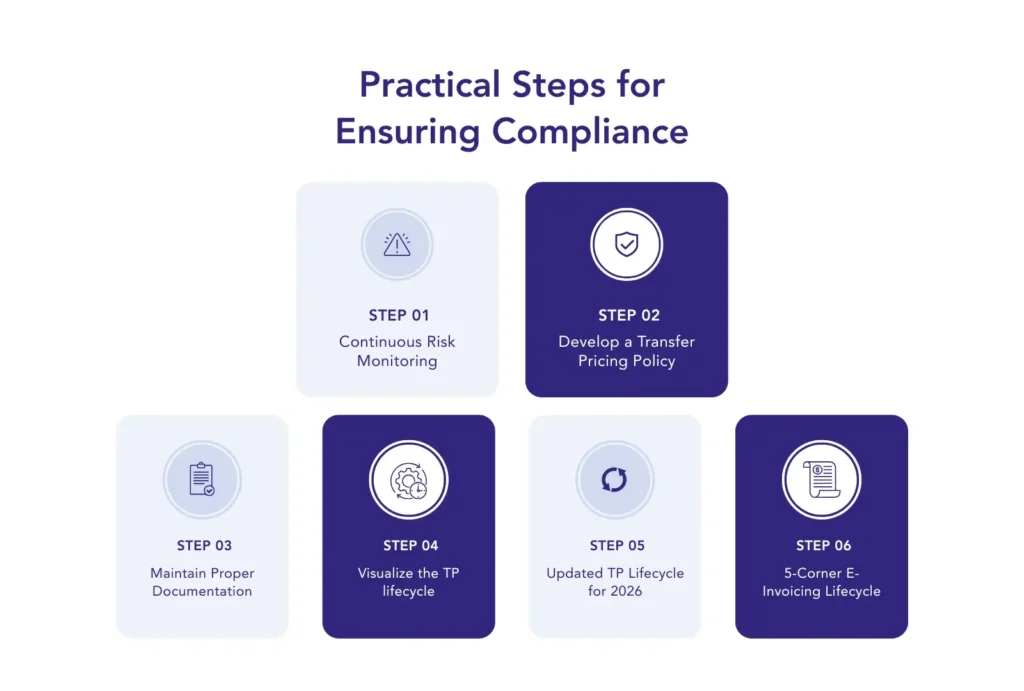
Practical Steps for Ensuring Compliance

To stay compliant with transfer pricing rules, businesses should follow a few simple steps.

Continuous Risk Monitoring

Instead of just conducting a one-time transfer pricing risk assessment, businesses must now focus on continuous risk monitoring using real-time transactional data. This is done by checking the intercompany agreements to ensure they match the actual practices between related companies. If the agreements don’t match reality, it could be a problem. It’s also important to do benchmarking studies to compare prices with market rates and make sure they follow the arm’s length principle.

Develop a Transfer Pricing Policy

Having a written transfer pricing policy is an important step to ensure compliance as it is a constant reminder for the employees. In fact it shows that a company is committed to staying compliant with the rules.

A good policy should include:

  • The method being used for transfer pricing 
  • Clear pricing guidelines to ensure the prices are fair
  • Clear roles and responsibilities for the involved employees

Moreover, it is important to regularly review and update the policy to keep it aligned with any changes in laws or business practices.

Maintain Proper Documentation

Keeping detailed records is a must for UAE transfer pricing compliance. These records help prove that your transactions follow the arm’s length principle.

Organizing all your documents neatly ensures that if there’s an audit, everything is easy to find and ready to show.

You can also use tech tools to help. Many companies use software to automate their documentation and keep everything up to date with less effort.

Visualize the TP lifecycle

  1. Start by identifying all related-party transactions. Choose the right transfer pricing method and set up intercompany agreements.
  2. Apply the selected method to set fair prices for goods, services, or intangibles exchanged between group entities.
  3. Check if your prices match what independent parties would charge. This usually involves a [benchmarking study].
  4. Prepare the Transfer Pricing Report, Master File, and Local File to prove you followed the rules. Keep everything documented.
  5. Be ready to explain and justify your pricing if the tax authority asks. Your documentation and analysis should support your case.

Updated TP Lifecycle for 2026

With active digital monitoring, the TP lifecycle has evolved to include:

  • Digital Pricing
  • Real-Time Testing
  • Automated Reporting
  • Audit Defense

In 2026, “year-end adjustments” are no longer the preferred method; “in-year adjustments” based on real-time data are the new gold standard for ensuring compliance.

5-Corner E-Invoicing Lifecycle

  • Supplier
  • Supplier’s Accredited Service Provider (ASP)
  • Buyer’s ASP
  • Buyer
  • Federal Tax Authority (FTA)

The integration of e-invoicing ensures that transfer pricing compliance is continually monitored using real-time transactional data, making it easier for businesses to maintain accurate documentation and defend against audits.

Penalties for Non-Compliance and Dispute Resolution

Not following UAE transfer pricing rules can lead to serious consequences.

Penalties for Non-Compliance

Transfer pricing is not something you can afford to take lightly. If your company fails to follow the rules, there are real consequences.

  • Missing documentation deadlines?
  • Using the wrong pricing methods?
  • Not keeping records at all?

Dispute Resolution Mechanisms

Having UAE transfer pricing problems may result in serious disputes with tax authorities. Hence you should know your options if something goes wrong.

  1. Mutual Agreement Procedure (MAP)

This lets tax authorities from different countries talk to each other and come up with a solution. It helps you avoid paying double taxes on the same income.


     2.  Advance Pricing Agreement (APA)


This is a deal you make with the tax authority ahead of time. You both agree on how to set your transfer prices for certain transactions. It gives you clarity and reduces the chance of future problems.

It’s also a good idea to talk to a tax advisor early. Getting the right advice at the start can help you avoid mistakes, stay compliant, and handle any disputes with confidence.

Then vs. Now: Penalties Comparison

Penalty Type Before (Old Framework) Now (2026 Framework)
Late Payment Penalty 2% + 4% compounding 14% annualized interest, accrued monthly
Voluntary Disclosure Penalty 5%–40% based on the tax difference 1% per month on the tax difference
Audit Notice Penalty N/A 15% fixed penalty + 1% monthly interest
Arabic Document Failure Penalty AED 20k AED 5k

Conclusion

2026 marks the inflection year where tax compliance meets real-time digital accountability. UAE transfer pricing regulations are detailed and require serious attention. It is important to be clear on the arm’s length principle and prepare the right documents. Every step plays a role in proving compliance. Non-compliance with the rules, can cause penalties, audits, and even reputational damage.


As the UAE continues aligning with global tax standards, staying informed and proactive is more important than ever. The April 14, 2026 penalty transition and the January 2027 e-invoicing deadline are key milestones to remember.


So, don’t wait for a tax notice to start taking action. Shift from just getting by to audit defense. Stay updated on the latest changes, review your transfer pricing policies regularly, and seek professional guidance when needed.


And If you still need help with your UAE transfer pricing compliance, then Adpets is here to support you every step of the way.


Reach out for a Health Check or Audit Readiness Assessment to ensure your business is prepared for the future of transfer pricing compliance.

FAQs:

The Domestic Minimum Top-Up Tax (DMTT) ensures that large multinational enterprises (MNEs) with global revenue exceeding EUR 750 million meet a minimum tax rate of 15%. For businesses operating in the UAE, this means transfer pricing adjustments must be made to align with the global minimum tax requirements. MNEs need to assess their transfer pricing policies to ensure compliance with both local and international standards under the OECD/BEPS 2.0 framework.


In 2026, businesses can apply for a Unilateral Advance Pricing Agreement (UAPA) with the UAE tax authority to establish pricing terms in advance for related-party transactions. The fee for applying for a UAPA is AED 30,000, and the consultation phase typically takes between 6 to 9 months. This process provides clarity on transfer pricing and helps mitigate the risk of disputes with tax authorities.


Yes, if your business exceeds the AED 3 million revenue threshold at any point, you permanently lose your Small Business Relief (SBR) status. This rule applies even if the threshold is exceeded just once. After this, your business will be subject to corporate tax at the applicable rate, so it’s important to plan accordingly for the 2026 tax period, as SBR relief will end for businesses exceeding this threshold after December 31, 2026.


The five-year rule for legacy VAT credits in 2026 refers to the requirement that unclaimed VAT credits can only be carried forward for up to five years from the initial period they were incurred. After this period, VAT credits will expire and cannot be used to offset VAT liabilities. Businesses need to ensure they have claimed all applicable VAT credits before the expiration deadline in 2026.


The PINT-AE format is the mandatory e-invoicing format required by the UAE tax authorities for all VAT-registered businesses starting July 1, 2026. This format standardizes invoice submissions and ensures automated validation of transaction data through the FTA’s e-invoicing system. The PINT-AE format is crucial for ensuring compliance with UAE tax laws and reducing audit risks by aligning with the country’s digital tax reporting framework.

Transfer pricing planning helps allocate profits in a way that complies with local tax regulations when entering new markets. By using methods like benchmarking analysis transfer pricing, businesses ensure that intercompany transactions are priced at arm’s length, avoiding tax issues and optimizing cross-border operations.

Intercompany financing in UAE transfer pricing ensures that loans, interest rates, and guarantees reflect market conditions and the arm’s length principle. Benchmarking transfer pricing helps determine the appropriate terms for intercompany financing to maintain compliance with local regulations.

A business may be under scrutiny if the tax authorities notice discrepancies in pricing or documentation. To prevent this, businesses should conduct regular benchmark studies transfer pricing to ensure their methods align with the UAE transfer pricing rules.

Technology streamlines the UAE transfer pricing process by automating documentation and ensuring real-time compliance with local regulations. Using software for benchmarking transfer pricing and maintaining proper records reduces errors and ensures alignment with the UAE transfer pricing guidelines.

Cost-sharing arrangements under UAE TP rules must reflect each company’s contribution fairly and align with the arm’s length principle. A detailed benchmarking study transfer pricing ensures that cost allocation is consistent with market practices and compliant with local regulations.

Multilateral APAs include more than two countries, while bilateral APAs only include two. The UAE’s transfer pricing rules allow multilateral APAs, helping businesses follow global tax rules and feel more confident about their international deals.

Red flags include 

  • significant discrepancies between intercompany prices and market rates, 
  • incomplete documentation, 
  • and low-profit margins. 

Regular benchmarking studies transfer pricing can help identify issues early and ensure compliance with the UAE transfer pricing rules.

Transfer pricing helps decide the right price for buying and selling between companies in different countries. This affects how much VAT and customs tax is paid. In the UAE, using correct transfer prices makes sure the prices match market rates, so there are no problems with VAT or customs.

At year-end, businesses should compare actual results with arm’s length prices and make adjustments if necessary. These adjustments should be documented and justified through a benchmark study transfer pricing to ensure compliance with UAE transfer pricing regulations.

Losses in group entities can raise questions about pricing practices and profit allocation. Using benchmarking analysis transfer pricing helps ensure that the allocation of losses is consistent with the arm’s length principle, as per UAE transfer pricing rules.

Reference

Related Articles​​

The Role of AI in Financial Due Diligence: How UAE Businesses Are Leveraging Technology for Risk Assessment in 2026

Financial due diligence in the UAE is getting more complex. There’s more data. More rules. And higher expectations.


For business owners and investors, keeping up is a challenge. That’s where AI is making a big impact.


In 2026 marks the arrival of the mature enforcement era. If you want to buy a business in UAE, you must now deal with a procedural overhaul effective January 1, 2026, where the system has entered a decisive phase of data-driven compliance and AI-enabled audits.


In 2026, smart tools are helping companies dig deeper, move faster, and stay compliant. From spotting hidden risks to checking financial health, AI is changing the game.


This article breaks it down. We’ll look at how AI speeds up the process, improves accuracy, and keeps businesses on the safe side of the law. You’ll also see how different sectors in the UAE are putting it to work.

The 2026 Shift: Why Compliance is No Longer Negotiable

Grace periods are largely over. The UAE Federal Tax Authority (FTA) now uses cross-tax data analytics to compare VAT and Corporate Tax filings and flag inconsistencies automatically. The Audit Assessment Timeline 2026 has shortened review cycles, meaning businesses are audited faster and more frequently. Compliance is no longer reactive. It must be continuous and audit-ready.

Current Trends in AI Adoption in UAE Due Diligence

AI adoption in the UAE has picked up speed. Especially after the country’s grey listing by the FATF. That move pushed many businesses to take compliance more seriously. Financial due diligence in UAE is now under a sharper spotlight, and AI is stepping in to help.


This increased scrutiny is also tied to stricter enforcement of Corporate Tax and VAT rules in 2026, where missing key obligations—like the 90-day Corporate Tax registration deadline—now triggers a fixed AED 10,000 penalty.


The UAE government is also pushing hard for AI growth. With a national AI strategy and big investments in digital transformation, the ecosystem is ready. Tools powered by AI are becoming more common in finance, audits, and risk checks.


Generative AI and machine learning are two big players. They can scan documents, spot patterns, and detect red flags faster than any human team. That means quicker decisions, fewer mistakes, and stronger protection against fraud.


We’re also seeing the rise of RegTech—regulatory technology. Places like DIFC and ADGM are turning into innovation hubs. They’re backing startups and solutions that use AI to improve compliance, reporting, and risk monitoring.


At the same time, regulators themselves are using AI (SupTech) to monitor filings, enforce AML/CFT rules, and detect mismatches across tax data—raising the standard for due diligence across all sectors.


The message is clear: in the UAE, AI isn’t just a trend—it’s becoming the standard in financial due diligence.

How AI Powers Financial Due Diligence and Risk Assessment

How AI Powers Financial Due Diligence and Risk Assessment

AI doesn’t just make due diligence faster. It makes it smarter.

Anomaly Detection in Financial Statements

AI tools are great at spotting strange numbers. They scan balance sheets and income reports to find things that don’t add up—like sudden losses, hidden debts, or inconsistent revenue. It’s like having a digital auditor that never gets tired.


This is especially important in 2026, where authorities cross-check Corporate Tax and VAT filings—meaning even small inconsistencies can trigger audits under the new data-driven enforcement model.

Automated Risk Scoring and Red Flag Systems

AI can quickly score how risky a company is. It looks at past records, compliance history, and financial strength. If there’s a red flag—like tax issues or lawsuits—it shows up fast. This helps businesses make safer choices before signing a deal.


For buyers, this now includes checking whether the target met key deadlines such as the March 31, 2026 registration requirement for natural persons earning above AED 1 million. Missing this alone results in a fixed AED 10,000 penalty.

AML Pattern Recognition in Banking and Real Estate

AI plays a key role in fighting money laundering. It can spot unusual patterns in transactions, flag fake IDs, or catch layered transfers. This is critical in high-risk sectors like banking and real estate, where hidden money flows are a serious threat.


It also supports compliance with stricter AML/CFT obligations, including automated KYC checks and transaction monitoring, which are now expected as standard practice in 2026.

Real-Time Monitoring Tools for Fraud Prevention

AI doesn’t just work after the fact. Real-time monitoring tools track activity as it happens. If something seems off—like a strange payment or a sudden change in data—it sends an alert. You can act before real damage is done.


These tools are now essential due to the shift toward continuous compliance monitoring, especially with the introduction of e-invoicing systems starting July 2026.

AI’s Dual Role: Due Diligence vs. Ongoing Risk

AI helps at two stages. First, during due diligence—when you’re checking a business before a deal. Second, for ongoing risk—watching what happens after. This dual role makes AI a long-term asset, not just a one-time tool.


This is critical in 2026, as businesses must remain compliant post-acquisition, especially with VAT credit expiry rules and ongoing audit exposure.

Document Analysis and Automation

Document Analysis and Automation

Going through stacks of documents is one of the slowest parts of due diligence. But AI is changing that. It reads, sorts, and highlights key info in minutes—not days.


Here’s how UAE businesses are using it to save time and cut risks:

1. Smart Reading with NLP

AI can now read contracts and audit reports like a pro. It uses Natural Language Processing (NLP) to find key terms, risks, and hidden clauses. No more missing fine print. No more endless hours of review.


This is increasingly important as contracts must now account for tax indemnities, escrow protections, and successor liability risks under the 2026 framework.

2. Scanning Any Document, Any Language

Got scanned files? Handwritten notes? Documents in Arabic or English? No problem. AI uses OCR (Optical Character Recognition) to read everything clearly. It also works across languages—perfect for the UAE’s global business mix.


This also supports compliance with e-invoicing requirements, where structured digital formats will gradually replace traditional invoices.

Regulatory Push and Policy Drivers

The UAE isn’t just embracing AI—it’s building the rules to support it. Business owners are now seeing real policy action that makes AI safer, smarter, and more useful for due diligence and compliance.

A Friendly Space for AI Innovation

The UAE government has created a regulatory environment that welcomes AI. From free zones like DIFC and ADGM to national strategies, the message is clear: AI is a business tool, not a tech toy.

Post-COVID Guidance on AI and RegTech

After COVID-19, government bodies pushed digital transformation hard. New frameworks were released to guide the use of AI in audits, finance, and compliance. For businesses, this made it easier to adopt new tech—without waiting on approvals.

Sandboxing and Pro-AI Compliance Policies

“Regulatory sandboxes” now let companies test AI tools in a safe environment before launching. This means fewer risks and faster adoption. Add to that simplified compliance rules, and AI becomes easier to use—even for smaller firms.

AML/CFT Rules and KYC Automation

Fighting money laundering is now a top priority. The UAE has mandated strict AML and CFT checks. But here’s where AI helps: it automates Know Your Customer (KYC) processes, flags suspicious activity, and speeds up compliance reviews.


At the same time, tax regulation has matured. The system now enforces strict deadlines, including Corporate Tax filing deadlines (typically within 9 months of financial year-end) and VAT refund limitations under the new five-year rule effective January 1, 2026.

Sector-Specific Use Cases

Let’s consider a few sector-specific cases here:

A. Real Estate

The real estate sector in the UAE is booming. But with high-value deals and complex buyers, risk is always part of the game. That’s why developers are turning to AI to stay compliant—and stay ahead. However, due diligence now must include VAT treatment checks such as Transfer of a Going Concern (TOGC), where the buyer inherits historical VAT risks, and sector-specific rules like the Reverse Charge Mechanism for scrap metal transactions introduced in 2026.

  1. Smarter Source-of-Funds Checks
    AI tools now check where the money is coming from. Fast. They scan global databases, match names, and flag risky buyers. No more guessing. No more delays. You know who you’re dealing with before the deal moves forward.

  2. Real-Time Compliance for Big Transactions
    Dubai’s property market has seen record-breaking deals. With so much money moving fast, real-time compliance is critical. AI helps monitor transactions as they happen—so you stay within the law without slowing down the process.

  3. Case Study: Developer Adoption in Action
    Real estate developers in the UAE are already leading the way. One example: companies using AI cut document review time by 70%, according to Khaleej Times. That’s not just faster—it’s smarter business.

B. Financial Services and FinTech

Banks and FinTechs are under pressure to move fast—but also stay fully compliant. AI is now doing the heavy lifting. They must also comply with updated transfer pricing rules in 2026, including maintaining documentation if revenue exceeds AED 200 million or if part of a large multinational group, with a strict 30-day submission requirement.

  1. Fast, Smart KYC and Onboarding
    AI tools are speeding up KYC checks. They scan documents, verify identities, and spot red flags instantly. Onboarding that once took days now takes minutes. Great for customers. Better for compliance.

  2. Transaction Monitoring That Learns
    AI doesn’t just follow rules—it learns patterns. Machine learning helps spot unusual activity across thousands of transactions. This cuts fraud and boosts real-time detection. No manual tracking. No delays.

  3. Case Study: ADIB’s Smarter Alerts
    Abu Dhabi Islamic Bank (ADIB) is using AI to streamline KYC compliance and alert handling. It now filters out false positives, so teams only focus on real risks. According to Zawya, this shift has saved time and made compliance teams more efficient.

C. Healthcare and Family Businesses

Not every risk is obvious. Some grow quietly—until it’s too late. AI is helping businesses stay ahead, especially in sectors like healthcare and family-owned firms.

A Lesson from the NMC Collapse

NMC Health was once a big name. Then came the scandal—hidden debts, poor controls, and no early warnings. AI could’ve spotted those red flags. Financial tracking tools can now alert you when numbers don’t add up. (FT Source)


The collapse of companies like NMC highlights the importance of deep financial checks—something that is now reinforced by a 15-year tax lookback period in serious non-compliance cases.

AI-Led Internal Governance


AI doesn’t just watch outside risks. It also tracks what’s happening inside your business. From unusual payments to missing documents—these tools give you full visibility over your company’s finances.

Family Offices Are Catching On


UAE family businesses are starting to adopt AI. Slowly, but surely. They’re using it for risk checks, portfolio tracking, and better decision-making. It’s not about replacing the family touch—it’s about protecting legacy with smart tools.

Benefits vs. Limitations of AI in Due Diligence

AI is powerful. But it’s not perfect. Here’s what UAE businesses need to know before going all in.

Where AI Shines

BenefitDescription
SpeedAI reviews documents and data in minutes, not days.
AccuracyIt spots errors and patterns human eyes might miss.
Cost EfficiencyLess manual work means lower due diligence costs.
Audit ReadinessAudit Readiness< is now critical due to stricter enforcement in 2026
Stronger Risk ReportingClear reports for boards and investment teams.
Better Target ScreeningQuick fraud checks before you invest.
Post-Investment Monitoringhelps track VAT credit expiries and compliance deadlines

What to Watch Out For

Limitation Description
Data Gaps AI is only as good as the data you feed it.
Integration Trouble It may not fit easily with old systems.
No Human Instinct Human oversight is required for interpreting complex regulatory scenarios like DMTT or Free Zone eligibility
Over-Reliance Risk AI depends on accurate historical tax data, which may be incomplete

What This Means for UAE Business Owners

Use AI to boost your due diligence, not replace it. It’s great for flagging issues fast, handling large volumes of data, and making compliance easier. But always pair it with human oversight—especially when the deal is big or the risk is unclear.


In 2026, this also means evaluating Corporate Tax exposure, VAT liabilities, and eligibility for relief schemes like Small Business Relief, which is only available until December 31, 2026 and comes with trade-offs like loss of tax carryforwards. Missing key deadlines, such as March 31, 2026, leads to a fixed AED 10,000 penalty.

Future Outlook for AI-Driven Due Diligence in the UAE

AI in due diligence isn’t a trend. It’s the future. This future includes integration with e-invoicing systems (starting July 2026), real-time tax reporting, and AI-driven compliance dashboards expected by regulators and boards alike.

Generative AI for Smarter Reports

Tools like ChatGPT are now being used to summarize financials, draft risk memos, and explain audit red flags. What used to take hours, now takes seconds.

Big Data + AI = Next-Level Insights

IoT devices, real estate platforms, and fintech apps are feeding new data into AI systems. This means deeper insights across sectors—especially when it comes to tracing money flows or verifying asset claims.

SupTech: Regulators Are Using AI Too

It’s not just businesses. UAE regulators are adopting AI to watch for fraud, non-compliance, and hidden risk. This means stricter oversight—but also more transparent markets.

AI as a New Governance Standard

More investment committees now expect AI-driven reports. Boards want dashboards with real-time alerts. In 2025, using AI isn’t a bonus. It’s becoming the baseline.

ADEPTS’ Role in UAE’s AI-Driven Due Diligence Transformation

The Role of AI in Financial Due Diligence: How UAE Businesses Are Leveraging Technology for Risk Assessment in 2025

AI is changing how due diligence works. Looking for financial due diligence UAE services? Go to ADEPTS. At ADEPTS, we’re helping UAE businesses lead that change.

Smart Strategy Backed by AI

We use AI to dig deep. From forensic finance reviews to real-time compliance scoring — our tools help spot risks before they become problems. We guide you through the entire journey of due diligence.

Sector-Specific Intelligence

We don’t do “one-size-fits-all.” Our AI models are tuned to your sector — real estate, healthcare, fintech, or manufacturing. We track UAE-specific risks like UBO mapping, ICV scores, and local regulatory red flags.

Future-Ready Support

Whether you’re a corporate, investor, or government-linked entity — we’ve got you covered.
Our predictive risk models help you make smart moves in a fast-changing market.


ADEPTS now supports businesses with strategic audit readiness, including e-invoicing integration, DMTT analysis for multinational groups, and 15-year historical tax health checks.

Conclusion: What’s Next for AI in Due Diligence?

AI is not just a tech buzzword. It’s reshaping risk management and compliance in the UAE.
With strong government backing and smart regulation, the UAE is becoming a global leader in AI-driven due diligence.


2026 is an inflection year for UAE taxation. Reactive filing is no longer enough—businesses must adopt proactive, audit-ready strategies to meet strict deadlines like March 31 and September 30, 2026.

FAQs:

 Private equity firms, SMEs, corporates, and developers. Anyone involved in big financial decisions or compliance-heavy sectors.

Yes. AI can flag risky buyers, trace source of funds, and monitor compliance — especially useful with UAE’s booming property market.

 Through smart UBO mapping and pattern detection, AI can trace links between entities that might be missed manually.

Unusual transaction patterns, fake invoices, repetitive anomalies in statements, or mismatched documentation.

Yes — but with caution. It’s better to work with AI tools tuned for UAE laws, languages, and sector risks.

 AI helps assess sustainability data, supply chain ethics, and regulatory risk — all key for ESG-focused deals.

Absolutely. Whether you need a quick risk scan or a full AI-backed report, we tailor the service to fit your goals and budget.

A fixed AED 10,000 penalty applies.

Yes, audited financials are mandatory to maintain 0% tax status under 2026 rules.

References

Related Articles​​

Top Business Investment Opportunities in the UAE for 2026 (Sectors Set for Growth)

With Vision 2031 and the Dubai Economic Agenda D33, the country is pushing hard to become one of the world’s top economic hubs. The goal? More global trade. Smarter industries. Bigger business.


In 2026, the UAE has transitioned from strategy to institutional execution. The economy is growing fast after the pandemic. Non-oil GDP dominance and infrastructure-led expansion are now driving the Forward Economy UAE 2026 narrative. Oil still plays a role, but the future is about tech, tourism, green energy, and innovation. And with foreign direct investment (FDI) at record highs, global players are taking notice.


Why the rush to invest? Simple. The UAE has what business needs—a great location, strong leadership, zero tolerance for instability, and easy rules for investors. The 2026-2028 budget is also very attractive fir investors.


The 2026 Dubai Budget stands at AED 99.5 billion with revenue projections of AED 107.7 billion. Nearly 48% is allocated to infrastructure development, confirming that Dubai Economic Agenda D33 milestones 2026 are now measurable and execution-driven. Large-scale projects such as the Stargate UAE AI campus Abu Dhabi and Guggenheim Abu Dhabi nearing completion on Saadiyat Island demonstrate that Vision 2031 investment targets are moving from policy to physical delivery.


It’s not just about starting a business. It’s about starting the right one, at the right time.


Let’s explore the sectors set for growth in 2025.

How We Picked the Best Sectors for 2025

Not every booming trend turns into a solid business. That’s why we used clear, practical criteria to highlight only the sectors that truly offer high growth and real value for investors in 2025.

Market Demand

We checked if people actually want the product—now and in the future. Local demand matters, but global appeal scores higher. Industries with buyers across the GCC, Asia, and Europe ranked best.

Government Support

In the UAE, if the government backs a sector, it means business. We focused on industries with clear strategic plans and real support— from places like ADIO and MoIAT. Grants, subsidies, and long-term incentives can make a big difference. Less risk. More return.


This includes the AED 600 billion renewable energy allocation and the Operation 300bn manufacturing goals that continue to reshape industrial output under UAE Vision 2031 investment targets.

Tech-Readiness

We live in a time of rapid innovation. The UAE is also positioning itself as a leader in the Fourth Industrial Revolution. That’s why we selected sectors that align with national tech goals—whether through National AI Infrastructure Readiness, automation, or green innovation. The more future-proof the sector, the better the opportunity.


In 2026, tech-readiness also means technical interoperability with Federal Tax Authority real-time reporting systems and the National E-Invoicing System (NEIS) pilot.

Ease of Entry

Business owners don’t want to get stuck in a maze of paperwork. We gave priority to industries where the setup process is fast, free zone benefits are strong, and foreign investors can fully own their companies. The easier it is to start and scale, the more attractive the sector becomes.

Friendly Regulations

Recent reforms have made the UAE one of the most business-friendly environments in the region. With new FDI laws, mature tax procedures and the National E-Invoicing System (NEIS) pilot, and ongoing digital transformation, it’s now easier than ever to navigate the rules. We chose sectors where the legal and tax environment supports rather than slows growth.


These five filters helped us cut through the noise and focus on the sectors that actually make sense for smart, forward-looking investors in 2025.

Top UAE Investment Sectors Set for High Growth in 2025

Top UAE Investment Sectors Set for High Growth in 2026

The UAE isn’t just open for business—it’s building the future. Let’s look at the industries getting the most attention, support, and money in 2025. These sectors are hot, fast-moving, and ready for bold investors.

Fintech & Digital Payments

Money is going digital—and the UAE is moving fast. By 2025, the fintech market is expected to cross USD 3.5 billion in transaction value. In 2026, the fintech market is valued at USD 52.07 billion, with digital payments accounting for 56.88% of total activity and a national target of 90% cashless transactions by year-end. Digital wallets are everywhere. People are paying through apps, not at counters. And businesses are finally going cashless.


The Digital Dirham roadmap 2026 and the National Payment Systems Strategy (NPSS) are reshaping real-time programmable settlements across the UAE financial system.


What’s driving this growth?


The UAE Central Bank’s FinTech Strategy is a major push. The launch of digital banking licenses opened the door for new, tech-first financial services. Plus, places like FinTech Hive (DIFC) and ADGM’s RegLab give startups a space to grow safely.


Still, there are risks.


Regulations are catching up, and some rules are still in flux. But this is common in fast-moving sectors. What matters is the direction—and it’s clearly forward.


Why now?


Consumers are shifting fast. Open Finance regulations scaling across the GCC are replacing early-stage open banking pilots.


The rise of super-wallet ecosystems is integrating payments, lending, insurance, and investment under unified compliance frameworks, accelerating Investment opportunities in UAE 2026 within regulated fintech infrastructure.

Renewable Energy & Sustainability

This isn’t just about going green. It’s about future-proofing your business.


The UAE has pledged $160 billion in clean energy investments. That’s not a trend—that’s a transformation. The country is pushing hard on its Net Zero by 2050 goal, building off the MENA Energy Outlook 2026 roadmap.


Solar production capacity has reached 3,860MW with a clear expansion path toward 8,000MW by 2030. In 2026, the launch of a 1,400MW Battery Energy Storage System (BESS) marks a shift toward grid resilience and long-duration storage.


The government is fully behind this shift. From green bonds to green visas for sustainability entrepreneurs, the UAE is rewarding those who build in this space.


But yes, there are some challenges. Building clean energy infrastructure isn’t cheap. There’s a high upfront cost, and policies can sometimes move slower than expected.


Still, the technology is getting better—and cheaper. Solar, hydrogen, and carbon capture tech are becoming more available. 


The UAE is positioning itself as a regional hydrogen export hub, scaling electrolyser capacity and linking renewable assets to industrial export corridors aligned with UAE economic forecast 2026 objectives.

Healthcare & Biotech

Healthcare in the UAE isn’t just growing—it’s evolving. Valued at $24 billion in 2022, the sector is seeing a 7% growth rate each year. In 2026, the sector reflects a $22 billion boom in MedTech and biotech research. Demand for high-quality care is up. So is interest in medical tourism, telehealth, and AI-powered diagnostics.


What’s pushing this?


The pandemic changed how people think about health. Now, they want faster, smarter, and more personal care. That’s where biotech comes in—especially with projects like G42’s genomics research and Dubai’s biotech zones.


The operational Phase 1 of the Stargate UAE AI campus Abu Dhabi is now supporting precision medicine and AI-driven diagnostics, with projections of 21.4% CAGR growth in AI healthcare integration.


AI in mammography, chronic disease detection, and the expansion of Health Information Exchange systems are now standard clinical practice, redefining profitable businesses in UAE 2026 within precision medicine.

E-Commerce Logistics & Last-Mile Infrastructure

Everyone’s shopping online. Fast. The real game? Delivering even faster. E-commerce in the UAE is on fire. It’s set to hit $9.2 billion by 2026.


What’s fueling this boom? Young crowd. Tech-savvy. Always on their phones. Plus, the government’s all-in on building a digital-first economy. There’s solid support too. Dubai Commerce City—the first e-com free zone—is expanding fast.


The market value reached USD 12.30 billion in 2026, driven by 4PL orchestration models and AI-powered predictive inventory management.


Automated sorting systems and robotic fulfillment centers have improved processing speeds by 40%, while reverse logistics and cold chain compliance now leverage blockchain transparency.


Logistics zones near Jebel Ali Port, Abu Dhabi Ports, and major airports? Ready to roll. But it’s not a walk in the park. Competition’s crazy. Customers want everything now. The edge? Innovation. Drones. Real-time tracking. Smart warehouses. That’s how you stay ahead.


Why jump in now? The UAE’s becoming a global trade bridge—especially to India and the GCC.


If you’re in logistics, this is your window. Don’t miss it.

Artificial Intelligence & Smart Solutions

AI is no longer just for tech giants. In the UAE, it’s becoming part of everyday business. The government wants AI to contribute 20% to GDP by 2030.


There’s strong support at the top.


The UAE AI Strategy 2031 and the National Program for Coders show just how serious the country is about digital transformation.


Challenges?


There’s a global shortage of skilled talent. Plus, ethical AI use is still being shaped. But if you can build or invest in smart, scalable solutions, the opportunities are huge.


Why now?


The government is actively outsourcing AI innovation to private players. They’re looking for partners. If you have ideas or tools that solve real problems, the door is open.


In Q3 2026, the launch of Stargate UAE Phase 1 (200MW) marked the beginning of a 5GW AI Campus in Abu Dhabi deploying 35,000 NVIDIA Blackwell chips. National AI infrastructure as a service for local enterprise is redefining Artificial Intelligence as sovereign compute infrastructure rather than standalone software tools.

Stargate UAE: Phase 1 (2026) vs. Long-term Ambition (2031)

Milestone 2026 2031 Target
Compute Capacity 200MW Phase 1 5GW Full Campus
AI Chips 35,000 NVIDIA Blackwell Scaled export-grade AI grid
Strategic Role Domestic enterprise AI Global AI compute export hub

AgriTech & Food Security

The disciplined scaling of vertical farming in the UAE is already here.


Food security became a top priority after COVID. That’s why the country is investing in vertical farming, hydroponics, and climate-resilient agriculture.


The Abu Dhabi AgTech Park is a key hub, and subsidies for AgriTech businesses are helping startups get off the ground.


Following 2025 bankruptcies in over-leveraged vertical farms, 2026 investment now focuses on operational discipline, energy optimization, and secured off-take agreements with major retailers.


Aeroponic and hydroponic systems now achieve up to 95% less water usage, supported by Abu Dhabi AgTech Park subsidies and structured expansion models.

Tourism, Culture & Experiential Leisure

The UAE is becoming more than just a stopover—it’s a destination.

Big projects are coming to life. The Guggenheim Abu Dhabi, new museums, film festivals, and design districts are reshaping the experience economy. The country is investing heavily in storytelling, culture, and lifestyle.

There’s also real support. With golden visas for talent, funding for creative businesses, and promotion from agencies like DCT Abu Dhabi and Dubai Tourism, there’s room to grow fast.The main risk? Tourism still depends on global trends. A dip in travel can hit hard. But the UAE is now focusing on year-round experiences, regional travel, and longer stays—which adds more stability.

Why now? because people want more than luxury. They want meaning, culture, and fun. If you can create experiences people remember, this sector is wide open.

Emerging UAE Investment Trends to Watch in 2025

The UAE is moving fast. These new trends are changing the way business works. If you want to stay ahead, this is what you need to know.

Blockchain & Web3 Are Growing Up

This is no longer about hype. Abu Dhabi is building real tools for real investors. The Digital Asset Exchange (ADX) is pushing ahead. It gives businesses a place to trade digital assets under clear rules.

That’s important. Because clear rules attract serious money. The UAE is now a top place to build Web3 tools. Think smart contracts, token platforms, or crypto services. It’s early. But if you get in now, you’re ahead of the crowd.

The VARA active enforcement phase 2026 and the ban on Privacy Coins signal strict regulatory oversight. NFT Marketplace Services now require full licensing, and marketing risk disclosure mandates for social media influencers and KOLs are enforced. VARA now holds the authority to impose fines of up to AED 100 million for unauthorized activity. The market is maturing and laws are getting stricter around here in 2026.

IPOs Are Getting Easier

The UAE wants homegrown companies to go public. And it’s making that possible. Rules are simpler. Access to capital is growing. Startups can now list on local markets without jumping through hoops.

This creates huge chances. Not just for founders—but for everyone around them. If you’re in finance, legal, or advisory work—get ready. IPO support services will be in demand.

A measured recovery with 73 GCC IPOs in the pipeline for 2026 reflects renewed momentum, including expected listings of Etihad Airways, Emirates Global Aluminum, and Binghatti Holding.

Free Zones Are Getting Smarter

Forget paper forms and slow processes. That’s the past. Smart free zones are now online. Like RAKEZ, where you can set up a company from your laptop. No lines. No stress. Just fast digital setup.

AI is helping make the process even quicker. This means less admin—and more focus on building your business. It’s perfect for solo founders, digital startups, or anyone who wants speed and control.

VARA-compatible free zones and the dual-track licensing regime now allow qualified companies to obtain mainland branch licenses through the Department of Economy and Tourism (DET), provided substance requirements are met.

Work Is Going Virtual

The office is changing. And UAE is ready. More businesses now run 100% online. Coworking spaces are booming. Free zones are offering e-licenses for virtual setups. You can have a legal UAE business—without renting a desk.

This is big for remote teams, freelancers, and global founders. And it opens up new markets for HR, IT, cloud, and coworking services. Business in the UAE is getting faster, smarter, and more flexible. If you’re looking for your next move—this is where it’s happening.

The 2026 refinement of the Remote-Work Visa to court digital nomads, alongside the UAE AI Specialist Visa requirements and the 10-year Blue Visa for environmental researchers, reflects sovereign talent permit reforms.

Investment Modes & Entry Points

There’s more than one way to start a business in the UAE. The best path depends on your goals, your budget, and how much control you want.

Mainland

Want full market access? Go mainland. You can trade across the UAE with no limits. You can also bid for government contracts—a big plus for service companies and suppliers.

You’ll need a local license, but 100% foreign ownership is now possible in many sectors. That’s a game-changer.

Tax structure is strict and it is tightening its clutches even more in 2026. Corporate Tax registration is mandatory regardless of revenue, with an AED 10,000 late registration penalty applicable for non-compliance under UAE corporate tax 2026 registration penalty waiver guidelines.

Free Zones

Free zones are built for speed. You get 100% ownership. No local sponsor. No customs duties within the zone. Each free zone targets a niche—tech, media, logistics, health, and more. So pick the one that fits your industry.

You can also enjoy easy setup, fast digital tools, and access to co-working hubs and startup support.

To maintain 0% tax status, companies must meet Qualifying Free Zone Person status 2026 criteria and comply with qualifying income rules.

Offshore

Going global? Consider offshore. UAE offshore companies are popular for holding assets, owning shares, and tax planning. They offer privacy, ease of exit, and a neutral tax environment. But note: you can’t trade directly inside the UAE. Offshore is for back-end structuring—not day-to-day operations.

Entry Strategies

Joint Ventures (JV)

Want a local partner who knows the ropes? Try a JV. You share the risk—and the reward. It’s a great way to enter complex sectors like energy, healthcare, or defense. Just make sure roles, profits, and exit terms are clear from day one.

Acquire an Existing Business

Skip the startup stage. Buy an SME that already runs smoothly. This saves time and gives you an instant team, clients, and income. M&A is hot right now, especially in F&B, logistics, and tech.


Pharma and Tech M&A set to boom in 2026, with Transfer Pricing documentation requirements now central to deal structuring and regulatory substance validation.

Greenfield Investment

Prefer full control? Build from scratch. Open a new branch or launch your own startup. This lets you shape everything—your brand, your culture, your product. Takes more time. But the reward? Total ownership and long-term value.

Angel or VC Investment

Want to invest, not operate? Join the UAE’s growing startup scene. Fund local tech founders. Back green solutions. Or support AI innovation. It’s lower effort—and higher potential—if you choose the right startups.

Tips for Smart Investors in the UAE

  • Do your homework. Run a proper feasibility study. What works in Dubai might not fly in Ras Al Khaimah.


  • Tap into government support. ADIO, Dubai FDI, and MoIAT offer grants, land, and help with hiring or R&D.


  • Talk to experts. A good consultant will help you structure your business for tax, compliance, and growth.


  • Study your competition. Use tools like Trade Map, Google Trends, or LinkedIn to check what’s hot—and what’s crowded.


  • Don’t follow the herd. If the market is full, you must stand out. Better tech, better service, better pricing—something different.

  • Appoint an Accredited Service Provider (ASP) for E-Invoicing before July 31, 2026, to prepare for the UAE e-invoicing mandate 2026 deadlines and avoid AED 1,000 daily non-compliance fines.
  • Clear all traffic fines before residency renewal processing to prevent administrative delays.

  • Check eligibility for the Corporate Tax late registration penalty waiver if registration was delayed.

FAQs:

The pilot begins July 1, 2026. Mandatory implementation for large firms starts January 1, 2027. All VAT-registered businesses must comply by July 1, 2027.

Several options exist. ADIO offers grants and rebates for innovation-driven businesses in Abu Dhabi. Dubai SME helps local startups with funding, training, and licensing. Also check MoIAT’s incentive schemes—great for manufacturing, tech, and green sectors.

Yes. In most sectors, 100% foreign ownership is now allowed on the mainland. Fintech, AI, health, logistics, and sustainability are all open. Free zones have always offered full ownership—no local partner needed.

The 9% corporate tax applies to profits above AED 375,000. Corporate Tax registration is mandatory, and returns must be filed within 9 months after the financial year-end. Late registration triggers an AED 10,000 penalty, though limited waivers may apply.

Top choices include DIFC (for fintech and financial services), ADGM (for digital assets and AI), and Dubai Internet City (for tech startups). Each offers investor-friendly rules, co-working spaces, and access to funding networks.

Yes. The AI Specialist Visa, the 10-year Blue Visa for environmental experts, and expanded Golden Visa categories for teachers and nurses now form part of the UAE’s sovereign talent strategy.

It depends. If you want full control and a fresh start, go greenfield. If you want speed and cash flow, acquire an SME. Both have pros. Your choice depends on your risk level, time frame, and budget.

Options are growing. Join a startup as an angel investor, back a project through equity crowdfunding, or partner in a free zone business with low setup costs. You can also buy into smaller franchises or co-invest in logistics and e-commerce ventures.

Related Articles​​

Top 12 Benefits of Forming a Mainland Company in Abu Dhabi for Investors

Looking to start your business? Or maybe grow the one you already have?

Abu Dhabi mainland isn’t just the capital of the UAE—it’s a place full of real, solid opportunities.

More and more investors are choosing Abu Dhabi mainland company formation over free zones or offshore setups. Why? Because it gives you more freedom, more market access, and more room to grow.

Since the 2023 Corporate Tax Law came in, things have shifted. The rules are clearer. The path is smarter. And Abu Dhabi mainland business setup just makes more sense now.

Getting an Abu Dhabi mainland license opens doors, lots of them. Local markets, government contracts, and full ownership in many cases. And yes, the Abu Dhabi mainland license cost is worth it.

So if you’re serious about building a business that lasts, this might be your best move yet.

Here are the top 12 benefits of forming a mainland company in Abu Dhabi that every investor should know.

1. Strategic Location with Direct Market Access

Want to be where the real business happens? Abu Dhabi mainland puts you right there.

With Khalifa Port, Musaffah, and Abu Dhabi Airport close by, your goods move fast and your reach gets wider. You’re also right next to mega players like ADNOC, Masdar, and other government-backed giants. That means more doors open, and quicker.

And when you’re this close to the action, you don’t want limits holding you back. Good news—you won’t have any.

2. Freedom to Operate Anywhere in the UAE

Top 12 Benefits of Forming a Mainland Company in Abu Dhabi for Investors

Why box yourself in? With an Abu Dhabi mainland license, your business isn’t tied to one spot. Unlike free zones, you can trade, deliver, and serve anywhere in the UAE, without any extra paperwork, and limits.

Whether you’re opening a shop in Dubai, offering services in Sharjah, or running logistics across all Emirates, mainland gives you that full freedom.

And that kind of reach? It opens the door to some seriously big clients—especially the ones backed by the government.

3. Access to Lucrative Government Contracts

If you’re in Abu Dhabi mainland, you’ve got access to some seriously big contracts. Only mainland companies can bid for government projects, both local and federal. Getting registered with the Abu Dhabi Department of Economic Development (ADDED) is the first step, and after that, you’re in the game.

These government contracts are where the real money is. It’s a great way to grow your business fast.

4. Eligibility for ICV Certification and Local Incentives

Top 12 Benefits of Forming a Mainland Company in Abu Dhabi for Investors

If you’re in Abu Dhabi mainland, you can tap into ICV (In-Country Value) certification—something that free zones can’t offer. ICV scores are crucial for ADNOC and ADQ tenders, opening the door to big, billion-dirham procurement deals.

For small and medium businesses (SMEs), this is huge. ICV can get you into these big tenders and give you access to local grants, subsidies, and contracts that focus on nationalisation. It’s a real game-changer for growth.

With all these local advantages, you’re also looking at more control over your business, especially when it comes to ownership and structure.

5. Full Foreign Ownership in Most Activities

Top 12 Benefits of Forming a Mainland Company in Abu Dhabi for Investors

One of the best things about setting up a business on the Abu Dhabi mainland is that you can own 100% of it as a foreign investor. Thanks to new rules, you don’t need a UAE national sponsor in most sectors. This makes it easier for international entrepreneurs.

Of course, a few sectors still need Emirati involvement, like some government-related ones. But for most businesses, owning your company outright is a huge plus.

Once you’ve got your Abu Dhabi mainland license, you’re in charge. You can grow and run your business however you want.

6. Flexibility in Legal Entity Types

Top 12 Benefits of Forming a Mainland Company in Abu Dhabi for Investors

Want flexibility in how your business is structured? With Abu Dhabi mainland business setup, you have the option to choose between a range of legal entities

  • LLC
  • Sole Proprietorship
  • Civil Company

This means you can pick the one that best fits your current needs.

And the best part? You can adjust your business structure as your company grows or diversifies, making it easier to scale without the hassle of restructuring.

7. Start Small, Grow Big

Top 12 Benefits of Forming a Mainland Company in Abu Dhabi for Investors

Not sure how much money you need to get started? Honestly, not that much. With Abu Dhabi mainland company formation, most professional or service licenses don’t need any minimum capital. You just register and go.

Unless you’re in stuff like finance, healthcare, or education, you don’t have to stress about big upfront money. It’s easy on the pocket and lets you grow when you’re ready.

That’s why Abu Dhabi mainland business setup works for small businesses too, less rules, more room to breathe.

And once you’re in, guess what? Your money can move just as freely.

8. No Currency Restrictions or Repatriation Limits

Top 12 Benefits of Forming a Mainland Company in Abu Dhabi for Investors

With an Abu Dhabi mainland setup, your money stays yours. You can send profits back home, 100%. No currency rules. No limits.

The UAE dirham’s tied to the US dollar too, so you don’t get exchange shocks. It’s stable and simple.

So whether you’re a local startup or an overseas investor, you’re not stuck.

And the good news? Setting it all up has gotten even smoother.

9. Talent Availability and Visa Flexibility

With Abu Dhabi mainland business setup, getting employee visas is pretty straightforward. You can sponsor staff without complicated restrictions.

Unlike free zones, mainland companies aren’t limited by location when it comes to hiring. That means you can bring in talent from anywhere, locally or internationally.

It’s flexible, simple, and works well if you plan to build a team as your business grows.

10. Streamlined Regulatory Framework & Digital Licensing

Setting up your business is way easier now. Thanks to Abu Dhabi mainland company formation services, most of the process happens online.

Through ADDED’s TAMM platform, you can register your company, get your Abu Dhabi mainland license, and even renew it, without stepping into an office. Instant licenses, e-notarized documents, fewer delays.

It’s quicker, cleaner, and honestly a lot less stressful.

And once you’re up and running, you’ve got options if you ever want to grow or change things up.

11. Stronger Market Credibility and Banking Access

Top 12 Benefits of Forming a Mainland Company in Abu Dhabi for Investors

Abu Dhabi mainland company formation gives your business a credibility boost. Banks, regulators, and big clients tend to trust mainland companies more than free zone or offshore ones.

That trust makes it easier to open and keep a business bank account. It also helps with government tenders and B2B partnerships, people just take you more seriously.

It’s one more reason why Abu Dhabi mainland business setup is a smart move if you’re planning for the long run.

And when you’re ready to shift gears or grow bigger, the mainland gives you room to adjust. Let’s look at that.

12. Easier Expansion and Corporate Structuring Options

Top 12 Benefits of Forming a Mainland Company in Abu Dhabi for Investors

Once your Abu Dhabi mainland business set up is done, growing it is straightforward. You can open branches, add new business activities, or convert your setup into an LLC when the time’s right.

Want to bring on a partner or launch a joint venture? You can. Mergers, acquisitions, restructuring, it’s all on the table with Abu Dhabi mainland company formation.

It’s a flexible base that grows with you. Whether you’re starting small or planning something big, the structure won’t hold you back.

Why Choose ADEPTS?

Need help figuring all this out? That’s where ADEPTS comes in.

We support both Abu Dhabi mainland company formation and free zone setups, whether you’re looking at ADDED, ADGM, KIZAD, Masdar, or elsewhere.

Not sure which license or location fits your activity? We guide you through jurisdiction comparisons, licensing rules, and setup routes that actually match your goals.

We also help with corporate governance, like annual general meetings, shareholder resolutions, and staying compliant without the stress.

Plus, we advise on ICV certification, UAE Corporate Tax planning, and how to be regulation-ready from day one.

Conclusion

Setting up a mainland company in Abu Dhabi isn’t just about getting a license. It’s about building in the right place, with the right rules, reputation, and room to grow.

With a clear path to ownership, real market access, better banking options, and easier expansion, the Abu Dhabi mainland setup route is looking better than ever.

Investors are already shifting toward onshore, fully compliant, and growth-friendly setups. You might want to do the same.

When choosing your path, think about what your business really needs. Consider your sector, long-term goals, and whether you’ll need local partnerships down the line.

And if you need someone to help you make sense of it all—ADEPTS is here.

FAQs:

If you’re just starting out, consulting, IT, marketing, and general trading are all pretty friendly under the ADDED license. These don’t come with too many rules, and the setup is smooth. Most people looking to do an Abu Dhabi mainland business setup go for one of these. You don’t need tons of capital either, which helps.

Yes, it can. Once your Abu Dhabi mainland license is sorted, you can apply for family visas. That means you can bring your spouse and kids here. It’s not too tricky. Just need to meet the visa rules and salary thresholds.

It depends on the business type. If you’re an LLC on the mainland, you might have to pay the standard corporate tax, depending on your income. Some free zone companies get tax breaks, but not all. Best to know your setup well. That way, you’re ready for tax filings and avoid surprises later.

It’s doable, but there’s a bit of work. You’ll need to cancel your free zone license, get a new Abu Dhabi mainland license, and sort out things like visas, tenancy, and bank accounts. It’s not instant, but many do it when they want to grow outside the free zone or take on mainland contracts.

Yes, especially in tech and green energy. Abu Dhabi pushes these areas a lot. You might get support from places like Masdar or benefit from grants and tax perks. So if your business is eco-friendly or digital, you’ve got more doors open. Makes Abu Dhabi mainland company formation in these fields more attractive.

You can. Once you’ve got your main Abu Dhabi mainland license, adding branches is just paperwork. It helps if you’re running the same activity in different places. So, if you’re expanding, no need for a brand-new license every time. Just apply to open more branches under your name.

You’ve got to show that your company is really doing work in the UAE. That means having a real office, staff, and some activity going on. Mainland companies need to file ESR reports if they’re in certain sectors. So, keep proper records and stay updated. It’s mostly about proving you’re not just a shell.

References

Related Articles​​

VAT Health Checks for UAE Free Zones: 5 Surprising Rules Even PROs Forget in 2026

Is your business ready for the active enforcement phase of the 2026 VAT rules?


The rules are changing. Again.


If you’re running a business in a UAE Free Zone, the active enforcement phase of 2026 marks a decisive shift from procedural learning to audit accuracy and digital scrutiny under the FTA Strategy 2023–2026, and these changes can affect how you work, how you file, and how much you pay.


Even experienced PROs can slip up. VAT can be tricky, and with the introduction of a 14% annual interest-based penalty (calculated monthly) under Cabinet Decision No. 129 of 2025, effective from January 1, 2026. Errors are no longer just compliance issues—they directly erode margins. That’s why a regular vat health check is more important than ever.


A vat health check in UAE helps you spot systemic compliance risks before audit interest and enforcement actions impact your bottom line. It makes sure your business is VAT-ready, up-to-date, and stress-free.


Many companies are now investing in vat health check services in UAE and even more specifically, vat health check services in Dubai. Why? Because even small errors in your returns can lead compounding audit interest and prolonged FTA exposure in 2026.


It’s not just about catching mistakes. A proper vat impact analysis UAE can show you where you’re losing money or where you’re structurally exposed to audit-driven interest leakage.


A full accounting health check gives you peace of mind. It’s like a tune-up for your business books. And yes, even if your books are clean, a vat due diligence in UAE is still a smart move in a digitally monitored, enforcement-first VAT regime.


So, whether you’re new to Free Zones or a seasoned business owner in Dubai, a vat health check in Dubai could be the smartest thing you do to protect cash flows and audit outcomes in 2026.


Let’s look into it in detail.

Understanding VAT in UAE Free Zones

Free Zones can be confusing when it comes to VAT. But don’t worry, we’ll break it down step by step.

Designated vs. Non-Designated Zones

There are two types of Free Zones:


Designated Zones are treated like outside the UAE for VAT purposes under Federal Decree-Law No. 16 of 2025, meaning goods moving in and out may not be taxed, provided the strict “outside the state” conditions are met and continuously maintained.


As of 2026, there are 23 officially Designated Zones, and the FTA is actively verifying physical fencing, access controls, and security segregation to confirm continued DZ status.


Non-Designated Zones are fully inside the UAE VAT system. So, supplies made there are taxed like any other business in the mainland.


A proper vat due diligence in Dubai can help you understand which zone you’re in—and how that affects your VAT filings.


Below is the updated list of the 23 Designated Zones in the UAE as recognized for 2026 VAT enforcement purposes:


EmirateDesignated Zone
Abu DhabiKIZAD
Abu DhabiFree Trade Zone of Khalifa Port
DubaiJAFZA
DubaiDAFZA
DubaiDubai Logistics City
DubaiDubai Aviation City
SharjahHamriyah Free Zone
SharjahSharjah Airport International Free Zone
AjmanAjman Free Zone
Umm Al QuwainUAQ Free Trade Zone
Ras Al KhaimahRAK Free Trade Zone
Ras Al KhaimahRAK Maritime City
FujairahFujairah Free Zone
FujairahFujairah Oil Industry Zone
Abu DhabiAbu Dhabi Airport Free Zone
DubaiGold and Diamond Park
DubaiDubai CommerCity
Abu DhabiTwofour54
Abu DhabiMasdar City Free Zone
DubaiDubai Wholesale City
SharjahSharjah Media City (SHAMS)
DubaiInternational Humanitarian City
Abu DhabiAl Ain International Airport Free Zone

Zero-Rated and Exempt Supplies

Some goods and services in Free Zones are zero-rated or exempt.


Zero-rated means VAT applies at 0%, and you can still recover input VAT. This includes:

  • Exports outside the GCC
  • International transport
  • Some education and healthcare services
  • First sale of newly built homes
  • Investment-grade precious metals

Exempt supplies are not taxed at all—but you can’t claim input VAT back. These include:

  • Certain financial services
  • Local passenger transport
  • Residential rent (after the first supply)
  • Bare land

VAT Changes in 2026

New year, new rules.


By 2026, these VAT updates have moved into an enforcement and verification phase, especially for Free Zone companies. These changes aim to make things clearer, but they also come with direct audit consequences.


One big update? Digital services and cross-border transactions are now under a sharper lens. FTA audit teams are actively reviewing transaction flows, platform sales, and cross-border invoicing logic. If you sell online or deal with customers outside the UAE, you need to double-check how VAT applies to your sales.


Also, VAT registration rules are more defined. If your business meets the threshold, you must register on time, or face interest-based penalties and audit scrutiny.


There are also updates around invoicing and record-keeping. You now need to issue proper tax invoices and keep digitally traceable, audit-ready records. That means no more guessing when it comes to dates, VAT amounts, or customer info.


Not sure how all this fits into your business? That’s where a VAT impact analysis UAE really helps.


To stay on the safe side, many businesses are now using VAT health check services in Dubai. It’s a smart way to spot gaps, defend Designated Zone positions, and make sure your books are clean and compliant.

Recent Regulatory Changes

The 2026 Shift: E-Invoicing and Refund Expiry

A vat impact analysis uae is no longer just about forward-looking compliance—it has become a critical tool for recovering historical VAT before time runs out. Under the active enforcement framework effective from January 1, 2026, the UAE has moved decisively into a stricter limitation regime that many businesses are overlooking.


Federal Decree-Law No. 16 of 2025 formally introduces a five-year statute of limitations on VAT refund claims, fundamentally changing how far back businesses can correct past errors. As a result, VAT credits relating to the tax periods from 2018 to 2020 must be reclaimed no later than December 31, 2026, or they will expire permanently.


This change coincides with the UAE’s accelerated rollout of mandatory e-invoicing and enhanced digital audit trails, meaning historical data is now being cross-checked against real-time transactional records. Refund claims submitted without proper reconciliation, supporting documentation, or alignment with digital records are increasingly being challenged or rejected.

2026 Warning: The Refund Expiry Clock

If VAT credits from 2018–2020 are not identified, validated, and submitted for refund by December 31, 2026, they will be legally time-barred under the new five-year limitation rule—regardless of whether the VAT was correctly incurred.


For many businesses, this makes 2026 the final opportunity to recover legacy VAT balances. A structured review—combined with transaction testing, documentation validation, and system alignment—is now essential to ensure that recoverable VAT does not silently lapse into irrecoverable cost.

5 Commonly Overlooked VAT Rules You Should Know

Even experienced businesses slip up on VAT rules, especially in Free Zones. Here are 5 rules that often go unnoticed, but can have a big impact.

1. Inter-Zone Transactions Are Not Always Zero-Rated

It’s a common assumption that all trades between Free Zones are zero-rated. That’s not true.


Only some zones, called Designated Zones can qualify for out-of-scope treatment (not zero-rated), and even then, only under strict conditions that must now be proven with audit-grade evidence.


These Designated Zones are treated like they’re outside the UAE for VAT purposes only in respect of qualifying supplies of goods, provided the legal conditions are met.


And here’s the catch: for a supply between two Designated Zones to be treated as outside the scope of VAT, the goods can’t enter the mainland. If they do, VAT applies. In 2026, the FTA requires transaction-level traceability to prove that goods never entered the mainland at any stage of the supply chain.


If a transshipment between two Designated Zones lacks proper customs documentation or movement records, it can trigger 5% VAT along with a 14% annual interest-based penalty under the new anti-evasion enforcement framework.


This is where a proper VAT health check in UAE can make all the difference. It helps businesses validate audit evidence, reconcile customs records, and defend out-of-scope positions before the FTA does.


Pro-Tip: Maintain digitally indexed customs declarations, gate passes, transport logs, and zone-to-zone movement confirmations as part of your VAT file—these are now critical audit artifacts in 2026.


Don’t assume you’re safe just because you’re in a Free Zone. The rules are tricky, the audits are deeper, and that’s why more companies are investing in VAT health check services in UAE.

2. Mandatory VAT Registration Thresholds Apply

Yes, the rules apply in Free Zones too.


If your taxable supplies and imports exceed AED 375,000 in the last 12 months, VAT registration is mandatory, even in a Free Zone. In 2026, this threshold is actively monitored through cross-verification between VAT returns and Corporate Tax (CT) filings.


This applies whether you’re selling goods, services, or both.


If you’re under that amount but above AED 187,500, you can still register voluntarily. Many small businesses choose this to recover input VAT and appear more credible to clients. However, registration decisions in 2026 increasingly factor in Corporate Tax positioning and audit visibility.

The VAT-CT Reconciliation: A 2026 Audit Priority

The FTA now cross-references VAT registration status, VAT returns, and Corporate Tax filings to identify unregistered businesses that exceed the VAT threshold. Businesses declaring revenue under Corporate Tax but remaining unregistered for VAT are flagged automatically for review, especially where taxable supplies are evident.


This is particularly relevant in light of the Small Business Relief (SBR) extension, which allows eligible businesses with revenue up to AED 3 million to benefit from a 0% Corporate Tax rate until December 31, 2026. While SBR provides CT relief, it does not remove VAT registration obligations, making strategic alignment between VAT and CT filings critical.


And remember, being in a Designated Zone doesn’t mean you’re off the hook. If you supply goods or services to the mainland or a non-Designated Zone, you must assess your VAT duties.


This is where a VAT health check in Dubai comes in handy. It helps you calculate thresholds, align VAT and CT data, understand your exposure, and make sure you’re not missing key steps.

3. Don’t Let Imports Sink Your VAT Compliance

Imports can be tricky.


Many businesses make mistakes when handling VAT on goods coming into the UAE, especially during audits where import VAT, RCM, and customs data are reconciled together in 2026.

The Problem: Misclassified Imports

Misclassifying goods or missing documents can lead to compliance issues.


Some businesses end up paying more VAT than they should. Others miss out on refunds they could have claimed. In 2026, both scenarios also attract audit scrutiny and interest exposure.

Reverse Charge Mechanism (RCM)

If your business is registered for VAT in the UAE, and you buy goods or services from a supplier based outside the country. In that case, you’re the one who has to handle the VAT side of things, not the seller.


This setup is known as the Reverse Charge Mechanism. It basically shifts the responsibility of reporting VAT to you, the buyer.  As of January 1, 2026, self-invoicing is no longer mandatory under Federal Decree-Law No. 16 of 2025; instead, the buyer must maintain valid supplier-issued invoices while remaining fully liable for VAT reporting under RCM.


You’ll need to record the VAT as if you charged it yourself, and at the same time, you can usually recover that amount, depending on your business activity. The reporting obligation remains unchanged, even though the documentation requirement has shifted.


It is a simple rule, but it must be handled correctly.


Before vs. After 2026: RCM Documentation Requirements


Before 2026From January 1, 2026
Self-issued tax invoice required under RCMSelf-invoicing abolished
Buyer created VAT invoice to itselfSupplier-issued invoice must be retained
RCM supported mainly by internal recordsRCM supported by supplier invoice + accounting entry
Lower audit emphasis on document formatHigh audit focus on invoice authenticity and traceability


Additionally, under Cabinet Decision No. 153 of 2025, a specific Reverse Charge Mechanism applies to metal scrap transactions, effective from January 14, 2026. Businesses dealing in scrap metal must ensure correct classification, supplier documentation, and RCM reporting, as this category is now explicitly monitored under anti-evasion measures.

Documentation is Everything

To get it right, your paperwork must be in order.


This includes customs declarations, shipping evidence, and clear supplier invoices. Under the 2026 framework, supplier-issued invoices replace self-invoices as the primary RCM evidence, and must align with customs and accounting records.  If you want to claim the transaction is outside the scope of UAE VAT, you need proof.


A proper accounting health check can spot these issues early and help avoid penalties and keep your books in line with the latest rules. If you import regularly, a VAT impact analysis UAE is also a smart move.

4. Misclassifying Services: A VAT Mistake You Can Avoid

Have you ever mixed up your services when it comes to VAT?


It’s a common mistake, but one that can lead to some serious issues with your VAT reporting, especially under the 2026 enforcement framework that applies recipient liability tests.


For example, certain services, like digital platforms or consultancy, have specific VAT rules. If you misclassify them, you could end up overpaying or underpaying VAT. In 2026, the FTA applies the “Should Have Known” test, meaning input tax recovery can be denied if a transaction is linked to tax evasion and the buyer failed to exercise reasonable due diligence. This could trigger fines, penalties, or interest, which no one wants!


But don’t worry; a VAT health check in UAE can help you review your service classifications and assess recipient-side exposure under the “Should Have Known” standard to ensure you’re on the right track. Whether you’re in Dubai or another emirate, there are VAT health check services in UAE that specialize in these types of checks.


Getting a tax health check done regularly can save your business from these costly mistakes by identifying supplier-related risks before they impact your recovery claims.


The best part? You don’t have to wait until you face an issue. Regular checks can help you stay ahead of any VAT-related problems. Many companies opt for accounting health check services to ensure their finances are running smoothly, including VAT-related matters and supplier risk controls.


Suggested Checklist: Supplier VAT Due Diligence (2026)

  • Verify supplier VAT registration status and TRN validity
  • Confirm the correct VAT treatment for the specific service supplied
  • Review contracts and scopes to ensure service classification aligns with VAT rules
  • Check invoices for mandatory VAT particulars and consistency
  • Document due diligence performed to defend input tax recovery under audit

5. Digital Transactions & VAT: The Trap Most Businesses Don’t See Coming

Let’s be honest, e-commerce has taken over. Whether you’re selling courses, clothes, or cupcakes online, going digital is the way forward. But here’s the thing: while most business owners are busy setting up websites and social media shops, the VAT side of things often slips through the cracks especially under the new 2026 digital marketplace enforcement framework.


And yes, it can cause problems later.

E-Commerce & Digital Marketplace Liability in 2026

The Digital VAT Dilemma


If you’re selling digital products or services in the UAE, VAT still applies. A lot of people assume online means “outside the system,” but that’s just not true In 2026, the FTA has aligned UAE VAT treatment of digital supplies with global marketplace liability standards, where certain platforms are treated as “deemed suppliers.”


Here’s the list:

  • Selling within the UAE usually has 5% VAT.
  • If you’re selling to customers outside the UAE, you might qualify for zero-rated VAT or need to apply the reverse charge mechanism. However, where sales are facilitated through digital marketplaces, the VAT burden may shift to the platform itself under deemed-supplier rules.

Confused? You’re not alone. This is exactly why more businesses are turning to a proper VAT health check in the UAE, to make sure they’re not accidentally breaking the rules without even knowing it, or misallocating VAT responsibility between sellers and platforms.


Infact if you run your business through a digital platform, maybe you invoice clients through email or use a Shopify store, you still need to play by VAT rules. That means:

  • Issuing proper tax invoices
  • Keeping records
  • Understanding where and how VAT applies to each sale and whether the platform or the seller is responsible for VAT reporting in 2026

It’s easy to assume that if you’re online, you’re under the radar. But the truth is, the FTA has tightened up. In 2026, the FTA is actively using payment service provider and platform transaction data to identify undeclared digital sales and VAT mismatches. Doing a VAT due diligence in Dubai or booking one of the many VAT health check services in the UAE can help you catch issues linked to platform liability and digital audit trails before they turn into penalties.

How to Make Your VAT Health Check Actually Work

Doing a VAT health check isn’t just about checking a task off your list. It’s more like a reality check for your finances, making sure everything’s running the way it should and that there aren’t any nasty surprises hiding in your tax filings especially as businesses prepare for mandatory e-invoicing and structured reporting in 2026.


Here’s how you can make the process actually useful:

Is Your ERP Ready for the 2026 E-Invoicing Pilot?

From July 2026, the UAE will begin a pilot phase for structured electronic reporting and e-invoicing (XML / e-reporting), initially targeting large and complex entities. As a result, a 2026 vat health check must now assess ERP readiness, system integrations, data accuracy, and invoice structure compatibility ahead of the mandatory rollout.

1. Don’t Skip Regular Compliance Reviews

VAT rules in the UAE aren’t exactly static, they change over time, and sometimes those changes slip under the radar. That’s why it’s a smart move to set up regular VAT health check services in UAE as part of your routine, now with a specific focus on e-invoicing data fields, invoice logic, and system controls.These reviews help uncover small issues before they turn into major penalties.


This is especially important for Free Zone businesses. Whether you’re in Dubai or anywhere else in the UAE, having VAT due diligence in Dubai or a full VAT health check in UAE can really keep you on track and ensure your systems are aligned with upcoming e-invoicing requirements.

2. Keep Your Team in the Know

A lot of VAT errors happen because staff just aren’t up to date with the latest rules. Maybe someone didn’t realize reverse charges apply, or they missed the correct format for invoices. And from 2026 onward, this also includes understanding structured invoice data, mandatory fields, and system-generated tax logic. Simple things, but they add up.


That’s why it helps to give your team regular updates or even short training sessions. It not only reduces compliance risks but also makes your VAT health check services more effective. Plus, this contributes to your overall accounting health check, keeping everything in sync with ERP and reporting systems.

3. Bring in the Pros

Even if you’ve got a solid grip on your numbers, a second pair of eyes never hurts. Professional VAT health check services in Dubai or other parts of the UAE can dive deeper than basic checks. They’ll look at how VAT applies to your operations, review ERP configurations for e-invoicing readiness, offer a full VAT impact analysis UAE, and catch gaps you might not have noticed.


This kind of expert tax health check doesn’t just help avoid fines, it gives you more confidence that your business is fully compliant and running smoothly.

Common Pitfalls and How to Avoid Them

Let’s be honest—VAT can catch you off guard. Even when you think you’ve got everything sorted, small things can slip through the cracks. Maybe you missed a deadline, or a new rule came in and no one noticed.


It happens. But these little things can turn into bigger problems if you’re not careful. Here are a few areas where businesses tend to stumble, and what you can do to avoid the hassle.

Delayed VAT Filings: Consequences and Preventive Measures

We’ve all had moments where a deadline sneaks past us—and when it’s a VAT filing, that slip can turn expensive. The fines, the interest, the back-and-forth with the tax authority – not fun. From April 14, 2026, late VAT payments are no longer penalised under the old fixed-percentage model; instead, unpaid VAT now attracts interest at 14% per annum, calculated monthly, under Cabinet Decision No. 129 of 2025.


The longer the delay, the higher the cost, turning timing errors into material cash-flow leaks.


Voluntary disclosures now carry a 1% monthly charge, making early correction significantly cheaper than waiting for an audit adjustment.


Old Penalties vs. 2026 Interest Regime


Before 2026From April 14, 2026
2% immediate penalty on unpaid VAT14% annual interest (calculated monthly)
4% monthly penalty (up to 300%)Time-based interest with compounding effect
Fixed penalty mindsetCash-flow erosion over time
Limited incentive for early detectionStrong financial incentive to correct early


One easy fix? Treat VAT deadlines like any other must-do task. Add them to your calendar, set phone reminders, or keep a checklist. Many businesses also go for regular VAT health checks in the UAE just to make sure nothing’s being missed. In 2026, early detection through an accounting health check has a measurable ROI by stopping the 14% interest clock before it starts. It’s a small effort that can save a lot of trouble down the line.

Inaccurate Record-Keeping: Importance of Maintaining Precise Financial Records

Not maintaining records carefully are one of the top reasons businesses face trouble during audits. If your invoices don’t match your returns, or your documents are missing key details, the tax authorities won’t be too forgiving especially where interest continues to accrue until discrepancies are resolved.


Keeping clean books doesn’t have to be complicated. Use accounting software if you can, and back it up with periodic VAT health checks in Dubai or elsewhere to make sure everything’s lining up. This is also a big part of your accounting health check, it’s all connected and directly linked to preventing interest exposure.

Overlooking Changes in Legislation: Strategies to Stay Updated with VAT Law Amendments

VAT laws in the UAE aren’t static, they evolve, and sometimes pretty quickly. What worked last year might not be valid anymore, especially with the shift from penalty-based enforcement to interest-based recovery in 2026.


Subscribe to updates from the FTA, follow trusted tax advisory blogs, or better yet, get periodic VAT due diligence in UAE from professionals who keep up with every change. It’s an easy way to stay informed and avoid costly interest accumulation without having to read through endless tax manuals.

How ADEPTS Can Assist

At ADEPTS, we make VAT compliance easier for businesses, particularly those in UAE Free Zones. In 2026, our focus extends beyond routine compliance to historical VAT refund recovery and audit defense. We offer custom solutions that fit your specific needs, including securing legacy VAT positions before regulatory deadlines, helping you avoid the hassle of penalties and mistakes. 


Whether it’s doing a VAT health check or offering advice on the latest regulations, or conducting a targeted vat impact analysis to address 2026 legislative shifts, we’re here to keep things on track.  


ADEPTS also assists businesses in identifying and reclaiming pre-2021 VAT credits before they expire under the transitional window ending on December 31, 2026. We’ve helped businesses get back on their feet after missing deadlines or making other VAT errors, and we actively defend VAT positions during audits, making sure they stay compliant without stress.


Don’t Let Your 2018–2020 Refunds Expire – Book Your 2026 Health Check Today.

Conclusion

Understanding VAT in the UAE Free Zones can be a lot, especially as the 2026 active enforcement phase intensifies,  Designated vs. Non-Designated Zones, reverse charge rules, refunds, and the risks of getting things wrong now carry direct audit and interest consequences. Even when there’s no income, filings still matter. And if you’re trading with the mainland, the rules shift again under heightened FTA scrutiny.


That’s why regular VAT health checks aren’t just a “nice-to-have”, they’re essential  in an enforcement-first VAT environment. They help you spot issues early, protect your bottom line from 14% annual interest exposure, stay compliant, and avoid costly fines.


At ADEPTS, we make VAT simple even in the face of 2026 regulatory complexity. Our team takes the stress out of it with clear advice, hands-on support, and friendly service that actually speaks your language while helping you stay audit-ready and financially protected.

FAQs:

Designated Zones are special areas where VAT rules are different and certain goods may not be taxed, while Non-Designated Zones follow the standard UAE VAT system. In 2026, Designated Zone treatment is actively verified by the FTA, including physical controls and audit evidence requirements. This distinction matters for VAT compliance and reporting.

Yes, even if you didn’t sell anything taxable, you still have to file VAT returns to stay compliant. Zero-sales VAT returns must still be filed on time, and failure to do so before the December 31 filing deadlines can trigger audit interest under the 2026 enforcement regime. A vat health check in Dubai can help ensure you’re covered.

If you receive services from outside the UAE, you handle the VAT yourself through the Reverse Charge Mechanism (RCM). As of January 1, 2026, self-invoicing under RCM is no longer mandatory under Federal Decree-Law No. 16 of 2025; however, the buyer remains fully liable for reporting VAT using valid supplier-issued invoices. VAT due diligence in the UAE can make this easier to manage.

Yes, as long as you follow the rules, you can reclaim VAT on business expenses. In 2026, refund claims are subject to stricter time limits and documentation checks. Doing a VAT impact analysis UAE will show you what you can reclaim.

When two businesses operate in the same Designated Zone and the goods aren’t used inside the UAE, no VAT is usually charged. But if goods are sold to a company in mainland UAE, the standard 5% VAT applies. In 2026, transaction-level traceability is required to defend zero-rating positions during audits.

Once a year is good, or anytime your business changes. With 2026 enforcement, many businesses now perform VAT health checks before audits, Corporate Tax filings, or e-invoicing readiness reviews. Regular tax health checks keep you safe from mistakes.

If Free Zone companies don’t follow VAT rules, they can face fines and penalties. From April 14, 2026, unpaid VAT is subject to a 14% annual interest rate (calculated monthly) under Cabinet Decision No. 129 of 2025, replacing the old fixed-penalty structure. It’s important to stay compliant to avoid escalating costs.

Yes. VAT credits relating to tax periods from 2018–2020 can still be claimed, provided refund applications are submitted no later than December 31, 2026, after which they become time-barred under the five-year limitation rule introduced by Federal Decree-Law No. 16 of 2025.

References

Related Articles​​

Post-Audit Action Plans: Turning Audit Findings into Strategic Improvements

Audit is like an exam. You prepare, you sit through it, and you wait for the result. But here’s the real deal, no matter what the score is, what you do after getting your score matters the most. It’s the same with audits.

A financial statement audit in UAE doesn’t just end with a report. The real work starts when you use the findings to improve. That’s where post-audit action plans come in. These are the steps a company takes after an audit to fix mistakes, close gaps, and keep moving forward.

Financial statement auditors check if everything adds up. But their job ends when the report is handed over. What happens next is on the business. Acting early can protect your reputation, save money, and avoid future trouble. After all, a financial statement audit is designed to find risks before they become real problems.

In the UAE, the rules are even tighter. Companies need strong financial statement audit services to stay compliant. The Federal Tax Authority (FTA), Economic Substance Regulations (ESR), and Ministry of Finance (MoF) all expect businesses to act fast. Missing a step after your financial statement audit in UAE could mean heavy fines or worse.

So, how do you turn audit findings into real progress? How can you stay ahead in a tough regulatory world?

Keep reading to find out.

Understanding Audit Findings in the UAE Context

Audit findings aren’t just a list of mistakes, they’re like a mirror showing how well your company’s systems, records, and processes actually work. Some issues might seem small, others more serious, but in the UAE’s regulatory environment, even the small ones need quick attention.

Across industries, certain patterns show up again and again. In financial services, the gaps often relate to incomplete records, old compliance tools, or overlooked anti-money laundering checks. In real estate, it’s usually issues like missing escrow documentation, weak reporting, or delays that can trigger red flags with RERA

Retail and Food and Beverage businesses struggle with inventory controls, pricing accuracy, and waste tracking. And in healthcare, the problems often lie in how insurance claims are handled or how VAT is applied to services and medicines.

That’s why strong financial statement audit services matter. They don’t just deliver reports, they help you see where your risks are before regulators do.

Now, depending on how your company runs, audits come in two main forms. Internal audits are done by your own team. They’re more like checkups, meant to catch problems early and keep your day-to-day operations healthy.

External audits, on the other hand, are performed by independent financial statement auditors. These carry more legal and reputational weight, especially when dealing with banks, regulators, or investors.

But it’s not just about the audit type, the culture also plays a role. In many Emirati-led companies, audits are seen as a way to reinforce trust and protect the company’s image. Fast action and staying in line with rules are top priorities. 

In expat-led or multinational companies, audits are usually more structured and documentation-heavy, following international standards with detailed action plans.

Both approaches have their strengths. What matters is understanding how your business operates, and using that understanding to build a post-audit plan that actually works.

Developing a Strategic Post-Audit Action Plan

Post-Audit Action Plans: Turning Audit Findings into Strategic Improvements

Finishing an audit isn’t the end. It’s the start of fixing what went wrong, and making sure it doesn’t happen again.

Structure the Plan: Goals, Timelines, Accountability

Start simple. Make a list of findings. Then, for each one, write down a clear goal. What needs to be fixed, who will fix it, etc. Assign team members to each task and set deadlines. Break big issues into small steps. Use a checklist. This makes follow-up easier and avoids confusion. Action plans work best when they are clear, short, and tracked.

Focus on Root Causes, Not Just Symptoms

Don’t just fix what’s visible. Ask “why” until you find the real cause. For example, if invoices are missing, is it poor filing, bad training, or software problems? Fixing the root cause prevents the same issue from repeating in the next audit. Many companies rush to close issues, but without solving what’s really behind them.

Create Task Forces and Response Teams

Bring in people from different departments to solve problems together. Finance, HR, operations, each team sees something different. Cross-team groups help find faster, smarter solutions. It also builds responsibility and teamwork. Everyone feels involved. And that makes follow-up smoother.

Follow UAE Regulations for Documentation

Keep a record of every step taken. The FTA, Ministry of Finance, and ESR framework expect companies to show proof of action. This includes logs of meetings, updated policies, and staff training. Always save revised documents and communication. If the FTA or other regulator asks, you should be able to prove what was done, when, and by whom. This protects your business and keeps you compliant.

From Compliance to Competitive Edge

Post-Audit Action Plans: Turning Audit Findings into Strategic Improvements

Let’s be honest, audits don’t exactly get anyone excited. But if you dig into the findings, they can actually help your business work better. A financial statement audit in UAE isn’t just about ticking off boxes; it can highlight things that might be slowing you down or causing problems you didn’t even notice.

Leverage Audit Insights for Operational Improvements

Think of it like a check-up for your business. Sometimes the audit will point out outdated tools, vague processes, or areas where different departments aren’t aligned. Instead of brushing that aside, smart companies use the feedback to tighten things up, whether that’s updating a policy, automating a task, or improving how teams communicate. And with the right financial statement audit services, these improvements can go a long way.

Realigning KPIs and Internal Controls Post-Audit

Once the audit wraps up, it’s a great time to pause and look at your KPIs. Are they still helping you track the right things? Are they catching issues early enough? A financial statement audit is designed to expose risks, so let it guide you. Adjust your internal controls to better match what’s really happening, not just what’s supposed to happen on paper.

Using Findings to Strengthen Investor and Regulator Trust

Following through on audit findings says a lot. It shows your business takes governance seriously. That can go a long way with investors and government entities. If you’re in a financial statement audit Dubai zone like DIFC or DMCC, being proactive can make it easier to renew licenses, raise funds, or meet compliance deadlines. Regulators like the FTA and MoF appreciate businesses that stay organized and fix things before they become issues.

Turning Mandatory Audit Exercises into Strategic Reviews

Audits are mandatory, but that doesn’t mean they have to be just another box on your to-do list. If you treat audits as learning tools, they can spark real improvements, better systems, smarter budgeting, tighter controls. It’s a mindset shift that can set your business apart.

Industry-Specific Examples from the UAE

Let’s take a closer look at how different industries in the UAE deal with audit findings and regulatory requirements.

Financial Services

In banks and financial companies, audits often point out issues with anti-money laundering (AML) or FATCA checks. These things get missed sometimes, maybe because the risk reports are too old, maybe some client info is incomplete, or maybe the systems aren’t doing what they should.

A financial statement audit in UAE tends to bring these gaps to light. When that happens, companies usually go back, update their tools, run new checks, and make sure the team knows what to do next time.

That’s why working with the right financial statement audit services really matters. It’s not just about the report—it’s about fixing what’s behind the numbers.

Real Estate

During a financial statement audit Dubai real estate companies often run into trouble with escrow account reconciliations, valuation documentation, or RERA compliance. These findings usually point to poor coordination with banks or unclear fund tracking.

A financial statement audit is designed to spot these weaknesses before they turn into regulatory issues. Fixing them means better record-keeping, updated internal policies, and more frequent checks.

Retail & Food and Beverage

For retail chains and F&B businesses, financial statement auditing often uncovers inventory mismatches, pricing errors, and waste. These may seem small, but they impact profit margins and tax filings.

Businesses respond by tightening inventory processes, using tech tools like barcode systems, and training staff to follow better documentation. These are simple fixes, but they can have a big impact on financial accuracy.

Healthcare

Hospitals, clinics, and pharmacies often face audit findings around insurance claims, expired licenses, and VAT application. Financial statement audit services in the healthcare sector tend to focus on how insurance is billed, how VAT is recorded, and whether all licenses are up to date. After audits, many organizations adjust billing systems, update coding practices, and ensure alignment with UAE tax laws to avoid future penalties.

Compliance Tips & Common Pitfalls

Post-Audit Action Plans: Turning Audit Findings into Strategic Improvements

After a financial statement audit in UAE, it’s tempting to just look at the findings and move on. But this approach can lead to bigger issues later.

Be Proactive, Not Reactive

Don’t wait for the next audit to fix things. Build a plan that looks ahead. Start by reviewing what went wrong and why. Then set up simple steps to avoid those mistakes in the future. This might mean updating controls, training your staff again, or switching to better systems. A financial statement audit is designed to show you where the risks are—don’t ignore them.

Watch Out for Common Pitfalls

Some businesses fall into the same traps:

  • Training staff once and never following up
  • Keeping poor records or outdated policies
  • Making changes but not documenting them

These issues may seem small, but they can lead to trouble if a regulator asks for proof and you don’t have it. That’s why strong financial statement audit services also help you stay on track even after the audit is done.

Understand the Rules in the UAE

Regulations in the UAE can be strict, and they change often. Whether it’s the Federal Tax Authority (FTA), Ministry of Finance (MoF), or ESR guidelines, each has its own expectations. If a company doesn’t follow up properly after a financial statement audit Dubai, it could face penalties or lose investor trust.

Working closely with financial statement auditors who know local laws can help avoid costly mistakes. It’s not just about staying compliant—it’s about staying ready.

Monitoring and Reviewing Implementation

Post-Audit Action Plans: Turning Audit Findings into Strategic Improvements

Once your audit action plan is in motion, the work isn’t over. You need to keep checking if it’s actually working. That’s where regular monitoring comes in.

Set Up a Review Loop

After a financial statement audit in UAE, many companies forget to follow up on their fixes. Don’t let that happen. Schedule regular internal reviews. Use checklists. Assign someone to track progress. A monthly or quarterly check-in is better than waiting for the next audit.

Internal audit teams should verify that changes are still in place and working as expected. This also prepares you for future audits and shows you’re serious about compliance.

Use Technology to Stay on Track

Simple tools like dashboards, workflow trackers, or ERP systems can help. They make it easier to spot delays, track who’s responsible, and document everything. That’s especially useful when working with financial statement auditors or when regulators ask for updates.

If you’re using financial statement audit services, ask your provider about tech-based tracking options. Some offer built-in tools or reports that make follow-up easier.

Stay Aligned with UAE Requirements

UAE regulators, like the FTA, MoF, and ESR authorities, may ask for evidence that audit findings were resolved. Having logs, updated policies, training records, and follow-up reports ready will make that process smooth.

Remember, a financial statement audit is designed to help you catch and fix issues before they become legal or financial problems. Monitoring ensures your fixes don’t fade over time.

That’s why proper financial statement auditing isn’t just about checking boxes, it’s about building habits that protect your business for the long run.

Conclusion

An audit isn’t just a formality, it’s a chance to improve your business. In the UAE, where regulatory expectations are high and constantly evolving, ignoring audit findings isn’t an option. But simply reacting to them isn’t enough either.

What sets strong businesses apart is what they do after the audit report lands on their desk. A well-structured post-audit action plan helps you fix what’s broken, prevent repeat issues, and even discover ways to run leaner, smarter, and stronger.

Treat each audit as more than a checklist. Use it as a strategic review of your controls, your team, and your systems. Whether you’re in finance, real estate, healthcare, or retail, the patterns are clear: companies that act early and follow through consistently build trust, with regulators, investors, and their own people.

The message is simple: don’t just pass the audit. Learn from it. Improve from it. And most importantly, stay ready for what’s next.

FAQs:

Action should begin immediately after receiving the final report. UAE regulators expect quick responses, especially for financial or tax-related findings. Delays can raise red flags during follow-ups or surprise inspections.

Even small findings can lead to bigger issues if ignored. Regulators like the FTA may view repeated non-material errors as signs of weak internal controls, which can trigger fines, compliance checks, or reputation damage.

SMEs can start by using simple tools like spreadsheets for tracking fixes, retraining staff internally, and updating key policies. Many improvements don’t require big investments—just consistency, documentation, and awareness.

Yes. Platforms like the Ministry of Finance portal, FTA e-Services, and free zone dashboards (e.g., DIFC or DMCC) offer templates, guides, and compliance checklists to support post-audit efforts and documentation.

Yes, many UAE businesses hire audit consultants or firms for short-term implementation. These experts help translate findings into practical steps, especially when internal resources are limited or compliance deadlines are tight.

Free zone authorities monitor whether businesses act on audit findings. In zones like DIFC or DMCC, ignoring issues can affect license renewals, impose fines, or trigger compliance reviews from regulatory units.

Not always. But if findings relate to tax, ESR, or licensing rules, regulators may request proof of action. Keeping updated records, policies, and training logs helps demonstrate compliance when requested by FTA or other bodies.

Related Articles​​

10 Signs Your Fixed Asset System Needs a Compliance Audit (Especially Post-Corporate Tax)

Fixed assets are not just items on a list. They shape your profits, taxes, and audit reports.


As UAE Corporate Tax enters its third year of operational maturity, 


The Federal Tax Authority (FTA) has transitioned from education to active enforcement. Non-compliance triggers the unified 14% annualized interest framework under Cabinet Decision 129/2025.


If your system is outdated or messy, the FTA will notice.


This article shares 10 warning signs your fixed asset setup needs a serious compliance check. Don’t wait for a fine to find out.

What Is a Fixed Asset Audit?

A fixed asset audit is a deep dive into everything your business owns—like equipment, machines, vehicles, and property. It’s about making sure your records match reality.


Here’s what it checks:

  • Existence and Digital Identity: Ensuring the asset exists physically and matches its PINT AE structured data in the e-invoicing system.

  • Location: Where is it? Is it where it’s supposed to be? Who’s using it?

  • Condition: Is it working? Damaged? Obsolete?

  • Valuation: Is the number in your books still right after depreciation?

  • Tax Basis Alignment: Verifying that revaluations and depreciation schedules align with Ministerial Decision No. 120 of 2023 and the 2026 4% property depreciation rule.

  • Compliance: Are you following the latest accounting rules and tax laws?
Audit Feature 2024 Scope 2026 Compliance Standard
Verification Method Annual manual counts RFID-enabled continuous monitoring
Tax Evidence Physical invoices/contracts Validated XML e-invoices (PINT AE)
Lease Treatment Standard depreciation IFRS 16 to Tax Reconciliation
Penalty Risk Tiered percentages Flat 14% Annualized Late Payment Interest
Environmental Voluntary ESG Mandatory Scope 1 & 2 Emissions Reporting

Why Fixed Asset Compliance Matters Post-Corporate Tax

With UAE Corporate Tax now in place, how you manage and record your fixed assets can directly affect your taxable income.

Why? Because:

  • Asset valuation influences your reported profits
  • Depreciation methods affect annual deductions
  • Misclassification can lead to overstated or understated income

If your records are inaccurate or outdated, it could mean:

  • You’re paying more tax than you should, or
  • You’re underpaying—putting you at risk of penalties or audits

In short, poor asset governance = failed tax reconciliation = mandatory 14% annualized penalties and forfeiture of five-year VAT credits.


Getting it right isn’t just good accounting. It’s a tax compliance essential in the post-corporate tax era. Fixed assets management services are a must.

The 2026 Unified Penalty Framework: Moving Beyond Compounding Fees

The 14% annualized penalty rate replaces the old 2% + 4% monthly model, simplifying calculations but increasing long-term accrual risks. For businesses with revenue exceeding AED 50 million, audited financial statements will be mandatory for corporate tax filings in 2026.

10 Warning Signs Explained

10 Warning Signs Explained

As the UAE implements Corporate Tax, fixed asset compliance has moved from a best practice to a regulatory necessity. Poorly managed asset records can distort your tax base and invite unwanted scrutiny. Below are 10 key red flags to watch for—each one a signal that your business might be at risk.

1. Outdated or Non-Existent Fixed Asset Register

Your fixed asset register is the foundation of compliance. It tracks the value, location, usage, and depreciation of all assets. If it’s missing, incomplete, or last updated years ago, your financials likely misrepresent reality.


In 2026, a non-existent or inaccurate register triggers an immediate AED 10,000 fine under the unified penalty regime, doubling to AED 20,000 for repeated violations.


The register must now include Tax Identification Numbers (TIN) for all related-party suppliers to facilitate transfer pricing disclosures.


A clean, updated register ensures transparency, traceability, and audit readiness. The register is no longer entity-specific. For Tax Groups, it must be part of a consolidated Aggregated Financial Statement (AFS) that eliminates intra-group gains/losses while maintaining a two-year clawback window for asset transfers.


The Fixed Asset Register (FAR) is now a “living document” that feeds directly into the corporate tax return’s reconciliation schedule.

Mandatory Audit Thresholds for 2026

Entities with revenue exceeding AED 50 million or those classified as Qualifying Free Zone Persons (QFZP) cannot file their 2026 returns without an audited register.

2. Missing Asset Tagging or Physical Verification

If assets aren’t tagged or physically verified, how do you prove they exist? Without regular verification (using barcodes, RFID, or other tagging), businesses often carry assets on their books that are missing, moved, or scrapped.


This lack of tracking can lead to overstated asset values and inflated depreciation deductions—a red flag for tax authorities. Asset management services make sure everything is clear and traceable.


In 2026, AI-driven RFID tagging provides the 99% accuracy rate required to satisfy risk-based FTA audits. Physical verification is now a pre-requisite for claiming the new 4% annual depreciation rule for property owners.

The Rise of Agentic AI in 2026 Asset Verification

Modern systems now use autonomous agents to monitor asset movement and trigger “Deemed Supply” tax events if an asset is moved out of a Designated Zone or repurposed for non-business use. The FTA’s audit infrastructure cross-references customs data with physical location, making “Ghost Assets” an automated red flag.

3. Discrepancies Between Records and Physical Assets

When what’s in the system doesn’t match what’s on-site, your reconciliation process has failed. Whether due to human error or outdated processes, mismatches signal risk.


For example, if your register shows five forklifts but only three are present, you could be claiming tax benefits on non-existent assets. This discrepancy could trigger a ‘Deemed Supply’ assessment where the business must pay VAT on missing assets as if they were sold, plus the 14% annualized late payment interest.


The five-year hard deadline for VAT credits makes resolving these discrepancies urgent before the December 31, 2026, forfeiture date.

4. Lack of Asset Revaluation to Reflect Fair Market Value

Under IFRS and the UAE Corporate Tax framework, businesses may need to revalue certain assets to fair market value—especially when there’s a significant change. 


Under Ministerial Decision No. 173 of 2025, property owners can now deduct 4% of the original cost annually, directly reducing taxable income, provided they account for the property at Fair Value. However, this election is irrevocable and must be made during the first tax period starting on or after January 1, 2026.


Failure to comply with IFRS standards when making this election will trigger the AED 10,000 “failure to keep records” penalty and disqualify the deduction.

Financial Impact of the 2026 4% Rule

Asset Type Original Cost Standard Depreciation 2026 4% Rule Deduction Tax Savings (@ 9% CT)
Commercial Property AED 10M (Variable) AED 400,000 AED 36,000
Residential Portfolio AED 50M (None/Variable) AED 2M AED 180,000

5. Non-Compliant Depreciation Methods

Using the wrong depreciation rate or method (straight-line, declining balance, etc.) is more than a bookkeeping error—it’s a compliance issue.


In 2026, IFRS 16 depreciation on Right-of-Use assets must be added back to taxable income and replaced by actual lease payments. Many businesses mistakenly assume IFRS-compliant statements are sufficient for tax returns, but UAE Corporate Tax law focuses on Actual Economic Substance — the rental payments made.


The Book-to-Tax Reconciliation process is now a mandatory attachment for 2026 tax filings. The 2026 Lease Accounting Trap: Failing to perform this reconciliation can lead to underreporting income penalties under Cabinet Decision 129/2025.

Non-compliant depreciation leads to inaccurate profit reporting, reducing credibility and inviting audits.

6. Obsolete or Disposed Assets Still on Books

Many businesses forget to write off or properly account for disposed, stolen, or obsolete assets. These “ghost assets” inflate the balance sheet and distort tax claims. For example, you may still be depreciating a machine you scrapped three years ago. In the 2026 digital regime, ‘Ghost Assets’ trigger automated flags in the EmaraTax portal because the system expects a corresponding ‘Disposal e-Invoice’ or ‘Scrap Certificate’ that matches the PINT AE schema.


The statute of limitations for record retention has been extended by an additional 2 years for any asset linked to an unresolved refund claim.

Checklist for Persuasive Disposal Evidence (2026):

  • Scrap approvals
  • Insurance claims
  • PINT AE-validated sale invoices

7. Misclassification of Capital and Revenue Expenditures

A major issue arises when businesses capitalize revenue expenses or vice versa. For instance, if routine maintenance is treated as a capital investment, it gets depreciated—wrongly lowering taxable income.


Similarly, classifying a new equipment purchase as an expense denies you depreciation benefits. In 2026, the FTA uses data from the ‘5-corner’ e-invoicing architecture to identify businesses that capitalize repairs to artificially lower their current-year tax liability.


Misclassification now carries a flat annualized 14% interest rate on any unpaid tax resulting from the error. The FTA’s e-Invoicing system (Mandatory Fields Specification) requires 51 data points per invoice, including “Transaction Type Codes” that explicitly flag whether a purchase is “Capital” or “Operational” – making classification errors immediately visible to the regulator.

2026 Classification Challenges:

Expenditure Type Accounting Treatment 2026 Tax Deduction Rule
Routine Maintenance Revenue (Expense) Fully deductible in the current period.
Asset Major Overhaul Capital (Asset Addition) Deductible via depreciation over useful life.
Small Value Assets Revenue (if < threshold) Immediate expensing if under corporate threshold.
Related-Party Interest Finance Cost Subject to “Interest Deduction Limitation Rules”.

8. Manual Data Entry Without System Integration

Still relying on spreadsheets?


By July 2026, manual entry is a liability; businesses must migrate to ERP systems integrated with an FTA-Accredited Service Provider (ASP) to comply with the mandatory PINT AE e-invoicing model.


Failure to implement the Electronic Invoicing System carries a penalty of AED 5,000 per month.


The rise of Agentic AI in 2026 marks a shift toward systems that autonomously manage complex workflows across APIs and legacy systems – making manual spreadsheets “Structurally Unprepared” for modern tax competition.

The 2026 ERP-ASP Integration Timeline

Businesses with revenue exceeding AED 50 million must appoint an ASP by July 31, 2026, to go live by January 2027.

9. No Audit Trail or Documentation for Asset Transfers

Assets change hands, move locations, or get reallocated. If you don’t keep a clear trail—who moved it, when, why—your asset management process lacks accountability. Missing documentation can make your depreciation records unverifiable. 


UAE Corporate Tax regulations expect transparency in all transactions. Having an audit trail protects you during inspections or disputes. In 2026, asset transfers within a Tax Group are subject to a mandatory 2-year clawback rule and require meticulous ‘Arm’s Length’ evidence under the new Transfer Pricing (TP) Disclosure Form.


Intercompany management fees for asset usage without a robust allocation key will be added back to taxable income.

Transfer Pricing Disclosures: A 2026 Audit Focus

The FTA Public Clarification CTP007 requires Tax Groups to maintain Aggregated Financial Statements (AFS)—where every asset transfer must be line-by-line reconciled to show the group’s “Raw Taxable Position”. Transfer Pricing Disclosures have become a top audit selector for the FTA in 2026.

10. Inadequate Internal Controls or External Reviews

Are you reviewing your fixed asset records quarterly?


By April 14, 2026, a Voluntary Disclosure (VD) filed before an audit notice is 15% cheaper than one filed after—but the ’20-business-day rule’ for payment means your internal controls must be liquid and ready.


All mainland and free zone entities must now maintain Ultimate Beneficial Owner (UBO) details and update records within 15 days of any change to asset control.

The 2026 ESG Reporting Mandate

Under Federal Decree-Law No. 11 of 2024, businesses must now report emissions from their fixed assets by May 30, 2026fines for non-compliance range from AED 50,000 to AED 2 million.

Strategic Benefits of Conducting a Compliance Audit

Strategic Benefits of Conducting a Compliance Audit

Conducting a fixed asset compliance audit isn’t just about ticking a tax box. It’s a smart business move that brings multiple benefits—especially now that UAE Corporate Tax is in effect. Hiring fixed asset management services is extremely important for businesses in the UAE. 

Improve Financial Accuracy

When your asset records are clean, your financial reports are accurate. That means no overstatement of profits, no hidden liabilities, and no surprises during audits. Clean data leads to better decision-making and smoother tax filings.

Reduce Regulatory Risks

Non-compliance with Corporate Tax rules can lead to fines, penalties, or even audits. A fixed asset audit helps you find and fix issues early—before the tax authority does. You stay on the safe side, with less exposure and more peace of mind.

Enhance Asset Utilization

An audit helps you spot underused or idle assets. Are you paying maintenance on something that doesn’t bring value? Or missing opportunities to redeploy assets where they’re needed? Knowing what you own—and where it is—helps you use it more efficiently.

Streamline Internal Controls

A proper audit highlights gaps in your current systems. It shows whether your asset tracking, approvals, and depreciation processes are working or need an upgrade. Strengthening controls means fewer errors, better accountability, and stronger governance.

2026 ROI of a Fixed Asset Audit

Benefit Area 2026 Strategic Value
Tax Optimization Unlocks the 4% Property Depreciation Rule
Penalty Mitigation Avoids 1% Monthly Voluntary Disclosure Charges
Capital Gains Enables Market Value Elections for Immovable Property
Banking/Finance Satisfies ESG Criteria for Sustainability Loans
Data Integrity Ensures 100% Alignment with PINT AE e-Invoicing

How ADEPTS Can Help

When it comes to fixed asset compliance, you don’t have to do it alone. ADEPTS Chartered Accountants offers hands-on support to make sure your business is compliant, audit-ready, and optimized for UAE Corporate Tax.

2026 Specialized Support Services

  • PINT AE e-Invoicing Implementation: Guiding businesses through ASP appointment and XML data validation to comply with the PINT AE (Peppol) model.

  • IFRS 16 to Tax Reconciliation: Managing the book-to-tax divergence for large lease portfolios, ensuring proper treatment of Right-of-Use assets under both IFRS and UAE Corporate Tax rules.

  • ESG Emissions Verification: Calculating Scope 1 & 2 emissions from fixed assets for the May 2026 MOCCAE reports, ensuring compliance with Federal Decree-Law No. 11 of 2024.

Asset Verification & Tagging

We conduct physical checks of your assets, tag them properly, and update your records. No more guessing what’s on the ground. You’ll know exactly what you own and where it is.

Asset Register Reconciliation

Our team compares your books with your actual assets. We fix mismatches, clean outdated entries, and make sure your register is complete and accurate—ready for audits and tax reporting.

IFRS-Aligned Revaluation

Need to update your asset values? We handle revaluations based on International Financial Reporting Standards (IFRS). This helps you reflect fair market value and get your depreciation right under Corporate Tax rules.

ERP Integration Support

Still using spreadsheets? We help businesses move to modern ERP systems with fixed asset modules. Better tracking, fewer errors, and real-time reporting—all built into your accounting platform.

Corporate Tax Impact Analysis

We review your fixed asset setup through a tax lens. How do your current practices affect your taxable income? Are you overpaying—or at risk? Our experts give you a clear picture and practical steps to stay compliant.

With ADEPTS, you get more than compliance. You get clarity, control, and confidence in your numbers. Ready to future-proof your business? Let’s talk.

Conclusion: The April 14 Deadline

With UAE Corporate Tax now in play, fixed asset compliance isn’t just good practice—it’s critical. Inaccurate records, outdated values, and missing documentation can lead to wrong tax filings, financial exposure, and unwanted audit attention.


Errors identified and fixed before April 14, 2026 are treated under the old, more lenient framework; after this date, the new 14% annualized interest and strict VD charges apply immediately.


A proper system gives you more than peace of mind. It sharpens your financials, boosts internal control, and ensures you’re fully aligned with the law.


At ADEPTS, we help you get it right—before it becomes a costly problem.


Don’t wait for an automated FTA inquiry—future-proof your fixed assets today.

FAQs:

Yes. While the law doesn’t explicitly require a fixed asset register, maintaining one is essential for compliance. Why? Because your taxable income depends on how you track, value, and depreciate your assets. If the FTA audits your books, they’ll expect to see clear, up-to-date records. No register = no proof = risk of penalties under the new 14% penalty regime.

Depreciation reduces your taxable profits. But if it’s wrong—either too much or too little—you could underpay or overpay taxes. Overstating depreciation? That could trigger a tax investigation. Understating it? You’re leaving money on the table. Getting it right protects your bottom line and keeps the taxman happy.

When asset values get outdated, your books stop showing the real picture. This can lead to wrong depreciation charges, skewed profit figures, and non-compliance with IFRS. In a tax audit, that’s a red flag. Periodic revaluation helps you stay accurate—and compliant.

It’s not legally required every year, but it’s highly recommended. Physical verification confirms what’s actually on the ground matches your books. If assets are missing or wrongly tagged, your financials—and tax filings—are affected. It’s a smart step for staying audit-ready.

Big impact. If you treat a capital expense (like buying equipment) as a regular cost, you lose depreciation benefits. If you treat a routine expense as a capital item, you delay tax deductions. Either way, your taxable income gets distorted. Classification matters.

Yes. UAE auditors follow IFRS and best practices. This includes checking:

  • Asset registers
  • Physical existence of assets
  • Valuation and depreciation methods
  • Proper classification
  • Supporting documents for purchases and disposals

If anything’s missing or unclear, it could lead to adjustments, delays, or tax issues. Being prepared makes the audit smoother—and safer, especially with the new penalties for non-compliance.

The UAE’s Cabinet Decision 129/2025 introduces a non-compounding accrual model, meaning businesses now face a flat 14% annualized penalty for any unpaid taxes after the due date. This replaces the previous tiered system, increasing long-term accrual risks for non-compliant businesses.

The forfeiture of 2021 input tax credits is now a critical issue for businesses. If you have unclaimed VAT credits from 2021, the deadline of December 31, 2026 will be your last opportunity to claim them. After this date, these credits expire permanently, potentially leaving money on the table if not claimed in time.

Yes, from July 2026, all fixed asset purchases must comply with the TIN-based PINT AE e-invoicing requirements. This system mandates that all transactions be flagged with specific data fields to ensure tax compliance, including fixed asset transactions in the UAE.

References

Related Articles​​