Multipolitan Releases 2025 Wealth Report, Crowns Dubai and Abu Dhabi as Most Tax-Friendly Cities

Multipolitan has released its 2025 Wealth Report, “The Taxed Generation,” marking a pivotal shift in how cities are measured for fiscal appeal. Alongside the report, the firm launched the world’s first Tax-Friendly Cities Index, comparing 164 global jurisdictions on tax policies and governance. 


The headline finding? Abu Dhabi and Dubai take the top two positions, a first for any Middle Eastern country, reinforcing the UAE’s position as a destination of choice for global investors and mobile wealth.


The 2025 edition of Multipolitan’s Wealth Report, titled The Taxed Generation, focuses on a growing reality: preserving wealth in an era of rising regulation is harder than ever.


With tax scrutiny intensifying, enforcement tightening, and rules shifting across jurisdictions, high-net-worth individuals and globally mobile entrepreneurs are being forced to rethink their strategies. The report dives into how they’re adapting — and where they’re turning.


At the center of this year’s findings is the debut of the Tax-Friendly Cities Index, a data-led benchmark that ranks 164 cities worldwide using a blend of fiscal, legal, and lifestyle metrics.


These include income tax rates, capital gains tax exposure, inheritance and wealth taxes, as well as the strength and breadth of bilateral tax treaties. Governance quality — covering transparency, consistency of enforcement, and regulatory ease — is also factored into the overall score.


The release comes at a time when global tax policy is tightening and mobility of wealth is accelerating. Governments are under pressure to widen tax bases, while families and founders alike are reassessing where and how their assets are structured. This year’s report responds to that shift with a new lens: not just where wealth is generated but where it’s safest to preserve.

Key Findings from the Tax-Friendly Cities Index

The newly launched Tax Friendly Cities Index ranks cities based on a mix of tax policies and governance quality, and this year’s findings bring the Gulf into sharp global focus. Abu Dhabi, Dubai, and Singapore top the list, each representing a different approach to attracting wealth.

Top 3 Cities in the Index:
  • #1 Abu Dhabi – Offers zero personal income tax, minimal property transfer costs, and a solid legal infrastructure for investors and private wealth.

  • #2 Dubai – Combines broad international connectivity with regulatory clarity and a continued zero tax regime on most income streams.

  • #3 Singapore – While not tax-free, it is recognized for fiscal prudence, deep treaty networks, and long-term policy consistency, making it a model of financial governance.
GCC Cities Dominate the Top 20:

The Index confirms the Gulf Cooperation Council’s emergence as a global wealth hub, with 7 cities from the region in the top 20:

  • Manama (4)

  • Doha (5)

  • Kuwait City (8)

  • Riyadh (12)

  • Muscat (17)

These cities score high on tax neutrality, investor visa access, and governance reforms — positioning the region as a haven for mobile capital and strategic relocation.


In the official press coverage, Nirbhay Handa, CEO of Multipolitan, commented:


“Wealth isn’t just being built anymore — it’s being defended. Geography has become the ultimate strategy. The UAE is at the forefront of this shift, offering not just low tax rates but something even more important — predictability, legal clarity, and institutional trust.”

Why Abu Dhabi Took the Top Spot

Abu Dhabi’s first-place ranking isn’t just about having no income tax — although that certainly helps. What truly sets it apart is a rare combination of low tax exposure, legal certainty, and affordability.


There’s no personal income tax, which removes a significant financial burden from individuals and business owners.


Property transfer costs remain low, reducing friction for investors and homebuyers alike.


The city also benefits from a robust legal and regulatory framework which is a critical factor for families and firms relocating capital across borders.


Importantly, governance has remained stable and predictable over the past decade, contrasting with many jurisdictions facing tax regime volatility. For cost-conscious investors, Abu Dhabi offers additional appeal: living expenses are roughly 10% lower than Dubai’s, and rents are up to 30% cheaper.


While Dubai shares similar tax benefits, Abu Dhabi edges ahead on total cost, legal continuity, and long-term clarity — especially for those focused on preserving wealth.

Inside Abu Dhabi’s Tax Ecosystem: ADGM, Mainland, and Strategic Flexibility

A key driver of Abu Dhabi’s rise is its diverse regulatory infrastructure. Investors can structure wealth and operations across multiple zones, each tailored to specific business objectives.


The Abu Dhabi Global Market (ADGM) has rapidly become a premier international financial center. Operating under an English common law framework and offering zero personal income tax, it’s a preferred jurisdiction for family offices, asset managers, and multinational firms.


One standout structure is the ADGM holding company, widely used for consolidating regional or global assets under a tax-efficient and reputationally strong umbrella. It offers flexibility in ownership, investment, and cross-border planning — with no capital gains or withholding tax.


Meanwhile, the Abu Dhabi Mainland remains attractive for businesses targeting the UAE’s broader domestic market, including government contracts and sectors outside of designated free zones.


This hybrid jurisdictional offering allows wealth owners and founders to align tax efficiency with real-world operational needs. Whether optimizing for international structuring via ADGM or running active onshore businesses through the mainland, Abu Dhabi delivers rare optionality.


As the UAE’s corporate tax regime matures, this flexibility ensures Abu Dhabi remains a secure, strategic base for long-term wealth preservation.

Why Stability Matters as Much as Tax Rates

In today’s world, low taxes alone aren’t enough. Wealth isn’t just looking for savings — it’s looking for safety. Cities that rank high on tax-friendliness also tend to offer something harder to quantify: predictability.


Abu Dhabi, Dubai, and Singapore have each earned reputations for stable and rules-based governance. That means investors aren’t constantly bracing for sudden tax law or enforcement changes. It also means courts, regulators, and institutions are seen as reliable, not arbitrary — a key difference when long-term wealth is on the line.


For global families and entrepreneurs moving capital across borders, the question is no longer just, “Where is tax low?” In fact, it’s, “Where will the rules still make sense five years from now?”


That’s why these cities stand out. They don’t just offer favorable tax rates — they offer clarity, consistency, and trust. And in an era of rising tax pressure elsewhere, that kind of certainty is becoming a premium asset in itself.

GCC: The Emerging Epicenter of Global Wealth Preservation

The Gulf is no longer just a region of oil and gas. It’s becoming a serious anchor for global wealth — and not just on paper. Over the past decade, cities across the Gulf Cooperation Council (GCC) have evolved into financial hubs that matter, drawing in high-net-worth individuals from all over the world.


What’s driving this? A mix of things. Tax neutrality, certainly. But also, capital market reforms, political stability, and a sense of long-term direction. Cities like Abu Dhabi, Dubai, Doha, and Manama aren’t just lucky. They’ve earned their reputations through years of steady planning and bold investment.


And the numbers speak for themselves. More than ever, wealthy families and business owners are choosing to live, work, and invest here. From London and Lagos to Mumbai and Hong Kong, global wealth is flowing into the region — not just for returns, but for reassurance. Many are moving their homes, trusts, and headquarters. That says something.


The Multipolitan Wealth Report 2025 puts this shift into sharp focus: 7 of the world’s top 20 tax-friendly cities are now in the GCC. 


That’s no footnote — it’s a headline. 


And it marks the Gulf’s growing role in shaping the future of private capital.


Why It Matters for Global Investors

For global investors and high-net-worth individuals, these rankings aren’t just vanity metrics. 


They’re a signal — and a strategy.


Wealth today isn’t just about growth. It’s about resilience. That’s why relocation choices now go beyond low tax rates. Investors are looking for the full picture: asset protection, legal clarity, political stability, and a lifestyle that works for both business and family.


In cities like Dubai, Abu Dhabi, and Singapore, that full picture comes into focus. These places offer more than tax advantages — they provide consistent governance, efficient regulation, and a standard of living that meets global expectations.


As the world becomes more complex — with tighter tax oversight and growing geopolitical risks — smart investors are rethinking how and where they hold their wealth. Diversification helps. But location? That’s the real moat.


For many, the GCC checks all the boxes. It’s not just about keeping more of your capital. It’s about living better, protecting smarter, and aligning your wealth with the future.

Conclusion

In today’s environment, where tax regimes are tightening and regulatory landscapes are shifting fast, geography has become a cornerstone of wealth preservation. Where you live and where you structure your assets can have as much of an impact as how you invest them.


As global tax regimes become more complex, knowing where and how to hold wealth matters more than ever. The Tax Friendly Cities Index isn’t just a ranking; it’s a practical tool for investors, family offices, and advisors navigating cross-border decisions.


In the years ahead, resources like this will be critical not just for tax efficiency but also for making informed, lasting choices about where wealth can thrive confidently.

References

Related Articles​​

Dubai Breaks the Mold: One Freezone Passport Lets Businesses Expand with a Single License

DUBAI, July 22, 2025 — Dubai has just done what most cities can’t. 


With the launch of One Freezone Passport, companies can now operate across multiple free zones using just one license. This is a huge development in the business world. No more duplicate applications. No more back-and-forth. 


One setup, multiple zones, faster growth.


And the world is paying attention. Louis Vuitton just became the first corporate member under the scheme, completing its registration in just five working days.

Why This Is a Big Deal

It’s a fundamental shift in how Dubai does business. Before this, companies had to juggle different rules, offices, and approvals to operate in more than one free zone. It would cost a lot of time. It created friction. It slowed down big decisions.


But that’s all in the past. 


Now businesses get access to multiple zones through a unified process. It will save weeks, if not months. Dubai is the first in the region to offer this kind of licensing agility, and the aim is to attract the world’s biggest names and it’s already working.

What Is the One Freezone Passport?

In simple terms, it’s a shared licensing system. One Freezone Passport lets businesses expand across multiple free zones while holding just one license. It opens access to over 40 specialized zones where foreign investors and expats can fully own their companies. 


Before this, setting up in multiple freezones meant applying separately, meeting different rules, and repeating paperwork. 


Now? One license can unlock operations across several zones and it simplifies all aspects of a business like registration, regulation, giving businesses faster setup, lower admin costs, and freedom to scale.


The initiative is backed by the Dubai Free Zones Council and includes zones like Dubai World Trade Centre (DWTC), Dubai Airport Freezone (DAFZ), and others.

Louis Vuitton Sets the Benchmark

Louis Vuitton has rushed to make a news out of it. LV registers right away , causing quite a stir in the international market. The process took only five working days. That’s fast, even by Dubai standards.


This isn’t just a corporate win. It’s a signal that global brands trust Dubai’s direction and are ready to invest more. For the luxury sector especially, it shows confidence in Dubai as both a retail hub and a strategic base for the region.

Benefits for Multinational Companies and Investors

The One Freezone Passport gives companies room to breathe. It reduces duplication, simplifies compliance, and allows easy access to different markets across Dubai.


This matters most to multinational firms, who often need multiple legal entities to cover logistics, warehousing, retail, and regional offices. With this passport, they can do it under one framework, saving lots of time and money.


The result is simple yet powerful – Dubai becomes more attractive to foreign investors, especially those looking to launch fast and scale smart.

Economic Goals in Motion

This passport isn’t just a paperwork update. It’s part of a bigger plan. It ties directly into Dubai Economic Agenda D33, which aims to double the city’s economy over the next decade. By making business’s entry easier, the initiative is expected to boost FDI, support job creation, and drive innovation across sectors. More efficient licensing also frees up capital and talent for growth, not bureaucracy.


Dubai is dreaming big and they are fortifying their dreams with convenient laws and attractive facilities for international businesses. They are working on their dreams. 

Expert Insights and Reactions

According to the Dubai Free Zones Council, the passport is designed to “empower companies” and “reduce regulatory burdens.” Officials say it reflects Dubai’s role as a global business hub that adapts fast.


“This initiative changes the game,” said Dr. Juma Al Matrooshi, Assistant Secretary General of the Dubai Free Zones Council. “It gives businesses the freedom to grow across our top-tier free zones with ease. The fact that Louis Vuitton joined so quickly shows how efficient and attractive Dubai’s business environment really is.


Louis Vuitton joining through the One Freezone Passport shows the kind of global brands Dubai continues to attract,” said Abdalla Al Banna, Vice President of Free Zone Regulatory Operations at DWTC. “Their move from Jafza to DWTC Free Zone reflects real trust in Dubai’s business setup. This programme makes it easier for major companies to expand across the city without hitting regulatory roadblocks.


Analysts agree: the initiative puts Dubai ahead of regional competitors like Riyadh or Doha. It’s all about speed, clarity, and coordination.

Global Context and What Comes Next

Globally, multizone licensing is still rare. Singapore, Luxembourg, and parts of China offer similar models, but often with more red tape. Dubai’s system stands out for how quickly it launched, and how public-private alignment made it happen.


Now that Louis Vuitton has joined, other global brands are expected to follow. And there’s talk of expanding the passport beyond Dubai, linking it to federal-level initiatives in the UAE.

Conclusion

The One Freezone Passport could be a game-changer. It makes Dubai’s already strong freezone ecosystem faster, easier, and more appealing to the world’s biggest companies.


With Louis Vuitton leading the way, expect more names to join. For now, Dubai just raised the bar on how global business gets done.

Related Articles​​

UAE Hits Record: 152,000 Emiratis in Private Sector by June 2025

Dubai, July 22, 2025 – The UAE has hit a major milestone. The ministry of  Human Resources and Emiratisation (MoHRE) confirms that more than 152,000 Emiratis are now employed in the private sector. The figure, recorded at the end of June 2025, marks a sharp rise in national workforce participation, with nearly 29,000 private companies now employing UAE nationals.


This is the highest number ever recorded. It is a strong indicator that Emiratisation policies are working just according to the planning that made them possible. 

What’s Driving the Surge in Emirati Private-Sector Jobs?

A record has not come about on its own. There are some solid policies behind this marvellous achievement: 

1. Nafis Programme Is Doing the Heavy Lifting

The Nafis programme is fueling this trend. Launched under the Emirati Talent Competitiveness Council, it gives companies real incentives to hire nationals. Think: salary top-ups, training, bonuses, and even child allowances. That’s why thousands of Emiratis are landing jobs they actually want. That too in places that used to overlook them.

2. Sectors Are Opening Up

Finance, healthcare, technology, and manufacturing are no longer off-limits. Emiratis are stepping into real roles: analysts, nurses, coders, engineers. These aren’t token placements, rather they’re part of the daily workforce, and companies are finally seeing the value of hiring locals.

3. The Rules Are Clear; Hire or Pay

If you run a company with 50 or more employees, you’re expected to meet annual Emiratisation targets. That’s not a polite request. It’s a policy now.You will have to pay the price if you miss it. Penalties are very real now. These aren’t empty threats. MoHRE means business.

4. Enforcement Is Real

By mid-2025, 2,200 companies had already been hit with fines for non-compliance. The system is digital, the checks are regular, and the pressure is rising. The new policies are efficiently and effectively fixing the balance in favour of locals. No exceptions are allowed.

From 100,000 to 152,000 in Just 13 Months

Compare the numbers. In May 2024, Emiratis in the private sector stood at just over 100,000. By June 2025? That figure surged by over 50%.This aligns with the UAE’s broader Vision 2030 goals: building a diversified economy and reducing dependence on public-sector employment. That shift is now visibly underway.

Sectoral Participation and Economic Impact

Nearly 29,000 private companies across the UAE now employ Emiratis. That’s not a niche trend anymore. It’s a real transformation. And it’s touching almost every industry.


The private sector is now absorbing Emirati talent across industries. 

  • Finance
  • Healthcare
  • Technology
  • Logistics
  • Manufacturing
  • Construction 

All of these sectors are seeing stronger national participation. This includes skilled positions and leadership-track roles, not just entry-level placements.


This milestone is not a game of numbers. It is part of a major governmental scheme aimed at uplifting emiratis in the long run. It’s about creating long-term, competitive career paths for UAE nationals, especially the youth.

Why This Matters Long-Term

This isn’t just a hiring push. It’s a transformation.


A more nationally representative workforce:

  • Strengthens economic resilience

  • Promotes social stability

  • Reduces youth unemployment

  • Builds local leadership in the private sector

It also signals that the private sector is no longer a foreign-only domain. Emiratis are choosing it and they are thriving in it. But challenges remain. There are skill gaps. Industry mismatches. There is significant resistance in some sectors. That’s why MoHRE is calling for closer collaboration between government, businesses, and educational institutions.


Looking ahead, the government’s next target is 10% Emiratisation in skilled private-sector roles by the end of 2026. For now, the push continues. MoHRE expects a 1% increase every six months for eligible firms.

Conclusion

This isn’t just a win for statistics. It’s a moment that shows Emiratisation is turning from policy into reality. From wage support to workforce integration, from compliance crackdowns to youth employment, the UAE is making it clear: Emiratis belong in the private sector. And they’re here to stay.

References

Related Articles​​

Dubai Free Zone Companies Can Now Operate in Mainland Dubai

Dubai is no longer announcing a change — it is now operating under it in 2026.


Executive Council Resolution No. 11 of 2025 slashes the boundary between free zones and the mainland. Free zone companies excluding financial establishments licensed in the DIFC, can now operate onshore directly within mainland Dubai, after obtaining authorisation from the Dubai Department of Economy and Tourism (DET) and for activities approved under its official eligibility framework. 


This is more than a tweak. It’s a major move under Dubai’s D33 agenda — not just expansion, but structural integration of the Free Zone and mainland commercial framework, with the mandate to double its economy by 2033.


Free zone businesses can now:

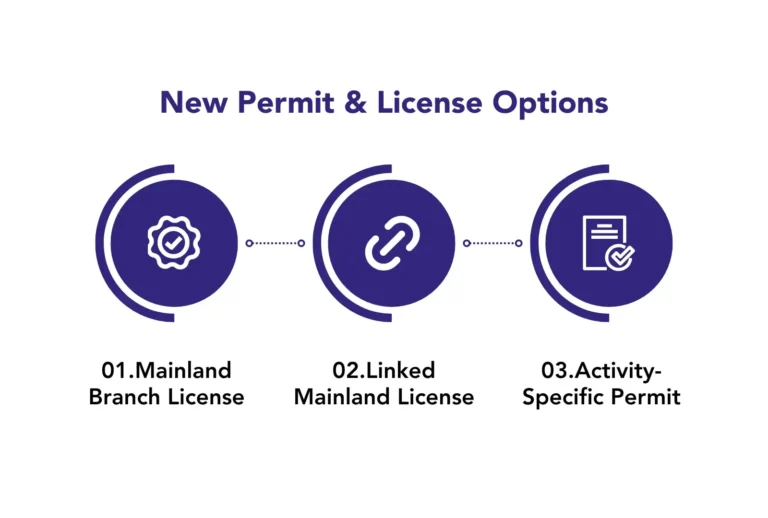
  • Apply for a mainland branch license
  • Get a hybrid license with headquarters kept in the free zone
  • Or use a short‑term, activity‑specific permit (up to six months)

This opens the door to local clients, government contracts, and projects across the whole emirate — without duplicating structures.


(Important: this applies within the Emirate of Dubai only. Operating in other Emirates still requires separate local approvals.)

What Has Changed?

Until now, free zone companies lived in a bubble.


They could trade inside their zone. Or do business internationally. But the moment they looked toward the mainland, the door shut — unless they set up a separate mainland company or brought in a local partner.


That’s over.


Under Executive Council Resolution No. 11 of 2025, free zone companies — except those in the DIFC doing financial activities — can now operate directly in mainland Dubai subject to DET approval and activity eligibility requirements.


All they need is a permit from the Dubai Department of Economy and Tourism (DET) without requiring the formation of a separate mainland LLC purely to access mainland Dubai. 


Just one legal framework, finally connecting the two worlds.


2026 Operational Reality:

  • Activity eligibility is verified during the DET application process and is not automatic.

  • Certain regulated sectors may require additional approvals from the relevant supervising authorities in addition to DET.

  • Authorised establishments are subject to inspection and compliance review mechanisms, not just annual renewal formalities.

New Permit & License Options

New Permit & License Options

So how exactly can a free zone company now enter the mainland space?


Dubai has introduced three flexible options, depending on what you want to do — open a full branch, run certain projects, or test the waters.


Branches issued under this framework do not have a separate legal personality from the parent free zone establishment. 


The AED 10,000 and AED 5,000 fees apply only to the specific routes defined under the Resolution, while other branch licensing fees follow applicable DET schedules.

1. Mainland Branch License

This is for companies that are ready to commit.


You can set up a proper branch office in mainland Dubai — no need to create a new company or find a local partner. It’s still your business, just with a mainland presence. 


This corresponds to a branch within the Emirate under the Resolution and may require physical premises depending on the approved activity and DET requirements.


You’ll use your original trade name and operate legally like any other mainland company.


Great for:

  • Long-term expansion
  • Serving local clients regularly
  • Bidding on government contracts

2. Linked Mainland License

Think of this as a hybrid model.


You keep your main office inside the free zone but get permission to operate in the mainland too. It’s like having a foot in both worlds — you’re still based in the zone, but now legally connected to the mainland market.


Under the Resolution, this route corresponds to a licence to establish a branch operating out of the Free Zone. It is issued for one year and is renewable, with an official fee of AED 10,000 per year. Prior approval from the relevant Free Zone Licensing Authority is required before the licence can be granted.


Great for:

  • Companies that want flexibility
  • Managing operations without shifting base

This model also makes compliance easier. One legal structure, two markets.

3. Activity-Specific Permit

This one’s more temporary.


It lets you perform a specific task or project in the mainland, a one-off installation, a limited contract, or a short-term assignment. The permit is valid for up to six months.


It may be renewed, subject to DET approval, and carries an official fee of AED 5,000 per issuance or renewal. The authorisation applies strictly to the specific approved activity stated in the permit.


You don’t need to open a branch or commit long term, just apply, do the job, and move on.

And There’s More Coming

In 2026, permitted mainland activities are treated as an eligibility checkpoint. Businesses must verify their specific activity through the Invest in Dubai / Dubai Unified License (DUL) workflow before applying.

Application Process & Eligibility

Good news: most free zone companies are eligible.


If your business has a valid license from any Dubai free zone and you’re not a financial firm based in DIFC, you can apply.


Eligibility requires:

  •  a valid Dubai Free Zone licence, 
  • compliance with DET’s approved activity framework, 
  • and exclusion of financial establishments licensed in the DIFC. 

These permits apply to operations within the Emirate of Dubai only.


What You Need to Submit:

  • Your current free zone trade license
  • Company incorporation documents
  • Passport and Emirates ID of the manager or authorized signatory

Pretty straightforward.


If you’re in a regulated sector, like healthcare, education, or anything that needs government oversight — you might need extra approvals from the relevant authority.  DET approval may not be sufficient where sector regulators supervise the activity.


For example, a clinic will need sign-off from Dubai Health Authority. A school might need KHDA clearance.


Once your documents are ready, you send them to the Dubai Department of Economy and Tourism (DET). They’re the ones reviewing the application, giving the green light, and issuing the permit or license.


Applications are processed through the Dubai Unified License (DUL) system on the Invest in Dubai platform, which links Free Zone records with the mainland registry under a unified digital identity.


No third parties. No agents. It’s all handled by DET directly.

Compliance Requirements

Getting a permit is just step one. You’ll need to play by the rules to keep it.

1. Keep Separate Financial Records

If you’re working in the mainland, you must track those operations separately.


That means clear books showing what you earned and spent onshore, not mixed in with your free zone accounts.


Why? Because mainland activities may trigger different taxes or regulatory obligations


In 2026, this separation is also critical for evidencing which income qualifies as “Qualifying Income” versus “Non-Qualifying Income” under the Free Zone Corporate Tax framework. 


It supports de minimis threshold monitoring and provides audit defence if QFZP status is reviewed. Proper segregation helps prevent accidental disqualification from the 0% regime.


Better to stay clean and clear from day one.

2. Follow UAE Laws

Once you’re in the mainland, you’re under both federal and local law.


This includes labor regulations, tax compliance (like Corporate Tax), and having a proper physical presence if your license demands it. No ghost offices allowed.


You’re now part of the onshore ecosystem, so your setup and conduct should reflect that.


Authorised establishments are subject to inspection and compliance review by DET and relevant authorities. Ongoing compliance with applicable legislation and Free Zone or DET procedures is required, not just annual renewal formalities.

3. Regularize If You Were Already Operating Onshore

Some companies were already dipping their toes in mainland waters, however unofficially. If that’s you, Dubai is offering a chance to fix things.


You have 1 year from the law’s start to regularize your status. The operational deadline for regularisation is March 21, 2026. While limited extension mechanisms may exist under the Resolution, businesses should not rely on them. 


Failure to regularise may result in administrative measures, including restrictions, suspension, or cancellation of authorisation, depending on the breach.


DET may allow an extension if needed, but it’s smarter to get compliant early and avoid penalties later.

Taxation & Regulatory Impact

Let’s talk money and rules, because operating in the mainland comes with responsibilities.

1. Corporate Tax Still Applies

Even if you’re a free zone company with tax exemptions, mainland profits are taxable.


The 9% UAE corporate tax kicks in for anything you earn onshore. So, if you’re billing mainland clients, that revenue falls under the tax net. For Qualifying Free Zone Persons (QFZPs), mainland income can be treated as non-qualifying income, which may create exposure under the de minimis rules.


You’ll need to keep your accounting clean and report mainland income separately. If non-qualifying income exceeds the de minimis threshold (AED 5 million or 5% of total revenue, whichever is lower), QFZP status may be lost. That can expose a wider portion of your income to the standard 9% rate for a minimum period under the Free Zone tax framework. 


Maintaining audited financial statements is also a core compliance requirement for preserving QFZP status.

2. VAT Still Counts

If your business hits the VAT threshold (AED 375,000), you need to register, no matter where you’re based.


If you’re already registered, make sure your mainland transactions are properly recorded. If not, and you cross the limit, it’s time to sign up.


Mainland expansion can change your VAT profile and reporting complexity, especially where supplies shift from Free Zone to onshore customers. If goods move from a Designated Zone into the mainland, import VAT obligations may arise depending on the structure and customs treatment.

3. Renewals and Inspections

All permits and licenses need to be renewed annually. That’s standard.


Also, expect regular inspections by the Dubai Department of Economy and Tourism (DET).


DET and relevant authorities may inspect compliance with authorised activities, premises requirements, documentation, and renewal conditions. 


Moreover non-compliance can lead to administrative actions, including suspension or cancellation of authorisation, depending on the breach.

Benefits for Businesses

This change isn’t just regulatory noise. It’s real opportunity.

1. Direct Access to Mainland Customers

No more middlemen. You can now deal directly with mainland clients, sign contracts, and deliver services, all under your free zone entity.

2. Fewer Headaches, Lower Costs

You don’t need to open a separate mainland company anymore. That means no double licensing, no duplicate admin, and fewer compliance layers to juggle.

3. Keep Your Free Zone Perks

Even while operating in the mainland, your free zone status stays intact.


You still enjoy:

  • 100% foreign ownership
  • 0% corporate tax on eligible free zone income
  • The flexibility that comes with being based in a zone

Free Zone status can remain intact, subject to maintaining QFZP conditions (including de minimis thresholds, substance requirements, audited financial statements, and proper record segregation).

4. Government Contracts Are Now In Play

Previously, free zone companies couldn’t bid for many public sector projects. That’s changed. With a DET-issued permit or branch, you can now join government tenders and contracts that require an onshore license.


Tender eligibility may still depend on the procuring entity’s vendor registration rules and the approved activity classification.

5. Growth, On Your Terms

Whether you want a full branch or just want to test the market with a short-term permit — you’ve got options.


This system is built for scalable growth, not forced expansion.

Market & Business Response

The reaction? Loud and positive.


Business leaders are calling it a “game changer” and a “gateway to growth.”


And for good reason, it’s the kind of reform people have been asking for.


The framework is positioned as pro-growth and designed to reduce structural barriers between Free Zones and mainland activity.


Official communications have projected a measurable economic impact as cross-jurisdictional activity expands under the new structure.


There’s already been a spike in inquiries and new business registrations since the announcement. Companies that were holding back are now moving fast to enter the mainland market without starting from scratch.


Analysts expect a strong ripple effect:

  • More foreign investment
  • New jobs
  • Increased competition
  • And a boost in innovation as companies expand their reach

It’s a big shift, not just in policy, but in mindset. Dubai isn’t just making it easier to do business. It’s making it hard not to.

Next Steps

So, what happens now?


DET’s permitted activity eligibility is now treated as a live compliance checkpoint. Before contracting or operating onshore, verify your exact activity through the Invest in Dubai / Dubai Unified License (DUL) workflow.


In the meantime, businesses should:

  • Verify activity eligibility through the DUL system before signing mainland contracts
  • Confirm whether the activity is regulated and secure any required sector approvals
  • Decide the correct authorisation route — full branch, branch operating out of the Free Zone, or temporary permit
  • Set up segregated accounting and monitor QFZP de minimis thresholds carefully
  • Assess VAT and customs implications if goods or inventory will move into mainland Dubai
  • Regularise before March 21, 2026, if previously operating unofficially — and do not rely on extension mechanisms

This reform opens up serious potential. But like any major shift, it rewards those who prepare, not just those who rush in.

Conclusion

This is more than a policy update, it’s a bold step in Dubai’s long game.


Letting free zone companies operate in the mainland brings the city closer to its vision of becoming one of the world’s top business hubs. It tears down walls, clears up red tape, and gives companies the flexibility to grow without losing the advantages they already have.


For businesses ready to expand, this reform formalises a regulated pathway for eligible Free Zone establishments to access the Dubai mainland, with clear licensing routes and enforceable compliance expectations.

FAQs:

The permit is for specific mainland activities and is valid for up to 6 months. A branch license is broader, valid for 1 year, and renewable.

No, not for the activity covered by the permit. But regulated goods or agency-based sales may still need separate approvals.

Yes. It applies to Dubai free-zone entities that want to operate outside the free zone and within Dubai. DIFC financial entities are excluded.

DIFC financial entities are excluded. ADGM companies are outside Dubai, so this Dubai resolution does not directly apply to them.

Yes, but not automatically. You must apply separately and meet DET and free-zone authority requirements.

Usually not for a temporary permit. A full mainland branch may require a mainland location, depending on the license type.

Yes. The resolution allows the existing free-zone workforce to support approved mainland activities.

Usually no, if they are already registered under the free-zone workforce. New staff may need normal visa and labor processing.

Possibly, but not automatically. Some tenders may require vendor registration, activity approval, or a full branch license.

No. It only covers mainland activity within Dubai. Other Emirates need separate approvals.

Yes, generally. Goods entering the mainland/local market usually require customs clearance and applicable duty.

Not automatically. But you must continue meeting QFZP conditions and keep separate records for mainland activities.

Usually, the mainland or domestic PE income is taxed at 9%. Qualifying free-zone income can still remain at 0% if all QFZP conditions are met.

Check total taxable supplies and imports, not only mainland sales. Mandatory VAT registration applies once the AED 375,000 threshold is exceeded.

Not necessarily. But you must maintain separate financial records for mainland activities.

It depends. An audit is mandatory if the entity is a QFZP or revenue exceeds AED 50 million.

Usually, the free-zone license and memorandum of association are required. DET may ask for additional documents.

Yes. Prior approval from the relevant free-zone licensing authority is required.

There is no fixed timeline. It depends on DET review, activity approval, and any external authority clearance.

The business may face penalties, inspection risk, and restrictions on mainland activity. Existing operators must regularize within the grace period set under the resolution.

References

Related Articles​​

Penalties for Late or Incorrect Corporate Tax Returns in the UAE

Corporate tax is here — and it’s serious business.


The UAE’s tax regime may be new, but the rules are firm. If you’re running a company, you’re expected to play by them.


Late filings? Mistakes in tax return? They’re not just paperwork issues anymore. They trigger penalties. And in some cases, big ones.


In today’s regulatory climate, being late or careless can cost you not just money but also credibility.


t’s important to note that penalties for Corporate Tax are governed by a separate set of rules under Federal Decree-Law No. 47 of 2022 and related decisions. The updates in Cabinet Decision No. 129 of 2025 apply specifically to VAT and Excise Tax penalties, not Corporate Tax.


This article breaks it all down.

Latest Update: Penalty Relief for First-Time Filers (2025)

Here’s the thing. If you’re filing your first corporate tax return in the UAE, the government’s giving you a bit of room to breathe.


As of April 2025, there’s temporary relief in place. File your first return within seven months after your tax period ends, and you won’t get hit with late filing or correction penalties.


But don’t confuse this with a free pass. It’s a one-time cushion, not a habit to build.


So, who qualifies?


Anyone filing their very first UAE corporate tax return. Doesn’t matter if you’re a mainland company or in a free zone. You’re covered if it’s your first go and you’re on time.


Wondering what does “on time” mean?


Let’s break it down:


Say your tax year ends 31 December 2024. You need to file your return by 31 July 2025.


If you do it by then? No penalties. But if you file on 1 August? You’re late. 


Relief gone. Simple.


Don’t mix this up with registration


Filing a return is not the same as registering for corporate tax. That’s a separate deadline and a separate penalty if you miss it. This relief only applies to tax return submission, not registration.


What this really means is that the grace period is real but limited. It buys you a little time, not immunity.


So use it well.

Standard Penalties for Late or Incorrect Corporate Tax Returns

Penalties for Late or Incorrect Corporate Tax Returns in the UAE

The UAE isn’t playing around with corporate tax. You’re expected to file, pay, and report things accurately. If you don’t, you’ll pay for it, literally.


Let’s break it down.

Late Filing of Tax Returns

If you miss your tax return deadline, the FTA starts charging you monthly:

  • 14% per annum on the outstanding tax, calculated monthly.
  • The meter starts ticking immediately, meaning every month of delay increases the penalty.

So, if you file 13 months late, your unpaid tax would continue to accumulate with a 14% per annum penalty, compounded monthly. This could add significant fines on top of the tax due — all for something that could’ve been done online in a few clicks through FTA eServices.

Late payment of corporate tax

Filing is one thing. Paying what you owe is another.


If you file on time but don’t pay, the FTA charges 14% annual interest on the unpaid tax in the UAE. This is calculated monthly.


So every month you delay, your unpaid UAE income tax grows. Slowly, then suddenly.

Not keeping accurate financial records

This one gets people into trouble.


If your books are incomplete, sloppy, or missing, you’ll be fined:

  • AED 10,000 the first time
  • AED 20,000 if you do it again within 2 years

Your records don’t need to be fancy. But they must be complete, current, and match what you report in your income tax return.

Filing the return incorrectly

Made a mistake in your income tax return filing? 

  • There’s an AED 500 fine, unless you correct it before the deadline.
  • Zero penalty if corrected before the deadline or if a Voluntary Disclosure (VD) is submitted with zero tax difference.

That’s the key. You’re fine if you catch it early and fix it in time. But if the FTA finds it after the deadline, it’s a penalty.

Not reporting changes to your tax info

If your business details change, like switching legal form, changing your tax period, or restructuring, you’re supposed to report that.


If you don’t:

  • It’s AED 1,000 per violation
  • AED 5,000 if it happens again within 24 months 

Log in to Eservices FTA to update your information. It takes five minutes, but skipping it could cost you much more.

Refusing to cooperate during a tax audit

If the FTA asks for your records or sends auditors, you need to cooperate. If you ignore them or withhold documents, you’ll get hit with an AED 20,000 fine.


It’s not about whether they like your numbers but about transparency.

Tax evasion

This is the big one.


If the FTA believes you’re hiding income, faking invoices, cooking the books, or doing anything intentionally to avoid paying federal tax, that’s tax evasion.


There’s no fixed fine for this. It depends on the case, but it’s serious:

  • You could face massive fines
  • They could freeze or suspend your license
  • You might end up in court

This isn’t a late fee situation. It’s criminal behavior, and it’s treated that way.

Voluntary Disclosure: Fixing Mistakes Before They Cost You

Let’s be honest. Mistakes happen. You might miscalculate, enter the wrong figure, or leave something out. The key is what you do next.


If you spot an error in your Income Tax Return filing after it’s been submitted, the FTA gives you a chance to correct it through voluntary disclosure.


Here’s how it works:


You log into FTA eServices, file a voluntary disclosure form, and fix the mistake. It’s straightforward, no explanations needed.


But here’s the catch:


If the correction results in more corporate tax owed, and you delay the disclosure, the penalties start to build.

What kind of penalty?

  • 1% per month
  • On the difference between what you originally paid and what you should have paid

So, let’s say you underpaid by AED 10,000 and only caught the mistake five months later. That’s AED 500 in fines, just for the delay. 


Wait longer, and it gets worse.


Why timing matters?


Correcting the error before the FTA notices makes the penalty smaller. You’re showing good faith and cooperating, and that goes a long way.


If they find it first?


Now you’re not just wrong, you’re also late. And that can push you into higher penalties or even trigger an audit.

Compliance Best Practices for UAE Businesses

Compliance Best Practices for UAE Businesses

If you want to avoid penalties, you need more than good intentions. You need systems that work, people who understand the rules, and the discipline to stay ahead.


Here’s what that looks like in practice:

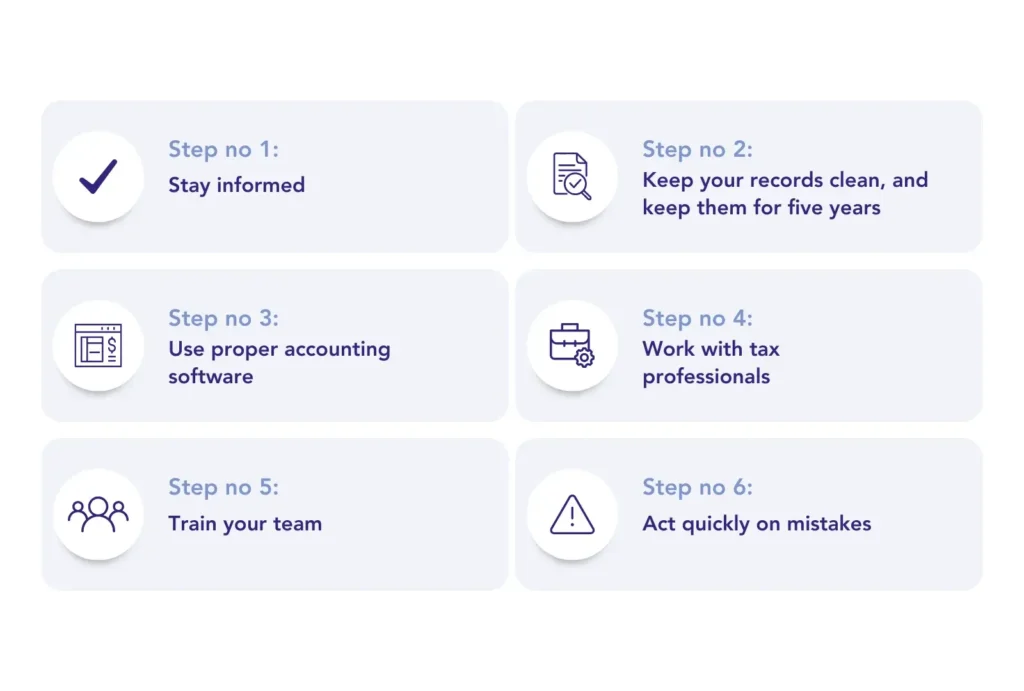
1. Stay informed

The FTA eServices and the Ministry of Finance don’t make quiet changes. When something shifts; deadlines, relief programs, reporting rules, they announce it. But you have to be paying attention.


Check their official channels regularly. Subscribe to alerts. Make it someone’s job to track updates.

2. Keep your records clean, and keep them for five years

You’re legally required to hold onto financial records for at least five years. That includes invoices, receipts, bank statements, and anything else tied to your tax return.


Don’t wait for an audit to start organizing. By then, it’s too late.

3. Use proper accounting software

Trying to track corporate tax on Excel? Risky. 


Use accounting tools that calculate tax, generate reports, and remind you of due dates. Better yet, pick one that connects directly with eservices fta.


Technology doesn’t eliminate errors, but it does reduce them, especially when deadlines start stacking up.

4. Work with tax professionals

You don’t need to hire an in-house tax team. But you should have someone who knows the law, understands your numbers, and can flag risks early.


This is especially important before your first  ITR filing, or if your business structure isn’t simple.

5. Train your team

If only one person understands the tax in the UAE rules, that’s a single point of failure. Make sure your finance, operations, and admin teams all understand the basics of what’s required.


Short sessions. Clear rules. Written procedures. It’ll save you headaches later.

6. Act quickly on mistakes

If you catch an error in your tax return, file a Voluntary Disclosure (VD) as soon as possible. With the new 1% per month penalty on unpaid tax, the earlier you file, the smaller the penalty. Don’t wait until the FTA notices, fix it promptly to avoid higher fines. 

Impact of Non-Compliance: Financial and Reputational Risks

Let’s not sugarcoat it. UAE income tax non-compliance isn’t just about paying fines. It’s about what those fines do to your business, over time, and in public.

The money adds up

One missed filing? That’s a few thousand dirhams. But stack that with late payments, incorrect returns, and missing records, and suddenly you’re bleeding cash every month, not because your business is failing, but because your compliance is.


Fines eat into profit. Interest compounds. Penalties pile up. And all of it could’ve been avoided.

The reputation hit is worse

Once you’re flagged as non-compliant, it’s hard to shake off.


Banks hesitate. Investors get nervous. Partners start asking questions. And when word gets around that your income tax return isn’t in order, the damage goes far beyond your balance sheet.


You don’t want your business name associated with negligence, especially not in a region where trust and transparency carry real weight.

It can get serious

Ignore the rules long enough, and it doesn’t just cost you money. It can cost you your business. 


The FTA has the power to escalate:

  • Freeze your accounts
  • Suspend your trade license
  • Take legal action

At that point, it’s not about cleaning up a spreadsheet. It’s about fighting to stay operational.

Build the right culture now

This is where smart businesses separate themselves. The ones that take federal tax compliance seriously don’t just avoid trouble, they build credibility.


When compliance becomes part of your internal culture, you stop reacting to rules. You stay ahead of them. That mindset pays off, year after year.

How ADEPTS Can Help Your Business Stay Compliant

Tax return compliance in the UAE isn’t just about filling out forms. It’s about knowing what’s required, doing it right, and staying ready, even when the rules shift.


That’s where ADEPTS comes in.


We specialize in UAE corporate tax compliance. That includes helping businesses register, file accurately, correct mistakes, and respond to the FTA when needed.


Here’s how we can support you:

  • Tailored tax solutions — from registration to income tax return filing to voluntary disclosures


  • Direct support with FTA eServices — so you never miss a notice or misread a requirement


  • Clean, audit-ready record-keeping systems — built to match your workflows


  • Ongoing advisory and training — to help your team understand the rules and avoid repeat mistakes


More importantly, we work proactively. We don’t wait for penalties to hit. We help you get ahead of the risks and stay compliant without stress.


With the new 1% per month penalty for delayed corrections or voluntary disclosure, timely filing and quick corrections are now more important than ever. We help you fix mistakes before they escalate into bigger fines. 


Because staying compliant shouldn’t feel like a scramble, it should feel like business as usual, calm, clear, and under control.

Conclusion

Corporate tax in the UAE is no longer optional, and it’s not something you can afford to get wrong.


Timely filing. Accurate reporting. Clean records. These aren’t just checkboxes, they’re the difference between smooth operations and mounting penalties.


The rules are clear, and the fines are real. With the new 1% per month penalty for delayed voluntary disclosures and corrections, waiting to fix mistakes can be costly. But with the right support, compliance doesn’t have to be stressful. 


ADEPTS helps you stay ahead with expert guidance, smart systems, and ongoing support that keeps you penalty-free and audit-ready.


Got questions? Facing deadlines? Let’s make sure your next move is the right one.

FAQs:

You’ll be fined. The AED 10,000 penalty is applied automatically once the waiver window closes. There are no extensions and no exceptions after that point.

Yes. The FTA allows formal reconsideration requests, but you’ll need to present a clear explanation and supporting documents. The sooner you act, the stronger your case.

Yes. If your business is subject to the corporate tax regime, the same rules and penalties apply regardless of your location.

Through your FTA eServices account and your registered email. If you’re not checking both regularly, you could easily miss critical updates.

Keep everything: tax return, financial statements, invoices, contracts, bank records, and any FTA correspondence. Store these securely for at least five years — they’re your first line of defense.

Yes. We handle the entire process — from preparing waiver applications to responding to FTA notices. We ensure your tax return communication stays clear, professional, and timely.

If you miss the deadline to file a voluntary disclosure (VD), the penalties will accumulate at 1% per month on the tax difference until the disclosure is submitted. It’s important to act quickly to reduce penalties.

Resources

Related Articles​​

How to File Zero Return for Dormant or Loss-Making UAE Companies

The UAE flipped the script by rolling out a 9% tax in UAE on profits above AED 375,000, while still dangling that sweet 0% for qualifying free zone outfits — unless you’re a giant multinational, then the new 15% Domestic Minimum Top-Up Tax jumps in. It’s a mix that keeps businesses guessing where they really stand. But even smaller players can’t just shrug this off.

Every registered company, from buzzing startups to total dormants, has a hard legal duty to file a tax return UAE, no matter if books show zero or heavy red. That’s why ADEPTS’ deep dive on compliance hits so hard. Staying sharp on UAE income tax means avoiding double costs later fixing slip-ups — and protecting yourself before the fines pile up.

Definitions: What Are Dormant and Loss-Making Companies?

Most owners in Dubai hear tax rules and think if they’re not making sales, they’re safe. That’s not how this plays out. Even zero-revenue setups fall under UAE’s new net, so knowing if you’re dormant or actually losing money changes everything. This isn’t just fine print — it shifts how your filings work and what penalties sit waiting if you skip a line.

Dormant Companies

A dormant company means you’ve got no business activity, no income hitting accounts, and zero actual expenses moving out. It’s parked. But under income tax in Dubai, even this silent operation must file. The FTA wants a clear paper trail proving there’s truly nothing happening. Otherwise, tax authorities start guessing — and that rarely goes in your favor. It’s a weird reality where doing nothing still means paperwork.

Loss-Making Companies

Here it flips. A loss-making business runs costs that blow past any income, leaving negative taxable profits. That shifts your tax declaration meaning entirely — you’re logging negatives instead of zero. Why does it matter? Because losses today can carry forward, shaving future tax bills. But only if you declare them right now. Miss it, and you lose the chance to offset gains later.

How It Changes Your Obligations

These definitions aren’t academic. Being labeled dormant means different checks, while showing losses builds a case for future tax relief. Either way, both types force your hand to file a corporate return or risk the FTA stepping in. It’s one of the stranger UAE rules: do nothing or lose money, you still owe a return.

Who Must File a Zero Return in the UAE?

A lot of owners think zero returns are only for loss-heavy firms or big chains. Truth is, the UAE set it so nearly every registered business has to show their numbers — even if it’s a flat zero. That means ignoring it because you’ve “done nothing” this year is a quick road to fines. Filing on time is what keeps you clear with the FTA, whether cash moved or not.

All UAE-Registered Companies

Every licensed entity counts. Mainland setups, free zone players, even local branches of foreign giants all need to submit a tax return UAE. The law doesn’t care if you made millions or sat idle. Once you’re registered, you’re in the loop. It’s a wide net that most new owners underestimate until the first penalty letter lands.

Dormant Companies Still File

Just because your trade license sat gathering dust doesn’t mean you skip reports. Dormant companies — no activity, no money in or out — still have to show they’re inactive by filing a proper return. That’s how you prove to the FTA this isn’t hidden income time. Miss it, and your silent company can look suspicious by default.

Loss-Makers Aren’t Exempt

Running losses doesn’t get you off the hook either. In fact, logging negatives can help later with carry-forwards. So even if costs crushed income, file that loss. It locks in credits for future years, which might save serious money down the line.

Some Get an Out

A tiny group dodges this: government bodies, extractive industries like oil, or certified public benefit outfits. They’ve got carve-outs written in. But unless your license explicitly states it, assume you’re on the FTA eServices grid with everyone else.

Step-by-Step Guide to Filing a Zero Return

How to File Zero Return for Dormant or Loss-Making UAE Companies

Filing a zero return in the UAE isn’t just logging into a portal and typing zeros. The FTA expects a full process that proves you’re compliant, even if business was dead all year. Missing one part turns your simple tax filing into a penalty magnet. This is where most owners slip — they wait too long or skip tiny details, and pay for it later.

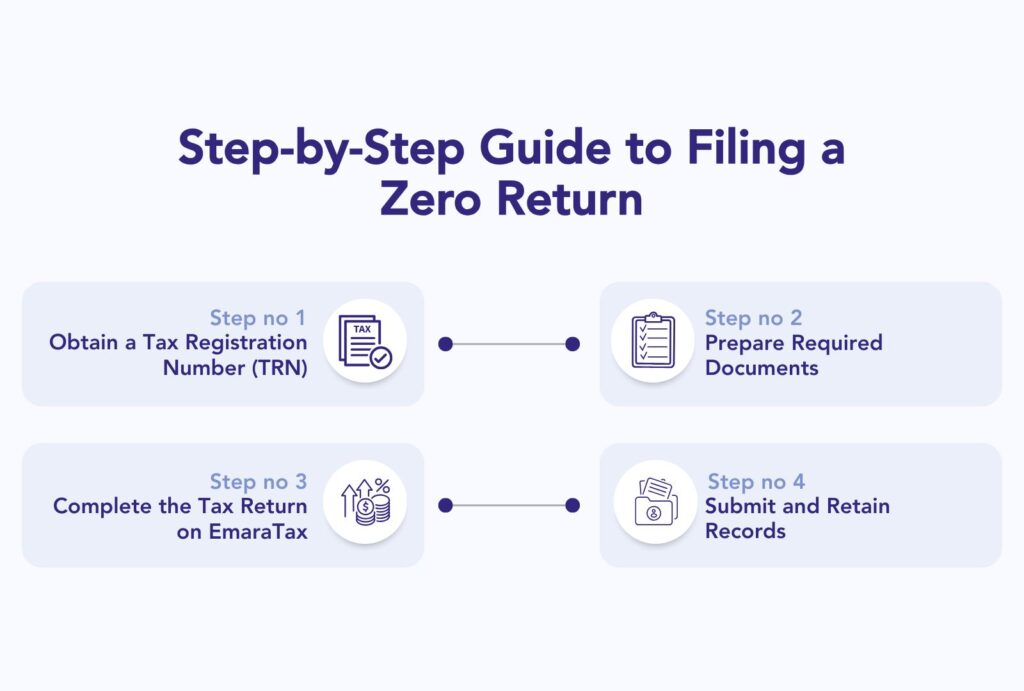
Step 1: Obtain a Tax Registration Number (TRN)

You can’t file anything without a TRN. Head to EmaraTax UAE and register your company under the right category. For individuals, deadlines hit March 31, 2025. Companies have separate clocks that tie back to their incorporation date, so don’t guess. ADEPTS’ corporate tax registration guide breaks this down so you don’t start wrong and spend weeks fixing a basic ID error.

Step 2: Prepare Required Documents

Before touching the return form, line up essentials: your trade license, MoA/AOA papers, financial statements (audited if you’ve got them, management if you don’t), and recent bank statements. These build the story the FTA needs to see. Skipping docs means the portal kicks you back, wasting time right when you need smooth flow.

Step 3: Complete the Tax Return on EmaraTax

Inside EmaraTax UAE, pick “Tax Return for Resident Person.” If you’re dormant, literally enter “0” across all income and expense lines. If loss-making, report your negative taxable income properly. That’s how you secure future credits without messing up the current cycle. Even FTA VAT filing habits here help — the cleaner your numbers, the easier matching them up later.

Step 4: Submit and Retain Records

Hit submit within 9 months of your financial year-end. Then stash those records safely. The FTA can ask years later why your zero return looked the way it did, and proving it fast is how you avoid deeper audits. It’s the least flashy part of tax but saves massive headaches.

Loss Carry-Forward Rules for Loss-Making Companies

One of the smartest tax moves in the UAE is reporting losses right. It might sting to show negatives now, but done cleanly, it slices future bills. Most owners mess this up on their income tax return filing because they think losses just vanish on their own. They don’t. File them wrong, and you give up cash that should’ve stayed in your business.

How to Report Tax Losses

It’s simple on paper: your losses get logged as negative taxable income directly inside the return. That little minus sign changes everything — telling the FTA you’ve got credits stacking. Miss this line or fudge the total, and it’s gone. Future years can’t use losses you didn’t file, so this is your one shot to lock them in.

When Can You Carry Forward?

If you’ve nailed the loss report, the UAE lets you offset up to 75% of future taxable profits. It’s how companies that took early hits smooth taxes once profits finally roll. That means next year, instead of paying the full chunk, you shield part using old losses. Done right, it’s a quiet money saver most overlook.

The Catch: Conditions & Exceptions

Carrying losses isn’t free. You have to keep at least 50% of your ownership steady and stay in the same type of business. Shift control or flip to a totally different operation, and your credits might vanish. This is where a decent tax service earns its fee — they track the rules so your future breaks don’t accidentally expire.

Common Mistakes and How to Avoid Them

How to File Zero Return for Dormant or Loss-Making UAE Companies

Most UAE companies think transfer pricing just tweaks a few invoices. It runs way deeper. These rules reshape how profits show up on books, how much you owe in tax in UAE, and even how your free zone perks hold up. It’s the kind of law that slips into every corner of a balance sheet. That’s why ignoring it now often means paying double later.

Missing Deadlines Costs Big

Deadlines are carved tight. Miss them, and penalties climb up to AED 10,000 fast. The FTA doesn’t negotiate much once your calendar runs out. ADEPTS’ guide on penalties lays it all out so you’re not shocked later. Pay close attention to your financial year-end dates and build reminders before panic season hits.

Reporting Numbers Wrong

Even small errors on returns — a transposed figure, missing invoice, or sloppy expense note — can flag problems. The FTA checks your records against your statements. If your reported sales or costs drift too far from reality, get ready to explain. Double-checking every filing isn’t wasted time; it’s the cheapest audit insurance you’ll ever buy.

Skipping Registration Altogether

It’s wild how many small businesses still forget to even register. They assume tiny operations fly under the radar. Nope. Miss that step, and FTA payment letters show up anyway — along with admin penalties that feel worse than paying normal tax. Even dormant setups have to stay on the grid.

Ignoring Dormant Rules

Doing zero business doesn’t cancel your duty to file. In fact, if you’re dormant, the FTA wants more proof you stayed inactive. Ignore these filings, and they’ll guess your books for you — usually not in your favor. A couple easy uploads now saves long hours (and big bills) fixing trouble later.

How ADEPTS Simplifies Zero Return Filing

Most business owners freeze up the minute they see tax rules spelled out. That’s why firms like ADEPTS exist — so you don’t gamble filings on guesswork. They step in early, mapping your situation, then build a file the FTA can’t poke holes through. Using a solid tax service up front is always cheaper than scrambling after penalties drop. It’s like paying a trainer now to avoid surgery costs later.

End-to-End Compliance Help

ADEPTS handles everything. From getting your TRN, pulling financial statements, to submitting your actual return, they keep the process smooth. Even if you’ve got quirks like dormant years mixed with active months, they sort it all out so your filing stays bulletproof. Saves countless hours fumbling through FTA sites on your own. That leaves you focusing on real business, not chasing paperwork.

Expert Review Cuts Audit Risks

Having someone who knows UAE tax comb through your docs means errors get flagged before the FTA sees them. ADEPTS spots small slip-ups — like mismatched bank totals or missing supporting invoices — that trigger big questions. That review shrinks audit chances down fast, which is all most owners really want. Peace of mind here is worth more than the fee.

Loss Tracking for Future Breaks

Losses aren’t just a sad report line. Handled right, they cut future bills. ADEPTS keeps track so you’re ready to offset profits next year, instead of forgetting old losses that could’ve saved cash. This is where a tax service earns its keep — they make sure the FTA sees every break you’re entitled to. Most companies underestimate these until it’s too late.

EmaraTax Integration

ADEPTS also plugs directly into EmaraTax UAE, meaning your filings push through the official portal clean. That way, no random fields get skipped, no surprise errors pop up at submission. Their corporate tax advisory team ties it all up so deadlines don’t sneak by and penalties stay far off. It’s the smoothest way to dodge admin chaos.

Conclusion

At the end of the day, zero returns in the UAE aren’t just dry compliance tasks — they keep your doors open and your tax return UAE clear of penalties that sting harder down the line. Whether your books show losses or you’re fully dormant, filing right means fewer FTA surprises and more breathing room. Most companies only learn this the hard way after missing tiny steps that grow into costly bills. It’s like ignoring small leaks until you’re mopping up a flood.


That’s why roping in experts like ADEPTS’ corporate tax advisory matters so much. They lock down every tax filing from start to finish, spot mistakes before the FTA does, and make sure old losses get carried forward to slash future payments. It’s cheaper peace of mind than scrambling later when the FTA comes knocking, asking why simple files never got done.

FAQs:

Staying dormant for years doesn’t automatically kill your trade license, but it can make the authorities wonder why you exist. Some free zones will push for deregistration if annual fees or filings lapse. Still, the FTA expects a tax return UAE every year — even from a company doing nothing. Skipping it is the real problem.

Miss zero filings long enough and penalties stack. The FTA can impose fines for every period missed, plus interest. It also throws up red flags for compliance checks later. Keeping up with even simple FTA eServices submissions stops small paperwork gaps from snowballing into big fines.

Branches in the UAE must still file just like locals. There’s no shortcut. The only wiggle is if your parent company’s earnings exempt that branch by treaty or specific ruling. But generally, expect your branch to show up on the tax return UAE grid every year.

Small Business Relief helps reduce corporate tax for businesses under AED 3 million revenue, but it doesn’t erase filing duties. You still need to lodge a return and prove your numbers fit the relief scheme. Otherwise, the FTA will treat you like any standard taxpayer.

The FTA could ask for bank statements showing zero movement, old invoices, or shareholder confirmations that no activity took place. It’s a weird burden of proof: you have to prove “nothing happened.” That’s why lining up clean supporting files with your FTA eServices account is smart.

Yes — losses filed correctly can offset future profits. It’s one of the few breaks the UAE offers. If you’re carrying negatives forward, you want them locked into your tax return UAE now so they save money later. Miss it, and that cushion disappears.

ADEPTS takes the lead on prepping documents, answering FTA letters, and explaining why your numbers look the way they do. Their corporate tax advisory team spots issues before auditors can. That’s the cleanest way to keep your zero returns from becoming expensive stories later.

Related Articles​​

How Transfer Pricing Affects Corporate Tax Filing in the UAE

UAE businesses used to cruise on tax-free status, but that’s changing fast. With the new tax in UAE regime under Federal Decree-Law No. 47 of 2022, even companies that never worried about numbers now face real filings, actual rates, and stiff penalties. That means UAE income tax isn’t just a rumor anymore — it’s showing up on profit statements across the Emirates.


More than that, transfer pricing is rolling in hard, forcing both mainland setups and free zones to prove they aren’t shifting profits through slick invoices. ADEPTS breaks this down in their transfer pricing in UAE guide, showing why it matters right from day one. Whether you’re trading across Emirates or just wiring cash inside a group, ignoring it can cost way more than you’d ever guess.

The Legal Framework: Transfer Pricing under UAE Corporate Tax Law

Transfer pricing isn’t just a buzzword here anymore. The UAE locked it into real rules with federal tax laws that change the game for everyone. That’s why companies that barely filed papers before now scramble to figure out what they owe. Ignore this, and it’s not just fines — it’s serious business headaches. ADEPTS’ breakdown on UAE transfer pricing basics is a solid first stop if you’re lost.

Federal Decree-Law No. 47 & Ministerial Decisions

The backbone is Federal Decree-Law No. 47 of 2022, backed up by a string of ministerial decisions that spell out how groups must price deals. ADEPTS’ complete guide on transfer pricing in UAE breaks down exactly how these laws set up penalties and checks. It’s not light reading, but if you’re running cross-entity trades, it’s must-know stuff.

OECD Alignment

The UAE didn’t dream this up alone. They tied it straight to OECD guidelines to keep multinationals honest. So even if your parent’s in Europe or the US, those same rules trail your books here. 

Applies Broad — Even Free Zones & Govt

It’s not only mainland firms sweating. Free zones, local groups, even some government-linked entities get swept in. That means tax in UAE touches setups that thought they’d always be ring-fenced. And it’s all under the eye of FTA eservices, which makes skipping lines a quick ticket to audits.

Who Must Comply?

All Taxable UAE Persons — Even Free Zones

It’s not just mainland LLCs in the net. Free zones fall in too, even when they’re chasing zero percent corporate rates. The law wraps them tight if they’re tied by common ownership or directors. That’s why filing right and showing clean internal pricing is a must.

Exemptions & Small Biz Relief

Sure, there are carve-outs. If you qualify for Small Business Relief or sit below certain thresholds, your burden lightens a bit. But those lines move, and they only cover limited checks. Miss the paperwork, and you’re back under full scope whether you meant to be or not.

Bigger Groups? Extra Docs

Multinationals and UAE companies with heavy turnovers need more. That’s where local files and master files step in. They prove your transfer prices stand up globally, not just on paper here. Slip up, and even a normal invoice can turn into a drawn-out audit nightmare.

Transfer Pricing Documentation: What’s Required?

How Transfer Pricing Affects Corporate Tax Filing in the UAE

Most firms worry about transfer pricing but forget the piles of paperwork that come with it. The UAE system needs clear files to back up every intercompany deal. Miss even one piece, and your next income tax return filing could trigger red flags. ADEPTS’ complete guide on UAE transfer pricing lays it all out — which means no surprises when the FTA comes asking.

Knowing the Disclosure Thresholds

Not every business files the same way. If you’ve got AED 40 million tied up with related parties, AED 4 million in individual related-party exposure, or AED 500k with connected folks, you’re on the radar. Those lines aren’t random. They tell the FTA who needs deep dives. Even smaller companies flirt with these without realizing, especially once loans or management fees pile up. Better to check before you’re forced into a rush.

The Core Documents You’ll Need

There’s a short list that grows fast: the TP Disclosure Form, Local File, Master File. Each builds a defense showing your prices make sense globally. Miss one and your tax filing turns shaky. ADEPTS also links benchmarking help right here so you’re not guessing on comparables. It’s dry work but skips ugly FTA letters later.

Attach Financials to Your Tax Returns

The FTA expects these docs tied directly to your financial statements. That means you don’t just store them on a shelf. They ride along with your income tax return filing, so if the numbers don’t match, you’re instantly flagged. Keeping everything tight up front avoids panicked scrambles at deadline time.

The Filing Process: How Transfer Pricing Impacts Corporate Tax Returns

A lot of companies think once they’ve got transfer pricing docs, the rest is automatic. Not in the UAE. Filing means every line ties up, so your TP data flows right into your tax return. If it doesn’t match, that’s how audits kick off. ADEPTS’ corporate tax advisory team shows how even tiny mismatches trip serious fines. Better to get it right than scramble later.

EmaraTax Portal Integration

The UAE didn’t build this on old spreadsheets. It all plugs into EmaraTax UAE, the digital hub that pulls your returns, payments, and transfer pricing flags together. Miss a line item, the portal’s checks ping it instantly. That’s why most big players do a full data sweep before uploading. It’s more work now, saves months of stress later.

Why Accuracy Is Everything

Because small slip-ups get magnified in the system. The FTA doesn’t chase you for typos — they spot patterns. Wrong related-party numbers or missing TP figures can spin into broader checks. It’s not just a local thing either. Errors in your FTA VAT filing or income tax returns often tie back to mismatched transfer pricing lines. That’s how a missed form becomes a headache.

Deadlines & Fixing Mistakes

Deadlines are carved tight. Miss them, and penalties stack fast. If you realize you blew a figure, the FTA does allow corrections. But your best shot is catching it before they do. ADEPTS steps in for exactly that — fixing returns before mistakes land you on the audit radar. It’s more rescue work than most businesses like to admit.

Practical Implications for UAE Businesses

Most UAE companies think transfer pricing just tweaks a few invoices. It runs way deeper. These rules reshape how profits show up on books, how much you owe in tax in UAE, and even how your free zone perks hold up. It’s the kind of law that slips into every corner of a balance sheet. That’s why ignoring it now often means paying double later.

Hits on Tax Base & Group Allocation

A solid transfer pricing policy decides where profits stack — which entity books more or less. That shifts your revenue tax base and can bump effective rates in ways most owners miss. ADEPTS lays this out in their 20 benefits of transfer pricing benchmarking. You see it best in groups juggling Dubai, Abu Dhabi, and offshore entities all in one breath. It’s never just lines on paper; it’s cash flow moving.

Why Free Zones Should Sweat

Too many free zone firms figure they’re bulletproof under 0% rules. But if your pricing skews profit outside arm’s length, you risk losing special rates or even having your tax benefits clawed back. That’s the fastest way to turn a slick low-rate structure into a hefty bill no one budgeted for.

The Risk Side: Penalties, Audits, Reputation

Get this wrong and it’s not just a quiet letter. The FTA flags weird numbers, triggers audits, and your next tax return Dubai can spiral into months of questions. Even worse, it rattles partners who see compliance slip. Most big groups sweat reputation hits as much as checks to the treasury. It’s easier to clean house early than pay consultants later.

Common Challenges and How to Overcome Them

How Transfer Pricing Affects Corporate Tax Filing in the UAE

Most UAE businesses think they’ll breeze through transfer pricing rules, then get slammed by paperwork or weird grey areas. New local rules tied to global standards means mistakes pop up fast, especially on your first income tax filing under the new regime. Missing details, funky contracts, or just slow prep — all that sets up headaches that drag way past due dates.

New Regulations & Document Hurdles

The UAE built this on OECD lines but added local twists. That means even companies that handled TP abroad still run into fresh document checks here. Suddenly your FTA login Dubai isn’t just for VAT anymore; you’re digging up files you never tracked before. The trick is starting docs early, not scrambling when tax season smacks you. Small step now, massive save later.

Keeping Deals at Arm’s Length

It gets trickier with group trades that aren’t simple. Loans, IP charges, weird service fees — proving arm’s length means showing outside firms would pay the same. ADEPTS tackles this in their benchmarking services so you don’t wing it. Otherwise the FTA calls it disguised profits and your file itr turns into an investigation file fast.

Functional Analysis & Proactive Docs

Most groups wait for the FTA to demand details. Better to build functional analyses, pull comparables, and keep folders ready. That’s what ADEPTS lines out in their 20 transfer pricing benchmarking benefits. Keeps stress low, plus you’ve got proof on hand if auditors start poking. Think of it like prepping gym gear before a fight — you never want to scramble at bell time.

ADEPTS’ Role in Transfer Pricing Compliance

Getting transfer pricing wrong in the UAE isn’t just a paperwork fail — it hits your wallet and rattles partners fast. That’s why so many companies lean on ADEPTS for guidance. They’ve mapped local and global rules so your tax filing doesn’t spin out into fines. Think of it as having a ringside coach — someone who’s seen a hundred bouts and knows exactly where you’ll slip.

How ADEPTS Actually Helps

ADEPTS doesn’t just toss over generic templates. They dig into your group, figure out risk spots, then shape a clear plan so your books stand up. From free zone traders to big multinational splits, they show how to run pricing that holds under the FTA’s glare. That’s what keeps your operations smooth and your board breathing easy.

Documentation, Benchmarking & More

It’s never one file. You need disclosure forms, local files, master files — plus solid benchmarking that proves arm’s length. ADEPTS lines this up through their transfer pricing benchmarking services, then helps prep data for fta payment checks and filings. It’s the kind of heavy lifting that saves long audit headaches down the road.

FTA Compliance & Tax Optimization

ADEPTS ties it all back to making sure your group pays exactly what it should — not more, not less. Their corporate tax advisory team also flags smart adjustments so your tax service bill shrinks legally. In a new regime where even tiny errors pop penalties, that edge matters. Most groups call it cheap insurance.

Conclusion

Transfer pricing isn’t just another checkbox on your tax filing list. It decides where profits land, how much you pay, and whether the FTA puts you under the spotlight. That’s why even small UAE groups need sharp docs tied to local and global rules. Miss it, and your tax return UAE could come loaded with risks you didn’t budget for. Smart firms hand this off to teams like ADEPTS’ corporate tax advisors so they stay ahead of the rules — and ahead of competitors who slip up first.

FAQs:

Mess up your transfer pricing and it’s more than a slap on the wrist. The FTA can tack on fines that multiply quick, and your next income tax return could come flagged for a full audit. That means hours burned with accountants instead of running your business. Easier to prep files right from the start.

The UAE plugged straight into OECD-style frameworks, which means tighter paperwork than you’ll see in some GCC neighbors. It’s more structured, more formal, but also clearer on expectations. That helps big groups avoid random surprises across borders. Still, you can’t copy-paste Saudi or Qatar docs here and hope it sticks.

Not always. Many free zone companies still need to register and file their ITR filing. Some may qualify for a 0% rate, but only if they meet the conditions of a “Qualifying Free Zone Person” under FTA guidelines. Even if exempt from tax, proper tax declaration is still required.

Anything involving brand names, patents, or secret formulas gets extra scrutiny. Those lines move profits fast. The FTA wants to see hard evidence your charges match real market rates. Miss it, and they might push income where it doesn’t belong.

Absolutely. Capital-heavy sectors like oil or real estate mean bigger numbers, which means more tax at stake. ADEPTS flags these in their due diligence checklist for UAE businesses. You’ll see more intense benchmarks here, and fewer easy comparables, so pricing has to stand on real legs.

If your docs line up, they’re smooth. If not, the FTA digs deep, sometimes across multiple returns. That’s why most firms line up their TP files with tax return UAE submissions to keep everything bulletproof.

Best move you’ll ever make. It’s way harder to patch policies on a mess later. Build your models, document them, get comparables early. Saves sweat when the FTA finally knocks or your investor demands a full due diligence pack.

Related Articles​​

Ultimate Checklist for Corporate Tax Return Filing in UAE 2025

Corporate tax is now part of doing business in the UAE. In 2025, it’s not just about profit — it’s about staying compliant. The new corporate tax regime was rolled out to keep the UAE in line with global standards. It aims to build a fair, transparent business environment that attracts investment and keeps the economy strong.


Most UAE businesses will have to file their tax returns for the 2025 tax period. Key point: your filing deadline is nine months after your financial year ends. For many, that means 30 September 2025. Payment is due on the same date.


So why does this matter?


Timely and accurate filing protects you from penalties and unnecessary costs. But it’s more than money — non-compliance can damage your reputation. And in a competitive market like the UAE, trust is everything.


This checklist will help you get it right. No last-minute panic. No costly mistakes. Just a clear plan to keep your business fully compliant.

Who Must File Corporate Tax Returns in UAE?

Ultimate Checklist for Corporate Tax Return Filing in UAE 2025

Not sure if corporate tax applies to you? Here’s what you need to know — no guesswork.

Mainland Companies

If you run a mainland company, corporate tax applies to you. Full stop.  All taxable income above the threshold is subject to the UAE’s 9% corporate tax rate. You must register with the Federal Tax Authority (FTA), file your tax return every year, and pay what you owe on time.

Free Zone Companies

Free Zone businesses are not exempt from filing just because they enjoy tax incentives.
Many Free Zone companies still qualify for the 0% corporate tax rate on qualifying income — but you still need to file a return. Failing to meet Free Zone conditions can remove your 0% benefit. So don’t risk it. Keep your records clean and submit your return each year.

Offshore Entities

Offshore companies can’t hide under the radar anymore. If your business is effectively managed and controlled from the UAE — for example, if your decision-making happens here — you may need to register and file. Offshore doesn’t always mean “off the hook.” Always check your specific setup.

Limited Exemptions

There are some exemptions — but they’re strict. Entities like certain government bodies, qualifying investment funds, or approved public benefit organisations may be exempt from corporate tax. But don’t assume you qualify. Check the FTA rules and get professional advice if needed. A simple oversight can cost you penalties later.

Mandatory Registration with the FTA

If your taxable income is above AED 375,000, you must register with the FTA. This isn’t optional. If you don’t register on time, you risk fines, compliance headaches, and delays in filing.

The Importance of a TRN

When you register, you’ll get a Tax Registration Number (TRN).  This is like your business ID for all corporate tax matters. No TRN means you can’t file your tax return. Worse, it can raise red flags with the FTA. Keep your TRN safe, up to date, and handy — you’ll need it for all your tax dealings.

Checklist for Corporate Tax Return Filing

I. Confirm Registration & TRN

Make sure you’re registered with the Federal Tax Authority (FTA) on EmaraTax. Check that you have a valid Tax Registration Number (TRN). No TRN, no filing.

II. Verify Financial Year & Filing Deadline

Know your company’s financial year. Is it Jan–Dec? Confirm it’s updated with the FTA. Remember: your corporate tax return is due within 9 months after your year ends.

III. Finalize Financial Statements

Prepare your financial statements under IFRS standards. Get them audited if your revenue is over AED 50 million — or if you’re a Free Zone entity. Match everything with your VAT records. No surprises.

IV. Determine Taxable Income

Start with your net profit (from IFRS statements). Adjust for non-deductible expenses, exempt income, and unrealized gains. Use any reliefs you qualify for — Small Business Relief, Free Zone 0% rate, Group Relief.

V. Calculate Tax Payable

In tax UAE scenario, 0% tax on the first AED 375,000. 9% tax on anything above that. Apply all your elections properly in EmaraTax.

VI. Gather Required Documents

Trade license, audited accounts, VAT returns. Transfer pricing docs if needed. Foreign income records, depreciation schedules, related party transactions. Keep them tidy.

VII. Reconcile Across Tax Systems

Cross-check your corporate tax return with your VAT returns and audit reports. Make sure the numbers line up. Mistakes attract penalties.

VIII. Interest & Losses Adjustment

Prepare interest limitation schedules (30% of EBITDA or AED 12 million cap). If you have tax losses to carry forward, include full details.

IX. Setup Payment Channels

Link your bank account to EmaraTax. Make sure funds are ready before the due date. Keep the payment confirmation for your records.

X. File and Submit Online

Log in to EmaraTax. Complete your return carefully. Upload all the documents. Double-check everything. Submit before the 9-month deadline.

XI. Maintain Records for 7 Years

Keep all tax files, payment slips, financials, and any FTA letters for at least 7 years. Store them safely — you may need them.

XII. Audit Readiness & FTA Preparedness

Be ready for an FTA review anytime. Have all supporting docs organized. Keep related party and transfer pricing files complete and easy to share.

Special Considerations for Different Business Types

Different types of businesses have specific considerations. If you are buying a business, these are specially important, Lets see what they are:

Mainland vs. Free Zone vs. Offshore

Not every business files the same way. Mainland companies follow the standard corporate tax rules. All taxable income is subject to the 9% rate of UAE income tax above the threshold.


Free Zone companies may still get the 0% rate on qualifying income — but don’t get comfortable. You still have to file your return and prove you meet all the conditions. One slip and the 0% can be lost.


Offshore entities? It depends. Many must register and report if they’re effectively managed and controlled from the UAE. Always double-check — assumptions can cost you big time.


Each business type must keep records that match its structure and tax position. So get your documents in order.

Small Businesses and Relief Options

Running a small business? The UAE offers Small Business Relief — but it’s not automatic.
You may qualify if your revenue is AED 3 million or less for the relevant tax period.


If you’re eligible, you can claim relief through EmaraTax — but you still have to register, file, and keep records.


No shortcuts. Keep your financials clean and clear. If you grow past the threshold, you must pay up.

How ADEPTS Can Help

Tax compliance can feel like a maze. That’s where we come in.

Expertise in Corporate Tax Compliance

At ADEPTS, we guide UAE businesses through every step. From registration to tax filing and staying audit-ready. Our team knows the rules. And we tailor our advice to fit your business, whether you’re mainland, Free Zone, or offshore.

Comprehensive Tax Solutions

We don’t just tick boxes. We help you plan ahead, for complex areas like ICV scoring, joint ventures, acquisitions, or group relief. No surprises. No costly mistakes. We handle the details so you can stay focused on what you do best — running and growing your business.

Related Articles​​

Do You Need a Tax Agent for UAE Corporate Tax Filing?

The UAE used to be a no-tax paradise. Not anymore.


Since June 1, 2023, a 9% federal tax on corporate profits now applies to earnings over AED 375,000. If you’re running a business here, this isn’t just background noise — tax in the UAE has moved into an established 2026 enforcement cycle, and it’s here to stay. 


That means paperwork, rules, and deadlines. The UAE income tax is now a core compliance task for most companies based on the mainland or in a free zone,  with 2026 marking the shift from awareness-driven compliance to accuracy-led, data-validated filings monitored directly by the Federal Tax Authority.


The education and transition phase between 2023 and 2025 has effectively closed. In 2026, the FTA’s focus is no longer on whether businesses understand the law, but on whether filings are complete, internally consistent, and supported by verifiable data trails.


So here’s the big question: Do you actually need a tax agent to handle it all?


This article breaks it down: who needs one, who doesn’t, and how to avoid costly mistakes, in a regulatory environment where compliance errors are increasingly identified through automated reviews and targeted audits rather than manual checks, with or without professional help.

Understanding UAE Corporate Tax Filing Requirements

Now that the UAE has rolled out corporate income tax, many businesses are still figuring out what exactly they need to do. Some assume it doesn’t apply to them. Others know they need to act but aren’t sure where to start — a risky assumption in the 2026 enforcement environment, where compliance gaps are identified through system-led reviews rather than reminders.


Before you decide whether to get a tax agent or not, it’s important to understand your actual income tax return obligations. Here’s a clear breakdown of who needs to register, what the deadlines are, and how the process works under the now fully operational corporate tax framework.


Here’s what you need to know:


If your business earns more than AED 375,000 in profit, you’ll be paying 9% federal tax on anything above that.


Even if you don’t cross that threshold, don’t relax just yet. Most businesses still need to register and file.


That includes:

  • Mainland companies
  • Free zone setups (yes, even if they enjoy 0% tax)
  • Foreign branches
  • Some solo entrepreneurs or freelancers, depending on how they’re structured

Think you’re exempted? Probably not. UAE income tax laws apply more broadly than many business owners expect, and in 2026, exemption claims are increasingly reviewed against actual turnover, activity, and reporting data.


Two deadlines matter:


Registration

  • For natural persons, freelancers, and individual business owners, registration is mandatory by 31 March 2026 if turnover during 2025 exceeded AED 1 million.

  • Missing this deadline is one of the most common compliance failures among freelancers and independent consultants.

Filing 

  • Your tax return must be submitted within 9 months after your financial year ends.

  • For businesses following the standard calendar year ending 31 December 2025, the filing and tax payment deadline is 30 September 2026.

Wondering what happens if you miss the deadline? You’re looking at a fine — AED 10,000 just for late registration. Filing late or submitting incorrect data may lead to further penalties,  with increased scrutiny applied where inconsistencies are detected across filings.


The entire process is online and handled through the FTA eServices portal—from registration and filing to document updates and submissions.


It might sound simple at first, but unless your books are perfectly in order and you understand the system well, it can get confusing quickly, especially as the FTA increasingly relies on automated validations and cross-checks in 2026.


That’s why more businesses ask: Should we get a tax agent involved?


The 2026 E-Invoicing (EIS) Pilot Phase

Starting July 2026, the UAE will launch a voluntary pilot phase for its electronic invoicing (EIS) system.


This pilot allows selected businesses to test digital invoice issuance, transmission, and reporting directly within the FTA’s evolving digital tax infrastructure. While participation is not mandatory at this stage, businesses that delay system readiness may face operational and reporting challenges as e-invoicing becomes a core compliance requirement in subsequent phases.


For freelancers and SMEs already struggling with registration and filing timelines, early awareness of the EIS framework is critical to avoid future compliance friction.

What Is a Tax Agent and a Tax Agency in the UAE?

Before we answer whether you need a tax agent, let’s first get one thing clear: what exactly is a tax agent?


In the UAE, a tax agent is an officially registered person approved by the Federal Tax Authority (FTA)


Their job is to represent you in front of the tax authorities. You may think of them as your go-between, someone who understands the FTA eServices system, speaks the tax language and makes sure everything related to UAE income tax and tax return requirements is done right on your behalf.


Now, a tax agency is a bit different. It’s a licensed business entity that employs one or more tax agents. You don’t just hire an individual; you often work with a full team. These agencies are also registered with the FTA and held to strict standards.


In 2026, the scope of a registered tax agent’s authority has expanded significantly. Tax agents are now permitted to handle advanced regulatory matters such as Binding Directions issued by the Federal Tax Authority, as well as compliance queries related to Pillar Two and the Domestic Minimum Top-Up Tax (DMTT). This has become particularly relevant for multinational groups subject to the 15% global minimum tax framework.

So, what do tax agents or agencies actually do?

Tax agents or tax agencies can be of great help. They can help you:

  • Register your business with the Federal Tax Authority
  • File your corporate tax return through FTA eServices
  • Check your financial records for income tax return filing compliance
  • Respond to any notices or letters from the FTA
  • Handle audits if you ever get flagged
  • Ensure you’re not missing out on exemptions or deductions

They basically take the stress off your plate — no guessing, no scrambling at the last minute, no fear of getting it wrong, especially during critical ITR filing periods.


Of course, all of that sounds helpful—but is it essential? Well, that depends. Let’s discuss whether your business really needs a tax agent or if you can manage filing taxes in the UAE on your own.

Do You Need a Tax Agent for UAE Corporate Tax Filing?

Do You Need a Tax Agent for UAE Corporate Tax Filing?

So, do you actually need a tax agent?


Let’s be blunt: in today’s high-stakes regulatory environment, the right tax agent is not a luxury, it’s a lifeline.

Yes, a tax agent makes sense if:
  • Your finances aren’t exactly simple
  • You’ve got cross-border deals, multiple branches, or large revenues
  • You don’t have a tax expert in-house
  • You want to avoid errors, audits, or missed deductions
  • You simply want to hand off the income tax return filing burden and get it done right
  • Your business is subject to the Domestic Minimum Top-up Tax (DMTT), applicable to multinational groups with consolidated revenues exceeding EUR 750 million
  • You need to transition your systems to align with the UAE e-invoicing framework starting July 2026

Hiring a tax agent means you’re choosing peace of mind over penalties, expertise over guesswork, and compliance over chaos  — especially as UAE income tax filings in 2026 are increasingly validated through automated data checks rather than manual reviews.


In short: if your setup is anything beyond basic, if the risk of error feels even slightly real, don’t try to go solo. Hand it over to a registered pro who knows exactly how to protect your business.

But you might not need one if:
  • Your business is small and extremely straightforward
  • Your accounting is squeaky clean, perfectly organized, and fully audit-ready
  • You’ve got the time, patience, and technical skill to confidently navigate the FTA eServices portal
  • Your books contain zero complexity, exceptions, or gray areas

In that case, sure, you can try to go solo.


But here’s the harsh reality: most businesses think they’re “simple” until the FTA proves otherwise. 


One missed rule, one misclassified entry, or one late submission can lead to a snowball of fines and regulatory headaches. And by the time a penalty notice shows up? It’s already too late to undo the damage.


So, be brutally honest with yourself:


Can you manage this every quarter, every year, without fail, and without any help?


If you have the slighted but of doubt in your mind, 


Get help early, not after the penalties arrive.


Either way, one thing’s clear: ignoring federal tax obligations is not an option.

If Yes, Then What to Do?

If you’ve decided a tax agent is the way to go, congratulations. You’ve just made one of the smartest business decisions you can make in today’s evolving tax environment.


Now comes the easy part: choosing the right partner.


Not all tax agents are created equal. You need someone who doesn’t just know the law — but knows how to work it for your benefit. Look for someone who:

  • Knows UAE corporate tax and excise tax inside and out
  • Understands the unique challenges of your industry
  • Communicates clearly and proactively — especially around critical deadlines
  • Is officially registered with the Federal Tax Authority — because without that, they can’t legally file or represent you

Once you’ve found the right fit, the next step is simple: appoint them through the FTA eServices portal. It’s a vital but quick and seamless process. Just a few clicks, and they can legally file your tax return, handle FTA correspondence, and represent your business end-to-end.

This is where ADEPTS makes it effortless.

We take the pressure off your plate from the moment you reach out. Here’s how we help:


We get you registered — fast and friction-free.
No back-and-forth. No confusion. We handle your FTA registration with speed and precision, so you’re fully set up from day one.


We file your tax return — clean, accurate, and always on time.
Forget about delays and errors. Our team ensures every submission is compliant with UAE income tax law while reducing your risk of penalties to zero.


We deal with the FTA — so you never have to.
Audits? Notices? Queries? We manage them all, professionally and promptly, with full visibility and minimal disruption to your daily operations.


We build solutions around your business, not just around the law.
Whether you’ve got multiple branches, overseas dealings, or non-standard setups, we tailor your tax filing strategy to match your structure, scale, and future plans.


No stress. No uncertainty. Just clean, compliant, confidence-backed income tax return filing — done right, every time.


Want to appoint ADEPTS as your tax agent?
We’ll walk you through every step — from FTA registration to final submission — and stand by your side long after. For us, tax is not a task. It’s a partnership.

We stand between you and the FTA — when it matters most.
2026 audits are data-driven, targeted, and unforgiving. We handle audit notices, system-triggered reviews, and technical queries end-to-end, defending your filings with structured evidence and clear regulatory positioning — so issues are resolved efficiently, not escalated.


We align your numbers before the FTA connects the dots.
VAT and Corporate Tax mismatches are one of the fastest ways to trigger an audit in 2026. We proactively reconcile your VAT returns, financials, and corporate tax disclosures to eliminate inconsistencies before they turn into formal notices.


We fix issues early — while the penalties are still manageable.
Under the revised April 2026 penalty framework, voluntary disclosures attract significantly lower exposure than audit-assessed errors. We assess risks early, prepare defensible disclosures, and manage submissions strategically — protecting your cash flow, reputation, and compliance record.

If No, Then What to Do?

Think long and hard before you decide to handle your UAE corporate tax compliance without expert support. Every step, from FTA registration to tax return filing and responding to audit notices, is governed by technical, unforgiving rules, and shifting fast. A small oversight can become a legal and financial problem.


If you decide to take matters into your own hands, you need to cover the following if you’re handling corporate tax filing yourself:

  • Register with the FTA and get your Tax Registration Number (TRN). Without this, you’re invisible to the system — and immediately liable for an AED 10,000 penalty, regardless of your business size.

  • Get your financials in order. P&L statements must be clear, compliant, and ready to survive an audit. Even one undocumented transaction can result in fines or a failed inspection.

  • Use the FTA eServices  portal to file your tax return in UAE — a system that may seem simple, but penalizes incorrect figures, missed attachments, and even minor formatting errors.

  • Stay updated. New public clarifications from the FTA can change filing rules overnight. If you miss one, you could unknowingly breach compliance, with no leniency after the deadline.

  • Keep strong records. The FTA doesn’t just check your tax return; they may demand Arabic-translated invoices, contracts, and ledgers. Not having them ready can trigger penalties of AED 5,000 or more.

  • Be ready for an audit. You’ll need to defend every number, line by line — in Arabic, on record, and possibly under pressure. No second chances.

In addition, two critical 2026 rules now apply:


The 20-Day Rule:


Any change in business details — such as license information, address, or activity — must be updated on the FTA portal within 20 business days. Failure to do so may result in an AED 1,000 penalty per instance.


The 5-Year Refund Window:


Effective 1 January 2026, businesses have only five years to claim any corporate tax refund or credit. Claims submitted after this period are automatically rejected, regardless of merit.


Handling tax filing without a registered agent might feel cost-effective until you factor in the penalties, administrative pressure, and time lost fixing errors. 


Many who start solo eventually turn to a tax agent when it’s already too late. If there’s ever a time to “do it right the first time,” this is it.

Benefits of Using a Tax Agent

Do You Need a Tax Agent for UAE Corporate Tax Filing?

Still on the Fence? Here’s What a Good Tax Agent Truly Brings to the Table


If you’re still undecided, let’s be clear — a skilled, FTA-registered tax agent doesn’t just help you meet deadlines. They help you take control of your business’s future in the UAE tax environment.

Fewer Mistakes, Zero Guesswork

Corporate tax in the UAE is not a guessing game. A professional tax agent is fluent in the structure of tax returns in the UAE, understands the intricate language of the law, and knows how to meet every deadline with precision. More importantly, from April 14, 2026, tax agents help businesses navigate the new 14% annual interest rate applied to late corporate tax payments, replacing the older fixed monthly penalty model. For larger tax exposures, this interest can accumulate quickly, making accurate and timely filings more critical than ever.

Time Back in Your Hands

Corporate tax compliance takes hours of data prep, review, and formatting. A tax agent takes that burden off your plate, managing everything through the FTA eServices portal so you don’t have to. While you focus on scaling your business, they take charge of the tax service logistics — no guesswork, no missed steps, no stress.

Smarter Tax Strategy, Not Just Submissions

The best tax agents do more than file returns; they unlock opportunities. Through expert handling of exemptions, deductions, credits, and allowable reliefs, your tax agent helps reduce your exposure while keeping you 100% compliant. In a 2026 environment where late payments attract compounding interest rather than flat fines, strategic tax planning has become just as important as correct filing.

Audit support, when it matters most

An FTA audit is no place for trial and error. Your tax agent stands between you and potential risk, representing you officially, managing all documentation, and speaking the FTA’s language on your behalf. As FTA enforcement increasingly relies on automated data checks and interest-based recovery mechanisms, having structured audit support can significantly limit financial fallout.

Always Compliant, Always Ahead

UAE tax regulations evolve fast. From new clarifications on UAE income tax to revisions in industry-specific treatment, staying informed is a full-time job. With a tax agent, you don’t have to chase updates, they embed regulatory changes, including post-April 2026 interest rules, directly into your compliance process, keeping you consistently compliant and ahead of the curve.

Common Challenges

Doing it yourself can work, but in today’s high-stakes tax environment, that choice can spiral quickly. Here are some very real, very costly challenges businesses often face when managing their income tax return filing on their own:


Easy to make mistakes. 

One wrong entry, a misclassified invoice, or a missing upload, that’s all it takes. The penalties? Harsh and automatic. And with the FTA tightening cross-checks, even the smallest slip in ITR filing can lead to massive fines, license complications, and reputational damage. In 2026, these risks are amplified by automated validations that flag inconsistencies instantly rather than after manual review.


The rules can get confusing. 

From deciphering tax declarations to understanding thresholds, group reliefs, and revenue tax exemptions, the UAE system is dense. One misinterpretation could invalidate your entire return, and the FTA won’t forgive misunderstanding as an excuse.


Cross-border issues can get tricky. 

If you’re dealing with international suppliers, clients, or branches, you’re stepping into a zone full of double taxation risks, complex reporting obligations, and disclosure requirements that can backfire — especially if you’re not trained to spot them.


VAT and Corporate Tax mismatches

One of the biggest audit triggers in 2026 is a technical mismatch between VAT-reported revenue and Corporate Tax disclosures. The FTA now performs automated cross-checks between VAT returns, corporate tax filings, and financial statements. Even timing differences or classification gaps can raise red flags, leading to audit notices and follow-up queries.


Risk of e-invoicing system rejection

As businesses begin interacting with the UAE’s evolving e-invoicing framework, incorrect invoice formats, missing data fields, or system incompatibilities can result in invoice rejections. Rejected or inconsistent invoice data can directly affect reported revenue figures and trigger compliance reviews.


You have to deal with audits yourself. 

And audits aren’t just scary — they’re relentless. If the FTA sends a notice, you’re on your own to respond, justify, and produce evidence that to in Arabic, under tight deadlines. No registered agent means no shield. The process can be overwhelming, time-consuming, and potentially disastrous if anything’s off.


So yes, you can handle tax filing yourself, but only if you’re 100% confident in your expertise, records, timing, and technical accuracy.


If that’s even a little uncertain, it’s not worth the risk. Because when the cracks show, the penalties pile up — fast.

Real-Time Case Study: The Risks of DIY Corporate Tax Filing

Let’s look at a real-world example — this scenario is becoming increasingly common as businesses try to save on tax advisory, only to spend more in damage control.

Case Study: Al Noor Trading LLC

A medium-sized company based in the UAE. To save costs, they self-managed their corporate tax filing, no registered tax agent, just internal staff.


At first, things seemed under control. But here’s how it unraveled:


Missed Registration Deadline
They didn’t register on time through FTA eServices. That alone triggered a AED 10,000 penalty, before they’d even submitted a return.


Incorrect Tax Calculations
Their team misunderstood parts of the UAE income tax law and underreported taxable income.


Under the revised penalty framework effective 14 April 2026, incorrect tax calculation now attracts a fixed penalty of AED 500 for a first-time error.


However, if the discrepancy is identified during an FTA audit, the penalty escalates to 15% of the unpaid tax amount. 


Late Filing
Internal delays led to a missed 9-month tax return deadline. Instead of the older fixed monthly penalty structure, late tax payments are now subject to a 14% annual interest charge under the post-April 2026 regime.


For larger tax liabilities, this interest accumulated rapidly, significantly increasing the company’s financial exposure.


Poor Record-Keeping
When the FTA requested supporting documents, the company couldn’t provide them in Arabic. That triggered two more fines:

  • AED 20,000 for insufficient documentation
  • AED 5,000 for not using the correct language

Reputation Damage
Beyond the financial penalties, their business partners started raising concerns. Their license was flagged, and trust was shaken.


Result
Handling income tax return filing yourself can work, but the risks are real.


Mistakes grow. Penalties pile up. And once the FTA notices you, every detail counts — especially under the stricter, audit-led enforcement model now applied in 2026.


Voluntary disclosures helped them resolve things, but it was far from a “cost-saving” strategy.

How ADEPTS Stands Out as Your Trusted Tax Agency Partner

So, why ADEPTS?


Simple: we understand UAE income tax, excise tax, and tax return UAE requirements inside out. Our team stays ahead of every law change, deadline, and FTA clarification, so you don’t have to.


But more than that, we make it personal. There is no generic playbook. We take the time to understand your operations, your books, and your growth plans and then build a customized tax filing strategy around that.


From startups to international operations, we’ve helped businesses:

  • Stay compliant
  • Pass audits
  • Minimize risks
  • Save money through smart tax service planning

We don’t just submit forms, we help you make better decisions.


With ADEPTS, you’ll always know where things stand. No surprises. Just proactive support, whether you’re filing your first return or preparing for your next audit.


Curious how we can help?


Let’s talk.


Book a free consultation today — and take the stress out of corporate tax.

Conclusion

Whether or not you need a tax agent in the UAE depends on how complex your business is — and how confident you are with your own corporate tax filing.


If your setup is simple and you’re comfortable using the Eservices FTA portal, self-filing may be enough. But if things are complicated, or you just want peace of mind, a registered tax agency can help you avoid errors, penalties, and missed deductions.


It is also important to note that Small Business Relief (SBR) remains available until 31 December 2026, offering eligible businesses temporary relief from corporate tax — provided compliance, registration, and filing obligations are met correctly. 


Filing income tax returns in the UAE isn’t optional anymore. So take stock of where your business stands, and get the right help if needed. With expert support from trusted partners like ADEPTS, you’ll stay compliant and focused on growth.

FAQs:

Yes. A registered tax agent can legally represent your company before the Federal Tax Authority (FTA), including during audits, queries, or disputes related to corporate tax return filing or income tax return issues. But they must be officially appointed through the FTA eServices portal.

You’ll need audited or well-organized financial statements, your Tax Registration Number (TRN), income records, expense logs, and supporting documents like invoices, contracts, and bank statements, ideally translated into Arabic if requested. These are essential for accurate tax return UAE submission.

Not always. Many free zone companies still need to register and file their ITR filing. Some may qualify for a 0% rate, but only if they meet the conditions of a “Qualifying Free Zone Person” under FTA guidelines. Even if exempt from tax, proper tax declaration is still required.

The Domestic Minimum Top-Up Tax (DMTT) has been active in the UAE since 1 January 2025. Multinational groups with consolidated revenues of EUR 750 million or more may be subject to a 15% minimum effective tax rate, with the UAE applying a top-up tax where the local tax rate falls below this threshold. This directly impacts corporate tax return Dubai filings and group-level it return reporting for affected multinational enterprises.

Yes, you can. You’ll need to cancel the existing agent’s appointment through the FTA eServices portal and officially appoint a new one. Both agents, old and new, must confirm the switch. This ensures your tax service provider is properly registered and authorized.

Late corporate tax filing attracts a penalty of AED 500 per month for the first 12 months of delay under the current penalty framework. If you also failed to register with the Federal Tax Authority, an additional AED 10,000 penalty applies. Proper tax return Dubai submission and it return filing through the FTA portal remains mandatory, with or without professional help.

The FTA regularly releases updates, guides, and public clarifications. To stay informed, subscribe to official bulletins or consult a registered tax agent in the UAE. Staying current is essential for accurate income tax return filing and avoiding unexpected compliance issues.

July 2026 marks the launch of a voluntary e-invoicing pilot program in the UAE. The pilot allows businesses to test digital invoicing and electronic reporting systems within the Federal Tax Authority framework before e-invoicing becomes mandatory. Early participation helps businesses align future tax return Dubai reporting and it return data flows with the FTA’s digital compliance model.

References

Related Articles​​

Corporate Governance for UAE SMEs: Simplified Codes & Culture Building

Running a business in the UAE? 


It’s not as simple as it used to be. 


Things move fast.


Expectations are high.


And if you’re running an SME, trust isn’t optional; it’s essential.


Forget the idea that governance is only for big corporations. In 2025, it’s what helps small businesses survive, grow, and stand out.


Corporate governance isn’t just for IPOs. It starts right at incubation—and grows with you.


Governance builds your business’s backbone. It keeps you on the right side of the law. It brings in investors, helps you sleep at night, and gives everyone; staff, customers and partners, confidence in how you work.


And that’s where corporate governance advisory companies in the UAE like ADEPTS come in. 


They turn complex rules into simple, tailored corporate governance solutions that match your business size and goals.

What Governance Really Means?

Let’s be honest. The phrase “what is corporate governance” sounds like legal speak. But in plain terms, it’s just about making sure your business runs properly.


Are decisions made clearly? Are people accountable? Do partners and clients know what to expect?


In the UAE, regulations are tightening. Investors are doing their homework. If your setup is unclear or messy, people will walk away. 


That’s where corporate governance consultants make a real difference, helping SMEs create structure before problems begin.

Trust Builds Business

Nobody sticks with a messy business. Clients move on. Investors stay silent. Even your own team starts losing faith.


On the flip side, when your roles are clear, your records are clean, and decisions are predictable, people notice. They trust you.


In the UAE, where reputation spreads quickly, good governance builds serious credibility. Having the right corporate governance services in place helps you stand tall, and stay there.

Stay on the Right Side

Paperwork might be boring, but ignoring it is risky.


Whether you’re in a free zone or on the mainland, rules are rules. Miss a deadline? Pay a fine. Lose a document? Face delays or penalties. Repeat it? You risk serious consequences.


With the help of experienced corporate governance advisory companies in the UAE, SMEs can stay compliant without drowning in red tape. It’s about building smart systems that keep things in order, even when the pressure’s on.

Why Governance Matters for UAE SMEs

Corporate Governance for UAE SMEs: Simplified Codes & Culture Building

SMEs are the real engine of the UAE economy. Over 94% of companies fall into this category. That’s why the government supports them through big initiatives like the National SME Programme and Operation 300bn.


But growth brings more eyes to how you run things. And that’s where corporate governance solutions step in. They help your business stay smart and stable as it expands.

What Makes It Difficult?

You’ve got a small team. You’re juggling sales, operations, finance, and more. Governance feels like another chore.


But putting it off causes bigger issues later; missed opportunities, internal confusion, and even legal trouble.


This is where working with experienced corporate governance consultants helps. They know how to build systems that work without slowing you down. Start small. Stay consistent. And grow from there.

A Practical Governance Guide for UAE SMEs

Forget thick manuals and corporate handbooks. The Dubai SME Corporate Governance Code is made for businesses like yours. It’s flexible. Voluntary. Built to grow with you.

Step-by-Step Governance Culture Building for SMEs

Corporate Governance for UAE SMEs: Simplified Codes & Culture Building

1. Assess Where You Are
Culture starts with clarity. Review your current setup—what’s working, what’s just habit, and where expectations aren’t clear. This helps set the tone for a structured, values-led business.

2. Know the Rules

Governance isn’t just about obeying rules—it’s about shaping a company culture that lasts. Learn the laws, like the Commercial Companies Law or Dubai SME Code, and use them as a launchpad for better decision-making.

3. Define Who Does What
Assign roles. This avoids confusion and helps your team work better.

4. Be Transparent
Regular reporting builds trust, both internally and externally. Many corporate governance services include easy-to-use templates for this.

5. Build Internal Controls
Even basic checks like approval workflows can save you trouble. Corporate governance advisory companies in the UAE offer scalable systems for this.

6. Lead with Values
Governance isn’t just about control, it’s about doing things right. Ethics matter.

7. Keep Checking In
Review your framework at least once a year or more if you’re growing fast.

How ADEPTS Helps You Get Governance Right

ADEPTS stands out among corporate governance advisory companies in the UAE because they focus on helping their clientel no matter how big or small. No corporate bloat. No one-size-fits-all advice.


They offer full corporate governance services—from policy writing and compliance audits to hands-on training and long-term advisory. Everything they build is practical. No fluff.

Just systems that make sense for how you actually work.

Conclusion

Corporate governance solutions aren’t about control, they’re about clarity.


They help you avoid legal drama, improve daily decisions, and give investors a reason to trust you. You don’t need long policy manuals or formal boardrooms. Just a structure that fits your business and evolves with it.


If you’re ready to take the next step, ADEPTS is ready to help. Their team of corporate governance consultants has helped many companies put the right systems in place, without slowing down growth.


Reach out to ADEPTS today and start building a business that’s easier to manage, safer to scale, and trusted by everyone you work with.

FAQs:

Lenders don’t just look at numbers. They look at how you run your business. Clear roles, clean books, and good decisions matter. That’s where corporate governance solutions help. They build trust, and that unlocks funding.

Not all rules are enforced the same way, but legal gaps cost you. Miss a filing? Get fined. Poor records? Lose credibility. Even if it’s not mandated, skipping corporate governance can stall growth or trigger issues later.

Smart tech keeps things in line. A few tools, like cloud books or digital approval flows, go a long way. Even a small team can stay organised with the right systems. That’s modern corporate governance in action.

Tensions rise when roles blur. A basic structure, who decides what, how money’s managed – avoids messy fallouts. For family firms, good corporate governance consultants help draw that line between family and the business side.

Mainland firms follow national rules like the Commercial Companies Law. Free zones? They have their codes. Either way, structure matters. That’s why many firms turn to corporate governance advisory companies in the UAE for tailored help.

Yes, and it pays off. Early adoption shows discipline. It gives banks and partners confidence, even before rules kick in. Most successful SMEs don’t wait. They build a strong base with trusted corporate governance consultants early on.

At least once a year. But if your team grows, you raise capital, or shift leadership, review sooner. A good framework should grow with you. That’s why corporate governance services stay useful, not just formal.

Related Articles​​

Adepts View Stats