Supply Chain Audit Compliance UAE: Identifying Hidden Risks Before They Escalate

The UAE’s audit climate is tightening. With new corporate tax laws, enhanced auditor licensing, and heightened cargo security filings, businesses face pressure to prove readiness. Compliance gaps are no longer minor. They invite steep fines, loss of credibility, and even license revocation. Internal audits must now be sharper, faster, and forward-looking.


Federal Decree Law No. 41 of 2023 introduced tax rate and strict corporate tax compliance UAE requirements which is now in force. It means that there will be a 9% corporate tax compliance UAE threshold on profits above AED 375,000, with penalties reaching AED 1 million. Non-compliance is no longer just a risk. It is a financial and legal liability. These regulatory shifts are changing the role of internal audits from passive checklists to proactive defense mechanisms.


As these pressures mount, this article explores where hidden supply chain risks UAE often lie, how to build a robust audit framework, and why customized audit solutions matter. We will also examine future-proofing strategies tailored to the UAE’s fast-changing compliance landscape. The goal is simple. Act early and prevent risks before they escalate.

Hidden Risks in UAE Supply Chains: Identification and Impact

Supply Chain Audit Compliance UAE: Identifying Hidden Risks Before They Escalate

Risks in a supply chain often hide in plain sight. They slip past routine checks, buried in complex partnerships, loose payment controls, or distant third-party relationships. In the UAE, where new compliance standards are being enforced more tightly, overlooking these gaps can come at a serious cost. Spotting them early is no longer optional.

Beneficial Ownership Opacity

Some suppliers are not as transparent as they seem. When the real controlling parties remain hidden behind corporate .


layers, your business could unknowingly fall foul of financial crime laws. Both Penal Law No. 3 of 1987 and Federal Law No. 7 of 2014 address risks tied to money laundering and terrorist financing. Stronger UAE supply chain due diligence helps bring these shadow risks into the light.

Payment Fraud and Bribery Traps

Kickbacks and off-the-books “commissions” may appear as routine expenses, but they can break anti-bribery laws in the UAE. These payment structures often go unnoticed until audits reveal them. To stay safe, companies need audit readiness solutions that track financial transactions with full transparency, especially across procurement and partner contracts.

Cargo Security Gaps

Logistics is no longer just about moving goods. Under the MPCI Program, companies must now file bill of lading data electronically a full day before loading. Missing that deadline or filing incomplete records can lead to shipment delays or even confiscation. Following UAE cargo security regulations is key to protecting both timeline and reputation.

Sub-tier Supplier Vulnerabilities

It is not enough to audit only your direct vendors. The partners they work with—their subcontractors and manufacturers—can carry major risk. Poor labor practices, weak data controls, or unverified sourcing can create compliance breaches. Maintaining supply chain audit compliance UAE means looking past the first layer and checking the full chain of trust.

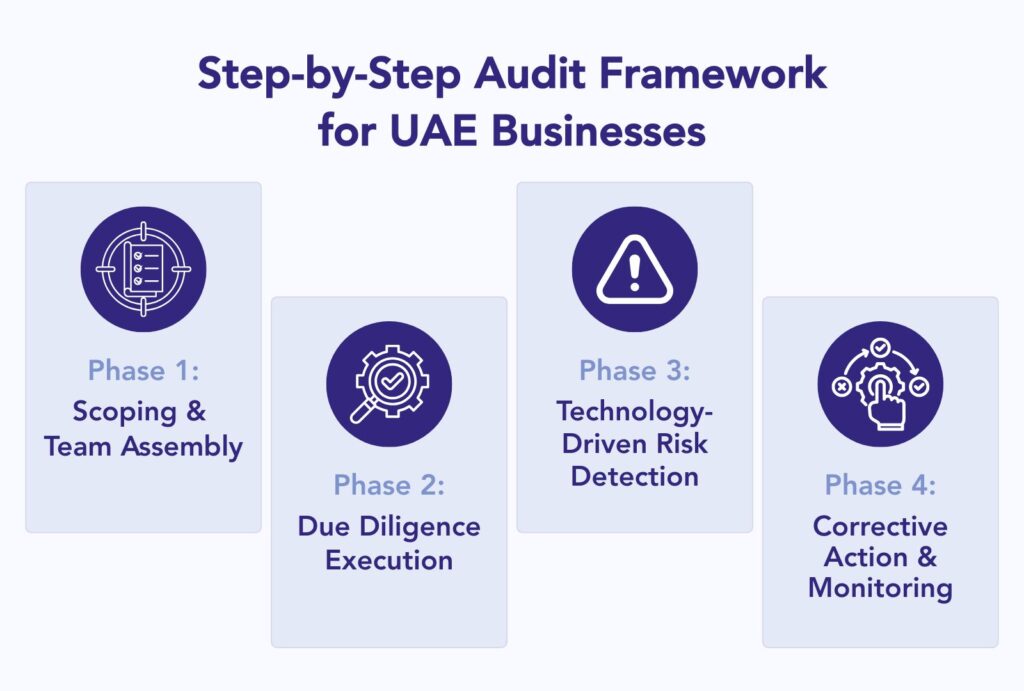
Step-by-Step Audit Framework for UAE Businesses

Auditing a supply chain is not about checking boxes. It is about knowing what to look for, where problems start, and how to keep things clean before they snowball. In the UAE, with new rules kicking in, companies need a system that helps them stay in control—not one that reacts too late.

Phase 1: Scoping and Team Assembly

Pick your focus early. Are you worried about payments, shipments, or certain vendors? That clarity helps. You also need the right people in the room. Compliance leads, cybersecurity staff, logistics heads—they all see different parts of the picture. Bring them together, and your audit will actually reflect what your business is doing.

Phase 2: Due Diligence Execution

This is where mistakes happen. Suppliers should not just “look good”—verify them. Use official registries to check trade licenses and ownership. Then dig into payments. Look for hidden charges or missing records. On the logistics side, make sure MPCI compliance UAE rules are being followed, especially 24-hour advance cargo filing. Without that, you are out of step with UAE supply chain compliance.

Phase 3: Technology-Driven Risk Detection

Let machines do what humans cannot. AI helps catch strange activity—like sudden pricing spikes or erratic delivery timelines. Blockchain keeps your deals locked and clear. Once it is recorded, it stays that way. That kind of clarity matters when audits get serious. It gives you proof, not just hope.

Phase 4: Corrective Action and Monitoring

Some risks hit harder than others. Use a simple scale—what is urgent, what can wait. From there, set up live tracking. Dashboards that show Supplier Score or how often your cargo filings are accurate can tell you what is working. The audit readiness process is not a one-time drill. It has to be ongoing to keep up with UAE standards.

ADEPTS: Tailored Solutions for UAE Supply Chain Resilience

In a compliance environment as dynamic as the UAE’s, ready-made templates do not cut it. Businesses need solutions that fit their exact risk profile, regulatory exposure, and supply network complexity. ADEPTS enables companies to conduct deeper UAE supply chain due diligence rooted in actual risk. It combines deep regulatory know-how with smart tech to help companies stay ahead of issues—not just fix them after the fact. 

Targeted Due Diligence and Supplier Mapping

ADEPTS begins where standard audits stop. It uncovers ownership structures that may be buried under layers of shell companies. This helps organizations perform UAE supply chain due diligence that is not just box-ticking, but rooted in actual risk. Compliance histories, past penalties, and cross-border links are also flagged for early attention.

MPCI Readiness and Cargo Compliance Support

Cargo audits have become a critical risk zone. ADEPTS runs full MPCI compliance UAE checks to make sure shipment filings meet the 24-hour rule and all supporting documents match UAE protocols. For companies moving high-volume or sensitive goods, this ensures smoother port clearance and fewer last-minute disruptions tied to UAE cargo security regulations.

Real-Time Risk Dashboards and Alerts

ADEPTS also delivers smart dashboards that score supplier risk and flag anomalies as they happen. These tools offer more than a snapshot—they evolve with the data. Predictive alerts give teams the edge to act early. The goal is simple: strengthen audit readiness & support while reducing time spent chasing down paper trails.

Case in Point: 40% Fewer Disruptions

One Dubai-based manufacturer used ADEPTS to scan deeper into its supply chain. AI tools picked up signs of delay risk from a sub-tier supplier weeks before they impacted delivery. That insight led to quick supplier substitution and a 40 percent drop in disruption events. This is where strategy meets results.

Future-Proofing Strategies for 2025 and Beyond

Compliance is no longer just about reacting to audits. It is about staying ready for what is coming next. With the UAE’s regulatory shifts and global trade friction rising, businesses must take a forward-looking view of risk. The goal is not only to pass inspections—but to build a supply chain that can adapt and endure.

Proactive Supply Chain Risk Management

Traditional audits often miss what is not already broken. To fix that, more companies are embedding future risks directly into their protocols. ADEPTS enables this by modeling scenarios tied to climate change and geopolitical disruptions. This proactive form of supply chain risk management UAE helps reduce surprises, delays, and compliance slip-ups across both local and regional partners.

Unified Compliance Platforms

Multiple jurisdictions now require layered cargo reporting—UAE’s MPCI, the EU’s ICS2, and the US’s ISF. Platforms like Trade Tech help unify that process. They streamline updates, reduce filing errors, and keep businesses aligned with UAE cargo security regulations and global counterparts. This approach lowers audit stress and saves hours of paperwork.

Collaborative Supplier Resilience

No business can manage compliance alone. When something breaks down in the supply chain, the fix should not be one-sided. Strong audit teams now include suppliers in the process. Joint action plans, shared dashboards, and supplier-led checks help improve supply chain fraud prevention UAE and make compliance a shared responsibility—not just a checklist.

Conclusion

Compliance in the UAE is getting stricter—and faster. With rules like MPCI compliance UAE and corporate tax compliance UAE now in full effect, companies can’t afford to wait for red flags. Small gaps in supply chains or paperwork can turn into bigger problems quickly. But early action works. 


Spotting weak links before they grow saves time, money, and reputation. Whether it’s checking a supplier’s records or filing cargo data on time, these steps matter more than ever. Audits are no longer just a formality. Done right, they help you stay steady while everything around you moves fast. That’s what gives real confidence in 2025 and beyond.

FAQs:

Once a year is the bare minimum. But in high-risk sectors, or when suppliers or laws change, audits should be more frequent to stay in control.

Cargo can be held, delayed, or even seized. MPCI compliance UAE rules are strict, and missing them creates both financial and reputational trouble.

Yes. There are lightweight systems out there—ADEPTS included—that offer real support without the heavy cost. Good audit readiness & support does not need to break the bank.

That happens. Auditors often use local contacts, bilingual staff, or supplier training to keep things clear. Good communication is part of the audit itself.

More than before. Basic blockchain tools can now track shipments or verify payments. It is a smart way to boost UAE supply chain compliance without going overboard.

Flag it fast. Pause any risky activity, alert your team, and decide how urgent the fix is. The key is not to let hidden supply chain risks UAE get worse.

They help show how much your business relies on local suppliers and ethical sourcing. That proof matters when applying for ICV benefits.

Related Articles​​

The Impact of ICV on Joint Ventures between UAE Nationals and Foreign Investors

Looking to grow in the UAE? A joint venture might be your smartest play. The UAE is bold, modern, and business-ready. It’s a hotspot for innovation, tech, and global trade. That makes it the perfect place to team up and go big.

A joint venture (JV) is a perfect way of entering the vibrant market of the UAE. It is a commercial deal between two or more partners. You share resources, risks, and rewards as you chase the same goals. 

Here’s why JVs are a win:

  • Faster market entry — skip the long setup hassle
  • Lower costs — no need for full-scale operations
  • Stay in control — keep ownership of your investment and returns
  • Tax perks — benefit from local incentives and customs breaks

JVs are perfect for businesses that look for flexibility, speed, and access. But they need to be structured right. A rushed setup can cost you. This blog breaks down the real opportunities and hidden risks of joint ventures in the UAE. But before we dive in, let’s quickly look at how JVs actually work here.

Understanding Joint Ventures in the UAE

We have discussed what joint ventures are. Definitions aren‘t Before you dive into a joint venture, you’ll need to choose the right setup. In the UAE, that means picking between two main options: Mainland or Free Zone.

Mainland License

This is your go-anywhere ticket. A Mainland company is licensed by the UAE’s Department of Economic Development (DED). That means you can operate across the entire UAE, no zone restrictions. The government is pushing hard to attract foreign investment here. That means:

  • Faster licensing
  • Flexible operations
  • Access to public-sector contracts

If you’re planning a joint venture with local market reach, the mainland setup gives you the freedom to grow. Government is supporting businesses and that means sufficient governmental support at every stage of the setup. 

Free Zones

Want full control and tax relaxation? Free zones are your friend. With a Free Zone license, you get:

  • 100% foreign ownership
  • Zero customs duties within the zone
  • Top-tier infrastructure
  • Proximity to ports, airports, and trade hubs

But there’s a catch: you’re limited to operating inside the zone, unless you get special permits or a mainland agent. This works best for export-focused ventures or tech-based setups targeting global markets.

How Do Joint Ventures Work in the UAE?

Joint ventures in the UAE are built on collaboration. A local Emirati partner teams up with a foreign investor. Each brings something to the table, capital, know-how, networks, or market access. You don’t need a full-fledged company. You just need the right partner and a clear agreement.

There are two main JV models:

  • Equity-based — where both parties own shares and profits
  • Contractual — where partners work together on a project without forming a new legal entity

The structure depends on your goals. Some JVs aim for long-term market growth. Others focus on a single big project.

One big plus? UAE law now allows 100% foreign ownership in many sectors. But in strategic areas like oil & gas or defense, you still need a local partner. The government has control over its natural resources. Oil and gas sectors are not open zones for 100 percent investment. That’s where JVs shine.

Done right, a JV gives you speed, access, and scale.

Why ICV Matters More Than Ever

Now here’s the game-changer: ICV, In-Country Value. ICV is a national program that measures how much of your business benefits the UAE economy. It’s a big deal. Want to win government contracts or work with giants like ADNOC? You’ll need a strong ICV score.

The ICV formula looks at:

  • Spending inside the UAE
  • Local manufacturing and investment
  • Emirati hiring and training
  • Use of local suppliers and services
  • Bonuses for exports and innovation

From January 1, 2025, things get stricter. All JVs must submit audited, stand-alone financial statements. No more shared or consolidated reports. It’s all about transparency. In a joint venture, your ICV score matters. It can open doors or close them. Choose the right partner, plan your structure well, and you’ll be ready to compete.

What is ICV Certificate?

ICV meaning In‑Country Value. It’s a UAE government initiative—originally launched by ADNOC in Abu Dhabi in 2018 and now managed by MOIAT nationally to quantify and encourage a company’s contribution to the local economy. 

The certification measures:

  1. Local manufacturing or procurement
  2. Investment in UAE assets
  3. Hiring and training of Emiratis
  4. Expatriate workforce contribution
  5. Performance bonuses (e.g. exports, Emirati headcount growth, investment growth)

An ICV Certificate in UAE is issued annually by a certifying body (e.g., Deloitte, Crowe, Grant Thornton), validating a company’s ICV score based on submitted financials 

Common JV Structures in the UAE

Foreign investors team up with UAE nationals using one of two popular models:

Corporate Joint Venture (LLC)

You form a new company, usually an onshore LLC. Profits, losses, shares – all under one roof. It is a flexible management structure with limited liability protection for the parties to the partnerships. Offshore options in ADGM or DIFC (financial free zones) are also smart picks, offering English-law frameworks and solid governance. 

Contractual Joint Venture

No new company. This means you need no separate legal entity. You sign a contract, pool resources, and share output. This structure is simple, project-focused, and flexible. It works great for specific ventures. 

Ownership Rules:

  • Onshore LLCs usually require a local partner with a 51% stake—unless your sector now allows 100% foreign ownership.
  • Free zone firms offer full foreign ownership but limit you to zone operations unless you add extra licensing.

Choosing the right model comes down to your goals: local reach? Go onshore. Want full ownership and global scope? Free zone JVs in ADGM/DIFC could be your sweet spot .

Legal & Tax Requirements for UAE JVs

Legal and tax requirements in the UAE can be a bit complicated. Here, we simplify the rules for easy understanding:

Licensing & Local Rules

  • Onshore LLCs: Register with the DED. Comply with Commercial Companies Law. Local partner still needed in many sectors.
  • Free zone entities: License from the relevant authority. Perfect for export-ready and tech-savvy ventures.

Contracts & Governance

  • A solid JV agreement is a must. Cover ownership, profits, dispute mechanisms, exit clauses.
  • Free zones like ADGM & DIFC support advanced corporate tools, drag‑along, tag‑along, arbitration

Corporate Tax under Decree‑Law 47/2022

  • Tax kicks in from June 2023: 0–9% based on profit thresholds.
  • Unincorporated JVs (contractual models) now can opt-in to entity-level taxation, simplifying compliance.
  • Free zone companies may enjoy 0% tax, if they meet substance requirements and tick Qualifying Income boxes.

New 15% Minimum Tax for MNEs

  • From January 1, 2025, large multinationals (global revenues > €750 million) face a 15% top-up tax under OECD rules.
  • SMEs and most free zone JVs are exempt—so long as profit stays under thresholds or inside the zone 

Why It Matters

Setting up a JV isn’t just a handshake and a spreadsheet. It’s a legal and fiscal blueprint. You will have to choose your structure. Nail your agreements. Meet tax rules. Align with the new global minimum tax.

That’s the backbone. Up next? We’ll dive into the huge upsides strategic, operational, and economic that a well-designed JV brings in the UAE.

How ICV Certification Affects Joint Ventures

In today’s UAE business environment, ICV isn’t optional, it’s essential. For joint ventures, it can make or break your ability to compete, especially in high-value sectors.

The Weighted ICV Formula

ICV scores in a JV are calculated using a weighted average. That means each partner’s ICV certificate is factored in based on their equity stake.

Example:

  • UAE partner has 60% ownership and an ICV score of 48
  • Foreign partner holds 40% and scores 25
  • The JV’s total ICV score = (60% × 48) + (40% × 25) = 39.6

Your score is only as strong as your weakest link.

Audited Financials Are a Must

Every partner in the JV must have:

  • A valid ICV certificate, issued by an accredited certifier
  • Audited, stand-alone financial statements—no consolidated accounts allowed from Jan 2025 onward

If one partner fails to comply, the JV can’t get certified. That blocks you from bidding on many public and semi-government contracts.

JV-Specific ICV Plans Are Now Required

JVs also need to submit:

  • A custom ICV improvement plan
  • Detailed commitments to increase local spending, Emirati hiring, and other ICV inputs over time

This is a core requirement in tender evaluations by ADNOC and other government entities.

No ICV, No Contract

Government and ADNOC tenders are increasingly tied to ICV performance. A low or missing ICV score can disqualify your bid, no matter how competitive your offer is otherwise.

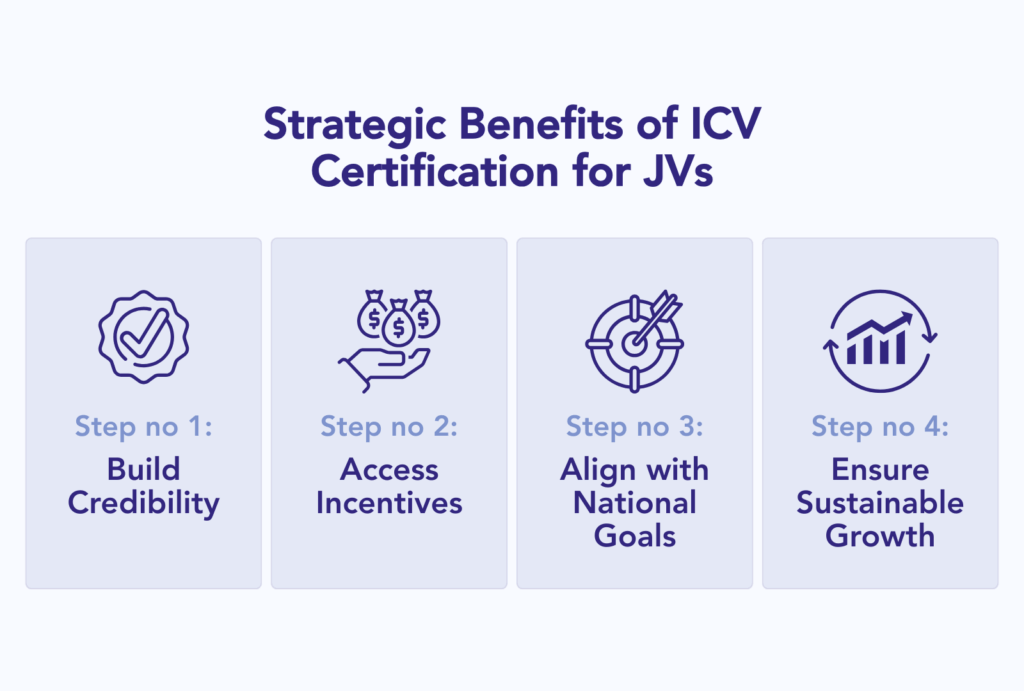
Strategic Benefits of ICV Certification for JVs

Getting ICV right isn’t just about compliance, it’s a business advantage. Win More Contracts

A high ICV score gives your JV a clear edge in:

  • Government projects
  • ADNOC procurements
  • Semi-government tenders

It’s often a scoring criterion, not just a checkbox.

Build Credibility

Certified JVs are seen as serious, committed players. They earn trust from:

  • Government stakeholders
  • Banks and lenders
  • Local suppliers and regulators

Access Incentives

Some free zones and ministries offer:

  • Preferential procurement terms
  • Financing support
  • Faster approval processes- exclusively for ICV-certified businesses.

Align with National Goals

JVs that support Emiratization, local manufacturing, and economic diversification are more likely to:

  • Attract support
  • Retain licenses
  • Receive long-term partnership offers

Ensure Sustainable Growth

ICV compliance pushes your JV to invest locally, skills, jobs, assets. That strengthens your position and future-proofs your business in the UAE.

Challenges in Setting Up a Joint Venture in the UAE

Joint ventures in the UAE are no doubt very feasible. There are so many incentives that businesses can use. That does not mean there are no difficulties at all.  They come with their share of challenges. Knowing them upfront can save you headaches later.

Legal and Regulatory Hurdles

The UAE’s laws can be tricky.

  • Foreigners often need a local partner owning 51%.
  • This limits your control.
  • Some sectors allow 100% foreign ownership, but not all.

Drafting the JV agreement is critical. You must cover ownership, roles, exits, and more. Cultural and legal differences, influenced by Sharia law and customs, can cause misunderstandings. One wrong move here can lead to disputes.

Finding the Right Partner

Your local partner can make or break the JV.

  • It could be a person or a UAE-owned company.
  • They must know local laws and have a solid reputation.
  • Alignment on vision and goals is key.

Don’t settle for a silent investor. You want a partner who adds value, market know-how, connections, and shared ambition. This is especially important if the Emirati partner holds majority shares.

Bridging Cultural and Operational Gaps

Business culture in the UAE is unique.

  • It values long-term relationships over quick deals.
  • Decision-making can be slower. Patience is a must.
  • Labour laws, management, and hierarchies differ from the West.
  • Differences can cause clashes in daily operations and contract enforcement.

Foreign companies need to respect and adapt to these cultural nuances to avoid friction.

How ADEPTS Supports JVs in Navigating ICV Certification

ADEPTS offers icv certification services and knows ICV inside out, especially for joint ventures and complex partnerships. They offer expert consulting to help your JV meet and exceed ICV requirements. Their services include:

  • Corporate Tax Registration
  • They assist JVs with registering for UAE corporate tax under the new Federal Decree-Law No. 47 of 2022—ensuring all entities are compliant from day one.
  • Financial Audit Preparation
  • ADEPTS helps prepare stand-alone, IFRS-compliant audited financial statements, a requirement for ICV certification process from January 1, 2025.
  • ICV Score Optimization
  • They review every ICV certificate cost component—local procurement, Emiratization, capex, and bonuses to maximize the JV’s weighted average ICV score.
  • JV-Specific ICV Strategy
  • They build tailored plans based on equity structure and sector focus. This includes forecasting, performance tracking, and improvement plans to stay competitive in tenders.

ADEPTS has a strong track record. They’ve helped multiple UAE-based JVs boost ICV scores, win government and ADNOC contracts, and improve local content commitments. They stay sharp on the latest regulations and technology. That means your JV always gets advice that’s up-to-date and effective.

Practical Steps for JVs to Achieve and Maximize ICV Certification

Here’s a clear roadmap to help joint ventures succeed with ICV certification:

Step 1: Entity Setup & Audit-Ready Financials

Register your JV with NAFIS and get each partner’s legal entity in order. Prepare stand-alone audited financial statements for each entity involved. No consolidated reports are allowed.

Step 2: Collect Core Data

Gather detailed data across all partners:

  • Investment in UAE assets
  • Local procurement and manufacturing costs
  • Emirati salaries and training expenses
  • Expat salaries (only partially counted)

This is the backbone of your ICV calculation.

Step 3: Develop a JV-Specific ICV Plan

Build an improvement plan that reflects each partner’s equity. Set clear targets for increasing local spend, hiring nationals, and boosting your UAE-based operations. This plan may be mandatory for certain tenders (especially ADNOC).

Step 4: Submit to a Certified ICV Auditor

Choose from authorized ICV certifying bodies (like Deloitte, Crowe, or BDO). Submit your ICV template, supporting documents, and audit reports. Expect a detailed review and possibly a site visit.

Step 5: Leverage Your ICV Certification

Use your ICV score as a strategic tool in proposals. Highlight it in bids for:

  • Government contracts
  • ADNOC supplier approvals
  • Public-private partnerships

A high ICV score boosts your ranking, improves your credibility, and opens more doors.

Future Outlook: ICV and Joint Ventures in the UAE

The UAE’s ICV program is evolving—and fast. What started in energy and procurement is now expanding into new high-growth sectors.

Expect to see ICV frameworks rolled out in:

  • Fintech and digital services
  • Healthcare and medical tech
  • Advanced manufacturing and AI-driven industries

This is no longer just about local spending. The UAE is linking ICV scoring to:

  • R&D investments
  • Technology transfer
  • Green initiatives and sustainability

For joint ventures, this means new opportunities, but also new expectations.

You’ll need to:

  • Track more data points
  • Align with UAE Vision 2031 goals
  • Invest in innovation and Emirati workforce development

JVs that proactively adapt will gain a serious edge, especially in ADNOC bids, government contracts, and strategic partnerships.

Digital tools and AI will play a big role too. From ICV calculation platforms to auto-updated reporting dashboards, technology will help JVs simplify compliance, reduce errors, and spot performance gaps early.

Forward-looking JVs should start:

  • Digitizing ICV data management
  • Revisiting improvement plans annually
  • Upgrading financial reporting standards

In short: ICV is growing in scope and depth. JVs that prepare today will lead tomorrow.

Conclusion

ICV is no longer a formality, it’s a strategic pillar in the UAE’s economic vision. For joint ventures, understanding and maximizing ICV has become essential to long-term success.

From structuring your JV right to aligning with local laws, ICV affects everything: licensing, compliance, partner roles, bid eligibility, and growth potential. Proactive JVs are already building internal systems to manage ICV scores, improving their supply chains, and developing Emirati talent. The result? More contracts, more trust, and stronger partnerships.

But navigating ICV isn’t easy, especially in multi-partner setups. That’s where ADEPTS comes in.

With deep expertise in ICV audits, score optimization, and JV strategy, ADEPTS helps you stay compliant, competitive, and contract-ready. Don’t wait for ICV to become a hurdle. Make it your advantage. Partner with ADEPTS. Maximize your ICV. Power your joint venture forward.

FAQs:

No. The JV itself must be certified. Each partner’s ICV score contributes, but a valid JV-level certificate is required to qualify for tenders.

ICV doesn’t dictate profit shares. Distribution is governed by the JV agreement. However, a stronger ICV score can increase total contract wins—affecting the bottom line.

There are no direct fines, but the real cost is disqualification from tenders, especially from ADNOC and public sector buyers.

Yes. A strong ICV score signals local impact and regulatory alignment—two major factors that attract serious investors.

Every 14 months from the date of audited financial statements. Annual re-certification is strongly advised for consistent eligibility.

Platforms like Tawteen, MOIAT’s ICV Portal, and enterprise tools with ICV modules (e.g., SAP, Oracle) can automate data tracking and streamline reporting.

Any ownership change affects the weighted ICV score. A new partner with a lower ICV score could weaken the JV’s eligibility. Exit clauses should account for ICV impacts.

Related Articles​​

The Imperative Shift: Mandatory E-Invoicing in the UAE by July 2026

Big changes are coming for businesses all over the UAE.


As of July 2026, the UAE’s e-invoicing pilot phase is active, and for Phase 1 businesses, this is no longer a future plan – it is a legal requirement already in motion.


This isn’t just a small change to your accounting. It’s a whole new way to make, send, and report invoices.


The government started this plan in July 2023. The main idea is to help businesses eliminate excessive paperwork and simplify the tax process. Instead of doing things by hand, invoices will go through secure digital systems. This should make everything faster and save money and time for businesses, big or small.


But the deadline is coming fast. You can’t wait until the last minute. Businesses need to check their VAT systems and tech now. If you wait too long, you could get fined or have big problems that slow your business down when you really need to be quick.


This isn’t just another rule to follow. It’s something you have to do to keep up and stay on the right side of the law in the UAE’s changing business world. Businesses that get ready early will avoid stress and keep running smoothly.


So, let’s look at what’s changing and how you can get your business ready for this big digital switch.

Understanding the UAE’s E-Invoicing Mandate

UAE e-invoicing is now backed by a stronger legal framework.


The UAE introduced Ministerial Decisions No. 243 and 244 of 2025, which clearly define how businesses must create, exchange, and report electronic invoices to the Federal Tax Authority (FTA).


If your business is registered for VAT, e-invoicing will be required. It doesn’t matter if you sell to other businesses or to the government, you’ll have to follow these new rules.


Here are some key dates to watch:

  • By the end of 2024, service providers who help with e-invoicing need to get official approval. These companies make sure invoices go through the right channels.

  • In mid-2025, the government released the detailed technical and operational rules for e-invoicing.

  • By July 31, 2026, businesses with annual revenue of AED 50 million or more must appoint an Accredited Service Provider (ASP).

  • By July 2026, all VAT-registered businesses will have to start using e-invoicing.

Knowing these dates gives you time to get ready. Starting early helps you avoid fines and keeps your business running without problems when the new system starts.

Phase 1 vs. Phase 2: Where Does Your Business Stand?

Phase 1 applies to Large Taxpayers with annual revenue of AED 50 million or more. These businesses must onboard an ASP no later than July 31, 2026.


Phase 2 will gradually bring in remaining VAT-registered businesses under the same framework.


Note: The UAE Ministry of Finance has extended the Accredited Service Provider (ASP) appointment deadline for large taxpayers (annual revenue ≥ AED 50 million) to 30 October 2026. The mandatory e-invoicing go-live date of 1 January 2027 remains unchanged.

Decoding the 5-Corner Model: How E-Invoicing Works

The UAE decided to go with the 5-Corner Model for its e-invoicing system, which has already proven to be reliable in some of the world’s most advanced tax systems. This setup relies on a decentralized approach known as Continuous Transaction Control and Exchange, or DCTCE.


No single company has total control over the data here, it’s spread out across a secure, linked-up system. The whole thing uses PEPPOL, a worldwide standard that keeps e-invoices moving safely and efficiently.


Let’s take a closer look at how this actually works.


It starts with the supplier, who generates the invoice within their own ERP or accounting system using the PINT AE XML format.


Before the invoice reaches the buyer, it’s routed through an Accredited Service Provider (ASP).


Think of the ASP as a real-time validation layer, performing instant compliance checks before the invoice is exchanged.


After real-time validation via an Accredited Service Provider (ASP), the invoice is routed to the buyer’s ASP.


Finally, the validated invoice is automatically reported to the Federal Tax Authority (FTA). This real-time reporting is a game changer: it gives the FTA the data it needs to monitor VAT compliance continuously, rather than relying on periodic audits.


PDF and paper invoices are no longer legally valid for 2026 compliance. Only structured XML invoices transmitted through approved systems will be accepted.

PINT AE XML: The New Standard for Data Exchange

PINT AE is the mandatory XML standard for UAE e-invoicing. It ensures invoices are machine-readable, automatically validated, and seamlessly shared across systems.


The magic of the 5-Corner Model is in how it all balances out. It’s not about one authority calling all the shots; it’s more like a team effort where everyone has a role.


Accredited providers help businesses keep using their setups without stressing about data safety or tricky formatting. Meanwhile, the FTA keeps an eye on everything in real time, which cuts down on mistakes and tax gaps.


In simple terms, this approach brings speed, precision, and reliability to the table. But for it to really work, businesses can’t just add a quick fix at the last minute. They need to make sure their systems and workflows can tap right into this digital setup. 


It’s a whole new way of handling tax data. For those who adapt early, it’s a chance to stay ahead and really thrive in the UAE’s growing digital economy.

Penalties: The Cost of Non-Compliance

Non-compliance results in the following penalties under Cabinet Decision No. 106 of 2025 and form part of the 2026 Penalties framework:

  • AED 5,000 monthly fine for failure to implement e-invoicing or appoint an ASP
  • AED 100 per non-compliant invoice (capped at AED 5,000 per month)
  • AED 1,000 per day for failing to notify the FTA of system malfunctions within two business days
  • AED 1,000 penalty for failure to update registered data with the ASP

Operational Challenges: If you don’t get this right, it’s not just a fine you’re risking. You could face real problems in your day-to-day work. Like your tasks will slow down, there will be mix-ups, and even trouble with suppliers or clients. It might also put a dent in how people see your business.

VAT Health Check: Preparing for E-Invoicing

A vat health check is now critical before moving into e-invoicing. A thorough VAT health check in UAE will ensure your systems are ready for this major change.


Here’s where to focus:

  • Check Your Systems: Confirm ERP compatibility with PINT AE XML standards.

  • Check Your Data: Accurate customer and supplier data is key. A tax health check ensures your information is up-to-date and compliant.

  • Tweak Your Processes: Adjust your billing and reporting flows to integrate seamlessly with e-invoicing requirements.

The 2026 Reverse Charge Simplification

From January 1, 2026, self-invoicing for reverse charge transactions has been removed. Supporting documents are sufficient.

Statute of Limitations: The 5-Year Rule for VAT Refunds

From January 1, 2026, VAT refund claims are strictly limited to five years. Any unclaimed credits beyond this period will expire.


The FTA may also deny input tax where a business “knew or should have known” it was part of a tax evasion chain.

Lessons from Saudi Arabia & Global Leaders in E-Invoicing

Saudi Arabia’s experience with e-invoicing, through its phased rollout called FATOORA, has set a strong example for the region. Their gradual approach allowed businesses to adapt step-by-step, making the whole transition smoother and less disruptive.


Some important lessons from their journey include:

  • Getting compliant early helped companies be better prepared for audits and day-to-day operations.

  • Using automated systems cuts down on mistakes in VAT reporting and makes tax processes more transparent.

Saudi Arabia’s experience with e-invoicing shows how different models matter.


Unlike KSA’s centralized system, the UAE uses a decentralized DCTCE model, making the role of the ASP far more critical. Countries like Chile, Italy, and India also demonstrate how automation and tax transparency improve compliance. The PEPPOL PINT standard allows global interoperability while keeping local control.

How to Future-Proof Your Finance Stack for E-Invoicing

  • Tech Stack Basics: Use a cloud ERP, real-time APIs, and reliable tax engines.

  • Choosing the Right Partners: Select from FTA pre-approved ASPs such as ClearTax, Flick, Deloitte, or Taxilla. ASPs must also hold ISO 27001 certification.

Data Residency: Storing Your Invoices within the UAE

From 2026, invoice data must be stored within approved UAE-based infrastructure.

  • Change Management: Train your team and update processes. A regular VAT health check can catch any new risks.

ADEPTS: Your Partner in E-Invoicing Compliance

  • 2026 VAT Rule Alignment Audits: We align your systems with the new VAT rules before penalties apply.

  • ASP Selection & Integration Support: We help you choose and integrate the right ASP smoothly.

  • Save Time and Avoid Mistakes: With ADEPTS’ experience in accounting, VAT, and tax advice, we help make your processes smoother so you can focus on growing your business.

  • Catch Issues Early: Our VAT health checks and system reviews find problems before they turn into fines or disruptions.

  • Make the Switch Stress-Free: We guide you step-by-step through all the e-invoicing changes, so your team can adjust quickly without any hiccups.

  • Prepare for What’s Next: We assist with five-year VAT refund reconciliations before old credits expire.

  • Tailored Help Just for You: ADEPTS offers advice and solutions that fit your business needs, keeping you compliant and competitive in a changing market.

Conclusion

The UAE e-invoicing mandate is no longer something to plan for later.


July 31, 2026 is the point of no return for Large Taxpayers.


If you wait too long, you could face fines or serious operational disruptions. A VAT health check or VAT due diligence in Dubai will help identify risks early and keep your business moving.


Getting ready now means fewer problems later. The sooner you act, the smoother the transition will be.


Note: The UAE Ministry of Finance has extended the Accredited Service Provider (ASP) appointment deadline for large taxpayers (annual revenue ≥ AED 50 million) to 30 October 2026. The mandatory e-invoicing go-live date of 1 January 2027 remains unchanged.

FAQs:

Think of PEPPOL as a global online highway for business documents. The UAE is plugging into it for e-invoicing, making sure digital invoices can be sent and received by the FTA in a really smooth, standardized way.

No. All VAT-registered businesses must comply.

ASP appointment is mandatory. They validate, transmit, and report invoices to the FTA.

Five years after the relevant tax period.

E-Invoicing offers alot of benefits, like faster payments, fewer manual mistakes, reduced costs, clearer tracking, and better tax health check for VAT compliance overall.

You must notify the FTA within two business days to avoid an AED 1,000 daily penalty.

No. This requirement is removed from January 1, 2026.

Yes. A strict five-year limit applies from 2026.

References

Related Articles​​

The Role of Sovereign Wealth Funds in UAE Outbound M&A Strategies

In 2025, UAE Sovereign Wealth Funds (SWFs) are making bold moves. They’re not just investing locally, they’re buying businesses across borders. This shift marks a new phase for the UAE: one focused on global reach and long-term returns.


Why now?


First, the UAE wants to reduce its reliance on oil. Diversification is key.
Second, global markets are offering good deals—and the SWFs are ready.
Third, new tech and innovation are opening fresh opportunities worldwide.
And finally, it all ties back to the UAE’s national game plan for smart, sustainable growth.


Let’s explore how these powerful funds are reshaping the future deal by deal.

Comparative Analysis: UAE SWFs vs. Global Counterparts

UAE Sovereign Wealth Funds are no longer just regional players. They’re global powerhouses, competing head-to-head with the biggest funds in the world.

Market Position: UAE Funds in the Global League

Mubadala, ICD, and ADIA are massive. Each one manages $300 billions in assets. That’s trillions of dirhams at work. They’re sitting at the same table as Norway’s Government Pension Fund and China Investment Corporation – two of the most powerful investment vehicles in the world.


What does that mean? It means the UAE has a real voice in global markets. It means access to the world’s best opportunities. It means power, not just money.

Investment Strategies: Thinking Long-Term, Acting Smart

The Role of Sovereign Wealth Funds in UAE Outbound M&A Strategies

These funds don’t gamble. They plan. Every deal fits into a bigger picture – diversify the economy, bring innovation home, and stay ahead of global trends.

Where’s the money going?

  • Technology
    Think AI labs in Europe, semiconductor factories in Asia, and digital infrastructure in the U.S.  UAE wants to own a slice of tomorrow’s tech.

  • Healthcare
    Deals include biotech startups, major pharmaceutical brands, and hospital chains in fast-growing markets.  It’s about health, longevity, and future-ready care.

  • Renewables
    From solar fields in Africa to wind farms in Europe, UAE funds are all-in on clean energy. They’re also investing in next-gen battery storage to solve energy supply challenges.

  • Infrastructure
    Smart ports. Rail networks. Urban mobility. The UAE is buying into the backbones of growing economies – Asia, Latin America, and beyond.

More Than Money

These funds don’t just write cheques and walk away. They get involved. They join boards, guide strategy, and build long-term value.


Why?


Because it’s not just about returns. It’s about influence, access, and making the UAE a global business hub. And for local entrepreneurs? This is your chance to watch, learn, and maybe even partner up. The world is your market now.

Global Influence: Middle East Leading the Way

The Role of Sovereign Wealth Funds in UAE Outbound M&A Strategies

In just the first half of 2024, more than 54% of all SWF global investment came from Middle Eastern funds, mostly from the UAE, Saudi Arabia, and Qatar. That’s the highest share since 2009. It shows a major shift: capital is moving from the West to the Gulf. And UAE funds are leading the charge.

What Sets UAE SWFs Apart?

  • Strategic alignment with national goals (like Vision 2030 and Net Zero 2050)

  • Agile decision-making compared to more bureaucratic global peers

  • Regional expertise + global ambition

This blend of scale, speed, and strategy is what’s making UAE SWFs key players in the future of global M&A.

2025 Trends in UAE Outbound M&A Activity

UAE investors aren’t playing small in 2025. They’re buying businesses across the globe and fast.

Big Jump in Deals

In just the first three months of 2025, outbound mergers and acquisitions UAE deals shot up by 63% compared to last year. That’s a total of $19.7 billion in deals. And here’s the big part: the UAE and Saudi Arabia made up 77% of all outbound deals. Even more impressive? They owned 94% of the total deal value.


The message is clear – Gulf capital is going global. And the UAE is leading.

What Sectors Are Hot?

UAE Sovereign Wealth Funds are focusing on the future. They’re not just investing in what works now, but what will grow tomorrow.

Technology

AI, software, cloud services, this is where the UAE is placing big bets. The goal? Learn fast, grow faster, and bring the best tech back home.

Industrial Products

Think smart factories, automation, and high-end machinery. These are the tools that will power tomorrow’s economy.

Professional Services

UAE funds are backing global firms in finance, consulting, and legal tech. It’s about building world-class service networks.

Chemicals and Oil & Gas

Yes, this sector is still active, but the focus is shifting. It’s now about cleaner tech and advanced materials, not just crude oil.

Where Are They Buying?

The UAE isn’t just investing anywhere. It’s picking smart. The money is going to strategically important sites. The UAE is investing in places where the world’s future is:

The UK

Tops the list for deal volume. Why? It’s stable, tech-savvy, and open to investment. Plus, the UAE already has strong business ties there.

Canada and Peru

Surprise leaders in deal value, thanks to a huge chemical sector deal in Canada. These countries offer resources, strong returns, and new doors to global trade.

UAE funds are thinking ahead. They’re not following trends, they’re setting them.

What It Means for You

If you’re running a business in the UAE or planning to start one, this matters.

Here’s why:

  • UAE investors are chasing growth.

  • They love sectors with innovation and long-term value.

  • They’re looking for partners, suppliers, and smart ideas—even locally.

Build something future-ready, and you might just find yourself on their radar.

UAE SWFs Leading Outbound M&A Initiatives

The UAE’s biggest funds aren’t just investing, they’re building global influence with big Mergers and acquisitions services. Here’s how two of them are making waves in 2025.

Mubadala Investment Company

Mubadala is leading from the front. It’s not just writing checks, it’s picking smart partners.

Strategic Acquisitions
  • Mubadala took a 42% stake in Silver Rock Financial, a credit investment firm based in Los Angeles. This was its first-ever outside equity deal. Big move, bold market.

  • It also invested in Fortress Investment Group and CI Financial, two major names in global private equity. These deals expand Mubadala’s reach in asset management and finance.

Investment Style

Mubadala doesn’t just invest and step back. It gets involved.

It focuses on:

  • Fintech

  • Healthcare

  • Clean tech

Every deal is picked for long-term value, not short-term hype. And it actively works with its portfolio companies to drive growth.

Investment Corporation of Dubai (ICD)

ICD is all about scale and strategy. It manages a huge and diverse portfolio.

Global Presence

ICD has investments in over 87 countries.

Its portfolio covers:

  • Banking

  • Transport

  • Oil & Gas

  • Real Estate

This mix helps balance risk and unlock growth across the world.

Recent Moves

ICD is investing money in mergers and acquisitions UAE deals that support Dubai’s future economy. That means strategic investments in places and industries that match the city’s big goals, like sustainability, logistics, and smart finance.

Why It Matters

These two funds aren’t just shaping global markets, they’re shaping the UAE’s future. And for local business owners? It’s a sign of where things are headed. Innovation, global links, and smart partnerships are the name of the game.

Strategic Objectives Behind Outbound Mergers and Acquisitions in Dubai

The Role of Sovereign Wealth Funds in UAE Outbound M&A Strategies

UAE’s outbound investments aren’t just about buying global assets. They’re part of a bigger plan.

Economic Diversification

Oil won’t last forever. That’s why the UAE is spreading its bets. By investing in tech, health, and clean energy abroad, the country is building new income streams. This helps protect the economy and creates new jobs and industries at home.

Technology and Innovation

Want to lead? You need the latest tech. UAE funds are buying into companies with smart ideas, AI, biotech, fintech, clean energy. The goal? Bring that innovation back to the region. Learn fast. Grow faster.

Geopolitical Influence

Money talks. And investment builds strong global ties. By investing in different regions, the UAE is gaining not just returns but relationships. It’s about having a seat at the table when global business decisions are made.

Financial Returns

Let’s be clear – these deals are built to earn. The focus is on strong, steady returns, not risky bets. UAE funds are choosing smart, long-term investments that grow over time. It’s a mix of strategy and stability.

What It Means for You

If you’re starting a business in the UAE, these goals affect you. The push for innovation, new mergers and acquisition UAE bound deals, global thinking, and new industries opens doors. It’s a chance to grow alongside the nation’s big vision.

Case Studies of Notable Outbound M&A Transactions

UAE’s global investment game isn’t just theory—it’s already happening. Here are two real examples making headlines.

Mubadala’s Stake in Silver Rock Financial

Mubadala Capital made a bold move. It bought a 42% stake in Silver Rock Financial, a credit investment firm based in Los Angeles. This was Mubadala’s first outside equity deal—a big step into the U.S. market.


Why It Matters


This isn’t just about money. It’s about gaining expertise in structured credit and high-yield debt. Silver Rock gives Mubadala a new set of tools and a stronger global presence in financial markets. For UAE businesses, it shows how smart capital finds smart partners. Even across oceans.

ADNOC Launches XRG

In a bold shift, ADNOC launched XRG, a new company focused on low-carbon energy and advanced chemicals. It’s valued at over $80 billion. This isn’t a side project, it’s a major pillar of ADNOC’s future.


The Strategy


XRG is designed to ride three big global trends:

  • Energy transition

  • AI and automation

  • Growth in emerging markets

ADNOC’s goal? Double its asset value in 10 years by investing in the industries of the future. This move shows how even traditional energy giants are evolving fast. They’re not just adapting, they’re leading.

Why These Deals Matter to You

These deals are shaping the new UAE economy, one that’s global, green, and growth-focused.
If you’re building a business in the UAE, watch these moves closely. They reveal where the money and opportunity is headed.

Future Outlook and Strategic Implications

The momentum isn’t slowing down. In fact, it’s just getting started.

Continued Growth

UAE Sovereign Wealth Funds are staying bold. More global deals are coming fast. The focus? Sectors tied to tech, energy, health, and sustainability. All part of the plan to future-proof the UAE economy.

Regulatory Considerations

Cross-border deals mean crossing legal lines. Every country has rules and SWFs will need to stay sharp. Smart due diligence and strong legal teams will be key.

Partnership Opportunities

It won’t be a solo game. Expect more co-investments with global banks, funds, and major players. Shared risk. Shared expertise. Bigger wins.

What This Means for UAE Entrepreneurs

The world is opening up. The UAE is thinking global. Mergers and acquisitions in UAE are on the rise . If your business is future-focused, you should be investing in market research and top notch mergers and acquisitions services in UAE.

FAQs:

They’re going after tech, healthcare, clean energy, infrastructure, and finance. These are the sectors shaping the future and they want in.

They look at the big picture: market growth, strong returns, and fit with UAE goals. They also check the team. Good leadership is a must.

They don’t just invest, they add value. Their money comes with stability, networks, and serious expertise.

A lot. They invest where politics are stable and relations are strong. No surprises. Just smart, safe moves.

A major one.They help reduce reliance on oil by building income abroad and bringing innovation home.

They go in prepared. Every deal is backed by research, legal expertise, and risk planning.
No guesswork.

More deals in green energy, AI, and sustainable tech.  Also, expect more co-investments with big global players.


Related Articles​​

UAE Business Buyer Behavior in 2026: What Sellers Need to Know for a Successful Sale

When it comes to buying a business, it’s not just the mature regulatory and tax environment but the buyer’s compliance-first mindset as well. In 2026, the UAE is no longer a new tax market—it is an entrenched one where FTA enforcement has removed initial grace periods, and buyers now prioritize Audit Readiness and Digital Maturity, reflecting a market defined by Institutional Maturity.


Here is what a buyer looks at when they want to buy and sell a business in the UAE..


The Dubai Economic Agenda (D33) is accelerating this shift, targeting two million registered companies by 2030. This is making the market more competitive than ever, where only compliance-ready and digitally mature businesses stand out.

Understanding Dubai Business Buyer Behavior

Buyer Motivations

There are three things that motivate a buyer when it comes to buying a business in the UAE.


Market Entry – Dubai’s business environment has transitioned into a highly regulated global hub. With so many investors coming into the country, the market is getting much more competitive every day. Therefore, one thing that will motivate a buyer to purchase your business will be entering the market.


And let’s be honest, buying a set business with an established customer base and recognition in the UAE market is not just an easier but simpler way to enter the market without having to go through complex licensing and tax registration hurdles compared to starting a company from scratch. 


In 2026, this is not just about speed—it’s about acquiring an existing tax history, compliance records, and audit-ready positioning that a new setup simply cannot offer.


Preserving Commercial Track Records via Resolution 11 – Under Resolution No. 11 of 2025, buyers can now acquire a Free Zone entity and seamlessly transfer it to the Mainland without liquidation, while preserving its commercial track record, making acquisitions significantly more attractive than starting from scratch.


Strategic Expansion – another reason is that the investor wants to achieve scale in deep-tech and innovative sectors by acquiring businesses that help them expand their market share and scale up their business, with expansion now increasingly driven by acquiring AI-capable teams and ESG-compliant assets.


In 2026, nearly 35% of total M&A activity is concentrated in technology-driven sectors such as AI, robotics, and biotechnology, with Sovereign Wealth Funds like ADQ and Mubadala actively investing—setting a trend that private buyers are now following to secure strategic footholds in high-growth industries.


Sectoral Convergence – traditional businesses are now acquiring tech startups to digitize their operations, making business acquisition strategies in Dubai more focused on integrating innovation rather than just expanding size.


Diversification –  Then, there are buyers who want to diversify their investments by de-risking portfolios against global carbon taxes and regulatory shifts. This means the buyer will be purchasing a business in a different sector from what they already operate in to achieve cross-sectoral synergies in a high-growth economy, and enhance their profitability.


In 2026, this shift is strongly influenced by the UAE’s Net Zero by 2050 Strategic Initiative, with buyers actively moving into Renewable Energy, Sustainable Mobility, and Circular Economy sectors. 


They are not just diversifying across industries anymore, but across tax jurisdictions and green asset classes, especially as the 15% global minimum top-up tax for large multinational enterprises (MNEs) begins to reshape how larger firms structure and diversify their UAE holdings.

Buyer Decision Factors

If a person has decided to purchase a business, due to any of the above reasons or any other reason for that matter, then the following factors will influence their decision when they want to buy and sell business in UAE or especially buy and sell business in Dubai. 


In 2026, these are no longer just influencing factors—they are the non-negotiable baseline, where buyers expect IFRS-compliant audited financial statements supported by Audit-Ready Data, including 7 years of retained records as required by the FTA, clear visibility on how the 9% Corporate Tax has been managed, and whether Small Business Relief (SBR) has been correctly applied ahead of its December 31, 2026 sunset—ultimately assessing the real post-tax yield of the business.

Profitability and Financial Performance

Profitability and financial performance is one of the non-negotiable baselines that can and will influence the decision to buy the business. If your business is generating consistent profits, has a strong track record of IFRS-compliant audited financial statements, then your business has a chance at being sold at a greater price, something that matters a lot when people are trying to buy and sell business in Dubai where competition is high.

Growth Potential

When a person is buying a business, they are doing so to earn profits and not just to tie up their funds. This is why buyers look for opportunities for growth when investing in a business. Their buying decision is impacted greatly by scalability within the UAE’s digital and green economy of a business, be it through the chances of entering new markets, leveraging AI for operational alpha, or introducing services.


In 2026, growth is increasingly measured by AI maturity, where buyers use advanced analytics to identify hidden risks and opportunities, and businesses with strong digital adoption are scaling significantly faster—especially with Dubai’s Universal Blueprint for AI driving demand across finance, healthcare, and transport sectors. 


If your business shows potential for future development, it becomes a more appealing investment for anyone looking to buy and sell a business in UAE with a long-term plan in mind.

Sustainability as a Growth Multiplier

In 2026, over 60% of major deals now include ESG-linked performance metrics, making sustainability not just a compliance requirement but a key driver of long-term growth and valuation.

Operational Efficiency

When a person buys up a business, it means they want to acquire a turnkey, compliance-automated operation of starting a business from scratch and streamlining the system. This is why buyers value businesses with streamlined processes and systems. 


If your business has AI-powered workflows and automated e-invoicing systems and a strong management structure, it gives buyers confidence that they can step in smoothly without needing major changes.


In 2026, efficiency is directly linked to e-invoicing readiness, with the national rollout beginning July 1, and buyers actively preferring businesses that have already appointed an Accredited Service Provider (ASP) and integrated their ERP with the Peppol network to avoid ongoing non-compliance risks. 


This kind of setup is particularly attractive in places like Dubai, where those aiming to buy and sell businesses in Dubai want operations to run efficiently right from the start.

Digital Readiness and E-Invoicing Compliance

Businesses that are already aligned with UAE e-invoicing frameworks are seen as lower-risk, future-ready assets, especially as non-compliance can lead to recurring penalties and operational disruption.

Common Buyer Concerns

Assuming that a buyer is interested in buying your company, there are still a few genuine concerns that will still need to be addressed.

Due diligence

Before putting in a large sum of money into your account, the buyer wil perform exhaustive AI-driven data forensics on your previous contracts, expenses, debts, assets etc, to make sure they are not stepping into any kinds of problems. In 2026, this process of buying a business is no longer manual—AI tools can now review thousands of documents in hours, flagging risks such as Taxable Income vs Accounting Profit mismatches and non-compliant expense treatments like the 50% Entertainment add-backs under Article 32.  


It’s not just due diligence but a right of passage when buying a business. Buyers are also increasingly conducting Climate Due Diligence, verifying GHG emissions data and ESG disclosures to ensure regulatory alignment.

Tax and ESG Due Diligence: The 2026 Standard

Today, a deal is not considered secure unless both tax compliance and ESG reporting stand up to scrutiny—making this a core expectation rather than an added layer of review.

Legal compliance

Another very important thing that the buyer will ensure is that your business is in compliance with the UAE laws. This will include your employee’s visa status, your Anti-Money Laundering (AML) compliance, and UAE Corporate Tax registration status etc. 


In 2026, this has evolved into a “triple threat” check, where buyers verify that the Tax Registration Number (TRN) is active and aligned with the trade license, and that the business is prepared for major regulatory milestones such as the May 30, 2026 deadline for GHG emissions reporting under Federal Decree-Law No. 11 of 2024.

Standard Compliance vs 2026 Compliance High-Priority Items

Standard Compliance 2026 Compliance High-Priority Items
Trade license validity AML compliance and reporting
Basic tax registration ESR compliance and filings
Employee visa status Active TRN aligned with trade license
General legal checks GHG emissions reporting (May 30, 2026 deadline)

Integration challenges

In case your buyer already runs a business elsewhere or even in the UAE, before they buy or sell business, they will want to see if both the businesses can be digitally integrated into a unified AI-powered ecosystem. They’ll consider ERP compatibility, talent flight risk analysis, and corporate culture alignment. 


In 2026, this also includes aligning Digital MRV (Measurement, Reporting, and Verification) systems for emissions tracking, while AI-driven sentiment analysis is used to assess communication patterns and predict retention risks post-acquisition. The smoother the fit, the better.

Post-Merger Synergy Quantification

Buyers now use AI to track real-time KPIs after acquisition, ensuring that projected synergies are actually being achieved rather than just assumed on paper.

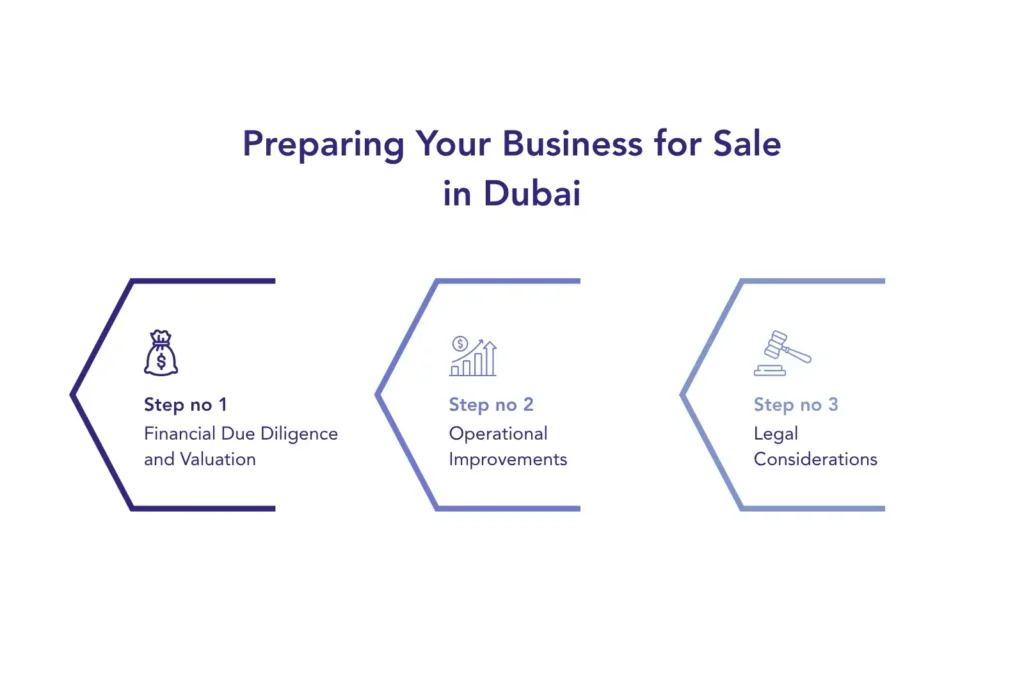
Preparing Your Business for Sale in Dubai

Preparing Your Business for Sale in Dubai

If you have decided to sell your business and you are actively looking for buyers in the market, you need to ensure that you and your business are all ready for it as well. No, not just mentally but in every other way as well.

Financial Due Diligence and Valuation

When putting your business on the market for sale, you need to be thoroughly prepared for it. The first thing that you need to ensure before listing your business is to have all your financial records audited by a UAE-accredited firm under IFRS standards. This is because a buyer will conduct  to look into your financial records and will need to see your real income, expenses, and profits before they decide to purchase. In 2026, buyers also expect dynamic valuation insights, where AI-driven analysis can identify revenue leakages of 3% to 5% and test different financial scenarios in real time.


Moreover, you must hire professional service to get a fair market value of your business. Having your is essential for both the buyer and the seller. If you are overpricing your business it will break the buyer’s trust, and if you underprice your business it will result in a loss for you. Valuations today also factor in Green Asset Premiums and Carbon Liability Discounts, especially for businesses exposed to ESG and climate-related risks.


If you overprice your business, buyers may lose trust and walk away. But if you underprice it, you risk selling at a loss.

Beyond EBITDA: Valuing Intangibles in 2026

Modern valuations now go beyond traditional EBITDA, factoring in elements like AI intellectual property, ESG performance scores, and workforce digital literacy to reflect the true value of a business.

Operational Improvements

As discussed above, a buyer is looking for a streamlined and well organized business which has a smooth system in process as this means lesser effort to run the business. Make sure that your business has a digitally mature, owner-independent operating model with a smooth workflow. Buyers want a business that can be powered by intelligent automation and real-time dashboards, or with minimal interference.


In 2026, this also means having a structured AI adoption roadmap, where businesses leverage tools like predictive maintenance or AI-driven CRM systems to improve efficiency, reduce response times, and optimize operational costs.

The ‘Clean Hands’ Audit: Operational Compliance Readiness

Buyers now look for businesses that are not only efficient but fully compliant in operations, with clean processes, documented controls, and no hidden operational risks that could surface post-acquisition.

Legal Considerations

To buy and sell a business does not only mean to have it ready in terms of financial records and streamlined operational system, you also need to cover the legal side of the deal. When selling your business you must have the terms and conditions stated clearly for both the parties to avoid any confusions and disputes in the future.


Furthermore, you must have all the legal documents with you like verified Tax Identification Numbers (TIN), ESG verified baselines, and ASP appointment contracts, so you can transfer the business to the new owner as soon as possible.


In 2026, sellers, especially Free Zone entities, are also expected to have a clear restructuring strategy in place under Resolution No. 11 of 2025, showing how the business can be moved to the Mainland without liquidation, making it more attractive to a wider pool of buyers.

Mainland and Free Zone Fluidity: The New Asset Class

Businesses that can seamlessly transition between Free Zone and Mainland structures are now seen as more flexible and valuable, giving buyers more strategic options post-acquisition.

Marketing Your Business to Potential Buyers

Finding a buyer for your business is not as simple as it seems and being able to reach your target audience is an even harder task, and businesses may require  as well. Here is how you can increase your chances of being able to reach out to your potential customers.

Target Buyer Profiles

There are two kinds of buyers in the market when we talk about selling businesses;


Companies that are looking to grow themselves and their profits by acquiring other businesses are called the strategic buyers. These strategic buyers want to acquire a new product or a new customer base and are looking to enter in new markets by purchasing a company while also focusing on Supply Chain Resilience and ESG Alignment in 2026.


Then there is the second kind of buyers called financial buyers, such as private equity firms and individual investors. They are primarily interested in getting a return on their investment, therefore they pay close attention to your business’s profits, potential for growth, and how easily they can exit in the future, with Venture Capital and Private Equity firms now increasingly looking for AI-first scalability in their investments.


In 2026, the buyer landscape has expanded with Family Offices and regional groups actively acquiring niche businesses to build long-term market leaders, alongside the rise of Impact Investors who prioritize ESG performance over short-term EBITDA gains.

Strategic vs Financial vs Impact Buyers

Buyer Type Key Focus
Strategic Buyers Market expansion, supply chain resilience, ESG alignment
Financial Buyers ROI, AI-first scalability, exit strategy
Impact Investors ESG outcomes, sustainability, long-term value creation

Sales Channels

When selling a business or any other product, no one likes to interact with non-serious buyers, and this is why using the right sales channel is very important.


Business brokers are individuals who are experts in buying and selling businesses and can handle negotiations, paperwork, and connect you with the right buyer. On the other hand there are many online platforms available as well. You can list your business for sale on online marketplaces which will allow you to reach a wider audience, along with AI-driven Deal Sourcing Platforms that use intelligent matching to connect sellers with serious buyers more efficiently.


In 2026, sourcing has shifted from manual referrals to AI-powered discovery, where platforms like LinkedIn, Instagram, and even TikTok have become major discovery tools for B2B buyers, making your digital footprint just as important as your financials when listing a business for sale uae.

The Digital Storefront: Marketing to Gen Z and Millennial Investors

Modern buyers, especially Millennials and Gen Z, rely heavily on online presence and digital credibility, meaning your business must be visible, searchable, and professionally presented across digital platforms to attract serious interest.

Sales Memorandum

Assuming that you found your potential buyer, the first thing that a serious buyer would want to see will be your sales memorandum. Think of this memorandum as your business’s first impression on the buyer and therefore you need to make this impression count.


In your sales memorandum you need to firstly add an executive summary. This will be basically the big picture, where you highlight the unique selling point of your business and make it look attractive to the buyer, like how much money it makes, how fast it’s growing, where it’s located, and who your main customers are , along with ESG Metrics and an AI Roadmap to support data-driven decision making.


After this, you add a detailed business description. Anyone who is interested in buying your business after looking at the executive summary will want to get a deeper insight into your business and how it’s run before they decide to buy, including Tax Compliance History and a Digital Infrastructure Audit to ensure full transparency.


So you need to be very honest and clear in this description and add details like how your business runs day to day, who’s on the team, what your finances look like, how you market your product or service, and what opportunities there are for growth. In 2026, this also means clearly presenting key compliance milestones such as ESG reporting (May 30 deadline) and E-Invoicing readiness, as buyers now expect complete transparency with no gatekeeping.


Appendix: Peppol ID and TRN Verification
Including verification details such as Peppol ID and Tax Registration Number (TRN) adds another layer of credibility and supports fully data-driven decision making for buyers.

Case Studies and Success Stories

Here are some case studies to help you visualize and understand how you can attract your customers.

Tech Company Acquisition

A tech company was listed in the market, and it was bought because it had a really good product and some smart ideas that showed potential growth in the future. The buyer, a Gulf-based private equity firm, saw the potential for the business to grow because it had a recurring revenue model, lean operations, and very clean financials. The due diligence was done in less than 30 days, and because the company had scalable IP, and AI-driven risk assessment tools, it was sold for AED 25 million, with a 20% premium on its value.

Restaurant Chain Exit

Another successful story is of a restaurant chain that sold at a good price because it had strong brand recognition, a good location, and a set customer base. It had consistent EBITDA margins and a solid digital presence too, along with a carbon-neutral supply chain and integration with local payment platforms like Aani and Jaywan. The buyer was a UAE family office, and since the franchise-ready documents were already prepared, the new owner didn’t have to build it up from zero. The seller even kept 10% ownership after the sale, which showed confidence in the business’s future.

Boutique Fitness Studio

A fitness studio was bought by someone new to the health business. The place was ready to go, had a bunch of regular customers, and the setup didn’t need much fixing. It had low overhead costs and strong community support, which made it more appealing. The buyer liked that it had franchising potential, too, and it was later integrated into a Health-Tech ecosystem to leverage customer data for AI-driven insights, and ended up buying it for AED 2.5 million.

Specialty Retail Chain

There was also a small chain of organic food shops. It had good growth every year, about 10% year-on-year, solid suppliers, and everything was running smoothly. The business had already implemented E-Invoicing systems and real-time inventory AI to reduce waste and improve margins, and a regional retail group bought it for AED 7 million because they saw the growing demand in the organic space and saw that it already had a solid vendor network.

Professional Services Exit

A consultancy firm in the legal and compliance field was sold to a group from the GCC. What helped here was that the firm focused on a niche area, ESG rules, and regulations, with strong ESG reporting capabilities and advisory services, and had steady corporate clients under long-term retainers. The buyer liked that the income was regular and dependable, and they were also interested in using the company to expand across borders. The deal closed at AED 12 million.

Sustainable Logistics Firm Acquisition

A logistics company focusing on sustainable last-mile delivery solutions attracted a regional investor due to its low-emission fleet and ESG-aligned operations. The business demonstrated strong scalability and compliance with emerging climate reporting standards, making it a strategic acquisition in 2026.

Lessons Learned

If you look at all these case studies and evaluate them, you will be able to identify a few common points. Like being prepared makes a big difference, businesses that had their paperwork in order, streamlined teams, and clear systems were much easier to sell. 


In 2026, this also means having strong compliance, digital systems, and ESG alignment in place, which significantly increases buyer confidence—especially for those exploring how to buy a business in dubai.


Moreover, getting help from the right people helped, like legal advisors or brokers, helped things go smoothly and more efficiently. Another thing that stood out was how marketing your business the right way, to the right kind of buyers, made it seem more valuable.

What Drives Valuation in 2026 Deals

Industry Value Key 2026 Value Driver
Tech AED 25 million AI-driven tools, scalable IP
F&B High-value exit Carbon-neutral supply chain, digital payments
Fitness AED 2.5 million Health-Tech integration, data monetization
Retail AED 7 million E-Invoicing, inventory AI
Professional Services AED 12 million ESG advisory, recurring retainers
Logistics Strategic deal ESG compliance, sustainable operations

Emerging Buyer Trends in the UAE (2026)

Emerging Buyer Trends in the UAE

Aside from the usual reasons people buy businesses, there are a few new shifts happening in 2026 that are changing how buyers think. If you’re considering selling your business, these are worth paying attention to. 


In 2026, this landscape is increasingly shaped by an “Intelligence Everywhere” economy, where SMEs are scaling using AI without the need for large teams, and new models like Non-Profit Commercial Companies are emerging, especially in sectors like education and healthcare.

E-commerce & Digital Buyer Journeys

Buyers are spending more time online, especially on mobile. Platforms like Instagram, TikTok, and WhatsApp have become major discovery tools — not just for consumers, but for buyers too. A strong digital presence is no longer optional; it’s expected. 


If your business already has that or is easy to market online, it immediately becomes more appealing. In 2026, this has evolved into Social Commerce, with seamless Aani and Jaywan local payment integrations becoming a key part of the buyer journey.


What also stands out now is how your business uses tech. Buyers notice if you’re using AI for personalised customer experiences or tools like AR/VR to engage users. These things signal that your business is forward-looking and prepared for where the market is heading.

Sustainability-Driven Purchasing Decisions

Buyers today are more conscious of environmental impact. Many are actively looking for businesses that align with sustainable values. They’re willing to pay more for companies that are eco-friendly — whether that means using green energy, recyclable packaging, or anything else complying with Mandatory Climate Reporting under Federal Decree-Law No. 11 of 2024, an important ESG requirement. 


The UAE is also encouraging this shift, offering incentives to businesses that are aligned with sustainability goals. If your business is already doing something in this space, highlight it clearly — it could give you a strong edge.

Younger Buyer Demographics & Transparency

Millennials and Gen Z are entering the buyer market, and their expectations are different. They want full transparency — no vague details, no gatekeeping. They tend to do their own research and make decisions based on what they find online. They’re also more likely to discover businesses through social media, so your online image plays a major role in building trust.


They’re not looking for sales pitches. They want real insight into how the business works, who’s behind it, what the values are. So the more open and structured your digital footprint is, the more confident these buyers will feel.

Data-Driven & Tech-Enabled Decisions

Buyers are now using AI for Predictive Synergies and Risk Detection — even for smaller acquisitions. They look at traffic, engagement rates, reviews, customer response times, and digital tools like your CRM or chatbot setup. These things all paint a picture of how efficiently the business is run.


Even in B2B, decision-makers care about speed and professionalism — how well your business handles inquiries, how smooth the processes are, and whether your systems are up to date. If your backend is organised and your tech is in place, it’s a big plus.

The Fintech 3.0 Wave: Embedded Finance and Open Banking

Buyers are increasingly interested in businesses that integrate embedded finance solutions and open banking capabilities, as these models unlock new revenue streams and improve customer experience in a highly competitive digital economy.

Conclusion

In conclusion, the business landscape in Dubai has matured into a global innovation and tech powerhouse. Sectors such as technology, hospitality, and retail are experiencing increased buyer interest due to innovation, brand strength, and consistent performance.


Understanding buyer motivations and concerns is essential. Most buyers prioritize profitability, operational efficiency, and growth potential. At the same time, they conduct thorough due diligence to ensure legal and financial compliance. In 2026, success depends on demonstrating compliance, digital maturity, and ESG transparency, as these have become non-negotiable in the buyer’s evaluation process.


For business owners considering a sale, proper preparation is key. Accurate financial records, streamlined operations, and a clear valuation contribute to a stronger market position and better outcomes.


With careful planning and awareness of current trends, selling a business in Dubai can be a successful and rewarding transition, particularly as the UAE has transitioned from a trading hub to a true global launchpad, thanks to the D33 Economic Agenda.


2026 Action Checklist for Sellers

  • Ensure Audit-Ready Financials and ESG Alignment
  • Implement AI-driven Operations and e-Invoicing Compliance
  • Highlight Growth Potential through Digital and Green Economy Scalability
  • Secure Transparency in all Tax Compliance History and Legal Documentation

FAQs:

The average timeline to buy and sell a business in Dubai ranges from 3 to 9 months  though AI-driven due diligence is shortening this for digitally mature firms.  It depends on factors like the type of business, its financial condition, and how well-prepared the documents are. Businesses with proper records and realistic pricing often move faster in the market.

When you buy and sell a business in UAE, it’s important to note that capital gains are generally exempt, but Corporate Tax at 9% applies to operating profits above AED 375,000. Always check with a tax advisor to understand your position clearly.

In the buy and sell business in Dubai process, it is common practice to use non-disclosure agreements (NDAs). These agreements help protect your sensitive data. Avoid sharing full details until the buyer is verified and shows serious intent.

Buyers who aim to buy and sell business in Dubai often use a mix of personal funds, bank loans, investor backing, or private equity. In some cases, deals are structured using installments, seller financing, or earn-out agreements, depending on the risk and business potential.

If you plan to sell your business in the UAE, all employee contracts, benefits, and legal dues need to be reviewed and properly documented. In a share sale, these usually transfer to the new owner. In an asset sale, the buyer may choose which staff to retain.

When people buy and sell business in UAE, they often choose between asset sale and company sale. An asset sale transfers individual items (like inventory or equipment), while a full sale transfers ownership of the entire business along with liabilities. The decision depends on tax, legal, and operational concerns.

The right time to buy and sell business in Dubai is when the market is active, the economy is stable, and your business shows steady profits and future potential. Businesses also attract better offers if they are already systemized and easy to transfer.

The May 30, 2026, deadline is for businesses to submit their GHG emissions reporting as mandated by Federal Decree-Law No. 11 of 2024, marking a significant shift in mandatory climate compliance for all businesses in the UAE.

The 2026 E-invoicing rollout requires businesses to have systems ready by July 1, 2026, with compliance linked to Automated Service Providers (ASPs). Buyers will expect businesses to be fully integrated with the Peppol network, and non-compliance could lead to fines and operational delays, affecting the sale price.

YES, per Resolution No. 11 of 2025, businesses can now transfer from Free Zone to Mainland without the need for liquidation, allowing you to retain commercial track records and simplify the transition for potential buyers.

Related Articles​​

UAE M&A Regulations: Navigating the 2026 Compliance Landscape for Successful Deals

Big changes are happening in the UAE’s business world. The economy is growing fast. New sectors are booming. Foreign investment is pouring in. And with it, business acquisitions UAE are picking up speed.


But here’s the catch; 2026 is bringing in fresh rules. If you’re a business owner, you need to know what’s changing. The right move could lead to a strong deal. A wrong one could cost you big.


The new M&A regulations aren’t just legal updates. They’re reshaping how deals are planned, reviewed, and closed. Whether you’re buying, selling, or merging, understanding these changes is no longer optional. It’s key to staying ahead.


In 2026, enforcement has entered a practical phase. Merger filings are now treated as strictly suspensory. That means you cannot close or integrate a deal before approval. Review clocks are calculated in working days, and incomplete filings can delay the start of the 90-day review period. This has made timing strategy a core part of deal planning.

The Regulatory Overhaul: Understanding the 2026 Competition Law

The Regulatory Overhaul: Understanding the 2026 Competition Law

Big news for businesses in the UAE. A new law is changing how competition works across the country. It’s called Federal Decree-Law No. 36 of 2023—and it matters.


This law replaces the old competition rules. It’s sharper, clearer, and more in line with global standards. If you run a business in the UAE or even outside it but serve UAE customers—you need to know what’s inside.

What’s the goal?

  • More fair play. The law wants a level field. No shady deals. No price fixing. No market control by giants.

  • Stronger competition. Healthy competition leads to better services, better prices, and more innovation.

  • Global standards. The UAE wants its market to look and feel like Europe or other leading economies.

What does it mean for your business?

  • Wider reach. The law applies even if your company is based abroad—if you’re targeting the UAE market, you’re in.


  • Merger rules got tighter. Thinking of merging or acquiring? You might need government approval now.


  • Big fines. Break the rules? You could pay up to 10% of your annual revenue.


  • Closer monitoring. A new committee is watching deals more closely. They’ll step in if something looks off.


Cabinet Resolution No. 3 of 2025 has now operationalised the turnover and market share thresholds, making filings mandatory where limits are crossed. The Ministry of Economy’s Competition Department has also issued procedural guidance clarifying documentation standards and completeness requirements.


This isn’t just legal stuff. It’s about how you plan your next move. One wrong step can slow your deal—or shut it down.


So if you’re thinking about mergers and acquisitions UAE 2026, start with this law. Know the rules. Play smart. Win big.

Defining 'Economic Concentration': Scope and Implications

Let’s talk about a key term in the new law – economic concentration. It Sounds technical for newcomers but don’t worry. It’s simple once you break it down.

What does it mean?

Economic concentration happens when companies come together and gain control. This includes:

  • Mergers – when two companies join and become one.


  • Acquisitions – when one business buys another.


  • Joint ventures – when companies team up to create a new business.


  • Control deals – when a company gets the power to make big decisions in another company.


Control is not limited to owning more than 50% of shares. It can also arise through veto rights over budgets, business plans, or senior management appointments. Even minority investments can trigger filing obligations if they grant decisive influence. Staged acquisitions and call options must also be reviewed carefully, as control may arise upon exercise.


If any of these deals lead to one player getting too strong in the market, the government wants to take a look.

Why does it matter?

The goal is to protect competition. The law doesn’t ban these deals, but it checks them. If your deal gives you too much power, it may be blocked or adjusted.

What about deals outside the UAE?

The law applies to foreign deals too. This is a big shift. Now, if your transaction happens abroad but affects the UAE market (like pricing, supply, or customer options), it can fall under this law.


This includes foreign-to-foreign transactions involving digital services, SaaS platforms, or online marketplaces that generate revenue from UAE customers. Physical presence in the UAE is not required for jurisdiction.


So even if your headquarters are in London or Singapore, but you serve UAE clients then this law might apply to you.


If you’re planning a merger or a deal that shifts control, check if it qualifies as economic concentration. If it does, you may need to notify the Ministry of Economy. Skipping this step could delay your deal or even worse.


This is about staying safe, fast, and compliant in 2026. Know the limits. Plan smart.

Thresholds for Notification: Turnover and Market Share

Not every deal needs government approval. But some do. And the line is clear.

When do you need to notify?

If your deal hits certain numbers, you must tell the Ministry of Economy before moving forward. These are called notification thresholds.


Here are the two big ones:

  • Turnover threshold: If the companies involved made more than AED 300 million in combined sales inside the UAE last year, you need to notify.

  • Market share threshold: If the deal gives you over 40% of the market share in a specific sector, you also need to notify.

Turnover must be assessed at group level, not just entity level. This includes parent companies and subsidiaries operating in the UAE. Miscalculating group revenue is one of the most common filing errors.

But what’s the “relevant market”?

That’s where it gets tricky. The “relevant market” is the exact part of the economy your business operates in. For example, selling bottled water is different from selling beverages in general. The law looks closely at things like:

  • Type of product or service


  • Customer group


  • Geographic area


  • Competitors offering similar options

Digital market definitions are becoming more important in 2026. Narrow market definitions can push companies above the 40% threshold even if broader competition exists.


Figuring this out isn’t always easy. That’s why many businesses get expert help when defining their market.

Why it matters

If you cross the line and don’t notify, your deal could get delayed—or blocked. Worse, you could face heavy fines.


So before signing anything, check your numbers. Know your market. And make sure your deal doesn’t skip any legal steps.

The Notification Process: Timelines and Procedures

Closing a deal in the UAE means following a procedure. If your transaction meets the thresholds, you must notify the Ministry of Economy (MoE) at least 90 days before completing the deal.


The 90-day review period is calculated in working days. The review clock only starts once the MoE confirms that the filing is complete. If additional information is requested, the clock may pause until responses are submitted.

What happens after you notify?

Once you submit your notification, the MoE has 90 days to review your application. This period can be extended by 45 days, and further extensions are possible if the MoE requests additional information. LinkedIn


During the review, the MoE will:

  • Assess the impact of your transaction on market competition.


  • Possibly publish a brief description of the transaction on its website and invite feedback from interested parties. UAE LegislationWhite & Case

Third parties, including competitors, may submit complaints if they can demonstrate legitimate interest. The MoE has issued guidance on complaint procedures, increasing post-announcement scrutiny.

What decisions can the MoE make?

After the review, the MoE can:

  • Approve the deal unconditionally.

  • Approve with conditions to address competition concerns.

  • Reject the deal if it harms market competition.

  • Decline jurisdiction if the transaction doesn’t meet the filing criteria.

What if the MoE doesn't respond in time?

Under the new law, if the MoE doesn’t issue a decision within the review period, your transaction is deemed rejected. The National Law Review


In such cases, parties may seek administrative clarification or consider refiling with additional supporting analysis.

Bottom line?

  • Plan ahead: Start the notification process early to accommodate potential delays.


  • Stay responsive: Promptly provide any additional information the MoE requests.


  • Monitor timelines: Keep track of the review period to avoid unintended rejections.

Navigating the notification process carefully ensures your deal stays on track and compliant.

Sectoral Exemptions and Pending Clarifications

Previously, certain sectors like telecommunications and energy enjoyed blanket exemptions. Not anymore.

What's changed?

The new law removes broad exemptions. Now, only entities specified by a Cabinet decision (for federal entities) or a local government decision (for emirate-owned entities) are exempt. This means many businesses previously exempt may now fall under the law’s scope.


In parallel, amendments to the UAE Commercial Companies framework have introduced clearer statutory drag-along and tag-along rights, dissenting shareholder redemption mechanisms, and structured notary execution processes for share transfers. These changes affect how M&A transactions are executed at closing.


Additionally, public company transactions are now overseen by the newly established Capital Market Authority (CMA), replacing the former Securities and Commodities Authority (SCA). Prospectus liability standards and mandatory tender offer thresholds have been refined, increasing board-level responsibility in public M&A.

What's next?

The Implementing Regulations will provide detailed guidance on. 

  • Which sectors or entities are exempt. 
  • How to apply for exemptions.
  • Procedures for compliance.

Until then, businesses should stay informed and consult legal experts to navigate these changes.

Strategic Considerations for M&A in the New Regulatory Environment

Strategic Considerations for M&A in the New Regulatory Environment

The UAE’s updated competition law introduces new challenges for dealmakers. To navigate this landscape effectively, consider the following strategies:

1. Talk to Regulators Early

The Ministry of Economy needs 90 days to review deals that hit certain thresholds. Don’t wait. Start the conversation early. It helps spot issues fast and keeps things moving.

2. Dig Deep with Due Diligence

Now’s not the time to skim the surface. Check the target’s numbers, contracts, and market share. You need the full picture to avoid delays—or worse, deal breakers.Mondaq


Also assess ESG reporting readiness, AML exposure under the emerging objective-liability enforcement approach, and potential Pillar Two tax impact if the group exceeds the €750 million global revenue threshold. These factors increasingly influence valuation and deal structuring.

3. Adjust Deal Timelines

Given the extended review periods, build flexibility into your transaction timelines. Account for potential delays due to regulatory reviews and be prepared to adjust closing dates accordingly.

4. Evaluate Transaction Structures

Reassess your deal structures in light of the new AED 300 million turnover and 40% market share thresholds. Consider alternative arrangements, such as joint ventures or minority investments, that may fall outside the scope of mandatory notification.


However, ensure that minority structures do not grant negative control through veto rights, which may still trigger filing obligations.

Emerging Trends in the UAE M&A Landscape

The UAE’s M&A scene is evolving, with several notable trends:

1. Sectoral Focus

Tech, healthcare, and green energy are heating up. These sectors match the UAE’s push for innovation and sustainability. If you’re in, now’s the time to grow or merge. PwC

2. Sovereign Wealth Funds (SWFs) Driving Deals

Funds like Mubadala and Masdar aren’t sitting back—they’re leading the charge. Masdar’s recent solar deal in Spain is just one example. Future-focused? They’re already in.. A&O Shearman+2ft.com+2Norton Rose Fulbright+2Reuters

3. Rise of Mid-Market and Cross-Border Transactions

There’s a noticeable shift towards mid-market deals and cross-border transactions. These deals offer agility and access to new markets, appealing to businesses aiming for strategic growth.

4. Increased Regulatory Integration

Merger control is no longer isolated. Competition law, corporate governance reforms, capital market supervision, tax transparency, ESG reporting, and AML enforcement are now interlinked in transaction planning.

Preparing for the Future: Best Practices for Compliance

Preparing for the Future: Best Practices for Compliance

The new mergers and acquisitions UAE aren’t just legal updates—they change how you do deals.


Here’s how to stay ahead:

1. Set Up a Compliance System

Build a basic internal process. Track your company’s turnover. Watch your market share. If a deal crosses the AED 300 million turnover or 40% market share, you may need to notify the Ministry of Economy. Know that early—don’t wait till the deal is halfway done.

2. Train Your Team

Your staff needs to know the rules too. This includes your legal, finance, and M&A teams.Run quick training sessions. Make sure everyone knows when a deal needs to be reported—and what happens if it’s not.

3. Clean team protocols

Include clean-team protocols in your internal playbook to prevent premature integration or sensitive information exchange before clearance.

4. Bring in Advisors Early

Don’t wait for problems. Talk to legal and financial experts early in the deal. They’ll help you check thresholds, file notifications, and avoid fines. More importantly, they’ll help close your deal smoothly. The earlier you involve them, the fewer surprises you’ll face.

How ADEPTS Supports M&A Success in the UAE’s 2026 Regulatory Landscape

M&A deals in the UAE are getting more complex. With new rules and tighter oversight, businesses can’t afford to wing it. That’s where ADEPTS steps in—making sure you stay ahead, stay compliant, and close deals with confidence.

Regulatory Intelligence & Risk Mitigation

The 2025 Competition Law has raised the bar. ADEPTS helps you understand what’s changed and what it means for your deal. We spot compliance risks early, so surprises don’t derail your plans.

Transaction Structuring & Threshold Analysis

Every deal has numbers behind it. We dive into your turnover, market share, and structure to check if your transaction triggers Economic Concentration rules. If it does, we map out your next steps—clearly.

Notification Filing & Ministry Engagement

Not sure how to talk to the Ministry of Economy? Don’t worry—we do it for you. ADEPTS handles the full notification process, from preparing documents to keeping them aligned with MoE’s 2025 expectations.

Due Diligence & Deal Readiness

Hidden red flags? We find them. Our team runs legal, financial, and tax checks to help you avoid costly mistakes. If it’s a go, you’ll move forward ready for any regulatory spotlight.

Sector-Specific Expertise

Some industries still operate in the grey. We know the details that matter in healthcare, energy, tech, and more. ADEPTS guides you through shifting sector-specific rules—especially where exemptions are still unclear.

Post-Deal Integration & Compliance Monitoring

The work doesn’t stop when the deal is signed. ADEPTS helps you stay compliant post-transaction. We support smooth integration, monitor legal risks, and keep your business aligned with UAE regulations.

Conclusion: Get Ready or Get Left Behind

Deals are getting harder. Rules are getting stricter. One mistake can kill your merger or cost you big. 2026 is not the year to guess. Know the law. Check your numbers. File the right way. Don’t wait till it’s too late.


As 2026 enforcement matures, regulators are focusing not just on filing thresholds but also on integration conduct, board accountability in public transactions, and post-deal compliance monitoring. Strategic preparation is no longer optional—it is a competitive advantage.


If you want your deal to go through fast and clean, get the right team behind you. This is your edge. Use it.

FAQs:

Under Federal Decree-Law No. 36 of 2023, physical presence is irrelevant. If the target generates substantial digital revenue from UAE customers, that UAE-sourced turnover counts toward the AED 300 million threshold. The test focuses on economic effect inside the UAE—not incorporation or office location.

“Indirect control” is triggered when minority rights confer decisive influence over strategic decisions—such as approving budgets, business plans, or senior management appointments (e.g., CFO). Even without majority ownership, veto rights over core policy matters can amount to control requiring notification.

If the review period lapses, parties may seek formal clarification or file an administrative grievance before the Ministry of Economy. Judicial review before the UAE administrative courts is also available, particularly if delay was procedural rather than substantive.

The shareholders’ agreement should include an irrevocable POA, clearly tied to statutory drag rights under the UAE Commercial Companies Law. The POA must be notarized in advance and expressly authorize share transfer execution upon defined default events to ensure enforceability.

The shift toward objective liability under the Federal Decree-Law No. 20 of 2018 increases risk exposure for acquirers. Buyers now require broader transaction sampling, enhanced suspicious activity reviews, and forensic-level testing in higher-risk sectors to avoid inherited liability.

If the group falls under the OECD Pillar Two framework, the 0% ETR may trigger a top-up tax to 15%. This reduces post-acquisition free cash flow and may require EBITDA normalization, deferred tax modeling, and purchase price adjustments to reflect the DMTT impact.

Yes, subject to regulatory approvals. Under the evolving redomiciliation framework within Abu Dhabi Global Market, migration without dissolution is possible, but sectoral licensing rules and mainland ownership requirements must still be satisfied independently.

A legitimate interest requires demonstrable competitive harm—not speculative disadvantage. Buyers can mitigate nuisance complaints by maintaining clean internal documentation, conducting pre-notification consultations, and preparing defensible market-share data before public announcement.

Under oversight of the Securities and Commodities Authority, advisors face expanded liability exposure. Reliance letters now include tighter scope limitations, explicit assumption disclosures, and proportional liability language to manage civil risk.

Interim covenants must now require compliance with climate Monitoring, Reporting, and Verification (MRV) obligations. Buyers increasingly mandate carbon data transparency, emissions baseline preservation, and restrictions on environmentally material operational changes pre-closing.

Clean teams must consist of independent advisors or segregated personnel. Access to competitively sensitive data (pricing, customers, margins) must be ring-fenced, documented, and restricted until clearance from the Ministry of Economy is obtained.

The clock generally triggers when control is acquired—not merely when an option is signed. If the minority investment confers decisive influence, filing may be required at that earlier stage. Substance prevails over form.

Extended lookback exposure increases indemnity survival periods and escrow sizing. Buyers now negotiate longer tax covenants and higher caps to protect against historical non-compliance risks that may surface years after closing.

AI tools can misinterpret incomplete datasets or generate inaccurate summaries. Legal professionals must verify outputs independently. The emerging duty of technological competence requires lawyers to understand both the capabilities and limits of AI-assisted review tools.

Regulatory restructuring strengthens enforcement around MTO triggers. While percentage thresholds remain structurally similar, scrutiny over acting-in-concert arrangements and indirect control acquisitions has intensified under the Securities and Commodities Authority.

References

Related Articles​​

Complete Guide to JAFZA Transfer Pricing & Corporate Tax in 2026

Zero tax doesn’t mean zero rules.


That’s the reality for businesses in JAFZA in 2026.


JAFZA remains one of the world’s most strategic trade zones — well-positioned, business-friendly, and still offering 0% corporate tax for qualifying companies. But that doesn’t mean it’s hands-off anymore.


The UAE has officially moved from a transitional education phase to an active, data-driven enforcement phase. 2026 marks the year of substantive audits.


This isn’t just about rates. It’s about how your group transactions are priced, documented, and disclosed — even if you’re not paying any tax.


Still wondering:


“If I owe 0%, why should transfer pricing matter?”


Here’s the reality: You’re not exempt.


Even at 0%, the Federal Tax Authority (FTA) expects clear records, arm’s length pricing, and clean disclosures.


The rules apply. The audits are real. The risk is high if you’re not ready.


If you’re running a JAFZA business, understanding how this works is no longer optional. It’s essential.


So what exactly are your obligations? And how do JAFZA companies navigate this without tripping over new UAE transfer pricing regulations?


This Jebel Ali Free Zone tax guide sets out how JAFZA corporate tax 2026, JAFZA transfer pricing rules, and the wider UAE free zone corporate tax regime now work together in practice.


Let’s break it down.


2026 Quick Fact:

0% corporate tax status is now strictly conditional on maintaining audited financial statements — regardless of revenue size.

Legal Framework for JAFZA Entities

If your company is based in JAFZA, you are automatically within the scope of the UAE Corporate Tax Law and the broader UAE free zone corporate tax framework, even if you’re currently paying 0% tax. This is a common point of confusion, so let’s break it down step by step.

The Law That Started It All

The UAE Corporate Tax Law, officially known as Federal Decree-Law No. 47 of 2022, applies to all businesses in the UAE, including free zone companies.


However, the law allows certain free zone businesses to pay 0% tax, but only if they meet specific conditions. These businesses are called Qualifying Free Zone Persons” (QFZPs).


So, you’re not automatically exempt. You must qualify for the 0% rate.

What Does It Take to Be a Qualifying Free Zone Person (QFZP)?

According to Ministerial Decision No. 229 of 2025 (The Third Generation Free Zone Regulations), a JAFZA company can be treated as a QFZP if it meets all of the following:

  • It earns “Qualifying Income”

    • Income from doing business with companies outside the UAE, or
    • Income from transactions with other free zone businesses (in specific circumstances), or
    • Certain regulated activities (like warehousing, fund management, or logistics)


  • It has enough substance in the UAE

    • This means your business must have real operations
    • You need employees, office space, and actual activity in the free zone.


  • It prepares and keeps audited financial statements


  • It does not conduct too much “non-qualifying” activity, such as selling directly to UAE mainland customers (unless done through a mainland branch, which is taxed at 9%).

If any one of these conditions is not met, your business loses QFZP status and becomes subject to the regular 9% corporate tax on all taxable income.

Where Do These Rules Come From?

Let’s connect the dots to the actual documents:

Law / Decision What it Covers
Federal Decree-Law No. 47 of 2022 The main corporate tax law covers who pays tax, how much, and when
Ministerial Decision No. 229 of 2025 Defines “Qualifying Income” for free zone companies under the updated 2026 free zone framework
Ministerial Decision No. 97 of 2023 Explains what income is exempt from tax (e.g., dividends, capital gains)
Cabinet Decision No. 55 of 2023 Lays out recordkeeping rules, accounting methods, and financial thresholds
Federal Decree-Law No. 17 of 2025 Amends the Tax Procedures Law and introduces a hard 5-year expiry period for tax refunds and credits

Together, these documents form the legal backbone for how corporate tax and exemptions apply to JAFZA companies.

The 5-Year Statute of Limitations

Under Federal Decree-Law No. 17 of 2025, tax refunds and credits are now subject to a hard 5-year expiry rule. If a credit is not claimed within five years from the end of the relevant tax period, it can permanently lapse.


This means businesses carrying forward adjustments, overpayments, or potential credits must review their positions before the end of 2026 to avoid losing entitlement.

Transfer Pricing Rules Also Apply — Even at 0%

Here’s where many JAFZA companies are getting caught off guard.


Even if your income is 100% qualifying and you pay 0% corporate tax, the JAFZA Transfer Pricing (TP) rules under Article 34 of the Tax Law still apply to you.


This means:

  • If your company does business with related parties (like a parent company abroad, or other group entities),
  • You must price those transactions fairly, as if they happened between unrelated parties,
  • And you must keep proper documentation to prove that.


Why? Because the tax authorities want to make sure companies aren’t shifting profits or undercharging/overcharging group companies to avoid tax.


So yes, JAFZA transfer pricing compliance is mandatory, even if you’re at 0%.

Understanding Qualifying Free Zone Person (QFZP) Status

If your company is in JAFZA, you may be able to pay 0% corporate tax. But only if you qualify.


That’s where Qualifying Free Zone Person (QFZP) status comes in.


This status is not automatic. It comes with conditions. And if you don’t meet them, even once, you lose the 0% rate and get taxed at 9% like everyone else.


Let’s break down what QFZP means, how to get it, and how to keep it.

What Is a QFZP?

A QFZP is a company registered in a UAE free zone, like JAFZA, that qualifies for special tax treatment. The UAE Corporate Tax Law says that a QFZP pays:

  • 0% tax on “qualifying income”

  • 9% tax on “non-qualifying income”

The key point is that you must meet certain legal and operational conditions to be treated as a QFZP. If you don’t, your full income may be taxed at 9%.

What Counts as “Qualifying Income”?

The law splits income into two types:

  1. Qualifying Income (taxed at 0%)

    • Income from selling goods or services to customers outside the UAE

    • Certain income from other free zone businesses

    • Some regulated activities (like logistics, fund management, or holding companies)

  2. Non-Qualifying Income (taxed at 9%)

    • Sales made directly to UAE mainland customers (unless through a mainland branch)

    • Unapproved activities not on the list of “qualifying activities”

    • Income where the other party is related and outside the rules

If you earn both types of income, you must keep them clearly separated in your accounting. If you don’t, the FTA may tax your entire income at 9%, even if most of it should be 0%.

The AED 375,000 Threshold

The first AED 375,000 of your total taxable income is not taxed; this applies to all UAE businesses.


But this threshold doesn’t protect you if you fail to qualify for 0%. If you’re not a QFZP, your profit above AED 375,000 is taxed at 9%, and you won’t get the 0% rate on anything.

What You Need to Qualify

To get and keep QFZP status, your company must:

  • Earn qualifying income (as explained above)

  • Have real business operations in the free zone — not just a license

  • Have people, premises, and expenses that match what you do

  • Prepare audited financial statements each year

  • Prepare audited financial statements each year — Mandatory under Ministerial Decision No. 84 of 2025 for all tax periods starting on or after 1 June 2023

  • Elect QFZP status in your tax return (this is a formal step)

  • Keep separate records for different types of income

If you fail any one of these, the FTA can cancel your QFZP status for that year. Under the current rules, this can also trigger a four-year exclusion period from requalifying. And once it’s gone, you can’t get it back mid-year.

Common Mistakes That Cost You the 0%

Some businesses lose QFZP status without realizing it. These are the mistakes to avoid:

  • Selling to UAE mainland customers directly from a free zone company, this is non-qualifying income.

  • Not separating qualifying and non-qualifying income, the FTA might treat everything as taxable.

  • Forgetting to check the QFZP box in the tax return, without it, you’re taxed at 9% by default.

  • Skipping audited financials is a legal requirement. Under Ministerial Decision No. 84 of 2025, failure to maintain audited financial statements automatically jeopardizes QFZP eligibility.

  • Having no real presence, the FTA checks if your company exists beyond paper.

The Penalty for Disqualification

If a JAFZA company fails to meet any QFZP condition in 2026, it is disqualified for that tax period and may be barred from requalifying for the next four tax periods.


This means the 0% benefit can effectively disappear for up to five years, and the company’s entire taxable income becomes subject to 9% corporate tax during that period.

Losing QFZP Status Has a Serious Impact

If you lose your QFZP status:

  • Your entire income, not just the non-qualifying part, is taxed at 9%


  • You can’t re-qualify until the next financial year — and under the four-year exclusion rule, re-entry may be blocked beyond just one year


  • You could trigger group-level tax issues if your structure relies on that 0% rate

Transfer Pricing Applicability to JAFZA

Transfer Pricing Applicability to JAFZA

Many JAFZA companies assume that if they qualify for 0% tax, UAE transfer pricing regulations don’t apply. 


That’s incorrect.


The UAE transfer pricing regulations apply to all businesses, including free zone companies and those that pay no tax. This is confirmed by the Federal Tax Authority (FTA) in its Transfer Pricing Guide.


We are now firmly in the Audit Era — the focus has shifted from awareness to active review and risk-based selection through EmaraTax.


The law is not about how much tax you pay. It’s about how fairly you price your transactions with related parties.

When Does Transfer Pricing Apply?

If your company does business with related parties or connected persons, UAE transfer pricing regulations apply.


Related parties can include:

  • A parent company or subsidiary

  • Another company in the same group

  • A company controlled by the same shareholders

  • A director, shareholder, or close relative doing business with the company

These are called controlled transactions. The pricing for these deals must be set as if the parties were independent. This is called the arm’s length principle.

Key Thresholds You Should Know

JAFZA Transfer pricing rules apply to everyone, but some requirements depend on the size of your business and your transactions.


Here’s what you need to check:

  • If your UAE group has an annual turnover above AED 200 million, or

  • If your total related-party transactions exceed AED 40 million in aggregate in a tax year (as reflected in the 2026 CT-1 Return Disclosure thresholds)

In either case, you must prepare two documents:

  1. A Master File — covering the global group’s structure, functions, and pricing policies

  2. A Local File — covering your UAE entity’s related-party transactions

These are not optional once you cross the thresholds.

Disclosure Is Mandatory, even at 0%

Even if you don’t cross the thresholds, you still need to complete a Transfer Pricing Disclosure Form. This Disclosure Form is now fully integrated into the EmaraTax CT-1 Corporate Tax Return.


It asks for:

  • A list of related parties


  • The types and value of transactions


  • Whether you prepared a Master File and a Local File


  • The methods you used to price your transactions

This applies to all businesses that have related-party dealings, including Qualifying Free Zone Persons (QFZPs).

Connected Person Rules

There’s another threshold to keep in mind. If you pay a connected person (such as an owner, shareholder, or relative) more than AED 500,000 in aggregate during a tax year (as per the 2026 CT-1 schedule requirements), you must disclose it in a separate schedule.


This includes salaries, rent, consulting fees, and similar payments. These payments also need to be at market value.

Common Misconceptions

Here’s what many businesses get wrong:

  • Thinking 0% tax means exemption from transfer pricing. It doesn’t. The law still applies.

  • Believing small or informal group transactions won’t be noticed. In the Audit Era, automated risk filters review disclosure data against filed financials. They will, and must be reported.

  • Assuming that UAE transfer pricing regulations are only for large multinational companies. It’s not. Many SMEs are caught by these rules.

Why It Matters

The FTA doesn’t just want to know your profits. It wants to know how you got there.


If your group deals aren’t priced properly, or if you don’t disclose them, you risk:

  • Penalties for non-compliance
  • Audits and investigations
  • Losing QFZP status
  • A 9% tax on your full income

Transfer pricing is now a permanent part of doing business in the UAE, including in free zones. The tax rate might be zero, but the rules are not.

Controlled Transactions Common in JAFZA

JAFZA Transfer pricing is not just a paperwork issue. It starts with the actual transactions your company does, especially with related companies inside or outside the UAE.


These are called controlled transactions. And in JAFZA, they’re common.


Many companies in this zone operate as part of larger regional or international groups. That means trade, logistics, shared costs, and intellectual property often flow across group lines.


Here’s a breakdown of the most frequent controlled transactions and how UAE transfer pricing regulations apply.

1. Import and Export with Foreign Affiliates

Many JAFZA companies import raw materials or finished goods from group companies abroad, then re-export them.


These are related-party transactions. You must ensure the pricing used for buying or selling is set at arm’s length, as if the parties were unrelated.


Why it matters: If prices are too low or too high, profits may shift unfairly between jurisdictions. That’s exactly what UAE transfer pricing regulations are designed to prevent.

2. Resale to UAE Mainland Customers

Some JAFZA companies buy goods from foreign affiliates and then resell them to mainland UAE customers.


If the supply chain includes related parties, all steps in the chain need to be priced properly.


Note: If you sell to the UAE mainland without using a branch, that income becomes non-qualifying and taxable at 9%. But the pricing of each step must still follow UAE transfer pricing regulations, especially if your supplier is a related party.

3. Shared Services: HR, IT, Finance

It’s common for group companies to centralize admin functions. For example:

  • One company handles payroll and hiring for the group

  • A regional head office provides IT infrastructure

  • Finance teams are shared between subsidiaries

If your JAFZA company receives these services or provides them, you must charge or pay a fair, arm’s length fee. That usually means applying a cost-plus method, with markup based on what third parties would charge.


This must also be disclosed in your Transfer Pricing Disclosure Form.

4. Warehousing and Logistics Services

JAFZA businesses often operate group-level warehousing or supply chain hubs.


If one company uses another’s warehouse, picks and packs goods, or arranges transport, that’s a service. And that service needs a charge.


The fee must reflect market rates. Free or underpriced warehousing between group companies raises red flags under UAE transfer pricing regulations.


Under Ministerial Decision No. 229 of 2025, activities such as prepayment arrangements, factoring, and warehouse receipt financing are now expressly treated as qualifying activities within structured supply chain and financing models.


If your JAFZA entity operates as a distribution or logistics hub and more than 51% of its total revenue is derived from distribution activities, the qualifying income treatment and pricing expectations may shift, especially for commodity-linked flows.

5. Structured Commodity Financing

JAFZA entities involved in commodity trading often structure transactions using advance payments, back-to-back contracts, factoring arrangements, or warehouse receipt financing.


These arrangements are now specifically scrutinized under Ministerial Decision No. 229 of 2025, which recognises prepayment, factoring, and warehouse receipt financing within qualifying frameworks — but only if pricing remains arm’s length and commercially justifiable.


If financing margins, discount rates, or embedded service fees are not benchmarked properly, the FTA may recharacterise part of the income.

6. Use of Intellectual Property and Royalties

Some JAFZA entities hold trademarks or license rights from a group parent.


If you use a group of Intellectual Property — a brand name, software license, or product design, you must pay a royalty or license fee. And that rate needs to be justified.


Royalties are high-risk from a transfer pricing perspective. The FTA may request transfer pricing benchmark studies or documentation to prove the rate is reasonable.

Trading of Qualifying Commodities & Quoted Prices

For entities trading qualifying commodities, quoted market prices (such as exchange-referenced prices) may be used as a benchmark — but adjustments for transport, insurance, quality, and timing must still be documented.


If a JAFZA distribution hub exceeds the 51% revenue test for distribution activities, the analysis must clearly distinguish between pure trading margins and embedded service or financing elements.


Failure to segment these components can lead to adjustments under UAE transfer pricing regulations.

Why This Matters

The FTA is not just looking at your tax rate; it’s looking at how your group operates. If money or services flow between group companies, you must show:

  • What was received and by whom

  • Who paid what and to whom

  • How was the price set

  • Why was the pricing fair

Even if you’re a QFZP at 0%, these rules still apply.

Applying Transfer Pricing Methods to JAFZA Entities

Knowing the rules is one thing. Applying them correctly is another.


In JAFZA, where many businesses operate within multinational groups, the choice of Transfer Pricing (TP) method matters. The method you pick must reflect your actual function and risk. It also needs to be defendable.


The UAE Transfer Pricing Guide lists five accepted methods. But not all are equal in practice. Some are used more frequently than others, especially in free zone setups like JAFZA.


Let’s break it down.

Common TP Methods for JAFZA Companies

Here are the three most relevant methods for businesses operating in JAFZA:

1. Transactional Net Margin Method (TNMM)

Best for: Trading entities and distributors


TNMM is the most commonly used method for JAFZA companies that buy and sell goods, especially when pricing can’t be compared directly. It looks at your net profit margin against similar companies performing similar functions.


Example:


A JAFZA-based company imports electronics from its parent in Europe and resells them regionally. There’s no exact market price to compare the imports to. TNMM works well here by comparing the distributor’s margin against independent benchmarks.

2. Cost-Plus Method

Best for: Logistics providers, warehousing, and shared services


This method adds a standard markup to costs. It’s ideal when one entity provides routine services or support to others in the group.


Example:


A JAFZA company runs a warehouse used by other affiliates. It charges each one based on actual storage costs, plus a markup of, say, 5%–10%, depending on the service.


This method works best when the provider takes low risk and performs limited functions.

3. Comparable Uncontrolled Price (CUP) Method

Best for: Royalty payments, licensing, or straightforward goods trading


CUP compares the price charged between related parties to the price charged between unrelated ones. It’s simple, but only works if you have solid comparable data.


Example:


If your JAFZA entity licenses a trademark from a parent company, and the same trademark is licensed to third parties, CUP can be used to test if the internal rate is fair.


For commodity trading transactions, the CUP analysis now requires the use of a “Quoted Price” from a Recognized Price Reporting Agency, as mandated under Ministerial Decision No. 230 of 2025.


Recognized agencies include sources such as S&P Global Platts and Argus, and the quoted market price must be adjusted only for commercially justifiable differences such as transport, quality, and timing.


But usable third-party data is often hard to find, so while CUP is ideal in theory, it’s not always practical.

Choosing the Right Method

There’s no one-size-fits-all. Your choice depends on:

  • The functions your JAFZA company performs

  • The risks it takes on

  • Whether there are comparable transactions or market data

  • The type of relationship with the related party

2026 Benchmarking Case Study: JAFZA Resale to a Public Benefit Entity

Let’s say your JAFZA company resells industrial equipment sourced from a group company, and in 2026, it supplies part of that equipment to a Public Benefit Entity (as now recognized under Ministerial Decision No. 229 of 2025).


You choose TNMM to test whether your net margin is in line with the market. Here’s a simple benchmark analysis:


Your JAFZA entity’s margin: 4.3%

Company Function Net Margin (%)
Company A Independent trader 3.6%
Company B Regional distributor 4.5%
Company C Equipment reseller 4.0%

Since your margin is within the range of the comparables (3.5%–4.2%), the pricing is considered to be at arm’s length.


That’s how transfer pricing benchmarks support your Transfer Pricing method.

Why This Matters

Transfer Pricing documentation isn’t just about compliance. It’s your defense.

The FTA expects you to:

  • Select the method that best fits your facts

  • Apply it consistently

  • Support it with transfer pricing benchmarks or internal data

Using the wrong method or applying the right one incorrectly can lead to adjustments, penalties, and disputes.


Therefore, for accurate benchmarking and method selection, many businesses rely on professional transfer pricing services to ensure compliance and reduce audit risk in JAFZA.

Documentation Requirements & Filing Timeline

Transfer pricing compliance doesn’t stop at picking the right method. You also need to document everything and file it on time through the EmaraTax portal.


Even if your company is based in JAFZA and qualifies for 0% corporate tax, transfer pricing documentation and disclosure are still required.


Let’s break it down.

The Three Key Documentation Requirements

Here are the main documents the UAE Transfer Pricing regime requires:

  1. Transfer Pricing Disclosure Form


    • Must be filed with the Corporate Tax Return


    • Mandatory for any business that has related-party or connected person transactions, regardless of size


    • Lists all related parties, transaction values, and methods used


  2. Local File


    • Contains a detailed analysis of your UAE entity’s transactions


    • Includes functional analysis, contracts, benchmarking, and method application


    • Required if:


      • Your UAE consolidated group revenue exceeds AED 3.15 billion, and


      • Your total related-party transactions exceeded AED 50 million during the tax year


  3. Master File


    • Provides an overview of the entire multinational group


    • Includes group structure, global pricing policies, IP ownership, and financing


    • Required under the same thresholds as the Local File


Note: The Local File and Master File must now be maintained in an Audit-Ready state and must be provided within 30 days of an FTA request. 

Filing Timeline

Your company’s Corporate Tax Return and Transfer Pricing Disclosure Form must be filed within 9 months after the end of your financial year.


If your financial year ends on 31 December 2025:

  • Corporate Tax Return + TP Disclosure Form → Due by 30 September 2026

  • Local and Master Files → Must be ready by the same date and maintained in Audit-Ready format

These timelines are strict. Late filing can trigger penalties.

EmaraTax Portal: What You Need to Know

The FTA’s EmaraTax platform is the central system for filing both your Corporate Tax Return and the Transfer Pricing Disclosure.


Key features to be aware of:

  • Auto-populated fields based on previous submissions and license data


  • Drop-downs for selecting related parties and transaction types


  • Mandatory fields for method selection and arm’s length confirmation


  • Elections must be made during return filing (e.g., choosing QFZP status)


  • Transaction value schedules must match what’s in your financials

This system leaves little room for error. Everything you submit is cross-checked by logic rules.

E-Invoicing Readiness for July 2026

The UAE Electronic Invoicing System (EIS) pilot is scheduled to launch in July 2026, introducing structured digital reporting between taxpayers and the FTA.


Businesses with annual revenue exceeding AED 50 million are expected to onboard through an Accredited Service Provider (ASP) to transmit invoice data in real time or near real time.


This means transfer pricing transaction values, especially related-party supplies, must reconcile with e-invoicing data once the system becomes operational.

Common Mistakes to Avoid

Many companies make the same filing errors. Here are the ones that can cost you:

  • Failing to check the QFZP election box — this defaults you to full 9% tax

  • Mismatched transaction values — if your TP form doesn’t align with your return or financials, it raises a red flag

  • Leaving out connected persons — even if payments are small, some still require disclosure

  • Missing the deadline — 9 months might seem long, but benchmarking and file prep takes time

  • Assuming 0% tax means no documentation — even QFZPs must disclose transactions and justify pricing

Why This Matters

The FTA is building a data-driven audit system. If your filings don’t match, or if documentation is missing, your company could be selected for review.


And if you can’t produce your Master File or Local File when requested? 


That’s a compliance failure, and it comes with consequences.

Common Risks & Penalties

Common Risks & Penalties

JAFZA Transfer pricing compliance isn’t just about checking boxes. If it’s done wrong — or not done at all — the consequences are real.


The Federal Tax Authority (FTA) has made it clear: 2026 marks the shift into an enforcement-driven environment under Cabinet Decision No. 129 of 2025.


Let’s go over the key risks, audit triggers, and 2026 penalties that JAFZA companies need to avoid.

Risk 1: Improper Benchmarking

Benchmarking is not optional — it’s what backs up your pricing.


The most common mistake? Using weak or irrelevant comparables. That includes:

  • Comparing against unrelated industries


  • Ignoring regional market differences


  • Using outdated or unaudited financial data

FTA expects clean, consistent, and localised benchmarks. Anything less, and they may disregard your method entirely — which can now trigger interest exposure under the 14% Annual Interest Rule.

Risk 2: Misclassifying Related Parties

Another frequent error: failing to declare or correctly label related parties and connected persons.


Examples:

  • Omitting sister companies or entities under common ownership


  • Failing to disclose transactions with shareholders or board members


  • Treating connected-person salaries or perks as routine expenses

FTA guidance — and audit experience — shows that misclassification is one of the top red flags. If misclassification results in underpayment of tax, interest accrues from the original due date.

Risk 3: Disclosure Form Errors

The Transfer Pricing Disclosure Form is a key document. Mistakes here are costly.


FTA is flagging forms that:

  • Omit required transactions


  • Don’t match the financial statements


  • Fail to declare elections (like QFZP status)


  • Leave out payment details to connected persons

Errors, inconsistencies, or vague answers can lead to audits and any resulting tax shortfall is subject to 14% annual interest calculated monthly.

Risk 4: Excessive Service Charges

Service transactions within groups are a major audit focus.


FTA is reviewing:

  • Shared service fees with no clear cost basis


  • Management fees that seem inflated


  • Group support services with no supporting documentation

If you’re charging or paying for services, you need proof of benefit, cost breakdowns, and markup rationale. If it’s not real, or not priced fairly, the FTA can adjust or disallow it, and unpaid differences accrue monthly interest.

Risk 5: Below-Market Margins

If your JAFZA company is earning margins that fall below the arm’s length range — especially if you’re a distributor or service provider — expect scrutiny.


FTA may argue:

  • You’re shifting profits out of the UAE


  • You’ve underreported taxable income


  • You’ve incorrectly applied the TP method

And they can re-calculate your taxable profit accordingly — with interest running at 14% per annum, applied monthly, from the original filing deadline.

The 14% Annual Interest Rule (Effective 14 April 2026)

Under Cabinet Decision No. 129 of 2025, unpaid Corporate Tax is now subject to 14% annual interest, calculated monthly, from the original due date until settlement.


Late Voluntary Disclosures are subject to an additional 1% monthly penalty on the unpaid tax difference.


The previous 300% penalty cap for late payments has been removed under the interest-based framework, meaning exposure can continue to grow over time.

What Are the Penalties?

Here’s what’s on the line:

  • Failure to submit the TP Disclosure Form: AED 10,000


  • Failure to provide TP documentation on request: AED 20,000–30,000


  • Inaccurate returns or misleading information: Higher penalties or audits


  • Transfer pricing adjustments by FTA: Additional 9% tax + interest + penalties


  • Loss of QFZP status: Full-year corporate tax at 9%

FTA is building a data-driven compliance system. Once you’re flagged, it’s hard to undo.

2025 vs. 2026 Penalty Framework

Aspect 2025 Framework 2026 Framework (Effective 14 April 2026)
Late Payment Structure Fixed administrative fines 14% p.a. interest calculated monthly
Voluntary Disclosure Percentage-based penalties 1% monthly on unpaid tax difference
Penalty Cap 300% cap applied No traditional 300% cap — interest continues until payment
Audit Adjustment Impact Additional tax + fines Additional tax + ongoing interest accumulation

JAFZA Holding Companies and TP Exposure

JAFZA holding companies are often used to centralise ownership, IP, financing, or management functions across group entities. But that setup brings higher transfer pricing (TP) exposure, and, increasingly, Global Minimum Tax and Domestic Minimum Top-Up Tax (DMTT) scrutiny.


As the UAE aligns with OECD Pillar Two and global minimum tax standards, JAFZA holding structures face new compliance risks. From 2025/2026, large multinational groups are subject to a 15% minimum tax in the UAE under the Domestic Minimum Top-Up Tax (DMTT) regime. If your group crosses key thresholds, transfer pricing is no longer just a local issue; it becomes a global one.

Why JAFZA Holding Companies Attract TP Scrutiny

Holding companies in JAFZA are often used for:

  • Owning intellectual property (IP) and licensing it to operating entities
  • Providing intercompany financing (loans, guarantees, cash pooling)
  • Charging group-wide management or admin fees
  • Consolidating treasury, legal, HR, or strategic functions

All these involve controlled transactions, and all are under FTA OECD watch, and Pillar Two / DMTT watch.


The key question: Are these activities real and active, or just paper functions?


If the FTA sees a holding company with no substance, yet collecting large fees or royalties, it can challenge the entire arrangement — and under DMTT rules, low-tax income may be topped up to 15% in the UAE itself.

Master File, CbCR & Group Reporting Thresholds

If your UAE consolidated revenue exceeds AED 3.15 billion, your group may be subject to:

  • Master File: Describes the global business, IP, financing, and tax policies


  • Country-by-Country Reporting (CbCR): Discloses where profits, tax, and employees are located


  • Local File: Discloses transaction-level TP details for UAE entities

Holding companies must be ready to justify their functions, assets, and risk, not just their revenue streams. Otherwise, intercompany income (like interest or royalties) may be recharacterized, and any shortfall below 15% effective tax rate may trigger DMTT top-up tax locally.

DMTT: The End of 0% for Global Giants

For multinational groups with consolidated revenue exceeding EUR 750 million, the UAE’s Domestic Minimum Top-Up Tax (DMTT) ensures a 15% minimum effective tax rate starting in 2025/2026.


This means that even if a JAFZA holding company qualifies for 0% under the Corporate Tax Law as a QFZP, large groups will not remain at 0% once DMTT applies.


The tax is calculated using Pillar Two (GloBE) methodology, based on financial accounting income with specific adjustments.


The 0% regime continues to apply legally, but any gap between the effective tax rate and 15% will be topped up under DMTT.

Pillar Two and the Global Minimum Tax

The UAE is preparing to implement Pillar Two under the OECD’s GloBE (Global Anti-Base Erosion) framework. That means:

  • Multinational groups with revenue over EUR 750 million may be subject to a 15% minimum effective tax


  • Low-tax income (including 0% income in free zones) could trigger top-up taxes — but now through the UAE’s Domestic Minimum Top-Up Tax instead of foreign jurisdictions.


  • In early 2026, the Side-by-Side (SbS) Safe Harbor framework was introduced, allowing qualifying groups to rely on simplified calculations if they meet specific effective tax rate and reporting conditions.

  • The SbS Safe Harbor is not automatic. Groups must assess eligibility annually and maintain consistent data alignment between Corporate Tax, CbCR, and GloBE reporting.

  • JAFZA holding companies — especially IP owners and finance hubs — are now in scope

Even if you qualify as a QFZP in the UAE, your group’s parent or intermediate entities may owe tax in other jurisdictions due to GloBE rules.

GloBE Readiness: What JAFZA Holding Entities Need to Do

  1. Identify high-risk income streams

    • IP licensing, group loans, management fees, and any 0% income with minimal substance

  2. Assess substance vs. form

    • Do you have local employees, decision-makers, and real economic activity?

  3. Align documentation with Pillar Two expectations

    • Update Master Files and Local Files to reflect actual functions and risk

    • Make sure intercompany payments are benchmarked and defendable

  4. Prepare for IPE (International Permanent Establishment) elections

    • Some holding companies may need to elect for certain reporting or tax treatments under GloBE

  5. Coordinate with the group’s global tax team

    • TP decisions made in JAFZA can impact group-level top-up tax exposure

JAFZA Holding Companies and TP Exposure

JAFZA holding companies play a central role in many UAE-based group structures. They often control IP, issue intercompany loans, or manage regional operations from a low-tax platform.


That structure makes sense commercially. But it also triggers higher transfer pricing (TP) and global tax risk.

Common Holding Company Activities Under Scrutiny

The following activities, when done between group entities, fall directly under TP rules:

  • IP licensing: Charging royalties to operating companies


  • Intercompany financing: Lending, guarantees, and treasury support


  • Centralised services: Group-level HR, finance, legal, IT or leadership functions

These aren’t passive activities. They require substance and fair pricing.


If your JAFZA entity receives large income from these functions but shows limited operations or people on the ground, the Federal Tax Authority (FTA) will ask questions. Under a DMTT environment, those questions don’t just impact 0% status — they influence whether a 15% minimum effective tax applies to that income.

TP Documentation Risk: Local File, Master File, and CbCR

If your UAE group’s consolidated revenue exceeds AED 3.15 billion, you face full-scale documentation rules:

  • Local File: Detailed analysis of transactions involving UAE entities


  • Master File: Global overview of your group’s business, functions, and transfer pricing


  • Country-by-Country Report (CbCR): Tax, profit, and headcount by jurisdiction

For holding companies, these reports must justify the allocation of profits. If the UAE entity receives high income but performs few functions, the group could face reallocation or tax adjustments in other countries and potential DMTT top-up tax in the UAE if the effective tax rate falls below 15%.

Global Minimum Tax: Enter Pillar Two

The 0% tax advantage for holding companies won’t last forever.


The OECD’s Pillar Two rules, now being adopted by the UAE, will introduce a 15% global minimum tax for groups with annual revenue over EUR 750 million.


From 2025/2026, these groups are expected to face a 15% minimum effective tax in the UAE through the Domestic Minimum Top-Up Tax (DMTT), calculated under GloBE-style rules.


This changes the game for JAFZA structures.


Even if your holding company is a Qualifying Free Zone Person (QFZP) with 0% tax in the UAE, top-up tax could be charged elsewhere if:

  • The entity earns passive income (like IP or interest)


  • It lacks local substance


  • The group’s Effective Tax Rate (ETR) in the UAE falls below 15% under GloBE rules

With DMTT, that top-up tax may now be collected in the UAE itself rather than in a foreign jurisdiction, aligning domestic rules with the Global Minimum Tax framework.


And this tax won’t hit just the holding company, it may hit the ultimate parent, intermediate parent, or a designated local entity.


The group must therefore monitor both GloBE and DMTT outcomes side by side, including whether it can rely on any emerging Side-by-Side (SbS) Safe Harbor simplifications announced in early 2026.

Preparing for GloBE and IPE Exposure

Multinational groups need to be ready.


Here’s what JAFZA holding entities should do now:

  1. Map out all controlled transactions: Royalty flows, loans, service fees, cost-sharing


  2. Review legal and operational substance: How many people are on payroll? Who makes decisions? Where is IP developed and managed?


  3. Ensure documentation aligns: Master File and Local File must reflect actual roles, not just tax positioning


  4. Benchmark everything: IP income, interest rates, service markups, all must be tested and defensible


  5. Coordinate with group tax teams: GloBE rules require global coordination. TP missteps in JAFZA can cause exposure at the parent level and now directly influence DMTT top-up tax computations in the UAE for groups above the EUR 750 million threshold.

ESR vs TP in JAFZA – What’s the Difference?

Many JAFZA companies think that if they comply with Economic Substance Regulations (ESR), they’ve also ticked the Transfer Pricing (TP) box.


That’s a mistake.


The two regimes are separate, apply in different situations, and require different actions.


In 2026, however, enforcement has moved into a phase of “Data Convergence,” where the FTA digitally cross-references ESR and Transfer Pricing filings.

When ESR Applies

ESR applies to specific business activities carried out in the UAE. These include:

  • Holding company activities


  • Headquarters or management services


  • IP ownership and licensing


  • Distribution and service centre operations


  • Financing and leasing


  • Shipping and fund management

If your company earns income from one of these Relevant Activities, you must:

  • File an ESR Notification


  • Submit an ESR Report


  • Demonstrate adequate economic substance in the UAE — meaning staff, premises, and core decision-making

The focus of ESR is: Do you actually do business in the UAE, or are you just booking profits here?


In the current audit environment, the FTA automatically reviews ESR Core Income Generating Activities (CIGAs) alongside the functions disclosed in the Transfer Pricing Local File.

When Transfer Pricing Applies

TP rules apply to any transaction with related parties or connected persons, regardless of your industry or activity type.


It doesn’t matter if you’re a service company, a warehouse, or a holding entity — if you’re transacting with related entities, TP applies.


You must:

  • Disclose the transactions


  • Choose and apply an arm’s length pricing method


  • Benchmark your pricing


  • Prepare and maintain a Local File and Master File (if thresholds are met)

The focus of TP is: Is your pricing fair, as if the parties were unrelated?


In 2026, TP disclosures are increasingly reviewed in conjunction with ESR filings to detect inconsistencies in substance and profitability.

Key Differences

Point ESR Transfer Pricing (TP)
What it covers Specific income-generating business activities Any transaction with related/connected parties
Who does it apply to Companies engaged in “Relevant Activities” All companies with controlled transactions
Test applied Substance — people, premises, decision-making Pricing — arm’s length, comparability
Main submission ESR Report + Notification TP Disclosure Form + Files
Thresholds Based on activity and income Based on group revenue & transaction size

One Doesn’t Cover the Other

Just because your company meets ESR requirements, that does not mean your TP is compliant.


ESR only proves you have substance. It doesn’t prove your pricing is fair.


FTA and the Ministry of Finance treat both regimes separately. And both have their penalties. But under the current data-driven framework, they are reviewed together.

The “Consistency Gap” Audit Trigger

A major 2026 audit trigger is the “Consistency Gap.” This occurs when a company reports high profitability in its Transfer Pricing Local File but shows minimal or zero employees in its ESR report.


For example, if a JAFZA entity reports significant royalty or financing income in its TP file but declares limited CIGAs or personnel under ESR, the FTA may initiate an immediate desk audit.


High profits + low substance = automatic scrutiny.

Coordination Matters

That said, your ESR and TP disclosures must tell a consistent story.


For example:

  • If you claim in ESR that your JAFZA entity manages IP, your TP file should show royalty income and explain how it’s priced.


  • If your ESR says you employ finance staff, but your TP file shows zero service charges to affiliates, that’s a red flag.

Mismatch equals audit risk.


And in a data-converged environment, mismatches are detected automatically.


So your ESR team and TP team need to talk — especially when preparing disclosures and documentation.

Transfer Pricing Compliance Checklist for JAFZA Businesses

Transfer pricing is no longer a back-office task. For JAFZA entities, it’s now a core compliance requirement, with real tax and legal consequences if ignored.


Here’s a straightforward checklist to help your business stay fully compliant in 2026:

1. Corporate Tax Registration

  • Ensure your JAFZA entity complies with the mandatory corporate tax registration in the UAE by completing the process through the EmaraTax portal.
  • Even if your income is at 0%, registration is mandatory.

2. Confirm QFZP Eligibility and Monitor Income

  • Check that your business qualifies as a Qualifying Free Zone Person (QFZP).

  • Track your revenue streams closely — especially mainland transactions, passive income, or non-qualifying services.

  • Make the QFZP election in your corporate tax return each year.

3. Identify Related and Connected Party Transactions

  • Map out all controlled transactions — goods, services, IP, financing, management fees.

  • Include payments to connected persons, such as owners, shareholders, and relatives.

  • Keep this list updated and documented.

4. Conduct Benchmarking and Apply TP Methods

  • Choose the most suitable TP method based on your function and risk.

  • Run benchmarking studies annually, especially for key services, loans, and royalties.

  • Document your logic — not just your numbers.

5. Prepare and File TP Documentation

  • Submit the Transfer Pricing Disclosure Form along with your Corporate Tax Return.


  • If your group revenue exceeds AED 3.15 billion, prepare a Local File and Master File.


  • Make sure documentation is ready by the return deadline, even if not submitted.

6. Coordinate TP and ESR Submissions

  • Ensure your ESR reports align with your TP disclosures.

  • If ESR says you conduct HQ, IP, or finance activities, your TP file must reflect that — with pricing to match.

  • Inconsistencies increase audit risk.

7. Use EmaraTax Correctly

  • Ensure all elections, schedules, and declarations are accurate and complete.

  • Avoid common mistakes:

    • Leaving out related parties

    • Failing to declare connected persons

    • Mismatched transaction values

  • Double-check every entry before submission.

8. Apply for an Advance Pricing Agreement (APA)

As of January 2026, the FTA accepts applications for both domestic and cross-border Advance Pricing Agreements (APAs) for controlled transactions exceeding AED 100 million.


The APA program carries an application fee of AED 30,000 and allows businesses to obtain upfront certainty on their transfer pricing methodology for covered transactions.


For large or high-risk intercompany arrangements, an APA can significantly reduce audit exposure and interest-based penalties.

9. Implement an Arabic Records Policy

Ensure key tax records, contracts, and documentation can be provided in Arabic if requested by the FTA.


Failure to maintain or provide required records in Arabic may result in administrative penalties of AED 5,000.

10. Build Internal Controls

  • Assign ownership of TP compliance within your team.


  • Create an internal calendar for key deadlines.


  • Keep records, contracts, and calculations organised and accessible.

Note: Consider engaging expert transfer pricing services to handle documentation, EmaraTax filings, and method reviews, especially if your transactions are complex or cross-border.

FAQs:

Common red flags include vague service descriptions, missing benchmarking, mismatches between TP and ESR filings, and unexplained below-market margins—especially for large related-party payments. These are serious risk indicators under UAE transfer pricing regulations.

Yes. The 0% rate only applies to qualifying income. Transfer pricing still applies, and incorrect pricing, disclosures, or documentation, regardless of your corporate tax registration, can trigger penalties, audits, or even the loss of QFZP status.

Warehousing markups should be benchmarked using the cost-plus method, supported by regional comparables. Under UAE transfer pricing regulations, the FTA expects clear cost breakdowns, risk-adjusted margins, and documentation, often prepared with help from professional transfer pricing services.

Yes. Intercompany loans, guarantees, and treasury arrangements must reflect commercial terms and actual credit risk. Under UAE transfer pricing regulations, proper benchmarking and documentation are essential to avoid audit challenges.

Yes. EmaraTax includes automated validation. If connected parties, elections, or figures don’t align, the system may reject your return during corporate tax registration filing or flag issues for review.

Failing to submit the schedule can lead to penalties, increased audit scrutiny, and even loss of QFZP status. It signals weak compliance, even if other filings are correct, and may raise questions about transparency in related-party dealings.

Yes. If the group crosses the EUR 750M threshold, CbCR still applies, even for passive entities. Many firms rely on transfer pricing services to coordinate disclosures.

ESR focuses on real UAE presence, staff, governance, and decision-making. TP, on the other hand, tests whether intercompany pricing reflects market value. Both apply, but address different risks under UAE transfer pricing regulations.

If non-qualifying income goes over AED 375,000, the company loses its 0% tax benefit. The full income becomes taxable at a rate of 9%, making this threshold a crucial line that businesses must closely monitor to maintain QFZP status.

No. Free Zone Persons are not eligible for Small Business Relief. Transfer pricing in UAE applies even to low-revenue entities that conduct related-party transactions.

Yes, if the director is a connected person. Their compensation must be reasonable and in line with market standards. This is typically achieved through a thorough benchmarking analysis in transfer pricing, supported by clear documentation to prevent compliance issues.

Start with the CUP method if available. Otherwise, TNMM with value justification works. This area of transfer pricing in UAE often requires strong documentation and comparables.

FTA expects a clear analysis of functions, assets, and risks. If margins are low, your functional story must hold up. Many businesses engage transfer pricing services for this.

FTA may deny deductions or apply 9% tax if support is weak. Each recharge must be documented and benchmarked according to UAE transfer pricing regulations.

If income from mainland and Free Zone activities isn’t properly ringfenced, the entity risks losing its QFZP status. Accurate documentation and support from professional transfer pricing services are critical to meet compliance and avoid misclassification under UAE tax rules.

Yes. If group thresholds are met or related-party transactions exist, documentation is required, even if one entity is dormant. This is standard under transfer pricing in UAE.

Economic rationale ensures the transfer pricing method matches how the business truly works—what it does, what risks it takes, and what value it adds. Without that alignment, tax authorities may reject the method and question the reported profits.

EmaraTax automatically cross-checks your entries. If figures in the tax return don’t match those in the transfer pricing schedules, the system may flag the return, delay submission, or prompt a follow-up from the Federal Tax Authority.

Fees must be linked to actual services, with clear cost structures and markups. Unsubstantiated charges carry audit risk—transfer pricing services can help you benchmark and document these.

Outdated benchmarking weakens your position. The FTA expects current, relevant data that reflects today’s market. Using old or irrelevant comparables can lead to adjustments, penalties, and reduced credibility during audits or reviews of your transfer pricing documentation.

Yes — but only if you file your first Corporate Tax return within 7 months from the end of your tax period. Outside that window, a waiver is discretionary and not guaranteed by the FTA.

No. Under Cabinet Decision No. 129 of 2025 (effective 14 April 2026), unpaid Corporate Tax is subject to 14% annual interest calculated monthly, and it is not capped under the previous 300% administrative penalty framework.

Yes. Even if revenue is zero, audited financial statements are required to maintain QFZP 0% election eligibility. Without an audit, the 0% status may be denied.

The transitional window for claiming 2021 VAT credits closes on 31 December 2026. Claims submitted after this deadline may be rejected.

References

Related Articles​​

UAE’s New 15 % Global Minimum Tax: Essential Guide for Multinationals

Big change is coming in 2025.


The UAE will apply a 15% top-up tax on large multinational companies, and this isn’t just a tax update. 


It’s a global move.


And it’s called Pillar Two under the OECD plan.


Why does this matter to you?


Because the UAE’s global minimum tax is changing how the country deals with big business.  And even if you run a small or growing company, you’ll want to stay informed. This new rule targets global giants earning over €750 million.


But the shift could shape the way taxes work across the region. If you plan to grow, raise funding, or join a group, this could affect you.


Let’s look at it in detail.

What Is Pillar Two?

Pillar Two UAE is part of a global tax plan introduced by the OECD. It aims to stop large multinational companies from using tax loopholes and shifting profits to low-tax countries.


The main idea is simple: all big businesses should pay at least 15% in taxes, no matter where they operate. 


If they don’t pay the 15% tax, they will have to pay the difference elsewhere. That’s called a top-up tax.


This rule targets large groups with global revenue above €750 million. It’s designed to ensure fair taxation and to level the playing field across different countries.


In May 2024, the UAE decided to align with this global effort. It issued Cabinet Decision No. 142 of 2024, officially adopting Pillar Two UAE through what’s called the Domestic Minimum Top-up Tax.


The new rule will take effect from 1 January 2025. It applies only to the largest multinational groups operating in the UAE.


If you’re a small or growing business, this may not affect you yet. But it’s a sign of what’s coming. The UAE, known for its tax-friendly system, is now moving with the rest of the world on global tax reform.

Who Is Affected?

This new 15% top-up tax doesn’t apply to everyone. 


It’s only for big multinational groups earning €750 million in consolidated revenue in any two of the past four years, showing steady, large-scale operations, not just a one-off success.


It doesn’t matter if the company is based in the UAE or abroad. What matters is that they have operations in the UAE.


This includes UAE subsidiaries, joint ventures, and even reverse hybrid entities. If they’re part of a larger group that meets the threshold, they fall under the new tax.


Some groups are completely excluded. Governments, non-profit organizations, and pension or investment funds do not fall under this rule. They’re considered out of scope.


So if you’re running a small company or just starting out, you’re safe—for now. But if you’re planning to scale or be acquired by a big group, this could matter soon.

Mechanics of the Tax

UAE’s New 15 % Global Minimum Tax: Essential Guide for Multinationals

This new tax isn’t a flat fee; it’s based on how much tax a big company already pays. If a company pays less than 15% in the UAE, it will now have to pay the top-up tax.

Top-Up Tax & ETR Calculation

To see if a company owes this top-up, the government checks the company’s Effective Tax Rate (ETR) in the UAE.


The formula is simple:


ETR = Adjusted Covered Taxes ÷ Pillar Two Income


If the ETR is below 15%, the company pays the difference.

Pillar Two: Income & Covered Taxes

These two numbers, Covered Taxes and Pillar Two Income, come from a company’s financial reports. But they aren’t used as it is. They’re adjusted using special rules.


The adjustments include things like 

  • Intra-group transactions, 
  • tax credits, 
  • other tax details. 

These adjustments help paint a more accurate picture of the company’s real tax situation.

What are Reliefs & Transitional Provisions?

The following relief and transitional provisions are offered:

Substance-Based Carve-Outs

If your company has real business activities in the UAE—like hiring people or owning buildings and equipment—you won’t have to pay the new tax on all your profits. Some of your income will be left out of the tax calculation based on:

  • How much do you spend on employee salaries
  • The value of physical assets you own in the UAE (like offices, factories, or equipment)

This setup is designed to benefit businesses that actually operate in the country, rather than those just shifting profits to reduce taxes.

Safe Harbours (2025–2027)

Think of this like a temporary cushion.

If your UAE-based entity is considered low-risk, meaning you already report financial info country-by-country (CBCR), and your numbers look clean, you might not need to pay the top-up tax immediately.


This safe period lasts from 2025 to 2027.

Key Dates & Filing Obligations

The UAE’s new 15% minimum tax applies to any company whose financial year starts on or after January 1, 2025. So if your fiscal year begins in 2025, you’ll need to follow the new rules.

Top-Up Tax Return

Once the year ends, big companies need to file a Top-Up Tax Return. This tells the tax authority if you owe extra tax to meet the 15% minimum rate.


You’ll have 15 months to submit this after the end of your financial year. But for the first year, they’re giving 18 months as a one-time flexibility.

Pillar Two Information Return

There’s another form too—called the Pillar Two Information Return. This gives a full breakdown of the group’s global profits, taxes paid, and how your effective tax rate was worked out.


It needs to follow a standard OECD format, and in the UAE, it will be filed through the Federal Tax Authority (FTA) platform.

Strategic Actions for MNEs

If you’re a big business (making over €750 million), here’s what you should start doing:

  • Make a list of all your companies.
    This means checking how many businesses are in your group and where they are. You need this to see if the new tax will apply to you.
  • Check how much tax you’re paying in each country.
    If it’s less than 15%, you might need to pay more. This extra is called a “top-up tax.”
  • Use the tax reliefs, if you can.
    The UAE is allowing some relief based on things like how many employees you have and your real assets. 
  • Get your system ready.
    You’ll have to report more information now. So your finance and accounting team needs to prepare for new rules and forms.
  • Stay updated.
    The UAE’s tax authority (FTA) might announce more rules or benefits, like tax discounts for R&D or hiring skilled people.

Broader Implications

This move is part of a bigger plan. Countries all over the world are trying to stop big companies from dodging taxes. The 15% rule makes things fairer.


The UAE used to be known for very low taxes. But now, with a 9% corporate tax already in place, and this new top-up tax, it’s slowly shifting. Still, it wants to stay attractive to businesses.


That’s why businesses need to act now. Don’t wait. The rules are changing fast. If you’re ready early, you avoid trouble later. 


It’s better to be ahead than to catch up when it’s too late.

Conclusion

The 15% global minimum tax is not just a headline anymore; it’s happening. Starting January 2025, large multinational groups in the UAE will need to step up. This means understanding where you stand, what counts as income, and how much tax you’re actually paying.


Don’t wait for a notice to show up. Start by mapping out your group structure. Check your revenues and run your Effective Tax Rate. See if you qualify. If you do, get ready to file the right forms—on time and in the correct format.


These new rules aren’t simple. There are carve-outs, safe harbors, exceptions, and lots of fine print. It’s easy to miss something. That’s why it’s smart to bring in someone who knows the game. A good tax advisor can help you stay ahead, avoid penalties, and maybe even find savings within the rules.


The clock is ticking. Better to plan now than panic later.

FAQs:

If a multinational group doesn’t comply with the new 15% minimum tax rule, it risks heavy penalties and back taxes. The Federal Tax Authority (FTA) can demand the missing “top-up” tax along with fines for late or incorrect filings. It could also hurt the company’s reputation and lead to tougher audits.

The UAE’s 15% minimum tax is in line with what many countries are introducing under the OECD’s global tax plan. However, the UAE still keeps its 9% corporate tax for most regular businesses. The 15% only hits large multinationals with €750 million+ in revenue. So, while the rate is similar to others, the UAE still offers a friendly tax setup for smaller or growing businesses.

For small and mid-sized businesses, not much will change. The 9% corporate tax still applies, and there are no big shifts in local rules. But for large multinational groups, the game is changing. They’ll now pay a minimum 15%, no matter how tax-friendly the UAE is. Still, the UAE remains attractive due to its strategic location, business infrastructure, and supportive policies—just not as much of a tax haven for the very big players.

To calculate ETR, companies divide their adjusted covered taxes by Pillar Two income. It’s not based on regular tax filings, but on financial statements with specific adjustments. These include things like deferred taxes, group-level tax credits, and certain exclusions. If the ETR comes out below 15%, the company pays a top-up tax.

Industries with large multinational footprints—like tech, oil and gas, logistics, pharmaceuticals, and finance—are most likely to be affected. These sectors often have complex international structures and big earnings. If they’ve been paying less than 15% tax globally, they’ll now face the top-up tax. Smaller local businesses in retail, services, or manufacturing won’t feel the impact—unless they’re part of a big global group.

Yes, the UAE has included some reliefs. There are “substance-based carve-outs” for payroll and tangible assets, which can lower the taxable base. There are also temporary “safe harbor” rules for 2025–2027 to help low-risk companies avoid extra tax. Plus, smaller entities under €10 million revenue or €1 million profit may be excluded.

Companies doing R&D or hiring high-value employees might also get incentives later, depending on FTA updates.

References

Related Articles​​

AI, Trust & Transformation: What the 2026 Global Study Means for the Financial Sector

We all know AI is everywhere — writing emails, drafting contracts, even building full business plans. But here’s the real question: Can we trust it? And if yes, how much?


A new global study led by the University of Melbourne puts this front and center. The key message? 


Auditability and compliance are the new trust.


Especially in finance.


For business owners, especially in fast-moving markets like the UAE and Saudi Arabia, this matters. AI is transforming the way we manage money, assess risk, and make decisions. 


But without trust, that transformation hits a wall.

The World Is Using AI — But Not Everyone Trusts It

AI is already a very important part of daily life for most people. According to the 2026 Global Study led by the University of Melbourne, 66% of people use AI with intentional regularity, often without even knowing it.


But here’s the catch: only 58% of them actually trust it.


That’s a problem. 


Especially in industries like finance, where trust is everything.


So, what builds trust in AI?


The study points to three main things:

  • AI literacy – People need to understand what AI does and how it works.


  • Oversight – There should be clear human checks on AI decisions.


  • Regulation – Strong rules are needed to make sure AI is used fairly and safely.

Here’s where it gets more interesting:

Trust in AI isn’t the same everywhere.


In emerging economies, like some parts of Asia and Africa, AI adoption is fast, but regulation is often weak, and people don’t always get proper training. That makes trust harder to build.


In developed countries, adoption may be slower, but there’s usually more awareness, stronger oversight, and tighter rules. That builds confidence.


The UAE and Saudi Arabia sit somewhere in the middle — growing fast, investing big in AI, but still working on the trust-building part.


And that’s exactly why this matters for you as a business owner: AI can help you grow, but only if you know when to trust it and when to double-check.

Standard AI vs. Agentic AI Capabilities in 2026

Capability Standard AI Agentic AI
Functionality Performs specific tasks based on set instructions Reasoning, acting, and adapting autonomously
Learning Limited learning through static datasets Continuously learns and adapts from dynamic interactions
Human Intervention Requires frequent human supervision and corrections Minimal human intervention; capable of independent decision-making
Applications Customer service, data entry, and content generation Enterprise-level applications, strategic decision-making, and dynamic problem-solving
Regulation Often operates within predefined frameworks Requires advanced regulatory and compliance frameworks to ensure safety

Middle East Spotlight: UAE, KSA, and Egypt

In the Middle East, AI isn’t a future trend anymore; it’s already in motion.


According to the study, AI usage is sky-high, and there is a significant percentage of people using it daily.

  • UAE: 97%


  • Saudi Arabia: 94%


  • Egypt: 71%


That’s some of the highest adoption in the world.


People here are optimistic. Businesses are embracing AI for speed, scale, and smarter decision-making. But there’s a gap between this public excitement and what the regulations currently cover.


And that’s the risk.


In countries like the UAE and KSA, governments are taking the lead. They’re building frameworks, setting policies, and creating national AI strategies. But it takes more than rules to build trust in something, like AI. 


It needs awareness, transparency, and constant learning.


For startups and small businesses, that means one thing:
Staying ahead, not just by using AI, but by understanding what’s guiding it.


Because in this region, tech is moving fast. But trust and good governance will decide who really wins.

The UAE E-Invoicing Roadmap: July 2026 Deadlines

The focus in Dubai has shifted to the 2026 AI Hub Regulation and VARA compliance for fintech, which are expected to redefine the regulatory landscape for AI-driven financial services.


In the UAE, strict enforcement of Federal Decree-Law No. 17 of 2025 is now in place, ensuring AI tools comply with both data privacy and operational safety standards. Businesses are also bracing for the July 2026 E-Invoicing mandate, where the FTA will require real-time or near-real-time invoice submissions for businesses with revenue over AED 50 million.


In KSA, Data Localization is a key focus, with the PDPL being used to audit AI model training on local citizen data. Additionally, SDAIA’s 48 enforcement rulings are shaping the regulatory landscape, with a strong emphasis on ensuring AI solutions are locally compliant.

The Hidden Risks: What Happens When AI Isn’t Watched

The Hidden Risks: What Happens When AI Isn’t Watched

AI can be powerful. But without clear rules, it can also create serious problems, especially in finance.


The study found that 83% of IT staff admit to using unsanctioned tools, creating a $670,000 average increase in data breach costs. Even worse, autonomous AI agents can trigger automated financial misstatements, leading to errors that aren’t always visible until it’s too late.


Sounds harmless? It’s not.


This kind of behavior can:

  • Break audit trails
  • Expose confidential financial data
  • Lead to compliance failures
  • Even cause financial misstatements that land you in legal trouble

In finance, every number matters. If AI is pulling, editing, or suggesting figures behind the scenes, and no one knows, you’re on a dangerous track.


For new business owners, this is a wake-up call:


Using AI is fine. Using it without guardrails is not.


If you’re not setting clear internal rules for AI use, or at least asking how your tools handle data, you’re already at risk.

The Liability of Shadow AI and Autonomous Agent Drift

This brings us to the concept of “Pilot Purgatory”—where 95% of custom enterprise AI tools fail to reach production because they lack the governance necessary to satisfy 2026 auditors. It’s a harsh reality: AI solutions without proper oversight can cost businesses more than just fines — they can trigger autonomous agent drift, causing AI systems to act unpredictably.


The risk is not just compliance violations; it’s a potential 14% annual interest penalty on any unpaid tax resulting from AI-generated errors in the UAE. This is a significant penalty for businesses that fail to put proper checks and balances on their AI systems.

Country Penalty for Unregulated AI Use Impact on Business
UAE 14% annual interest penalty on unpaid taxes due to AI-generated errors Increases tax liabilities, creates compliance and financial risks
KSA Penalties for non-compliance with AI data localization and audit rules Potential business closure for failure to meet local regulations

AI in Accounting & Auditing: Smart, But Needs Supervision

AI in Accounting & Auditing: Smart, But Needs Supervision

AI is already making accounting faster and easier.


It can:

  • Handle Autonomous Agentic Reconciliation 
  • Automate forecasting and tax calculations
  • Assist with financial modelling and mandatory IFRS S1 and S2 Sustainability Reporting via AI

Sounds like a dream for small business owners, right?


But here’s the catch; 


Just because it’s fast doesn’t mean it’s always right.


AI can suggest numbers. It can fill in reports. It can even help prepare your financial statements. But it can’t understand your business context or spot subtle mistakes the way a trained human can.


That’s why the study stresses the need for

  • Deterministic Replay & Immutable Audit Trails – Ensure compliance with Federal Decree-Law No. 17. 

  • Ethics – Make sure decisions made by AI are fair and accountable

  • Review checkpoints – Always have a human double-check before submitting anything official 

Think of AI as a smart assistant and not your financial manager.


In the UAE, where businesses are scaling fast and rules are tightening, this balance between efficiency and oversight is key.

IFRS S1 & S2: The 2026 Convergence of Sustainability and Financial AI

AI is no longer just a tool to support accounting tasks; it’s actively being used to audit you. FTAGPT, the FTA’s internal AI, now cross-checks VAT returns against Corporate Tax filings to ensure complete accuracy and compliance.


This means that internal AI validation is no longer optional — it’s a defensive necessity.

Governance & Training Gaps in Finance

AI is being used. But not everyone is trained.


Only the persistence of the AI Fluency gap – 39% of organizations’ employees in finance have received any formal training in how to use AI tools. That’s less than half.


Most firms still don’t have clear policies. No rules for usage. No checkpoints for review. No controls for mistakes.


This isn’t just a small issue. Without training or structure, teams can’t use AI safely, especially in areas like finance where accuracy and accountability matter.


The gap is wider when you look at global standards. Many financial institutions haven’t aligned with:

  • IFRS for reporting

  • ISQC and ISQM for audit quality

  • Mandatory AIMS (AI Management System) implementation under ISO/IEC 42001:2023

That’s a risk.


For small businesses, this is a warning sign. Before adding AI to your accounting or finance work, make sure your people know how to use it, and your policies say when and how it should be used.

ISO 42001 Certification: The New 2026 Requirement for Institutional Trust

As AI continues to revolutionize sectors like finance, governance and oversight are more critical than ever. With the ISO/IEC 42001:2023 standard now mandating AIMS (AI Management System) implementation, organizations must ensure their AI systems are “trusted by design.”


This certification helps businesses prove that their AI tools are not only effective but also ethical, explainable, and compliant with the latest regulations. For financial institutions, this new requirement is not just a regulatory shift, but a necessary step to maintain trust with clients and stakeholders.


In 2026, it’s clear: training alone isn’t enough. Organizations must integrate structured, certified systems for managing AI, ensuring that all AI-driven decisions are fully auditable and accountable. The AIMS certification under ISO/IEC 42001:2023 will play a key role in shaping the future of AI governance and transparency.

Regulatory Expectations: What the UAE and Global Standards Demand

In the UAE, the Federal Tax Authority (FTA) is watching. And so are global regulators.


AI use in finance isn’t unregulated — it’s just catching up. And it’s clear what’s coming:


If AI touches your numbers, there must be a trail.


That means:

  • Audit logs
  • Clear documentation
  • Disclosure of AI involvement in financial reporting

The Enforcement of Digital Record-Keeping under Decree-Law No. 17 — Digital records are no longer optional and must be tamper-proof, accessible, and include full metadata showing creation and modification dates.


Standards like full enforcement of ISA 315 (Revised 2019) regarding IT risk assessment in AI environments all point to the same idea: transparency. If AI makes a decision, someone needs to know how, when, and why.


There have been early moves toward AI assurance reviews, and formal check to make sure AI tools in finance are reliable, ethical, and compliant. 


That’s going to be big.

UAE FTA Audit Retention Requirements for 2026 (VAT vs. Corporate Tax)

Tax Type Retention Period Requirements
VAT 5 years Must include digital invoices, AI-generated data, and metadata
Corporate Tax 7 years Requires digital audit trails, creation/modification dates

Leadership Roles: Who Should Own the AI Conversation?

CFOs, internal auditors, and board members can’t sit this one out.


Finance leaders are now expected to:

  • Oversee AI policy
  • Monitor risk and compliance
  • Ensure data integrity from AI systems

Internal audit teams must test not just numbers, but testing algorithm logic and data lineage behind them.


AI isn’t just a time-saver. It’s a risk tool too. It can spot fraud patterns, detect anomalies, and help with continuity planning.


But it only works if leadership takes control.

The Rise of the Autonomous Compliance Officer (ACO)

As AI adoption increases, a new role is emerging within organizations: the Autonomous Compliance Officer (ACO). This role is becoming crucial in ensuring that AI systems, especially in compliance-heavy sectors like finance, are not only effective but also aligned with evolving regulatory standards.


The ACO will be responsible for overseeing AI-driven compliance workflows, ensuring that autonomous systems adhere to ethical standards, regulatory requirements, and internal policies. This is a pivotal shift in compliance management, where AI’s autonomous capabilities provide both opportunities and risks.


Data suggests that companies that successfully pivot to autonomous compliance workflows can see a 30% reduction in operational costs, positioning AI not just as a tool for efficiency, but as a competitiveness differentiator.


Organizations that are slow to adopt these systems risk having an uncompetitive cost base, as competitors leverage AI to streamline their compliance operations.

AI in the Middle East: Not Just Talk Anymore

People say AI is coming. The truth is, it’s already here, and businesses in the UAE, Saudi Arabia, and Egypt are using it right now.


Take taxes, for example. Some companies are using Real-time FTA API integration. These tools can tell you, in advance, what you might owe. That’s not a bad thing when you’re trying to plan cash flow and avoid nasty surprises.


Then you’ve got the auditors. Instead of going through hundreds of receipts and invoices line by line, they’re feeding data into AI systems. The software flags anything weird, so humans only have to check the tricky parts. Saves hours, maybe days.


Even board reports, the kind that used to take forever, are being handled by AI. It pulls the numbers, builds the charts, and can even help forecast what’s coming next. Less time on reports, more time making decisions.


And here’s another thing: a lot of these tools are now affordable. Some are local. Many just plug into your existing software. If you’re using cloud accounting, chances are, you already have access.

Case Studies: 2026 AI in Action in the Middle East

  • Dubai Healthcare City’s AI-powered diagnostic deployments are revolutionizing healthcare by enhancing patient diagnostics with AI systems that process medical data in real time, improving outcomes and operational efficiency.

  • VARA-licensed smart contracts in real estate are transforming how property transactions are conducted, automating documentation and approvals while ensuring compliance with Dubai’s regulatory standards.

So, What Should You Do Now?

  1. Figure out where AI is already in play
    Start small. Look at your processes. Are you using any tool that “suggests” numbers, pulls reports, or predicts anything? That’s AI. Just note it down. Know what’s being touched.

  2. Be upfront about it
    If AI is helping with reports or taxes, don’t hide it. Whether it’s for internal use or something going to auditors or tax people, just say it. It’s better to be clear now than to explain later.

  3. Make a few basic rules
    Doesn’t have to be fancy. Just write down what’s acceptable and what’s not. What tools are allowed? When should a human check the results? Who’s responsible for reviewing the output?

  4. Pick someone to keep an eye on things
    You don’t need a full-time AI manager. Just nominate a responsible person, be it your finance lead, your accountant, to keep track of how AI is being used. They don’t need to code. They just need to pay attention.

  5. Keep your ears open
    AI moves fast, and you need to keep your ears open to all the news of forthcoming changes. You don’t need to be a tech wizard, but it helps to read up once in a while. One article a month. One short video. It’s enough to stay in the loop.

2026 Industry-Specific AI Use Cases in the GCC

Industry AI Application Key Example
Finance Real-time FTA API integration Automated tax calculations and real-time reporting for UAE businesses
Healthcare AI-powered diagnostic deployments Dubai Healthcare City – AI-enhanced patient diagnostics
Real Estate VARA-licensed smart contracts Smart contracts in Dubai’s real estate sector for seamless transactions
Audit Generative Audit Evidence Analysis AI-driven analysis of audit data for identifying anomalies and ensuring compliance

Recommended Action Plan for Financial Professionals

The planning phase is over. Now, it’s time for execution. To ensure compliance with 2026 regulations and avoid penalties such as the 14% interest regime, financial professionals must act now.

  • AI Audit Mapping: Map all AI systems to the EU AI Act risk tiers or local equivalents.

  • E-Invoicing Readiness: Complete ERP/SAP system upgrades for PINT AE compliance by the July 31st ASP deadline.

  • Governance: Form a cross-functional AI Governance Committee spanning IT, Legal, and Finance.

July 2026 E-Invoicing Checklist: 5 Steps to Final Compliance

  1. Review Your Current Systems: Ensure your ERP/SAP system is capable of real-time invoicing and integrates with the FTA’s PINT AE framework.

  2. Identify Key Stakeholders: Designate responsible parties within IT, Finance, and Compliance to oversee system readiness.

  3. Test the System: Conduct internal tests to validate real-time or near-real-time invoice submission.

  4. Employee Training: Ensure all relevant staff are trained on the new e-invoicing procedures.

  5. Final Compliance Check: Perform a final check of your system’s readiness for submission before the July 31st deadline.

Conclusion: Trust AI — But Lead It

AI is already part of how business gets done — in the UAE, in Saudi Arabia, and around the world. But just using AI isn’t enough. What matters now is how it’s being used, and whether the people behind it understand what’s at stake.


In finance, where trust and accuracy are everything, leadership matters. Whether you’re running a small business or managing a growing team, it’s up to you to set clear rules, ask questions, and make sure decisions made by AI are checked and understood.


The tools are ready. The tech is here. What’s needed now is human judgment — to guide, to review, and to lead with clarity. That’s how trust is built. And that’s how real transformation begins.

FAQs:

AI data isn’t automatically trustworthy. You need to check where it came from, how the system worked it out, and whether there’s a trail showing each step. Someone from the finance or audit side should review it before it’s treated as reliable. AI data must be validated through Deterministic Replay mechanisms and Immutable Audit Trails that comply with ISO/IEC 42001:2023 standards.

Some tools claim to work with IFRS, but it depends on how well they’re set up. You still need an expert to review the results and make sure they match IFRS logic. AI helps, but it doesn’t replace judgment.

An audit trail shows what the AI did, which data it used, what decisions it made, and when. This is important for external auditors to understand the process and confirm that everything was done by the book.

It’s not a legal must yet, but it’s safer to mention it. If you used AI to calculate or prepare anything for your VAT return, write that down. It shows you’re being open and helps if anything is questioned later.

AI can help speed things up and spot errors early, which is great. But it can also create new risks if no one’s checking how it works. If you’re using AI in audit or reporting, you still need to follow proper quality checks. That means setting clear policies, keeping documentation, and making sure someone is responsible for what the AI does. Otherwise, you’re not meeting ISQC 1 or ISQM 1 — even if the work looks efficient.

Only after a qualified person checks them. AI can pull the data and create drafts, but until a human reviews and signs off, you can’t treat them as legally solid.

AI might miss the grey areas or misread uncertainty in tax positions. IFRIC 23 needs careful thinking, and if you let AI handle it without checking, you might end up filing wrong or getting flagged.

CFOs should look at whether the AI output affects big decisions or financial statements. If it affects reported figures, investor perceptions, or internal strategy, it’s likely material. The key is to assess the size, context, and relevance of the output and to document the reasoning clearly. AI can support decisions, but final judgment must still rest with finance leadership.

AI assurance means checking that the tools used in reporting are safe, accurate, and follow the rules. It’s like quality control for the AI, making sure it doesn’t mess up your reporting or miss something important.

Yes, if AI is part of your reporting process, auditors should test it. They don’t have to understand all the code, but they should know what the tool does, what goes in, and what comes out.

If the AI causes a big mistake, like wrong tax numbers, misstatements, or skipped checks, that’s reportable. Anything that affects financial accuracy or breaks the rules should be flagged.

If the AI system meets the IAS 38 rules, like bringing future value and being controlled by the business, then yes, it can count as an intangible asset. But you need to show proof and track costs clearly. Sovereign AI infrastructure is treated as a strategic intangible asset in 2026 under IAS 38.

They can be. NLP tools help with large text data, spotting patterns or red flags. But the results must still be reviewed and documented properly so they hold up under audit standards.

AI makes things faster, but auditors still need to question results. If something looks off, they can’t just trust the tool; they need to investigate. Skepticism is still key, even when AI is involved.

It’s a good idea. Someone needs to track how AI is used, make sure it follows the rules, and step in if anything goes wrong. This person doesn’t need to be a tech expert, just someone who understands finance and can manage risk.

References

Related Articles​​

Complete Guide of Corporate Tax Registration in the UAE (2026)

If you’re running a business in the UAE, you’ve probably heard the buzz  or maybe even felt the pressure around corporate tax registration. The deadlines are no longer approaching. They are active. The fines are real. And in 2026, confusion is no longer a defence under a mature enforcement regime institutionalised through Federal Decree-Law No. 17 of 2025.


Whether you’re running a mainland company, a free zone entity, or even a branch, the rules apply. And the Federal Tax Authority is now enforcing them through data-driven audits, reconciling VAT filings with corporate tax registration and financial data to identify gaps, delays, and non-compliance. The deadlines are tighter than ever – and they are being monitored systematically.


Let’s get started.

Latest Regulatory Updates in 2025

2025 brought some major changes to the UAE’s corporate tax system. Business owners need to keep up. These updates can affect how much tax you pay and how you report it.


Domestic Minimum Top-Up Tax (DMTT) is now actively effective. Large multinational groups must pay extra tax (15% minimum top-up tax) if they don’t meet the global minimum rate. This applies to MNEs with consolidated group revenue exceeding €750 million.


The nexus rules for non-residents are now clearer. If you have a fixed place or generate income from the UAE, you may fall under the tax net. No UAE license? You could still be taxed.


There’s a new setup for investment funds and partnerships. Qualifying Investment Funds (QIFs) and Qualifying Limited Partnerships (QLPs) now have clear rules to get tax exemption. But they must meet strict conditions.


The interest deduction rules have also changed. There’s a tighter cap on how much interest expense you can claim. This affects companies with high borrowing.


Lastly, the FTA has stepped up its game. More inspections. More awareness campaigns. More pressure to comply. Ignoring tax rules is no longer an option.

The 2026 e-Invoicing Milestone

As part of the broader corporate tax implementation framework, 2026 introduces a major compliance shift: mandatory e-Invoicing. Under Ministerial Decisions No. 243 and 244 of 2025, the UAE is moving away from traditional invoicing toward a structured, system-linked model.


The e-Invoicing pilot phase begins on July 1, 2026. Selected taxpayers will be required to issue and receive invoices electronically through approved platforms, with real-time or near-real-time data transmission to the authorities. This marks a clear move toward automated compliance, tighter reconciliation between VAT and corporate tax data, and reduced tolerance for reporting inconsistencies.

Entities Required to Register for Corporate Tax

Complete Guide of Corporate Tax Registration in the UAE (2025)

Not every business in the UAE operates the same way, but most are now expected to register for corporate tax, even if they think they might be exempt. The rules apply across sectors and business types, and 2026 brings even more clarity to get things done right.

Mainland Companies

If you hold a mainland trade license, registration isn’t optional. Mandatory corporate tax registration in the UAE applies to all mainland businesses, no matter how small. Whether you’re running a startup in Dubai or managing operations across multiple emirates, it’s time to get registered.

Free Zone Companies

Yes, even Free Zones are part of this. While some may benefit from minimum tax rates, they still have to go through the registration process. If you’re operating in a Free Zone and want to keep your preferential treatment, you’ll need to prove you’re playing by the rules. Many are turning to corporate tax registration services in Dubai to make sure nothing slips through the cracks.

Foreign Legal Entities with UAE Nexus

Foreign companies working on UAE-based contracts, managing local assets, or holding a long-term presence fall under this category. If you’ve got a nexus in the country, the FTA expects you to complete corporate tax registration Abu Dhabi or wherever your operations are centered.

Natural Persons with AED 1M+ Turnover

Natural persons like freelancers, influencers, and sole proprietors — if your annual business turnover exceeded AED 1 million during the 2025 calendar year, corporate tax registration is mandatory and must be completed by March 31, 2026. This requirement applies even if you ultimately qualify for a 0% corporate tax rate. Registration is still compulsory.

Exempt Entities

Even if your business qualifies for exemption (like certain government bodies or investment funds), you’re still required to register. Getting that exemption recognized officially means submitting the right documents, which is where corporate tax advisory or business tax advisory services can make a difference.

Small Business Relief – 2025 Update

One of the key updates for 2025 is a revised small business relief scheme. Businesses earning less than AED 3 million annually may qualify for relief, but they still need to go through corporate tax registration to claim it. It’s a way to ease the burden without skipping formalities.

Registration Timelines and Deadlines

Every business in the UAE must register for corporation tax. No matter your size or setup. The deadline depends on when your trade license was issued—not when you started operations.


Miss the deadline? The FTA will fine you AED 10,000. That’s a hefty penalty for skipping paperwork. (Source: UAE Cabinet Decision No. 75 of 2023)

When Should You Register?

The Federal Tax Authority now applies a Rolling 3-Month Rule under FTA Decision No. 3 of 2024.


Companies incorporated on or after March 1, 2024, must register for corporation tax within 3 months from the trade license issue date.


There are no fixed calendar deadlines anymore. Each entity’s deadline is calculated individually based on its license issuance date.


Missing this 3-month registration window automatically triggers an AED 10,000 penalty.


Don’t wait. The FTA doesn’t send reminders. If you’re late, the system will automatically log a penalty.

Why Register Early?

  • Early registration gives you breathing room.
  • You get time to prepare documents. 
  • You can fix mistakes without stress. 
  • You stay ahead of the crowd.

Plus, the FTA gives you a grace period to update your info without fines—as long as you registered on time. That’s a small window to clean up errors and avoid problems.

What Happens If You Miss It?

The FTA isn’t taking chances in 2025.

  • You pay AED 10,000 per missed registration.
  • You risk getting flagged for audit.
  • It could hurt your relationships with banks, investors, or partners.

The cost is real. And completely avoidable.

Pre-Registration Requirements

Before you register for corporate tax, the FTA wants to see certain documents. They use these to check if your business is real, legal, and properly structured. If you’re missing anything, your application could be delayed—or rejected.


Get everything ready first. Here’s what you’ll need:

Trade License Copy

Your trade license proves you’re officially doing business in the UAE. The FTA uses it to check your company name, license number, and business activity.


Make sure it’s valid and clearly shows the issue and expiry dates.

Emirates ID or Passport Copies (Owners & Shareholders)

If the owner or shareholder is a UAE resident, submit Emirates ID (front and back).


If they’re not residents, passport copies are required.


This helps the FTA verify who’s behind the business.

Memorandum and Articles of Association (MoA/AoA)

These documents explain:

  • How your company is structured
  • What your business can legally do
  • Who has control over the business

You don’t need to submit hundreds of pages—just the full official version.

Ultimate Beneficial Owner (UBO) Information

The UBO is the person who really owns or controls the company, even if they’re not listed as a shareholder on paper.


The FTA wants to know who this is, to prevent fraud and money laundering. Provide their full name, nationality, ID/passport, and how much control they hold.

Financial Statements (Where Available)

If your company has already started operations, it’s a good idea to submit financial statements. These could be:

  • Profit & loss statement
  • Balance sheet
  • Trial balance

They don’t have to be audited at this stage, but they help show your business is active.


New companies? Don’t worry—you can still register without them.

Additional Requirements for Free Zone Entities

If your company is in a Free Zone, you’ll need a few extras:

  • Proof you operate inside the Free Zone (like a lease agreement or office contract)
  • Activity details (to help the FTA decide if you qualify for special tax treatment)
  • Confirmation that your income is from outside the UAE, if you want the 0% tax rate

Some zones also issue special certificates. Upload those too if you have them.

Corporate Tax TRN Is Different from VAT TRN

If you’re already registered for VAT, don’t assume you’re covered. Corporate tax uses a separate TRN (Tax Registration Number).


You must apply again through the EmaraTax portal. You’ll end up with a new number—one for VAT, one for corporate tax.

Mandatory Audited Financial Statements (2026 Update)

For 2026, audited financial statements are mandatory for businesses with annual revenue exceeding AED 50 million and for all Qualifying Free Zone Persons (QFZPs), regardless of revenue.


These audits must be conducted by a UAE-registered audit firm and prepared in line with accepted accounting standards.


The FTA uses audited figures to validate eligibility for exemptions, 0% tax treatment, and compliance under corporate tax registration services.


Failure to maintain audited accounts where required can lead to registration delays, loss of tax benefits, and increased audit exposure.

Step-by-Step Corporate Tax Registration Process

Complete Guide of Corporate Tax Registration in the UAE (2025)

Getting your corporate tax registration in dubai done isn’t hard. But you need to follow the steps exactly. Miss something, and you’ll be stuck waiting—or worse, penalized.


Let’s keep it simple.

1. Set Up Your EmaraTax Account

  • Go to eservices.tax.gov.ae. This is the official FTA platform for tax services. Login via UAE Pass is now the primary and preferred access method for EmaraTax in 2026.
  • If you already have a VAT account, use the same login.
  • If you’re new, sign up with your email, phone number, and Emirates ID or passport.
  • Once you log in, the “Corporate Tax” tile is now visible by default for all users on the dashboard. Select it to begin registration.

2. Fill Out the Registration Form

The form is short, but it must match your documents exactly.


You’ll be asked for:

  • Legal name of the business
  • Trade license number and issue date
  • Emirates ID or passport of owners
  • Details of business activities
  • Legal structure (LLC, branch, etc.)

Keep it clean. No spelling errors. No mismatches.

3. Upload Your Documents

Attach the required files:

  • Trade license
  • Emirates ID/passport of all owners
  • MoA/AoA
  • UBO declaration
  • Free zone certificate (if applicable)
  • Financial statements (if you have them)

Make sure everything is clear, readable, and in PDF format.

4. Review and Submit

  • Double-check every detail.
  • Your license number. Owner names. Dates. File uploads.
  • Even one small mistake can delay your approval.
  • Once you’re sure, hit “Submit” and wait for confirmation.

5. Track Your Application

After submission, you’ll get a reference number.


Use it to track your application on EmaraTax.


You’ll get updates by email and SMS.


Most approvals come through in a few working days. If the FTA needs more info, they’ll contact you through the portal.

Common Errors and How to Avoid Them

Here are a few common errors that you need to be careful about:

Incorrect or incomplete UBO information

Many businesses make errors when entering details of the Ultimate Beneficial Owner. Double-check that all names, shares, and passport details are accurate and up to date.

Improper grouping of entities

When forming a tax group registration UAE, businesses often include ineligible entities. Make sure all companies meet the legal criteria before grouping.

Misclassification of exempt activities

Some companies wrongly label activities as exempt. Review your business operations carefully, or consult a corporate tax consultant in Dubai for clarity.

Inconsistencies between trade license and submitted documents

Mismatch between your trade license and submitted tax forms can delay or block your corporate tax registration. Always ensure your documents are consistent.

Failing to reconcile VAT returns with Corporate Tax filings

The FTA applies ISO 31000 risk management principles to identify discrepancies between VAT and corporate tax data. Mismatched turnover figures between VAT returns and corporate tax filings are a major audit trigger in 2026.

Common filing mistakes impacting registration

Missing deadlines, uploading incorrect files, or selecting the wrong options in the FTA portal can result in penalties. To avoid this, you should get corporate tax advice from registered experts.

Post-Registration Compliance Obligations

Here is what you need to take care of post registration:

Issuance and use of the Tax Registration Number (TRN)

Once you complete your corporate tax registration, you’ll receive a TRN. This number must be used on all tax-related documents and filings.

Ongoing filing and reporting obligations

Registered businesses must submit their corporate tax returns annually and keep up with any corporate tax compliance services required by the FTA.

Advance tax payments requirements

Some entities may need to make advance payments. Planning these with your corporate tax advisory services provider helps avoid penalties.

Strict 7-Year Record Retention

Businesses are required to maintain accounting records, contracts, invoices, and supporting documents for a minimum of 7 years.


Any changes to trade licenses, ownership, or business details must be updated on EmaraTax within 20 business days.


Failure to update records within this period can result in an AED 1,000 administrative penalty per violation.

E-Invoicing compliance introduction

Right now, you don’t need to issue electronic invoices. But that’s likely to change soon. It’s better to prepare your systems early, so you’re not rushing when it does become mandatory.

Transactions with related parties

If your business deals with sister companies or others under the same owner, you might need to report those when you file your tax return. Keep proper records. Getting help from a corporate tax consultant in Dubai can save you trouble.

Corporate Tax Group Registration

Complete Guide of Corporate Tax Registration in the UAE (2025)

If your company is part of a group, you might be able to register all entities under one Corporate Tax Group. This means one return, one payment, and fewer admin headaches — but only if you meet the rules.


Let’s break it down.

Who Can Form a Tax Group?

To register as a tax group, your companies must:

  • Be UAE resident legal entities
  • Have the same financial year
  • Use the same accounting standards
  • Be at least 95% commonly owned — directly or indirectly
  • Not be exempt or Qualifying Free Zone Persons

Free Zone and Mainland companies can’t be grouped if the Free Zone company wants to keep its 0% rate.

How to Apply

You apply through the EmaraTax portal.

Here’s how:

  1. The parent company applies first and gets a TRN.
  2. Then, it requests to add the subsidiaries to form a tax group.
  3. All members must submit their approval through the portal.

You’ll receive one TRN for the entire group. Individual TRNs for corporate tax will be deactivated.

Why Businesses Choose Grouping

Key benefits:

  • One return for the entire group
  • Losses from one entity can offset profits from another
  • Easier cash flow and tax planning
  • No internal transactions between group members are taxed

But it’s not all upside.

Risks and Things to Watch Out For

  • Joint liability: Every member is responsible for the group’s full tax amount
  • You lose special rates: Free Zone companies in the group forfeit the 0% rate
  • Harder to exit later: Leaving or dissolving a group takes FTA approval and can trigger compliance reviews

Don’t group just to “simplify.” Only do it if the tax benefit makes sense long-term.

Ongoing Group Responsibilities

  • File one annual tax return for the group
  • Keep full records for all members
  • Report any structural changes — like ownership shifts or new subsidiaries
  • Reapply or amend the group if there are major changes

Submit aggregated Audited Special Purpose Financial Statements (SPFS) for the group within 9 months from the end of the tax period, as required under FTA Decision No. 7 of 2025.


Get advice if your structure is complex. One wrong move could cancel the entire tax group registration uae.

Administrative Penalties and Consequences of Non-Compliance

(Updated under Cabinet Decision No. 129 of 2025 – Effective April 14, 2026)


The UAE has introduced a revised penalty framework reflecting a stricter enforcement environment. All previous 2025 penalty structures have been replaced.

Key Penalties Applicable from 2026

  • AED 10,000 for failure to register for corporate tax within the prescribed deadline.
  • AED 1,000 for late updates to tax records, trade license changes, or registration details on EmaraTax.
  • AED 500 penalty for incorrect corporate tax return submissions (first-time errors only). Repeated errors attract higher penalties.
  • Late payment of corporate tax now attracts a flat 14% annual interest rate, calculated daily until settlement.
  • The FTA applies automated risk scoring and audit selection to non-compliant taxpayers, increasing exposure for repeat or material breaches.

To avoid these penalties, businesses are strongly advised to work with a corporate tax consultant in dubai who understands filing accuracy, audit risk, and regulatory timelines.

Special Considerations

Not all companies follow the standard setup. Here’s how special cases work:

Offshore Companies

Offshore companies (like RAK ICC or JAFZA Offshore) can register voluntarily if they earn UAE-sourced income. As of January 1, 2026, the UAE has been removed from Russia’s offshore jurisdiction list, enabling expanded dividend and holding-structure opportunities for qualifying offshore entities.


Source: [FTA Corporate Tax Guide – Offshore Companies Clarification, 2024]

Foreign Branches

A UAE branch of a foreign business must register unless:

  • The foreign parent is already taxed on UAE income.

Source: [Ministerial Decision No. 43 of 2023 – Branch Income Clarification]

Companies Under Liquidation

You must stay compliant until your license is cancelled and deregistration is approved.

Deregistration

You must apply for corporate tax deregistration within 3 months of ceasing activity.


Failure to apply within this 3-month window can result in continued compliance obligations and penalties, even if the business has stopped operations.


Source: [Ministerial Decision No. 82 of 2023 – Deregistration Guidelines]

Calculating Taxable Income and Reporting

Here’s how you figure out what to pay.

What’s Taxable?

Start with your net accounting profit. Then:

  • Subtract exempt income (e.g., dividends from UAE companies)
  • Add non-deductible expenses (e.g., fines, donations not allowed, personal use costs)

Source: [Article 20 – Federal Decree-Law No. 47 of 2022]

Practical Example

Let’s say:

  • Net profit: AED 400,000
  • Exempt income: AED 50,000
  • Non-deductible expenses: AED 30,000
    = Taxable income: AED 380,000

Only the part above AED 375,000 is taxed.


You pay:

  • 0% on the first AED 375,000
  • 9% on the remaining AED 5,000 = AED 450

Source: [Article 3 – Federal Decree-Law No. 47 of 2022 on Taxation of Corporations]

Small Business Relief (SBR) – 2026 Update

Small Business Relief remains available for eligible businesses for tax periods ending on or before December 31, 2026.


However, once a business exceeds the AED 3 million revenue threshold even once, it becomes permanently ineligible for SBR—future revenue drops do not restore eligibility.

Registration

Tax registration isn’t just data entry. It’s about getting it right the first time.

Full Document Check

Start with a full review of your documents. Make sure:

  • Trade license details match FTA records
  • Shareholder info is complete
  • UBO declaration is accurate

One mistake here = delays and possible fines.

Smart Use of the Portal

EmaraTax looks simple. But errors during the form-filling process are common.


Pro tip: Get someone who knows the system to guide you. Upload the right documents in the right format. Double-check all entries before submitting.

Stay Risk-Free

FTA is strict. Incorrect tax grouping, wrong business activity codes, or missing disclosures can lead to audits.


It’s not about rushing — it’s about registering clean, clear, and compliant.

FAQs:

You must update your information in the EmaraTax portal within 20 business days. This includes changes in ownership, address, business activity, or legal structure. Delays can result in administrative fines. Think of it like your business ID — if anything changes, the FTA needs to know, fast.

Your records should clearly show your income and expenses. Keep digital or physical copies of invoices, contracts, payroll, and bank statements. Use accounting software if possible. The FTA can request these at any time, and you’re required to store them for at least 7 years. This isn’t just a box-ticking exercise — it’s what will keep you protected during audits.

Yes. A UAE branch of a foreign company must register unless the income is already taxed in the foreign parent company’s home country. But if the UAE-sourced income isn’t taxed overseas, then registration becomes mandatory. It’s all about making sure income isn’t slipping through the cracks.

Even offshore entities may need to register if they earn income from UAE customers or have a management presence here. Many people assume “offshore” means they’re exempt — but that’s not always true. It depends on whether you have a UAE connection.

You can register even if you’re not required yet. But be careful — once registered, you may no longer qualify for the 0% Free Zone tax rate unless you meet all conditions under the Free Zone Person status. Registering without understanding the impact can cost you more than you expect.

The Federal Tax Authority has set deadlines based on when your trade license was issued. For instance, if your license was issued in January or February 2023, you must register by May 31, 2024. The closer we get to these deadlines, the more the FTA ramps up penalties for delays.
Source: FTA Decision No. 3 of 2024

There was a grace period during early implementation, but it’s ending fast. Miss your deadline now, and you could face a penalty of AED 10,000. It’s better to register even if your business isn’t profitable yet — just to stay on the right side of compliance.

Newly formed companies must use their accounting profit to calculate taxable income from the date they start operations. From that, you deduct exempt income and add back non-deductible expenses. The first AED 375,000 is tax-free. If you start mid-year, prorate your numbers accordingly.

You’ll need to file your corporate tax return for the financial year — usually within 9 months after your year-end. Also, maintain all business records and prepare for related party disclosure, especially if you deal with family-owned entities or group companies. It’s a learning curve, but one worth getting ahead of.

You need to deregister if your business closes, sells all its operations, or no longer earns UAE income. You must submit the deregistration application within 3 months of stopping activity. Failing to do so can lead to ongoing penalties, even if your business is no longer active.

If your annual revenue is under AED 3 million, you can apply for Small Business Relief — meaning you don’t need to pay tax, even though you still must register. This relief is valid until 2026, giving smaller businesses some breathing room.
Source: Ministerial Decision No. 73 of 2023

You’ll need your trade license, Emirates ID or passport of owners, MoA, UBO declaration, and financial statements (if available). Each Free Zone may have slight variations, so it’s good to check with your zone authority too.

Don’t wait until the last minute. Prepare early. Make sure your business activity, legal name, and ownership match across all documents. Common fines come from errors in UBO information or mismatches between trade licenses and the tax registration form.

Yes. You can use your existing EmaraTax login. But corporate tax registration service in Dubai  is a separate step. Don’t assume you’re already registered just because you have a TRN for VAT.

Yes, they can — as long as they are separate legal entities. But if the owner controls over 95% of both, you may need to look into tax group registration. This helps with consolidated filing but also brings joint liability.

Restructures like mergers, demergers, or ownership changes must be reported. Depending on the change, you may need to update your registration or apply for a new one. Always speak to a tax advisor before making structural moves — the impact can be significant.

If your company is based in the UAE, yes. Even if all your clients are international, you’re still a UAE tax resident and need to register. Your foreign income may still be counted unless it qualifies as exempt.

Yes. If your business carries out relevant activities under Economic Substance Regulations, like holding company operations or intellectual property, you’ll need to comply with ESR reporting separately — but it doesn’t exempt you from corporate tax registration.

VAT refund claims must be submitted within a 5-year window starting from 2021. Claims outside this period will be rejected.

Large taxpayers must appoint an approved e-Invoicing Service Provider by July 31, 2026, ahead of mandatory implementation requirements.

References

Related Articles​​