Healthcare Industry Audit - DHA, DOH, MOHAP & Insurance Compliance (UAE 2025–2026)

Audits are not something you hope to pass. They are something you prepare for. Mistakes cost money, licences, and reputation. Healthcare in the UAE runs on rules. Regulators inspect, insurers query, and patients expect privacy. Bookkeeping, coding, and data control decide the outcome. Get those three right and audits stop being a crisis. They become a routine check. Get them wrong and you’ll pay for it.

Regulatory & Compliance Framework - What You Really Should Know

Healthcare in the Middle East and especially in the UAE isn’t simple. It’s layered – federal rules, plus local laws, plus sector-specific regulations. If you’re working in healthcare, you can’t treat all rules the same way. Each regulator targets different risks. And yes, sometimes it feels like there’s too much overlap. But knowing which rule applies to which part of your business is what makes or breaks an audit.

Ministry of Health & Prevention (MOHAP)

At the federal level, MOHAP is the big picture. They set national policies on digital health, traceability, and compliance. Their digital-participation program isn’t just a checkbox – it’s a signal that they expect systems to be audit-ready, with traceable records and strong governance. MOHAP healthcare compliance system is strong and it is enforced for a stringent healthcare system overall. 

DHA (Dubai Health Authority)

Over in Dubai, DHA runs things. They care a lot about licensing, patient data handling, and solid clinical governance. During audits or inspections, DHA will dig into your EMR controls, clinical documentation, and whether your facility license is fully up to date. Their blog often pushes the point: medical records must be traceable – no loose ends, no missing signatures.

DOH (Department of Health, Abu Dhabi)

If you’re in Abu Dhabi, DOH is watching closely. Their focus goes beyond just financials. They track performance KPIs, patient safety taxonomy, and audit cycles. They also demand documented clinical governance audit UAE – privileging, peer review, safety metrics — things that show you’re not just running a business, but a care provider. Templates and standards from DOH help set the bar.

Tax, Accounting Standards, Insurance & PDPL

It’s not just about DHA healthcare audit requirements – tax and accounting standards hit hard, too. Corporate tax rules affect how you recognize revenue and treat medical equipment. On accounting: IFRS is your playbook: IAS 16 for equipment, IFRS 15 for services, IAS 37 for provisions (yes, even for things like refunds or insurance clawbacks).


And insurance? That’s another frontier. Whether it’s Thiqa, Daman, or private insurers: they expect you to submit clean, accurate claims. Mistakes on coding or documentation can lead to rejections or worse.


Then there’s PDPL, the UAE’s data protection law. This isn’t optional: patient consent, secure data handling, and healthcare audit UAE trails for EMRs – they matter. Weak controls here are not just a compliance risk; they’re a strategic risk. Cross-checks, penalties – they’re all very real.

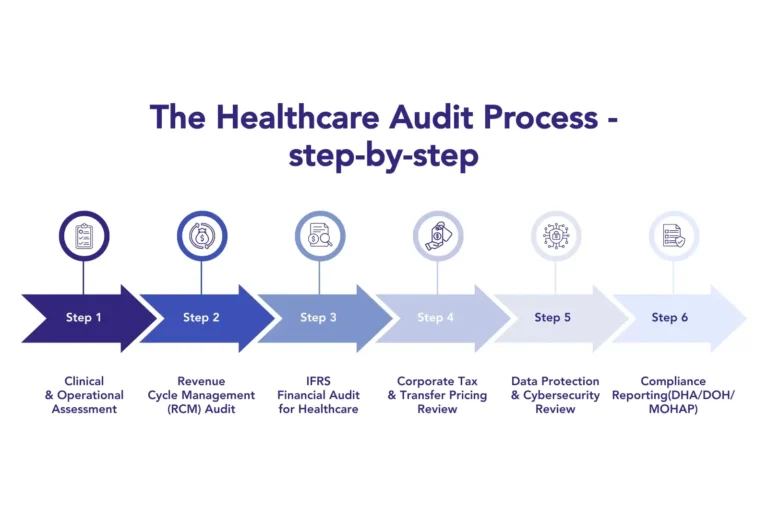
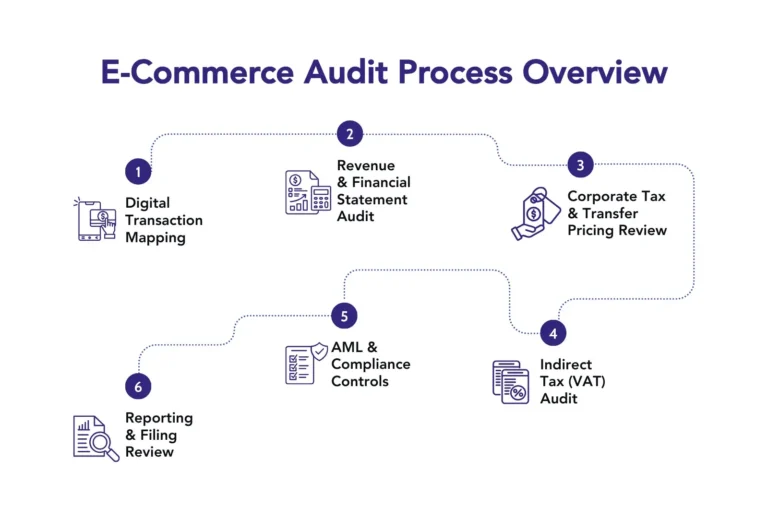
The Healthcare Audit Process - step-by-step

Healthcare audit UAE covers clinical practice, finance, tax, and data. A methodical approach reduces surprises.

Step 1 – Clinical & Operational Assessment

Review patient flow, clinical notes, and EMR completeness. Look for gaps between what clinicians record and what’s billed. Check whether consent forms and treatment authorisations are stored and timestamped. Clinical audit in healthcare templates from DOH are a useful benchmark.

Step 2 - Revenue Cycle Management (RCM) Audit

This is where money and compliance meet. Validate insurance claims, match clinical codes to services, and reconcile rejections. Common healthcare audit UAE checks include ICD-10 and CPT code accuracy, duplicated claims, and unexplained write-offs. Industry firms recommend automated checks and regular rejects analysis to catch systemic issues.

Step 3 - IFRS Financial Audit for Healthcare

Auditors test revenue recognition for consultations, labs, and surgeries. They will verify asset registers and depreciation methods for medical equipment under IAS 16 according to Abu Dhabi audit guidelines. They look for appropriate provisions: malpractice reserves, refunds, and insurance clawbacks. Use clear supporting schedules for each revenue stream.

Step 4 - Corporate Tax & Transfer Pricing Review

Large healthcare groups must document intercompany fees, management charges, and shared services. Transfer pricing policies should reflect arm’s-length principles. Corporate tax packs need reconciliations between accounting, VAT, and tax treatments. Expect auditors to probe allocation methods and service-level agreements.

Step 5 - Data Protection & Cybersecurity Review

Audit teams test EMR access controls, encryption, and incident logs. They look for proper user role definitions and prompt revocation of access. PDPL compliance healthcare UAE requires documented consent flows and secure data-sharing agreements. Digital trust reports recommend identity and access controls as top priorities.

Step 6 - Compliance Reporting (DHA/DOH/MOHAP)

Compile licence status, KPI performance, inspection histories, and clinical audit process UAE findings. Each regulator expects a tidy pack showing corrective actions and evidence of improvements. Templates and guidance from DOH help standardise reporting.

Step 7 - Final Reporting

The final deliverable is a combined clinical, financial, tax, and healthcare data privacy audit UAE report. Include a risk register and a pragmatic improvement plan with owners and due dates. Auditors want clarity on remediation timelines and evidence of management oversight. 

Audit Risks & Common Issues

Auditors look for patterns. Here are the usual culprits.

  • Rejected or fraudulent insurance claims. High rejection rates attract forensic scrutiny. Auditors will look for unusual patterns across clinicians, dates, and claim types.

  • Incorrect coding (ICD/CPT mismatches). Wrong codes alter revenue and can trigger insurer clawbacks. Regular ICD-10 CPT coding audits UAE are essential.

  • Incomplete clinical documentation. Missing notes or unsigned records break the claim trail. Regulators prioritise traceability.

  • Weak segregation of duties. Pharmacy and cash-handling are common weak spots. Combine automated logs with manual checks.

  • Inflated revenue from unsubmitted claims. Claims booked but not submitted create future reversals and tax issues. Keep tight controls on claim lifecycle.

  • Understated liabilities from insurance clawbacks. Provision for clawbacks must be realistic under IAS 37. Auditors test the assumptions.

  • Patient data breaches.Any breach invites regulator action. Evidence of prompt incident handling and root-cause analysis matters.

Documentation Checklist - evidence auditors expect

You need a tidy folder. Here’s what belongs in it.

  • EMR access logs and patient record audit trails.

  • Insurance claim files, submission logs, and rejection reports.

  • DHA/DOH/MOHAP inspection reports, corrective actions, and closure evidence.

  • Medical equipment asset register with purchase invoices and depreciation schedules.

  • Corporate Tax (CT), VAT, and Transfer Pricing working papers.

  • Pharmacy stock records and narcotics registers.

  • Clinical audit checklists and KPI trend reports.

For each item, add a short narrative: what it is, why it matters, and who owns it. That makes auditors’ work faster and your findings cleaner.

Enforcement & Penalty Cases (2024–2025) - lessons from the field

Regulators publish outcomes for a reason. These cases highlight what to avoid.


Case 1 – Clinic fined for improper insurance submissions (Dubai, 2024)
DHA action showed how poor claim documentation and mismatched clinical notes lead to penalties. Maintain traceable claim files and cross-check before submission.


Case 2 – Pharmacy fined for controlled medicines (2025)
Pharmacies face steep fines for weak narcotics controls. Proper registers, inventory reconciliations, and access logs are non-negotiable. 


Case 3 – Hospital warned for ICD coding errors (2024)
Repeated coding errors led to inflated claims and insurer disputes. Implement coder training and automated validation checks.


Case 4 – EMR privacy control failure (DOH action)
Lax access controls and unsolved incidents triggered DOH warnings. Tighten role-based access and keep incident logs with root-cause analysis. 


These cases are not rare. They’re signals. Fix the basics first: records, codes, and controls.

Audit Deliverables - what you should expect to receive

A proper annual audit dubai produces documents you can act on.

  • Healthcare Financial Audit Report (IFRS). Clear opinion and schedules for revenue, assets, and provisions.

  • Insurance Claims & RCM Audit Report. Details on claim accuracy, rejection trends, and recovery opportunities.

  • Clinical Governance & Compliance Report. Assessment of clinical audits, KPIs, and privileging.

  • Data Protection & Cybersecurity Audit. Findings on EMR controls, encryption, and incident handling.

  • Corporate Tax Pack & TP Documentation. Reconciliations and transfer pricing policies.

  • Management Letter. Practical recommendations with owners and deadlines. Good letters are specific and limited to priority items.

Future Trends (2026 & Beyond) - prepare now

Regulators and payers are moving fast. Prepare for these shifts.

  • AI-driven clinical coding and automated claim audits. Expect increased automation and machine checks. Build explainability into AI tools.

  • Mandatory digital health compliance audits. MOHAP signals stronger digital oversight and traceability expectations.

  • Blockchain for patient record tracking. Traceability use-cases are emerging; pilots may lead to mandatory standards.

  • More scrutiny on telemedicine. Regulators will expand audit focus to virtual care platforms.

  • Performance-based reimbursement models. These require tight KPI tracking and auditable outcomes.

Plan projects now. Small, staged improvements beat big, late fixes.

How ADEPTS Supports Healthcare Audit - practical help

ADEPTS provides focused help across audit risk areas. Our audit services include:

  • RCM & Claim Audit Expertise: We test coding, submission, and reimbursement flows. We spot reject trends and reduce rework.

  • Clinical Governance Review: We map KPIs, check privileging, and review clinical audit trails.

  • Financial Audits for Hospitals, Clinics & Labs: IFRS-focused reviews, schedules, and management letters.

  • TP & CT Advisory for Healthcare Groups: Transfer pricing policies, intercompany pricing, and tax reconciliations.

  • Healthcare Cybersecurity Audit: Access control reviews, incident log checks, and PDPL alignment.

  • Licensing & Facility Compliance Support: DHA/DOH/MOHAP licence checklists and remedial action plans.

We don’t sell templates. We build packages that match your system and risks.

Final notes - practical steps you can take this week

  1. Run a coding sample for top 10 high-value procedures. Fix errors and retrain coders.

  2. Reconcile submitted claims to paid claims and outstanding rejects. Assign owners for each reject type.

  3. Clean your asset register. Attach invoices and depreciation schedules.

  4. Lock down EMR access. Remove inactive users and document role definitions.

  5. Build a short management letter with three top risks and three fixes. Make it visible to the board.

FAQs:

They sample records, match codes to clinical notes, and test coder training logs. Automated validation engines speed this up.

Coding errors, missing documentation, mismatched patient IDs, and policy exclusions top the list. Regular rejects analysis helps.

Frequency varies. Routine inspections, targeted audits, and risk-based cycles are all used. High-risk findings increase audit frequency. 

Yes. Telemedicine has its own controls: consent, platform security, clinician licensing, and documentation standards. Regulators are tightening oversight.

Auditors assess incident logs, insurance coverages, provisions for claims, and how incidents were handled and closed. 

Complete narcotics registers, inventory reconciliations, access logs, and supplier invoices. Any gaps trigger enforcement. 

Yes. EMR access logs and timestamps support service delivery claims and link records to billing. Ensure logs are immutable and archived.

They use data analytics to spot patterns: repeat claims, unusual clinician billing, or improbable treatments. Forensic teams then deep-dive.

Role-based access, encryption, consent records, and secure data-sharing agreements. Regular privacy impact assessments help.

Inspect purchase invoices, maintenance logs, and technical specs. Compare with IAS 16 and market practice. Document assumptions.

References

Related Articles​​

Statutory Audit vs Internal Audit in the UAE (2026)

Two audits. 


One confused market. 


In the UAE, the line between a statutory audit and an internal audit gets blurry fast. 


But here’s the truth: one is demanded by law; the other is demanded by good sense. 


One satisfies regulators; the other strengthens your business from within. And if you want to stay compliant and stay ahead in 2025, you need to know precisely where each one fits.

Executive Summary

Audits. 


Everyone talks about them, but very few really get the difference between a statutory audit and an internal audit. They sound similar. They even use similar words. But they serve different purposes.


A statutory audit is about the law. It reviews your financial statements, keeps regulators happy, and ensures your numbers are solid. Banks, investors, and free zones all rely on it.


An internal audit is about your business. Management runs it to see how things really work. It spots risks, fixes weak spots, and makes operations smoother.


So why do UAE business owners get confused? Both audits involve auditors, reports, and numbers. But one keeps you legally safe. The other keeps your business running well.


Many companies actually need both. One ensures compliance. The other ensures efficiency. Together, they give you a complete picture of your business inside and out.

Definition & Core Purpose

Before comparing the two audits, it’s essential to understand what each one does and why UAE companies often use both.

What a Statutory Audit Really Is?

A statutory audit is required by law for many businesses in the UAE. Its main job is to verify your financial statements and ensure everything is accurate independently. Regulators, free zones, banks, and investors all rely on it.


For example, if a company in DMCC wants to secure financing from a bank, a clean annual statutory audit report is often mandatory. Similarly, free zones such as DIFC and ADGM require audited financial statements for license renewal or corporate tax filings.


Most companies hire professional firms offering audit services in the UAE to make sure nothing is missed. The statutory audit is all about compliance and trust—making your numbers legally defensible.

Understanding Internal Audit

An internal audit is basically a way to check how your business really works. Management conducts these audits to figure out what’s going well and what isn’t. It looks at all the processes in depth, identifies gaps, and flags risks before they become actual problems.


Picture a growing e-commerce company in Dubai. Internal audit might show that order processing slows down at peak times, inventory mistakes keep recurring, or refund procedures aren’t tight enough. It’s not about going over the previous figures. It’s about making day-to-day operations smoother, safer, and more efficient.

Why Both Audits Work Together?

Think of it like this: a statutory audit is the guardrail. 


It ensures your financial statements are accurate and that everyone from regulators to investors are confident in your numbers. 


An internal audit on the other hand is the engine. 


It keeps operations running smoothly and efficiently.


Having both means you’re covered on both fronts. Your books are correct, and your business actually works the way it should. That combination gives leaders the confidence to grow without constantly worrying about surprises.

Legal & Regulatory Requirements

Knowing the UAE’s audit rules makes it easier to see whether your business needs a statutory audit, an internal audit, or both.

Is a Statutory Audit Mandatory in the UAE?

In the UAE, many companies are required to have their financial statements audited each year, but the exact rules depend on the business type. 


All mainland LLCs and joint-stock companies must carry out an annual audit under the UAE Companies Law. The corporate tax rules also require audits for businesses with over AED 50 million in annual revenue, as well as for all Qualifying Free Zone Persons. 


Major free zones such as DMCC, DIFC, and ADGM also require audited accounts for licence renewal, because of these combined requirements and because banks often ask for audited reports before approving loans or opening accounts, most UAE businesses end up needing an annual statutory audit.

Is an Internal Audit Mandatory in the UAE?

An internal audit is not required for most companies in the UAE. It only becomes mandatory if financial authorities, such as banks, insurance companies, or other supervised financial institutions, regulate a business. 


For other private companies and SMEs, internal audit is optional. Still, many choose to implement it because it helps identify mistakes, improve internal controls, and reduce operational risks as the business grows.

Laws governing both audits

Several laws and frameworks shape how auditing services in the UAE are carried out:

  • UAE Commercial Companies Law

  • Corporate Tax Law

  • IFRS

  • COSO (internal control framework)

  • COBIT (IT governance framework)

Process & Methodology Comparison

A statutory audit and an internal audit may sound similar, but the way they’re carried out is very different. One checks your numbers for the year, the other looks under the hood of your operations.

Statutory Audit Process

A statutory review follows a clear, structured path. It starts with planning, during which auditors understand the business and its areas of risk. Then they move into the testing phase, where they check samples, review controls, and validate figures for your audited financial statements.


If anything needs adjusting, it’s flagged before the final audit opinion is issued. The whole aim is accuracy, compliance, and clean reporting that meets UAE expectations for statutory audit work.

Internal Audit Process

The internal audit process works differently. It begins with a risk assessment to see where things are most likely to go wrong. Auditors then conduct walkthroughs, test controls, and monitor how processes perform in real-world situations.


Companies often rely on internal audit services to keep this cycle going, especially when operations are complex or growing fast. It’s a continuous loop of checking, improving, and strengthening the business from the inside.

Key Scope Differences

The most significant difference is the mindset. A statutory audit looks backward; it reviews what already happened and whether the numbers are correct.


An internal audit looks forward. It focuses on preventing issues, tightening controls, and helping management run the business with fewer surprises.

Scope of Work: What Auditors Check

Every audit looks at the business from a different angle. One focuses on your financial truth; the other focuses on how your operations actually run.

Statutory Audit Scope

A statutory audit is built around your numbers. Auditors review revenue, expenses, and the handling of CT and VAT during the year. They check whether your records follow IFRS and whether the figures in your annual audited financial statements are reliable.


It’s a straightforward, compliance-driven review that supports banks, regulators, and anyone relying on accurate financial reporting.

Internal Audit Scope

An internal audit digs into the engine of the business. It looks at internal controls, fraud risks, HR processes, procurement practices, and IT systems. It also checks if teams are actually following the SOPs that management has put in place.


Many companies use internal audit services to keep these areas in check, especially when systems become more complex or when the business starts scaling quickly.

Who Performs Each Audit?

The people handling each type of audit aren’t the same, and that difference shapes the entire approach.

Statutory Auditor

Approved external auditors must carry out a statutory audit. 


These firms are registered with the relevant authorities and follow strict rules when preparing your annual audited financial statements. Their job is independent verification, which is why regulators and banks rely on them so heavily within the broader landscape of auditing services in the UAE.

Internal Auditor

An internal audit can be done by an in-house team or outsourced to experts. Many companies use professional internal audit services to gain a fresh perspective and detailed insights without building a full internal audit department. Others keep it internal, so the auditor is closely involved with daily operations and understands the business from the inside.


Both approaches work well on their own; it depends on the size, structure, and complexity of the business.

Deliverables

Each audit leads to a different set of outputs. One is built for regulators and external stakeholders, the other is designed to help management tighten controls and improve operations.

Statutory Audit

A statutory audit ends with an auditor’s opinion on your financial statements. 


You also receive a management letter that points out any issues discovered during the audit, along with recommended adjustments to your annual audited financial statements.


These documents are important because they help meet banking requirements, support license renewals, and ensure full statutory audit compliance in the UAE.

Internal Audit

An internal audit produces a detailed findings report. 


It breaks down the issues, assigns risk ratings, and outlines what needs to be fixed. Most companies also get an improvement plan that helps them strengthen internal controls and day-to-day processes.


This is where internal audit services add real value. They don’t just identify problems; they give management a clear way to fix them.

Impact on Corporate Tax, VAT & Compliance

A statutory audit makes Corporate Tax filings simpler and safer. With annual audited financial statements, you know your CT submissions are accurate. Banks and regulators trust these reports, which is why audit services in the UAE are so important.


An internal audit adds another layer. It reviews VAT processes, tests internal controls, and ensures that daily operations comply with the rules. It also helps with ESR and AML compliance. Using internal audit services keeps issues from slipping through the cracks and gives management confidence that operations and compliance are on track.

Industry-Specific Scenarios

  • Real Estate: Tracks property values and rental income. A statutory audit keeps investors and regulators confident in the numbers.

  • E-commerce: Focuses on inventory and order management. Internal audit services help make sure daily operations run smoothly.

  • Healthcare: Covers billing and patient records. Internal audit makes processes more reliable and reduces errors.

  • Construction: Follows project costs and subcontractor payments. Both statutory audit and internal audit help maintain accuracy and efficiency.

  • Banks & Financial Institutions: Operate under heavy regulatory oversight. Both statutory audit and internal audit are essential for compliance and risk control.

Cost & Time Differences

A statutory audit happens once a year. It focuses on planning, testing, and preparing annual audited financial statements to ensure compliance with statutory audit requirements.


An internal audit runs continuously or quarterly. Companies use internal audit services to spot issues early, improve efficiency, and keep business operations on track. Unlike the annual statutory audit, this one is proactive, preventing problems before they grow.

Risks of Not Performing the Audit

Audits aren’t optional checkboxes. Skipping them leaves holes in your business that can grow into real problems. Each audit type protects your company differently.

Risks of Skipping a Statutory Audit

  • Your annual audited financial statements won’t be independently verified.

  • Banks may pause loans or credit because they can’t trust your numbers.

  • Regulators could fine your company or question your statutory audit compliance.

  • Investors may doubt your financial reliability.

  • Corporate Tax and VAT filings could face delays or extra scrutiny.

Risks of Skipping an Internal Audit

  • Internal controls may have gaps that go unnoticed.

  • Small errors or fraud can turn into big issues before anyone notices.

  • Inefficient processes grow worse over time, costing more to fix.

  • Correcting problems later wastes a lot more time, money, and energy.

  • Regulated sectors may face attention from authorities if internal audit services aren’t being used.

Skipping audits isn’t just risky. Combining statutory audit with internal audit services gives you confidence that your business is both compliant and operationally strong.

Penalties & Enforcement Cases (UAE)

Skipping mandatory checks never ends well. In the UAE, every authority enforces its own requirements, and the consequences hit hard when you ignore them. Administrative penalties in the UAE are governed by Cabinet Decision No. 129 of 2025 (effective 14 April 2026) for VAT and Excise Tax, alongside separate regulatory frameworks for Corporate Tax and free zone compliance. 

Free Zone Fines

Popular free zones like DMCC, JAFZA, and RAKEZ quickly impose penalties if companies fail to submit annual audited financial statements on time. Failure to comply with statutory audit requirements can also delay or prevent license renewal, causing real trouble for your operations.

Corporate Tax Troubles

Corporate Tax penalties are governed under Federal Decree-Law No. 47 of 2022 and related decisions, and are separate from VAT and Excise administrative penalties. 


Late, incomplete, or inaccurate filings connected to statutory audit obligations bring heavy fines from the Federal Tax Authority. They can reopen past returns for scrutiny. Reliable auditing services in the UAE prevent these expensive mistakes from happening.

Weaknesses Exposed by Internal Reviews

An internal audit that reveals poor processes or control gaps often invites regulatory sanctions, especially in banking, insurance, and other tightly regulated sectors. Quality internal audit services catch and correct issues before regulators notice.


In short, combining solid statutory audit and internal audit services protects your business from penalties while keeping full statutory audit compliance intact.

Choosing the Right Audit Type

Picking the right review is far more than a routine task. It actively safeguards your business and spots risks early.

Statutory Audit

A proper statutory audit ensures your figures stand up to examination. Your annual audited financial statements become fully trustworthy for banks, investors, and regulators throughout the UAE.

Internal Audit

An internal audit examines daily operations from the inside. It uncovers risks, strengthens controls, and removes inefficiencies that slow growth.

Getting the Best of Both Worlds

Many leading companies use both statutory audit and professional internal audit services together. This combination delivers accurate finances and robust operations—ideal for fast-growing or highly regulated businesses.

Sector-Specific Needs

Rules and risks vary widely by industry. A solution perfect for trading may not fit finance, so know what applies to your field.

Timing Makes a Difference

Statutory audit is conducted once a year without fail. Internal audit can be conducted quarterly, half-yearly, or continuously, depending on your company’s needs.

Stay Ahead of the Law

Both audit types keep you fully aligned with UAE federal laws, free-zone regulations, and ongoing statutory audit compliance requirements.

More Than Just Compliance

When delivered by experienced audit service providers in the UAE, these audits go beyond mere compliance. They reveal hidden inefficiencies, drive real improvements, and turn compliance into a true competitive advantage.

Conclusion

Understanding the difference between a statutory audit and an internal audit is no longer optional for UAE businesses—it’s essential. 


A statutory audit ensures your annual audited financial statements are accurate, keeps regulators satisfied, and maintains statutory audit compliance. 


An internal audit, on the other hand, strengthens your internal controls, identifies risks early, and improves operational efficiency through professional internal audit services.


For most growing or regulated companies, relying on just one type of audit leaves gaps. Combining both provides a complete view of financial health and business operations. 


From meeting UAE Commercial Companies Law requirements to supporting Corporate Tax, VAT, and ESR compliance, these audits protect your business and build confidence with investors, banks, and regulators.


Partnering with experienced audit services in the UAE ensures you stay compliant, reduce risks, and turn audits into a strategic advantage rather than a compliance chore.

FAQs:

The UAE Commercial Companies Law requires mainland LLCs, public joint-stock companies, and certain free zone entities to prepare annual audited financial statements. Licensed external auditors must audit these to ensure transparency and compliance with statutory audit requirements.

Statutory audits review internal controls only to the extent necessary to verify financial statements. A full operational review is not included; this is handled through professional internal audit services.

The FTA does not specifically mandate a statutory audit for related-party transactions, but audited financials provide credibility and reduce risk during Corporate Tax (CT) assessments.

Free zones such as DMCC, JAFZA, and RAKEZ verify that companies submit annual audited financial statements prepared by licensed auditors. Compliance is checked before license renewal.

Yes. Banks, insurance companies, and other regulated entities are generally required to maintain internal audit functions to monitor internal controls and risk management.

For high-risk sectors or regulated companies, the Ministry of Economy may verify that internal audit frameworks are in place during inspections or compliance reviews.

Companies below certain revenue thresholds can submit unaudited or management-prepared financials for CT filing. However, statutory audit compliance strengthens credibility and reduces scrutiny.

Yes. Free zones can impose fines, issue compliance warnings, or delay license renewals if statutory audits are missing, incomplete, or not prepared according to IFRS standards.

Regulatory authorities may request internal audit reports from regulated entities to verify controls, risk management, and compliance.

The FTA does not routinely request internal audit findings. However, for large or high-risk businesses, these reports can support compliance and demonstrate robust internal controls.

Statutory auditors must provide audit reports, management letters, and supporting working papers to substantiate annual audited financial statements.

Internal audit findings are not strictly mandatory for ESR, but having them strengthens compliance by showing effective monitoring and control.

Internal audits are legally required for regulated sectors, including banks, insurance companies, investment firms, and certain large or high-risk entities.

Yes, for smaller companies below specified revenue thresholds. Larger or higher-risk businesses benefit from statutory audit compliance to reduce regulatory scrutiny.

Yes. DIFC and ADGM regulations require regulated entities to maintain internal audit frameworks to ensure risk management, governance, and internal control monitoring.

References

Related Articles​​

DFSA Artificial Intelligence Survey 2025

Summary

The DFSA’s Artificial Intelligence Survey 2025 presents one of the clearest snapshots so far of how AI is shaping financial services inside the DIFC. It builds on the first edition released in 2024, allowing regulators and firms to track how adoption, governance, and risk practices have evolved in just one year. The picture that emerges is of a market moving quickly, but not blindly. Firms are expanding their use of AI across critical functions, yet remain conscious of the need for stronger oversight and clearer regulatory signposts.


The survey’s goal is straightforward. It measures how DIFC-authorised firms are adopting and governing AI, and how prepared they are for the risks and operational challenges that come with it. Because this is the second edition, it offers year-on-year comparisons that show how fast the ecosystem is maturing. The DFSA is using these insights to understand where firms need support, and where regulatory frameworks may need to evolve.


These findings sit within a wider national environment where AI has already become mainstream. The UAE continues to position itself as a global benchmark for AI readiness. Almost all residents – 97% – interact with AI in some form. A large majority of organisations, around 73%, already operate with formal governance frameworks. This national maturity creates both momentum and expectation. Firms inside the DIFC are under pressure to match the pace of the wider UAE economy.


The survey found that a total of 661 DIFC firms took part, representing an 88% response rate — unusually high for a regulatory survey. Their responses highlight a system that is shifting from experimentation to real deployment. Efficiency, performance gains, and data-driven decision-making remain the top reasons for using AI. What has changed is the scale. Many firms have moved beyond pilots and are now applying AI to core business areas, with adoption jumping from 33% in 2024 to 52% in 2025. Generative AI saw the most dramatic rise, growing by 166% in one year.


Progress, however, is uneven. Sixty percent of AI-using firms now have some form of governance structure. Yet 21% still operate without clear accountability, even in sensitive or high-risk functions. This gap is drawing attention. Firms repeatedly asked for clearer guidance, more practical examples, and greater harmonisation among UAE regulators. Their message is simple: adoption is accelerating, but governance frameworks must catch up.

Introduction

The DIFC is entering a new phase of AI maturity, and the shift is easy to see. Firms are using AI to sharpen judgment, strengthen controls, and upgrade how they work. It helps spot risks earlier, tighten compliance, and improve the way customers experience financial services. But the same tools that make operations smarter also introduce new risks. They need oversight that matches their impact. Not too heavy. Not too loose. Just proportional and clear.


This is where the DFSA’s approach stands out. It follows a simple idea. Regulate the risk, not the tool. The framework stays technology-neutral and risk-based, which gives firms freedom to innovate while still keeping the system safe. It also keeps the DFSA aligned with global regulators. 


The themes match what the FCA and the Bank of England highlighted in their 2024 review. The direction is reinforced again in the Dubai State of AI Report 2025, which sets the national tone for ai adoption and the wider push toward secure ai adoption across the UAE.


The survey itself has become an important source of insight. The 2024 edition gave everyone a baseline. It showed the early patterns of enterprise ai adoption and the first signs of an organised ai adoption framework emerging inside the DIFC. 


The 2025 edition goes deeper. More firms participated. More use cases surfaced. The data is richer, and the story is clearer. AI is no longer a side project. It is becoming part of core strategy, and the survey now acts as a practical ai adoption report for the region.

AI Adoption and Types of Applications

AI is part of business in the UAE in different ways. Here are some explained:

Adoption Growth

AI use inside the DIFC has jumped fast. Adoption moved from 33 percent in 2024 to 52 percent in 2025. The number of firms using AI almost doubled, rising from 177 to 345. This is real momentum, not hype. It shows that ai adoption is becoming part of the operating model, not an experiment on the side.

Type-Wise Growth

The growth is uneven but telling. Generative AI saw the biggest leap with a 166 percent increase. Narrow AI almost doubled with 99 percent growth. Machine learning and deep learning continued steady expansion at more than 60 percent. These numbers show a shift from theory to practice, especially in ai adoption in banking, where structured data and repeatable processes make deployment easier.

Drivers of AI Adoption

AI is spreading across DIFC firms because it solves real problems. Each driver has its own weight, and together they explain why adoption keeps climbing.

Efficiency gains

This is the biggest driver. Firms want processes that move faster and break less. AI automates routine tasks, reduces manual effort, and cuts waiting time in workflows. Teams can focus on judgment instead of admin. When a firm feels the speed difference once, it rarely goes back.

Enhanced performance

AI helps teams make better decisions. Not louder decisions. Better ones. Models pick up patterns that humans miss in day-to-day work. That leads to sharper forecasting, cleaner prioritisation, and stronger execution. Performance becomes more consistent because it relies less on guesswork.

Better data analytics

Most firms already sit on mountains of data. Very few can use it well. AI changes that. It turns raw information into practical insight. It helps firms see risk, behaviour, and trends with a level of clarity they didn’t have before. For many executives, this is the moment AI stops being a buzzword and becomes a tool.

Improved risk management

Risk teams are using AI to spot issues earlier. Whether it’s transaction monitoring, stress testing, fraud detection, or anomaly checks, AI picks up signals long before traditional controls react. This early-warning ability is why ai adoption metrics keep rising across compliance-heavy firms. It’s prevention, not clean-up.

Compliance automation

Compliance used to scale only by adding people. AI changes the equation. It reads, compares, tracks, and flags. It makes monitoring continuous instead of periodic. It keeps teams updated on policy changes and helps them test controls faster. For regulated firms, this alone creates huge value.

Cost reduction

AI isn’t about replacing people. It’s about reducing waste. Less duplication. Fewer repeated tasks. Fewer manual checks. Over time, this lowers operational cost without weakening control. For many firms, the cost argument becomes the clean business case that pushes AI from “good idea” to “approved project.”

Barriers to AI Adoption

The push to adopt AI comes with friction. Regulatory uncertainty is still a top concern. Cybersecurity risks are another. Implementation costs slow down smaller firms. Data quality issues and old systems get in the way. Some teams worry about ethical risks. Others simply don’t have the skills yet. These challenges explain why secure and structured deployment frameworks, like a clear ai adoption framework, matter more than ever.

Stages of AI Deployment

AI inside the DIFC is maturing fast. Firms are no longer just experimenting. They are building structured paths that take an idea from a small test to a live system that runs every day. These stages help explain how enterprise ai adoption is spreading and why the DIFC is becoming a serious centre for ai adoption in financial services. You can see a clear progression now, and the data shows how quickly firms are climbing the ladder.

Maturity Levels

Most firms follow the same journey. They begin with small proof-of-concepts to test if a model works. Then they shift into pilot phases with limited teams. If the results hold up, AI is deployed across bigger parts of the business. The final stage is when AI becomes critical to operations. At that point, the tool is too important to remove without slowing the business. This path is becoming the standard across the centre.

Maturity Shift from 2024 to 2025

The jump in one year is striking. Large-scale deployments tripled from 41 to 121. AI systems that used to sit in controlled tests are now running across major functions. Even more important, the number of firms that call AI critical to their daily operations doubled from 17 to 29. These are big leaps. They show that firms are no longer just exploring. They are committing. It also explains the growing interest in ai governance, because deeper deployment brings higher expectations.

Internal vs External Deployment

Internal use still dominates. Seventy-nine percent of firms deploy AI in functions like HR, Finance, Legal, and operations. These are controlled environments where risk is easier to manage. Audit, compliance, and risk management teams are heavy adopters too, with 162 firms using AI in these areas. That makes sense. The work is repetitive, data-heavy, and perfect for automation.


Customer-facing adoption is rising. One hundred forty-six firms now use AI in client-related functions. This shift reflects the broader push of ai adoption in finance, where internal gains eventually lead to better customer experiences.

Adoption Outlook

Most firms expect their AI footprint to grow. Sixty percent anticipate expansion in the next twelve months. Seventy-five percent expect even wider expansion over three years. These expectations align with national ai adoption by industry 2025 trends and the UAE’s push toward secure ai adoption. The message is simple. AI is no longer a trial phase. It is becoming a long-term capability shaping how financial institutions operate and compete.

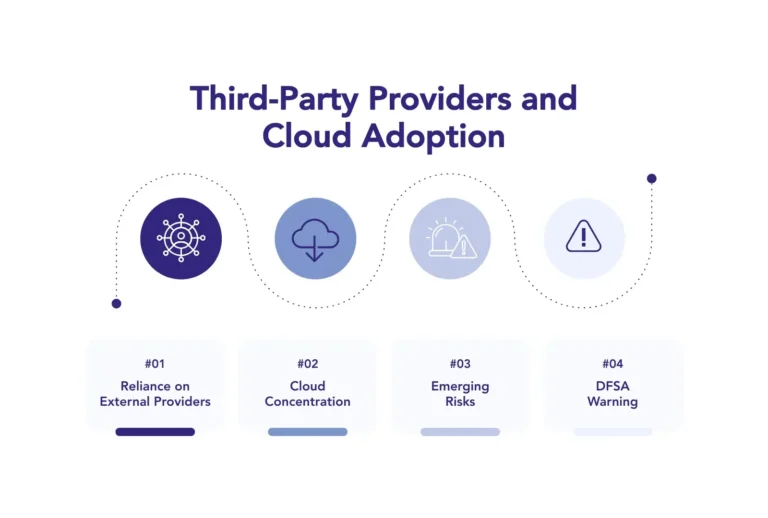
Third-Party Providers and Cloud Adoption

AI inside the DIFC isn’t being built in isolation. Most firms rely on outside providers to develop, run, or maintain their systems. This dependence is shaping how AI operates across the centre, especially as more firms shift toward cloud-heavy setups driven by ai adoption, uae tech ai cloud adoption, and the wider push for scalable models.

Reliance on External Providers

A clear majority of firms use third-party AI developers. The pattern is simple. Instead of building everything internally, firms buy specialised tools and plug them into their systems. More than 60 percent now run 90 percent of their AI workloads on cloud platforms. That’s almost full reliance on external infrastructure. This level of dependence speeds up deployment but also raises new questions about control, resilience, and who carries responsibility when things break.

Cloud Concentration

The cloud choices are highly concentrated. AWS, Google Cloud, and Microsoft Azure dominate the market. These providers give firms scale, security features, and fast implementation. But the downside is also obvious. When most of the DIFC runs AI on the same few platforms, one disruption can hit many firms at once. This is becoming an important point in every ai adoption report across the region.

Emerging Risks

The survey highlights three risks that are starting to grow faster than adoption itself.
Structural concentration risk is the first. If one major provider goes down, a large part of the DIFC stalls with it.
Supply chain vulnerabilities come next. Firms depend on long chains of vendors, tools, and model components. One weak link affects them all.

The third is systemic operational risk. As reliance grows, the failure of a single provider or major update could spill across the market. These risks now sit at the centre of conversations about secure ai adoption.

DFSA Warning

The DFSA is clear. Firms must strengthen their third-party risk management. They need continuity plans that actually work, not just documents. The regulator expects firms to understand how their providers operate, what happens during outages, and how quickly they can recover. This guidance now forms part of the region’s expectation for responsible growth in ai adoption in finance.

Governance and Accountability

AI governance is becoming the deciding factor between safe growth and risky deployment. As adoption rises, so does the need for clear structures, real accountability, and people who understand the risks. The DIFC’s shift mirrors global movements in ai governance, ai governance framework, and broader responsible ai governance.

Governance Structures in Place

Seventy percent of AI-using firms now have formal governance frameworks. That’s progress. It means most firms agree that AI needs structure, rules, and oversight. Ninety percent have assigned responsibility for AI oversight to specific teams or leaders. This shows a maturing market. AI is no longer a side task handled by whoever has time. It is now part of corporate governance.

Who Governs AI?

Responsibility varies across firms. Some assign it to a Chief AI Officer or the Head of Compliance. Others rely on department heads or committees. Technology committees handle the technical side. Risk committees monitor model impact and reliability. Audit committees look at controls and testing.

A growing number now have AI ethics or AI governance committees. Even though titles differ, the message is the same. AI oversight is moving toward formal structures that mirror traditional governance models across the ai in finance industry.

Governance Gaps

Even with progress, the gaps are serious. Twenty-one percent of firms still have no accountability for AI. Eleven percent run large-scale AI deployments with no governance structure at all. Twenty-six percent use AI in critical business areas without any formal oversight. These numbers show that adoption is moving faster than governance. Without stronger frameworks, risks will grow quietly under the surface.

Governance Challenges

The biggest challenge is the need for clearer regulatory guidance. Firms want to know how to build governance that aligns with expectations. Skill shortages add pressure. Many teams don’t have enough expertise to manage complex AI systems.


Board understanding is another issue. The number of boards struggling to understand AI jumped from 20 to 53 firms. Executives face similar gaps. Many don’t fully grasp the risk, value, and long-term impact of AI.


These challenges explain why ai governance best practices and ai data governance are becoming essential topics inside the DIFC. Without stronger knowledge and clearer guidance, firms won’t reach the maturity levels they aim for.

Regulatory Guidance and Future Initiatives

The conversation around AI in financial services is changing fast. Firms are no longer asking whether they should use AI. They are asking how to use it safely, intelligently, and in line with expectations from the DFSA. The latest data shows that businesses want clarity. They want consistency. And they want guidance that feels practical, not theoretical.

What Firms Expect from the DFSA

Firms are reaching a point where high-level advice is not enough. They want clear rules they can use in real decisions.


Most firms are asking for clarification of regulations. They want to know what is acceptable, what is risky, and where the DFSA draws the line.


They also want scenario-driven guidance. Not generic pointers. Actual examples that reflect real situations financial institutions face as they deploy AI across compliance, risk, and operations.


Another big request is UAE-wide harmonisation. Many firms operate across multiple regulators. When rules differ, even slightly, it slows down deployment and increases uncertainty. They want a system where standards align so decisions can move faster.


Some firms expect the DFSA to introduce AI-specific rules for the DIFC. They are not afraid of rules. They simply want clarity on expectations so they can plan long-term and scale without second-guessing compliance.


And finally, there is a strong push for governance best practices. Firms want benchmarks. They want examples of what “good” looks like so they can build internal models that match the DFSA’s view of responsible AI.

What These Expectations Mean

These expectations show that the market is maturing. Firms are smarter about AI. Their questions are more precise. They want predictability, not guesswork.


The data also shows an increasing need for unified standards across regulators. As AI becomes more central to business operations, fragmented rules can create friction. Firms want a clean, consistent regulatory environment that supports responsible growth.

Conclusion

AI adoption is accelerating. Firms are confident. They are building internally first, testing models inside their own walls before they scale outward. This internal-first pattern shows they are cautious but committed. They want control. They want safety. But they are moving ahead at full speed.


Governance is not keeping up. Many firms deploy AI in critical areas, yet their governance frameworks are still thin or incomplete. The gap between deployment risk and governance maturity is widening. And that gap is where real risks live.


The DFSA is preparing for this shift. Their approach is shaping into three priorities.


They plan to take a risk-based supervisory model, meaning higher-risk deployments will get more attention, more scrutiny, and more engagement.


They are also leaning toward collaborative regulatory development. The market is moving too fast for static rules. Firms and regulators need to build guidance together, sharing insights and shaping common standards.


And most importantly, they want to balance innovation with investor protection. The goal is not to slow firms down. It is to make sure AI grows with safeguards, fairness, and accountability built in from the start.

References

Related Articles​​

Technology & AI Industry Audit — IP Valuation, Data Governance & Algorithmic Compliance (UAE 2025–2026)

Every tech CEO in the UAE loves to talk about innovation — until the audit season begins.
Suddenly, that brilliant AI model turns into a compliance minefield. Data trails don’t match. IP papers are half-done. Algorithms can’t explain their own decisions.


Welcome to the new reality of AI audit UAE — where innovation meets interrogation.


Between UAE’s data governance laws, AI governance principles, and a tightening Corporate Tax Law, tech companies can’t afford to treat compliance as an afterthought. The more digital your business, the more complex your audit story becomes.


Whether you run a SaaS startup or an AI-driven fintech, every dataset, model, and line of code now falls under a microscope. Regulators want proof of fairness, transparency, and ownership — not just working software. 


That’s where a strong technology audit in the UAE comes in.


This article breaks down what a next-gen AI governance audit UAE really looks like. From data governance audit in the UAE and IP valuation audit in the UAE to Algorithmic compliance in the UAE and intangible asset reviews. 


You’ll also see how forward-thinking audit firms are helping tech businesses stay one step ahead.

Regulatory & Compliance Framework

Innovation in the UAE no longer lives outside regulation, it grows within it. The country’s digital economy is booming, but so is its oversight. Every technology audit in the UAE now begins with one big question: how responsibly is innovation being built? 


For AI companies, fintechs, and SaaS platforms, compliance isn’t an afterthought anymore, it’s part of the design.

Data Protection & Privacy (PDPL 2021)

The UAE Federal Decree-Law No. 45 of 2021 (PDPL) sets the rules for handling data in the UAE. It’s not just about collecting or storing information, it’s about how you process and protect it, especially when AI is involved. During a data governance audit in the UAE, auditors don’t just glance at databases. They follow the data from start to finish, checking encryption, access controls, and consent records. Secure storage alone isn’t enough anymore. You have to prove that the data is being used responsibly, ethically, and in line with the law.

AI Governance & Explainability

Fairness, transparency, accountability, and explainability are no longer optional. These are the pillars of the UAE AI Office Governance Principles. A proper AI governance audit UAE inspects algorithms for bias, evaluates decision-making clarity, and ensures outputs can be explained. Can your AI justify its actions? Regulators and investors expect proof. They want systems that are traceable, understandable, and fair.

Tax & Intellectual Property Compliance

Intellectual property has real value. The Corporate Tax Law requires companies to verify IP income, R&D capitalization, and intangible amortization. A thorough IP valuation audit UAE confirms that your code, algorithms, and patents are recorded accurately. Mistakes here don’t just affect tax filings—they can shake investor confidence.

IFRS Standards for Tech Businesses

Accounting rules matter. IAS 38 covers intangible assets, IFRS 15 handles SaaS revenue, and IFRS 16 defines cloud infrastructure costs. Together, they form the backbone for intangible asset valuation UAE tech companies. Applying these standards consistently ensures investors see real value, not just numbers on paper.

AML, CFT & Cybersecurity Controls

Digital finance adds another layer of scrutiny. The UAE’s AML/CFT rules now apply to fintech apps, digital wallets, and online payments. Every transaction must be traceable and compliant. Meanwhile, NESA and DESC cybersecurity frameworks require strong IT controls. Cloud configurations, APIs, and DevOps pipelines are tested for resilience. In a technology audit in the UAE, security is no longer a checkbox, it is a differentiator.


These frameworks work together to define trust in UAE innovation. They don’t slow progress—they protect it. And they create the foundation for a comprehensive AI audit in the UAE, where compliance transforms from theory into measurable, auditable proof.

Technology & AI Audit Process

Auditing technology and AI is all about understanding systems, data, and value at every layer. Each step uncovers risks, verifies ownership, and ensures compliance.

Step 1 – Algorithm & Model Inventory

The first step is taking stock. All algorithms, datasets, and training methods must be catalogued. Version histories are tracked. Auditors check ownership and usage, including third-party or open-source components. A proper inventory forms the backbone of any AI audit in the UAE and ensures nothing slips through the cracks.

Step 2 – Data Governance Audit

Next, data is examined. Classification, encryption, access controls, and audit logs are reviewed. Data lineage is traced from training to inference. During a data governance audit in the UAE, every pipeline is scrutinized. It’s about proving your AI respects privacy, security, and regulatory standards.

Step 3 – IP Valuation & R&D Audit

Intellectual property is the hidden engine of value. Ownership documents, code repositories, and licensing contracts are verified. R&D expenditures are assessed for capitalization criteria. Transfer pricing for global development hubs is also reviewed. A thorough IP valuation audit UAE ensures that intangible assets are properly recorded and compliant.

Step 4 – Corporate Tax & Transfer Pricing Review

Financial compliance is next. R&D deductions, IP royalty structures, and related-party arrangements are examined. This step ensures that your innovation not only creates value but is reported accurately under the Corporate Tax Law.

Step 5 – Cybersecurity & ITGC Testing

Security isn’t just a checklist. It’s about knowing your systems won’t fail when it matters most. Auditors start by looking at cloud setups; AWS, Azure, or GCP and checking if everything is configured correctly. 


They dig into APIs and DevOps pipelines, making sure processes are consistent and nothing slips through unnoticed. Penetration tests and SOC reports aren’t just read—they’re interpreted, with auditors asking, “What could go wrong here?” 


By the end, a technology audit in the UAE shows whether your systems are not only working but also resilient, safe, and ready for real-world challenges.

Step 6 – AI Ethics & Bias Assessment

AI is only as good as it is fair. Models are tested for discriminatory outputs. Transparency and explainability are validated. During an AI governance audit UAE, auditors ensure algorithms behave responsibly and outputs are defensible.

Step 7 – Final Reporting

Finally, all findings are compiled. Financial, technological, cybersecurity, and governance insights are brought together. Reports are actionable, clear, and ready to guide leadership. This is the step where a full AI audit in the UAE translates into trust, accountability, and strategic advantage.

Audit Risks & Common Issues

When you dig into audits, the risks show themselves quickly. Some are obvious. Others are hiding in plain sight, and ignoring them can cost a lot.

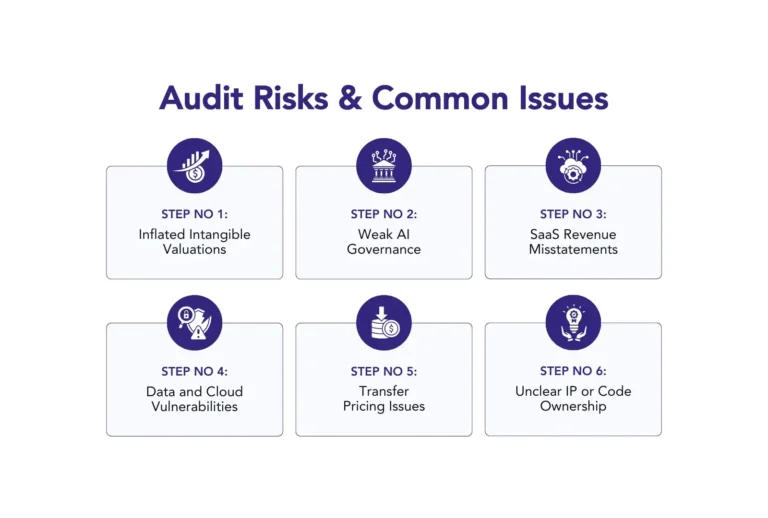
Inflated Intangible Valuations

Intangible assets can be tricky. A dataset or partially built AI model might be counted as fully developed. On paper it looks valuable, but it isn’t. Doing an IP valuation audit UAE helps set the numbers straight before anyone notices a mismatch with tax filings or investors.

Weak AI Governance

Algorithms don’t always behave as expected. A hiring AI, for example, could unintentionally favor certain profiles. A proper AI governance audit UAE checks whether decisions are fair and explainable. It’s not about ticking boxes. It’s about trust.

SaaS Revenue Misstatements

Revenue recognition trips up a lot of SaaS companies. Subscriptions, bundles, usage-based billing—they can all get misreported under IFRS 15. What looks like a small error can snowball when investors or regulators dig deeper.

Data and Cloud Vulnerabilities

Even systems that seem secure can hide weak spots. Misconfigured APIs, sloppy access controls, or gaps in DevOps pipelines can become real problems. A technology audit in the UAE helps spot them before they cause downtime or data breaches.

Transfer Pricing Issues

Distributed teams and global R&D hubs complicate finances. Misaligned costs, IP royalties, or intercompany charges can trigger fines or disputes. Clear documentation and careful review prevent headaches later.

Unclear IP or Code Ownership

Outsourcing is common, but it can blur ownership. Freelancers or contractors may not assign IP rights properly. Auditors make sure every line of code, dataset, and AI model belongs to the company.


Every one of these risks shows why audits are critical. They aren’t just a compliance exercise. They protect value, build trust, and make sure innovation doesn’t run into unexpected problems.

Documentation Checklist

Having the right documents makes audits faster and less stressful. Missing or messy records create delays and questions. Auditors expect the following:

  • Source code repositories: GitHub or GitLab repositories with full commit histories. Auditors need to see who made changes and when. This isn’t bureaucracy—it’s accountability.

  • AI model files and datasets: Complete models, hyperparameters, training datasets, and testing logs. Without them, it’s impossible to verify how the AI works or whether outputs are reliable.

  • IP and legal documents: Patents, trademarks, licenses, and registration papers. These prove ownership and are essential for any IP valuation audit UAE.

  • R&D and financial records: Development expenditure schedules, transfer pricing documentation, and corporate tax working papers. Clear records show where resources went and support compliance.

  • Cloud and security files: Cloud configuration files, SOC reports, and penetration test results. These demonstrate that your systems are secure and resilient.

  • Data protection documentation: DPIAs, consent logs, and other privacy-related records. These show that data is handled ethically and in line with data governance audit in the UAE requirements.

Audit Deliverables

Audits need to end with clarity, not more questions. The deliverables are the proof points leadership, investors, and regulators read. They should be practical, evidence-backed, and tied to action.

  • IP Valuation & Intangible Asset Report
    A clear valuation of patents, code, models, and datasets. Shows how you recorded R&D and why a number is defensible. Includes supporting schedules, assumptions, and links to repositories or registration documents. Useful for tax, fundraising, or sale discussions. (Think IP valuation audit UAE level detail.)

  • AI Governance & Bias Assurance Report
    What the model does, why it does it, and how you checked it. Tests run, bias metrics, explainability notes, and remediation steps. It should say whether outputs are explainable and where human review is needed. Investors and HR teams read this one closely.

  • Cybersecurity & Data Protection Audit
    Maps vulnerabilities and confirms mitigations. Cloud config, API exposures, SOC findings, penetration test highlights, and privacy gaps. Also includes DPIA findings and consent-log checks so you can show compliance in practice. This ties directly into any data governance audit in the UAE.

  • Corporate Tax & Transfer Pricing Compliance Pack
    R&D capitalization workpapers, IP income calculations, royalty structures, and intercompany agreements. Clear linkages between accounting treatment and tax positions. Ready for tax authorities or transfer-pricing inquiries.

  • ITGC Assessment
    Evidence that core IT controls work: access management, change control, backup and recovery, and deployment pipelines. Includes test samples, deviations, and recommended fixes. This is the backbone that makes other reports credible.

  • Management Letter with Control Enhancements
    Practical, prioritized recommendations. Not long theory—specific fixes, owners, and timelines. A short roadmap for the first 90 days and a follow-up plan for the next 12 months.

Each deliverable should include an executive summary, the raw evidence or links, and an action plan. That’s how an audit becomes a tool for better decisions, not just a compliance exercise.

Future Trends (2026 and beyond)

Regulators are signalling what’s coming next, and the direction is obvious: more oversight, tighter documentation, and stronger controls for every tech and AI business in the UAE.

Mandatory AI audits for high-risk systems

Models that affect people’s lives will face deeper review. Hiring engines, lending models, health predictions — all of these may need a formal AI audit in the UAE before going live. It’s not just accuracy anymore. It’s accountability.

Stronger data lineage expectations

Companies will need to show where their data came from and how it changed over time. This is where blockchain-backed trails will blend with data governance audit in the UAE checks to create verifiable histories of training data and model inputs.

Continuous monitoring inside the audit process

Year-end reviews won’t be enough. Teams will shift to real-time flags for drift, anomalies, or config changes. Continuous controls will sit inside every technology audit in the UAE, making compliance a daily activity rather than an annual task.

Tougher scrutiny on IP and intangible assets

Regulators are paying more attention to how code, models, and datasets are valued. This means more documentation, more testing, and stronger logic supporting IP valuation audit UAE and intangible asset valuation UAE tech positions.

Higher standards for AI behaviour and governance

Fairness, transparency, recourse, and model explainability will move from “good practice” to “required practice.” These expectations will align with AI governance audit UAE principles as the region pushes for responsible AI deployment.

A national push for algorithmic compliance

Expect a unified registry or structured filing that tracks how companies manage and monitor their models. When that arrives, documenting algorithmic compliance in the UAE won’t be optional — it will be a visible part of your operating footprint.


The direction is clear: the UAE is moving toward a world where AI systems are not only innovative but also auditable, explainable, and accountable. Companies that build these habits now will grow faster and face fewer surprises later.

How ADEPTS Supports Technology & AI Audit

ADEPTS helps tech companies in the UAE navigate complex challenges with clarity. IP valuation audit UAE ensures every dataset, model, and codebase is accurately measured and defensible. 


AI governance audit UAE tests fairness, transparency, and model explainability so your decisions can be trusted. Cross-border R&D and financial flows are aligned through intangible asset valuation UAE tech and transfer pricing guidance. 


Technology audit in the UAE reviews cloud setups, APIs, and DevOps pipelines for security and reliability. Data governance audit UAE confirms consent management, DPIAs, and privacy compliance. AI audit UAE reconciles SaaS revenue, licensing, and cloud costs to IFRS standards. 


Finally, algorithmic compliance in the UAE ties all these elements together, giving leadership one clear, actionable view of technology, finance, and governance.

Conclusion

Auditing tech and AI in the UAE isn’t just paperwork. It’s about making sure your models, data, and systems actually do what you think they do. When you run an IP valuation audit UAE, you see the real worth of your code, datasets, and intellectual property. AI governance audit UAE makes sure your algorithms behave fairly and can be explained to anyone who asks.


You don’t stop there. A technology audit in the UAE checks cloud setups, DevOps pipelines, and APIs. A data governance audit UAE confirms consent is recorded, DPIAs are in place, and privacy rules are followed. Algorithmic compliance in the UAE ties everything together, so leadership has a clear, actionable picture.


Intangible assets matter just as much as the stuff you can touch. A solid intangible asset valuation UAE tech makes sure your R&D, models, and datasets are properly recorded and defensible. 


Once these checks are in place, running your company feels simpler. You see the risks clearly. Decisions are easier, and regulators aren’t a looming worry. Auditing isn’t something to tick off—it’s what keeps your AI honest and your business steady.

FAQs:

They usually start by checking where the data came from and what permissions exist. Licenses, contracts, agreements—these all matter. Sometimes they dig into logs to see the full history of the dataset.

Keeping proof of ethical AI isn’t just ticking boxes. You want test records, bias checks, notes on how decisions were made, and anything showing human oversight. It’s about showing you actually thought through the impact.

If AI influences financial reports or big decisions, companies have to be clear about it. Auditors will ask how it’s being used and whether the results match reality.

Data security is more than a locked server. They look at who can access the data, how it’s encrypted, and whether backups exist. Logs and change history tell them whether anything was tampered with.

Stopping model drift means keeping an eye on outputs over time. Alerts for weird behavior, regular retraining, and performance checks help make sure the AI doesn’t go off track.

Third-party APIs and external datasets come with their own headaches. Auditors check contracts, security standards, and how outputs are validated before using them in anything important.

AI outputs can sometimes be assets. If they help build products or services, they count. What matters is documenting them properly and linking them to your financial or IP records.

Whenever a model gets updated, retrained, or tweaked, auditors want a clear trail. Version histories, testing notes, datasets used, and approvals all show what changed and why.

Cloud systems need a close look too. Configurations, access permissions, penetration test results, and incident response policies tell auditors whether your AI infrastructure is solid.

Generative AI for forecasting? They check inputs, assumptions, and how the outputs feed into reports. Bias, accuracy, and human oversight are all on the table.

Handling personal data under PDPL isn’t just theory. They review consent, retention, encryption, and impact assessments to see that data is treated properly throughout its lifecycle.

Explainability reports should tell a story, not just show numbers. Who influences the decision, what factors matter, and how errors are handled—all should be clear to anyone reading it.

Looking ahead to 2026 and beyond, businesses should document everything now. Training data, model versions, processes, governance steps—if it’s traceable, you’re ready. Continuous monitoring is key.

Yes. If you can’t explain how a high-impact model makes decisions, there can be penalties. Regulators want clarity and accountability, not mysteries.

Splitting R&D and operational costs requires context. Creating or improving models counts as R&D. Day-to-day maintenance is operational. Auditors look at records, notes, and purpose to decide.

References

Related Articles​​

ADEPTS Secures Official Auditor Status in Dubai International Financial Centre

Getting registered as a DIFC auditor is a notable milestone for ADEPTS. It shows that the firm is ready to meet the expectations of one of the region’s most regulated financial environments. 


And while it is a formal recognition, its practical impact is immediate for clients who require rigorous audit support.

Strategic Importance of DIFC Accreditation

The Dubai International Financial Centre (DIFC) is one of the region’s leading financial hubs. It’s not just about size. The Centre’s rules and standards align closely with international norms. This gives banks, insurance companies, and asset managers a framework they can trust. In practice, it also encourages consistent reporting and good governance across the board.


For ADEPTS, gaining the status of DIFC-registered auditor is a significant milestone. It puts the firm in a small group of organizations allowed to conduct statutory audits within the Centre. Often, this kind of recognition signals to clients that audits are done carefully—and that independence and thoroughness are taken seriously.


The accreditation also connects with broader UAE priorities. In many ways, the country is focused on boosting market confidence, encouraging transparency, and reinforcing its position as a global financial hub. 


For ADEPTS and its clients, the registration shows more than just compliance—it reflects a clear alignment with the wider economic landscape and the evolving expectations of regulators.

About ADEPTS Chartered Accountants LLC

ADEPTS Chartered Accountants LLC is one of the UAE’s professional services firms that has grown steadily over the years. It works with businesses across many sectors and has built a reputation for practicality and client focus. The firm doesn’t just offer advice on paper, it helps clients solve real-world problems.


Its strengths lie in audit, tax, advisory work, IFRS implementation, and compliance. In practice, this means ADEPTS combines technical know-how with an understanding of local rules. Clients often find this combination useful when navigating complex reporting requirements or regulatory expectations.


The firm’s leadership and market presence are important parts of its identity. Experienced professionals guide its work, governance practices are strong, and the team is recognized for delivering quality. This mix of expertise and trust has helped ADEPTS establish a solid position in the UAE’s professional services market.

Implications for Clients and Stakeholders

Achieving DIFC auditor registration has clear benefits for clients and other stakeholders. It strengthens the firm’s ability to provide reliable audit and assurance services. At the same time, it signals credibility to regulators, boards, and investors alike.


The key implications include:

  • Stronger assurance and governance – Clients can trust that audits are conducted independently and thoroughly.

  • Increased stakeholder confidence – Investors, boards, and regulators can rely on the firm’s work.

  • Enhanced financial reporting – Companies benefit from greater accuracy and reliability in their accounts.

Contribution to the DIFC Ecosystem

As DIFC-registered auditors, ADEPTS can play a more active role in the Centre’s financial ecosystem. In practice, this goes beyond compliance. The firm helps strengthen market standards and supports clients in meeting their reporting obligations.

Transparency and Governance

ADEPTS helps companies maintain clear reporting and robust oversight. This ensures that governance structures are effective and reliable, giving stakeholders confidence across the board.

Audit Quality

The firm conducts audits that meet the Centre’s high standards. This not only reassures investors and regulators but also promotes consistent, high-quality financial reporting.

Global Competitiveness

By providing rigorous and dependable services, ADEPTS supports DIFC’s reputation as a trusted hub for international business. The firm’s work contributes to the Centre’s attractiveness for investors and multinational companies.

UAE Financial Vision

ADEPTS’ efforts align with national priorities for market integrity, compliance, and sustainable growth. In this way, the firm plays a part in advancing the UAE’s broader financial strategy while supporting clients’ needs.

Enhanced Service Portfolio Post-Accreditation

With DIFC accreditation, ADEPTS has expanded its services to support clients better. 


Key offerings include:

  • Full-scope DIFC audits cover all statutory audit requirements within the Centre.

  • IFRS-based financial reporting and review ensure accurate and internationally aligned financial statements.

  • AML, compliance, and governance advisory helps strengthen internal controls and meet regulatory expectations.

  • Corporate Tax and QFZP advisory for DIFC entities guides corporate tax and free zone policies.

  • Regulatory reporting for financial institutions supports timely and reliable submissions to regulators.

Competitive Positioning and Market Advantage

Being a DIFC-registered auditor gives ADEPTS a noticeable edge in the UAE market. And it’s more than just a title. Many clients seek this approval because it demonstrates credibility and practical experience in regulated environments.

Access to DIFC-Specific Engagements

The registration allows ADEPTS to take on engagements that only approved auditors can handle. In practice, this often means working on more complex, high-profile assignments, which also helps the firm broaden its portfolio.

Greater Trust Among Clients

Clients can rely on ADEPTS to handle audits and advisory services carefully. It signals that work is done thoroughly and meets both local and international expectations. For many investors and boards, that trust makes a real difference.

Forward Outlook and Strategic Vision

Audit excellence is the firm’s main focus. It’s not just about ticking boxes. In practice, ADEPTS aims to deliver work clients can trust—every single time.


The growth trajectory in DIFC is clear, but it’s not just about getting bigger. The firm wants to take on more complex engagements, build deeper relationships, and make an impact that lasts.


Expanding advisory services help clients across the UAE and GCC navigate tricky regulatory changes, tax questions, and governance issues. It’s about practical support, not just advice on paper.


And reputation in high-governance environments matters. Strong oversight, transparency, and compliance aren’t just words—they guide how the firm works with boards, investors, and regulators alike.

FAQs:

ADEPTS takes a practical approach that links financial reporting and corporate tax. In many cases, reviewing accounts with tax in mind helps ensure IFRS statements and tax filings are aligned. It also reduces surprises when submitting reports to regulators.

The firm combines audit, tax, and advisory expertise, often making the overall process smoother. Teams work together to spot risks, give advice, and optimize reporting. For clients, it’s not just about compliance, it’s about seeing the bigger picture.

Staying on top of DIFC audit regulations is part of the daily work. Auditors also make sure IFRS reporting captures all the complexities of the business. This means DIFC requirements are met without losing clarity in financial statements.

ADEPTS helps companies maintain or qualify for QFZP status. This often involves checking structures and compliance steps. Aligning corporate activities with UAE tax incentives also helps clients benefit from the 0% Corporate Tax regime.

For entities with multiple setups, like SPVs, holding companies, or fintechs, ADEPTS offers tailored support. Each structure gets attention, but there’s also a consolidated view so nothing slips through the cracks. This approach keeps oversight clear and efficient.

Clients often ask how ADEPTS differs from larger or boutique firms. The answer is simple: hands-on attention plus deep expertise. The firm is flexible, practical, and experienced, delivering solutions that really fit the client’s needs.

Partner involvement is strong throughout every engagement. Senior auditors keep an eye on details, ensuring independence and quality. It also means issues are spotted early and addressed quickly, which clients appreciate.

Experience in VAT, Corporate Tax, Transfer Pricing, and ESR makes audits more than just compliance checks. The team can spot risks or opportunities that might otherwise be missed. This adds real value and practical insights for clients.

Preparing for regulatory reviews, investor due diligence, or board reporting is another area where ADEPTS helps. Clear documentation, structured reports, and practical guidance make responding easier and more confident.

Confidentiality and independence are non-negotiable. The firm follows strict ethical rules, robust internal controls, and UAE/DIFC standards. Clients can trust that sensitive information is handled carefully, which is always a priority.

Related Articles​​

Retail & E-Commerce Audit — Digital Sales & VAT Accuracy (UAE 2025–2026)

Retail in the UAE is no longer what it used to be. 


The shelves are now screens. The checkout is a click. 


But behind every sale lies a complex trail of VAT, payment gateways, refunds, and digital receipts.


For online sellers, this new world is fast but risky. One wrong VAT entry or missed reconciliation can trigger FTA penalties or corporate tax red flags. 


That’s where audit services in the UAE now play a bigger role than ever.


A modern audit is no longer just about numbers. It’s about digital trust and ensuring your sales data, e-invoices, and tax reports actually tell the same story. 


From Shopify carts to Stripe payouts, everything must line up.


In 2025 and beyond, the UAE’s auditing services world is shifting gears. The focus is clear: digital sales accuracy, VAT precision, and airtight compliance. 


Whether you’re a marketplace seller or a growing e-commerce brand, the question is the same: can your audit keep up with your speed?

Legal & Regulatory Framework

Behind every online sale in the UAE lies a trail of laws and audit checkpoints. Whether you’re a marketplace seller or a digital brand scaling fast, compliance isn’t just about filing on time — it’s about understanding how every rule fits together. For that, strong audit services in the UAE make all the difference.


Let’s break down the legal framework that shapes retail and e-commerce audits today.

Corporate Tax Law (Decree-Law No. 47 of 2022)

This law forms the financial core of your compliance story. It requires audited financial statements for corporate tax filings and adjustments. From calculating depreciation to tracking disallowed expenses, your audit determines what finally appears in your corporate tax return. A small error in the books can easily snowball into tax understatements or FTA notices.

Transfer Pricing Rules

Corporate tax is directly connected to transfer pricing. For e-commerce groups operating across regions — utilizing fulfillment centers, marketing hubs, or intercompany service agreements — every internal transaction must be priced fairly. Auditing services help validate these arrangements, ensuring that the business meets the UAE’s arm’s length requirements and OECD standards.

Federal Decree-Law No. (8) of 2017 on VAT

Once your internal pricing is sorted, the focus shifts to VAT. This law governs how VAT applies to your online sales — whether domestic, GCC-based, or exports. It sets the rules for tax invoices, refund claims, and exemptions on digital services. A thorough audit service ensures that your VAT reporting aligns perfectly with your accounting and payment gateway data.

FTA Regulations

VAT doesn’t work in isolation. The Federal Tax Authority (FTA) demands complete digital records — from order confirmations to refund details. Every figure you declare should have an audit trail behind it. Inaccurate logs, missing e-invoices, or mismatched payment data can all trigger FTA penalties. Auditing services in Dubai now focus heavily on ensuring this digital accuracy.


Administrative penalties for VAT and Excise Tax are governed by Cabinet Decision No. 129 of 2025 (amending Cabinet Decision No. 40 of 2017), effective 14 April 2026, which introduced a revised non-compounding penalty framework.

Economic Substance Regulations (ESR)

Tax and VAT compliance naturally lead to ESR, which targets companies conducting key economic activities. If your e-commerce business acts as a distribution hub, service centre, or IP holder, you must show real substance in the UAE. Here, an annual audit in Dubai helps confirm that you meet ESR thresholds before filing your notification or report.

Anti-Money Laundering (AML) Laws — Cabinet Decision 10/2019

From refunds to affiliate commissions, money moves fast in digital retail. That’s why AML rules sit right alongside ESR. These laws require you to know your customers, track high-value payments, and flag suspicious patterns. Strong auditing services in the UAE now integrate AML testing into their standard review process.

Consumer Protection Law (Cabinet Decision No. 66 of 2023)

Finally, every transaction ends with the customer. This law ensures fair pricing, honest disclosures, and transparent refund policies. A good audit checks not just your ledgers but your promises — the ones made on your website and invoices. Non-compliance here not only risks fines; it damages brand trust.


Together, these laws form one connected compliance chain. Audit and assurance services specialists in Dubai now treat them as an ecosystem — where VAT links to CT, ESR ties into AML, and every policy flows toward one goal: a clean, compliant digital audit trail.

E-Commerce Audit Process Overview

An e-commerce audit isn’t just about reviewing numbers. It’s about tracing every click, payment, and refund until the story adds up. For companies using audit services in the UAE, this process turns scattered platform data into a single, verified truth.


Here’s how it unfolds — step by step.

Step 1 – Digital Transaction Mapping

The audit begins with understanding where the money comes from. Auditors map all digital sales channels — websites, apps, marketplaces, and social commerce platforms. Each order, refund, and wallet credit is tracked through the full order-to-cash cycle. 


Even small things, such as discount codes or cash-on-delivery (COD) options, matter because they impact both VAT and revenue recognition. Once this digital map is complete, the financial testing begins.

Step 2 – Revenue & Financial Statement Audit

With the data landscape clear, auditors validate how revenue is recorded. Under IFRS 15, they confirm the correct treatment of subscriptions, bundled offers, and digital services. Every platform sale must match the general ledger, bank feeds, and payment gateway settlements. A thorough review by auditing services in the UAE ensures revenue completeness across multiple channels and currencies.

Step 3 – Corporate Tax & Transfer Pricing Review

Once revenue is verified, attention turns to corporate tax accuracy. This stage reviews related-party transactions — such as marketing support, IP licensing, or fulfillment services to ensure arm’s-length pricing. 


Auditors verify documentation, expense adjustments, and depreciation rules in accordance with the Corporate Tax Law. The findings here directly influence the company’s tax computation and its annual audit in Dubai.

Step 4 – Indirect Tax (VAT) Audit

After corporate tax comes VAT — the most dynamic area for e-commerce. 


The auditor validates the VAT classification of each sale: standard-rated, zero-rated, or exempt for digital services. Discounts, vouchers, loyalty programs, and influencer payouts are tested for accurate VAT application. Businesses using professional audit services can identify rate errors before the FTA does.

Step 5 – AML & Compliance Controls

Audits then move beyond tax into financial integrity. The focus shifts to AML compliance, where KYC processes, refund behaviour, and chargeback patterns are reviewed. For high-volume e-commerce firms, this step ensures that no suspicious or high-risk payment slips through. Strong auditing services in Dubai integrate AML checks into the audit plan, not as an afterthought.

Step 6 – Reporting & Filing Review

Finally, all findings come together. Auditors verify that corporate tax (CT) and VAT returns are accurate, ESR triggers are correctly reported, and every document has a digital trail ready for FTA e-Audit review. At this stage, your audit story becomes complete — transparent, reconciled, and fully compliant.


A key change is the zero-penalty scenario — if an error is corrected within the filing deadline, or a voluntary disclosure results in no Tax Difference, no penalty applies. 


From digital mapping to final filing, this process connects every number to a law, and every transaction to a record. That’s what makes a retail or e-commerce audit more than a routine check — it’s a safeguard for financial and regulatory integrity.

Audit Risks & Common Issues

Even the most advanced e-commerce platforms face hidden risks. The challenge isn’t just selling, it’s ensuring every sale is compliant. During audit services in the UAE, these are the red flags that appear most often.


Under the revised framework effective 14 April 2026:

  • Late payment penalties apply at 14% per annum (calculated monthly)

  • Voluntary Disclosure penalties apply at 1% per month on the Tax Difference

  • Fixed penalties have been reduced (e.g., AED 500 for incorrect returns, AED 1,000 for record-keeping violations

Incorrect Revenue Recognition

E-commerce revenue is rarely straightforward. Subscriptions, bundles, and drop-shipping all blur the lines of when revenue should actually be recorded. Under IFRS 15, timing errors can distort profit and trigger corporate tax discrepancies. That’s why auditing services in the UAE focus heavily on tracing each sale from order to settlement.

Transfer Pricing Gaps

For digital businesses with regional affiliates, transfer pricing is another significant risk zone. Marketing fees, fulfilment charges, or IP royalties between related entities must follow arm’s length rules. Without proper benchmarking or documentation, these transactions can draw scrutiny under corporate tax reviews. Experienced audit and assurance services professionals often catch such issues early.

VAT Misclassification

VAT gets trickier when sales cross borders. Many online retailers misclassify exports, GCC supplies, or exempt digital services from taxation. A 5% error on thousands of transactions adds up fast. Accurate VAT coding and reconciliation through professional audit services help businesses avoid FTA penalties and ensure refunds are not rejected.


Such errors may trigger penalties calculated on the Tax Difference, including 1% per month under voluntary disclosure rules, or higher exposure if identified during audit.

Incomplete Payment Gateway Data

When it comes to reconciliation, missing data is the silent killer. Differences between payment gateway reports and accounting system entries can lead to underreported sales or unclaimed refunds. Regular audits ensure that every AED collected through Stripe, PayTabs, or COD is accurately reflected in the financial statements.

AML Control Lapses

Refunds, affiliate payouts, and high-value orders create opportunities for misuse. Weak KYC checks or unverified customer profiles make it harder to detect fraud. Auditing services in Dubai now include AML assessments as part of their standard scope — reviewing suspicious patterns, duplicate accounts, and failed payment activity.

Cybersecurity Weaknesses

Digital controls matter as much as financial ones. Inadequate cybersecurity can lead to data tampering, fake refunds, or unauthorized order edits. A single breach can compromise not just your platform but your audit trail. That’s why annual audit reviews in Dubai now include IT access and data integrity checks to secure the audit process end-to-end.


Together, these risks show why e-commerce audits go beyond balance sheets. They’re about accuracy, security, and trust — making sure every transaction you report is one you can stand behind.

Documentation Checklist

A strong e-commerce audit depends on how well your digital and financial records align. Use this checklist to keep every compliance document within reach:

  • Audited financial statements (IFRS-compliant) — form the foundation of corporate tax and VAT filings, confirming true income and expense positions.

  • Corporate Tax working papers & Transfer Pricing documentation — include schedules, adjustments, and intercompany pricing reports for related-party or cross-border entities.

  • VAT registration, returns, reconciliations & e-invoice logs — support accurate reporting under FTA e-commerce VAT regulations.

  • ESR notifications & annual reports — required for e-commerce businesses performing distribution, IP, or service centre functions.

  • Platform sales reports — from Shopify, Amazon, Noon, TikTok Shop, or other channels, showing complete order and refund data.

  • Payment gateway statements — from Stripe, PayTabs, Telr, Checkout.com, and COD logs, matching digital receipts to bank settlements.

  • Marketing & influencer records — invoices, contracts, and affiliate commission statements for expense validation and transfer pricing accuracy.

  • AML/KYC logs & refund reports — document identity verification, high-value order checks, and suspicious activity alerts for AML compliance in the UAE.

Enforcement & Penalty Cases (2024–2025)

Before diving into each incident, it’s essential to recognize that the legal frameworks covered earlier now translate into real consequences when not adhered to. These are not hypothetical—they reflect enforcement actions and regulatory standards that every business using audit services in the UAE must take seriously.


Now, let’s walk through the incidents and what they reveal.

Case 1: The GCC‑VAT Misclassification Incident

An online UAE‑based retailer sold large volumes of goods to GCC markets during 2024. They treated these sales as zero‑rated exports instead of properly verifying the place of supply and corresponding documentation. The Federal Tax Authority (FTA) intervened with formal notices demanding correction of VAT treatment and proper record‑keeping.


Outcome & key takeaway: Incorrect VAT classification for cross‑border e‑commerce triggered regulatory action. Any business selling to GCC markets must ensure correct VAT treatment and maintain clear export or supply records under the Federal Decree‑Law No. (8) of 2017 on VAT.


Source for penalty framework: https://tax.gov.ae/DownloadOpenTextFile?fileUrl=en%2FVAT_VAT_Guides%2FE_Commerce%2FE_Commerce_VAT+Guide_EN_09_08_2020_EN.pdf

Case 2: Marketplace Seller Penalised for Invalid Tax Invoices

Also in 2025, a marketplace seller repeatedly issued invoices that did not meet the FTA’s standard tax‑invoice requirements (missing TRN, tax breakdown or date). When the FTA requested compliant invoices during an audit, the seller was unable to produce them. The regulator imposed a fine for non-issuance and non-compliance.


Outcome & key takeaway: Tax‑invoices are not optional — they’re a core part of VAT compliance. Even if tax rates are correct, missing or invalid invoices open the door to penalties. Businesses relying on audit and assurance services in Dubai must ensure invoice processes are robust and automatic.

Case 3: Digital Services Firm Fails ESR Substance Test

A free‑zone digital services entity claimed to have UAE‑based operations but lacked adequate onshore staff, premises, or decision‑making. Under the Cabinet of Ministers Resolution No. 31 of 2019 (amended by Resolution No. 57 of 2020), which governs the Economic Substance Regulations (ESR), the firm was found non-compliant and faced an administrative fine in the range of AED 20,000–AED 50,000.


Outcome & key takeaway: Holding a UAE licence isn’t enough. You must show real substance—staff, premises, decision‑making—to satisfy ESR. The MoF page on substance regulations confirms the penalty ranges.

Case 4: Corporate Tax Under‑Reporting Due to Gateway Reconciliation Gaps

In 2025, an e‑commerce entity under‑reported revenue when filing under the Decree‑Law No. 47 of 2022 on corporate tax. The root cause: the company failed to align payment‑gateway data and multi‑channel sales with its tax return. The tax authority made adjustments and imposed penalties and interest.


Outcome & key takeaway: Under‑reporting revenue—even inadvertently—triggers enforcement. Integration between sales data, payment gateways, and accounting systems is critical. Audit services in the UAE must verify these gaps before tax filing.

Audit Deliverables

Once the e-commerce audit is done, you walk away with clear, actionable reports. These aren’t just documents, they tell you exactly where you stand with audit services in the UAE and regulators.

  • IFRS-based Audited Financial Statements
     Shows your true revenue, expenses, and retained earnings. It’s the base for corporate tax filings and proves financial credibility.

  • Corporate Tax Computation Pack
     All adjustments, schedules, and disclosures needed to file Corporate Tax correctly. Helps avoid surprises and penalties.

  • Transfer Pricing Local File (if needed)
     Documents related to party or cross-border transactions. Proves your pricing is arm’s length and keeps audit and assurance services in Dubai happy.

  • VAT Compliance & Reconciliation Report
     Matches every platform sale, refund, voucher, and loyalty point with your invoices. Makes FTA audits much smoother.

  • AML / Compliance Control Report
     Flags suspicious refunds, high-risk transactions, and KYC gaps. Keeps anti-money laundering compliance in check.

  • IT & Payment Gateway Controls Report
     Checks your platforms, gateways, and cybersecurity. Ensures transaction data is reliable and auditable.

  • Management Letter
     Summarises weaknesses, gaps, and areas for improvement. Gives practical recommendations to tighten governance and internal controls.

Future Trends & Technology Integration

E-commerce audits are evolving, and businesses can’t afford to lag behind. By 2026, the FTA will make e-invoicing and e-audit frameworks mandatory. For companies relying on audit services in the UAE, this means digital record-keeping and automated trails will be more critical than ever.


Technology is stepping up. AI-driven anomaly detection is becoming an integral part of modern auditing services in Dubai, enabling the identification of unusual patterns in VAT, Corporate Tax, and AML before they escalate. Imagine catching a misclassified refund or a cross-border discrepancy instantly — that’s the power auditors are starting to tap into.


Integration is key. Linking ERP, POS, and payment gateways creates a real-time snapshot of your sales and tax obligations. Firms using audit and assurance services in Dubai benefit most, as reconciliations, VAT filings, and CT compliance can be verified quickly and accurately.


Cross-border transparency is improving, too. Blockchain-based traceability allows e-commerce businesses to track products from the warehouse to the customer. It’s a practical tool for audits and for ensuring proper VAT and customs compliance, something all serious auditing services in the UAE are now factoring into their checks.


Finally, transfer pricing documentation is becoming increasingly stringent. Businesses need clear records of intercompany fees, IP licensing, and fulfillment flows. Strong audit services make sure all this is captured, reducing regulatory risks and helping companies stay ahead.

How ADEPTS Supports E-Commerce Audit & Compliance

Running an e-commerce business isn’t easy — sales happen on multiple platforms, payments flow through different gateways, and tax rules keep evolving. ADEPTS brings it all together with end-to-end audit services in the UAE, designed for clarity, compliance, and control.


End-to-End Financial Audits
 ADEPTS conducts complete IFRS-based audits covering revenue, expenses, and reconciliations. Every number ties back to your Corporate Tax, VAT, transfer pricing, and ESR requirements.


Digital Sales & Gateway Reconciliation
 Whether it’s Shopify, Amazon, Noon, or Stripe — ADEPTS reviews each channel to detect mismatches, refund irregularities, and revenue gaps early. It’s what sets our auditing services in Dubai apart.


Corporate Tax & Transfer Pricing Advisory
 From cross-border pricing to intercompany marketing fees, ADEPTS ensures compliance with UAE CT law and OECD standards. It’s precision-driven audit and assurance services that Dubai businesses trust.


VAT Accuracy & FTA Audit Readiness
 ADEPTS checks VAT rates for domestic, GCC, and export sales. All documentation is prepped and ready in case of FTA reviews, keeping your compliance smooth and stress-free.


AML & Fraud Risk Controls
 We monitor KYC processes, refund patterns, and high-risk transactions. Strong payment and cybersecurity checks safeguard your business from financial or data manipulation.


Governance & Internal Controls
 After every audit, ADEPTS shares a management report highlighting control gaps, reporting weaknesses, and practical fixes to strengthen governance.


Scalable for Growth
 Whether you’re a fast-growing startup or a large online retailer, ADEPTS adapts its auditing services in the UAE to your scale — keeping your operations clean, compliant, and ready for expansion.

Conclusion

E-commerce in the UAE is growing fast, and so are the rules around Corporate Tax, VAT, and compliance. Staying on top of audits isn’t optional — it’s essential.


From mapping digital transactions to reconciling platforms and ensuring transfer pricing and ESR compliance, every step matters. Professional audit services in the UAE help businesses stay accurate, avoid penalties, and prepare for FTA or CT reviews.


Technology is changing the game. AI, integrated systems, and blockchain are enabling faster and more precise audits. Businesses that adopt these tools and collaborate with reputable auditing services are better equipped for growth and regulatory scrutiny.


Finally, partnering with experts like ADEPTS ensures that audits, reporting, and internal controls aren’t just a compliance exercise — they become a strategic advantage. With the right audit and assurance services in Dubai, e-commerce businesses can focus on growth while maintaining full compliance.

FAQs:

Dropshipping and cross-border sales are tricky. VAT applies to deliveries within the UAE, while exports to GCC countries are usually zero-rated. Auditors make sure everything is classified correctly so businesses don’t get caught off guard.

Yes, if taxable sales exceed the mandatory threshold. That means keeping invoices, payment records, and transaction logs organized — even small influencers can get FTA notices if they skip this step.

Businesses should track sales, refunds, vouchers, COD payments, and cross-border transactions. Professional audit services in the UAE help ensure all records are complete and audit-ready.

Refunds and returns must match the original sale. VAT adjustments need to be properly recorded; otherwise, the FTA could flag discrepancies.

Failure to report online overseas sales can result in fines. Proper reconciliation and timely VAT filings prevent unnecessary regulatory headaches.

Automation helps, but it can’t replace humans. Software speeds up reconciliation, but auditing services in Dubai catch subtle errors machines often miss.

The e-invoicing law requires all invoices to be digital and traceable. Small retailers must have systems in place to generate compliant invoices, making audits smoother.

Yes, if they trade with the UAE mainland. Proper documentation and reconciliation are still required to stay compliant.

Audits will focus more on digital sales, refunds, multi-currency payments, and e-invoicing. AI and automated anomaly detection will likely flag irregularities faster.

Maintain a clear trail linking orders, payments, and refunds across all platforms — websites, apps, marketplaces, and social commerce. Clear documentation keeps audits stress-free.

Marketplaces often act as facilitators, but sellers remain responsible for VAT reporting. Professional auditing services in the UAE help navigate these differences.

VAT must be applied to each transaction, and currency conversions must be accurate. Auditors ensure all gateway data reconciles with accounting records.

Auditors verify revenue recognition under IFRS 15, ensuring VAT matches service type, frequency, and delivery method.

Invoices, contracts, and payment records are essential. Any discounts or vouchers used in these arrangements must also be documented for accurate VAT reporting.

Only completed transactions are subject to VAT. Partial payments and abandoned carts still need proper documentation to prevent discrepancies.

No, COD transactions are treated like any other sale. Cash collected must match accounting records, and auditors verify this reconciliation.

Transactions must be converted to AED using the correct exchange rate on the transaction date. Auditors ensure consistency and traceability for FTA reporting.

Proof can include shipping confirmations, courier tracking, or signed receipts. This ensures VAT is only applied to completed deliveries.

Yes, they reduce the taxable amount of a sale. Accurate accounting of these incentives is essential for correct VAT liability.

Document customer location, service type, and transaction details. Apply the correct VAT treatment, and rely on professional audit and assurance services in Dubai to ensure full compliance.

References

Related Articles​​

Real Estate & RERA Audit Guide — UAE Perspective (2025–2026)

Think your project’s safe because it’s selling fast?


Think again.


In the UAE, every dirham that enters or leaves your escrow account tells a story, and RERA wants to read every line.


If you’re a developer, broker, or homeowner association, your numbers are under the spotlight. RERA audits are no longer a yearly formality. They’re a reputation check, a compliance test, and a make-or-break moment for your next project approval.


And yes, the rules are getting tighter.


Dubai Law No. (8) of 2007. The Corporate Tax Law. The Ministry of Economy’s audit filings. Each regulation now links directly to how clean your books look.


That’s where expert audit services come in. The right auditing services in the UAE don’t just tick boxes; they safeguard your escrow funds, flag compliance gaps, and keep you ahead of DLD enforcement.


This guide walks you through everything you need to know — from legal foundations to the step-by-step RERA audit process, the documents you’ll need, the common mistakes that cost developers millions, and what’s changing by 2026.


Whether you’re reviewing your annual audit Dubai checklist or exploring trusted auditing services in Dubai, this is your shortcut to staying compliant, credible, and one step ahead.


Ready? Let’s dive into how the UAE’s most regulated real estate audits actually work.

Legal & Regulatory Foundations

Real estate audits in the UAE begin with one rulebook — Dubai Law No. (8) of 2007. It dictates how developers handle escrow accounts and makes annual audits by RERA-approved firms non-negotiable.


RERA isn’t a silent observer. It tracks every dirham, from buyer deposits to contractor payments, and requires transparent reporting from developers.


The Dubai Land Department (DLD) is the gatekeeper. It runs the registry of approved auditors and tracks who file their RERA reports on time. If you’re engaging audit services in the UAE, the DLD is where those reports ultimately end up.


The Ministry of Economy (MoE) takes it further. Every licensed real estate firm must file annual audited financial statements — a compliance step that ensures operations are legitimate and investor-ready.


Then comes the Corporate Tax Law (Decree-Law No. 47 of 2022). Those same audited statements now form the basis for corporate tax calculations. Accuracy matters more than ever, making expert auditing services and specialized audit and assurance services in Dubai crucial for developers navigating both RERA and tax obligations.

RERA Audit Process Overview

A RERA audit doesn’t happen overnight. It’s structured, detailed, and follows a strict process — from onboarding to final submission. Here’s how it unfolds:

Step 1 – Planning

It starts with the engagement letter, your official agreement with the auditor. Scope, timelines, and deliverables are set. The auditor then gathers project registration documents, buyer payment schedules, and escrow details to define the scope of the audit.

Step 2 – Fieldwork

This is where the real digging begins. The audit team reviews every inflow and outflow in your escrow accounts. Contractor payments, consultant certificates, and bank reconciliations are cross-checked for accuracy. Revenue milestones are validated under IFRS 15 — no guesswork allowed.


Professional auditing services in the UAE ensure this step aligns with both RERA and accounting standards.

Step 3 – Reporting

Once testing is done, it’s time to put the findings on paper. The auditor prepares an escrow audit report in the RERA-approved format and issues a management letter highlighting compliance issues or control gaps. Many developers in the UAE bring in audit services at this stage to review numbers before submission.

Step 4 – Submission

The final step happens digitally. Reports are uploaded to the DLD e-portal through a registered RERA auditor account. The system verifies entries, flags discrepancies, and issues a digital acknowledgment. Timely submission is critical — and this is where reliable auditing services in Dubai help avoid costly delays or rejections.

Types of Real Estate Audits

Not all real estate audits look the same. Each one targets a different side of the property business — and each comes with its own compliance traps.

Developer Audit

This one delves deeply into project revenue, costs, and escrow fund usage. It verifies whether the developer is adhering to RERA’s escrow rules and IFRS standards. Most developers rely on trusted audit services or audit services in the UAE to ensure full transparency before submitting their reports.

Brokerage Audit

Real estate brokers don’t get a free pass either. These audits confirm that licensed brokers are maintaining accurate commission records, handling client funds properly, and complying with DLD regulations. Many firms utilize specialized auditing services to ensure compliance across multiple transactions.

Homeowners Association Audit

For communities, this audit focuses on maintenance fees, reserve funds, and service charges. It ensures every dirham collected from owners is used as promised. Reliable audit and assurance services in Dubai firms often handle these to keep governance watertight.

Escrow Audit

This is the heartbeat of real estate compliance in Dubai. It’s an independent review of how escrow funds are received, spent, and reconciled. Auditing services in Dubai help confirm that no funds are transferred outside of approved project purposes and that every transaction is tied back to RERA’s escrow law.

Documentation Checklist for RERA Audits

If your paperwork isn’t airtight, your RERA audit won’t be either. These are the documents auditors expect, and missing even one can stall your report.

  • RERA project registration certificates – proof your project is approved and active.

  • Escrow bank account statements and reconciliation reports – the core of compliance. Every inflow and outflow must match.

  • Buyer payment schedules and contracts – to trace how funds enter escrow and link to project milestones.

  • Progress payment certifications (for consultants and contractors) – auditors verify that the funds released align with the verified construction progress.

  • Project cost summaries and approved budgets – show where the money’s going and how it’s allocated.

  • Title deeds, valuation reports, and NOCs – evidence of ownership, valuation accuracy, and no outstanding obligations.

  • Developer-borrower loan documentation – confirms that any financing aligns with RERA guidelines and escrow laws.

  • FTA/Corporate Tax compliance reports (if applicable) – with new tax laws in play, these are now integral to auditing services in the UAE and overall financial accuracy.

Professional audit services ensure that every file is formatted correctly, appropriately labeled, and ready for DLD submission — eliminating the need for last-minute document chasing.

Common Audit Findings & Penalties

When RERA auditors dig into real estate projects, they usually find the same red flags — and they’re rarely small ones.


Typical Findings

  • Misuse of escrow funds.

  • Delayed reconciliations between project and bank records.

  • Wrong project classifications under RERA.

  • Missing or incomplete milestone documentation.

These errors might look minor, but they can cost developers serious money. That’s why most firms now bring in professional audit services in the UAE to clean up records before RERA does.


Penalties Under RERA
When compliance slips, penalties hit hard:

  • Suspension of new project registrations.

  • Fines from AED 50,000 to AED 500,000.

  • License cancellation for repeat offences.

Even one missed annual audit Dubai submission can trigger regulatory action.

Real-World Enforcement Cases (2024–2025)

To see how these rules translate into real consequences, let’s look at some recent cases from across the UAE.

Case 1: Dubai Land Department fines three developers AED 1.5 million (June 2024)

In June 2024, the Dubai Land Department (DLD) fined three property developers AED 500,000 each for violating escrow account regulations under Dubai Law No. (8) of 2007.


The developers had failed to maintain proper escrow account records and didn’t submit their annual RERA audit reports on time.


According to the DLD, such delays can distort project fund transparency and investor confidence, key pillars of the UAE’s real estate framework.


The case became a public reminder that RERA audits aren’t just a regulatory checkbox; they’re a compliance safeguard against misuse of buyer funds.

Case 2: ADGM fines Half Moon Investments and Directors USD 37,500 (August 2025)

Half Moon Investments Limited and its three directors — Shaukat Murad, Zia Murad, and Manuel Mateos failed to file annual financial statements and directors’ reports for FY 2023 within the statutory deadline under ADGM regulations.


 The Abu Dhabi Global Market (ADGM) Registration Authority imposed a total fine of USD 37,500 — USD 7,500 on the company and USD 10,000 on each director.


This reflects ADGM’s zero-tolerance approach toward late filings and financial non-disclosure. It signals a broader tightening of compliance across the UAE’s business ecosystem — whether in real estate or otherwise.

Case 3: Abu Dhabi Developer Suspended for Compliance Breach (2025)

A real estate developer in Abu Dhabi was suspended by the Department of Municipalities and Transport (DMT) after repeatedly breaching real estate compliance rules and delaying mandatory audit submissions.


The developer’s license was suspended, with the DMT warning of fines up to AED 20,000 for repeated offenses and prolonged non-compliance.


This case highlights Abu Dhabi’s proactive enforcement of real estate audit timelines, sending a clear message that procedural delays can bring projects to a standstill.

Case 4: RAKEZ Enforcement on Non-Filing of Audited Financial Statements (Ongoing)

Several businesses under Ras Al Khaimah Economic Zone (RAKEZ) failed to submit their audited financial statements by the regulatory deadline, violating RAKEZ company compliance rules.


A fine of AED 2,500 per entity and temporary service suspension until the required financials are filed.


Though not limited to real estate, the case highlights how delayed audit filings can freeze business operations — from trade license renewals to banking clearances.

Case 5: DMCC Audit Compliance and Approved Auditor Mandate (2024–2025)

The Dubai Multi Commodities Centre (DMCC) issued enforcement notices to companies that failed to submit audited financial statements or used auditors not approved by DMCC.


DMCC extended the submission deadline for FY2024 audits to 30 September 2025, emphasizing strict future enforcement and mandatory use of registered auditors.


The move highlights DMCC’s commitment to audit quality, transparency, and consistency — a stance that mirrors RERA’s approach across Dubai’s regulatory landscape.

Key Audit Deliverables

Once the audit wraps up, the paperwork begins — and it’s what separates compliant developers from those facing penalties.


Every real estate company in the UAE must ensure these audit deliverables are complete, accurate, and on time.


RERA Escrow Audit Report – Submitted annually to the Dubai Land Department (DLD), this report confirms how escrow funds are used and whether project milestones match payments. It’s the backbone of developer credibility and a key part of auditing services in Dubai today.


Audited Financial Statements – Prepared under IFRS and filed with the Ministry of Economy (MoE), these statements show a developer’s true financial health. They also form the foundation for Corporate Tax and serve as proof of transparency for banks and investors relying on audit services in the UAE.


Management Letter – More than a formality, this letter highlights control gaps, documentation issues, and compliance risks. It helps management act fast — improving accuracy before the next annual audit, the Dubai cycle begins.


Tax Audit Pack – A complete set of financial and tax records aligned with Federal Tax Authority (FTA) standards. It connects the dots between financial audits and corporate tax, ensuring consistency across all auditing services in the UAE.

Investor & Stakeholder Perspective

RERA audits build confidence.


Investors, banks, and regulators all look at these reports before deciding where to place their trust (and money).


Investors use RERA audit outcomes to gauge a developer’s solvency and fund safety. They want proof that every dirham collected from buyers is used exactly as promised. Transparent auditing services in the UAE make that visibility possible.


Banks rely on RERA escrow audits to monitor project financing covenants and ensure that loan disbursements align with actual on-site progress. For them, strong audit and assurance services in Dubai mean lower lending risk.


When audits are conducted properly, everyone benefits — developers earn credibility, investors feel secure, and projects move forward without friction. That’s the power of quality audit services in the UAE’s real estate sector.

Future Developments

The UAE’s real estate audit landscape isn’t standing still; it’s evolving fast.


Regulators are moving toward smarter, faster, and greener systems that reshape how audit services in the UAE operate.


Blockchain Integration – The Dubai Land Department (DLD) plans to roll out blockchain technology by 2026 to track escrow transactions through smart contracts. Every transaction will be time-stamped, traceable, and tamper-proof — a major leap for transparency in auditing services in Dubai.


Digital Audit Submissions – Paper-based reports are on their way out. The next phase is full e-Audit adoption, where approved auditors upload data directly to the DLD portal. It means faster reviews, fewer errors, and smoother workflows across all auditing services platforms.


Sustainability Assurance – ESG is entering the audit scene. Developers with green-certified projects will soon need sustainability metrics validated during their audits. Expect audit and assurance services in Dubai firms to play a growing role in verifying environmental and social impact claims.

RERA Audit Readiness Checklist

Think your records are ready for a RERA audit? Let’s find out.


This checklist helps developers spot red flags early and stay fully compliant with audit services in the UAE regulations.

  • Confirm appointment of a RERA-approved auditor – Always verify your auditor through the official DLD portal to avoid rejection during submission.

  • Maintain updated escrow reconciliations and progress reports – Delays here are one of the most common audit findings.

  • Segregate client and project funds – Keep them separate to meet RERA and MoE compliance standards.

  • Review revenue recognition under IFRS 15 – Ensure milestones align with actual progress and payments.

  • Update valuation reports – Make sure your property valuations are current (not older than 12 months).

  • Cross-check corporate tax compliance and project profitability alignment – Financial accuracy now directly affects your tax standing.

  • Prepare management responses for prior-year audit findings– Addressing past issues upfront builds credibility with regulators and improves future auditing services in the UAE.

Conclusion

A strong RERA audit does more than tick regulatory boxes — it builds trust.


Developers who plan ahead, keep records clean, and work with RERA-approved auditors stay miles ahead of compliance risk.


In today’s market, transparent auditing services in Dubai don’t just satisfy regulators — they attract investors, secure financing, and boost reputation.


When your audit services in the UAE are done right, you’re not just compliant; you’re credible, confident, and ready for growth.

FAQs:

The Corporate Tax Law links directly to audited statements. Developers must ensure their financials comply with IFRS and are verified by licensed audit services in the UAE. These audits now form the base for tax calculations and FTA reporting.

Banks rely heavily on RERA audit results to assess a developer’s fund management and project progress. Clean audit opinions improve loan eligibility and financing terms.

Audit reports often serve as evidence in DLD or arbitration cases. They validate fund flow, milestone payments, and compliance with RERA regulations, helping resolve disputes faster.

Not entirely. Blockchain will automate parts of the audit trail, but auditors will still verify compliance, controls, and real-world documentation — especially for auditing services in Dubai.

Data breaches and unauthorized access are major threats. Firms using e-Audit portals must ensure encryption, two-factor authentication, and secure data storage as part of their compliance strategy.

Projects with green or LEED certifications now face added verification of ESG claims. audit and assurance services in Dubai teams assess energy use, waste management, and sustainability disclosures during reviews.

Yes. Property managers follow service-charge and operational standards, while developers adhere to escrow and project-cost frameworks under RERA. Both require licensed auditing services in the UAE.

Auditors ensure that developers and brokers comply with UAE’s AML rules — monitoring large transactions, identifying beneficial owners, and reporting suspicious activity when needed.

International investors view RERA and financial audit reports as proof of reliability. Transparent audit services give them confidence in a developer’s governance and solvency.

Expect full digitization — e-Audit submissions, automated validation, and blockchain-linked verification under DLD’s Smart Dubai initiative. The future of auditing services in the UAE is faster, smarter, and completely paperless.

References

Related Articles​​

Small Business Relief vs 0% Threshold: Who Actually Qualifies Under UAE Corporate Tax

When the UAE rolled out its Corporate Tax regime in 2023, it marked a new era for local businesses. For the first time, profits were taxed, but the government made sure small players and free zone entities had room to breathe.


That’s where two lifelines come in: Small Business Relief and the 0% Corporate Tax Threshold. Both sound like good news. But here’s the catch: they’re not the same thing, and not everyone qualifies.


Understanding which category you fall into isn’t just about saving money. It’s about staying compliant and avoiding costly errors down the line. 


This is where ADEPTS and their team of UAE corporate tax experts step in. From UAE corporate tax consultation to hands-on UAE corporate tax compliance support, they help businesses confidently navigate the maze.

Understanding UAE Corporate Tax Basics

The UAE’s corporate tax system looks simple on paper, with a 9% tax on business profits above a certain limit. But like most tax rules, the details matter.


Corporate Tax penalties are governed under Federal Decree-Law No. 47 of 2022 and related decisions. These are separate from VAT and Excise penalties, which were revised under Cabinet Decision No. 129 of 2025 (effective 14 April 2026)


Businesses earning profits above AED 375,000 are taxed at the standard 9% rate. Anything below that sits in the 0% bracket. Yet, that doesn’t automatically make every small company or freelancer eligible for Small Business Relief (SBR) or the 0% Free Zone rate. The difference lies in how your taxable income and revenue thresholds are calculated.


Taxable income is the profit you report after deducting legitimate business expenses — not the total cash flowing through your bank. The revenue threshold, on the other hand, looks at your overall business turnover. Confusing these two can easily push you out of a relief bracket for which you actually qualified.


The corporate tax regime also interacts closely with other UAE regulations. You must still meet VAT, Economic Substance Rules (ESR), and Corporate Tax audit requirements. Each rule checks that your company has real operations, real income, and proper recordkeeping — something UAE corporate tax consultants and UAE corporate tax services teams help businesses stay on top of.


For companies applying for Small Business Relief or the 0% Free Zone rate, these obligations don’t disappear. They still affect how you handle your accounting, reporting, and bank covenants. Getting the right UAE corporate tax services early on can keep your financial statements clean and your eligibility intact.

What is Small Business Relief (SBR)?

Small Business Relief (SBR) helps smaller UAE businesses reduce their corporate tax burden. Under Article 21 of the UAE Corporate Tax Law and Ministerial Decision No. 73 of 2023, businesses with AED 3 million or less in annual revenue (from 2024 to 2026) can enjoy 0% corporate tax.


This is a boost for freelancers, startups, and SMEs. For example:

  • A home-based designer can save on taxes while focusing on growth.

  • A small logistics firm can reinvest savings into operations.

Key points to remember:

  • The relief isn’t automatic. Exceed AED 3 million in revenue, and SBR is lost for that year.

  • Tax filing is still required, even if you qualify. Proper documentation is essential.

  • SBR limits deductions like interest expenses and prevents carrying forward losses, so it’s a trade-off between simplicity and tax planning flexibility.

  • Failure to meet eligibility or compliance conditions may not only result in penalties but can also lead to loss of tax relief, exposing the business to the standard 9% Corporate Tax on previously exempt income.

Professional UAE corporate tax consultants help businesses elect SBR correctly, maintain records, and stay audit-ready, ensuring you benefit from relief safely and strategically.

What is the 0% Corporate Tax Threshold?

While Small Business Relief (SBR) depends on revenue, the 0% Corporate Tax Threshold depends on profit. Every UAE business, whether mainland or free zone, gets a 0% tax rate on the first AED 375,000 taxable income. Anything above that gets taxed at the standard 9%.


Here’s the simple math:
If your business earns AED 350,000 in taxable profits, you pay zero corporate tax. If it earns AED 450,000 only AED 75,000 (the portion above the threshold) is taxed at 9%.


This threshold is a built-in buffer for smaller profits for mainland businesses. For free zone companies, it often layers with the separate 0% Qualifying Income benefit though eligibility depends on being a Qualifying Free Zone Person (QFZP).


The threshold offers more than just tax savings. It helps businesses plan better, price smarter, and reinvest early profits into operations rather than compliance costs. Many companies work with UAE corporate tax consultants to structure expenses and revenue timing around this limit not to evade tax, but to legally optimize it.


For instance:

  • A small retail shop with AED 340,000 in taxable income pays nothing.

  • A marketing agency with AED 410,000 pays tax only on AED 35,000.

  • A free zone tech startup with AED 320,000 in qualifying income still benefits but must maintain its QFZP status to stay eligible.

The 0% threshold can be a simple yet strategic win when handled right. That’s why many growing firms rely on UAE corporate tax services for forecasting and compliance to ensure their filings align perfectly with their profits.

Eligibility for 0% Corporate Tax in Free Zone Companies (QFZP)

Not every UAE free zone company automatically qualifies for the 0% corporate tax rate. To benefit, a business must meet the Federal Tax Authority’s definition of a Qualifying Free Zone Person (QFZP) and continue to satisfy the conditions each year.


A QFZP is a registered free zone entity that earns Qualifying Income from permitted activities, maintains adequate substance in the UAE, and complies with relevant laws. The requirements are strict but clear.


Key conditions for QFZP eligibility:

  • Free Zone Establishment: Be registered and hold a valid commercial license in a UAE free zone.

  • Qualifying Income: Earn revenue from permitted activities such as manufacturing, logistics, or R&D. Non-qualifying income is limited by the de-minimis rule.

  • Adequate Substance: Maintain real operations in the UAE, including staff, office space, and business activity.

  • Compliance: Follow transfer pricing rules and maintain proper documentation.

  • Election Status: Do not opt to be taxed under the regular corporate tax regime, as this can affect QFZP eligibility.

De-minimis Rule: If more than 5% of total income (or AED 5 million, whichever is lower) comes from non-qualifying activities, the 0% rate may be lost for that period.


Mainland Sales: A free zone company can still qualify as a QFZP even if it sells to mainland clients, provided all other eligibility conditions are met and relevant rules for income sourcing, substance, and documentation are followed.


Professional UAE corporate tax consultants often advise free zone entities to separate qualifying and non-qualifying revenue streams and maintain clear records. This ensures compliance, simplifies reporting, and safeguards the 0% tax advantage.


Quick Reference:

Condition Requirement Risk if Ignored
Free Zone Establishment Valid license and registration Loss of QFZP status
Qualifying Income Revenue from eligible activities; mainland sales allowed if rules are met Entire income taxed at 9% if non-qualifying income exceeds de-minimis threshold
Substance in the UAE Real office, staff, and business activity Disqualification
Transfer Pricing Compliance Maintain documentation Penalties, audits
De-minimis Rule ≤ 5% non-qualifying revenue (or ≤ AED 5 million) Loss of 0% rate

Maintaining QFZP status is an ongoing responsibility, not a one-time task. UAE corporate tax services and compliance specialists help with record-keeping, audit support, and reporting, ensuring your free zone business retains its tax benefits safely.

Comparing Small Business Relief and the 0% Threshold

If you are still unsure whether your business qualifies for Small Business Relief (SBR) or the 0% Corporate Tax Threshold, here’s a quick side-by-side look to clear it up.

Feature Small Business Relief (SBR) 0% Corporate Tax Threshold
Eligible Entities Small businesses with revenue ≤ AED 3M; resident companies not part of an MNE Any qualifying business up to AED 375,000 taxable income
Tax Rate 0% tax on all income if eligible 0% tax on taxable income up to AED 375,000
Applicability Mainland and Free Zone (subject to conditions) Mainland businesses and Qualifying Free Zone Persons
Limitations Cannot deduct any expenses or carry forward losses; only for resident companies not part of an MNE Subject to conditions and ongoing compliance
Duration 2024–2026 tax years Applies indefinitely as long as conditions are met
Measurement Revenue Taxable Income
Free Zone Considerations Not restricted but subject to the revenue threshold Qualifying Free Zone Persons only; must meet conditions
Administrative Requirements Election, record-keeping Compliance, documentation, transfer pricing

In short, SBR helps smaller businesses stay tax-free as long as they keep revenue under AED 3 million. At the same time, the 0% threshold benefits any company, mainland or free zone, that keeps taxable profits under AED 375,000.


Choosing the right relief depends on how your income is measured, where you operate, and how your business is structured. That’s why many companies work with UAE corporate tax experts for tailored UAE corporate tax consultation. With ongoing UAE corporate tax compliance and UAE corporate tax services, ADEPTS ensures you don’t just qualify — you stay qualified.

Step-by-Step Guide to Determine Which Relief Applies

Not every business fits neatly into one tax category. Some qualify for Small Business Relief (SBR), others for the 0% corporate tax threshold, and a few for neither. The trick is knowing which one applies to you — before you file. This quick guide will help you figure that out, step by step.

1. Assess Your Annual Revenue

Start by checking your total business revenue for the year. If it’s AED 3 million or less, you could qualify for Small Business Relief (SBR). This relief is based on revenue, not profit. That means even if your expenses are high, what really matters is how much money your business earned before deductions. Many small companies confirm this through professional UAE corporate tax consultation to ensure their revenue is correctly calculated under FTA rules.

2. Calculate Your Taxable Income

Next, figure out your taxable income your net profit after subtracting legitimate business expenses. If that amount is AED 375,000 or less, you may qualify for the 0% corporate tax threshold. This applies to both mainland and free zone entities, provided they meet other compliance rules. Getting early advice from UAE corporate tax experts helps ensure you don’t misclassify your income and miss out on a legal tax advantage.

3. Evaluate Your Business Location

Your location matters more than you might think.

  • Mainland companies can use both SBR and the 0% threshold (depending on revenue or profits).

  • Free zone companies, on the other hand, must meet strict conditions to be a Qualifying Free Zone Person (QFZP) before claiming the 0% rate.

Many firms rely on UAE corporate tax consultants to check these conditions and align their business setup accordingly.

4. Compare Both Criteria Side-by-Side

Once you know your revenue and taxable income, compare them.

  • If your revenue ≤ AED 3M, SBR may be the better option.
  • If your taxable income ≤ AED 375K, the 0% threshold might suit you more.

A small consulting firm, for instance, could qualify for both, but only one may give a better long-term advantage. UAE corporate tax services can run both scenarios and recommend the smarter pick for your growth plan.

5. Think About Growth and Future Compliance

These reliefs sound easy, but they’re temporary or conditional. As your business grows, your eligibility can vanish overnight. That’s why you should plan beyond the current tax year. ADEPTS helps clients project future income, adjust accounting structures, and maintain smooth UAE corporate tax compliance even after crossing relief limits.

6. Seek Expert Support Before You File

Finally, don’t guess, get guidance. A short call with corporate tax specialists at ADEPTS can save you hours of confusion and potential penalties. Their tailored UAE corporate tax consultation walks you through registration, election filing, and record-keeping so you stay eligible and compliant from day one.

Key Points to Remember

Understanding the rules is one thing. Staying eligible is another. Both Small Business Relief (SBR) and the 0% Corporate Tax Threshold come with strict conditions and missing just one can land you in the standard 9% corporate tax bracket.

1. Eligibility Means Following the Rules — Closely

You only qualify if your business meets the official revenue and income thresholds. Go even a little over, and the relief is gone for that tax year. That’s why companies work with UAE corporate tax experts to keep their financial reporting clean and consistent.

2. Compliance is Non-Negotiable

Failing to meet Economic Substance, transfer pricing, or audit documentation requirements means losing your relief even if your numbers qualify. UAE corporate tax compliance services ensure your filings match the Federal Tax Authority (FTA) standards so you don’t get caught off-guard during a review.

3. Keep an Eye on FTA Bulletins and Deadlines

The FTA regularly issues corporate tax updates and reminders about filing and election deadlines. Missing one could result in penalties or loss of eligibility. ADEPTS monitors these updates for clients through continuous UAE corporate tax consultation, helping them stay aligned with changing rules.

4. Watch Out for GAAR and Anti-Avoidance Rules

The General Anti-Avoidance Rule (GAAR) allows the FTA to disregard artificial arrangements made to reduce tax. It could be challenged if you restructure your business purely to fit under SBR or the 0% threshold. This is where professional UAE corporate tax consultants can advise on safe, compliant planning.

5. Know Your Timelines and Election Deadlines

SBR isn’t forever, it runs until the 2026 tax year. The 0% corporate tax threshold, on the other hand, applies indefinitely as long as you meet the criteria. Make sure you file your SBR election and supporting records on time each year to keep your relief valid.

6. Communicate Clearly with Banks, Investors, and Auditors

Your tax status affects your financial credibility. Banks may review SBR or QFZP status before approving credit, and auditors check compliance documentation. Staying transparent with professional UAE corporate tax services shows that your company manages finances responsibly and understands its obligations.

7. Avoid the Most Common Mistakes

Many businesses lose eligibility due to simple errors like misclassifying revenue, ignoring substance requirements, or skipping transfer pricing documentation. These issues are fixable if caught early. Getting timely assisstance can prevent expensive surprises later.


Smart compliance isn’t just about avoiding penalties but building trust. With ADEPTS and their team of UAE corporate tax experts, businesses can meet every filing, reporting, and record-keeping standard without the stress.

How ADEPTS Supports UAE Businesses in Tax Relief Qualification

Understanding the UAE Corporate Tax relief can feel like walking through a maze. There are numbers, thresholds, and a list of rules that keep changing. That’s why many small businesses and free zone companies turn to ADEPTS for clear direction.


The team at ADEPTS looks closely at how each business earns, spends, and grows. They check if the Small Business Relief (SBR) or the regular UAE Corporate Tax regime will bring better results. It’s not just about paying less tax today, it’s about planning smart for the next few years.


For free zone companies, staying at a 0% tax rate isn’t automatic. You must prove you’re a Qualifying Free Zone Person (QFZP), follow the de-minimis rule, and keep your records in order. ADEPTS helps make sure all that happens on time. They guide clients through documentation, substance checks, and transfer pricing reports, which often trip up businesses during audits.


ADEPTS also helps small and growing firms build a plan that fits them. Their UAE corporate tax experts review revenue and compliance needs, help with elections under Ministerial Decision No. 73 of 2023, and ensure businesses don’t miss out on relief by mistake.


Most of all, ADEPTS teaches clients what not to do — like misreporting income or skipping filings. Hands-on UAE corporate tax consultation and year-round support make it easier for businesses to stay compliant and confident under the UAE’s new tax rules.

Conclusion

Strategic planning is the foundation of success under the UAE Corporate Tax regime. Whether your business qualifies for Small Business Relief (SBR) or the 0% corporate tax threshold, the key lies in understanding your numbers, maintaining compliance, and planning for growth.


Reliefs are not just about saving tax they’re about building a compliant, sustainable, and investor-ready business. With every financial year, the FTA refines its approach, making it even more crucial to stay proactive and informed.


That’s where ADEPTS comes in. As a trusted UAE corporate tax advisor, ADEPTS helps businesses assess eligibility, file elections on time, and maintain clear, audit-ready records. From understanding tax thresholds to navigating FTA guidelines, ADEPTS ensures you make every decision confidently and clearly.


With the proper guidance, tax relief isn’t a one-time advantage it becomes a long-term strategy for stability and growth.

FAQs:

Yes, SBR is applied at the individual entity level, not based on the combined revenue of a group. Each eligible entity with revenue ≤ AED 3 million can claim SBR independently. However, if a tax group has been formed for Corporate Tax purposes, then the SBR eligibility is assessed at the group level.

While under SBR, businesses can’t use or accumulate losses for future deductions. Once they leave the relief, only new losses (from that point onward) can be carried forward for UAE corporate tax compliance purposes.

A Qualifying Free Zone Person (QFZP) must separate qualifying and non-qualifying income clearly. This helps apply the de-minimis rule correctly and ensures the 0% rate is applied only to eligible activities.

Foreign branches are generally excluded from SBR, but they may benefit from the 0% corporate tax threshold on income earned in the UAE — if that income meets local eligibility tests.

Yes. Once a business crosses the AED 3 million revenue limit, SBR is forfeited for that full tax year. The entity then becomes subject to the standard 9% UAE Corporate Tax from that same period.

The Federal Tax Authority (FTA) expects evidence such as lease agreements, employee contracts, management records, and local expense details to prove genuine business activity in the UAE.

Generally, grants and capital funding aren’t considered revenue for SBR purposes. But businesses should maintain documentation and consult UAE corporate tax consultants to confirm proper classification.

If the SBR election is based on wrong calculations, the FTA can withdraw the relief and impose back taxes with penalties. Quick disclosure and correction may reduce fines, but expert UAE corporate tax help is strongly advised.

Improper related-party pricing or missing transfer pricing documentation can disqualify a QFZP from the 0% rate. Regular review and UAE corporate tax consultation ensure ongoing compliance.

Banks and investors often prefer the 0% QFZP route because it signals structured operations and long-term compliance. SBR is seen as temporary and suited for early-stage businesses.

No. Once a business elects SBR, it must keep that status for the entire tax year. The switch to the standard 9% corporate tax applies only in the following year.

Keep income statements, contracts, invoices, and FTA submissions ready. UAE corporate tax experts recommend digital records and reconciliation reports to make audits smooth and transparent.

Yes, but only if each subsidiary meets its own criteria independently. Group status doesn’t automatically extend SBR or 0% qualification to every entity under the parent company.

References

Related Articles​​

The Role of AI in Post-Merger Integration: A Blueprint for Success

Most mergers are perfect in the deal room. They fail in the months after, when two companies try to act as one. Confusion gets the better of them. Systems clash. Cultures collide. Promised gains vanish. It all seems lost and deals end up in failures. 


That’s the battle of post-merger integration. And it’s where Artificial Intelligence has redefined the mandatory baseline for success. For clarification, AI doesn’t replace strategy. But it does give leaders sharper eyes and faster tools. It spots risks early. It cuts through noise. It pushes integration forward when human bandwidth runs out.


As of Q1 2026, the UAE has shifted from voluntary AI adoption to a penalty-driven compliance environment, reinforced by “AI Legis,” the AI-powered regulatory ecosystem launched in April 2025 — proving that the laws themselves are now AI-optimized.


In the UAE, this matters more than ever. Competition is fierce. Regulators are demanding. Investors expect results. Getting PMI right isn’t optional. It’s survival.


This article breaks down how AI can reshape every step of integration. And how mergers and acquisitions services in Dubai and across the UAE are using it as the blueprint for lasting success.

Understanding Post-Merger Integration (PMI)

PMI is the process of combining two companies after a deal closes. It’s where value is either unlocked or destroyed. The stages are clear: 

  • Planning
  • Execution
  • Monitoring. 

First, leaders set the roadmap. Then they merge teams, systems, and operations. Finally, they track whether goals are met.


Sounds simple. In reality, it’s messy. Data must be governed through centralized Records of Processing Activities (ROPA) under federal mandate. Workflows overlap. Cultures resist change. Leaders face pressure to show results fast, but integration takes time and precision.


In 2026, larger transactions are subject to compressed 90-day Ministry of Economy review windows, and integration cycles are increasingly driven by agentic workflows to meet these deadlines. Leaders should also evaluate exposure under the 2026 Unified Fine System for administrative lapses during integration.


For UAE businesses, the stakes are even higher. Multinational teams bring cultural complexity. Regulations add compliance demands. Investors want proof of synergy, not just a signed deal. Success requires discipline, speed, and insight. And that’s exactly where AI steps in.

The AI Evolution in Mergers and Acquisitions

Traditionally, PMI relied on human judgment, consultants, and spreadsheets. Integration was slow, reactive, and often full of blind spots.


AI is now changing all of that. Companies can analyze vast data in hours, not weeks with machine learning, natural language processing, and predictive analytics. They can test scenarios before committing resources. They can uncover risks humans miss. This saves time,effort and so much risk too. 


In the Middle East, mergers and acquisitions services in UAE are now shaped by the “ROI Awakening” of 2026 — where only 5% of companies are achieving substantial AI returns while others struggle with scale and governance.


The focus has shifted toward Sovereign AI — UAE-specific AI infrastructure deployed under local laws to ensure compliance, security, and national data residency. From Dubai to Abu Dhabi, integration projects are increasingly shaped by AI-driven insights.


UAE is diversifying and they are streamlining processes to bring in more investment and more business. Integrating AI is part of the plan because it speeds things up as well as eliminates uncertainty and lags.

AI Applications Across PMI Phases

AI creates impact at every stage of integration.

AI in Due Diligence

Traditionally, due diligence was weeks of manual review. AI can perform autonomous threshold analysis in minutes. It flags risks, highlights compliance gaps, and spots patterns across financials, contracts, and operations.


AI must now automatically flag whether a transaction meets the AED 300 million turnover or 40% market share filing thresholds under UAE Competition Law 2026.

Climate Liability Audits: The May 2026 Mandate

Under Federal Decree-Law No. 11 of 2024, all entities must report greenhouse gas emissions by May 30, 2026. AI systems are now required to integrate climate liability checks into due diligence workflows to ensure Mandatory UAE Climate Reporting Acquisitions 2026 compliance.

AI-Assisted Cultural Integration

Merging teams is harder than merging systems. AI tools now rely on predictive attrition modeling for the Human + Agent workforce. Leaders see where friction exists and act early before morale collapses.


In 2026, AI acts as a tireless analyst that absorbs operational workload, allowing human leaders to focus on complex cultural nuances and leadership alignment.

Operational Integration

AI deploys self-healing operational architectures. It identifies duplicate functions and suggests optimal structures. Integration that once dragged for months now moves faster.

E-Invoicing Readiness and July 2026 Penalties

Effective July 2026, non-compliance with mandatory electronic invoicing triggers penalties of AED 5,000 per month. AI is required to integrate e-invoicing systems across merged entities before the deadline to avoid recurring financial exposure.

Performance Monitoring

Instead of waiting for quarterly reports, AI gives leaders real-time dashboards. KPIs are tracked live. Anomalies are flagged instantly. Decisions become proactive, not reactive.

Financial Consolidation and Reporting

Merging financial systems is one of the hardest PMI tasks.


AI now ensures compliance with the 2026 simplified tax penalty regime.


This includes managing exposure to the new 14% per annum flat monthly late-payment penalty effective April 14, 2026, and monitoring the five-year cap on VAT credit carry-forwards. Errors shrink. Reporting cycles shorten. Investors see confidence.

AI Agents and Intelligent Automation in PMI

AI agents are becoming the quiet force behind integration. They process data without bias. They compare systems, flag risks, and identify possible synergies. They don’t get tired. They don’t get political.


Automation has evolved into Multi-Agent Systems that collaborate across finance, HR, legal, and compliance functions.


Agentic AI can now shorten traditional 9–24 month integration timelines by handling end-to-end processes such as procure-to-pay and contract harmonization.


In the UAE, mergers and acquisitions consultants Dubai are already deploying AI agents in real deals. The results are striking: faster execution, cleaner data, and stronger compliance trails.

Leveraging AI for Strategic Insight and Synergy Realization

AI uncovers hidden overlaps in customer bases, product lines, or vendor networks. It uses predictive analytics to sequence integration steps for maximum impact. It simulates scenarios to show how choices play out before they’re made. All of these steps lead to synergy realization.


Leaders get clarity. They know where to invest, where to cut, and how to align resources. Instead of guessing, they move with confidence. So much of the unnecessary risk, unnecessary moves are avoided. Businesses have a clear road map to work on. Trial and error is now replaced by clarity and certainty. 


That’s how AI-powered mergers and acquisition advisory service in Dubai is turning theory into results.

Enhancing Cultural and Human Capital Integration with AI

Enhancing Cultural and Human Capital Integration with AI

Culture makes or breaks a merger. Numbers may add up on paper, but if people don’t align, the deal bleeds value. AI is giving leaders new ways to see and manage this invisible side of integration.

Spotting Cultural Friction Early

AI tools scan employee surveys, internal chats, and collaboration data. They detect signals that humans might miss like frustration building in one department, or silence from teams that used to be active. These insights let leaders act fast, not after damage is done.

Building Trust Through Data

Instead of guessing where teams are clashing, AI provides evidence. Leaders can address issues directly, with clear interventions. This transparency builds trust. Employees see that leadership is listening, not just talking.

Retaining Talent Before It Walks Out

Mergers often push top talent to leave. AI predicts who is most likely to resign, based on behavior and sentiment. It doesn’t stop there. It also suggests retention strategies, new roles, recognition, or team adjustments that keep valuable people on board.

Smarter Restructuring

Restructuring isn’t just about cutting roles. It’s about placing the right people in the right seats. AI maps skills, performance, and potential across the new organization. This helps leadership design structures that strengthen, not weaken, the merged entity.

Connecting Global Teams

When companies span regions, culture becomes even harder to manage. AI-driven platforms support virtual collaboration, flagging communication gaps and recommending ways to bridge them. Whether teams are in Dubai, London, or Singapore, the sense of working as one company grows faster.

ADEPTS’ Approach in the UAE

At ADEPTS, we use these AI tools inside real mergers and acquisitions services in Dubai projects. Our focus is not only operational efficiency but also cultural strength. We help clients read employee sentiment, design smarter retention plans, and build structures that last. The result: integration that blends people, not just balance sheets.

AI-Driven Supply Chain and Vendor Network Optimization

Supply chains often get messy after a merger. Two companies mean two sets of vendors, overlapping contracts, and wasted spend. Discounts that should be bigger are lost. Conflicting terms create friction.


AI fixes this with clarity. It scans all vendor data, flags duplication, and builds a unified view of the new network. That makes it easier to consolidate suppliers and negotiate stronger deals. Predictive tools go further by spotting risks early like shipment delays, compliance gaps, or sudden price spikes. Leaders don’t just react. They act before problems hit the bottom line.


In the UAE, where logistics and re-exports are central to the economy, this is game-changing. A merger that integrates supply chains with AI doesn’t just save money. It gains speed. It secures reliability in ports, customs, and free zone operations. And it positions the new company to scale regionally with confidence.


At ADEPTS, we apply these tools in M&A advisory projects in Dubai, showing clients how to turn supply chain complexity into an engine of value creation.

Managing Risks and Challenges of AI in PMI

AI can transform post-merger integration. But it comes with risks. Ignoring them can turn a smart tool into a liability. Addressing them head-on makes AI stronger and more valuable.

1. Data Privacy and Compliance

Every merger creates a massive pool of sensitive data: customer details, employee records, financial files. Feeding this into AI without guardrails is dangerous. In the UAE the Personal Data Protection Law (PDPL) aligns with GDPR standards. Companies must ensure consent, secure storage, and clear usage rules. A single slip can bring fines and reputational damage.


In 2026, active supervision of the UAE PDPL includes mandatory Data Protection Officer (DPO) registration for qualifying entities, particularly where integrated data systems process high volumes of personal data.

2. Data Quality and Reliability

AI is only as good as the data it reads. In a merger, systems often clash. Formats don’t match. Records overlap. Old errors resurface. If leaders don’t clean and validate data, AI outputs mislead. Wrong forecasts, false risk alerts, and biased recommendations follow. Investing time in data governance is not extra work, it’s the foundation of trust.

3. Algorithm Transparency

Black-box AI doesn’t inspire confidence. If decision-makers can’t see how an algorithm arrived at a result, they hesitate to act on it. In PMI, that hesitation slows down integration. Companies need explainable AI tools, where the logic is clear and traceable. Trust grows when executives understand both the insight and the reasoning behind it.


Effective January 2026, high-risk AI systems deployed in the DIFC require Regulation 10 certification. High-risk processing environments must appoint an Autonomous Systems Officer (ASO) to ensure oversight and explainability.

4. Employee Resistance

AI doesn’t only touch data. It touches people. Employees often see it as a replacement, not a partner. That fear can create pushback or even quiet sabotage. The answer is communication. Leaders must frame AI as a support system that removes grunt work and helps people focus on strategy. Training sessions and small wins build acceptance.

5. Ethical Responsibility

AI isn’t neutral. It reflects the data and rules it is given. If bias creeps in, decisions can become unfair or discriminatory. Leaders must set clear ethical standards. They need guardrails for fairness, inclusivity, and accountability. Aligning AI with company values turns it from a technical tool into a cultural asset.

6. ESG Compliance Risk

Failing to submit mandatory emissions reports by May 2026 can result in fines up to AED 2,000,000. ESG compliance risk is now a core integration variable, not a side issue. AI must track emissions data, sustainability disclosures, and climate exposure during and after integration.

The Takeaway

AI risks in PMI are real. But they are not blockers. When leaders manage privacy, data quality, transparency, resistance, and ethics with discipline, AI becomes safer and smarter. Integration runs smoother. Value creation accelerates.

The Future of AI in Post-Merger Integration

AI is evolving fast. Generative models, advanced NLP, and autonomous agents are entering the PMI toolkit. Under the UAE National AI Strategy 2031, AI is targeted to contribute 20% of non-oil GDP.


Abu Dhabi’s 5GW AI campus and the $100 billion MGX fund are accelerating AI-native M&A Advisory Dubai and sovereign AI transactions across 2026–2027.


Future integrations will be a lot more advanced in terms of efficacy and efficiency. They’ll be faster and they’ll be smarter. AI will predict cultural clashes before they surface, automate complex compliance, and suggest entirely new business models post-merger. For UAE businesses, the message is urgent. Staying competitive means embracing AI not just as a support tool but as a driver of integration strategy.

ADEPTS: Your Partner for AI-Powered PMI Success in UAE

AI alone doesn’t guarantee success. It takes expertise to design and run AI-driven integration. That’s where ADEPTS comes in.


As a leader in mergers and acquisitions advisory Dubai, ADEPTS blends technical knowledge with local insight. Our consultants design AI frameworks tailored to each deal, from due diligence to cultural integration.


We have guided clients through financial consolidation, operational realignment, and human capital strategies, all powered by AI. The result: faster integrations, stronger compliance, and measurable value creation.


For businesses seeking mergers and acquisitions services in Dubai, ADEPTS is more than an advisor. We’re a partner committed to turning deals into long-term growth.

Conclusion

Post-merger integration is the battlefield where deals live or die. AI is no longer an experiment, it is the difference between surviving and thriving. It speeds up diligence. It strengthens cultural alignment. It sharpens financial reporting. It unlocks synergies leaders would otherwise miss.


For UAE businesses, AI-driven PMI is not just an advantage. It’s becoming a requirement. With advisors like ADEPTS, companies can integrate faster, smarter, and with confidence. If you are preparing for a merger, don’t leave success to chance. Contact ADEPTS today and see how AI-powered PMI can shape the future of your business.

FAQs:

Between 2% and 10% of annual revenue, depending on severity and delay.

Yes. All qualifying entities must report emissions by May 30, 2026 under Federal Decree-Law No. 11 of 2024.

Start with the basics: data. Get your systems in one place. Clean it up. Then pick the areas where AI can actually move the needle.

It listens. It scans emails, surveys, and patterns. It shows leaders where teams are aligned and where they’re drifting apart. That way, gaps close fast.

Yes. Think of it as a watchdog. It tracks transactions, highlights red flags, and keeps everything aligned with local and global rules.

That it replaces people. It doesn’t. AI guides. Humans decide.

Absolutely. It reads employee feedback and collaboration patterns. It tells leaders where the friction is, so they can act before things break.

Not at all. A little data literacy goes a long way. Dashboards do the rest. At ADEPTS, we also train teams hands-on, so the tools don’t feel foreign.

Cost savings. Faster reporting. Better decision-making. AI levels the playing field so smaller businesses don’t get crushed.

By spotting churn early. It predicts who’s at risk and suggests ways to keep them engaged. Customers feel valued, not lost.

Yes. When you merge two data sets, new ideas pop up—new markets, new products, sometimes whole new strategies.

We bring the tools, but more importantly, we bring judgment. AI handles the heavy lifting. Our consultants make sure it’s used the right way. That’s how integration stays smooth.

References

Related Articles​​

Related-Party Charges in the UAE: How Much Mark-Up Is ‘Too Much’ Under Transfer Pricing?

“How much is too much?” — that’s the question keeping many finance heads awake after the UAE rolled out its Corporate Tax and Transfer Pricing rules.


In a landscape where one misjudged related-party transaction can trigger scrutiny, understanding the Arm’s Length Principle (ALP) isn’t just smart — it’s survival. The UAE’s transfer pricing regime now expects every business, from family-run firms to free zone entities, to prove that their prices match what independent parties would charge.


The good news is that you don’t need to be a multinational giant to get it right. Even SMEs and free zone companies can use simple tools like benchmarking and FAR analysis to justify their mark-ups and avoid red flags.


At ADEPTS, we help businesses navigate the grey areas — where compliance meets commercial strategy. Whether it’s identifying qualifying transactions, preparing a Local File, or avoiding excessive mark-ups, our approach simplifies transfer pricing in UAE for real-world application.

Understanding Related-Party Transactions

Not every deal between companies is as simple as it looks. Some sit under the tax microscope, especially when they happen between connected parties. These are called related-party transactions.


Under UAE transfer pricing rules, related parties are companies or people linked through ownership or control. That could mean a parent and subsidiary, two firms owned by the same group, or even directors who hold enough power to influence decisions.


The law makes it clear. If your business provides intercompany services, loans, royalties, or the supply of goods and intangibles to a related party, the price has to follow the Arm’s Length Principle (ALP). In simple words, it should be the same price you’d charge an independent company in a fair market.


And it doesn’t matter if the deal crosses borders. A cross-border related-party transaction between a UAE company and its foreign branch still needs to meet the same transfer pricing in UAE standards. That’s where things get tricky because global compliance rules also come into play.


To stay on the safe side, every business needs proper records. The FTA can ask for proof that your prices are fair. That’s why companies prepare a Master File and a Local File showing how their prices align with the ALP and what benchmarks they used to support it.


The UAE transfer pricing framework is clear about one thing — if related parties set prices, they need to be fair, transparent, and backed by evidence.

Arm’s Length Principle and Mark-Up Determination

So how do you know if your pricing is fair? 


That’s where the Arm’s Length Principle (ALP) comes in. It’s the heart of transfer pricing in UAE, built on the same idea used in the OECD guidelines. The rule is simple. When two related companies deal with each other, the price they set should be the same as what independent businesses would agree on.


Under UAE law, this principle isn’t just theory. The FTA expects every company to show how its related-party transactions meet this test. That means proving your mark-up isn’t random, but based on facts — what you do, what you own, and the risks you take.


This is where the FAR analysis helps. It stands for Functions, Assets, and Risks. You look at what each party contributes. Who performs the key functions? Who owns the assets? Who carries the risk? The answers shape the right level of profit or mark-up for each side.


UAE businesses also rely on benchmarking studies to check if their pricing fits the market. These studies compare your margins with comparables — real companies doing similar work under similar conditions. If your mark-up falls within that range, you’re usually in safe territory.


There’s also something called a safe harbor. It’s a comfort zone that allows minor pricing differences if they stay within a reasonable limit. But don’t take it for granted. The UAE transfer pricing framework still expects proof that your prices are in line with the ALP.


For low-risk support or routine back-office work, companies often apply smaller mark-ups. These are called low-value-adding services, and they’re usually tested with simpler benchmarks. Interactive benchmarking tools can make this process easier, especially for SMEs that don’t have large finance teams.

Transfer Pricing Methods Recognized in the UAE

Once you know how to judge a fair mark-up, the next step is choosing the right transfer pricing method. The UAE transfer pricing rules recognize five main methods. Each helps you test whether your related-party transactions meet the Arm’s Length Principle (ALP).


The first is the Comparable Uncontrolled Price (CUP) Method. It’s the most direct one. You simply compare the price you charge a related party with the price charged in a similar deal between independent companies. If the numbers line up, your pricing passes the test.


Next is the Resale Price Method (RPM). This applies when a company buys goods from a related party and resells them to someone else. You start with the resale price, subtract a normal gross margin, and what’s left should be your arm’s length cost.


The Cost-Plus Method (CPM) works differently. It’s common for service providers or manufacturers. You take your total cost and add a reasonable mark-up — one that matches market benchmarks or comparables.


Then comes the Transactional Net Margin Method (TNMM). This one focuses on net profit instead of price. You compare your operating margin with similar companies performing similar functions. It’s often used when you can’t find direct price comparisons.


Finally, there’s the Profit Split Method (PSM). This is used for complex cases where two related parties both make major contributions, like in joint ventures or when dealing with unique intangibles. You split the total profit based on each side’s role, assets, and risks.


Each method has its place. The key is to pick the one that fits your transaction best and to back it with solid benchmarking data and a clear FAR analysis. That’s what keeps your UAE transfer pricing documentation consistent and defensible if the FTA comes asking.

Determining Acceptable vs Excessive Mark-Up

Every company wants to earn a profit, but when it comes to related-party transactions, the question is — how much is too much?


The UAE transfer pricing framework doesn’t fix a single number for mark-ups. Instead, it relies on benchmarking and the Arm’s Length Principle (ALP) to find what’s fair. The idea is to see what independent companies charge in similar deals, then stay within that range.


Mark-ups depend on what kind of work you do, what risks you carry, and how much value you add. That’s where the FAR analysis comes in — looking at your functions, assets, and risks. A low-risk service might justify a 5% return, while a high-risk project or unique technology license might justify more.


Here’s a simple view of how different transactions often fall within reasonable ranges in transfer pricing in UAE:

Transaction Type Typical Arm’s Length Mark-Up Range
Low-value-adding services
3% – 7%
Contract manufacturing
7% – 12%
Distribution or resale activities
5% – 10%
Technical or management services
8% – 15%
Licensing or intangibles
10% – 25%

These ranges aren’t official “safe harbor” limits, but they’re common in benchmarking reports used in the UAE. The key is to prove, through data, that your rate sits comfortably inside the Arm’s Length zone.


Let’s make it real.


An SME providing admin support to its parent might use the Cost-Plus Method and apply a 6% mark-up. A free zone startup offering tech support could justify a slightly higher rate if it carries local operational risks. A multinational licensing its brand to a UAE subsidiary might charge 15%, backed by comparables from the same industry.


Problems start when a company pushes too far. If your mark-up suddenly jumps mid-year — say from 10% to 25% without a business reason, it may look like an excessive mark-up. That’s a red flag for the FTA, and it can lead to profit adjustments or tax penalties.


The trick is to stay consistent, stay documented, and keep your mark-ups backed by real market data.

Interaction with Other Taxes and Regulations

Transfer pricing doesn’t exist in a bubble. The way you price related-party transactions can ripple across other parts of your tax and reporting landscape.


Let’s start with VAT. If your company adjusts prices to meet the Arm’s Length Principle (ALP), that change can also affect the taxable value of supplies. A higher or lower mark-up might alter your VAT base, so it’s important to keep both systems aligned.


Then there’s Economic Substance Regulation (ESR). The ESR test looks at whether your company actually performs real business activities in the UAE. When the FTA reviews your transfer pricing documentation in UAE, it also checks if your profits reflect those real functions, assets, and risks — what we call the FAR analysis. If not, you could face ESR non-compliance issues.


Corporate tax audits are another area to watch. A transfer pricing adjustment can directly impact your taxable income. If the adjustment increases profits, it can change your corporate tax payable. That’s why companies need to maintain consistent figures between their UAE transfer pricing documentation, audited financials, and tax returns.


It doesn’t stop there. Banks and investors also pay attention. Significant pricing changes or excessive mark-ups might raise questions about transparency or financial stability. For businesses with bank covenants or investor agreements, consistent transfer pricing in UAE practices build confidence and avoid unnecessary red flags.


In short, one pricing change can touch everything — from VAT to audits to investor trust. The smarter approach is to treat transfer pricing as part of your broader compliance strategy, not an afterthought.

Documentation and Compliance Requirements

Getting your transfer pricing in UAE right isn’t just about numbers. It’s also about proof. The FTA expects every business that meets the thresholds to maintain detailed documentation. That includes a Master File, a Local File, and a Transfer Pricing Disclosure Form.


The Master File gives a big-picture view of your group — how it’s structured, where it operates, and how it makes money. The Local File zooms in on your UAE entity, showing specific related-party transactions, pricing policies, and benchmarking results. The Disclosure Form is a quick summary that gets filed with your corporate tax return, confirming which qualifying transactions took place during the year.


Being audit-ready means more than just having papers in a folder. The FTA can ask for your files anytime, usually within 30 days of a request. Missing information or inconsistencies can lead to penalties, and those fines can be steep. That’s why it helps to keep your records updated throughout the year — not just at tax season.


Deadlines matter too. The Local File and Master File are due at the same time as your corporate tax return. Late submission or errors can result in financial penalties and longer audits.


The good news? Technology makes this process easier. Many businesses now use automation tools, benchmarking calculators, and digital reporting platforms to prepare their transfer pricing data. These tools help check margins, flag risks, and keep the UAE transfer pricing documentation consistent.


When your data is clear, your mark-ups make sense, and your records are ready, compliance becomes simple — and that’s exactly what the FTA expects.

Common Mistakes and Compliance Risks

Even with the best intentions, businesses slip up on transfer pricing in the UAE more often than you’d think. The rules look simple, but the small details often trip people up.

Weak or Incorrect Benchmarking

This is one of the biggest problems. Some companies rely on outdated studies or pick comparables that don’t match their business model. Others skip benchmarking altogether. Without reliable data, it’s impossible to prove that your pricing follows the Arm’s Length Principle (ALP). If your margins look unrealistic, the FTA will question them right away.

Missing or Incomplete Documentation

Another major issue is poor record keeping. Many firms prepare their Master File and Local File too late, or miss key details like the FAR analysis. When the FTA asks for proof, they can’t show how their mark-ups were set. That lack of evidence alone can lead to adjustments or penalties.

Ignoring Economic Substance Requirements (ESR)

A lot of companies forget about ESR while focusing on UAE transfer pricing compliance. But the two go hand in hand. If you report high profits but have little real activity — no staff, minimal assets, or outsourced functions — you could fail the ESR test. The FTA expects the profits to match the functions and risks performed in the UAE.

Misclassifying Intercompany Services

Not all services are equal. Low-value-adding services such as basic admin or IT support usually justify smaller mark-ups. Charging 20% or more for these routine services can look like an excessive mark-up. That’s a red flag in any benchmarking review.

Crossing Thresholds Without Disclosure

Some companies forget to track the size of their related-party transactions. If the value crosses the reporting threshold and you don’t declare it in your transfer pricing documentation, that’s a compliance breach. The FTA takes missed disclosures seriously, even if the pricing itself is fine.


Mistakes like these are easy to avoid with early preparation and regular reviews. Consistent data, clear documentation, and the right support can save you from a lot of unwanted tax trouble.

Step-by-Step Guide to Assessing Related-Party Charges

Understanding how to evaluate related-party transactions doesn’t have to feel overwhelming. The process is straightforward once you know what to look for and how to document it properly.

Step 1: Identify Related-Party Transactions

Start by mapping out all your intercompany dealings. This includes management fees, shared services, royalties, loans, and cost allocations between branches or subsidiaries. Make sure each transaction is supported by an agreement that clearly defines the terms.

Step 2: Select the Appropriate Transfer Pricing Method

Next, decide which transfer pricing method fits the transaction type. For instance, a Cost-Plus Method (CPM) often works best for service charges, while a Comparable Uncontrolled Price (CUP) method may suit goods or financial transactions. The goal is to mirror what two independent companies would agree on in similar conditions.

Step 3: Conduct Benchmarking and FAR Analysis

Once the method is chosen, use benchmarking studies to find comparable businesses or transactions. Then perform a FAR analysis — identifying the key Functions, Assets, and Risks involved. This ensures that the mark-up or margin you apply truly reflects the economic value each entity adds.

Step 4: Apply Arm’s Length Adjustments and Document Results

After analyzing the data, make necessary adjustments so your pricing aligns with the Arm’s Length Principle (ALP). Document all findings in your Local File and Master File, including assumptions, comparables, and justifications. This documentation is what supports your position during a UAE transfer pricing review or audit.

Step 5: Regular Review and Compliance Updates

Finally, review your related-party charges at least once a year. Market conditions, business models, or FTA guidelines can change, and your transfer pricing policy should evolve with them. Update your documentation and recheck safe harbor margins to avoid penalties or disputes down the line.

ADEPTS Advisory Support

At ADEPTS, we make transfer pricing in UAE simple, practical, and stress-free. Our advisory team guides businesses through every stage — from choosing the right transfer pricing method to preparing strong benchmarking documentation that stands up to scrutiny. We help companies assess their risks, carry out detailed FAR analysis, and build compliance strategies aligned with UAE transfer pricing guidelines.


When an FTA audit or dispute arises, ADEPTS represents you with complete confidence. Our experts review your Master File and Local File, ensure your arm’s length position is defensible, and manage communication with authorities to reduce uncertainty and penalties.


For SMEs, we know compliance can feel overwhelming, so ADEPTS offers easy-to-use digital tools, simplified calculators, and transfer pricing documentation in UAE templates tailored for smaller setups. You get compliance without complexity — and strategy without the stress.

Conclusion

Getting related-party charges right isn’t just about avoiding penalties — it’s about building trust, transparency, and long-term sustainability in your business. With UAE transfer pricing rules now fully in play, every company, whether on the mainland or in a free zone, must prove that its pricing meets the Arm’s Length Principle (ALP).


The good news is that compliance doesn’t have to be complicated. By using proper benchmarking, maintaining your Master File and Local File, and reviewing your related-party transactions regularly, you can stay well within the acceptable range and focus on growth.


At ADEPTS, we believe smart compliance is smart business. Our goal is to help you manage transfer pricing in UAE with clarity and confidence — keeping your mark-ups fair, your documentation audit-ready, and your strategy future-proof.

FAQs:

Yes. Even if a company operates in a free zone, it must comply with UAE transfer pricing regulations when dealing with related-party transactions. The only difference is that certain Qualifying Transactions may enjoy tax benefits — but they still have to meet the Arm’s Length Principle (ALP).

The mark-up is based on market interest rates for similar loans between independent parties. Factors like loan term, risk, and currency exposure are considered to ensure the charge aligns with the arm’s length standard.

Yes, in many cases. The Federal Tax Authority (FTA) allows simplified approaches or safe harbor ranges for low-risk or low-value-adding services, especially for SMEs.

If your mark-ups exceed acceptable benchmarking ranges, adjustments can be made before filing your return. It’s best to document these changes immediately and disclose them in your Local File.

Each entity that meets the threshold must file its own TP Disclosure Form, even if it operates under a shared Master File. This ensures transparency in related-party transactions.

Yes. Any pricing adjustment between related parties may affect your VAT reporting if it changes the transaction value. Always align transfer pricing documentation in UAE with your VAT filings to stay compliant.

Yes, but only with valid justification. If the business model or transaction type changes, you can switch to another transfer pricing method as long as it better reflects the Arm’s Length Principle.

Not always. Small entities below the materiality thresholds may only need to submit a TP Disclosure Form, but keeping simplified records is still recommended for audit readiness.

Increasingly, yes. Banks often review transfer pricing documentation in UAE to assess financial transparency and ensure the borrower’s intercompany funding aligns with fair market terms.

They can be. Cross-border related-party transactions must meet both UAE and foreign transfer pricing requirements, which may include withholding taxes or additional reporting under OECD guidelines.

References

Related Articles​​

Adepts View Stats