Ministry of Finance Announces Key Amendments to UAE Excise Tax Framework

New Cabinet Resolution Sharpens Compliance and Clarity


The UAE Ministry of Finance has just delivered a major update to the country’s excise tax rulebook.


On 18 December 2025, the government issued Cabinet Resolution No. (198) of 2025.


It changes key parts of the Executive Regulation of the Excise Tax Law.


This move is meant to bring the regulation in line with recent changes in the core law.

What’s in the Cabinet Resolution

Cabinet Resolution No. (198) of 2025 amends certain provisions of Cabinet Resolution No. (37) of 2017 — the rulebook that supports the UAE’s Excise Tax Law.


The changes respond directly to updates made earlier this year to the main Excise Tax law. 


The new resolution focuses on several technical but important areas:

It also tweaks other parts of the regulation to make them clearer and more up-to-date. 


The Ministry made it clear that these amendments are about alignment and clarity. They help ensure the Executive Regulation matches the updated Decree-Law on excise tax. 


The goal is to make the entire system clearer and easier to follow for businesses that must comply. 


Officials say the changes will:

  • Increase tax compliance efficiency.
  • Improve procedural clarity for taxable persons.
  • Support a stable business environment.
  • Strengthen the sustainability of public revenues.

This is part of a wider push to update the UAE’s tax framework.

.

The aim is simple: make the system more transparent and keep local regulations in step with international norms.

Key Amendments Introduced

On 18 December 2025, the Ministry of Finance issued Cabinet Resolution No. 198 of 2025. It updates parts of the Excise Tax Executive Regulations.


The resolution revises sections of the original 2017 framework under Cabinet Resolution No. 37. 


The aim is alignment. The regulations are being brought in line with recent changes to the Excise Tax Law.


The impact is practical. The changes affect excise tax registration. They also cover how deductions are treated. Refund request procedures have been updated as well.


Beyond that, the Ministry has adjusted other provisions. These changes close gaps. They also remove wording that had made the rules harder to apply.


The message from the Ministry is clear. Compliance should be more predictable and the process should involve less friction for businesses.


By aligning the regulations with the current law, the UAE continues to refine its tax framework. The direction is toward clearer rules and closer alignment with international standards.

Key Areas Impacted

The changes hit a few parts of the excise tax process that most businesses already know well.


Registration is one of them. The rules around who needs to register, and when, have been tightened. The idea is to reduce grey areas that had been open to interpretation.


Deductions are another. The amendments adjust how excise tax deductions are treated. This should make calculations more consistent, especially in cases where the rules were previously unclear.


Refunds are also in scope. The process for submitting refund requests has been updated, with clearer expectations around how applications are filed and reviewed.


There are other, smaller changes too. Some wording has been cleaned up. Certain procedures have been refined. 


Together, these updates are meant to make compliance less awkward and more predictable in day-to-day practice.

What Businesses Need to Know

For many businesses, the impact won’t be theoretical. It will show up in the way compliance is handled day to day.


Some existing workflows may no longer fit as neatly as before. Processes that were built around the old wording may need to be revisited.


Registration is one area to watch. Businesses should check whether their current excise tax registration status still holds under the updated rules. The same goes for refund positions.


Eligibility assumptions made in the past may need a second look.


Paperwork will matter more than it did before. Record-keeping, supporting documents, internal checks all need to be maintained now more then ever, because if there were weak spots before, they are more likely to be exposed now.


The message is not panic, rather it’s attention


Knowing where you stand early will make the adjustment easier later.

Ministry of Finance Statement

The Ministry of Finance says the amendments are part of its ongoing work on the Excise Tax system.


According to the Ministry, the changes are meant to make the rules easier to apply in practice. The focus is on procedure. Fewer grey areas. Fewer questions around how things are supposed to work.


The Ministry also linked the update to its longer-term plans for the tax system. As the law changes, the regulations need to keep up. This resolution is part of that process.


More guidance is expected. The Ministry indicated that FAQs and supporting material will be issued to help businesses understand how the amended rules apply.

How ADEPTS Supports Businesses

As the updated rules take effect, many businesses need clarity on what the changes mean for their existing excise tax position.


ADEPTS works with businesses to assess the impact of the amended Excise Tax regulations on registration status, deduction treatment, and refund positions.


There is a strong focus on fundamentals. Documentation is reviewed. Record-keeping practices are checked. Internal processes are assessed to ensure they remain consistent with the revised regulatory framework.


The aim is simple. Help businesses stay compliant, reduce uncertainty, and manage the transition without unnecessary disruption.

Conclusion

Cabinet Resolution No. 198 of 2025 is another step in the UAE’s ongoing work to refine its tax framework. The direction is consistent. Clearer rules. Tighter processes. Fewer gaps in application.


For businesses, the takeaway is practical. It’s worth reviewing how the changes affect current excise tax positions, rather than waiting for issues to surface later.


Early attention usually means fewer problems down the line. It also makes compliance easier to manage as the rules continue to settle.

References

Related Articles​​

UAE’s Corporate Tax Overhaul: Refund Rights and Settlement Reforms That Could Impact Your Business

A new decree simplifies tax settlements and allows businesses to claim unused credits, creating new growth opportunities.


The UAE government has announced updates to its Corporate Tax Law (Federal Decree‑Law No. 47 of 2022) to streamline the calculation and settlement of tax liabilities. The revisions are designed to provide greater clarity for businesses that utilize tax credits and incentives.


Under the new rules, the process of applying these credits has been simplified, eliminating much of the previous uncertainty. Companies can now also claim unused tax credits, offering potential financial relief. 


The updates, which were announced in mid-December 2025, are already in effect. Businesses are advised to quickly adapt to these changes to ensure compliance and avoid falling behind.

Background: UAE Corporate Tax Framework

The UAE introduced its corporate tax system in 2023. 


The idea behind it was simple: create a system that’s both fair and easy to navigate. 


The tax rate is set at 9% on profits over AED 375,000. For profits below that, businesses pay 0%, which helps smaller companies keep more of their earnings. The goal was to make the system straightforward, without adding unnecessary complexity. 


As the country continues refining its tax framework, clear rules are becoming even more critical. Businesses need that clarity to manage their taxes effectively, plan for the future, and stay in line with the evolving system.

Key Changes to Corporate Tax Rules

The recent updates to the UAE Corporate Tax Law bring some significant changes that businesses need to understand. These changes streamline tax liability settlement and create new opportunities for businesses to manage their tax positions more effectively. 


Let’s break down the key changes you should know.

Clear Sequential Settlement Order

The new rules establish a clear order for settling tax liabilities.

  1. First, any withholding tax credits are applied, as outlined in Article 46.

  2. After that, foreign tax credits are used under Article 47.

  3. Once these are applied, any other approved incentives or reliefs are taken into account, as determined by Cabinet decisions.

  4. Finally, any remaining tax due will be paid in cash under Article 48.

This structured approach removes ambiguity and makes the process much more predictable for businesses.

New Refund Rights for Unused Credits

One of the most significant updates is the ability for businesses to claim payments for unused tax credits. 


Under the new rules, companies can request refunds for tax credits that arise from approved incentives or reliefs. 


However, this process comes with conditions, timelines, and procedures set by the Cabinet. This move offers businesses a chance to get financial relief, particularly for credits that would have otherwise gone unused.

Expanded Role for the Federal Tax Authority

The Federal Tax Authority (FTA) now has expanded powers to help manage refund claims. 


The FTA can withhold amounts from corporate tax revenues and top-up tax revenues to settle approved refund claims. This change aims to ensure that refunds are processed efficiently and fairly, with oversight provided by board-approved decisions. Businesses will now have more certainty about how and when their claims will be handled.

What Businesses Need to Know

The amendments to the UAE’s Corporate Tax Law remove significant compliance uncertainty by clarifying the order in which tax credits and incentives should be applied. Under the new rules, companies now have a defined sequence for settling corporate tax liabilities, which helps reduce disputes and streamline planning.


This matters for businesses with cross‑border income or complex incentive structures. The law now clearly states that withholding tax credits are applied first, followed by foreign tax credits, then other approved incentives, before any remaining tax is paid in cash. That clarity makes it easier for companies with international operations to forecast their tax positions with confidence.


The most practical change is the new refund mechanism for unused tax credits. Companies can now claim payments for unutilised credits arising from eligible incentives or reliefs, subject to conditions and procedures set by the Cabinet. This gives firms flexibility and can improve cash flow, especially for those with large incentive balances that exceed their immediate tax liabilities.

How ADEPTS Helps Businesses Navigate These Changes

As the UAE introduces new corporate tax rules, ADEPTS is here to help businesses make a smooth transition.


Instead of getting lost in complex tax changes, ADEPTS works directly with clients to ensure they understand exactly what they need to do, from applying for tax credits to managing refunds. 


The firm takes the guesswork out of the process by assessing eligibility for tax incentives and unused credits, then guiding clients through the steps to ensure compliance.


For businesses facing cross-border income or complex tax positions, ADEPTS simplifies compliance with the new requirements. The firm helps streamline tax procedures, enabling companies to meet their obligations without missing a beat. 


With ADEPTS’ support, businesses can confidently embrace the new tax system and focus on growth.

Conclusion

With the recent updates to the UAE Corporate Tax Law, businesses must stay ahead of the changes to ensure compliance and optimize their tax strategies. The new rules bring much-needed clarity, especially in how tax credits and refunds are handled. 


For companies navigating this shift, ADEPTS provides the expertise needed to make sense of these updates and implement them effectively. 


By working with ADEPTS, businesses can confidently adapt to the evolving tax landscape, reduce compliance risks, and focus on what matters most—driving growth and success.

References

Related Articles​​

Hospitality & F&B Annual Audit – UAE 2025–2026

The UAE’s Hospitality and F&B sector isn’t slowing down. It’s entering 2026 bigger, faster, and far more complex than it was a year ago.


Hotels, cafés, restaurants, cloud kitchens — everyone is dealing with higher transaction volumes and tighter profit margins. 


And with that comes the usual trouble: revenue leakage, VAT slip-ups, POS discrepancies, and the messy accounting caused by delivery platforms.


But 2026 raises the bar even further. Corporate Tax is fully in play. VAT reviews are sharper. Compliance expectations are no longer optional. Regulators want cleaner books and clearer reporting, and the pressure is real.


This is exactly why a strong hospitality audit in the UAE, or an F&B audit in the UAE, isn’t just a nice-to-have for the new year. It’s survival. 


A thorough annual audit helps owners uncover hidden losses, improve transparency, and build financial systems that won’t break under 2026’s regulatory demands.


Whether you manage a hotel group, a high-volume restaurant, or a small neighbourhood café, the right audit services in UAE give you control. From focused checks to broader reviews, every layer helps tighten operations and align your business with evolving F&B compliance UAE standards.


In 2026, the hospitality and F&B businesses that win are the ones that run clean, catch errors early, and make decisions based on facts and not assumptions. Audits help you do exactly that.


And here’s the part most owners miss; the real value of an audit goes far beyond compliance. Keep reading to see what actually drives stronger margins and smarter operations in 2026.

Why Audit Matters

The UAE’s hospitality and F&B industry is booming. But with growth comes complexity. High volumes, multiple revenue streams, and stricter 2026 regulations mean mistakes can cost more than ever. A hospitality audit in the UAE isn’t just a checkbox, it’s a way to see the full picture and take control.

Clearer Cash Flow Visibility

Cash comes in and goes out fast. With a proper annual audit, you see the real picture. You notice gaps before they grow into problems, plan purchases wisely, and avoid scrambling for last-minute cash.

Stronger VAT & Corporate Tax Compliance

Rules are tightening. F&B compliance UAE is no longer optional. An audit makes sure VAT returns and Corporate Tax filings are correct. You don’t just avoid fines—you sleep easier at night knowing the books are clean.

Quick Detection of Revenue Leakage

Small leaks sink ships. Discounts applied incorrectly, voids not logged, or delivery orders mismatched—all get caught. A restaurant audit UAE helps you recover lost revenue before it piles up.

POS & Delivery Platform Accuracy

Your POS, delivery platforms, and accounting software all need to reflect the same numbers, because they are different windows into the same revenue story. Audit services in the UAE help verify this alignment and highlight gaps before they become costly. When these systems don’t match, revenue slips through the cracks and VAT filings become unnecessarily complicated, so timely audits protect you from both.

Control Over Food Wastage & Kitchen Losses

Food wastage and kitchen losses often build up without anyone noticing, whether it’s spoiled stock, portion sizes that drift over time, or recipes that aren’t followed consistently. 


An audit brings these hidden issues to the surface so you can understand where the leakage is happening. With that clarity, it becomes much easier to cut unnecessary waste and safeguard your margins.

Stronger Profitability Reporting

You need to know which outlets, dishes, or sales channels are truly profitable. An annual financial audit Dubai ensures your reporting is accurate and actionable, so decisions in 2026 are based on real numbers, not assumptions.

Early Warning for Fraud & Pilferage

Cash shortages, inventory misuse, or questionable vendor deals can happen without anyone noticing. Audits highlight these risks, giving you the chance to act quickly before small problems turn into big losses.

Confidence for Investors, Lenders & Partners

Nothing impresses investors like clean books. A proper hospitality audit in the UAE gives banks, landlords, and partners confidence. It makes expansion, funding, or franchise opportunities much smoother.

UAE Regulatory Landscape (2025–2026)

Running a hospitality or F&B business in the UAE is exciting—but the rules are complex, and 2026 will bring even more scrutiny. Taxes, municipal requirements, and industry-specific standards are moving targets. Without a structured hospitality audit in the UAE or a F&B audit in the UAE, it’s easy to miss something that could cost money, time, or reputation.

VAT Law (5%)

VAT is simple in theory but tricky in practice. Discounts, refunds, and promotions often create gaps between what you report and what regulators expect. A proper annual audit checks every transaction, ensuring VAT is applied correctly and nothing slips through the cracks.

Corporate Tax (CT 47/2022)

Corporate Tax brings its own set of challenges. Stock valuation, cost allocation, and deductibility issues can quietly inflate liabilities. Audit services in UAE help spot these gaps early, so you’re paying the right amount—not too much, not too little.

FTA Audit Readiness

The FTA doesn’t warn you before audits. Common triggers in F&B include unrecorded discounts, mismatched POS data, or incomplete delivery platform reports. A restaurant audit UAE identifies these risks ahead of time and keeps your records ready for inspection.

Municipality Requirements

Compliance goes beyond taxes. Hygiene, food handling, and waste tracking are daily operational necessities. An F&B audit in the UAE ensures that your procedures, logs, and practices meet municipality standards, so inspections don’t turn into headaches.

Tourism & Hotel Classification Standards

Hotels have extra layers to consider. Ratings, licenses, and service quality standards matter for classification and incentives. A hospitality audit in the UAE ensures that your documentation and operations align with these requirements without constant firefighting.

Economic Substance Regulations (ESR)

If your business owns multiple outlets or holding structures, ESR may apply. Audits make sure reporting obligations are met without disrupting operations or creating unnecessary risk.

Labour & Service Charge Rules

Managing wages, gratuities, and service charges correctly is critical. An annual financial audit Dubai flags inconsistencies, protects staff rights, and ensures your service charge and payroll practices are compliant and fair.

Audit Scope

A proper F&B audit in the UAE isn’t about filling out checklists. It’s about understanding your business from the ground up. In 2026, with multiple revenue streams and tighter compliance rules, audits are essential. They help you see where money flows, where it leaks, and how processes can be tightened to protect profit and efficiency.

Sales & Revenue Controls

This is where your revenue starts. 


A restaurant audit UAE checks POS Z-reports against bank deposits to ensure no sale goes unrecorded. Delivery platforms like Talabat, Noon, Deliveroo, and Careem are convenient but tricky—commissions and settlements often don’t match records. Even payment gateways like Apple Pay or Google Pay can have errors. Catching these mismatches early ensures revenue is accurate and VAT reporting is correct.

Delivery Platform Reconciliation

Third-party platforms can quietly impact your margins. Reviewing settlements, commissions, and promotional adjustments ensures the business gets every dirham it earned. A restaurant audit UAE will flag underpayments and errors before they snowball.

VAT Audit Review

VAT isn’t just a number—it affects cash flow and compliance. Output VAT, exemptions, discounts, promotions, and delivery-specific VAT all need careful checking. A misstep can trigger fines. Regular review ensures you stay compliant while optimizing your tax position.

Corporate Tax Audit (CT) for F&B

Corporate Tax can be a headache if unchecked. Deductibility, staff meals, wastage treatment, CAPEX versus OPEX, and stock valuation are all reviewed in a proper restaurant audit UAE. For example, a cloud kitchen misclassified staff meals as CAPEX instead of deductible expenses. Identifying and correcting that saved the business money and kept regulators happy.

Inventory & Cost Audit

Margins are made in the kitchen and back office. Food cost percentages, spoilage, yield, and recipe compliance are checked. Procurement audits review supplier pricing, goods received notes, and duplicate invoices. One small café discovered overbilling from a supplier—catching it early prevented repeated losses. Tight control in this area directly boosts profitability.

Menu & Operational Efficiency

A menu is only profitable if it’s managed well. Menu audits look at contribution margins and low-performing dishes. Kitchen yield checks and portion control reviews reduce waste. For example, a popular dish may cost 20% more than expected in raw ingredients. Adjusting portions or negotiating supplier pricing often improves margins without touching prices.

Cash & Staff Controls

Cash handling and staff management often become weak spots in day-to-day operations. Through petty cash reviews, cashier activity checks, and payroll scrutiny, an audit can reveal shortages, unauthorized staff consumption, or patterns of overtime misuse. 

Financial Statements & Internal Controls

Accurate financial statements are essential. An annual financial audit Dubai reviews revenue, expenses, stock valuation, and compliance with IFRS. At the same time, internal control audits check approvals, access rights, and segregation of duties. Reliable, verified records give investors and lenders confidence, making growth, funding, or expansion decisions much easier.

Specialized Audits

Certain business models need extra care. Hotels require audits for room revenue, night audits, PMS vs POS reconciliation, minibar, spa, banquet revenue, and tourism fees. Cloud kitchens need checks on virtual brands, aggregator dependence, dark store inventory, and ghost kitchen reconciliation. Specialized audits ensure every revenue stream and operational nuance is accounted for.

Documentation Required

Make sure you have these ready for your F&B audit in the UAE:

  • POS Z-reports & daily sales summaries

  • Bank statements

  • Delivery platform statements

  • Purchase invoices & GRNs

  • Inventory movement sheets

  • Menu pricing sheets

  • VAT returns & ledgers

  • Staff lists & payroll files

  • Supplier contracts

  • Cash reconciliation sheets

  • Stocktake reports

Common Issues

Before we look at specific audit areas, it helps to know where problems usually crop up. These are the kinds of issues that quietly chip away at revenue if left unchecked, and they’re exactly what an F&B audit in the UAE is designed to uncover.

POS vs Bank Mismatch

Sometimes what shows up in your POS doesn’t match the bank deposits. Even small daily gaps can add up. A restaurant audit UAE checks every transaction to make sure money isn’t slipping through unnoticed.

Incorrect VAT on Promotions & Discounts

Promotions, combo deals, or discounts can easily confuse VAT calculations. Audits make sure the numbers are right, so you avoid fines and stay compliant.

Overstated or Understated Daily Sales

It’s surprisingly easy for daily sales to be recorded incorrectly. Human error or simple oversights can distort your revenue picture. Regular auditing ensures your reports reflect reality, not assumptions.

Unrecorded Delivery Commissions

When you work with Talabat, Noon, Deliveroo, or Careem, commissions can get messy. Sometimes platforms underpay or misreport. A thorough F&B audit in the UAE catches these gaps, making sure every dirham due is actually received.

Incorrect Food Cost Percentage

Margins live in the kitchen. Over-portioning, recipe changes, or mispriced ingredients can quietly eat profit. Audits check your costs against actual usage to keep margins healthy.

Wastage Not Documented

Spoiled stock, over-portioning, or inconsistent recipe execution can quietly eat into profit. Audit services in UAE highlight these areas so you can fix them before they become costly.

Fake Expenses or Inflated Purchases

Occasionally, expenses get inflated—intentionally or not. A restaurant audit UAE reviews invoices and GRNs to make sure your costs are real and accurate.

Missing GRNs & Incomplete Procure-to-Pay Cycle

Without proper documentation for purchases, it’s impossible to track accountability. Audits verify every purchase is recorded and approved, reducing mistakes or misappropriation.

Cash Handling Discrepancies

Petty cash and cashier mistakes happen more than you think. Regular annual financial audit Dubai checks cash movements, so small errors don’t turn into bigger losses.

Fraud or Pilferage

Kitchen theft, cashier manipulation, fake voids, free meals, or even supplier collusion can quietly eat into profits. F&B internal audit UAE identifies these patterns early so you can act before they escalate.

Payment Gateway Settlement Delays

Card machines, Apple Pay, and Google Pay don’t always settle on time. Audits help spot missing or delayed payments, keeping your cash flow predictable.

Incorrect Delivery Platform Commission Deductions

Sometimes the platforms themselves deduct wrong amounts. A restaurant audit UAE ensures commissions are correct and settlements reflect what was actually earned.

Inconsistent PMS/POS Reconciliation in Hotels

Hotels have multiple revenue streams. Room revenue, minibar, spa, and banquet services all need to line up. Hospitality audit in the UAE ensures nothing is slipping through the cracks.

Stock Valuation Errors Affecting Corporate Tax

If stock values are off, Corporate Tax calculations can be wrong. An annual financial audit Dubai confirms your valuations so tax obligations are accurate.

Poor Yield Control in Cloud Kitchens

Cloud kitchens operate differently, but waste and inefficiency are just as costly. Recipe yield, portions, and inventory usage need constant oversight. An F&B audit in the UAE ensures virtual operations stay profitable.

Deliverables

When an F&B audit in the UAE is completed, you should walk away with insights you can actually act on. It’s more than just numbers—it’s about understanding where your business is strong and where it leaks money.

  • POS & Delivery Reconciliation Report – Confirms that what hits your POS matches what comes through delivery platforms like Talabat or Noon. No surprises, no missed revenue.

  • VAT Compliance Report – Shows if VAT on discounts, promotions, and regular sales is being applied correctly, keeping you safe from fines.

  • Inventory & Food Cost Audit – Tracks stock use, recipe compliance, and spoilage, so you know exactly where food cost is creeping up.

  • Financial Audit (IFRS Compliant) – Gives a clear, reliable view of revenue, expenses, and stock valuation, ready for investors or banks.

  • Menu Profitability Analysis – Tells you which dishes actually make money and which are dragging margins down.

  • Wastage & Leakage Report – Highlights areas where over-portioning, spoilage, or inefficiencies are quietly eating into profit.

  • Cash & Internal Controls Review – Checks petty cash, staff handling, approvals, and access controls, so no mistakes or misuse slip through.

  • Supplier Fraud Risk Assessment – Flags overbilling, duplicate invoices, or suspicious patterns before they hurt your bottom line.

  • End-of-Year Audit Pack for Corporate Tax– Prepares all verified records to make annual financial audit Dubai and Corporate Tax reporting straightforward and compliant.

Future Trends in F&B & Hospitality Audits for 2026

F&B audits aren’t what they used to be. Technology is moving fast. Rules are tighter. Business models keep changing. If you’re running a restaurant or hotel, you can’t just look at numbers and call it a day. Audits now dig deeper—they show you what’s really happening behind the scenes.

Smarter POS and Fraud Detection

POS systems are getting smarter. Some can now flag unusual transactions instantly. An F&B audit in the UAE doesn’t just look at totals anymore. It investigates patterns, helping spot errors or fraud before they spiral out of control.

Transparency in Cloud Kitchens

Virtual kitchens are booming. Multiple brands, multiple platforms. Talabat, Noon, Deliveroo—each comes with its own commission and reporting quirks. A restaurant audit UAE ensures nothing gets missed, and every sale is reconciled.

Integrated Systems for Clear Trails

Connecting POS to ERP or accounting systems is now standard. It gives auditors a full trail—from purchase to plate. When systems are integrated, discrepancies are easier to spot, and mistakes don’t linger unnoticed.

Smart Inventory and Kitchen Monitoring

IoT sensors, smart fridges, and automated stock trackers are no longer optional. They help track wastage and portioning. Audits check these tools too, ensuring reported costs match actual usage. Margins are protected.

Digital Payments and Real-Time Reconciliation

Card machines, Apple Pay, Google Pay—they speed up transactions. But they also introduce new reconciliation challenges. Modern audits confirm every payment is captured correctly, keeping cash flow predictable.

Tightening VAT Compliance

VAT regulations are stricter than ever. Promotions, discounts, and delivery fees are frequent pitfalls. An annual financial audit Dubai ensures VAT is applied correctly, reducing the risk of fines.

Menu and Profitability Optimization

Some dishes make money. Others don’t. Audits now help you see the difference. Menu engineering reviews contribution margins, pricing, and portioning, so decisions are based on numbers, not guesswork.

Hotel PMS and Revenue Streams

Hotels run on multiple income streams. Rooms, minibar, spa, banquets—all need accurate tracking. Hospitality audit in the UAE checks PMS integration to ensure every dirham is captured.

Multi-Brand Kitchen Management

Running several virtual brand audits now track each separately. Revenue, inventory, and costs are all verified. Nothing falls through the cracks, and your profitability picture stays clear.

How ADEPTS Supports

ADEPTS takes a hands-on approach to support F&B and hospitality businesses, going far beyond traditional audits. We start with a thorough F&B financial and operational audit, reviewing revenue, expenses, stock, and daily operations to give you a clear picture of performance.


Delivery platforms like Talabat, Noon, Deliveroo, and Careem can create reconciliation challenges. We handle POS and delivery platform reconciliation to ensure every sale and commission is accurately captured, leaving no revenue unnoticed.


Compliance is critical. We prepare your business for VAT, Corporate Tax, and FTA audits, helping you stay fully compliant and avoid costly penalties.


Margins are everything in the F&B business. Our cost control and menu profitability advisory analyzes food costs, portioning, and menu performance to show which dishes drive profit and which need attention.


Strong internal controls protect your business. We assess cash handling, staff meals, and potential fraud risks to safeguard revenue and ensure accountability.


Inventory and wastage can quietly eat into profits. Our analytics highlight losses from spoilage or over-portioning, giving you actionable insights to improve efficiency.


Support doesn’t stop at the audit. With monthly or quarterly accounting and audit support, we keep your records accurate, issues caught early, and reporting reliable, so your business stays profitable and compliant all year round.

FAQs:

Revenue sometimes drops even when foot traffic appears normal and bank deposits do not match POS reports. A few mismatched receipts can quietly erode profits over time, and a proper review helps reveal these weak spots before they grow into major issues.

Seasonal highs and lows create unique challenges for operations, with busy periods masking small errors and slow periods highlighting inefficiencies. Scheduling audits across both peak and off-peak periods provides a more complete understanding of the business and its financial performance.

Petty cash handling, ingredient measurement, and unrecorded wastage are often missed in smaller outlets. Even small oversights in these areas accumulate over time, affecting margins, and occasional reviews reveal where money and resources are slipping.

Staying organized with up-to-date POS summaries, delivery reconciliations, and VAT logs reduces stress during inspections. Having all documents easy to access simplifies verification and lowers the chance of fines or penalties.

Hotels generate revenue through rooms, minibar sales, spa treatments, and banquets, and keeping detailed PMS logs, stock sheets, and payroll information allows audits to proceed efficiently and ensures nothing is missed.

Variations in portion sizes or ingredient prices across shifts or outlets distort profit margins and make it difficult to understand which items are profitable. Standardizing recipe costs clarifies margins and improves inventory control.

Reconciliation gaps occur due to delayed settlements, misapplied processing fees, or voided transactions, and regular comparisons between POS totals, bank deposits, and card machine reports prevent these discrepancies from growing into larger problems.

Cloud kitchens depend on multiple aggregators for order fulfillment, and verifying each payout against POS data and bank statements ensures all revenue is captured and commissions are correctly calculated.

Supplier fraud can occur when GRNs are missing, duplicate invoices are paid, or approvals are weak, and careful examination of these processes helps prevent overpayments and keeps operations transparent.

Service charges and tips must be recorded in the POS and reconciled with payroll to ensure reported income matches actual cash flow, preventing discrepancies during audits.

In multi-branch operations, inconsistent reporting, misaligned POS systems, and untracked inter-branch transfers create risks of inaccurate consolidated financials, and regular checks ensure numbers reflect reality.

All complimentary meals should be logged in the POS with the reason and proper approval, preventing stock and revenue reports from being misleading and ensuring compliance.

Hotels use the same stock across multiple departments, including kitchens, minibars, spas, and banquet services, making valuation complex, and audits verify each stream for accuracy.

Monitoring daily stock movements, sales patterns, and food cost percentages allows management to identify unusual trends early, prevent losses, and adjust operations proactively.

Family-owned restaurants benefit from clear approval hierarchies, documented processes, and periodic checks to maintain accountability and reduce the risk of money being lost through unclear responsibilities.

Regular PMS-POS reconciliation, accurate night audits, and careful logging of adjustments provide a stronger audit trail, ensuring that room revenue is fully captured and verifiable.

Hybrid operations involve multiple revenue streams and shared inventory, creating complex tracking requirements, and audits help ensure all sales, costs, and inventory movements are correctly recorded.

Contracts, fee schedules, POS integration details, and reconciliation procedures should be prepared before adding a new payment gateway to avoid errors and ensure smooth accounting integration.

Restaurants with large cash transactions face greater risk of mismanagement or errors, and frequent petty cash reviews with reconciliations help identify inconsistencies early.

Verifying supplier rebates involves cross-checking claims with purchase orders, GRNs, and payment confirmations to ensure the expected rebates are legitimate and fully received.

References

Related Articles​​

Engineering the Capital Network: Understanding Abu Dhabi’s Trillion-Dollar Rise Through Bloomberg’s 2025 Report

Bloomberg Analysis 2025 claims Abu Dhabi now occupies a commanding position at the heart of one of the most formidable pools of deployable capital on the planet. As documented in a Bloomberg News investigation, the emirate’s sovereign wealth funds, state-backed vehicles, and royal holding companies collectively oversee more than $2 trillion-an amount surpassing the combined annual GDP of multiple advanced economies.


What sets Abu Dhabi apart in late 2025 is not merely the size of its coffers, but the sophistication, coordination, and structural ambition behind their deployment. Long known for patient accumulation and long-horizon investments, the emirate has shifted toward what the report describes as a new model of “ecosystem engineering”: an integrated network of overlapping institutions designed to control not only assets, but supply chains, financing channels, and market access.


According to the exhaustive analysis of thousands of transactions since 2020, Abu Dhabi’s principal funds have executed hundreds of high-profile deals spanning finance, energy, and artificial intelligence-often in a concerted, highly strategic manner. This transformation was made visible during Abu Dhabi Finance Week, held December 8–9, 2025, which brought together managers, lenders, and policymakers overseeing an estimated $63 trillion in global assets. Even where negotiations remained behind closed doors, the publicly reported deals and announcements underscored a clear message: Abu Dhabi is no longer simply a reservoir of capital. It has become an architect of the next era of global finance, energy infrastructure, and technological innovation.

The Sovereign Trinity: Strategic Divergence and Convergence

Abu Dhabi is soaring high in the Financial world and the crown goes to the three Sovereign funds which are pouring money into strategic projects aimed at long-term, massive economic growth:

Abu Dhabi Investment Authority (ADIA): The Silent Trillionaire

ADIA remains the least vocal, and arguably the most influential, of Abu Dhabi’s sovereign wealth funds. Founded in 1976 to prepare the emirate for a post-oil future, it has never officially disclosed assets under management. Industry estimates compiled by Global SWF place the figure near $1 trillion.


Historically a backer of external managers, ADIA has begun to recalibrate. The report shows the fund increasingly participating as an active co-sponsor in large transactions, including partnerships with BlackRock and deeper involvement in operating assets such as Domestic & General in the UK. This marks a quiet but notable evolution in mandate.

The India Corridor

India has emerged as one of ADIA’s most strategically important theaters. Data shows the fund accounting for the largest share of Abu Dhabi-backed deal activity in the country among the three sovereign funds. In public equities, several ADIA-linked investments recorded gains of 20% to 70% in FY26, according to market filings. The fund’s $315 million capital injection into IDFC First Bank, executed through its Platinum Invictus unit, reflects a broader focus on financial infrastructure rather than short-term yield.

Mubadala Investment Company: The Strategic Architect

With approximately $330 billion in assets, Mubadala has become Abu Dhabi’s most active dealmaker. The analysis in view  shows it completed more than 300 transactions in the past five years alone, making it the world’s most prolific sovereign investor by volume.


In December, Mubadala and Aldar Properties announced a 60 billion dirham ($16.3 billion) expansion of Al Maryah Island, a project designed to double the commercial capacity of Abu Dhabi Global Market. The initiative aligns with the observation that Mubadala increasingly invests in platforms that anchor long-term capital inflows rather than standalone assets.


The company has also expanded its role as a conduit for foreign capital. Aldar Capital, launched recently, aims to raise $1 billion for its first fund in 2026, targeting global institutions seeking exposure to Gulf real estate. Parallel to this, Mubadala has extended multi-billion-dollar private credit partnerships with Apollo Global Management reinforcing Abu Dhabi’s role as a liquidity provider as Western banks pull back amid Basel III pressure.

ADQ: The National Champion & Infrastructure Titan

ADQ, with assets of roughly $263 billion, has positioned itself as Abu Dhabi’s domestic economic engine. While smaller than ADIA and Mubadala, the report notes it is the fastest-growing of the three, having more than doubled in size in four years.


At Abu Dhabi Finance Week, chief executive Mohamed Alsuwaidi reaffirmed the fund’s focus on infrastructure, logistics and supply chains, explicitly distinguishing its strategy from technology-led speculation. 


This stance was accompanied by the release of a white paper forecasting a $100 trillion global infrastructure gap by 2040, which ADQ executives cited as a roadmap for capital deployment across clean energy, transport and digital networks.

The New Vanguard: Specialized Investment Vehicles

In addition to the sovereign funds that we have mentioned, there are some other vital options inundating the economy in the most strategic ways. Here are the most important ones:

MGX: The Artificial Intelligence Juggernaut

MGX, Abu Dhabi’s purpose-built AI investor, has quickly become central to the emirate’s technological ambitions. Established with backing from Mubadala and G42, it targets $100 billion in assets and has already executed several of the largest infrastructure deals in the sector.


Bloomberg reports that MGX is actively constructing data-center campuses in Abilene, Texas, with additional US projects under development. In Asia, partnerships with Samsung and SK Group in South Korea focus on high-bandwidth memory chips and advanced data-center design. 


The $40 billion acquisition of Aligned Data Centers, led by MGX alongside BlackRock and Global Infrastructure Partners, secured roughly 5 gigawatts of capacity, at a time when global supply remains constrained.

Lunate: The Alternative Asset Disruptor

Lunate has emerged as the Middle East’s largest alternatives manager in under two years, managing approximately $115 billion. The firm deployed $13.5 billion in that period, with an emphasis on private credit and hedge fund strategies.


A $1 billion commitment to HPS Investment Partners’ strategic solutions platform underscores Lunate’s appetite for complex credit. Its partnership with Brevan Howard, including a minority stake, has deepened Abu Dhabi’s role in global macro investing, with the hedge fund now managing more assets from the emirate than from London or New York.

XRG: The Energy Transition Engine

XRG, ADNOC’s international investment platform, now carries an enterprise value of $151 billion following the transfer of assets spanning gas, drilling and distribution. Unlike traditional national oil companies, XRG is characterized as an investor focused on the “Energy x AI” nexus – integrating hydrocarbons, power systems and the infrastructure required to run data centers at scale.


The company is pursuing expansion in US liquefied natural gas and has set its sights on industrial materials, including the pending acquisition of Covestro.

2PointZero: The Merged Behemoth

2PointZero was formally created through the merger of 2PointZero, Multiply Group and Ghitha Holding. Now trading on the Abu Dhabi Securities Exchange with assets of roughly 120 billion dirhams ($32.7 billion), it represents a rare example of consolidation among Abu Dhabi’s listed investment vehicles.


Executives have outlined plans for a dividend policy by 2027, a signal, analysts say, of a gradual shift toward shareholder returns alongside balance-sheet growth.

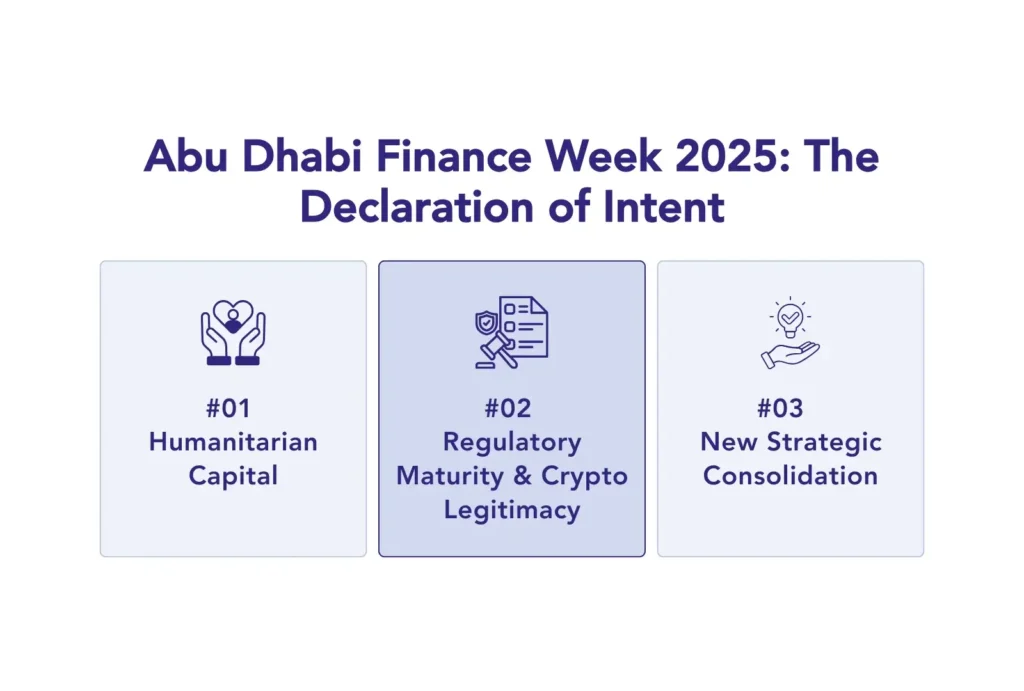
Abu Dhabi Finance Week 2025: The Declaration of Intent

Abu Dhabi Finance Week 2025 became a stage where the emirate showcased what its next decade of influence will look like – a blend of humanitarian leadership, regulatory confidence, and bold economic consolidation. The announcements that followed showed a city positioning itself not just as a regional hub, but as a global agenda-setter.

Humanitarian Capital

The emirate paired financial ambition with soft power. A $1.9 billion pledge toward global polio eradication, led by the Mohamed bin Zayed Foundation in partnership with the Gates Foundation, was among the largest health commitments announced during the event.

Regulatory Maturity & Crypto Legitimacy

ADGM granted Binance full financial services authorization, making it the first global crypto exchange to receive such status in the jurisdiction. Circle, the issuer of the USDC stablecoin, was licensed as a money services provider, moves described as part of Abu Dhabi’s effort to institutionalize digital assets rather than marginalize them.

New Strategic Consolidation

On December 9, OCI Global and Orascom Construction announced talks to merge and create a global infrastructure platform anchored in Abu Dhabi, reinforcing the emirate’s role as a base for multinational consolidation.

Thematic Analysis: The Geoeconomics of 2025

By 2025, Abu Dhabi’s investment activity can no longer be understood deal by deal. Recent capital flows, structural partnerships, and asset-level deployments point to something more coherent: a geoeconomic strategy that positions capital as infrastructure in its own right. The following analysis examines how private credit, artificial intelligence, energy systems, and global connectivity have become interlinked components of a broader ambition-one that extends Abu Dhabi’s influence across markets, supply chains, and geopolitical alignments.

Private Credit & Secondaries Pivot

As global banks retreat under capital constraints and the final phases of Basel III implementation, Abu Dhabi has emerged as an increasingly critical liquidity provider of last resort. Recent transaction records show a marked acceleration into private credit platforms, secondaries, and restructuring-linked financing – sectors traditionally dominated by Western balance sheets.


Large-scale partnerships with global asset managers have enabled the emirate to underwrite complex capital needs across jurisdictions, often stepping in where syndicated bank financing has thinned. The structure of these deals – long-dated, yield-focused, and asset-backed- suggests a deliberate attempt to institutionalize private credit as a core pillar of sovereign deployment rather than a cyclical supplement.


This shift is not merely opportunistic. It reflects a structural bet that private markets will remain the preferred channel for global capital formation well beyond this cycle.

Layered Capital Architecture

What distinguishes Abu Dhabi’s model is not speed, but architecture. Sovereign funds, sector-specific vehicles, listed platforms, and holding companies operate within a tiered system that allows capital to be deployed across multiple risk horizons simultaneously.


Primary sovereign entities anchor long-term exposure, while specialized vehicles absorb thematic risk-whether in artificial intelligence, energy transition, or alternative credit. Tactical platforms then execute at the transactional level, providing flexibility without diluting strategic control.


Deal data from recent years points to increasing coordination across this stack. Co-investments, shared counterparties, and sequential capital commitments indicate a system designed not for isolated returns, but for optionality, influence, and scale.

Global Ripple Effects

The implications of this approach extend well beyond the Gulf. In private credit markets, the presence of a deep-pocketed, patient allocator has altered pricing dynamics and competition for assets. In artificial intelligence, the emirate’s willingness to finance both compute infrastructure and underlying energy inputs has reshaped supply chain economics for data-intensive growth.


Emerging markets, particularly in South Asia and parts of East Asia, have benefited from direct capital access that bypasses traditional Western intermediaries. For policymakers and financiers alike, Abu Dhabi has become not just a capital source, but a parallel system, one capable of influencing where, and how, capital flows.

Recent Deal Snapshots

A review of recent mega-transactions illustrates strategy in motion. Large-scale acquisitions in data center infrastructure, anchor commitments to global private credit platforms, and cross-border energy investments share common traits: control-oriented structures, long-duration capital, and embedded strategic optionality.


These are not portfolio trades. They are system-building exercises, transactions designed to lock in future advantage across infrastructure, financing, and technology.

Internal Competition vs Coordination

Despite the growing web of entities, internal rivalry appears managed rather than chaotic. Mandates remain differentiated: some vehicles prioritize national infrastructure, others global exposure, others thematic innovation. Overlaps exist, but are bounded.


Internal governance frameworks appear designed to preserve competitive tension while avoiding capital cannibalization. The result is a controlled rivalry that sharpens execution without fragmenting strategy-a balance few state investors have managed to achieve.

Geopolitical Capital Strategy

Capital, in this architecture, functions as a diplomatic instrument. Investments deepen strategic partnerships, hedge geopolitical risk, and embed Abu Dhabi into critical supply chains. The approach is notably balanced: deepening alignment with the United States through technology and infrastructure, while expanding economic presence across the Global South.


Rather than choosing sides, the emirate is building exposure.

Risks & Fragilities

For all its strengths, the model is not without fault lines.

  • Liquidity Exposure: Greater reliance on private markets reduces exit flexibility during periods of stress.

  • Coordination Complexity: As the ecosystem expands, governance risks increase. Alignment must be actively maintained.

  • Valuation & Execution Risk: Large checks in capital-intensive sectors leave little room for error, particularly amid geopolitical uncertainty.

The coming years will test whether Abu Dhabi’s engineered system can sustain both scale and discipline under pressure.

Conclusion

By December 2025, Abu Dhabi had moved beyond the role of allocator to that of owner and operator. Bloomberg’s multi-year analysis shows an emirate that has engineered a dense, overlapping financial structure capable of shaping outcomes across energy, credit and technology. The coordination between ADIA, Mubadala and ADQ, reinforced by MGX, Lunate and XRG, now represents one of the most sophisticated examples of state-capital strategy in operation.

FAQs:

Officials at Abu Dhabi Finance Week described the Financial Infrastructure and Digital Assets (FIDA) cluster as a mechanism to deepen capital-market activity rather than a standalone growth engine. Internal estimates shared with investors suggest the cluster could add several billion dollars in incremental financial-services output over the next decade by attracting more fund managers, trading firms and data-driven financial platforms to ADGM. Bloomberg reporting indicates the primary objective is densification, increasing transaction volume and cross-border deal flow, rather than headline job creation.

Unlike provisional or limited-market approvals seen elsewhere, Binance’s authorization allows it to operate a full suite of regulated financial services within ADGM’s legal framework. Bloomberg notes that the approval places Binance under the same supervisory standards as traditional financial institutions in the zone, including capital, compliance and reporting requirements. The move signals Abu Dhabi’s intent to integrate digital asset firms into its mainstream financial system rather than regulate them on an exceptional basis.

People familiar with the discussions say the proposed merger is intended to create a vertically integrated infrastructure platform with operations spanning fertilizers, construction and energy-linked assets. Anchoring the entity in Abu Dhabi provides access to long-term capital from sovereign and quasi-sovereign investors, a point highlighted repeatedly in Bloomberg’s reporting on regional consolidation trends. The combined balance sheet would be positioned to bid for large, multi-decade infrastructure projects globally.

ADIA’s investment in IDFC First Bank is consistent with its broader focus on core financial infrastructure in high-growth markets. Bloomberg’s analysis shows the fund has prioritized assets tied to domestic credit expansion and retail banking rather than cyclical or export-driven sectors. India’s expanding middle class and regulatory reforms around financial inclusion have made private-sector banks a strategic entry point for long-horizon capital.

The partnership centers on securing critical components for large-scale AI infrastructure, particularly high-bandwidth memory and advanced data-center design. According to Bloomberg, collaborations with Samsung and SK Group are intended to reduce supply-chain bottlenecks while aligning Abu Dhabi-backed data-center projects with leading semiconductor ecosystems. The arrangement reflects MGX’s strategy of pairing capital with industrial partnerships rather than relying solely on market procurement.

Analysts say the announcement points to a gradual recalibration of expectations for public-market vehicles backed by Abu Dhabi capital. While balance-sheet growth has historically taken precedence, a formal dividend framework suggests greater emphasis on recurring returns and minority shareholders. Bloomberg notes this mirrors a broader trend among regional investment firms seeking to deepen engagement with international equity investors.

The term refers to the final phase of global banking regulations that increase capital requirements for long-dated and complex lending. As banks retrench, Bloomberg reports that sovereign investors such as Mubadala have stepped in through private-credit partnerships, including with Apollo, to originate and hold loans that banks are less able to carry. The shift has positioned Abu Dhabi as a key provider of replacement capital in global credit markets.

People familiar with the matter say Lunate viewed HPS as a scalable platform in private credit regardless of ownership. Bloomberg reporting suggests the investment was driven by strategy alignment rather than transaction timing, allowing Lunate early exposure to origination capabilities later absorbed into BlackRock’s broader credit ecosystem. The move reflects Abu Dhabi investors’ preference for platforms with durable fee-generating potential.

The index is intended to benchmark financial centers beyond traditional metrics such as market capitalization or headcount. By hosting its launch, Abu Dhabi signaled an effort to shape the criteria by which competitiveness is assessed, emphasizing regulatory sophistication, capital availability and cross-border connectivity. Bloomberg notes this aligns with the emirate’s push to influence standards rather than merely participate in them.

The expansion effectively doubles ADGM’s commercial footprint, increasing space for fund managers, legal firms and trading platforms. Bloomberg reporting suggests the goal is to remove physical constraints on capital inflows while reinforcing Abu Dhabi’s positioning as a base for regional and global finance. The project ties infrastructure investment directly to capital-market strategy.

Unlike legacy NOCs focused on hydrocarbon extraction and distribution, XRG operates as an investment platform spanning energy, materials and enabling infrastructure. Bloomberg characterizes it as a vehicle designed to finance the systems that energy-intensive technologies, including AI, depend on. Its mandate includes power, gas and industrial assets rather than upstream dominance alone.

The Bridge Summit functions as a closed-door convening point for sovereign investors, asset managers and policymakers. Executives attending described it as a forum for relationship-building rather than deal announcement. Bloomberg notes such gatherings are integral to Abu Dhabi’s model, where trust and long-term alignment often precede formal transactions.

ADQ executives stressed a distinction between enabling infrastructure and speculative technology exposure. According to Bloomberg, the fund’s mandate prioritizes assets with predictable cash flows, such as logistics, utilities and supply chains. Technology enters the portfolio primarily as a user of infrastructure rather than a standalone growth bet.

The phrase, used by market participants rather than officials, refers to Abu Dhabi’s positioning as a capital partner to multiple geopolitical blocs without formal alignment. Bloomberg’s reporting shows the emirate deepening ties with the US and Europe while simultaneously expanding investment across India, Asia and parts of Africa, allowing capital flows to remain flexible amid global fragmentation.

The concept captures the interdependence between compute-intensive technologies and energy supply. Bloomberg notes Abu Dhabi is uniquely positioned to address both sides of this equation, using vehicles such as XRG for energy and MGX for AI infrastructure. The strategy aims to ensure control over the full stack required to support large-scale data and computing growth.

References

Related Articles​​

Global Family Office and Investment Fund Audit- Governance, Valuation, Compliance, and Why 2025–2026 Changes Everything

Family Offices used to fly under the radar. Wealth moved quietly. Structures evolved across borders. Decisions were made within a small circle. Those days are gone.  Regulators expect transparency. Banks expect documentation. Investment partners want valuation clarity. Even families themselves want stronger governance as wealth moves into its second, third, and fourth generation.


And it’s not only Family Offices. Venture capital funds, private equity platforms, holding companies, and investment SPVs are all facing pressure to show clean controls, reliable numbers, and a clear audit trail.

Add the UAE’s tightening rules like Corporate Tax, ESR, AML-CFT, UBO, DIFC and ADGM frameworks and you get one reality:
 

The audit is no longer optional. It is the backbone of global credibility.


This article breaks down how a Global Family Office and an Investment Fund should think about their audit in 2025–2026. You’ll see how governance, valuation, and compliance connect. You’ll see where FO and fund audits usually fail. And you’ll understand why the UAE is becoming the world’s preferred hub for family office audit UAE, fund audit UAE, vc audit UAE, and everything related to cross-border wealth.


Let’s get into it.

The New Reality: Why Structured Audits Are Surging

Family wealth today lives across multiple asset classes. Venture capital allocations, private credit deals, startup cap tables, real estate SPVs, digital assets, managed portfolios, art, yachts, and corporate holdings-it’s all part of the modern FO balance sheet. But the ecosystem around it has changed faster than the structures themselves.


First, multigenerational families now want clear rules. They want documented governance, controlled spending policies, defined investment committees, and succession frameworks that work in real life, not theoretical advice sitting in a drawer.


Second, global regulators have tightened their expectations. AML-CFT checks are stricter. SOW/SOF expectations are stronger. CRS/FATCA data is exchanged automatically.
Third, LPs in VC and PE funds demand valuation discipline. SAFEs, convertibles, and early-stage bets need IFRS 13, IPEV, and IVS alignment. LPs don’t accept vague narratives anymore.


This is why both Family Offices and investment platforms are shifting toward structured annual audits. Strong audits support:

  • governance visibility

  • wealth protection

  • valuation accuracy

  • investor confidence

  • better bank and KYC clearance

  • clean cross-border transparency

  • reliable residency files (Golden Visa, FO licensing, etc.)

A bank in Dubai opening an account for a holding structure will always prefer audited financials over self-prepared spreadsheets. A regulator at DIFC or ADGM reviewing a Family Office file will always trust audited numbers more than internal Excel-based reporting.
And a family preparing for succession understands that without an audit, wealth transfers turn into disputes.


2025–2026 marks a turning point because UAE regulations now expect FO and investment structures to behave like institutional entities. That means solid books, clear valuation logic, clean governance, and real compliance.

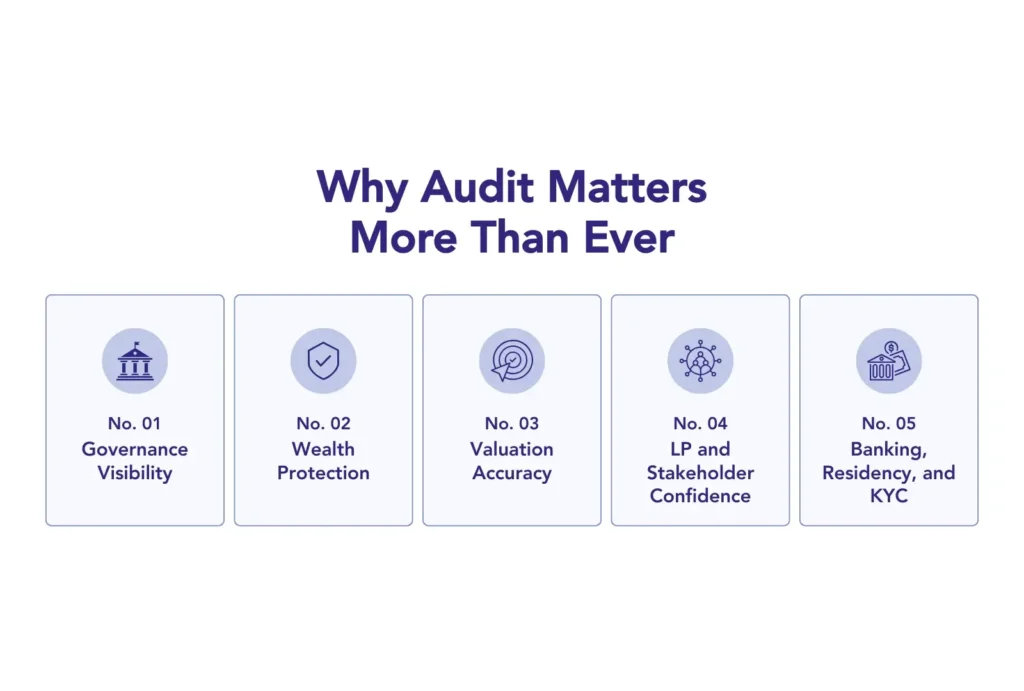
Why Audit Matters More Than Ever

Let’s make this simple. A Family Office or VC fund audit is not just a financial statement check. It’s a credibility upgrade. It brings order to a complex web of assets, entities, and decisions that often grow faster than documentation.

Governance Visibility

Governance is the heart of long-term wealth continuity. An audit forces clear processes. It tests approvals, delegation of authority, investment committee behavior, risk oversight, and reporting responsibilities. This protects families from internal mismanagement and helps funds avoid operational drift.

Wealth Protection

Many global FO disputes start because no one agrees on what the family actually owns, who approved what, or how decisions were justified. An audit creates a defensible record. It also protects against unnoticed losses, poorly structured loans, and under-documented side deals with related parties.

Valuation Accuracy

Early-stage investments, alternative assets, and real estate SPVs are often mispriced. No LP wants vague stories about growth curves anymore.
With valuation audit UAE, startup valuation audit UAE, IFRS 13 valuation UAE, and IPEV valuation UAE, everything gets tied to a defensible valuation framework.

LP and Stakeholder Confidence

LPs will always trust funds that can prove clean NAVs, accurate waterfalls, and transparent fee calculations. The same logic applies to family members who rely on FO reporting.

Banking, Residency, and KYC

UAE banks now expect documented wealth structures. They review audited financials when opening high-value accounts. Golden Visa cases increasingly require audited SOW/SOF documentation, making residency wealth audit UAE, banking compliance audit uae, and kyc audit uae central to FO operations.

UAE Regulatory Landscape (2025–2026

The UAE has transformed from a low-documentation jurisdiction to a high-standard compliance hub. Family Offices and funds must now operate with institutional discipline. Here’s what drives that shift.

Corporate Tax Law (CT 47/2022)

CT impacts holding structures, investment platforms, and FO governance more than people think. Participation exemption rules, TP documentation for related-party deals, tax grouping, and treatment of realised vs unrealised gains all require proper accounting evidence.
For an FO or VC fund, this means clean books, clear transaction trails, and well-documented cross-border flows—exactly what an annual audit delivers.

Economic Substance Regulations (ESR)

Investment activities fall squarely within ESR monitoring. Most FO/holding companies fail ESR not because they lack substance, but because they lack documentation proving it. An audit strengthens ESR submissions by providing:

  • controlled board minutes

  • evidence of decision-making

  • substance justification files

  • accounting support for revenue and expenses

This is why esr audit for investment entities is becoming standard.

AML-CFT and UBO

Banks, regulators, and external due diligence teams expect FO structures to maintain strong SOW/SOF documentation. Audit work often exposes missing UBO evidence, undocumented loans, or unclear ownership links across SPVs. Strong aml audit for family offices practices help mitigate those risks.

DIFC & ADGM

Both regulators are moving toward institutional-grade expectations for Family Offices and investment funds.
DIFC’s Single Family Office regime and ADGM’s Family Office framework expect:

  • proper accounting

  • periodic reporting

  • clear governance

  • documented investment decisions

  • annual audits in most structures

This is why adgm family office audit and difc investment audit are rapidly becoming mainstream.

CRS and FATCA Enforcement

Banks in the UAE are now stricter in how they classify FO structures. Misclassification creates reporting risk. An audit helps clean entity classifications and ensures FO structures do not inadvertently trigger CRS/FATCA obligations.

VARA – If Digital Assets Are Held

Crypto exposure requires:

  • custody controls

  • wallet evidence

  • chain-of-ownership files

  • valuation logic for tokens

This is where vara crypto audit uae enters the picture, especially for FOs allocating into tokenised assets or Web3 ventures.

What the Audit Actually Covers

A Family Office audit is wider than most business owners expect. A fund audit is even more technical. Here are the layers that matter.

Financial Statement Audit

This is the core: verifying the numbers. Yes, the financial statement audit. But with FO and funds, the numbers sit across multiple entities-SPVs, PropCos, OpCos, holding companies, and investment vehicles. Audit teams must reconcile everything: equity, loans, capital contributions, distributions, unrealised gains, SPV movements, and investment classifications under IFRS.


This is where audit services, auditing services in uae, and annual audit dubai truly prove their value.

Internal Controls Audit

Families and funds often underestimate internal risk. Weak approvals, casual payments, undocumented treasury flows, and ad hoc IC meetings cause operational friction.
A proper internal controls audit tests:

  • treasury controls

  • approval authority

  • investment committee oversight

  • delegation of authority

  • conflict-of-interest management

  • capital movement discipline

This feeds into governance audit uae, investment committee audit uae, and succession audit uae.

Valuation Audit

Valuation is the most sensitive part of FO and fund audits.
This involves:

  • early-stage investments

  • SAFEs and convertibles

  • tokenised assets

  • PropCo/OpCo structures

  • Level 1–3 valuation hierarchy

  • IPEV/IFRS alignment

  • market data and model checks

This is where valuation audit uae, private equity audit uae, pe fund audit uae, and venture capital audit uae become critical.

Performance Verification

NAV accuracy.
Fee calculations.
Carried interest.
Distribution waterfalls.
LP allocations.


Clean performance verification is central to fund audit uae, portfolio audit uae, and alternative investment audit uae.

Governance and Succession Audit

Families now expect documented succession plans, governance policies, and clear inter-generational communication. Audits review constitutions, board frameworks, stewardship policies, and Shariah-aligned arrangements, supporting shariah governance audit uae.

Digital Asset Audit

Wallet verification, chain analysis, custody controls, and tokenised portfolio valuation all sit here.
This supports digital asset audit and vara crypto audit uae.

Documentation Required

Families and funds often underestimate how much documentation an audit needs. It seems like the routine work but there is just too much detail to it. This is especially true after the new rules and regulations in the UAE.

Here is what auditors typically review:

  • financial statements

  • valuation files

  • bank and custody statements

  • capital call records

  • LP agreements

  • structure charts for SPVs and holdings

  • investment memos

  • governance policies

  • ESR filings

  • AML/UBO documentation

  • CRS/FATCA classification files

  • board minutes and IC minutes

Without these, the audit runs late or fails outright.

Common Weaknesses and Audit Failures

Most FO and fund audits fail for the same reasons.

Misstated Valuations

SAFE notes, early-stage startups, and crypto tokens are often overvalued due to optimism or lack of proper valuation models. Without ifrs 13 valuation uae and ipev valuation uae, these valuations break during audit.

Weak Governance

Missing investment committee minutes, ad hoc approvals, and undocumented decisions undermine credibility. Funds especially struggle here because governance slips between deals.

Missing SPV Documentation

Many SPVs lack shareholder resolutions, capital contribution evidence, or loan agreements.
Auditors cannot sign off without these.

Incorrect IFRS Classification

IFRS 9, 10, and 13 rules are commonly misunderstood.  This affects investment categorisation, consolidation, and fair value reporting.

ESR and AML Failures

Most FO-related ESR issues come from absent documentation, not absent substance.
AML issues stem from incomplete SOW/SOF files.

NAV and Waterfall Errors

Funds miscalculate NAV due to stale valuations or wrong fee logic.
LPs lose confidence quickly.

Digital Asset Custody Issues

Crypto wallets with unclear access controls or missing chain-of-ownership records are a red flag.

Audit Deliverables

A full Family Office or fund audit produces a set of deliverables that strengthen credibility.

  • audited financial statements under IFRS

  • valuation assurance reports

  • governance and succession audit reports

  • ESR/AML/UBO compliance summaries

  • LP-ready performance reporting

  • risk and controls improvement roadmap

  • investment committee governance review

  • bank/KYC support file for SOW/SOF

  • fund and SPV mapping documentation

These become essential during bank onboarding, visa applications, regulator interactions, and cross-border tax filings.

Future Trends Shaping FO and Fund Audits

The next few years will bring significant shifts.

Institutional Governance Maturity

Family Offices are moving from informal decision-making to structured governance maturity models.
This includes documented charters, voting models, and data-driven investment oversight.

Stronger DIFC/ADGM Frameworks

Both regulators DIFC and ADGM are raising the bar. Annual audits, governance expectations, and reporting discipline will continue to tighten.

AI-Driven Portfolio Valuation

AI tools will be used to validate valuations, detect anomalies, and independently assess portfolio trends.
Valuation audits will evolve accordingly.

Digital Asset and Tokenization Audit

VARA will expand rules around digital custody, tokenisation, and crypto valuations.
Families investing in digital assets should expect deeper audit expectations.

CRS/FATCA Enforcement

Banks will continue increasing classification checks, making crs fatca audit uae essential.

UAE as a Global FO Headquarters Hub

Dubai and Abu Dhabi will continue attracting global families seeking a stable base with strong but predictable regulation.

How ADEPTS Supports Families and Funds

ADEPTS works with Family Offices, multi-jurisdiction wealth structures, and investment funds across the UAE. Our focus areas include:

  • multi-asset audit

  • DIFC and ADGM licensing experience

  • valuation and structuring advisory

  • governance and succession planning

  • ESR, AML, and Corporate Tax compliance

  • Family Office setup reviews and operating model design

This integrated approach ensures families and investment firms meet global expectations with clarity and confidence.

FAQs:

Typically 8-12 weeks for a first-time audit. Complex structures may take longer if documentation is scattered.

Not always. But SPVs that hold active investments, loans, or real estate benefit from audits. Banks and regulators often request them.

Not legally. But most banks, residency applications, and cross-border filings now expect audited numbers.

It creates clarity: clean records, documented decisions, proper valuations, and defensible governance. This reduces disputes.

Banks review them during onboarding, when assessing SOW/SOF, and during periodic reviews. Audited numbers reduce queries.

Confusion. Valuation disputes. Undocumented decisions. Regulatory risk. Internal mismanagement. An audit prevents these issues.

Yes. IFRS and IPEV are standard for audit and LP reporting.

Yes. Many do. But the audit expects accurate records regardless of who maintains them.

For proper NAV reporting—yes. Valuations should be updated when material events occur.

By checking documentation, interest logic, repayment terms, and balance sheet impact.

Cross-border reporting, inconsistent documentation, and unclear ownership across SPVs.

Absolutely. Wallets, custody, and valuation need expertise.

Yes. Regulators expect proper books and clean audit reports.

Have books updated, documents organised, and structure charts ready.

Yes. Audits expose gaps, control weaknesses, and unexplained movements.

Related Articles​​

Difference Between a Dubai Restaurant License and a Cafeteria License (2026 Guide)

Dubai is a famous and one of the most loved recreational hubs of the world, and for that reason, there is a lot of glamour and innovation around food places. And with that kind of activity comes the UAE licensing system. 


You can love food. You can hire chefs. You can design a beautiful space. None of it matters if your license does not match what you are doing inside those four walls. In the UAE, the food license is not paperwork at the end of a checklist. It is the legal boundary of your business. It controls what you cook, how you cook it, how big your space must be, how much rent you pay, how many inspections you face, and how expensive your mistakes become.


And yet this is where most new F&B investors go wrong.


They care about how much the license costs. Little attention is paid to what the license allows.


They pick a cafeteria license because it is cheaper, then try to run a restaurant under it. Or they jump straight into a restaurant license without realizing how heavy the compliance and fixed costs really are. Both paths end the same way. Fines, restrictions, or closure.


This guide exists to stop that from happening.


We are breaking down the difference between a Dubai restaurant license and a cafeteria license in real terms. Not brochure definitions. Not consultant fluff. Real regulatory expectations in 2026.


We will cover Dubai in depth, then expand to Abu Dhabi and Sharjah, because the rules are similar but the experience is not. We will talk about costs, inspections, layouts, staffing, survival rates, and real outcomes.


If you are serious about opening a food business in the UAE, read this slowly. This decision shapes everything that follows.

Understanding Food Licenses in the UAE (Before We Compare)

Before comparing cafeteria and restaurant licenses, you need to understand one basic truth.


There is no single “UAE food license”.


Each emirate has:

  • Its own economic department

  • Its own food safety authority

  • Its own inspection culture and enforcement style

The definitions are aligned. The execution is not.


Dubai, Abu Dhabi, and Sharjah all recognize cafeterias and restaurants as separate business models. But what gets approved easily in one emirate may face resistance in another.


So while this guide focuses heavily on Dubai, every comparison will note where other emirates differ.

What Exactly Is a Cafeteria License?

A cafeteria license is built for simple food and fast turnover.


Not casual dining. Not gourmet concepts. Not complex cuisine.


A cafeteria is expected to serve food that is:

  • Prepared quickly

  • Low in preparation complexity

  • Low in food safety risk

  • High in volume

Typical cafeteria offerings include:

  • Tea and coffee

  • Fresh juices

  • Sandwiches and wraps

  • Pastries and baked goods

  • Simple fried or grilled snacks

This is why search terms like cafe license cost, tea shop license cost in dubai, and food license cost in dubai are dominated by cafeteria-style businesses. The entry barrier is lower and the model is easier to sustain.


Regulators assume a cafeteria will:

  • Have a compact kitchen

  • Use limited cooking equipment

  • Employ fewer staff

  • Generate less waste and grease

  • Serve customers quickly

That assumption drives every approval, inspection, and restriction that follows.

What Is a Restaurant License Really For?

A restaurant license exists for full cooking operations and dine-in service.


It is not about prestige. It is about risk management.


Restaurants are allowed to:

  • Prepare complete meals from scratch

  • Operate structured kitchens with multiple stations

  • Offer table service

  • Handle complex ingredients

  • Use gas-heavy and heat-intensive equipment

From a regulator’s perspective, restaurants involve:

  • Higher food contamination risk

  • Greater fire risk

  • More waste and grease management

  • Larger teams handling food

This is why the restaurant license cost in Dubai is always higher than it seems on paper. You are not just paying a fee. You are stepping into a heavier regulatory category.

The Core Differences That Actually Matter

Let’s move beyond labels and talk about how these licenses behave in real life.

Menu Scope and Cooking Depth

This is the single biggest point of difference and the most common cause of violations.

Cafeteria Menu Scope

Under a cafeteria license, cooking is allowed but limited.


Authorities expect:

  • Short cooking times

  • Basic preparation methods

  • Few cooking stages

  • Minimal raw ingredient handling

If your menu requires:

  • Long marination

  • Sauce reduction

  • Complex spice preparation

  • Multiple hot preparation stations

You are already pushing beyond what a cafeteria license is meant to support.


Many cafeterias get approved initially because menus look simple on paper. Problems start later, during inspections, when inspectors see what is actually happening in the kitchen.

Restaurant Menu Scope

A restaurant license removes those limits.


You can:

  • Develop cuisine-driven menus

  • Offer multiple categories of dishes

  • Handle raw proteins extensively

  • Operate multiple kitchen stations

This flexibility is why chefs insist on restaurant licenses. But flexibility also invites scrutiny.

Space and Layout Requirements (Where Most Applications Fail)

Food authorities do not care how expensive your interiors are. They care about what happens behind the counter. They care about your space and layout:

Cafeteria Space Requirements

Cafeterias can operate from smaller units.


Typical expectations include:

  • A compact food prep area

  • Basic refrigeration

  • Small storage zones

  • One washing station

  • Light ventilation

Because space requirements are lighter, cafeterias are easier to place in:

  • Narrow retail strips

  • Service roads

  • Older buildings

  • Community shopping blocks

This has a direct impact on license cost in Dubai because rent is often the largest fixed cost.

Restaurant Space Requirements

Restaurants need space. Real space.


Authorities look for:

  • Clear separation between prep, cooking, and washing

  • Dedicated dry and cold storage

  • Separate hand wash stations

  • Heavy-duty exhaust and hood systems

  • Grease trap installation

Many investors make the mistake of signing a lease first and checking compliance later. That mistake is expensive.


A space that looks perfect to customers can be impossible to license as a restaurant.

Seating and Dine-In Permissions

Another misunderstood area.

Cafeteria Seating Rules

Yes, cafeterias can have seating. But seating is not the focus.


Authorities expect:

  • Limited seating

  • Self-service orientation

  • Short customer stays

If inspectors see table service, extended dining, or layouts resembling a restaurant, they will flag it.

Restaurant Seating Rules

Restaurants are designed for dine-in.


This includes:

  • Approved table arrangements

  • Customer circulation space

  • Waiting zones

  • Outdoor seating, with separate permits if applicable

If your business success depends on people sitting, ordering, eating slowly, and staying, a cafeteria license will eventually restrict you.

Regulatory Approvals and Inspections

This is where the real difference shows up over time.

Cafeteria Approval Path

In Dubai, a cafeteria typically requires:

  • Trade name reservation

  • Business activity approval

  • Initial approval from DET

  • Tenancy contract and Ejari

  • Kitchen layout submission

  • Food safety inspection

The process is relatively fast. Inspections are focused and limited.

Restaurant Approval Path

Restaurants must clear everything cafeterias do, plus:

  • Gas installation approval if applicable

  • Civil defense fire clearance

  • Ventilation and exhaust certification

  • Equipment-specific approvals

  • Multiple food safety inspections

This adds weeks, sometimes months, to setup. It also increases the chance of rework if requirements are not met exactly.


This is a major reason why the restaurant license in dubai cost is higher in practice than most online estimates suggest.

Cost Differences That Go Beyond the License Fee

Let’s be blunt.


The license fee is pocket change compared to what actually drains your bank account.


People obsess over application costs and trade license numbers because they are visible and fixed. Rent, build-out, staffing, and compliance costs do the real damage quietly, month after month.


This is where the cafeteria vs restaurant decision becomes financial, not philosophical.

Cafeteria Cost Reality

Cafeterias stay alive because they control fixed costs.


That single fact explains why so many searches revolve around license cost in Dubai, food license cost in Dubai, and food trade license Dubai cost. People are not asking out of curiosity. They are trying to avoid overcommitting.

Lower Trade License and Approval Fees

A cafeteria license sits in a lighter regulatory category.


You pay less at the trade license stage, and just as important, you pay less at renewal. Fewer approvals also mean fewer follow-up inspections that carry penalties if something small is off.


This matters because compliance costs are recurring. Not one-time.

Smaller Leasable Areas, Lower Rent

Cafeterias can operate from smaller units. That alone changes everything.


Smaller space means:

  • Lower monthly rent

  • Lower security deposit

  • Lower service charges

  • Lower air-conditioning costs

  • Less wasted space behind the counter

In a city like Dubai, rent can easily destroy a good concept. A cafeteria license keeps you out of oversized, unnecessary spaces.


That restraint is survival.

Simpler Fit-Out and Equipment

Cafeterias do not require heavy infrastructure.


You are usually dealing with:

  • Basic cooking equipment

  • Simple exhaust systems

  • No gas line complexity in many cases

  • Minimal grease management requirements

Fit-out costs stay predictable. Changes are cheaper if inspectors ask for adjustments.


Compare this to refitting a full restaurant kitchen. The difference is not small. It is dramatic.

Fewer Staff Visas and Lower Payroll Pressure

A cafeteria can run lean.


Two or three kitchen staff. Counter service. No layered hierarchy.


This reduces:

  • Visa fees

  • Medical and insurance costs

  • Accommodation obligations

  • Payroll risk during quiet periods

This is why cafeterias often survive slow seasons while restaurants bleed.

Lower Ongoing Compliance and Maintenance Costs

Less equipment means fewer breakdowns.


Less heat means less ventilation stress.


Less grease means fewer plumbing nightmares.


Over time, these savings compound. They do not show up in brochures, but they decide whether a business lasts.


That is why cafeterias are not just cheaper to start. They are easier to sustain.

Restaurant Cost Reality

Restaurants fail for boring reasons. Not because food is bad. Not because branding is weak. But because fixed costs become impossible to outrun.


This is where the romance of restaurants collapses into spreadsheets.

Larger Rent Commitments

Restaurants need space. Real space. FoH seating. BoH kitchens. Storage. Wash areas. Staff movement.


That space costs money every single month, whether customers show up or not. One slow quarter can erase a year of effort if rent is high and margins are thin.


This is the unspoken truth behind restaurant license cost in Dubai calculations. Rent is the silent killer.

Expensive Exhaust, Gas, and Fire Safety Systems

Restaurants demand infrastructure.


Heavy-duty exhaust systems. Certified gas lines. Fire suppression systems. Civil defense approvals.


These are non-negotiable and non-cheap.


Once installed, you still pay for:

  • Maintenance

  • Certification renewals

  • Repairs

  • Re-approval when layouts change

None of this generates revenue. All of it is mandatory.

Larger Kitchens and Storage Increase Everything Else

More kitchen space means:

  • Higher fit-out costs

  • More refrigeration

  • More cleaning effort

  • More electricity and water use

Utility bills are rarely discussed at the planning stage. Yet they rise fast in restaurants, especially in hot months.


Margins shrink quietly.

Higher Staffing and Visa Costs

Restaurants need people. Many of them.


Chefs. Prep cooks. Service staff. Supervisors. Cleaners.


Each additional staff member adds:

  • Visa and renewal costs

  • Accommodation responsibility

  • End-of-service obligations

During peak months, this feels manageable. During slow months, it becomes exhausting.

Waste, Grease, and Compliance Drain

Restaurants produce more waste. More grease. More risk.


That triggers:

  • Grease trap maintenance

  • Waste management contracts

  • Frequent inspections

  • Fines for small lapses

None of this is optional. All of it hits cash flow.

The Real Difference in Financial Pressure

Here is the simplest way to understand it.


A cafeteria’s costs scale with demand.
A restaurant’s costs exist regardless of demand.


That single distinction explains why:

  • Cafeterias are easier to recover during slow months

  • Restaurants require stronger buffers

  • Many first-time founders underestimate restaurant burn rates

When people compare license cost in UAE, they often stop at application fees.


That is a mistake. The real cost is not what you pay to open. It is what you pay while trying to stay open.

Staffing and Operational Complexity

Regulators link license type to staffing expectations.

Cafeteria Staffing

Typically:

  • Counter staff

  • Small kitchen team

  • Minimal hierarchy

  • Limited supervision requirements

This keeps visa and payroll costs under control.

Restaurant Staffing

Restaurants require:

  • Head chef or kitchen lead

  • Multiple cooks

  • Service staff

  • Supervisors

  • Cleaners and support roles

Each role adds visa costs, accommodation requirements, and compliance oversight.


This is often underestimated by first-time restaurant operators.

Branding, Concept Growth, and Flexibility

Cafeterias are operationally efficient but creatively limited.


Restaurants offer:

  • Menu evolution

  • Brand storytelling

  • Premium pricing

  • Expansion into delivery, catering, or franchising

If long-term brand building is the goal, a restaurant license offers more freedom. But that freedom must be earned with compliance.

Approval Processes by Emirate

Because Dubai is not the whole story.

Dubai

Dubai is strict but organized.

Authorities Involved

  • Dubai Department of Economy and Tourism

  • Dubai Municipality Food Safety Department

The system is digital, predictable, and transparent. If you follow the rules, approvals come.

Abu Dhabi

Abu Dhabi takes longer and asks more questions.

Authorities Involved

  • Abu Dhabi Department of Economic Development

  • Abu Dhabi Agriculture and Food Safety Authority

Expect:

  • More detailed layout review

  • Heavier focus on food labeling

  • Strong separation requirements

The restaurant license cost in Abu Dhabi often increases due to additional build-out requirements.

Sharjah

Sharjah is cost-sensitive but conservative.

Authorities Involved

  • Sharjah Economic Development Department

  • Sharjah Municipality Food Safety Division

Lower rents drive interest in license cost in Sharjah, but inspectors are strict on:

  • Seating arrangements

  • Health cards

  • Cleanliness standards

Sharjah rewards simplicity.

Financial Requirements and Investment Breakdown

Let’s ground this discussion. It starts with capital aka money:

Cafeteria Investment Profile

Best suited for:

  • First-time founders

  • Lean businesses

  • High footfall, low ticket areas

  • Residential neighborhoods

Lower startup costs increase survivability.

Restaurant Investment Profile

Best suited for:

  • Experienced operators

  • Well-researched locations

  • Strong capital backing

  • Clear demand signals

Higher potential returns. Higher downside risk.

Market Data and the Reality Behind the Numbers

Dubai issues thousands of new F&B licenses every year. That looks encouraging. But cancellation and non-renewal data tells the other half of the story. Many restaurants close within two years. Cafeterias last longer on average, especially in residential areas.


This tells us something important. The market is not forgiving. Concept, location, and license fit matter more than passion.

Real-World Case Snapshots

Case 1: The Overlicensed Restaurant
An investor leased a prime location and chose a restaurant license for flexibility. Demand supported only quick meals. Rent and staffing killed margins. License canceled within two years.


Case 2: The Smart Cafeteria
A small cafeteria validated demand first. Minimal costs. Strong cash flow. Upgraded to restaurant license later.


Case 3: The Compliance Collapse
An operator ignored ventilation rules. Fines accumulated. Forced closure despite good sales.


Each outcome was decided before the first meal was served.

Operational Requirements That Apply to Both

Menu Approval

Menus are reviewed during inspections. Deviating from approved scope leads to penalties.

Waste Management

Restaurants face stricter grease trap and waste requirements. Cafeterias face lighter rules, depending on menu.

Ventilation

Inadequate ventilation is one of the most common violations.

Food Safety Training

Both licenses require:

  • Food handler permits

  • Health cards

  • HACCP compliance scaled to operation size

There is no shortcut here.

Which License Should You Choose?

This is the point where theory ends and judgment begins.


There is no universally “better” license. There is only a license that fits your location, demand, budget, and risk tolerance. Choose based on how the business will live day to day, not how exciting the idea sounds on paper.


Let’s break it down by emirate first. Then by business type.

Dubai: High Rent, High Competition, No Forgiveness

Dubai is not expensive because regulators want it to be.
It is expensive because demand is relentless.


Rent is high. Fit-out costs are high. Competition is everywhere. When something fails here, it fails quickly.


Because of this, cafeteria licenses work extremely well in Dubai for testing and early-stage entry.


A cafeteria license allows you to:

  • Enter prime or semi-prime locations with smaller spaces

  • Keep rent and fit-out under control

  • Move faster through approvals

  • Adapt menus quickly without heavy sunk costs

This is especially effective in:

  • Residential clusters

  • Mixed residential–commercial zones

  • Office-adjacent areas with predictable footfall

  • High-delivery-demand neighborhoods

Many successful Dubai restaurants did not start as restaurants. They started as cafeterias, validated demand, built a customer base, and upgraded the license later once cash flow justified the jump.


A restaurant license in Dubai makes sense when:

  • You already know the market

  • The location guarantees dine-in traffic

  • The menu cannot legally or practically operate under a cafeteria scope

  • You have capital buffer for slow months and compliance surprises

Dubai rewards preparation. It punishes optimism.


If you are unsure, start smaller. Dubai always gives you another chance to upgrade. It rarely forgives overreaching.

Abu Dhabi: Structured Demand, Slower Burn, Better Planning Horizon

Abu Dhabi behaves differently from Dubai.


It is calmer. More predictable. Less impulsive.


Corporate offices, government entities, and long-term residents shape food demand here. Lunch crowds are steady. Dinner crowds are planned. People return to places they trust.


Because of this, restaurant licenses tend to perform better in Abu Dhabi when properly planned.


A restaurant license works well here if:

  • The menu targets professionals and families

  • The concept is consistent rather than trendy

  • Seating and dine-in experience are part of the value

  • The investor plans for the long term, not quick exits

That said, Abu Dhabi regulators are thorough. Layout approvals take time. Food safety authorities scrutinize storage, labeling, and preparation closely. Changes after submission are common.


The restaurant license cost in Abu Dhabi often rises not because of fees, but because of redesigns and compliance upgrades.


Cafeterias still work in Abu Dhabi, especially near:

  • Labor accommodations

  • Transport corridors

  • Mixed-use suburban developments

But if your menu and service are clearly restaurant-grade, Abu Dhabi is one of the better emirates to execute it cleanly and sustainably.

Sharjah: Lower Costs, Tighter Rules, Family-Centric Demand

Sharjah attracts founders for one big reason. Cost.


Rent is lower. Setup costs are lower. The license cost in Sharjah is often more manageable for small and medium businesses.


But lower cost does not mean looser rules.


Sharjah food authorities are conservative and strict. Seating layouts, cleanliness, health cards, and operating discipline are enforced closely. Inspectors expect order, not experimentation.


Because of this, cafeteria licenses perform exceptionally well in Sharjah, especially in:

  • Residential neighborhoods

  • Family-centric areas

  • Budget-sensitive zones

  • Local community strips

Family-oriented cafeterias with clean operations and consistent menus do well here.


Restaurants can succeed too, but only when:

  • Demand clearly supports dine-in

  • The concept fits Sharjah’s demographic

  • Seating complies with local expectations

  • The operator accepts tighter enforcement

Sharjah rewards simplicity and discipline. It does not reward overcomplication.

Choosing by Business Type

Now let’s talk less about geography and more about who you are as an operator.

Small Entrepreneur or First-Time Founder

If this is your first food business, the answer is clear.


Start with a cafeteria license.


Not because cafeterias are “less ambitious”, but because they are operationally forgiving.


A cafeteria license allows you to:

  • Learn inspections without panic

  • Understand municipality expectations

  • Control monthly burn

  • Experiment with demand

  • Adjust menu pricing and offerings quickly

Mistakes cost less under a cafeteria license. That alone makes it the right choice for most first-time founders.


Many people ruin their first business by aiming too big too soon. The UAE does not give refunds for enthusiasm.

Full-Service Dining Concepts

If your idea depends on:

  • Table service

  • Long dining times

  • Multi-course meals

  • Complex kitchen operations

Then trying to squeeze it into a cafeteria license will create constant problems.


For full-service dining, a restaurant license is not optional. It is a requirement.


This applies to:

  • Fine dining

  • Casual sit-down restaurants

  • Theme-based dining concepts

  • Family restaurants with large menus

Yes, the restaurant license cost in Dubai or Abu Dhabi will be higher.
Yes, inspections will be stricter.


But operating a full restaurant under a cafeteria license almost always ends in fines, forced modifications, or shutdowns.


If the model is full service, align the license from day one.

Specialty Cuisine Brands

This is where things are less black and white.


Some specialty cuisines look simple but are not.


For example:

  • A sandwich shop may legally operate as a cafeteria

  • A ramen shop may require restaurant licensing due to broth preparation

  • A dessert brand may start as a cafeteria unless baking and cooking scale increases

For specialty cuisine brands, the correct license depends on:

  • Depth of food preparation

  • Number of cooking stages

  • Equipment used

  • Time food spends in the kitchen

Many successful brands start with a cafeteria license, limit menu complexity, then upgrade once the brand gains traction and the menu expands.


The worst approach is guessing. The smart approach is aligning menu design with license limits intentionally.

Cloud Kitchens and Delivery-Only Concepts

Cloud kitchens are a separate regulatory category, but the choice still matters.


In Dubai and Abu Dhabi, cloud kitchens often:

  • Operate under restaurant-style food preparation approvals

  • Require layout approval even without dine-in

  • Face the same food safety standards as physical restaurants

Many cloud kitchens start under cafeteria-style scopes but quickly exceed them as menus grow.


For cloud kitchens:

  • Cafeteria licensing works for simple menus and limited prep

  • Restaurant licensing becomes necessary for complex, fully cooked menus

Inspectors do not care whether customers sit or take delivery. They care about what happens inside the kitchen.


In the UAE food business, the license does not follow the concept. The concept must fit the license. Get this part right, and most other problems become manageable. If you get it wrong, nothing else will save the business.

Common Mistakes That Kill Businesses

  • Choosing cafeteria license for restaurant menus

  • Leasing non-compliant spaces

  • Ignoring ventilation and grease requirements

  • Underestimating inspection frequency

These mistakes are common. They are also avoidable. Many challenges come your way when you are entering the eatery industry. If you watch out for these mistakes, a lot of problems will be avoided without causing any disturbance.

Setup Timeline Comparison

Cafeteria:

  • Faster approvals

  • Fewer inspections

  • Lower risk

Restaurant:

  • Longer timeline

  • Multiple inspections

  • Higher chance of delays

Time is money. Especially in Dubai.

Conclusion

The difference between a cafeteria license and a restaurant license is not semantic. It is operational reality. One prioritizes speed and efficiency. The other demands structure and discipline. 


Before asking about license cost in UAE, ask the harder question. 


Does this license fit how I plan to operate, scale, and survive?


Answer that honestly, and everything else becomes manageable.

FAQs:

Not really. The general idea is the same everywhere — small, quick-service food outlets — but each emirate has its own way of classifying, approving, and inspecting them. Dubai, Abu Dhabi, and Sharjah all follow national food-safety rules, but the paperwork flow and small details shift from place to place. So the license looks similar on paper, but the route to getting it isn’t identical.

Yes, but only in a limited way. Sharjah cafeterias can offer a few seats. Think small. Quick turnover. Not the kind of dine-in experience you’d get in a full restaurant. If you try to stretch the space into something bigger, the inspectors will notice.

The ADDED handles the business license. The Abu Dhabi Agriculture and Food Safety Authority handles food approvals. Two doors. One business. They work together behind the scenes, but you still deal with both.

The core rules are the same. The internal processes are not. Dubai pushes most approvals through Dubai Municipality. Abu Dhabi routes them through ADAFSA. Sharjah uses Sharjah Municipality. All three test you on layouts, exhaust, hygiene, and how you store anything edible. Same standards. Different desks.

Yes. It happens often. You’ll need a bigger space, updated drawings, kitchen changes, and another round of approvals. Think of it as moving from a bicycle to a car. Same direction. Different engineering.

Not dramatic, but noticeable. Dubai tends to be slightly more expensive, mainly because of rent, location competition, and higher fit-out expectations. Abu Dhabi is steadier. Either way, the biggest cost killer isn’t the license – it’s the space.

Dubai Free Zones move fast. Mainland Dubai and Abu Dhabi take a bit longer because there are more inspections. Sharjah sits somewhere in the middle. But speed isn’t everything. A fast approval doesn’t save you if your site drawings get rejected twice.

Yes. Full foreign ownership is allowed in all three emirates for these activities. No sponsor required. People still ask this question because old rules linger in memory.

Yes. No one will let you cook legally without approved drawings. The layout is the first thing every authority looks at. Because if the kitchen is wrong, everything else will go wrong too.

Slightly. The idea is the same everywhere, delivery-only operations, but Dubai has a more mature cloud-kitchen ecosystem with stricter fire, exhaust, and zoning checks. Abu Dhabi is catching up fast, though. Sharjah keeps it simpler but still firm on hygiene.

Cafeteria. Always. Less space, fewer requirements, smaller fit-out, lighter inspections. Restaurants cost more because they expect a full kitchen, proper dining, more staff, and a more complex layout.

Yes, but only in a small way. A few tables. Quick seating. Nothing resembling a full dining area. As soon as it becomes a big sit-down operation, the license category stops matching your reality.

Yes. Dubai Municipality sits at the core of anything related to kitchens, food, exhaust, ventilation, and structural safety. Even if your business license comes through DED or a free zone, DM still has the final say on food activity.

Yes. People do it all the time as their business grows. Expect new drawings, new approvals, and usually a bigger space. It’s an upgrade, not a tweak.

If you serve anything cooked, reheated, or fried, the authorities expect proper ventilation, grease traps, chimney height, and kitchen compliance. Technically it’s not a separate “approval,” but your layout must reflect it. Otherwise the inspectors will stop you right there.

Yes. Many do, because it adds an extra revenue stream. As long as your kitchen meets the standard, delivery-only operations are fine. Some restaurants even run separate virtual brands from the same kitchen.

Cafeterias can run in smaller spaces, sometimes as low as 250–300 sq ft depending on layout. Restaurants need more room: proper kitchen, storage, dish-washing, and a real dining area. Authorities focus less on square footage and more on whether the space meets safety logic.

Usually 1–3 weeks for cafeterias and 3–6 weeks for restaurants. The actual timeline depends on drawings, fit-out quality, and whether your site passes the first inspection. Most delays come from fit-out contractors, not the regulators.

Yes. Full ownership. No sponsor requirements. No local partner needed. All three emirates allow 100% foreign ownership for these activities.

Not always at the start, but eventually yes, especially when you grow. Restaurants usually need HACCP from day one because of food volume. Cafeterias may not, but the moment you handle high-risk items, deliveries, or storage expansions, the requirement appears.

References

Related Articles​​

New Cabinet Resolution Makes E-Invoicing Mandatory — Penalties Up to AED 5,000

The UAE Cabinet has given the green light to Resolution No. 106 of 2025, introducing fines for companies that don’t comply with the electronic invoicing system.


The move is part of a bigger push to digitize tax reporting, and businesses are being warned: get your systems ready, or the penalties will start adding up.


This is no longer a future framework. 2026 marks the transition into active enforcement, with the voluntary pilot phase going live from July 1, 2026, turning policy into a live operational system.


Officials say the goal is simple – make reporting more transparent and set the stage for a fully digital tax system now entering its first real-world implementation phase.

Understanding the Legal Framework

The UAE Cabinet’s new resolution builds on existing rules and aligns with the broader push to digitize tax compliance. Knowing the framework helps businesses understand what’s expected and what’s coming next.

How Cabinet and Ministerial Rules Connect

Resolution No. 106 of 2025 strengthens the earlier Ministerial Decision No. 243 of 2025. It essentially gives the Cabinet’s backing to rules that were already in place, creating a solid legal framework for e-invoicing.


This framework is now reinforced by Federal Decree-Law No. 16 of 2024, which amended the UAE VAT Law to formally recognize electronic invoices as legally valid tax documents.


For businesses, the message is simple: systems need to be ready, processes must align with the rules, and penalties now carry real consequences. Compliance is no longer just bureaucratic – it’s predictable and enforceable.


Under the UAE’s Decentralized Continuous Transaction Control (CTC) model, invoices that are not issued through an Accredited Service Provider (ASP) are no longer considered valid for VAT recovery purposes.

The PINT AE Standard v1.0.1

To support the 2026 rollout, the FTA has released the PINT AE Standard v1.0.1. This technical data dictionary defines the mandatory XML/JSON structure for e-invoices exchanged through the Peppol network. Any invoice issued outside this format will be treated as non-compliant.

Businesses in the Spotlight

Not every company is affected in the same way. VAT-registered businesses that handle B2B or B2G transactions must implement the e-invoicing system and appoint an Accredited Service Provider by the deadlines.


Businesses with annual revenue of AED 50 million or more fall under Phase 1 and must appoint an ASP no later than July 31, 2026.


Larger businesses face earlier compliance dates, while smaller firms have more time to prepare.


B2C-focused businesses are currently excluded from issuing e-invoices, but they are still required to onboard to receive structured invoices from suppliers.


Still, officials caution that now is the time to review processes.


Once the system goes live, there will be no shortcuts, and fines will begin accumulating quickly.


Note: The UAE Ministry of Finance has extended the Accredited Service Provider (ASP) appointment deadline for large taxpayers (annual revenue ≥ AED 50 million) to 30 October 2026. The mandatory e-invoicing go-live date of 1 January 2027 remains unchanged.

Administration of Penalties: What Businesses Face

The resolution clearly lays out the consequences for missing e-invoicing requirements. Here’s what businesses need to know:

  • Failure to appoint an Accredited Service Provider by the July 31, 2026 deadline triggers an automated monthly fine of AED 5,000 until compliance is achieved.

  • Every late electronic invoice carries a fine of AED 10,000, for repeat violations within 24 months

  • Late electronic credit notes are also fined AED 1000 each, with the same monthly cap. for repeat violations within 24 months

  • Failing to notify the FTA about system malfunctions can result in a daily penalty of AED 1,000.

  • Companies that don’t update their registered data with the service provider face a daily fine of AED 1,000.

These penalties are system-triggered. In 2026, fines are no longer discretionary – they are automated once non-compliance is detected.

How Fines Affect Businesses

Getting ready for e-invoicing is more than just turning on software. Systems must work seamlessly, data needs to be accurate, and internal controls must be tight. 


The FTA now has real-time transaction-level visibility. Errors are detected instantly, not during audits months later.


Equally important are the people running them — finance and operations teams must understand the rules, anticipate issues, and act quickly when problems arise. Strong processes and trained staff are what keep businesses ahead of fines and operational headaches.


Businesses are also expected to meet a “knew or should have known” standard, meaning they are responsible for verifying the e-invoicing compliance status of their suppliers.


Financial exposure is real. Even minor oversights can quickly turn into recurring monthly or daily fines, hitting the bottom line.


This is not a one-time adjustment. Companies that build strong processes now will navigate future digital tax rules more smoothly and avoid last-minute headaches.

Strategic Readiness for Taxpayers

Getting ready for e-invoicing is more than flipping a switch. 


It requires mapping ERP data fields to PINT AE specifications and integrating with one of the 12 FTA-approved Accredited Service Providers via Peppol.


Companies need their systems to actually work—ERP software must integrate seamlessly with accredited service providers, and every function should be tested before penalties start stacking up.


Manual PDF uploads are officially non-compliant for B2B and B2G transactions in 2026. Only structured XML/JSON e-invoices transmitted through approved channels are accepted.


Internal controls are non-negotiable. Companies need a solid plan for system downtime, accurate reporting, and catching mistakes before they turn into fines. Minor slip-ups can quickly become costly if left unaddressed.


Equally important are the people running the system. Finance and operations teams need to know the rules, grasp the risks, and act decisively when something goes wrong. Training isn’t just helpful—it’s what keeps a business ahead of trouble and running smoothly.

Data Residency and UAE-Based Archiving

All e-invoice data must be stored within the UAE. Businesses must ensure their ASP provides UAE-based data residency and archiving that meets FTA retention requirements.

ADEPTS Helps Businesses Stay Compliant

For many businesses, switching to electronic invoicing can feel complicated. ADEPTS helps bridge that gap.


ADEPTS supports businesses during the 2026 pilot phase by preparing ERP mappings, validating PINT AE compliance, and coordinating ASP onboarding ahead of mandatory deadlines.


The firm works with companies to establish compliant processes, understand VAT requirements, and prepare their systems to meet the new invoicing standards.


ADEPTS works directly with finance and operations teams to look at how things are done day to day. They ensure the ERP system supports the invoicing process and put stronger checks in place to prevent mistakes from slipping through. 


For small and mid-sized businesses, this means the steps are more straightforward, errors are fewer, and moving to e-invoicing doesn’t feel like a minefield as the UAE shifts to fully digital tax reporting.


At the core of ADEPTS’ approach is readiness. The firm helps companies move into the e-invoicing framework with confidence, reduce risks, and gain a practical understanding of how the new rules will affect day-to-day operations.

Looking Ahead

Companies will need to keep an eye on the Federal Tax Authority. Clear instructions are coming, and they’ll show exactly how to follow the rules and avoid penalties.


January 1, 2027 marks the mandatory go-live for Phase 1 taxpayers (revenue ≥ AED 50 million), followed by Phase 2 on July 1, 2027.


All B2G transactions must be fully compliant by October 1, 2027.


B2C issuance remains excluded until further notice.


Those who pay attention now will have a much easier time when full compliance is enforced.


This isn’t happening in isolation. The UAE is also looking at how other countries handle digital tax systems.


E-invoicing is becoming the global norm, and the authorities here want to make sure local businesses aren’t left behind. 


The aim is to make reporting less of a headache and the whole system more reliable.

Conclusion

The voluntary window is closing. E-invoicing fines are real, and enforcement is already being tested through the 2026 pilot. December 31, 2026 is the final deadline to correct historical VAT credits before the five-year limitation period applies under the updated law.


But it’s not just about penalties. This is part of a bigger push — a step toward a fully digital tax system that matches what the rest of the world is doing. For businesses that get ahead of it, that’s a chance to streamline processes, reduce mistakes, and actually take control of how they handle compliance.


It’s a wake-up call. Stay ready, stay organized, and the transition doesn’t have to be painful.

FAQs:

Yes, sending PDFs is allowed, but the official e-invoice record must still be uploaded to the system on time. The PDF alone doesn’t fulfill compliance requirements.

Yes. Businesses remain responsible even if the downtime is on the ASP’s side. It’s important to have backup procedures and monitor the system closely.

Yes, any internal outage that prevents timely submission can trigger fines. Companies should plan for contingencies to avoid penalties.

It depends on the Free Zone and whether the entity is registered for VAT in the UAE. VAT-registered businesses generally fall under this rule, even in Free Zones.

No, invoices cannot simply be deleted. Corrections must be made via electronic credit or debit notes, in accordance with the e-invoicing procedures.

During the pilot, penalties may not be enforced immediately, but errors should still be avoided. It’s best to treat the pilot phase seriously to avoid future fines.

Yes, all mandatory adopters must follow e-invoicing rules for B2C transactions, including retail sales, unless specifically exempted.

Yes, VAT-registered foreign entities must appoint an Accredited Service Provider to comply with e-invoicing requirements.

The cap limits the total penalties for repeated errors within a month. Each invoice error is fined AED 100, but the sum cannot exceed AED 5,000 per month.

Changes such as business address, VAT registration details, or ASP information need to be updated with the FTA promptly to avoid daily fines.

No. PDFs are no longer compliant for B2B and B2G transactions. Only PINT AE–compliant XML invoices issued through an ASP are valid.

Yes. VAT-registered entities, including those in Designated Free Zones, must comply with e-invoicing requirements in 2026.

The pilot begins on July 1, 2026. Participation is voluntary and allows testing without penalty exposure.

B2C issuance is currently excluded. However, these businesses must still onboard to receive compliant e-invoices from suppliers.

References

Related Articles​​

Value Surge vs. Volume Contraction in GCC Markets

Q3 2025 was a quarter that made global dealmakers look twice. 


Deal value climbed, yet deal volume slipped. 


This contrast turned Global M&A Q3 2025 into one of the most closely watched periods of the year.


A handful of major transactions shaped the numbers.


The market leaned toward selectivity, strategy, and scale was driven by a clear Megadeal Surge and a faster wave of AI-Driven M&A. These moves set the tone for what deal making now looks like: fewer files on the table, but far bigger bets.


At the same time, the GCC carved out its own story. 


While many markets slowed, the region kept its pace. The GCC IPO Pipeline stayed active. Cross-border interest held steady. And UAE M&A Growth continued to build confidence across sectors.


This momentum is shaping the GCC M&A Outlook 2025, supported by a sharper regional appetite for scale and a more deliberate cross-border deal strategy. 


In a year defined by contrasts, the Gulf is proving that steady conviction can stand out even when global activity becomes uneven.

Global Value Surge vs. Volume Collapse

Q3 2025 was a quarter of contrasts. Deal values soared, but the number of transactions dropped. This is the reality of Global M&A Q3 2025 – a market where a few big moves can define the quarter while smaller deals pause.

Record Value, Depressed Volumes

Global M&A reached approximately US$1.26 trillion in Q3 2025, up about 40% from the previous year, making it one of the most valuable third quarters on record.


Yet the deal count told a contrasting story. With roughly 8,912 transactions, Q3 saw its lowest volume in twenty years. There were fewer deals overall, but the ones that closed carried far higher stakes.


In this environment, regional players moved fast. Companies turned to M&A advisory in the UAE, to navigate increasingly complex transactions. Expertise in cross-border deals became essential, and strategic guidance was in high demand.

Average Deal Size Jumps

With fewer deals but much larger totals, the average deal size climbed to roughly US$141.4 million, from US$85.5 million last year. The market is clearly rewarding scale and strategy. Every move counted. Every transaction had to justify itself.


This set the stage for careful planning and strategic timing. Companies leaned on the cross-border deal strategy to make each deal work. Size alone was not enough; execution was critical.

Macro Headwinds and Tariff Uncertainty

Early in the quarter, U.S. tariff announcements and antitrust reviews froze several pipelines. By the end of the quarter, cautious optimism returned. Pent-up demand and easing fears pushed investors into large strategic deals and selective IPOs.


Naveen Nataraj of Evercore said, “As the year has progressed, there’s growing comfort that the tariff landscape is going to land in a place that people are able to navigate.”


That sentiment fueled confidence in the GCC M&A Outlook 2025 and kept the GCC IPO Pipeline active. Meanwhile, UAE M&A growth continued steadily, proving the Gulf remains a hotspot for bold, strategic investments.

Middle East Resilience and Divergence

The global market slowed, but the Middle East didn’t wait.


Global M&A Q3 2025 had soaring deal values but falling volumes. The Gulf took a different path.


In H1 2025, regional M&A volumes grew about 19%, with roughly 271 deals announced. While global boardrooms hesitated, investors in the Gulf acted decisively.

GCC Concentration

Most deals came from the UAE, Saudi Arabia, and Egypt. Together, they made up nearly 90% of the region’s deal value.


Strong UAE M&A Growth and a busy GCC IPO Pipeline show the Gulf is more than a participant — it’s a driver. Companies increasingly relied on M&A transaction support. Expertise in cross-border transactions became essential.

Key Structural Drivers

Sovereign wealth funds continue to push big deals. National diversification agendas, like Vision 2030, guide investments in tech, infrastructure, and industrial assets.


The rise of AI-Driven M&A is fueling high-value strategic moves. Smart players use a deliberate cross-border deal strategy to capture the best opportunities.


All of this strengthens the GCC M&A Outlook 2025. Even as global markets pause, the Gulf is moving with confidence, liquidity, and strategy.

Strategic Imperatives Driving M&A Scale

The global M&A landscape is increasingly defined by size and strategic intent


Large-scale deals are no longer outliers. They set the tone for the quarter, influence market confidence, and shape the GCC M&A Outlook 2025. The next section explores how the Megadeal Surge has redefined dealmaking and why scale has become a central strategic focus.

The Megadeal Ecosystem and Focus on Scale

The first nine months of 2025 set a new benchmark for high-value deals. Global M&A Q3 2025 saw Megadeals Above US$10bn reach a multi-year high. From January to September, the number of megadeals jumped from 28 to around 50 compared to the same period in 2024 (Dealogic, MUFG).


This is more than a numbers story. 


It reflects a market that rewards scale, strategy, and impact. Corporations and sponsors are targeting transactions that reshape industries. At the same time, the rise of AI-Driven M&A is creating opportunities in tech, data, and IP-heavy sectors, where innovation drives value.

Flagship Industrial & Consumer Transactions

Some transactions defined the quarter:

  • Union Pacific – Norfolk Southern: This rail consolidation, valued at roughly US$85bn, highlights the ongoing appetite for network-scale industrial deals.

  • Electronic Arts LBO: A US$55bn leveraged buyout by a consortium including Saudi Arabia’s PIF demonstrates the willingness of global sponsors to pursue scale in gaming and IP-rich assets. This deal also underscores the importance of cross-border deal strategy in complex, high-value transactions.

Regional players and advisory firms were crucial in making these deals happen. Companies relied on M&A advisory in the UAE to structure, navigate, and execute cross-border, continental transactions.


These megadeals didn’t just make headlines — they set the stage for future transactions, influencing both the GCC IPO Pipeline and continued UAE M&A Growth.

Sovereign Capital and National Vision Alignment

Sovereign wealth funds are no longer just investors. 


In the Gulf, they act as systemic M&A actors, shaping markets and setting strategic direction. Funds like PIF, Mubadala, ADQ, and QIA are deploying capital into domestic champions while supporting outbound diversification in energy transition, logistics, technology, and healthcare. 


This is a key driver of the Megadeal Surge in the region.

Vision-Linked Portfolio Construction

Deals are increasingly structured to align with national priorities. 


Localization initiatives, digital sovereignty programs, AI-Driven M&A, data center build-outs, manufacturing projects, and green infrastructure investments are shaping transactions. 


PwC’s regional analysis shows mid-market, high-impact deals are often designed with national vision alignment in mind.


This approach reinforces UAE M&A Growth while boosting the GCC M&A Outlook 2025. Sovereign-backed strategy ensures that deals aren’t just financial-they serve a long-term, structural purpose.

GCC Technology & Infrastructure Deals

The region’s biggest moves in 2024–2025 show how capital is shifting toward scale, petrochemicals, and AI-ready digital infrastructure. Two deals stand out because they capture where the GCC is heading.


Borouge – Borealis – NOVA combination
ADNOC and OMV agreed to bring Borouge and Borealis under one umbrella and acquire NOVA Chemicals. The combined business, Borouge Group International, is positioned as a US$60+ billion global polyolefins champion, one of the largest in the world. This deal strengthens Abu Dhabi’s role as a petrochemicals hub and shows how sovereign capital is driving consolidation at the top end of the industry.


G42 – Khazna Data Centers
In another major move, e& sold its 40 percent stake in Khazna Data Centers to G42 for US$2.2 billion. The transaction marks a deliberate shift toward AI-ready digital infrastructure, with G42 expanding its footprint across hyperscale and cloud-driven assets. It also highlights how sovereign-linked groups in the UAE are reshaping the data-centre landscape to support the next wave of AI and cloud growth.


These two deals illustrate a broader pattern.


Large-scale combinations are building national champions in core industries, while data-infrastructure investors are pushing hard into AI-focused assets. Advisory firms providing M&A advisory in the UAE are playing a central role in structuring these complex transactions and navigating cross-border considerations.

Artificial Intelligence (AI) as the Core Value Driver

AI is no longer a niche topic. It drives strategy, valuations, and integration decisions in almost every sector. For dealmakers, understanding AI is now as crucial as understanding finance.

Security & Infrastructure Consolidation

In 2025, Palo Alto Networks agreed to acquire CyberArk in a US$25 billion cash-and-stock deal, merging network, cloud and identity security under one roof. This integration aims to deliver a comprehensive security platform ready for AI-era risks — from human users to machine and AI-agent identities.

AI Infrastructure Super-Deals

Meanwhile, NVIDIA’s partnership with OpenAI, backed by a commitment of up to US$100 billion for AI infrastructure and data-centre scale-up, highlights how strategic value today is not just in software or tech services — but in the physical infrastructure powering large-scale AI operations worldwide.

Implications for the Gulf

AI is also reshaping deals in the GCC.


Sovereign funds, private equity sponsors, and corporates are positioning to capture AI-related value. Firms offering M&A transaction support are crucial partners for navigating these complex transactions.


These trends are feeding into UAE M&A Growth and keeping the GCC IPO Pipeline active. Companies are no longer just investing in assets; they’re investing in future-proof capabilities. Cross-border deal strategy has never been more important as investors align AI, scale, and long-term strategic goals.

Global & MENA IPO Market Assessment: Quality Over Volume

Even with global uncertainty, the MENA region is holding its ground. Investors are looking for quality over quantity, and that’s reshaping the market. The GCC IPO Pipeline is growing, while UAE M&A Growth continues steadily, showing that Gulf markets are maturing without chasing volume.

MENA Market Maturity and Listings Surge

According to EY’s MENA IPO Eye, the region recorded 11 IPOs in Q3 2025, raising roughly US$0.7bn. While total proceeds were slightly lower year-on-year, the number of listings increased, mainly driven by mid-market activity in Saudi Arabia and the UAE.


This shows continued investor appetite for well-structured, fundamentals-focused companies.


Market performance also reinforces this confidence. Dubai’s DFM General Index is up around 18% year-to-date, while Abu Dhabi’s ADX General Index has gained about 9%. The momentum reflects strong demand for high-quality GCC names and newly listed infrastructure, financial, and industrial assets.


Looking forward, approximately 19 companies and funds are preparing to launch IPOs in Q4 2025 and into 2026, signalling increasing depth in the GCC listings pipeline.


In this environment, robust advisory support, including M&A advisory in the UAE, and cross-border transaction support, remains essential for issuers navigating valuation, structuring, and regulatory requirements.

Americas & Europe: High-Quality Revivals

While MENA markets continue to focus on selective mid-market listings, the U.S. and Europe are experiencing a resurgence of high-quality, large-cap IPOs.


According to Martin Thorneycroft of Morgan Stanley, this latest wave is being led by more stable, well-established companies, in contrast to the speculative growth names that characterized the previous cycle.

  • Klarna (Fintech) raised US$1.37bn in its blockbuster New York IPO. Shares jumped ~30% on debut, pushing the company’s market capitalization near US$20bn and validating renewed investor appetite for sustainable fintech models.

  • StubHub (Ticketing Platform) raised US$800m in a listing with a market valuation of approximately US$8.6bn. While slightly below initial targets, the listing marked a critical reopening of the consumer-internet IPO window.

These marquee transactions highlight a robust recovery rather than a slowdown.


Contrary to fears of stagnation, global IPO volumes in Q3 2025 rose roughly 19% year-over-year, with proceeds surging nearly 89%. The market has moved beyond “measured” caution into a period of accelerating momentum, driven by high-quality issuers with disciplined pricing and clear paths to profitability.

Implications for the Gulf

This selective revival in the Americas and Europe reinforces the importance of strategic positioning in the GCC IPO Pipeline. Gulf investors and sponsors are watching closely, using lessons from global listings to shape UAE M&A Growth and plan cross-border deals.

Asia-Pacific: Strategic Capital Shift

Asia-Pacific is showing a clear shift in capital allocation. Investors are weighing risk, opportunity, and market structure, creating a strategic revival in the region’s IPO activity.

Hong Kong Listing Revival

In late September 2025, Zijin Gold International raised about US$3.2 billion in an IPO on HKEX — one of the largest public offerings in Hong Kong this year. 


The strong demand, oversubscription, and post‑listing surge suggest renewed investor confidence in select high‑value deals. While overall capital markets data for 2025 remains incomplete, marquee listings such as this point to a tentative recovery in Hong Kong’s equity capital markets.

Drivers: China Risk Re-Pricing & Delisting Threats

Investor sentiment is being shaped by risk and regulatory considerations. U.S. delisting threats for Chinese companies, coupled with easing domestic tech scrutiny and attractive valuations, are prompting global funds to rebalance toward Hong Kong. 


James Wang from Goldman Sachs highlights how these dynamics are creating strategic entry points for long-only investors.


This regional shift also has implications for the Gulf. Lessons from Hong Kong’s market, combined with selective, high-quality IPOs, reinforce the importance of cross-border deal strategy and careful advisory support from M&A advisory in the UAE. Gulf sponsors can leverage these insights to position companies for both regional and global listings, strengthening the GCC IPO Pipeline.

Investor and Analyst Commentary

The M&A and IPO landscape is being shaped as much by market dynamics as by expert insight. Leading investors and analysts provide context that helps explain recent trends and what comes next.

Tariff Landscape & Deal Confidence – Naveen Nataraj, Evercore

“As the year has progressed, there’s growing comfort that the tariff landscape is going to land in a place that people can navigate,” says Nataraj. This confidence underpinned the late-Q3 surge in megadeals and IPOs, reinforcing the momentum seen in Global M&A Q3 2025 and the Megadeal Surge across major markets.

Return of High-Quality, Large-Cap IPOs – Martin Thorneycroft, Morgan Stanley

Thorneycroft notes that subdued IPO issuance over the past year was largely due to a lack of strong, large-cap companies. Q3 2025 marked a turning point as these high-quality names returned, supporting both GCC IPO Pipeline activity and investor appetite in the UAE M&A Growth market.


https://www.morganstanley.com/insights/articles/ipo-outlook-2025

Capital Rebalancing Toward Hong Kong

Global capital is gradually shifting toward select emerging markets, including Hong Kong, as investors respond to attractive valuations, cleaner regulatory environments, and geopolitical developments. This trend highlights the growing importance of a robust Cross-Border Deal Strategy for regional investors and sponsors.

Mid-Market, High-Impact Deals in the Middle East

Mid-market transactions in the Middle East that align with national priorities—such as localization, economic diversification, and digital or green infrastructure—continue to attract attention. Even as global deal volumes fluctuate, these deals illustrate why M&A transaction support remains essential for structuring and executing complex cross-border transactions.

MENA IPO Depth and Regulatory Strength – Brad Watson, EY-Parthenon MENA

Watson emphasizes that MENA capital markets are growing in depth and maturity. Strong regulatory frameworks and a healthy pipeline heading into Q4 2025 position the region for sustainable long-term growth, supporting both the GCC IPO Pipeline and continued UAE M&A Growth.

Key Transaction Cases: Global and Regional

The past nine months have produced deals that define both scale and strategy. From U.S. industrial giants to Gulf tech infrastructure, these transactions illustrate where capital, expertise, and foresight are coming together.

Case 1 – Industrial Consolidation: Union Pacific & Norfolk Southern (~US$85bn)

This proposed rail merger demonstrates the strategic pursuit of network scale, operational efficiency, and pricing power in core U.S. infrastructure. The deal underscores how cross-border deal strategy and careful advisory can unlock value in complex, high-capital transactions.

Case 2 – Gaming and Private Equity: US$55bn Leveraged Buyout of Electronic Arts

One of the largest sponsor-led take-privates ever, this buyout highlights private equity’s willingness to invest in IP-rich, cash-generative gaming assets with strong recurring revenue. It exemplifies the Megadeal Surge in high-value, strategically focused transactions, a trend mirrored in Gulf markets via UAE M&A Growth.

Case 3 – UAE Digital Sovereignty & Data Centres: G42 / Khazna Data Centers (~US$2.2bn)

E &’s sale of its wholesale data-center operations to G42, alongside Silver Lake and MGX, signals Abu Dhabi’s push into AI-ready digital infrastructure and regional cloud capacity. Deals like this show how Dubai M&A is critical to executing sovereign-backed, high-impact deals.

Case 4 – AI-Security Integration: Palo Alto Networks’ ~US$25bn Acquisition of CyberArk

This transaction reflects the convergence of network, cloud, and identity security in an AI-driven M&A environment. Companies are increasingly paying premiums for platforms that manage privileged access, underscoring how technology is a core driver of Global M&A value creation in Q3 2025.

Strategic Takeaways for Q4 2025

As Q4 2025 unfolds, a few clear themes are emerging for M&A and IPO activity. Scale, strategy, and quality are dominating investor decisions.

M&A Focus

Global deal-making continues to favor high-value transactions. According to GlobalData, global M&A deal value surged 36% in Q3 2025, highlighting that companies and sponsors are prioritizing transactions above US$500 million. Many of these deals focus on AI capabilities, data, or infrastructure, reflecting strategic ambitions that go beyond mere expansion.

Regional Strategy (GCC)

The GCC is demonstrating resilience through mid-market deals (US$50–500 million), which move quickly, face clearer regulatory pathways, and often align with national priorities like digital transformation, energy transition, and economic diversification. 


PwC Middle East reports that regional M&A volumes grew ~19% in H1 2025, while EY notes that MENA completed 649 deals worth roughly US$69.1 billion in the first nine months of 2025.

Capital Markets Advisory

Equity capital markets continue to reward high-quality, profitable issuers. Clear governance, ESG commitments, and a compelling strategic narrative help companies secure premium pricing. Lower-quality names, meanwhile, face ongoing pricing pressure, reinforcing the need for careful preparation before listing.

Inbound Opportunity into GCC

Investor-friendly frameworks—especially in free zones like ADGM and DIFC—combined with robust sovereign-backed pipelines and strong index performance, are attracting sustained foreign direct investment. This is creating fertile ground for UAE M&A Growth, the GCC IPO Pipeline, and cross-border transactions guided by a sophisticated cross-border deal strategy.

Outlook and Forecasted Trends (Q4 2025 / 2026)

Q4 2025 and 2026 are all about value over volume. Investors are picky. They want deals that matter. That’s why average deal sizes remain high, even if total volumes stay below 2021 peaks.

Sustained High Average Deal Size

Megadeals and upper-mid-market transactions dominate. Fewer deals, but bigger impact. Global M&A Q3 2025 shows scale still drives attention. Assets in tech, infrastructure, and industrial sectors are especially sought after.

Continued Momentum in MENA IPOs

MENA IPOs are holding strong. State-linked listings and healthy local liquidity keep the GCC IPO Pipeline active. Investors are favoring quality, well-run companies over speculative names.

AI Infrastructure & Data Centre M&A

Deals in AI infrastructure, data centres, and semiconductor-adjacent assets are heating up. AI-Driven M&A is shaping valuations and strategy. Middle East AI campus projects and NVIDIA–OpenAI-style investments show where long-term value is heading.

Privatisation & Asset Recycling in GCC

Sovereign privatisations and stake sales remain active. Moves like ADNOC portfolio shifts and Saudi privatisation programs support UAE M&A Growth and cross-border deal strategy. Clearer regulations and alignment with national priorities make these deals attractive.

Navigating the New M&A / IPO Landscape (Expert Guidance Themes)

The market is selective. Deals that work now need focus, planning, and clear priorities.

Strategic Due Diligence for Scale Deals

Big transactions demand more than a basic review. Experts check synergies, tech and AI integration, antitrust exposure, and regulatory or tariff risks. For UAE M&A Growth and cross-border deals, spotting issues early speeds up the process and reduces surprises.

Capital Markets Advisory for High-Quality IPOs

Investors care about quality. Firms with solid governance, clear sector focus, and good timing attract attention. Strong advisory helps companies hit the right windows, supporting the GCC IPO Pipeline.

GCC Sector Deep Dives

Some sectors are hotter than others. Digital transformation, fintech, logistics, and healthcare get the most investment interest. Knowing regulations and growth trends is critical to closing deals successfully.

Fintech & Open-Banking Trends

Targets must be ready for open banking, cloud systems, and Islamic fintech setups. Proper preparation boosts investor confidence. Here, M&A advisory in the UAE and Dubai M&A support are key to navigating local rules.

Geopolitical Risk Assessment

Global risks matter. Tariffs, sanctions, and delisting threats—especially across the U.S., China, and GCC—can derail deals. A clear cross-border deal strategy keeps deals moving and protects value.

Conclusion

The dealmaking environment is shifting fast, and the Gulf sits at the centre of that momentum. Companies that prepare early, understand sector dynamics, and stay alert to regulatory and geopolitical risks tend to move with more confidence—and capture more value. Whether it’s an IPO, a large acquisition, or a cross-border partnership, the decisions made now shape growth for years to come. With clearer governance, stronger technology foundations, and a more global investor base, the GCC market is entering a phase where well-planned strategies genuinely stand out.

FAQs:

Companies face tricky tax and cross-border issues. Double taxation is still a concern, and different jurisdictions often have conflicting rules. Working with M&A advisory in the UAE and leveraging a cross-border deal strategy helps identify pitfalls early and structure deals efficiently, reducing surprises at closing.

Currency swings, especially USD versus emerging market currencies, are affecting deal pricing and returns. Buyers often adjust valuations, include hedging clauses, or renegotiate terms to protect margins. This volatility adds complexity to cross-border transactions and requires active treasury management.

Earn-outs and conditional payments protect buyers and reward sellers if the target performs as expected. They are increasingly used in tech, AI, and infrastructure deals where future revenue or milestones are uncertain. This approach aligns incentives and mitigates risks when valuations are high or markets volatile.

Family-owned businesses in the GCC are selling partial stakes or restructuring before IPOs to bring in strategic partners and professional management. This spreads ownership, improves governance, and smooths the listing process. It also feeds the GCC IPO Pipeline by creating investable, transparent entities attractive to institutional investors.

Cybersecurity is now a top focus for buyers and investors. IT systems, cloud infrastructure, and AI platforms are scrutinized, as breaches can affect valuation and post-deal integration. Companies engaging in AI-Driven M&A need robust controls and documented mitigation strategies to maintain investor confidence.

Regulators now require detailed disclosures on AI systems, data handling, and privacy protocols. Companies must show compliance, storage procedures, and ethical use of data. This transparency ensures investors understand potential operational or reputational risks before listing.

Green-energy and ESG certifications are increasingly important. Investors want proof that infrastructure projects meet sustainability standards, are energy-efficient, and comply with regulations. This affects financing costs, deal attractiveness, and long-term asset valuation.

AI-focused acquisitions can be tricky to integrate with older IT systems. Data migration, workflow alignment, and cybersecurity must be carefully managed. Poor integration can slow ROI, reduce operational efficiency, and even trigger compliance issues, making planning and governance critical.

ESG compliance is a major factor for institutional investors. Companies with strong governance, transparent reporting, and credible social/environmental policies are more likely to secure premium pricing. This trend reinforces the importance of aligning strategy with market expectations.

In uncertain markets, investors favor defensive sectors like healthcare, utilities, and infrastructure. These sectors offer stability and predictable cash flows. This behavior shapes where IPO and M&A activity is concentrated during periods of market stress.

Private credit funds are filling the gap left by more cautious banks. They provide flexible financing for mid-market and cross-border transactions, often at faster turnaround times. This supports UAE M&A Growth by enabling deals that might otherwise stall.

Lower tech valuations are drawing strategic buyers back to the market. Companies with strong IP, AI capabilities, or digital infrastructure are seen as long-term winners. Deals now focus on acquiring high-potential targets at better pricing, creating opportunities for both regional and global investors.

Geopolitical tensions add complexity to approvals. Tariffs, sanctions, and national security reviews can slow or block deals. Careful planning using a cross-border deal strategy is essential to ensure deals proceed without delays while protecting value.

Dual listings allow companies to access multiple capital pools and reduce regional or currency risks. Listing in the GCC, Hong Kong, and US also boosts visibility, liquidity, and investor confidence. This strategy can be particularly effective for tech, fintech, and energy companies.

Investors expect strong boards, transparent operations, and clear ESG policies. Meeting these standards increases credibility and attractiveness for institutional capital. Aligning with these requirements supports the GCC IPO Pipeline and encourages long-term investor engagement.

References

Related Articles​​

UAE Announces changes in VAT laws Starting January 2026

The UAE Ministry of Finance (MoF) has rolled out important updates to the country’s VAT and tax-procedure laws – via Federal Decree-Law No. 16 of 2025 and Federal Decree-Law No. 17 of 2025 – set to take effect on 1 January 2026.


These changes aim to make VAT simpler, cleaner, and more predictable. There is less paperwork. More clarity. Clear fairness rules.

What’s Changing and Why It Matters

The 2026 updates reshape how businesses handle VAT on a practical, day-to-day level. The aim is to enhance clarity and cut the admin delays. Stronger governance is also one of the objectives. And a system that leaves less room for interpretation. Here’s what stands out:


Removal of the self-invoice requirement under the reverse charge mechanism.
Companies no longer need to issue self-invoices when applying the reverse charge. Regular supporting documents – invoices, contracts, and similar records – are enough. It cuts paperwork and gives the FTA a cleaner audit trail.


A standard five-year window for claiming excess recoverable VAT.
Refund claims must be submitted within five years of reconciliation. After that, the right expires. This keeps balances current and brings more predictability to cash-flow planning.


Stricter documentation and record-keeping expectations.
Taxpayers must maintain full supply-transaction records to support audits and compliance checks. The bar for documentation is higher, and so is accountability.


Clearer definitions and more consistent interpretations of VAT rules.
The amendments reduce ambiguity and bring UAE VAT practice closer to international standards, making compliance easier for businesses operating across borders.

Major Amendments in Tax Procedures Law (Decree-Law 17 of 2025)

  • A clear five-year limitation period for claims or use of credit balances with the Federal Tax Authority (FTA) – whether refunding or offsetting tax dues.

  • Flexible paths for correcting past mistakes: not all errors need “voluntary disclosure” — some can now be fixed directly through tax returns.

  • FTA gets more explicit power to deny input-VAT deductions if supplies are linked to evasion or illegitimate transactions. Taxpayers must confirm supply legitimacy before claiming input VAT.

  • Enhanced audit and assessment powers for the FTA. Even certain credit/refund claims may be reviewed outside normal time limits under specific conditions, reinforcing compliance oversight.

Why These Changes Matter

  • Better governance and less evasion. The tighter audit trails, documentation rules, and FTA powers discourage shady supply-chain tricks. Everyone’s on the hook for legitimacy.

  • Less burden for honest businesses. Fewer self-invoices and simpler compliance reduces paperwork. For firms operating reverse charge, compliance becomes easier.

  • Financial clarity and fairness. The five-year window puts a clear expiry on refund claims. That ends uncertainty over old balances – good for both businesses and the government.

  • Predictable planning. Businesses get a clearer framework for VAT refunds, credit-balance use and compliance cycles. This supports better financial planning and budgeting.

A System Reset for Transparency

The Ministry says the purpose is simple: reduce friction, raise clarity, and give both taxpayers and regulators a framework that feels predictable, not burdensome.


One of the most tangible changes is the removal of the self-invoice requirement under the reverse charge mechanism. Businesses no longer need to create self-issued invoices when accounting for VAT on imported services or certain local supplies. Instead, they must keep proper supporting documents – invoices, contracts, and records that prove the nature of the supply.


It sounds small, but the impact is big. Less paperwork. Fewer administrative hurdles. And a cleaner audit trail. The FTA gets better visibility. Taxpayers get simpler compliance.


The amendments also introduce a five-year window for reclaiming excess refundable VAT after reconciliation. Once that period closes, the right to claim expires. This stops old balances from sitting unresolved for years and gives companies a clear planning horizon. It also aligns the UAE with global practices where refund reviews operate on predictable, time-bound cycles.

What Businesses & Professionals Should Do

  • Review all past unclaimed VAT refunds or excess input-tax credits – if they go beyond five years, claim or use them before they expire.

  • Update internal systems, accounting policies, and ERP / SOP procedures to align with the new documentation, filing and refund rules.

  • Train accounting, procurement, and compliance teams on new rules: reverse-charge handling, supply legitimacy checks, record-keeping, refund windows.

  • Ensure supply-chain integrity: verify vendors, validate transactions, retain full documentation. Do not assume input-VAT deduction is automatic.

  • Keep an eye on FTA communications and future guidance – some flexibility exists for late claims or special cases, but conditions apply.

Bigger Picture: Where This Fits

These updates remain focused on improving clarity and consistency within the existing VAT framework. The aim is to make the rules easier to understand, reduce ambiguity, and support smoother compliance for businesses.


For companies involved in cross-border activities or complex supply chains, the effect is largely practical: clearer guidance, fewer grey areas, and a better understanding of what the FTA requires.


At the broader level, the changes reinforce the UAE’s ongoing efforts to maintain a well-structured tax environment—one that supports transparency, reliability, and confidence for businesses and investors alike

The Bottom Line

VAT 2026 brings a few straightforward adjustments aimed at making the system clearer and easier to follow. The focus is simply on streamlining existing processes and improving overall clarity.


For businesses in the UAE, it’s a good moment to review VAT records, update documentation practices, and make sure internal teams understand the new requirements. Ensuring systems reflect these changes will help everything run smoothly once the updates take effect on January 1, 2026.

Related Articles​​

Dubai’s 2026–2028 Budget: The Financial Engine Behind D33

Dubai’s new AED 302.7 billion budget cycle marks a decisive moment in the emirate’s economic path. Announced by His Highness Sheikh Mohammed bin Rashid Al Maktoum, the budget is the largest in Dubai’s history. But the scale is not the story. The intent is.


This budget is designed as the operational engine for the Dubai Economic Agenda (D33). It pushes investment in infrastructure, digital systems, and economic diversification while holding firmly to a principle Dubai has increasingly relied on: expansionary prudence.


Dubai wants to grow fast, but not recklessly. It is taking a meticulous and strategic course to long-term benefits of economic growth. The target of a 5% operating surplus shows this clearly. Dubai’s vision is to double its GDP  and to make it one of the top three urban economies of the world. 


The budget is ludicrous but there are buffers, reserves, and a balance sheet that remains both stable and investment-grade. This means Emirates wants to accelerate the speed of growth but this is going to be done in an organized and balanced way where growth and stability go hand in hand.

Macroeconomic Context and Fiscal Strategy

Dubai’s new budget is a clear national ambition. It supports the vision of His Highness Sheikh Mohammed bin Rashid Al Maktoum to double Dubai’s GDP and position the emirate among the world’s top three urban economies within the next decade. The budget balances ambition with discipline. It pushes the city forward while protecting the economy from global shocks. His Highness emphasized that this financial framework strengthens Dubai’s competitiveness and supports innovation, entrepreneurship, and long-term prosperity.


Sheikh Hamdan bin Mohammed Al Maktoum highlighted that the budget accelerates the shift toward a knowledge-based, digital, and innovation-led economy. It expands opportunities for local businesses and attracts global talent and investors. The fiscal stability embedded in the plan ensures Dubai can pursue bold goals without compromising resilience.

The Revenue-Expenditure Dynamic

Over the next three years, Dubai expects AED 329.2 billion in revenues and AED 302.7 billion in expenditure. This is not a simple surplus, it is a strategic cushion. It ensures Dubai can continue funding long-term infrastructure and transformation projects without facing liquidity pressure.


A key piece of this strategy is the AED 5 billion general reserve. This reserve acts like Dubai’s financial shield. It protects the city from global volatility, whether it’s shifts in commodity prices, geopolitical risks, or external capital market movement. Because of this buffer, Dubai does not have to slow down infrastructure projects every time global sentiment changes.


For the private sector, this stability is valuable. It reduces uncertainty, strengthens confidence, and supports multi-year investment planning.

Surplus Targeting

Dubai’s aim to maintain an operating surplus equivalent to 5% of GDP has several major implications:

  • It supports stronger sovereign credit ratings.

  • It keeps borrowing costs low for the government and for state-linked entities.

  • It gives Dubai fiscal space for counter-cyclical spending if global conditions tighten.

  • It reassures investors that the emirate’s growth strategy is disciplined, not speculative.

In short, Dubai is showing that rapid expansion and financial resilience can go hand in hand- balance many global cities fail to achieve.

Federal Synergy

Dubai’s budget is aligned with the AED 92.4 billion UAE Federal Budget for 2026 and the national “We the UAE 2031” vision. This alignment ensures that federal and emirate-level strategies move in the same direction-toward digital transformation, high-productivity growth, and better quality of life.


For regulators, financial institutions, and investors, this coherence matters. It reduces policy friction and allows long-term planning with fewer surprises. It signals that the UAE operates as a unified economic system where each emirate’s progress reinforces national goals.

Infrastructure as Economic Destiny (48% Allocation)

Infrastructure is the engine of long-term economic power. Everyone says that, but in Dubai’s case it’s not a slogan – it’s the logic behind the entire budget. And you can see it in the scale of what’s already underway. A USD 35 billion airport expansion here, a USD 4.9 billion metro line there, and a USD 22 billion sewerage system quietly taking shape beneath the city. These aren’t small upgrades; they’re the kind of projects that quietly (and sometimes loudly) shape an economy for decades.


Infrastructure gets 48% of the budget this time. That number feels big, almost too big at first glance, until you think about the strategy behind it. Build now. Lock in competitiveness before the next global cycle turns. Don’t wait for demand to force your hand. 


What’s interesting is how coordinated it all is. Aviation, mobility, logistics, digital infrastructure, the essential “invisible” systems that keep a city functioning – none of it feels random. None of it feels like spending for the sake of spending. These projects aren’t just about keeping up with growth today. They’re about crafting the city Dubai wants to be two, three, even four decades from now. Ambitious, yes. But also oddly practical in the long run.

The Dubai Metro Blue Line

The Blue Line is one of the most consequential mobility investments in recent years.
It will connect fast-growing residential and commercial districts such as:

  • Mirdif

  • Dubai Silicon Oasis

  • Dubai Creek Harbour

This line serves the city’s next growth corridor- where density is rising, demand is strong, and future development is planned at scale.


The long-term effects are clear:

  • Higher property values along the route

  • Reduced congestion costs for businesses

  • Improved talent mobility across the city

  • Stronger real estate stability in secondary districts

By financing the Blue Line through a mix of budgetary allocation and structured funding, Dubai avoids the long-term debt traps common in global metro expansions.

Climate Resilience & the ‘Tasreef’ Project

Dubai is investing AED 30 billion to expand drainage capacity by 700%. It is a response to the vulnerabilities exposed by recent extreme weather events.


For businesses, this investment reduces operational risk.
For real estate, it reduces insurance uncertainty and protects asset values.
For the city, it ensures rapid recovery from climate shocks-an increasingly important competitive advantage.

Logistics and Aviation

The expansion of Al Maktoum International Airport (DWC) is more than an aviation project. It is a pivot toward new global trade corridors across Asia, Africa, and Latin America.


As DWC scales, logistics clusters will follow. Industrial land values will shift. And Dubai’s role as a global freight hub will deepen.

Operationalising the D33 Agenda: Economic Transformation

Dubai isn’t treating Dubai Economic Agenda D33 as a slogan. It’s treating it like a work plan. The budget pushes the agenda from ambition to execution, and you can see the shift everywhere: in trade routes, in licensing rules, in how people pay for things, even in how the government answers a phone call. The theme is simple. Make the system faster. Make it clearer. And make it big enough to support the next decade of growth.

Trade and Investment Corridors

Dubai wants deeper commercial links with 400 cities across Africa, Latin America, and Southeast Asia. That number is large for a reason. These markets are young, growing, and still building their own infrastructure. Dubai sees the opening.


The Dubai Unified License is a quiet but important part of this push. It gives businesses a single commercial identity across the emirate. No juggling multiple licenses. No repeating paperwork with every expansion. Companies that use Dubai as a base to enter regional markets get a cleaner, faster setup.


Free zones, mainland entities, and cross-border operators all benefit from this. The more friction you remove, the easier it is for firms to scale beyond the city.

The Digital Economy and Cashless Strategy 2026

Dubai wants 90 percent of all transactions to be digital by 2026. That includes government fees, business payments, and everyday consumer activity. Cash is not disappearing, but it’s being nudged aside.


This is the heart of the Dubai Cashless Strategy 2026. And the point isn’t convenience. It’s clarity. Digital payments create cleaner records, faster audits, stronger compliance, and fewer operational costs. They also make it easier to build new financial services on top of the system.


You’ll see more government channels supporting digital wallets, instant payments, and regulated crypto tools. Not hype. Actual, managed integration that fits within the UAE’s regulatory framework.

The Unified Contact Centre (UCC)

Fifteen government entities are merging their service channels into a single AI-enabled contact system. This is a real structural shift, not a cosmetic one.


The Dubai Government Unified Contact Centre gives businesses one point of contact. No more bouncing between departments. Less repetition. Faster resolution. And a single standard for how public services should operate.


It also frees up time inside government. Less duplication. Fewer parallel teams doing the same task. More room for departments to focus on policy instead of administration.


The goal is simple: one city, one interface, one experience that makes sense for businesses and residents trying to get things done.

Social Development: A 30% Commitment to Human Capital

Dubai isn’t treating social spending as a side project. It sits at the center of the Dubai Budget 2026-2028. Almost a third of the budget goes into people, stability, and long-term mobility. The idea is simple. A city grows faster when its population feels rooted, supported, and able to plan their future without stress.

Housing Strategy (MBRHE)

Housing stays a priority. The Mohammed Bin Rashid Housing Establishment (MBRHE) will deliver 3,004 new homes across areas like Wadi Al Amardi and Al Awir. More space. More stability. A clearer base for Emirati families building their future.


It also keeps the labour market grounded. When housing supply is predictable, talent stays longer and moves with more confidence. That matters in a city growing as fast as Dubai.

Education and the Affordable Schools Initiative

Education is getting a serious upgrade. Dubai plans 60 new affordable schools with room for 120,000 students. But the key shift isn’t the number. It’s the intent.


The Affordable Schools Dubai KHDA policy is now active, with incentives for private operators to build and run schools at accessible fee levels. Reduced land leasing costs. Lower operating burdens. Clear guidelines to keep education standards at a solid “Good” rating.


You can already see movement on the ground. A new British-curriculum school has broken ground in Liwan 2. Operators are calling affordable education a core part of the city’s future, not an afterthought. And they’re right. A family that finds stable schooling is a family that stays, works, spends, and invests.


For businesses, this is a quiet advantage. A city with predictable, affordable education attracts skilled workers. It keeps parents from constantly recalculating costs. It supports long-term hiring.

Healthcare Expansion

Healthcare is scaling too. Dubai Healthcare City is getting a AED 1.3 billion expansion, paired with a plan to raise virtual consultations to 65 percent. Less pressure on hospitals. Faster access for patients. A system that grows without hitting physical limits.


It fits the larger pattern across the budget: modernise essential services so the city can absorb more people, more demand, more complexity.

Real Estate Market Analysis

Dubai’s property market is getting bigger, richer, and more competitive. The UAE real estate sector is on track to hit a massive US$693.53bn in 2025, with residential properties making up the largest share at US$401.81bn. Demand is rising, luxury buyers are pouring in, and long-term growth looks steady. The Dubai Real Estate Forecast 2026 already points to stronger activity as new infrastructure unlocks fresh pockets of value.

Supply vs. Demand

Between 2025 and 2028, Dubai is expected to add about 210,000 new residential units. This new supply brings more balance, but demand stays strong. Population growth, relocations, and a surge of high-net-worth buyers keep absorption levels high. The overall UAE market is still expected to grow at 2.28% annually until 2029, reaching roughly US$759.04bn.

ROI and Yields

Properties along the Blue Line corridor are positioned for stronger capital appreciation as connectivity improves and surrounding districts develop. Prime areas will keep their stable rental yields, while secondary districts may catch up as infrastructure opens new routes and reduces commute times. Luxury demand adds another layer of momentum, keeping the upper end of the market hot.

Sustainability

Green building standards are taking center stage across new projects. Developers who move early benefit from lower operating costs and stronger investor appetite. Climate-resilient construction is no longer optional. It’s becoming a key factor in long-term value and market competitiveness.

Final Takeaway

Dubai’s new budget is not simply the largest in its history. It is a clear financial blueprint for what the city aims to become over the next decade: a high-growth, disciplined, globally connected economy with strong infrastructure and a resilient fiscal base.For businesses, the message is straightforward:
The environment is expanding. The direction is predictable. And the opportunities are multiplying, backed by one of the most carefully structured public budgets in the region.

FAQs:

Tasreef is designed to upgrade Dubai’s entire stormwater network, not just patch weak spots. The system adds deep tunnels, higher-capacity drainage lines, and smart pumping controls. The goal is to move rainfall away from roads and neighbourhoods before it accumulates. It’s a structural fix, not a temporary response, and it addresses the exact gaps exposed during the 2024 floods.

No. Cash won’t disappear. The strategy aims to make digital the default, not eliminate physical currency. You will still be able to use cash, but government services, retail payments, and transport systems will increasingly encourage or require digital options because they’re faster, traceable, and cheaper to manage.

The initiative expands supply, not standards. Schools still follow KHDA regulations, teacher qualification rules, and curriculum approvals. The change is in pricing and accessibility, driven by more operators entering the mid-fee segment. Quality remains regulated at the same level.

Demand is expected to rise around Mirdif, Dubai Silicon Oasis, International City, Festival City, Dubai Creek Harbour, and parts of Al Warqa. These areas gain direct connectivity they previously lacked. Historically, Dubai sees price lifts when new transport corridors open, and the Blue Line follows the same pattern.

No direct personal taxes have been introduced. Dubai continues to rely on diversified revenue – fees, government services, tourism income, and returns from state-owned entities. The budget’s size reflects growth, not new personal taxation.

The federal budget covers nationwide ministries, federal authorities, healthcare, education, and defence. Dubai’s local budget focuses on emirate-level services-transport, housing, infrastructure, economic development, security, and local government operations. The two operate independently but align strategically.

Not directly. The strategy explores blockchain-based payments and tokenised settlement rails, but government services will not accept volatile cryptocurrencies as legal tender. Any crypto-linked payment option would be through regulated intermediaries or stable, dirham-backed digital instruments-not open crypto assets.

It signals stability. A surplus means the government is not under pressure to raise fees, delay projects, or borrow heavily. For businesses, this reduces policy risk. It also creates fiscal space for incentives, grants, and infrastructure spending that support the private sector during slowdowns.

Funding flows through Dubai SME, the Mohammed bin Rashid Fund, and sector-focused accelerators linked to D33. They offer equity support, loan guarantees, export backing, and fast-track licensing for high-potential startups. The new budget expands allocations to these programmes, especially in technology and advanced industries.

Timelines vary by project. Most developments fall within the 2026–2028 window, aligned with the budget cycle. Early-phase handovers begin in established communities, while larger clusters in new housing districts complete toward the end of the three-year period.

Dubai anchors regional trade and tourism, which requires stronger-than-average security infrastructure. The allocation covers policing, courts, cyber defence, and border systems—all essential to the emirate’s economic model. It’s less about risk and more about preserving the environment that attracts investors and visitors.

They are planned trade and investment routes linking Dubai with high-growth regions. Current focus areas include South Asia, East Africa, Central Asia, and parts of Southeast Asia. The corridors aim to increase bilateral trade, streamline logistics, and position Dubai as a hub between emerging markets and global capital.

The expansion increases cargo capacity, adds integrated logistics zones, and shortens processing times through automated customs systems. For e-commerce companies, this means faster delivery cycles, more warehouse options, and reliable long-haul connectivity as the airport becomes the region’s primary freight gateway.

Incentives exist, but not as direct subsidies. Developers benefit from expedited approvals, green building rule flexibility, and lower long-term operating costs through energy-efficient design. The budget supports sustainability through infrastructure, not cash payouts.

It will integrate access, not eliminate agencies. Customers will use one entry point, but the underlying services remain with their respective authorities. The goal is convenience—fewer numbers to remember, faster routing, and unified service tracking.

References

Related Articles​​

Adepts View Stats