MOIAT Branch Audit Rule for ICV: Requirements, Risks & Compliance Guide

January 2025 was the turning point.


That’s when the MOIAT branch audit rule moved to full enforcement, and companies relying on group numbers immediately ran into rejections of ICV consolidated accounts. 


The message was clear: consolidated reporting no longer proves economic contribution in the UAE.


Now, as the 2026 cycle begins, the standards remain just as strict.


Every branch or legal entity must present branch-level audited financial statements in the UAE, and only those numbers will count toward your ICV certificate in the UAE


No merging. No shortcuts. No masking weak branches behind stronger ones.


If you want to secure entity-level ICV certification in the UAE this year, the work starts early. Clean allocations. Accurate records. And financials that match MoIAT’s structure—not your internal convenience.


Companies that learned this lesson in 2025 are better positioned today.


Those who didn’t will feel the pressure in 2026.

Regulatory Background

MoIAT’s National In-Country Value Program was built to measure real contribution inside the UAE—how companies spend, hire, manufacture, and invest. The structure is strict because every dirham and every job affects a company’s ICV score.


The 2025 audit alignment raised the bar.


From that point onward, MoIAT required branch-level audited financial statements in the UAE, prepared under IFRS, for all ICV submissions. Group results and parent-level reports triggered ICV consolidated accounts rejection, and this enforcement continues into 2026.


The MOIAT branch audit rule was introduced to close the gaps that allowed combined figures to inflate scores or disguise the performance of individual branches. By forcing each entity to report its own numbers, MoIAT created a fairer, more transparent system for evaluating economic impact.


This shift set a new compliance baseline. Companies that provide clean, stand-alone financials experience fewer delays, fewer clarifications, and smoother approval of their ICV certificate in the UAE.


Understanding this regulatory framework is essential. Without a clear view of how MoIAT expects data to be prepared and verified, even compliant businesses may struggle to secure entity-level ICV certification in the UAE.


The sections ahead break down exactly how to meet those expectations for the 2026 cycle.

What Is the "Branch Audit" Requirement?

The rule is built on one principle: every ICV score must reflect the performance of the exact unit being certified. 


To achieve this, the MoIAT requires companies to separate branch activity from full-entity reporting and present numbers that stand on their own. This separation is now the foundation of compliance under the MOIAT branch audit rule.

Branch-Level Financials Defined

Each branch or legal entity must prepare and submit its own IFRS-compliant financial statements. These statements must be independently audited before ICV submission.


The purpose is straightforward: MoIAT wants the ICV score to reflect the actual activity of that branch, not the totals of a parent company or a combined set of accounts. This is why many companies previously experienced ICV-consolidated account rejections.

Standalone Entity vs. Branch Accounting

Branch accounting refers to a branch that operates under a parent company but lacks full legal or financial independence. 


A standalone entity, on the other hand, has its own trade licence and financial obligations.


For ICV purposes, MoIAT only accepts the financials of the branch itself. Group figures, parent-level results, or consolidated accounts do not meet the criteria for entity-level ICV certification in the UAE and are rejected automatically.

Applicability Across Emirates, Sectors, and Licence Types

The requirement applies nationwide—every Emirate, every sector, every licence model.
Whether a business operates in manufacturing, trading, services, or a mixed-activity structure, each branch must produce branch-level audited financial statements in the UAE for the certification process unless MoIAT explicitly allows consolidation based on the licence setup.

When Branches Can Certify Together

Branches may only combine into a single ICV certificate when all of the following match:

  • the same trade licence

  • the same legal entity

  • the same Emirate

If even one factor differs, the branches must certify separately.

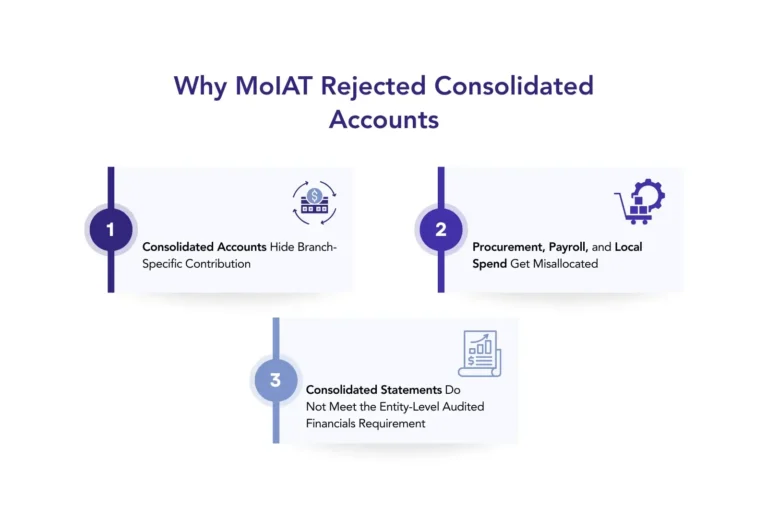
Why MoIAT Rejected Consolidated Accounts

MoIAT’s shift to branch-level reporting is more than procedural—it reflects a deliberate effort to make ICV certificates in the UAE assessments more accurate. Examiners found that consolidated or parent-level accounts obscure the real economic contribution of individual branches. As a result, these combined accounts are no longer a reliable basis for entity-level ICV certification in the UAE.

Consolidated Accounts Hide Branch-Specific Contribution

When financials are consolidated, the results of multiple branches are pooled together. This makes it impossible to isolate payroll, procurement, or local spend for a single branch. The MOIAT branch audit rule requires that each branch’s economic activity be transparent. Using consolidated numbers undermines the principle of “one entity, one audit,” which is fundamental to obtaining branch-level audited financial statements in the UAE.

Procurement, Payroll, and Local Spend Get Misallocated

In many groups, payroll, procurement, and local expenditure are allocated at a central or corporate level. These allocations are often not directly traceable to individual branches. 


MoIAT requires verifiable evidence of local spend and Emirati headcount to ensure accurate ICV calculations. When costs are estimated or distributed from consolidated accounts, this can lead to rejection of the consolidated ICV accounts, as the branch’s true contribution is no longer clear.

Consolidated Statements Do Not Meet the Entity-Level Audited Financials Requirement

Under the MOIAT branch audit rule, only stand-alone, audited financial statements prepared for each branch satisfy compliance. Consolidated statements or bifurcated group-level accounts do not qualify. 


Without proper branch-level audited financial statements in the UAE, companies risk rejection during the certification process and cannot secure a valid entity-level ICV certification in the UAE.

Effective Date & Enforcement

The MOIAT branch audit rule has been fully applicable since 1 January 2025. Any ICV certificate issued in the UAE for a financial year ending after 31 December 2025 must comply with the new branch-level reporting requirements.


There is no transitional period for compliance. Companies are required to submit branch-level audited financial statements in the UAE for each entity. The only limited exception applies to entities that are in the final stages of an ongoing audit when the rule took effect; even in these cases, verifiers may request detailed schedules to demonstrate adherence to entity-level ICV certification in the UAE standards.


Non-compliance carries significant consequences. Applications that do not meet the branch-level financial reporting requirements may be rejected, resulting in ICV consolidated accounts rejection and the inability to secure a valid entity-level ICV certification in the UAE.

Entities Affected

The 2026 MOIAT branch audit rule applies to a wide range of companies with multi-branch operations in the UAE. Specifically, it impacts:

  • Multi-branch mainland companies – each branch must submit its own branch-level audited financial statements in the UAE.

  • Multi-emirate branches under the same ownership – branches across different Emirates require separate submissions for entity-level ICV certification in the UAE.

  • Groups previously submitting consolidated ICV certificates – reliance on consolidated reporting will trigger ICV consolidated accounts.

  • Free zone companies with mainland branches – branches operating on different licences must provide branch-specific audited financials.

  • Companies using bifurcated management accounts – only complete, independently audited branch-level accounts are now accepted.

Understanding whether your company falls into one of these categories is critical for planning compliance and avoiding delays in obtaining a valid ICV certificate in the UAE.

Process Flow: How Branch Audit ICV Works in 2026

Transitioning to branch-level reporting under the MOIAT branch audit rule may seem complex, but the process follows a clear, step-by-step approach. Understanding each stage is crucial to ensure compliance and avoid errors during the ICV branch audit.

Identify Branch Structure & Legal Entities

Map your company’s branches to determine which are separate legal entities and which can be grouped under a shared licence. Proper classification ensures accurate branch-level audited financial statements in the UAE and supports entity-level ICV certification in the UAE.

Prepare Entity-Level Audited Financial Statements

Each branch must submit independently audited, IFRS-compliant financials. Consolidated or parent-level accounts are no longer accepted to help prevent ICV consolidated account rejections.

Allocate Payroll, Procurement, Capex, and Assets

Assign payroll, procurement, capital expenditure, and assets accurately to each branch. Correct allocation ensures that each branch’s contribution is reflected correctly in its ICV certificate in the UAE.

Perform Reconciliations & Prepare Mapping Files

Reconcile all branch-level financials and create mapping files linking them to the ICV calculation template. This documentation is essential to demonstrate compliance during verification.

Submit to the ICV Certifying Body

Send each branch’s audited financial statements and supporting mapping files to the certifying authority. Auditors evaluate each entity individually to ensure adherence to the MOIAT branch audit rule.

Receive Separate ICV Certificates per Entity

Once verified, compliant branches receive individual ICV certificates in the UAE. Multi-branch companies may obtain multiple certificates—one for each branch or legal entity that meets all requirements.

Detailed Breakdown: What MOIAT Expects in a Branch Audit

A successful ICV branch audit depends on meeting MoIAT’s expectations for branch-level reporting. Companies must provide accurate, detailed, and independently audited financials that reflect each branch’s true operations.

Branch-Level Financial Statements

Every branch must prepare standalone IFRS-compliant financial statements. Consolidated or group-level accounts are no longer accepted, as they can lead to ICV consolidated accounts rejection.

  • Statements should clearly segment revenue and costs, showing which income and expenses belong to the specific branch.

  • Each branch must have its own Profit & Loss (P&L) statement and balance sheet. This ensures MoIAT can evaluate the branch independently and assign a fair score for entity-level ICV certification in the UAE.

Payroll Allocation Rules

Payroll forms a core part of the ICV calculation, and MoIAT requires precise allocation to reflect the branch’s real economic contribution.

Branch-Specific Employee Allocation

  • Report only the payroll expenses for employees physically or legally assigned to that branch, including both local and expatriate staff contributing directly to operations.

  • Using central or group payroll across multiple branches is not acceptable and may trigger ICV consolidated accounts rejection.

Allocation Rules for Multi-Location Employees

  • Employees who split time across multiple branches must have their salaries allocated proportionally based on the time spent at each branch.

  • Transparent, documented allocation methods are expected to ensure that the branch-level audited financial statements in the UAE accurately reflect activity for the ICV calculation.

Documentation Required for Justification

Supporting documents must be prepared and reconciled with the branch’s financial statements to demonstrate compliance and qualify for entity-level ICV certification in the UAE. These include:

  • HR records showing employee assignments per branch

  • Payroll reports aligned with branch-level allocations.

  • Internal schedules for allocating multi-location employees

Accurate and well-documented financials, combined with proper payroll allocation, are critical for a smooth audit process and maintaining eligibility for a valid ICV certificate in the UAE.

Procurement, Vendor Localisation, and Asset Allocation

Accurate allocation of procurement and assets is essential for calculating each branch’s ICV score. The MOIAT branch audit rule requires that all branch-level spending and assets be clearly documented, traceable, and auditable.

Branch-Specific Procurement Mapping

Every branch must maintain records of its own purchases, including raw materials, goods, and services directly consumed. Consolidated or parent-level procurement reports are not acceptable for the ICV branch audit.

Shared Vendor Allocation Keys

When vendors serve multiple branches, costs must be allocated proportionally based on predefined keys, such as volume, revenue share, or contract value. Allocation methods must be transparent, auditable, and justifiable during verification to ensure accurate entity-level ICV certification in the UAE.

Local vs. Imported Spend Per Branch

Branches should clearly differentiate between local and imported spend. Local procurement directly contributes to the branch’s ICV score, whereas imported purchases do not. Transparent, branch-specific segregation prevents overstating local contribution and avoids ICV consolidated accounts rejection.

Capital Expenditure & Asset Allocation

Capital expenditure and asset assignment are critical for determining a branch’s ICV score. All assets must be accurately attributed to the branch that owns or primarily uses them.

  • Asset Tagging by Branch: Every fixed asset should be tagged or recorded for the branch it belongs to. This ensures the balance sheet reflects the branch’s tangible assets and supports branch-level audited financial statements in the UAE.

  • Depreciation per Branch: Depreciation must be calculated and recorded separately for each branch. Shared depreciation is acceptable only when supported by a precise usage allocation method.

  • Handling Shared Machinery & Equipment: Assets used by multiple branches must have costs proportionally allocated based on usage, production volume, or operational hours. The method must be auditable to verify that assets are correctly assigned to each branch.

Meticulous procurement tracking, vendor allocation, and capex management are vital for compliance with the MOIAT branch audit rule and securing a valid ICV certificate in the UAE for each branch.

Impact on ICV Score

The move to branch-level audits significantly affects how ICV scores are calculated and reported. Companies seeking entity-level ICV certification in the UAE must understand these implications to ensure accurate scoring and tender competitiveness.

Branch-Level Scores Can Differ from Consolidated Scores

Scoring each branch individually often produces results that differ from previous consolidated figures. Some branches may show higher local contributions, while others may appear lower, affecting overall group perception. This granular approach ensures that the ICV certificate in the UAE reflects actual economic activity at the branch level.

Why Scores May Drop Initially

Branches previously reported under consolidated accounts may see an initial decline in their ICV score. This is not an error; instead, it provides a more precise representation of local procurement, payroll, and capital expenditure per branch. Proper branch-level allocation aligns with the MOIAT branch audit rule and helps prevent rejection of consolidated ICV accounts.

Opportunities to Optimize Scores Through Branch Restructuring

Companies can enhance ICV outcomes by reviewing branch structures and refining allocation methods. Accurate distribution of payroll, procurement, and assets can increase branch-level contribution, ultimately improving the overall group performance and strengthening the entity-level ICV certification in the UAE.

Tender Competitiveness Based on Branch-Level Scores

Many UAE government and semi-government tenders now require valid branch-level audited financial statements in the UAE. A branch-level score that clearly reflects local economic contribution is critical for tender eligibility. Misaligned or inaccurate branch reporting can reduce the chances of winning contracts, delaying projects, and impacting growth opportunities.

Risk Areas & Common Failures

Many companies face challenges during a MOIAT branch audit rule assessment because even minor errors can have significant consequences. Recognizing common risk areas helps prevent score reductions or potential ICV certificate in the UAE.

Financial Allocation Risks

Misallocating operational and capital expenditures remains a key pitfall. Every expense must be assigned correctly to its respective branch to reflect actual usage and economic contribution. Allocation errors can distort branch-level scores and increase the risk of ICV consolidated accounts rejection.


Shared services—such as HR, IT, or central management functions—require careful proportional allocation. Incorrect distribution can overstate or understate a branch’s local contribution, creating compliance issues and reducing competitiveness for tenders requiring entity-level ICV certification in the UAE.

Operational Mapping Risks

Accurate operational mapping is essential. Each branch must properly map employees and vendors to the correct location. Missing or incomplete mapping can lead to errors in branch-level reporting, directly affecting the ICV score.


Misclassifying local versus imported spend can also misrepresent a branch’s economic contribution. Payroll, procurement, and capital expenditures must be clearly assigned to the branch that incurred the expense to ensure compliance with the MOIAT branch audit rule and maintain eligibility for branch-level audited financial statements in the UAE.

Documentation & Compliance Risks

Poor documentation is a frequent cause of challenges in branch audits. MoIAT requires full supporting schedules for payroll, procurement, capital expenditures, and asset allocations. Missing or incomplete documentation can delay verification or trigger ICV consolidated accounts rejection.


Reconciliations must link branch-level allocations to the financial statements. Discrepancies here can reduce a branch’s ICV score or result in certification denial. Additionally, all financial statements must comply with IFRS standards. Non-compliance may invalidate the branch’s audited results and prevent issuance of a valid entity-level ICV certification in the UAE.

Audit Readiness Risks

Even with correct allocations and complete documentation, weak internal controls can create issues. Branch-level processes for payroll, procurement, and capital expenditures must be structured to demonstrate compliance during the audit.


Maintaining accurate, up-to-date bookkeeping is equally crucial. Errors such as inaccurate ledgers, missing journals, or inconsistent records can delay verification or impact a branch’s ICV score. Strong internal controls and meticulous record-keeping are vital to secure entity-level ICV certification in the UAE.

Documentation Checklist for Branch Audit ICV 2025

Having the correct documentation ready is crucial for a smooth MOIAT branch audit rule assessment. Proper records not only demonstrate compliance but also make it easier for auditors to verify each branch’s true contribution toward entity-level ICV certification in the UAE.


Every branch should maintain the following:

  • Branch-Level Audited Financial Statements UAE
    Independently audited financial statements for each branch, prepared separately and in compliance with IFRS standards. These form the foundation of branch-level reporting and ensure accurate scoring.

  • Branch-Specific Employee Lists
    Detailed payroll records, employee assignments, and Emirati headcount per branch. These documents validate workforce contribution and support the ICV certificate in the UAE applications.

  • Procurement and Vendor Records
    Branch-specific procurement records clearly distinguish local purchases from imported goods. Accurate tracking is essential for proper ICV scoring and for avoiding rejection of consolidated ICV accounts.

  • Fixed Asset Registers
    Registers showing asset tagging, depreciation, and allocation of shared equipment across branches. This ensures tangible assets are correctly represented in branch-level accounts.

  • Inter-Branch Allocation Schedules
    Schedules for shared costs, services, or revenue. These demonstrate fair distribution of shared resources and support transparency during audit.

  • Reconciliation Files
    Files linking all branch-level allocations back to the audited financial statements. Proper reconciliation ensures clarity, reduces audit queries, and strengthens compliance.

Pro Tip: Organizing these documents ahead of the audit can save significant time, prevent errors, and ensure a smoother process toward securing entity-level ICV certification in the UAE.

How to Prepare if You’re Still Using Consolidated Accounts

Switching from consolidated accounts to branch-level reporting can seem challenging, but a step-by-step approach makes it manageable and ensures compliance with the MOIAT branch audit rule.

  1. Set Up Branch-Level Accounting
    Each branch should have its own ledger, chart of accounts, and reporting codes. This allows accurate tracking of revenues, costs, and assets for branch-level audited financial statements in the UAE.

  2. Restate Past Financials if Needed
    If previous reports were consolidated, break them down by branch for prior periods. This creates a clear historical record and aligns with requirements for entity-level ICV certification in the UAE.

  3. Update ERP or Accounting Systems
    Tag all transactions, payroll, procurement, and assets to the correct branch. Proper tagging prevents errors and reduces manual adjustments during the MOIAT branch audit rule process.

  4. Define Allocation Methods for Shared Resources
    For employees, services, or equipment used across multiple branches, establish clear allocation rules. Accurate allocations ensure each branch’s ICV score is calculated correctly and prevent rejection of consolidated ICV accounts.

  5. Strengthen Internal Controls
    Implement robust workflows for payroll, procurement, and asset management at the branch level. Strong internal controls reduce mistakes, streamline audits, and protect your branch’s eligibility for entity-level ICV certification in the UAE.

Industry-Specific Considerations

Each industry feels the impact of the MOIAT branch audit rule differently. Understanding these nuances helps companies adjust their reporting and stay fully compliant for entity-level ICV certification in the UAE.

Trading Companies

Trading firms need strict control over inventory tracking. Stock must be linked to the correct branch, and vendor records should clearly indicate where purchases were made. This ensures accurate local spend reporting for each branch and supports a valid ICV certificate in the UAE.

Construction & Contracting

Project-related costs are the main challenge for construction and contracting businesses. Every site expense — including labour, materials, subcontractors, and equipment — must be allocated to the branch managing the project. Proper allocation ensures branch-level contribution is accurately captured in branch-level audited financial statements in the UAE.

Manufacturing

Manufacturers should link production cost centres to the appropriate branch. Revenue, material costs, and overheads must be correctly assigned to ensure the branch’s economic activity is properly reflected for entity-level ICV certification in the UAE.

Service Companies

Service providers must allocate shared staff time and consultancy hours across branches. Accurate documentation and time-tracking are crucial to ensure each branch’s actual economic contribution is recorded, preventing rejection of ICV consolidated accounts and ensuring compliance with the MOIAT branch audit rule.

Consequences of Non-Compliance (2025)

Failing to comply with the MOIAT branch audit rule carries significant business implications. Understanding these risks helps companies prioritize proper branch-level reporting and avoid costly setbacks.

ICV Certificate UAE Rejection

Branches that do not meet MoIAT’s reporting or allocation standards risk denial of entity-level ICV certification in the UAE. Without a valid certification, the branch cannot participate in ICV-related programs, limiting its ability to demonstrate verified local contribution.

ICV Score Drops to Zero

Non-compliant branches may be assigned an ICV score of zero. This reflects a complete lack of verified branch-level contribution and can negatively affect the overall evaluation of the parent company or group.

Tender Disqualification Risk

An increasing number of UAE government and semi-government tenders now require valid, branch-level audited financial statements in the UAE. If a branch lacks proper certification or if its submission is rejected due to the rejection of consolidated ICV accounts, the company may be immediately disqualified from bidding, risking the loss of projects and revenue.

Re-Audit and Delays

MoIAT may mandate a full re-audit for non-compliant branches. This can delay issuance of an ICV certificate in the UAE, disrupt tender submissions, or affect strategic planning timelines.

Conclusion

From 2025 onward, consolidated accounts are off the table. The MOIAT branch audit rule requires branch-level audited financial statements in the UAE, with each branch reporting independently. Every entity must stand on its own to secure entity-level ICV certification in the UAE.


Companies that act early protect themselves from ICV certification requirements in the UAE, avoid score reductions, and avoid missed tender opportunities.


While the shift may feel demanding, strong branch-level structures offer clear advantages: better visibility, cleaner reporting, higher credibility, and a stronger position in the UAE’s ICV-driven procurement landscape.


Proactive preparation ensures compliance, safeguards ICV scores, and strengthens your competitive edge.

How ADEPTS Helps

The MOIAT branch audit rule has transformed how companies prepare for the ICV branch audit 2025, and many are still adjusting. ADEPTS simplifies the process, helping you produce clean, compliant, and audit-ready branch-level audited financial statements in the UAE.


We guide you from the ground up, ensuring each branch meets the UAE ICV audit requirements and qualifies for entity-level ICV certification in the UAE. Our approach reduces the risk of errors and avoids rejection of ICV consolidated accounts.


ADEPTS also handles procurement and payroll localisation, mapping every vendor, employee, and shared resource to the correct branch so that your economic contribution is accurately reflected.


Finally, we manage scoring, documentation, and submission end-to-end, helping you efficiently and on time secure a valid ICV certificate in the UAE.

FAQs:

The shift toward branch-level auditing reflects MOIAT’s intention to capture financial performance and localisation impact at a more granular level. Consolidated accounts tend to blur the economic footprint of each branch, especially when procurement, payroll, and assets are pooled. By isolating each branch’s activity, the ICV score becomes a more accurate reflection of where value is created, allowing the government to evaluate localisation outcomes Emirate by Emirate.

Branches within the same Emirate often fall under one licence, but they may still carry separate activities, cost centres, or operational setups. MOIAT’s intent is not only legal structure but also operational transparency. If the branches function distinctly — with their own revenues, procurement patterns, or staffing — auditors are generally expected to treat them individually. However, where activities and books are genuinely unified, auditors may still consider a combined review, provided disclosures support that structure.

Shared-services setups can continue, but reliable branch-level allocation mechanisms must support them. The new rule doesn’t prohibit centralised accounting; it simply requires that each transaction can be traced to the originating branch. Companies relying on shared ledgers may need to enhance cost allocation, tagging, and internal reporting controls so the auditor can extract branch-specific performance without relying on assumptions alone.

The absence of revenue does not prevent branch evaluation. MOIAT views localisation through multiple dimensions — payroll, Emiratisation, operating expenses, assets, and supplier spend. A branch with zero revenue can still demonstrate localisation contribution. The key requirement is that audited financials present a true picture of that branch’s activity, even if minimal.

In such cases, certification teams generally look for evidence that the company made reasonable attempts to comply. Where historical data isn’t split by branch, auditors may request internal allocations backed by logic, documentation, or ERP extracts. MOIAT tends to be cautious about accepting reconstructed data, so companies may face delays or partial scoring. Preparing proper branch-level books early significantly reduces these risks.

There is no specific mandate to upgrade to a new ERP, but whatever system is used must allow auditors to extract branch-level transactions without relying on guesswork. This can be done through tagging, cost centres, or structured spreadsheets. The emphasis is on traceability rather than technology, so even smaller systems can comply if properly configured.

Auditors generally expect staff costs to be allocated based on the economic reality of their work patterns. Time sheets, project logs, or HR deployment plans can support fair allocation. The goal is to avoid double-counting and to ensure that each branch shows only the payroll cost genuinely associated with its operations. Consistency across months is more important than mathematical perfection.

Branches treated purely as cost centers often show higher expenses and little to no revenue, which can distort certain ratios. Under the 2025 framework, auditors may focus more on localisation inputs—payroll, assets, supplier spend—rather than revenue-driven metrics. While some score categories may shift, branches can still achieve competitive ICV results if localisation efforts are well-documented.

Merging branches across Emirates tends to conflict with MOIAT’s objective of Emirate-level economic visibility. Even if activities match, the geographical footprint is considered significant. Auditors may hesitate to combine branches unless MOIAT provides explicit justification. In practice, companies are advised to maintain separate reviews when branches operate in different jurisdictions.

Shared suppliers continue to be acceptable, but the company must show how the spend was consumed by each branch. Allocation can be based on usage, volume, project size, or other logical drivers. The auditor’s role is to ensure the methodology is reasonable and consistently applied. Clear documentation from procurement teams helps avoid disputes during certification.

During transition periods, some flexibility may exist, especially for companies that historically used consolidated books. However, MOIAT generally prefers branch-specific audit trails. A hybrid model may be acceptable if the supporting schedules are detailed, well-substantiated, and reviewed by the auditor. Transition allowances, if any, will likely reduce over time as the 2025 requirement becomes standard practice.

Auditors are expected to outline the methodology used to isolate each branch’s financials. This may include allocation principles, inter-branch eliminations, shared cost distribution, and verification procedures applied to branch sub-ledgers. Enhanced disclosures ensure that MOIAT can trace how the auditor arrived at branch-level results, especially when centralised systems or shared services are involved.

References

Related Articles​​

FTA Highlights Mandatory Conformity Certificates Under New Tiered Excise Tax on Sweetened Drinks (Effective 1 January 2026)

The Federal Tax Authority made a key announcement on 29 December 2025. Released at year-end, the update outlines significant changes to the excise tax framework for sweetened drinks and sets the compliance direction for 2026.


The most notable change is the introduction of a Tiered Volumetric Model for excise tax. This model replaces the previous fixed-rate calculation method for sweetened drinks.


Under the new approach, excise tax will be linked to sugar content. Drinks with higher sugar levels will attract higher tax, while those with lower sugar content will be taxed at reduced rates.


The model applies to all sweetened beverages sold in the UAE. Defined sugar thresholds bring greater predictability to tax calculations and place increased focus on product composition rather than volume alone.


This new model applies to all sweetened beverages sold in the UAE. 


Clear sugar thresholds make the tax predictable. At the same time, it nudges manufacturers to review and, if needed, adjust their formulas. 


The change signals a broader shift; tax policy is now tied to product composition, not just volume.

Key Amendments

The Federal Tax Authority has confirmed that the changes are official. 


Cabinet Decision No. 197 of 2025 provides the legal basis, setting out updated rules for excise goods, including applicable tax rates and calculation methods. The decision replaces earlier regulations and aligns with amendments to Federal Decree-Law No. 7 of 2025 on Excise Tax.


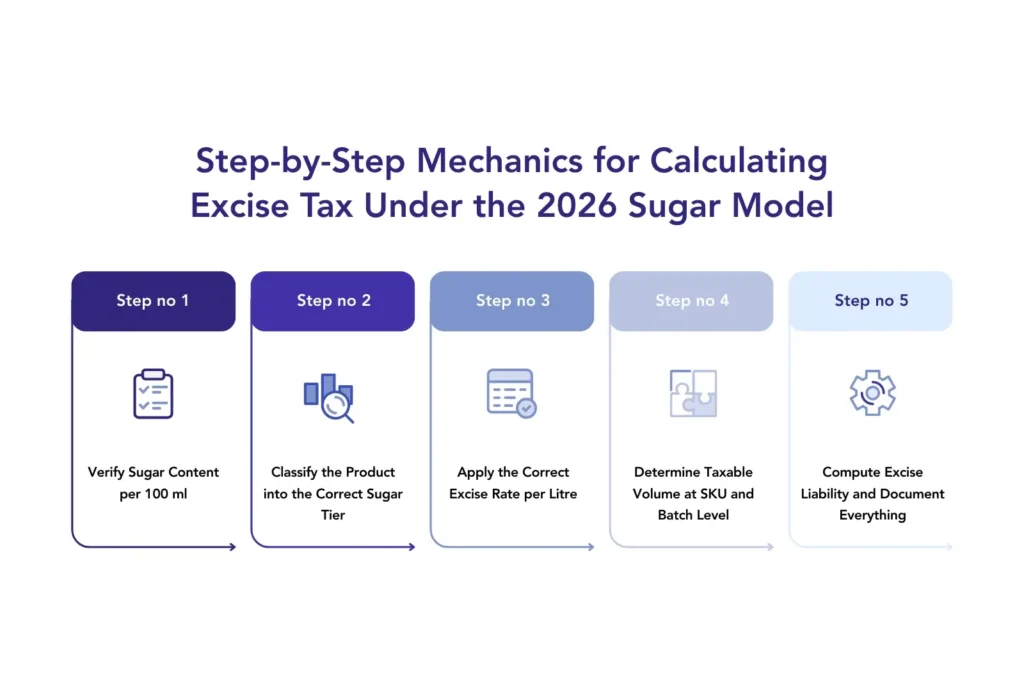
Under this framework, excise tax on sweetened drinks will be calculated using the tiered volumetric model. The tax rate per litre will reflect the sugar and other sweetener content per 100 ml. The flat-rate system is no longer applicable.


From 2026 onwards, producers, importers, and stockpilers are required to obtain and submit conformity certificates when registering or updating product details through EmaraTax. Products without approved certificates will be classified by default as high-sugar sweetened drinks.

Mandatory Emirates Conformity Certificate

Producers, importers, and stockpilers of sweetened drinks are required to obtain an Emirates Conformity Certificate. The certificate is issued following testing by UAE-accredited laboratories to confirm sugar and sweetener content.


Certificates must be submitted through the EmaraTax portal. Where a certificate is not submitted, the product will be treated as a high-sugar sweetened drink and subject to the highest excise tax rate.


This requirement supports accurate tax calculation and reinforces transparency around product composition. It also provides the regulatory basis for enforcing the new Tiered Volumetric Model.

Excise Tax Categories for Sweetened Drinks

  • High-sugar sweetened drinks: Products with the highest sugar content, subject to the highest excise tax rate.

  • Moderate-sugar sweetened drinks: Products with moderate sugar levels, taxed at a reduced rate compared to the high-sugar tier.

  • Low-sugar sweetened drinks: Products with minimal sugar content, subject to the lowest excise tax rate.

  • Artificially sweetened drinks: Drinks containing only artificial sweeteners, or artificial sweeteners with less than 5g of sugar or other sweeteners per 100 ml, are subject to excise tax at zero dirhams per litre.

These categories provide a clear framework for product classification and tax application, while encouraging lower sugar formulations.

Impact on Specific Beverage Types

Carbonated drinks will be taxed based on their actual sugar content rather than their category. Accurate measurement and reporting of sugar levels will therefore be required.


Energy drinks remain subject to excise tax at 100% of the excise price and are excluded from the tiered volumetric model.


For concentrates, syrups, and powdered drinks, additional disclosures apply. Businesses must provide serving size information and dilution instructions so that sugar content reflects the product as consumed.

Compliance Requirements Under the Tiered Excise Tax

Businesses involved in the production, import, or stockpiling of sweetened drinks will need to assess product formulations and sugar classifications under the tiered model.


Accurate product classification is essential, as errors may result in higher tax exposure or incorrect treatment under the excise framework.


Conformity certificate testing must be completed through UAE-accredited laboratories, with validated results and supporting documentation submitted through EmaraTax.


Product registrations on EmaraTax will also need to reflect the new requirements to ensure alignment with the updated excise rules.

Conclusion

The introduction of the Tiered Volumetric Model marks a structural change in how excise tax on sweetened drinks is calculated in the UAE.


Compliance will depend on accurate product classification, valid conformity certification, and correct registration through EmaraTax.


With the new rules businesses must ensure their products and documentation align with the updated excise framework.

References

Related Articles​​

M&A in 2026: Detecting “Sleeping” Tax Liabilities in UAE Target Companies

As mergers and acquisitions evolve in the UAE, the rules of the game are changing, and understanding tax risk has never been more critical.


Mergers and acquisitions in the UAE have entered a new phase. In 2026, deals are no longer judged only by growth potential or market access. They are judged by how well buyers identify risk before it becomes real. Tax authorities are no longer taking a hands-off approach. Reviews are deeper, broader, and often triggered after a transaction is completed.


This change has pushed tax risk into the centre of deal value. What once felt like a routine compliance exercise now affects pricing and long-term returns. In many mergers and acquisitions, acquiring a UAE company’s tax risks can materially change how a deal performs after closing, even when the financials look clean.


This is where “sleeping tax liabilities” come into play. In a UAE mergers and acquisitions context, these are past tax exposures that stayed hidden simply because they were never tested. Old VAT treatments, early corporate tax positions, or ignored excise issues may not have caused problems before. A transaction is often what brings them to the surface.


This is why Hidden VAT liabilities M&A issues are so common in mergers and acquisitions. VAT errors rarely show up in financial audits. Incorrect classifications, missed reverse-charge obligations, or incomplete filings can sit unnoticed for years. Once ownership changes, scrutiny follows.


Corporate tax and excise risks behave similarly. As enforcement tightens and clarity improves, especially under the amendments to the UAE Tax Procedures Law 2026, historic positions are being reviewed more closely. What once seemed acceptable can quickly become costly.


For buyers, this creates a clear challenge. A clean audit no longer guarantees a clean deal. It does not protect projected returns or provide comfort on tax exposure. This is why a practical Tax due diligence checklist UAE 2026 is now essential for any serious mergers and acquisitions strategy.


As a result, buyers are increasingly relying on M&A advisory professionals in the UAE who understand how tax risk unfolds after completion. Strong Corporate tax advisory services and experienced M&A deal structuring experts have become critical to protecting value in mergers and acquisitions.


In 2026, tax risk in mergers and acquisitions does not announce itself; it waits, silently, until the deal triggers scrutiny. 


The next step is understanding exactly where these hidden liabilities live and how to uncover them before it’s too late.

Why ‘Sleeping’ Tax Liabilities Are a Bigger Problem in 2026

Tax risks that once slept quietly can now wake up and hit a deal hard.


In 2026, mergers and acquisitions in the UAE are taking place amid a new enforcement landscape. Buyers can no longer rely solely on clean audits. Historic mistakes, minor oversights, and even past behaviours are under scrutiny.

The UAE’s New Tax Enforcement Architecture (2025–2026)

The UAE has reshaped how it enforces tax. VAT, Corporate Tax, and Excise are now part of a single, unified framework. That means old positions that were once ignored can suddenly become material liabilities. For anyone involved in a deal, this makes understanding Acquiring UAE company tax risks more important than ever.


Key parts of this reform package include:

  • Federal Decree-Law No. 17 of 2025 (Tax Procedures Law): Gives authorities stronger powers to review past filings, demand documents, and enforce penalties. This makes a robust Tax due diligence checklist UAE 2026 essential for any serious buyer.

  • Federal Decree-Law No. 16 of 2025 (VAT Law amendments): Expands VAT obligations, including historical transactions. Hidden VAT liabilities M&A can now surface even years later.

  • Cabinet Decision No. 129 of 2025 (Administrative penalties): Introduces stiffer penalties for errors, late filings, and misreporting—turning minor oversights into costly surprises.

The significant change is that VAT, Corporate Tax, and Excise are no longer treated separately. Everything is connected, which means buyers must look at risk holistically. Past assumptions that one type of tax was safe no longer hold.


The Federal Tax Authority (FTA) now focuses on historic positions, documentation quality, and behavioural compliance. Even if numbers on paper were correct, gaps in records or inconsistent practices can trigger scrutiny. 


In this world, working with M&A advisory in the UAE and expert Corporate tax advisory services isn’t just helpful, it’s critical for deal certainty.

Limitation Periods That Buyers Can No Longer Ignore

Understanding enforcement is one thing, but knowing how far back it reaches is another. In 2026, buyers in the UAE mergers and acquisitions can’t afford to assume that tax risks are limited to the last few years. Historical exposure now plays a direct role in deal certainty and value.

How Far Back Can Authorities Go?

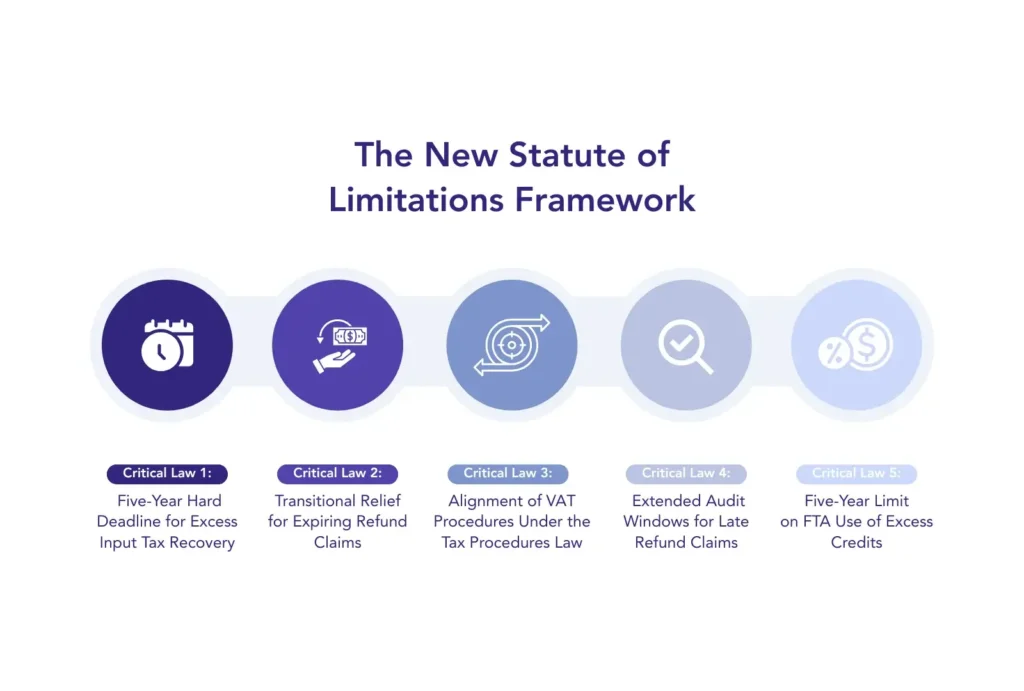
The standard 5-year audit and refund limitation period still applies for routine reviews. But the game has changed for serious non-compliance. In cases of tax evasion or significant errors, authorities can reach back up to 15 years. That’s a long tail of potential liabilities that can unexpectedly surface during or after a transaction.


This extended reach affects more than just tax reporting; it hits the deal directly. Limitation periods now influence:

  • Valuation models: Unassessed or hidden liabilities can reduce a target’s net asset value, making pricing assumptions unreliable.

  • Escrow sizing: A more extended exposure period may require larger reserves to protect buyers against unforeseen claims.

  • Completion risk: Transactions can stall or even fall through if historic issues trigger last-minute scrutiny or negotiations.

For any serious buyer, these realities make a targeted Tax due diligence checklist for UAE 2026 essential. It’s no longer enough to rely solely on audited financials. Acquiring UAE company tax risks now means understanding exactly how far back authorities can go and what can suddenly become payable.

The ‘Refund Trap’: How the 5-Year Statute of Limitations Really Works

Limitation periods set the boundaries of risk, but clever accounting moves can quietly extend them. For buyers in the UAE mergers and acquisitions, understanding how the standard 5-year rule interacts with refunds is critical. Otherwise, what feels like a closed period can suddenly reopen, creating unexpected liabilities.

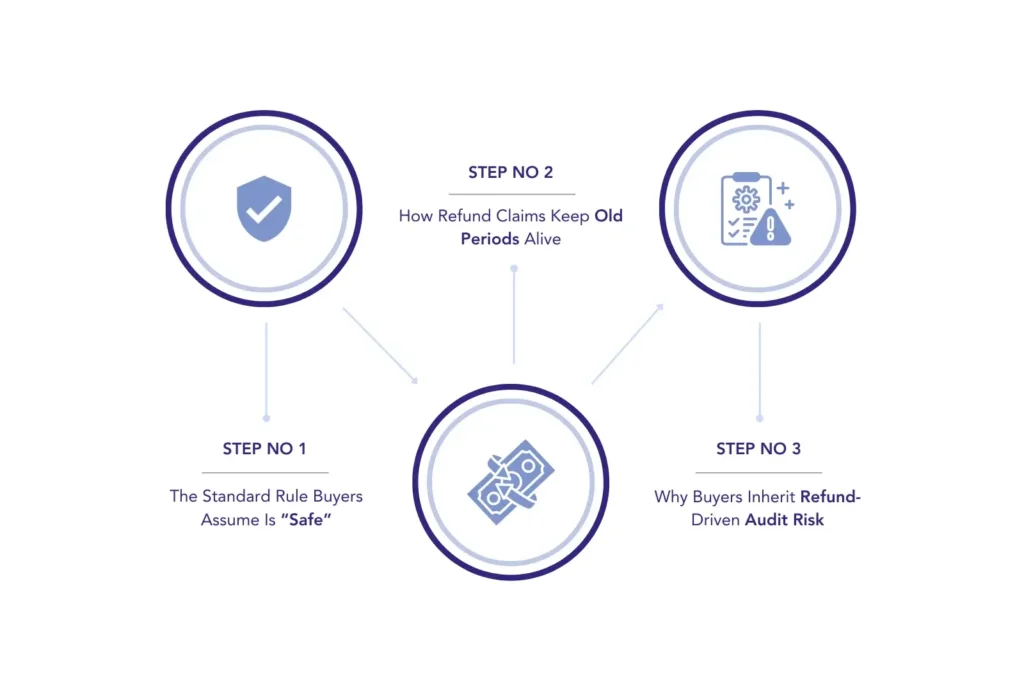
The Standard Rule Buyers Assume Is “Safe”

Under the Tax Procedures Law, routine audits and refund claims are generally limited to the last 5 years. Many buyers assume this means older VAT periods are effectively off-limits.


This assumption is risky. 


In reality, historical VAT positions can remain vulnerable if past filings were incorrect or incomplete, or if refunds are claimed late. Even when the target company appears clean, past reporting gaps can expose hidden VAT liabilities in M&A deals that were never considered.

How Refund Claims Keep Old Periods Alive

Refund claims can extend exposure far beyond what buyers expect. Filing a VAT refund, even within the standard 5-year window, can reopen historic audit exposure. 


This is often called the “fifth-year refund” problem. 


For example, a refund claimed in year five can extend the audit window by up to two additional years, dragging older periods back under scrutiny.


The transitional 2026 risk adds another layer. Companies claiming legacy VAT credits from 2018–2021 before their expiry often trigger audits that go further back than anticipated. Authorities use these refund claims as a reason to review supporting documentation and past behaviour, exposing risks that were previously assumed to be long closed.


For anyone evaluating acquiring a UAE company, tax risks highlight why relying on a clean financial audit is no longer enough. 


A detailed tax due diligence checklist for the UAE 2026 can reveal areas where refund claims might extend liability and help structure M&A advisory in UAE strategies to protect value.


Experienced Corporate tax advisory services and M&A deal structuring experts can guide buyers through these nuances, ensuring historic exposures are identified, assessed, and mitigated before a deal closes.

Why Buyers Inherit Refund-Driven Audit Risk

Understanding refund-driven exposure is critical because it doesn’t disappear at closing. Even after ownership changes hands, historic VAT issues can follow the company into the buyer’s hands, creating real financial risk in mergers and acquisitions.


Refund audits frequently continue after share transfers because the FTA focuses on the entity, not the former shareholders. This means that even if the seller handled filings, or claimed refunds, whether correctly or incorrectly, the buyer can become liable for gaps, mistakes, or audits triggered by prior claims. 


Simply put, buying a clean balance sheet doesn’t guarantee a clean deal.


The impact on deals can be significant. Refund-driven audits can delay completion while additional information is gathered. Escrow accounts may need to be increased to cover potential liabilities. And post-closing tax shocks can erode projected returns, especially if hidden VAT liabilities from M&A were not identified during due diligence.


For buyers, this underscores the importance of a thorough tax due diligence checklist for the UAE 2026. Partnering with experienced M&A advisory teams in the UAE and Corporate tax advisory services helps anticipate refund-driven risks, properly size escrows, and structure deals so that historic liabilities do not catch the buyer off guard.

Successor Liability: Why You Buy the Seller’s Mistakes

In 2026, buying a UAE company often means buying its history, both good and bad. Even if the financials look perfect, historic tax exposures can transfer automatically, turning old mistakes into new liabilities for the buyer.


Understanding successor liability is crucial to protecting value in mergers and acquisitions.

Share Deals vs Asset Deals in the UAE

Most acquisitions in the UAE are structured as share deals. This isn’t just a preference; it has practical consequences. When you acquire the shares, you also acquire the company’s TRN and its full tax history. This means any prior missteps, missing documentation, or unclaimed obligations now sit squarely on the buyer’s shoulders.


Even with a careful Tax due diligence checklist, UAE 2026 work, and share deals require deep scrutiny of historic filings. Hidden VAT liabilities M&A can follow the entity seamlessly, turning what seemed like a routine acquisition into a potential minefield if past errors are uncovered.

Why the FTA Does Not Care About Your SPA?

UAE tax law treats the entity itself as the continuing taxpayer. The Federal Tax Authority does not accept indemnities, warranties, or caps in a share purchase agreement (SPA) as protection. That means aggressive refund claims, misapplied VAT, or other historic issues are enforceable against the buyer, regardless of contractual protections.


This makes acquiring a UAE company tax risks a tangible deal factor. Clawback risk is real, especially for VAT refunds claimed by prior owners. Even post-closing negotiations cannot undo exposure once the authority initiates an audit.

When Exposure Extends to 15 Years

Certain situations push exposure far beyond the standard 5-year limitation period. Serious non-compliance, evasion, or intentional misreporting can extend liability to 15 years. Documentation gaps, behavioural indicators, and intent tests all feed into this calculation.


Legacy practices from the early VAT years (2018–2019) still matter in 2026. Buyers cannot assume historic positions are safe just because audits didn’t happen in the past. Robust M&A advisory in the UAE and expert Corporate tax advisory services are essential to identify and mitigate these long-tail risks before signing.

Identifying Red Flags Beyond the Balance Sheet

Financial statements tell part of the story, but they rarely reveal the complete picture of historic tax risk. 


In 2026, buyers in UAE mergers and acquisitions must dig deeper to uncover hidden exposures that could threaten valuation, completion, or post-closing certainty. Spotting red flags beyond the balance sheet is now critical.

VAT and Refund Risk Indicators

Large VAT credit balances visible on the FTA portal are often the first sign that a target may carry Hidden VAT liabilities M&A risk. Weak or incomplete support for historic refund claims, misclassification of zero-rated, exempt, and out-of-scope supplies, or input tax recovery linked to suppliers later found non-compliant are all red flags.


Buyers should also watch for exposures under “knew or should have known” anti-evasion tests. Even if filings were technically correct, inconsistent practices or missing documentation can trigger scrutiny. A detailed Tax due diligence checklist for the UAE 2026 helps flag these risks early, allowing buyers to structure protections or negotiate appropriate warranties.

Reverse Charge Mechanism (RCM) Gaps

The removal of self-invoicing from 2026 does not reduce exposure. Missing RCM documentation for imports and cross-border services (2022–2025) can still result in penalties, even when VAT is economically neutral.


Inconsistencies between customs data, VAT returns, and accounting records often indicate potential audit triggers. For buyers, these gaps highlight why acquiring UAE company tax risks requires more than a surface-level review. Partnering with M&A advisory in UAE and expert Corporate tax advisory services ensures RCM exposures are properly assessed before closing.

Corporate Tax Maturity Risks (2024–2025 Filings)

Corporate Tax is still young in the UAE, but early filings can reveal structural weaknesses. Reviewing the first two Corporate Tax returns helps predict audit focus and identify risk areas. Misuse or misunderstanding of Small Business Relief, transfer pricing inconsistencies, undocumented related-party positions, or gaps between filings, management accounts, and audited financial statements all represent potential liabilities.


Free zone assumptions that previously offered comfort no longer always hold under Corporate Tax. Identifying these issues early allows buyers to proactively address risks and avoid post-closing shocks, making M&A deal structuring experts and robust Corporate tax advisory services indispensable.

The Tax Control Environment Buyers Often Miss

Even when the numbers look clean, the real risk often lives in how a company manages tax. In 2026, buyers in UAE mergers and acquisitions are discovering that weak or missing internal controls can turn routine processes into costly surprises.

Missing Documented Policies

A common red flag is the absence of documented tax policies and procedures. Without clear guidance, teams may misclassify transactions, misapply VAT rules, or overlook Hidden VAT liabilities M&A. Documented policies are the backbone of a reliable tax control environment.

Weak Internal Controls

Weak internal controls over VAT, RCM, and refund processes amplify risk. Historic errors can remain undetected until a deal triggers scrutiny. Ensuring controls are properly designed and followed is critical for any Tax due diligence checklist UAE 2026.

Lack of Board-Level Oversight

Lack of tax risk reporting at the executive or board level means past mistakes may never have been formally reviewed or corrected. Boards that do not monitor tax compliance leave companies exposed to penalties, clawbacks, and post-closing disputes.

Reliance on Informal Guidance

Relying on informal advice or outdated FTA guidance can perpetuate errors. In 2026, this is no longer a minor issue; it can directly affect acquiring UAE company tax risks and the accuracy of historic filings.

Unreviewed Historic Transactions

Historic restructurings or asset transfers that were never formally tax-reviewed also create exposure. Legacy transactions can trigger audits or clawbacks once a buyer acquires the company. Robust M&A advisory in the UAE and Corporate tax advisory services can help identify and mitigate these risks before signing.

The Technical Solution: The ‘Historic Tax Health Check’

If understanding risk is half the battle, verifying it is the other half. In 2026, standard tax due diligence alone is often not enough. Buyers in UAE mergers and acquisitions need a deeper, forensic approach to uncover legacy liabilities before they hit post-closing.

Why Standard Tax Due Diligence Falls Short

Traditional tax reviews focus on sampling rather than a full forensic review. They often prioritize filings over audit-ready evidence. While this may satisfy standard compliance requirements, it can completely miss legacy exposures, including hidden VAT liabilities, M&A, and historic Corporate Tax gaps. Simply ticking boxes does not give the certainty buyers need.

What a Historic Tax Health Check Covers

A proper Historic Tax Health Check goes beyond the basics. Key elements include:

  • Forensic verification of high-value VAT refund claims to ensure they are legitimate and correctly supported.

  • Reconciliation of FTA ledgers with ERP and trial balances to spot discrepancies before they become liabilities.

  • Mapping refund claims to limitation and audit-exposed periods, identifying which historic periods remain “live” and why.

  • Testing document readiness under the 2026 tax invoice and e-invoicing standards, ensuring records meet new compliance expectations.

This approach helps buyers identify acquiring UAE company tax risks that are invisible in standard audits and prepares them for negotiations, structuring, and post-closing management.

Timing the Review Within the Deal Lifecycle

Getting the timing right is key. A Historic Tax Health Check can be conducted at different points in a deal to maximize protection:

  • Before signing: Spot potential red flags early, so you know what risks you’re taking on.

  • Before completion: Use the findings to structure price adjustments, warranties, or escrow arrangements.

  • After closing: Put controls in place and monitor the company to manage any legacy liabilities that might surface.

The 2026 Tax Due Diligence Checklist for UAE Buyers

In 2026, tax due diligence isn’t just a box to tick, it’s how you protect the deal. A single oversight can turn hidden liabilities into major problems after closing. Buyers in the UAE mergers and acquisitions need a straightforward, practical approach to spot risks early.

Key Areas to Review

  • Tax registrations, deregistrations, and filing history: Make sure VAT, corporate tax, and excise registrations are up-to-date. Nothing should be assumed.

  • FTA correspondence, audits, penalties, and voluntary disclosures: Past interactions can reveal hidden exposures or ongoing issues.

  • Limitation periods across VAT, Corporate Tax, and Excise: Check which remain “live” and could be audited.

  • Input tax on capital assets and major expenses: Verify claims were supported properly.

  • Refund claims and audit exposure: Large or unusual refunds can trigger historic audits.

  • E-invoice Compliance: all invoices meet the structured XML/JSON requirements to avoid penalties of AED 2,500 per detected case.

  • Voluntary Disclosure Penalties: 1% per month on the tax difference if not filed on time, and the additional 15% fixed penalty if filed after an FTA audit notice.

  • Incorrect VAT Returns: AED 500 for errors can be charged if discrepancies are not corrected within the filing time limit.

Governance and Controls

  • Tax policies and board oversight: Strong internal processes matter. Weak systems can let small mistakes escalate.

  • Data reconciliation: Compare the company’s records with FTA portal data. Mismatches are red flags.

Using Findings to Protect the Deal

Once you know the risks, the next step is translating them into protections in the SPA:

  • Indemnities: Shift responsibility for historic tax issues to the seller.

  • Warranties: Confirm the accuracy and completeness of all filings.

  • Escrows: Hold funds to cover potential liabilities.

  • Completion conditions: Make closing dependent on resolving or mitigating key exposures.

Conclusion: Bulletproofing the Acquisition

In 2026, tax is no longer just a back-office task; it has become a critical driver of deal value. Sleeping liabilities often destroy value after completion, not before signing, which means a clean-looking balance sheet can hide costly surprises. Refunds, limitation periods, and successor liability are now interconnected risks; overlooking one area can quickly expose a company to multiple liabilities.


Investing in a Historic Tax Health Check is far cheaper than facing a single FTA penalty. Early diligence allows buyers to identify, quantify, and mitigate risks before they become real financial shocks. 


The final takeaway is simple: protect your investment before closing, not during an audit. Structuring the deal, negotiating appropriate warranties, escrows, and completion conditions, and leveraging expert M&A advisory in UAE and Corporate tax advisory services ensures both value and certainty.

FAQs:

Yes. In the UAE, the company itself is responsible for its taxes. Even if the SPA says the seller will handle past VAT, Corporate Tax, or Excise obligations, the FTA doesn’t care about that. You inherit whatever is unresolved. That’s why a proper Tax due diligence checklist UAE 2026 is essential before closing any deal.

The new laws extend exposure for serious non-compliance—sometimes up to 15 years. Buyers can no longer assume older periods are closed. Historic filings, refund claims, and legacy practices all need careful review because past mistakes can still surface and affect the deal.

Pending refunds are tricky. They can reopen older audit periods and trigger scrutiny that wasn’t expected. This might mean larger escrows, additional warranties, or specific pre-completion conditions to protect the buyer. It’s one of those hidden issues that only shows up after digging a bit deeper.

Yes. Even minority stakes carry risk if the buyer has operational influence. Full buyouts, of course, assume all historic liabilities. That’s why working with experienced M&A advisory in UAE and Corporate tax advisory services is crucial to understanding what you’re really taking on.

That can trigger penalties. Even if the data exists somewhere, the FTA requires it in the right format. Reconciling ledgers, validating filings, and double-checking everything is essential to reduce risk.

Yes. If you find liabilities after signing, it’s fair to renegotiate the price, increase escrow funds, or adjust indemnities. Doing this before completion protects you from nasty surprises later.

Not automatically. But it does attract attention. The entity itself remains liable for past taxes, so historic issues don’t disappear with a change in management or ownership.

Weak systems can signal negligence. Even small underpayments can lead to fines if the FTA believes the company didn’t act responsibly. Clear procedures, governance, and oversight go a long way toward preventing this.

Yes. Authorities and banks may require tax clearance before approving licenses, bank accounts, or financing. Ignoring historic issues can create real operational delays.

Review past filings, refund claims, and internal records carefully. A Historic Tax Health Check is the best way to spot hidden risks and quantify what could go wrong.

It can help, but coverage depends on accurate disclosure and proper diligence. Don’t assume insurance fixes every gap; you still need a thorough review of Acquiring UAE company tax risks.

Reorganizations or system changes often expose misclassified transactions, mismatched records, or gaps in documentation. This is usually when hidden VAT or other historic liabilities become visible.

Yes. Disclosures can draw attention to past errors, sometimes increasing fines or audit scrutiny. They need to be handled carefully, ideally with expert advice.

Missing invoices, unmatched ledgers, and misclassified transactions often appear during system updates or clean-ups. These events commonly reveal Hidden VAT liabilities M&A.

Set up formal tax policies, strengthen internal controls over VAT, RCM, and refunds, and introduce board-level oversight. It won’t erase past issues, but it stops them from happening again.

References

Related Articles​​

Tokenized Assets, Digital Securities & VAT in the UAE: 2025 Recap and 2026 Outlook

Tokenization is no longer a concept piece in the UAE. By 2025, it became operational. Real estate is being fractionally owned through tokens. Funds are issuing digital units. Exchanges, brokers, custodians, NFT platforms, and Web3 protocols are now licensed, audited, and taxable.


At the same time, the UAE finally resolved a long-standing tax question:


How does VAT apply to virtual assets, digital securities, and tokenized structures?


The answer arrived through a combination of regulatory reform and tax clarification between late 2024 and early 2025.
The result: much less ambiguity, and much higher compliance expectations.


This article recaps what changed in 2025 – and explains what UAE businesses must prepare for in 2026.

What Do We Mean by Tokenized Assets and Digital Securities?

Before tax, comes classification.


In business terms:

  • Tokenized assets are blockchain-based representations of value or rights.
    These can include tokenized real estate, tokenized funds, income-generating RWAs, or digital debt instruments.

  • Digital securities are tokens that represent traditional financial instruments – shares, bonds, fund units – issued and transferred on-chain under a regulated framework.

  • Virtual assets is the broader regulatory term used in UAE law.
    It includes cryptocurrencies, exchange tokens, utility tokens, NFTs, and many tokenized structures.

For VAT purposes, the technology does not matter.
The economic substance does.


That principle sits at the heart of the UAE’s 2024–2025 VAT reforms.

2024-2025: From Grey Area to Defined VAT Treatment

The biggest shift came with Cabinet Decision No. 100 of 2024, effective 15 November 2024.


Article 42 – which governs financial services – was expanded to explicitly include virtual assets.


For the first time, UAE VAT law clearly stated that financial services now include:

  • Transferring ownership of virtual assets

  • Converting virtual assets

  • Keeping, managing, or enabling control of virtual assets

This amendment removed years of uncertainty around UAE VAT on virtual assets and VAT on crypto transactions UAE businesses had struggled to interpret.

Retroactive Application Back to 1 January 2018

One of the most consequential elements was retroactivity.


The transfer and conversion of virtual assets were treated as exempt financial services retroactively from 1 January 2018.


This matters because:

  • Many exchanges and brokers historically charged VAT conservatively.

  • Others treated crypto activity as outside scope without formal guidance.

  • Input VAT recovery calculations were often incorrect.

The change opened the door to historic reviews, corrections, and potential adjustments – both positive and negative.

VATP040: The Practical Rulebook Arrives (March 2025)

On 14 March 2025, the Federal Tax Authority issued Public Clarification VATP040.


This document mattered more than the regulation itself.


It explained, in operational terms:

  • Which virtual asset activities are exempt, taxable, or zero-rated

  • How to treat fees, spreads, commissions, and composite supplies

  • How partial exemption must be recalculated

  • How tax invoices and records should be maintained

For finance teams, this was the moment theory met reality.


ERP systems, wallet records, and accounting policies suddenly needed alignment.

Accounting and ERP Impact: The Hidden Cost of Clarity

VATP040 made one thing clear: VAT compliance in Web3 cannot live in spreadsheets.


Finance teams now need to:

  • Re-map on-chain and off-chain transaction flows

  • Separate exempt virtual asset transfers from taxable service fees

  • Re-code VAT treatments at the token and transaction level

  • Align VAT logic with IFRS classification

This is where UAE blockchain accounting rules moved from optional to essential.

The 2026 Angle: From Clarity to Enforcement

2025 gave the UAE its rulebook.


2026 is about execution.


Expect:

  • Deeper FTA audits focused on virtual asset businesses

  • Scrutiny of partial exemption calculations

  • Requests for historic transaction reviews back to 2018

  • Questions around token classification and documentation

For CFOs and founders, the risk is no longer uncertainty. It is getting the classification wrong.

2025 Regulatory Milestones Beyond VAT

VAT reform did not happen in isolation. It aligned with wider regulatory consolidation across the UAE.

VAT: Virtual Assets Now Sit Inside Financial Services

Under the revised UAE VAT Article 42 amendments, financial services now explicitly cover:

  • Virtual asset transfers

  • Virtual asset conversions

  • Keeping and managing virtual assets

  • Enabling control over virtual assets

But exemption is not automatic.


The exemption depends on how value is earned.


If revenue comes from:

  • A bid–ask spread

  • Counterparty trading

  • Embedded pricing

The service may be exempt.


If revenue comes from:

  • An explicit fee

  • A commission

  • A custody or platform charge

The service is generally standard-rated at 5%.


This distinction is central to Digital securities VAT treatment and Financial services exemption virtual assets analysis.

VARA: Dubai’s Virtual Asset Regime Matures

Dubai’s Virtual Assets Regulatory Authority (VARA) became fully operational in 2025.


Key developments:

  • VARA confirmed its role as the sole regulator for virtual assets in Dubai (outside DIFC)

  • The Virtual Assets and Related Activities Regulations formed the baseline framework

  • The Marketing Regulations 2024 tightened disclosure and risk communication

  • Updated activity-based rulebooks and a refreshed Trading Rulebook followed in 2025

In May 2025, VARA formally recognised Asset-Referenced Virtual Assets (ARVAs) – a major step for tokenized RWAs and fractional ownership structures. This development directly impacts Tokenized assets VAT UAE analysis, especially for real estate and income-linked tokens.

ADGM: Digital Asset Framework Refinement

Abu Dhabi Global Market continued its steady, institutional approach.


In June 2025, ADGM’s FSRA issued updated guidance covering:

  • Trading facilities

  • Custody

  • Stablecoins

  • NFTs

  • Market infrastructure

The changes streamlined licensing, adjusted capital requirements, and made ADGM more attractive to institutional players.


ADGM also opened consultations on staking, a topic with unresolved tax implications heading into 2026.


Together, these reforms strengthened the ADGM digital asset framework and set the stage for deeper tax analysis of yield, rewards, and DeFi structures.

Federal and DIFC Context

At the federal level:

  • The SCA retains oversight of securities and certain tokenized instruments

  • DIFC and the DFSA continue to operate a parallel digital asset regime

For VAT, however, the Federal Tax Authority remains the final authority, regardless of licensing jurisdiction.


By the end of 2025, the UAE had achieved something rare: Regulatory alignment across tax, financial services, and virtual asset supervision. But clarity creates responsibility.

How Tokenized Assets and Digital Securities Fit into the New UAE VAT Rules

One of the most important lessons from 2025 is simple: VAT treatment follows what the token represents, not how advanced the blockchain is.


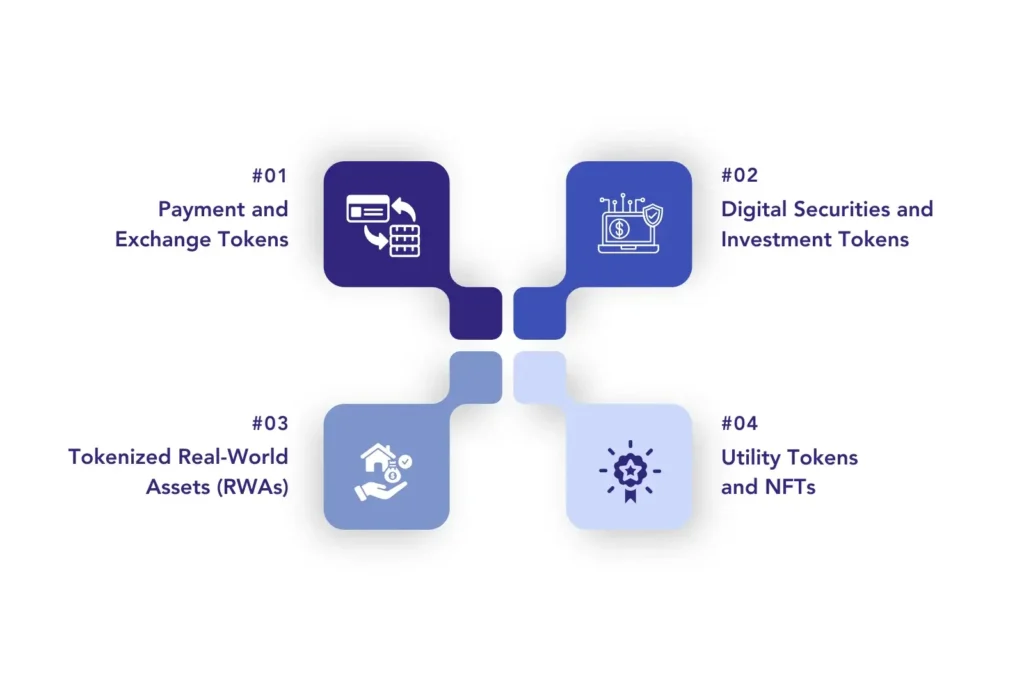
For UAE VAT on virtual assets, most activity falls into four practical buckets.

Payment and Exchange Tokens

(Cryptocurrencies and Similar Assets)


Examples include Bitcoin, Ethereum, and exchange-based tokens used primarily for value transfer or trading.


For VAT purposes:

  • Transfers and conversions of these tokens are treated as financial services

  • They are generally VAT-exempt, following the UAE VAT Article 42 amendments

  • This exemption applies retroactively from 1 January 2018

However:

  • Trading fees or commissions charged by exchanges or brokers are standard-rated (5%) when the place of supply is the UAE

This distinction is central to VAT on crypto transactions UAE and Partial exemption virtual asset businesses

Digital Securities and Investment Tokens

These tokens represent:

  • Shares

  • Debt instruments

  • Fund units

  • Structured investment products

They are closer to traditional securities than crypto.


VAT treatment generally aligns with financial instruments:

  • Issuance and transfer often qualify as exempt financial services

  • Platform, advisory, structuring, or administration fees are usually taxable

This is where Digital securities VAT treatment overlaps heavily with capital markets regulation.


The mistake many firms make is assuming “regulated” means “VAT-free.”
It does not.

Tokenized Real-World Assets (RWAs)

This is the fastest-growing and riskiest category.


Examples include:

  • Tokenized real estate

  • Revenue-linked tokens

  • Fractional ownership structures

  • Asset-Referenced Virtual Assets (ARVAs) under VARA

Here, VAT depends entirely on legal structuring.


If the token grants:

  • A direct interest in UAE real estate, real estate VAT rules may apply

    • Zero-rated first supply of qualifying residential property

    • Standard-rated commercial property

  • A financial exposure to income or value, VAT may align closer to exempt financial services

This tension sits at the core of VAT on tokenized real estate UAE – and will remain a major advisory issue in 2026.


Documentation matters more than marketing language.

Utility Tokens and NFTs

NFTs are not automatically exempt.


If an NFT provides:

  • Digital content

  • Access to platforms

  • In-game items

  • Membership or rights

It is often treated as an electronic service.


That typically means:

  • Standard-rated VAT (5%) when supplied to UAE customers

  • Place of supply rules apply like other digital services

This is a key area under VAT treatment of NFTs UAE, and one where enforcement is expected to increase.

Core VAT Treatment After Article 42: What Changed in Practice

The revised Article 42 clarified what qualifies as a financial service, but it also narrowed assumptions.

Virtual Asset Transfers and Conversions

These are generally:

  • Exempt financial services

Unless:

  • They represent an underlying taxable supply

  • They qualify as zero-rated cross-border financial services (non-resident customer, no UAE use)

The difference between exempt and zero-rated matters deeply for input VAT recovery.

Keeping and Managing Virtual Assets

This was a major 2024–2025 change.


From 15 November 2024:

  • Keeping, managing, or enabling control of virtual assets is treated as a financial service

But exemption applies only if:

  • No explicit fee or commission is charged

If a custodian, wallet provider, or platform charges a clear fee:

  • The service is generally standard-rated

This distinction directly impacts Virtual asset custodian VAT rules.

Practical VAT Scenarios: What This Looks Like in Real Life

Example 1: Centralised Exchange or Broker in the UAE

Activities include:

  • Crypto-to-crypto trades

  • Fiat-to-crypto conversions

VAT impact:

  • The transfer/conversion itself is generally exempt

  • Trading fees or commissions charged to customers are standard-rated (5%)

Key risk:

  • Reduced input VAT recovery due to increased exempt revenue

  • Misapplied partial exemption ratios

This is one of the most common audit triggers under FTA VAT guidance virtual assets.

Example 2: Tokenization Platform (Real Estate or Funds)

Typical revenue streams:

  • Token issuance fees

  • Platform onboarding fees

  • Smart contract deployment fees

VAT treatment:

  • These services are usually standard-rated if supplied in the UAE

  • The token itself may be exempt or follow real estate VAT rules, depending on structure

This creates mixed supplies and complex apportionment.


Product-by-product VAT mapping is no longer optional.

Example 3: Custody and Wallet Providers

If the service involves:

  • Safekeeping assets

  • Enabling control

  • No explicit fee

It may qualify as an exempt financial service (from 15 Nov 2024).


If the service includes:

  • Monthly custody fees

  • Asset-based charges

It is generally taxable.


This distinction directly affects UAE blockchain accounting rules and pricing models.

Example 4: NFTs and Gaming Tokens

If NFTs deliver:

  • Digital art

  • Content access

  • In-game functionality

They are often treated as:

  • Standard-rated electronic services

VAT applies based on customer location, not blockchain location.

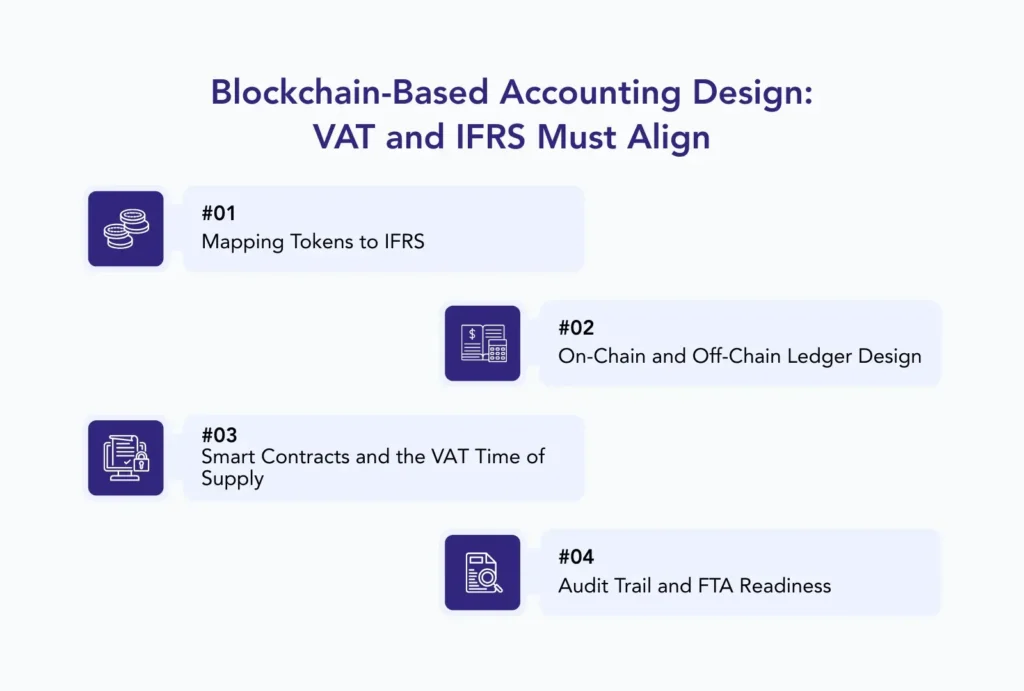
Blockchain-Based Accounting Design: VAT and IFRS Must Align

By 2026, tax authorities will expect accounting systems to match tax logic.

Mapping Tokens to IFRS

Most UAE firms now use a hybrid approach:

  • IFRS 9: Digital securities, tokenized debt, investment tokens

  • IAS 38: Own crypto holdings

  • IFRS 15: Platform fees, issuance revenue, staking as services

This classification directly affects Tokenization accounting standards UAE and VAT treatment.


If accounting says “financial instrument” but VAT treats it as a digital service, problems follow.

On-Chain and Off-Chain Ledger Design

A 2026-ready setup includes:

  • Separate ledgers for client assets and house assets

  • Wallet-level transaction tagging

  • Journal entries capturing:

    • Token type

    • Counterparty nature

    • Jurisdiction

    • VAT category

Dedicated VAT codes are essential, including:

  • Exempt VA transfers

  • Taxable fee-based VA services

  • Zero-rated cross-border financial services

  • Standard-rated NFTs and digital services

This is the backbone of Blockchain-based ERP integration.

Smart Contracts and the VAT Time of Supply

Smart contracts automate:

  • Token issuance

  • Distributions

  • Staking rewards

  • Protocol fees

Each trigger may create:

  • A VAT tax point

  • A revenue recognition event

Finance teams must map smart contract logic to:

  • UAE VAT time-of-supply rules

  • Continuous supply principles

  • IFRS 15 performance obligations

Ignoring this creates silent exposure.

Audit Trail and FTA Readiness

By 2026, FTA audits involving blockchain will expect:


Off-chain evidence:

  • Legal opinions

  • Classification memos

  • Contracts and engagement letters

  • Customer residency documentation

On-chain evidence:

  • Wallet transaction histories

  • Reconciliations to ERP

  • Blockchain analytics reports

This is becoming standard for Blockchain audit trail UAE requirements.

2025 Lessons: Where UAE Businesses Are Getting VAT Wrong

By the end of 2025, the rules were no longer the problem. Execution was. Across exchanges, tokenization platforms, custodians, and Web3 groups, several patterns emerged during reviews and early audits.

Misclassification of Tokens and Services

The most common error was treating all token movements as exempt virtual asset transfers.


In reality:

  • Exempt VA transfers

  • Taxable platform fees

  • NFT-based digital services

  • Real-estate-linked supplies

often exist inside the same transaction flow.


This misclassification risk is now central to Virtual asset VAT risks UAE and UAE Web3 regulatory compliance.


Tokenized real estate structures are especially exposed.
Marketing language often promises “fractional ownership,” while legal documents quietly create something else.


VAT follows the documents – not the pitch deck.

Weak Partial Exemption Calculations

The expansion of Article 42 increased exempt revenue across the sector.


Many businesses failed to update:

  • Pro-rata methods

  • Input VAT attribution logic

  • Recovery assumptions baked into pricing

This matters because:

  • Exempt VA flows reduce recoverable input VAT

  • Zero-rated cross-border services preserve recovery

  • Treating one as the other distorts tax outcomes

This is now a priority area under Partial exemption virtual asset businesses and FTA VAT guidance virtual assets.

ERP and Wallet Integration Gaps

Many firms still rely on:

  • Manual exports from exchanges

  • Wallet screenshots

  • Excel-based VAT tagging

These approaches fail under audit.


Common gaps include:

  • No FX policy for token valuation at tax point

  • No approved VAT control framework

  • No management-level sign-off on token classification

By 2026, these gaps will be interpreted as control failures – not growing pains.

2026 Outlook: What UAE Firms Should Expect Next

The direction is clear. The question is pace, not intent.

More Detailed FTA Guidance and Enforcement

Based on 2025 trends, further clarification is likely in areas such as:

  • VAT on DeFi and staking UAE

  • NFTs linked to memberships, royalties, or access rights

  • Complex RWA tokenization and income-based ARVAs

More importantly, expect targeted audits.


Groups most exposed:

  • Exchanges and brokers with high exempt turnover

  • Tokenization platforms earning mixed revenue

  • Custodians offering fee-based safekeeping

  • Groups with offshore wallets and cross-border flows

The FTA is no longer asking what crypto is.
It is asking how you accounted for it.

ADGM, VARA, and International Alignment

Regulatory momentum continues.

  • ADGM is expected to refine staking, yield, and fiat-referenced token rules following its 2025 consultations

  • VARA will continue tightening disclosure, retail protections, and ARVA governance as Dubai scales its Web3 strategy

  • Alignment with the OECD’s Crypto-Asset Reporting Framework (CARF) will increase data sharing and transparency

This will directly affect Virtual asset regulations UAE 2026 and reporting expectations for VASPs.

Market Developments Driving VAT Complexity

Expect growth in:

  • Tokenized real estate and income-linked RWAs

  • Institutional custody and trading under VARA and ADGM licences

  • Hybrid products combining tokens, smart contracts, and traditional assets

Each layer adds VAT complexity. The market is maturing and so is enforcement.

Action Plan for 2026: How UAE Businesses Can Future-Proof VAT and Blockchain Accounting

The difference between compliance and exposure in 2026 will come down to preparation.

Step 1: Token and Business Model Diagnostic

Start with a full inventory:

  • Token types: payment, security, utility, NFT, ARVA, RWA, stablecoins

  • Business roles: exchange, broker, custodian, issuer, protocol, investor

This diagnostic underpins UAE VAT on virtual assets and Tokenized assets VAT UAE analysis.

Step 2: VAT Mapping and Policy Paper

For each transaction flow, document:

  • VAT treatment (exempt, standard-rated, zero-rated, outside scope)

  • Place of supply

  • Input VAT attribution

The outcome should be a formal VAT policy paper – signed off by management and ready for FTA review. This is no longer optional.

Step 3: ERP, Wallet, and Control Enhancements

A 2026-ready setup includes:

  • Wallet-to-ERP integration

  • Dedicated VAT codes reflecting post-Article 42 logic

  • Automated partial exemption calculations

This supports Blockchain-based ERP integration and audit defensibility.

Step 4: Historic Review and Corrections (2018–2025)

Businesses should reassess:

  • Virtual asset transfers and conversions back to 1 January 2018

  • Custody and management services from 15 November 2024

The goal is not perfection – it is defensible correction.


Voluntary disclosures are often cheaper than enforced ones.

Step 5: Governance, Training, and Monitoring

Leading firms are now establishing:

  • Internal VA tax and accounting committees

  • Cross-functional training for finance, legal, and tech teams

  • Continuous monitoring of FTA, VARA, ADGM, and OECD developments

Governance will increasingly be treated as evidence of intent.

Conclusion

The UAE has done something few jurisdictions have achieved. By 2025, it aligned:

  • VAT law

  • Financial services regulation

  • Virtual asset supervision

Article 42, VATP040, VARA, and ADGM frameworks now provide a clear baseline for UAE crypto tax updates 2026 and beyond.


But clarity raises expectations.


In 2026, success will not come from knowing the rules.
It will come from implementing them properly.


For CFOs and founders, this means:

  • Correct token classification

  • Ledger redesign that reflects economic reality

  • VAT compliance across on-chain and off-chain activity

Those who treat VAT as an afterthought will struggle. Those who integrate tax, accounting, and blockchain design will scale faster  and safer.

A Note for UAE Businesses

At TaxADEPTS, we see this shift clearly.


2026 will reward firms that combine:

  • VAT and corporate tax expertise

  • Transfer pricing awareness

  • Blockchain-ready accounting design

A structured Tokenization & VAT Readiness Review is no longer a defensive exercise. It is a strategic one.

FAQs:

VAT depends on what the token represents. RWAs referencing real estate or income streams may follow property or financial-service rules rather than generic virtual-asset treatment.

Often yes — but recovery depends on whether output supplies are taxable, zero-rated, or exempt.

It follows customer location and contractual arrangements, not node or wallet location.

Yes, where they trigger consideration or performance obligations under UAE VAT rules.

Generally treated as third-party costs, but treatment depends on structure and documentation.

Using a consistent, documented FX policy at the tax point.

Only with careful legal structuring and documentation.

Often analysed as consideration for services – a key 2026 risk area.

No directly, but inconsistent classification creates audit exposure.

References

Related Articles​​

The Tiered Volumetric Model Explained: Calculating Excise Tax on Sugar for 2026

Imagine two drinks on the same shelf. Same size, same brand tier, same retail price. Today, they face the same excise tax. From 1 January 2026, that changes. One will pay more, not because it’s priced higher, not because it’s marketed as premium, but because it simply has more sugar per 100 ml.


The UAE is overhauling its sugar-sweetened beverage excise. The flat 50% ad-valorem tax is gone. In its place a tiered volumetric model is introduced, where tax is calculated per litre based on sugar content. Shelf price is no longer the basis of tax liability, formulation is. 


This shift is much more than a shift. It changes how manufacturers, importers, and distributors think about pricing, product design, and compliance.


In this article, we break down:

  • How the tiered volumetric model works

  • Step-by-step calculation examples

  • Compliance, pricing, and reformulation strategies for 2026

For businesses, this isn’t just a tax update. It’s a call to rethink product strategy.

Understanding How the Tiered Volumetric Model Redefines Sugar Excise Tax

The terminology like tiered and volumetric sounds technical. The logic is not.


Volumetric means excise is calculated per litre of product. Not as a percentage of price.
Not based on invoice value. Simply AED per litre. Tiered means the per-litre rate changes depending on sugar content.


More sugar per 100 ml = higher excise per litre.
Less sugar = lower or zero excise.


That is the core idea. Instead of asking, “How much does this product cost?” The tax now asks, “How much sugar does this product contain?”


This approach breaks the automatic link between premium pricing and higher tax. A low-sugar premium drink may attract less excise than a cheaper, high-sugar alternative. For businesses used to modelling excise tax in the UAE as a pricing function, this is a fundamental shift.

Why the UAE abandoned the flat 50% ad-valorem excise

Under the current regime, sweetened and carbonated drinks generally attract a 50% excise tax calculated on the higher of:

  • Declared retail selling price, or

  • A deemed market value

This system has two well-known limitations:

  1. Price-driven distortions
    Higher-priced products pay more excise, even if their sugar content is lower.

  2. Weak health signalling
    Consumers do not see a consistent relationship between sugar intensity and price.

The tiered volumetric model fixes both.


Excise liability will now rise or fall only with sugar density. Retail pricing strategy becomes secondary. For some products, excise will increase.  For others, it will fall. And for zero- or very low-sugar products, it may disappear entirely.


This is why UAE introduced a new tiered excise tax model for sugary drinks, not as a revenue experiment, but as a behavioural tool.

Sugar bands, not shelf labels, drive tax outcomes

Under the 2026 framework, sweetened beverages are classified into sugar tiers based on grams of total sugar per 100 ml. The thresholds are fixed. They are not averaged across a portfolio. They apply product by product.


A difference of 0.1 g per 100 ml can move a drink into a higher tier. That is not theory.
It is how the law is drafted. Which is why excise is now inseparable from formulation data, lab testing, and product governance. This is also where excise tax compliance risk increases sharply for businesses without robust controls.

Legal Architecture Behind the New Sugar Excise Framework

The tiered volumetric model does not stand alone. It sits on top of an existing excise framework that has been gradually expanded since 2017.


Key instruments include:

  • Federal Decree-Law No. 7 of 2017 on Excise Tax

  • Cabinet Decision No. 52 of 2019 (Executive Regulations)

  • Cabinet Decision No. 99 of 2025 (mechanism refinements)

  • Cabinet Decision No. 197 of 2025, which formally introduces the tiered volumetric model

  • FTA Public Clarification EXTP012, which explains application mechanics

Together, these instruments redefine how excise tax accounting recommendations UAE professionals must approach sweetened beverages. The Decree-Law establishes the tax base.
The Cabinet Decisions define calculation mechanics. The Public Clarification explains how the FTA expects businesses to apply them in real life.


This layered structure matters. Most disputes do not arise from the law itself. They arise from interpretation gaps between these layers. Which is why excise tax advisory services in the UAE are increasingly focused on governance, not just filing.

Why Health Policy Sits at the Centre of This Reform

Globally, sugar-sweetened beverage (SSB) taxes have evolved in one clear direction:
away from value-based taxation and toward sugar-content-based models.


Evidence from WHO, EMRO, and multiple OECD jurisdictions shows that tiered sugar taxes:

The UAE’s model mirrors frameworks used in the UK, South Africa, and parts of the EU, but adapted to GCC excise architecture. This matters for one reason.


Once a country adopts sugar-based taxation, thresholds tend to tighten over time. Today’s <5 g band may not remain static forever. From a forward-looking excise tax management perspective, this reform should be read as a direction of travel, not an endpoint.

Defining Sweetened Drinks, Sugar Content, and Tax Tiers in Practice

To put this new tax system into context, it is extremely important to define sweetened drinks first of all:

What Legally Counts as a “Sweetened Drink”

The excise framework does not care how a product is marketed.


“Natural.”
“Light.”
“No added sugar.”
“Craft.”
“Functional.”


None of these terms determine excise treatment.


What matters is whether the product meets the FTA definition of a sweetened drink.


Under the UAE excise regime, sweetened drinks include:

  • Ready-to-drink beverages

  • Concentrates, syrups, powders, gels, and extracts

  • Any product that can be converted into a beverage for consumption, whether immediately or after dilution

If it can become a drink, it is potentially in scope.


That includes products not traditionally viewed as “soft drinks.” Flavoured waters. Drink mixes.
Liquid enhancers. Certain coffee and tea bases. This is where excise tax audit exposure typically begins.

Ready-to-drink beverages

These are straightforward.

  • Sugar is measured per 100 ml of the finished product

  • Excise is charged per litre of the beverage as sold

No conversion logic is required.

Reconstituted products

This is where complexity enters.


For concentrates, syrups, powders, and extracts:

  • Excise is calculated on the final consumable volume, not the sold volume

  • Manufacturer-recommended dilution ratios are mandatory

  • Excise liability is often many times higher than businesses initially expect

A 750 ml syrup bottle may produce 7.5 litres of drink. Excise is charged on 7.5 litres, not 0.75. This point alone has triggered significant reassessments under previous excise audits.

Total Sugar Means Total Sugar - Not Just Added Sugar

This is one of the most misunderstood elements of the 2026 model.


Total sugar content includes:

  • Added sugars

  • Naturally occurring sugars

  • Sugars from honey, syrups, fruit concentrates, and similar caloric sweeteners

There is no carve-out for “naturally sweet.” If sugar is present, it counts. This is intentional.
Health policy does not distinguish metabolic impact based on marketing narratives. For excise tax advisory UAE professionals, this means nutrition labels must be read with legal precision, not consumer logic.

Artificial Sweeteners and Sugar Calculations

Artificial sweeteners complicate classification, but not in the way many expect.

  • Artificial sweeteners do not add to sugar grams per 100 ml

  • They are excluded from sugar calculations

However, a product with zero sugar but artificial sweeteners does not automatically fall outside excise. It is classified into a separate category under the tiered model. This distinction matters when modelling future policy risk, which we will return to later.

Sugar Thresholds That Determine Excise Outcomes

Under Cabinet Decision No. 197 of 2025, sugar tiers are fixed and explicit.


They are measured strictly per 100 ml of finished beverage.

The tiers are:

  • Less than 5 g per 100 ml
    0% excise (AED 0 per litre)

  • 5 g to less than 8 g per 100 ml
    AED 0.79 per litre

  • 8 g or more per 100 ml
    AED 1.09 per litre

  • Artificial-sweetener-only beverages
    → Separate classification (not sugar-based)

If a product sits at 5.01 g, it moves up a tier. This is why lab precision matters more than ever under excise tax compliance rules.

Why “Low Sugar” Claims Often Fail Excise Tests

A common mistake appears again and again during reviews. A product is marketed as “low sugar.”  Its nutrition panel supports that claim under consumer law. But excise classification still pushes it into a taxable tier.


Why?


Because excise law does not use marketing thresholds. It uses numeric thresholds per 100 ml. A drink can be “low sugar” in consumer terms and still exceed 5 g per 100 ml. This disconnect is where disputes begin.

Explicit Exemptions from Sugar Excise

Not everything that tastes sweet is taxable. The framework explicitly excludes certain categories, but only if strict conditions are met.


Common exemptions include:

  • 100% natural fruit juice with no added sugar

  • Milk and dairy products, including plain and flavoured milk (subject to limits)

  • Baby formula and infant nutrition

  • Medical nutrition products, when properly classified

These exemptions exist for nutritional and policy reasons. But they are narrow. And they are frequently misunderstood.

The Risk Zone: “Natural Sugar Only” Products

This is where businesses tend to overestimate safety.


A beverage may be labelled:

  • “No added sugar”

  • “Naturally sweetened”

  • “Fruit-based”

Yet still fall into excise scope. Why? Because even small additions of sweeteners, including fruit concentrates, honey, or syrups, can disqualify the exemption. Once an exemption condition fails, the product enters the tiered model like any other sweetened drink. This is a recurring focus area in excise tax advisory services in Dubai engagements.

Edge Cases That Require Careful Testing

Some products sit right on the boundary.

  • Coconut water blends

  • Flavoured plant-based drinks

  • Juice drinks diluted below 100%

  • Kombucha and fermented beverages

In these cases:

  • Lab results matter more than ingredient lists

  • Branding language offers no protection

  • Conservative classification is often the safer position

This is where excise tax consultancy services in Dubai add the most value, not by filing returns, but by preventing misclassification before products reach market.

Step-by-Step Mechanics for Calculating Excise Tax Under the 2026 Sugar Model

Once a product is correctly defined and classified, the excise calculation itself is not complicated. What is complicated is doing it in a way that survives an excise tax audit. The 2026 model is unforgiving. Small documentation gaps default to the highest tier. Small arithmetic errors multiply across volume.

Step 1: Verify Sugar Content per 100 ml

Everything starts here. Sugar content must be supported by a MOIAT-accredited laboratory certificate confirming:

  • Total sugar (g per 100 ml)

  • Testing methodology

  • Product identity matching the registered SKU

  • Batch or formulation reference

Marketing nutrition panels are not enough. Supplier declarations are not enough. Foreign lab reports are not enough unless formally accepted. If sugar content cannot be proven, the FTA is empowered to assume highest-tier classification. This is why excise tax compliance begins in the lab, not in the ERP.

Step 2: Classify the Product into the Correct Sugar Tier

Using the certified sugar value, the product must be placed into one of the defined categories:

  • <5 g per 100 ml

  • 5 g to <8 g per 100 ml

  • ≥8 g per 100 ml

  • Artificial-sweetener-only

There is no averaging across batches. If lab results show 4.99 g, the product qualifies for zero excise. If they show 5.01 g, it does not. Misclassification risk here is one of the most common triggers for retrospective reassessments under excise tax in the UAE.

Step 3: Apply the Correct Excise Rate per Litre

Once the tier is fixed, the rate is mechanical.

  • <5 g per 100 ml → AED 0 per litre

  • 5–<8 g per 100 ml → AED 0.79 per litre

  • ≥8 g per 100 ml → AED 1.09 per litre

Retail price is irrelevant. Promotions are irrelevant. Transfer pricing is irrelevant at this stage. This is where the volumetric model shows its discipline.

Step 4: Determine Taxable Volume at SKU and Batch Level

Excise is calculated on litres, not units. And not at invoice level. The FTA expects excise to be computed:

  • Per SKU

  • Per batch or import consignment

  • Using consistent units of measure

A 330 ml can equals 0.33 litres. A 1.5 L bottle equals 1.5 litres. It sounds obvious. Yet errors here are frequent – especially in multipacks and promotions. This is why excise tax management now requires SKU-level master data integrity.

Step 5: Compute Excise Liability and Document Everything

The calculation itself is simple:


    Taxable volume (litres) × applicable rate = excise payable


What matters is what sits behind that number.


A defensible excise position requires:

  • Lab certificates

  • SKU master data

  • Volume calculations

  • Tier classification rationale

  • Reconciliation to EmaraTax filings

This documentation becomes the permanent audit trail.

Worked Calculation Examples

Let’s translate theory into numbers.

Example 1: 330 ml Can Near the 5 g Threshold

Product A

  • Sugar content: 4.9 g per 100 ml

  • Package size: 330 ml (0.33 L)

  • Tier: <5 g → 0% excise

Excise calculation
0.33 L × AED 0 = AED 0


Now compare with:


Product B

  • Sugar content: 5.1 g per 100 ml

  • Same size, same price

Excise calculation
0.33 L × AED 0.79 = AED 0.26 per can


A difference of 0.2 g of sugar changes the tax outcome entirely.


This is why reformulation discussions are already underway across the market.

Example 2: 1.5 L PET Bottle in the High-Sugar Tier

Product C

  • Sugar content: 9.8 g per 100 ml

  • Package size: 1.5 L

  • Tier: ≥8 g → AED 1.09 per litre

Excise calculation
1.5 L × AED 1.09 = AED 1.64 per bottle


Under the old 50% ad-valorem system, excise would have depended on price.
Under the new model, sugar density alone drives the result.

Example 3: Syrup Converted into Ready-to-Drink Volume

Product D (Syrup)

  • Bottle size: 750 ml

  • Manufacturer dilution ratio: 1:9

  • Final consumable volume: 7.5 litres

  • Sugar content (after dilution): 6.5 g per 100 ml

Tier
5–<8 g → AED 0.79 per litre


Excise calculation
7.5 L × AED 0.79 = AED 5.93 per bottle


This is where many businesses under-declare.


They calculate excise on 0.75 L instead of 7.5 L.


That error rarely survives an audit.

Concentrates, Powders, and Gels – Mandatory Conversion Logic

The FTA requires excise on reconstituted products to be calculated using:

  • Manufacturer-recommended dilution ratios

  • Consistent, documented conversion factors

Businesses cannot select dilution ratios opportunistically. If multiple ratios exist, the most common or consumer-realistic ratio must be used. This area remains a priority focus for excise tax advisory services in the UAE because it directly affects payable volumes.

Multipacks, Promotional Bundles, and Mixed-Tier Cartons

Promotional pricing does not simplify excise. If a multipack contains:

  • One zero-excise SKU

  • One medium-tier SKU

  • One high-tier SKU

Excise must be calculated separately for each item, even if sold under a single promotional price. There is no averaging across the pack. This is a frequent failure point in excise tax filing assistance UAE reviews.

Common Calculation Errors That Trigger Reassessments

By experience, these issues recur:

  • Using retail price instead of volumetric logic

  • Applying average sugar values across SKUs

  • Ignoring dilution ratios for concentrates

  • Failing to update excise registration data after reformulation

  • Treating lab results as optional

Each one can result in default classification at AED 1.09 per litre.

Special Product Scenarios That Complicate Sugar Excise Calculations

Not every beverage fits cleanly into a sugar tier. Some products straddle definitions.
Others sit outside the model entirely. A few look exempt until one ingredient quietly pulls them back in. This is where excise tax compliance stops being theoretical and becomes judgment-based, guided by law, but tested by facts.

Products Combining Sugar and Artificial Sweeteners

These products are increasingly common.


Lower sugar.
Better taste control.
Often positioned as “reduced sugar” rather than “sugar-free.”


From an excise perspective, the rule is precise:

  • Artificial sweeteners do not count toward sugar grams

  • Sugar content still drives tier classification

If a product contains any sugar, it is classified based on total sugar per 100 ml, even if artificial sweeteners are also present. There is no blended or weighted approach. A drink with 6 g of sugar and artificial sweeteners still falls into the 5–<8 g tier. Artificial sweeteners do not soften the rate. This distinction is frequently misunderstood and regularly corrected during excise tax audits.

Artificial-Sweetener-Only Beverages

Products containing zero sugar but artificial sweeteners only are treated separately.


They are not assessed under the sugar tiers. They fall into a distinct classification under the excise framework. Today, this category benefits from favourable treatment compared to high-sugar products. But this comes with a strategic warning.


International health policy is increasingly scrutinising artificial sweeteners. WHO guidance has already shifted. Future tightening is plausible. From an excise tax advisory UAE perspective, artificial sweeteners may offer short-term tax relief, but they are not a long-term certainty.

Energy Drinks Remain Outside the Tiered Model

Energy drinks are the major exception. They do not move into the volumetric sugar-based framework. They remain subject to the existing 100% ad-valorem excise tax. This is not an oversight. It is a policy choice.


Energy drinks are regulated based on stimulant content and consumption patterns, not just sugar. For portfolios that include both soft drinks and energy drinks, this creates internal complexity:

  • Different excise bases

  • Different calculation logic

  • Different pricing sensitivities

Managing both under one system requires careful configuration – a growing area for excise tax services in UAE.

Milk-Based Beverages: Exempt, Until They Aren’t

Milk and dairy products are generally excluded from sugar excise.


But the exemption is conditional. Plain milk is excluded. Flavoured milk with limited additions?
Usually excluded. Milk-based drinks with added sugars, syrups, or flavour enhancers beyond permitted thresholds? Potentially taxable.


Plant-based alternatives – almond, oat, soy – require even more care. They do not automatically inherit dairy exemptions. This category often requires product-by-product testing, not blanket assumptions.

Coffee and Tea-Based Beverages

Coffee and tea products create recurring confusion. The key distinction is where and how they are prepared.

  • Ready-to-drink bottled coffee or tea → potentially in scope

  • Concentrated bases or syrups → in scope once reconstituted

  • On-premise preparation (cafés, restaurants) → generally excluded

A bottled iced coffee with added sugar is not treated the same way as a café latte made on-site. This line matters. It is also frequently tested during audits because classification errors are common.

On-Premise Beverages and Non-Sealed Products

Generally, excise applies to produced or imported excise goods.


Beverages:

  • Prepared on-premise

  • Not sealed for retail sale

  • Not entering commercial distribution

are typically outside excise scope.


This includes:

  • Fountain drinks

  • Freshly prepared beverages

  • Drinks mixed at point of sale

However, if syrups or concentrates used on-premise are imported or produced commercially, excise may still apply at the concentrate level. This distinction is subtle and often overlooked.

Non-Commercial and Personal-Use Products

Excise tax is a commercial tax.


Products prepared for:

  • Personal consumption

  • Non-commercial events

  • Demonstrations or testing

may fall outside scope, but only with evidence. The burden of proof sits with the business.


Without documentation, the FTA is unlikely to accept non-taxable treatment during an excise tax audit.

Why These Scenarios Matter More Than They Seem

Most excise disputes do not arise from core soft drinks.


They arise from:

  • Borderline products

  • Hybrid formulations

  • Portfolio extensions launched quickly

  • Seasonal or limited-edition SKUs

These are exactly the situations where internal controls are weakest. Which is why excise tax consultancy services in Dubai increasingly focus on product governance, not just return preparation.

Compliance Infrastructure - Documentation, Registration, and Systems Readiness

The tiered volumetric model does not fail because businesses misunderstand the law. It fails because systems are not ready to carry it.


From 2026 onward, excise compliance will be judged less on intent and more on evidence.
If the data cannot be produced cleanly, consistently, and quickly, the position is weak – even if the tax paid is broadly correct. This is the quiet shift happening inside excise tax compliance in the UAE.

MOIAT-Accredited Laboratory Certificates as Primary Evidence

Lab certificates are no longer supporting documents. They are foundational. For each excise-registered sweetened beverage, the FTA expects:

  • Sugar content (g per 100 ml)

  • Test method and standard used

  • Product formulation or SKU reference

  • Batch or formulation version linkage

  • Issuance by a MOIAT-accredited laboratory

Certificates must be current, traceable, and consistent with product registration data. Outdated or generic lab reports are not defensible. This is why excise tax advisory services in the UAE increasingly start with a lab-gap assessment, not a tax review.

Validity Periods and Retesting Expectations

The law does not prescribe a fixed retesting frequency. But audit practice does. Retesting is expected when:

  • Formulation changes

  • Ingredient sources change

  • Agricultural inputs vary materially

  • Sugar values sit close to tier thresholds

If a product sits at 4.9 g or 5.0 g per 100 ml, relying on a two-year-old report is risky. During an excise tax audit, the question is not “Was a test done?”  It is “Is this result still reliable?”

Default-to-Highest-Tier Risk Without Valid Documentation

This point cannot be softened. If acceptable lab evidence is not available, the FTA may:

  • Classify the product provisionally at the highest sugar tier

  • Apply excise at AED 1.09 per litre

  • Reassess retrospectively

The financial exposure is not limited to underpaid tax.


Penalties, late payment charges, and reputational risk follow.


This is a recurring outcome in cases reviewed by excise tax auditor teams.

Updating Excise Goods Registration Before 1 January 2026

Existing excise registrations will not automatically convert. Businesses must update registered product details to reflect:

  • Sugar tier classification

  • Applicable volumetric excise rate

  • Product form (ready-to-drink, concentrate, powder)

  • Lab certificate references

Failure to update registrations creates a mismatch between filings and product data – a red flag in excise tax in the UAE. Timing matters. Waiting until January 2026 compresses risk. Early updates allow testing and correction.

ERP and Tax Engine Configuration for Sugar-Based Excise

This is where many organisations underestimate the change. Under the old ad-valorem system, excise was often calculated downstream, linked to pricing modules. That approach no longer works. The 2026 model requires excise logic embedded upstream.

Systems must support:

  • SKU-level sugar tier attributes

  • Fixed AED-per-litre rates

  • Accurate unit-of-measure conversions

  • Dilution logic for concentrates

  • Automated excise determination independent of price

For groups operating across multiple channels, this becomes a core excise tax management issue – not just a compliance task.

Master Data Discipline Is No Longer Optional

SKU master data must now include:

  • Sugar content reference

  • Applicable excise tier

  • Volumetric rate

  • Product form

  • Lab certificate ID

If master data is wrong, every downstream calculation is wrong. This is why excise tax services UAE engagements increasingly involve master-data remediation, not just return preparation.

Internal Controls and Audit Trails Expected by the FTA

The FTA does not expect perfection. It expects governance. Typical expectations include:

  • Segregation between product formulation, tax classification, and filing

  • Documented review of tier assignments

  • Periodic lab retesting protocols

  • Reconciliation of excise calculations to inventory movements

  • Clear retention of supporting documentation

When these controls exist, audits move faster. When they do not, scrutiny increases.

Transitional Treatment for Pre-2026 Stock

This remains an area where formal guidance may evolve.


However, current indications suggest careful documentation will be critical for:

  • Goods produced or imported before 1 January 2026

  • Sold or distributed after the go-live date

Businesses should be prepared to demonstrate:

  • Production or import dates

  • Applicable excise regime at the time

  • Clear inventory segregation

Until further clarification is issued, conservative positioning is advisable – a common recommendation under excise tax advisory Dubai reviews.

Financial Modelling - Pricing, Margin, and Cash-Flow Implications

The tiered volumetric model does not just change how excise is calculated. It changes who absorbs it, when it is paid, and how visible it becomes inside the P&L. For many businesses, the biggest impact will not be the tax itself – but the friction it creates across pricing, trade spend, and working capital.

Excise Costs Cascade Through the Pricing Ladder

Volumetric excise is charged early. At production. At import. Before the product ever reaches the shelf. That means excise becomes part of:

  • Ex-factory pricing

  • Landed cost

  • Distributor margins

  • Retail pricing decisions

Unlike ad-valorem excise, which flexed with price movements, volumetric excise is fixed. A price promotion does not reduce the tax. A discount does not soften the burden. This rigidity is why excise tax in the UAE will feel more immediate from 2026 onward.

High-Sugar Products Face the Sharpest Margin Compression

Products in the ≥8 g tier absorb AED 1.09 per litre, regardless of market positioning.


For:

  • Entry-level brands

  • Price-sensitive categories

  • High-volume SKUs

That cost is difficult to pass through fully. Margins narrow first. Then trade spend gets squeezed. Then SKU rationalisation begins. This is already visible in internal modelling exercises led by excise tax advisory services in the UAE.

Why Passing the Tax to Consumers Is Not Always Possible

In theory, excise is often described as a “pass-through tax.” In practice, that assumption breaks down quickly. Retail price ceilings. Competitive pressure. Consumer price sensitivity. For many products, especially in convenience retail, price elasticity limits how much excise can be passed on.


The result?

  • Partial absorption by manufacturers

  • Margin erosion at distributor level

  • Reduced promotional flexibility

Excise becomes a silent cost rather than a visible line item.

Low- and Zero-Sugar Products Gain Structural Pricing Advantage

The flip side matters just as much. Products below 5 g per 100 ml carry zero volumetric excise.


That advantage compounds.

  • Lower landed cost

  • Greater pricing flexibility

  • More room for trade investment

  • Stronger promotional resilience

Over time, this reshapes shelf economics.


Low-sugar products do not just align with health policy. They align with margin protection. This is one reason portfolio reformulation discussions are accelerating under excise tax management reviews.

Cash-Flow Planning Becomes Critical Under Volumetric Excise

Excise is payable on:

  • Production, or

  • Import, or

  • Release from designated zones

Not on sale. This timing matters. Under a volumetric model, excise payable is predictable, but it is also front-loaded.


Businesses with long inventory cycles face:

  • Earlier cash outflows

  • Higher working capital requirements

  • Greater sensitivity to demand fluctuations

This is particularly acute for high-volume importers.

Filing Deadlines and Payment Timing

Excise returns must be filed through EmaraTax within prescribed deadlines. Late payment penalties apply regardless of whether goods have been sold.


This creates a clear linkage between:

  • Inventory management

  • Cash-flow forecasting

  • Excise tax compliance

Where forecasting is weak, liquidity pressure builds quickly.

Scenario Modelling Is No Longer Optional

Under the 2026 model, financial modelling must move upstream. Boards increasingly ask:

  • What happens if sugar content increases slightly due to input variability?

  • What is the margin impact if a product crosses the 5 g or 8 g threshold?

  • Is reformulation cheaper than absorbing excise over three years?

These are not theoretical questions. They sit at the intersection of tax, finance, and product strategy, exactly where excise tax advisory Dubai teams are now most active.

Inventory Risk Under Fixed Excise Rates

One overlooked issue is inventory exposure. If excise is paid upfront on high-sugar stock and market conditions change – price pressure, demand shifts, reformulation – the excise cannot be recovered.


That sunk cost risk grows with:

  • Large production runs

  • Slow-moving SKUs

  • Seasonal products

This reinforces the case for tighter SKU governance.

Strategic Response - Reformulation, Portfolio Design, and Market Positioning

Once the numbers are modelled and the systems are scoped, a harder question surfaces. Do you absorb the excise? Pass it on? Or redesign the product itself? The tiered volumetric model quietly pushes companies toward that third option.

Threshold-Driven Reformulation Strategies

The new excise framework introduces cliffs, not slopes.


Crossing 5 g or 8 g per 100 ml does not gradually increase tax.
It triggers a step-change.


That makes reformulation economics unusually binary.


A reduction of 0.3 g per 100 ml can eliminate excise entirely.
A reduction of 1.2 g can move a product down a tier.


This is why reformulation discussions now start with tax thresholds, not taste panels.

Reformulation Is No Longer Just an R&D Decision

Historically, reformulation was driven by:

  • Cost of ingredients

  • Consumer preference

  • Shelf life

Now tax joins the list.


For many manufacturers, excise tax in the UAE has become a design constraint.


But reformulation carries risk:

  • Taste drift

  • Brand perception

  • Consumer rejection

  • Increased use of sweeteners

This is where excise tax advisory services in the UAE often sit in joint workshops with R&D and finance teams, aligning tax outcomes with commercial reality.

Portfolio Rationalisation Becomes Inevitable

Not every SKU deserves saving.


Under volumetric excise, some high-sugar products become structurally uncompetitive.


Common outcomes include:

  • Discontinuing marginal SKUs

  • Reducing pack sizes to manage absolute excise per unit

  • Prioritising low-sugar line extensions

  • Accelerating zero-sugar variants

This is not about health messaging. It is about portfolio efficiency. Excise acts as a filter.

Artificial Sweeteners: Short-Term Relief, Long-Term Question

Artificial sweeteners offer a clear tax advantage today.


Zero sugar.
Favourable classification.
Lower excise burden.


But the policy direction is not neutral.


WHO guidance is evolving.
Public scrutiny is increasing.
Future excise treatment may change.


From an excise tax advisory Dubai perspective, artificial sweeteners are a tactical lever — not a strategic endpoint.


Over-reliance increases future regulatory risk.

Channel-Specific Pricing Strategies Matter More Than Ever

The same product behaves differently across channels.


Supermarkets absorb price changes differently from convenience stores.
HORECA operates under different margin logic entirely.


Volumetric excise forces sharper channel thinking:

  • Supermarkets may tolerate gradual price increases

  • Convenience retail amplifies price sensitivity

  • HORECA may internalise excise within menu pricing

One-size-fits-all pricing rarely works.


This is why excise tax services UAE increasingly intersect with commercial strategy teams.

Pack Size as a Strategic Lever

While excise is charged per litre, pack size still influences consumer psychology.


Smaller packs:

  • Reduce absolute excise per unit

  • Lower shelf price points

  • Improve affordability perception

This does not eliminate excise.
But it can soften consumer resistance.


Expect to see pack redesigns alongside reformulation.

Market Positioning Under Sugar-Based Excise

The tax creates new narratives — whether brands want them or not.


Low sugar becomes a price advantage.
High sugar becomes a premium cost.


Brands that move early control the narrative.
Those that react late absorb it.


This is one of the quieter insights emerging from excise tax management reviews across the sector.

Cross-Border and GCC Context

The UAE’s tiered volumetric model does not exist in isolation. It sits inside a wider GCC excise framework, global health-tax coordination, and cross-border trade reality. Understanding that context matters – especially for businesses operating regionally or managing parallel imports.

Alignment With GCC Health-Tax Coordination

GCC excise taxes were designed to be harmonised. Common product categories. Aligned principles. Shared public-health objectives. While implementation details vary by country, the UAE’s move toward sugar-content-based taxation is consistent with the broader direction across the region.


Other GCC states already tax sweetened beverages. Some are actively reviewing volumetric or tiered approaches. This means the UAE’s reform should not be read as an outlier. It is a signal. For regional groups, this reduces the likelihood that sugar-based excise remains UAE-only in the medium term.

Regional Consistency vs Local Flexibility

Harmonisation does not mean uniformity. Each GCC state retains discretion over:

  • Tax rates

  • Thresholds

  • Product definitions

  • Exemptions

That creates a landscape where compliance is aligned in principle but fragmented in execution.


For businesses relying on excise tax services in UAE with regional operations, this requires:

  • Country-specific SKU classification

  • Separate lab evidence strategies

  • Jurisdiction-specific pricing models

Assuming full alignment creates risk.

Cross-Border Price Differentials and Trade Behaviour

Volumetric excise creates visible price differences.


A high-sugar drink taxed at AED 1.09 per litre in the UAE may be cheaper in a neighbouring market with lower or different excise.


That differential matters.


It can incentivise:

  • Parallel imports

  • Informal trade flows

  • Grey-market sourcing

None of this is theoretical. It has been observed in jurisdictions that moved to sugar-based excise. From an excise tax compliance perspective, this raises enforcement and valuation challenges.

Import Controls and Documentation Become More Important

Where price gaps widen, scrutiny follows.


Expect closer attention on:

  • Import declarations

  • Product classification accuracy

  • Sugar content verification for imported goods

  • Transfer pricing and related-party transactions

This reinforces the need for robust excise tax audit readiness, particularly for importers.

Lessons From International Sugar Tax Regimes

Globally, a few patterns repeat.

  1. Reformulation accelerates
    Companies quickly target thresholds once tax cliffs appear.

  2. Consumption patterns shift
    High-sugar products lose volume over time.

  3. Policy tightens, not loosens
    Thresholds and rates tend to evolve, rarely reverse.

  4. Compliance complexity increases
    Especially around concentrates, blends, and new product categories.

The UAE’s model reflects these lessons, especially the use of clear thresholds and volumetric rates.

Public Health, Economic Impact, and Forward-Looking Implications

The tiered volumetric model is often framed as a tax reform.


It is more accurate to see it as a behavioural instrument — one that uses excise mechanics to reshape product design, pricing decisions, and long-term consumption patterns.


That distinction matters.

Evidence Shows Reduced Sugar Consumption and Health Risk

International experience is consistent.


Where sugar-based excise taxes are introduced:

  • Average sugar intake declines

  • Reformulation accelerates

  • High-sugar products lose relative shelf share

WHO and EMRO studies show that tiered SSB taxes reduce sugar consumption without collapsing demand or eliminating consumer choice. Consumers still buy beverages. They just buy different ones. This is the outcome the UAE is targeting.

Health Taxes and Fiscal Sustainability

From a fiscal perspective, sugar excise is unusually effective.


It:

  • Raises stable revenue

  • Does not rely on income growth

  • Aligns taxation with public-health costs

Over time, revenue may soften as reformulation increases, but this is expected and planned for. In policy terms, success is less sugar, not more tax.

Equity and Affordability Considerations

Critics often label health taxes as regressive. The counterpoint is important. Sugar-based excise is avoidable.


Consumers can shift to:

  • Low-sugar products

  • Zero-sugar alternatives

  • Smaller pack sizes

At the same time, tax revenue supports public health systems that disproportionately benefit lower-income populations. The UAE’s tiered design, especially the zero-excise <5 g band – mitigates equity concerns more effectively than flat ad-valorem taxes.

Final Thought

From 2026, excise tax in the UAE stops asking how much a drink costs. It asks what is inside it. That single shift changes everything. For businesses that understand it early, the tiered volumetric model is manageable – even advantageous. For those that react late, it becomes expensive. Sugar is no longer just an ingredient. It is a tax driver. And in this framework, design decisions are tax decisions.

FAQs:

There is no fixed rule, but retesting is expected when formulations change, ingredients vary, or results sit close to tier thresholds. Annual testing is common for borderline products.

Only if they remain valid, traceable, and representative of current formulations. Older reports increase audit risk.

Use conservative classification, frequent testing, and documented variance controls.

Typically no — but excise volume calculations must be updated. Documentation remains critical.

Exports may be eligible for relief, but require clear segregation and evidence.

Manufacturer instructions, technical specifications, and consistent application across filings.

Yes, if MOIAT-accredited and properly linked to the registered product. Ultimate responsibility remains with the registrant.

Excise is applied independently of transfer pricing, but excise costs influence margins and pricing structures.

Formal launch checklists, pre-registration review, and temporary SKU governance.

Product registrations must be updated and excise applied based on the effective formulation date.

Excise already paid is not refundable simply due to discontinuation.

Each excise product must be calculated separately, regardless of bundle pricing.

A central one. Formulation decisions now directly affect tax liability.

By comparing reformulation cost versus long-term excise absorption across volumes and time.

References

Related Articles​​

UAE Sovereign Wealth Outbound Investments: A Tax Structuring Playbook for Global Acquisitions

Capital from Abu Dhabi has become a permanent feature of global deal markets rather than a periodic surge tied to cycles or commodity prices. Transactions involving UAE sovereign wealth funds now surface regularly across North America, Europe, and Asia, cutting across technology platforms, infrastructure assets, regulated financial services, and education networks. 


The shift is not only about volume. It reflects a change in how Gulf sovereign investors think about ownership, governance, and the durability of returns.


Over the past five years, outbound capital from the UAE has grown not just larger, but more complex. Institutions such as the Abu Dhabi Investment Authority, Mubadala Investment Company, and ADQ have moved beyond portfolio diversification into control transactions, co-sponsored acquisitions, and the construction of multi-asset platforms.


These investments increasingly come with board seats, operational influence, and layered holding structures spanning multiple jurisdictions, replacing the passive minority stakes that once defined sovereign participation.


This expansion has unfolded alongside a recalibration of tax policy at home and abroad. The introduction of UAE corporate tax, the global rollout of the OECD’s Pillar Two framework, and the UAE’s own Domestic Minimum Top-Up Tax have altered assumptions that have governed sovereign investment for decades. 


Structures once built around treaty access and withholding tax efficiency are now tested against effective tax rates, substance requirements, and disclosure expectations.


This playbook examines how UAE sovereign investors are adapting. It traces why tax structuring has moved to the center of acquisition planning, how domestic and international regimes intersect in practice, and how investments are now engineered with exit taxation and regulatory review in mind. 


The emphasis is practical, reflecting how transactions are structured today rather than how sovereign capital was historically perceived.

Why UAE Sovereign Wealth Funds Now Lead Global Deal Activity

The rise of UAE sovereign investors has been measured rather than abrupt. ADIA, founded in 1976, built its standing through disciplined allocation across public markets, private equity, and real assets, often operating far from headlines. Mubadala took shape through the consolidation of Abu Dhabi’s strategic investment arms, pairing capital with industrial objectives in sectors ranging from aerospace to semiconductors. ADQ, the youngest of the group, began with a focus on domestic champions before extending selectively into international platforms.


Collectively, these institutions now manage portfolios measured in the hundreds of billions of dollars. Their combined scale places them among the largest and most flexible pools of capital globally. Unlike institutional investors tied to quarterly benchmarks, UAE sovereign funds operate on multi-decade horizons, giving them room to absorb volatility and commit to assets that may take years to mature.


The shift toward direct ownership follows naturally from that mandate. Control transactions offer clearer sightlines into cash flows, governance, and capital allocation. In sectors such as infrastructure, data centers, and healthcare, where returns are shaped by regulation and long operating cycles, this approach favors stability and relevance over short-term upside.


It also places sovereign investors closer to the operational realities of the assets they own, a position that increasingly defines their role in global dealmaking.

Capital Deployment Beyond Minority Stakes

Outbound investments from the UAE increasingly involve majority or joint-control positions. In infrastructure and utilities, sovereign investors have acquired operating platforms rather than individual assets. In technology, they have participated in growth equity rounds alongside global private equity sponsors, often securing governance rights disproportionate to their economic stake.


This approach reduces reliance on external managers and allows sovereign investors to influence expansion strategies, financing structures, and eventual exits. It also increases exposure to tax risk, particularly where acquisitions span multiple jurisdictions with divergent rules on withholding taxes, capital gains, and permanent establishment.

Sectoral Focus of UAE Outbound Capital

Recent outbound investments have concentrated on sectors with long-term structural demand. Technology and artificial intelligence platforms have attracted capital through co-investments with established private equity and venture firms. 


Financial services investments have focused on regulated platforms with scalable regional footprints. Education and healthcare assets offer defensive characteristics and demographic tailwinds, particularly in Europe and Asia.


Infrastructure remains central. Ports, logistics hubs, renewable energy assets, and data centers align with both financial and strategic objectives. These investments often involve layered holding structures to manage jurisdictional exposure and facilitate future exits, particularly where assets are classified as real-estate-rich or subject to special capital gains regimes.

Tax Structuring as a Deal-Critical Function

As transaction sizes increased, so did regulatory attention. Cross-border acquisitions involving sovereign investors now face scrutiny comparable to that applied to multinational corporations. Anti-avoidance rules, beneficial ownership tests, and substance requirements have become standard components of due diligence.


At the same time, the global tax environment has shifted decisively. Pillar Two’s minimum tax rules have altered the economics of low-tax holding companies. 


For sovereign investors accustomed to neutral or exempt treatment, this change has forced a reassessment of traditional structures and an increased emphasis on modelling effective tax rates across the investment chain.

UAE Tax Framework - The New Investment Reality for SWFs

The introduction of UAE corporate tax marked a structural change in the country’s fiscal architecture. Under Federal Decree-Law No. 47 of 2022, taxable income up to AED 375,000 is subject to a 0 percent rate, with income above that threshold taxed at 9 percent. While modest by international comparison, the regime established formal concepts of tax residency, taxable presence, and compliance obligations.


For sovereign investors, the implications depend on how investment vehicles are classified. UAE-resident holding companies and special purpose vehicles now fall within the scope of the regime unless an exemption applies. This has elevated the importance of entity design and activity classification at the outset of any outbound investment.

Exempt Persons and Sovereign Treatment

Under the UAE Corporate Tax Law, certain persons are fully exempt from corporate tax, but this exemption is not automatic and depends on strict criteria. The law clearly defines who qualifies as an “Exempt Person,” and sovereign wealth funds fall under these rules only if they meet them.

Who Is Considered an Exempt Person?

The Corporate Tax Law recognises the following categories as exempt:

  1. Government Entities
    Federal and emirate-level government bodies are fully exempt, provided they conduct only sovereign or public-interest activities.

  2. Government-Owned Companies (100% Owned)
    Companies wholly owned and controlled by the UAE government can apply for exemption if they conduct “mandated activities” only (e.g., strategic or public-interest services).

    • If they carry out commercial activities outside their mandate, their exemption may be restricted.

  3. Qualifying Investment Funds
    These include regulated investment funds, private equity funds, venture capital funds, and certain sovereign investment vehicles if:

    • They are widely held

    • The main purpose is investment, not active business

    • They are regulated by a competent authority

    • They meet specific investor and activity conditions

  4. Public Pension and Social Security Funds
    Pension funds established by government decree or operating under government supervision are exempt.

  5. Wholly Owned Pension or Social Security Subsidiaries
    Subsidiaries that support exempt pension funds can also receive exempt status.

How Sovereign Wealth Funds Fit Into This Framework

Sovereign wealth funds (SWFs) typically seek exemption under one of two categories:

1. As Government Entities or Wholly Owned Government Companies

If the fund is 100% government-owned and controlled, and operates purely as a sovereign investor, it can qualify as an Exempt Person.

2. As Qualifying Investment Funds

Some SWFs use fund structures managed by subsidiaries or platforms. These vehicles may seek recognition as “Qualifying Investment Funds” rather than relying solely on sovereign status.

Where Exemption Can Be Lost

Exemption is not guaranteed, especially as sovereign investors expand into commercial sectors:

  • If a sovereign-owned entity operates active businesses
    (e.g., running logistics companies, data centres, hospitals, manufacturing),
    it may lose exemption for those activities.

  • If the structure mixes commercial operations with investment, the exempt status may apply only to passive income.

  • If a fund does not meet the regulatory or ownership criteria under “Qualifying Investment Fund,” the exemption may not apply at all.

This is increasingly relevant today, as sovereign investors shift from purely financial holdings to operating platforms, JV partnerships, and active investment strategies.

Qualifying Investment Funds and Structural Safeguards

A Qualifying Investment Fund is a special type of investment vehicle that meets specific regulatory and operational rules under UAE Corporate Tax.


If a fund meets these rules, it gets tax neutrality, meaning:

  • The fund itself does not pay corporate tax, and

  • Tax is applied only at the investor level, when required.

This is meant to protect investment funds from being taxed multiple times.

Why Sovereign Wealth Funds Use These Structures

Sovereign investors like Mubadala, ADQ, and ADIA often:

  • Invest through funds, or

  • Sponsor/launch their own funds,

because qualifying funds offer:

  • Tax neutrality

  • Simplified compliance

  • Clean structures for co-investment with international partners

This helps them pool capital with global investors without increasing tax risk.

Structural Safeguards Required

To qualify, a fund must meet specific conditions such as:

  • Being regulated (by a financial regulator like the FSRA, DFSA, SCA, etc.)

  • Having multiple investors, not just one

  • Not being used to run an active business

  • Having a clear investment mandate (e.g., investing in shares, bonds, funds)

  • Meeting substance requirements (proper governance, board oversight, documented policies)

These safeguards ensure the fund is a real investment vehicle, not just a holding company with a “fund” label.

Risk of Misclassification

If a structure is incorrectly labelled as a “qualifying fund” – but doesn’t actually meet the definition – problems occur:

What can go wrong:

  • The holding company may become fully taxable at 9%

  • Certain income may be treated as non-qualifying, losing exemption

  • Dividends, capital gains, or interest might be reclassified as taxable

  • The structure may be deemed commercial, not passive

  • Past years may be exposed to penalties and back taxes

This is why classification must be accurate.

Why This Matters for Sovereign and Institutional Investors

Sovereign investors increasingly use operating platforms, private equity arms, and joint ventures, which are more “active” in nature.


Active operations = higher chance of losing exemption.


So, qualifying fund structures give them:

  • A compliant way to invest in private markets

  • A clear separation between passive investment and active operations

  • Tax certainty when partnering with global PE funds

Free Zones and Investment Platforms

The UAE’s free zone regime continues to play a role in outbound investment structuring. Qualifying Free Zone Persons may benefit from a 0 percent rate on qualifying income, subject to meeting substance and compliance requirements. ADGM and DIFC, in particular, have emerged as preferred jurisdictions for investment holding companies due to their legal frameworks and international credibility.


These platforms are often used to house intermediate holding companies, board functions, and financing activities. However, non-qualifying income remains subject to the standard corporate tax rate, and the distinction between qualifying and non-qualifying activities has become a focal point for tax authorities.

Double Tax Treaties as a Structuring Pillar

The UAE’s network of more than 130 double tax treaties remains central to outbound investment planning. These agreements can reduce withholding taxes on dividends, interest, and royalties, and in certain cases protect against capital gains taxation on exit.


Access to treaty benefits is contingent on substance and beneficial ownership. Holding companies must demonstrate genuine economic presence and decision-making capacity. For sovereign investors, this has translated into increased emphasis on governance documentation, board composition, and operational substance within UAE-based platforms.

Pillar Two & UAE Domestic Minimum Top-Up Tax - What Sovereign Investors Must Know

The introduction of the OECD’s Pillar Two framework marked a decisive shift in how governments assess cross-border capital structures. The rules establish a 15 percent global minimum effective tax rate for multinational groups with consolidated revenues exceeding EUR 750 million. 


While designed primarily to curb base erosion by commercial multinationals, the framework has direct implications for tax structuring used by sovereign investors. Sovereign wealth funds themselves are generally excluded from Pillar Two calculations at the top-entity level. 


The exclusion, however, does not extend automatically to portfolio companies, intermediate holding entities, or acquisition platforms. As a result, structures historically regarded as tax-neutral can now generate top-up tax exposure elsewhere in the investment chain.


For UAE-based sovereign investors, the challenge lies in reconciling domestic exemptions with international minimum tax rules applied by foreign jurisdictions. Pillar Two shifts the analytical focus away from statutory rates and toward effective tax outcomes measured across jurisdictions.

In-Scope Groups and Sovereign Complexity

Pillar Two applies at the level of the consolidated group. Where a UAE sovereign wealth fund holds controlling stakes in operating groups exceeding the EUR 750 million threshold, those groups fall within scope regardless of the sovereign status of the shareholder.


This distinction matters in practice. Many outbound acquisitions involve platform entities that consolidate multiple operating subsidiaries across regions. Even where upstream holding companies benefit from exemptions or low effective taxation, downstream operating profits may trigger top-up taxes under foreign Pillar Two implementations.


The result is a fragmented exposure profile. Sovereign investors must assess Pillar Two not as a single obligation but as a series of jurisdiction-specific calculations applied to portfolio companies, financing entities, and intermediate holdings.

UAE Domestic Minimum Top-Up Tax

The UAE’s response came in the form of a Domestic Minimum Top-Up Tax, effective from 1 January 2025. The DMTT ensures that qualifying UAE entities within in-scope groups are taxed up to the 15 percent minimum domestically, rather than allowing other jurisdictions to collect the top-up under income inclusion rules.


For sovereign-backed structures, this has two immediate consequences. First, UAE-based holding companies previously operating at a 0 percent rate may now face incremental tax if they form part of a consolidated group meeting the revenue threshold. Second, the presence of a domestic top-up alters the sequencing of tax collection across jurisdictions.


From a structuring perspective, DMTT shifts attention to where value is booked, where decision-making occurs, and how income is characterized within UAE entities.

Interaction With Exempt and Free Zone Entities

Exempt status under UAE corporate tax does not automatically remove entities from Pillar Two calculations. While certain government-controlled entities may remain outside the scope, intermediate holding companies and investment platforms often do not qualify for full exclusion.


Similarly, Qualifying Free Zone Persons taxed at 0 percent on qualifying income may still generate Pillar Two exposure if their effective tax rate falls below the minimum threshold. The distinction between domestic tax exemption and global minimum tax compliance has become a central issue in deal modelling.


This interaction has prompted sovereign investors to re-evaluate the role of free zone SPVs within multinational stacks. Structures optimized solely for domestic tax efficiency may inadvertently increase exposure to foreign top-up taxes.

Mapping Pillar Two Exposure Across Structures

Effective Pillar Two planning  requires granular mapping of income, taxes, and ownership across the entire investment chain. Sovereign investors now routinely model effective tax rates at each tier, including UAE holding companies, foreign intermediate entities, and operating subsidiaries.


Particular attention is paid to low-tax jurisdictions traditionally used as holding platforms. Where such entities remain part of an in-scope group, their income may attract top-up tax in another jurisdiction, eroding the intended efficiency of the structure.


The modelling exercise extends beyond acquisition. Exit scenarios, refinancing events, and dividend distributions are increasingly stress-tested against Pillar Two outcomes to avoid unexpected tax costs late in the investment lifecycle.

Governance and Compliance Implications

Pillar Two has introduced a compliance dimension previously absent from sovereign investment structures. Documentation requirements now extend to detailed calculations, jurisdictional blending analyses, and consistency between tax filings and financial reporting.


For global acquisitions, this has translated into closer coordination between tax, finance, and legal teams. Investment committees increasingly review tax modelling alongside commercial assumptions, particularly where returns are sensitive to incremental basis points of effective tax leakage.


The operational burden is non-trivial. Yet for sovereign investors, the reputational cost of non-compliance or post-acquisition tax disputes often outweighs the incremental tax itself. As a result, Pillar Two considerations are now embedded into governance frameworks rather than treated as an external compliance overlay.

The Tax Structuring Playbook - From Deal Planning to Exit

Before any capital is committed, sovereign investors start with classification. The question is not academic. Whether the investing entity qualifies as an exempt government-controlled body, a qualifying investment fund, or a taxable UAE resident determines how the entire structure will behave under both domestic and foreign tax rules.


In practice, this assessment often runs in parallel with commercial due diligence. Investment teams work alongside tax advisers to confirm ownership thresholds, control rights, and permitted activities under the fund’s mandate. A structure that drifts into active management, financing, or operational decision-making can quickly fall outside exemption boundaries, triggering unexpected exposure under UAE corporate tax and foreign regimes.


For large acquisitions, classification is documented early and revisited repeatedly as the structure evolves. Changes in co-investor mix or governance rights can alter the tax profile in ways that are difficult to unwind post-closing.

Mapping the Deal and the Partners

Outbound transactions rarely involve a single investor. Sovereign wealth funds frequently invest alongside global private equity firms, pension funds, or strategic partners. Each participant brings its own tax constraints, regulatory considerations, and return expectations.


Structuring discussions therefore focus as much on alignment as efficiency. Voting rights, economic participation, and exit mechanics must work for all parties without creating asymmetrical tax outcomes. Sovereign investors are particularly sensitive to structures that expose them to operational tax risks generated by partners with shorter time horizons.


The choice between a direct acquisition, a joint holding vehicle, or participation through a fund vehicle reflects this balance. In larger transactions, parallel structures are sometimes used, allowing different investor classes to achieve their objectives without forcing uniformity.

Choosing the Investment Platform

Platform selection remains one of the most consequential decisions in outbound structuring. Direct acquisition from a UAE-based entity can offer simplicity but may limit treaty access or raise substance questions in source jurisdictions.


UAE holding companies, particularly those established in ADGM or DIFC, continue to play a central role. These platforms provide legal certainty, access to the UAE’s treaty network, and a credible base for governance and decision-making. Board meetings, investment committees, and financing arrangements are often anchored in these jurisdictions to reinforce substance.


Foreign holding platforms have not disappeared. Luxembourg, Ireland, and Singapore remain relevant in specific circumstances, particularly where local regulatory regimes, financing markets, or investor familiarity matter. Their use, however, is increasingly selective. Structures must now justify why additional layers are necessary rather than defaulting to them.


Across all platforms, substance is no longer a formality. Personnel, decision-making authority, and documentation are scrutinized by both tax authorities and counterparties.

Managing Source-Country Tax Exposure

Source-country taxation often determines whether a deal meets its target return. Withholding taxes on dividends, interest, and royalties can materially erode cash flows, particularly in jurisdictions with limited treaty relief.


Sovereign investors rely heavily on double tax treaties UAE has concluded, but access is not assumed. Beneficial ownership tests, limitation-of-benefits clauses, and anti-abuse rules are now standard features of treaty analysis. Holding companies must demonstrate economic purpose beyond mere conduit functions.


Capital gains taxation has become an equally important consideration. Many jurisdictions have expanded their ability to tax indirect transfers of real-estate-rich entities or assets deemed locally situated. Structuring for exit now begins at entry, with careful attention to where value is expected to accumulate over the life of the investment.

Integrating Pillar Two Into Deal Economics

Pillar Two has changed how returns are modelled. Effective tax rate calculations now sit alongside leverage assumptions and cash flow forecasts. For in-scope groups, each tier of the structure is assessed for potential top-up exposure under foreign or domestic rules.


Sovereign investors increasingly avoid concentrations of income in low-tax entities that could become “top-up hotspots.” Instead, income is aligned more closely with substance and operational activity, even where this results in higher nominal taxation.


The presence of the UAE Domestic Minimum Top-Up Tax further complicates modelling. In some cases, paying additional tax domestically reduces exposure elsewhere. In others, it alters the relative attractiveness of holding structures previously optimized for zero-tax outcomes.

Designing the Exit From Day One

Exit planning has become a core element of initial structuring. Whether the anticipated route is an IPO, a trade sale, or a dual-track process, tax consequences differ significantly.


Share disposals may trigger capital gains tax in certain jurisdictions, particularly where assets are tied to local real estate or infrastructure. Asset sales raise separate issues around withholding and transfer taxes. Repatriation of proceeds to UAE-based entities must be planned to avoid friction at multiple levels.


For sovereign investors, exits also carry reputational considerations. Large disposals attract public and regulatory attention, increasing the importance of defensible, transparent tax positions established well before the transaction reaches the market.

Case Studies and Forward Trajectory - How the Framework Shapes What Comes Next

A European Infrastructure Acquisition

A recent acquisition of a regulated European infrastructure platform illustrates how UAE sovereign investors now integrate tax design with long-term operating control. The transaction involved the purchase of a portfolio of energy and logistics assets with revenues spread across multiple EU jurisdictions.


The investment was executed through a UAE-based holding company supported by an EU intermediate entity, allowing access to treaty protections on dividend flows and mitigating capital gains exposure at exit. Board-level decision-making and financing authority were anchored in the UAE, supported by documented substance and governance protocols.


Pillar Two modelling formed part of the acquisition approval process. Rather than routing income through low-tax entities, profits were aligned with operating jurisdictions to avoid top-up exposure under European minimum tax rules. The structure sacrificed nominal tax efficiency in favor of predictability and audit resilience, a trade-off increasingly accepted in large sovereign transactions.

A US Technology Co-Investment

A co-investment in a US-based technology platform highlights the continuing complexity of US tax exposure for sovereign investors. The transaction involved a consortium of global funds alongside a UAE sovereign participant, with the acquisition structured through a combination of offshore and onshore vehicles.


US effectively connected income, withholding taxes, and FIRPTA exposure were central considerations. A blocker structure was used to isolate sovereign capital from operating tax risk, while preserving economic participation alongside private equity sponsors.


Limitations on sovereign exemptions under US law influenced both the holding structure and financing terms. The investment committee placed particular emphasis on exit flexibility, recognizing that future IPO or strategic sale scenarios would attract heightened regulatory and tax scrutiny.

A Multi-Jurisdictional Education Platform

In Asia and Europe, sovereign investors have targeted education platforms capable of regional expansion. One such acquisition involved operating entities across multiple jurisdictions, supported by centralized intellectual property and management functions.


The holding structure layered UAE, European, and Asian entities, with careful attention to interest limitation rules and anti-hybrid provisions. Transfer pricing policies were established at entry, governing management fees, licensing arrangements, and intercompany financing.


Exit planning assumed a listing on a major international exchange, requiring alignment between tax positions and financial disclosures well in advance. The structure favored consistency and transparency over aggressive tax minimization, reflecting the realities of public market scrutiny.

The Direction of Sovereign Capital

These transactions sit within a broader reorientation of sovereign investment strategy. Between 2025 and 2030, outbound capital from the UAE is expected to deepen its focus on technology, artificial intelligence, and semiconductor ecosystems, where scale and capital intensity favor long-term investors.


Energy transition assets, including renewable infrastructure and hydrogen-related platforms, are emerging as dominant targets. These investments align financial returns with national policy objectives and benefit from predictable regulatory frameworks.


Co-investment is becoming the default rather than the exception. Partnerships with global asset managers such as Blackstone and Brookfield allow sovereign investors to access proprietary deal flow while retaining influence over governance and risk. Family offices, particularly those based in the Gulf, are increasingly participating as active co-investors rather than passive allocators.

The UAE as a Structuring Hub

The UAE’s regulatory and tax reforms are repositioning the country as a central hub for MENA-focused private equity and outbound acquisition platforms. The introduction of corporate tax, combined with exemptions, free zone regimes, and treaty access, has created a framework that is legible to global counterparties.


Rather than deterring capital, the move toward alignment with international tax standards has reduced friction in cross-border transactions. Counterparties and regulators increasingly view UAE-based holding structures as predictable and defensible, particularly in the context of exits.


Regional capital markets are part of this strategy. Exchanges such as ADX, Tadawul, and Nasdaq Dubai are expanding their role as exit venues for assets built through sovereign-backed platforms. Clean tax structures and documented substance are now prerequisites for these listings.

ESG and Tax Transparency Converge

Environmental, social, and governance considerations are no longer separable from tax planning. Valuations increasingly reflect exposure to tax disputes, regulatory risk, and compliance failures. For sovereign investors, alignment between tax strategy and sustainability commitments has become a governance expectation rather than a reputational add-on.


Tax transparency around large acquisitions and exits is now standard practice. Structures that rely on opaque or aggressive positioning face higher discount rates and longer exit timelines.

Policy as Investment Infrastructure

The UAE’s tax framework functions less as a revenue tool and more as investment infrastructure. By adopting global minimum tax standards while preserving targeted exemptions and treaty access, the country has positioned itself to host increasingly complex acquisition platforms.


For global acquisitions, this framework reduces uncertainty at entry and exit. It allows sovereign investors to scale outbound M&A while maintaining compliance with evolving international standards. The result is a system designed not to inhibit capital deployment, but to support it in a world where transparency and defensibility define long-term value.

Governance, Substance and Risk Management in Sovereign Structures

Substance has moved from a defensive concept to an operating requirement for sovereign investment platforms. Tax authorities now expect decision-making authority to align with economic outcomes, particularly where holding companies claim treaty benefits or exemptions under domestic law.


For UAE-based structures, this has translated into clearer board mandates, documented investment committees, and demonstrable control over financing and exit decisions. Board location, frequency of meetings, and the seniority of decision-makers are routinely examined in audits and treaty claims. The location of capital alone is no longer sufficient to establish nexus.


Permanent establishment risk has also gained prominence. Where senior executives or investment professionals operate across borders, authorities increasingly assess whether activities cross from shareholder oversight into operational control. Sovereign investors have responded by formalizing roles, limiting execution authority, and documenting the separation between ownership and management.

Transfer Pricing in Sovereign Contexts

Transfer pricing rules apply regardless of exemption status. Intercompany loans, management services, and intellectual property arrangements are scrutinized with the same rigor applied to multinational groups.


Sovereign-backed structures now implement transfer pricing policies at entry rather than retrofitting them later. Pricing methodologies are aligned with OECD standards, and documentation is maintained contemporaneously. This approach reduces the risk of recharacterization during audits, particularly in jurisdictions sensitive to profit shifting.


Financing structures receive particular attention. Interest rates, guarantee fees, and refinancing terms are benchmarked against market data, reflecting the expectation that sovereign capital does not justify non-arm’s-length outcomes.

ESG, Transparency and Reputational Exposure

Tax strategy has become inseparable from governance and sustainability considerations. Large sovereign transactions attract public scrutiny, particularly when they involve critical infrastructure, technology, or regulated sectors.


Investors increasingly assess tax positions through a reputational lens. Aggressive structures can complicate exits, delay listings, and attract political attention in host countries. As a result, sovereign investors favor approaches that balance efficiency with predictability and transparency.


Disclosures around major acquisitions and exits now routinely reference tax considerations. This convergence of ESG and tax governance reflects broader expectations placed on state-backed capital operating in global markets.

Practical Checklists for Sovereign Investment Teams

At the transaction level, tax teams confirm exemption status, assess treaty eligibility, model withholding tax leakage, and integrate Pillar Two and Domestic Minimum Top-Up Tax exposure into return projections. Exit taxation is evaluated alongside entry pricing, particularly where assets are located in jurisdictions with expanding capital gains rules.


At the platform level, substance is reviewed periodically rather than assumed. Holding structures are stress-tested against regulatory changes, and documentation is maintained with future audits and disputes in mind. Consistency between tax filings, financial statements, and governance records is treated as a control objective rather than a compliance exercise.

How ADEPTS Supports UAE Sovereign Investors

ADEPTS advises UAE-based sovereign investors across the full lifecycle of global acquisitions. Its work spans pre-acquisition structuring, cross-border tax analysis, and the design of holding platforms aligned with domestic and international requirements.


The firm supports implementation through entity formation in the UAE and abroad, ongoing UAE corporate tax, DMTT, and transfer pricing compliance, and coordination with audit and reporting teams. For complex transactions, ADEPTS assists with treaty analysis, ruling requests, and engagement with tax authorities to mitigate uncertainty.


In dispute prevention, the focus remains on defensible positions rather than reactive resolution. Structures are designed to withstand scrutiny at exit, when visibility and regulatory interest peak.

Conclusion

UAE sovereign wealth funds have become central actors in global capital markets. Their outbound investments reflect long-term strategies rather than opportunistic allocation, spanning sectors critical to economic transformation worldwide.


The tax environment surrounding these investments has changed fundamentally. New rules demand precision, documentation, and alignment between structure and substance. In response, tax design has evolved into a strategic function embedded in deal planning and governance.


The UAE’s framework—combining corporate tax, targeted exemptions, treaty access, and alignment with global minimum tax standards-functions as enabling infrastructure. It supports the country’s ambition to serve as a hub for outbound investment while meeting international expectations for transparency and compliance.


For sovereign investors, success now depends less on minimizing tax in isolation and more on building structures capable of scaling, exiting, and enduring scrutiny in a more regulated global landscape.

FAQs:

A UAE sovereign wealth fund is a state-owned investment institution that manages public capital on behalf of the government. Unlike private equity firms or pension funds, these entities typically operate with multi-decade horizons, strategic mandates, and higher tolerance for illiquidity. Their investment decisions often combine financial objectives with national or sectoral priorities.

Outbound investments have increased due to portfolio scale, reduced reliance on hydrocarbons, and expanded opportunities in technology, infrastructure, healthcare, and education. Control transactions and platform acquisitions allow sovereign investors to influence governance, capital allocation, and long-term strategy rather than relying on minority exposure.

The introduction of UAE corporate tax has formalized concepts such as tax residency, taxable activity, and compliance obligations. Holding companies and SPVs must now assess whether they fall within scope or qualify for exemption. This has increased the importance of upfront classification and activity mapping in acquisition structures.

Sovereign wealth funds may qualify as exempt persons under UAE tax law if they are wholly owned and controlled by the government and meet prescribed conditions. However, exemption is not automatic and may not extend to holding companies, SPVs, or entities conducting taxable commercial activities.

A Qualifying Free Zone Person may benefit from a 0 percent tax rate on qualifying income if substance and compliance requirements are met. For sovereign investors, free zone entities in ADGM or DIFC are commonly used as holding platforms, though non-qualifying income remains taxable and global minimum tax rules still apply.

The UAE’s treaty network can reduce withholding taxes on dividends, interest, and royalties, and in some cases protect against capital gains taxation on exit. Access depends on beneficial ownership, substance, and compliance with anti-abuse provisions. Treaty eligibility is now a core element of deal structuring.

Pillar Two establishes a 15 percent global minimum effective tax rate for multinational groups with revenues above EUR 750 million. While sovereign wealth funds are often excluded at the top level, portfolio companies and holding structures may still be in scope, creating potential top-up tax exposure.

The Domestic Minimum Top-Up Tax applies from 1 January 2025 and ensures that low-tax UAE entities within in-scope groups are taxed up to the global minimum domestically. This can reduce exposure to foreign top-up taxes but changes the economics of traditional low-tax holding structures.

ADGM and DIFC SPVs are typically used where governance credibility, treaty access, and legal certainty are required. They are particularly suited to multi-jurisdictional acquisitions, co-investments with global funds, and structures intended for eventual IPO or strategic exit.

US investments often require blocker structures to manage effectively connected income, withholding tax, and FIRPTA exposure. Sovereign exemptions under US law are limited, making careful structuring essential at entry to preserve exit flexibility and manage regulatory scrutiny.

Substance expectations include active boards, documented decision-making, senior management involvement, and alignment between governance and economic outcomes. Authorities increasingly examine whether holding companies exercise genuine control rather than acting as passive conduits.

Yes. Transfer pricing rules apply to intercompany transactions regardless of exemption status. Loans, management services, guarantees, and IP arrangements must be priced on an arm’s-length basis and supported by contemporaneous documentation.

Exit risks include capital gains taxation, withholding on distributions, real-estate-rich rules, and increased scrutiny from regulators and public markets. Structures that lack substance or rely on aggressive positions may face delayed exits or valuation discounts.

Key considerations include confirmation of exemption status, treaty eligibility, expected withholding tax leakage, Pillar Two and DMTT exposure, transfer pricing readiness, and exit taxation analysis across likely scenarios.

ADEPTS advises on cross-border structuring, holding company design, treaty analysis, and Pillar Two modelling. Support extends through implementation, ongoing compliance, and governance alignment to ensure structures remain defensible throughout the investment lifecycle.

References

Related Articles​​

2026 UAE Tax Reforms: What Every Business Must Prepare For

2026 is going to be an important year. You can feel it in every new Cabinet decision, every Ministry of Finance announcement, and every advisory from the Big Four. The message is blunt: the UAE is moving into a new phase of its tax system. This phase is stricter, faster, more digital, and far less forgiving than what businesses have been used to.


For the first time, compliance failures will hit your cashflow. Not years later. Not after long disputes. But immediately.


Think of it as a shift from soft education to serious enforcement. A slip in documentation can cost you money. A slow refund claim can vanish on the deadline. A weak supplier check can kill your input VAT. An outdated POS can make you unfit to transact with companies that expect structured UAE e-invoicing mandate 2026 standards.


Compliance stops being paperwork. It becomes part of your operating system.


The reforms are telling every business the same thing: your systems, policies, and decision-making need upgrades. Not cosmetic ones. Real ones. The kind that change how you trade, how you approve invoices, how you deal with suppliers, and how you prepare for the auditor who shows up at your door with new powers.


And the clock isn’t ticking. The clock has already started.

12 Key Tax and Compliance Reforms

The following reforms are not predictions or market rumors. They come directly from official sources: Ministry of Finance announcements, Cabinet decisions, Federal Decree-Laws, and detailed guidance from firms who monitor every line of regulation.


This is the real rulebook for 2026.

1- Refund and Credit Reform

The UAE has introduced a strict five-year limit for VAT refund claims and credit balances. You now have a clear window, and once it closes, the unused credit expires. This is a major shift. Many companies have been sitting on large credit balances for years, waiting for the perfect moment to file.


That era is over.


The new rule is grounded in Federal Decree-Law No 17 of 2025, which locks in the UAE VAT refund deadline 2026. The idea is simple: old credits create risk and create confusion in audits. So the government wants them cleared or forfeited.


There’s a grace period — but it’s short.
A one-year transitional window until January 1, 2027 allows businesses to claim historic credits. If they don’t, they lose them.


The ones who feel this most are businesses with heavy input VAT balances: retail fit-outs, construction, healthcare, manufacturing, exporters, and SMEs that invested heavily in equipment or renovation. Groups that casually carried credit forward every year are suddenly exposed too.

2- Digital Enforcement and Record Traceability

If the refund deadline is the financial shock, e-invoicing is the operational shock.


Starting mid-2026, the UAE begins rolling out its structured invoicing regime. Every invoice needs to follow a standard format based on Peppol PINT AE requirements, use accredited platforms, and be able to flow through the national system without human editing.


This is not a simple digitization exercise.
It’s a redesign of how invoices are created, approved, and stored.


The elimination of simplified VAT invoices means small traders, cafes, retail chains, B2B service providers, and any entity with high invoice volume must upgrade their POS and ERP systems. The law expects full traceability. The tax authority wants clean, structured data that can be verified instantly.


Many companies underestimate this. They think an invoice PDF from their accounting system is enough. It isn’t. Businesses will need an Accredited Service Provider UAE e-invoicing, integration work, new workflows, revised roles, and a culture that treats digital accuracy as a tax responsibility.

3- Anti-Evasion and Integrity Controls

A major reform gives the tax authority the power to deny input VAT when they believe the underlying supply is illegitimate. That means your supplier can put you at risk.


Even if you acted in good faith.
Even if the invoice looks fine.
Even if your books are spotless.


This reform is a clear signal: tax compliance is now collective. If your supplier isn’t compliant, you can lose your recovery rights. Cash-heavy sectors, fragmented supplier networks, and businesses that rely on “informal vendors” are the most exposed.


This is also where the input tax denial UAE tax evasion risk becomes real. The tax authority doesn’t need to prove criminal intent. Suspicion backed by factual inconsistency is enough to challenge your claim. Companies that never had a supplier onboarding process will need one.


Those that trusted handwritten supplier invoices will need to rethink everything.

4- Tax Administration and Interpretation Power Shift

The UAE is introducing stronger, more unified tax interpretation mechanisms. The FTA can issue binding guidance that applies across industries and clarifies complex issues. This reduces ambiguity, but it also raises accountability.


If the FTA provides a binding direction, you must follow it. If you don’t, the penalties are yours.


The audit window is also being extended. When you request a refund, the FTA now has extra time to revisit those years. This matters for large businesses, holding companies, multinational groups, and entities dealing with cross-border, exempt, or partially exempt transactions.


It also matters for refund-heavy sectors like exporters, real estate developers, and capital-intensive entities. The risk of an extended audit window becomes part of daily risk management.

5- Transaction Simplification and Efficiency

The reforms simplify the Reverse Charge Mechanism for imported services. You no longer need self-invoices. Instead, you must keep proper documents and clear evidence of the supply.


This reduction in paperwork may look small, but it changes workflow. It makes cross-border service purchases cleaner and shifts the focus from invoice production to evidence management.


Consultancies, tech firms, IP-heavy businesses, offshore service users, and companies that buy international software or licenses will feel this. It removes friction but increases the need for documentation discipline around imported services.


The VAT reverse charge mechanism UAE changes aim to make the system more predictable, but the responsibility on businesses remains high.

6- Innovation and Modernisation Incentives

The UAE Corporate Tax regime is introducing an R&D incentive. If your business carries out qualifying R&D and documents it well, you can convert part of your spend into tax savings.


This is a subtle but important shift. The UAE is signaling that it wants intellectual property, innovation, product development, and scientific progress to happen inside the country.


A properly structured R&D program can unlock benefits under UAE R&D tax credit eligibility – but only if records, methodology, and documentation meet the standard. Tech, manufacturing, healthcare, biotech, and advanced engineering firms are positioned to benefit most. SMEs that innovate behind the scenes may also qualify, but they need to formalize what they’ve always done informally.

7- International Alignment

Global tax rules are shifting, and the UAE is stepping into full alignment with the OECD. Multinational groups with global consolidated revenue above €750 million must deal with the DMTT UAE multinational enterprises entry into force.


This Domestic Minimum Top-up Tax is part of Pillar Two. The goal is simple: ensure large groups pay at least the global minimum tax rate somewhere. If they don’t, the UAE collects the difference.


This increases the compliance burden for large global groups with UAE subsidiaries. It also forces groups to analyze their global tax structures, entity substance, transfer pricing documentation, and profit allocation.

8- Penalty and Settlement Reform

The UAE has redesigned its penalty system. Late payment charges now apply at a flat annual rate of 14 percent, replacing the older compounding regime. This makes penalties more predictable and less explosive. These changes are introduced under Cabinet Decision No. 129 of 2025 (amending Cabinet Decision No. 40 of 2017), effective 14 April 2026, which redesigns the administrative penalty framework for VAT and Excise Tax in the UAE. 


But the bigger news is the reform to voluntary disclosure penalties. They’re lower. Simpler. More encouraging. The Voluntary Disclosure (VD) regime has been fundamentally redesigned.
Penalties are now calculated at 1% per month on the Tax Difference, from the original due date until submission.


“Tax Difference” refers to the gap between the tax reported and the tax that should have been reported.


This creates a direct financial incentive: the earlier the disclosure, the lower the penalty.


If a company discovers an error and comes forward early, the penalty level is dramatically lower than if the authority finds it first. This makes the UAE tax voluntary disclosure penalty 2026 regime a real opportunity for businesses to clean up before the strict enforcement era begins.


Where no voluntary disclosure is submitted before a tax audit notice, penalties apply at:

  • 15% fixed on the Tax Difference, plus
  • 1% per month

The calculation period depends on whether a disclosure is eventually filed or an assessment is issued


SMEs, busy retailers, growing groups, fast-scaling companies, and any business with complex transactions should take this seriously. Errors happen. The new regime rewards those who act before the audit notification arrives.


These penalty changes apply to VAT and Excise Tax, not Corporate Tax, which is governed under a separate framework.

9- VAT Grouping Reform

VAT grouping in the UAE is no longer treated as a convenience election.  It’s being treated as a tax position.


The rules around VAT groups are tightening. The FTA is looking harder at whether companies in a VAT group are actually integrated, financially, operationally, and economically, or whether the group exists mainly to smooth cash flow and reduce admin. Paper links aren’t enough anymore.


If companies share a TRN but don’t share real operations, decision-making, or risk, the group can be challenged. And that challenge doesn’t always start today. It can reach back into prior periods. For some groups, de-grouping will be mandatory. For others, the risk is worse: VAT previously recovered within the group may be reassessed.


Holding structures, family groups, multi-entity retail chains, and shared-service models feel this first. Especially where VAT grouping was set up years ago and never revisited. What was once “standard practice” is now something the authority expects you to justify.

10- Corporate Tax Loss and Credit Utilisation Reform

Tax losses are no longer treated as a permanent asset. They are conditional.


Under the Corporate Tax framework, the ability to carry forward and use losses is now closely tied to ownership, business continuity, and economic activity. Change those too much, and the losses stop working. This matters during restructurings, acquisitions, spin-offs, and even internal reorganizations. A change in shareholders. A shift in activity. A dormant period. Each one can limit or fully block loss utilisation.


The intent is clear. The UAE wants to prevent loss trading and artificial continuity. Losses should belong to the business that generated them, not to whoever acquires the shell later.


Startups, fast-growing companies, groups preparing for M&A, and entities that relied on accumulated losses to shelter future profits need to reassess assumptions now. Loss planning has become a compliance exercise, not just a spreadsheet exercise.

11- Cross-Border Payment and Reverse Charge Enforcement

Cross-border payments are under the microscope.


Payments for services, IP, royalties, management fees, and shared services now face deeper scrutiny, not just for VAT, but for Corporate Tax alignment as well. The days of treating VAT and CT in isolation are ending.


If VAT is reverse-charged, the authority expects the supply to be real, priced correctly, and supported by evidence. If a payment is deductible for Corporate Tax, the value must be defensible. Mismatches attract questions. Fast ones. This reform doesn’t introduce a new tax. It enforces consistency.


UAE entities paying overseas affiliates or consultants will need stronger contracts, clearer benefit analysis, and better documentation of what was actually received. Generic invoices and vague descriptions won’t survive review.Groups that built their operating models on cross-border services will feel this shift immediately. The compliance burden isn’t theoretical anymore. It’s operational.

12- Corporate Tax Relief and Exemption Re-Qualification

Tax relief in the UAE is no longer “set and forget.” Free Zone relief, Small Business Relief, and exempt-person classifications are now subject to ongoing scrutiny. The question isn’t just did you qualify once? It’s do you still qualify, every year?


Substance, activity mix, revenue thresholds, and compliance behavior all matter. A small change in operations can push an entity out of relief without anyone noticing, until the assessment arrives. And when it does, the exposure can be retroactive.


Free Zone entities claiming the 0 percent rate, SMEs relying on Small Business Relief, and structures built around exemption assumptions must monitor eligibility continuously. Relief is conditional. And conditions change. This reform shifts tax planning from structure to behavior. What you do now matters more than how you were set up before.

What These Changes Mean in Practice

The reforms sound technical on paper. But their impact shows up in ordinary business life – the daily decisions, the supplier choices, the system upgrades, the refund timing. These aren’t abstract policy shifts. They touch cashflow, negotiations, and how confident your clients feel when they trade with you.


Picture a restaurant group that spent heavily on a new fit-out. New flooring. New kitchen equipment. New POS terminals. The input VAT sits untouched because the owner always planned to “claim it later.” In 2026, that balance has an expiry date. A slow refund strategy becomes a direct cashflow loss tied to the UAE VAT refund deadline 2026. Money they believed they would eventually recover may simply disappear.


Or take a trading company with large B2B clients. These customers are under pressure to upgrade to structured invoicing first, and they expect their suppliers to match them. If your ERP cannot issue an invoice that meets Peppol PINT AE requirements, you become a weak link. Suddenly, clients start pushing you to upgrade or refusing to process your invoices. A small system delay can turn into delayed payments or lost contracts.


Then there is the family-owned firm that buys from informal suppliers to keep costs low. These suppliers don’t always have proper documentation. They might issue handwritten invoices or inconsistent TRN details. Under the new rules, the FTA can deny input VAT if the supply looks illegitimate, even if you paid it in full. That’s where the input tax denial UAE tax evasion provisions strike hardest. The business ends up paying more than it expected, not because of fraud, but because of weak controls.


On the other side of the spectrum, imagine a tech or healthcare company investing in research and development. It documents its process – testing, prototypes, software development, clinical validation. For the first time, this work can unlock benefits under the new Corporate Tax incentive tied to UAE R&D tax credit eligibility. A structured approach turns innovation costs into real savings.


These examples capture the new reality. Compliance is not an administrative task. It affects pricing, profitability, and how you design your operations.

Sector Impact Snapshot - Who Feels It Most

Every sector is touched, but the pressure isn’t equal. Some feel strain. Some find opportunities. Some deal with both at the same time.

SMEs and Family-Owned Firms

The small businesses often operate with lean teams and limited internal capacity. They rely on external accountants who handle filings but not governance. With the five-year limit and the transitional relief ending in 2027, refund expiry becomes a real threat. Small businesses that track credits informally or delay claims may lose them entirely.


But there is an upside. SMEs that formalize their systems early, clean bookkeeping, consistent invoicing, documented supplier vetting — instantly look more attractive to lenders and investors. As banks and financial institutions begin checking tax compliance, businesses with proper controls may stand out.

Cafes, Restaurants, Retail and Trade

These sectors issue hundreds or thousands of invoices every day. They feel the impact of UAE e-invoicing mandate 2026 first. Upgrading POS systems, revising workflows, setting up structured invoice files, and training staff all take time. It’s a cost, and it’s noticeable.


The reliance on informal suppliers adds another layer of risk. A small grocery chain or a busy restaurant may work with vendors who don’t maintain strong documentation. Under the new enforcement policy, this weak link can directly block VAT recovery.


But once digital systems are in place, these businesses gain better data. They can track which supplier is performing, which item sells the most, what times drive the best traffic, or which promotion failed. Clean data becomes a competitive advantage.

Holding Groups and Multinational Structures

Large groups feel the pressure from multiple angles. There’s more attention on group structures, related-party transactions, substance requirements, and cross-border service flows. The introduction of DMTT UAE multinational enterprises for Pillar Two compliance increases the complexity even further.


For some groups, effective tax costs may rise. For others, there is room to optimize by using R&D credits, revisiting transfer pricing documentation, or restructuring entities in a tax-efficient way.


The bottom line: multinational groups cannot rely on global compliance systems and assume they cover UAE requirements. The enforcement culture here is evolving quickly and expects local adherence with local evidence.

What Businesses Must Do Before 2026

Preparation is not optional. The businesses that wait for official reminders will feel the consequences. The ones that act now will avoid the frantic rush that always hits when enforcement begins.


Start with e-invoicing readiness. This means testing your ERP or POS, checking if it can produce structured invoices, and preparing integration with an Accredited Service Provider UAE e-invoicing platform. The transition is not plug-and-play. Workflows change. Approval paths change. Staff routines change.


Next, map all your refund balances. Find out which credits are aging, which ones are at risk, and how soon you need to file. The five-year rule and transitional relief require precision. Businesses that don’t map and prioritize may lose eligible claims simply because they didn’t act in time.


Supplier vetting becomes a new frontline. You need basic checks: valid TRN, clean invoicing history, clear documentation, and consistent supply records. This is essential if you want to protect your VAT recovery and reduce exposure under input tax denial UAE tax evasion provisions.


Teams also need training. Not generic training. Real training on documentation, evidence collection, structured invoicing, audit expectations, and voluntary disclosures. A clear understanding of UAE tax voluntary disclosure penalty 2026 rules can save money if errors appear later.

What Regulators Expect From You in 2026

Regulators are not asking for perfection. They are asking for consistency, clarity, and alignment.


They expect your invoices, accounting records, and VAT returns to match. Not roughly. Exactly. Any mismatch triggers a question. Too many mismatches trigger a review.


They expect you to generate structured invoices on demand, especially once the July 2026 phase begins and early adoption starts gaining ground.


They expect strong audit trails. That means contracts, invoices, supporting documents, payment proofs, and structured files that tie together cleanly. Refund claims will be examined with closer attention as the UAE 5-year tax statute of limitations becomes stricter.


They expect evidence of supplier checks. If the FTA asks why you trusted a particular vendor, you should have a factual answer, not a guess. And they expect governance – documented policies, approval paths, escalation methods, and controls that show tax is not an afterthought.


This is the new compliance economy. You don’t need a large tax department. You need clarity, structure, and a paper trail.

Enforcement Timeline - What Happens When

The timeline is tight. And it matters.


Administrative penalty reforms under Cabinet Decision No. 129 of 2025 come into force on 14 April 2026, not January 2026. 


By the second quarter of 2026, enforcement becomes sharper. The FTA begins reviewing input tax legitimacy and refund timing more aggressively. Businesses that ignored the signals begin feeling the pressure.


July 2026 marks the start of the national e-invoicing rollout. Early adopters begin onboarding. Large businesses will likely be first in line. And they will expect their suppliers to follow.


In 2027, the mandatory adoption phase expands. Almost all VAT registrants will be expected to comply with UAE e-invoicing Phase 1 deadline requirements.


And on January 1, 2027, the transitional period for old refund balances ends. Any unclaimed credit from the past – gone.


This is the landscape businesses must navigate.

Conclusion

Let’s close with the truth that matters most.


The 2026 UAE tax reforms aren’t about squeezing businesses.
They’re about setting expectations, removing ambiguity, and building a tax environment that looks and feels like mature global systems.


The UAE has made its direction clear:


More documentation.
More digital.
More compliance.
More accountability.


If your business runs clean, great. 2026 will become your competitive advantage. You’ll navigate audits easily. You’ll recover VAT faster. You’ll reduce penalties to near zero.But if your business is messy? If your documentation is weak? If your systems are outdated? If your tax governance is “hope for the best”? Then 2026 will be… a wake-up call.


This is the moment to prepare, upgrade, overhaul, and future-proof. Because when the UAE modernises its tax system, businesses that modernise with it win. And those that don’t… pay.

FAQs:

The biggest change is a complete tightening of VAT and Tax Procedures Law rules.
This includes e-invoicing rollout, new refund timelines, stricter record-keeping, faster penalties, and more transparency obligations. Basically: the UAE is closing loopholes.

Almost all major updates take effect 1 January 2026, unless noted otherwise by the Ministry of Finance or FTA in specific implementing regulations.

No. There is no announcement of a VAT rate increase.
Changes focus on compliance, documentation, and digital controls, not the tax rate.

Yes. The UAE has already launched the E-Invoicing Portal, and implementation will follow a phased rollout similar to KSA.
If you issue invoices, you must prepare for structured digital invoicing.

Most likely yes, especially for VATable transactions.
If the business issues VAT invoices, expect to adopt the system.

The new law sets a five-year limit to claim excess recoverable VAT.
After that, claims expire.

Very much so. Businesses must retain detailed, traceable, audit-ready documents for all transactions. Missing records = penalties + denied claims.

The new regime allows:

  • AED 500 penalty for incorrect returns
  • No penalty if corrected within deadline or zero tax difference
  • 1% monthly penalty for delayed voluntary disclosure

Not structurally. But procedural and administrative updates will continue, especially around BEPS Pillar II and international transparency standards.

SMEs will feel the reforms more.
Why?
Because documentation and ERP-level controls are harder to maintain manually.
SMEs should upgrade early to avoid disruption.

Yes, this has already started.
Businesses with unresolved penalties or missing filings often face restrictions when renewing licences or using digital government services.

Expect penalties. E-invoicing is not optional. Delays will lead to administrative fines and possibly the rejection of non-compliant invoices.

Yes, but only for fully compliant businesses. Stronger documentation = faster refunds.
Weak documentation = delays or rejections.

If they are VAT-registered or fall under the Corporate Tax regime, then yes.
Free zones are not exempt from proper tax governance.

Absolutely. Digitalisation + e-invoicing + stricter procedures = more targeted, data-driven audits with less warning.

There is zero indication of personal income tax.
2026 reforms target business transparency, not individuals.

If your system cannot:

  • generate structured e-invoices
  • store digital records
  • track input/output VAT cleanly
  • integrate with FTA systems

…then yes, you should upgrade.

Yes. Governance is the biggest hidden requirement in the reforms.
The government wants businesses to show how they manage tax risks – not just file returns.

Initially, yes – mainly due to software and compliance upgrades.
But long term? Lower risks, fewer penalties, smoother audits.

Three things:

  1. Digitise invoicing and records.

  2. Strengthen internal tax controls.

  3. Run a pre-2026 compliance audit.

This sets you up for clean operations when the new rules hit.

References

Related Articles​​

Abu Dhabi Reinvented: How IHC Reshaped the Emirate’s Economy

Abu Dhabi has been racing to rewrite its future. The old oil playbook no longer works on its own, so the emirate turned to big bets, bold consolidation, and a deeper push into new industries. 


That transition opened the door for a new kind of economic engine — one shaped not just by policy, but by power.


Enter International Holding Company (IHC)


Its portfolio now spans food and agriculture, technology, energy, healthcare, real estate, and several other key sectors. This trajectory reflects the broader direction of Abu Dhabi’s economy today: deliberate, fast-moving, and impossible to overlook.


But this story is bigger than growth charts. 


IHC has become the ultimate symbol of the UAE’s diversification strategy, driving capital into sectors aimed at boosting non-oil GDP growth. At the same time, its structure, scale, and royal-linked ownership place it at the center of debates about state capitalism in the UAE, the role of the Sheikh Tahnoon business empire, and what this means for the emirate’s Abu Dhabi investment strategy.


IHC has undoubtedly reshaped Abu Dhabi’s path beyond oil. The question now is whether its dominance strengthens the system — or quietly sidelines the competitive, transparent, independent private sector the UAE says it wants to build.

The Genesis of IHC and the State-Corporate Hybrid Model

IHC didn’t start as the giant it is today. The company’s early story is quiet, simple, and almost easy to overlook. But those beginnings explain how it later became one of the most powerful forces in the Abu Dhabi economy and a core pillar of the UAE’s diversification strategy.

Origins and Founding Purpose

Before International Holding Company (IHC) became a flagship of the Sheikh Tahnoon business empire, it was just a modest business. Founded in 1998/1999, the company operated in unglamorous sectors — fisheries, real estate, and food-processing. Nothing about it suggested a future multi-sector empire.


Yet even in those early years, the purpose was clear: build something that could support the country’s shift away from oil. Abu Dhabi wanted vehicles that could pull capital into new industries and reduce long-term dependence on hydrocarbons. 


IHC became one of those vehicles.


Its formation aligned with a broader national plan to channel oil-era wealth into diversified investments and sectors tied to non-oil GDP growth in the UAE. This wasn’t just corporate strategy. It was part of the emirate’s long-term blueprint — a state-backed model where commercial ambition and national policy moved in the same direction. A model is now central to discussions of state capitalism in the UAE and its role in shaping the Abu Dhabi investment strategy.


Those modest beginnings laid the foundation for the hybrid structure IHC operates under today — a company that looks private on paper but functions as a strategic arm of Abu Dhabi’s economic transformation.

Governance Structure and Links to Ruling Family/State Wealth

Most of International Holding Company (IHC) is owned by the Royal Group, the family office of Abu Dhabi’s ruling dynasty. This gives the ruling family direct influence over the company’s strategy and investments. 


Sheikh Tahnoon bin Zayed al-Nahyan, a senior royal, national security adviser, and a key player across state wealth funds chair IHC. These connections blur the line between private enterprise and state or royal assets. Analysts often describe IHC as a “state-related entity.” Its governance reflects how state capitalism in the UAE operates in practice, positioning the company as a strategic lever in the Abu Dhabi economy and a central tool in the UAE’s diversification strategy.

From Small Holdings to Massive Conglomerate: IHC’s Growth Trajectory

Before getting into the numbers, it’s worth noting how dramatically International Holding Company has evolved. What began as a modest operation is now a sprawling powerhouse with a footprint across almost every major sector in Abu Dhabi. This leap is not just about assets or revenue — it tells the story of a company central to the Abu Dhabi economy and the UAE diversification strategy.

Explosive Growth in Assets & Scale

Few companies have grown as fast as International Holding Company (IHC). What started as a small mix of fish-farming and real estate has transformed into something closer to a corporate map. 


By the first nine months of 2025, revenue reached AED 84.6 billion, up more than 30% from the year before, with net profit of around AED 19.5 billion. Numbers like these aren’t just statistics; they tell a story of ambition and strategy in action.


Assets, too, have expanded steadily. Over the same period, they reached AED 462.1 billion, up roughly 15% year to date. The trend is clear: IHC is no longer a background player. Its footprint is central to the Abu Dhabi economy and the emirate’s broader economic direction.


Perhaps the most remarkable transformation is in scale. 


From humble beginnings, IHC now manages over 1,400 subsidiaries. Healthcare, real estate, food and agriculture, construction — almost every sector has felt its presence. This growth is a vivid example of the UAE’s diversification strategy, executed not through scattered ventures, but through a single, highly integrated powerhouse.

Portfolio Diversification Across Sectors and Geographies

The explosive growth of International Holding Company (IHC) naturally leads to a bigger question: where exactly does all this capital go? 


Over time, IHC has built a sprawling, multi-sector portfolio that spans virtually every corner of Abu Dhabi’s economy.


From real estate and construction to utilities, healthcare, food & agriculture, manufacturing, IT, and asset management, the company has left few stones unturned. Its listed subsidiaries and associated companies include major players in property development, healthcare, mobility and leasing, energy, and global food and agriculture assets.


The way IHC spreads its investments is interesting. 


At home, it quietly pulls together key industries, making its presence in the Abu Dhabi economy impossible to ignore. Abroad, it takes smaller stakes in businesses like mining, global food, and agriculture — moves that fly under the radar but build influence over time. 


Together, these domestic and international bets show how IHC is executing the UAE’s diversification strategy while gradually extending Abu Dhabi’s reach beyond the Gulf.


IHC’s portfolio isn’t just broad, it’s carefully engineered. Every investment reinforces its dominance at home while positioning the company as a global actor, blending state-backed ambition with corporate expansion in ways few other conglomerates can match.

The Macro Picture: Abu Dhabi’s Economy and Diversification in 2025

Abu Dhabi is in the middle of a shift. Oil still matters, but it’s no longer the only thing powering the city. 


A lot of the movement is now coming from outside the oil sector. You can see it in the pace of GDP growth, in the new industries gaining weight, and in how quickly the Abu Dhabi economy is broadening. With that happening in the background, it’s easier to understand why International Holding Company (IHC) keeps showing up in discussions about where the emirate is heading.

Non-Oil Economy Surge and GDP Growth

Take the second quarter of 2025. The non-oil economy reached AED 174.1 billion, which is a 6.6 percent increase from the same quarter a year earlier. It’s also the highest number recorded so far. More than half of Abu Dhabi’s GDP now comes from non-oil activity, a clear sign that hydrocarbons are no longer steering the ship alone.


If you look at the first half of the year, the trend holds. Total GDP came in at AED 597.4 billion, a 3.63 percent increase from 2024. Non-oil sectors produced AED 337.6 billion, rising 6.37 percent year-on-year. 


This shows that the economy is diversifying, and it’s doing so with momentum.


A few sectors are driving most of this movement. Manufacturing brought in AED 30.1 billion in Q2. Finance and insurance added AED 21.8 billion. Real estate contributed AED 11.7 billion.


These areas sit at the heart of the UAE’s diversification strategy, and together they show how Abu Dhabi is widening its economic base in a very deliberate, measurable way.


Within this environment, IHC stands out. The company invests across these high-growth sectors. Its work helps the emirate move beyond oil while translating economic goals into real, tangible business outcomes. 


Over time, IHC’s role has become both strategic and practical.

Diversification in Motion: IHC’s Role

Abu Dhabi’s diversification agenda is underway and moving faster than many expected. Non-oil sectors are gaining momentum, and the emirate’s strategy to reduce reliance on hydrocarbons is gaining real traction. 


Large conglomerates like IHC are playing a key role in turning this strategy into action.


IHC’s growth is both a result of and a driver for this shift. The company deploys capital into fast-growing non-oil sectors across the emirate and also invests in strategic global assets. In doing so, it acts as a bridge between Abu Dhabi’s economic goals and tangible business outcomes. 


Over time, IHC is helping diversify the economy while creating real, measurable impact.

Market Dominance, Concentration, and Potential Risks

Abu Dhabi’s economy is growing fast, but one company has become impossible to ignore. International Holding Company (IHC) has expanded so much that its influence now touches nearly every corner of the emirate’s markets. 

Market Share and Stock-Market Influence

Recent estimates suggest that IHC accounts for roughly 41.5 percent of the major Abu Dhabi stock-market index when its subsidiaries are included. The real figure could be even higher. Its market capitalization reportedly approached US$240 billion in late 2025. That makes it the largest listed company in the emirate by far.


But size is only part of the story. 


IHC’s reach spans multiple sectors, giving it real power in shaping the Abu Dhabi economy, which is a clear example of state capitalism in the UAE, where royal-linked conglomerates can consolidate influence across industries.


At the same time, the dominance of this scale naturally raises questions. 


How competitive is the market when one company is so central? How much transparency exists when decisions are concentrated in a single entity? IHC’s influence also reflects the broader Abu Dhabi investment strategy and the role of Sheikh Tahnoon’s business empire, which has become intertwined with the emirate’s economic planning.


There is a positive side. 


By directing investment into high-growth sectors, IHC supports non-oil GDP growth in the UAE and contributes directly to the UAE’s diversification strategy. The company is both a mirror and a driver of Abu Dhabi’s economic transformation.

Transparency, Valuation, and Governance Concerns

Even with its scale, IHC presents challenges for investors. Independent research coverage is limited, and there are no public credit ratings. That makes it harder to assess valuations and understand the full picture.


Many of its assets were initially transferred from Royal Group or other state-linked entities. That raises questions about valuation benchmarks and whether some holdings may be overstated. 


This concentration of power also affects confidence, especially for foreign investors. Questions around corporate governance, conflicts of interest, and market transparency are natural when a single company dominates so broadly. IHC remains crucial to Abu Dhabi’s diversification and growth, but these risks are an important part of the story.

Impact on Private Sector & Independent Businesses

As International Holding Company (IHC) expands across the Abu Dhabi economy, attention naturally turns to how this shift affects the independent private sector — especially the smaller firms now operating alongside a rapidly growing state-linked ecosystem shaped by the UAE’s diversification strategy.

Concerns About a “Crowding Out” Effect

Many private companies say the rise of large conglomerates reflects a new phase of state capitalism in the UAE — one where scale, institutional backing, and access to capital matter more than ever. 


For them, competing with firms like IHC isn’t just about business fundamentals; it’s also about navigating an environment where major contracts and big-ticket projects often align with the broader Abu Dhabi investment strategy.


Some of the long-standing business families feel this shift more sharply than others. They’ve built their companies in a slower, steadier era, and many aren’t eager to chase new sectors or take on the kind of calculated risks the market now rewards. 


Meanwhile, non-oil GDP is rising, and fresh opportunities keep opening up, but stepping into them requires a different mindset.


That hesitation creates a gap. Big conglomerates move fast, backed by capital and clear direction, while traditional firms often prefer to hold their ground. The private sector is becoming a space where adaptability matters as much as reputation, and not everyone is adjusting at the same pace.

Sectoral Dominance — From Healthcare to Utilities to Real Estate

As International Holding Company (IHC) has grown, it has left less room for independent entrepreneurs or standalone firms, highlighting one of the persistent private sector challenges the UAE faces today.


Even areas that might seem open to private innovation, such as renewables, tech, and manufacturing, can quickly come under a state-linked umbrella. This trend illustrates the realities of state capitalism in the UAE, where large conglomerates like IHC consolidate influence across sectors. While such control can stabilize growth and support non-oil GDP growth in the UAE, it can also limit competition and slow the pace of dynamic entrepreneurship.


At the same time, this sectoral reach reflects a broader Abu Dhabi investment strategy, where sovereign wealth investment in Abu Dhabi and Royal Group ownership intersect with corporate ambitions. 


The dominance of Abu Dhabi conglomerates such as IHC demonstrates how the emirate is steering the economy while pursuing the UAE’s diversification strategy. Still, it also raises questions about market concentration in the UAE and the balance between state-linked giants and truly independent players.

Strategic Rationale and What Abu Dhabi Gains

Abu Dhabi wants an economy that moves quickly, stays coordinated, and delivers results. A conglomerate like International Holding Company (IHC) gives the emirate exactly what it needs: speed, capital, and execution power.

Speed, capital deployment, and execution power

IHC lets Abu Dhabi move fast. It can deploy large amounts of capital, take over assets, consolidate industries, and push new sectors forward without the delays that slow down smaller private companies.


This ability feeds directly into the UAE’s diversification strategy, which aims to expand the Abu Dhabi economy beyond hydrocarbons and to grow non-oil sectors at scale. Quick moves matter — especially as non-oil GDP growth in the UAE becomes the main engine of long-term stability.


The model also aligns with state capitalism in the UAE, where a powerful, state-linked conglomerate drives policy priorities on the ground. It gives Abu Dhabi a tool that can execute major projects, absorb risk, and stabilise sectors that are still developing.

Global expansion and sovereign-wealth style investment

IHC isn’t confined to Abu Dhabi anymore. Its portfolio stretches across borders — mining ventures, global food and agriculture assets, real estate holdings, and other overseas plays. These moves look a lot like how a sovereign wealth fund diversifies risk, but are executed through a listed conglomerate rather than a formal SWF.


This global reach gives Abu Dhabi several advantages. 


It helps Abu Dhabi avoid being tied too closely to local market swings and the ups and downs of oil. It also gives the emirate a stronger presence abroad, the kind that draws global investors’ attention. 


And in the bigger picture, it supports the UAE’s ongoing economic shift, one that relies on real capital, clear strategy, and a broader international footprint rather than a single revenue source.

Non-Oil GDP Growth and Macro Stability Through Diversified Sectors

Non-oil sectors are picking up fast. Manufacturing, real estate, and finance are all contributing more to the Abu Dhabi economy than before. This shift is driving non-oil GDP growth in the UAE and reducing the emirate’s reliance on oil.


Diversification is becoming real. It spreads risk and gives Abu Dhabi room to grow steadily. The UAE’s diversification strategy is being implemented through investments by International Holding Company (IHC) and other Abu Dhabi conglomerates. Their capital flows stabilize key sectors and support the UAE’s economic transformation.


The result is an economy that can weather shocks and continue moving forward. This is the goal behind the broader Abu Dhabi investment strategy—building resilience while expanding beyond hydrocarbons.

Challenges Ahead & Strategic Questions

Even as International Holding Company (IHC) drives growth across the Abu Dhabi economy, questions remain. Success brings influence, but influence brings scrutiny. Understanding these challenges is key to seeing how the emirate balances rapid expansion with long-term stability.

Institutional Transparency and Investor Confidence

One of the main concerns is transparency. IHC has grown fast, but independent credit ratings and valuations are limited. For investors, this raises red flags. Without clear benchmarks, some worry about overvaluation. Others flag potential GCC corporate governance risk.


Even with strong IHC’s financial performance, questions linger. How reliable are the numbers? Can outside investors fully trust disclosures? These issues matter not just for private-sector challenges in the UAE but also for Abu Dhabi’s broader credibility in global markets.


The challenge is balancing speed and scale with clear reporting and governance. For a conglomerate so central to the UAE’s diversification strategy and the Abu Dhabi investment strategy, maintaining investor confidence is critical.

Can Market Concentration Last Without Harming Competition?

International Holding Company (IHC) dominates so many sectors that it raises a simple question: can smaller businesses keep up? 


Family-owned firms, SMEs, and foreign investors face real challenges when industries are largely controlled by Abu Dhabi conglomerates. Scale and speed give IHC an edge, but too much control can make the market feel closed.


This matters for the UAE’s diversification strategy. If competition is squeezed, growth may be strong on paper but weaker in practice. True non-oil GDP growth in the UAE relies on a mix of players, not just a few giants steering everything.

Regulatory and Structural Risk

Overconcentration carries structural risks. When one player, or a few, control large portions of an industry, competition can falter. Innovation slows. Sectoral dynamism weakens.


There’s a real danger that “diversification” in the UAE will, in practice, turn into state capitalism. In other words, economic expansion may end up as a state-backed conglomeration, where independent players struggle to participate. For the Abu Dhabi investment strategy to succeed long-term, policymakers will need to balance control with openness, ensuring the market remains dynamic and fair.

Reputation and Global Investor Perception

In global markets, perception matters.


Investors closely monitor governance, transparency, and independent oversight. International Holding Company (IHC) is big and powerful, but some see its structure as unclear or risky.


That matters for the Abu Dhabi economy. Foreign investors bring capital, credibility, and confidence. If they hesitate, it can slow the UAE’s diversification strategy and affect non-oil GDP growth.


Abu Dhabi’s task is simple but challenging: keep growing fast while staying clear and trustworthy. IHC needs strong reporting and governance to ensure the emirate’s Abu Dhabi investment strategy maintains its reputation.

2025 & Beyond — Outlook, Strategy & What to Watch

International Holding Company (IHC) has grown fast, but the next phase is about focus. Its moves will shape the Abu Dhabi economy and the UAE’s diversification strategy.

Current Strategic Signals from IHC (2025)

In the first nine months of 2025, IHC saw revenue and profits climb, with assets still expanding, according to WAM.


At the same time, the company plans to restructure or sell some non-strategic minority holdings over the next 18 months, reports Reuters. The goal seems straightforward: concentrate on core sectors while maintaining control.


The message is clear. IHC wants to stay dominant, support non-oil GDP growth in the UAE, and drive the Abu Dhabi investment strategy forward efficiently.

Macro-Economic Prospects for Abu Dhabi

Non-oil sectors now make up over half of GDP in Q2 2025. That’s a big shift for the Abu Dhabi economy. The city is clearly moving away from oil, and fast.


Manufacturing, finance, real estate, and services are leading the way. They are likely to keep growing. That means opportunities for businesses and investors. IHC and other Abu Dhabi conglomerates are already active in these sectors, helping push the UAE’s diversification strategy and supporting steady non-oil GDP growth in the UAE.

What Needs to Happen for a Balanced Ecosystem

The Abu Dhabi economy has momentum, but balance is key. Governance has to be stronger. Transparency matters. Independent valuations and credible ratings give investors confidence. Without them, even big players like International Holding Company (IHC) can look risky.


There also has to be space for others. Private firms, family businesses, and foreign investors need a fair shot. Regulations can help make sure the market isn’t stacked too heavily in favor of Abu Dhabi conglomerates.


Ownership matters too. Too much concentration can turn growth into state capitalism in the UAE, where a few companies call most of the shots. Spreading ownership keeps markets competitive, fuels innovation, and supports the UAE’s diversification strategy and non-oil GDP growth.

Conclusion

International Holding Company (IHC) has reshaped the Abu Dhabi economy. It has accelerated the UAE’s diversification strategy, deployed capital across sectors, and helped make the emirate a more resilient, multi-sector hub.


At the same time, its dominance brings real risks. High market concentration in the UAE, reduced competition, potential opaqueness, and governance questions mean investors and advisors need to proceed carefully.


From a business advisory perspective, this model offers both opportunity and caution. Understanding IHC’s financial performance, its holdings, and strategic moves is essential before recommending investments or committing capital.


The big question for the future: can Abu Dhabi balance state capitalism in the UAE as a growth engine while keeping a vibrant, competitive private sector? How IHC evolves, alongside regulatory reforms, will determine whether this balance succeeds.

FAQs:

IHC operates as a listed, multi-sector conglomerate with direct ownership of hundreds of subsidiaries. Unlike sovereign wealth funds such as ADQ or Mubadala, which primarily manage state capital and investments across public and private assets, IHC takes an operational role, running businesses directly across healthcare, real estate, food, and other sectors.

Growth has been fueled by a combination of access to capital, Royal Group ownership, strategic sector consolidation, and aggressive acquisitions. The ability to move quickly across sectors, combined with state connections and hands-on management, sets it apart from slower, more conservative competitors.

Dominance brings both clarity and concentration risk. Investors benefit from a stable, well-capitalized entity driving non-oil GDP growth in the UAE, but high market concentration and limited competition can pose governance or valuation concerns.

Healthcare, food and agriculture, real estate, utilities, and selected technology and manufacturing segments are prime targets. These sectors align with Abu Dhabi’s strategy and offer opportunities for both domestic consolidation and international expansion.

Through its subsidiaries, IHC creates jobs across multiple skill levels, from construction and healthcare to finance and management. Its growth indirectly shapes wages, labor demand, and sectoral training needs in the Abu Dhabi economy.

SMEs must focus on niche areas, specialized services, or innovation where IHC has less presence. Building strategic partnerships, exporting, and leveraging agility allows smaller players to survive and even thrive alongside larger conglomerates.

Listing subsidiaries abroad is possible, especially for strategic sectors or to attract foreign capital. International listings would allow global investors exposure while strengthening IHC’s financial performance and transparency.

Stable macroeconomic growth, a robust Abu Dhabi investment strategy, strong governance frameworks in key sectors, and the ongoing UAE diversification strategy make the emirate attractive, even with dominant players like IHC.

Rating agencies and investors often focus on transparency, governance, and debt exposure. While IHC is well-capitalized, lack of independent credit ratings and complex ownership can make agencies cautious.

The combination of state backing, strong capital access, and sectoral consolidation is replicable, but it requires political support, clear strategic direction, and careful risk management. Not every market has the scale or state integration of Abu Dhabi.

Traditional and family-owned businesses face challenges competing against state-linked conglomerates with larger balance sheets and political connections. This can slow expansion or shift strategies toward niche markets.

With significant weight on the Abu Dhabi stock index and influence across multiple sectors, IHC drives liquidity, valuations, and investor sentiment. Its performance often sets benchmarks for broader market confidence.

By investing internationally and managing diversified assets, IHC indirectly supports Abu Dhabi’s global economic influence. Strategic foreign holdings can strengthen bilateral relations and position the emirate as a reliable partner in key sectors.

Factors include governance concerns, regulatory changes, slower growth in core sectors, global economic shocks, or competition from emerging conglomerates. Market overconcentration could also invite policy interventions.

They should monitor IHC’s restructuring moves, expansion into new sectors, international acquisitions, governance improvements, and regulatory developments. Understanding its strategy will be key to assessing opportunities and risks in the Abu Dhabi economy.

References

Related Articles​​

ADEPTS Secures Auditor Registration in Dubai Airport Freezone

In regulated Freezones, auditor approval is not a formality, but rather a prerequisite for operating within the system.


ADEPTS has achieved a key regulatory milestone with its formal registration as an approved audit firm with the Dubai Airport Freezone. The approval authorizes ADEPTS to undertake statutory audits for Freezone-licensed entities operating within one of Dubai’s most tightly regulated commercial environments.


The registration confirms that ADEPTS meets the Freezone’s eligibility, independence, and technical audit standards, positioning the firm among the recognized auditors permitted to support DAFZ entities in meeting their statutory and reporting obligations.


Beyond formal recognition, this approval carries practical significance for businesses operating within Dubai Airport Freezone, shaping how audits are conducted, reviewed, and relied upon.

Strategic Importance of Dubai Airport Freezone Approval

Dubai Airport Freezone is a demanding environment. It supports businesses that operate across borders, at pace, and often at scale. As activity grows, so do expectations around financial reporting, audit quality, and governance. Being approved to operate within that framework is not incidental. It is earned.

A Milestone for ADEPTS

Approval as an auditor for Dubai Airport Freezone marks a meaningful professional milestone for ADEPTS. It reflects the firm’s readiness to deliver audit work that meets the Freezone’s standards in practice, with the required level of independence, oversight, and accountability. It also places ADEPTS among the firms permitted to support entities operating in one of Dubai’s most commercially active zones.

Confidence in a Changing Regulatory Landscape

The timing of the approval matters. Across UAE Freezones, expectations around reporting and governance are becoming clearer and more consistently enforced. Businesses are expected to demonstrate control, sound judgment, and reliable reporting. Within that context, this registration signals progress, capability, and alignment with where the regulatory environment is heading.

Implications for DAFZ-Licensed Businesses

For companies licensed in Dubai Airport Freezone, appointing an approved auditor is more than a procedural requirement. It has a direct impact on how efficiently statutory audit obligations are completed and reviewed.


Now that ADEPTS is registered, DAFZ-licensed entities can engage an auditor whose work aligns with Freezone expectations and is supported by clear documentation and consistent reporting practices. This reduces uncertainty around whether audits will be accepted and lowers the likelihood of delays, follow-up queries, or resubmission requests.


It also allows management teams to navigate the audit process with greater confidence, knowing that financial reporting is handled in a way that regulators, banks, and other stakeholders are familiar with and rely on.

Alignment with UAE Regulatory Objectives

This registration aligns with the direction that UAE regulators have been moving toward over the last few years.


Across Freezones, there is a stronger expectation that financial information is reliable, consistently prepared, and adequately reviewed. Audits are no longer treated as a formality. They are increasingly viewed as a control point that supports transparency, governance, and regulatory confidence.


Approved auditor frameworks are part of how that control is applied in practice. By limiting audit work to firms that meet defined standards, Freezones are able to maintain oversight without micromanaging individual businesses.


Within that context, the registration supports not just compliance at the entity level, but trust in the wider business environment that Freezones are designed to protect.

About ADEPTS Chartered Accountants LLC

ADEPTS Chartered Accountants LLC works across audit, tax, advisory, and compliance, with a clear emphasis on getting the regulatory basics right and executing them properly.


The firm supports businesses that operate under scrutiny, where audit quality, independence, and consistency are not negotiable. 


The focus is practical and disciplined:

  • transparent reporting, 
  • sound judgment, 
  • and work that stands up to review when it matters.

Key Benefits for DAFZ Clients

Once auditor approval is in place, the real value shows up in how smoothly audits are planned, executed, and accepted. For businesses operating in the Dubai Airport Freezone, this registration removes friction and replaces it with clarity.

  • Approved auditor eligibility
    DAFZ-licensed entities can appoint ADEPTS without navigating additional approval layers or exceptions. The eligibility question is settled upfront, simplifying planning and avoiding last-minute constraints.

  • Statutory audits aligned with Freezone requirements
    Audit work is carried out with a clear understanding of Dubai Airport Freezone’s expectations. This reduces back-and-forth during review, limits procedural queries, and helps ensure audit outcomes are accepted the first time.

  • IFRS-based financial reporting and review support
    Clients receive hands-on support with IFRS financial reporting and reviews. The focus is on consistency, judgment, and clarity so financial statements stand up to scrutiny from regulators, banks, and other stakeholders.

Contribution to the Dubai Airport Freezone Ecosystem

Approved auditors influence more than individual engagements. Over time, their work shapes how confidence, discipline, and consistency take shape across Dubai Airport Free Zone.

  • Stronger governance practices
    Regulated audit work reinforces accountability at management and ownership levels. It pushes organisations to take oversight seriously, document decisions correctly, and address weaknesses before they become regulatory issues.

  • Consistent financial reporting standards
    When audits are carried out under the same approval framework, reporting becomes more consistent across the Freezone. Financial information is easier to compare, easier to review, and more reliable for decision-making.

  • Increased confidence among stakeholders, banks, and counterparties
    Reliable audits reduce uncertainty for external parties. Banks, investors, and commercial partners are more comfortable relying on financial statements prepared and reviewed under an approved audit framework.

Each of these outcomes supports a Freezone environment where trust is built through practice, not promises.

Expanded Service Scope Following Registration

As an approved audit firm for Dubai Airport Freezone, ADEPTS is now able to support Freezone-licensed entities across a broader range of services. In practical terms, this means businesses can address audit, reporting, and tax requirements within a single, consistent framework rather than treating them as disconnected exercises.

Statutory Audits

ADEPTS is authorized to conduct statutory audits for DAFZ-licensed companies in line with Freezone requirements. These audits are planned and executed with an understanding of what the Freezone expects, helping ensure reports are accepted without unnecessary delays or rework.

IFRS Financial Reporting and Assurance

Beyond the audit itself, ADEPTS supports IFRS-based financial reporting and assurance. The focus is on clarity and consistency, so that financial statements accurately reflect the underlying business and stand up to external review.

Corporate Tax and Compliance Advisory

The registration also allows ADEPTS to support Corporate Tax and related compliance matters alongside audit work. This integrated approach helps businesses manage reporting and tax positions more coherently, reducing gaps and last-minute issues.


Taken together, this expanded scope allows DAFZ entities to work with a single advisor who understands both the regulatory framework and the practical realities of operating within the Freezone.

Forward Outlook

Looking ahead, ADEPTS intends to build steadily on its presence within regulated Freezones, including Dubai Airport Freezone, while keeping audit quality, independence, and professional discipline firmly in focus.


As regulatory expectations continue to evolve, the firm’s priority remains practical support. That means helping DAFZ-licensed entities stay aligned with changing requirements, address issues early, and approach audits and compliance with confidence rather than uncertainty.

FAQs:

It allows ADEPTS to carry out statutory audits for companies licensed in Dubai Airport Freezone, with audit reports that the Freezone recognises without the need for further approval.

Any DAFZ-licensed company that is required by its licence terms, Freezone rules, or internal governance policies to submit audited financial statements must appoint an auditor from the approved list.

Using an approved auditor removes uncertainty around audit acceptance. It reduces the likelihood of objections, revisions, or delays during submission and review.

Audits are expected to follow IFRS and recognised professional auditing standards, along with any specific reporting or filing requirements set by Dubai Airport Freezone.

ADEPTS supports IFRS compliance by reviewing accounting treatments, identifying issues early, and ensuring financial statements are prepared correctly before the audit is finalised.

Yes. Banks, investors, and counterparties are generally more comfortable relying on financial statements that have been audited by a Freezone-approved firm.

Audit engagements are handled with direct involvement from partners and senior staff, ensuring key judgments are reviewed properly and audit quality is maintained.

Independence is maintained through professional ethical requirements, internal controls, and clear separation between audit work and any non-audit services.

Yes. ADEPTS can support clients during inspections or reviews by helping respond to queries, explain audit outcomes, and address follow-up matters.

Yes. Corporate Tax and related compliance support can be provided alongside audit services, allowing reporting and tax matters to be managed in a coordinated way.

Related Articles​​

UAE Moves VAT Liability to Buyers in Scrap-Metal Trades

Reverse charge to apply from January 2026 under Cabinet Decision No. 153 of 2025


The UAE is changing how VAT works in scrap-metal trading. Not in a dramatic, system-wide way. More like a quiet but deliberate shift.


Under the new rules, the VAT burden moves from the seller to the buyer in certain transactions. Same tax. Different responsibility. The Ministry of Finance confirmed the change this year. It kicks in on 14 January 2026, through Cabinet Decision No. (153) of 2025.


Why scrap metal? Because it’s one of those sectors that looks simple on the surface but leaks VAT when no one’s watching too closely. Thin margins. Fast trades. Refund exposure. You can see the pressure points. What’s notable is what the decision doesn’t do. It doesn’t widen the tax net. It doesn’t raise rates. It doesn’t make noise.


It just shifts the load to where the tax authorities believe it can be carried more cleanly.

Introduction

The Ministry of Finance has confirmed it. VAT on scrap-metal trading is getting the reverse-charge treatment.


On paper, it’s straightforward. The rule applies only where both sides of the deal are VAT-registered. No spillover. No grey expansion. Just a tighter grip on a part of the supply chain that has always carried a bit more risk than it looks like from the outside.


The decision was issued in 2025, but the clock really starts ticking in January 2026. That gap matters. It’s intentional. Time to adjust systems. Time to rethink invoices.


And if this feels familiar, it should. This is how UAE tax policy usually moves. Narrow changes. Very specific targets. Clear compliance logic. Not louder rules. Sharper ones.

Background: UAE VAT Framework

The UAE VAT system is built on Federal Decree-Law No. 8 of 2017, supported by the VAT Executive Regulations under Cabinet Resolution No. 52 of 2017. Since VAT was introduced, the framework has allowed for sector-specific measures where standard charging mechanisms create enforcement challenges.


The reverse charge mechanism is one such tool. It has been used selectively, not broadly. Its purpose is practical. Shift VAT accounting to the party best positioned to comply and audit. In high-volume trading environments, that party is often the buyer.

What Has Changed: Cabinet Decision No. 153 of 2025

At the centre of Cabinet Decision No. (153) of 2025 is one clean shift. VAT on scrap metal no longer sits with the seller. It moves to the buyer.


For qualifying transactions between VAT-registered businesses, the reverse charge mechanism now applies. That means suppliers stop charging VAT on eligible scrap-metal supplies. No output tax on the invoice. Instead, the buyer accounts for VAT directly in its return.


But this isn’t a free-for-all. The rule only kicks in where the scrap metal is bought for resale or for processing or manufacturing. That detail matters. It draws a clear line between commercial trading activity and everything else.


The tax itself hasn’t changed. The timing and responsibility have. And in VAT, those two things make all the difference.

Scope of Application: Eligible Supplies and Parties

The scope of the decision is intentionally tight. Almost surgical.


It applies only to supplies of scrap metal made between VAT-registered persons. If either party isn’t registered, the reverse charge simply doesn’t apply. Full stop.


Buyers must also meet specific eligibility conditions. They need to be registered, documented, and purchasing the scrap metal for a qualifying purpose. No assumptions. No informal understanding. The system now expects clarity upfront.


Non-registrants are excluded entirely, and the mechanism doesn’t spill into adjacent industries or finished metal products. This is not a broad VAT reform. It’s a sector-specific response, aimed squarely at scrap-metal trading.


In other words, the rule isn’t trying to catch everything. It’s trying to catch the right things.

Procedural and Documentation Requirements

So here’s how it works in practice because rules on paper are one thing, actually getting them done is another.


Buyers now have to step up. They need a written declaration that proves a few things: 


First, that they’re properly VAT-registered with the Federal Tax Authority. Makes sense, right? You can’t pass responsibility to someone who isn’t in the system. 


Second, they must confirm why they’re buying the scrap-metal: are they reselling it or using it for processing? This isn’t just bureaucracy for the sake of it. It gives the FTA clarity and helps prevent loopholes.


Suppliers, on the other hand, can’t just shrug and invoice as usual. They need to obtain and retain these buyer declarations, verify that the buyer is indeed registered for VAT, and make sure the invoices carry a clear reverse-charge statement. Forget any of this, and you’re in tricky territory. It’s about traceability. About being able to show, if asked, that every piece of scrap was accounted for in line with the new rules.


Think of it like prepping for a long workout: you don’t just show up and lift. You check your form, your gear, your environment. Same here, documentation is your form, your safety net, your proof that you played by the rules.

Objectives of the Decision

Why go through all this hassle? Well, the UAE isn’t trying to make life harder for traders. It’s trying to make the system smarter.


The first goal is obvious: combat VAT fraud in the metal-scrap sector. This is a segment that’s historically been prone to gaps, and the government wants to plug them without taxing everyone blindly.


Second, it’s about voluntary compliance and fairness. Traders who follow the rules should feel the system is fair because if everyone sees a gap being exploited, it undermines trust.


Third, the move should improve VAT refund administration. When paperwork is clear and responsibilities are defined, the FTA can process refunds faster, disputes are minimized, and everyone knows where they stand.


Finally and perhaps most importantly, it’s about transparency and trust in the UAE tax system. You could think of this as strengthening the core, making it resilient, but without adding weight that drags legitimate businesses down. It’s careful, deliberate. Not perfect, but a step toward a cleaner, more reliable tax environment.

Alignment with Existing Reverse Charge Applications

This is not new territory for the UAE.


Reverse charge mechanisms already apply to electronic devices, gold, and precious metals. In each case, the same logic was used: high transaction volumes, thin margins, and elevated fraud risk.


The extension to scrap metal fits squarely within that policy lineage.

Impact on Businesses and VAT Registrants

For scrap-metal traders, recyclers, and manufacturers, this won’t stay theoretical for long. It’s operational. Very.


Invoices will need new wording. Some ERP systems will need tweaks. In many cases, someone will have to sit down and ask an uncomfortable but necessary question: Do we actually verify our counterparties properly, or have we just been assuming things work out?


Buyer declarations become central. Not a box-ticking exercise. Something you obtain, review, store, and rely on. VAT registration checks move from “nice to have” to essential. Miss one, and the exposure lands squarely on the business.


January 2026 might sound distant. It isn’t. System changes take time. Training takes longer. And habits, especially informal ones, take the longest to fix. Waiting until the effective date would be like starting a training plan the morning of race day. Possible. Not smart.

Ministry of Finance Position

From the Ministry of Finance’s perspective, the logic is consistent.


The goal isn’t to make VAT heavier. It’s to make it cleaner. Shift the risk away from cash-flow loops and refund pressure. Place responsibility where oversight is easier and documentation tends to be stronger.


There’s also a broader message here. The UAE VAT framework isn’t frozen. It’s evolving. Adjusting. Responding to how markets actually behave, not how they look on paper.


For businesses, that adaptability cuts both ways. The system stays competitive. But it also expects attention. Awareness. Readiness. VAT in the UAE isn’t becoming more aggressive. It’s becoming more precise.

Conclusion

Cabinet Decision No. (153) of 2025 signals a sharper, more surgical phase of VAT administration in the UAE. The reverse charge mechanism for scrap-metal trading is not about increasing tax. It is about controlling risk. For affected businesses, the message is simple. Understand the change. Fix the processes. Be ready well before January 2026.

Related Articles​​

Adepts View Stats