A Blueprint for Success: Key Government Initiatives Attracting UK Capital

The UAE pulled in over $23 billion in foreign direct investment last year, making it the top destination in the Middle East for global capital. A growing share of that money now comes from the UK. In 2025, the flow of UK capital investment in UAE is a major economic trend. In fact, it’s a defining shift.


It is not some coincidence, though. The government has built an environment where investors can see and realise long-term financial security. From UAE tax incentives for UK investors and zero barriers in free zones to targeted support for the UAE green economy investment 2025 and fintech hubs, every initiative is designed with foreign capital in mind.


The UAE’s diversification plan is deliberate, ambitious, perfectly executed, and is now paying off. For UK investors weighing options in a slower European market, the UAE is proving to be the safer bet.


And this is where ADEPTS comes in. With on-the-ground expertise in compliance, UAE corporate tax 2025, and advisory for sector-specific entry, ADEPTS helps UK investors cut through complexity and position themselves where the real growth is happening.

UAE’s Strategic Economic Diversification

The UAE’s Diversifying its economy and this is attracting UK investors to the UAE. The investors now see more scope, more depth and more breadth in the economy. This transformation i.e. UAE economic diversification 2025 is anchored in Vision 2030 and it is specifically built on reducing reliance on oil. The shift is clear: capital is moving into non-oil sectors that promise long-term growth.


For UK investors, the opportunity lies across multiple fronts. Fintech and tech startups in Dubai and Abu Dhabi are scaling fast, attracting record funding rounds. Renewable energy projects tied to the UAE’s Net Zero 2050 strategy are drawing serious attention from green-focused funds in London. 


The logistics sector, powered by world-class ports and free trade zones, continues to secure big-ticket partnerships. And the creative industries like film, design, and digital content are gaining ground as the UAE positions itself as a cultural hub. These are some of the notable UAE government initiatives for foreign capital attraction. 


What makes this shift even more attractive is government backing. From innovation grants to UAE foreign direct investment trends 2025 pointing to tech and sustainability, every signal reassures investors that this growth is intentional and supported. The message to the UK is simple: the UAE is open, ambitious, and future-focused.

Legal and Regulatory Reforms Enhancing Investment Confidence

If there’s one thing investors hate, it’s uncertainty. The UAE knows that. That’s why it rolled out the UAE corporate tax 2025 regime, not as a barrier, but as a reassurance. A clear framework, aligned with OECD standards, tells UK investors the rules are modern, transparent, and globally recognized. No surprises. No shifting goalposts.


And it’s not just about tax. The creation of authorities like ADRA has changed the way business gets done. Setting up a company that once felt like a maze now feels like a process. Faster registration, less paperwork, fewer dead ends. For UK firms used to slow-moving bureaucracy, that speed is an edge.


What seals the deal is predictability. Equal treatment of foreign and domestic investors means UK capital is treated like it belongs here. That sense of legal stability is one of the reasons UAE UK investment 2025 flows are climbing.

Attractive Tax Policies and Free Zone Benefits

Now to the sweet spot: free zones. This is where the UAE plays its trump card. In designated zones, qualifying businesses still enjoy 0% corporate tax, a stark contrast with the rising rates back in Britain. For UK investors running the numbers, the difference is impossible to ignore.


Ownership is another draw. The days of needing a local partner are gone in most zones. 100% foreign ownership rights are the new norm. That freedom gives UK investors full control of their capital, their strategy, their future.


And then there’s the practical layer. Simplified visa processes make it easy to move teams in and out. Ports and airports connect directly to Europe, Africa, and Asia. Free zones like DIFC and ADGM are ecosystems where fintech, green energy, and logistics startups are thriving. The result is a clear message that UK capital will only grow here.

UAE’s Innovation and Technology Ecosystem

The UAE didn’t wait for the future to arrive. It built it. Institutions like the Dubai Future Foundation and the DIFC Innovation Hub are not just think tanks. They are launchpads. They fund pilots, bring regulators and startups into the same room, and remove the friction that usually slows innovation.


The strategy is to attract the brightest companies and give them space to scale. That’s why the ecosystem is heavy on AI, blockchain, and cybersecurity, and increasingly on green tech. These aren’t side projects. They’re priority sectors tied directly to national plans like Vision 2031 and Net Zero 2050.


As a result of all these accommodating governmental strategies, the DIFC Innovation Hub now hosts over 700 fintech and digital-first firms, making it one of the largest clusters of its kind in the Middle East. The UAE’s digital economy is projected to contribute nearly 20% of GDP by 2031, up from around 10% today.


UK venture capital is responding. Funds that once focused on London fintechs are now writing cheques in Dubai and Abu Dhabi, where valuations look better and the regulatory support is sharper. For UK startups eyeing the Gulf, the UAE is no longer a secondary market. It’s the main stage.


This is also where ADEPTS plays its role. Breaking into the UAE requires more than a good pitch deck. There are compliance rules, UAE corporate tax 2025 implications, and sector-specific approvals. ADEPTS helps UK founders map those requirements, align with regulators, and focus on growth instead of red tape.

Infrastructure and Connectivity Advantages

The story doesn’t stop at policy. Geography and infrastructure give the UAE another advantage. Sitting between Europe, Africa, and Asia, the country acts as a natural gateway. For UK investors, that means every dollar deployed here has reach far beyond local borders.


Billions are going into infrastructure upgrades. Dubai International Airport handled over 86 million international passengers in 2023, more than Heathrow, making it the world’s busiest for global travel. Jebel Ali Port remains one of the top ten container ports worldwide, anchoring the UAE’s logistics dominance. Add to that digital upgrades, with 5G coverage reaching nearly 97% of the population, and investors see a platform built for speed and reliability.


ADEPTS helps UK investors plug directly into these strengths. Whether it’s structuring a fintech in DIFC with access to Gulf banks, or advising a green energy firm on logistics partnerships, ADEPTS ensures capital is positioned to use the UAE’s infrastructure as leverage, not just as background.

Green Economy and Sustainability Initiatives

The UAE is not just talking about sustainability. It’s funding it at scale. Projects like Masdar City in Abu Dhabi are drawing billions in clean energy investment, with Masdar itself targeting 100 GW of renewable energy capacity by 2030. For UK investors, this is not a distant vision. It’s a live market looking for capital and technology partners.


The commitment runs deep. From hydrogen to solar to carbon capture, the UAE is positioning itself as a leader in the green industrial revolution. That shift creates room for UK green tech companies and sustainable investment funds to step in with expertise and financing. London has the knowledge. Abu Dhabi and Dubai have the appetite. Together, they can build profitable projects that also tick ESG boxes.


Government incentives are already in place. Subsidies, preferential licensing, and targeted grants are being rolled out to speed approvals for green projects. This is where ADEPTS adds value. Navigating environmental regulations, compliance filings, and tax breaks isn’t always straightforward. ADEPTS guides UK investors through approvals so they can capture opportunities in UAE green economy investment 2025 without delays.

Bilateral Trade and Investment Agreements

Policy support doesn’t stop at the border. The UAE has been actively signing free trade agreements (FTAs) and bilateral deals that open markets for foreign investors. For UK firms, this is a big deal. Lower tariffs, reduced customs duties, and faster clearances mean capital goes further and projects scale faster.


Take the UAE–UK Sovereign Investment Partnership, which already channels billions into tech, energy, and infrastructure. Or the UAE’s wider network of FTAs with countries like India, Israel, and ASEAN markets. These UAE bilateral trade agreements UK deals don’t just benefit local firms, they make the UAE a launchpad for global expansion.


UK companies that understand how to use these agreements get a clear edge. And that’s exactly where ADEPTS steps in. From structuring trade flows to advising on customs reliefs, ADEPTS ensures UK investors don’t just enter the UAE, they maximize the benefits of every bilateral agreement the country has in place.

Government Support for Foreign Direct Investment (FDI)

The UAE has made FDI its backbone. Investor protections are written into law, capital repatriation is guaranteed, and dispute resolution frameworks are clear and internationally recognized. UK investors know their money can move freely in and out, without the uncertainty they face in other markets.


The government has also digitized the FDI process. The FDI rules are crystal clear for investors’ convenience. Approvals that once took weeks now happen online in days. Monitoring and compliance tools are built into these systems, making it easier for foreign companies to stay in line and focus on growth.


We’ve already seen results. UK firms in sectors like fintech and renewable energy have established operations with the support of ADEPTS, which guided them through regulatory hurdles, structured their tax strategy, and ensured compliance from day one. These aren’t just success stories. They’re proof that the system works when paired with expert advisory.

Cultural and Business Environment Factors

Numbers matter, but so does lifestyle. The UAE understands that attracting capital also means attracting people. Safety, stability, and a cosmopolitan business culture give UK investors confidence to relocate teams and families here.


Education and healthcare are world-class, with British schools and hospitals widely available. Lifestyle amenities, from cultural hubs to leisure options—are designed for expatriates who want more than just a business base.


For UK entrepreneurs, ADEPTS adds another layer. Beyond compliance and tax, we help clients adapt to local business culture, connect with the right networks, and settle into an environment where both business and personal life thrive.

Conclusion

The UAE’s strategy is deliberate. From transparent tax policies and free zones to sustainability initiatives and FTAs, every piece of policy is geared toward making the country a magnet for UK capital investment in 2025.


But entering this market isn’t just about spotting opportunities. It’s about executing them right. That’s where ADEPTS comes in—turning regulation into an advantage, smoothing entry, and keeping compliance watertight while investors focus on growth.


For UK investors, the message is simple. The doors are open, the frameworks are strong, and the opportunities are real. The next move is yours. And ADEPTS is ready to guide you through it.

FAQs:

Fintech, tech startups, renewable energy, logistics, and creative industries. These are fast-growing and well-backed by government support.

A 9% corporate tax applies above AED 375,000 in profits. Free zone firms can still enjoy exemptions if they meet the rules.

Yes. The UAE allows full repatriation of profits and capital without restrictions.

No. Each free zone has its own perks—like sector focus, tax breaks, or location advantages. Choosing the right one matters.

They cut tariffs, ease customs, and give better market access. This makes entry smoother and often cheaper.

Through accelerators, VC funds, and government-backed programs. Dubai and Abu Dhabi are hotspots for this.

We guide company setup, tax, and compliance. We also help with banking, visas, and local approvals.

Yes. Options include golden visas, green visas, and investor visas. Each designed to attract long-term talent and capital.

Yes, if they register properly. Many free zones and mainland setups allow access to tenders.

Clean energy, waste management, and sustainable real estate are booming. Masdar City and government green initiatives are key drivers.

Related Articles​​

The Fintech Frontier: How Dubai and Abu Dhabi is Stealing the UK’s Investment Crown

Money is on the move. In 2025, the fintech map looks nothing like it did a decade ago. The US is still king, but the real drama isn’t in New York or London. It’s in the Gulf.


Dubai and Abu Dhabi have gone from bold outsiders to global heavyweights. Investors are circling. Startups are scaling. Regulators are moving fast. What used to be the future of Middle East finance is now the present, and the world has noticed.


The milestone? Huge. This year, the UAE leapfrogged the UK to claim the number two spot in global fintech investment. London just lost its edge. The Emirates stole the crown. And the race for what comes next has never been more interesting.

Global Fintech Investment Trends in 2025

2025 is a good year for Fintech. Funding is steady worldwide. However, power is shifting here. The US still wears the crown with the biggest deals and deepest capital pools. But the Gulf is definitely making some ripples in the world. UAE fintech investment 2025 is all set to make UAE the new hub. 


In just six months, global fintech raised about $24 billion across 2,597 deals. That’s a six percent jump compared to late 2024. The rise itself is solid, but the bigger question is where the cash is landing. In places like the UAE, investor confidence is riding high thanks to flexible banking setups and company formation options guides like offshore vs onshore accounts, and Abu Dhabi company setups show just how streamlined the landscape has become. That kind of clarity matters when billions are in play.


Now, let’s talk about rankings. The United States pulled in about $11.5 billion from over 1,000 deals in H1 2025. Still the heavyweight. But here’s the shocker — the UAE shot into second place with $2.2 billion, powered by a single $2 billion mega-deal in Abu Dhabi. That one move shook the global leaderboard overnight. 


The UK, once a safe number two, slipped to third with $1.5 billion across 240 deals. India followed close behind with $1.4 billion, and Singapore held its ground at about $800 million. This fintech investment comparison, UAE vs UK, is more than a scoreboard. It proves how hubs with agile frameworks like RAKEZ free zone structures are pulling capital away from older, slower markets.


So what’s powering this shift? Tech and regulation. The UAE has been quick to push out rules for open finance, digital assets, and AI, building a trusted UAE fintech regulatory environment that investors love. 


On top of that, billion-dollar deals, a buzzing Dubai fintech ecosystem, and the rise of the Abu Dhabi fintech hub keep drawing fresh money in. The momentum is clear, Dubai fintech investment growth, bigger Abu Dhabi fintech funding 2025, and a swelling UAE fintech market size 2025 are now watched as closely as activity in New York or Singapore. The message is simple: the UAE isn’t following anymore. It’s leading.

Dubai and Abu Dhabi’s Fintech Ecosystem: A New Powerhouse

Dubai and Abu Dhabi are now the ones drawing in startups, investors, and global heavyweights. The UAE has planted itself firmly on the financial map. 

Key fintech sectors fueling the rise

The growth story is broad and fast. Digital payments in Dubai are scaling with a young, mobile-first population. Neobanks are taking off. Abu Dhabi is attracting global names in digital assets and AI. Wealthtech is gaining traction alongside them. Together, these sectors are pushing the UAE fintech market size 2025 to record highs, putting the Emirates in the same league as London, Singapore, and New York.

The role of major fintech events

Nothing fuels an ecosystem like visibility. The Dubai FinTech Summit and Abu Dhabi Finance Week have become deal-making stages. Investors fly in, startups pitch, and regulators set the tone for what’s next. Miss these summits, and you miss where the money is heading. That’s why tracking Dubai fintech investment growth or Abu Dhabi fintech funding 2025 isn’t just about numbers, it’s about understanding the conversations shaping tomorrow’s markets.

Government support and policy frameworks

The UAE’s rise isn’t an accident. Regulators,  CBUAE, DFSA, FSRA, and VARA — have all taken a proactive stance. Open banking, digital assets, and AI in finance each have their own clear framework. That kind of clarity builds trust, pulls in capital, and gives startups a launchpad to scale across borders. It’s why the UAE fintech regulatory environment is now seen as one of the most investor-friendly anywhere.

Strategic free zones powering growth

Then there are the free zones. DIFC in Dubai and ADGM in Abu Dhabi aren’t just office parks, they are global gateways. With their own courts, tax benefits, and streamlined company setups, they give fintechs the credibility and flexibility they need to grow. For many founders, setting up in DIFC or ADGM is the difference between being a local player and a global one. No wonder the Dubai fintech ecosystem and Abu Dhabi fintech hub are now on every investor’s radar.


Bottom line: Dubai and Abu Dhabi didn’t just join the fintech race, they built their own track. And right now, the rest of the world is running to catch up.

UAE's Unique Regulatory Advantage Over the UK

Fintech landscape is changing and there are reasons for that kind of massive shift. Look at some of the regulatory advantages that UAE is offering and it will no more be a surprise that balance of power in fintech is leaning in favor of the UAE.

Dual regulatory structure: Onshore vs free zone regulation

The UAE gives fintechs something rare: choice. Onshore, the Central Bank oversees the big retail market. In the free zones, DIFC in Dubai and ADGM in Abu Dhabi set their own playbooks. A startup can go onshore to reach mass customers, or plant itself in a free zone for global credibility and easier cross-border deals. The UK doesn’t have this kind of dual system, and that flexibility is exactly what’s pulling founders and investors to the Emirates.

Adoption of international best practices with local innovation

DIFC and ADGM are built on English common law, so global investors know the rules. But regulators tweak them for local needs, whether that’s Sharia-compliant finance or smoother capital flows across borders. It’s a mix of global trust and local fit. The UK’s one-size-fits-all model just can’t keep pace. This hybrid approach is also one of the biggest draws for the UAE fintech regulatory environment.

Regulatory sandbox and crypto/digital asset oversight

Testing new ideas is part of the system here. DIFC and ADGM sandboxes let startups try products with real customers while regulators keep an eye on things. On top of that, VARA gives crypto and digital asset firms a clear rulebook. That clarity turns Dubai and Abu Dhabi into safe launchpads for innovation. In the UK, crypto rules are still messy and uncertain, which slows everyone down. For digital asset players, the difference is night and day, and a major reason Dubai fintech ecosystem and the Abu Dhabi fintech hub keep attracting global giants.

Consumer protection, AML, and fintech-friendly regulations

Speed doesn’t mean cutting corners. The UAE enforces tough consumer protection and anti–money laundering rules, while keeping licensing simple enough for startups to scale fast. It’s the best of both worlds: safety for investors, momentum for founders. The outcome is clear: UAE fintech investment 2025 looks safer, smarter, and more scalable compared to the UK.

That’s the edge. With flexibility, innovation, and firm guardrails, the UAE hasn’t just matched the UK, it’s overtaken it. And right now, the Emirates are setting the global benchmark for fintech hubs.

Breaking Down the Investment Surge: Key Drivers

The headline number says it all: UAE fintech investment 2025 hit $2.2 billion in the first half of the year, leaping past the UK’s $1.5 billion. For the first time, London isn’t the world’s clear runner-up, Dubai and Abu Dhabi have stolen the spotlight.


One deal did the heavy lifting. Abu Dhabi’s MGX dropped $2 billion into Binance, instantly putting the Abu Dhabi fintech hub at the center of global headlines. That single transaction not only pushed the UAE ahead of the UK, but it also showed the scale of ambition investors can expect here.

But it’s not just mega-deals. Venture capital appetite is climbing fast. Early-stage fintech startup funding in the UAE is seeing a steady stream of checks, especially in neobanking, payments, and digital assets. Investors who once defaulted to London or Singapore are now running their numbers on Dubai fintech investment growth and betting early on founders across the Emirates.


The projections confirm the momentum. The UAE fintech market size in 2025 is expected to climb from $3.16 billion in 2024 to $5.71 billion by 2029. That’s nearly doubling in just five years, a pace few other hubs can match. For investors, this isn’t a short-term play. It’s proof that the UAE is building a scale that lasts.


And that’s the real takeaway. Between billion-dollar bets, VCs eager to back the next breakout, and growth curves that keep bending upward, the Dubai fintech ecosystem and the Abu Dhabi fintech hub aren’t chasing anyone anymore, they’re leading.

What the UK is Facing: Challenges and Competitive Pressures

The power shift away from UK is due to some challenges that deter investors:

Regulatory hurdles and calls for reform in the UK fintech sector

The UK still carries weight as a fintech hub, but its regulatory machine is slowing the sector down. Startups complain about drawn-out approvals and murky rules around crypto and digital assets.The contrast with the UAE fintech regulatory environment is stark. Here, licenses come faster, rules are clearer, and frameworks are built with digital finance in mind. That agility is what’s pulling founders and investors toward Dubai and Abu Dhabi.

Market saturation and slower growth rates compared to UAE

By mid-2025, UK fintech raised about $1.5 billion flat compared to late 2024. Growth has plateaued, and competition among existing players makes it harder for new entrants to break through. 


Meanwhile, UAE fintech investment 2025 hit $2.2 billion, propelled by Abu Dhabi’s $2 billion MGX-Binance deal and a steady pipeline of smaller rounds in Dubai. The result? Investors are finding more upside in tracking Dubai fintech investment growth and Abu Dhabi fintech funding 2025 than betting on a crowded UK market.

Comparisons of governmental support and ecosystem readiness

Government support is another area where the UK lags. While London fintech still thrives on private capital and heritage, it doesn’t enjoy the same policy-level push. The UAE has made fintech a national project, backing it with events like the Dubai FinTech Summit and Abu Dhabi Finance Week, plus investment-friendly initiatives through DIFC and ADGM


This mix of visibility and structural support has made the Dubai fintech ecosystem and Abu Dhabi fintech hub feel more investor-ready and growth-driven than London’s.

Impact of Brexit and global market shifts

Brexit has reshaped the UK’s financial standing. The loss of EU passporting rights has limited London’s appeal as a European launchpad, while the UAE has doubled down on attracting international firms. 


The milestone where the UAE overtook the UK in global fintech fundraising is more than headline news, it reflects shifting investor confidence. With a rising UAE fintech market size 2025, global capital that once defaulted to London is now diversifying into Dubai and Abu Dhabi.


Bottom line: London isn’t out of the game, but it’s no longer untouchable. Regulatory drag, a crowded market, and Brexit fallout are slowing momentum. Meanwhile, the UAE has speed, clarity, and government backing. Right now, the smart money is flowing east.

What This Means for Investors and Startups

Fractional Ownership and Crypto: The Future of Real Estate Investment is in Dubai

Sitting at the crossroads of the Middle East, Africa, and Asia, the Emirates offers access to growth corridors where fintech adoption is moving faster than in Europe. Reports like the Invest UAE FDI Report 2025 highlight how this positioning is pulling in global capital that once flowed to London.

Benefits of establishing fintech ventures in UAE free zones

DIFC and ADGM are no longer just regional financial centers; they’ve become credibility badges. A license here signals investors that you’re operating under common law systems aligned with global standards, while still enjoying tax breaks and startup-friendly policies. Add to that initiatives spotlighted at the Dubai Fintech Summit 2025, and you see why global fintechs are setting up shop in free zones first before expanding regionally.

Opportunities in emerging fintech sub-sectors

The UAE isn’t only chasing payments and neobanks. Watch where the regulators and capital are leaning: green finance tied to sustainability goals, embedded finance baked into e-commerce and logistics platforms, and tokenization driven by blockchain infrastructure in Abu Dhabi. These aren’t side bets, they are growth engines, and players who get in early stand to define the market.

Risks and considerations

The upside is real, but so are the hurdles. Multi-license compliance across onshore and free zones can get messy. Regulations evolve quickly – VARA’s crypto oversight is an example of how fast things can shift. Smart money knows this isn’t a set-and-forget play; it’s about staying close to the regulators and building adaptability into your strategy from day one.


If you are weighing the UK versus the UAE, here’s the blunt truth: London still has history, but the Emirates has momentum. And in fintech, momentum is what compounds.

Case Study: How ADEPTS Supports Fintech Businesses

ADEPTS as a trusted partner

Breaking into the UAE fintech ecosystem means navigating both onshore rules and free zone frameworks like DIFC and ADGM. ADEPTS makes that easy, helping startups cut through red tape, secure licenses, and launch faster. With the UAE now outpacing the UK in fintech fundraising (Compliance Corylated), this kind of support is a real edge.

Services that matter

ADEPTS covers the pain points every founder faces:

Proven results

From helping neobanks land in DIFC to guiding crypto ventures under ADGM’s forward-looking rules, ADEPTS has built a track record of wins. It’s not theory, it’s execution that turns plans into operations 

Beyond setup: global expansion

The UAE isn’t just a market, it’s a gateway to the Middle East, Africa, and Asia. With the fintech market set to hit $5.71B by 2029 (Emirates NBD), ADEPTS ensures clients scale locally while positioning for global reach.


For fintech founders, ADEPTS isn’t just an advisor. It’s the partner that turns ambition into growth fast, compliant, and investor-ready.

Future Outlook: The Road Ahead for UAE Fintech

The UAE isn’t slowing down. By 2030, fintech here is set to double in size, powered by a mix of bold policy, deep capital pools, and hungry startups. The momentum isn’t hype, it’s structural.


The real catalysts are already in motion. AI is rewriting lending and risk models. Blockchain is turning settlements into instant transactions. Open finance is pulling banks and fintechs into the same sandbox. Add tokenization of real assets into the mix, and you’ve got a market that’s moving faster than almost any other hub.


For investors, this means the UAE isn’t just a safe bet – it’s a growth bet. The Dubai fintech ecosystem and the Abu Dhabi fintech hub give companies a launchpad into the Middle East, Africa, and Asia, while frameworks like DIFC and ADGM keep capital comfortable. That’s the sweet spot: innovation with guardrails.


London may still have legacy weight, but the UAE has speed, flexibility, and vision. If you’re serious about fintech, the signal is clear: the next decade belongs to Dubai and Abu Dhabi.

Conclusion

The story is simple: the UAE has climbed fast, moving past the UK to take fintech’s second spot worldwide. UAE fintech investment 2025 wasn’t a one-off spike; it’s proof of a system built for growth, backed by policy, capital, and ambition.


What we’re watching is a shift in the crown. London still matters, but Dubai and Abu Dhabi are now setting the pace. With the Dubai fintech ecosystem and the Abu Dhabi fintech hub pulling in startups, investors, and global names, the UAE is no longer the challenger; it’s the benchmark.


For investors and founders, the opportunity is right here. Whether it’s tapping into digital assets, AI-driven finance, or cross-border payments, the Emirates offer scale and clarity that few hubs can match. The only real question is whether you’ll move fast enough to catch it.


And when you’re ready, ADEPTS is here to guide you from licensing and free zone setups to compliance and strategy. The window is open, the momentum is real. Now’s the time to step in.

FAQs:

London is still bigger, but Dubai and Abu Dhabi are catching up fast with global talent moving in and local graduates feeding the pipeline. It’s leaner, hungrier, and scaling quickly.

Digital payments and neobanks are leading. Crypto, AI-driven wealthtech, and green finance are pulling in the boldest bets.

Free zones like DIFC and ADGM give 0% corporate tax, full foreign ownership, and easy profit repatriation — a big edge for startups and investors.

Yes. Licensing is quicker, frameworks are internationally recognized, and free zones make market entry almost plug-and-play.

They often juggle multiple licenses and need to adjust to Sharia-compliant products. But the payoff is a faster, clearer growth path than the UK.

Strong rules from CBUAE and FSRA set the bar high, while sandboxes let startups test safely. It’s innovation with guardrails.

They’re partners, not just competitors. Emirates NBD and others invest in fintechs, pilot new products, and open doors for scale.

Yes, it pushed ESG finance, carbon credits, and sustainable investment tools to the front of the fintech agenda.

VARA gives clear rules on everything from exchanges to tokens. That certainty is why big global players choose Dubai.

ADEPTS handles the setup, licensing, and compliance, so founders can focus on growth. It’s the shortcut to scaling in the UAE market.

References

Related Articles​​

Time Out 2025 Index: Abu Dhabi Tops Happiest Cities List, Dubai Shines at 16th

Turns out, happiness has an address this year. 


And it’s Abu Dhabi.


Time Out’s 2025 Index has named it the happiest city in the world. 


Locals already knew this, and now everyone else does, too.


Dubai also made the list, sitting comfortably at number 16. That’s not bad for a city that never really stops to rest.


But this isn’t just another ranking. 


It’s a glimpse into how cities are changing; building spaces that don’t just look good in photos but actually feel good to live in. 


Because happiness isn’t just luck, it’s design, safety, balance, and a bit of soul. 


And right now, the UAE is getting that mix just right.

About the Time Out 2025 Happiness Index

So, what exactly is this Time Out 2025 Happiness Index everyone’s quoting?


It’s not some random list someone threw together over coffee. It’s built on voices — real ones.


More than 18,000 people from cities worldwide shared what life in their hometowns actually feels like.


The survey asked about five big things

  • Do people feel happy where they live? 
  • Do they feel connected to their community? 
  • Are they proud of their city? 
  • Do they find it inspiring? 
  • Do they feel like life there is fulfilling?

Those answers became the backbone of the ranking. The idea’s clever but straightforward: instead of measuring happiness through GDP or data points, Time Out asked the people living in the city daily. It’s about quality of life, community spirit, and that personal spark — the stuff you can’t measure but feel when it’s there.

Abu Dhabi’s Top Ranking Highlights

You don’t need numbers to feel it, but the numbers help. 


Almost 99% of Abu Dhabi residents told Time Out they’re happy living there. That’s a city speaking with one voice.


Ask anyone and they’ll tell you — it’s the small things. The calm. The way parks pop up between glass towers. The sense that someone planned this place for humans, not just cars.


People talk about safety first, always. Safety in Abu Dhabi makes life easy in ways you don’t notice until you travel somewhere else. There’s also the balance: wide green spaces on one side, glittering towers and cafés on the other.


And somehow, it all works. 


The city manages to be both a business hub Abu Dhabi depends on and a place where you can take a long walk without stress. Add the zero income tax Abu Dhabi setup to the mix, and you start to see why the vibe stays so light. 


Work hard, live easy — that seems to be the mood here.

Dubai’s Position Among the Happiest Cities

Now to Dubai. Sitting at number 16 on the Time Out 2025 Index. That’s a good place to be, right next to global heavyweights like Hanoi and Glasgow.


Not bad for a city that’s constantly running on ideas and ambition.


People love its mix. 


You walk through the city and hear half the world’s languages in one block. That multicultural environment is part of its charm. It feels like everyone belongs. The energy is different in Dubai: quick, confident, always moving.


The city’s money side plays a role too. 


With 100% foreign ownership, Dubai attracts dreamers and doers who want to build something real. It’s also a financial center that Dubai takes pride in; stable, modern, and open to risk-takers.


But it’s not all boardrooms and deals. 


There’s Dubai tourism & leisure, the weekend escapes, the beach cafés, and the festivals that pop up just when you need a break. Add to that the city’s push toward a Dubai sustainable city future — more greenery, cleaner transport, and smarter buildings, and you can see why life here feels balanced.


Sixteenth place sounds small until you realize the list includes every major city that claims to be livable. 


Dubai doesn’t just make the cut; it shapes the standard.

Tax Benefits and Startups Advantages in Abu Dhabi and Dubai

There’s another layer to all this happiness — money. 


The UAE’s tax setup is a big reason both Abu Dhabi and Dubai score high on overall well-being. A zero income tax Abu Dhabi policy means more freedom for residents to enjoy what they earn. 


Add a low, simple corporate tax structure, and you’ve got a country where ambition feels rewarded instead of punished.


That’s part of what makes Abu Dhabi tax-friendly. It’s not just about saving money — it’s about what that freedom allows people to build. Families can plan better. Entrepreneurs can take more risks. People have room to live, not just survive.


Then there’s Dubai, always the hustler of the two. With 100% foreign ownership, Dubai makes it easier for global startups to plant roots. Its financial center, the Dubai ecosystem, is packed with accelerators, venture funds, and investors looking for the next big thing. 


Free zones turn ideas into companies fast — no red tape, no fuss.


Across both cities, government incentives keep the innovation wheel spinning. You see it in grants, mentorship programs, and policies that make investing in Abu Dhabi or scaling a startup in Dubai easier. 


The message is clear: dream big, build fast, and don’t let taxes slow you down.

Economic Growth and Investment Climate

Behind the smiles, there’s solid math. 


The UAE’s economy isn’t just growing — it’s steady, confident, and built to last. 


GDP growth continues to be strong, with recent figures hovering around the 4% mark and projections staying positive. For a small country with big ambitions, that’s serious momentum.


What keeps it going? Stability. Policy consistency. A sense that the rules won’t suddenly change overnight. Businesses trust that. Investors trust that. It’s one of the quiet reasons Abu Dhabi and Dubai keep drawing global attention.


Each sector plays its part. Tourism is booming — think Dubai tourism & leisure, where hotels, beaches, and events bring in millions every year. 


Finance continues to anchor Dubai’s financial center, while real estate and technology push boundaries in design and innovation. In the capital, smart planning and the business hub Abu Dhabi vision keep the numbers climbing.


But here’s the interesting link — happiness and economics aren’t separate stories anymore. 


Cities that make people feel safe, valued, and supported attract better talent and more substantial investment. That’s where safety in Abu Dhabi, cultural depth, and smart policy come together. 


The result? A growth model that isn’t just about money — it’s about mindset.

Insights on What Drives Urban Happiness

What makes people happy in a city?


 It’s not just fancy buildings or shiny towers. It’s how life actually feels day to day.


Community matters. When neighbors talk, kids play safely outside, and people look out for each other, the city hums. That’s where safety in Abu Dhabi really shows. Combine that with culture, music, food, and festivals, and you get a vibe that lifts everyone.


Green spaces and parks aren’t just pretty. They give people room to breathe. Good transport, public services, and easy access to everyday things make life smoother. That’s what the Dubai sustainable city concept aims for — practical, livable, and full of little joys.


Then there’s money and work. Jobs that pay, policies that protect, and freedom to invest or start something new — like in a business hub, Abu Dhabi, or a city with zero income tax, Abu Dhabi — give people confidence. 


You feel secure, you plan ahead, you live happier.


Happiness, in the end, isn’t a single thing. It’s a mix: safe streets, cultural buzz, smart design, and economic stability all rolled into one. 


And when a city nails that mix, people notice.

Broader Implications for the UAE Urban and Economic Strategy

So what does all this happiness stuff actually mean for the UAE?


It’s bigger than showing off rights. 


These rankings show that measuring people’s feelings isn’t just fun — it’s smart policy. Cities that score high get it: you can plan better, build better, and keep people sticking around.


This aligns perfectly with the UAE Vision 2031 for Abu Dhabi and Dubai. Happiness, safety, and quality of life aren’t just nice extras; they’re part of a bigger plan. 


Economic diversification, attracting talent from everywhere, and keeping people engaged all depend on how livable a city feels.


Other emirates are taking notes


If a city can mix green spaces, good infrastructure, and community trust with strong business opportunities, like the business hub Abu Dhabi, or a financial center like Dubai, residents thrive, investors notice, and the whole region benefits.


At the end of the day, it’s not just about being rich or flashy. It’s about feeling like life works. And that’s a lesson the UAE seems to be teaching the world, one happy city at a time.

Quotes and Reactions

Officials in Abu Dhabi are clearly proud, but not boastful. One city planner said, “We’ve tried to make life easier, calmer, more connected. Seeing residents respond like this? That’s the reward.”


Economists point out the numbers behind the smiles. A local expert explained, “Policies like zero income tax in Abu Dhabi and business hub Abu Dhabi initiatives aren’t just incentives. They change how people live, attract talent, and create confidence.”


Residents have their own take. “It feels safe. You can walk anywhere. You can plan your life without constant stress,” said one long-time Abu Dhabi resident. Another in Dubai added, “The city keeps changing, but in a way that works for people. Life feels balanced between 100% foreign ownership in Dubai, the financial center, and the parks.”


Even government voices highlight that this isn’t a one-off. Continuous efforts in public services, urban planning, and economic policy are meant to keep both happiness and competitiveness high. It’s a constant push to make the cities livable, attractive, and resilient.

Global Perspective and Comparison

The results are eye-opening when you put Abu Dhabi and Dubai on the global map.


Abu Dhabi’s number one ranking isn’t just a local win; it beats cities known for being “happy” for decades. 


And Dubai’s number 16 ranking is ahead of many European and Asian hubs that people assume lead the pack.


What makes the UAE stand out isn’t just money or skyscrapers. It’s the mix: modernity and tradition, luxury and accessibility, a multicultural environment where people from all over feel at home, parks and public spaces alongside the city buzz. Policies like zero income tax in Abu Dhabi or 100% foreign ownership in Dubai make life easier while still pushing growth.


The combination of safety, Dubai tourism & leisure, thoughtful urban planning, and economic opportunity shows that happiness and development can go together. It’s a lesson other countries are starting to notice.


Put simply, the UAE is not just building cities. It’s creating a formula for living well.

ADEPTS’ Role in Supporting the UAE Business Community

Then there’s the role of advisors, who make all this easier to navigate. ADEPTS has been helping startups and SMEs make the most of the UAE’s advantages without getting lost in paperwork.


They guide entrepreneurs step by step from company formation to tax planning in Abu Dhabi and Dubai. They make policies like zero income tax in Abu Dhabi, a business hub, and 100% foreign ownership in Dubai, practical, not just theoretical.


Free zones, government incentives, and regulatory frameworks can be tricky. 


ADEPTS helps businesses leverage these tools effectively so startups can grow faster, smarter, and more sustainably.


The goal? Not just profits, but growth that aligns with the UAE’s bigger picture: urban wellbeing, economic diversification, and a quality-of-life boost that feeds back into happier cities.

Conclusion

So here’s the takeaway: Abu Dhabi tops the happiness charts, and Dubai holds strong at 16th. Together, they’re showing the world that the UAE isn’t just building cities — building lives that feel good.


A lot of that comes down to smart choices: zero income tax in Abu Dhabi, a business hub in Abu Dhabi, 100% foreign ownership in Dubai, and policies that support growth while keeping people happy. 


Money and life don’t have to fight — here, they work together.


Partners like ADEPTS keep the engine running. 


They guide startups and SMEs, help leverage free zones, navigate regulations, and ensure ambition meets opportunity. That’s part of why the UAE’s business ecosystem feels alive and sustainable.


The bigger picture? This isn’t a one-off win. With thoughtful planning, firm policy, and a focus on people, the UAE is set for sustained happiness and long-term economic success. Residents, investors, and visitors can all feel it — the cities aren’t just impressive, they’re built to improve life.

Related Articles​​

Fractional Ownership and Crypto: The Future of Real Estate Investment is in Dubai

Dubai has never played small in real estate. From record-breaking towers to man-made islands, the city has always treated property as more than just bricks and mortar. 


It’s vision, status, and opportunity.


Now, the market is stepping into a new chapter. Fractional ownership and crypto real estate in Dubai are changing how investors think about property. 


The game is no longer limited to billionaires buying luxury villas. With tokenized assets and blockchain-backed platforms, owning a slice of Dubai real estate is becoming as accessible as owning shares in a company.


At the center of this shift are real estate tokenization in the UAE and the ability to buy property with cryptocurrency in Dubai. Together, they’re making the market more open, global, and tech-driven than ever before.


Accessibility, innovation, and technology aren’t buzzwords here; they’re the building blocks of Dubai’s future property landscape. 


Leading advisors like ADEPTS are helping investors, startups, and entrepreneurs confidently tap into this fast-evolving space.

What is Fractional Ownership in Dubai Real Estate?

Fractional ownership is a straightforward idea. 


Instead of buying an entire property, you buy a share of it. That share gives you fundamental rights: a cut of the rental income, a share of future profits, and sometimes even the chance to use the place yourself. 


In Dubai, where property prices can be sky-high, this setup allows regular investors to enter a market that was once limited to the ultra-wealthy.


It’s not the same as buying outright, and it’s certainly not the same as a timeshare. 


With full ownership, one buyer controls everything. With timeshares, you’re essentially buying vacation time, not an actual piece of the asset. Fractional ownership is different — it gives you legal equity in the property, which means your share can be sold, transferred, or passed on, just like any other real estate holding.


Dubai has built a strong legal foundation to make this model reliable.


 The Dubai Land Department blockchain framework now supports tokenisation certificates, which securely record fractional shares on a transparent digital ledger. This system ensures that regulators validate, recognize, and safeguard every ownership portion.


That clarity has unlocked the next big step: tokenized real estate investment in Dubai


Instead of dealing with complicated paperwork, investors can buy or trade property shares digitally, almost like trading stocks. This isn’t just about convenience; it’s about merging global investor appetite with Dubai’s reputation for innovation, creating a real estate market that feels modern, borderless, and future-ready.

How Cryptocurrency is Revolutionizing Real Estate Investment

Not long ago, the idea of buying property with Bitcoin sounded far-fetched. Today, it’s happening in Dubai. You can now buy property with cryptocurrency in Dubai through approved developers and platforms, making the city one of the first movers in merging digital assets with bricks and mortar.


At the heart of this shift is blockchain. 


Every transaction is recorded on a secure, tamper-proof ledger, which makes fraud nearly impossible. Beyond that, blockchain also supports the tokenisation of real estate assets. A villa or apartment can be broken down into digital tokens, making it easier for investors to purchase fractions of high-value properties. 


This is where crypto property investment in the UAE is rewriting the rules and turning once-illiquid assets into tradable, borderless investments.


The benefits are hard to ignore. Crypto payments are fast, cutting down weeks of banking delays into minutes. They’re secure, with transactions protected by advanced encryption. And they’re transparent — every transfer leaves a clear digital trail. For global investors eyeing blockchain real estate in Dubai, this means less red tape and more confidence.


The government has also stepped in to push adoption. The Dubai Land Department blockchain initiative and its partnership with Crypto.com are designed to encourage digital currency usage in property transactions. It’s a strong signal that Dubai isn’t experimenting with crypto, rather it’s building it into the foundation of its real estate sector.

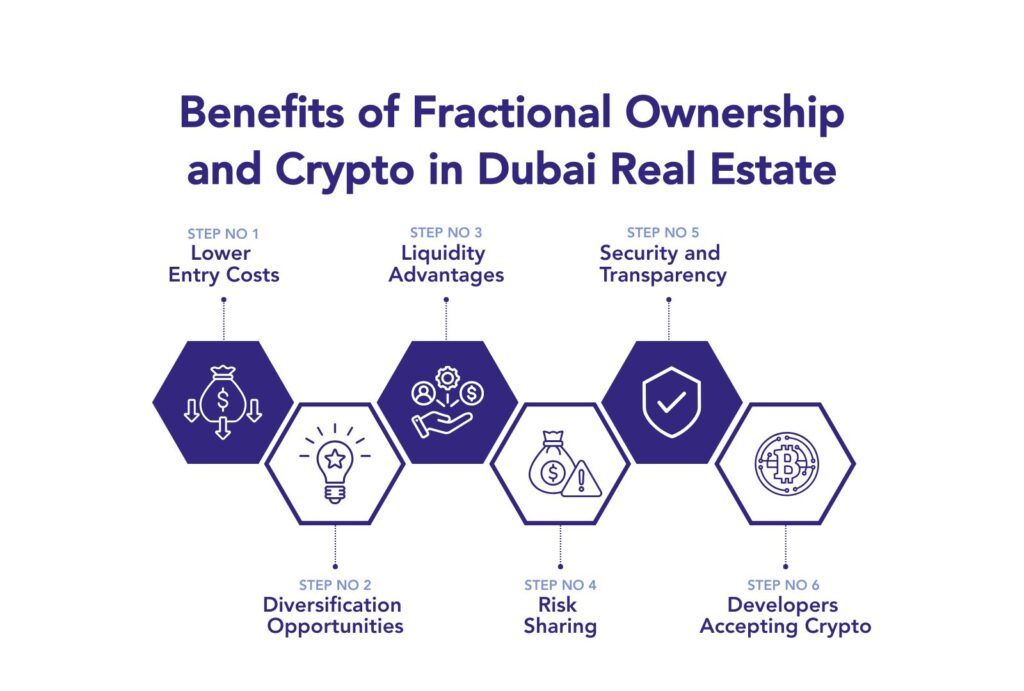
Benefits of Fractional Ownership and Crypto in Dubai Real Estate

Fractional ownership and cryptocurrency aren’t just trendy ideas. Together, they’re changing how people approach property in Dubai. What used to be a market reserved for the wealthy is now more open, flexible, and transparent. Here’s why investors are paying attention:

Lower Entry Costs

Luxury real estate in Dubai usually comes with a steep price tag. With Dubai fractional property investment, that barrier drops. Investors can purchase smaller shares instead of buying an entire villa or apartment, making crypto real estate in Dubai accessible to a wider audience than ever before.

Diversification Opportunities

Putting all your money into one property is risky. 


Fractional ownership makes it possible to spread investments across different types of assets. You might hold a piece of a high-rise apartment, a share in a commercial unit, and a fraction of a holiday home — building balance while exploring new opportunities.

Liquidity Advantages

Traditional real estate often ties up capital for years. Not anymore. Property shares can be traded or sold on secondary markets through tokenized real estate investment in Dubai. It’s like turning real estate into a more fluid, stock-like asset that gives investors flexibility when needed.

Risk Sharing

The costs and risks of buying prime property no longer fall on one buyer alone. With fractional ownership, multiple investors share the responsibility. It’s a more innovative way to manage exposure while tapping into Dubai’s high-growth property market.

Security and Transparency

Every transaction linked to blockchain real estate in Dubai is recorded on a secure digital ledger. This means there are no hidden terms, no unclear ownership, and no room for fraud. Investors know exactly what they own — and it’s recognized under Dubai’s regulatory framework.

Developers Accepting Crypto

The model isn’t just theory; it’s happening now. Several major developers already let buyers invest in Dubai real estate with crypto. That means faster payments, global accessibility, and fewer banking hurdles — making Dubai one of the world’s most forward-thinking property markets.

The Role of Tokenisation: Turning Properties into Digital Assets

The advantages of fractional ownership and crypto naturally lead to tokenisation — turning physical properties into digital assets. In Dubai, this is where the real disruption is happening.


Real estate tokenization in the UAE divides properties into digital tokens. Each token represents a fractional asset share, giving investors a legally recognized stake. It’s like owning stock in a company, but instead of shares in a business, you hold a slice of Dubai real estate.


This makes buying and selling smoother than ever. With tokenized real estate investment in Dubai, investors don’t need to deal with endless paperwork or months-long processes. Tokens can be transferred or sold quickly, bringing speed and flexibility to a once slow-moving market.


The real game changer is how it opens doors for global investors. Someone sitting in London, Mumbai, or Singapore can now hold a share in crypto real estate in Dubai with just a few clicks. Geography matters less, while opportunity spreads wider.


Platforms offering tokenised property assets are already active in Dubai. They make it possible to diversify portfolios and even buy property with cryptocurrency in Dubai directly, using secure, blockchain-backed systems. For many investors, this is the first time real estate feels as dynamic and borderless as the digital economy itself.

Latest Market Trends and Statistics (2024–2025)

Dubai’s property sector is moving fast, and the numbers prove it. The fractional property investment market in Dubai has grown into the billions of dirhams, reflecting just how popular shared ownership has become. For investors, it’s no longer just a niche option; instead, it’s one of the fastest-growing ways to access high-value assets with lower capital.


At the same time, crypto real estate in Dubai is no longer experimental. The number of property sales closed in cryptocurrency has jumped steadily, with developers and buyers embracing it. What was once a bold idea, to buy property with cryptocurrency in Dubai, has now become a genuine, trusted practice.


Demographics are shifting, too. A younger wave of investors, especially those familiar with blockchain and digital assets, is driving much of this change. They see blockchain real estate in Dubai not just as an investment but as part of their lifestyle. The international buyer pool continues to grow, with tokenisation making it far easier for overseas investors to get involved without the traditional red tape.


There are already examples of this model working at scale. Several tokenized real estate investment Dubai projects have been launched successfully, allowing everyday investors to own slices of premium developments that would otherwise be out of reach. These case studies build confidence and prove that tokenisation isn’t just a theory — it’s a practical tool for reshaping the market.


Looking ahead, analysts see this momentum aligning perfectly with the city’s vision. Predictions stretch to 2033, with Dubai’s Real Estate Strategy pointing toward a more digital, accessible, and globally integrated property market. Fractional ownership, tokenisation, and crypto transactions aren’t side trends anymore; they’re central pillars of where Dubai real estate is headed.

Challenges and Considerations for Investors

Fractional Ownership and Crypto: The Future of Real Estate Investment is in Dubai

The buzz around crypto real estate in Dubai and Dubai fractional property investment is hard to ignore. But as with any opportunity that looks this exciting, investors need to pause and look at the fine print.


Regulation comes first. Dubai has made strong progress with real estate tokenization in the UAE, but not every platform out there plays by the same rules. If a project isn’t backed by the Dubai Land Department blockchain framework or an approved operator, that’s a red flag worth noting.


Volatility is another reality check. Buying property with cryptocurrency in Dubai has clear perks—speed, security, and transparency, but crypto prices can shift in hours. If the value of your investment depends heavily on Bitcoin or Ethereum, you’ll want a strategy to manage that risk.


Then there’s the shared ownership side. Splitting a property means splitting the bills, too. Service charges, repairs, and upkeep don’t disappear because the asset has been tokenised. Good projects are usually built in professional management, so investors don’t get bogged down in day-to-day details.


Finally, trust, but verify. The rise of tokenized real estate investment in Dubai has brought serious players into the market, but also a few opportunists. Before sending money, check the property’s existence, ownership structure, and the platform’s security.


If you want to invest in Dubai real estate with crypto, the potential is huge—but only if you combine optimism with discipline. 


That balance is what separates winners from those who simply chase hype.

Step-by-Step Guide to Investing in Fractional Ownership with Crypto in Dubai

Getting started with crypto real estate in Dubai doesn’t have to feel complicated. Break it into clear steps, and the process becomes manageable, even for first-time investors.


Step 1: Define your goals


Before diving in, decide what you aim for with Dubai fractional property investment. Is it passive rental income, long-term appreciation, or exposure to a new asset class? Your goals will shape how much risk you take and which properties you target.


Step 2: Choose the right property and platform


Not all assets or platforms are created equal. Some focus on luxury residential, others on commercial or mixed-use spaces. Look for operators that follow real estate tokenization in the UAE standards, as these provide transparency and a clearer legal framework.


Step 3: Do your due diligence


This is where smart investors separate themselves from the crowd. Confirm that the property exists, ownership records are clean, and the Dubai Land Department blockchain backs the project. If a platform can’t provide clear answers, walk away.


Step 4: Decide how to fund


You can use traditional currency or buy property with cryptocurrency in Dubai through approved systems. Many investors choose a mix—crypto for speed and flexibility, fiat for stability. The good news is that most tokenisation platforms accept both.


Step 5: Manage and monitor


Once you’ve invested, don’t just forget about it. Track your rental yields, market performance, and token value. Platforms offering tokenized real estate investment in Dubai often have dashboards that make it easy to see how your stake is performing.


Step 6: Plan your exit


Liquidity is one of the most significant advantages here. You can invest in Dubai real estate with crypto and later sell your fractional shares on secondary markets, without waiting for the whole property to change hands. Having an exit plan ensures you stay flexible.

Future Outlook: The Evolution of Real Estate Investment in Dubai

The momentum around crypto real estate in Dubai and Dubai fractional property investment isn’t slowing down. If anything, the next decade looks set to accelerate the changes we’re already seeing today.


Blockchain is expected to be the backbone of this evolution. With stronger adoption of real estate tokenization in the UAE, investors may one day buy, sell, and trade fractional property shares as easily as stocks. The role of the Dubai Land Department blockchain will likely expand, ensuring every transaction is secure, transparent, and instantly verifiable.


Institutional players are also entering the picture. Banks, funds, and global investors are beginning to see tokenized real estate investment in Dubai not as a novelty but as a serious asset class. This shift could make liquidity deeper, platforms more reliable, and opportunities broader.


By 2040, the idea of fully digital ownership doesn’t sound far-fetched. Imagine an ecosystem where you buy property with cryptocurrency in Dubai, manage it through smart contracts, and exit via global secondary markets, all without touching a single piece of paperwork. That’s the vision taking shape.


For Dubai, the goal is clear: stay ahead of the curve. The city has already positioned itself as a leader in blockchain-backed innovation. If it continues on this path, anyone looking to invest in Dubai real estate with crypto will find a market that’s not just competitive but defining the global standard.

How ADEPTS Supports Investors in Fractional Ownership and Crypto Real Estate

For many investors, the real challenge isn’t spotting opportunities—it’s navigating them. That’s where ADEPTS comes in.


The firm’s strength is connecting clients with vetted platforms for Dubai fractional property investment and tokenized real estate investment. That kind of trusted access makes a big difference in a noisy market.


ADEPTS also helps investors understand how to buy property with cryptocurrency in Dubai while staying within the city’s regulatory framework. From compliance with real estate tokenization in the UAE laws to confirming integration with the Dubai Land Department blockchain, they ensure every move is legally sound.


But advisory isn’t just about rules—it’s also about strategy. ADEPTS tailors plans to each client’s goals, balancing growth potential with risk management. For some, that means diversifying across multiple assets; for others, it’s about maximizing returns from a single premium property.


In short, ADEPTS gives investors the tools and insights to confidently invest in Dubai real estate with crypto—without falling into the traps that often come with emerging markets and new technologies.

FAQs:

Yes. Foreign investors can take part in Dubai fractional property investment through regulated platforms. Many allow funding via fiat or crypto, making it easy to get started from anywhere in the world.

Dubai is known for its investor-friendly tax environment. There is no income tax or capital gains tax on tokenized real estate investment Dubai, though you should always confirm rules in your home country.

Owning a fraction means you hold a legally recognized share of the property. Depending on the agreement, this entitles you to rental income, profits, and in some cases, limited access to use the property.

Not all, but the number is growing. Some major developers now allow buyers to buy property with cryptocurrency in Dubai, reflecting the city’s push toward blockchain integration.

Platforms built on the Dubai Land Department blockchain and other licensed systems are highly secure, offering transparency and fraud protection. The key is to choose regulated operators and avoid unverified projects.

It varies by platform and property, but some opportunities start from as low as AED 500. This accessibility is one of the biggest advantages of real estate tokenization in the UAE.

Yes. Investors receive rental income proportional to their share of ownership, making crypto real estate in Dubai both an asset for appreciation and a source of passive income.

Yes. Many platforms now allow investors to trade fractional shares on secondary markets, giving them liquidity and flexibility to exit without selling the entire property.

ADEPTS provides advisory services that include valuation support, ensuring investors pay fair market value when entering Dubai fractional property investment deals.

Dubai’s regulatory framework is evolving, but protections are in place through the Dubai Land Department blockchain system and licensing requirements. Working with vetted platforms and advisors like ADEPTS adds another layer of security.

References

Related Articles​​

From "Uninvestable" to Unstoppable: How the UAE is Capturing Capital in Life Sciences and Tech

Once, the UAE wasn’t even on the map for global biotech and health tech investors. Too young. Too risky. Too far from traditional research hubs. 


Fast forward to today, and the country is pulling in record capital. 


From UAE life sciences investment 2025 to bold bets in technology, the shift is nothing short of dramatic.


Why does it matter? 


This surge isn’t just about money; it’s about economic diversification, global credibility, and a seat at the table in industries shaping humanity’s future. 


The UAE isn’t chasing trends; it’s building platforms that last.


This article takes you inside that transformation. We’ll track the capital flows, spotlight the rising hubs, and map how policy, innovation, and ambition have turned a once “uninvestable” market into an unstoppable one.

UAE’s Vision and Strategic Framework for Life Sciences and Tech

The UAE isn’t growing by chance. 


It’s growing by design. The “We the UAE 2031” vision and the Operation 300Bn industrial strategy set a clear roadmap: diversify beyond oil, and lead in knowledge-driven industries.


Life sciences and technology are right at the center of that play.


Government support is more than just words. R&D grants, patent protections, and investor-friendly rules are pulling in global partners. Government incentives for UAE life sciences have been a turning point, lowering barriers and making the market far more attractive.


The Emirates Drug Establishment (EDE) is a key player in this push. Its mandate is simple: regulate with speed, ensure quality, and enable global-standard clinical trials. That efficiency matters to investors and startups alike.


The incentives don’t stop there. Full tax exemptions, 100% foreign ownership, and specialized UAE free zones for biotech give founders and funds the freedom to scale. This means fertile ground for biotech, health tech, and pharma ventures to grow without friction.

Life Sciences Sector Expansion in the UAE

Biotech is no longer a side note in the UAE. It’s becoming a pillar.


Abu Dhabi is shaping into a powerhouse with specialized research parks and talent pipelines. The capital is branding itself as the Abu Dhabi life sciences hub, designed to attract global players. Dubai is adding fuel on the commercial side, with strong Dubai tech sector funding that supports health tech and biotech startups.


Inside these clusters, the focus is sharp. Vaccine development centers are scaling. Biosimilar manufacturing is gaining ground. Rare disease research is pulling in partnerships, since it offers scientific prestige and market potential. This signals real UAE biotech funding growth, not just policy talk.


The clinical trials of the UAE ecosystem are also maturing. Faster approvals, cross-border collaborations, and joint studies with leading pharma companies are boosting credibility. For investors, that means lower risk and faster pathways to market.


Next comes precision. Genomics labs and personalized medicine startups are surfacing, aligned with the country’s push for healthcare innovation, UAE 2025. From gene sequencing to AI-powered diagnostics, the UAE wants to provide tailored treatments to individuals.


But challenges remain. Regulations are improving, yet they’re still not as streamlined as in global hubs like Boston or Singapore. That gap matters, but the direction is clear: the UAE is closing it faster than anyone expected.

Technology Sector Growth and Capital Inflows

From "Uninvestable" to Unstoppable: How the UAE is Capturing Capital in Life Sciences and Tech

The numbers tell the story. 


In the first quarter of 2025 alone, UAE tech firms raised $872 million. That’s a 194% increase year-on-year. The scale of growth shows that capital isn’t trickling in anymore — it’s pouring.


Are you wondering where the money is going? It’s going straight into the fastest-growing sectors of the decade. 


Artificial intelligence is leading the pack, with fintech and cloud computing close behind. 


Add health tech and blockchain, and you have an ecosystem that looks nothing like it did five years ago. Unsurprisingly, UAE health tech startups’ investment is rising in lockstep with UAE biotech funding growth.


Deals are getting bigger, too. Mega rounds and late-stage funding are shaping serious regional champions. Startups that once fought for seed checks are now closing $100 million-plus deals. Dubai tech sector funding is a big part of this shift, giving the city a stronger role as the commercial engine of innovation. 


Meanwhile, Abu Dhabi continues positioning itself as the scientific anchor through the Abu Dhabi life sciences hub, connecting tech with deep research.


Policy is also doing its part. 


Digital transformation projects and smart city initiatives are backed by serious capital. Government incentives for UAE life sciences work hand in hand with broader tech policies, ensuring that innovation is both funded and protected. That’s also where UAE life sciences investment 2025 overlaps with the wider tech play — the two sectors are no longer separate worlds.


What ties it all together is vision. The drive toward healthcare innovation, UAE 2025, sits right beside AI, fintech, and blockchain. Together, they form a national tech narrative that attracts capital, talent, and global attention.

Venture Capital and Investment Landscape in Life Sciences and Tech

Capital is the lifeblood of innovation, and the UAE has no shortage of it. Heavyweights like ADQ, JIMCO, Mubadala, and Ultreum Capital are writing some of the biggest checks. Sovereign wealth funds play a central role, anchoring confidence and pulling in private capital alongside them.


What’s new is the global attention. International funds that once overlooked the region are now circling back. They’re drawn by the UAE life sciences investment 2025 and the rapid scaling of AI, fintech, and digital platforms. The result is a mix of deep-science bets and quick-scale tech plays.


The appetite for UAE health tech startups’ investment is especially strong. These ventures intersect with healthcare and software, a sweet spot that makes sense for regional and global VCs. 


But not all capital flows evenly. Biotech still carries a higher risk, longer timelines, and tougher regulations. That’s where UAE biotech funding growth depends heavily on patient investors and government incentives for UAE life sciences. Tech, by contrast, enjoys faster exits and broader pools of venture money.


Stage by stage, the ecosystem is diversifying. Seed and early-stage rounds are now supported by accelerators and angel networks. Growth and late-stage deals, often crossing the $100 million mark, are dominated by sovereign funds and large institutions. 


And while Dubai tech sector funding tends to favor fast-scaling startups, the Abu Dhabi life sciences hub is drawing capital for longer-horizon science ventures.


Together, these flows shape a balanced market. Quick wins in tech keep liquidity high, while strategic plays in life sciences position the UAE for the long game. Both are necessary, and both are happening now.

Infrastructure and Ecosystem Enablers

Innovation needs a home, and the UAE is building plenty of them. 


Masdar City, Dubai Science Park, and the Abu Dhabi life sciences hub are more than just office complexes — they’re designed as ecosystems. Inside them, startups and multinationals share space, resources, and talent.


The facilities are modern and flexible. Wet labs for biotech research sit next to co-working areas for software teams. Scaleups can plug into advanced manufacturing lines or shift into larger offices without leaving the zone. This kind of adaptability matters when capital is moving fast, whether in the Dubai tech sector funding or in the UAE biotech funding growth.


Location is another advantage. The UAE’s logistics network makes it easy to reach markets in Asia, Africa, and Europe within hours. That reach helps both digital startups and pharma companies testing products in clinical trials UAE.


Free zones are the final piece of the puzzle. By offering tax breaks, 100% foreign ownership, and targeted packages, they’ve become magnets for specialized firms. For biotech, that means less friction in scaling research. 


For tech, it means a smoother path to global expansion. Together, they form the backbone that supports healthcare innovation, UAE 2025, and the broader vision for a knowledge-driven economy.

Regulatory Framework and Compliance Landscape

From "Uninvestable" to Unstoppable: How the UAE is Capturing Capital in Life Sciences and Tech

Rules matter just as much as capital. In life sciences, they often matter more.


The UAE has built a regulatory backbone to keep pace with its ambitions. Product approvals, clinical trials in the UAE, and medical device licensing are governed by federal law but also by emirate-level bodies. 


MOHAP handles national oversight, while the Dubai Health Authority and Abu Dhabi’s Department of Health shape local frameworks.


One big shift is digitalization. Registration, licensing, and approval processes are moving online, cutting down timelines that once discouraged investors. For startups chasing UAE health tech startups’ investment, that speed can be the difference between scaling locally and looking abroad.


There’s also an effort to close the gap with global hubs. Authorities are working to align with FDA and EMA standards, making UAE-based studies more credible internationally. This directly supports the UAE life sciences investment 2025, as global pharma companies weigh the country as a base for R&D.


Challenges remain. Regulations are improving, but they still lack the clarity and predictability of Boston, Singapore, or Zurich. Even so, Government incentives for UAE life sciences and faster pathways are helping build confidence. The more predictable the system becomes, the easier it will be to anchor long-term bets in both biotech and tech.

Growth Drivers and Innovation Trends

Money alone doesn’t build an industry. Ideas do. And in the UAE, the ideas are big.


AI is already reshaping medicine in the UAE. Hospitals are using algorithms to read scans, and researchers are testing machine learning in early drug discovery. That isn’t a future promise — it’s happening now, and it is one reason investors are piling into UAE health tech startups.


Telehealth tells a similar story. What started as a pandemic stopgap has become a permanent fixture of the healthcare system. Patients like the convenience, providers like the efficiency, and policymakers see it as a way to expand reach without building more hospitals. It fits squarely into healthcare innovation, UAE 2025, where digital-first care is treated as standard, not experimental.


Hardware hasn’t been left behind, either. Advanced diagnostic tools and medical devices are drawing fresh money. Local manufacturing is picking up, supported by government incentives for UAE life sciences and tied to a broader push for UAE biotech funding growth. For the UAE, this is as much about independence as economics — fewer imports, more local production.


Collaboration is the final piece. The Abu Dhabi life sciences hub is one example: researchers, universities, and private companies all working under the same roof. Pair that with the flow of Dubai tech sector funding, and you get an ecosystem where science can turn into startups, and startups can turn into scaleups.


That combination — AI, telehealth, hardware, collaboration — is driving the momentum. The UAE life sciences investment 2025 looks less like a gamble and more like a calculated bet with global upside.

Challenges and Risks for Investors and Startups

The UAE story is exciting, but it isn’t risk-free. 


Investors and founders know that already.


Life sciences require a lot of capital. Setting up labs, running trials, and navigating approvals takes years. Returns don’t come fast, which makes the sector harder to finance than software. That’s why, even with strong UAE life sciences investment in 2025, capital often leans toward shorter-term bets in fintech or cloud instead of biotech.


Local VC funding for medtech and biotech is still thin. While Dubai tech sector funding keeps flowing, only a handful of investors specialize in life sciences. Most heavy lifting still comes from sovereign wealth funds or global players. For startups, that means fewer local partners who truly understand their timelines and risks.


Talent is another gap. Scientists, regulatory experts, and senior biotech executives are in demand, but the pipeline inside the country is small. The Abu Dhabi life sciences hub and universities are working to change that, but it takes time to build human capital at scale.


And then there are the rules. While Government incentives for UAE life sciences have lowered barriers, regulatory processes still lag behind global hubs like Boston or Singapore. Market entry takes longer. Approvals can be less predictable. For some investors, that uncertainty is still a sticking point.


The risks don’t erase the opportunity, but they do shape it. Anyone betting on biotech or health tech here needs patience, deep pockets, and the right partners. Without those, the odds get steep fast.

Future Outlook and Investment Predictions

The UAE’s next chapter looks even bigger than the one we’re in now.


Funding in life sciences and tech is expected to keep climbing between 2026 and 2030. Sovereign funds will remain the anchor, but more international VCs are likely to follow. The attraction is obvious: UAE life sciences investment 2025 has already proven there’s momentum, and the country’s tech ecosystem is maturing fast.


Policy will adapt too. Expect more targeted government incentives for UAE life sciences, not just broad tax breaks. Faster approvals for clinical trials UAE, streamlined digital licensing, and grants tied to innovation benchmarks are all on the table. 


The point is simple: keep the pipeline moving and the capital flowing.


The long-term bet is positioning. If current trends hold, the UAE could emerge as a global hub for biotech and digital health. Healthcare innovation, UAE 2025, is only a starting point. Precision medicine, AI-driven drug discovery, and large-scale data platforms could push the country into the same conversation as Boston, Singapore, and Basel.


Partnerships will be critical. International pharma firms, big tech, and academic institutions are already testing the waters. Public-private collaborations anchored in places like the Abu Dhabi life sciences hub and fueled by Dubai tech sector funding will decide how fast the UAE gets to global scale.


The outlook isn’t guaranteed, but the direction is clear. With capital, policy, and global attention aligned, the UAE has a shot at turning ambition into permanence. And if that happens, the “unstoppable” label won’t be an exaggeration.

ADEPTS’ Role in Supporting UAE’s Life Sciences and Tech Ecosystem

ADEPTS sits at the intersection of capital and innovation. The firm specializes in guiding SMEs and startups through the financial side of growth, with a sharp focus on healthcare, technology, and other innovation-led sectors.


Its services go beyond basic advisory. From capital structuring and compliance support to audit readiness and strategic funding, ADEPTS helps young companies stay investor-ready while avoiding costly missteps.


Life sciences and tech ventures face unique hurdles — long R&D cycles, complex regulations, and demanding investors. ADEPTS helps founders navigate these challenges by combining financial expertise with sectoral insight. The result is faster fundraising, smoother regulatory journeys, and stronger positioning for scale.

Conclusion

A few years ago, global investors barely glanced at the UAE’s life sciences and tech sectors. They were too small, too risky, and not worth the bet. 


That story is over. 


Today, the UAE is raising serious capital, attracting world-class partners, and building clusters that can compete with established hubs.


For founders, this isn’t theory anymore — the funding, the labs, the support networks are right here. For investors, the region offers what few markets can: scale, government backing, and a shot at outsized returns in fields like biotech, digital health, and AI. 


And firms like ADEPTS are helping both sides meet in the middle, making sure young companies are ready to raise and grow without stumbling on regulation or structure.


The shift from “uninvestable” to “unstoppable” didn’t happen by chance. It happened because the UAE committed to it. 


The next move belongs to the people who see the opportunity and decide to act.

FAQs:

The UAE combines 100% foreign ownership, tax-free structures, and fast-track licensing in dedicated free zones. Unlike many markets, these incentives are paired with direct government funding programs and sovereign wealth participation. That blend is rare and attractive.

ADEPTS takes a sector-specific approach. For tech startups, the focus is on scaling quickly, structuring capital efficiently, and investor readiness. For life sciences, the work goes deeper into regulatory compliance, audit preparation, and structuring to handle long R&D timelines.

Long ROI cycles, high capital needs, and regulatory differences compared to the US or EU. Investors should also watch for talent shortages in specialized fields like biotech.

Yes. Abu Dhabi and Dubai have science-focused clusters such as Dubai Science Park and the Abu Dhabi life sciences hub. They offer lab-ready infrastructure, clinical trial support, and tailored licensing. Tech free zones lean more toward digital infrastructure, co-working spaces, and smart city integration.

It’s improving fast. The system is digitalized, approvals are getting faster, and international pharma companies are running trials here. Still, it’s not yet as streamlined as the US FDA or EMA frameworks.

Early-stage and growth-stage rounds. Seed activity is steady, but the biggest jump has been in Series A and Series B deals, thanks to sovereign wealth funds and larger foreign VCs entering the market.

They’re cautious with life sciences — bigger checks, longer horizons. Tech gets more volume because of quicker turnaround and exits. But sovereign-backed funds are deliberately pushing money into both to build balance.

AI is being used in diagnostics, drug discovery, and genomics research. It’s also embedded in hospital systems to improve patient outcomes. In short, it’s both a research accelerator and a healthcare delivery tool.

Work with advisors who know the local system, like ADEPTS, and build compliance into the business plan from day one. Don’t treat regulation as an afterthought — it’s central to scaling.

The UAE leans heavily on global partnerships, sovereign fund involvement, and specialized free zones. Others in the region are investing too, but the UAE’s mix of infrastructure, policy, and speed of execution sets it apart.

References

Related Articles​​

UAE to Implement Tiered Sugar Content-Based Excise Tax on Beverages from January 2026

Dubai, October 2025 – The UAE is changing how it taxes sugary drinks.


From January 1, 2026, the excise tax will no longer be a flat 50%. It will depend on how much sugar a drink actually contains.


The Ministry of Finance confirmed this week that the new model i.e. a tiered, sugar-based excise system is now written into national legislation. It aligns with the GCC’s unified approach, where countries are adopting a more refined, content-driven method for taxing sweetened beverages.


For businesses, that means a fresh layer of compliance. Knowing which products fall into which tax tier and how to claim deductions on previously taxed stock will take careful planning. ADEPTS tax advisory team guides UAE businesses through new excise frameworks, helping you classify products correctly, avoid overpayments, and stay fully compliant when the new system kicks in.

From Flat to Flexible

Since 2017, the UAE has taxed all sugar-sweetened drinks at a single 50% rate. Simple, yes, but it treated all drinks the same. A lightly sweetened iced tea paid as much tax as a can loaded with 10 teaspoons of sugar.


This new tax update is all set to change that.  From 2026, rates will be tiered by sugar concentration in drinks which will be measured per 100 millilitres. More sugar, more tax. Less sugar, less tax. It is that simple.


The goal is very clear here: push manufacturers to cut sugar and give consumers a price signal to choose better options. It’s also about precision. The new model connects health policy with fiscal logic, encouraging reformulation instead of blanket taxation.

Key Features of the Legislative Amendments

The Ministry says the legal amendments build a full framework for this shift. The Federal Tax Authority (FTA) will run the rollout and publish detailed guidance next year.

Graduated Tax Brackets

The old 50% flat rate? Gone. In its place come graduated tax brackets based on actual sugar or sweetener levels. Businesses will have to measure, label, and report those figures accurately. This will result in more accurate measuring and more thought being poured into cutting sugar content.

Deduction Rule

The update also introduces a deduction rule for unsold stock. If a company paid the old 50% tax before 2026, and that same product now qualifies for a lower rate, they can claim back part of the difference. Fair play, especially for large distributors holding inventory into the new year.


The intent is simple: prevent double taxation and make the transition clean.

Implications for Businesses

For producers and importers, this isn’t just a number change. It’s an operational one.


Sugar levels now matter and they must be tested, verified, and documented. Manufacturers will likely need certified lab results. Importers must ensure their suppliers’ labels and product data meet UAE standards.


Pricing will also need a rethink. Some products could face higher rates; others might get relief. Finance teams will need to model margins again under the new brackets. This tax will bring about quite a few noticeable changes in the prices of drinks. 


At the same time, it is quite revolutionary in terms of public health. Brands now have incentive to cut on sugar. Those that cut sugar or launch healthier variants will gain both tax and market advantages. We’ve seen this pattern elsewhere – reformulation first, innovation next.


Still, adjustment takes time. That’s why the early notice matters. With more than a year before rollout, companies have a clear runway to adapt.

Public Health and Economic Objectives

This isn’t just a fiscal reform. It’s public health policy in action.


The Ministry says the change supports the UAE’s long-term wellness goals i.e. reducing sugar intake, curbing obesity, and addressing lifestyle-related diseases. By tying tax directly to sugar, the system rewards better choices rather than just penalizing consumption. Manufacturers will feel a push towards less sugar which means better health in general. 


Globally, the World Health Organization supports these models. Countries using tiered sugar taxes often see both lower sugar content and stable tax revenues.


Economically, the UAE’s approach is pragmatic. It fine-tunes the tax base while keeping the system efficient. It also reduces distortions that come from one-size-fits-all rates.


That balance between fiscal strength and public health is what the reform is designed to deliver.

Impacts for Consumers

Your soft drink shelf is going to change for good now. The classic, high-sugar sodas and energy drinks? Rethink or expect a price hike. Mid-sugar ones might hold steady. And the “zero” or low-sugar cans? They’ll probably become the cheaper pick.


This tax will not only shift manufacturers’ concerns but it will also help change habits for the people in the long run. Families who fill their carts with juices and fizzy drinks each week will start spotting small savings when they choose the lighter versions. Things can start changing in just a few months. 


Retailers and distributors will feel the ripple too. The new rules let businesses reclaim part of the old 50% tax on any unsold stock that ends up in a lower tax bracket. It’s a fair cushion. But there’s still work ahead – relabeling shelves, reclassifying goods, and updating systems to track the new sugar-based tiers.

Regional Coordination

The UAE isn’t moving alone. The GCC Unified Excise Tax Agreement aims to align member states on how they treat sugar-sweetened drinks. The UAE’s amendments fit right into that framework.


For multinational beverage companies, harmonization means fewer inconsistencies between markets. Less paperwork. Fewer tax surprises. It is more about building a culture of health.


And for regulators, it strengthens oversight. Shared rules make it easier to compare data, track imports, and manage cross-border enforcement.


That’s the bigger picture – a more connected regional tax environment.

Government’s Direction

The Ministry described the reform as part of its work to keep the UAE’s tax system modern and adaptable. Clear. Predictable. Transparent. It’s not just about this one policy. It’s about building trust and showing that the system evolves with logic, consultation, and foresight.


The FTA will soon release detailed implementation guides, including sugar testing methods and reporting formats. Industry workshops are expected in 2025 to help businesses prepare.


January 1, 2026, is the go-live date. No extensions mentioned. Businesses that plan early, test products, update records, train staff, will be ready. Those who wait will scramble.

The Bigger Impact

For consumers, prices may start to reflect sugar content more directly. A higher-sugar soda could cost more than a lightly sweetened drink from the same brand. That’s intentional – the tax design encourages better choices through pricing, not prohibition.


For businesses, it’s a nudge to innovate. Reformulated beverages, alternative sweeteners, and transparent labelling could all gain traction under the new regime.


And for the UAE, the reform fits a pattern: precision over simplicity, health over habit, and alignment over isolation.


The tax is small in scope but large in signal. It shows how the UAE continues to link economic policy with long-term social goals.

Related Articles​​

Updated Guide on VAT Input Tax Apportionment in the UAE: Key Changes for 2025

The Federal Tax Authority (FTA) on September 30, 2025, released an updated guide on Input Tax Apportionment under UAE VAT. The document refines how businesses calculate and report partially recoverable input tax, particularly those involved in both taxable and exempt activities. It builds on the framework introduced in 2018 and clarifies the use of the Specified Recovery Percentage (SRP) method, which became effective in November 2024.

Overview

Input tax apportionment isn’t new, but it remains one of the most technical VAT areas in the UAE. For sectors such as banking, healthcare, and real estate, getting the calculation wrong can distort VAT recoveries for years.


The FTA’s latest update seeks to align practices and reduce uncertainty. It gives businesses a clearer roadmap on how to determine recoverable input VAT while tightening documentation expectations. That balance, clarity with control, is at the heart of the new guidance.

Understanding Input Tax and Its Recovery

Under UAE VAT Law, input tax is the VAT a business pays on goods and services it buys for commercial use. Businesses can reclaim this tax if certain conditions are met: a valid tax invoice, the intent to pay the supplier, and use in a taxable business activity.


Some costs are fully recoverable. Others linked to exempt activities like residential leasing or specific financial services are not. Many fall in between. These “mixed-use” expenses need proportional allocation. That’s where apportionment comes in, and that’s where most confusion happens.

What Input Tax Apportionment Means

When a business earns both taxable and exempt revenue, it can’t claim back every dirham of input VAT. Instead, it applies an apportionment method to calculate the recoverable portion.


In practice, this means spreading VAT costs between activities – often based on how much of the total income each side generates. Overheads such as rent, utilities, and administrative costs are common examples where this rule applies.

Standard Apportionment Method

The FTA guide reaffirms the standard pro-rata method as the default approach. It’s a straightforward ratio: 


taxable supplies divided by total supplies. Multiply that percentage by your shared input VAT, and you get your recoverable amount.


Simple on paper. But in reality, timing differences, credit notes, and exempt adjustments can complicate things fast. That’s why the annual reconciliation remains essential. It corrects the provisional figures used throughout the year and ensures accurate reporting.

Specified Recovery Percentage (SRP) Method

The SRP method, introduced in November 2024, gets a fuller explanation in this update. It allows eligible businesses to apply a fixed recovery percentage based on the prior year’s actual apportionment, but only after obtaining FTA approval.


For many businesses, this approach cuts down the monthly calculation burden. It’s useful where income patterns remain consistent year to year, such as in established financial or education institutions.


The trade-off? Once approved, the SRP must reflect reality. If a company’s operations shift or new revenue streams emerge, it needs to inform the FTA and possibly reapply. That clarity helps both auditors and finance teams.

Application Timelines and Adjustments

Apportionment adjustments continue to pass through periodic VAT returns, followed by a mandatory annual reconciliation at the end of each tax year. The updated FTA guide sets out clearer timing and reporting expectations for these reviews.


Key timelines and requirements include:

  • Annual reconciliation: Must be completed within four months after the end of the financial year.

  • Reporting adjustments: The final recovery percentage should be reflected in the first VAT return following that reconciliation.

  • Business changes: Any material change in business activity — for example, adding an exempt supply or closing a taxable line — must be reported to the FTA within the specified limit.

  • SRP reviews: Entities using the Specified Recovery Percentage (SRP) method must reapply or seek reapproval if actual recovery rates deviate significantly from the fixed rate.

In practice, this means businesses can’t wait until year-end to reconcile. Mid-year checks help identify recovery variances early and prevent compliance gaps.


Missing the four-month reconciliation window or delaying FTA notifications can result in administrative penalties and interest adjustments. It’s not just about compliance; these deadlines directly affect cash flow and audit readiness.

Special Apportionment Methods

Some operations are too complex for standard ratios. The updated guide recognizes this and allows special apportionment methods where the normal pro-rata approach doesn’t reflect actual business use.


Approved alternatives include:

  • Outputs-based method: Calculates recoverable input VAT according to the value of taxable outputs rather than total supplies. It suits businesses where sales values better reflect resource use.

  • Transaction-count method: Uses the number of taxable versus total transactions to determine recovery. Common in service industries with high transaction volumes but small margins.

  • Sectoral method: Applies separate recovery rates for different business divisions. Financial institutions and conglomerates often use this where activities vary significantly across departments.

  • Floorspace method: Allocates input VAT based on the physical area used for taxable versus exempt activities – practical for retail, real estate, and mixed-use facilities.

On the other hand, these options aren’t automatic. Businesses must demonstrate to the FTA that the chosen method produces a fairer and more representative result than the standard formula. The approval process involves detailed justification, supporting calculations, and documentation and not just a preference for convenience.


That balance between flexibility and control is deliberate. It allows businesses with complex models to recover input VAT fairly, while ensuring consistency across the system.

Practical Compliance Guidance

The FTA’s message is consistent: keep evidence and stay organized. Working papers showing how each calculation was made should be readily available. So should supporting records that explain assumptions or adjustments.


This may sound simple, but it’s easy to overlook. Many disputes arise from missing internal documentation rather than incorrect math.


Regular internal reviews can also help identify shifts in business use before they trigger compliance issues. For growing companies, this kind of proactive review matters more than ever.

Impact on UAE Businesses

The update brings both relief and responsibility. It provides clearer direction, yet expects stronger compliance control. Businesses can now choose simpler methods like SRP but must also prove they use them correctly.


For finance teams, the immediate challenge lies in adapting accounting systems to capture taxable and exempt use more precisely. For auditors, the revised framework should lead to more consistent treatment across sectors.

Outlook

The 2025 update continues the FTA’s move toward data-driven VAT supervision. It aims to streamline compliance for consistent taxpayers while tightening oversight where recovery patterns deviate.


Businesses should take this as an opportunity to review their current apportionment methods before year-end. Those operating across mixed sectors – especially financial, education, or real estate – will feel the most impact.

References

Related Articles​​

The New Playbook for Private Equity: How Funds are Targeting MENA's Growth Sectors

Private equity has changed its game plan in the Middle East. Gone are the days of chasing dozens of small deals. In 2025, funds are placing fewer but much larger bets. They’re focusing on sectors tied to long-term growth, not quick wins. 


Saudi Arabia and the UAE are in the spotlight. Governments are pushing diversification. The idea is to end sole reliance on oil. Sovereign wealth funds and family offices are pouring in capital. These changes are attracting global players. The field is all set for business growth. Mergers and acquisition are on the rise. 


For business owners, this matters. The question is simple: which sectors are getting the money, and how can you position your business?

Private Equity in MENA, 2025

Private equity is showing favorable trends in the region. That means the economy is now betting for massive projects. Here are some statistics that back the aforementioned claims:

  • Deal count in the first half of 2025 fell by nearly 40%.

  • But total deal value only dropped around 10%.

  • Almost a third of all transactions were in the half-billion to billion-dollar range.

Saudi Arabia took nearly half of the activity by volume, while the UAE remained the key entry point for cross-border investors. Dubai still hosts the structures, the holding companies, and many of the international fund offices.


This concentration signals a new phase. The region is no longer a side bet for private equity. It is becoming a main stage actually. The strong legal structure, enhanced governmental funding, and fair taxation system are all attracting big business names from all over the world. 

Why MENA’s Diversification Drive Matters

Economic diversification is ruling both economies. They were both predominantly oil based economies. The new economic agenda is based on ending the oil dependency and economic diversification. 

  • Saudi Vision 2030 is reshaping entire industries.

  • The UAE is investing heavily in AI, clean energy, logistics, and education.

  • Egypt is opening more sectors to private capital.

This government push creates investments and a fair playing field for businesses. There is certainty in the market. Investors like predictability, and when a state signals it wants a sector to grow, capital follows. When investors see their money is safe in a place and there is room for growth, they rush to the site. This is what’s happening in the UAE.


Plus, Saudi Arabia and UAE are backing sustainable energy, AI, Green technology, and other such new technologies. This is attracting even more investors because they see innovation in it. They see a new world in the making and they are rushing to have their share here. 


For example, clean energy isn’t just an environmental move, it’s a trillion-dollar investment agenda across MENA. Healthcare demand is exploding with population growth. Digital transformation is on every regulator’s priority list.


Private equity is stepping in as the accelerator. It takes policy intent and turns it into funded companies, operating at scale.

The Role of Private Equity

The New Playbook for Private Equity: How Funds are Targeting MENA's Growth Sectors

Private equity is patient capital. It brings more than money. It starts processes that churn money. It takes time but it explodes with time. Funds restructure businesses, professionalize governance, and expand operations. These policy shifts create growth engines.


In MENA, that’s critical. Many sectors are young or fragmented. PE can consolidate, inject expertise, and position businesses for IPOs or strategic sales. Governments set ambitious goals. Private equity turns those ambitions into investable realities.

The Strategic Shift

It is not just simple mergers and acquisitions or private equity deals, some notable changes are happening here:

From volume to value

Private equity in MENA is moving away from scattergun strategies. Deals under $50 million are becoming rare. Larger, conviction-driven investments dominate.


This means higher barriers for businesses. Funds are selective. They want companies with scale, strong management, and room for regional growth.

Syndication and co-investment

Big deals now often involve multiple investors. Family offices, sovereign wealth funds, and international players team up.


For business owners, this opens doors. A company can raise larger sums without relying on a single backer. But it also raises the bar—governance, compliance, and performance must satisfy multiple investors.

New partnership models

The old “2 and 20” fee model is losing ground. Limited partners want more financial and structural flexibility and alignment. Funds are responding with tailored structures.


That shift makes the ecosystem more collaborative, less rigid. It’s another sign of maturity.

Key Growth Sectors

The Governments are intentionally and quite ambitiously trying to break free from economic oil dependence. This is done by investing in various new technologies and industries. Here are some sectors that are receiving a lot of attention from government in the UAE:

Technology and Digital Transformation

Data centers, cloud platforms, and AI infrastructure are hot. Demand for digital services is booming, and governments are treating digital transformation as critical.


Fintech is also drawing attention. Payments, embedded finance, and cross-border solutions are expanding fast in the UAE and Saudi Arabia. For funds, these are scalable, high-margin plays.

Energy Transition and Infrastructure

Renewables are now central to national agendas. Funds are backing solar, wind, and hydrogen projects, as well as utilities modernizing grids. It is happening all over the Emirates. The UAE is funding research as well as professionals of the field from all over the world. Consciousness is rising and businesses are generally moving towards utilizing renewable resources.


UAE is joining the world in its quest for renewable resources maximum utilization. These aren’t speculative bets. They’re real projects backed by the government.

Healthcare and Education

Healthcare demand is rising with population growth and lifestyle shifts. Education, especially private and vocational, is expanding under government reform. Both sectors are attractive for private equity: recurring revenues, predictable demand, and consolidation opportunities.

Consumer and Retail

E-commerce continues to expand. Consumer habits are shifting online, and PE funds are looking at scalable platforms, not just traditional retail.


This space is competitive, but businesses with strong brands or regional logistics capacity can stand out.

Logistics and Supply Chain

The UAE’s role as a global hub makes logistics a natural target. From ports to last-mile delivery, funds see opportunities in efficiency and digital integration.

Market Drivers and Enablers

Private equity in MENA isn’t running on hope. It demands consistent funding and It’s powered by deep pools of capital and deliberate policy moves.

  • Sovereign wealth funds set the pace. Abu Dhabi’s ADIA and Saudi’s PIF aren’t just investors. They anchor deals, draw in global partners, and give confidence that projects will scale.

  • Family offices are stepping up. Wealth that once sat in real estate or public markets is now chasing private equity. Allocations are rising, and many are backing regional champions directly.

  • Government agendas open doors. Vision 2030 in Saudi and Dubai’s D33 Agenda aren’t slogans. They are pipelines of projects from clean energy to logistics that private equity can’t ignore.

  • Rules are changing for the better. Regulatory reforms are cutting red tape, making exits cleaner, and giving investors more transparency than ever.

Put together, these forces create a rare mix: plenty of capital, clear policy direction, and improving market infrastructure. That’s why private equity is circling the region more seriously than before.

Challenges and Risks

There is momentum in the market. There is funding flowing from the government but there are many challenges too:

  • Corporate tax changes the game. The UAE’s 9% tax may look low globally, but it adds new layers to fund structures and exit planning. Deals now need sharper tax advice. This is why businesses need specialised mergers and acquisitions exit strategies from professionals of the field so the tax card is played compliantly and smartly.

  • Politics can’t be ignored. Geopolitical tensions don’t always hit the headlines, but they remain a factor every cross-border deal team has to model.

  • Due diligence matters more than ever. Fast-growing sectors like fintech or education can look dazzling on the surface, but governance and compliance gaps are common. Investors who don’t dig deep risk buying trouble.

The region rewards ambition. But it punishes shortcuts. Legal Compliance is very important. That’s the balance private equity players and business owners seeking their backing have to respect.

How Funds Position for Success

Not all funds are achieving the same results. Some are gaining more while others are stuck. There are some similarities in the winning side that can give direction to the newcomers. Here the notable similarities:

  • They back scale-ready SMEs. Not every company qualifies. Investors want businesses with proven models, strong management, and the ability to expand beyond their home market.

  • They treat ESG as core. Environmental and social performance isn’t a side checkbox anymore. Funds are building ESG metrics into valuations and exit strategies.

  • They use data, not guesswork. Advanced analytics helps them find deals earlier, benchmark operations, and create value faster once they buy in. AI backed new technologies are changing the game for businesses.

For business owners, the message is simple: if you want private equity at your table, build with these same priorities. Growth potential, responsible practices, and tech-driven efficiency are no longer “nice to have.” They are entry tickets.

Outlook Beyond 2025

With this background, the PE streak is only expected to grow in the coming years. This marks a huge potential for big businesses, big funds. Money in the UAE and Saudi Arabia now knows a new direction where it will only grow beyond bounds. Here is what is expected for future:

  • More capital will flow into tech and energy transition.

  • ESG will be non-negotiable.

  • Innovation funds and direct investments will rise.

The region’s private equity market will look less like “emerging” and more like a core allocation for global LPs. The coming years are going to be very exciting.

ADEPTS’ Role in Private Equity Advisory

For funds and businesses, execution matters as much as strategy. This is where expert advisory makes the difference.


ADEPTS supports clients with:

Private equity is about conviction and precision. ADEPTS helps deliver both.

Conclusion

MENA private equity is in a new phase. Fewer deals, bigger bets, sharper focus.


For business owners, that means opportunity if you’re in the right sector with the right structure. For funds, it means aligning with governments, sovereign wealth funds, and long-term growth themes.


The playbook has changed. Those who adapt will lead.

FAQs:

PE invests in more mature businesses, often with established revenues. Venture capital backs earlier-stage startups.

It influences fund structures, profit distribution, and exit planning. Good tax planning is critical.

Technology, renewable energy, healthcare, education, and logistics are leading.

They often anchor deals, provide credibility, and crowd in more investors.

It’s now a requirement. Many investors won’t back deals that ignore ESG.

They allow bigger transactions, spread risk, and add complementary expertise.

Corporate structuring, transfer pricing, and compliance with new reporting standards are top concerns.

Funds use data to find opportunities faster and monitor portfolio companies more effectively.

IPOs, trade sales, and secondary buyouts are the main routes.

By co-investing with funds, allocating more to private equity, or building direct investment teams.

Related Articles​​

From London to Dubai & Abu Dhabi: How Entrepreneurs are Scaling Their Businesses in the UAE

By 2025, a noticeable shift is in progress. Many London entrepreneurs are looking to expand their companies, drawn by the simplicity and speed of doing business in Abu Dhabi and Dubai.


Dubai has become one of the leading hubs for business setup. Free zones like DIFC allow 100% foreign ownership, low taxes, and quick access to markets across Europe, Asia, and Africa. It is the city of choice for founders who want speed and scale. Abu Dhabi is moving just as strongly, with government-backed programs, simplified company formation, and a focus on long-term stability that appeals to serious investors.


For entrepreneurs ready to expand beyond London, the UAE is not a backup plan. It is the main stage. And this is where ADEPTS comes in. They help founders set up in Dubai and Abu Dhabi, handle licensing, and move quickly from launch to growth. With ADEPTS, scaling in the UAE is not theory. It happens.

Why UK Entrepreneurs Are Choosing the UAE in 2025

For a growing number of UK founders, the UAE has become the obvious next step. The pull is all about clear business advantages.

Attractive tax environment

In the UAE, personal income tax doesn’t exist. Corporate tax is capped at 9 percent, which is among the lowest rates in the world. For entrepreneurs accustomed to the UK’s heavier tax burden, this alone makes expansion more appealing.

Strategic geographic advantage

Abu Dhabi and Dubai sit at the crossroads of Asia, Europe, and Africa. From here, a founder can reach millions of potential customers within a few hours’ flight time. It is a location built for global trade.

Business-friendly setup

Forming a company in the UAE is faster compared to the UK. Dubai offers Free zones, like DIFC and IFZA, which allow simplified licensing and 100 percent foreign ownership. Abu Dhabi is also striving hard to make starting a business easier, with government-backed initiatives that offer to speed up registration.

Quality of life

Entrepreneurs are not just developing corporations; they are living lives. The UAE proposes cultural diversity, safety, and modern infrastructure. Healthcare, schools, and lifestyle opportunities are major factors for founders bringing families with them.

Government support

The UAE is not leaving progress to chance. Dubai’s initiatives, like Abu Dhabi’s startup support programs Invest in Dubai, show their clear commitment to appealing to and keeping overseas entrepreneurs. Incentives include funding access to reduced fees, making it simpler for UK businesses to gauge here. This kind of government support makes company formation in Abu Dhabi convenient and smooth.

Dubai vs Abu Dhabi: Choosing the Right Hub for Your Business

From London to Dubai & Abu Dhabi: How Entrepreneurs are Scaling Their Businesses in the UAE

 For entrepreneurs coming from the UK to the UAE, they are usually confused by one big question: should you establish in Dubai or Abu Dhabi? Both of the cities are strong, but serve different kinds of business goals.

Dubai: the global magnet

Dubai moves fast. It attracts startups in finance, tech, trade, and tourism. Free zones such as DIFC and IFZA make it easy to keep full ownership, pay minimal tax, and plug straight into global markets. Company formation in DIFCC or any other freezone is a pleasant experience for entrepreneurs from UK who are hardly used to such ease and support 

Abu Dhabi: the steady builder

Abu Dhabi works differently. It has deep roots in energy and heavy industry, but it’s also investing in clean technology and research. For founders chasing government-backed projects or long-term ventures, the capital often makes more sense.

Free zones and mainland choices

Both cities give you two routes: free zones with ownership and tax benefits, or mainland licenses that let you trade directly across the UAE. The smarter choice depends on where your customers are, not just on cost.

Licensing and structure

In Dubai, getting a license is often quick, especially if you’re in a free zone. Abu Dhabi takes more time, but the process is designed to support companies working in key sectors. That choice can influence how your business grows.


In the end, Dubai is ideal if you want speed and global reach. Abu Dhabi is better for founders looking for stability and deeper partnerships. Many entrepreneurs don’t stop at choosing one; they start in one city and expand into another as their business grows.

Comprehensive Guide to Setting Up Your Business in the UAE

Setting up your business is a tedious task no matter where in the world you are. Follow our step-by-step guide for ease:

Step 1: Define Your Business Activity and Legal Structure

At the first step of company formation Abu Dhabi or any freezone for that matter, you have to start simple. What’s your business going to do? In the UAE, everything depends on this first choice. Trading, consulting, building products, tourism, and farming each come with their own licenses. If you pick the wrong category, you will hit roadblocks later.


Once that’s clear, think about the setup. Most people go with an LLC because it’s flexible and works well for local and international trade. You can hire professionals for llc company formation abu dhabi too. If you’re working solo, a sole proprietorship might be all you need. Big companies sometimes open a branch office, while professionals like lawyers or doctors tend to register as a civil company.


Licenses are straightforward once you know your activity. Commercial, professional, and industrial are the main categories, and there are also special ones for tourism and farming. Nail this step, and the rest of the process becomes much smoother.

Step 2: Mainland or Free Zone?

This choice shapes everything. Mainland company formation abu dhabi or free zone? Thats an important question. Mainland companies can work across the UAE and take on government projects. But the process is slower and usually tied to office space rules. Free zones are quicker. You get full ownership, low taxes, and fewer hoops to jump through. The catch is you can’t sell straight into the local market unless you team up with a distributor.


Most founders from London go straight for free zones. In Dubai, DIFC and IFZA are big draws for finance, tech, and service firms. In Abu Dhabi, ADGM is pulling startups that want access to capital and global networks. Each zone leans toward certain industries, so the best choice depends on what you’re building.


The reason people like free zones is simple you own your company outright, pay less tax, and avoid red tape. For many, that is more than enough to get started.

Step 3: How the Setup Works

The process looks complex until you break it down. First, pick a company name. Keep it original, keep it clean, and check that no one else has taken it.


Next, get the green light from the authorities. It’s just their way of saying your activity fits the system. Once that’s done, apply for your license. Around the same time, you will need an office. Free zones often let you rent a desk or a small space. Mainland setups usually want a proper office.


Then come visas. First yours, then your team’s. The number you get depends on how big your space is and what license you hold. After that, open a bank account. Banks here like to see a clear plan and proper paperwork before they let you in.


Timelines vary. Some free zones wrap it up in weeks. Mainland setups take longer. Costs also shift depending on your sector, office choice, and location. The smoother your prep, the faster things move.

Step 4: Keeping Your Business in Shape

Opening a company is just the beginning. To keep it running, you’ll need to renew your license each year and stay on top of the paperwork.


Taxes are part of the picture. If sales cross the set limit, you’ll have to register for VAT. On top of that, many companies now pay corporate tax, so it’s worth keeping track and filing on time.


When you hire, every contract must follow UAE labor law. Some firms also need to add Emirati nationals to their team under Emiratization rules. Knowing this early makes life easier.


Money management matters too. Some free zones ask for audits, while others want simple accounts. Having a good local accountant helps you avoid mistakes.

Key Strategies UK Entrepreneurs Are Using to Scale in the UAE

From London to Dubai & Abu Dhabi: How Entrepreneurs are Scaling Their Businesses in the UAE

There are certain favourable strategies that UK entrepreneurs are making use of to grow and excel in the UAE. They are listed here as:

Tapping government incentives, grants, and funding programs

  • UK founders are using free zone packages for fast entry. A company setup plus visa is often wrapped into one deal.

  • They are applying for Dubai SME grants and Sharjah’s Sheraa funding to back early-stage ventures. Tech and green startups are the big winners here.

  • Many are eyeing the new R&D tax credits (30–50% refunds from 2026). If you’re moving innovation from the UK, this is real money back in your pocket.

  • Some scale-ups are working with ADIO (Abu Dhabi Investment Office) for matched funding in agri-tech, health, and AI projects.

Entering new markets through UAE trade agreements and logistics

  • UK businesses are setting up in Dubai to be ready for the UK-GCC free trade deal. Once it lands, tariffs drop and sales margins rise.

  • They use UAE’s ports and air hubs to reach Africa and South Asia in days, not weeks. Faster shipping = happier distributors.

  • Some British brands are plugging into Abu Dhabi Chamber’s “Gateway to the World” network to get introductions in new regions without cold-calling.

  • E-commerce players from London are running fulfilment through UAE free zones to cut delivery times and costs across the Middle East.

Going digital with smart tools

  • UK entrepreneurs are rolling out AI for hiring. Screening CVs in hours instead of weeks is a big cost saver.

  • Many are shifting ops to the cloud. Accounting, HR, and supply chain tools are online, making remote management easy from London or Dubai.

  • They are also adopting digital work permits for overseas hires. No more paperwork delays; talent arrives faster.

  • For customer growth, founders are testing AI-driven marketing to track UAE consumer behavior in real time.

Building partnerships in hubs and chambers

  • British entrepreneurs are joining Dubai Chamber events to meet investors and distributors in one room instead of chasing meetings for months.

  • They are signing MoUs through trade associations—for example, Sheraa’s startup links with India help UK tech firms tap two markets at once.

  • Networking in DMCC for company formation and DIFC hubs connects them with fintech and commodity players who can open doors beyond the UAE.

  • Some use bilateral UK-UAE trade missions as springboards for joint ventures, especially in renewable energy and digital services.

Hiring from the UAE’s diverse talent pool

  • UK founders are recruiting AI engineers and digital marketers from the region because the skill base is deeper and salaries are often more competitive than London.

  • They value that the UAE market is skill-first, not degree-first. This widens the hiring pool.

  • The new digital work permit system makes it easier for them to bring in staff from India, Pakistan, and Africa when roles can’t be filled locally.

  • Many are also tapping into Emirati graduates through Emiratisation programs, giving them local insight while fulfilling policy requirements.

Challenges Faced and How to Overcome Them

Scaling in the UAE is full of upside. But there are hurdles every UK entrepreneur hits. Here’s what they are—and how people are getting past them.

Navigating cultural and communication nuances

Business meetings can feel different. Decisions often take longer and rely on trust. The fix? Spend time building relationships. Join local chambers, show up at networking events, and learn the etiquette. A bit of cultural awareness earns you serious respect.

Managing legal and bureaucratic complexities

The UAE has rules for everything—licenses, visas, taxes, compliance. Miss a step and your launch slows down. The workaround is clear: use local advisors who know the system, or set up in free zones that streamline the process. Don’t guess. Get guidance early.

Access to finance and credit facilities

UK entrepreneurs often find that local banks are cautious with new entrants. Credit history in Britain doesn’t always carry over. Many solve this by starting with free zone-linked banks, using alternative financing platforms, or partnering with UAE investors who already have banking lines open.

Building credibility and brand presence in a competitive environment

You’re not the only foreign founder in Dubai or Abu Dhabi. Standing out is tough. The ones who win focus on visibility: register with business councils, get featured in local media, and partner with established UAE brands. Credibility builds faster when locals see you’re serious and invested.

ADEPTS Support: Your Partner in Scaling from London to the UAE

Knowing the rules and governmental policies won’t help you alone. You will need professionals to take the massive load of setting up a business off your shoulders and that is exactly where you need ADEPTS:

  • Company setup made simple
    We guide you through licenses, visas, and free zone choices. You get the right structure from day one, without costly detours.

  • Tax and VAT made clear
    From corporate tax to VAT refunds, we break down the rules in plain English. Our advice is tailored to UK entrepreneurs, so you don’t get lost in compliance.

  • Forensic audit and compliance
    We dig deep to uncover risks before they hit your balance sheet. That means cleaner books, stronger investor confidence, and zero nasty surprises.

  • Growth consultancy with local insight
    We don’t stop at setup. Our team tracks trends, connects you to local networks, and gives you the market intelligence you need to scale fast.

  • Proven track record
    From tech startups to family businesses, we’ve helped UK founders enter, grow, and exit in the UAE. Real results, not just promises.

Future Trends: Scaling Businesses in the UAE Beyond 2025

The UAE is not standing still. It’s moving into industries where growth is explosive. Green energy is one of them. Abu Dhabi’s clean hydrogen projects and Dubai’s solar parks are pulling in investors from Europe and Asia. For UK founders, this means there’s room to bring tech, supply chains, and project expertise into billion-dollar ventures.


Fintech is another magnet. The UAE Central Bank has rolled out instant payment platforms and is piloting a digital dirham. DIFC and ADGM are positioning themselves as global hubs for blockchain and digital assets. British fintech startups are already testing products here because regulation is more open than in London.


It’s not just about sectors—it’s about ecosystems. Dubai’s DIFC Innovation Hub, Abu Dhabi’s Hub71, and Sharjah’s Sheraa are becoming meeting points for mentors, investors, and scale-ups. These hubs don’t just offer co-working desks; they connect you to funding rounds, pilot projects, and government contracts.


Of course, rules will keep shifting. Corporate tax, ESG reporting, and digital asset laws will evolve. That’s where firms like ADEPTS step in. Our role is to track the changes, decode the fine print, and keep entrepreneurs building instead of battling paperwork.

Final Word

For UK founders, Dubai and Abu Dhabi are more than new markets; they are launchpads into Europe, Asia, and Africa. Few places combine tax perks, safety, and reach like this.


The move can feel daunting, but with ADEPTS, the path clears fast. They have helped other founders leap, and they will do the same for those ready to grow.


2025 will not wait. The entrepreneurs who move now will set the pace for the UAE’s next chapter of business.

FAQs:

Most founders get an investor or partner visa through their company. Free zones throw in a few visas with the setup. If you meet the rules, the Golden Visa gives you a longer stay.

It depends on where you set up. Some free zone packages start around AED 15,000. If you want a bigger mainland setup with staff and office space, you’ll pay more.

Not much: a passport copy, photos, proof of address, and a basic business plan. A few industries ask for extra papers, but that’s it.

Yes, if the activities are linked. If they’re completely different, you will need another license.

Once sales hit AED 375,000, VAT applies. Corporate tax is 9% for most companies. Some free zones still give tax breaks if you follow their rules.

Mainland companies need a physical office. Free zones are easier; you can start with a desk or a shared space and upgrade later.

In Dubai’s free zones, it can be done in just a few days. Abu Dhabi or mainland setups may take a couple of weeks if more approvals are needed.

Yes. You can register your brand, invention, or creative work with the Ministry of Economy to lock in your rights.

Yes, and that’s the difference. They stay with you after registration, handling taxes, audits, and compliance, so you don’t get stuck in paperwork.

By getting out there. Founders join trade shows, business councils, and chamber events. One good coffee meeting can turn into your next big partnership.

Related Articles​​

Real Estate Gold Rush: Why UK Investors Are Flocking to Dubai Property

2025 has turned into a gold rush for Dubai real estate. The city’s property market is buzzing, and UK buyers are leading the charge. From family homes to glittering towers, British investors are snapping up assets at record speed.


This surge isn’t just about lifestyle. It’s reshaping the market. UK investors’ Dubai property activity jumped dramatically this year, pushing them ahead of other foreign buyers. The weak dirham, rising rents, and Dubai’s tax-free environment are all magnets for British capital.


The trend is significant for the UAE. It signals fresh global confidence in Dubai property market trends 2025 and cements the city’s role as a haven for overseas wealth. Developers, agents, and landlords are all adjusting to meet the demand.


At the same time, trusted advisors like ADEPTS are making the process seamless, guiding UK buyers through everything from compliance to valuations. For many, this support turns a good deal into a great investment.

The Currency Advantage: Impact of the Weak Pound and Dirham

Currency shifts don’t always make headlines, but can change investment patterns overnight. That’s exactly what happened in 2025. 


The dirham is pegged to the U.S. dollar, and when the pound bounced back after months of weakness, British buyers suddenly had a hidden advantage.


In practice, this meant that UK investors could enter the Dubai property investment market and pay roughly 8% less than they would have a year earlier. In a luxury apartment, that discount isn’t pocket change; it’s tens of thousands of pounds. For many buyers, that swing in value was the trigger to act.


Developers weren’t slow to catch on. 


UAE real estate firms have opened dedicated sales offices in London, targeting British buyers with flexible payment schedules, exclusive previews, and tailored marketing. The pitch is simple: why let your stronger pound sit idle when it can buy more square footage in one of the world’s fastest-growing property hubs?


This currency edge hasn’t just encouraged transactions; it has also accelerated a full-blown surge in UK investors’ Dubai property activity, shifting the balance of overseas demand.

Tax Benefits Driving UK Investment

Ask any seasoned investor what keeps them awake at night; taxes will almost always make the list. In the UK, property owners are weighed down by income tax on rental earnings, capital gains tax when they sell, and even inheritance tax when passing assets on. Add stamp duty surcharges for second homes, and the bill can look punishing.


Dubai flips that script entirely. There’s no income tax on rental returns. No capital gains tax when you sell. No inheritance tax to worry about. What you earn, you keep. That clarity and simplicity have become one of the strongest selling points of the Dubai real estate investment story.


Consider a basic example. A landlord in London might face 40% income tax on rental profits plus capital gains charges when exiting the asset. The same investor in Dubai keeps every dirham of their rental income and can sell without a large chunk going to the government. The difference in net returns isn’t small; it’s transformative.


This is why so many British investors are asking whether it still makes sense to tie up money in the UK market. For many, the answer is no. They’d rather buy property in Dubai from the UK and enjoy a system built to reward, not penalize, long-term investors.

Strong Rental Yields and Capital Appreciation

If you ask investors why they’re shifting money to Dubai, rental returns are usually the first thing they mention. The city is averaging around 6.9% yields, and landlords are pushing closer to 9% in some hot spots. That’s more than double what you’d typically earn in London, where rental income is often capped at 3–4%.


Then there’s the growth in property values. Villas have jumped almost 29% year-on-year in 2025, while high-end apartments show gains north of 20%. Those aren’t the numbers you see in mature Western markets anymore. 


Higher borrowing costs and tax hikes have kept growth sluggish in the UK. In Dubai, the opposite is happening; cheap money, rising demand, and strong fundamentals drive prices up.


This is not a short-lived hype. UK buyers see something sturdier: good rental income plus homes that keep climbing in value. That’s why talk around Dubai property prices 2025 feels less like bubble chatter and more like a market still opening up.

Dubai’s Strategic Location and Market Maturity

Check a flight map. You can reach London, Mumbai, Singapore, or Nairobi from Dubai in under eight hours. That reach has turned the city into a global stopover and a permanent home for people and businesses from three continents. More people arriving means more roofs need to be built.


The numbers back it up. Dubai’s economy isn’t hanging on to oil anymore. Banking, trade, tourism, aviation, tech—they’re all pulling weight. Meanwhile, the population keeps climbing, squeezing housing stock at every level. From starter flats to Dubai luxury property investment, demand just doesn’t cool.


Unlike in the old days, the market has matured. Big institutional players are in. Regulations are tighter. Financing is steadier. For anyone tracking Dubai real estate 2025, it’s less about gambling on a hot market and more about trusting fundamentals built to last.


Just as important, the property market itself has grown. A decade ago, Dubai was known for volatile swings. Today, the cycles are flatter, backed by better regulation, institutional players, and developers planning for decades, not quick wins. For UK investors’ Dubai property, that means less guesswork. You’re entering a market with more stability, more explicit rules, and genuine long-term potential.

Luxury and High-End Property Demand from UK Buyers

Real Estate Gold Rush: Why UK Investors Are Flocking to Dubai Property

One of the most apparent shifts in Dubai real estate 2025 has been at the top of the market. Transactions for super-luxury homes, valued at £1 million and above, are rising sharply, and a growing share of those buyers comes from the UK. For many, the appeal isn’t just lifestyle; it’s also the ability to move capital into an appreciating market without being weighed down by the heavy tax load they would face at home.


Developers have been quick to recognize this demand. You now see a wave of branded residential projects tied to luxury names and even high-profile partnerships like Chelsea FC—designed to catch international investors’ eyes. These homes aren’t just about square footage; they sell prestige, community, and brand association, which matters to a buyer willing to spend seven figures.


Equally important, developers are making the financial side easier. Flexible post-handover payment plans and financing options are being marketed directly in London and other UK hubs. For UK investors in Dubai property, this removes one of the biggest barriers to entry and makes the decision to buy property in Dubai from the UK a smoother, more attractive move.

UAE’s Investor-Friendly Policies and Golden Visa for Real Estate Investors

One reason UK buyers are sticking with Dubai is policy


The UAE doesn’t just allow foreign investment; it encourages it. The Golden Visa is the clearest example. Put around AED 2 million or more into property and secure a ten-year residency. For families, that’s a big shift. It means kids can stay in schools long-term, businesses can be set up without stress, and travel in and out of the country is far simpler.


Financing rules have also moved in the right direction. In the past, buying in Dubai often meant paying cash up front, which was a barrier for many overseas buyers. Now, more banks are opening up to expats, offering higher loan-to-value ratios and mortgage products that are far closer to what UK investors are used to at home.


These changes signal clearly that the government wants global capital to feel comfortable here. For many British investors, that mix of residency rights and easier financing tips the scales toward Dubai over other international markets.

Market Outlook and Risks: Is the Boom Sustainable?

No market climbs forever. Analysts following the Dubai real estate 2025 expect some cooling ahead. Forecasts suggest prices could dip by 10–15% in specific segments as new projects hit the market. For investors, that sounds like a red flag, but context matters. In a market that just posted double-digit gains across villas and apartments, a correction is often less a crash and more a reset.


Demand holds the market together. The population is still growing, corporate relocations keep climbing, and tourism continues to feed the rental pool. On the supply side, developers have learned from past cycles. 


Instead of overloading the city with one type of project, they’re spreading risk and mixing mid-market housing with Dubai luxury property investment opportunities and building in new areas to match shifting demand.


For UK investors, the message is balance. Short-term volatility is part of any fast-moving market, but the fundamentals point to long-term strength. That’s why UK investors’ Dubai property activity isn’t slowing down. 


Even with corrections, the broader Dubai property market trends 2025 lean toward growth, supported by diversification and global demand.

Step-by-Step Guide for UK Investors Buying Property in Dubai

Real Estate Gold Rush: Why UK Investors Are Flocking to Dubai Property

If you’re a UK buyer looking at Dubai real estate 2025, the process can feel exciting but also overwhelming. The market is hot, the opportunities are real, and yet the details matter. Here’s how most successful investors approach it.

1. Start with the Budget and Currency

Before anything else, determine how much you want to spend and in which currency.


Because the dirham is pegged to the dollar, small swings in the pound can shift your buying power. Many UK investors in Dubai property use currency brokers or forward contracts to lock in a rate before moving money across. That way, you know exactly how far your budget goes when you decide to buy property in Dubai from the UK.

2. Choose Between Off-Plan and Ready Homes

This is where strategy comes in.


Off-plan projects usually mean lower upfront costs and staggered payments. They’re great if you’re betting on the Dubai property market trends 2025 continuing upward. Ready-to-move-in homes, on the other hand, give you immediate rental income. Neither option is “better”, it depends on whether you value instant yield or long-term growth. Both play a role in a balanced Dubai property investment UK portfolio for some.

3. Understand the Legal Basics

The legal process in Dubai is straightforward but unfamiliar to many first-time buyers.


Foreigners can buy in designated freehold areas, but you will want to check that the developer is registered with RERA. Contracts are standard, but it’s smart to have them reviewed before signing. Clear steps like this cut risk and give confidence, especially in a fast-moving market where Dubai property prices 2025 are still rising.

4. Explore Financing and Mortgages

Gone are the days when cash was the only route.


Banks now lend to overseas buyers, usually covering 50–70% of the property’s value. That makes it easier to spread your investment across several assets, from mid-range apartments to Dubai luxury property investment opportunities. The key is to shop around; terms vary, and a good advisor can save you serious money.

5. Think Beyond the Purchase

The buying process doesn’t stop once you get the keys.


You’ll need to register with the Dubai Land Department, arrange management if you plan to rent, and stay on top of service charges. Many UK owners hire property managers to handle tenants and maintenance, leaving them free to focus on strategy. And when it’s time to sell, strong demand in prime areas means your exit is usually smooth—another reason Dubai property market trends 2025 remain so investor-friendly.

How ADEPTS Supports UK Investors

Stepping into the Dubai real estate 2025 is easier when you have the right partner. That’s where ADEPTS comes in. Their role goes beyond pointing at listings; they act as guides through every stage of the journey.


From day one, they give UK investors in Dubai property a clear picture of the market: which areas are performing, which projects are worth watching, and how to align your budget with your goals. When picking the right asset, ADEPTS filters the noise and narrows the options, so you’re not left second-guessing.


The tricky parts—legal paperwork, financing hurdles, or even applying for residency visas tied to property investment are handled with structure and clarity. For someone looking to buy property in Dubai from the UK, that support can save weeks of stress and cut out costly mistakes.


Even after the purchase, ADEPTS doesn’t disappear. Their team helps with valuations, tenant management, and long-term planning, whether your focus is steady rental income or building a portfolio of Dubai luxury property investments.


This end-to-end approach, advisory, execution, and aftercare, turns a good opportunity into a long-term, scalable strategy for Dubai property investment UK clients.

Conclusion

Dubai is on a roll in 2025. The numbers speak for themselves. Rental yields are strong, prices are climbing, and the tax setup is simple. The choice is obvious for many: the returns in Dubai real estate 2025 beat what they’re getting back home. That’s why more and more UK investors’ Dubai property stories are popping up monthly.


But money isn’t the only angle. The city has grown into a hub. Planes, trade, talent—it all connects here. And that keeps demand steady. It’s not just about this year’s spike; the Dubai property market trends 2025 suggest a market still moving forward.


For British buyers wondering how to buy property in Dubai from the UK, the right support makes all the difference. ADEPTS has been helping people make sense of the process—paperwork, financing, even what happens after you get the keys. It’s that guidance that can turn a risky step into a smart move.


So, if you’re looking for better yields, growth potential, and fewer tax headaches, the future of Dubai luxury property investment seems wide open.

FAQs:

Yes, UK investors can rent out their properties in Dubai. The law is clear on that point. Once the property is registered under your name, you can lease it out either short-term or long-term, but you’ll need to make sure it’s licensed properly if you go down the short-stay route like Airbnb.

The purchase process for foreigners is surprisingly fast compared to the UK. If you’ve got your documents lined up and the property is ready to transfer, the whole thing can be done in as little as two to four weeks. Delays only happen if financing is involved or if you’re buying off-plan.

In terms of restrictions, UK buyers aren’t really limited except to “freehold areas.” That simply means you can own outright in designated zones, which conveniently include most of the prime spots foreigners are actually interested in.

The paperwork is pretty straightforward: a valid passport, proof of funds, and if you’re financing, the usual income and bank statements. Developers and banks may ask for more, but nothing excessive.

Brexit hasn’t really changed the picture for British buyers in Dubai. The market here doesn’t discriminate based on EU or non-EU status; all foreign investors are treated the same.

Financing through Dubai banks is possible for UK citizens, but expect a higher down payment than locals—usually around 25% to 30%. Some prefer to arrange financing in the UK against assets there, but both paths exist.

After purchase, there are ongoing costs like service charges (basically maintenance for common areas), utilities, and if you’re renting out, property management fees. These vary depending on the building and location, but they’re not hidden costs—they’re laid out from the start.

Buying off-plan is generally safe in Dubai, provided you stick to developers approved by the Dubai Land Department. The government has tightened rules so funds are protected in escrow accounts until construction milestones are hit. Due diligence is key, as always.

Managing a rental remotely isn’t an issue if you’re a non-resident UK investor. Most owners use professional management companies that handle tenants, maintenance, and rent collection, so you don’t need to physically be here.

Owning property in Dubai doesn’t automatically give you residency or work rights. That said, there are specific visa programs tied to property ownership, but they come with eligibility criteria based on property value.

References

Related Articles​​

Adepts View Stats