ADGM's English Common Law: Why It Matters for International Investors

Investors care about more than tax breaks or flashy towers, they care about how secure their deals are. That is where the Dubai Global Market (DGM) stands out. It’s a financial hub built on English Common Law, the same legal backbone trusted in places like London and Singapore.


Why would Dubai import English Common Law? Well, it matters when money crosses borders. Common law gives clear contracts, predictable rulings, and strong dispute resolution give investors real confidence. Instead of navigating unfamiliar local codes, businesses work within a system they already understand.


And the timing couldn’t be better. With capital flowing into the Gulf from Asia, Europe, and Africa, DGM is now a base for holding companies, fund management, and fintech scaling into new markets. For anyone planning serious regional growth, understanding how DGM’s legal framework protects capital and simplifies risk is now part of the investment playbook.

Understanding DGM's English Common Law Framework

English Common Law is shaped by centuries of real disputes and the judgments that followed. Each case becomes a precedence that renders clarity to the legal protocols, creating a system grounded in fairness and predictability. For investors from any part of the world, this predictability means legal stability and authenticity. It means fewer surprises, clearer outcomes, and a legal environment you can actually plan around.


In DGM, these principles apply directly. Commercial contracts, disputes, and enforcement follow familiar global standards. If you are planning company formation in ADGM or exploring business setup in the ADGM free zone, this legal certainty makes operations smoother and reduces risk. Judges are experienced in commercial law, and precedents guide decisions, so there’s far less room for surprises.

Common Law vs UAE Civil Law

Mainland UAE’s civil law is strict and based on fixed codes. English Common Law adjusts as markets change, which is why investors often weigh ADGM vs DIFC before expanding. Its flexibility helps structure complex contracts, strengthens investor protection, and removes friction when businesses move across borders.


Adopting the English Common Law was a deliberate move to draw global capital. It shows that companies in ADGM operate under a legal system they already understand and trust. That builds confidence, speeds up decision-making, and strengthens the appeal of the UAE as a financial centre.


Not all UAE free zones apply English Common Law in the same way. Here’s how ADGM stands apart from others.

The Foundational Difference: ADGM vs. Other Jurisdictions

The real difference with ADGM is in how its legal system is built. Unlike most financial hubs that only borrow from English Common Law, ADGM applies it directly and without changes. Nearly 50 English statutes are part of its legal framework from the start. That gives businesses the same level of legal clarity and contract certainty they would expect in London.


This approach is a major reason why ADGM company formation appeals to global investors. It reduces legal uncertainty, limits disputes, and builds confidence into every deal.


DIFC, on the other hand, treats English law as a backup. Its own laws take priority, and English precedent only applies if there’s a gap. That distinction matters. Companies in ADGM know exactly how the law applies from day one, they are not relying on a fallback. For complex transactions or when establishing a holding company in ADGM, that certainty becomes a real strategic advantage.


ADGM doesn’t reference English law as a safety net. It makes it the foundation, and that’s why it’s drawing international capital faster than rival jurisdictions.


With the foundation in place, it’s important to see how DGM’s legal system functions day-to-day for investors.

Legal Infrastructure of DGM Under English Common Law

DGM’s legal structure is solid and known. There is nothing abrupt in it so everyone knows what to expect in a certain case. The precedences set the tone.  At its core are the Application of English Law Regulations and Companies Regulations, which import English Common Law into the jurisdiction almost word for word. That means contracts, governance, and dispute resolution follow rules global investors already know and trust.


The DGM Courts apply those laws directly. They oversee commercial disputes, contract enforcement, tort claims, and trust matters, giving businesses the same legal clarity they would expect in London or Hong Kong. Remedies like damages and equitable relief are available, which strengthens confidence in cross-border deals.


Recent 2025 legislative changes tightened corporate governance standards, improved investor protections, and addressed digital asset activity, all aligning DGM’s framework with global practice.


For firms planning ADGM company formation or building a holding company in ADGM, this isn’t just a legal detail. It’s a core advantage: a predictable system built for complex financial structures and international capital.


This legal setup directly benefits investors by creating predictability and protection.

Benefits of English Common Law to International Investors

English Common Law comes with solid benefits. Here they are:

Legal Certainty Through Common Law

For global investors, legal certainty is just as important as tax advantages or market reach. The English Common Law framework in DGM delivers that certainty by making dispute outcomes predictable and consistent. With centuries of case law guiding decisions, companies walk into negotiations already knowing how contracts will be read and enforced.

Clarity That Builds Trust

That level of clarity builds trust. No one entering a new market wants legal guesswork, and DGM’s transparent system, rooted in London’s legal tradition, makes judicial reasoning easy to follow and future outcomes easier to anticipate.

Faster, Respected Contract Enforcement

Enforcing contracts is also quicker and carries more weight internationally. Because DGM courts rely on established common law principles, there are fewer procedural obstacles, and judgments are widely respected, a crucial factor in cross-border deals and fund management business in ADGM.

Strong Investor Protection

Investor protection isn’t only about winning cases. Rights tied to ownership, fiduciary duties, and equitable remedies are defined in detail and actively enforced. This reduces exposure in joint ventures, acquisitions, or shareholder disputes.

Flexibility in Dispute Resolution

Finally, DGM’s dispute resolution process offers a practical edge over many local civil law courts. Instead of applying rigid codes, its system evolves with commercial realities, a major advantage for investors dealing with complex contracts or seeking to resolve cross-border issues without unnecessary friction.


Legal clarity feeds directly into foreign investment, making DGM an attractive destination for capital.

How DGM's Legal System Supports Foreign Direct Investment (FDI)

Certainty and legal clarity are two factors that investors look for before investing in a place. DGM delivers that. Contracts and disputes follow English Common Law, so companies know exactly what they are signing up for.


With UAE FDI rules allowing 100% foreign ownership, setting up an ADGM holding company is simple. Governance and ownership rules are clear, cutting risk and speeding market entry.


Investor rights are enforced. Shareholder protections, director responsibilities, and equitable remedies are all in place, making joint ventures, acquisitions, or fund management business in ADGM less risky.


Disputes are handled quickly, and contracts are respected internationally. Compared with other UAE jurisdictions, DGM makes complex investments easier to structure and manage. In 2025 alone, a notable rise in cross-border investment cases was seen by DGM courts, spotlighting growing confidence from global investors in the English Common Law framework.


The 2025 updates sharpened corporate governance, strengthened investor protections, and clarified rules for digital assets. The result: investing in DGM is faster, safer, and predictable. It’s built for international capital moving into the Middle East, Africa, and Asia, no surprises, no guesswork. Knowing the rules is one thing, here is how investors put them into practice.

Practical Considerations for International Investors in ADGM

Starting in DGM begins with picking the right entity. Most investors set up a subsidiary or a holding company in ADGM. This follows UAE FDI rules and allows 100% foreign ownership. Getting the structure right up front avoids delays and sets the foundation for cross-border operations.


Compliance is ongoing. Companies must file reports, maintain shareholder and board records, and meet fiduciary obligations. For businesses like fund management in ADGM, this also means periodic audits and checks on key personnel. Staying on top of compliance reduces operational risk and ensures regulators don’t flag issues later.


Contracts are critical. Every agreement should clearly define jurisdiction, remedies, and investor rights under English Common Law. Jurisdiction clauses matter, they tell everyone which legal system applies if there’s a dispute. Well-structured contracts prevent costly uncertainty and ensure enforcement across borders.


Cross-border deals carry legal risks. Understanding DGM rules, structuring agreements carefully, and including enforceable protections limit exposure. For investors weighing ADGM vs DIFC, DGM’s clear legal framework provides a real advantage for complex transactions.


Dispute resolution options include mediation, arbitration, and DGM court litigation. All follow English Common Law principles. This gives investors confidence that disputes will be handled predictably, with enforceable outcomes that international partners recognize.


Following proper steps in DGM, from ADGM company setup to compliance, contract drafting, and risk management, ensures investments are protected and operations run smoothly. Every decision, from company type to dispute strategy, directly impacts outcomes when moving significant capital across borders.


Following these practical steps creates a foundation of legal certainty, which becomes a real competitive advantage.

Why Legal Certainty is Your Strategic Advantage

Having talked about legal certainty in great deal, it is only pertinent that we point out solid strategic advantages that come with it:

Risk Mitigation for High-Value Transactions

ADGM applies English Common Law directly. Investors see exactly how contracts and agreements will be treated. This reduces legal uncertainty in property deals, fund management, and complex financial transactions. Ownership rights, fiduciary duties, and remedies are clearly defined, giving businesses confidence across borders.

Efficient and Respected Dispute Resolution

ADGM Courts handle disputes quickly and fairly. They follow English Common Law, so international investors get a system they recognize. Cases involving property and financial firms show consistent, enforceable outcomes. This predictability allows investors to plan with certainty.

The Choice of Global Law Firms

English Common Law draws top international law firms to ADGM. Investors gain access to experienced counsel who understand both the jurisdiction and global business expectations. Comparing ADGM vs DIFC, this legal ecosystem makes market entry simpler and protects capital.

ADEPTS Role in Navigating DGM English Common Law for Investors

ADEPTS helps investors set up companies in DGM efficiently. From selecting the right legal structure to completing registration under English Common Law, they make the process clear and compliant. For those considering a holding company in ADGM or the fund management business, ADEPTS provides tailored guidance to reduce risk and simplify operations.


They advise on contracts and transaction structures to leverage English Common Law benefits. Jurisdiction clauses, rights enforcement, and investor protections are clarified upfront, giving businesses confidence in cross-border agreements.


Dispute resolution is another focus. ADEPTS supports mediation, arbitration, and litigation in DGM Courts. Investors get practical, actionable guidance to enforce agreements and resolve conflicts efficiently.


Regulatory compliance is built into every step. ADEPTS ensures ongoing adherence to reporting, governance, and 2025 legislative updates. By optimizing company structures, contracts, and compliance processes, investors can operate securely and scale confidently within DGM.


By understanding the system and working with experts, investors can secure both capital and growth

Conclusion

DGM’s English Common Law gives investors clear rules, predictable outcomes, and enforceable rights on ownership, fiduciary duties, and contracts. This makes cross-border deals, fund management, and corporate transactions secure.


The 2025 reforms strengthen governance, investor protections, and compliance. DGM aligns with global standards and attracts international capital efficiently.


Expert guidance matters. ADEPTS supports company setup, contracts, dispute resolution, and ongoing compliance. Their expertise helps businesses operate smoothly, reduce risks, and maximize DGM’s legal framework.


Investing in DGM is about building a solid legal foundation that protects capital and enables sustainable growth across borders.

FAQs:

English Common Law is case-law driven, flexible, and evolves with business practices. UAE civil law is code-based and less adaptable. DGM vs DIFC comparisons often highlight this difference.

Yes, but only if the counterparty agrees. DGM automatically applies English Common Law; elsewhere, it must be contractually specified.

Reforms enhance governance, investor protections, and dispute resolution efficiency, giving international investors clearer legal certainty

Commercial, corporate, financial, and contractual disputes are handled under English Common Law principles.

Yes, DGM applies English Common Law directly to contracts, corporate structures, and dispute resolution.

Rights around ownership, fiduciary duties, equitable remedies, and shareholder protections are clearly defined and enforceable.

Minor disputes may be resolved in weeks; complex commercial cases can take a few months. The process is faster than in many civil law jurisdictions.

Yes, IP rights are recognized and enforceable through DGM courts, providing clear remedies for infringement.

ADEPTS supports company setup, regulatory adherence, contract management, and ongoing governance to minimize legal risks.

Draft contracts carefully, include jurisdiction clauses, conduct due diligence, and engage professional advisors like ADEPTS for compliance and dispute management.

Related Articles​​

Financial vs. Commercial Due Diligence: A Buyer's Guide to Uncovering Value

Buying a business isn’t just about the price tag. 


It’s about what lies beneath the surface. 


In the UAE’s fast-moving 2025 market, skipping due diligence is like buying a car without lifting the hood.


For buyers, due diligence in the UAE isn’t a formality. It’s the flashlight that reveals both hidden risks and hidden value. 


Whether you’re eyeing a startup in Dubai or a mature company ready for expansion, the stakes are higher than ever.


That’s why smart investors don’t rely on instinct alone. 


They dig into two key layers: 

  • financial due diligence to test the numbers, 
  • and commercial due diligence to understand the market realities. 

Each serves a different purpose, but together, they tell you if the deal is worth the leap.


This guide unpacks both. We’ll show you how UAE buyers can use them to make sharper, safer decisions in 2025’s evolving landscape.

Understanding Financial Due Diligence

Financial due diligence is when buyers stop guessing and start testing the numbers. It’s the step that shows whether a seller’s story actually holds up. In the UAE’s fast-paced deal-making scene, clarity isn’t a luxury; it’s essential.


This stage often makes or breaks the deal for anyone considering due diligence for a business acquisition. That’s why many buyers bring in specialist financial due diligence services in Dubai to get a clear, unbiased view of the business they’re about to buy.


A solid due diligence process in 2025 focuses on spotting financial strengths and uncovering risks before you sign. 


Here’s what a good review typically digs into:

  • Quality of Earnings (QoE) and Adjusted EBITDA: This tells you how much of the profit is steady and repeatable versus one-time gains. It shows what the business can realistically earn, not just what looks good on paper.
  • Audited financial statements (past 3+ years, IFRS-compliant): Looking at multiple years of audited reports helps uncover trends, unusual spikes, or inconsistencies. It’s how you see the full story behind the numbers, rather than just a snapshot.
  • Tax compliance, including VAT and UAE Corporate Tax: Missing or unpaid taxes can reduce the deal’s value. A proper check ensures you know precisely what liabilities exist before you commit.
  • Cash flow and working capital: A company can show a profit but still run out of cash. Reviewing how money flows in and out ensures the business can pay bills, salaries, and suppliers on time.
  • Debts, contingent liabilities, and off-balance-sheet items: Loans, leases, or hidden commitments can quietly eat into profits. Identifying these early protects you from surprises after the deal.
  • Financial projections with forward-looking insights: Forecasts often look optimistic. Stress-testing assumptions helps you see whether growth targets are realistic or just wishful thinking.
  • Technology and data analytics: Modern due diligence services in the UAE use software to scan large volumes of data quickly, flag anomalies, and create more accurate financial models. It’s faster and more reliable than manually reviewing spreadsheets.

In a world of inflation, new tax rules, and unpredictable markets, guessing is expensive. A disciplined due diligence approach helps buyers avoid overpaying or inheriting risks they didn’t sign up for. For anyone preparing for due diligence for business acquisition, it’s not just paperwork — it’s the shield you need before entering the deal.

Understanding Commercial Due Diligence

Where financial due diligence tells you if the numbers add up, commercial due diligence asks the bigger question: will this business keep performing once you own it?


That question matters in a fast-shifting market like the UAE. Deals often look good on a spreadsheet, but markets, customers, and competition decide what happens next.


That’s why serious buyers lean on experienced advisers, often the top due diligence companies in Dubai, to test every seller’s claim against real-world data.


Here’s what that process usually focuses on:

  • Market size and growth. Is the company playing in a growing space or fighting over a shrinking pie?

  • Competitive position. What’s their real edge — brand strength, technology, relationships — and can it last?

  • Customers and suppliers. Future revenue depends less on last year’s sales figures and more on the stability of these relationships.

  • Management and operations. A solid plan is useless if the leadership team can’t execute.

  • Regulatory factors. In the UAE, shifts in Competition Law or sector-specific rules can reshape a company’s prospects overnight.

  • External forces. Economic diversification, rapid digital adoption, and shifting consumer habits can fuel or erode growth.

  • Sustainability and ESG. Investors increasingly want proof that the business is resilient, not just compliant, and can adapt to a greener, more transparent economy.

This kind of review gives you a forward-looking picture.


It shows whether the business has room to expand, where it’s exposed, and how it’s likely to perform in tomorrow’s UAE market.


Skipping commercial due diligence in the UAE during a business acquisition is like buying a car after glancing at the odometer — you miss what determines how far it can take you.

Key Differences Between Financial and Commercial Due Diligence

Aspect Financial Due Diligence Commercial Due Diligence
Focus
Historical and current financial health
Market potential and operational risks
Data Sources
Financial statements, tax returns, and audits
Market research, customer data, and interviews
Objective
Validate value and uncover financial risks
Evaluate growth potential and strategic fit
Typical Users
Buyers, investors, and financial analysts
Corporate strategists, market analysts
Outcome
Risk mitigation in deal valuation
Strategic guidance on deal feasibility

Why Both Are Vital for UAE Buyers

Numbers tell you part of the story, markets tell you the rest, and smart buyers in the UAE can’t afford to ignore either.


Financial due diligence is about testing what’s really on the books. It reveals things that can quietly drain value — overstated earnings, fragile cash flow, or hidden liabilities. Catching those early can save you from overpaying or inheriting risks you didn’t plan for. That’s why many investors rely on specialist financial due diligence services in Dubai to dig beneath the surface.


Commercial due diligence in the UAE goes beyond spreadsheets. It asks tougher questions: Where will growth come from? Is the pipeline real? Can the company hold its ground as competitors and customer preferences shift? These answers often decide whether a deal is worth pursuing in fast-moving sectors like logistics, healthcare, or fintech.


The real insight comes from using both together.  One uncovers hidden financial risks, while the other highlights growth potential in the market. For anyone preparing for due diligence for business acquisition, that combination isn’t optional — it’s what turns a deal from a gamble into a strategy.


In the UAE, there’s another layer to consider: the terrain you’re stepping into. 


Free zones versus mainland rules, VAT obligations, licensing quirks, and other compliance issues can shape both the deal’s value and future returns. Building these factors into your due diligence UAE process, on both the financial and commercial sides, lets you go in with your eyes wide open.

Case Study: Successful Use of Integrated Due Diligence in UAE M&A

To explain the concept better, here’s a hypothetical example. 


A UAE-based logistics company was considering acquiring a mid-sized e-commerce fulfilment provider in Dubai. The target looked strong on paper, with steady revenue growth, healthy margins, and an expanding client base. However, the buyer decided to run a full integrated due diligence process, combining financial and commercial reviews.


The financial due diligence quickly flagged two key issues: 

  • Much of the reported earnings came from short-term contracts nearing expiry, 
  • and there were potential VAT and corporate tax exposures that could impact profits.

At the same time, the commercial due diligence review revealed that the company’s growth relied heavily on a single market segment facing rising competition. On the positive side, they found untapped potential in proprietary software for last-mile delivery that could scale across the buyer’s existing operations.


Armed with these insights, the buyer negotiated price adjustments, structured part of the deal as an earn-out tied to software expansion, and developed a post-deal plan to diversify customers and address tax compliance. Thanks to these operational adjustments, the acquisition delivered higher-than-expected margins within a year.


This example shows why combining financial due diligence services in Dubai and commercial due diligence in the UAE isn’t just a formality. 


It uncovers hidden risks, identifies growth opportunities, and gives buyers insight into structuring smarter deals in the UAE market.

Integrating Due Diligence Findings into Deal Negotiations

Financial vs. Commercial Due Diligence: A Buyer's Guide to Uncovering Value

Due diligence isn’t just a box to tick before signing. The best buyers treat it as ammunition for smarter negotiations and smoother integrations.

  • Start with the numbers. If financial due diligence uncovers overstated earnings, unexpected debt, or shaky working-capital practices, you have a solid case for price adjustments. You can also use those findings to press for warranties and indemnities that protect you after the deal closes.
  • Look beyond the balance sheet. Commercial due diligence often reveals where the real value, or risk, lies. The target’s market share may depend on a single contract that’s up for renewal. Maybe the competitive moat isn’t as deep as it looked in the pitch deck. Those insights shape how you structure the deal and plan for integration.
  • Keep the spotlight on execution. The work doesn’t stop at closing. Buyers who build post-deal monitoring frameworks, tracking cash flow, customer churn, regulatory compliance, and ESG metrics, are far better at protecting value and spotting growth opportunities early.

In short, diligence findings aren’t just for your lawyers and accountants. They’re the map for what to pay, how to protect yourself, and what to focus on once the ink is dry.

ADEPTS: Your Strategic Partner for Due Diligence in the UAE

At ADEPTS, we see due diligence in the UAE as more than a routine step. It’s the stage in a deal where strong opportunities come into focus, or where risky ones are stopped before they go too far.


With years of experience in corporate tax, accounting, and company formation across the region, we understand how to navigate the numbers and the regulatory terrain. That perspective sets us apart from many other due diligence companies in Dubai.


On the financial due diligence side, we go deeper than headline figures. We examine the quality of earnings, the reliability of cash flows, tax exposures, and hidden liabilities. These details can reshape value and determine the true cost of a deal. That’s why so many clients turn to our financial due diligence services in Dubai to guide their acquisition decisions.


On the commercial due diligence side, we focus on the bigger picture: Is the company’s market position defensible? How will new competitors, regulations, or changing customer behaviors affect its prospects? And, crucially, where is the untapped growth that isn’t obvious in the seller’s pitch? 


For buyers exploring opportunities in sectors such as fintech, healthcare, or logistics, thoughtful commercial due diligence in the UAE can be the difference between overpaying for a fading business and securing one poised for future growth.


For any due diligence for business acquisition, our job isn’t just to identify risks; it’s to uncover opportunities and equip you to negotiate smartly and integrate effectively. In a market as dynamic as Dubai, shaped by free-zone vs. mainland rules, VAT, and evolving sector dynamics, choosing the right partner for due diligence services in the UAE often determines whether you buy a problem or a winner.

Conclusion

Every deal looks promising in the pitch deck. Due diligence is where you find out what’s real.


Financial due diligence shows you the business as it is today — how it earns, how it spends, and what debts or liabilities might be lurking in the shadows. 


Commercial due diligence points to the future — whether the market is growing, whether customers will stick around, and how tough the competition really is.


You need both. Ignore one, and you’re flying half-blind. In the UAE, with its mix of free-zone and mainland rules, VAT, and fast-moving sectors, the blind spots get bigger.


That’s why smart buyers don’t go it alone. They work with advisors who can cut through the noise, test assumptions, and spot risks and the hidden value.


Due diligence isn’t a hoop to jump through. The work turns a leap of faith into a clear-eyed investment.

FAQs:

Most due diligence projects in the UAE take four to eight weeks. That’s if the seller’s books are in good order. When records are scattered or the company spans several jurisdictions, it can take longer. If both sides stay organised and respond quickly, the timeline shortens

With free zone companies, you dig into that zone’s rules — ownership caps, licence types, reporting requirements. Mainland firms bring in extra layers like labour law, VAT, and foreign ownership. The process is similar, but the focus points shift.

Yes. A good review doesn’t just crunch numbers; it often exposes compliance gaps. Things like missed licences, late VAT filings, or labour issues usually arise. Catching these early can save you a deal of headache later.

Startups and SMEs can help themselves by staying tidy. Keep accounts current, filings up to date, contracts, and IP paperwork in one place. Doing a quick internal review before you invite investors in makes the whole process smoother.

Prominent warning signs include heavy dependence on a single customer or supplier, wild growth forecasts, shaky competitive footing, or poor market insight. In the UAE, another common trip-up is underestimating regulation or cultural buying habits.

Lenders dislike uncertainty. A solid due diligence report helps them see the business’s cash flow, risks, and stability. The cleaner the picture, the more likely you’ll get financing on decent terms.

In the UAE, business still relies heavily on personal trust and relationships. How fast things move, and even whether a deal goes through, often depends on those dynamics as much as on the numbers. Ignoring that can stall a perfect transaction.

Tech has sped things up. Secure data rooms, automation, and smarter search tools mean less time spent buried in paperwork. But you still need experienced people to interpret the data and decide what matters.

Sometimes, the findings point to a better setup, such as using a different free zone or restructuring part of the business before closing. Those insights can virtually change the deal terms.

Costs vary. A small transaction might run into tens of thousands of dirhams; big or complex deals cost more. Usually, it’s a small slice of the overall deal value and can save far more than it costs by avoiding mistakes.

References

Related Articles​​

Comprehensive Guide Outline: Virtual/Fractional CFO Demand in UAE SMEs (2026 Outlook)

In 2026, the UAE’s fiscal landscape is reaching full maturity, moving from the implementation of new laws to a phase of rigorous enforcement and digital auditing.


Margins are thinner. Regulations are tougher. Investors are asking harder questions before they start supporting a business.


That shift is driving a surge in demand for Virtual CFOs and Fractional CFOs.


A Virtual CFO acts as an ongoing finance partner, usually working remotely through cloud tools; however, a Fractional CFO is brought in part-time or for targeted needs like fundraising, tax planning, or restructuring.


Both give SMEs access to seasoned leadership without paying for a full-time executive seat.


The pressure isn’t just commercial — it’s regulatory.


The UAE’s corporate tax, set at 9% above the small-business relief threshold, is now part of every CFO’s planning.


Regular VAT filings and refund claims have become routine.


Free-zone firms that were once lightly supervised now have to demonstrate economic substance (ESR).


Even basic payroll is under stricter watch through the Wage Protection System (WPS).


These are no longer box-ticking exercises; mistakes bring penalties and cash-flow pain.


Global trends add another layer.


The UAE has adopted the Domestic Minimum Top-Up Tax (DMTT) in line with the OECD’s Two-Pillar framework, which means new reporting duties for larger groups and sharper scrutiny of how profits are booked.


At the same time, technology and leadership priorities are shifting.


The PwC Middle East CEO Survey shows regional leaders are betting on AI-driven productivity, yet they rank cash discipline, risk, and talent as top concerns.


Finance leadership is at the centre of all three, and that’s where experienced CFO services in the UAE can change the game.


A decade ago, many founders thought a CFO was something you hired once you were “big enough.”


In 2026 they see it differently.


The right finance partner helps them stay compliant today, prepare for tomorrow’s moves, and use data to compete.


This guide unpacks that shift.


You’ll see why more founders are leaning on CFO services in Dubai and across the Emirates, what the numbers say about the SME market, and how the best CFO partners help businesses stay sharp.

Market Outlook & Data: 2026 UAE SME Landscape

SMEs still carry most of the weight in the UAE economy.


According to the UAE Government Portal, there were roughly  1.4 million  SMEs at the mid-2025 point, contributing about 77.5% of non-oil GDP.


The government isn’t slowing down: the official target is 2 million companies by 2031. That ambition tells you a lot about where policy and capital are headed.


You can see that energy in the business hubs.


The Dubai International Financial Centre (DIFC) reported 1,081 new company registrations in the first half of 2025 alone, bringing its total to almost 7,700 active firms employing 47,900 professionals.


Free-zone authorities in Dubai and Abu Dhabi are seeing a similar pattern.


The UAE remains a magnet for businesses that want both opportunity and a predictable regulatory environment.


Growth brings its own set of headaches.


Since the launch of the corporate tax in 2023, the Federal Tax Authority has processed hundreds of thousands of registrations. Add that to ongoing VAT, ESR, and Wage Protection System (WPS) requirements, and you get a compliance burden that stretches small finance teams to the limit.


Cash flow is another stress point.


The PwC Middle East Working Capital Study 2025 found that many UAE businesses still have substantial cash locked up in receivables and inventory, leaving little headroom for working capital. Sales may be up in plain language, but money isn’t always moving fast enough to keep pace with obligations.


That’s why more owners are leaning on CFO services in the UAE — especially CFO services in Dubai.


They’re looking for seasoned professionals who can help them tighten cash conversion cycles, keep up with compliance, and build finance systems that scale.


For a growing number of SMEs, the most practical path is to outsource CFO services to specialists.


Whether through CFO consulting services, full-time CFO accounting services, or established outsourced CFO companies, the goal is the same: focus the core team on customers and growth, while finance is handled by experts who already know the terrain.

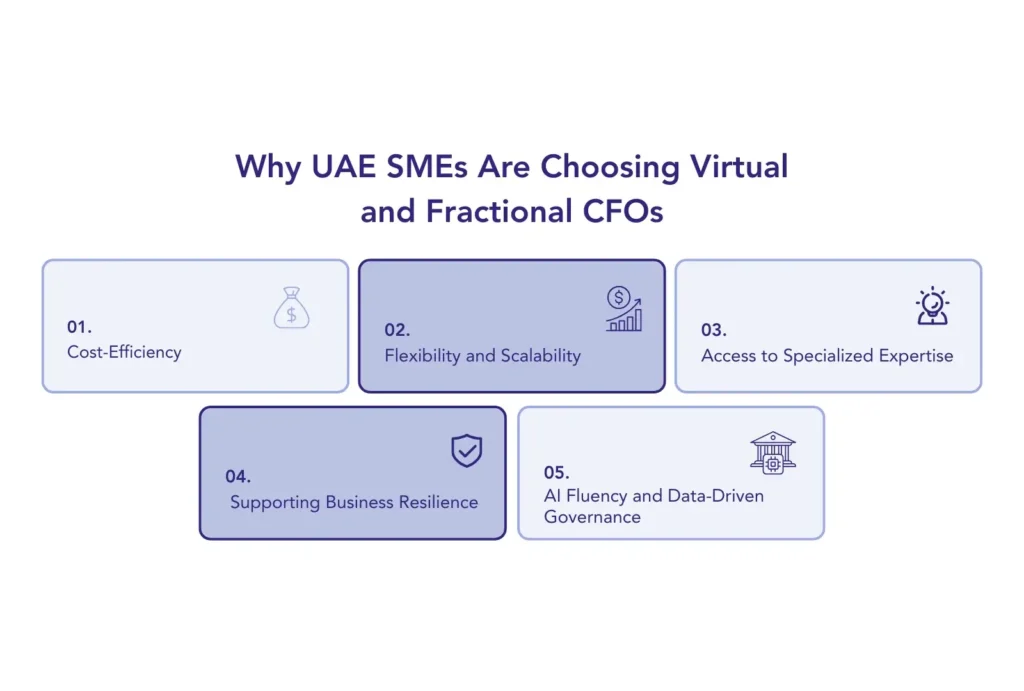
Why UAE SMEs Are Choosing Virtual and Fractional CFOs

Why UAE SMEs Are Choosing Virtual and Fractional CFOs

For many small and mid-sized businesses in the UAE, the question is no longer “Do we need a CFO?” — it’s “How can we afford the right level of finance leadership?”

Cost-Efficiency

Hiring a full-time CFO in the UAE is a major commitment.


Recruitment data from sources such as Michael Page UAE and regional salary benchmarks indicate that an experienced CFO in Dubai typically earns a base salary of AED 720,000 to AED 1,080,000 per year (AED 60,000–90,000 per month) for SMEs.

Once you include housing, visas, health coverage, and annual bonuses, the real cost of a full-time CFO can climb well above that range.


A Virtual CFO or Fractional CFO offers the same senior-level insight without the fixed payroll burden.


Businesses pay for the time and expertise they actually need, whether that’s ongoing support for cash flow and compliance or targeted guidance during fundraising or restructuring.


This flexible cost structure is particularly attractive to SMEs that need seasoned input but can’t justify a permanent C-suite hire.

Flexibility and Scalability

Financial needs for SMEs are rarely constant throughout the year.


A company might need close support during a corporate tax assessment, a funding round, or an ERP rollout, but not necessarily on a full-time basis.


Virtual and fractional CFO models let founders scale support up or down as the situation demands.


This approach helps them avoid carrying extra overhead during quieter periods while ensuring that expert guidance is immediately available during critical moments.

Access to Specialized Expertise

Compliance demands in the UAE have become far more complex in the last two years.


SMEs now have to manage corporate tax (9%), VAT filing and refunds, Economic Substance Regulations (ESR), Wage Protection System (WPS) reporting, and even transfer pricing for businesses with cross-border operations.


Many in-house finance teams are lean and lack the depth to handle all these requirements efficiently. 


Fractional CFOs — often working with established outsourced CFO service providers — focus precisely on these areas. They bring current, local knowledge of compliance obligations and an ability to integrate those requirements into day-to-day financial planning, which helps SMEs avoid penalties and maintain investor confidence.

Supporting Business Resilience

Resiliency isn’t only about keeping costs low in a quickly changing market. It’s about having the flexibility to adjust when things change.


The PwC 2025 Middle East CEO Survey shows that most leaders now focus on three things: keeping cash flow steady, making funding accessible when needed, and speeding up decision-making.


A virtual or fractional CFO can help SMEs do precisely that.


Instead of waiting months to hire a senior finance executive, businesses can immediately access experienced guidance. This means better reporting, stronger oversight, and advice that helps leaders act on the right numbers at the right time.


That flexibility often makes the difference between reacting late and moving early — whether it’s to comply with a new rule, secure funding, or seize a new market opportunity. For many SMEs, this kind of support has become a key part of staying competitive in an unpredictable economy.

AI Fluency and Data-Driven Governance

In 2026, CFOs are increasingly expected to be fluent in AI tools and data‑driven governance. Research shows finance leaders are not only embedding AI into core planning and decision‑making but are also steering technology and data strategy as part of business growth and risk management.


CFOs today help shape digital transformation and strategic priorities across the enterprise, reflecting how their roles have evolved beyond traditional reporting into strategic technology leadership.

Regulatory & Compliance Drivers in 2026

Regulatory & Compliance Drivers in 2026

For many UAE-based SMEs, the biggest push toward using virtual or fractional CFO services isn’t just about saving money but staying on the right side of increasingly complex rules.


Tax, payroll, or reporting mistakes can trigger penalties that easily outweigh the cost of bringing in experienced guidance.

Corporate Tax: The 9% Era with Reliefs and Limits

Since the corporate tax regime went live in mid-2023, the Federal Tax Authority (FTA) has tightened expectations around return filing, grouping rules, interest-deduction limits, and eligibility for Small Business Relief.


Many founders assume the 9% headline rate makes planning simple. In practice, the conditions for relief — including revenue thresholds and the way connected companies are grouped — need close tracking.


For calendar-year companies, the first annual filing deadline is September 30, 2026, and businesses must ensure their tax returns are filed by that date.


An outsourced or fractional CFO helps businesses interpret the FTA’s Corporate Tax Guides (like CTGGCT1 and the Small Business Relief Guide) and align their bookkeeping and reporting accordingly.

The AED 10,000 Penalty Waiver Initiative

Businesses that missed their Corporate Tax registration deadline and were hit with a AED 10,000 fine can have that penalty remitted if they file their first Tax Return within 7 months of their tax period’s end.


This initiative allows late registrants to avoid penalties by filing on time. For businesses ending their calendar year on December 31, 2025, the waiver deadline is July 31, 2026.

VAT Compliance: Refunds, Filings, Penalties

The UAE’s 5% VAT is mature now, but penalties for errors in VAT filings or delayed refund claims can range from AED 500 for minor issues to AED 20,000 for repeated non-compliance, along with additional fines for incorrect filings and audits.


The FTA’s published VAT User Guides and FAQs detail the required documentation and how timing affects refund eligibility.


A CFO or a specialist working under their direction ensures invoices, contracts, and filings are aligned from the start, avoiding the penalty regime that applies to late or incorrect filings.

The 2026 R&D Tax Credit

Effective for tax periods commencing on or after January 1, 2026, the UAE has introduced a robust R&D Tax Credit framework aimed at positioning the nation as a global tech hub. This provides a tiered credit rate based on expenditure and staffing:

  • 15% Credit: For the first AED 1 million of qualifying spend (min. 2 R&D staff).
  • 35% Credit: For spend between AED 1 million and AED 2 million (min. 6 R&D staff).
  • 50% Credit: For spend between AED 2 million and AED 5 million (min. 14 R&D staff).

The credit is capped at AED 2 million per year and requires pre-approval for projects from the Emirates Research and Development Council. Fractional CFOs play a pivotal role in identifying Qualifying R&D Activity, helping SMEs understand eligibility and documentation requirements based on the OECD Frascati Manual criteria. This guidance helps SMEs capture the full benefit of the R&D credits.


CFO accounting services are crucial to ensure that businesses are correctly calculating and claiming the R&D credits, particularly when allocating costs and documenting R&D activities.

WPS and Payroll Discipline

Under the UAE’s Wage Protection System (WPS) — administered jointly by MoHRE and the Central Bank of the UAE — every registered employer must transfer salaries through approved channels.


Penalties for late or incomplete salary payments through WPS can include fines starting at AED 5,000 for first-time offenses, escalating to AED 10,000 for repeated violations. Work-permit freezes and suspension of new visa applications are also possible penalties.


Since December 2025, the WPS has been upgraded to a ‘Smarter WPS’ with real-time salary tracking, which improves compliance and reduces the risk of penalties.


CFO oversight keeps payroll reconciled, cash flow planned, and reporting accurate, which is particularly critical for growing SMEs that often run lean finance teams.

ESR and Cross-Border Substance Rules

The Economic Substance Regulations (ESR) — overseen by the UAE Ministry of Finance — require certain businesses to demonstrate that they conduct real activity in the UAE.


That means submitting annual ESR notifications and reports and being ready to evidence board-level decision-making and staff functions.


A fractional CFO provides the governance discipline to meet these requirements and avoid escalating penalties for SMEs engaged in distribution, holding-company structures, or service centers.


ESR has now been integrated into Corporate Tax substance rules, so ESR reporting ceased to apply for financial years ending after December 31, 2022. It is now handled as part of the Corporate Tax framework for tax periods after January 2023.

What Happens Without the Right Guidance

Many SMEs trip up not because they’re trying to evade rules but because they underestimate the paperwork and timing.


A typical example is failing to register for corporate tax on time, assuming small business relief applies automatically — it doesn’t.


Another is delaying VAT refund claims, leaving working capital locked up for months.


These are precisely the avoidable missteps driving the uptake of CFO consulting services in the UAE.

2026 Regulatory Deadlines and Incentives

Trigger / Threshold Impact Applies To
AED 375,000 taxable income First AED 375,000 is taxed at 0%; income above this is taxed at 9% All taxable persons (except QFZPs)
AED 5 million OR 5% of total income (de minimis rule) If non-qualifying income exceeds this, QFZP loses 0% CT benefit Qualifying Free Zone Persons (QFZPs)
EUR 750 million consolidated global revenue Triggers 15% DMTT under OECD Pillar Two rules MNEs (Mainland & Free Zones)
0% CT for Qualifying Income Available only if substance, activity type, and qualifying income conditions are met QFZPs only
Connected person transactions > AED 500,000 Triggers mandatory Connected Person Disclosure Form All entities with connected persons
Revenue or assets > AED 50 million Triggers mandatory Audit Requirement All entities
Total revenue > AED 200 million Requires preparation of Master File & Local File for TP compliance All large entities
Late Filing Penalty: AED 10,000 – AED 50,000 Penalty for failure to submit CT return, TP forms, or supporting documents on time All taxable persons

Technology & AI Transformation

For many growing businesses in the UAE, the conversation about CFO services isn’t just about bookkeeping or compliance. It’s about getting the right systems in place so the numbers tell you something useful, quickly and clearly. The best outsourced CFO companies help owners make sense of technology instead of being overwhelmed by it.

From Cloud Accounting to AI-Powered Business Engines

A lot of UAE SMEs still manage finance in Excel until it becomes unmanageable.


That’s usually the point where a Virtual CFO suggests moving to a proper cloud ERP. Popular names you’ll hear in the region include QuickBooks UAE, Zoho Books UAE, Odoo, and TallyPrime.


The tool itself matters less than how it’s set up. A CFO who has done dozens of implementations can steer the choice, align it with VAT reporting, and save months of trial and error. That’s where CFO consulting services and CFO accounting services really prove their value.

Smarter Dashboards, Quicker Calls

The next step is usually analytics.


Today’s AI-powered CFO dashboards don’t just report what happened; they help you see what’s coming. They can project cash-flow weeks out, estimate VAT payables, and even run simple scenarios for hiring or pricing.


For most SMEs, building that capability in-house is unrealistic. This is why outsourced CFO services have become attractive. The CFO brings the tools, interprets the signals, and folds them into boardroom conversations — so data starts shaping decisions instead of sitting in a report.

Automation as a Quiet Advantage

A lot of gains come from small automations: invoices that upload themselves, reconciliations that run overnight, direct bank feeds that cut manual entry.


Firms that work with CFO services in Dubai often find that their month-end close gets noticeably faster and mistakes drop. That extra time and cleaner data let leaders focus on sales or operations instead of chasing numbers.

The CFO as a Tech Guide

Buying software doesn’t solve the problem by itself. Many businesses sign up for ERPs or dashboards and barely use them. A good Virtual CFO acts as the link between the founder, the accountant, and the IT team. They ensure the system is configured correctly, that staff are trained, and that the reports produced help run the business.

The CFO as an AI Compliance Guardian

As AI continues to evolve, CFOs must play an active role in ensuring that AI-generated reports are both accurate and ethically sound. With predictive analytics and anomaly detection becoming the norm, AI is not just an assistant—it is becoming a critical partner in financial decision-making. CFOs in the UAE are now tasked with ensuring that AI-powered systems are compliant with local regulations and that the data used is both reliable and transparent.

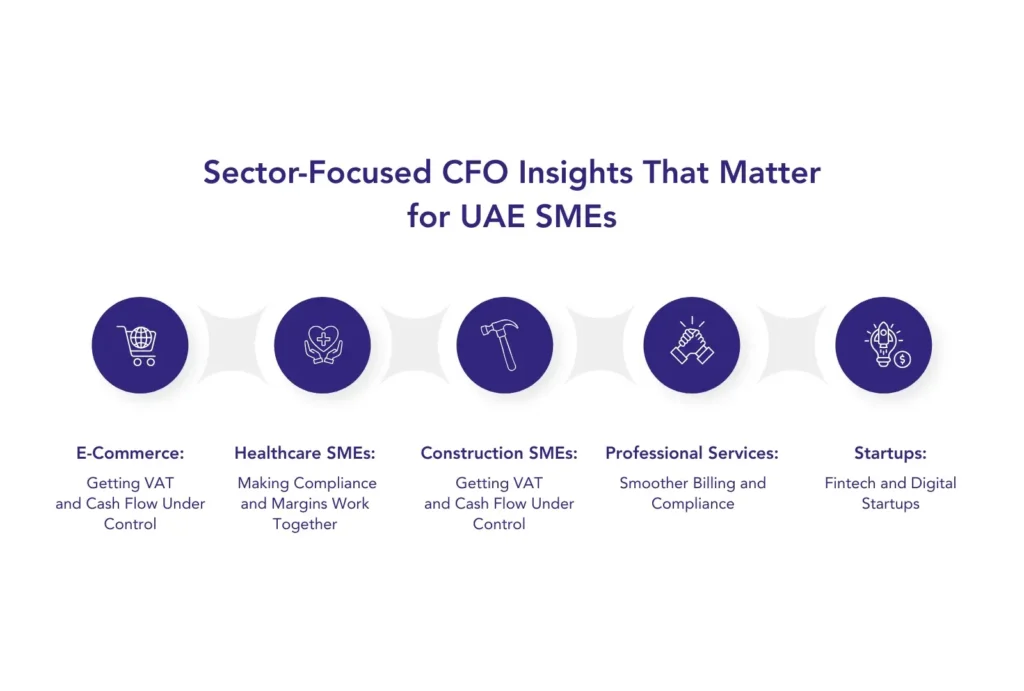
Sector-Focused CFO Insights That Matter for UAE SMEs

Sector-Focused CFO Insights That Matter for UAE SMEs

Every industry in the UAE has its own financial headaches. We see the same patterns again and again. This is where strong CFO services in UAE come in — whether you hire a full-time finance head or work with outsourced CFO companies. 


A focused CFO consulting service can spot these patterns early and help SMEs fix them before they turn into cash flow crises.

E-Commerce: Getting VAT and Cash Flow Under Control

E-commerce in the UAE looks simple until you face cross-border VAT, delayed refunds, and reconciling payments across different gateways. It’s more than paperwork, it locks up cash that should be working for you.


A skilled partner offering CFO services in Dubai can align your VAT calendar with the Federal Tax Authority’s VAT refund framework, set up automated reconciliation across gateways, and tie gross margin tracking to your pricing strategy.


When these pieces work together, VAT refunds arrive on time, cash flow smooths out, and you can fund new inventory or campaigns without scrambling.


The UAE e-commerce market is projected to reach $20 billion by 2030. As the market expands, the role of the CFO in managing embedded payments and automated SME credit platforms becomes crucial. CFOs help SMEs navigate these growing tech demands while maintaining compliance and optimizing cash flow.

Healthcare SMEs: Making Compliance and Margins Work Together

Healthcare providers, especially in Abu Dhabi, have to comply with Department of Health (DOH) costing standards, manage complex insurer settlements, and apply VAT to certain health services.


A good outsourced CFO service connects billing with DOH costing templates, tracks claim denial analytics, and reports on payer mix to show where margins leak.


The result is fewer denied claims, faster month-end closes, better visibility into cash — and all while staying within regulatory lines.


Additionally, the 2026 requirement for ESG and Sustainability reporting is now critical in health services. A CFO ensures compliance with these new mandates and helps align financial and sustainability goals, which is essential for attracting investment and staying competitive.

Construction SMEs: Bringing Order to Cash Curves and Rules

Contractors face long payment cycles, retentions, and milestone-based billing, all while having to report revenue correctly under FTA guidance on construction revenue recognition.


CFO consulting services bring structure by setting up WIP waterfalls, aligning billing with project milestones, and forecasting the impact of these on corporate tax.


That combination improves visibility, reduces finance costs, and strengthens cash positions — making it easier to negotiate with banks or fund new bids.


Contractors in the UAE must be aware of the 14% annual interest rate on late tax payments for unpaid taxes. In a sector with long cash cycles, CFOs play a key role in ensuring timely payments and preventing penalties that could jeopardize cash flow.

Professional Services: Smoother Billing and Compliance

Consultancies, legal practices, and other advisory firms live or die by billing discipline and payroll compliance. Late invoices and loose time-keeping quickly become cash flow problems.


An experienced team providing CFO accounting services can implement project-aligned billing, ensure Wage Protection System (WPS) compliance, and build dashboards that give leaders a real picture of utilisation and lock-up.


The payoff is faster collections, fewer compliance headaches, and a finance function that supports growth instead of slowing it down.

Fintech and Digital Startups

Fintech and digital startups in the UAE are thriving, with 32% growth in DIFC registrations in recent years. These businesses often require VARA-compliant financial reporting to meet regulatory standards. A CFO’s role is vital in ensuring that the startup’s financial systems are not only optimized for growth but also aligned with the regulatory requirements of VARA (Virtual Assets Regulatory Authority).


A strong CFO service ensures the accuracy of financial reporting, helping digital startups avoid regulatory pitfalls and stay compliant with the evolving fintech landscape in the UAE.

CFO Dashboard & KPIs: What UAE SMEs Actually Need

Running an SME in the UAE is about more than chasing sales. CEOs need a real-time view of cash, obligations, and compliance. This is where CFO services in the UAE make a tangible difference. A Virtual or Fractional CFO doesn’t just hand over reports—they turn numbers into guidance you can act on.


Most UAE business leaders focus on a core set of metrics. Cash runway is critical—it tells you how long operations can continue if revenues slow. Days Sales Outstanding (DSO) shows whether customers are paying on time, while Days Payable Outstanding (DPO) indicates how effectively supplier terms are managed. 


VAT forecasts and corporate tax effective rates are non-negotiable because errors can lead to fines. Other KPIs include working capital efficiency, revenue versus budget, project profitability, payroll compliance under WPS, and ESR reporting. Tracking these numbers gives leaders clarity on where cash is tied up, upcoming obligations, and operational performance.


Dashboards are how all this information comes together. With outsourced CFO companies, KPIs are presented visually so trends and issues become obvious at a glance. Rising DSO signals early collection action. 


VAT and tax projections prevent last-minute surprises. Project-level reporting highlights bottlenecks and ensures milestone billing stays on track. Compliance metrics show whether payroll and ESR filings are complete and accurate.


The difference is in actionable insight. A Virtual CFO does more than show numbers—they explain what the numbers mean and what to do next. They often suggest adjusting supplier terms or speeding up invoicing when cash is tight. If a VAT refund is delayed, they know how to troubleshoot the filings. 


As ESR deadlines draw closer, they prepare the workflows and documentation in advance. This is why more SMEs turn to CFO consulting services and CFO accounting services instead of trying to manage everything themselves.


Outsourced or fractional CFOs also offer flexibility that full-time hires cannot. You get senior-level guidance exactly when you need it, whether for month-end reporting, corporate tax planning, or preparing for a funding round. You don’t carry the full-time payroll burden but still have expert oversight guiding decisions.


In short, a CFO dashboard isn’t just a reporting tool. Combined with CFO services in Dubai or across the UAE, it becomes a strategic instrument. It shows you where the business stands, warns you of risks, and helps you act before major issues become major. It gives SMEs control, clarity, and confidence in a fast-moving, complex market.

The 2026 Executive Dashboard: Top 10 Metrics

KPI What It Shows Why It Matters for UAE SMEs
Cash Runway How many months can the business operate with its current cash CEOs using CFO services in the UAE want to know exactly how long their operations can sustain without new revenue. It’s the ultimate measure of financial resilience.
Days Sales Outstanding (DSO) Average time customers take to pay invoices High DSO ties up cash. A Virtual CFO can suggest collection strategies or invoice automation to reduce delays.
Days Payable Outstanding (DPO) Average time to pay suppliers Balances cash conservation with supplier relationships. CFO consulting services help negotiate terms that optimize working capital.
Working Capital Efficiency Ratio of current assets vs. liabilities Reveals whether cash, inventory, and receivables are being managed efficiently. Improves liquidity for growth initiatives.
VAT Forecast / Payable Expected VAT obligations vs. payments Crucial for compliance with FTA rules. CFO accounting services track VAT timelines and prevent penalties.
Corporate Tax Effective Rate Actual tax rate after reliefs and deductions Keeps SMEs aligned with FTA corporate tax rules, ensuring no surprises at year-end.
Revenue vs. Budget Compares actual income to planned revenue Shows whether the business is on track. Highlights areas where outsourced CFO companies can intervene early.
Project Profitability Revenue minus costs per project Especially relevant for construction or service SMEs. Identifies underperforming projects before losses accumulate.
Payroll Compliance / WPS On-time wage transfers and reporting Avoid fines and work-permit freezes by monitoring WPS obligations in real-time.
ESR / Economic Substance Compliance Notification and reporting status Ensures Free Zone or holding company operations satisfy Ministry of Finance rules.
Cash Conversion Cycle Days to convert inventory and receivables into cash Shorter cycles free up capital for growth. Virtual CFOs recommend process improvements for faster cycles.
Forecast vs. Actual Cash Flow Predictive cash vs. real inflows/outflows Detects early deviations, enabling preemptive funding, spending, or investment decisions.

2026 New KPIs:

  • Forecast Accuracy %: Measures the accuracy of cash flow and financial forecasts compared to actuals. Critical for ensuring that financial plans are aligned with real-time data.

  • WPS Compliance Score: Tracks adherence to WPS payroll deadlines and accuracy. Measures how well the business complies with real-time wage protection standards, reducing the risk of fines and penalties.

  • Corporate Tax Effective Rate: Measures the tax burden relative to income after deductions and exemptions. Ensures that businesses are optimizing their tax positions and not missing available reliefs.

Real-Time Integration with Etihad Credit Bureau

Modern CFO dashboards are now fully integrated with Etihad Credit Bureau data. These dashboards monitor metrics that directly affect the company’s credit score, including wages, fines, and pension contributions


This real-time spend data provides a live picture of the business’s financial health, rather than relying solely on month-end snapshots.

Benefits Beyond Compliance

Running a business in the UAE isn’t just about ticking regulatory boxes. It’s about using finance as a tool to make smarter, faster decisions. This is where CFO services in the UAE really pay off. A Virtual or Fractional CFO doesn’t just handle filings or reports—they help you see the full picture and act before small issues become big problems.

Investor Readiness

If you want investors or funding, your books need to make sense. A good CFO ensures your financials are clear, accurate, and ready for scrutiny. That means proper investor packs, realistic valuations, and reports that tell a story. Banks and venture capitalists don’t just look at revenue—they look at control, discipline, and predictability. CFO services in Dubai give you that credibility without the cost of a full-time hire.


The 2026 IPO Pipeline is looking strong, with analysts projecting 9 to 12 IPOs on the ADX and DFM in the first half of the year. CFOs play a crucial role in preparing businesses for these opportunities by ensuring financials are clear, accurate, and attractive to investors.

Strategic Planning

Budgets, forecasts, market-entry plans—these aren’t just paperwork. They’re how you make informed choices. Outsourced CFO companies help SMEs test scenarios, plan investments, and adjust to market shifts. With proper planning, you’re not guessing but responding confidently. CFO consulting services make this practical for teams that are small but ambitious.


56% of CFOs are now responsible for high-level strategic decision-making, reflecting the evolving role of CFOs in shaping the direction of businesses, particularly SMEs. With a Virtual or Fractional CFO, SMEs can take advantage of this strategic oversight without the need for a full-time hire.

Cash Flow Management

Cash drives everything. You can be profitable on paper, but growth stalls if cash is stuck in receivables or delayed VAT refunds. A Fractional CFO or outsourced CFO company keeps tabs on collections, payables, and working capital. You know where money is, when it will come in, and what you can safely spend. That clarity alone often makes the difference between surviving and scaling.

Risk Management

Fraud, errors, and weak controls are silent killers. CFO accounting services design internal checks, review processes, and help catch issues before they snowball. Leaders sleep easier knowing someone is watching the numbers, spotting risks, and suggesting fixes.


In 2026, cybersecurity and AI-related threats have become critical concerns for CFOs, with many prioritizing them as key risks. A CFO’s role extends beyond ensuring financial stability — they also safeguard the business’s operations and prepare it for evolving security challenges.

Challenges and Considerations

Getting CFO support right isn’t automatic. There are real choices and trade-offs to consider.

Data Security and Confidentiality

Your financial data is sensitive. Any provider, be it local or offshore, must comply with UAE data protection laws, including PDPL requirements. Access needs to be controlled, and reports handled responsibly.


Additionally, 2026 has brought a new mutual adequacy recognition between DIFC, ADGM, and QFC for cross-border data flows. This ensures that businesses operating in these jurisdictions can exchange data securely, making it easier to collaborate with international providers while ensuring compliance with local regulations.

Local vs. Offshore Providers

Local CFO knows UAE regulations, market culture, and business norms. Offshore providers can bring skills and cost savings, but you risk misalignment if they don’t understand local nuances. Choosing the right mix depends on your company’s size, risk appetite, and complexity.


In 2026, local expertise is non-negotiable due to the specific UAE FTA audit nuances and the integration of WPS (Wage Protection System) requirements. A local CFO is critical for navigating these complex systems, ensuring compliance, and avoiding costly penalties.

Evaluating Providers

Don’t hire blindly. Insist on a clear SLA, defined deliverables, timelines, and escalation procedures. Know what the CFO will do for you and how success will be measured. CFO services in the UAE or outsourced CFO companies are only helpful if expectations are crystal clear. Transparency now saves headaches later.


In 2026, a majority of employers worldwide continue to struggle with talent shortages  making it even more critical to evaluate providers carefully. A good CFO service provider should bring not only expertise in finance but also an ability to fill the skills gap with access to a network of specialists.

2026 SME Service Level Agreement Checklist

When evaluating outsourced CFO companies, make sure you have a clear SLA (Service Level Agreement) in place. Here’s what to check for:

  • Defined deliverables and timelines: Know exactly what will be delivered and when.
  • Escalation procedures: Ensure there is a clear path for addressing issues or delays.
  • Measurable success criteria: Understand how success will be measured and tracked.
  • Access to specialized talent: Ensure the provider has the right expertise, especially in technology and UAE-specific regulations.

A well-defined SLA is key to ensuring transparency and aligning expectations, ultimately saving you from future headaches.

Pricing Models & Engagement Structures

Not every UAE SME needs a full-time CFO. Sometimes you just need guidance, someone to steer the numbers without carrying the fixed overhead. That’s where CFO services in the UAE, CFO consulting services, and outsourced CFO companies come in.


Some businesses pay hourly, dipping in for advice when needed—say, reviewing a VAT filing or checking a cash-flow plan. Others go for a monthly retainer, getting ongoing support without hiring a full-time executive.


Then there’s project-based pricing, which works for tasks like setting up reporting dashboards, preparing for corporate tax, or creating investor-ready packs. Each has its trade-offs. Hourly is flexible but unpredictable. Retainers give consistency. Projects are focused and finite.


In Dubai, typical ranges show the landscape. Hourly engagements can start around AED 600–1,000. Retainers for fractional CFO support hover between AED 18,000–45,000 per month. Project-based work can jump anywhere from AED 25,000  for a compliance or reporting task to over AED 150,000 for a full financial overhaul or capital-raising prep. These aren’t exact, but they give you a sense of scale.


Here’s a simple way to see the difference between a full-time CFO and fractional/outsourced support:

Component Full-Time CFO Fractional / Virtual CFO
Base Cost AED 550,000–700,000 Paid per engagement or retainer
Benefits Housing, visa, health, and bonus Included in the fee
Flexibility Low High; scale support up or down
Expertise Limited to one person Access to multiple experts and best practices
Compliance & Reporting Depends on the internal team Structured, proactive, and tech-enabled

The math is simple. A fractional CFO gives you expert insight without locking yourself into a huge fixed salary. You get dashboards, cash-flow discipline, compliance oversight, and guidance that drives decisions. That flexibility makes all the difference for many SMEs in Dubai and across the UAE.


The fractional model typically saves SMEs AED 500,000+ per year compared to a full-time senior hire. This makes it an even more attractive option, especially in the 2026 business environment, where cost efficiency is critical.

How ADEPTS Adds Value

Running a business in the UAE is complicated. Regulations, taxes, and payroll rules can all pile up fast. That’s where CFO services in the UAE from ADEPTS come in. We don’t just produce reports. We sit alongside founders and management teams, translating numbers into decisions you can act on. Every strategy is tailored for SMEs, whether you’re in e-commerce, healthcare, construction, or professional services.


Our CFO consulting services don’t operate in isolation. They work hand in hand with ADEPTS’ tax, audit, valuation, and advisory teams. Corporate tax planning is handled from start to finish. VAT compliance is fully covered. Investor-ready financial packs for funding are prepared end-to-end. There are no gaps and no passing the buck. You get clear, practical guidance that keeps your finance function lean, compliant, and ready for what’s next.


Technology is part of the package, too. We help implement ERPs, dashboards, and reporting tools so your numbers aren’t just accurate and visible, clear and meaningful. With this setup, your outsourced CFO services become a competitive advantage, not just a cost.


At ADEPTS, we also boldly highlight our capability in managing the 7-month Corporate Tax penalty waiver and handling R&D tax credit applications, which are critical areas for businesses in 2026.

Conclusion

The demand for Virtual and Fractional CFOs in the UAE is no longer a trend; it’s a necessity. SMEs face tighter margins, more complex compliance obligations, and higher investor scrutiny. CFO expertise is no longer a luxury; it’s a strategic tool to stay ahead. Businesses that move fast, track cash flow, manage corporate tax, VAT, WPS, and ESR effectively, and make data-driven decisions have a clear advantage in 2026.


ADEPTS stands out as a trusted partner in this landscape. Our CFO services in the UAE, CFO consulting services, and outsourced CFO companies’ offerings give SMEs access to seasoned finance leadership without the overhead of a full-time hire. We integrate regulatory knowledge, technology implementation, and sector-specific expertise to keep your business compliant, agile, and investor-ready.


Take the step today. Let ADEPTS help you turn numbers into strategy, risk into opportunity, and compliance into confidence.

FAQs:

A Virtual CFO can’t replace someone sitting in the office every day. They won’t manage your whole accounting team or handle every small operational task. They focus on strategy, reporting, compliance, and actionable advice.

Free zone firms need different attention than mainland ones. Although the rules for ESR, VAT, and WPS are similar, there are subtle differences in filing and reporting. Qualifying Free Zone Person (QFZP) rules distinguish between a 0% and 9% corporate tax rate depending on a company’s qualifying income. CFO services in the UAE adjust guidance based on whether a company is in the mainland or free zone.

Smart systems handle multi-currency accounting. Virtual CFOs implement tools that track exchange rates, reconcile transactions, and ensure that reporting meets corporate tax and IFRS standards.

SMEs usually get monthly dashboards showing cash runway, DSO, DPO, VAT forecast, CT effective rate, working capital, project profitability, payroll compliance, and ESR readiness. These dashboards are built for decisions, not just numbers. Additionally, WPS Compliance Scores and R&D Expenditure tracking are included to help businesses stay compliant and focused on innovation.

A Virtual CFO coordinates with auditors, prepares schedules and reconciliations, and ensures documentation is ready. This keeps audits smooth without disrupting daily operations.

Contracts are flexible. Some SMEs hire on a retainer, others for specific projects, month-end reporting, corporate tax planning, or fundraising support.

 Core KPIs include cash runway, DSO, DPO, VAT, and CT compliance, working capital efficiency, project profitability, payroll and ESR metrics, and investor-readiness numbers.

They help banks see the story behind the numbers. CFO services in Dubai prepare investor packs, financial projections, and compliance records to improve the chances of loan or credit approval.

 Data stays secure. Virtual CFOs follow UAE PDPL laws, use secure cloud platforms, and limit access to protect sensitive numbers.

E-commerce, healthcare, construction, and professional services are adopting fractional CFOs the fastest. Complexity in cash flow, compliance, and reporting drives this trend.

Onboarding messy accounts usually takes a couple of weeks. After that, dashboards, processes, and controls start providing actionable insights.

Popular platforms include QuickBooks UAE, Zoho Books UAE, Odoo, and TallyPrime. CFOs also build dashboards to track cash, VAT, corporate tax, and operations metrics.

Family businesses benefit from Virtual CFOs for succession planning. They set up governance, reporting, and financial clarity to smooth transitions.

ESG and sustainability reporting are integrated into dashboards. CFO services in the UAE track metrics, comply with local requirements, and help businesses report transparently.

During investor due diligence, Virtual CFOs prepare clean financial statements, validate controls, and efficiently answer investor queries.

Project-based pricing covers a fixed scope, such as system setup or tax filing. Retainers provide ongoing advice, which is often better for SMEs with continuous needs.

They can prepare and submit documents, coordinate responses, and guide compliance but do not replace legal representation in front of regulators.

Dashboards are sector-specific. E-commerce tracks DSO, VAT, and payment gateways. Construction monitors WIP, retentions, and milestones. Healthcare focuses on DOH reporting, insurance claims, and cash flow. Professional services track billable hours, payroll, and project profitability.

You need a Virtual CFO: cash flow delays, missed VAT or corporate tax deadlines, messy accounts, slow decision-making, investor pressure, or poor reporting.

They work alongside in-house finance teams. Virtual CFOs improve reporting, controls, and compliance, and train internal staff while leaving day-to-day bookkeeping to the team.

File your first tax return within 7 months of your period end to have your AED 10,000 penalty remitted.

No, ESR reporting has ceased for years starting after 2022, as it is now integrated into Corporate Tax substance rules.

Yes, Virtual CFOs manage the pre-approval process with the Emirates Research and Development Council to ensure eligibility and compliance.

Resources

Related Articles​​

Participation Exemption, Dividends & Exits: A CFO Decision Matrix

Every CFO knows that numbers tell stories.


But in today’s UAE corporate tax landscape, the real story isn’t just in the balance sheet—it’s in how you manage what stays, what moves, and what exits.


The UAE’s tax regime has matured fast. 


With that growth comes a sharper focus on how participation exemption, dividends, and exit strategies shape a company’s financial backbone. These aren’t accounting footnotes anymore; they’re boardroom priorities.


Getting them right means more than ticking compliance boxes. It’s about designing smarter structures, protecting profits, and planning clean exits without leaving money on the table.

That’s where ADEPTS steps in. 


Their corporate tax advisors and CFO consulting services help businesses build strategies that meet the law. From structuring cross-border holdings to optimizing dividends and exits, ADEPTS turns complex tax rules into clear, confident decisions, making it a trusted name in corporate tax advisory services and CFO services in Dubai.

Understanding Participation Exemption in UAE Corporate Tax Law

Participation exemption sounds like a technical term, but at its core, it’s about fairness and efficiency. The UAE corporate tax framework, set out under Federal Decree-Law No. 47 of 2022, recognizes that profits shouldn’t be taxed twice when they move within a corporate group.

Under this rule, dividends and capital gains earned from a qualifying shareholding can be exempt from corporate tax. This ensures that when a UAE company invests in another entity, it doesn’t get penalized for the same income on both ends.

To qualify:

  • The UAE company must hold at least 5% ownership in the foreign or local entity.

  • That ownership must continue for 12 consecutive months.

  • The subsidiary should be subject to a reasonable level of taxation—typically at least 9%.

The rule applies broadly across local and foreign legal entities, giving CFOs flexibility when structuring investments and group holdings. It also extends to dividends, profit distributions, and capital gains from those participations.

The participation exemption applies automatically in most qualifying cases, though taxable persons may elect to apply it formally.

Ministerial Decision No. 302 of 2024 refined the definition of “participating interests” and clarified foreign subsidiaries in low-tax jurisdictions. 

This decision was crucial for CFOs using corporate tax planning in the UAE to strengthen investment structures. It also showed how the UAE remains aligned with international norms while retaining its competitive edge.

Dividends Treatment and Tax Implications

Dividends are where strategy meets reward. 


Understanding how they’re taxed or not is key to smart cash flow and cleaner reporting for CFOs in the UAE.

Under UAE corporate tax rules, dividends received by a UAE resident company are exempt from corporate tax if they meet participation exemption criteria. That means the income can flow tax-free when your UAE entity earns dividends from a qualifying subsidiary.


For non-resident investors, the UAE does not impose withholding tax on dividends paid to foreign shareholders. This zero-withholding policy gives multinational groups a considerable advantage when repatriating profits; no friction, no double tax drag.


However, full exemption doesn’t apply in every case. 


Dividends from non-qualifying participations may still be taxable. CFOs should assess these thresholds carefully, especially when working with outsourced CFO companies managing multiple jurisdictions.


The UAE’s extensive tax treaty network further strengthens this position. Many treaties reduce or eliminate taxes on outbound dividends, enabling smoother global cash flows. Here’s where top corporate tax advisory services help CFOs make informed distribution decisions.


In short, dividend strategy isn’t just about distributing profit; it’s about structure, timing, and compliance. This is where CFO consulting services and corporate tax advisors can turn a standard dividend policy into a powerful planning tool.

Exit Strategies and Corporate Liquidation Considerations

Every exit tells a story. 


For a CFO, every sale, merger, or liquidation is first and foremost a tax event.


Under UAE corporate tax, exits attract detailed scrutiny. The tax impact depends on the transaction type: share sale, asset sale, or winding-up. Each route has its own reporting and timing obligations.


Taxable persons must file a final corporate tax return and settle all outstanding liabilities during liquidation. The Federal Tax Authority (FTA) may audit closing accounts to ensure full disclosure.


Here’s the good news: a participation exemption can apply to capital gains from exits, provided ownership and holding conditions are met. For CFOs handling cross-border mergers, this relief can translate to millions in tax savings.


Strategic corporate tax planning in the UAE ensures such exits are structured for minimum leakage. By aligning ownership periods and documentation, CFOs can turn exits into efficient, compliant transitions, something outsourced CFO companies like ADEPTS help engineer with precision.

The CFO Decision Matrix: Balancing Participation Exemption, Dividends & Exits

Every CFO eventually faces the same puzzle

when should profits stay, when should they move, and when should they go? 


The right answer depends on structure, timing, and the ability to see three steps ahead. 


Expert corporate tax advisors often guide these decisions, ensuring every move aligns with broader corporate tax planning in the UAE regulations.


A smart decision matrix starts with understanding the company’s investment structure. 


If your subsidiaries or investments qualify under the participation exemption, dividends and capital gains can flow tax-free. That’s where corporate tax advisory services become essential. They help CFOs design frameworks that align operational and tax efficiency. 


But that’s only one piece of the puzzle


You still need to weigh control, liquidity needs, and long-term strategic goals with the help of experienced CFO consulting services.


The key is to assess eligibility and timing together. For example, a dividend received just before the 12-month ownership mark could miss the exemption window. 


Similarly, selling a participating interest too early could turn a potentially exempt gain into a taxable one under UAE corporate tax rules. 


Timing is not just an operational detail; it’s a tax strategy.


When it comes to retaining earnings versus distributing dividends, CFOs must think beyond immediate cash flow. Retaining profits may strengthen capital for reinvestment or future acquisitions, but distributing them could optimize shareholder returns if participation exemption conditions are already met. 


CFO services in Dubai often play a key role in modeling these outcomes for sustainable profitability for companies operating across regions. 


The goal is balance: liquidity without leakage.


Finally, integrating exit planning into this matrix ties everything together. 


The best exits are never reactive; they’re engineered early.


When participation exemption rules and exit timing align, CFOs can secure clean, tax-efficient transitions that protect value and reputation. Working with outsourced CFO companies often allows businesses to align their strategies across compliance, investment, and tax planning.


This is where the modern CFO moves from compliance to design, using the UAE’s tax framework not as a limitation, but as a map to smarter, more deliberate financial outcomes.

Impact of Free Zones and the UAE Tax Grouping Regime

Free Zones have always been the UAE’s sweet spot for business growth. 


But their role has evolved with the introduction of the UAE corporate tax. CFOs need to understand not just the incentives but also the fine print that decides how those incentives interact with participation exemption and dividend rules. Strategic guidance from professional corporate tax advisors helps ensure compliance while maximizing the benefits available to Free Zone entities.


Companies established in Qualifying Free Zones can still enjoy a 0% corporate tax rate on qualifying income, provided they meet the substance, activity, and transfer pricing conditions set by the FTA. 


However, dividends and capital gains from other Free Zone or mainland entities may still require careful review to confirm whether the participation exemption applies, an area where experienced corporate tax advisory services play a critical role.


For larger organizations, the tax grouping regime offers a way to simplify. 


Eligible UAE companies, whether mainland or Free Zone, can form a tax group and be treated as a single taxable entity. This allows intragroup dividends and transfers to pass without triggering additional corporate tax, provided they stay within the group and meet the law’s ownership and control thresholds. 


Businesses often rely on CFO consulting services to evaluate whether tax grouping aligns with broader corporate tax planning goals in the UAE.


The advantages? Administrative relief and consolidated reporting. 


Tax grouping reduces the number of internal transactions being taxed twice, reduces filing volume, and lets CFOs manage tax positions at a group level. Partnering with outsourced CFO companies allows businesses to maintain efficiency while optimizing tax structures across multiple jurisdictions. 


It’s a strategic move for diversified businesses, balancing multiple entities under one umbrella.


Still, the details matter


Not all Free Zone entities can join tax groups, and qualifying income rules differ. CFOs must constantly review eligibility, especially when reorganizing holdings or planning for exits, to ensure compliance without losing access to exemptions or reliefs under the evolving UAE corporate tax framework.

Practical Steps for CFOs to Optimize Tax Outcomes

Knowing the rules is one thing. Using them to your advantage is another. 


The best CFOs don’t just react to UAE corporate tax law; they design around it.


Start with due diligence. Before claiming a participation exemption, confirm every condition: ownership thresholds, holding periods, and proof that the subsidiary is subject to sufficient taxation. 


Keep records neat; share certificates, board resolutions, and audited financials. These become your first line of defense in an FTA review. Experienced corporate tax advisors and CFO consulting services can help structure documentation so nothing slips through the cracks.


Next comes the documentation and election process. While many exemptions apply automatically, certain cases require a formal election filing with the Federal Tax Authority. Ensure your tax team tracks submission deadlines and attaches supporting evidence. 


A missed step here can turn an exempt gain into a taxable one. Something corporate tax advisory services can help you avoid.


Timing also matters. Use financial accounting standards to align when income is realized with when exemptions apply. The goal is consistency. Showing that accounting recognition and tax treatment move in sync. 


Strategic corporate tax planning in the UAE ensures your timing, structure, and filings work together for maximum efficiency.


CFOs don’t need to navigate this alone. Advisors like ADEPTS specialize in translating UAE tax law into practical structures that fit your business reality. Whether you rely on CFO services in Dubai or partner with outsourced CFO companies, having expert support makes compliance smoother and decisions sharper. From designing group holdings to exit sequencing, they help ensure every move is compliant and efficient.


Finally, make monitoring a habit. Ministerial Decisions and FTA clarifications evolve frequently. Staying current means staying ahead, especially as the UAE continues refining its corporate tax advisory services and regulatory framework to match international standards while protecting its investment appeal.


Smart planning, disciplined compliance, and the right partners can turn complex tax rules into clean financial wins.

Conclusion

For today’s CFO, corporate tax planning in the UAE isn’t just about compliance; it’s about control. The way you manage participation exemptions, dividends, and exits can define your company’s financial efficiency for years.


The key takeaway is simple: know your structure, plan your timing, and document everything. 


The participation exemption can unlock major savings on dividends and capital gains only when eligibility is clear and consistent. Exit transactions can be clean, tax-light, and strategically sound, but only with foresight and precision guided by experienced corporate tax advisors.


This is where expert guidance makes the difference. 


ADEPTS provides corporate tax advisory services that help CFOs turn complex frameworks into clear, confident strategies. From group structuring to liquidation, their team supports clients who rely on CFO consulting services and CFO services in Dubai to stay ahead of evolving UAE corporate tax rules. 


Whether you’re managing expansions, mergers, or working with outsourced CFO companies, ADEPTS ensures every decision aligns with the law’s letter and spirit.


The smartest leaders don’t wait for tax season; they plan for it. 


Proactive, well-informed corporate tax planning in the UAE doesn’t just protect profits; it builds resilience. In a landscape that rewards clarity and compliance, that’s what sustainable corporate growth is built on.

FAQs:

It allows multinational groups to avoid double taxation on intra-group dividends and capital gains. By structuring qualifying shareholdings correctly, CFOs can move profits between entities more efficiently and plan global reinvestments with fewer tax leakages.

Yes. Subsidiaries in low- or no-tax jurisdictions must meet additional substance and taxation tests to qualify. The UAE requires proof that the subsidiary is subject to at least a 9% effective tax or operates in a recognized jurisdiction.

Companies should maintain shareholding records, board resolutions, dividend vouchers, and audited financial statements. Clear documentation showing ownership percentage and holding period is essential for FTA reviews.

The exemption may be lost if ownership drops below 5% or the 12-month holding period is not met. CFOs should monitor restructuring or transfers carefully to maintain qualification.

No. The exemption applies based on ownership and holding conditions when income is realized or declared. Retroactive claims aren’t allowed unless specifically clarified by an FTA decision.

Yes. Even exempt income must comply with transfer pricing documentation and arm’s length principles. The exemption doesn’t remove the need for proper intercompany pricing and disclosure.

Penalties can include loss of exemption, additional tax assessments, and administrative fines for late or incorrect filings. CFOs should ensure accurate and timely elections with the FTA.

The UAE’s regime is among the most flexible. It mirrors OECD standards while offering 0% withholding tax and simplified participation rules, making it more attractive than most GCC systems.

Dividends received before liquidation may qualify for exemption. However, any liquidation proceeds are generally treated as capital gains—potentially exempt if participation conditions are met.

Free zone authorities don’t grant or manage the exemption directly, but their licensing and compliance frameworks help define whether entities qualify as Qualifying Free Zone Persons under FTA rules.

References

Related Articles​​

How Dubai & Abu Dhabi Became the World’s Most Tax-Friendly Cities: Lessons for Business Owners

Dubai and Abu Dhabi didn’t just land on the 2025 list of the world’s most tax-friendly cities — they owned it.


What was once a desert ambition is now a global magnet for entrepreneurs, investors, and corporations seeking innovative tax structures without the red tape.


This ranking isn’t just good news for business owners — it’s a roadmap. 


Friendly tax laws mean fewer financial hurdles, stronger cash flow, and more room to scale. It’s what fuels economic growth and keeps foreign investment flowing into the UAE year after year.


But behind the headlines lies a system that’s both strategic and sophisticated. Understanding the UAE’s corporate tax registration process, incentives, and exemptions isn’t optional — it’s essential for SMEs and multinational players. That’s where expert guidance makes all the difference.


Firms like ADEPTS simplify the journey through the UAE’s evolving tax framework — from corporate tax advisory services to corporate tax registration in the UAE. With the right corporate tax advisors, businesses can focus on growth, stay compliant, and avoid pitfalls such as the late corporate tax registration penalty.

The Top Rankings Explained: Dubai & Abu Dhabi in the Global Tax-Friendly Cities Index

When the Tax-Friendly Cities Index 2025 dropped, it wasn’t a surprise — it was confirmation.


Abu Dhabi took the top spot. 


Dubai followed close behind. 


Together, they’ve turned the UAE into the world’s benchmark for tax-smart governance.


The Gulf region dominated the list this year, with the UAE leading thanks to its crystal-clear tax framework, stable economy, and smooth digital compliance system.


While other global hubs debate higher levies and complex filings, the UAE keeps it simple — 9% standard corporate tax, clean exemptions for Free Zone entities, and zero tax on personal income.


These rankings aren’t based on charm but on metrics that matter — business-friendly regulations, investor security, transparency, and infrastructure built to scale. The combination of low friction, high trust, and steady growth keeps investors pouring in.


For global entrepreneurs, this ranking is a green light. It signals a system designed to empower and not penalize business owners. With corporate tax advisory services and trusted corporate tax firms guiding the way, investors can tap into a structure that rewards compliance and encourages expansion.

Unique Tax Advantages in Dubai and Abu Dhabi

How Dubai & Abu Dhabi Became the World’s Most Tax-Friendly Cities: Lessons for Business Owners

It’s one thing to rank high on a global index. It’s another thing to earn it year after year.


What truly cements Dubai and Abu Dhabi’s reputation as global business magnets is their unique tax advantage; a framework that balances opportunity with stability.

No Personal Income Tax

Here’s the game-changer: there’s no personal income tax in the UAE. None. Whether you’re an expatriate executive or a UAE national, your salary, dividends, and capital gains stay yours.


For business owners, that means greater wealth retention and stronger reinvestment potential. Employees feel it, too. They enjoy higher take-home pay, which translates to a higher quality of life and stronger loyalty. It’s one of the simplest yet most powerful factors that make the UAE stand out from every other business hub in the world.


With expert support from corporate tax advisors and corporate tax firms, even small and mid-sized businesses can structure their finances smartly, ensuring compliance without losing their competitive edge.

Competitive Corporate Tax Policies

While most global hubs are tightening tax laws, the UAE took a more innovative approach, implementing a balanced structure with simplicity.


Since June 2023, the country has introduced a federal corporate tax of just 9% on profits above AED 375,000 — still one of the most competitive rates in the world.


For startups and SMEs, the message is clear: growth first, tax later. 


The UAE government has carved out generous exemptions and reliefs to keep innovation thriving and small businesses breathing easy.


The UAE corporate tax registration process is fast, transparent, and digital. Companies can complete their filings online, often within days, which reflects a sharp contrast to the paperwork nightmares seen elsewhere.


With the guidance of experienced corporate tax advisory services, business owners can identify every available relief and structure their operations efficiently. From corporate tax registration in the UAE support to long-term compliance planning, top corporate tax advisors help ensure that businesses stay on the right side of the law — and far from any penalty for late corporate tax registration.

Free Zone Incentives That Attract Global Investors

If Dubai and Abu Dhabi are the UAE’s business engines, their Free Zones are the turbochargers.


Think DIFC, ADGM, and DMCC — places where paperwork takes days, not months, and global investors find the red carpet already rolled out.


The perks are hard to beat:

  • Tax holidays that can stretch up to 50 years.

  • Full foreign ownership and no customs duties.

  • Easy profit repatriation and simplified licensing for almost every industry.

Each zone runs on its own rules — light, digital, and built for speed. It’s no wonder startups and Fortune 500s alike are setting up here.


With help from corporate tax advisory services and trusted corporate tax firms, businesses can settle in quickly, handle corporate tax registration in the UAE, and focus on growth instead of red tape.

Double Tax Treaties and Global Connectivity

Beyond its borders, the UAE’s tax network stretches wide — more than 142 double tax treaties link it to major economies worldwide.


For global companies, that means no double taxation and smoother cash flow across borders.


These treaties build confidence. They make it easier for investors to move money, trade goods, and expand operations — all under one consistent, transparent framework.


Innovative companies don’t go it alone. 


They lean on corporate tax advisors who know how to apply treaty benefits and avoid penalties for late corporate tax registration. With solid corporate tax advisory, expansion feels less like a maze and more like a plan.


Dubai and Abu Dhabi aren’t just friendly to business; they make global tax planning seem like a good strategy.

Stability and Governance: Building Investor Confidence

How Dubai & Abu Dhabi Became the World’s Most Tax-Friendly Cities: Lessons for Business Owners

Taxes attract attention, but stability seals the deal.


Dubai and Abu Dhabi didn’t climb the global ranks by accident. They built investor trust through predictability.


Both cities run on strong regulatory frameworks and clear, business-friendly laws. Companies know exactly what to expect — no sudden changes, no hidden clauses. 


That’s gold for investors.


Political stability is another cornerstone. The UAE’s consistent leadership and institutional strength create a sense of security that global markets crave. When the world feels uncertain, Abu Dhabi and Dubai stay steady, and that steadiness translates into investment confidence.


Add to that the country’s digital infrastructure. 


Every process feels seamless, from online corporate tax registration services to fully automated government portals. Smart city initiatives are reshaping how companies operate by cutting downtime, reducing paperwork, and making compliance effortless.


With trusted corporate tax advisors guiding setup and compliance, business owners can focus on growth instead of bureaucracy. This mix of transparent governance, political calm, and tech-driven efficiency turns Dubai and Abu Dhabi from safe bets into smart ones.

Emerging Tax Reforms and Adaptations

The UAE isn’t standing still. Every year, there’s a quiet tweak or a significant shift that keeps its tax system one step ahead.


In 2025, the government introduced the Domestic Minimum Top-Up Tax (DMTT) along with a few updates around compliance. It sounds heavy, but it’s about keeping pace with the OECD’s global tax standards while protecting what already works for business owners here.


These changes don’t mean higher taxes or red tape. They’re more like guardrails, updates ensuring the UAE stays transparent, credible, and trusted internationally. Most companies won’t feel a big shake-up; things remain digital and straightforward, more aligned with global best practices.


This is when having someone like ADEPTS in your corner matters most. 


They turn complex updates into clear steps, helping with corporate tax registration, filings, and long-term planning. Their corporate tax advisory services keep businesses compliant without slowing them down.


So yes, the rules evolve. But the message stays the same: the UAE’s tax system is still built for growth — just sharper around the edges now.

Lessons for Business Owners: How to Leverage Dubai and Abu Dhabi’s Tax Ecosystem

There’s more to the UAE’s tax system than low numbers on paper. The real advantage lies in how you use it.


Smart business owners know that strategic tax planning makes all the difference. With the correct setup, you can tap into Free Zone benefits, keep your tax exposure low, and reinvest more into growth. 


Whether it’s DIFC, ADGM, or DMCC, each zone comes with its own perks; the trick is to match those perks to your business model, not the other way around.


Mainland setups have their edge too. They often make more sense when focusing on local trade or government contracts. The key is knowing your options and building around them, not guessing.


It also pays to look beyond borders. The UAE’s network of double tax treaties can save you from paying double taxes. A good corporate tax advisory team will show you how to use those treaties and transfer pricing rules to keep things efficient and compliant.


Of course, staying on top of the small stuff matters just as much — new updates, filings, and compliance deadlines. Missing one can lead to a penalty for late corporate tax registration, which is easy to avoid with the right support.


ADEPTS makes the process seamless, from corporate tax registration in the UAE to tailored corporate tax advisory services. They don’t just keep your business compliant; they help you turn the tax system into a real strategic advantage.


Dubai and Abu Dhabi offer maps. You just need the right guide to make the most of them.

Conclusion

Dubai and Abu Dhabi have built more than skylines — they’ve built trust. Their tax-friendly frameworks, clear regulations, and global outlook make them two of the most attractive business hubs in the world.


For entrepreneurs, that combination of low taxes, policy stability, and access to global markets is hard to match. It’s why so many business owners choose to set up here and stay for the long haul.


Still, the real value isn’t only in the system itself — it’s in how you use it. With the right tax advisory support, companies can go beyond compliance and unlock genuine savings and strategic advantages.

That’s where firms like ADEPTS make a difference. 


Their deep understanding of UAE corporate tax laws, Free Zone benefits, and international tax strategies helps businesses survive and scale confidently in one of the world’s most forward-thinking economies.

FAQs:

Dubai and Abu Dhabi both make it easy to start a business, but they serve slightly different goals. Dubai’s free zones like DIFC or DMCC are perfect for finance, trade, and tech ventures. Abu Dhabi’s ADGM leans more toward financial services and innovation. Both give you full ownership, long-term tax breaks, and simplified corporate tax registration — it’s just about finding the right fit for your business model.

Since there’s no personal income tax in the UAE, employees — especially expats — get to keep what they earn. It’s one of the biggest reasons people live and work here. The same tax-friendly setup also helps business owners retain wealth and reinvest profits through smart corporate tax advisory services.

Sectors like finance, tech, logistics, renewable energy, and consulting see the most significant wins from Uthe AE’s tax setup. Each free zone is built to support specific industries, so the incentives are very targeted. Corporate tax advisors often help companies identify which free zone gives the best structure and exemptions.

There aren’t any hidden taxes. You have VAT at 5% and corporate tax if your profits exceed the threshold. Other than that, it’s a clean system — just a few local fees, depending on your business type. Working with trusted corporate tax firms helps ensure everything stays transparent.

Foreign investors can send their profits and capital back home without restrictions. That freedom to move funds globally is one of the reasons so many entrepreneurs choose to expand here.

Startups get a great deal — the 9% corporate tax only applies after AED 375,000 in profit, so smaller companies can grow first before worrying about taxes. Many free zones also give added exemptions and flexibility.

If a company misses registration or filing deadlines, it can face fines or temporary restrictions. Staying compliant is simple, though — especially if you’ve got a good advisor keeping you updated. Firms specializing in corporate tax registration services ensure all filings are on time and accurate.

VAT in the UAE is minimal at 5%, but it still needs proper handling. Keeping accurate records and invoicing correctly saves a lot of future trouble. Many companies manage this alongside their corporate tax advisory to keep everything aligned.

Certain free zones offer tax holidays that can stretch up to 50 years. Industries like manufacturing, logistics, finance, and tech often qualify — it depends on what and where you set up. UAE corporate tax registration is straightforward for these businesses, especially with advisory support.

ADEPTS helps businesses get all of this right — from choosing the right setup to managing compliance and planning tax strategies. Their team makes sure you’re not just registered, but actually optimized for the UAE market through expert corporate tax advisory and corporate tax registration in the UAE services.

Related Articles​​

20 Essential Checklists: When and Why to Hire a CFO in the UAE

What if the biggest threat to your UAE business in 2025 isn’t competition — but your own numbers?


Every founder dreams of growth. 


But in the UAE’s fast-moving market, cash flow gaps, tax penalties, and poor forecasts can sink a company faster than a rival can.


That’s why many businesses are turning to CFO services in the UAE, not as a luxury, but as survival gear.


The right CFO is not merely about crunching numbers. They’re your strategist. Your compliance shield. The voice that turns raw data into smart moves.


In a landscape where one wrong call can set you back months, a strong CFO isn’t a nice-to-have. It’s your unfair advantage.


Want to know precisely when to bring one on board and why it could change your company’s future?


Here’s a 20-point checklist that shows you the signs it’s time to hire a CFO in the UAE.

Understanding the CFO Role in the UAE Context

In the UAE’s fast-paced economy, a Chief Financial Officer is more than a numbers person. A CFO bridges your business vision and the financial strategy that makes it real.


So, what does a CFO do?


They track the money, but that’s just the start. A good CFO builds forecasts, spots risks before they become crises, and guides leaders to make decisions backed by data, not guesswork.


Hiring a full-time CFO isn’t always practical for many companies, especially startups and SMEs. That’s where outsourced CFO services come in. Instead of a permanent hire, you get access to the same expertise on flexible terms. 


This model has made CFO services in Dubai and CFO services in the UAE a game-changer for growing businesses.


Whether full-time or outsourced, a CFO in the UAE typically handles:

  • Financial planning and forecasting — helping you prepare for what’s ahead.

  • Cash flow management — ensuring you never run out of fuel to keep the business moving.

  • Risk management — protecting you against market shifts, compliance failures, and financial shocks.

  • Regulatory compliance — keeping you in line with the UAE’s tax and reporting requirements.

In short, CFOs don’t just manage your books; they safeguard your growth. With the UAE’s changing business laws and competitive environment, having the right financial leader is no longer optional.

When to Hire a CFO: 20 Essential Checkpoints

20 Essential Checklists: When and Why to Hire a CFO in the UAE

Deciding to bring a CFO on board isn’t about following a trend. It’s about recognizing that your business has reached a new level of complexity. One where strong financial leadership can make the difference between sustainable growth and costly mistakes.


The following checklist highlights the most essential checkpoints that innovative UAE businesses watch for. If you see yourself in these situations, it’s a strong signal that it’s time to consider CFO services in the UAE.

Business Growth & Complexity

Growth is exciting, but it often exposes weaknesses in finances. This is where a strong CFO steps in.

1. Rising Revenue

When sales spike, so do risks. Cash flow gets tighter, costs creep up, and mistakes go unnoticed. A CFO sees what the numbers really mean and helps you grow without stumbling. Many leaders turn to outsourced CFO companies in Dubai for this stage because they can jump in fast.

2. Bigger Teams

Adding people and locations can turn simple finances into a maze. Payroll, compliance, and reporting get more complicated to manage. CFO services in Dubai or Abu Dhabi bring structure and financial controls so growth doesn’t spin out of control.

3. Complex Operations

Multiple currencies, new revenue streams, or cross-border work add layers of complexity. Without expert oversight, it’s easy to lose clarity. CFO consulting services bring discipline and visibility, helping you make confident decisions as your business evolves.

4. New Markets

Expanding into different emirates or GCC countries means new tax rules and reporting requirements. Getting it wrong can be expensive. Many companies rely on outsourced CFO services to handle day-to-day compliance and avoid setbacks.

Financial Planning & Controls

Solid financial planning often separates a growing company from one spins in circles. Many UAE businesses realize at this stage that they need more than a bookkeeper. They need real expertise. That’s why so many turn to CFO services in the UAE to build proper systems before problems pile up.

5. Poor Reporting

If your financial reports arrive late or feel unreliable, you’re flying blind. This is usually the first sign that your business has outgrown its current setup. Experienced CFO accounting services can deliver accurate reports on time so that you can confidently make decisions.

6. Strategic Planning

Growth brings bigger questions: how to budget, when to invest, what to cut back. Reliable forecasting and scenario planning are critical here. Many leaders hire CFO consulting services to build models that prepare them for opportunities and risks.

7. Cash Flow Risks

Plenty of profitable businesses still run into cash flow crises. Late payments, seasonal sales dips, or sudden expenses can strain your operations. This is where working with outsourced CFO companies can bring discipline to managing inflows and outflows.

8. Weak Controls

Fast-moving businesses often let small mistakes slip through until they become expensive. A skilled CFO tightens internal controls so errors and fraud don’t erode your margins. Companies often use outsourced CFO services to set up these guardrails efficiently.

9. Compliance Pressure

Corporate tax, VAT, and audit requirements in the UAE are changing quickly. Missing a deadline or misunderstanding a rule can be costly. Reliable CFO services in Dubai or CFO services in Abu Dhabi help you stay compliant while you focus on running the business.

Funding & Investment Needs

Raising capital changes the entire conversation. Banks and investors stop listening to stories and start digging into the numbers. This is usually when founders realize they need more than an accountant — they need the credibility of seasoned CFO services in the UAE.

10. Raising Capital

Preparing for a loan or pitching to investors takes more than a good idea. You need reliable forecasts, solid cash flow models, and financials that stand up to scrutiny. Many companies in Dubai and Abu Dhabi turn to CFO consulting services to prepare these materials so they can walk into negotiations ready.

11. Investor Confidence

Investors look for more than growth potential. They want to see disciplined governance, transparent reporting, and strong audit trails. Businesses often bring in CFO accounting services early to demonstrate that the company is well-run and trustworthy.

12. Deals and Restructuring

Mergers, acquisitions, and restructuring raise the stakes even higher. Due diligence is intense, and weak numbers can kill a deal. This is where outsourced CFO services or established outsourced CFO companies add real value. They bring experience in managing complex transactions and ensure no critical detail is missed.

Risk & Compliance Management

Risk often grows quietly while you’re focused on customers, sales, or expansion. Many UAE businesses only notice it when it’s too late. That’s why experienced CFO services in the UAE are brought in to spot problems before they become costly.

13. Financial Risks

Without clear oversight, financial and regulatory risks can spiral quickly. Late filings, misinterpreted rules, or overlooked exposures can cost more than lost revenue. Trusted CFO consulting services help build systems that keep these risks under control.

14. Currency & Commodity Risks

Companies operating across regions or dealing with imports and exports face currency and commodity swings. Unchecked, these can quietly erode margins. Experienced outsourced CFO companies set up policies and monitoring that protect your cash flow.

15. Audit & Fraud Controls

As teams grow, so does the chance for errors or deliberate fraud. Strong internal audits and proper controls are not just regulatory boxes — they safeguard your business and reputation. Many leaders rely on CFO accounting services to set up robust systems that keep everything transparent and secure.

Operational Efficiency & Technology

Technology can make a business faster and smarter, but only if it’s managed well. Many UAE companies invest in ERP, treasury, and accounting systems but don’t get the value they expect. That’s where CFO services in the UAE or CFO services in Dubai come in, to ensure the tools actually drive better decisions.

16. System Integration

ERP, treasury, and accounting platforms are powerful individually, but chaos happens when they don’t talk to each other. A CFO ensures these systems are connected, providing accurate, timely insights that leaders can act on. Many businesses rely on outsourced CFO companies to align technology with financial strategy efficiently.

17. Profitability & Cost Control

Technology alone won’t improve profits. You need someone reviewing costs, spotting waste, and identifying opportunities to increase margins. CFO consulting services or CFO accounting services help set up the processes that keep spending in check and maximize every dirham invested.

Leadership & Strategic Vision

Leadership isn’t just about making choices. It’s about making the right choices at the right moment. Many UAE businesses hit a crossroads and realize they need more than instinct. They need someone who sees the numbers clearly and knows what they mean. That’s when CFO services in the UAE or CFO services in Abu Dhabi really pay off.

18. Executive Decisions

Big moves, like launching a new branch, hiring key staff, entering fresh markets — can’t rely on gut feeling alone. A CFO steps in with insight, analysis, and guidance. CFO consulting services give leaders the clarity to act confidently and avoid costly missteps.

19. Long-Term Strategy

Success isn’t built in a day. It’s about laying a strong foundation for the future. CFOs design strategies that balance growth with stability. Many companies outsource CFO services here, tapping top-level expertise without the expense of a full-time executive.

20. Regulatory Alignment

Rules and regulations in the UAE change quickly, from corporate tax to audit standards. A misstep can be expensive. Experienced CFO accounting services make sure your plans stay compliant while your business keeps moving forward.

Choosing the Right CFO

Hiring a CFO isn’t just filling a role. It changes how your business handles finances and plans for the future. Choosing full-time, part-time, or outsourced CFO companies depends on your company’s size, growth stage, and complex finances.

Cost vs. Benefit

A full-time CFO can be a heavy expense, especially for startups or smaller businesses. Many companies start by working with outsourced CFO services or part-time CFO consulting services. This approach gives you access to high-level expertise without carrying the full-time salary overhead.

Virtual CFO Trends

Remote CFO setups are catching on fast in the UAE. Startups and small businesses in Dubai, Abu Dhabi, and elsewhere are choosing CFO services in Dubai or other flexible options. You get financial oversight, compliance support, and strategic advice without committing to a full-time hire.

Key Considerations

Figure out what you truly need before hiring, whether financial planning, risk management, compliance, or all of these. The right CFO knows your business, your sector, and where you want to go. CFO accounting services can back up your team, improve controls, and make planning less of a guessing game.

Benefits of Hiring a CFO in the UAE

Hiring a CFO isn’t about titles. It’s about bringing someone who actually sees the numbers, spots risks early, and keeps decisions grounded. Without that, even a growing company can drift into trouble.

Enhancing Financial Visibility and Control

You need to know where your money is going, what’s profitable, and where the gaps are. CFO services in the UAE provide that clarity. The numbers stop being vague and start guiding real decisions.

Better Strategic Decision-Making and Sustainable Growth

Growth isn’t only about achieving bigger numbers. It’s about making decisions that hold up over time. CFO consulting services or outsourced CFO companies provide the insight to spot risks early, weigh options carefully, and guide the business as it expands so it doesn’t stumble under its own success.

Facilitating Access to Capital and Investor Confidence

Banks and investors won’t rely on promises. They need evidence. CFO accounting services prepare the forecasts, reports, and governance that give them confidence. It makes negotiating funding easier because they see you run a disciplined business.

Ensuring Regulatory Compliance and Avoiding Penalties

UAE rules change fast. Corporate tax, VAT, and audits aren’t optional. CFO services in Abu Dhabi or local experts ensure compliance is baked into day-to-day operations. You avoid fines and can focus on growth.

ADEPTS: Your Partner in CFO Services and Financial Advisory

ADEPTS knows the UAE business landscape from the inside out. They don’t just provide numbers, they help you understand what those numbers mean for your growth, risk, and strategy.


Whether hiring a full-time CFO, bringing in a part-time advisor, or working with outsourced CFO companies, ADEPTS provides real guidance that fits your needs.


Their approach is practical and tailored. Every solution aligns with UAE regulations and your business’s realities, helping you stay compliant while planning for growth. With ADEPTS, financial leadership isn’t just a service—it’s a partner you can rely on.

Conclusion

Knowing when to bring in a CFO can save your business from costly mistakes. Rapid growth, complex finances, cash flow issues, or compliance headaches are all clear signs. Using CFO services in the UAE, Dubai, or outsourced CFO companies gives you the expertise to handle these challenges without losing focus on the business itself.


The benefits go beyond numbers. You get clearer insights, stronger controls, smarter planning, and easier access to funding. Compliance becomes manageable, and decisions become more confident.


For UAE businesses, working with a trusted partner like ADEPTS means you’re not just hiring a service—you’re gaining a guide who helps your company grow safely and strategically.

FAQs:

A CFO should have strong financial and accounting credentials with international exposure. Experience in UAE corporate regulations, tax, VAT, compliance, and a track record in strategic planning and growth management are crucial.

Startups often don’t need a full-time CFO. Outsourcing gives access to expert guidance, financial planning, and compliance support without the high salary and benefits of a permanent hire. It’s flexible and cost-effective.

Finding the right fit usually takes 2–4 months, depending on your business size, complexity, and whether you’re hiring full-time or engaging outsourced CFO companies.

A CFO ensures timely filings, correct VAT reporting, and adherence to corporate tax laws. They also help implement systems and controls to avoid penalties and maintain accurate records.

Yes. Experienced CFOs integrate ESG metrics into financial planning and reporting, ensuring transparency and alignment with investor and regulatory expectations.

Without proper financial leadership, growth can lead to cash flow gaps, compliance issues, and poor strategic decisions. Delays increase operational and financial risk.

Free zone businesses often deal with multi-jurisdiction compliance, currency management, and reporting standards. A CFO ensures smooth operations and compliance with the free zone regulations.

CFOs should be proficient in ERP systems, financial reporting tools, treasury management, and data analytics to provide accurate insights and strategic recommendations.

 CFOs assess financial risks, develop contingency plans, and ensure cash flow resilience. They also help prepare for market volatility, regulatory changes, and unexpected disruptions.

 Outsourced CFO arrangements are usually flexible, ranging from project-based to monthly retainer agreements. Terms depend on the scope, frequency of engagement, and specific business requirements.

Related Articles​​

The Rise of Crypto Fraud: Protecting Your Customers from Pig Butchering and VASP-related Scams

How do you stop a scam you can’t even see coming?


In the UAE and beyond, cryptocurrency has gone from a niche hobby to a serious investment. 


But as wallets grow, so does the danger. The UAE crypto fraud 2025 is hitting harder than ever. Sophisticated tricks like the pig butchering scam and calculated VASP scams in the UAE are leaving victims blindsided and broke.


The targets aren’t just careless investors. They’re business owners, professionals, even experienced traders. Without crypto fraud prevention in the UAE, the odds are stacked against them.


This is where ADEPTS steps in. As a trusted partner, we help companies close the gaps, shield their customers, and fight back against crypto investment scams in the UAE before the damage is done.

Understanding Crypto Fraud in 2025: The UAE Context

The UAE has become one of the fastest-growing crypto hubs in the world. Digital assets are finding a firm home here, from individual traders to global exchanges. But rapid growth comes with a price. The country is now facing one of the highest rates of cryptocurrency scams in the UAE.


In 2025, the average loss per victim reached Dh293,600 — the highest anywhere. That’s not just a statistic. That’s life savings, business capital, or retirement funds gone in a single click. It’s the cost of being caught in a UAE crypto fraud 2025 trap.


The challenge? The UAE’s crypto ecosystem is evolving faster than its safeguards. UAE crypto regulations 2025 are tightening, but scammers are just as quick to adapt. New schemes, like  VASP scams in the UAE, exploit licensing, compliance, and consumer awareness gaps.


Regulators are stepping up. The Central Bank of the UAE (CBUAE) is setting anti-fraud standards. VARA in Dubai is building clear frameworks for virtual assets. The Securities and Commodities Authority (SCA) is strengthening oversight. Together, they’re creating a safer environment, but it’s still a race against time.

What is Pig Butchering? The Devastating Scam Explained

It sounds strange, but it’s deadly serious. The pig butchering scam in the UAE is a long-running scam built to drain victims dry. The name comes from how fraudsters “fatten up” their targets before the kill.


This scam traces its roots to criminal networks in Southeast Asia. It’s now global and thriving in crypto markets. Scammers spend weeks or even months building trust. They appear on dating apps, slide into social media DMs, or message on WhatsApp. The tone is friendly, even caring. Nothing about it feels like a scam.


Then comes the “fattening” phase. Victims are slowly guided into investing in what looks like a high-return crypto opportunity. In reality, it’s nothing more than a polished scam. Accounts, dashboards, and transaction histories are all fabricated. The more you invest, the more convincing the setup looks until the day your money vanishes.


Globally, pig butchering has cost victims an estimated $4.4 billion in recent years. In the UAE, it’s one of the fastest-growing forms of crypto investment scams UAE.

The warning signs are there, if you know them:

  • Unsolicited contact from strangers claiming quick profits

  • Heavy use of personal flattery or emotional connection

  • Pressure to move money into little-known platforms

  • Promises of guaranteed returns

Once you’re inside the trap, it’s almost impossible to get your funds back. That’s why awareness is your first line of defense.

Virtual Asset Service Provider (VASP) related Scams: The Regulatory and Fraud Risk

The Rise of Crypto Fraud: Protecting Your Customers from Pig Butchering and VASP-related Scams

Virtual Asset Service Providers, or VASPs, are the backbone of the crypto ecosystem. They handle exchanges, transfers, custody, and even ICO facilitation. When licensed and compliant, they’re critical to safe market growth. When they’re not, they become prime tools for crime.


The UAE has set clear rules. UAE crypto regulations 2025 require VASPs to follow strict anti-money laundering (AML) and know-your-customer (KYC) procedures. Licenses are issued by authorities like VARA, the SCA, and the Central Bank, each working to create a safer environment for crypto transactions.


The problem is the rise of illicit operators. VASP scams in the UAE are often disguised as legitimate platforms. They offer unrealistic returns, keep communication vague, skip physical addresses, and avoid regulation entirely. Many of these unlicensed VASPs are pipelines for money laundering, large-scale Cryptocurrency scams in the UAE, and other financial crimes.


UAE regulators have taken notice. In a joint move, authorities released new guidance to shut down unlicensed providers, enforce penalties, and improve reporting channels. Licensed banks and crypto companies are also tasked with monitoring suspicious transactions and flagging risks early.


Compliance isn’t just about ticking boxes. Following the FATF Travel Rule, which mandates accurate, transparent transaction data, is key to preventing fraud before it starts.

Emerging Crypto Fraud Techniques in 2025

It starts with a friendly message. Or maybe a phone call from someone claiming to be from the authorities. The tone is calm, the details convincing. By the time you realise something’s wrong, the account is empty.


Scammers in 2025 are no longer just sending suspicious links. They’re running full-scale operations. UAE crypto fraud 2025 now blends social manipulation with technology that can mimic real websites, clone voices, and create fake credentials. A scammer can look like a police officer online in minutes and sound like one, too.


Money laundering has also taken a sharper turn. Stolen funds often move through stablecoins, then vanish into hawala networks operating quietly across borders. It’s quick, discreet, and leaves little trace.


The worst part? Many scams are now stitched together. A fake trading platform feeds into a Ponzi-style payout. A romance scam doubles as a pig butchering scam in the UAE. This layering hides the fraud inside what looks like legitimate activity.


In a market moving this fast, crypto fraud prevention in the UAE isn’t a nice-to-have; it’s the only way to keep customers a step ahead.

Best Practices for Protecting Customers in the UAE’s Crypto Space

The Rise of Crypto Fraud: Protecting Your Customers from Pig Butchering and VASP-related Scams

Fraud moves fast. Protection has to move faster. Here’s what works in the UAE’s high-growth crypto market.


Start with compliance that actually bites. Strong AML and KYC checks applied with a risk-based approach stop many Cryptocurrency scams in the UAE before they reach the customer. Make sure you know exactly who you’re dealing with, not just at onboarding but throughout the relationship.


Monitor transactions as if every one matters. Sudden large transfers, repeated use of new wallets, or activity in high-risk jurisdictions should trigger immediate reviews.


Your team is a critical line of defense. Train employees to spot the social and technical red flags of crypto investment scams in the UAE, and empower them to act quickly.


Customers also need the right tools and habits. Teach them how to store assets securely, avoid suspicious links, and use hardware wallets. Private keys should be treated like the keys to a vault, never shared, never stored online.


When something feels wrong, report it fast. The UAE’s Financial Intelligence Unit makes it simple through the goAML system. Early reporting can prevent further losses and disrupt criminal networks.


Finally, give yourself an edge. Use blockchain analytics and AI-driven fraud detection to identify suspicious activity before it becomes a breach. With threats like  VASP scams in the UAE and pig butchering on the rise, proactive detection is non-negotiable.

Future Outlook: Strengthening Crypto Security in the UAE

The rules are tightening, and that’s a good thing. UAE crypto regulations 2025 are evolving to close loopholes, make licensing stricter, and give authorities more power to act against UAE crypto fraud 2025. Each update raises the cost of doing business for criminals.


Fraud prevention is also getting smarter. New blockchain analytics tools, AI-powered monitoring, and improved identity verification are making it harder for scams like the pig butchering scam in the UAE to hide in plain sight. Transparency isn’t just a buzzword; it’s becoming the norm.


But technology alone won’t win this fight. Public-private collaboration is critical. Regulators, banks, licensed VASPs, and fintech firms must share intelligence and act in sync to stay ahead of increasingly complex threats, from  VASP scams in the UAE to multi-layered investment fraud.


ADEPTS is committed to that fight. We invest in advanced crypto fraud prevention UAE tools, stay aligned with global best practices, and work closely with clients to protect customers before scams take root. The tactics will change. Our resolve won’t.

How ADEPTS Supports UAE Businesses in Combating Crypto Fraud

Fighting UAE crypto fraud in 2025 takes more than basic compliance checklists. It demands expertise, speed, and tools built for the way scams work today. That’s where ADEPTS comes in.

We specialise in AML, KYC, and fraud detection solutions designed for the realities of the crypto market. Every risk management framework we build is customised to fit our client’s needs — and to align with UAE crypto regulations 2025 as they evolve.

Our technology works in real time. Transactions are monitored the moment they happen, with suspicious activity flagged and reported through secure channels like the goAML system. This means threats are caught before they turn into losses.

But tools alone aren’t enough. We run training programs for employees and awareness campaigns for customers, making them active participants in crypto fraud prevention in the UAE. Education turns weak links into strong defenses.

For licensed VASPs, banks, and financial institutions, partnering with ADEPTS means more than compliance. It means gaining a trusted ally who understands  VASP scams in the UAE, Cryptocurrency scams in the UAE, and the tactics behind crypto investment scams in the UAE, and knows how to stop them.

Conclusion

Crypto crime isn’t slowing down, and businesses that ignore the risk put both their money and reputation on the line. Scams are getting smarter, and old ways of fighting them won’t hold up. What makes the difference is having the right people and tools in place before problems surface.


That’s where ADEPTS can help. With practical strategies, clear insight into regulations, and hands-on experience, they guide businesses to spot risks early and stay protected. Working with experts who know the landscape means you can focus on growth without constantly looking over your shoulder.

FAQs:

You can check directly with VARA in Dubai or the Securities and Commodities Authority (SCA) for other emirates. Both publish lists of licensed entities, and you can cross-check a provider’s name against those records.

Penalties can include heavy fines, business closure, and, in some cases, criminal liability. The UAE takes unlicensed financial activity very seriously, especially in crypto.

They usually start with social media, dating apps, or messaging platforms. Scammers build trust over time and then slowly introduce fake investment opportunities.

They use blockchain analytics tools to trace suspicious transactions, monitor wallet activity, and flag money laundering patterns. Regulators also coordinate with global exchanges and law enforcement.

A hardware wallet protects your keys, but it cannot protect you from social engineering. If you willingly send funds to a scammer, no device can reverse that.

Report it immediately to the UAE Cybercrime unit or local police. Keep all messages, transaction records, and wallet addresses. Early reporting improves the chance of tracing funds.

It requires VASPs to carry out strict KYC checks, report suspicious activity, and share data with regulators when cross-border transfers are involved. This ensures compliance with FATF guidelines.

ADEPTS guides firms through licensing, risk assessments, and compliance programs. They help businesses understand the regulatory framework and reduce exposure to enforcement actions.

References

Related Articles​​

CFO Conference Middle East 2025 - Shaping the Future of Finance

Something extraordinary is coming to Dubai, and it’s redefining what finance leadership looks like.


The CFO Conference Middle East 2025, hosted by the Institute of Chartered Accountants of Pakistan (ICAP), isn’t just another finance event. It’s the gathering where the sharpest financial minds meet to shape what’s next for the region.


The theme this year says it all: 


“Quantum Leap: Agility & Competitive Edge.”


Because the world of finance doesn’t stand still anymore.

Every headline brings a new shift in markets, technology, or mindset. Artificial intelligence, sustainability, and data are now the daily tools of the modern CFO, not distant concepts on the horizon.


This conference isn’t about sitting through theories or predictions. It’s about what works, how today’s finance leaders stay flexible, make sharper calls, and turn uncertainty into an advantage.


And this year, that conversation takes center stage in Dubai.

Significance of the Event

The CFO Conference Middle East 2025 isn’t just another item on the financial calendar. It’s where ideas shape direction and where finance leaders come to talk about what really matters.


Since ICAP launched this series in 2015, it has grown from a niche gathering into a flagship regional event. 

Every edition has built on the last. 

  • The 2016 conference focused on recovery and reform. 
  • 2023 and 2024 took on digital acceleration and post-pandemic resilience. 
  • Now, in its fifth edition, the conversation widens again — bigger, bolder, and more urgent than ever.

The theme, “Quantum Leap: Agility & Competitive Edge,” couldn’t be more fitting. The pace of change has never been this fast. CFOs are being pushed to adapt, to read the market’s next move before it happens, and to lead through constant uncertainty.


This year’s agenda goes straight to the pressure points every finance leader feels: 


Riding out volatile markets, keeping up with AI’s breakneck speed, and leading with purpose when the rules keep changing. Add to that the challenge of retaining top talent engaged and skilled, and you get a conversation that every boardroom quietly has.


At the center of it all is a transformed role. The CFO is no longer just a guardian of the books — they’re the strategist, the innovator, the steady hand guiding the business through whatever comes next. 


This conference is where that transformation takes center stage.


Expect the sessions to hit hard. AI and digital transformation are no longer buzzwords; they’re the heartbeat of modern finance. Leaders will share how technology reshapes decision-making, risk mapping, and long-term growth. 


The tone is practical, not theoretical, a space for fundamental strategies, not slides.


Sustainability will also have its moment, not as a side topic but as a business imperative. The discussions go beyond compliance, focusing on how finance can drive genuine, lasting impact.


And then there’s the human side — leadership, talent, resilience. How do you keep teams inspired when the world keeps shifting underfoot? How do you grow people while reinventing systems? Those questions are at the core of the modern CFO’s job, and this event tackles them head-on.


The backdrop is a world still in flux — economically, environmentally, and technologically. The sessions are built to challenge, spark debate, and send every attendee home with sharper instincts and stronger ideas.


The CFO Conference Middle East 2025 isn’t just another gathering. It’s where the next chapter of finance begins — and if you lead, influence, or shape strategy, this is where you’ll want to be when it happens.

Key Personalities and Speakers

The 2025 lineup reads like a who’s who of finance leadership, bringing together voices that shape markets, policy, and strategy across the Middle East and beyond.

  • Dr. Thani bin Ahmed Al Zeyoudi, UAE Minister of State for Foreign Trade


    He’s not just a policy-maker — he’s a visionary shaping how trade, technology, and economic reform redefine the region’s financial landscape. Expect insights beyond numbers, offering a roadmap for growth and transformation.

  • Saif Ullah, President of ICAP


    Saif Ullah will challenge finance leaders to rethink agility. His perspective will reveal why adaptability is the ultimate competitive edge in a world where change is the only constant.

  • Jean Bouquot, President of the International Federation of Accountants


    With a global lens on finance, standards, and digital transformation, Jean Bouquot brings perspectives that stretch far beyond the Middle East. He will show CFOs how to navigate evolving regulations while embracing innovation.

  • Dr. Ahmed Almeghammes, CEO of the Saudi Organization for Chartered and Professional Accountants


    Dr. Almeghammes will share insights on collaboration and transparency across regional markets, highlighting the partnerships that drive resilience and trust in finance.

  • Senior executives from BlackRock and Investcorp

    These leaders will reveal where capital flows, which sectors are heating, and where big opportunities lie. Their insights offer attendees a front-row seat to global investment trends.


Different voices. One message:


Finance leadership in the Middle East stands at a turning point.

Participating Audience and Registration Details

This year’s CFO Conference Middle East isn’t just another finance event; it’s a must-attend gathering for leaders who want to stay ahead in a fast-changing world.


The region’s top CFOs, finance heads, and business leaders will be under one roof. These people shape strategy, drive innovation, and turn disruption into opportunity.


The agenda goes beyond speeches. Expect real discussions, practical insights, and strategies you can implement immediately — from AI in finance to sustainable growth initiatives.


Seats are limited, and they won’t last. 


Early bird registration is live. Grab your spot now and secure the best rate before it’s gone.


Team packages are available for companies sending multiple participants, but spaces are filling fast.


Registering takes just a few minutes: visit the official ICAP website, select your package, confirm your details, and your seat is guaranteed.


https://cfomiddleeast.icap.org.pk/ 


Contact the ICAP events team directly through the conference page for sponsorship or partnership inquiries.


Don’t wait. 


2025 will be the biggest, most impactful edition yet, and you cannot afford to miss it.

Adepts as Silver Sponsor

Adepts joins the CFO Conference Middle East 2025 as a Silver Sponsor, alongside the region’s leading voices in finance and technology.


The partnership isn’t just about visibility; it’s about purpose. 


Adepts has long backed the push for digital transformation, sustainable growth, and finance leadership that looks beyond numbers.


This year, Adepts is bringing practical insights into how to make AI work for finance, stay resilient, and build systems that move as fast as the market.


The team believes in people first. That’s why they invest in upskilling and innovation, helping finance professionals stay ready for whatever the next shift brings.


For Adepts, this sponsorship is more than a title. It’s a chance to stand with the region’s most forward-thinking CFOs — and help shape the next leap in finance.

Conclusion

The CFO Conference Middle East 2025 isn’t just about panels and keynotes. It’s about connection — leaders learning from leaders, and ideas turning into action.


If you’re in finance and want to stay sharp in a changing world, this is where you’ll want to be. Adepts will be there too, working with teams to make sense of what’s next, and to turn fresh insight into smarter, stronger finance systems.

References

Related Articles​​

A Step-by-Step Guide to Calculating a DCF in the UAE
(2026 Edition)

When the number really matters, people still turn to DCF. 


That has not changed in the UAE in 2026 – what has changed is how hard that number is challenged.


Market volatility, higher interest rates, and tighter deal activity have not made discounted cash flow optional; they have made it unavoidable. Investors, buyers, and auditors now rely on DCF valuation in the UAE because quick multiples and informal rules of thumb no longer survive serious review.


There is far less tolerance for loose assumptions. A valuation that once passed with minimal explanation is now questioned line by line, and the model is no longer judged by its output alone.


The introduction of the UAE’s 9% corporate tax accelerated this shift. Cash flows can no longer be projected without tax in mind, and discount rates are scrutinised in ways that were rare before 2023.


In practice, a discounted cash flow UAE model has become a credibility check. Forecasts, tax treatment, and economic assumptions are expected to align; when they do not, the valuation unravels quickly.


This guide focuses on how DCF valuation actually works in the UAE today. It avoids textbook theory and concentrates on the judgment calls that attract questions, so decision-makers can understand, challenge, and defend a DCF valuation in the UAE in 2026—whether the model is built internally or by an advisor.

Understanding DCF in a UAE Context

A Discounted Cash Flow valuation estimates what a business is worth based on the cash it is expected to generate over time. In reality, a DCF valuation in the UAE is less about perfect maths and more about whether the assumptions reflect commercial reality. Weak logic collapses quickly under review.


The core idea is simple: future cash flows are worth less than cash today. A DCF brings those future amounts back to present value using a discount rate. 


That principle is universal — its application in the UAE is not.


UAE valuations operate within a unique environment shaped by the AED–USD peg, new corporate tax rules, and evolving regulatory expectations. A generic global DCF model often produces inconsistencies once assumptions are questioned. 


That’s why jurisdiction-specific DCF logic matters. A discounted cash flow UAE model must reflect how businesses operate, finance themselves, and are regulated locally.


DCF is typically used alongside market multiples or asset-based methods, but in regulated or transaction-heavy situations, it becomes the preferred tool because it exposes assumptions and makes them testable. This transparency is exactly why reviewers rely on it.


In 2026, a DCF valuation in the UAE is commonly required where value must withstand external scrutiny — M&A and shareholder exits, transfer pricing and related-party transactions, Golden Visa applications, and impairment, dispute, or restructuring scenarios.


In these situations, DCF is not a theory exercise. It is the framework that anchors real decisions.

Step 1: Choosing the Right Cash Flow — FCFF vs FCFE

Before forecasting anything, a DCF valuation in the UAE requires one clear decision: which cash flow is being valued. 


Many models fail here, not because of complex maths, but because the wrong cash flow is chosen at the start. Everything that follows may look correct while being directionally wrong.


In most UAE DCF valuations, Free Cash Flow to the Firm (FCFF) is the safer and more defensible choice. FCFF measures cash generated by the business before financing decisions, making it resilient when debt levels change — which they often do in UAE businesses.


Free Cash Flow to Equity (FCFE) focuses only on cash available to shareholders after debt service. It can work when leverage is stable, but becomes fragile when borrowing is expected to move or refinancing is likely.


A simple rule applies. For transactions, regulatory reviews, or investor discussions, FCFF is usually preferred. Its key advantage is capital-structure neutrality, which strips out financing noise and keeps the valuation focused on operating performance.


In a discounted cash flow UAE model, this neutrality creates consistency. FCFF is discounted using WACC, aligning cash flows with the risk profile of both debt and equity. Reviewers expect to see this logic applied cleanly.


The FCFF construct itself is straightforward:

  • NOPAT (EBIT after 9% corporate tax)
  • plus depreciation and amortisation
  • less capital expenditure
  • less changes in net working capital

Most errors here are judgment-based. Owner-driven expenses may be left unadjusted, related-party charges accepted without challenge, or pre-tax cash flows paired with post-tax discount rates — quietly inflating value.


Group structures add further complexity. Cash may accumulate in holding entities while value is created elsewhere. The key question remains: where is value actually generated?


FCFF should reflect operating reality, not bank balances. Getting this right early makes the DCF valuation in the UAE far easier to defend later.

Step 2: Building the Cash Flow Forecast (Reality Over Optimism)

Building the Cash Flow Forecast (Reality Over Optimism)

This is where most DCF valuation UAE models quietly drift off course.


Because assumptions become optimistic without being challenged. If the forecast is weak, no discount rate will fix it.


Before breaking forecasts into detail, one point matters.


Cash flow forecasting is not about the best-case story. It is about what the business can reasonably deliver.

  1. Forecast period selection comes first, and it already shapes the outcome.
    In most UAE valuations, a five-year forecast is standard because it balances visibility with realism. Shorter periods miss business cycles, while longer ones rely heavily on assumptions.

  2. Extended forecasts can be justified in limited cases. 
    Capital-intensive businesses or long-term contracts may support seven to ten years. Without evidence, longer forecasts usually stretch value rather than reflect reality.

    If this decision feels minor, it isn’t.

    The forecast horizon tilts the valuation before any numbers are entered.

  3. Revenue forecasting is where credibility is tested next.
    Growth must be tied to something real, such as capacity, headcount, signed contracts, licences, or geographic expansion. A percentage increase on its own is not enough.

    Aggressive CAGR assumptions attract immediate scrutiny in 2026. Investors now ask how growth will be delivered, not how attractive it looks in a spreadsheet. When the explanation is weak, confidence drops quickly.

  4. Margins and costs come next, and this is where judgment matters most.
    Forecasting costs is not about repeating history. It is about identifying a normal, sustainable level of profitability.

    Owner-driven costs often distort UAE financials and may need adjustment. Related-party charges should reflect arm’s length pricing. Non-recurring or exceptional items should be excluded from forward projections.

  5. Reinvestment assumptions close the loop. 
    Capex varies by sector, with asset-heavy businesses requiring ongoing investment and service firms investing more in people and systems. Working capital behaviour also differs, especially between services and trading businesses.

    As revenue grows, working capital usually grows with it.

    When forecasts show the opposite, optimism has entered the model.

The next step decides whether that optimism survives scrutiny.

Step 3: Incorporating UAE Corporate Tax (9%) Correctly

This is the point where older valuation models break.


A DCF valuation in the UAE cannot ignore corporate tax anymore, and any model that still uses pre-tax logic will produce inflated and indefensible results. If your DCF doesn’t reflect how much cash the company actually keeps after tax, the valuation number has already drifted.


Corporate tax affects the discounted cash flow UAE model in two key places. The first is the shift from EBIT to NOPAT, which becomes the foundation for Free Cash Flow to the Firm. 


The second is the free cash flows themselves, because the 9% tax reduces cash that can be reinvested or distributed.


EBIT → NOPAT is straightforward in principle. EBIT is reduced by the 9% UAE corporate tax rate to calculate post-tax operating profit. The challenge is consistency. Using pre-tax cash flows with a post-tax WACC is still a common mistake, and it overstated valuations even before tax became mandatory.


Loss carryforwards add another layer. Many UAE businesses built up tax losses during the first years of the regime, and these can offset taxable income in early forecast years. Cash flows may appear unusually high during these periods, so the model must show when losses are used and when normal tax payments resume.


Transitional adjustments also matter. Timing differences, opening balance changes, and early-year compliance corrections can distort cash flows if not separated from recurring operations. Reviewers prefer to see these items clearly isolated so they do not inflate long-term expectations.


A high-level distinction exists between mainland and free zone valuations. Free Zone entities that qualify for 0% tax on certain income streams will naturally produce higher post-tax cash flows. This influences valuation outcomes, but it should be treated strictly as a valuation observation rather than tax advice.


There is also a boundary to respect. Pillar Two and Domestic Minimum Top-Up Tax (DMTT) rules affect large groups and require a different valuation approach. These should not be mixed into a standard DCF unless the business clearly falls under that regime.


Corporate tax is now an operating reality in every discounted cash flow UAE model. 


If the tax logic is weak, the valuation will be too. 


The next step, building the discount rate, decides whether those cash flows actually make sense when risk is priced in.

Step 4: Calculating WACC for UAE Businesses (2026 Reality)

This is where most DCF valuation UAE disagreements begin. 


Two models can use identical cash flows and still produce very different values because WACC was handled differently. If this step is weak, everything before it loses credibility.


WACC is not a plug-in. It reflects how the market prices risk for this business, in this environment, today.


The starting point is the risk-free rate, and currency consistency is non-negotiable. If cash flows are in USD, the risk-free rate must also be USD-based. Mixing currencies quietly distorts the discounted cash flow UAE model. Short-term benchmarks such as EIBOR are not suitable for long-term valuation because they reflect liquidity conditions, not long-term risk.


Next comes the equity risk premium. This represents the return investors expect for taking equity risk and should not be inflated by default. UAE country risk is often overstated. The AED–USD peg, sovereign backing, and access to capital markets do not support high emerging-market premiums in most cases. Where additional country risk is applied, it must be tied to specific exposures such as geographic instability, regulatory uncertainty, or revenue concentration.


Beta selection adds another layer of judgment. Perfect listed comparables rarely exist for UAE businesses, and differences in size, geography, and leverage matter more than headline beta figures. Listed betas are a starting point, not an answer. Unlevering and relevering beta helps adjust for capital structure differences, but the assumptions behind the inputs matter more than the mechanics.


Cost of debt should reflect reality, not optimism. Market rates are useful where observable, while company-specific borrowing terms matter when financing is bespoke. Under UAE corporate tax, interest creates a tax shield that reduces the effective cost of debt and must be reflected in WACC.


Finally, capital structure brings everything together. Target leverage is usually preferred in DCF valuation UAE work because it reflects long-term operations rather than temporary financing. Small changes in WACC can create large valuation swings, which is why this step deserves discomfort, and scrutiny.

Step 5: Calculating Terminal Value (Where Most DCFs Fail)

Calculating Terminal Value (Where Most DCFs Fail)

Terminal value often represents the majority of enterprise value, and small assumptions here can outweigh everything in the forecast period. 


That is why auditors and investors focus on this step more than any other — they know it is where optimism usually hides.


There are two accepted ways to calculate terminal value in a discounted cash flow UAE model: 


the perpetuity growth method and the exit multiple method. 


The perpetuity approach assumes the business continues indefinitely with a stable growth rate. It is widely accepted, but only when the long-term growth rate is realistic. The exit multiple method can be useful as a cross-check, but on its own it often imports short-term market sentiment into a long-term valuation.


In the UAE, the perpetuity growth method is generally preferred because it forces the model to confront long-term sustainability instead of market noise. Selecting the growth rate is the challenge. It must reflect economic reality — typically aligning with long-term inflation or nominal GDP expectations. Any growth rate suggesting the business will outpace the UAE economy indefinitely rarely survives review.


The alignment of assumptions matters. Inflation expectations, market maturity, and long-term demand must all point in the same direction. When they don’t, terminal value becomes fragile. 


Reviewers also watch for common red flags: terminal growth rates above realistic benchmarks, exit multiples above market ranges, or models that are conservative in the forecast period but suddenly optimistic in the terminal year.


Terminal value should feel steady and unexciting. If it looks bold or ambitious, it is probably wrong. 


This step often determines whether a DCF valuation in the UAE is trusted or challenged immediately.

Step 6: Discounting Cash Flows to Present Value

This is the step that turns forecasts into value.


Until now, everything has been about assumptions. Discounting is where those assumptions are tested against risk.


In a discounted cash flow UAE model, future cash flows are not taken at face value. They are discounted back to today using WACC. This reflects the reality that money received later is worth less than money received now.


The logic is simple, even if the maths looks intimidating. Future cash flows carry uncertainty, and investors demand a return for taking that risk. The higher the risk, the higher the discount rate.


Each year’s forecast cash flow is discounted separately. Cash flows further in the future are discounted more heavily. This is why early-year assumptions matter more than many people expect.


Terminal value is treated the same way. Even though it represents long-term value, it is still a future amount. It must be discounted back to today using the same WACC for consistency.


Once this is done, two numbers are brought together. The discounted forecast-period cash flows are added to the discounted terminal value. The result is Enterprise Value.


This is a critical moment in any DCF valuation in the UAE. If the discount rate and cash flows are misaligned, the value will look precise but be wrong. Consistency matters more here than complexity.


Enterprise Value reflects the value of the business as a whole.


The next step determines how much of that value actually belongs to shareholders. That’s where surprises often appear.

Step 7: From Enterprise Value to Equity Value

Enterprise Value is not the final answer.


It represents the value of the business operations, not what shareholders ultimately own. The bridge between the two is where details start to matter.


The first adjustment is net debt. Interest-bearing debt reduces equity value, while cash increases it. This sounds obvious, but the definition of “debt” often causes confusion.


Excess cash needs to be treated carefully. Operating cash required for day-to-day activity should remain within Enterprise Value. Only surplus cash, not needed to run the business, should be added back to arrive at Equity Value.


Non-operating assets are another adjustment point. Investments, idle property, or assets not generating operating cash flows should be separated. Including them inside Enterprise Value usually inflates or distorts the valuation.


Shareholder loans require particular attention in UAE valuations. Some are genuinely debt-like and should be treated as such. Others function more like equity, depending on repayment terms and behaviour.


Intercompany balances can complicate the picture further. Loans, advances, and current accounts within a group may cancel out at a consolidated level. If they don’t, the valuation needs to reflect the economic substance, not just the accounting entry.


There is also a UAE-specific adjustment that often gets missed. End-of-Service Gratuity (EOSB) is typically treated as a debt-like item in valuation work. It represents a real future obligation, even though it does not behave like traditional borrowing.


Ignoring EOSB can quietly overstate equity value. Including it improves credibility with auditors and investors who expect to see it addressed.


This step often changes the headline number more than expected. 


It’s also where disagreements tend to surface.


The next step tests whether the valuation holds up once key assumptions are stressed.

Step 8: Sensitivity Analysis & Reasonableness Checks

A single DCF number is never the answer.


It is an outcome based on assumptions, and assumptions move.


Sensitivity analysis shows how fragile or resilient a DCF valuation in the UAE really is. Small changes in key inputs can produce large swings in value. If the valuation collapses under minor stress, the issue is not the maths.


Three variables usually matter most. 

  • WACC tests how sensitive the model is to risk assumptions. 
  • Terminal growth shows how much long-term optimism is embedded. 
  • Operating margins reveal whether profitability assumptions are doing too much work.

These inputs should be stressed one at a time. Large value swings from small changes are a warning sign. Stable outcomes suggest the model is grounded.


Interpreting sensitivities requires judgment. A valuation that only works at the most optimistic end of the range is not robust. Reviewers look for values that remain reasonable across plausible scenarios.


Sensitivity analysis should not exist in isolation. A discounted cash flow UAE model must be cross-checked against market multiples and transaction benchmarks. These do not replace DCF, but they test whether the result sits within commercial reality.


If DCF and market evidence point in different directions, something needs revisiting.


That tension is not a problem — it’s a signal.


Common DCF Mistakes in UAE Valuations (2026 Edition)

Common DCF Mistakes in UAE Valuations (2026 Edition)
  • Ignoring corporate tax mechanics
    Using pre-tax logic, inconsistent tax treatment, or poorly modelled loss utilisation inflates cash flows. In a DCF valuation UAE context, these models rarely survive scrutiny.

  • Misusing short-term interest rates
    Applying benchmarks like EIBOR to long-term valuations understates risk. This weakens WACC and distorts the discounted cash flow UAE model.

  • Overstated terminal growth assumptions
    Growth rates that exceed long-term economic reality immediately raise red flags. When terminal value dominates, small optimism creates large errors.

  • Inconsistent currency and discount rate usage
    Mixing AED cash flows with USD discount rates, or combining pre-tax and post-tax elements, undermines credibility fast.

  • Treating DCF as a mechanical output
    DCF is not a formula-driven answer. It is a judgment framework, and weak judgment shows through every assumption.

Practical Takeaways for Decision-Makers

This is the point where theory turns into action. What matters now is how you use the DCF, not how elegant it looks.


A defensible DCF valuation in the UAE (2026) is structured, consistent, and easy to explain. Cash flows align with tax treatment, WACC reflects real risk, and assumptions are documented clearly. If any part feels hard to justify, it probably is.


When reviewing a discounted cash flow UAE model, ask the right questions early:

  • What assumptions drive most of the value?
  • How sensitive is the result to small changes in WACC or terminal growth?
  • Are tax mechanics and currency choices consistent throughout?
  • What evidence supports the forecast beyond optimism?

Use DCF as a decision framework, not negotiation theatre. The goal is not to defend a number at all costs, but to understand what would need to be true for that number to hold. That insight is often more valuable than the valuation itself.


In 2026, assumptions and documentation matter more than model complexity. Simple models with clear logic outperform complex ones with weak judgment. When scrutiny increases, clarity is what holds.

How ADEPTS Approaches Business Valuation in the UAE

This is not about producing a number. It is about producing a valuation that stands up to scrutiny.


ADEPTS approaches business valuation in the UAE through regulatory-aligned frameworks that reflect local tax law, economic conditions, and professional valuation standards. Every DCF valuation is built to be audit-defensible, with clear assumptions, consistent treatment of tax and risk, and documentation that can withstand review.


Valuation models are tailored to the business and its sector, not applied as generic templates. Sector-specific drivers, operating realities, and capital structures are reflected explicitly in the analysis.


The focus is always the same: clarity, consistency, and defensibility — not complexity.

Conclusion: Using DCF with Confidence in the UAE

At its best, DCF is not a valuation trick. It is a way of thinking clearly about value.


When applied correctly, DCF remains the most robust valuation framework available to UAE businesses in 2026. It forces assumptions into the open and links value directly to cash generation, risk, and time. That discipline is exactly why it continues to matter.


UAE valuations now demand more than technical accuracy. They require judgment, consistency, and realism across forecasts, tax treatment, and discount rates. Models that rely on shortcuts or optimism rarely survive professional review.


The most important reminder is also the simplest.


Assumptions drive value, not formulas.


Used properly, a discounted cash flow UAE model becomes more than a pricing exercise. It becomes a decision tool that helps owners, investors, and boards understand risk, challenge expectations, and make defensible choices.


Confidence comes from clarity. When the logic holds, the number follows.

FAQs:

UAE corporate tax directly reduces post-tax operating cash flows, which lowers value compared to pre-tax models. DCF valuation in the UAE now requires consistent treatment of tax in both cash flows and WACC. Pre-tax DCF models are no longer defensible in 2026.

A DCF valuation should be updated whenever assumptions change materially, such as after major contracts, restructuring, financing, or regulatory changes. In practice, most UAE businesses refresh DCFs annually or before key transactions. Outdated valuations lose relevance quickly.

Startups can use DCF, but only if cash flows can be modelled with reasonable assumptions. Early-stage valuations rely more heavily on scenario analysis and judgment. DCF becomes more reliable as revenue visibility improves.

Yes, a DCF valuation can support Golden Visa applications where business value or investment size is assessed. Authorities focus on credibility and documentation rather than aggressive numbers. A defensible discounted cash flow UAE model strengthens the submission.

There is no single “correct” WACC for all UAE businesses. The discount rate depends on currency, risk profile, capital structure, and sector exposure. What matters most is consistency and clear justification.

The most reliable inputs come from audited financials, signed contracts, capacity data, and internal operating metrics. External benchmarks are useful as sense checks, not primary drivers. Forecasts must reflect how the business actually operates in the UAE.

Free Zone entities qualifying for 0% tax on certain income streams may show higher post-tax cash flows. Mainland entities generally reflect full corporate tax impact. The difference affects valuation outcomes but must be applied carefully and consistently.

Yes, if cash flows and discount rates are in different currencies, currency risk must be addressed. UAE DCF models often benefit from USD alignment due to the AED-USD peg. Inconsistency is a common valuation red flag.

The most frequent issues are inconsistent tax treatment, weak WACC assumptions, and overstated terminal growth. Mixing currencies and relying on short-term interest rates also attract scrutiny. These are judgment errors, not technical ones.

DCF is preferred when valuation must be defensible, such as for M&A, tax, disputes, or visas. Multiples are useful as cross-checks but depend heavily on market sentiment and comparables. In most UAE decisions, DCF leads and multiples validate.

Related Articles​​

The Step-by-Step Guide to Obtaining DFSA Approval for Financial Activities in DIFC

Dubai International Financial Centre (DIFC) is the beating heart of finance in the Middle East where global banks, fintechs, and investment firms plant their flag. It’s a very favourable field for financial players but not one without effective oversight.  Dubai Financial Services Authority (DFSA) has strict measures for approval of activities in DIFC and their word matters. 


Why? Because the DFSA is the gatekeeper. It decides who can operate in DIFC and who can’t. Without its green light, your DIFC company setup is incomplete, no matter how strong your business model is. If you have a business plan, you have to fulfill DIFC requirements. 


This guide is your shortcut through the maze. No legal jargon. No endless PDFs. Just a clear, step-by-step path to securing DFSA approval and making your business fully compliant.

Understanding DFSA and Its Role

The Step-by-Step Guide to Obtaining DFSA Approval for Financial Activities in DIFC

Dubai Financial Services Authority (DFSA) is the regulator of DIFC,  the one making sure every DIFC company set up plays fair and earns trust. It enforces rules and regulations which are aimed at compliance, fair business practices, and customer protection.


The DFSA’s mission is simple but powerful: protect investors, keep the market clean, and safeguard DIFC’s status as a world-class hub. DFSA keeps the environment stable and attractive for investments to prosper. With its strict regulations, it ensures certainty, legal compliance and financial stability. 


In addition to regulation and protection, DFSA encourages innovation. Companies operating in DIFC are encouraged to use the latest technologies and this feature makes DIFC ecosystem more attractive to foreign investment. 


And what falls under DFSA’s watch? Banking, asset management, insurance, funds, brokerage, and even fintech players are trying new models. If money flows through DIFC, the DFSA is involved.

Step 1: Determine Your Financial Activity and License Category

As a business aiming for DFSA approval, you will have to determine your financial activity. This is the very first thing DFSA asks. You can’t register a DIFC company setup without answering this. The license/ financial activity you pick depends on your model, advisory, asset management, custody, dealing in investments, or arranging credit. Each option comes with its own rules and minimum capital.


If you only advise clients, an advisory license may be enough. If you actually hold client money or securities, you need custody. Asset managers face higher capital requirements because of the risks involved.


This step is not some paperwork necessity. It is fundamental in your license process. In case of picking the wrong license, you will waste months. When you pick the right category, Pick the right one and the rest of your DIFC company formation moves faster, cleaner, and with fewer compliance problems.

Step 2: Legal Entity Incorporation in DIFC

Next step is to turn plans into a real business.Right after choosing your financial activity, you need to choose your company structure: Limited Liability Company, branch, or subsidiary. Pick the one that fits your goals and ownership style. Each structure type has its own benefits and drawbacks. You need to be careful while choosing one because this choice will have long-term effects. 


From there inwards, you deal with the DIFC Registrar of Companies. Applications, shareholder details, constitutional docs, it’s paperwork is heavy, but it’s the paperwork that gives your firm legal standing. Get it right the first time, or risk delays in your DIFC company incorporation.


Office space is another non-negotiable for a company set up in DIFC. Each requires a physical lease inside the Centre. Why? Because the DFSA wants proof you are actually here doing business. If you are still weighing options, check this: ADGM vs DIFC: Better Choice for Holding Company in UAE.

Step 3: Prepare and Submit a Letter of Intent (LOI)

Until the third step, you were choosing your activity and your company structure. DFSA was not involved. Your first move with the DFSA is a Letter of Intent. It’s the opening handshake your way of saying, here’s who we are, here’s the financial activity we plan to run in DIFC, and here’s why we are serious.


The LOI doesn’t need fluff. Just clearly spell out your model, the license you are chasing, and how your DIFC business setup will operate. You are not required to give the entire plan or nitty gritty details here. Just the basics of your chosen financial activity and the setup that you have chosen along with some other essential but rudimentary details. 


You will submit through the DFSA portal. Deadlines are strict, so missing one means waiting and it costs time.


What makes a strong LOI? The basics done right: corporate details, target activities, proof of capital, and even your DIFC office lease. It should be clear and confident. And if you want extra prep before sending, here’s a good starting point: DIFC Freezone Business Setup.

Step 4: DFSA Formal Application Submission

After the LOI, it’s time to file the full application with the DFSA, the step that makes or breaks your DIFC company setup.


The centerpiece is your regulatory business plan. This is a lot more complex than a common regulatory document. It’s the DFSA’s window into your operations. You will outline your financial model, risk controls, compliance approach, and how your firm will stay aligned with DIFC regulations.


Alongside that, expect to prepare compliance manuals, KYC and AML policies, governance structures, and risk management strategies. The DFSA wants to see not only what you will do, but how you will keep it safe and transparent.


Everything goes through the DFSA’s online portal. And yes, there are fees. Payment is part of the submission process, so plan it into your budget early. It’s a common pitfall for first-time applicants.


Want to make the compliance side smoother? Our team at ADEPTS can guide you, and you can also check out VAT Registration Services in Dubai if taxation is part of your broader setup strategy.

Step 5: DFSA’s Detailed Review and Assessment Process

Submitting your DFSA license application is just the start. Once it’s in, the DFSA assigns a case officer. Think of them as your examiner and guide rolled into one. They will comb through every part of your application, your business plan, compliance manuals, financial projections, and even your risk policies. Nothing gets a free pass.


This stage is all about dialogue. The DFSA will send you questions, sometimes very specific, sometimes broad. How you respond makes or breaks the pace. Clear, direct answers build trust and keep things moving. Slow, messy replies? They only stretch the timeline.


Then comes the human test. The Senior Executive Officer (SEO), Compliance Officer, and other senior managers sit for interviews. These aren’t box-ticking chats. The DFSA wants to see if leadership truly understands what it means to run a regulated firm inside the DIFC business setup ecosystem. They will test your grip on compliance, governance, and investor protection.


On paper, this review takes two to three months. In reality, it depends on how prepared you are. Firms with solid documentation and sharp teams often move faster. Those who stumble on details can drag for much longer.


This is where outside expertise pays off. Advisors who’ve walked this road know what the DFSA looks for and can help you avoid rookie mistakes. And if you are still mapping out whether DIFC Freezone Business Setup aligns with your goals, this is the stage to get absolute clarity.

Step 6: In-Principle Approval (IPA)

Getting In-Principle Approval (IPA) is the first approval but not the final one. It’s not the finish line, but it’s a solid green light with a few hoops left to clear. Final approval is subject to further documentations and their approval. 


The conditions are pretty straightforward. Set up your legal entity in DIFC, open a local bank account, and drop in your share capital. This is where your business shifts from being an application on paper to a real operation on the ground.


At this stage, DFSA wants to see the substance. Office space, governance structure, compliance framework, it all needs to be in place. They are not just testing your paperwork anymore, they are testing your execution.


Most firms often stall here. The paperwork gets messy, timelines slip, and momentum fades. That’s why leaning on a seasoned advisor makes a big difference. And if you are still weighing options, check the guide on DIFC Freezone Business Setup. It will give you a clear picture of how IPA fits into the bigger licensing roadmap.

Step 7: Finalizing Licensing and Compliance Setup

So you have cleared IPA. Now it’s time to lock it all in. The DFSA will ask for final proof of capital deposited, office lease locked, and governance structure nailed down. At this stage, clearly show them you have built what you promised. Then, pay the last licensing and registration fees.


That’s when it happens: your full DFSA license lands. With it, you are officially cleared to operate inside the DIFC business setup. It’s the big win.


But don’t let the celebration fool you. The real work starts now. Holding a license means living under the regulator’s eye. Reports need to be filed on time. Risk controls have to be active, not decorative. Compliance has to feel like muscle memory, not paperwork for a drawer.


Firms that get sloppy here pay the price of audits, fines, and even suspension. Firms that get it right barely notice. Why? Because they have built compliance into everyday operations.


If you are still mapping out how to stay ahead, check the guide on DIFC Freezone Business Setup. It shows how this last step connects to the bigger picture.


Cross this stage clean, and you are not just licensed, you are running, trusted, and ready to grow.

Step 8: Post-Licensing Support and Regulatory Compliance

Getting licensed is truly a huge achievement, considering all the regulations and specifications of DFSA. Staying licensed is the real game, though!


The DFSA expects firms to follow the rules every single day. That means timely reporting, regular audits, and proving that key individuals remain “fit and proper” to hold their roles. You can’t get lazy in this regard or the regulator won’t hesitate to tighten the screws.


2025 has raised the bar even higher. The DFSA’s updated approach puts more focus on designated individuals, your Senior Executive Officer, Compliance Officer, MLRO, and requires ongoing attestations. In short, the spotlight never leaves your leadership.


For new firms, this can feel heavy. You are running a business and at the same time making sure compliance is bulletproof. That’s exactly why smart companies lean on experts. At ADEPTS, we step in with post-licensing support, providing Compliance Officers, MLRO services, and hands-on guidance to keep you aligned with the DFSA’s evolving framework.


If you want to see how this fits into the bigger picture, take a look at the guide on DIFC Freezone Business Setup. It shows how post-licensing isn’t just a box to tick, it’s the foundation of trust and long-term growth inside DIFC.


A DFSA license gets you in the door. Ongoing compliance is what keeps you in the room.

Additional Considerations

Not every firm takes the same road. If you are a fintech, you have another option: the Innovation Testing Licence (ITL). It lets you trial new financial products in a safe space inside DIFC, with the DFSA watching but giving you room to experiment. Perfect if you want proof that your idea works before going big.


The DFSA in 2025 isn’t standing still either. They have rolled out new thematic reviews, digging into fast-growth firms, tokenisation, and how well companies are protecting investors. The point is that you can bring innovation, but you must play by the rules.


If you only show up when your application’s ready, you will face delays. But if you engage them upfront, they will flag issues before they become roadblocks. That early dialogue saves weeks, sometimes months.


Still weighing your options? Check the breakdown on ADGM vs DIFC: Better Choice for Holding Company. Knowing which free zone suits you best can shape your whole licensing journey.

Why Choose ADEPTS for DFSA Approval Assistance

The DFSA regulatory landscape can feel like a maze. Every license type in the DIFC comes with its own capital rules, compliance manuals, and reporting timelines. ADEPTS has walked this path countless times and knows exactly how to guide businesses through it.


Our support does not stop at the green light. We cover the full journey, authorization, compliance, and post-license support. Whether it’s drafting risk frameworks, setting up reporting, or providing a dedicated Compliance Officer and MLRO, we make sure nothing slips through the cracks.


No two applications look the same. That’s why ADEPTS builds a custom project plan for every client. It keeps your application moving, avoids common pitfalls, and trims weeks off the timeline.


For businesses aiming to launch financial activities in DIFC, you need more than just paperwork. You need a trusted partner who knows how to turn approvals into real opportunities. That’s what makes ADEPTS the go-to choice.


Learn more about DIFC freezone business setup with ADEPTS.

FAQs:

Most firms get through the DFSA approval process in about 4–6 months. Sometimes faster, sometimes slower, it depends on how quickly you respond to DFSA’s questions.

A branch is basically an arm of your parent company, with no separate identity. A subsidiary is its own legal entity under DIFC company formation, with separate obligations and reporting.

Yes. Foreign companies can apply, but first, they need to complete the DIFC freezone business setup. Only then can they move forward with a DFSA license.

A few, yes. But core regulated activities like asset management, custody, or investment advisory always need approval under DFSA regulations.

DFSA expects a full financial model: revenue forecasts, capital calculations, operating costs, and even stress tests. It’s part of every solid DFSA application.

It’s strict. You will need strong KYC processes, an appointed MLRO, and policies aligned with the DFSA Rulebook and the UAE’s AML laws.

The SEO is the point person. They run strategy, daily operations, and ensure the DIFC company meets DFSA standards.

You renew annually. Show compliance, submit updated reports, and pay your renewal fees through the DFSA system. Straightforward if you have stayed on track.

A rejection is not the end of the road. You can reapply once the issues are fixed. If it’s just delayed, DFSA is usually waiting on more info or clarification, so the process picks up again once you respond. In both cases, ADEPTS helps smooth things out so your DIFC company setup doesn’t stall.

Yes. From company formation in DIFC to ongoing compliance, ADEPTS can handle the full process without you needing to be in Dubai.

Related Articles​​

Adepts View Stats